ACH Returns, Reversals and Notifications of Change. A practitioner deep dive into ACH returns, return reason and timing logic, WSUDs, reversals, NOCs, dishonored and contested returns, recovery requests, settlement impact, reconciliation and exception operations.
ACH does not end when an entry settles. A payment can be accepted by the ACH Operator, settle between financial institutions, post to a customer account and still enter a later correction or exception path. That is why a bank that understands only forward ACH origination understands only half of the operating model.
Chapter 11 deals with three mechanisms that are often mixed together even though they solve different problems.
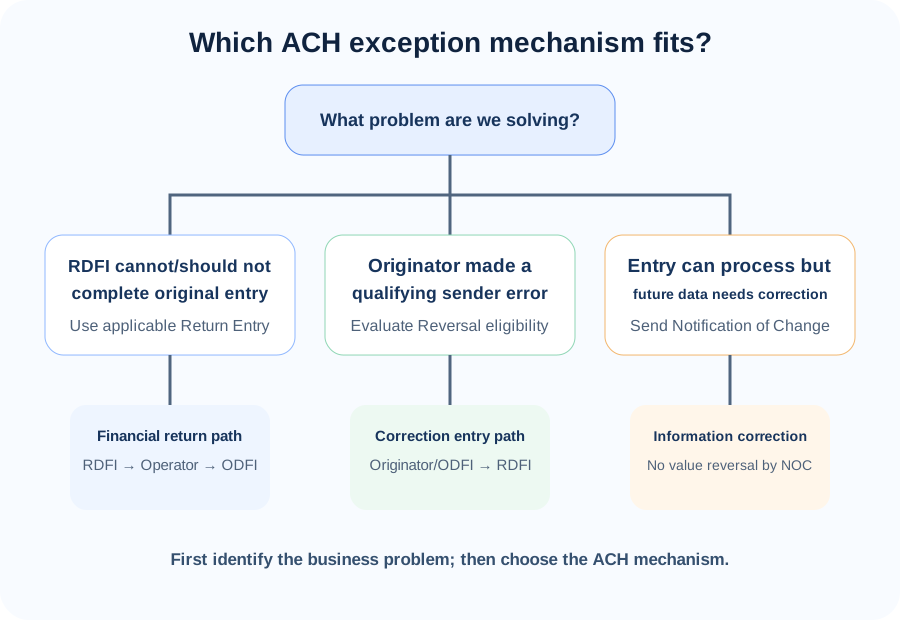
A Return Entry is the RDFI-side mechanism for sending an ACH entry back because the receiving side could not or should not complete it under an applicable return reason. A Reversing Entry is initiated from the originating side to correct a qualifying sender error in an entry that was already originated. A Notification of Change, or NOC, is not a return of value at all; it tells the Originator that information used in an otherwise processable ACH entry needs to be corrected for future entries.
That distinction is the foundation of this chapter:
return = receiving side sends the financial entry back → reversal = originating side corrects its own qualifying error → NOC = receiving side sends corrected information for future origination.
The chapter also covers dishonored returns, contested or corrected dishonored returns, Written Statements of Unauthorized Debit, Request for Return, recovery attempts, settlement impact, accounting, reconciliation, reporting and real-bank operating controls. It deliberately does not turn into Chapter 12’s fraud-control deep dive or Chapter 13’s broader exception-research chapter.
A useful end-to-end mental model is:
forward entry → RDFI posting decision → normal settlement → return/reversal/NOC trigger → correct ACH exception mechanism → ACH Operator processing → financial or informational outcome → accounting/reconciliation → customer communication → root-cause correction.
For a roughly 60-minute core session, spend about 35 minutes on Sections 1–3, Sections 5–9 and Sections 11–14. For the next 10 minutes, use the chapter’s three diagrams to identify the initiator, purpose and financial effect of each exception path. Use 10 minutes to work through one case in Section 16, then spend the final 5 minutes explaining: How would you decide whether the facts call for a return, a reversal or an NOC? Treat these timings as a study guide. The remaining sections, additional cases and extended reference material are follow-up study; completing the whole chapter takes longer.
Chapter navigator
- Why return, reversal and NOC are three different tools
- Participants and responsibility across the exception lifecycle
- Return Entries: what they mean and when they happen
- Return reason codes and the business meaning behind them
- Return timeframes: standard, extended and special cases
- Consumer unauthorized debits, WSUD and extended returns
- Reversals: correcting genuine Originator errors
- Reversing files, correcting files and improper reversals
- Notifications of Change and corrected account information
- Dishonored returns and contested or corrected dishonored returns
- Request for Return, recovery attempts and fraud-induced payments
- Statuses, evidence and customer communication
- Settlement, accounting and financial impact of exceptions
- Reconciliation, reporting and operational MI
- Controls, operating model and production resilience
- End-to-end cases, BA checklist and testing
1. Why return, reversal and NOC are three different tools
The easiest way to make an ACH exception process unsafe is to use one word such as “reject,” “recall” or “reverse” for every post-origination problem.
Consider three situations.
A payroll credit reaches an RDFI but the account is closed. The receiving bank cannot post the credit to the intended account. That is a return problem.
A corporate Originator accidentally sends the same supplier ACH credit twice. Both entries are technically valid and can reach settlement. The sender needs to correct its own duplicate-payment error. That is potentially a reversal problem, assuming the reversal meets the applicable Nacha requirements.
A recurring consumer debit reaches the right customer, but the RDFI has corrected account information because of a merger or account-number change. The entry can still be processed, but the Originator should update future instructions. That is an NOC problem.
Those three events have different direction, purpose, evidence and accounting effect.
A return normally originates from the RDFI toward the ODFI. It sends an ACH entry back and generally reverses the financial effect of the original entry through the ACH settlement process.
A reversal originates from the Originator or ODFI side. It is a new ACH entry created specifically to correct a qualifying erroneous entry. It is not a generic right to pull money back after the sender changes its mind.
An NOC normally originates from the RDFI side but does not reverse value. It sends corrected information so future entries can be originated properly.
This chapter therefore uses the following rule throughout:
first identify who made the problem and what outcome is needed; only then choose the ACH exception mechanism.
That avoids dangerous shortcuts.
A customer complaint such as “I did not mean to pay them” does not automatically create a reversal right. A fraud alert after an authorized credit push does not automatically make a reversal permissible. A wrong routing number that an RDFI can correct may create an NOC rather than an immediate return. An insufficient-funds debit return is not evidence that the original authorization was invalid.
The business analyst should model these as separate states and event families. A payment record may have ORIGINAL_ENTRY_ID, one or more RETURN_EVENT_IDs, a REVERSAL_ENTRY_ID, or an NOC_EVENT_ID. They should not all be stored in a generic exception_reference field that loses the meaning of what happened.
2. Participants and responsibility across the exception lifecycle
The forward ACH participants remain relevant after an exception starts.
The Originator created or caused the original entry. It owns the business instruction and, depending on the event, may need to correct source data, respond to a return, provide authorization evidence, initiate a permitted reversal, or stop future origination.
The ODFI is the Originator’s financial institution in the ACH Network. It receives returned entries, may initiate or transmit reversing entries, may request returns, communicates with the Originator or Third-Party Sender, and is responsible for applying Nacha rules and its customer agreement.
The ACH Operator processes forward and exception entries. FedACH and EPN distribute return entries and NOCs and support the related settlement processing. An operator processes the ACH records; it does not decide the underlying customer dispute for the parties.
The RDFI received the original entry. It may generate a return because of account status, customer instruction or another permitted reason. It may obtain a Written Statement of Unauthorized Debit for an applicable consumer claim. It can send NOCs when information should be corrected. It also receives reversals and must determine whether they can be posted or whether an improper reversal can be returned under applicable rules.
The Receiver is the account holder affected by the original entry. A Receiver can raise issues such as unauthorized debit claims, stop-payment instructions or incorrect posting. The customer’s statement is not itself an ACH return message; the RDFI translates the customer event into the appropriate ACH or internal process.
Third-Party Senders and processors can sit between these actors. They do not eliminate responsibility. If a processor receives a return file from the ODFI but fails to pass the return to the Originator, the network return still occurred. The customer-service and accounting failure is now inside the origination chain.
A real bank should therefore keep a responsibility model such as:
RDFI detects/receives issue → RDFI classifies exception → ACH Operator transmits exception → ODFI receives and validates → Originator/TPS is notified → source system and accounting are corrected → future behavior is changed where required.
The exact technology varies. The responsibilities do not disappear because the bank outsourced ACH formatting or connectivity.
3. Return Entries: what they mean and when they happen
A Return Entry is the ACH mechanism by which an RDFI sends a forward ACH entry back to the ODFI under an applicable return reason.
Returns happen for many different reasons, and those reasons should not be collapsed into one category called “payment failed.”
Some returns are account-condition problems. The account may be closed, nonexistent, unable to accept the transaction type, frozen or otherwise unavailable under the applicable rules.
Some returns are administrative or data problems. Account information may be invalid or incomplete.
Some are funds-related. A debit may be returned because sufficient or collected funds are not available.
Some are authorization or customer-instruction problems. The Receiver may say the debit was not authorized, authorization was revoked, the entry did not conform to the authorization, or a stop-payment order applies.
Some returns relate to an improper reversal, reinitiation or other special condition.
The crucial operating point is that a return is a new ACH entry linked to the original forward entry. It is not the original entry being physically pulled backward out of a file.
The bank therefore needs lineage:
customer instruction → original ACH entry → original trace → original settlement → return reason → return entry → return settlement → customer/accounting consequence.
For a credit return, the original Originator may see the funds come back and need to decide whether to repair beneficiary data, contact the payee, or use a different payment method.
For a debit return, the collector may have already applied the expected cash against a receivable. The return means the receivable may need to reopen, collections activity may resume and any provisional accounting must be corrected.
A return is also not necessarily evidence of misconduct. An R01-style insufficient-funds outcome, for example, is economically and operationally different from an unauthorized-debit return. Return reporting should preserve that distinction.
A return has several dates
A useful model preserves:
- original Effective Entry Date;
- original Settlement Date;
- RDFI posting/presentation date;
- return decision date;
- return transmission date;
- return Settlement Date;
- ODFI receipt date;
- Originator notification date.
Without these dates, a bank cannot reliably test timeliness or explain why an item was returned when it was.
4. Return reason codes and the business meaning behind them
Nacha return reason codes are compact network codes, but a bank should not teach them as a memorization exercise. The important skill is understanding the business category and the processing consequence.
Common operational families include:
funds/account status — such as insufficient or uncollected funds, closed account or no account;
authorization/customer instruction — such as unauthorized debit, revoked authorization, stop payment or entry not in accordance with authorization;
administrative/data — such as invalid account structure or routing/account information problems;
corporate authorization — where a non-consumer account indicates that the debit was not authorized under the business relationship;
reversal/reinitiation conditions — including improper reversals or improper reinitiated entries;
dishonor and contest codes — used in the return-versus-dishonor lifecycle rather than as ordinary forward-entry returns.
An operations user should see both the code and a human explanation.
R02 is much more useful when displayed as something like Account closed — receiving account is closed; do not automatically retry without corrected payment instructions than as three characters alone.
The code should also drive workflow.
A funds-related return may support a permitted reinitiation under separate rules and bank policy. A closed-account credit needs beneficiary repair. An unauthorized consumer debit requires a different customer and evidence process. An NOC may update future master data instead of creating a return at all.
This is why the exception engine should use typed reason data rather than free text.
A practical schema can include:
network_reason_code
reason_family
financial_effect
customer_action_required
originator_action_required
reinitiation_possible
authorization_review_required
master_data_change_required
investigation_required.
The bank should derive these from current rules and product policy. It should not invent its own meaning for official return codes.
5. Return timeframes: standard, extended and special cases
Return timing is one of the most important parts of ACH exception processing because the deadline depends on why the entry is being returned.
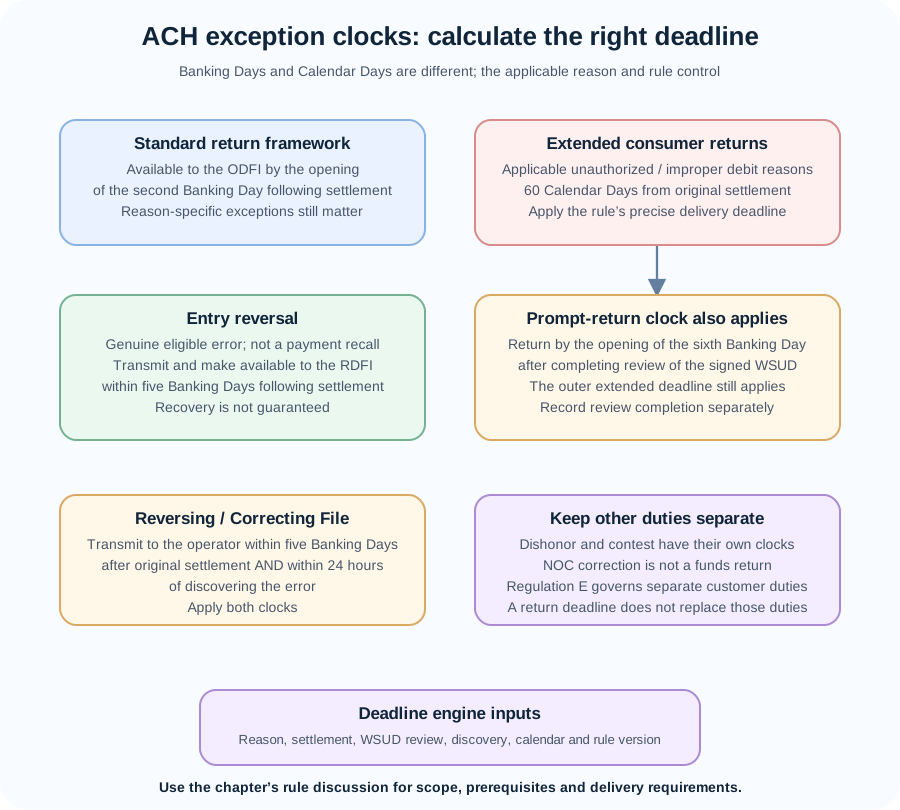
Many ordinary ACH returns operate within the familiar standard return framework in which the RDFI must transmit the return so it is made available to the ODFI by the applicable second-banking-day deadline following settlement of the original entry.
That is not a universal rule for every return.
Consumer unauthorized debit returns can use an extended timeframe. Certain other return reasons have their own rule treatment. Dishonored returns and contested dishonored returns have different clocks. A Request for Return has a separate status-response obligation and does not itself create an automatic right to return the funds.
The BA should therefore never implement one field such as:
return_due_date = original_settlement_date + 2 days.
That is wrong for at least three reasons.
First, the unit is often Banking Days, not calendar days.
Second, some extended consumer returns are measured in calendar days.
Third, the applicable rule depends on the return reason and account/customer context.
A better design is:
return_reason + receiver_type + original_settlement_date + rule_version → calculated_return_deadline.
The rule version matters. Nacha rules change. A future amendment should not silently change the deadline of a historical exception that was governed by an earlier rule set.
Current versus proposed changes
In 2026 Nacha has been consulting on return-efficiency proposals that could shorten certain return timeframes. Those consultations must not be treated as current production rules unless and until adopted with an effective date.
This is a practical governance lesson: a payments platform should distinguish PROPOSED, APPROVED_FUTURE, and EFFECTIVE rule states.
Banking Day is a rule term
The ACH definition of Banking Day changed effective January 1, 2026. Systems should use effective-dated rule calendars rather than branch-opening assumptions or generic Monday-to-Friday logic.
6. Consumer unauthorized debits, WSUD and extended returns
Consumer unauthorized debit handling is one of the highest-risk areas in ACH operations because network rules, evidence and consumer-protection processes intersect.
When a consumer tells the RDFI that an ACH debit was unauthorized or did not conform to the authorization, the bank should not simply type “fraud” into a case and send a return. The RDFI has to apply the applicable return reason and evidence requirements.
For qualifying consumer unauthorized-debit returns, the Nacha framework provides an extended return period tied to the 60th calendar day after the original Settlement Date. A Written Statement of Unauthorized Debit, or WSUD, is required for these returns.
The WSUD is not merely a signature box. It captures the Receiver’s attestation about why the debit was unauthorized or did not conform to authorization. Nacha’s sample form includes scenarios such as no authorization, wrong amount, wrong date, revoked authorization, improperly reinitiated debit and improper reversal.
Since the October 1, 2024 rules change, a consumer can sign and date the WSUD on or after the date the entry is presented to the Receiver, including when the customer receives notice of a pending debit before it has posted. That supports earlier response when digital alerts reveal suspicious activity.
There is also a prompt-return clock. When returning a covered consumer debit as unauthorized or improper in the extended timeframe, the RDFI must return it by the opening of the sixth Banking Day after completing its review of the signed WSUD. The outer extended-return deadline still applies. Record review completion separately from complaint receipt and signature: an available 60-day period is not permission to leave a completed review waiting. Regulation E investigation and customer-credit deadlines remain a separate obligation.
The RDFI should preserve:
customer complaint received
entry presented/posted
WSUD signed
return reason selected
return transmitted
return settlement
provisional/final customer-credit handling under applicable law and bank process.
Nacha return rights and Regulation E processes should not be described as identical. They interact, but the bank may have consumer error-resolution obligations beyond the mechanics of transmitting an ACH return.
Consumer versus non-consumer unauthorized returns
Do not copy the 60-calendar-day consumer workflow onto corporate accounts.
Nacha’s public guidance states that unauthorized debit returns for non-consumer accounts use the applicable standard two-banking-day framework rather than the consumer 60-calendar-day period.
Corporate customers therefore need strong debit blocks, filters, alerts and contractual controls because waiting weeks to review activity can be operationally too late for the ACH return mechanism.
Chapter 12 will go deeper into those preventive controls.
7. Reversals: correcting genuine Originator errors
A reversal is a powerful but narrow correction tool.
The originating side uses a Reversing Entry to correct a qualifying erroneous ACH entry. Nacha’s current public guidance identifies examples such as duplicate payments, incorrect amount, wrong date and payment sent to an unintended account. The error must be a sender-side error that fits the reversal rules.
A reversal is not a general cancellation right.
If a corporate sends money to the account number it intentionally approved and later discovers that the beneficiary was a fraudster, that fact does not convert the original payment into a technical sender error. Nacha’s August 2026 guidance explicitly warns that reversals cannot be used simply to pull back a fraudulent payment in that situation.
That distinction is critical in modern credit-push fraud.
A bank should therefore have a reversal-decision workflow:
- Was there an original ACH entry?
- Has the original settled or will the reversal not settle before it?
- Does the error fit a permitted reversal reason?
- Is the reversal within the applicable timing requirement?
- Does the reversing entry use the required data relationship to the original?
- Is this really an error correction, or is the customer asking for a recall/recovery because circumstances changed?
For an eligible Reversing Entry, transmission to the ACH Operator must allow the entry to be transmitted or made available to the RDFI within five Banking Days following the erroneous entry’s Settlement Date. The bank must allow for operator delivery; sending at the end of day five is not automatically timely. A Reversing File has an additional discovery-based clock, explained below. Customer cutoffs can be earlier than these network boundaries.
IAT entries cannot be reversed. For an IAT error, identify the supported return or investigation route rather than building a domestic reversal. An eligible reversal also does not guarantee recovery: the RDFI can return it under an applicable reason.
Reversal state model
Useful states include:
REVERSAL_REQUESTED
ELIGIBILITY_REVIEW
PERMITTED
NOT_PERMITTED
REVERSAL_CREATED
TRANSMITTED
OPERATOR_ACCEPTED
SETTLED
RETURNED_AS_IMPROPER
RECONCILED.
The status should never say simply REVERSED before the reversing entry has actually completed its own ACH lifecycle.
8. Reversing files, correcting files and improper reversals
A single erroneous entry and an erroneous file require different operational treatment.
For an individual Reversing Entry, the reversal must preserve the required relationship to the original transaction. Nacha’s reversal rule also requires important fields such as Company ID, SEC Code and Amount to match the original entry, with other data changed only as necessary for proper reversal processing.
For an erroneous file, a bank may need a Reversing File and, when appropriate, a corresponding Correcting File. The objective is not merely to negate the first file; the bank must ensure the intended good payments are still represented correctly.
The Reversing File and any corresponding Correcting File must be transmitted to the ACH Operator within five Banking Days after the erroneous file’s Settlement Date and within twenty-four hours of discovering the erroneous file. These are two simultaneous conditions, not alternative deadlines. Capture discovery time and escalate immediately; a file discovered early in the five-day period cannot simply wait until day five. Use the applicable current Rules for entry-versus-file classification and required notice and formatting.
This creates a classic reconciliation problem.
Imagine a payroll file of 8,000 entries was transmitted twice.
The second file is erroneous because it duplicates the first. The bank should identify exactly which file is being reversed, preserve the file and batch identifiers, generate the reversing population, monitor its acceptance and settlement, and prove that the final economic result equals one intended payroll file—not zero and not two.
Improper reversals
An RDFI can return an improperly initiated reversal under current Nacha rules.
For a consumer account, an improper reversal can be returned using the applicable extended consumer process and R11 when the consumer claim supports it. For non-consumer accounts, R17 can be used within the applicable two-banking-day timeframe. An RDFI can also use R17 when it independently identifies an improper reversal within the applicable timeframe.
This means reversal controls matter on both sides.
The ODFI should prevent improper reversals from being originated.
The RDFI should not assume every entry labeled as a reversal is automatically valid.
9. Notifications of Change and corrected account information
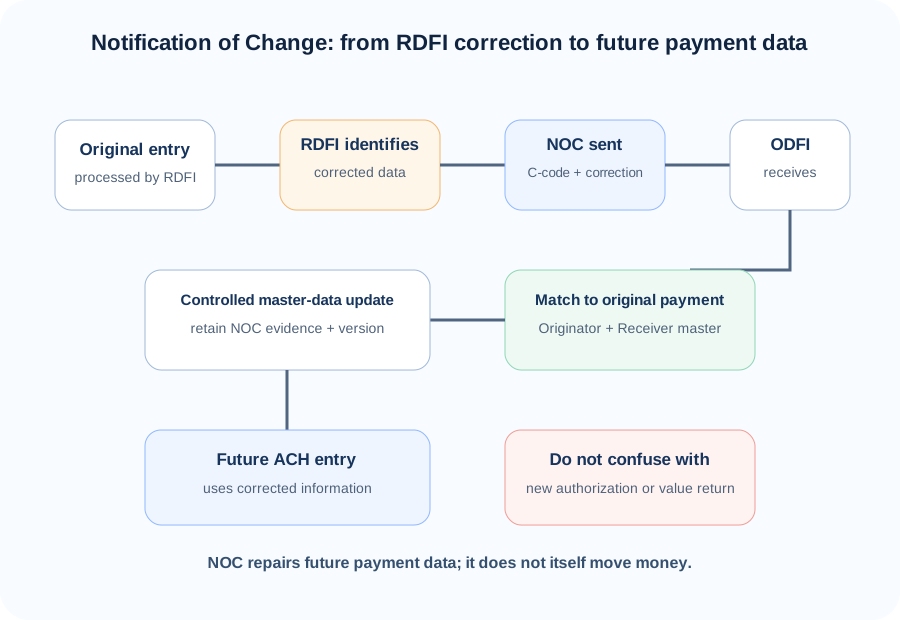
An NOC is fundamentally different because it is information correction rather than value recovery.
The RDFI sends an NOC when it can process an entry but identifies information that should be corrected for future ACH entries. Common change-code concepts include corrected account number, routing information, transaction code or combinations of account/routing data depending on the specific NOC code.
The NOC should be linked to the original entry through its ACH data so the Originator can identify which customer or mandate/master-data record needs to change.
A good bank architecture therefore treats NOCs as master-data events.
NOC received → match to original ACH entry → identify Originator/customer → validate corrected data → update approved payment master/authorization reference where appropriate → evidence change → use corrected information on future entry.
The Originator generally must make the specified change within the applicable Nacha timeframe—commonly within six Banking Days of receiving the NOC information or before initiating another entry to the Receiver’s account, whichever is later—subject to the specific application and NOC rules.
The phrase “generally” matters because certain one-time applications have different discretionary treatment. A bank should not hard-code one NOC obligation across every SEC Code without current-rule mapping.
NOC is not new authorization
A critical Chapter 9 boundary applies here.
Receiving an NOC does not automatically cancel the Receiver’s underlying authorization, and the Originator should not automatically force the customer to create a brand-new authorization merely because the RDFI corrected account information. The authorization relationship and the corrected routing/account data are separate concepts.
Corrected NOC
If an NOC itself contains incorrect information, a corrected NOC can be used. That creates versioning requirements.
The master-data system should retain:
original value
NOC corrected value
corrected NOC superseding value
effective timestamp
source entry/trace
operator evidence.
That audit trail prevents an operations team from overwriting customer data without being able to explain why.
10. Dishonored returns and contested or corrected dishonored returns
The ACH return lifecycle can itself have an exception.
An ODFI can dishonor a return when the return has a qualifying defect such as untimeliness, misrouting or another applicable problem under the dishonor rules. Nacha uses the R61–R70 family for dishonored-return situations.
The RDFI can then contest or correct certain dishonored returns using the applicable R71–R77 codes.
This is not the same as an Originator arguing informally that it dislikes a return. The dishonor/contest mechanism is a structured ACH process with defined reasons, data and timing.
Under the current 2026 rules described by Nacha’s return-efficiency consultation, the ODFI must transmit a dishonored Return Entry within five Banking Days after the Settlement Date of the Return Entry. The RDFI must transmit a contested or corrected dishonored return within two Banking Days after the Settlement Date of the dishonored Return Entry.
Nacha has been gathering industry input in 2026 about whether these periods should be shortened. Those discussions are not current effective rules unless a later adopted rule says otherwise.
Why this matters operationally
A bank can receive what looks like a final return and then later receive a dishonor.
Therefore the exception state model may need:
RETURN_RECEIVED
RETURN_ACCEPTED
DISHONOR_REVIEW
DISHONORED
CONTESTED
CORRECTED
FINAL_EXCEPTION_POSITION
RECONCILED.
Accounting and customer communication should avoid declaring a permanent outcome before the applicable exception chain is understood.
IAT boundary
IAT has special handling. Nacha’s public IAT FAQ states that automated dishonored and contested dishonored returns are not supported for IAT entries; related requests must be handled outside the ACH Network. Chapter 51 will own the broader IAT discussion.
11. Request for Return, recovery attempts and fraud-induced payments
A Request for Return is often misunderstood as a network command that forces the RDFI to send money back.
It is not.
Since October 1, 2024, the Nacha rules allow an ODFI to request the return of an entry for any reason. Compliance by the RDFI remains optional. The ODFI indemnifies the RDFI for complying with the request under the applicable rule framework.
Beginning April 1, 2025, the RDFI must advise the ODFI of the status of a Request for Return within ten Banking Days of receipt of the request.
That creates a useful operational distinction:
request accepted for review ≠ funds recovered.
A strong case model includes:
REQUEST_FOR_RETURN_SENT
RDFI_ACKNOWLEDGED/STATUS_PENDING
RDFI_AGREED
RDFI_DECLINED
FUNDS_RETURNED
PARTIAL/OTHER_RECOVERY
NO_RECOVERY.
Fraud-induced ACH credits
This process is especially relevant when a credit push was authorized by the payer but induced by fraud, such as vendor impersonation or business email compromise.
The original payment may have been technically authorized and therefore not eligible for a reversal merely because fraud was later discovered. The ODFI can still pursue recovery through Request for Return, direct bank-to-bank communication, law-enforcement/fraud processes or other remedies as appropriate.
The customer-facing wording should be careful.
“Recovery requested” is accurate.
“Payment reversed” is not accurate unless an actual permitted reversing entry has been completed.
R06 and request semantics
A bank should distinguish the Request for Return communication process from an actual Return Entry and from R06 usage. The case-management layer can track the request while the ACH transaction layer records only the financial entry that actually occurs.
12. Statuses, evidence and customer communication
ACH exception processing is full of states that sound similar but mean different things.
A customer may ask, “Has my payment come back?” Operations should not answer from a generic case status.
Useful evidence points include:
return identified — the RDFI has determined a return should be sent;
return transmitted — the return file/entry has left the RDFI process;
operator accepted — the ACH Operator accepted the return entry;
return settled — the return’s interbank financial effect occurred;
ODFI received — the originating bank has the return information;
Originator notified — the customer-facing origination chain was updated;
accounting reconciled — the bank’s ledger/control accounts reflect the final position.
The same discipline applies to reversals and NOCs.
For a reversal, “request approved” is not “reversal settled.”
For an NOC, “NOC received” is not “customer master corrected.”
For Request for Return, “RDFI responded” is not “funds recovered.”
Evidence package
A robust exception record should be reconstructable from:
- original customer instruction/reference;
- original ACH file/batch/trace data;
- original Settlement Date;
- return/reversal/NOC reason and code;
- exception ACH entry data;
- operator acknowledgement;
- exception Settlement Date;
- WSUD or authorization evidence when applicable;
- customer/Originator communication;
- accounting postings;
- final reconciliation evidence.
This evidence model is what lets operations, audit and customer service tell the same story.
13. Settlement, accounting and financial impact of exceptions
Returns and reversals are not only message events. They change financial positions.
Suppose an ACH debit settles and the Originator’s bank credits the collector. The collector applies the cash against an invoice. Two days later the RDFI returns the debit for insufficient funds.
The return settles back through ACH. The ODFI’s financial position changes, the collector’s account may be debited under the customer agreement, the invoice may need to reopen, fees may be applied under product terms, and the customer may decide whether permitted reinitiation is appropriate.
A reversal is different.
If a duplicate ACH credit settled twice and a valid reversing debit later settles, the accounting story is:
intended credit + erroneous duplicate credit + correcting reversal.
The ledger should preserve all three events. It should not delete the duplicate payment from history as though it never existed.
An NOC has no comparable value correction. The accounting effect is normally none because the NOC is informational. The control effect is future-data correction.
Settlement date lineage
Return Entries have their own settlement processing. The original Effective Entry Date is carried for return-processing purposes, and ACH Operators determine the appropriate return Settlement Date under the rules and processing schedule.
The bank should preserve original and exception settlement dates separately.
original_settlement_date
return_settlement_date
reversal_settlement_date.
Using one field called settlement_date creates audit ambiguity.
GL and suspense
Banks can implement different accounting architectures, so the chapter should not prescribe one universal set of accounts. Common concepts include customer account postings, ACH settlement/control accounts, return suspense, fees, receivables impact and investigation suspense.
The control objective is stable across architectures:
every ACH financial exception must reconcile back to the original financial event and to the operator settlement evidence.
14. Reconciliation, reporting and operational MI
Good ACH exception reporting answers more than “how many returns did we get?”
At transaction level, reconciliation should match:
original entry → original settlement → exception entry → exception settlement → customer posting → GL posting → final case status.
At file level, the bank should reconcile return files and NOC files to operator control totals and downstream ingestion counts.
At Originator level, useful reporting includes:
- return volume and value;
- return rate by reason family;
- unauthorized return rate;
- administrative return rate;
- repeat returns after reinitiation;
- NOC volume and ageing;
- reversals originated and reversal reason;
- improper reversals returned;
- Request-for-Return cases and recovery outcomes;
- dishonored/contested-return activity;
- unresolved exception ageing;
- customer-notification timeliness.
Returns are risk telemetry
A return is not only an accounting event. Patterns tell the bank something about origination quality.
High closed-account returns can indicate poor account-master maintenance.
High unauthorized debit returns can indicate weak authorization, deceptive originator practices, account takeover or incorrect SEC treatment.
Repeated NOCs can indicate that an Originator is ignoring corrected account information.
Frequent reversals can indicate poor duplicate controls, weak release governance or unstable upstream data.
These signals should feed risk and customer-management processes without turning every isolated return into a fraud accusation.
Human reporting matters
A corporate customer may not know what R03 means. A good report can show the code plus a business explanation and the next action.
Example:
Returned — account number structure valid but account not found at RDFI. Review beneficiary account details before resubmission.
The wording should match the official reason accurately and avoid promising that a particular repair will succeed.
15. Controls, operating model and production resilience
ACH exception processing is a production service, not a back-office afterthought.
The bank should have automated controls for ingesting return/NOC files, validating file integrity, preventing duplicate ingestion, matching to originals, calculating deadlines, routing high-risk reasons, posting financial impacts and escalating unmatched entries.
Manual intervention should be controlled.
A user should not be able to change an official return reason code after operator receipt merely to make a dashboard look cleaner. If the bank adds an internal categorization, it should remain separate from the network code.
Deadline monitoring
The case engine should calculate and display rule deadlines.
For a consumer unauthorized-debit case, the team needs visibility to the extended return deadline and WSUD status.
For a reversal request, it needs visibility to the five-Banking-Day reversal limit.
For NOCs, it needs visibility to the master-data correction deadline.
For Request for Return, it should track the ten-Banking-Day status-response expectation.
For dishonor/contest handling, the separate five- and two-Banking-Day clocks matter.
Resilience and replay
If an inbound return file is received but downstream posting fails, the bank must be able to replay processing without duplicating the return financial effect.
Stable identifiers and idempotency are essential.
A restart should be able to distinguish:
file received
file parsed
entry matched
accounting posted
customer notified
reconciliation completed.
The same design applies to NOCs. Replaying an NOC should not create repeated conflicting master-data changes.
Segregation of duties
High-impact actions such as manual reversal creation, exception write-off, account override or return-deadline override should have appropriate entitlement and approval controls according to bank policy.
A reversal tool that lets any operations user debit a Receiver account without rule validation is not a convenience feature; it is a serious control weakness.
16. End-to-end cases, BA checklist and testing
Case 1 — payroll credit to closed account
An employer sends a $2,800 payroll ACH credit. The file is accepted and settles. The RDFI identifies that the employee account is closed and sends the applicable return.
The correct story is not payroll failed.
The correct story is:
Originator released valid payroll → ODFI originated → ACH settled → RDFI could not complete account posting → RDFI returned → return settled → ODFI received funds/information → employer informed → employee master data repaired.
Test the original-to-return trace linkage, settlement dates, customer notification and accounting.
Case 2 — consumer says recurring debit was revoked
A consumer tells the RDFI that a recurring debit posted after authorization had been revoked.
The bank obtains the required WSUD for the applicable extended unauthorized-return path, selects the correct return reason, transmits within the applicable rule timeframe, handles Regulation E obligations separately where relevant, and retains evidence.
Test the 60-calendar-day logic, presentation date, WSUD signature timing, reason-code mapping and customer-case integration.
Case 3 — duplicate supplier credit
A corporate file is accidentally transmitted twice. The ODFI identifies a genuine duplicate sender error.
The bank evaluates reversal eligibility, creates the reversing entries with the required data relationship, meets the applicable entry/file transmission and delivery clocks, monitors settlement and reconciles the intended one-payment outcome.
Test that the platform does not use reversal for a simple customer change of mind.
Case 4 — fraud discovered after authorized credit
A company employee approves a supplier payment after being deceived by a fraudulent bank-detail-change email.
The payment was intentionally released to the account number presented at approval. The bank should not automatically label it a technical erroneous entry eligible for reversal. It can initiate recovery actions such as Request for Return and fraud investigation.
Test customer wording: recovery requested rather than reversal guaranteed.
Case 5 — NOC updates future collection data
A utility debit is processed successfully, but the RDFI sends an NOC with corrected account information.
The Originator matches the NOC to the customer authorization/master record, updates the future origination data within the applicable timeframe, retains the source NOC and does not unnecessarily invalidate the authorization.
Test NOC ageing, corrected-NOC supersession and next-payment generation.
Case 6 — return is dishonored
An RDFI returns an entry outside the applicable timeframe. The ODFI identifies the return as untimely and sends the appropriate dishonored return within its five-Banking-Day window. The RDFI reviews whether it can contest or correct the dishonor within its two-Banking-Day window.
Test the complete chain rather than only the original return.
BA requirements checklist
Before approving an ACH exception design, ask:
- Can every return, reversal and NOC be linked to the original entry?
- Is the mechanism direction explicit: RDFI return, Originator/ODFI reversal, RDFI NOC?
- Are official return and change codes stored separately from internal reason text?
- Are Banking-Day and calendar-day deadlines calculated from effective-dated rules?
- Does consumer unauthorized-debit processing capture WSUD evidence?
- Can the platform distinguish consumer and non-consumer return treatment?
- Is reversal eligibility rule-driven and restricted to permitted sender errors?
- Can reversing files and correcting files be handled separately?
- Can improper reversals themselves be returned?
- Are NOCs routed into controlled master-data correction?
- Is Request for Return modeled as a request, not guaranteed recovery?
- Can dishonored and contested/corrected dishonored returns be tracked?
- Are accounting events preserved rather than overwritten?
- Can operations see original and exception Settlement Dates separately?
- Are customer communications based on evidence, not optimistic status labels?
- Can replay/recovery happen idempotently after a system failure?
Testing minimum
A serious test pack should include ordinary returns, extended consumer unauthorized returns, corporate unauthorized returns, stop-payment scenarios, insufficient-funds returns, closed accounts, NOCs, corrected NOCs, single-entry reversal, reversing file plus correcting file, improper reversal, dishonored return, contested dishonored return, Request for Return, operator-file duplicates, late inbound files, unmatched return entries, settlement/accounting mismatch and system-recovery replay.
Boundary tests are especially important around deadlines. Test the last valid Banking Day, federal holidays, rule-definition changes, daylight-saving timestamps where systems convert between ET and UTC, and historical exceptions processed under an older rule version.
The final practitioner rule is simple:
Do not ask only “why did the ACH payment fail?” Ask what financial event happened, which party initiated the correction, which network mechanism was used, what deadline governed it, what evidence proves it, and whether the bank’s books and customer story now agree.
Authoritative references
This application uses JavaScript for the full interactive experience. This text summary is served for accessibility and search indexing.