ACH Reconciliation, Reporting and Cash Visibility. A practitioner deep dive into ACH reconciliation from customer instruction through operator processing, settlement, customer and GL posting, returns, reporting, cash visibility, breaks, suspense and controlled close.
ACH processing is not complete when a file is accepted, when an operator distributes entries, or even when settlement occurs. A bank still has to prove that the financial result recorded in its books matches what the ACH Network processed, that customer balances and statements reflect the correct events, that exceptions have been carried into the right accounting state, and that treasury and operations teams can see the cash position clearly enough to act.
That is the purpose of Chapter 14.
Chapter 13 focused on researching individual exceptions. Chapter 14 focuses on systematic proof and visibility across the whole ACH processing day. It asks whether the bank can reconcile source instructions, ACH files, operator processing, settlement, customer posting, returns, reversals, Notifications of Change, suspense, fees and reporting into one consistent operating picture.
A good reconciliation framework does not start with “Do the totals match?” It starts with a fuller set of questions:
What did the customer instruct? What did the bank accept? What did the bank release? What did the ACH Operator process? What settled? What posted to customer and internal ledgers? What returned later? What remains unmatched? What is informational only? What cash is truly available? What evidence proves each answer?
The chapter uses this operating model throughout:
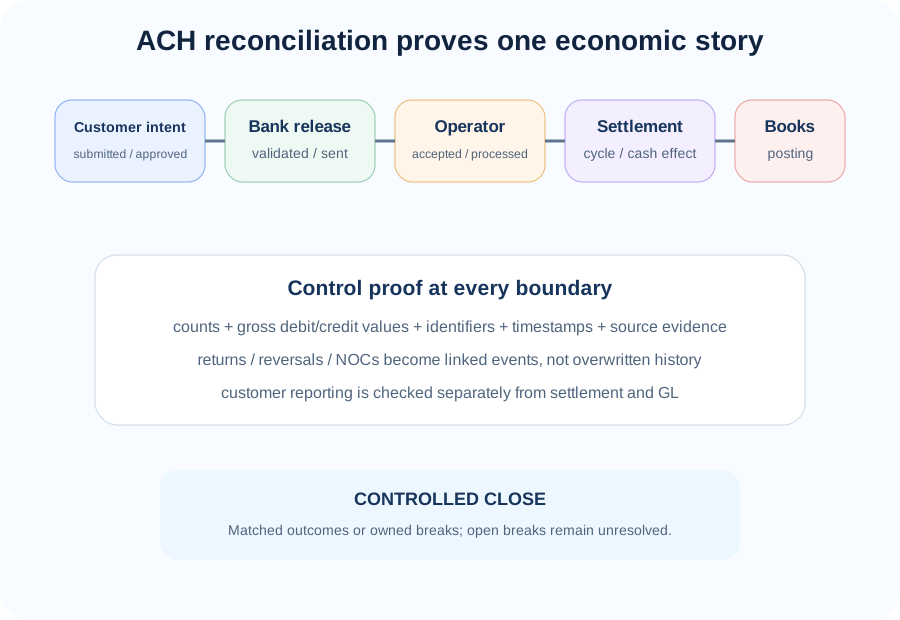
source instruction → bank acceptance → ACH file/batch/entry creation → operator acceptance → operator distribution → interbank settlement → customer/internal posting → exception activity → reporting → reconciliation → cash-position visibility → break management → close and control evidence.
For a roughly 60-minute core session, spend about 35 minutes on Sections 1–8, Sections 10–13 and Section 15. For the next 10 minutes, use the chapter’s three diagrams to reconcile network evidence, bank books and customer outcomes. Use 10 minutes to work through one case in Section 16, then spend the final 5 minutes explaining: Why is a balanced settlement total insufficient to prove that every customer posting is correct? Treat these timings as a study guide. The remaining sections, additional cases and extended reference material are follow-up study; completing the whole chapter takes longer.
Chapter navigator
- What ACH reconciliation really proves
- The evidence chain from instruction to books
- Participants and ownership of reconciliation truth
- File, batch and entry-level control totals
- Operator acceptance, processing and distribution evidence
- Settlement reconciliation and Federal Reserve account impact
- Customer posting and general-ledger reconciliation
- Returns, reversals, NOCs and exception effects
- Intraday versus end-of-day reconciliation
- Cash visibility, liquidity and treasury interpretation
- Customer reporting, remittance and receivables visibility
- Breaks, suspense, unmatched items and ageing
- Reconciliation statuses, evidence and control design
- Operational reporting, MI and control effectiveness
- Real-bank architecture, resilience and close controls
- End-to-end cases, BA checklist and testing
1. What ACH reconciliation really proves
Reconciliation is the discipline of proving that two or more independently produced views of the same economic event agree, or of explaining precisely why they do not.
In ACH, there are many views. A corporate channel can say 20,000 payroll credits were approved. The payment hub can say 19,998 were released because two failed internal validation. The ACH gateway can say one file containing 19,998 entries was transmitted. FedACH or EPN can acknowledge acceptance. The operator can later provide processing or settlement evidence. The bank ledger can show a settlement debit. Deposit systems can show employee credits on the receiving side. A return file two days later can economically reverse part of the original result.
If the bank looks only at one of those layers, it does not know the whole truth.
A useful reconciliation hierarchy is:
CUSTOMER_INTENT
BANK_ACCEPTED
BANK_RELEASED
OPERATOR_ACCEPTED
OPERATOR_PROCESSED
SETTLED
CUSTOMER/INTERNAL_POSTED
EXCEPTION_ADJUSTED
REPORTED
RECONCILED.
Each status answers a different question.
Matching totals is necessary but not sufficient
Suppose a file contains 1,000 entries totaling $10 million. The operator report also shows 1,000 entries totaling $10 million. That is encouraging, but it does not prove that each customer payment is correctly represented.
Two entries could have been swapped between customers while the total still matches. A duplicate $5,000 payment and a missing $5,000 payment can also leave the aggregate unchanged.
Therefore reconciliation should combine control totals and identity-level matching.
Control totals answer:
Did the expected population and value move?
Identity-level matching answers:
Did each expected business event become the correct network and accounting event?
Reconciliation is not the same as investigation
Chapter 13 taught how to research an individual exception. Chapter 14 designs the machinery that detects which items need that research.
If 99.98% of a population reconciles automatically and 0.02% becomes a break population, Chapter 14 owns the detection, classification, ageing and control framework. Chapter 13 owns the deeper case reconstruction for the break when required.
A reconciled payment can still return later
ACH is not a single final-state event from the bank’s operational perspective.
A forward entry can be fully reconciled for its original processing and settlement day and later receive a return. The original reconciliation should not be rewritten as “wrong.” It was correct for the forward event. The later return creates another economic and network event that must be reconciled.
The event model should therefore preserve history:
FORWARD_SETTLED_AND_RECONCILED
then later
RETURN_SETTLED_AND_RECONCILED.
That is better than changing the original payment to a timeless status such as FAILED.
2. The evidence chain from instruction to books
A reliable reconciliation process depends on evidence from independent systems.
The customer instruction may originate in online banking, host-to-host connectivity, an API or an internal bank product. That instruction should have a stable business identifier before it enters ACH formatting.
The payment hub or origination service then produces internal release evidence. The ACH gateway builds files and assigns network-relevant identifiers. The ACH Operator provides acceptance, distribution and settlement-related evidence. The bank’s settlement and accounting systems record financial impacts. Customer account systems record customer-facing postings. Reporting platforms publish what customers and internal teams see.
A useful lineage chain is:
customer payment ID → internal payment ID → ACH file ID → batch number → entry/trace identity → operator process evidence → settlement event → ledger entry → customer statement/report → later exception identity if any.
The exact internal identifiers vary by bank. The principle does not.
Do not use one identifier for everything
A customer reference may not be globally unique. A file ID is not an entry ID. A trace number identifies an ACH entry but should not be forced to serve as the bank’s only business key. A settlement summary is population-level evidence, not the same as a customer payment identifier.
A bank-grade data model allows multiple identifiers and records their relationships.
For example:
payment_id = PAY-92731
file_id = FILE-A7
batch_no = 0031
trace = ...
settlement_cycle = ...
ledger_event_id = GL-....
Evidence should have source and timestamp
When operations asks whether a payment “settled,” the answer should come from a known evidence source.
The system should be able to say:
source = FedACH settlement summary / bank settlement interface
observed_at = timestamp
settlement_date = date
amount = value
population = originated/received debit/credit.
A dashboard field copied from another dashboard without lineage is weak evidence.
Customer reporting is a separate evidence layer
A bank can reconcile network and ledger activity while a customer portal is stale because its reporting feed failed.
That means:
financially_reconciled = yes
customer_reporting_complete = no.
Those are different operational truths and should have separate controls.
3. Participants and ownership of reconciliation truth
Reconciliation usually fails organizationally before it fails mathematically. Different teams own different parts of the evidence and assume someone else owns the end-to-end proof.
The Originator may reconcile a payroll or supplier file against employee, invoice or payable records. The Originator knows whether the correct business obligations were included.
The ODFI reconciles customer origination, ACH files, operator processing, settlement, internal posting and customer reporting. It also needs to attribute returns and fees back to the right customer and original activity.
The ACH Operator provides processing and settlement-related information but does not reconcile the ODFI’s internal books or customer ERP.
The RDFI reconciles received ACH files and entries to deposit-system posting, customer account effects, returns, NOCs and internal accounting.
The bank’s treasury or liquidity function interprets settlement debits and credits as part of the institution’s cash position. Treasury does not necessarily own customer-level exception matching.
The general-ledger/finance function needs proof that clearing, settlement, suspense and fee accounts are balanced and that period-close balances are explainable.
The operations function owns break handling and operational evidence in many banks.
The customer reporting/cash-management function ensures the customer sees useful and timely data.
Ownership should be defined by evidence boundary
A useful RACI-style design can define ownership for:
- source-to-bank acceptance;
- accepted-to-released;
- released-to-operator accepted;
- operator accepted-to-settled;
- settled-to-ledger;
- ledger-to-customer posting;
- exception-to-adjustment;
- reporting publication;
- suspense ageing;
- final daily close.
Without this, one team can close its own control while the end-to-end process remains broken.
Processor relationships do not remove accountability
A bank may use a third-party processor for ACH gateway or core processing. An Originator may use a payroll processor. A bank may subscribe to information and reporting services.
Outsourcing a processing step does not remove the need for reconciliation. It changes the boundary to include external service evidence and service-level monitoring.
4. File, batch and entry-level control totals
ACH naturally provides several hierarchical levels for control.
A file contains batches. A batch contains entries and addenda. Internal payment systems may create one ACH file from several customer files, or split one customer file across network files.
Reconciliation should therefore support more than one level.
File-level controls
At file level, a bank can compare expected versus transmitted and operator-accepted totals such as:
- file count;
- batch count;
- entry/addenda counts;
- debit totals;
- credit totals;
- hash/control values where applicable to the file format;
- file ID/modifier and processing date;
- transmission status.
The exact ACH control fields come from the Nacha file structure. The bank should preserve them rather than recompute values from a later transformed population and assume equivalence.
Batch-level controls
Batch reconciliation is valuable when one file carries several Originators or Company IDs.
A file can be accepted while one batch is operationally inconsistent with internal expectations. Batch summaries help attribute volume/value to the correct Originator, SEC Code and processing context.
FedACH APIs include Batch Origination Summary information specifically useful for retrieving summarized batch status and transaction information for originators. This can support automated monitoring and reconciliation for institutions using FedACH Services.
Entry-level controls
Entry-level matching proves that each payment event is represented correctly.
Useful match attributes can include:
internal_payment_id
trace_number
amount
transaction_code
SEC_code
company_id
effective/settlement date
account-token/internal account key.
Do not expose full account numbers broadly merely to make reconciliation easier. A bank can reconcile with protected/tokenized identifiers and role-based access.
Count/value controls need direction
A net total can hide direction errors.
For example:
Credits = $8m
Debits = $3m
Net = $5m.
If a defect changes both to Credits = $7m, Debits = $2m, net is still $5m but gross activity is wrong.
Therefore reconcile gross debit and gross credit totals, not only net settlement.
5. Operator acceptance, processing and distribution evidence
One of the most common operational mistakes is to treat successful transmission as successful ACH processing.
A bank can send a file and receive a transport-level success while the operator later rejects the file or certain entries. Conversely, an internal gateway timeout does not prove the operator failed to receive the file.
The reconciliation chain should distinguish:
TRANSMISSION_COMPLETE
OPERATOR_ACCEPTED/PENDING/REJECTED
DISTRIBUTED
SETTLEMENT_SCHEDULED/SETTLED.
FedACH status APIs can close evidence gaps
Federal Reserve Financial Services publishes FedACH APIs for File Origination Status, File Receipt Status, Batch Origination Summary, Rejected Entries and Settlement Summaries.
These are valuable because they allow banks to integrate current operator evidence into operations tooling rather than relying entirely on manual portal checks.
For originated work, File Origination Status can help determine whether work is accepted, rejected or pending.
For received work, File Receipt Status can help reconcile files waiting to be sent or already sent to the financial institution.
Rejected Entries supports detailed analysis of rejected entry information.
Settlement Summaries provides settlement-summary information for originated or received FedACH items and can support balancing against Federal Reserve account activity.
EPN participants need equivalent evidence from their operator relationship
The Clearing House’s EPN and FedACH are the two ACH Operators. A bank using EPN should reconcile from EPN-provided processing/settlement evidence rather than pretending all ACH operator evidence is FedACH-specific.
This chapter uses FedACH sources where the Federal Reserve publishes detailed public APIs and report descriptions. The bank design should remain operator-aware.
Distribution is not posting
An RDFI receiving a file from the operator still has internal work to do.
The bank should not mark all entries POSTED merely because the operator distributed them. Received-file reconciliation should continue through parsing, validation, account posting and exception creation.
6. Settlement reconciliation and Federal Reserve account impact
Settlement is the interbank financial event. It is not the same as customer posting.
For FedACH items, settlement occurs according to the published processing schedule and Operating Circular 4 framework. Same Day ACH has three current-day settlement windows in the FedACH schedule, while future-dated and later return windows can settle at the next-business-day 8:30 a.m. ET settlement as applicable.
The important reconciliation lesson is not to hard-code one “ACH settlement time.”
Settlement summaries should be reconciled to settlement-account activity
A financial institution needs to prove that operator settlement activity agrees with the debit/credit entries affecting the institution’s settlement account or correspondent arrangement.
A typical population view can separate:
originated credits
originated debits
received credits
received debits
returns
adjustments/other ACH-related settlement items
by settlement cycle/date.
The exact debit/credit effect on the bank’s account depends on direction.
Gross activity versus net settlement
ACH settlement is generally netted through operator processing, but bank accounting still needs enough detail to explain the net.
A $25 million settlement debit may represent many millions of gross originated credits and received debits offset by opposite-direction activity.
Treasury may care first about the net cash effect. Operations and finance still need the gross composition.
Settlement cycle matters
If the bank aggregates the entire day into one number, it can miss an intraday mismatch that later happens to offset.
A better control can reconcile by settlement cycle first, then by day.
For Same Day ACH this is especially useful because the 1:00 p.m., 5:00 p.m. and 6:00 p.m. ET settlement windows have distinct liquidity implications.
Correspondent settlement changes the evidence path
Not every financial institution settles directly in its own Federal Reserve account. If a correspondent arrangement is involved, the bank should reconcile to the correspondent’s settlement advice and internal due-to/due-from accounting as applicable.
Do not design reconciliation under the assumption that every institution has the same settlement-account topology.
7. Customer posting and general-ledger reconciliation
Network settlement and customer posting can happen on different systems and at different times.
The bank’s core/deposit system may credit or debit customer accounts. A payment hub may create accounting entries. A general ledger may carry clearing, settlement or suspense accounts. A customer reporting system may publish statements or intraday transaction data.
The bank must prove that the same economic event has been represented consistently across those layers.
A practical ledger chain
An illustrative architecture can include:
ACH settlement/control account
customer deposit/payable account
ACH clearing/suspense account
fee income account
fraud/recovery receivable where applicable.
The exact GL names and posting logic vary by bank. The principle is that every balance movement should trace back to a network/business event.
Customer posting can precede or follow final internal reconciliation
A customer may see an ACH credit before finance completes end-of-day balancing. That is normal if the bank’s posting and availability rules support it.
The control design should not force the customer to wait for finance reconciliation before seeing funds that should be posted and available.
Instead, the bank should run operational reconciliation in parallel and escalate breaks.
Posting completeness control
A basic completeness equation can be:
received entries accepted for posting = posted entries + returned/rejected entries + controlled pending/suspense entries.
Every item should have an outcome.
If 50,000 received entries produce 49,998 postings and one return, the remaining one cannot disappear simply because the financial net seems correct.
Fees are separate economic events
ACH processing fees, customer service fees, return-item fees and other charges should not be merged into the principal ACH amount.
For reconciliation:
ACH payment amount
and
customer fee amount
should be independently traceable.
8. Returns, reversals, NOCs and exception effects
Chapter 11 owns the rules and mechanics. Chapter 14 owns how their financial and informational effects are reconciled.
Returns
A return is a new ACH financial event linked to the original entry.
The bank should reconcile:
return received/sent
return operator acceptance
return settlement
internal financial posting
original payment linkage
customer/Originator reporting.
Do not merely change the original payment status and lose the return event.
Reversals
A reversal creates a new correction entry. The bank should reconcile the reversing population to the original erroneous population and, where a correcting file is also needed, reconcile that separately.
A gross-history view is essential. Netting the original and reversal together can hide duplicate-processing risk.
Notifications of Change
NOCs are informational and generally do not create payment value movement themselves.
Therefore NOC reconciliation is mainly a count, matching and propagation control:
NOCs received = matched + unmatched + rejected/manual review.
Then:
matched NOCs requiring correction = corrected + pending within SLA + overdue.
The next payment should use corrected data where the Rules require the Originator to make the change.
Dishonors and contested returns
These can create additional financial events. Reconciliation must preserve the entire chain rather than only the latest state.
A useful event chain is:
forward entry → return → dishonored return → contested/corrected dishonor → final financial position.
Chapter 13 owns the detailed research; Chapter 14 ensures every step has financial and evidence lineage.
9. Intraday versus end-of-day reconciliation
A bank that reconciles ACH only once at midnight is operating with unnecessary blindness.
Intraday reconciliation can detect missing files, rejected batches, settlement mismatches and posting failures while there is still time to act.
Intraday controls
Useful intraday checks include:
- originated files expected versus transmitted;
- transmission versus operator acceptance;
- same-day settlement cycle totals;
- files expected from operator versus received;
- received population versus posting outcomes;
- return/NOC files expected versus processed;
- high-value suspense/unmatched items;
- customer reporting publication status.
End-of-day controls
End-of-day reconciliation asks whether the processing day can be closed with explainable balances.
A daily close can include:
all expected files accounted for
all settlement cycles balanced
all material GL/control accounts balanced or explained
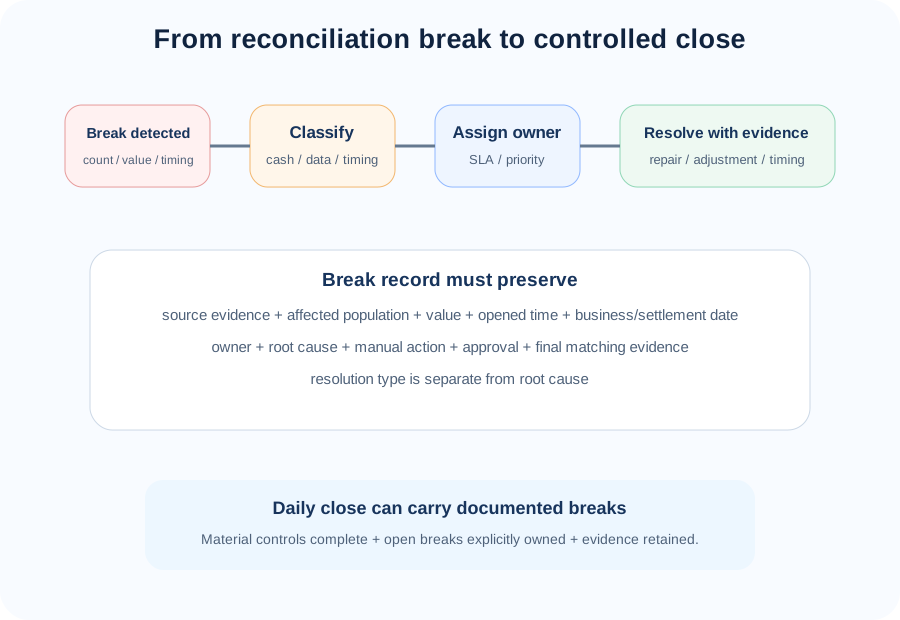
all breaks owned
all suspense items aged/classified
customer reporting delivered or incidents raised
next-day carryover population documented.
Reconciliation cut-off is an internal control, not a network cutoff
A bank may define an internal close time after the final relevant ACH processing events for its operating model. That time is a bank policy/control point.
Do not label it as a Nacha universal deadline unless a rule explicitly establishes one.
Overnight activity needs date clarity
ACH processing can span evening and overnight windows. The system should distinguish:
calendar timestamp
ACH process date
effective entry date
settlement date
bank accounting date.
Without those fields, overnight reconciliation can attribute activity to the wrong day.
10. Cash visibility, liquidity and treasury interpretation
Cash visibility is the ability to understand the institution’s or customer’s financial position using information that is timely enough and correctly classified enough to support decisions.
It is related to reconciliation but not identical.
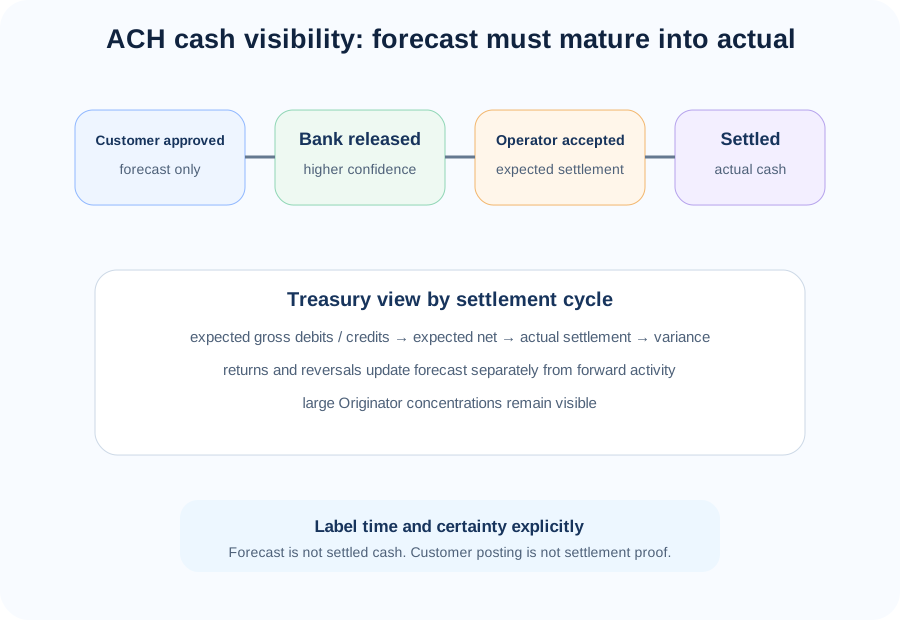
Reconciliation proves what happened. Cash visibility helps users understand what the proven and expected activity means for liquidity.
Bank treasury view
Treasury needs to know expected and actual ACH settlement debits/credits by cycle.
Useful views can include:
expected settlement by cycle
actual settlement by cycle
variance
large Originator concentrations
late file changes
returns/reversals affecting forecast
current Federal Reserve/correspondent balance.
Treasury should not rely on customer payment statuses that have not been translated into settlement cash effects.
Expected versus actual cash
Before settlement, a bank can forecast based on released/accepted ACH populations.
After operator settlement evidence arrives, the forecast becomes actual settlement.
The platform should distinguish:
FORECAST
OPERATOR_ACCEPTED_EXPECTED
SETTLED_ACTUAL.
Otherwise a projected $20 million debit can be mistaken for already-settled cash.
Customer cash visibility
Corporate customers also need useful views.
An Originator may want to know which supplier/payroll entries were accepted, which were returned and what cash has actually left its account.
A Receiver may need incoming ACH detail and remittance information to apply cash to receivables.
The bank should not present every submitted payment as cash movement.
Available balance and ledger balance are separate
For customer accounts, ledger balance, available balance, pending activity and settled ACH activity may differ depending on product/account rules.
Reporting should label these states clearly rather than calling all of them “cash.”
11. Customer reporting, remittance and receivables visibility
ACH reporting is not merely a formatted copy of the ACH file. Good reporting translates network activity into information a customer can use.
Federal Reserve Financial Services describes FedPayments Reporter for FedACH as a service that can search ACH files for information such as return items, IAT transactions and financial EDI messages, convert the data into human-readable reports and distribute reports within a financial institution or to business customers.
That illustrates an important design point: network data and business reporting have different usability requirements.
Originator reporting
An Originator may need:
- file and batch acceptance;
- payment counts and values;
- individual payment status;
- returns and reasons;
- NOCs;
- same-day indicators;
- settlement/account debit information;
- fees;
- downloadable reconciliation files.
Receiver reporting
A corporate Receiver may need:
- incoming credit detail;
- Originator identity;
- addenda/remittance information;
- invoice/reference data;
- settlement/posting dates;
- return/reversal information where relevant.
Remittance supports cash application
FedPayments Reporter includes remittance-advice and payment-data reporting capabilities designed to help business customers match ACH payments to invoices or recipients.
The bank’s own product can provide similar value through its own reporting architecture. The key requirement is preserving remittance information through processing rather than dropping it between ACH gateway and customer reporting.
Reporting should not overstate certainty
Useful customer statuses include:
Submitted
Accepted by bank
Sent to ACH Operator
Operator accepted
Settled
Posted/credited where known
Returned
Under review.
Not every bank can observe every downstream posting at another bank. Customer language must respect the evidence boundary.
12. Breaks, suspense, unmatched items and ageing
A reconciliation break is not automatically a financial loss. It is evidence that two expected views do not currently agree.
Breaks can arise from timing, missing data, transformation defects, duplicate events, posting failures, external-service delays or genuine financial mismatches.
Break categories
Useful categories include:
MISSING_OPERATOR_ACK
FILE_COUNT_MISMATCH
ENTRY_COUNT_MISMATCH
VALUE_MISMATCH
SETTLEMENT_MISMATCH
UNMATCHED_RETURN
UNMATCHED_NOC
LEDGER_POSTING_MISSING
CUSTOMER_REPORTING_MISSING
DUPLICATE_EVENT
TIMING_DIFFERENCE
REFERENCE_DATA_ERROR.
Timing differences should not be hidden
Some breaks resolve naturally when a later settlement cycle or reporting feed arrives.
The system can classify them as expected timing differences only when the expected future event is known.
A vague status pending without reason, owner or deadline is not a control.
Suspense is a controlled temporary state
If value cannot be posted to the final account because of an unresolved exception, the bank may use suspense according to its accounting design.
Every suspense item should have:
amount
currency
source event
reason
owner
opened_at
age
expected resolution path
financial account
case/reference link.
Ageing should be risk-sensitive
Not all breaks need the same SLA.
A missing $20 reporting record may be lower financial risk than a $5 million settlement mismatch. A one-cent systematic rounding defect across millions of records can still be serious because it indicates a scalable defect.
Ageing views should combine value, volume, customer impact, settlement impact and rule deadlines where relevant.
Auto-close needs evidence
A break should not auto-close merely because the values later match.
The system should record what event resolved the break and preserve the before/after evidence.
13. Reconciliation statuses, evidence and control design
Statuses should communicate what is known rather than hiding complexity.
A practical model can include:
NOT_STARTED
SOURCE_MATCHED
NETWORK_MATCHED
SETTLEMENT_MATCHED
LEDGER_MATCHED
CUSTOMER_REPORTING_MATCHED
BREAK_OPEN
BREAK_RESOLVED
FULLY_RECONCILED.
Not every bank needs these exact labels. The key is to distinguish stage-level evidence.
Reconciliation result and payment status are different
A payment can be SETTLED while reconciliation is BREAK_OPEN because a GL posting is missing.
A payment can be RETURNED while the return reconciliation is complete.
Do not overload payment status with reconciliation status.
Evidence object
A reusable evidence record can contain:
evidence_type
source_system
source_reference
business_date
timestamp
count
debit_value
credit_value
hash/checksum where appropriate
received_at
immutable_archive_reference.
Control tolerance should be explicit
Financial value reconciliation often requires exact agreement at the relevant precision. Some operational metrics may have controlled tolerances due to timing or known non-financial differences.
A tolerance should never be an undocumented convenience.
If a system allows a $1 variance, the business must know why $1 is acceptable, which account/population it applies to, and how repeated small differences are monitored.
Maker-checker for manual adjustments
Manual financial adjustments and forced reconciliation closures are high-risk actions.
They should require appropriate entitlement, reason codes, evidence and approval according to bank policy.
A button Mark reconciled with no audit trail is unsafe.
14. Operational reporting, MI and control effectiveness
A reconciliation platform should tell management more than “all green.”
Useful management information includes:
- originated/received ACH volume and value;
- files/batches/entries by status;
- operator rejects;
- settlement totals by cycle;
- intraday versus end-of-day break counts;
- unmatched returns/NOCs;
- suspense value and ageing;
- customer-reporting failures;
- manual adjustments;
- auto-match rate;
- manual-match rate;
- break root causes;
- repeat breaks by system/customer/operator path;
- close completion time;
- control exceptions and overrides.
High auto-match rate is useful but not proof of quality
A system can auto-match 99.99% and still miss one material $100 million break.
Metrics should therefore show both rate and absolute value/risk.
Root-cause reporting closes the loop
If most breaks come from missing customer references, the fix may be upstream data quality.
If most settlement breaks come from cycle misclassification, the fix may be date/time logic.
If NOCs repeatedly remain unmatched, the issue may be original-entry lineage or customer-master ownership.
Reconciliation should generate product and technology improvement, not only daily operational workload.
Operator reports can supplement internal MI
FedPayments Reporter offers reports including ACH routing-number activity, SEC-code volumes, return ratios, return reasons, originated batch/entry detail and received-entry detail. Those can support bank operations and customer reporting.
A bank should still maintain its own internal source-of-truth controls rather than depend on one external report for every reconciliation layer.
15. Real-bank architecture, resilience and close controls
A bank-grade reconciliation platform is an integration and evidence system.
It may ingest:
- channel/payment-hub events;
- ACH gateway files and acknowledgements;
- operator APIs/reports/files;
- settlement account data;
- core/deposit postings;
- GL events;
- returns/NOCs/reversals;
- customer-reporting events;
- fee/billing events.
The platform then normalizes identifiers, matches populations, calculates control totals, creates breaks and publishes status/MI.
Event-driven and batch controls can coexist
ACH is file-oriented, but reconciliation does not need to wait for one nightly batch.
Event/API signals can update status intraday while end-of-day batch controls provide completeness proof.
The strongest design often combines both.
Idempotency is mandatory
If an operator status message or file is replayed, reconciliation must not create a second financial event or second break.
Store stable source identifiers and process events idempotently.
Late-arriving data must be supported
Returns, NOCs and some reports arrive after the original forward processing day.
The data model should support reopening or extending the event chain without rewriting prior closed evidence.
Business continuity
If the reconciliation platform is unavailable, payment processing may continue depending on bank design, but control risk increases.
The bank needs a contingency for:
- capturing operator evidence;
- preserving settlement totals;
- recording manual control checks;
- preventing duplicate adjustments;
- restoring missed events after recovery;
- completing delayed close with audit evidence.
Data retention and audit
Reconciliation evidence should remain retrievable for operational, audit, legal and rule purposes according to the bank’s retention obligations.
Do not retain sensitive data merely because it is convenient. Preserve what is required for proof with appropriate security and access controls.
Migration and cutover
A platform migration should test cross-boundary scenarios such as:
forward entry in legacy → return in new system
file accepted before cutover → settlement evidence after cutover
NOC received before cutover → next payment after cutover
open suspense item migrated → resolved in new system.
These are common places for reconciliation lineage to break.
16. End-to-end cases, BA checklist and testing
Case 1 — payroll file accepted but two entries never released
A corporate submits 25,000 payroll credits. The channel accepts the file. Internal validation rejects two entries because account data is invalid, so only 24,998 are released to ACH.
The correct reconciliation is:
customer submitted = 25,000
bank accepted for processing = 25,000
bank released to ACH = 24,998
internal rejects = 2.
The customer should not see “25,000 sent to ACH.”
Test file-level counts, entry-level rejects, customer reporting and payroll control totals.
Case 2 — gateway timeout after operator acceptance
The ACH gateway transmits a file but times out before it records the response. Operations sees UNKNOWN internally.
Do not resend blindly.
Use operator status evidence to determine whether the file was accepted, rejected or pending. If accepted, reconcile it to the original file identity and continue. If not received, follow controlled retransmission procedures.
Test duplicate-prevention and operator-status recovery.
Case 3 — Same Day settlement cycle mismatch
The bank expects a $12 million net debit in the 5:00 p.m. ET cycle but settlement evidence shows $11.7 million.
The reconciliation engine should break the variance into originated/received debit/credit components and identify which file or batch population moved to a different cycle or was rejected.
Test cycle attribution and treasury alerting.
Case 4 — customer posting feed misses one received credit
Operator and settlement evidence is correct for 100,000 received credits. The core posts 99,999. One entry remains in a controlled suspense state because of an account-status problem.
The correct completeness equation is:
100,000 received = 99,999 posted + 1 suspense/exception.
The bank should not call the file fully posted until the one item has an explicit controlled outcome.
Case 5 — return arrives after original day closed
A supplier ACH credit was fully reconciled on Monday. The receiving bank returns it on Wednesday because the account is closed.
Monday’s forward event remains reconciled. Wednesday creates a return event, new settlement effect, new customer reporting and a link to the original payment.
Test historical integrity and cross-day linkage.
Case 6 — NOC never reaches the payroll master
The ODFI receives an NOC and reports it to the corporate, but the corporate payroll master remains unchanged. The next payroll sends the old data and another NOC arrives.
Reconciliation should show:
NOC received = yes
matched = yes
reported = yes
master correction evidence = no
repeat NOC = yes.
The break is informational/master-data rather than settlement value.
Case 7 — customer portal stale after financial close
Network, settlement and GL reconciliation is complete, but the portal reporting feed failed.
Do not tell operations “everything is green.”
Financial close can be complete while customer-reporting control remains open.
Test separate reconciliation dimensions.
Case 8 — processor and bank totals disagree
A third-party processor reports 3 million received entries while the bank core shows 2,999,998 outcomes.
The bank must reconcile external processor evidence to internal posting outcomes and locate the two missing items. Outsourcing does not make the mismatch somebody else’s control problem.
BA requirements checklist
Before approving an ACH reconciliation design, ask:
- Are customer intent, bank acceptance, release, operator acceptance, settlement, posting and reporting separate states?
- Are file, batch and entry identifiers preserved end to end?
- Can the platform reconcile gross credits and gross debits, not only net settlement?
- Are operator acceptance and transmission success distinguished?
- Can FedACH/EPN operator evidence be represented without hard-coding one operator model?
- Is settlement reconciled by cycle and day where useful?
- Can the bank trace settlement totals to Federal Reserve/correspondent account activity?
- Are customer posting and GL events separately evidenced?
- Are returns, reversals and NOCs represented as linked events rather than overwritten statuses?
- Are intraday and end-of-day controls distinct?
- Does treasury see forecast versus actual settlement clearly?
- Can corporate customers receive useful remittance and return information without overstated status claims?
- Are suspense and unmatched items owned, aged and evidenced?
- Are financial breaks exact or governed by explicit tolerance?
- Are manual adjustments and forced closures entitled and auditable?
- Can reporting failures remain open even when money is reconciled?
- Are root causes and repeat breaks measured?
- Can the platform recover idempotently after outages?
- Are cutover scenarios with old forward/new exception events tested?
Testing minimum
A serious Chapter 14 test pack should include file-count mismatches, batch mismatches, entry mismatches, equal-net-but-wrong-gross totals, gateway timeout after operator acceptance, operator reject, same-day cycle shift, received-file delay, missing core posting, duplicate posting, return after prior close, reversing file, unmatched NOC, stale customer portal, fee-posting mismatch, suspense ageing, manual adjustment, replay/idempotency, holiday/process-date boundaries, correspondent settlement and platform-outage recovery.
The final practitioner principle is:
Reconciliation is not a final spreadsheet at the end of the day. It is the continuous proof that customer intent, network processing, settlement, bank books and customer reporting still describe the same economic reality. Cash visibility becomes trustworthy only when that proof is available.
Authoritative references
This application uses JavaScript for the full interactive experience. This text summary is served for accessibility and search indexing.