ACH Debit Collections. A practitioner deep dive into collector-initiated ACH debits across recurring and one-time collections, covering authorization boundaries, account validation, ODFI controls, settlement, RDFI posting, returns, reconciliation and receivables operations.
An ACH debit is a collector-initiated pull payment carried through the U.S. Automated Clearing House Network. The business wants to collect money from a Receiver’s account, the Originator creates the debit under an appropriate authorization, the Originating Depository Financial Institution (ODFI) sends the entry into the ACH Network, an ACH Operator distributes it to the Receiving Depository Financial Institution (RDFI), the RDFI determines whether the account can be debited, interbank settlement occurs, and the collection either becomes usable cash for the Originator or enters an exception path such as return, correction, dispute or investigation.
That one sentence hides most of the difficulty.
A successful ACH debit is not simply “money was pulled.” The collector must have the right to initiate the debit. The debit must target the correct account. The ODFI must be willing to originate it. The ACH entry must be valid. The RDFI must be able to post it. The settlement event must reconcile. The collector must understand that settlement does not eliminate later return exposure. Customer reporting must distinguish collected, settled, returned and still-at-risk amounts. Operations must be able to trace the debit from the original bill or receivable all the way to the Receiver account outcome.
Chapter 6 explained the ACH infrastructure. Chapter 7 followed payer-initiated ACH credits. Chapter 8 now follows the opposite value direction: collector-initiated ACH debit collections.
This chapter focuses on the collection lifecycle itself: recurring bill collections, one-time authorized consumer debits, business-to-business collections, account-to-account pulls, dues, insurance premiums, loan payments, subscription collections and other domestic ACH debit use cases. Standard Entry Class (SEC) Codes such as PPD, WEB, TEL and CCD appear where they are necessary to understand the collection model, but Chapter 9 owns the detailed authorization, SEC-code and mandate rules. Same Day ACH is mentioned only as a timing option; Chapter 10 owns the detailed eligibility and limit mechanics. Returns, reversals and Notifications of Change are introduced only far enough to complete the debit lifecycle; Chapter 11 goes much deeper. Fraud controls and debit blocks/filters are bounded because Chapter 12 owns that topic.
A practical mental model for ACH debit collections is:
receivable → authority → account validation → collection instruction → ODFI acceptance → ACH debit entry → operator processing → RDFI posting decision → settlement → cash application → return exposure → reconciliation → exception management.
For a roughly 60-minute core session, spend about 35 minutes on Section 1, Sections 4–6 and Sections 9–14. For the next 10 minutes, use the chapter’s three diagrams to follow collection authority, funds movement and later return exposure. Use 10 minutes to work through one case in Section 16, then spend the final 5 minutes explaining: Why can a settled debit still require a financial correction and customer investigation? Treat these timings as a study guide. The remaining sections, additional cases and extended reference material are follow-up study; completing the whole chapter takes longer.
Chapter navigator
- What an ACH debit collection really is
- Participants and responsibilities in a debit collection
- Where ACH debit collections are used
- The end-to-end debit collection lifecycle
- Authorization as the business foundation of the debit
- Account validation, payee setup and collection readiness
- Debit entry data, batches, references and collection identity
- PPD, WEB, TEL, CCD and other debit use cases
- ODFI validation, risk decision and release
- Operator processing, clearing and settlement
- RDFI receipt, account debit and posting outcome
- Statuses, evidence and what collection success really means
- Returns, stop payments, disputes and reversal boundaries
- Reconciliation, reporting, cash application and accounting
- Controls, return-rate management and real-bank operating design
- End-to-end cases, BA checklist and testing
1. What an ACH debit collection really is
An ACH debit answers a specific business question: who initiates the movement of value?
In a debit collection, the Originator on the collection side initiates an entry that instructs the Receiver’s financial institution to debit the Receiver’s account. Economically, value is being pulled from the Receiver toward the Originator. That is different from an ACH credit, where the payer tells its own bank to push value outward.
The direction changes the control problem.
For an ACH credit, the bank primarily worries about whether the payer intended to send the money, whether the beneficiary is correct, whether the payer is funded and whether the payment should be released.
For an ACH debit, the central question becomes: what gives the collector the right to initiate this debit against someone else’s account?
That is why authorization is not an optional administrative detail. It is the business foundation of the debit.
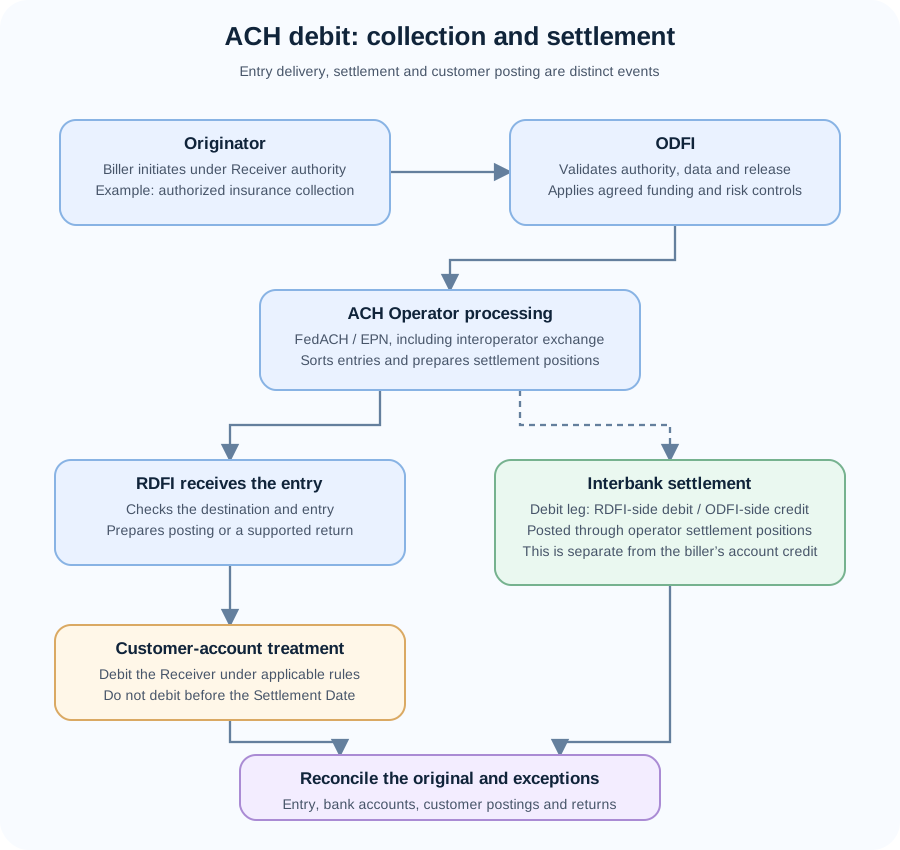
A utility company collecting a monthly electricity bill is a simple example. The consumer has agreed that the utility may debit the consumer’s bank account under defined terms. The utility calculates the amount due, creates a collection instruction, and sends it through its bank. The consumer’s bank receives the debit and posts it if the account and entry are valid and no applicable block, stop-payment instruction or other condition prevents posting.
But even in that simple case, several different events must be kept separate.
The bill became due. This is a receivables event.
The consumer authorization permitted collection. This is an authority event.
The Originator created and released the debit. This is a collection-initiation event.
The ODFI accepted and originated the entry. This is a bank-origination event.
The ACH Operator processed the entry. This is a network event.
The RDFI posted the debit. This is a receiving-account event.
Interbank settlement occurred. This is a financial-infrastructure event.
The collector applied the cash to the customer’s receivable. This is a receivables event.
The debit remained free of later return or dispute. This is a later risk outcome, not something that can always be known at settlement.
Those distinctions prevent a common implementation mistake: marking a receivable as permanently collected merely because the ACH debit entered settlement.
Pull direction does not mean unlimited authority
A debit is collector-initiated, but the Originator does not have a general right to debit any account it knows. The debit must be supported by the appropriate authorization and business relationship. The format of that authorization, the type of transaction, retention obligations and consumer protections vary by use case and SEC Code. Chapter 9 handles those details.
Chapter 8 needs the practitioner principle:
the collection system must be able to prove why this debit was allowed to exist.
That proof can involve an authorization record, customer agreement, recorded consent, authenticated online acceptance or other mechanism permitted for the use case. The collector should be able to link the payment entry back to that authority.
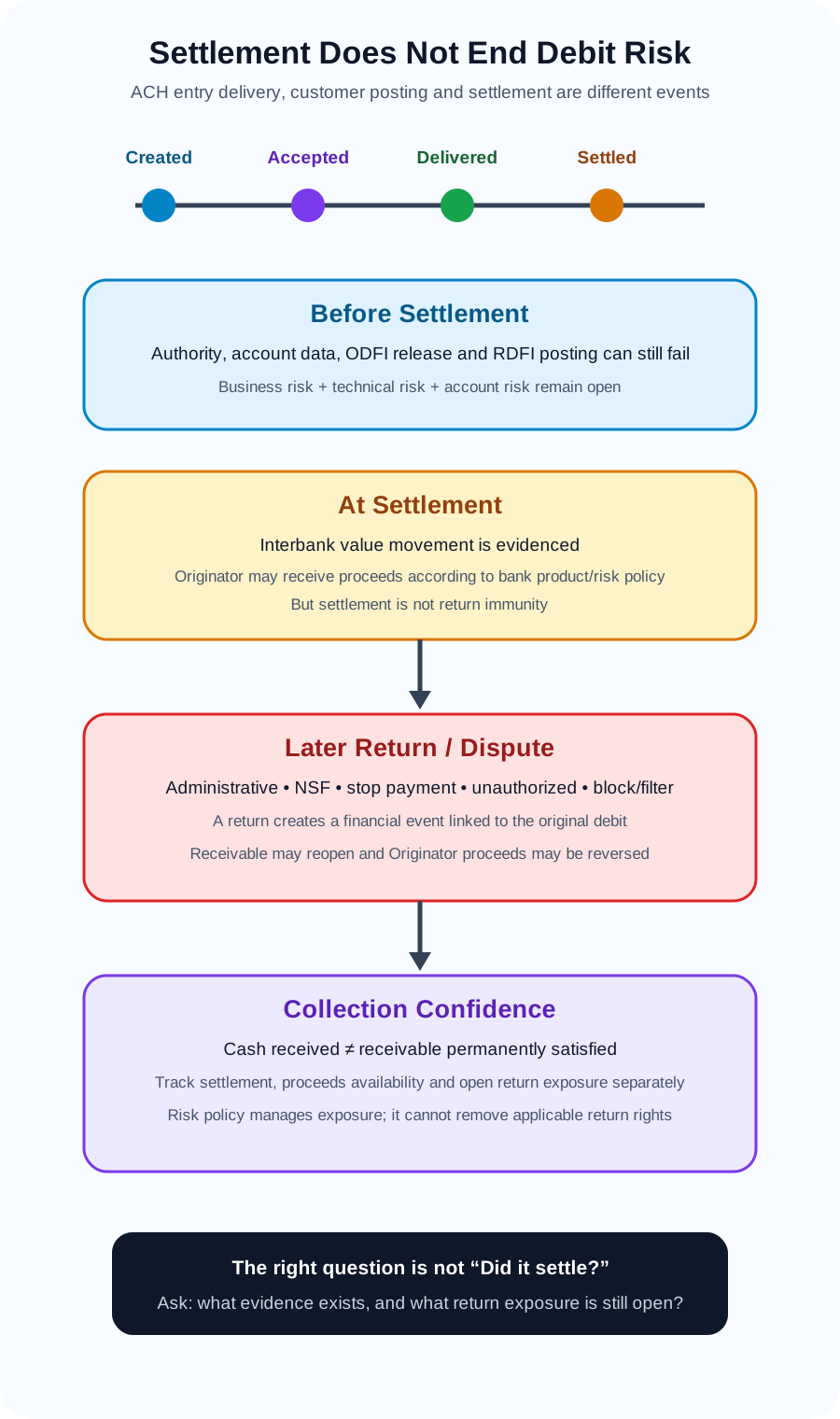
Settlement does not equal irreversible collection
ACH debit collections have return rights and dispute paths. A debit can settle and later come back through the ACH Network under applicable rules. Consumer unauthorized-debit rights can extend beyond the ordinary operational return window. Corporate debits operate under different agreements and timing expectations.
The practical conclusion is that collected cash can have different confidence levels over time.
A receivables system may need statuses such as:
COLLECTION_CREATED
AUTHORIZED
SUBMITTED_TO_ODFI
OPERATOR_ACCEPTED
SETTLED
APPLIED_TO_RECEIVABLE
RETURNED
or another bank-specific model.
The exact names vary. The principle is to avoid one generic SUCCESS status that hides return exposure and collection uncertainty.
2. Participants and responsibilities in a debit collection
The ACH participant chain is familiar from Chapters 6 and 7, but debit collections change what each participant is trying to prove.
The Originator is the business, biller, lender, merchant, service provider, government entity or other party that initiates the ACH debit. In a recurring collection, the Originator may be collecting a monthly invoice, premium, loan installment, membership charge or subscription amount. In a one-time debit, the Originator may be collecting a single agreed obligation.
The Originator owns the business truth of the collection. It should know:
- who owes the money;
- why the money is due;
- what amount is due;
- when it is due;
- which account has been authorized for collection;
- what authorization supports the debit;
- what reference links the debit to the underlying receivable.
The ODFI is the financial institution that originates the debit entry into the ACH Network. The ODFI is not simply a pipe. It has a network role and risk responsibility. It accepts debit origination under its agreement with the Originator and must manage the quality and risk of the debit activity it sends.
The ACH Operator, FedACH or EPN, processes and routes the debit entry through the national ACH infrastructure. The operator does not independently determine whether the customer truly authorized the underlying bill payment. It processes according to ACH rules and operator requirements. That separation is important: network processing can be technically successful even when the underlying collection is later disputed as unauthorized.
The RDFI holds the Receiver’s account. It receives the debit entry, validates and processes it, applies account-level controls, and either posts the debit or handles it according to the applicable ACH and account rules. It also processes stop-payment instructions, returns and consumer error claims within the applicable framework.
The Receiver is the person or organization whose account is being debited. For a utility bill, it is the utility customer. For a corporate collection, it may be a business counterparty. The Receiver is not merely a field in the ACH file; it is the party whose deposit account liability is being reduced.
Third parties can complicate the chain
Many debit businesses use third-party service providers, payment processors, billing platforms, subscription platforms, property-management systems, payroll/benefit administrators or third-party senders.
The technical path may therefore look like:
biller → billing platform → payment processor → ODFI → ACH Operator → RDFI → Receiver.
That does not mean every service provider becomes the formal Originator or ODFI. Legal/network roles and technical service roles need to be mapped separately.
This matters especially for authorization evidence. A bank may not directly capture the customer’s consent if the Originator uses a billing platform. But the bank still needs confidence that its customer is originating lawful and compliant debit activity under the bank’s origination agreement.
Ownership by event
A mature debit collection process assigns ownership to each event rather than assuming “the ACH team owns it.”
The billing system may own receivable creation.
The customer-consent platform may own authorization evidence.
The collection engine may own debit scheduling.
The ODFI payment engine may own network validation and release.
The ACH gateway may own operator transmission.
The settlement team may own settlement reconciliation.
The receivables system may own cash application.
The dispute team may own unauthorized-debit claims.
The operations team may own return handling.
The BA should document those boundaries because debit failures often cross organizational lines.
3. Where ACH debit collections are used
ACH debit is one of the most important collection mechanisms in the United States because it can support both consumer and business receivables at large scale.
Recurring consumer bill collections
Utilities, telecom providers, insurers, lenders, property managers, subscription providers and many other billers use recurring ACH debits. The consumer provides appropriate authorization, and the biller initiates collections on agreed dates.
The business benefit is predictable receivables processing. The consumer benefit is convenience. The risk is that a recurring collection process can continue month after month, so changes to amount, timing, authorization status, account status and cancellation requests must be controlled.
Regulation E is relevant for consumer preauthorized electronic fund transfers. A recurring consumer debit is not just a merchant operational arrangement; consumer rights around authorization, stop payment and error resolution can apply. Chapter 9 goes deeper into the authorization mechanics, while Chapter 8 focuses on what those rights mean operationally for the collection lifecycle.
One-time consumer debits
A consumer may authorize a one-time ACH debit through the web, telephone or another permitted channel. The authorization model and applicable SEC Code depend on how the debit was initiated.
From a collection platform perspective, the important point is that a one-time debit still needs its own authority record. The business cannot simply reuse an old recurring authorization if the new transaction falls outside what the customer authorized.
Business-to-business collections
Corporates can collect from other businesses through ACH debit arrangements. Examples include wholesale payments, franchise fees, commercial service charges, treasury sweeps or agreed recurring commercial obligations.
B2B collections often involve CCD or other corporate ACH applications. They can also be subject to corporate debit blocks and filters at the Receiver’s bank. That means a debit can be perfectly authorized under the commercial agreement and still be returned or blocked because the Receiver has configured account-level controls that do not recognize the Originator.
Chapter 12 covers debit blocks and filters in depth. Here the lesson is that collection readiness includes both business authority and account-level acceptance conditions.
Loan and financing collections
Banks, fintechs, lenders and finance companies can collect installments through ACH debit. These flows need strong linkage between loan servicing and payment collection.
The servicing system knows the installment schedule, principal/interest allocation, fees and delinquency state. The ACH collection system moves the money. If the debit is returned, the loan system must update the obligation and possibly late-payment or collection workflows according to the governing product terms and law.
That is why ACH returned should not automatically mean loan default without product logic.
Insurance premium collections
Recurring premium debits are operationally similar to other recurring consumer collections, but the business consequence of a failed debit may be materially different. Coverage, grace periods and cancellation rules are insurance-product matters. The payment platform should not invent those consequences. It should report the collection outcome accurately so the insurance system can apply the correct policy logic.
Subscription and membership collections
Subscription businesses often think in terms of “charge the customer every month.” ACH debit collections require more explicit banking discipline. The account, authority, schedule, amount, description, collection date, retry policy and cancellation state all matter.
A subscription platform should distinguish a failed card charge from a returned ACH debit. They use different networks, timing, reason frameworks and customer protections.
Account-to-account pull models
Some financial products use ACH debits to pull money from an external account into an account at the initiating institution. This can appear to the user as “add money from my other bank.” Economically, the destination-side institution or its service provider may originate a debit against the source account.
This use case makes account validation particularly important. The initiating institution must reduce the risk that a user links an account they do not control and then attempts to pull funds from it.
Checks converted to ACH
Certain check-based collection flows can be converted into ACH entries under specific ACH applications. Those are specialized cases and belong more fully in the later check/conversion chapters. Chapter 8 only needs the boundary: not every ACH debit begins as an online “bank debit” experience; some originate from other payment instruments that are converted under specific rules.
4. The end-to-end debit collection lifecycle
A good debit collection architecture begins with the receivable, not with the ACH file.
Consider a fictional electricity provider, Malla Energy, collecting monthly bills from 250,000 customers.
Stage 1 — receivable creation
The billing system calculates the customer’s monthly charge and creates an amount due with a due date. At this point there is no ACH entry yet. There is only a receivable.
The billing system may also determine whether the customer is enrolled in automatic bank debit and whether the account is active for collections.
Stage 2 — authority check
Before the collection engine creates the debit, it confirms that an appropriate authorization exists and remains valid for this type of collection.
The system should know the authorization identity, date, method, scope and status. If the customer revoked authorization, changed account details, cancelled the service or moved to another payment method, the debit schedule should reflect that state.
Stage 3 — amount and schedule determination
The collection engine determines how much to collect and when.
For fixed recurring debits, the amount may be constant.
For variable bills, the amount changes each cycle. Consumer regulations and authorization terms can create notice requirements depending on the arrangement. Chapter 9 goes deeper into those rules.
The collection date also matters. A bill due on the 15th is not necessarily transmitted on the 15th. The Originator may create the ACH file in advance so the entry settles on the intended date.
Stage 4 — account and routing validation
The collection uses the Receiver’s bank account and routing information. The Originator can validate syntax, routing data and—where applicable—account ownership or status through commercially reasonable methods.
For WEB debits, Nacha rules specifically make account validation part of the fraud detection framework. More broadly, account validation is useful because account-data errors generate administrative returns and customer friction.
Stage 5 — debit creation
The Originator or processor creates the ACH debit entry with the appropriate SEC Code, transaction code, amount, company information, Receiver information, effective date, trace number and other required data.
The collection system should preserve the link to the receivable and authorization:
invoice/receivable ID → authorization ID → collection ID → ACH batch → trace number.
Stage 6 — ODFI acceptance and release
The ODFI receives the collection file or instruction, validates it, applies customer limits and risk controls, evaluates the Originator’s debit quality, and decides whether to release the entries into the ACH Network.
A technically valid file can still be held because the Originator exceeded a limit, return-rate risk is high, required approval is missing or the bank has another risk concern.
Stage 7 — ACH Operator processing
FedACH or EPN receives the file, processes and sorts the debit entries, and creates output for the appropriate RDFIs or the other ACH Operator.
The debit becomes part of the applicable ACH settlement cycle.
Stage 8 — RDFI receipt and posting decision
The RDFI receives the debit and determines whether it can post to the Receiver’s account.
Possible outcomes include normal posting, insufficient-funds treatment, account-closed handling, invalid-account handling, stop-payment handling, corporate debit block/filter handling or another return condition.
The exact return codes and timing are Chapter 11 material.
Stage 9 — settlement
Interbank settlement moves the financial position associated with the ACH debit. Economically, the ODFI side receives value and the RDFI side funds the debit settlement position, subject to the ACH settlement model.
Settlement is important, but it is not the final answer to whether the collector will permanently keep the money.
Stage 10 — cash application
The Originator receives settlement or bank reporting and applies the collected amount to the customer’s receivable.
This step can be automated when the collection ID and remittance reference are preserved.
Stage 11 — return exposure and exception management
A debit may later be returned. The Originator must reopen or adjust the receivable, reverse cash application, update customer status, decide whether recollection is appropriate, and preserve the return linkage.
The lifecycle therefore does not end with SETTLED. A practical end state might be:
receivable satisfied and no unresolved ACH exception remains.
5. Authorization as the business foundation of the debit
A debit collection is unusual because the party initiating the payment is not the party whose account is being reduced. That makes authorization central.
For consumer recurring debits, Regulation E provides a legal framework for preauthorized electronic fund transfers. The current rule defines a preauthorized EFT as one authorized in advance to recur at substantially regular intervals, and recurring transfers from a consumer’s account require appropriate written or similarly authenticated authorization with a copy provided to the consumer.
But Chapter 8 should not turn into a legal authorization manual. Chapter 9 owns the detailed rules.
The operational lesson is more direct:
a debit entry should never be detached from the authority that supports it.
Authorization needs a lifecycle
A good collection system treats authorization as a managed object with states such as:
CAPTURED
ACTIVE
SUSPENDED
REVOKED
EXPIRED
or other product-specific states.
The authorization can contain:
- Receiver identity;
- account identity or tokenized account reference;
- Originator identity;
- payment purpose;
- fixed or variable amount terms;
- frequency;
- start date;
- cancellation/revocation state;
- evidence location;
- channel or SEC context.
The exact data varies by use case. The important point is that the collection engine should not rely on “customer is enrolled in autopay = true” as the only proof.
Authority and account ownership are separate questions
A person can provide an account number that is structurally valid but does not belong to them. Account validation may reduce that risk, but authorization and account validation are not the same thing.
Authorization asks whether the Receiver agreed to the debit.
Account validation asks whether the account information is plausible and associated with the intended Receiver or authorized user.
Authentication asks whether the person giving the instruction is really who they claim to be.
A strong debit program may need all three.
Revocation must reach the collection engine
A common operational failure occurs when the customer revokes authorization in one system, but the scheduled debit remains active in another.
For example, the customer calls the biller and cancels autopay. The CRM records AUTOPAY_CANCELLED, but the collection scheduler already built the next week’s ACH file and does not receive the update.
That is not a network problem. It is an internal state-synchronization problem.
The requirement should define the latest point at which a revocation or cancellation can stop a scheduled collection and how in-flight entries are handled.
Stop payment is not the same as revocation
A Receiver can also instruct the RDFI to stop a preauthorized transfer under applicable rules. That action exists at the account-holding bank and is not identical to revoking authority with the biller.
A well-designed customer journey should encourage the customer to manage the underlying relationship, but the RDFI must still honor its own stop-payment obligations.
Chapter 13 discusses the operational exception path in more depth.
6. Account validation, payee setup and collection readiness
Debit collections are highly sensitive to account quality because the Originator is initiating against an external account.
A wrong routing number can prevent the entry from reaching the intended RDFI.
A wrong account number can generate an administrative return.
A valid account belonging to the wrong person can create an unauthorized-debit dispute.
A corporate account can have a debit block that rejects otherwise valid entries.
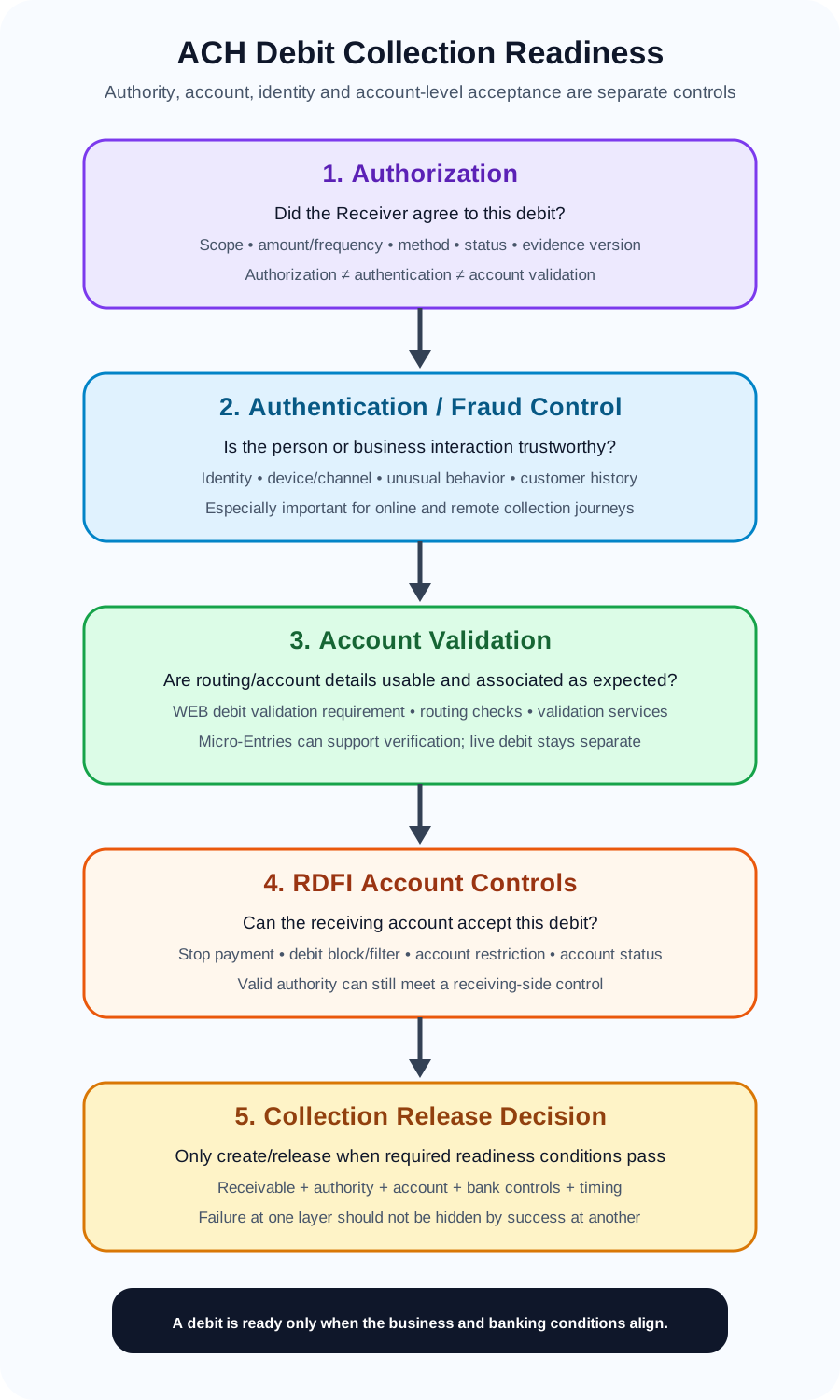
Collection readiness therefore has several layers.
Routing validation
The routing number should be checked against authoritative routing/reference data and the bank’s own ACH reachability information.
A routing number being syntactically valid does not guarantee the specific account is open or accepts the intended debit type.
Account validation
Nacha explicitly requires account validation as part of the commercially reasonable fraud detection system for first-use WEB debit account information. Nacha does not mandate one technology for accomplishing it.
Methods can include credential-based account verification, account/routing validation services, trial deposits or other commercially reasonable approaches.
Micro-Entries
Micro-Entries are one standardized ACH-based account-validation method. Nacha defines them as small ACH credit entries and permitted offsetting debits used for account verification. Credit Micro-Entries are less than one dollar, and the total process cannot result in a net debit to the Receiver’s account.
For Chapter 8, the important point is that account validation can itself use ACH entries, but the validation process must be distinguished from the actual collection debit.
The collection should not be originated merely because Micro-Entries were sent. The Originator should complete its validation process first.
Account tokens and change management
Many platforms avoid storing raw account numbers in every downstream service. They use a token or internal account reference linked to secured account data.
That can improve security, but the system still needs versioning. If the Receiver changes bank account details, the next debit must use the new account while historical collections retain the old account reference for investigation.
A token that silently points to “current account” without version history can make old transactions impossible to reconstruct.
Corporate debit blocks and filters
Corporate Receivers may configure their bank accounts to block ACH debits entirely or allow only approved Originators/company IDs and amounts.
From the collector’s perspective, this means onboarding a corporate Receiver may require exchanging the Originator’s ACH Company ID and agreeing on the debit pattern.
A recurring corporate collection can fail every month until the Receiver updates its bank filter. That should be treated as an onboarding/control issue, not as random operational noise.
7. Debit entry data, batches, references and collection identity
Chapter 6 explained the ACH file hierarchy. Chapter 8 focuses on what that hierarchy means for a debit collection.
An ACH debit can be one Entry Detail Record inside a batch, and many debit collections can be combined into one file.
The Originator may have its own billing-run ID.
The ODFI may create a bank file ID.
The ACH batch has a Company/Batch Header.
Each debit has a trace number.
The return, if one occurs, must link back to the original debit.
The receivables system may have an invoice or account reference.
The real operating challenge is maintaining all of those identities together.
Company identity matters
ACH batches carry Originator/company information. The RDFI and Receiver may rely on those values to understand who initiated the debit.
Corporate debit filters can use company identifiers as part of their control logic.
Customer statements can display company-related descriptors.
Changing company identity therefore cannot be treated as a harmless formatting change.
Transaction codes indicate debit direction and account type
Entry Detail transaction codes tell the receiving process whether the entry is a credit or debit and the broad receiving-account type. For common debits, checking and savings debit transaction codes differ.
Chapter 8 does not need to memorize the full code table. Developers and testers do need to understand that using a credit transaction code in a debit batch, or the wrong account-classification code, is not a cosmetic error.
SEC Code expresses the application model
PPD, WEB, TEL and CCD are not merely labels. They describe different transaction contexts and authorization expectations.
The SEC Code should match the real business initiation method, not whichever code is easiest for the Originator’s software to produce.
Chapter 9 goes deep into that subject.
Effective Entry Date and settlement intent
The batch carries the effective date context used in ACH processing. The Originator’s billing date, file creation date, transmission date, effective date, settlement date and customer posting date can differ.
The collection system should preserve those dates separately.
Collection references and cash application
The collection should carry or preserve a reference that lets the Originator apply the incoming value to the correct receivable.
For a utility, this may be customer account plus bill ID.
For a loan, it may be loan account and installment reference.
For a business collection, it may be contract, invoice or remittance reference.
The ACH file has limited field space compared with richer internal payment models. The bank or Originator may therefore preserve additional references internally even if they are not all transmitted through ACH.
Original data should survive transformation
If the Originator submits a modern API or ISO 20022 instruction and the bank transforms it into ACH, the bank should preserve the original business data and transformation evidence.
A return investigation may require both the ACH trace number and the customer’s original reference.
That is Chapter 5’s data-lineage lesson applied to debit collections.
8. PPD, WEB, TEL, CCD and other debit use cases
A deep ACH debit chapter needs to explain the major application patterns without turning into the full SEC-code rulebook.
PPD debit
PPD is commonly used for consumer account transactions, including recurring consumer debits. A utility autopay or recurring insurance premium is a typical training example.
The core operational characteristics are:
- consumer account;
- appropriate authorization;
- scheduled or recurring collection context;
- consumer-protection considerations;
- return/dispute exposure.
Chapter 9 handles the exact authorization requirements.
WEB debit
WEB is used for internet-initiated debit entries to consumer accounts under the ACH rules.
WEB debits deserve extra attention because account validation and fraudulent transaction detection are explicit risk considerations.
A consumer entering bank details into a website does not automatically prove account ownership or authorization quality. The Originator needs appropriate authentication, authorization and account-validation controls.
TEL debit
TEL applies to telephone-initiated consumer debits under defined ACH rule conditions.
The practical risk is that telephone evidence is harder to reconstruct if call recording, consent capture, agent scripts and transaction data are fragmented across systems.
A call-center collection platform therefore needs strong evidence linkage.
CCD debit
CCD is widely used for corporate ACH transactions. A supplier, franchise operator, treasury service or another business relationship can support B2B debit collections.
Corporate Receivers may use debit blocks and filters, so company ID and agreed debit parameters matter operationally.
The consumer Regulation E framework generally does not apply to business accounts in the same way, but the Nacha rules, commercial agreements and bank account controls still matter.
Other debit applications
There are other ACH debit SEC Codes for specialized use cases, including check-conversion and re-presentment contexts. Those belong in the dedicated SEC-code and check chapters.
The learner should not leave Chapter 8 believing that every debit is PPD, WEB, TEL or CCD. Those are simply the most important collection patterns for this foundation.
Why the wrong SEC Code is a real risk
If an Originator classifies an internet debit as a generic recurring PPD debit merely to avoid WEB controls, the problem is not just technical classification. It can change authorization expectations, risk controls and return/dispute handling.
A BA should therefore capture the customer journey first and derive the SEC Code from the real initiation context.
9. ODFI validation, risk decision and release
The ODFI carries meaningful risk when it originates debit entries because poorly controlled debit activity can generate high returns, unauthorized disputes, network-quality problems and reputational harm.
A good ODFI does not simply check that the ACH file is structurally valid.
Customer entitlement
The Originator must be permitted to originate ACH debits from the relevant bank relationship.
The bank can control which accounts, SEC Codes, company IDs, daily values and transaction volumes the Originator is allowed to use.
File and batch validation
The ODFI validates record structure, batch consistency, counts, totals, SEC Code, effective dates, routing data and other ACH requirements.
Debit exposure and return risk
Debit origination creates a different exposure from credit origination.
In a credit, the ODFI may need to fund an outgoing settlement obligation on behalf of the Originator.
In a debit, the ODFI receives settlement value for the Originator, but later returns can create a financial obligation to send value back. If the Originator has already withdrawn the proceeds or becomes insolvent, the ODFI can be exposed.
That is why banks can apply debit exposure limits, reserve arrangements, delayed availability, rolling reserves, collateral or other risk controls depending on the Originator.
The exact model is bank-specific.
Return-rate monitoring
Nacha’s debit risk framework uses return-rate measures as important network-quality signals.
Unauthorized returns, administrative returns and overall returns represent different problems.
A high unauthorized return rate can indicate weak authorization or fraud.
A high administrative return rate can indicate poor account data.
A high overall return rate can indicate a broader quality or business-model problem.
Chapter 15 of this lesson uses those metrics operationally, while Chapter 11 explains the return codes in depth.
Velocity and behavioral controls
A bank can monitor changes in volume, value, account concentration, geography, SEC Code mix, return behavior and other patterns.
A new Originator that normally sends 500 recurring utility debits and suddenly submits 100,000 high-value WEB debits should not be treated as normal merely because the file is syntactically correct.
Release is a formal state
A good architecture has an explicit state such as:
RELEASED_TO_ACH
That state should mean the debit population passed the bank’s required validation and approval controls and is now authorized for network transmission.
It should not be inferred from “file received.”
10. Operator processing, clearing and settlement
Once the ODFI releases the debit into the ACH Network, the infrastructure behavior is similar to Chapter 6—but the financial direction is reversed relative to an ACH credit.
The ACH Operator receives the file, performs operator-level edits and sorting, creates RDFI output, supports inter-operator exchange where required, and feeds the entries into the applicable settlement cycle.
Clearing versus settlement
The debit instruction and related files move through the clearing process.
Settlement is the financial movement between participating institutions.
The ACH Operator can process the debit before the customer account has actually been posted.
The RDFI can receive the entry before settlement.
Customer posting and interbank settlement are related but not identical events.
Chapter 4 established that distinction and Chapter 6 applied it to ACH infrastructure.
Debit settlement direction
For an ACH debit collection, the receiving bank’s customer account is being reduced. Economically, settlement moves value toward the ODFI side.
The Originator may see collection proceeds according to its bank product and availability policy.
The ODFI may credit the Originator before or after final settlement evidence depending on its product and risk model.
A bank should not teach one universal ledger sequence as a Nacha requirement.
Standard versus Same Day ACH
Eligible debit entries can use Same Day ACH, but the detailed limits, windows and eligibility rules belong in Chapter 10.
Chapter 8 needs only the design principle:
collection timing is a parameterized processing choice, not a different debit authority model.
Using Same Day ACH does not create authorization if none existed.
Settlement is not return immunity
A settled debit can still be returned later under applicable rules.
That means the Originator’s cash position and its receivables confidence are separate concepts.
11. RDFI receipt, account debit and posting outcome
The RDFI is the institution whose customer account is being debited.
Its processing starts when it receives operator output containing the debit entry.
Receive and validate
The RDFI verifies file integrity, routing destination, control totals, duplicate file conditions and expected processing context.
The entry is then parsed into the bank’s internal payment/account-processing model.
Identify the account
The bank uses the routing/account information and transaction code to identify the receiving deposit account and intended account type.
Possible problems include:
- account closed;
- account number invalid;
- account type inconsistent;
- account frozen or restricted;
- corporate debit block/filter;
- stop-payment instruction;
- insufficient or unavailable funds;
- duplicate or suspect debit;
- other account-level conditions.
Posting logic
If the debit is acceptable, the RDFI posts the amount to the Receiver’s account.
The customer ledger event should preserve linkage to the ACH trace number, company identity, amount, settlement date and other relevant data so the debit can be found later from a statement complaint.
Account balance and availability
Unlike an incoming credit, a debit reduces the customer’s available funds. The RDFI’s posting and overdraft/insufficient-funds policies can affect the outcome.
Chapter 8 should not turn into an overdraft-regulation chapter. The operational requirement is to distinguish:
entry received
from
debit posted
from
debit returned.
Customer description matters
The Receiver needs enough statement information to recognize the debit.
A technically valid debit that displays an unfamiliar company name can generate customer disputes and unauthorized claims.
Originator/company descriptors therefore have both technical and customer-service importance.
Corporate controls
For business accounts, debit blocks and filters can create deterministic return behavior. The RDFI may reject debits not matching authorized company IDs or limits.
That control belongs primarily in Chapter 12, but Chapter 8 needs the operational point: RDFI posting is not guaranteed simply because the Originator and ODFI believe the debit is valid.
12. Statuses, evidence and what collection success really means
ACH debit collections need especially careful status language because the collector can receive settlement before the collection is economically secure.
Customer authorization status
AUTHORIZED should mean the system has appropriate evidence that the debit is allowed under the business and rule framework.
It should not mean the ACH Operator accepted the entry.
Collection scheduling status
SCHEDULED means the debit is planned for a future processing date.
Originator/ODFI status
SUBMITTED, VALIDATED, RELEASED_TO_ACH or similar statuses describe the originating side.
Operator status
OPERATOR_ACCEPTED is network evidence.
It does not prove RDFI posting or permanent collection.
Settlement status
SETTLED proves the interbank settlement event according to the bank’s authoritative evidence.
It does not eliminate return exposure.
Receivables status
COLLECTED is a dangerous word unless the product defines what it means.
Some businesses use COLLECTED as soon as settlement occurs.
Others use it only after the debit has passed a defined risk period.
Others separate CASH_RECEIVED from FINAL_COLLECTION_CONFIDENCE.
The system should document the meaning.
Return status
A returned debit is not simply FAILED.
The return can reopen the receivable and create a new operational/financial event linked to the original debit.
Status provenance
Every important status should have a source:
- billing system;
- authorization store;
- ODFI payment engine;
- operator acknowledgement;
- settlement evidence;
- RDFI return file;
- customer dispute system;
- cash-application system.
A dashboard that merges all of those into one green/red flag is not bank-grade observability.
13. Returns, stop payments, disputes and reversal boundaries
Returns are fundamental to debit collections because they represent the mechanism by which a debit can come back from the receiving side.
Chapter 11 handles the complete return framework. Chapter 8 needs the business consequences.
Administrative returns
A debit can be returned because the account is closed, invalid or otherwise cannot be processed.
Those outcomes often indicate account-data quality problems rather than authorization fraud.
The Originator should update account data before trying again.
Blindly resubmitting the same invalid account can create repeated returns and network-quality problems.
Insufficient funds
A debit may be returned because the Receiver lacks sufficient funds.
The Originator’s business policy may allow a later reattempt under the applicable ACH rules and customer agreement.
The payment platform should not hard-code unlimited retry behavior. Reinitiation conditions are rule-governed and belong in the detailed return chapter.
Unauthorized debit claims
Consumers can dispute debits as unauthorized under the applicable Regulation E and Nacha frameworks.
That is why authorization evidence must be retrievable after origination.
A collector saying “the payment settled successfully” does not answer an unauthorized-debit claim.
Stop payment
The Receiver can issue a stop-payment instruction to the RDFI for qualifying preauthorized transfers.
The collection system should treat this as a receiving-side control event, not as proof that the original authorization never existed.
Revocation versus stop payment
The customer may revoke the underlying debit authorization with the Originator while separately placing a stop payment at the RDFI.
These are related but distinct events and can arrive through different systems.
Reversal
A reversal is an Originator-initiated corrective entry for specific erroneous-entry situations. It is not a normal collection retry and not a general way to reclaim value after a customer changes their mind.
Chapter 11 covers reversal rules in detail.
Return linkage
A returned debit must preserve linkage to:
original collection ID → ACH trace → return trace/reference → return reason → receivable reopening.
Without that chain, accounting and customer service can diverge.
14. Reconciliation, reporting, cash application and accounting
Debit collection reconciliation is more complicated than “money came in.”
A mature bank or Originator reconciles several layers.
Billing-to-collection reconciliation
The system should prove that every receivable selected for ACH collection became the intended collection entry once, and only once.
Examples of breaks:
- invoice selected but no ACH entry created;
- one invoice created two debits;
- wrong amount;
- wrong account;
- cancelled customer still included;
- collection file missing one batch.
Collection-to-ODFI reconciliation
The Originator should confirm that the file or API population accepted by the bank matches what it intended to send.
ODFI-to-operator reconciliation
The bank proves that its released debit population was transmitted and accepted by the ACH Operator.
Settlement reconciliation
The bank compares expected debit settlement positions with authoritative settlement evidence.
Return reconciliation
Later return entries must be matched back to original debits and reflected in the Originator account, receivable and reporting.
Cash application
The Originator needs to apply successful collections to the correct customer accounts.
For recurring billers this can be highly automated because the Originator created the debit and already knows the customer account.
But return processing must reverse or reopen that application when the debit comes back.
Accounting
Different banks and corporates use different GL structures. Chapter 8 should not invent one universal journal model.
The control objective is consistent:
- Originator receivable reduction must reconcile to collected cash;
- ODFI customer accounting must reconcile to ACH settlement;
- RDFI customer debit posting must reconcile to settlement and returns;
- suspense and clearing accounts must age to zero or have an explained owner.
Reporting audiences
The same debit population can produce different reports:
- Originator collection dashboard;
- ODFI origination report;
- operator transmission report;
- settlement report;
- RDFI posting/return report;
- customer statement;
- receivables aging report;
- finance GL report;
- risk return-rate dashboard;
- audit evidence report.
All should derive from the same transaction lineage.
15. Controls, return-rate management and real-bank operating design
ACH debit quality is heavily influenced by how the Originator and ODFI manage authorization, account data and return behavior.
Return-rate controls are business controls
Nacha’s risk framework distinguishes unauthorized returns, administrative returns and overall return-rate levels.
Those are not just compliance statistics.
They tell the bank something about the Originator’s business model.
A rising unauthorized-return rate can indicate weak customer consent or fraud.
A rising administrative-return rate can indicate poor onboarding or account validation.
A high overall return rate can indicate collection practices that are not sustainable.
The ODFI should monitor trends by Originator, SEC Code, product, channel and time period.
Thresholds versus internal risk appetite
The Nacha rules establish network thresholds/levels for specific return categories, but a bank does not have to wait until an Originator reaches a network threshold before taking action.
Internal warning levels can be lower.
The bank may require remediation, additional reserves, enhanced monitoring or temporary restrictions based on its risk appetite.
Account validation control
WEB debit account validation is a specific rule requirement. Even outside WEB, broader account validation can reduce administrative returns and misdirected collections.
Authorization evidence control
The Originator should be able to retrieve authorization evidence quickly enough to support disputes, audits and bank review.
An evidence store that takes ten days of manual searching to find a customer authorization is not operationally mature.
Change control
Changes to account numbers, company IDs, SEC Codes, collection dates, retry policies and authorization templates should be controlled.
A small configuration change can affect thousands of recurring debits.
Duplicate control
A duplicate collection can cause direct customer harm.
The platform should detect duplicate billing-run IDs, debit IDs, files, batches and retransmissions according to its architecture.
Safe retransmission
As Chapter 6 established, a file-transmission failure can create uncertainty about whether the ACH Operator received the file.
For debit collections, safe retransmission is critical because blindly resending can double-debit customers.
The bank should verify file identity and operator evidence before retransmission.
Fraud monitoring in 2026
Nacha’s 2026 fraud-monitoring changes expand risk-based fraud monitoring responsibilities across ODFIs and non-consumer Originators/third parties, with phased implementation. Those changes are broader than debit fraud alone and were driven heavily by credit-push fraud concerns, but they reinforce a general design principle: ACH originators and banks need risk-based processes that reflect the role they perform rather than relying on file syntax alone.
Chapter 12 goes deeper into ACH fraud and debit-specific controls.
Operations dashboard
A practical debit dashboard can show:
- expected files versus received files;
- counts and values by Originator;
- authorization exceptions;
- account-validation failures;
- ODFI rejects;
- operator acknowledgements;
- settlement totals;
- same-day versus standard lane;
- return counts and rates;
- unauthorized-return trends;
- administrative-return trends;
- open disputes;
- suspense items;
- unreconciled cash.
The dashboard should surface missing expected events, not only explicit failures.
16. End-to-end cases, BA checklist and testing
The final test of Chapter 8 is whether the learner can reason through real debit collection situations without collapsing them into “ACH succeeded” or “ACH failed.”
Case 1 — recurring utility debit succeeds normally
Malla Energy bills a consumer $186.40.
The customer has an active recurring authorization.
The collection engine schedules the debit.
The account data passes validation.
The ODFI releases the batch.
The ACH Operator accepts and distributes it.
The RDFI posts the debit.
Settlement occurs.
Malla Energy applies the cash to the customer’s receivable.
No return arrives.
The important evidence chain is:
bill → authorization → collection ID → ACH trace → settlement → receivable application.
Case 2 — closed account
A recurring customer changed banks but never updated autopay.
The Originator submits the debit against the old account.
The RDFI returns it because the account is closed.
The collector should:
- match the return to the original collection;
- reverse or reopen the receivable application;
- stop using the closed account;
- request new payment information;
- update the authorization/account setup according to the product rules;
- avoid blind resubmission.
This is primarily an account-data lifecycle problem.
Case 3 — customer says “I cancelled autopay”
The debit settled, but the customer claims they revoked authorization before the collection date.
Operations should not answer by saying “the ACH was successful.”
The investigation needs:
- revocation date/time;
- authorization state;
- collection file creation time;
- latest cancellation cut-off;
- Originator release time;
- ACH trace;
- RDFI dispute/return evidence;
- customer communication.
The root cause may be an internal synchronization failure between customer service and the collection scheduler.
Case 4 — corporate debit blocked
A business Receiver has a debit filter allowing only company ID COMPANY-A up to a defined amount.
The collector migrates to a new processor and the company ID changes.
The first debit after migration is returned by the RDFI’s filter.
The collector had valid commercial authority, but the account-level control was not updated.
The lesson: authorization, ACH identity and RDFI acceptance controls are separate.
Case 5 — transmission timeout creates duplicate risk
The ODFI sends a debit file containing 75,000 recurring collections.
The connection drops before the bank receives the expected operator acknowledgement.
The sending system must not simply resend the file.
Operations first determine whether the ACH Operator accepted the original transmission using file identity, operator evidence and transmission logs.
Only if retransmission is safe should the file be sent again.
The control protects 75,000 customers from duplicate debits.
Case 6 — settlement succeeds, then unauthorized return arrives
The Originator receives settlement value and marks the invoice paid.
Later, the debit is returned as unauthorized under the applicable framework.
The system should create a linked return event, update the financial position, reopen the receivable if appropriate, update return-rate metrics and preserve authorization evidence for investigation.
This demonstrates why settlement is not equivalent to permanent collection certainty.
Case 7 — WEB account validation failure
A new customer enters account details online.
The routing number is valid but the account cannot be validated under the Originator’s required process.
The system should not simply proceed because the account number “looks valid.”
The customer journey should request correction or another verification method.
Case 8 — billing and ACH totals do not match
The billing system selects 48,000 customer receivables totaling $9.8 million.
The ACH file contains 47,998 entries totaling $9.7994 million.
The difference is small relative to total value, but the file should not be released until the two missing collections are explained.
This is a pre-network reconciliation failure.
BA requirement checklist
A BA designing ACH debit collections should be able to answer:
Business and product
- What receivable types can be collected by ACH debit?
- Is the collection recurring, one-time or both?
- Which customer segments are in scope?
- What payment alternatives exist when debit fails?
Authorization
- What authority supports each debit?
- Where is evidence stored?
- How is revocation handled?
- How are variable amounts and schedule changes handled?
- What SEC Code follows from the customer journey?
Account setup
- How are routing/account details captured?
- What validation is required?
- How are WEB account-validation obligations satisfied?
- How are account changes versioned?
- Are corporate debit blocks/filters part of onboarding?
Origination
- Who creates the collection?
- What approvals are required?
- What file/API formats are accepted?
- How are duplicates prevented?
- What return-rate and exposure controls apply?
- What conditions cause ODFI hold or reject?
Network and settlement
- Which ACH Operator path is used?
- What processing date is required?
- Is standard or Same Day ACH selected?
- What settlement evidence is authoritative?
RDFI and posting
- What receiving-account conditions can prevent posting?
- How are stop payments represented?
- How are corporate filters handled?
- What evidence is retained for posting and returns?
Returns and disputes
- How are returns matched to original debits?
- What receivable state changes after a return?
- What retry/reinitiation rules apply?
- What unauthorized-debit process applies?
- How are reversals distinguished from returns?
Reconciliation and reporting
- How are billing totals reconciled to ACH totals?
- How is operator acceptance reconciled?
- How is settlement reconciled?
- How are returns reconciled?
- How are customer and finance reports derived from common lineage?
Operations and controls
- What is monitored in real time or by processing window?
- What is the escalation path for missing files?
- How is safe retransmission controlled?
- How are authorization and account-data quality measured?
- How are return-rate trends monitored?
Testing strategy
A serious Chapter 8 implementation should test more than happy-path file acceptance.
Authorization-state tests
Test active, revoked, expired and suspended authorization states.
Test collection creation after revocation.
Test authorization evidence retrieval.
Account-data tests
Test valid routing/account data.
Test invalid account numbers.
Test closed accounts.
Test account changes.
Test WEB account-validation pass/fail conditions.
Debit-entry tests
Test correct debit transaction codes.
Test wrong account-type code.
Test incorrect SEC Code for the customer journey.
Test company ID changes.
Test fixed and variable amounts.
Batch/file tests
Test one batch and many batches.
Test control totals.
Test duplicates.
Test missing entries.
Test late files.
Test retransmission after uncertain operator acknowledgement.
ODFI risk tests
Test Originator limits.
Test return-rate warning conditions.
Test abnormal volume/value spikes.
Test hold/release approvals.
RDFI posting tests
Test normal posting.
Test insufficient funds.
Test account closed.
Test stop payment.
Test corporate debit block/filter.
Test posting-system outage and recovery.
Settlement and reconciliation tests
Test expected settlement versus actual evidence.
Test billing total versus ACH total.
Test returned debit reopening receivable.
Test suspense aging.
Test GL reconciliation.
Customer-service tests
Test statement descriptors.
Test “I cancelled autopay” investigation.
Test “I do not recognize this debit.”
Test duplicate debit complaint.
Test missing debit/collection-not-applied scenarios.
Final practitioner checkpoint
Before leaving Chapter 8, the learner should be able to explain the complete chain without saying “ACH pulls the money.”
A better explanation is:
A receivable becomes eligible for collection. The Originator confirms authority and account readiness, creates a debit entry, and releases it through the ODFI. The ACH Operator clears and distributes the entry. The RDFI decides whether the Receiver account can be debited. Settlement moves interbank value toward the Originator side. The Originator applies the cash, while return and dispute exposure remain governed by ACH rules, Regulation E where applicable, bank controls and the customer agreement. Reconciliation proves every stage.
That is the operating model a banking practitioner needs.
Authoritative references
This application uses JavaScript for the full interactive experience. This text summary is served for accessibility and search indexing.