ACH Credit Payments. A practitioner deep dive into payer-initiated ACH credits across payroll, supplier payments and disbursements, covering ODFI controls, ACH data, settlement, RDFI posting, availability, exceptions, reconciliation and reporting.
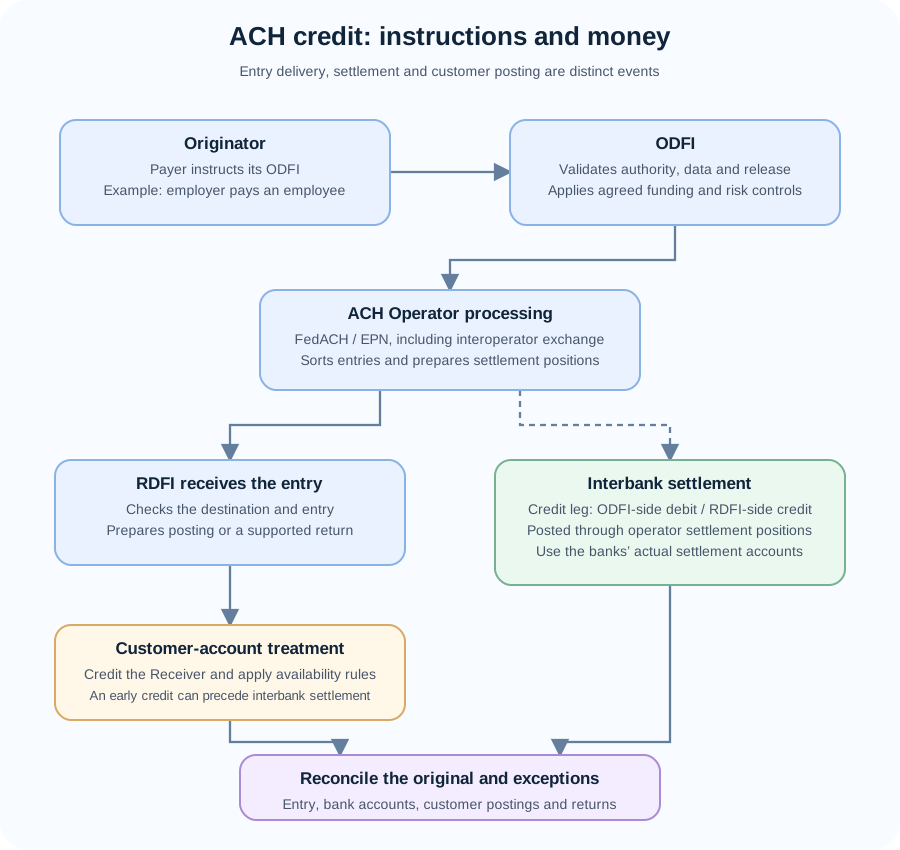
An ACH credit is a payer-side push payment carried through the U.S. Automated Clearing House Network. The Originator instructs its bank or payment provider to send value to a Receiver's account, the Originating Depository Financial Institution (ODFI) places the credit into the ACH Network, an ACH Operator processes and distributes it, the Receiving Depository Financial Institution (RDFI) receives the entry, interbank settlement occurs, and the RDFI posts the credit to the Receiver's account under the applicable ACH rules and its own controlled processing model.
That sounds simple until a bank has to operate it at scale. A payroll run may contain tens of thousands of employee credits. A supplier file can carry remittance data that accounts-receivable teams depend on. A treasury platform may create future-dated credits days before settlement. A customer may upload a technically valid file that fails a funding or entitlement control. An ACH Operator may accept the file while a specific receiving account later fails posting. A payment can settle and still generate a later return or, in a permitted error scenario, a reversal. Those are different states, different responsibilities and different pieces of evidence.
Chapter 6 established the infrastructure: the ACH Network, FedACH, EPN, files, batches, operator processing, inter-operator exchange and settlement. Chapter 7 moves one level closer to the business payment and follows the life of an ACH credit from payer intent to beneficiary availability, reporting and reconciliation.
The focus is ACH credits such as payroll and Direct Deposit, supplier and trade payments, corporate disbursements, account-to-account credits, bill-payment credits and other domestic credit use cases. Standard Entry Class (SEC) Codes such as PPD, CCD, CTX and CIE appear where they help explain the credit use case, but Chapter 9 remains the dedicated SEC-code and authorization chapter. Same Day ACH appears as a timing option, but Chapter 10 owns its detailed eligibility, limits and window rules. Returns, reversals, Notifications of Change and fraud controls are explained only far enough to make the credit-payment lifecycle complete; Chapters 11–13 go much deeper.
A careful learner should treat an ACH credit as a chain of controlled commitments:
payer intent → originator approval → ODFI acceptance → funding/risk decision → ACH entry creation → operator processing and delivery to the RDFI. Interbank settlement occurs in the scheduled cycle. RDFI posting and funds availability must be tracked separately under the applicable rules and bank processing arrangements; entry delivery can precede settlement. Reporting, reconciliation and exception handling connect those separate events.
That chain is the mental model for this chapter.
For a roughly 60-minute core session, spend about 35 minutes on Section 1, Sections 4–6, Sections 10–11 and Sections 13–14. For the next 10 minutes, use the chapter’s three diagrams to trace release authority, settlement and receiving-account evidence. Use 10 minutes to work through one case in Section 16, then spend the final 5 minutes explaining: How would you investigate a payroll credit that the employer says was sent but the employee cannot see? Treat these timings as a study guide. The remaining sections, additional cases and extended reference material are follow-up study; completing the whole chapter takes longer.
Chapter navigator
- What an ACH credit really is
- Participants and responsibility from payer to Receiver
- Where ACH credits are used in real banking
- The end-to-end ACH credit lifecycle
- Originator initiation, approval and release
- ODFI validation, funding, exposure and acceptance
- Credit entry data: batches, transaction codes, references and remittance
- PPD, CCD, CTX, CIE and other credit use cases
- Account validation, routing quality and pre-notification
- Operator processing, settlement and timing
- RDFI receipt, posting and funds availability
- Statuses, evidence and customer communication
- Credit exceptions, returns, reversals and repair boundaries
- Reconciliation, accounting, reporting and cash application
- Controls, fraud prevention and real-bank operating design
- End-to-end cases, BA checklist and testing
1. What an ACH credit really is
An ACH credit answers a very specific business question: who instructs the banking system to push funds? In an ACH credit, the payment is initiated from the payer side. The Originator tells its financial institution to send a credit to the Receiver. That is fundamentally different from an ACH debit, where the collection side initiates an instruction to pull funds from the Receiver's account under appropriate authority.
This direction matters because it changes the control problem. With a debit, much of the discussion revolves around the collector's authority to take money. With a credit, the primary control problem is whether the payer really intended to release the money, whether the beneficiary details are correct, whether the Originator is entitled and funded to send it, and whether the ODFI should place that instruction into the ACH Network.
A payroll credit is the easiest example. An employer owes an employee $3,500. The employer's payroll system calculates the net pay, creates a payment instruction and sends the file to its bank. The employer is not asking the employee's bank to pull money. It is instructing its own bank to push value to the employee's account. The same pattern appears in supplier payments, refunds, insurance or benefit-type disbursements, corporate transfers and many other ACH credit use cases.
But ACH credit does not mean instant, final at initiation, guaranteed to post, or impossible to return.
The credit can be originated today for a future settlement date. It can be processed as standard ACH or, if eligible and selected, through Same Day ACH. The ACH Operator can accept the file while the receiving bank later finds that the account is closed or otherwise cannot accept the entry. Interbank settlement can occur before an operational team has completed every customer-facing report. A later return can generate a new financial event. A permitted reversal can be originated to correct a genuine sender error, but a reversal is not a generic way to recover a payment simply because the sender changed its mind.
That is why a practitioner should separate five statements that inexperienced implementations often collapse:
The Originator approved the payment. This is a payer-side business event.
The ODFI accepted and released the payment. This is a bank-side origination event.
The ACH Operator accepted and processed the entry. This is a network event.
The entry settled. This is an interbank financial event.
The RDFI posted the credit and made funds available. This is the receiving-bank customer-account event.
Those events are connected, but none is an automatic synonym for the others.
A strong system therefore does not have one status called SUCCESS. It keeps enough state to answer where the payment is in the chain and which institution or system owns the next action.
Credit does not tell you the customer segment
An ACH credit can be consumer-facing or corporate-facing. A PPD credit commonly supports consumer Direct Deposit. CCD and CTX are important in corporate payments. CIE supports customer-initiated credit use cases such as consumer bill payments. The direction—credit—does not by itself tell you the commercial agreement, account type, remittance requirement or SEC Code.
Credit does not mean the receiving account is already validated
The payer can initiate a perfectly valid ACH credit using a wrong account number. If the routing and account data point to a valid but unintended account, the operational problem can be serious. This is why account validation, beneficiary maintenance controls and payment-release controls are important even though ACH credit risk differs from ACH debit authorization risk.
The first principle for the rest of the chapter is therefore simple:
An ACH credit is a payer-initiated value push through the ACH Network, controlled by a sequence of business, bank, network, settlement and receiving-account decisions.
2. Participants and responsibility from payer to Receiver
Chapter 6 described the ACH participant structure from an infrastructure perspective. For ACH credits, we need to look at the same chain from the payment's responsibility perspective.
The Originator is the person or organization that initiates the credit. It may be an employer, a corporation paying suppliers, a government entity making disbursements, a consumer using a bill-payment service, or another party permitted to initiate ACH credits through its financial institution.
The Originator is responsible for the business truth of the payment: who should be paid, how much, when, from which funding arrangement and with what remittance information. A bank can validate syntax, permissions and risk rules, but it cannot manufacture a correct supplier invoice reference if the Originator supplied the wrong one.
The ODFI is the financial institution that originates the ACH entry into the network. The ODFI has a materially stronger role than a technical gateway. It accepts the Originator's instruction under its customer agreement and the Nacha Rules, performs its own controls, and transmits the resulting ACH entry through its ACH Operator arrangement.
A third-party sender, payroll processor, treasury platform or service provider may sit between the Originator and ODFI. That can change the technical path and service responsibilities, but it does not erase the formal Originator and ODFI roles. A useful architecture model therefore separates:
business Originator → service/processor → ODFI → ACH Operator → RDFI → Receiver.
The ACH Operator—FedACH or EPN—processes the ACH entry as part of the network infrastructure established in Chapter 6. For Chapter 7 the operator's importance is that the credit becomes a network item, is sorted toward the appropriate RDFI, participates in the relevant settlement cycle and becomes observable through operator-level files and reports.
The RDFI receives the ACH credit for an account it services. The RDFI identifies the Receiver's account, applies receiving-side processing, posts the credit when appropriate, makes the funds available according to applicable rules, provides customer reporting and handles any receiving-side exception.
The Receiver is the person or organization whose account is being credited. For payroll, the Receiver is the employee. For a supplier payment, it is the supplier or other corporate beneficiary. For a bill payment sent as an ACH credit, the Receiver can be the biller.
Legal role versus technical sender
A large corporate may use a payroll processor that generates the ACH file and sends it through the corporate's bank. A bank may use another technology provider to transmit the ACH file to the Operator. An RDFI may use a processor to receive and parse operator files.
Those technical facts do not automatically make the processor the ODFI or RDFI. A system diagram should therefore show role and connectivity separately.
This matters during incidents. If a payroll file is late because a corporate processor did not transmit it to the ODFI, the root cause sits before ODFI release. If the ODFI transmitted successfully but received an operator rejection, the failure is at the operator hand-off. If settlement occurred but a customer account remained unposted, the investigation moves to the RDFI or its processor.
Responsibility cannot be inferred from who owns the screen
A treasury portal can display a payment status without owning settlement. A payment hub can create the ACH batch without owning the customer's authorization. A core ledger can post the credit without owning the network trace. A reconciliation platform can identify a break without owning the repair decision.
For a BA, the practical requirement is to define ownership by event:
- who owns beneficiary creation and change;
- who approves the payment;
- who validates routing/account data;
- who performs the funding or exposure decision;
- who decides the ACH processing lane;
- who releases to the Operator;
- who monitors operator acceptance;
- who reconciles settlement;
- who confirms receiving-side posting when available;
- who communicates exceptions to the Originator or Receiver.
A payment journey becomes supportable only when those owners are explicit.
3. Where ACH credits are used in real banking
ACH credits are not one product. They are a payment direction used across many products and customer journeys.
The most visible use case is Direct Deposit. Employers use ACH credits to pay wages, salaries and similar compensation to employee accounts. Government entities and other organizations also use ACH credits for recurring disbursements. From a customer perspective this can feel almost invisible: the Receiver sees money in the account on the expected date. Behind that simplicity is payroll calculation, payee/account maintenance, corporate approval, ODFI processing, ACH exchange, settlement, RDFI posting and reporting.
In 2026 there is an important data rule attached to a common payroll pattern. Effective March 20, 2026, Nacha requires Originators to use the standardized Company Entry Description PAYROLL for PPD credits that pay wages, salaries and similar compensation. This is not a cosmetic label. Standardized descriptions support identification, monitoring and risk management. A bank supporting payroll origination therefore needs to treat the description as controlled ACH data for qualifying PPD payroll credits rather than free text.
A second major use case is supplier and vendor payment. A company can use ACH credits to pay invoices, reimburse partners, settle recurring supplier obligations or move funds between business relationships. Here remittance information becomes especially important. The supplier may receive the cash correctly but still be unable to apply it if the invoice numbers, references or addenda are missing or malformed.
That creates an important distinction:
payment success means the money reached and posted to the intended account;
receivables success means the beneficiary can identify what the money is for and apply it to the correct open items.
For large B2B payments, CCD or CTX may be relevant depending on the relationship and remittance requirement. Chapter 9 covers SEC-code mechanics in detail, but Chapter 7 needs to teach why a corporate credit may need more than account and amount.
A third use case is account-to-account movement. A customer or corporate treasury function may move funds between accounts at different banks through an ACH credit. This is still a push from the originating side. If both accounts are at the same bank, the bank might instead process the movement on-us without sending an ACH item; product routing determines the rail.
A fourth use case is consumer bill payment. In some bill-payment models, a consumer tells a bank or bill-pay service to send a credit to a biller. CIE is one ACH application associated with customer-initiated credit entries. The commercial experience can look like “pay my electricity bill,” while the back-end payment can be an ACH credit to the biller or its processor.
A fifth use case is refunds, payouts and disbursements. Businesses may use ACH credits to send customer refunds or other approved payouts. In a modern platform, these flows may compete with instant payments, push-to-card or checks depending on speed, reachability, cost, amount, customer preference and operational rules. Chapter 50 later covers broader payout models. Here the important point is that ACH credits remain a major disbursement mechanism.
Not every credit should automatically be ACH
A bank or corporate may have several push-payment options: on-us transfer, ACH, wire, RTP, FedNow, card-based payout or check. ACH is especially strong where the payment can tolerate batch-oriented processing, the Receiver is reachable through ACH, the economics favor high-volume processing and the payment does not require the immediacy or finality characteristics of a real-time or high-value rail.
Routing logic should therefore reflect product intent. A payroll file with 40,000 employees is a natural high-volume ACH use case. A time-critical $8 million corporate obligation might be better suited to a high-value rail depending on the business requirement. A small urgent customer payout might use an instant rail when available. The fact that ACH can carry a credit does not mean ACH is always the correct rail.
4. The end-to-end ACH credit lifecycle
A reliable ACH credit model begins with the end-to-end lifecycle rather than with the file format.
Consider a fictional corporate, Malla Manufacturing, paying 2,000 suppliers. The treasury system creates a payment run after approved invoices are selected. The run is not yet an ACH payment. It is a business obligation converted into a set of payment instructions.
Stage 1 — obligation and payment creation
The corporate identifies who should be paid, the amount, requested execution or settlement date, funding account and remittance information. Internal ERP controls may confirm invoice approval, prevent duplicate invoices and enforce payment-run segregation of duties.
Stage 2 — beneficiary and account validation
The payment instruction references beneficiary banking details. The corporate or bank may use account-validation methods, routing-reference data, prior payment history and beneficiary-change controls to reduce the risk of misdirected credits. Validation does not guarantee ownership or future posting, but it raises confidence in the data being used.
Stage 3 — corporate approval
The payment run moves through entitlements and approvals. One user may prepare, another approve, and a treasury officer may release. The exact pattern is a customer/product choice, but the bank must know when the payment becomes authorized for bank processing.
Stage 4 — ODFI intake
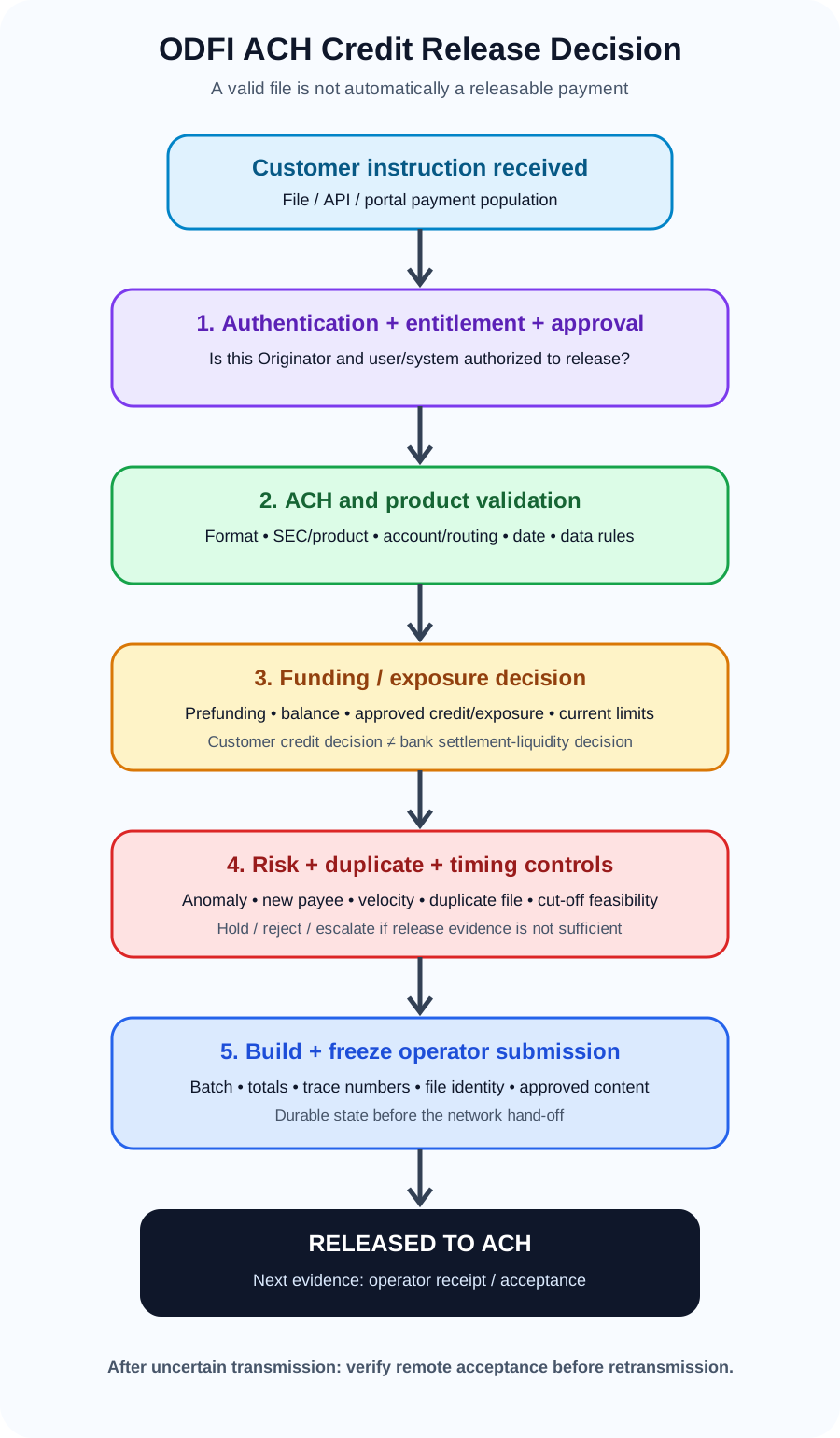
The bank receives the corporate file or API instruction. It validates channel authentication, customer entitlement, file integrity, batch structure, ACH data, requested dates, account eligibility, limits and risk rules. It links the customer's reference to the bank's internal payment and batch IDs.
Stage 5 — funding and exposure decision
The ODFI decides whether it is willing to originate the credits. Some customers may be prefunded. Others may have an agreed funding or credit arrangement. The bank may verify available balance, collected balance, credit facility, prefunding account or another product-specific funding model. The key is that file valid does not automatically mean bank willing to release.
Stage 6 — ACH construction and release
The bank maps the payment data into ACH entries, groups them into batches, calculates totals, assigns trace numbers and builds the operator-facing file. It then releases the file to its ACH Operator according to the selected timing lane.
Stage 7 — operator acceptance and processing
FedACH or EPN receives the file, performs operator processing, sorts the credit entries and creates output for the receiving institutions or the other Operator where inter-operator exchange is needed.
Stage 8 — settlement
The ACH credit participates in the applicable interbank settlement cycle. The financial obligation between originating and receiving institutions is discharged according to ACH settlement arrangements. Settlement is not the same event as receiving-account posting.
Stage 9 — RDFI receipt and posting
The RDFI receives the operator output, parses the entry, identifies the Receiver account and applies its receiving logic. If the account can accept the credit, the RDFI posts it and applies the relevant funds-availability treatment.
Stage 10 — reporting and reconciliation
The Originator receives bank status and reporting appropriate to the service. The ODFI reconciles customer instructions, operator files, settlement and accounting. The RDFI reconciles received items, posting and settlement. For corporate payees, remittance information may also feed cash application.
Stage 11 — later exception if required
A return, reversal or investigation can create a new lifecycle after the original credit. That later event must not overwrite the historical truth that the original credit was transmitted or settled.
The operational rule is simple: preserve the lifecycle as evidence, not just the current status.
If an entry is later returned, the bank should still know when the Originator approved it, when the ODFI released it, which operator file carried it, when it settled, when the return arrived and how the financial correction was posted.
5. Originator initiation, approval and release
ACH credit quality begins before the ODFI receives anything.
For a consumer using bill pay, initiation may be a single digital instruction. For payroll, it may be a payroll file created from a payroll engine. For supplier payments, an ERP or treasury management system can generate thousands of entries after an accounts-payable run.
The Originator's first responsibility is business correctness. The bank can reject an invalid routing number, but it cannot know that invoice 8472 should have been excluded because the supplier disputed the goods. The corporate control environment therefore remains part of payment quality.
Beneficiary maintenance is part of payment control
Many serious credit-payment losses begin before payment creation, when beneficiary details are changed. A fraudster may compromise a supplier mailbox and request a bank-account update. An employee may enter a digit incorrectly. A legitimate supplier may move banks.
A mature corporate or bank service can apply controls such as dual approval for beneficiary changes, out-of-band confirmation for sensitive updates, waiting periods for newly changed beneficiaries, first-payment limits, account-validation checks and comparison to prior payment behavior. Chapter 12 will go deeper into ACH fraud controls; Chapter 7 only needs the design principle: the risk decision must consider the payee data that the payment depends on.
File creation should preserve payment identity
When a customer sends a file, each payment should be traceable to a customer-level identity. The bank may add its own file, batch and transaction IDs, but it should not lose the corporate payment reference.
A useful lineage can be:
ERP payment run → customer file ID → customer payment reference → bank transaction ID → ACH batch → ACH trace number.
That lineage becomes essential when a corporate asks, “Which of the 12,000 payments in yesterday's file reached this supplier?”
Approval is a state, not a screen click
The approval model should answer who was authorized, what exactly they approved, when, under which limit and whether the approved content changed after approval.
If a file is approved and then transformed, the bank must know which transformations are expected and controlled. Normal formatting or batching can occur after approval; unauthorized changes to beneficiary, amount or date cannot be silently introduced.
Strong implementations use integrity evidence such as file hashes, version IDs, immutable approval records and maker-checker logs. The exact technology varies, but the control objective is consistent: prove that the released payment population is the one that was authorized.
Scheduled does not mean released
Corporate users often schedule ACH credits days in advance. A payment can therefore have states such as CREATED, APPROVED, SCHEDULED, READY_FOR_RELEASE, RELEASED_TO_BANK and later RELEASED_TO_ACH.
This matters operationally when a customer asks whether a payment can still be changed. The answer depends on where it is in the release lifecycle. Before ODFI release, the bank may permit modification or cancellation under product rules. After release into the ACH Network, the options and responsibilities change.
Payroll needs special operational discipline
Payroll is emotionally and operationally sensitive. A supplier receiving payment one day late is serious; 40,000 employees not receiving salary on payday can become a major incident within minutes.
Payroll controls therefore often include earlier customer cut-offs, high-visibility monitoring, predictable file naming, strict totals, funding verification, release confirmation, settlement monitoring and escalation paths. The March 20, 2026 PAYROLL Company Entry Description requirement for qualifying PPD payroll credits adds another data-quality control to that operating model.
6. ODFI validation, funding, exposure and acceptance
The ODFI is where a customer instruction becomes a bank-originated ACH obligation.
A common mistake is to treat ODFI processing as one validation call. In reality, the bank may need several logically separate decisions.
Channel and entitlement validation
The bank verifies the customer and technical source. Did the file arrive through an approved host-to-host connection? Was the API client authenticated? Is the user entitled to originate ACH credits from the funding account? Did the required approvals occur?
Structural validation
For file-based origination, the bank verifies ACH or customer-file structure: record lengths, headers, batches, control totals, required fields, supported transaction types and date formatting. If the customer sends ISO 20022 or a proprietary file rather than native Nacha format, the bank also validates the source format and mapping into ACH.
Business validation
The bank checks whether the payment fits the product agreement. Is the customer permitted to originate the selected ACH credit application? Is the requested processing date supported? Is the destination routing number reachable? Is the account type compatible with the chosen transaction code? Does the batch classification match the intended entries?
Funding and credit decision
This is one of the most important distinctions in ACH origination.
A technically valid credit instruction creates an obligation for the ODFI when it enters the network. The bank therefore needs a controlled funding model. Depending on the customer and product, the ODFI may require available funds before release, use a prefunding arrangement, rely on a credit facility, apply an ACH exposure limit or use another approved credit-risk model.
The implementation should not assume that customer account balance is the only relevant number. A corporate may fund through a concentration structure. A bank may maintain a separate exposure engine. A payroll customer may have a pre-approved ACH exposure based on historical activity and credit assessment.
The requirement should therefore say what evidence authorizes the bank to originate value, not merely check balance.
Limit and anomaly controls
An ODFI can monitor total file amount, entry count, per-payment amount, customer daily exposure, historical behavior, new beneficiaries, unusual destination concentrations and other risk indicators. Since Nacha's 2026 fraud-monitoring changes expand expectations around fraud monitoring, banks should treat ACH origination monitoring as an active risk capability rather than a static limit table. Chapter 12 covers those requirements in depth.
Release decision must be atomic enough to be trusted
A dangerous design is:
- approve file;
- deduct funds;
- crash;
- restart;
- send file again because the system cannot tell whether it was already transmitted.
The architecture needs a durable release state and idempotent handling around operator transmission. The ODFI should be able to tell whether a file was built, released, transmitted, acknowledged or still uncertain.
That does not mean “retry blindly.” It means recover from uncertain technical outcomes without creating duplicate financial instructions.
Accepted by bank versus accepted by Operator
When the ODFI tells a customer Accepted, the status should identify what that means. The bank may mean:
- file syntax accepted;
- payment accepted for processing;
- funding approved;
- released to ACH;
- operator accepted.
Those are materially different. Customer APIs and portals should avoid an ambiguous ACCEPTED unless documentation makes the boundary clear.
7. Credit entry data: batches, transaction codes, references and remittance
Chapter 6 explained the ACH file hierarchy. Chapter 7 now asks what the fields mean for a credit payment.
At entry level, the transaction code identifies whether the entry is a credit or debit and the type of receiving account. Nacha's developer guidance identifies common credit transaction codes such as 22 for a checking-account credit and 32 for a savings-account credit, with separate non-monetary prenote codes. A bank should not derive credit/debit direction from free text or product name when the ACH entry already carries a defined transaction code.
At batch level, the Service Class Code indicates whether the batch contains credits, debits or both. 220 identifies credits-only batches and 200 mixed debit/credit batches. That field participates in structural and control validation; it is not just descriptive metadata.
The Company Name, Company Identification, Company Entry Description, SEC Code, Effective Entry Date, receiving routing data, account number, amount, individual/receiving name and trace number all have different operational uses.
Trace number is critical but not sufficient
The ACH trace number is one of the most important operational identifiers for an entry. Operations teams use it when researching what happened to a payment. But it should not be the only identity retained.
A complete lineage might include:
customer payment ID → bank payment ID → ACH trace number → operator file ID → settlement cycle → RDFI receipt evidence.
If the bank stores only the trace number, customer reporting becomes difficult. If it stores only the customer reference, operator research becomes difficult.
Payroll description is now controlled data
For PPD credits that pay wages, salaries and similar compensation, the standardized Company Entry Description PAYROLL became required on March 20, 2026. The rule is a good example of why banks should not treat ACH descriptive fields as unrestricted free text.
A product can therefore need validation such as:
if qualifying PPD payroll credit → Company Entry Description must satisfy current rule.
The exact implementation may sit in the customer's file-generation software, the ODFI's ACH mapper, or both, but responsibility should be clear.
Remittance matters more in B2B credits
A supplier can receive $217,456.32 successfully and still call the payer because it cannot identify the invoices.
CCD can carry limited payment-related addenda; CTX supports significantly richer addenda structures for trading-partner use cases. Chapter 9 will explain the SEC formats in depth. For Chapter 7, the practical lesson is that payment data must support both money movement and business matching.
If a customer sends ISO 20022 pain.001 data into a bank that ultimately originates ACH, the bank may need to map richer remittance content into the available ACH format. Chapter 5 already established the key principle: translation can lose information. The bank should define what is transmitted in ACH, what is preserved internally and what is available in separate reporting or remittance channels.
Effective Entry Date is not the same as customer requested execution timestamp
The ACH batch contains an Effective Entry Date concept, while the bank may separately store customer requested date, internal processing date, operator processing date and settlement date. Those dates can differ.
A robust data model therefore does not overwrite one date with another. It keeps enough detail to answer:
- When did the customer request payment?
- When did the bank release it?
- What effective date was carried in the ACH batch?
- Which processing window handled it?
- What settlement date applied?
- When did the RDFI post it?
This is especially important for payroll and future-dated supplier files.
8. PPD, CCD, CTX, CIE and other credit use cases
An ACH credit is a direction. The SEC Code describes the ACH application and the type of business context. Chapter 9 will cover the complete SEC-code framework; here we focus on the codes most useful for understanding credit payments.
PPD — consumer-facing prearranged credits
PPD is widely associated with consumer payments, including Direct Deposit. A classic use is an employer sending salary to an employee's consumer account.
For payroll, the ODFI and Originator need to apply the correct data and processing controls, including the 2026 standardized PAYROLL description requirement for qualifying PPD credits. The employee does not normally interact with the ACH file; the customer experience is the expected credit appearing in the account on payday.
CCD — corporate credit or debit
CCD supports corporate-to-corporate ACH activity and can be used for vendor payments, cash concentration and other business payments. A CCD entry can carry a single addenda record with payment-related information.
For a supplier credit, CCD can be operationally efficient when the beneficiary can apply the payment using the available remittance content or a separate remittance channel.
CTX — richer corporate trade exchange
CTX supports corporate payments where richer addenda information is required. Nacha's developer guidance notes that CTX can support up to 9,999 addenda records and is used in trading-partner relationships where extended payment-related information needs to travel with the entry.
That does not mean every B2B payment should be CTX. The correct ACH application depends on the payer-payee relationship, product design, data requirement and agreed processing model.
CIE — customer-initiated credit
CIE is associated with a credit entry initiated by a consumer through a bill-payment service provider to pay a biller. It is useful because it reminds learners that ACH credits are not only employer or corporate-originated files. A consumer can initiate a push payment through a service that ultimately creates an ACH credit.
IAT credit boundary
ACH also has International ACH Transaction (IAT) rules for transactions involving certain non-U.S. financial-agency circumstances. IAT can be credit or debit. Chapter 51 later covers cross-border alternatives and IAT in the broader international context. Chapter 7 should therefore not turn into an IAT rulebook; it is enough to recognize that a credit can be classified as IAT when the applicable definition is met.
This boundary remains especially important after Nacha's revised IAT definition became effective on September 18, 2026. A bank should use the current rule definition and effective-date governance rather than hard-coding an old interpretation.
SEC Code is not a customer product name
A corporate portal may offer Payroll, Supplier ACH, Tax Payment and Account Transfer. The ACH file may use PPD, CCD, CTX or another appropriate code. The product name and SEC Code are related but not interchangeable.
For requirements, model the mapping explicitly:
customer use case → legal/business relationship → account type → ACH application/SEC Code → entry format → controls → reporting.
That is much safer than a table saying Payroll = ACH and Supplier = ACH with no further detail.
9. Account validation, routing quality and pre-notification
ACH credits are pushes, but wrong-account risk remains material.
If a corporate sends a credit to a closed account, the RDFI may return it. If it sends the credit to a valid account belonging to the wrong person, recovery can be much harder. Good payment design therefore treats beneficiary banking data as controlled master data.
Routing validation
The receiving routing number should be checked against current ACH participant/reference data and structural rules. A routing number can be syntactically valid but not appropriate for the intended processing path. Banks should use current operator or industry reference data rather than relying on a static table embedded in code.
Account validation is broader than routing validation
Valid routing does not prove that the account exists, is open, accepts ACH credits or belongs to the intended Receiver.
Nacha identifies several account-validation approaches, including prenotification entries and external validation services. Account validation is a best practice for organizations sending payments, including credits, because misdirected payments create operational and fraud risk.
Prenotification entries
A prenotification, or prenote, is a non-monetary ACH entry used to validate account information. Nacha's developer guidance describes prenotes as optional for SEC Codes and notes that they precede or can be used to revalidate live-entry information under current rules.
A credit prenote does not move money. It gives the RDFI an opportunity to identify account-data problems before the live-dollar credit.
Do not confuse a prenote with a zero-dollar payment. Its purpose and transaction code identify it as account-validation activity.
Micro-Entries are different
Nacha defines Micro-Entries as ACH credits of less than $1 and any offsetting ACH debits used for account validation. They are live transactions, not zero-dollar prenotes, and have their own rule requirements including standardized descriptive treatment.
Chapter 7 does not need to teach every Micro-Entry rule. The key distinction is:
prenote = non-monetary validation entry; Micro-Entry = live small-dollar validation transaction pattern.
Validation result should not become false certainty
An account validated last year can be closed today. A successful prior payment does not prove that a beneficiary-change request is genuine. A routing directory does not confirm account ownership.
Banks and corporates should therefore treat account validation as one control in a broader payee-risk framework.
Change events deserve more control than stable data
A practical risk rule is that new or changed beneficiary details deserve stronger scrutiny than unchanged details with a long successful history.
This can affect approval requirements, payment limits, first-payment monitoring and out-of-band verification. The details vary by institution and customer segment, but the design principle belongs in any serious ACH credit implementation.
10. Operator processing, settlement and timing
Once the ODFI releases an ACH credit to FedACH or EPN, Chapter 6's network infrastructure becomes active.
The ACH Operator receives the file, performs operator-level edits and processing, sorts the entries, distributes them toward RDFIs or the other ACH Operator and supports settlement.
For the credit-payment learner, three timing concepts matter most.
Standard ACH can be future-dated
A payroll file may be submitted before payday. A supplier file may carry an effective date for a future banking day. The ACH Network can therefore receive and process information before the value settlement date.
That means operational dashboards should not label a future-dated credit late merely because it has not settled on the day the file was uploaded.
Same Day ACH is an option, not a different rail
Eligible ACH credits can use Same Day ACH when the ODFI product, timing and current rules support it. The same ACH participant chain exists; the processing and settlement schedule is compressed.
Chapter 10 will cover current Same Day ACH limits, windows, eligibility and detailed funds-availability rules. Chapter 7 only needs to model standard versus same-day lane as a controlled routing/timing decision.
Settlement is financial evidence, not customer posting evidence
When the ACH credit settles, the interbank obligation is discharged through the applicable settlement arrangement. That is a major milestone, but it does not prove that the Receiver's account has posted successfully.
A strong event model therefore keeps:
OPERATOR_ACCEPTED
SETTLEMENT_CONFIRMED
RDFI_FILE_RECEIVED
RECEIVER_ACCOUNT_POSTED
as distinct evidence points.
The chronological order of operator file receipt and settlement evidence can vary with the processing schedule; the model should not force an inaccurate universal sequence. What matters is that the evidence remains separate.
Effective dates should be rules-driven
Do not hard-code assumptions such as ACH credit = next day. Standard ACH can involve different future-dated timing, and Same Day ACH offers same-banking-day processing for eligible entries. Holidays, non-banking days, customer cut-offs and operator schedules all influence what date can actually be achieved.
Customer-facing date promises should therefore be generated from controlled calendars and current processing rules.
Funds availability changes matter even when the rail does not change
As of the October 5, 2026 release audit, Nacha's non-Same-Day credit-availability rule is effective. It removes the 5:00 p.m. prior-day receipt condition and generally requires the RDFI to make covered credits available by 9:00 a.m. RDFI local time on Settlement Date, subject to the rule's geographic and processing exceptions. A bank must apply effective-dated behavior and must not imply that every RDFI posts at exactly 9:00 a.m.
This is a good example of banking software reality: the payment rail is unchanged, but a rule change can alter receiving-side service timing and operational readiness.
11. RDFI receipt, posting and funds availability
The RDFI turns network receipt into the customer's account outcome.
Receive the operator output
The RDFI receives the ACH file or output from its Operator or processor. It validates file identity, sequence, controls and expected receipt. It parses the individual credit entries into internal processing objects and preserves important ACH data such as trace number, ODFI identification, company information, SEC Code, amount and addenda.
Identify the account
The receiving routing information brought the entry to the RDFI, but the RDFI still needs to identify the target customer account from the account number and other entry data.
Possible outcomes include:
- account found and open;
- account found but unable to accept the credit under applicable processing rules;
- account number invalid;
- account closed;
- account type mismatch or another correctable/return condition;
- operational posting failure despite otherwise valid ACH data.
The exact return reason and timeframe belong in Chapter 11. Chapter 7 needs to show that network delivery does not guarantee account posting.
Posting is an internal ledger event
The RDFI posts the ACH credit to the customer's account through its core or deposit platform. The posting engine may also create general-ledger entries, update available balance, create statement narrative and generate customer notifications.
Banks differ in architecture. Some post ACH in large batch processes. Others ingest operator files into a payment hub that then calls a core posting API. Some maintain separate memo-posting and final-posting states. The Academy should teach the responsibility, not pretend every bank uses one architecture.
Availability is not the same as ledger posting
A ledger can record the credit while funds are still subject to a separate availability state. Conversely, a bank may design posting and availability to occur together for a given ACH credit type.
Chapter 4 established this distinction. For Chapter 7, the important operational question is: when can the Receiver actually use the credited funds under the applicable ACH rule and bank process?
The September 18, 2026 change to non-Same-Day credit availability makes this especially important. RDFIs need to ensure the receiving process, posting schedule and customer-balance availability logic meets the now-effective requirement and its geographic exceptions.
Posting exception after settlement
Suppose settlement has occurred, but the RDFI core database is unavailable. The operator and settlement layers can be healthy while customer posting is delayed.
The bank must not send a false status saying ACH failed if the actual problem is RDFI posting delayed after successful settlement. The operational response may require queueing, controlled reprocessing, customer communication and reconciliation without creating a duplicate credit.
This is why the bank's internal identifiers and idempotency controls matter on the receiving side as well as origination.
12. Statuses, evidence and customer communication
ACH credit statuses are difficult because the network is file-oriented while customers think in individual payments.
A corporate user wants to know, “Did supplier ABC get paid?” The bank may know that the file was accepted by the ACH Operator, but it may not have real-time proof that the RDFI posted that specific account.
The status model must therefore be truthful about evidence.
Suggested internal state layers
A bank might maintain states such as:
CUSTOMER_CREATED
CUSTOMER_APPROVED
BANK_ACCEPTED
FUNDING_APPROVED
RELEASED_TO_ACH
OPERATOR_ACCEPTED
SETTLEMENT_CONFIRMED
RDFI_DELIVERY_EXPECTED
RETURN_RECEIVED
and product-specific customer states such as Scheduled, Processing, Completed or Returned.
The internal state model and customer status do not have to use the same vocabulary. They do have to map consistently.
Do not promise RDFI posting without evidence
If the ODFI has only operator acceptance and settlement evidence, it should not manufacture an RDFI_POSTED state. Some services may provide richer receiving feedback; many ACH payment flows do not provide instant beneficiary-posting confirmation comparable to an instant-payment network.
A careful customer message may therefore say Processed by ACH or Settled according to the bank's product definition rather than Beneficiary credited unless the bank has evidence for that statement.
Status provenance
Every important status should record its source:
- customer approval event;
- bank payment engine;
- funding engine;
- ACH file gateway;
- FedACH/EPN acknowledgement;
- settlement report;
- return file;
- RDFI posting system when the bank is the receiver.
This lets operations distinguish evidence from inference.
Missing event is itself a problem
ACH incidents often appear as silence rather than an explicit rejection.
If a payroll file was released at 09:12 and operator acknowledgement is normally expected within a defined operational window, absence of that acknowledgement should trigger monitoring. The system should not wait for an employee complaint at payday.
Customer communication should reflect the party asking
The Originator cares about payment release, exceptions and returned funds. The Receiver cares about whether funds are available. A corporate treasury user cares about total file value, failed payments and settlement. An operations user cares about missing files, acknowledgements and reconciliation breaks.
One universal status screen cannot serve all those needs without context.
13. Credit exceptions, returns, reversals and repair boundaries
ACH credits have exceptions, but Chapter 7 should not become the full returns chapter.
The cleanest way to understand credit exceptions is to classify where they happen.
Before network release
The customer file may be malformed, approval incomplete, funding unavailable, account data invalid, requested date unsupported or risk controls triggered.
These are pre-origination exceptions. The ODFI can usually reject, hold or return the instruction to the customer without creating an ACH network entry.
At ACH Operator processing
The file or batch can fail operator edits. The ODFI needs to identify the rejected unit, understand whether any items were accepted, prevent duplicate retransmission and communicate the outcome to the Originator.
At RDFI receipt or posting
A credit can reach the RDFI but be unable to post—for example because the account is closed or other return conditions apply. The RDFI can originate a return in accordance with the Nacha Rules. The returned entry creates a new payment event back through the network.
Chapter 11 will cover return reason codes, timing and Notifications of Change in depth.
Reversal is not the same as return
A return is sent back because the receiving side cannot or should not accept the original entry under the applicable ACH rules.
A reversal is originated by the sender side to correct a qualifying erroneous entry or file.
Nacha's August 2026 guidance emphasizes that reversals are limited to genuine sender errors, such as duplicate payment, incorrect amount, wrong date or unintended account/Receiver scenarios defined by the rules. A reversal cannot simply be used because a sender later suspects it paid a fraudster or changed its mind.
For an eligible Reversing Entry, the originating side must send early enough for transmission or availability to the RDFI within five Banking Days following the erroneous entry’s Settlement Date. Merely beginning an upload on the fifth day is insufficient. Reversing Files also have a discovery-based transmission clock; Chapter 11 explains the distinction.
Repair before release versus correction after release
Before ACH release, a bank may be able to repair customer data under controlled rules—for example correct a clearly formatted field when the customer agreement permits it. After release, changing the economic payment is no longer a simple data repair. The bank may need a return, reversal, request for return or investigation process depending on the scenario.
That boundary should be explicit in the payment platform.
Do not overwrite the original transaction
If a credit is returned or reversed, the original record should remain historically intact. Create a linked new event with its own amount, direction, date, reason and accounting effect.
This preserves auditability:
original credit → settlement → return/reversal → settlement of corrective event → customer/accounting impact.
14. Reconciliation, accounting, reporting and cash application
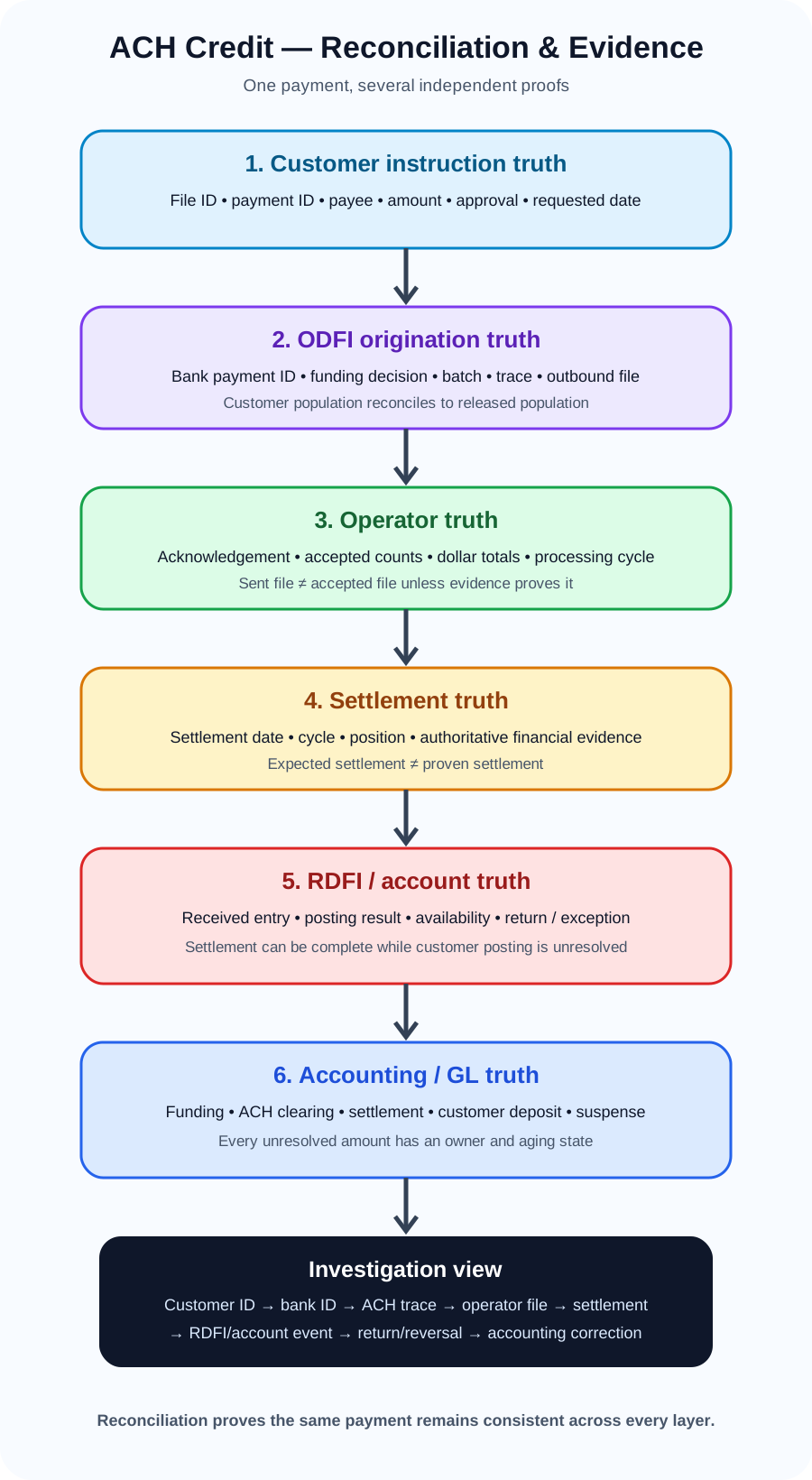
A high-volume ACH credit service is only complete when the bank can prove that every instruction moved through the expected financial and operational states.
Originator-to-bank reconciliation
For a corporate file, the bank should reconcile what the customer submitted with what the bank accepted.
Useful controls include:
- file count;
- batch count;
- entry count;
- total credit amount;
- rejected entries;
- held entries;
- customer control totals;
- bank-generated totals after transformation.
If a file of 20,000 payments becomes 19,998 network entries because two were rejected, that difference must be explicit.
Bank-to-operator reconciliation
The ODFI then reconciles what it intended to transmit with what the ACH Operator acknowledged and processed.
The key question is not merely file sent? but:
Was the expected file accepted, with the expected batches, entries and dollar value, into the expected processing cycle?
Settlement reconciliation
The bank reconciles operator settlement information with its expected ACH financial position and relevant settlement-account evidence.
An internal scheduler reaching 17:00 is not settlement proof. Authoritative settlement evidence is required.
General-ledger reconciliation
Customer funding, ACH settlement and internal GL posting may create several accounting legs. The exact journal model differs by bank, but a bank should be able to reconcile customer-account movement, settlement-account movement, ACH clearing/suspense accounts and fees where applicable.
RDFI receiving reconciliation
On the receiving side, the bank reconciles operator receipt, parsed entries, customer posting, returns and settlement.
A useful control is:
received ACH credit value = posted credit value + returned/rejected value + controlled unresolved/suspense value.
The equation can vary with timing, but unexplained residual value should not disappear.
Corporate cash application
For supplier payments, reconciliation continues beyond the banks. The beneficiary company may need to apply the incoming cash to invoices.
This is where CTX/addenda and Chapter 5's remittance concepts become valuable. A payment can be bank-reconciled but still create a receivables exception because remittance is missing.
A complete B2B design therefore asks:
- what remittance travels in ACH;
- what reference is shown on the beneficiary statement;
- whether separate remittance advice is sent;
- how the beneficiary matches payment to invoices;
- how unmatched cash is investigated.
Reporting should preserve hierarchy
Corporate users often need both file-level and entry-level reports. Operations need settlement-cycle reports. Finance needs GL and settlement reports. Compliance/risk may need monitoring data. Customer service needs searchable trace and status history.
Do not force all those users to reconstruct the truth from raw ACH files.
15. Controls, fraud prevention and real-bank operating design
ACH credit risk is often misunderstood because people assume “push payment means safe.” It is safer to say the risk changes shape.
Unauthorized release risk
If credentials are compromised or approvals are bypassed, an attacker can cause the Originator to send genuine ACH credits to attacker-controlled accounts. The ACH file can be technically perfect. The control failure is in authentication, entitlement, beneficiary change or payment approval.
Misdirected payment risk
A legitimate user can send funds to the wrong account through data error. Account validation, payee confirmation and change controls reduce this risk but cannot remove it completely.
Duplicate origination risk
File retransmission after an uncertain technical event can create duplicate credits if the bank does not know whether the original file was accepted. Stable file identities, duplicate detection, acknowledgement tracking and controlled retransmission are essential.
Funding and credit risk
The ODFI can become exposed if it originates credits without adequate funding or approved credit capacity. ACH exposure controls therefore belong in the release decision, not just in post-event reporting.
2026 fraud-monitoring context
Nacha's 2026 risk-management amendments increase the importance of fraud monitoring across ACH participants. Chapter 12 covers the formal requirements in detail. Chapter 7 should make the architecture ready for them: payment history, Originator profile, amount, velocity, beneficiary novelty, account/routing data, file patterns and other signals need to be available to risk controls before release.
Operational resilience
A bank needs plans for failure at each boundary:
- customer channel unavailable;
- file ingestion delayed;
- validation service down;
- funding engine unavailable;
- ACH gateway unavailable;
- operator acknowledgement delayed;
- settlement evidence missing;
- RDFI posting engine unavailable;
- reporting delayed.
The response cannot be one generic retry. Financial-state recovery must know whether the payment has crossed the release boundary.
Safe reprocessing
If a pre-release validation job fails, it may be safe to re-run it using the same instruction.
If operator transmission is uncertain, the system must first determine whether the file was already accepted before retransmission.
If RDFI posting fails after the entry was received, the bank should reprocess the posting idempotently rather than create another ACH credit.
Those are three different recovery patterns.
Audit evidence
A strong ACH credit audit trail can answer:
- who created the payment;
- who changed beneficiary data;
- who approved and released it;
- what file version was approved;
- what ODFI controls passed or failed;
- what funding decision was used;
- which ACH trace number was assigned;
- which operator file and cycle carried it;
- when settlement was confirmed;
- what RDFI/posting evidence exists;
- what return/reversal or exception followed;
- what customer communication was sent.
That evidence is valuable for operations, audit, fraud investigation and customer dispute handling.
16. End-to-end cases, BA checklist and testing
The best way to finish Chapter 7 is to work through realistic cases.
Case 1 — standard payroll credit
A company has 12,500 employees. Payroll is approved two banking days before payday. The file total is $31.8 million.
The payroll system creates employee-level PPD credits. The qualifying payroll batches use the required PAYROLL Company Entry Description. The treasury approver releases the file to the ODFI. The bank validates file integrity, customer entitlement, payroll product configuration and exposure. It builds the operator file and transmits it.
The ACH Operator accepts the file and processes it for the applicable future settlement date. The ODFI monitors acknowledgement and settlement evidence. RDFIs receive their entries and post the employee credits under the applicable availability rules.
The customer sees file-level status and any rejected entries. The bank reconciles 12,500 customer instructions to 12,500 ACH entries and the expected total value.
Key test: the system must not mark payday complete merely because the payroll file was uploaded.
Case 2 — one invalid account in a supplier file
A corporate sends 5,000 CCD supplier credits. All payments pass ODFI validation and are released. One supplier account at the RDFI is closed.
The original credit can be included in operator processing and settlement. The receiving bank cannot post that entry and later returns it under the appropriate ACH return process.
The ODFI receives the return and links it to the original customer payment using trace and internal identifiers. The corporate's original file remains historically processed; the individual supplier payment gets a later returned event and financial correction.
Key test: one later return must not retroactively change the status of 4,999 successful payments.
Case 3 — duplicate file transmission uncertainty
A bank sends a $75 million ACH credit file. The network connection drops before the application records the operator acknowledgement.
The bank must not simply retransmit. It checks transmission identity, operator status tools and file-control evidence to determine whether the first file was accepted. Only after resolving that uncertainty can it decide whether controlled retransmission is required.
Key test: simulate connection loss after remote receipt but before local acknowledgement persistence. The system must prevent duplicate financial origination.
Case 4 — supplier bank-details change
A long-standing supplier normally receives $250,000 each Friday. On Thursday, an email requests a new account number. The new account validates structurally.
The payment should not automatically inherit the supplier's old trusted history. Beneficiary-change controls may require additional approval or confirmation. The risk decision should consider that the payee's destination changed shortly before a high-value credit.
Key test: a valid account number is not proof that the requested change is legitimate.
Case 5 — settlement succeeds, RDFI posting is delayed
The ACH credit settles in the expected cycle. At one RDFI, a core-banking incident delays account posting for 30 minutes.
The ODFI should not report ACH settlement failed. The RDFI should queue the received entries and post them safely when the core recovers. Reconciliation should show settlement complete but customer posting pending.
Key test: recovery must not create a duplicate account credit.
Case 6 — future rule change on funds availability
An RDFI receives non-Same Day ACH credits after the prior-day 5:00 p.m. condition. The system is tested on September 10, 2026 and again on September 18, 2026.
Before the new rule's effective date, the bank applies the then-current requirement. On and after September 18, it applies the new 9:00 a.m. local-time requirement for all covered non-Same Day credits, subject to applicable provisions and exceptions.
Key test: effective-dated rule behavior changes without code being manually edited on the effective date.
BA requirements checklist
A BA defining an ACH credit capability should be able to answer all of the following:
Product and customer
- Which customer segments can originate ACH credits?
- Which business use cases are supported: payroll, supplier, account transfer, bill pay, disbursement?
- Which SEC Codes are permitted by product?
- Is standard ACH, Same Day ACH or both offered?
Initiation and authorization
- Which channels are supported?
- What maker-checker or approval model applies?
- How are beneficiary additions and changes controlled?
- What is the cancellation/modification boundary before release?
Data
- What customer fields map into ACH?
- How are Company Name, Company ID, description, Effective Entry Date and remittance populated?
- How is the 2026
PAYROLL description rule enforced where applicable?
- Which references are preserved end to end?
ODFI controls
- What structural validation occurs?
- What funding or exposure evidence is required?
- Which limits and risk checks apply?
- How are duplicates detected?
- What state proves release to the Operator?
Network and settlement
- Which ACH Operator arrangement is used?
- How are acknowledgements captured?
- How is processing-window assignment determined?
- What evidence confirms settlement?
RDFI processing
- How are received credits validated and posted?
- How is funds availability calculated?
- How are account-level exceptions queued?
- How is duplicate posting prevented during recovery?
Exceptions
- Which pre-release failures are repairable?
- When is the customer instruction rejected rather than repaired?
- How are returns linked to original credits?
- How are reversals distinguished from returns and requests for return?
Reconciliation and reporting
- How are customer file totals reconciled to bank acceptance?
- How is ODFI output reconciled to Operator acceptance?
- How is settlement reconciled?
- How are customer-account/GL outcomes reconciled?
- What customer reports exist at file, batch and entry level?
Testing matrix
A serious Chapter 7 implementation should test more than a happy-path payroll file.
Happy paths: standard payroll credit, supplier CCD credit, richer-remittance corporate credit, consumer-initiated bill-payment credit, future-dated credit, eligible same-day credit at the boundary level.
File/data tests: wrong record length, incorrect control total, malformed routing data, unsupported transaction code, inconsistent Service Class Code, wrong account type, missing required payroll description, duplicate trace or payment identity scenarios.
Authorization tests: unauthorized user, missing second approval, beneficiary changed after approval, file modified after approval, limit exceeded.
Funding tests: insufficient prefunding, exposure exceeded, funding service unavailable, funding decision timeout, release after funding changes.
Operator tests: file accepted, file rejected, batch rejection where applicable, delayed acknowledgement, connection drop after remote receipt, inter-operator path, late file relative to requested service.
Settlement tests: expected settlement, missing settlement evidence, settlement amount mismatch, settlement cycle mismatch, GL break.
RDFI tests: valid account posting, closed account, invalid account, posting engine outage, controlled reprocessing, availability-rule boundary, September 18, 2026 effective-date switch.
Exception tests: return received and matched, reversal linked to original, attempted invalid reversal scenario rejected by business controls, correction without overwriting original history.
Reconciliation tests: one rejected entry in a large file, partial customer acceptance, operator total mismatch, suspense item, returned credit after original settlement, unmatched remittance at beneficiary side.
Resilience tests: duplicate customer upload, repeated API request, worker restart during release, database failover after operator transmit, delayed operator output, disaster-recovery processing without duplicate origination.
Final practitioner checkpoint
Before leaving Chapter 7, a learner should be able to explain this journey without hiding behind the word ACH:
The payer creates and authorizes a credit. The ODFI validates the instruction, controls funding and risk, converts it into a compliant ACH entry and releases it to FedACH or EPN. The ACH Operator processes the entry and supports settlement. The RDFI receives the entry, identifies the Receiver account, posts the credit and makes funds available under the applicable rule. The banks reconcile every hand-off and preserve enough evidence to handle a later return, reversal or investigation without losing the history of the original payment.
That is ACH credit processing as a banking capability, not merely a file format.
Authoritative references
This application uses JavaScript for the full interactive experience. This text summary is served for accessibility and search indexing.