A UK business can pay wages, collect subscriptions, accept cards and complete a property purchase through services that appear together in one banking portal. Behind that screen, the instructions can travel through different systems, rely on different permissions and create different settlement obligations. The practical skill is to connect the business event to the institutions, data, accounts and evidence that make it work.
This first chapter builds that map. It explains the UK ecosystem deeply enough to follow a payment through a bank, while leaving the detailed Bacs, Direct Debit, Faster Payments, CHAPS, card and cheque procedures to their own chapters. The question running through the lesson is: who is responsible, which account changes, and what evidence supports the status being reported?
The same discipline used throughout the USA programme applies here: customer instruction, messaging, clearing, settlement, account posting, availability and finality are related events with different meanings. UK terminology and UK operating arrangements must be understood on their own terms.
What you should be able to do after this chapter
By the end, you should be able to trace a payment or collection across its customer, provider, system and settlement boundaries; distinguish an account provider from a processor or sponsor; explain direct connectivity without assuming direct settlement; recognise the purpose of the main UK identifiers; and describe the evidence needed to investigate an uncertain outcome. You should also be able to choose a plausible route for a business need and explain what must be checked before that route becomes a customer promise.
Allow roughly 60 minutes for a careful reading and the worked cases. Read Sections 1–8 to establish the participants and authority model, Sections 9–18 to follow the money and data, and Sections 19–26 to apply the map inside a bank. Pause at each of the four diagrams and explain the arrows in your own words. Finish with the practitioner checkpoint before reading its suggested answers. Reading speeds differ; the references are follow-up material rather than part of the timed lesson.
Public-source position reviewed 5 October 2026. Examples use fictional organisations and illustrative amounts. The bank architectures and accounting illustrations explain common design choices; they are not claims that every institution uses identical systems or entries.
Chapter navigator
- One business morning, several payment journeys
- Payment, collection and the underlying obligation
- Push, pull, standing order and request-led instructions
- The provider behind the account
- Operators, infrastructure providers and settlement agents
- Direct access, sponsored access and settlement responsibility
- Law, regulation, scheme rules and bank contracts
- What kind of money does the customer hold?
- Instruction, clearing, settlement, posting and availability
- The core UK routes in context
- Choose the route from the business need
- Operating clocks and the promise made to the customer
- Sort codes, account numbers and secondary references
- IBANs, BICs and international boundaries
- Payment identifiers and remittance that survive the journey
- Files, APIs and ISO 20022 have different jobs
- Inside the bank, from channel to ledger
- Account switching and controlled data maintenance
- Controls belong to identifiable decisions
- Exceptions begin with the original outcome
- Reconciliation, accounting and customer reporting
- Worked case: an urgent supplier payment
- Worked case: money received, invoice still open
- Build a bank requirement from the map
- Current services, announced changes and proposals
- Practitioner checkpoint and the next chapter
- Official and primary references
1. One business morning, several payment journeys
At 8:30 on Monday, the finance team at Northbridge Engineering opens its banking portal. Its wage run is due later in the week. A supplier needs £24,600 before releasing replacement parts. Several maintenance customers are due to pay by Direct Debit. Yesterday's card sales are appearing in the merchant dashboard, and a solicitor needs to receive a separate property-completion payment.
Amira, the treasury manager, sees balances, beneficiaries and a list of instructions. The bank sees more: customer authority, product permissions, destination eligibility, file processing, payment-system access, settlement funding and reporting. A single customer relationship does not reduce those journeys to one process.
The wage run may use Bacs Direct Credit because its planned date and batch preparation suit that service. The supplier payment may use Faster Payments if the bank's product supports the amount, destination and urgency. The Direct Debit run starts from the collecting organisation's authority to request debits. The property payment may use CHAPS. The card dashboard records a separate acquiring relationship in which a sale, an authorisation and a merchant payout can occur at different times.
These are candidate routes, not instructions to select a system from the payment description alone. A salary can be paid through a different supported route when circumstances justify it. A large payment does not automatically become CHAPS merely because someone calls it high value. A collector cannot choose Direct Debit without the necessary authority and service arrangements. The bank must evaluate the actual product and operating conditions.
Northbridge also moves £15,000 between two of its accounts at the same legal bank. That can be an internal book transfer: the bank changes its liabilities to the customer without creating an obligation to another institution. A transfer between two brands is not automatically internal; the legal account providers and actual processing arrangement decide that.
For the rest of the chapter, keep Northbridge's portal in mind. The screen captures the customer's intention. The ecosystem determines how that intention becomes a financial result. If an operator later says that an instruction was accepted, Amira still needs to know what was accepted, by whom, and whether the evidence supports the business outcome she cares about.
2. Payment, collection and the underlying obligation
A payment and a collection are often two views of the same movement. Northbridge calls the £24,600 a supplier payment. The supplier calls it a customer collection. The sending bank sees an outgoing instruction, and the receiving bank sees an incoming credit. None of these perspectives changes the amount, but each creates different information needs.
Northbridge wants to know that the correct beneficiary will receive the approved amount before the agreed deadline. The supplier wants to know which invoice has been paid and whether it can release the parts. Its accounts-receivable system needs an invoice allocation. The bank's payment engine needs routing information and authority. Its ledger needs balanced financial entries. Operations needs identifiers that connect those records if one part of the chain fails.
The commercial obligation exists outside the payment system. An invoice describes a debt for goods or services. A payment instruction asks a provider to move funds. A bank receipt establishes a financial event. Cash application links that receipt to the debt. A successful bank transfer can therefore coexist with an open invoice when the reference is missing or a customer has made a partial payment.
The reverse distinction matters too. Cancelling a Direct Debit instruction changes the authority to collect through that arrangement; it does not by itself decide whether an underlying bill remains payable. Refunding a mistaken collection does not automatically settle a dispute over the supplied service. Those issues belong to connected but separate records and processes.
Government payments follow the same logic. An amount can reach a public body's bank account while the payer's tax record remains unallocated because the required reference was wrong. Public-body instructions must therefore be treated as part of the payment requirement, rather than relying on a generic beneficiary template. Chapter 10 develops payroll, supplier and tax execution in detail.
In a requirements workshop, start with the obligation: who owes whom, how much, in which currency, by what date, and against which reference? Then identify the payment authority and route. Finally define what proves completion at both ends. This sequence prevents the common mistake of designing a technically successful transfer that does not finish the customer's business task.
3. Push, pull, standing order and request-led instructions
With a credit push, the payer instructs its provider to send funds. Northbridge's supplier payment is a push. So is a customer paying Northbridge's invoice by bank transfer. The party receiving the money may have supplied a payment link or an invoice, but the subsequent credit instruction still comes from the payer side.
A Direct Debit collection has a different starting point. The collecting organisation initiates a debit under an established Direct Debit Instruction and the applicable arrangements. The payer's earlier authority, subsequent changes and cancellation history are therefore essential evidence. The bank must not treat possession of an account number as collection authority. The mandate lifecycle, notice, unpaid items and Guarantee belong to Chapter 3; here, recognise why a collection needs an authority record separate from the invoice.
A standing order is a recurring instruction controlled by the payer. The payer sets the schedule and payment details through its provider. It is not a Direct Debit simply because money leaves regularly. If Northbridge's customer pays a fixed maintenance instalment by standing order, Northbridge does not gain the ability to change the amount in that customer's bank instruction. A changing bill needs a process for communicating and authorising the appropriate payment method.
A request-led journey adds communication before payment. Pay.UK's Request to Pay framework supports requests and responses about an amount due; it does not itself clear or settle the resulting money movement. A customer can also approve a payment through an open-banking payment-initiation service. Those are distinct capabilities: a request presents the obligation, an initiation service helps instruct the account provider, and a payment system carries the resulting transfer. Pay.UK's Request to Pay explanation establishes that boundary.
Card purchases have their own authority, authentication, authorisation and clearing arrangements. Describing a card collection loosely as a pull does not make it a Bacs debit or give it Direct Debit rights. A recurring card authority is also different from a standing order. Chapter 6 develops those distinctions.
This classification changes the questions a bank asks after a complaint. Did the payer issue the transfer? Did a collector have valid debit authority? Did a scheduled instruction execute as configured? Was a request merely displayed, or did it lead to a separate authorised payment? Without this starting point, an investigation can gather the wrong evidence before it even identifies the relevant system.
4. The provider behind the account
The name on an app is not a sufficient description of the institution holding the customer's money. A bank or building society may provide a deposit account. A payment institution may provide payment services. An electronic money institution may issue e-money and provide related payment services. A technology company may supply the interface while another legal entity supplies the regulated account or payment service.
Read the customer agreement and regulatory information to identify that legal entity. Establish the type of service and the permissions relevant to it. Registration or authorisation is not a blanket approval for every financial activity, and the label “fintech” says little about the legal relationship. The FCA's guide to using payment service providers explains the distinction between banks and non-bank providers and the importance of checking a firm's status.
For a bank implementation, this information belongs in the operating model. Who receives the customer's instruction? Who owes the account balance? Who can restrict or close the account? Who answers complaints? Who maintains the customer ledger? Which organisation participates in the payment system, and which institution settles? Some answers can name the same entity, but the design must establish that rather than assume it.
Consider a fictional business-account app called Moorland Pay. Northbridge's supplier uses it, but the app's payment connection is sponsored by another institution. A payment addressed to the supplier may therefore involve Northbridge's bank, the sponsor and Moorland Pay before the supplier's balance is updated. The sponsor's receipt is useful evidence, but it may not establish that Moorland Pay has completed the supplier-level ledger allocation.
A processor performs technology or operational services: validating a file, operating a gateway, maintaining a platform or processing card records. Outsourcing that work does not automatically transfer the contracting provider's responsibilities to its customer. The bank needs clear service boundaries, incident contacts and evidence access even when the processor runs the system day to day.
Avoid turning provider categories into quality rankings. Direct access is not inherently better for every business, and an attractive app does not prove either strong or weak controls. The useful assessment concerns the actual legal entity, product, access arrangement, funding model and ability to demonstrate a payment's outcome. These are the facts that support a reliable service.
5. Operators, infrastructure providers and settlement agents
The payment-system operator governs the system: participation, rules, standards, risk arrangements and the responsibilities required of participants. An infrastructure provider supplies some or all of the technology that exchanges and processes information. A settlement agent provides the accounts or arrangements through which settlement obligations are discharged. These roles can be combined within one organisation, but they remain different functions.
Pay.UK operates Bacs, Faster Payments and the Image Clearing System. The Bank of England operates CHAPS and the Real-Time Gross Settlement service, usually shortened to RTGS. The Bank also supplies central-bank settlement for several other systems. Therefore “Pay.UK handles the payment” is incomplete: it does not identify the customer account provider, the participant responsible for settlement or the actual account entries. The Bank's introduction to RTGS and CHAPS explains these separate roles.
Card schemes have their own participation and processing arrangements. The merchant's acquirer and the cardholder's issuer remain important even when the customer recognises only the card brand. Cash and cheque journeys add participants concerned with custody, capture, presentment and counting. An ecosystem map should name the role that matters at the relevant stage rather than place every organisation under a single “network” box.
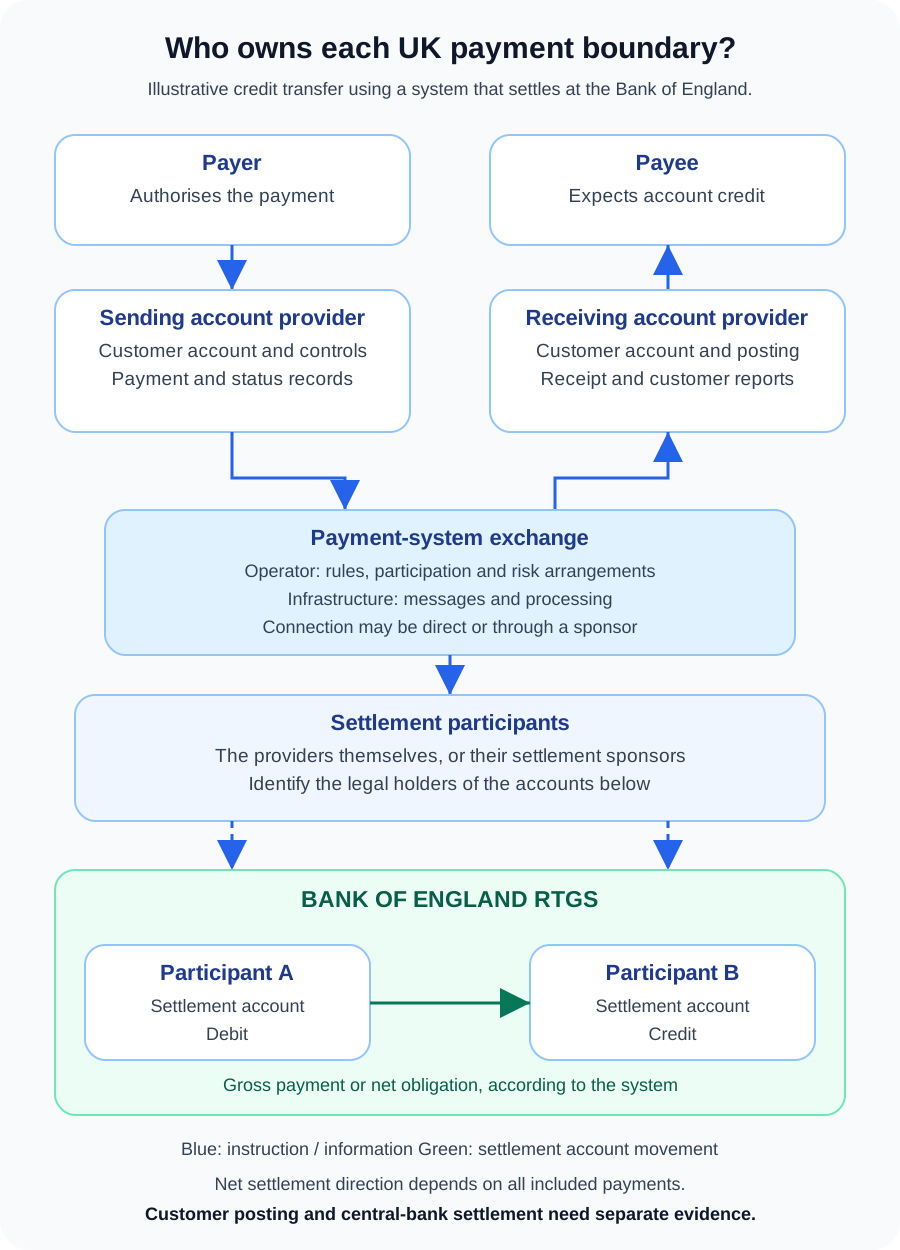
Read the diagram from the customer's service relationship into the inter-provider arrangement. Its settlement layer is illustrative for systems that settle in Bank of England accounts; it is not a claim that every payment product or internal transfer follows that path. Where a provider uses a sponsor, the sponsor's settlement account can support payments for multiple underlying customers or providers.
This map also tells operations where to ask a question. A customer-account posting problem starts with the account provider. A central-system processing incident needs the participant's operator-facing route. A settlement-account discrepancy involves the institution that owns that account. A processor incident may explain why information is delayed, but operations still needs a financial account owner to establish whether money moved.
An operational contact list should mirror these responsibilities. One generic supplier support address cannot replace the different escalation paths for a message incident, a settlement-funding issue and an incorrect customer ledger entry.
6. Direct access, sponsored access and settlement responsibility
Direct access generally means a relationship with the system operator that permits participation under that system's requirements. Indirect access uses an agreement with a provider that already has the relevant access. Pay.UK also uses the terms sponsored access and agency banking for indirect arrangements. The exact participation model must be checked system by system. Pay.UK's access guidance provides the starting distinction.
Connectivity and settlement are separate questions. Faster Payments illustrates this clearly: a participant can connect directly and settle for itself; connect directly while a sponsor settles; or use a sponsor for both the connection and settlement. These are the three access options described in Pay.UK's participation guidance. A diagram showing a direct technical link must therefore not silently imply that the institution owns the Bank of England settlement account used for those payments.
Suppose Moorland Pay sends through a sponsor. Its customer may hold enough spendable value, yet the sponsor may refuse release because the agreed funding or exposure capacity is insufficient. Conversely, the sponsor may have central-bank liquidity while Moorland Pay lacks the operational authority or product permission to send a particular instruction. Customer funds, provider capacity and settlement liquidity are different checks.
An indirect arrangement also creates an additional reconciliation boundary. Moorland Pay must reconcile its customer ledger with the sponsor's reports and account movements. The sponsor must reconcile its own records with system and settlement evidence. A successful reconciliation at the sponsor does not prove that Moorland Pay allocated every payment to the correct customer. The provider's controls must reach across both layers.
Non-bank status does not automatically exclude direct settlement. Eligible FCA-authorised payment and e-money institutions can apply for RTGS access, subject to the Bank's criteria, assessment and discretion. Small registered payment or e-money institutions are not eligible under that access policy. The Bank's non-bank access guidance also explains why direct settlement does not remove every commercial-bank dependency.
A practical access decision should consider volume, operating coverage, resilience, liquidity management, evidence access and cost. The contract must define funding, supported services, cut-offs, incidents and exit arrangements. “We have an API to the sponsor” answers only how instructions enter one part of the chain; it does not establish the complete service model.
7. Law, regulation, scheme rules and bank contracts
Four layers commonly influence the same payment. Legislation creates the legal framework. Regulatory rules, directions and supervisory requirements apply within the relevant regulator's powers and scope. Payment-system rules govern participation and processing in a particular system. Bank and service-provider contracts define the product offered within those constraints. A requirement should identify its source rather than call every obligation a regulation.
The Payment Services Regulations 2017 and Electronic Money Regulations 2011 are central UK legal frameworks for their respective subjects. The FCA's Payment Services and Electronic Money Approach Document explains its approach to those frameworks. Guidance is not a substitute for the underlying law or applicable Handbook rules. Equally, copying a rule from another jurisdiction because the service sounds similar can produce the wrong customer rights or implementation.
The Prudential Regulation Authority, part of the Bank of England, supervises the prudential position of banks, building societies and other firms within its remit. The FCA has conduct and other regulatory responsibilities, including the payment and e-money framework. The Bank has financial-stability responsibilities for relevant financial market infrastructures as well as its operator and settlement roles. The Payment Systems Regulator has functions concerning designated payment systems. These responsibilities overlap in the ecosystem without making the organisations interchangeable. See the PRA overview and the PSR's current information.
As at this review date, government plans to consolidate the PSR into the FCA are a transition to track, not a reason to relabel every existing PSR direction as an FCA rule. In April 2026 government confirmed the intended consolidation and said primary legislation is required; the Financial Services and Markets Bill 2026 was introduced in May 2026, but PSR statutory powers and existing directions remain in force until Parliament enacts the change. Establish the authority and applicable instrument when implementing a requirement. A change in staffing or a shared contact point is not, by itself, the legal effective date of a transfer of powers.
The Financial Ombudsman Service considers eligible complaints after the provider has had the opportunity to respond under the applicable process. It does not operate a payment system or issue settlement acknowledgements. A complaint decision, a scheme recovery and a bank's voluntary refund can have different foundations and financial consequences. The Ombudsman's complaint guidance describes the route.
In Northbridge's project, a useful requirement record would state the applicable rule or contract, its effective version, the responsible team and the evidence of compliance. That is more actionable than a field labelled “regulatory requirement” with no supporting source. Chapter 14 develops customer protections and the regulatory perimeter; this chapter establishes where those obligations enter the map.
8. What kind of money does the customer hold?
A positive number in an app can represent different legal and accounting relationships. In a bank deposit account, the customer's balance is a liability of the bank. In an e-money arrangement, the customer has a claim against the issuer under that product's terms and legal framework. A payment institution may hold relevant funds in connection with payment services. These should not all be described as bank deposits.
Safeguarding protects relevant customer funds under the applicable payment or e-money regime. Under the FCA's current regime, authorised payment institutions other than firms solely providing payment-initiation or account-information services, authorised and small e-money institutions, and UK credit unions issuing e-money are in scope; small payment institutions may opt in. Safeguarding remains distinct from deposit protection. Failure of the non-bank provider is not an FSCS deposit-protection event simply because that provider uses a bank. Recovery can involve an insolvency process, time and costs. The FCA's consumer explanation and PS25/12 set out these distinctions.
Eligible bank deposits can qualify for Financial Services Compensation Scheme protection, subject to the scheme's conditions. At this review date, the standard deposit limit is £120,000 per eligible person per authorised firm, following the change on 1 December 2025. Accounts under different brands can share one authorisation. That limit concerns qualifying deposit protection; it is neither a payment-system transaction limit nor an automatic refund limit for fraud. See the Bank's FSCS explanation.
The Bank of England settlement account is another relationship again. A participating institution's balance there is central-bank money used for settlement. Northbridge does not acquire a personal RTGS account when its bank sends CHAPS. Nor is the institution's settlement balance simply the sum of the numbers displayed in its customer apps. Its balance sheet, payment flows and funding arrangements connect those layers.
For a simple internal transfer, the bank reduces one customer liability and increases another; no external settlement asset has to move for that book transfer. For an external transfer, the provider also needs the appropriate inter-provider funding and settlement arrangement. A customer may be fully funded while the provider has a liquidity problem in the account or system needed for execution.
For an implementation team, ask three separate questions: what claim does the customer hold, how are relevant funds protected, and what funding supports execution? Chapter 12 expands the treasury dimension, and Chapter 14 develops safeguarding and protection. Keeping those questions separate now prevents misleading explanations later.
9. Instruction, clearing, settlement, posting and availability
An instruction expresses an authorised request to perform a payment. Messaging communicates information about that request or its outcome. Clearing comprises the relevant exchange, validation and calculation of obligations before settlement under the system's arrangements. Settlement discharges the obligation using the agreed settlement asset and accounts. Posting changes a ledger. Availability concerns whether funds can be used. Finality concerns the point at which the relevant transfer or settlement is irrevocable and unconditional under its legal and system framework.
These are not seven mandatory screens in a rigid order. Systems combine activities differently. A receiving provider can make customer funds available before the next net settlement cycle. A sending provider can reserve funds before release without making the final debit at that moment. A message may contain information about a financial event that has already happened. The bank's design must preserve the meanings even when its implementation groups the work.
CHAPS payments settle individually in RTGS. Bacs and Faster Payments use net settlement arrangements, although their customer processing patterns differ. The Bank's payment and settlement overview describes central-bank settlement of the resulting obligations. An immediate Faster Payments customer experience must therefore not be drawn as a separate RTGS transfer for each retail item.
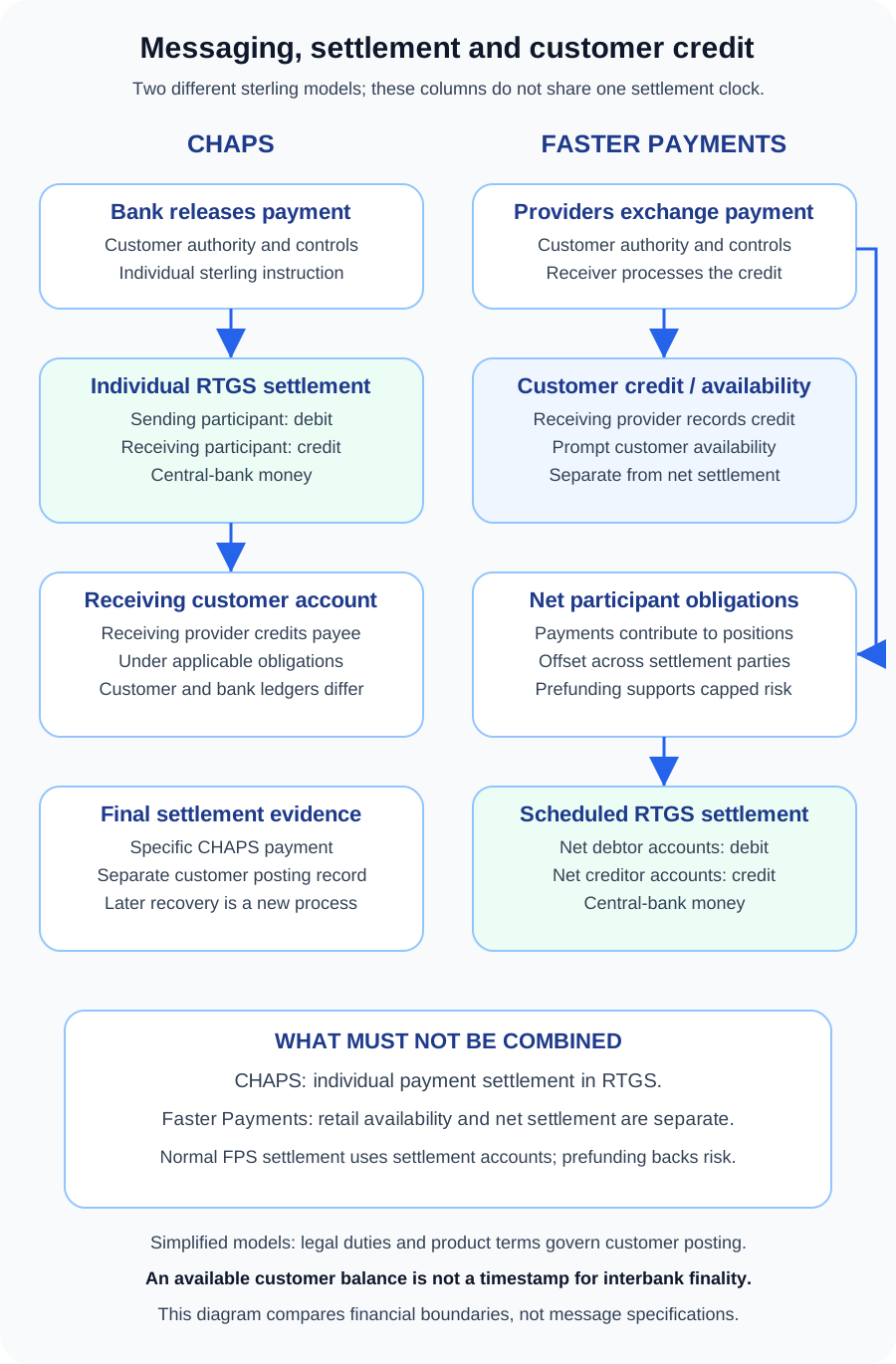
The diagram compares two models; it does not promise a universal customer-posting sequence. Its Faster Payments side shows why the receiver can see a credit while the participants' next net settlement remains a separate event. Prefunding and related controls support the settlement arrangement; they do not convert each retail instruction into CHAPS.
In normal Faster Payments settlement, participants use their reserves or settlement accounts. The separate prefunding balance backs their capped obligations if a participant cannot meet settlement; it is not normally spent afresh on each retail payment. Pay.UK's January 2026 system principles explain that relationship. This distinction matters when treasury reconciles available funding against the customer-payment population.
Consider a deliberately simplified two-participant net cycle. Bank A owes Bank B £100,000 for included payments, while Bank B owes Bank A £70,000. The net obligation is £30,000 from A to B. Individual customer records still show the underlying payments, not one £30,000 customer transfer. Real multilateral systems aggregate across more participants and apply their own rules. The arithmetic illustrates netting rather than specifying a production settlement file.
Final settlement does not settle every legal or customer question. A subsequent refund, recovery payment or reimbursement may create a new financial obligation. It does not mean the original settlement never occurred. Likewise, a customer's available balance is not sufficient evidence of the precise interbank finality event. Use the relevant system's rules and the correct account evidence for that claim.
10. The core UK routes in context
The following comparison locates the principal services. It is a route map, not a schedule or an eligibility guarantee. Each later chapter owns the detailed authority, processing, exception and reporting mechanics for its subject.
| Route or model | Typical business fit | Financial boundary to recognise |
|---|---|---|
| Bacs Direct Credit | Planned wages, benefits and other bulk credits | Customer items and files feed a scheduled processing cycle and net settlement. |
| Bacs Direct Debit | Authorised bill and subscription collections | The creditor initiates a collection; authority, unpaid items and refund rights need separate records. |
| Faster Payments | Immediate and scheduled sterling credit transfers, including standing orders | Customer processing operates around the clock; interbank net settlement is a separate process. |
| CHAPS | Time-critical sterling payments and wholesale transfers | Each payment settles individually in Bank of England RTGS accounts. |
| Cards and acquiring | Shop, online and recurring merchant collections | Authorisation, financial clearing, participant settlement and merchant funding are distinct. |
| Image Clearing System | Cheques and eligible paper instruments processed through image exchange | Capturing an image is different from paying-bank processing and settlement. |
| Cash collection | Physical takings paid into an account | Custody, counting and contractual account credit must be reconciled. |
| On-us transfer | Transfers between accounts on the same provider's relevant books | Internal ledger changes may complete the movement without external clearing. |
Bacs serves both credits and debits; it is not another name for Direct Debit alone. Pay.UK's Bacs overview identifies both categories. Planned processing suits obligations known ahead of their due date, but the file's submission status does not prove that every underlying payment has achieved its intended result.
Faster Payments supports a different customer expectation: prompt account-to-account payment handling, including services available outside normal office hours. The sender's product limits and receiving capability still matter. The Faster Payments overview should be read alongside the participant's actual offering. A bank can provide a narrower service than the maximum capabilities of the central system.
Cheque image exchange modernises the handling of a cheque; it does not turn a photograph into an instant credit push. A deposit notification and a paid-item outcome answer different questions. Pay.UK's Image Clearing System description provides the system context, while Chapter 7 follows custody, deposit and exceptions.
Other arrangements also belong on the wider UK map. LINK supports the ATM network; international payments may involve correspondent accounts, currency conversion and foreign systems; specialist property and securities arrangements have their own settlement context. They do not all require a separate retail payment button. The important starting skill is to identify when the basic account-payment model is insufficient and a specialist flow must be mapped.
11. Choose the route from the business need
Route selection begins before a bank creates a system-specific message. Establish the currency, authority, required receipt date, destination, amount, data needs and permitted product. Then consider availability, system and bank limits, funding and operational readiness. Cost matters, but it should be evaluated within the set of routes that can satisfy the requirement safely.
For Northbridge's wage run, the finance team can prepare and approve instructions ahead of the due date. That makes a planned bulk service a plausible candidate. For a supplier payment needed immediately, the bank must check an immediate service against the amount and destination. For a property completion, the customer may require CHAPS under the solicitor's instructions and the bank's supported service. These choices follow the requirement; the amount alone does not identify the rail.
The collection side starts with authority. A business with a valid Direct Debit arrangement can prepare a debit collection. Without that arrangement, a request to pay an invoice can lead to a customer-authorised credit, but a biller cannot silently turn an unpaid request into a debit. An existing card-acquiring relationship may support a card purchase; an acquiring credential is not permission to originate bank-account collections.
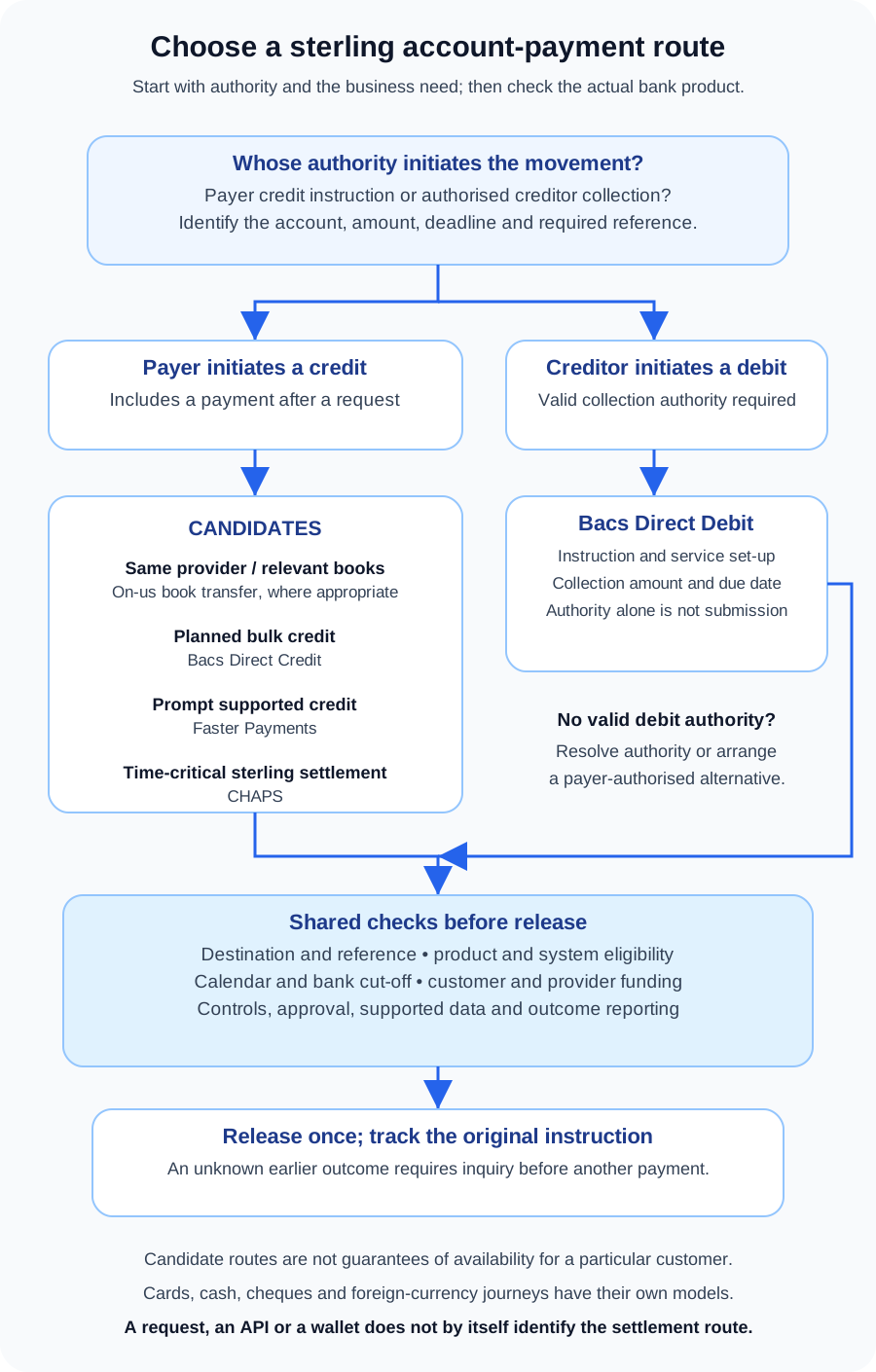
The shared gate in the diagram is deliberate. Choosing a candidate service does not mean it can be released. Northbridge's bank might support Faster Payments generally but apply a lower limit for a particular account, channel or customer. A destination might require a secondary reference. The requested date might fall outside a service's supported calendar. The provider must resolve those conditions before confirming execution.
Fallback requires particular care. If no instruction has been released and a route is unavailable, an alternative may be considered under the customer's authority and product terms. If the first instruction has been released but its outcome is unknown, changing rails can create a duplicate payment. That is an investigation condition, not ordinary route optimisation.
A good customer-facing explanation reflects the actual decision. It might say the payment is scheduled for a specified date, awaiting approval, or under investigation. A vague “processing” label used for all three leaves the customer unable to decide whether another action is safe. Route choice, evidence and communication should therefore be designed together.
12. Operating clocks and the promise made to the customer
A payment journey contains several clocks. The business obligation has a due date. The customer's channel has an instruction-receipt time. The bank has approval and release deadlines. The payment system has processing and settlement arrangements. The receiving provider has posting responsibilities. A calendar date without a time zone or business-day definition can leave those clocks misaligned.
Bacs has a three-day processing cycle, with net settlement once each business day. Faster Payments customer exchange is available around the clock, while its net settlement occurs three times each business day in RTGS under the current arrangement. Those facts concern different layers. A Saturday Faster Payment is not evidence that the same retail item settled separately at the Bank of England on Saturday. The Bank's settlement description is the authority for this comparison.
For CHAPS, the current settlement day runs from 06:00 to 18:00 on its operating days. The provider's customer cut-off can be earlier, and system calendars exclude relevant non-operating days. The planned earlier start in 2027 is addressed in Section 25. A bank must not advertise that future capability as today's customer service. See the Bank's settlement-hours policy.
Suppose Northbridge approves a payment five minutes before its bank's published cut-off, but required supporting information is missing. The submission time alone may not mean the bank received a complete executable instruction under the contract. A clear design states how it handles incomplete requests, approvals, rejected data and customer communication. It should not leave the branch or service desk to invent a promise while a queue is building.
Scheduled payments need execution-day checks. A beneficiary can change, an account can become restricted, funding can fall short or a service can experience an incident between scheduling and release. The scheduling acknowledgement proves that the instruction was recorded, not that future execution is guaranteed. The bank needs a defined revalidation policy appropriate to the product.
Store the relevant timestamps separately and retain their time zones. Use named UK local time where an external service specifies it, with correct handling of Greenwich Mean Time and British Summer Time. A server timestamp in UTC is useful for engineering, but the customer's contractual deadline must still be interpreted using its governing calendar. Chapter 15 develops operational incident and timing controls in more detail.
13. Sort codes, account numbers and secondary references
For many domestic sterling journeys, the payer supplies a six-digit sort code and an eight-digit account number, together with the account name and any required reference. The combination identifies the destination in the relevant provider and routing arrangements. It does not independently establish customer authority, beneficiary legitimacy or the account's ability to receive every type of payment.
Pay.UK manages industry rules and processes for sort codes. Its sort-code guidance and Extended Industry Sort Code Directory information explain their routing role. A current directory can identify supported services and routing details. A bank should not infer capability solely from a familiar bank name or a sort code stored years earlier.
Some destinations also require secondary reference data, often abbreviated to SRD. This can identify a final account behind shared payment details, such as a building-society roll number or a credit-card account being paid. Omitting that reference may prevent the receiver from applying funds correctly even when the main destination is reachable. Pay.UK's Confirmation of Payee FAQs explain this use.
An invoice reference has a different purpose. It tells the receiving business how to apply a receipt against a commercial obligation. A required secondary account reference cannot safely be replaced by a helpful invoice description unless the receiving institution's instructions allow that. The screen should make the distinction visible when the destination requires both routing and business information.
Confirmation of Payee, or CoP, checks the supplied account name against the relevant account information through the service. It is a pre-payment assurance measure, not settlement, not proof that the invoice is genuine and not a guarantee that the payer is free from manipulation. Technical validation of a sort-code/account-number combination answers another question again. Different checks reduce different errors; none should be presented as universal approval to pay.
Store identifiers as strings so leading zeros survive. Validate the appropriate length and character rules at the relevant interface, and retain the original supplied data alongside any permitted normalisation. If an imported spreadsheet removes a leading zero, a technically valid API payload can still contain the wrong information. The bank needs to detect that at intake rather than rely on the payment system to repair the customer's record.
14. IBANs, BICs and international boundaries
An International Bank Account Number, or IBAN, identifies an account using a standardised national structure. A Business Identifier Code, or BIC, identifies an institution or business party under its standard. The two identifiers have different jobs: an IBAN is not the name of a payment system, and a BIC is not the beneficiary's account. Swift acts as registration authority for these standards and publishes IBAN information and BIC information.
International instructions can require more than either identifier. Currency, beneficiary information, intermediary arrangements and the sending product determine the necessary data. Use the beneficiary's verified instructions and the bank's applicable requirements. Do not construct an international route from an assumed relationship between a domestic sort code and an organisation's brand.
Swift is a financial messaging network and standards provider. Sending a message through it does not itself move a balance from Northbridge's account to a foreign supplier. The money movement can involve correspondent-account entries and settlement in one or more systems. A message-delivery acknowledgement and a correspondent-account debit are therefore different evidence.
The UK also participates in the geographical scope of SEPA, the Single Euro Payments Area. That concerns euro schemes; it does not turn a domestic sterling Faster Payment into a SEPA payment or automatically apply all EU rules to a UK provider. Chapter 11 owns the international and foreign-exchange flows. The European Payments Council's SEPA overview provides the geographical and currency context.
For this foundation chapter, the practical lesson is to recognise a boundary crossing. If Northbridge owes euros to an overseas supplier, “send £24,600” does not fully describe the task. The bank must establish the amount and currency to be delivered, conversion arrangements where relevant, fees, route, deadline and evidence of the receiving outcome. Those decisions change both the payment data and the reconciliation.
Do not load a UK domestic service with international assumptions simply because the bank uses an international messaging standard elsewhere. The route's actual rules determine how account identifiers, institution identifiers and customer information are used. Standards make data interoperable only when the participating services apply compatible definitions and usage requirements.
15. Payment identifiers and remittance that survive the journey
A single payment can acquire several identifiers without becoming several payments. Northbridge has an invoice number. Its portal creates an instruction reference. The bank records an internal payment identifier. A sponsor or payment system can add its own reference. Ledger entries and statements may use further identifiers. The operational requirement is to preserve the relationships between them.
The invoice number identifies the commercial obligation. A customer instruction identifier identifies a request. A submission or message identifier may identify a file or transmission rather than an individual financial transfer. A ledger entry reference identifies a booking. If a bank uses only one field called “reference” for all of these, it becomes difficult to investigate whether two records are duplicates, related events or unrelated transactions.
A robust design stores both the source identifier and its context: who assigned it, at which stage, for which object, and within what uniqueness scope. This is an implementation principle, not a universal UK message format. The particular system specifications determine which identifiers must travel externally and how they are validated.
Remittance information explains why funds were paid. It can identify one invoice, several invoices, a partial payment or an adjustment. Some detail may travel in the payment, while supporting documents arrive through a separate channel. The receiver needs a reliable way to connect them. A long remittance document is of little use if its reference is removed when the bank generates the customer statement.
Suppose Northbridge receives £18,000 against three invoices. The sender enters only its trading name in the payment reference, then emails an allocation spreadsheet. The bank can correctly credit Northbridge while its receivables system remains uncertain. The problem is not necessarily payment failure; it is incomplete business matching. An account statement, payment details and external remittance together may resolve it.
Data minimisation still matters. A reference should carry the information needed for the payment and its application without exposing unnecessary personal or sensitive details. Payroll records, for example, should not be populated with unrelated employee information just because a file permits free text. The bank needs access controls and retention appropriate to the data and the relevant obligations.
During testing, follow a chosen reference from the customer's input through every permitted transformation to the receiver's report. Test leading zeros, long values, supported characters and missing data. A syntactically valid message is not enough if the transformation destroys the information that enables the business to recognise its money.
16. Files, APIs and ISO 20022 have different jobs
A file is one way to package and submit instructions. An application programming interface, or API, defines how software systems interact. ISO 20022 provides a financial messaging methodology, dictionary and business-message definitions. A payment system defines how participants use the relevant messages and data in its service. These concepts can work together without becoming synonyms.
Northbridge's payroll application may upload a bank-specific file. The bank can validate and transform it for the selected service. Another customer may use an API to initiate a payment that follows the same underlying rail. Neither intake method proves the external clearing format. The implementation must distinguish the customer-to-bank contract from the bank-to-system specification.
Open banking introduces identifiable roles around those interfaces. An account-information service accesses permitted account information; a payment-initiation service helps initiate a payment from an account held with another provider. Customer consent and the account provider's authentication process remain important. Reading an account balance is not authority to send a payment, and the payment initiator need not be the institution holding or settling the funds. Open Banking's service overview supplies the context; Chapter 8 develops consent, initiation and recurring-payment arrangements.
Within ISO 20022, payment initiation, interbank payment and cash-management messages serve different business purposes. Familiar families such as pain, pacs and camt do not provide an automatic map to every UK service. A bank may support an ISO-based corporate interface while the selected service uses another external format. Conversely, an ISO-based interbank service need not expose the same message directly to a customer. ISO's overview explains the standard's role.
CHAPS and RTGS migrated to ISO 20022 in June 2023. Their implementation includes specific usage requirements and enhanced data policies. It would be inaccurate to conclude that all UK rails consequently use the same schema or that every supported enhanced field is mandatory for every payment. The Bank's ISO 20022 guidance and its handbook identify the applicable material.
API responses require equally careful interpretation. An HTTP response can confirm that a service received or processed a request at the software interface. It proves a financial outcome only if the API's documented status semantics and underlying evidence support that meaning. A timeout may leave the outcome unknown; it is not automatically a payment rejection. The customer instruction, transport request and financial transaction need separate identities where the interface design requires them.
Do not invent a universal UK XML example or field-length table here. Exact schemas, versions, message purposes and release dates belong to the relevant system chapter and current specification. At this level, the useful technical skill is to identify the interface, its data contract, its authoritative specification, the evidence returned and any transformation between interfaces.
17. Inside the bank, from channel to ledger
A practical bank architecture begins with channels: mobile and online banking, branch services, corporate portals, payroll connections and APIs. These collect instructions and present information. Identity and entitlement services establish who is acting and what that person or system may do. A company employee allowed to view balances may not be allowed to release a payment or amend a beneficiary.
The payment-processing layer checks the request and manages its lifecycle. Depending on the institution, this may be a shared payment hub, several product engines or services operated by a processor. It evaluates product eligibility, reference data, duplicate risk and the selected route. It coordinates with fraud, financial-crime, account and funding controls. The precise sequence varies with the service and risk model; it should not be presented as one mandatory architecture for every bank.
A gateway or sponsor interface carries the instruction into the external arrangement. The bank must preserve the distinction between an internal release decision and evidence from that external service. Durable records are especially important where a process can fail after sending but before storing the response. A retry policy that ignores that failure point can create duplicate payments.
Core banking and ledger services record customer balances and the bank's financial position. Treasury monitors the funding relevant to execution and settlement. Reporting services translate events into customer statements, notifications and operational views. Reconciliation compares records across those boundaries, while investigation tools provide an accountable case when the evidence does not agree.
Imagine a valid supplier instruction that reaches the bank gateway while the notification service is unavailable. The financial payment might still complete, even though the customer receives no alert. Conversely, a channel can send a confirmation that the instruction was recorded before the bank has released it. The architecture needs event meanings that remain correct when individual components are delayed.
A practical event record should identify the payment, the event, its source, event time, recorded time and evidence reference. It should distinguish a business status from a technical transport state. Access to that history should be controlled, but operations must be able to reconstruct the chain without manually joining unrelated screenshots from different teams.
The customer's view should follow the reliable event model. “Awaiting approval” invites a different action from “sent; outcome being checked”. A well-designed bank makes that difference clear because its systems already know which boundary has been crossed, not because a service agent has improvised a reassuring phrase.
18. Account switching and controlled data maintenance
Bank details can change without the underlying customer or supplier relationship ending. The Current Account Switch Service, or CASS, helps eligible customers move current accounts between participating providers. Its service includes transferring relevant payment arrangements and redirecting payments sent to the old account under the switching arrangements. The published switching process takes seven working days. CASS's service explanation describes the Guarantee and process.
Eligibility matters. The service is not a universal migration mechanism for every account, product or corporate relationship. A bank must establish whether the customer and account qualify, what arrangements are included, and what the customer must handle separately. Recurring card payments, for example, should not be assumed to update merely because a current account switches. The service's common questions describe the practical boundaries.
For Northbridge, switching creates both an operational and a data-maintenance issue. A payment addressed to old details may reach the new account through the service. The company's finance system should still update its records using reliable evidence rather than rely indefinitely on redirection. A new successful destination is useful, but the original address, redirect event and final account relationship should remain traceable where the bank's records support them.
Do not confuse an official switching or account-change notification with an unverified email asking a payer to replace a supplier's bank details. The former follows a defined service process; the latter may be an attempted diversion. The bank or corporate must validate the source and apply the appropriate authority before changing a beneficiary record.
Scheduled instructions add a further complication. A future payment may have captured account details before a verified change occurred. The implementation needs a clear policy on whether that instruction retains its original details or receives an authorised update, and how the customer sees the change. Neither silent mutation nor blind reuse of stale information is a sufficient design.
The same principle applies to sort-code directories and service capabilities. Updating reference data is an operational change with a source, effective date, validation and rollback process. A routing table should not be treated as permanent configuration. When an account or institution changes, the bank must keep the payment's historical evidence intact while using appropriate current information for new instructions.
19. Controls belong to identifiable decisions
Controls make more sense when attached to the decision they support. Authentication establishes who is using a channel. Entitlements establish what that user may do. Approval establishes release authority under the product. Account validation checks whether supplied details meet relevant rules. Confirmation of Payee provides account-name assurance. Fraud controls assess deception and abnormal behaviour. Sanctions controls assess restrictions that can prohibit or constrain activity. These are different questions.
In Northbridge's supplier case, a genuine employee can be manipulated into paying a fraudster. Successful authentication therefore does not prove that the economic purpose is legitimate. Equally, a matching account name does not prove that the invoice or supplier-change request is genuine. CoP improves assurance about the destination information; it does not replace all the other controls. Pay.UK's CoP overview defines the service's purpose.
Sanctions screening needs the applicable legal framework and current data. At this review date, the UK Sanctions List is the sole source for UK sanctions designations; the former OFSI consolidated list stopped being updated on 28 January 2026. A bank must also consider restrictions and ownership or control issues that are not resolved by a simple name-list comparison. The current UK Sanctions List publication identifies the source transition. Chapter 13 develops financial-crime decisions in detail.
The control outcome should create an actionable status. A payment waiting for an authorised second approver should go to the appropriate approval queue. A potential sanctions match needs the designated review process. A missing secondary reference needs data repair through an authorised channel. A generic “failed” status hides these distinctions and may cause a customer to attempt a second payment unnecessarily.
Controls also need ownership when work is outsourced. If a processor performs screening, the bank still needs to understand the service, escalation arrangements and evidence available for its responsibilities. If a sponsor imposes an exposure limit, the account provider needs a way to distinguish that funding decision from a customer insufficient-funds condition.
Finally, operational speed should be part of the design. A service offered outside office hours needs appropriate monitoring and response arrangements. That does not mean every issue can be resolved instantly, but it does mean an incident cannot disappear until Monday simply because the customer interface remains open all weekend. The customer promise and support model must be compatible.
20. Exceptions begin with the original outcome
An exception is not one universal failure state. An instruction can fail validation before release. A receiving service can reject it. A payment can complete and later become the subject of a return, refund, recovery request or dispute. A communication failure can leave the bank uncertain about the outcome. Those states call for different actions and can have different legal foundations.
A rejection normally indicates that the relevant instruction or transaction was not accepted at the specified stage. State the stage: a rejected upload is not the same as a receiving-bank rejection. A return is a separate financial process concerning an earlier payment under the applicable arrangement. A cancellation or recovery request asks for action; it does not prove that funds have been recovered. A refund and a card chargeback have their own business and scheme context. Use the vocabulary of the relevant rail rather than importing terminology from another country or system.
An unknown outcome deserves particular attention. Suppose Northbridge's portal loses its response after the bank has sent the supplier payment. The absence of a response is evidence of a communication problem, not evidence that no money moved. Operations should locate the original instruction, establish release and external status, and reconcile the relevant account records before authorising another payment.
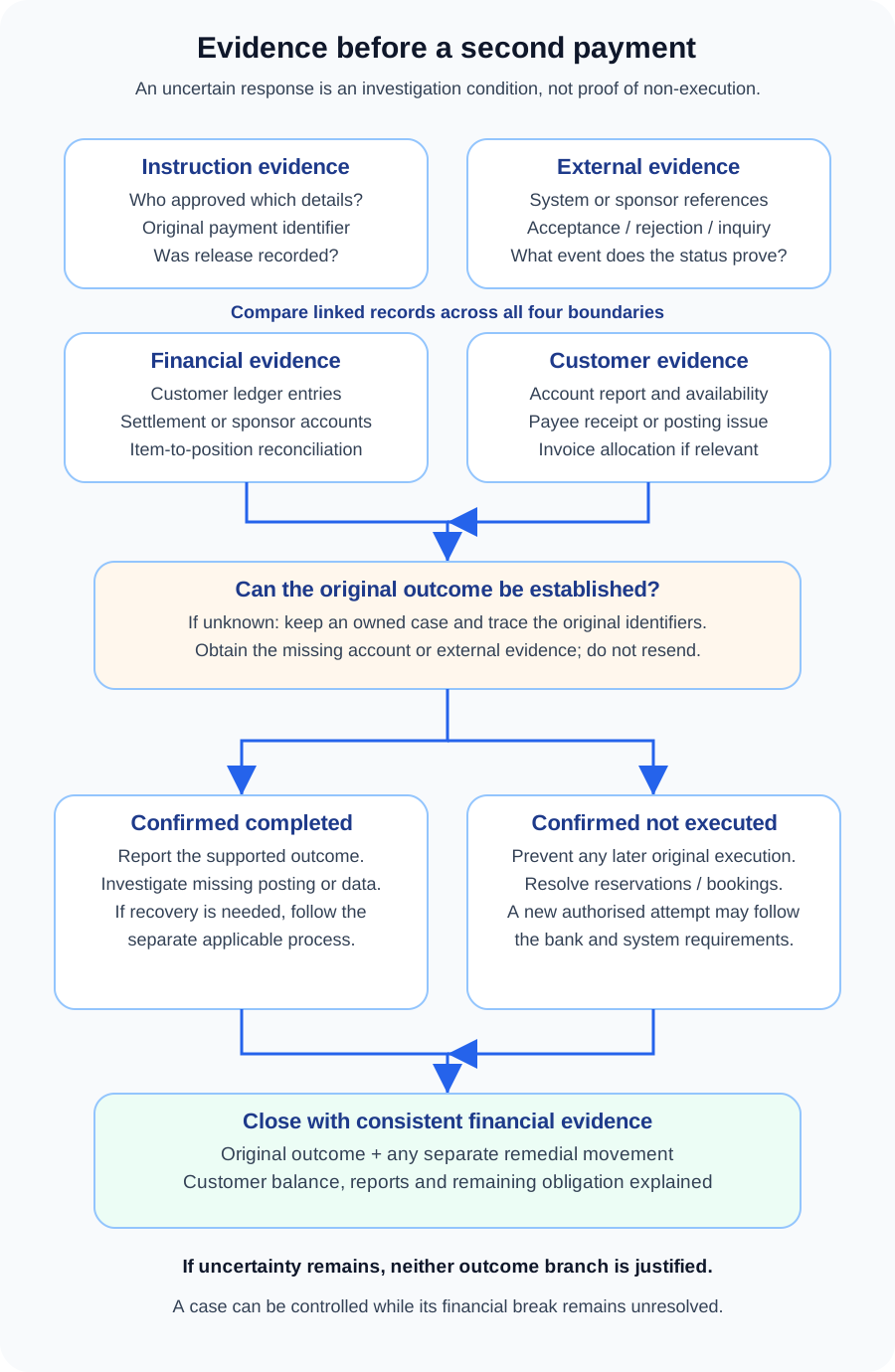
The diagram's outcome branches are deliberately evidence based. A confirmed completed payment requires correct reporting, posting investigation if needed, or a separate recovery process. Confirmed non-execution may permit a new authorised attempt after the original is prevented from executing later. An unresolved case remains owned and investigated. A timeout alone does not select the non-execution branch.
Customer remedies also require scope checks. The Direct Debit Guarantee, regulatory rights for unauthorised transactions, APP scam reimbursement and card dispute processes are not interchangeable. The PSR's APP reimbursement information concerns qualifying cases under that framework, not every failed or disputed payment. Chapter 14 compares protections; the rail chapters explain their own exception mechanics.
Before closing a case, identify the original financial outcome, any separate remedial movement, the affected customer balance and the remaining business obligation. Otherwise a bank can close the technical incident while leaving the customer short of funds, or issue a second refund because two teams treated the same complaint as unrelated cases.
21. Reconciliation, accounting and customer reporting
Reconciliation establishes that records agree for the correct reason. Matching two totals is useful, but it does not prove that each customer received the correct amount. An extra £500 payment and a missing £500 payment can leave an unchanged total. The bank needs the appropriate item-level links as well as control totals and account reconciliation.
At the instruction boundary, reconcile what the customer authorised with what the bank accepted and released. At the external boundary, reconcile released instructions with system or sponsor outcomes. At the financial boundary, reconcile the bank's payment records with settlement or correspondent accounts and the general ledger. At the customer boundary, reconcile postings, fees, refunds and reports. An indirect provider has an additional sponsor boundary to reconcile.
For a simplified interbank credit settled individually, Bank A reduces its liability to the payer and reduces its settlement asset; Bank B increases its settlement asset and its liability to the payee. Actual banks may use pending, clearing or suspense accounts and different posting sequences. The final economic effect is the teaching point. A reserved amount is not automatically the same ledger event as a completed payment debit.
Under net settlement, individual payment records accumulate into a participant's settlement position. The settlement-account entry is then reconciled to the relevant net obligation, while the underlying customer items remain separately identifiable. The £30,000 illustration in Section 9 must not be matched to a fictional customer payment for that amount. The bank needs the link between item populations, position calculations and settlement records.
On the collection side, Northbridge reconciles a bank receipt with its receivables ledger. A merchant additionally reconciles sales, captures, fees, refunds, adjustments and payouts under its acquiring agreement. Its bank credit can legitimately differ from gross sales, but the difference needs an explainable record. “The processor paid less” is not a completed reconciliation.
An unresolved break can be controlled without being reconciled. Give it an owner, amount, reason, age and next action. A suspense entry can preserve balanced books while investigation continues; it does not make the underlying error disappear. Reporting should distinguish matched outcomes from open exceptions.
Customer reports should state what their events mean. A bank statement normally evidences an account booking, whereas an instruction report may show a future scheduled item. A system acknowledgement has another scope. When Northbridge asks for proof of payment, the bank should provide the appropriate evidence and explain any remaining uncertainty, rather than attach the first available successful-looking status.
22. Worked case: an urgent supplier payment
Return to Northbridge's £24,600 payment. Its parts supplier, Pennine Components, uses Moorland Pay, which receives Faster Payments through a sponsor. For this fictional case, assume Northbridge's bank supports the amount and destination, the customer has approved the instruction, the relevant controls have passed, and the provider has sufficient funding. These assumptions describe the case; they are not universal limits or service promises.
Northbridge enters the supplier's verified payment details and invoice reference. The bank records the authority, approved data and instruction identifier. It applies its product and destination checks, then releases the payment through its supported Faster Payments arrangement. Northbridge's internal invoice remains linked to the original instruction even if the gateway assigns another reference.
The receiving sponsor processes the incoming payment within its arrangement with Moorland Pay. Moorland Pay then needs to identify Pennine Components and update the appropriate customer records. The sponsor's role in system participation and settlement does not remove Moorland Pay's responsibility for its customer-level outcome. This is why the provider and settlement-account holder were identified separately before the payment was sent.
Now introduce a failure: Northbridge's portal response times out. Amira sees the amount no longer available in the spending balance, but no reliable completed status. She asks whether to send the payment again through CHAPS because the supplier is waiting. Operations should not infer completion from the balance alone, but it should not infer failure from the timeout either.
The investigator locates the original instruction and gateway reference. The bank checks the available external outcome and its own booking records. The case then establishes that the receiving-side payment was accepted under the service and traces the related credit through the sponsor and Moorland Pay. If Pennine's app has not displayed the receipt, the investigation moves to the receiving provider's posting or reporting boundary. A second transfer would not repair that display problem.
If instead the bank obtains reliable evidence that the original was rejected and cannot subsequently execute, it can resolve any reserved or debited funds under its process and consider a new authorised instruction. It must preserve the link to the failed attempt. The customer should not see two unrelated payments without an explanation of which one executed.
The bank's net settlement evidence is reconciled at the appropriate participant level. It is not a separate £24,600 RTGS receipt for this retail payment. A customer service agent should therefore avoid promising to find such a record. The investigation follows the evidence the actual model produces.
The final customer communication should answer the business question: which supplier account received the value, what reference accompanied it, what evidence supports the result, and whether any action remains. The case closes only when financial records and communication are consistent. The lesson is the participant and evidence map; Chapter 4 supplies the detailed Faster Payments lifecycle and exception rules.
23. Worked case: money received, invoice still open
Northbridge's receivables team expects £18,000 from a maintenance customer. The customer sends a bank transfer covering two overdue invoices of £7,000 and £6,000 and a current invoice of £5,000. The bank correctly credits £18,000. The statement reference contains the customer's abbreviated trading name, while the allocation information arrives separately through the customer's finance portal.
The automated matching process finds several customers with similar names and declines to allocate the receipt. That is an appropriate uncertainty to surface. Choosing the oldest three invoices merely because their total happens to match could close the wrong obligations and create an inaccurate credit-control position.
The bank payment has succeeded at the account-credit boundary, while the corporate collection remains incomplete at the cash-application boundary. The receivables analyst should obtain the remittance details, connect them to the bank receipt and confirm the invoice allocation. The bank's role is to supply the payment information it holds; it cannot necessarily determine the customer's intended invoice split from a short reference.
Northbridge records the receipt and allocates £7,000, £6,000 and £5,000 to the identified invoices after checking the evidence. If an invoice had already been paid, the analyst would need to resolve the excess or disputed allocation rather than force the whole amount into a successful-looking match. The cash receipt, allocation and any later refund remain separately recorded.
Now compare a £18,000 card-sales report. That figure cannot automatically be matched to a £18,000 bank credit. Depending on the acquiring agreement and reporting period, fees, refunds, adjustments or retained amounts may affect the payout. The receivables team needs the acquirer's financial report and the payout identifier. An authorisation total is not the same thing as captured sales or funded merchant proceeds.
A Direct Debit collection introduces another distinction. The collector's expected receivable and submitted amount must be reconciled with collection outcomes, including any unpaid item or subsequent relevant refund. The bank should not treat the submitted collection file as permanent proof of cash. Chapter 3 develops that lifecycle, and Chapter 9 applies the information to billing and receivables.
Across these examples, the useful operational habit is to ask which boundary is incomplete. Is the money missing, the account posting missing, the report delayed, or the invoice allocation unresolved? Each answer points to a different owner and avoids an unnecessary recovery request or duplicate refund. Clear payment evidence improves collections because it lets the business work on the actual remaining problem.
24. Build a bank requirement from the map
Suppose a product owner writes: “Business customers must be able to pay suppliers instantly from the portal.” That describes an intention, but it leaves important decisions unresolved. Which accounts qualify? Which currency and destinations are supported? What does instantly mean? Who can create and approve the instruction? What happens if the provider cannot establish the outcome?
A useful requirement connects the customer promise to a specific event. It might define receipt of an instruction separately from its approval and release, then describe which confirmed external and account events support the displayed completion status. The exact service-level values must come from the product agreement and applicable system arrangements. They should not be invented during interface design.
The participant model names the customer-facing provider, external participant, sponsor if any, settlement-account holder and relevant processors. The data model records destination identifiers, required references, amount, currency, dates and correlation identifiers. The authority model records who can maintain beneficiaries and release payments. The financial model identifies customer reservations or debits, funding dependencies and settlement reconciliation.
The exception model then considers realistic interruptions. An instruction can be duplicated at upload, rejected for invalid data, held for review, released without a response or completed with a delayed report. Each event needs an owner and an allowed next action. “Retry three times” is not a safe financial requirement unless the interface guarantees and duplicate controls make the effect of those retries clear.
Testing should challenge these boundaries. Use a destination that requires a secondary reference, a value with a leading zero, a scheduled instruction whose beneficiary changes, and an otherwise valid request outside the bank's product limit. Interrupt the response after release and verify that the customer is not invited to send again. Confirm that the original identifier remains traceable through the external and ledger evidence.
Test reconciliation with deliberately mismatched records as well as the happy path. A missing customer credit, a duplicated report and a settlement-total difference should not all receive the same resolution. The system should distinguish a delayed informational event from a financial break and preserve the audit trail when an authorised correction is made.
These are suggested implementation checks, not additional scheme rules. Their value is that they expose assumptions hidden by a simple portal demonstration. A service is ready for customers when its promises, controls, financial records and support actions agree across the mapped boundaries. The later chapters supply the detailed rules needed to complete this design for each rail.
25. Current services, announced changes and proposals
Payment architecture must be dated. A service that is live, an approved change awaiting implementation and a proposal under discussion require different treatment. This chapter's position is reviewed to 5 October 2026; the following distinctions are particularly relevant to a UK foundation map.
CHAPS currently uses its established operating day. The Bank has announced its intention to move the start of settlement from 06:00 to 01:30 in September 2027, subject to final confirmation of timelines with affected direct participants.
The policy makes sending during the early-morning extension optional for CHAPS direct participants; all direct participants receive settlement from 01:30, while each direct participant decides when to process received payments and credit its own or customer accounts. That is a future change, not a current 01:30 customer promise. The Bank's wider consultation on extending RTGS and CHAPS settlement hours discusses further expansion; consultation options must not be described as a live weekend settlement service.
ISO 20022 implementation dates also need current verification. The Bank's 27 August announcement defers its entire November 2026 RTGS standards release, including CHAPS messaging changes. The release was deferred in its entirety. The Bank currently expects a 12-month deferral, potentially incorporating the changes into the November 2027 release, subject to confirmation; structured remittance has no revised mandate date. Bank of England release-deferral notice. Separately, the Bank states that structured remittance will not be mandated from November 2026 and gives no revised mandate date. These are distinct points, both recorded in the current ISO 20022 update. Existing supported data and existing obligations still need to be handled correctly.
For payment and e-money firms, the FCA's supplementary safeguarding regime took effect on 7 May 2026. A chapter written before that date should not continue treating it as merely forthcoming. The FCA policy statement and the current Approach Document establish the regulatory reference point. Chapter 14 owns the detailed implementation and protection analysis.
The digital pound remains a design project at this review date. The Bank states that no decision has been made to introduce it. It should not appear as an available route for Northbridge's wages or supplier payment. A bank-deposit balance displayed digitally, e-money and a possible future central-bank digital currency are different forms and proposals. See the Bank's digital pound information.
The same discipline applies to open-banking expansion and new commercial services. Availability depends on the actual provider, product and contractual arrangements, not the existence of a standards document or announcement. Chapter 8 examines those services. For implementation, maintain the effective source, version, owner and review trigger alongside each material requirement. A future announcement can change the delivery roadmap without changing today's live processing rules.
26. Practitioner checkpoint and the next chapter
Before reading the suggested answers, work through the following short cases. Name the provider, relevant boundary and evidence you would seek. The aim is to explain a payment clearly enough that a product owner, developer and operations analyst would make compatible decisions.
A direct connection and a sponsored account
A provider connects directly to Faster Payments but uses a sponsor for settlement. Its product team says it settles directly because it operates its own gateway. Is that description sufficient?
It is not. Direct connectivity and settlement responsibility must be identified separately. The provider should name the actual participation model and the institution performing settlement. The operating design must also show how the provider reconciles its customer records with the sponsor's financial and payment evidence. A gateway topology alone cannot answer who owns the settlement account.
A successful response and a missing balance
A business receives an API success response, but its supplier reports no credit. What does the success response prove?
Read the documented status meaning and inspect the underlying event. It may acknowledge instruction receipt, approval, release or a later confirmed outcome. Trace the original identifiers through the sending provider, external arrangement and receiving account provider. Do not decide to resend until the original financial outcome is established. The problem may concern execution, customer posting or only reporting.
A valid account and the wrong reference
A payment reaches a shared collection account, but the required secondary reference is missing. The sender argues that the account details were valid. Has that completed the intended payment journey?
Technical address validity does not prove application to the intended final account. Investigate with the receiving provider using the original amount, identifiers and account evidence. Distinguish the missing secondary account reference from an invoice description. Correcting or recovering the payment must follow the receiving arrangement; a new transfer is not an automatic repair for the first one.
Available on Saturday
A consumer receives a Faster Payment on Saturday and can spend it. Does that prove the individual payment settled in RTGS on Saturday?
No. The customer availability event and the system's interbank net settlement have different timing and evidence. Explain the current settlement arrangement without diminishing the customer's valid account credit. Use the correct records for the claim being made: customer posting evidence for the account outcome and participant settlement records for the net obligation.
One final explanation
Take Northbridge's supplier payment and explain it in one paragraph without using the word “processed” as a substitute for a specific event. Your explanation should identify the authority, account provider, route, sponsor if used, settlement model, receiver posting and business reference. Add the evidence you would need if the customer disputed the outcome.
If you can do that, the common map is in place. Chapter 2, Bacs Direct Credit, Bulk Files and Payment Reports, follows a planned credit run through submission, processing, settlement and reporting. It will use the distinctions established here rather than rebuild the entire ecosystem.
27. Official and primary references
These sources were checked for the scope and dated claims in this chapter on 5 October 2026. The public explanations support this foundation lesson. Detailed implementation still requires the applicable current system specifications, participant agreements and product terms; a general overview does not establish every field, cut-off or exception rule.
Participants, access and settlement
- Bank of England — introduction to RTGS and CHAPS: operator, infrastructure and settlement roles.
- Bank of England — payment and settlement: gross and net settlement, participating systems and accounts.
- Bank of England — access for non-bank payment service providers: eligibility and settlement-account requirements.
- Pay.UK — access to payment systems: direct and indirect access.
- Pay.UK — Faster Payments participation: direct connection, sponsored settlement and indirect participation.
- Pay.UK — Faster Payments System Principles, January 2026: settlement accounts, net sender caps and the separate prefunding balance.
- Pay.UK — Bacs, Faster Payments and Image Clearing System: the three system overviews.
Data, initiation and switching
-
Pay.UK — sort-code information and Extended Industry Sort Code Directory: domestic routing information.
-
Pay.UK — Confirmation of Payee and CoP FAQs: account-name checks and secondary references.
-
Pay.UK — Request to Pay FAQs: request messaging and the separate payment.
-
Open Banking — what open banking is: consent-based account access and payment services.
-
Swift — IBAN and BIC: account and business identifiers.
-
ISO — about ISO 20022: the financial messaging standard.
-
Bank of England — ISO 20022 policy and current updates and ISO 20022 handbook: CHAPS and RTGS implementation, data and release status.
-
Current Account Switch Service — service and Guarantee and common questions: switching and payment-arrangement boundaries.
-
European Payments Council — about SEPA: euro schemes and geographical scope.
-
Bacs — Direct Debit Help Centre / Direct Debit Guarantee: direct scheme-owned reference for the Guarantee; Chapter 3 covers mandate, unpaid-item and indemnity mechanics.
Regulation, protection and change
- FCA — using payment service providers: provider types and protection of funds.
- FCA — payment services and e-money publications and current Approach Document: the applicable UK framework and FCA guidance.
- FCA — changes to safeguarding, PS25/12: the supplementary regime effective in May 2026.
- Bank of England — prudential regulation and FSCS explanation: prudential responsibilities and deposit protection.
- Payment Systems Regulator and APP reimbursement protections: current regulatory information and the scope of APP protections.
- Financial Ombudsman Service — how to complain: customer complaint escalation.
- UK Government — UK Sanctions List: current designation source and the closure of the former consolidated list.
- Bank of England — early-morning settlement-hours policy and further-hours consultation: announced changes and proposals, distinct from current hours.
- Bank of England — digital pound: project status rather than a live payment route.