Wire Returns, Investigations and Reconciliation. Handle return requests, misdirected payments, investigations, recovery and settlement reconciliation.
Block 8 · Chapter 40 of 75
A Toronto manufacturer releases a CAD 1.8 million supplier wire on a Tuesday morning. By noon the money has settled through Lynx, the beneficiary bank has posted it, and the supplier's account shows the credit. In the afternoon the manufacturer's controller calls the bank in a panic: the account number on the instruction was wrong by two digits. The money went to the wrong business at a different bank. "Just pull it back," the controller says. "It was our mistake, the payment only went out this morning."
This chapter exists for that phone call. The honest answer — the only answer a Canadian bank can give — is that a settled Lynx wire cannot be pulled back. Settlement finality means the interbank leg is complete and irrevocable between participants. What the bank can do is move fast and work a disciplined process: protect the customer from making things worse, preserve the original payment's identity, trace the funds with end-to-end references, ask the beneficiary bank for cooperation under the applicable rules and guidelines, obtain the beneficiary's consent where it is needed, receive any returned funds as a new linked payment, keep the customer truthfully informed throughout, and reconcile every leg so finance, operations, and the customer agree on what happened. Recovery after settlement depends on beneficiary cooperation plus bank process. It never depends on reversing settlement, because settlement cannot be reversed.
That single sentence — settlement finality means recovery depends on beneficiary cooperation and bank process, not on reversing settlement — is the core message of this chapter. Everything else is working method: how return requests work, how misdirected payments are recovered, how investigations run from inquiry through tracing to resolution, and how settlement reconciliation proves the whole story. If you take one idea into your daily work, take this one: the moment Lynx reports settlement, your tools change from stopping to asking, and your skill changes from control to coordination.
This chapter stays at the operating level introduced in the foundations block. Message-tag construction for returns, the pacs.004 family in detail, camt reporting mechanics, and the PCRN and UETR data definitions are expanded in Block 9 and the rail chapters that follow. Here you learn what a banker, analyst, product owner, or operations lead must be able to do when a wire goes wrong or a customer asks where their money is: classify the situation correctly, start the right workflow, use the right references, set the right expectations, and close with reconciled evidence.
What you should be able to do after this chapter
After working through this chapter, you should be able to:
- explain in plain language why a settled Lynx payment is final and irrevocable, and why no recall message can unilaterally pull settled value back;
- distinguish a reject, a return, a return request, a reversal, and an investigation, and choose the correct one for any wire situation without hesitation;
- describe what a return request is, who acts on it, and why its outcome depends on the beneficiary bank's action and the beneficiary's cooperation;
- walk a misdirected wire through the full recovery flow — detect, protect, preserve identity, trace, request, consent, return, reconcile — without creating a duplicate payment;
- run a wire investigation from inquiry to resolution using the UETR, the PCRN, and the bank's instruction reference as one joined identity;
- explain the return-of-funds concept at family level: a separate new payment that points back to the original, never an edit of settled history;
- state the recovery limits for authorized-push-fraud cases honestly, including what the bank can and cannot promise once the victim's wire has settled;
- describe how beneficiary-bank consent works functionally and what happens, operationally and legally, when consent is refused or funds are no longer available;
- reconcile wire activity three ways — released, Lynx-settled, and posted — and route each break type to its owner with a clock;
- explain the postings and accounting entries a wire and its return create, including suspense, fees, and settlement-account effects;
- set customer expectations truthfully at every stage, using verifiable lifecycle states instead of vague reassurance;
- list what a bank must build, staff, and test before it can credibly promise controlled wire recovery and reconciliation.
For a roughly 60-minute core session, spend about 20 minutes on Sections 1–4 (the business need, the participants, and the finality reality that governs everything), 15 minutes on Sections 5–6 (references and rules) tracing one misdirected wire through the recovery diagram, 15 minutes on Sections 7–9 (fraud limits, the exceptions core, and reconciliation) using the investigation and reconciliation diagrams, and 10 minutes on Section 11 (the three fictional Canadian stories) plus Section 12 (takeaways). The remaining depth — implementation checklists, testing design, and message-family detail — is follow-up study that later blocks expand.
Chapter navigator
- Business context and customer need
- Participants, responsibilities and system boundaries
- Initiation, validation and bank processing
- Clearing, settlement and finality: the settled-wire reality
- Data, identifiers, messages and references
- Rules, service levels and customer impact
- Fraud, compliance and operational controls
- Exceptions core: return requests, misdirected payments, investigations and recovery
- Posting, accounting, reporting and reconciliation core
- Bank implementation, testing and resilience
- Practical Canadian end-to-end examples
- Key takeaways and authoritative references
1. Business context and customer need
Nobody buys a wire return. Customers buy certainty: the supplier releases the steel, the law firm closes the property deal, the pension fund meets its obligations, the parent company sweeps its subsidiary balances before quarter-end. Returns, investigations, and reconciliation are what the customer experiences when certainty breaks — and the quality of that experience determines whether the customer trusts the bank with the next large payment. A corporate treasurer who mistypes an account number will forgive the bank that traces the funds within hours, explains each step in verifiable terms, recovers the money through a clean linked return, and reconciles every dollar. The same treasurer will leave the bank that says "we're looking into it" for six days, sends a replacement wire that doubles the exposure, and then argues about whose error it was. This chapter teaches the first kind of bank.
Start by understanding the three situations that fill a wire exception queue. The first is error: the sender's own mistake — a wrong account number, a transposed transit, a duplicated release, a stale supplier record. Error cases are emotionally charged because the customer knows it was their fault and still expects the bank to fix it. The bank cannot fix it unilaterally, but it can do everything the system allows, quickly and visibly. Speed matters enormously here because the beneficiary account may still hold the funds; every hour of delay is an hour in which the unintended beneficiary can withdraw, spend, or onward-send the money. The operational lesson is that error recovery is a race against the beneficiary's use of the funds, and the race is won by banks that start tracing within minutes, not by banks that debate liability first.
The second situation is fraud-induced payment, where the instruction itself was authorised by someone who was deceived. The classic pattern is the authorised push: a fraudster impersonates a supplier, a law firm, or an executive, supplies changed payment details, and the victim's own staff release a genuine, properly approved wire to the fraudster's account. The wire settles normally — validation passed, sanctions passed, approvals were obtained — because the deception happened outside the payment system, in email and trust. By the time the real supplier asks where the money is, the funds have often been withdrawn or layered onward within hours. These cases carry the hardest customer conversations in this chapter, because the victim reasonably asks why the bank "let it through" and the honest answer is that the bank executed a properly authorised instruction and cannot reverse settlement. Section 7 sets out the recovery limits plainly so you can have that conversation truthfully.
The third situation is uncertainty: "where is my wire?" The customer released a payment, the beneficiary says it never arrived, and someone must determine the truth. Most uncertainty cases resolve into one of three findings: the payment is delayed but identifiable (queued for liquidity, held for screening, warehoused against a future date), the payment settled correctly but the beneficiary cannot apply it (wrong reference, truncated remittance, posting to suspense), or the payment genuinely went somewhere unexpected (misdirection, diversion). The investigation discipline in Section 8 exists to reach the correct finding before acting, because each finding demands a different action and the wrong action — especially a premature replacement payment — converts uncertainty into a double payment.
Underneath all three situations sits the same customer need, expressed in the customer's language rather than the bank's. The customer wants four things: to know what happened, stated in terms they can verify; to know what happens next, with a named owner and a visible clock; to get their money back where recovery is possible, without being asked to do the bank's job; and to receive proof at the end — references, dates, amounts — that finance and audit can file. Notice what is absent from that list: the customer does not need to understand RTGS mechanics, message families, or settlement accounts. Your job is to translate system reality into customer-usable truth without misrepresenting either side. Promising "we'll reverse it" when reversal is impossible is not kindness; it is the seed of a complaint, a compensation claim, and a lost relationship.
The business stakes scale with the rail. Lynx carries high-value, time-critical Canadian-dollar payments — supplier settlements that unlock shipments, property closings that must fund on the day, interbank obligations between financial institutions themselves. Individual amounts are large, deadlines are hard, and batch-style return rights do not exist. That is why this chapter recommends intraday discipline: as a bank-specific operating target, wire investigations and reconciliation breaks should be worked through settlement and posting windows and escalated on clocks measured in hours, not weeks. This is not a universal Lynx service-level guarantee.
2. Participants, responsibilities and system boundaries
A wire recovery only moves as fast as its slowest handoff, and handoffs only work when each participant knows exactly what it owns. This section assigns the jobs crisply so that later sections can describe the workflows without pausing to ask who does what.
The sending customer (originator) owns the instruction's accuracy and the authority behind it: the right beneficiary, the right account, the right amount, the right date, properly approved under the customer's own controls. When the originator errs, it owns the error — but the bank still owns the response. The practical implication is that originator education is a recovery control: customers who verify beneficiary details, use confirmation callbacks for changed instructions, and enforce dual approval generate fewer exceptions. Banks that invest in pre-release verification tooling and customer education spend less on post-settlement recovery. Every misdirected-wire story in Section 11 begins with a preventable initiation failure; read them as arguments for upstream investment.
The sending bank (originator's bank) owns validation, release, tracing, requesting, customer communication, and its own reconciliation. Concretely: it validates and releases the original wire; when trouble is reported, it locates the payment in its own records first; it confirms the Lynx settlement evidence; it constructs and sends the return request with full original references; it chases responses on a clock; it tells its customer the truth at every stage; and it posts and reconciles both the original and any return. The sending bank does not own the beneficiary's account, cannot compel the beneficiary's consent, and cannot debit the beneficiary bank. Its power after settlement is the power of speed, accuracy, evidence, and persistence. Banks that trace within minutes and request with complete references recover more than banks that trace tomorrow with partial data.
The beneficiary bank (receiving bank) owns receipt, verification, beneficiary engagement, and any return it constructs. When a misdirected-payment request arrives, it identifies the relevant payment from the supplied PCRN, SWIFT reference and other details, checks whether the amount has been made available to the unintended payee, and investigates the disposition. The 2022 Payments Canada Guideline: Misdirected Lynx Payments is guidance, not a source of new legal rights or obligations. If the amount has not been made available to the unintended payee, the receiving participant handles it under the Lynx By-law and Rules. If it has been made available, the guideline says the receiving participant should use best efforts to investigate and, without undue delay, attempt to contact the unintended recipient for reimbursement or permission to debit, while taking lawful remedial action. If the recipient consents or reimburses, the participant can redirect funds where applicable or make a new Lynx payment to the sending participant; refusal or unavailable funds may require court or other legal process. The bank must protect customer confidentiality and contractual rights while cooperating and documenting the response.
The beneficiary (the credited party) is the decision-maker the whole recovery depends on. Where the credit was a genuine error — funds that were never owed — most beneficiaries consent to the return once their bank explains the situation, and recovery completes in days. Where the beneficiary disputes the claim, has already spent the funds in good faith, asserts the money was owed, or is the fraudster, there is no operational path to recovery and the matter becomes legal. Train staff to internalise this: the beneficiary is not an obstacle to be routed around but a rights-holder whose consent is the mechanism. Communications drafted as demands fail; communications drafted as evidenced requests, routed bank-to-bank, succeed more often and create fewer complaints.
Payments Canada owns and operates Lynx under the Canadian Payments Act, sets the Lynx By-law, rules, procedures, and guidelines that govern participant behaviour, and provides the settlement service and its evidence — including the PCRN that proves a wire settled. It is not a party to individual recoveries: it does not adjudicate disputes between banks, compel returns, or judge the underlying commercial facts. When this chapter refers to "the applicable rules and guideline family," it means the Payments Canada Lynx framework that tells participants how return requests and related cooperation are expected to work. The sending and beneficiary banks operate inside that framework; neither can invent its own return mechanics and expect the other side to honour them.
The Bank of Canada acts as settlement agent — Lynx settles in central-bank money across settlement accounts at the Bank — and as overseer of Lynx as a designated systemically important payment system under the Payment Clearing and Settlement Act. Neither role makes the Bank a recovery agent for individual wires. Settlement agency is daily plumbing at system level; oversight is designation, standards, and risk control at system level. A customer asking "can the Bank of Canada reverse it" needs a gentle, clear no: the Bank settles participants' obligations; it does not unwind individual customer payments.
Correspondents and intermediaries enter when the wire has a cross-border leg. The Canadian sending or beneficiary bank remains responsible to its own customer for the end-to-end story even where downstream legs sit outside Lynx. Investigations must therefore trace leg by leg, confirming each holder in turn with the UETR in hand, rather than assuming the Lynx confirmation describes the whole journey.
Two boundary principles close this section. First, on-us versus interbank determines which toolkit applies. A transfer between two accounts at the same bank never enters Lynx, never earns a PCRN, and is governed by internal correction rules rather than interbank return mechanics. Staff must check this first. Second, every boundary needs a handoff record with a reference key. Section 9's reconciliation model consumes exactly these records; investigations die in the gaps where records are missing.
3. Initiation, validation and bank processing
Recovery quality is decided before release. That sounds paradoxical in a chapter about post-settlement events, but every experienced wire operator knows it is true: the payments that recover cleanly are the ones whose initiation data was complete, whose validation left evidence, and whose processing preserved references. The payments that become nightmares are the ones released with thin data, silent approvals, and rewritten references — because tracing a payment the bank itself cannot fully describe is slow, and slow loses the race against the beneficiary's use of the funds. This section covers the pre-settlement stages from the recovery perspective: what to capture, what to check, and what to preserve so that any later return request or investigation starts from strength.
Initiation for a wire must capture the minimum complete dataset plus the recovery keys. Beyond payer, payee, amount, currency, and value date, the initiation record needs the beneficiary account detail exactly as the customer provided it (unmodified, so later disputes can show what was instructed versus what was keyed), the purpose or invoice reference the beneficiary needs for application, the customer's contact path for urgent queries, and a unique instruction reference the bank generates and quotes back immediately. Business channels should enforce dual preparation-and-approval for wires above threshold, bind approval to the specific instruction (not to a session or a batch), and lock released instructions against editing — any correction after release is a new version linked to the old, never a silent overwrite. Duplicate protection belongs here too: instruction hashes, amount-and-beneficiary velocity checks, and release locks that make a double-click or a retried file produce a duplicate warning rather than a second wire. A duplicated wire release is the most avoidable investigation in this chapter.
Initiation is also where beneficiary verification earns its keep. Confirmation of payee-style checks, callbacks to known supplier numbers for changed instructions (never to numbers supplied in the change message itself), and cooling periods for first-time high-value beneficiaries are fraud controls with direct recovery implications: each impersonation caught here is an authorised-push case that never happens. Product owners should treat verification friction as a recovery feature and measure it that way — exceptions prevented per thousand wires — rather than as conversion loss. The cheapest return is the wire that was never misdirected.
Validation gates determine whether the instruction earns release. Format and completeness (valid institution, transit, and account structure; reachable destination; well-formed message data). Authority (approval matrix satisfied, dual control where required, file release authority for host-to-host). Funds and limits (balance plus fees, intraday and customer-level limits, liquidity feasibility for immediate release). Duplicates (hash and reference history). Risk and compliance — fraud scoring resolved to a decision, sanctions screening completed with false positives dispositioned and recorded, AML review where triggered — all before release, because a hold placed before settlement is a control and a hold wished for afterwards is a regret. Each gate must leave a decision record: what was checked, on what data, when, by whom or what, with what outcome. When a return request later needs to prove the original was properly authorised — for instance, to show an authorised-push victim's instruction genuinely passed all gates — these records are the evidence. Validation that happens silently and leaves no trace is operationally equivalent to no validation when the investigation starts.
Validation outcomes must be explicit and communicated. Accepted means the wire may proceed to release scheduling. Rejected means the bank stopped it before Lynx and must tell the initiator why with repair-grade specificity: which field, which rule, how to fix. Held means it awaits approval, funding, or screening disposition, with a named owner and an expiry after which it is rejected or re-validated rather than released stale. Repaired means a defect was corrected under controlled rules and the instruction re-passed every gate, not just the failed one. Wire operations should monitor the reject-to-release ratio as a health metric: a bank that rarely rejects but frequently investigates has its gates in the wrong place.
Bank processing and routing turns the validated instruction into a releasable Lynx obligation. Enrichment adds routing, value-date assignment, charge handling, and reference propagation: the instruction reference into the end-to-end identification, the UETR into its dedicated element, remittance detail intact, and the data the bank will need if a return is ever constructed. The routing decision — on-us versus Lynx, direct versus through an agent, immediate versus warehoused — must be recorded with the rule that fired, because the investigation will ask why the payment travelled the path it did. Release authorisation — who released, when, under what limit and approval, against what liquidity check — becomes the anchor that reconciliation ties back to. A wire without a clear release record is operationally orphaned from birth.
Three processing disciplines deserve emphasis for their recovery consequences. First, never transform away the identity: enrichment, format conversion, and gateway translation must carry the instruction reference, UETR, and remittance forward untouched. Second, warehousing needs triggers with clocks: future-dated wires held for release must carry their value date, re-validation policy, and release trigger, all visible to operations. Third, liquidity honesty at release: a wire released without sufficient settlement balance queues in Lynx, and the customer-facing status must say "queued for liquidity" rather than "sent."
4. Clearing, settlement and finality: the settled-wire reality
This section states the chapter's core mechanism plainly, because every workflow that follows is shaped by it. Lynx is a real-time gross settlement system: when a payment passes the applicable conditions and liquidity mechanisms, settlement entries are made individually in central-bank money across participants' settlement accounts at the Bank of Canada. Payments can queue while liquidity or system conditions are resolved; settlement itself is not a deferred net settlement cycle. Once Lynx settles a payment, that payment is final and irrevocable as between the participants. The system assigns a Payment Confirmation Reference Number (PCRN) to the settled wire, and that confirmation is the evidence that the interbank leg is complete. There is no Lynx function that un-settles a payment, no sender recall that pulls settled value back, and no participant action that unwinds finality unilaterally. Recovery after this point uses the applicable rule/law path and, where appropriate, a new linked payment — never an edit of the settled one.
Read that paragraph twice, because it contradicts the mental model most newcomers bring from batch payments and card disputes. In ACSS batch, funded does not mean finished: defined return rights let items come back after apparent completion for reasons like insufficient funds or invalid account. In card acquiring, chargebacks operate through scheme rules. Interac e-Transfer has separate acceptance and cancellation mechanics; do not import either model into Lynx. Lynx finality attaches at settlement, and the sending bank cannot unilaterally reverse a settled participant obligation. The post-settlement path depends on the state of payee availability: where the amount has not been made available to the unintended payee, the Lynx By-law and Rules govern the receiving participant's handling; where it has been made available, the Payments Canada misdirected-payments guideline calls for cooperation, best efforts, contact with the unintended recipient and, where consent or reimbursement is obtained, a new payment back to the sending participant. Internalise the asymmetry: stopping a wire before settlement is the sending bank's control; recovery after settlement is a request governed by the receiving participant's rules, customer relationship and applicable law.
The timeline therefore has exactly three phases with a bright line between the second and third. Before settlement, the sending bank holds every tool: validation gates can reject, approvals can be withheld, screening holds can pause, queued payments awaiting liquidity can be managed, and even a released-but-unsettled instruction can be handled under the bank's release and queue management procedures. Costs of action here are measured in minutes and explanations. At settlement, Lynx debits and credits participant settlement accounts, finality attaches, and the PCRN is generated. This is the bright line. After settlement, the sending bank cannot unilaterally unwind the participant obligation. What remains is influence without compulsion: fast, accurate, well-evidenced requests; persistent chasing; honest customer communication; and meticulous record-keeping that preserves every later option, including legal ones. The diagram below is the visual anchor for this reality — place it in front of every new wire operator before they take their first exception call.
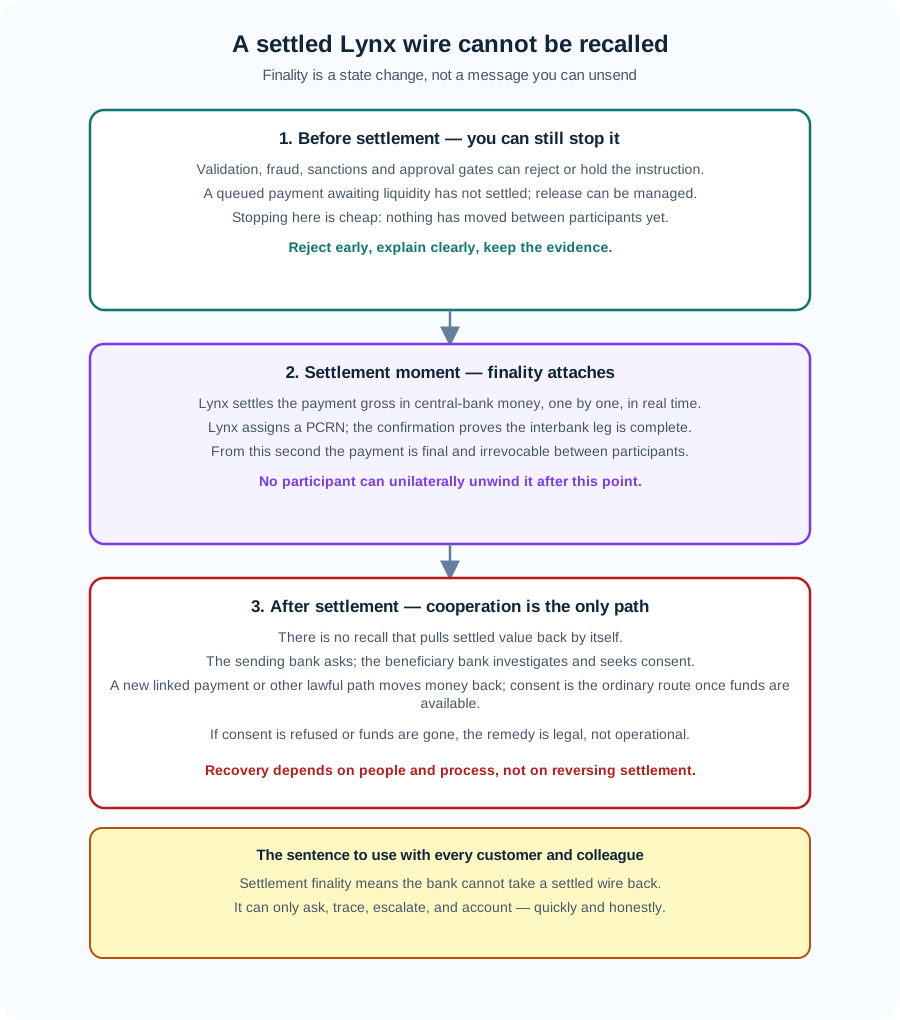
Four practical consequences follow. First, release discipline is the primary control. "Validate twice, release once" is not a slogan but the economic conclusion of finality: pre-release verification, dual approval, beneficiary confirmation, and liquidity checks are cheap, while post-settlement recovery is expensive and uncertain. The control trade-off is straightforward: pre-release verification is controllable, while post-settlement recovery is uncertain. Second, customer language must change at the bright line. Before settlement the bank can say "we have stopped it" or "we are holding it." After settlement the bank must say "we have traced it, we have asked the beneficiary bank, here is the reference and the clock" — states the other side can verify, promises the bank can keep. Third, posting follows finality, not the reverse. The beneficiary bank posts the incoming wire against the comfort of settled funds on the interbank leg; its posting decision concerns its customer's account (is the account open, are there holds, is screening clear), not whether the interbank value is real. Fourth, reconciliation evidence changes meaning at settlement: before settlement the bank reconciles expectations and releases; after settlement it reconciles confirmations and postings. Section 9 builds the three-way model on exactly this distinction.
Two misunderstandings need explicit correction because they cause real incidents. The first is "the wire is confirmed, so it can be cancelled." A Lynx settlement confirmation (PCRN) confirms irrevocability, not cancellability. Train front-line staff to respond to "cancel my wire" with one clarifying question — has it settled — and two honest scripts, one for each answer. The second is "SWIFT will recall it." SWIFT messages instruct and inform; for a domestic Lynx leg, no messaging network overlays a reversal capability on top of Lynx finality. Where a wire spans a Lynx leg and correspondent legs, each leg's finality is judged under its own system; the settled Lynx leg stays settled regardless of what happens elsewhere.
A note on what this chapter does not claim. It does not reproduce Lynx rule or guideline text, numbers, or timeframes, which evolve and belong to the authoritative sources listed in Section 12. It describes the functional mechanics — request, verify, consent, return-as-new-payment — that any version of the framework must implement given finality. When your bank's procedures cite specific Lynx rules, procedures, or guidelines, those citations govern your operation; this chapter explains why they take the shape they do.
RTR boundary (current status). Do not treat the Real-Time Rail as a current production alternative to Lynx in this chapter. At the audit date, Payments Canada describes RTR as launching in Q4 2026 and reports industry solution-assurance testing with participants. RTR operating rules, access, settlement, fraud services and exception mechanics are therefore modernization/launch material, not evidence that a live RTR payment can be traced or returned today. Apply the Lynx rules here only to Lynx payments; use the current RTR programme materials for planned capabilities.
5. Data, identifiers, messages and references
Investigations and returns are data problems before they are money problems. A recovery where every party quotes the same references resolves in days; a recovery where the sending bank quotes its channel number, the beneficiary bank asks for a different identifier, and the correspondent in the middle recognises neither can stall for weeks while funds drain away. This section defines the reference discipline that makes tracing, requesting, returning, and reconciling possible: which identifiers matter, where each is created, how each travels, and what breaks when any of them is lost.
Every wire needs a minimum identity set, created at initiation and preserved through every handoff. The bank instruction reference is the sending bank's own identifier for the customer's instruction — the number quoted on the customer advice and the key that joins the channel record to the hub record to the gateway record. The Lynx PCRN (Payment Confirmation Reference Number) is generated by the system upon settlement and identifies a Lynx payment that settled; it is the settlement evidence, not a customer instruction number. The sending participant's SWIFT/reference data should also be retained. For a cross-border SWIFT chain, the UETR (Unique End-to-end Transaction Reference) is the end-to-end thread carried through the applicable message chain. Do not assume that every on-us or non-SWIFT wire has a PCRN or UETR: Payments Canada says only wires settled through Lynx have PCRNs, and the sending institution's reference may be the relevant identifier for other paths. Investigations should quote the identifiers that exist rather than inventing one.
Remittance and party data ride alongside the references and determine whether the beneficiary can apply the funds. Payer and payee identification, amount, value date, and invoice detail must travel with enough fidelity for the beneficiary's accounts-receivable team to match the credit to the obligation. Truncated remittance creates the settled-but-unapplied case: the money arrived, the beneficiary cannot use it, and an investigation opens on a payment that is technically perfect. Validate at every format boundary that remittance survived.
Messages and formats differ by leg, and each leg's format governs what evidence exists. Lynx operates on ISO 20022 messaging, with customer credit transfers, interbank payments, returns, and cash-management reporting each belonging to their message families. Cross-border legs use SWIFT CBPR+ ISO 20022 with the UETR as the common thread. Customer channels and internal hubs use their own formats. The lifecycle point is not tag-level construction — Block 9 owns that — but three operating rules. First, know which format governs each leg of the specific wire you are tracing, and validate evidence in that leg's terms. Second, carry compliance and screening data with the payment rather than beside it, so holds, releases, and reports all reference the exact payment. Third, design every conversion and mapping to be reference-preserving and prove it with round-trip testing using realistic Canadian content — accented Québec names, long legal-entity titles, structured invoice detail — before production discovers the truncation.
The return-of-funds concept deserves careful treatment because it is widely misunderstood. Functionally, a Lynx return is a new payment in the return family (the pacs.004 family level) that moves value back from the beneficiary side to the sending side and points to the original payment through its references. It is not an edit, a deletion, or an unwinding of the original credit transfer. The original settled payment remains in history permanently, with its PCRN intact; the return is a second settled payment with its own identity, linked to the first. Reconciliation therefore joins three objects — original, request, return — rather than matching one object that changed state. Data models must enforce this: no return object without its original pointer, no netting of the two legs into a single "cancelled" line, no screen that shows the original as un-sent. The diagram below states the concept at family level; exact fields, codes, and construction rules live in the Lynx specifications and your bank's implementation of them, not in this chapter.
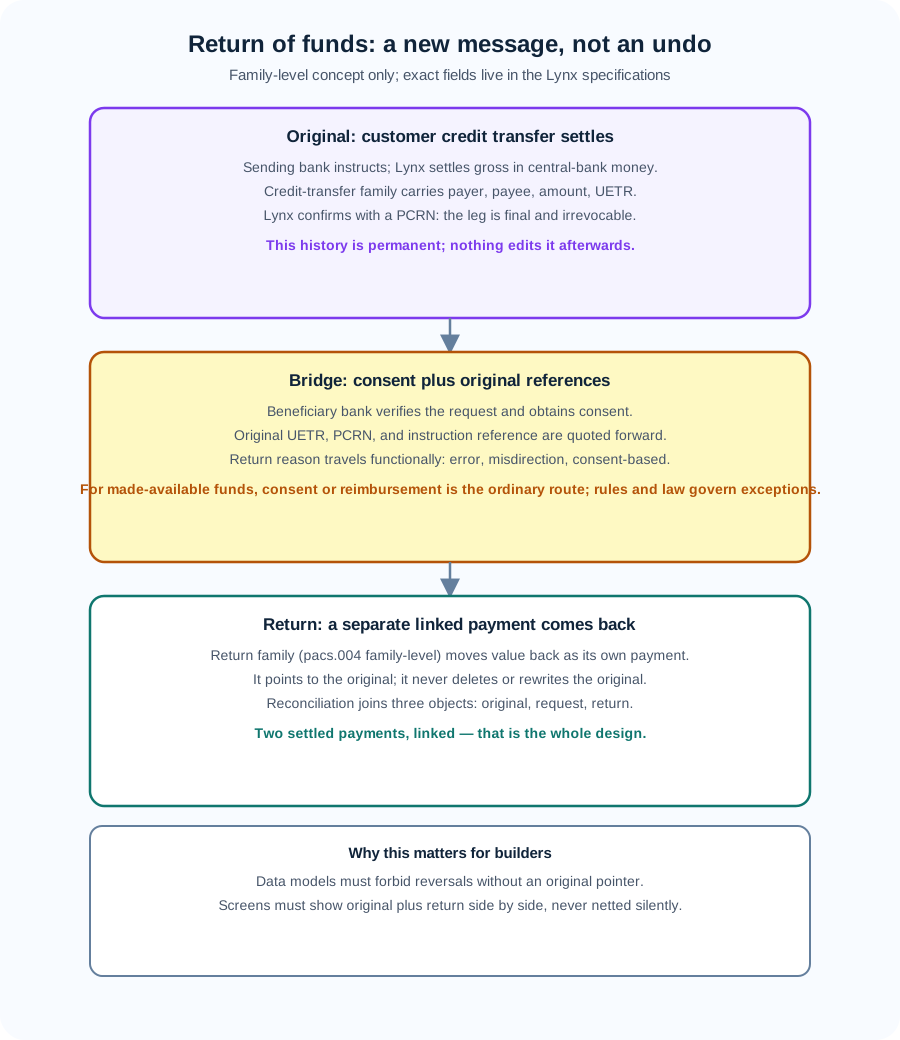
Close with the preservation rule that underpins everything: references created at initiation must survive enrichment, conversion, settlement, posting, and reporting. The banks that recover fastest are not the ones with the most investigators but the ones whose data never needs reconstructing.
6. Rules, service levels and customer impact
Customers experience the return framework as a service promise: "how fast will you act, what will you tell me, when will I know, and will I get my money back?" Operations experiences the same framework as constraints: what the Lynx By-law, rules, procedures, and guidelines require of participants, what cooperation can be expected from another bank, what consent means, and what happens when cooperation fails. This section connects the two views so that product, operations, and customer-facing teams describe the same reality — and so that no customer is ever promised an outcome the framework cannot deliver.
Start with what the framework functionally provides. The Lynx rules and guideline family set participant expectations for handling return requests and related cooperation: how a request should be constructed, what references and reasons it should carry, how the receiving participant is expected to handle it, and the role of beneficiary consent. Treat this as cooperation plumbing, not compulsion machinery. The framework standardises the asking; it does not empower the sending bank to compel the answer. Any service level your bank publishes must reflect that shape: commit to what your bank controls (speed of tracing, quality of the request, chasing discipline, communication honesty, reconciliation completeness) and describe what it does not control (the beneficiary bank's verification time, the beneficiary's decision, the availability of funds) as dependencies with clocks, not as guarantees. A bank may choose a target such as "we will trace within the hour, contact the beneficiary bank the same business day, chase on a defined schedule, and update you at each verifiable state," but it must label that as its own operating commitment. "We will have your money back by Friday" is a promise the framework cannot support.
Consent must be explained to customers early, not revealed after days of "we're working on it." Under the Guideline: Misdirected Lynx Payments, if the amount has been made available to the unintended payee, the receiving participant should use best efforts to investigate and attempt to obtain reimbursement or permission to debit; refusal can leave court or other legal process as the available path. If the amount has not been made available, the Lynx By-law and Rules govern the receiving participant's handling and consent is not the right starting assumption. Staff scripts should introduce this distinction in the first customer conversation: "The Lynx leg has settled, so we cannot reverse it. The receiving institution is checking whether the funds were made available and will follow the applicable rule or cooperation path. Here is what we are doing and what happens if cooperation fails." Customers told this on day one can make informed decisions; customers told on day six feel deceived, even though the facts never changed.
Service levels are bank-specific operating targets, not Lynx or Payments Canada guarantees. Publish a staged timetable the customer can follow: acknowledge the claim with a case reference; complete internal tracing and confirm settlement status promptly; send a properly evidenced request as soon as operations allow; chase non-responses on a defined cadence; and update the customer at each verifiable state change — traced, requested, acknowledged, recipient contacted, reimbursed/returned, credited, or legally escalated. Do not turn "same business day" or an hourly target into a claimed scheme rule. Close with linked evidence: original reference, request reference, return reference where one exists, dates, amounts, and reconciled proof. Each stage needs a named owner inside the bank; a timetable without owners is a wish.
Customer impact honesty extends to fees and consequential loss. State upfront whether investigation and return handling carry fees and how value-date differences are treated. Record consequential impacts the customer reports (missed closing costs, supplier penalties) factually in the case. Where the outcome is partial, present the partial return immediately with a clear statement of what was recovered, what was not, and what options remain.
Four practices separate strong service from weak. Promise only the verifiable: states the other bank can confirm and the customer can check. Give every promise a clock and an owner, and show both to the customer. Communicate in the lifecycle vocabulary of Section 8 — traced, requested, consent pending, returned — so that front-line staff, operations, and the customer use the same words for the same states. And staff through the full window: return requests, beneficiary-bank responses, and investigation updates arrive across settlement, posting, and end-of-day cycles, not just during morning release hours. A recovery team that goes home at five while the beneficiary bank responds at six loses a day on every cycle.
7. Fraud, compliance and operational controls
Controls for wires concentrate before release, because after settlement the most important control — the ability to stop — is gone. This section maps fraud, sanctions, AML, and operational controls onto the wire lifecycle, states the authorised-push-fraud recovery limits honestly, and explains why prevention investment is the only economically rational posture for irrevocable payments.
Fraud controls before release are the bank's real recovery strategy. Authentication strength matched to channel and amount; device and behavioural signals on business sessions; payee verification and mandatory callback discipline for changed supplier instructions, using independently known numbers; velocity and anomaly scoring tuned to wire patterns (first-time beneficiary, round amount, urgency pressure, changed details after a quiet relationship); dual approval for business wires with the approver seeing full beneficiary detail, not just the amount. Each control must resolve to a release decision — release, hold, step-up, or reject — before routing commits. A fraud score that arrives after settlement is a report, not a control. Measure control performance in prevented exceptions: impersonation attempts stopped, changed-instruction callbacks that caught fraud, dual-approval rejections. These are the recoveries that never needed beneficiary consent because the wire never left.
Authorised-push-fraud recovery limits must be stated without flinching, because these conversations carry the highest emotional and reputational stakes in wire operations. When a victim authorises a wire under deception and it settles through Lynx, the following limits apply. First, the bank cannot reverse the settlement — finality binds regardless of the instruction's backstory. Second, the funds are typically moved onward within hours by design; fraud beneficiaries withdraw, layer, and disperse, so the race described in Section 1 is usually already lost by the time the victim discovers the deception days later. Third, recovery still depends on beneficiary cooperation, and a fraudster does not consent; realistic recovery paths run through the beneficiary bank's ability to freeze or hold funds under its own fraud and compliance powers, law-enforcement involvement, and legal process — not through the return-request workflow that serves genuine-error cases. Fourth, liability and reimbursement outcomes depend on the facts, the bank's own conduct (were its controls reasonable, did it execute properly), and the applicable legal framework — they are not determined by operations and must never be pre-judged by operations staff. The honest customer script has four parts: what happened in system terms, what the bank is doing right now (trace, notify beneficiary bank, preserve evidence, report), what the realistic prospects are given timing, and what the next steps are (case ownership, law-enforcement reporting, complaint and review paths). False hope is cruelty with a delay; disciplined honesty preserves trust even when money is lost.
Sanctions, AML, and travel-rule controls gate initiation and validation and shadow the payment downstream. A bank may require screening to complete — including false-positive disposition with recorded rationale — before release; that is a bank-specific control policy, not a universal Lynx timing rule. Applicable AML/ATF, sanctions and travel-rule obligations determine what information, reporting, holds and non-disclosure constraints apply to the institution and transaction. FINTRAC's EFT reporting guidance concerns international electronic funds transfers of $10,000 or more (including aggregation under the 24-hour rule), with reports due within five business days; it should not be presented as a report for every domestic CAD Lynx payment. Completeness of originator and beneficiary data remains a control: truncated party data that screens faster creates the exposure the control was meant to prevent. Holds need honest customer status with an owner and a clock, while avoiding tipping off. On recovery, a compliance hold, screening on the return leg, or legal restraint can explain delay; operations should route such states without disclosing restricted detail.
Operational controls prevent the errors that become recoveries. Duplicate-release protection (hashes, reference history, release locks). Balance, limit, and liquidity checks at release. Approval-matrix enforcement bound to the specific instruction. Reference validation so no wire releases with an identity that cannot be traced. Segregation of preparation, approval, and release. Post-release, the controls shift to detective mode: settlement-confirmation monitoring (every released wire matched to its PCRN intraday), queue monitoring with honest customer status, and posting verification.
Placement summary for designers: initiation owns authentication, authority capture, beneficiary verification, and intent clarity. Validation owns format, authority, funds, duplicate, reachability, fraud, and sanctions gates with recorded decisions. Processing owns enrichment integrity, routing records, and release authority. Settlement owns confirmation monitoring and queue management. Posting owns account-integrity checks. Reporting and reconciliation own completeness proof and the feedback loop into upstream rules. Every gate needs an owner, a metric, and a tested playbook — and the whole stack must be re-proven after every hub, gateway, or screening upgrade, because controls drift silently and finality does not forgive drift.
8. Exceptions core: return requests, misdirected payments, investigations and recovery
This is the operational heart of the chapter: the five exception terms used precisely, the misdirected-payment recovery flow end to end, the investigation lifecycle from inquiry to resolution, and the recovery paths for each classification. Read it as a procedures manual in prose form — the section your operations team should be able to execute from.
Start with vocabulary, because the wrong word starts the wrong workflow. A reject happens before the item leaves the acceptance boundary: the sending bank rejects an invalid instruction, screening holds and then refuses a release, Lynx refuses malformed input. Nothing settled; respond with a clear reject advice and reason enabling repair. A return is a post-settlement or post-posting movement of funds back under the applicable framework, normally as a separate linked payment. For Lynx wires there is no unilateral sender reversal after settlement. A return request is the formal information-and-cooperation workflow in which the sending bank quotes the original identity and reason and asks the receiving participant to investigate; it moves no value. For a misdirected payment, the receiving participant's path differs depending on whether the amount was made available to the unintended payee: the By-law and Rules govern the former case, while the guideline's best-efforts, contact, reimbursement/permission and legal-process framework applies to the latter. A reversal is an internal or scheme-permitted linked accounting correction, not an overwrite; do not use it as a synonym for a Lynx recall. An investigation is the case around uncertainty: where is it, what state, who holds it, what next. Preserve the original identity throughout and accumulate evidence in one case with one owner. Five terms, five workflows; interchanging them creates the wrong expectations and the wrong accounting.
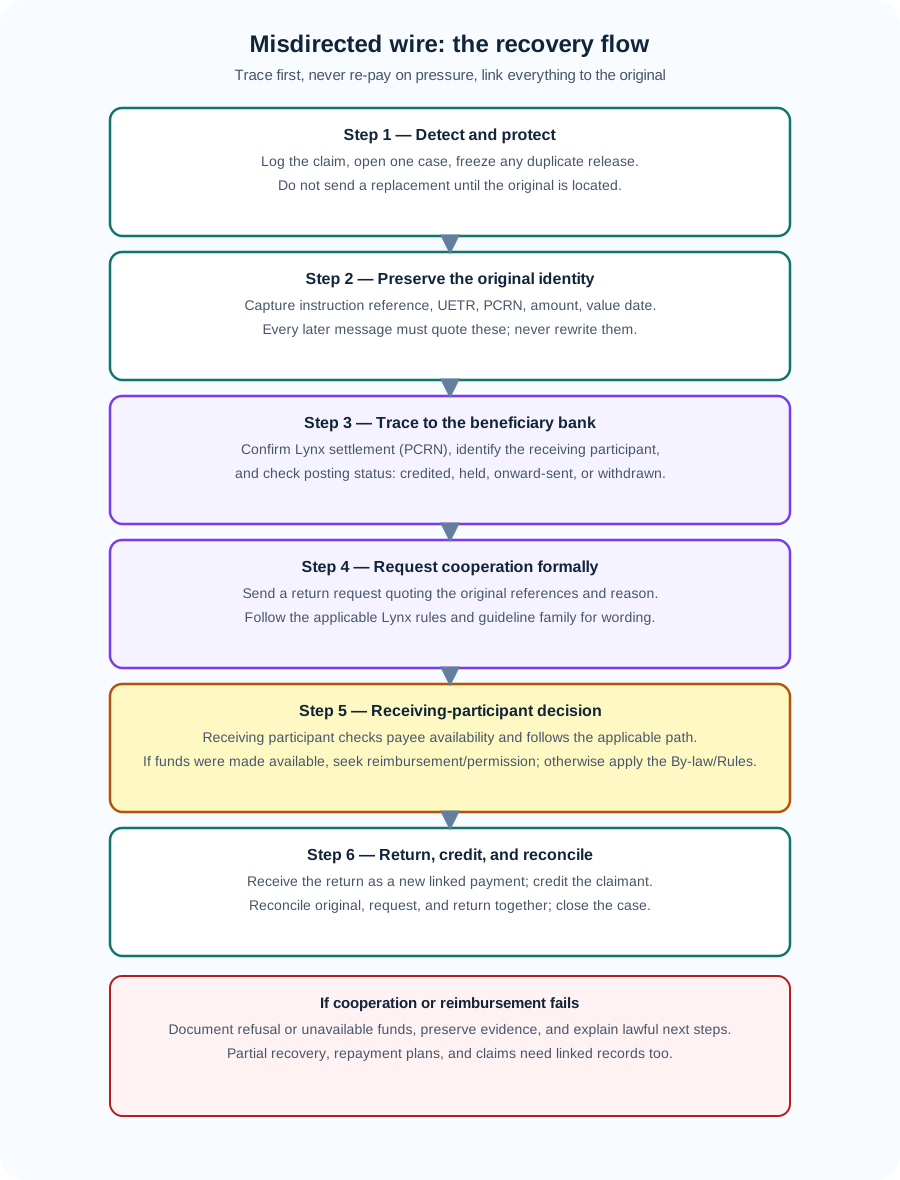
The misdirected-payment recovery flow runs in six steps, and the order matters. Step one, detect and protect: log the customer's claim, open a single case with an owner and a clock, and immediately guard against the most common self-inflicted worsening — the replacement wire sent "to make the supplier whole" while the original is still live. No replacement releases until the original is located and classified; state this to the customer as protection, not obstruction. Step two, preserve the original identity: assemble the instruction reference, UETR, PCRN, amount, value date, beneficiary detail as instructed versus as sent, and the settlement confirmation. If any element is missing, reconstruct it from hub, gateway, and Lynx records before contacting anyone — a request with partial references gets a slow answer. Step three, trace to the beneficiary bank: confirm from Lynx evidence that the wire settled and identify the receiving participant; establish posting status as far as your side can see (settled to participant; beneficiary posting is the other bank's fact to confirm). Step four, request cooperation formally: send the return request under the applicable Lynx rules and guideline family, quoting the full original identity, stating the reason functionally (error, misdirection, duplicate), and providing your case contact. Step five, the receiving participant verifies, engages, and decides: it identifies the account, checks whether the amount was made available to the unintended payee, and follows the applicable By-law/Rules or guideline path. Where the amount was made available, it uses best efforts to investigate and attempts reimbursement or permission to debit; consent or reimbursement supports a new payment back, while refusal or unavailable funds is reported with lawful next steps. Chase on cadence and escalate on schedule; silence gets a documented follow-up, not a passive wait. Step six, return, credit, and reconcile: receive the return as a new linked payment, verify its references point to the original, credit the claimant, account for any fee or value-date effects transparently, reconcile original, request, and return together, and close the case with evidence all three parties can file.
The investigation lifecycle generalises the same discipline to every "where is my wire" inquiry. Phase A, inquiry: convert the question into a case — who asks, what they expect, which references they quote — acknowledge with a case number, and state the first clock ("we will confirm settlement status by…"). Never answer "we're looking into it" when you can answer "case opened, settlement confirmed at HH:MM under PCRN …, now tracing beneficiary posting, next update by…". Phase B, trace: follow the references through each holder in turn. Sending bank records first (was it released, when, with what references). Lynx evidence next (PCRN, settlement time, receiving participant). Beneficiary bank next (posted, held, suspense, onward-sent). Correspondents leg by leg for cross-border spans, UETR in hand. At each holder ask the same four questions: received, posted, held, or onward-sent. Then classify before acting: delayed-but-located, settled-correctly-but-unapplied, misdirected, diverted-by-fraud, or settled-correctly-and-applied (the "beneficiary looked in the wrong account" outcome, more common than anyone admits). Phase C, resolve with linkage: delayed items are expedited and confirmed, never duplicated; misdirected items enter the six-step recovery flow; fraud-suspected items trigger fund-protection requests, evidence preservation, and reporting alongside the trace; unapplied items are fixed with corrected remittance references so the beneficiary can post; correctly-applied items are closed with proof shown to the inquirer. Close when the receiving participant's disposition and evidence are recorded, the customer has been updated, reconciliation agrees, and legal/compliance obligations are complete. A customer disagreement may remain a complaint or legal matter; it is not evidence that the settled payment history can be rewritten.
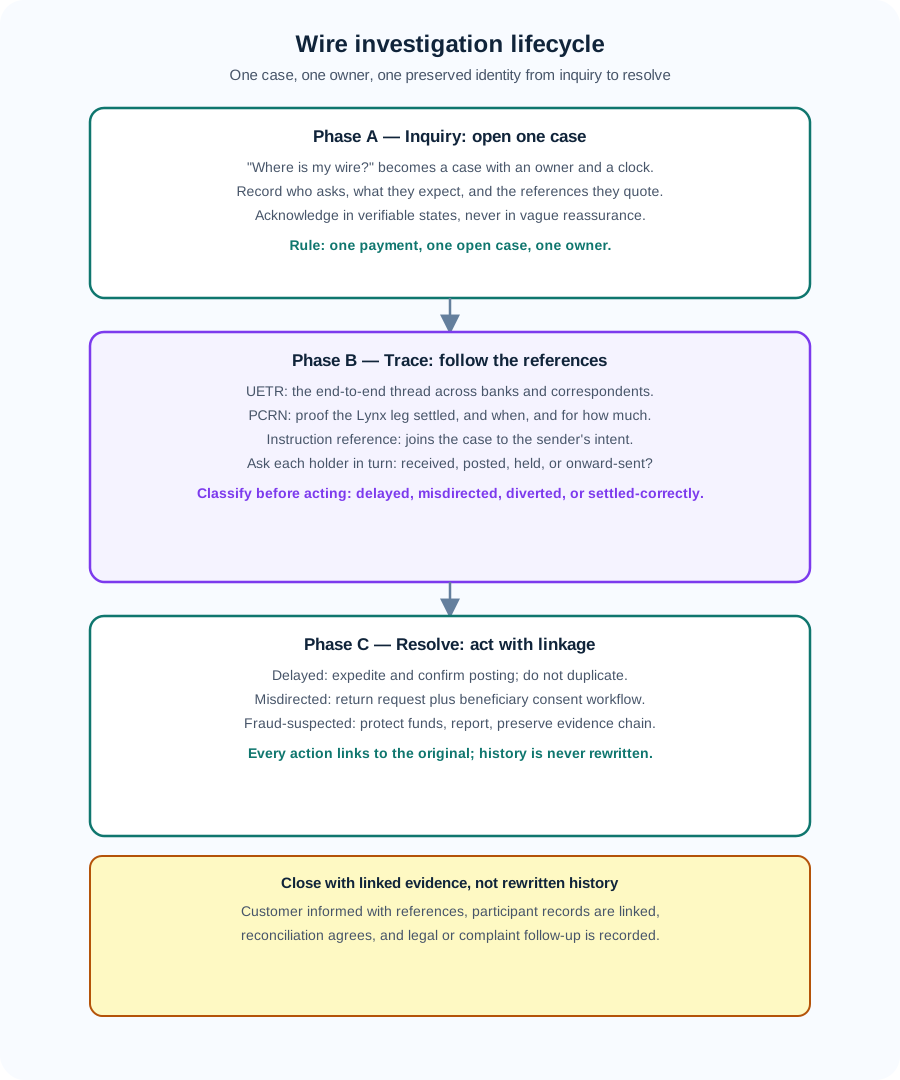
Recovery paths by classification complete the picture. Genuine error with funds available and consent: full return, the clean path. Consent or reimbursement refused, or funds no longer available: no routine consensual recovery; document the response, preserve evidence, and advise that court or other legal options may be available. Do not imply that operational staff have adjudicated liability. Duplicate release: recover one leg through the same flow while clearly identifying the beneficiary's single legitimate entitlement. Fraud diversion: parallel tracks of fund protection, law-enforcement reporting, and evidence preservation, with the return-request workflow running only where it can help. In every path, the case accumulates evidence and the customer hears verifiable states on a clock.
9. Posting, accounting, reporting and reconciliation core
Money becomes proof in this section's territory. The wire's postings, the return's postings, the reports that tell each customer what happened, and the reconciliation that proves the whole story balanced — built as one assurance chain so that operations, finance, and the customer share a single truth.
Posting applies value to accounts in a strict order governed by settlement evidence. For the sending bank's customer debit: debit on release authorisation (with transparent value-dating), never before approval, never twice — idempotency at the posting engine so retries, replays, and duplicate gateway confirmations cannot double-post. For settlement-account entries: reflect the Lynx debit when confirmation arrives, joined by PCRN to the release record. For the beneficiary bank's customer credit: post on the strength of the settled interbank leg, subject to the bank's own account-integrity checks (account open and able to receive, screening clear, no hold) and its availability policy. Suspense postings capture the items that cannot yet be applied — unidentified beneficiary detail, compliance holds, amount-reference mismatches — aged in days with owners, not parked indefinitely. Returns post as new entries in the reverse direction: the beneficiary bank debits its customer (on consent or lawful authority) and the sending bank credits its claimant, each entry linked to the original. Posting hygiene rules are absolute: no posting from channel status instead of settlement evidence; no silent netting of original and return into one line; memo-versus-hard-post discipline so intraday views never masquerade as final books.
Accounting translates postings into ledgers the bank controls against: customer deposits, settlement accounts at the Bank of Canada, fee income, and suspense accounts. The return leg creates mirror entries, and period-end must show both legs with their linkage. Strong accounting drives every entry from the same lifecycle records operations uses, so finance and operations share one truth. State which legs bore fees and who paid, because unexplained fee residue is the commonest source of "the amount came back short" complaints.
Reporting turns events into customer-usable information at each stage. Release advices quoting the instruction reference and UETR. Settlement confirmations quoting the PCRN with timestamp. Beneficiary advices with payer detail and remittance the beneficiary can apply. Return-request acknowledgements with case references. Return advices showing the new payment's references and its linkage to the original. Corporate reporting feeds — camt-family statements and legacy formats where still used — carrying the same references so the customer's own reconciliation joins without fuzzy matching. Exception advices with coded reasons plus next steps and clocks. Date precision is a reporting discipline: state release date, settlement date, posting date, and availability date separately rather than collapsing them into one "date," because each answers a different customer question and conflating them manufactures disputes. Customer-facing advices, statuses and case updates should meet the bank's applicable language-access and service commitments; do not present an internal language standard as a Lynx rule.
Reconciliation proves the chain three ways: (A) instructed and released, versus (B) Lynx clearing and settlement evidence, versus (C) postings and books. Instruction-versus-settlement breaks belong to channels, hubs, and gateways (released but unconfirmed — chase the gateway, not the customer; confirmed without a release record — treat as a control failure, not a windfall). Settlement-versus-books breaks belong to posting and finance (settled but unposted — post from settlement proof; posted without confirmation — reverse the process error under control). Instruction-versus-books breaks surface suspense, fee residue, and misapplied credits. Match on reference, amount, date, and status together — totals can balance while a single wire sits wrong, so item-level joining on the UETR and PCRN is the standard, not sampling. Run reconciliation intraday for wires as a bank-specific control target appropriate to their amount and finality; age every break with a named owner and feed repeat causes back into validation and release rules. Returns and investigations join the same model: a return is a new (B) with its own PCRN linked to the original (A); open investigations appear as unmatched expectations with owners and clocks; a case closes only when (A), (B), and (C) agree including the return leg. The diagram below is the operating contract between operations, finance, and technology — no wire is complete until all three sources agree and the bank can show the agreement on demand.
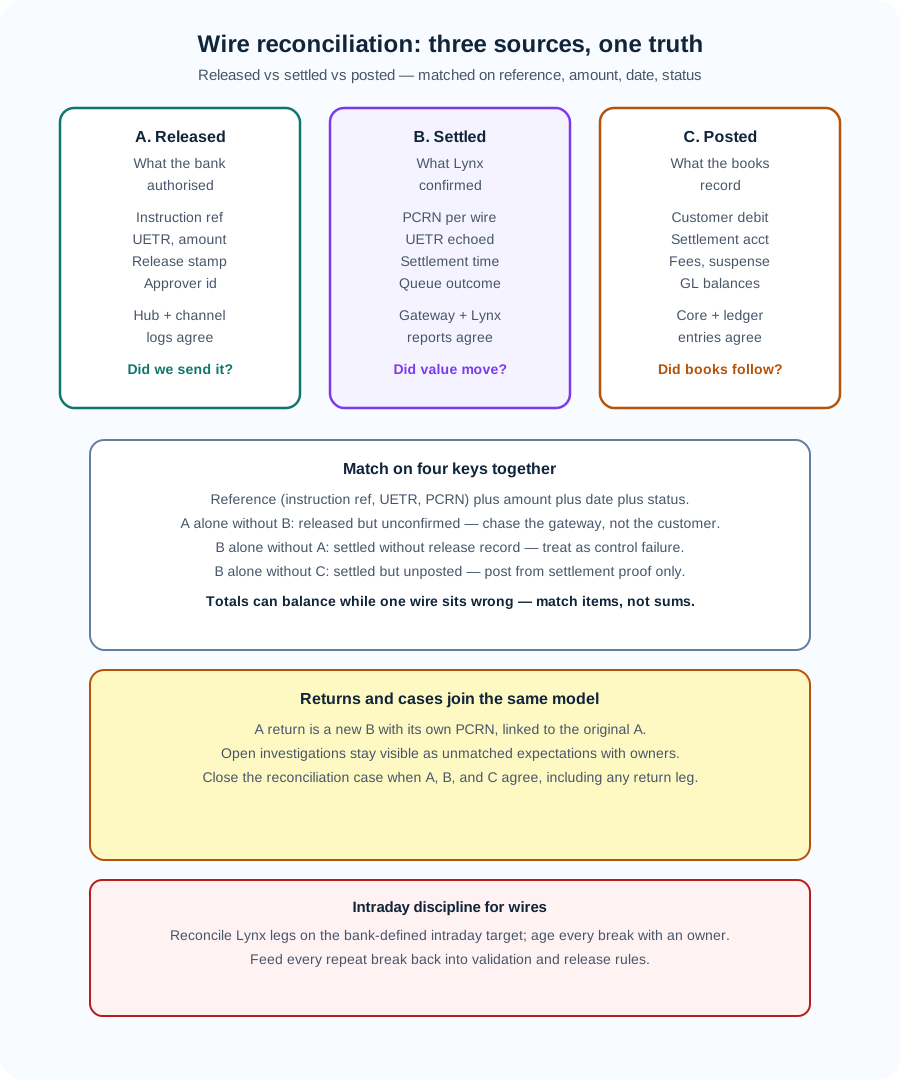
A short fictional worked case shows the model under stress. A business customer releases three wires totalling CAD 6.1 million before noon. Intraday reconciliation reports: released three per the hub log; Lynx confirmations two with PCRNs by 13:00, the third queued for liquidity; postings show two customer debits plus settlement-account entries for two. The three-way view resolves cleanly: the A-versus-B break of one is owned by treasury and operations jointly (fund the queue position, show "queued for liquidity" honestly); A-versus-C agrees on two with the third correctly unposted pending settlement. By 15:00 the third confirmation arrives, posting follows from the proof, and all three sources agree.
10. Bank implementation, testing and resilience
Understanding recovery is necessary but not sufficient; a bank must build it, staff it, prove it, and keep it running through failures. This section translates the chapter into implementation scope, testing discipline, and resilience expectations that product owners, engineers, and operations managers can plan against. It stays at operating level — message-tag construction belongs to Block 9 — and focuses on the decisions that determine whether the bank's wire recovery promise is real.
Implementation starts with architecture that respects the lifecycle boundaries: channels, payment hub, core banking, Lynx gateway, fraud and sanctions services, reference data, accounting and reporting, reconciliation, and case management — exchanging reference-keyed events rather than duplicating decisions. The canonical wire object must carry the instruction, the UETR, the PCRN once settled, enrichment and disposition history, routing and release decisions with rule citations, settlement pointers, posting records, and exception linkages (request, return, case) as first-class relations. Common build errors to forbid explicitly: validating only in the channel so host-to-host flows bypass gates; screening only at submission so warehoused wires release against stale lists; converting formats while dropping the UETR or truncating remittance; posting customer debits from channel status instead of release authority and settlement evidence; modelling returns as status changes on the original instead of new linked objects; building case management as free-text notes instead of reference-keyed state machines. Direct versus indirect (agented) participation changes who validates, funds, monitors, and answers — each responsibility must be contractual, staffed, and evidenced, with the agent's confirmations flowing back into the sponsor's reconciliation on the same business day.
Staffing and organisation need the same rigour as software. Wire exceptions require coverage through settlement, posting, and end-of-day windows, with on-call escalation for large-value cases. Define roles: case owner, tracer, interbank contact, customer communicator, and reconciliation analyst. Segregate preparation, approval, and release for the return legs too. Train front-line staff on the two scripts that matter most — "your wire has not yet settled, here is what we can do" and "your wire has settled, here is what happens next" — and test that they use the right one.
The operational risk register for this chapter should name each risk with a control owner, a detection metric, and a tested playbook. Duplicate-release risk (double-clicked wire pays twice; recovery only through cooperation). Reference-loss risk (mapping drops the UETR; tracing stalls). Queue-opacity risk (liquidity-held wire misreported as settled; phantom investigation). Consent Refusal risk (beneficiary says no; legal path needed). Fraud-speed risk (authorised-push funds dispersed before discovery). Posting-integrity risk (double-post on retry, unaged suspense). Evidence-gap risk (silent hub-to-gateway handoff leaves reconciliation nothing to join). Third-party risk (gateway or screening vendor fails; accountability never transferred). Calendar risk (holiday or daylight-saving boundary shifts value dates the promise did not anticipate). Key-person risk (one tracer holds all interbank relationships). Review the register quarterly and after every incident; an unowned risk is an unmanaged one.
Testing must prove the recovery lifecycle, not just connectivity. Design test suites around the chapter's workflows: reject-before-release with correct codes and advices; settlement-confirmation matching including PCRN handling; queue-and-liquidity behaviour with honest status; return-request construction with full original references; beneficiary-side simulation (verify, consent, construct return, refuse with reasons); return receipt, linkage, and claimant credit; investigation state transitions from inquiry through classification to resolution; reconciliation breaks of each type with owner routing; duplicate-release prevention under retry storms; posting idempotency under replayed confirmations; reporting that joins original, request, and return. Test data must include realistic Canadian content — bilingual names, long legal-entity titles, structured remittance — plus failure injection: gateway outage mid-release, funding shortfall at queue time, posting delay after confirmation, stale reference data, vendor failover, beneficiary-bank silence. Certification proves the bank can exchange with Lynx; lifecycle testing proves it can recover and reconcile. Run the latter before launch and after every material change.
Resilience assumes components fail and requires graceful degradation without losing or duplicating money. Duplicate-safe retry everywhere from channel through posting, keyed on the instruction reference and UETR. Warehoused wires surviving outages with triggers, value dates, and re-validation policies intact. Visible queue intervention with treasury when liquidity constrains release. Re-driveable gateway submission without re-creating obligations. Pausable posting engines that prove no gap or overlap across the pause. Reporting that distinguishes delayed from missing so customers are never told "sent" for a payment that never left. Reconciliation that maps the outage's footprint — which wires lack confirmations, which confirmations lack postings — and guides ordered catch-up rather than bulk re-release. Add people and process resilience: cross-trained tracers, documented interbank contacts, incident communication in lifecycle states ("release delayed, settlement re-timed, postings follow with value date X"), and practiced fallback per failure mode. Every scenario review must answer three questions for each in-flight wire: which stages completed, which are pending, and what should the customer be told right now. If answering needs forensics, resilience is not built.
11. Practical Canadian end-to-end examples
Three fictional stories carry the chapter's mechanics into recognisable Canadian business days. Each is labelled, uses invented figures and references, and is designed to be traced through the diagrams above. Work each one with a colleague: classify the situation, name the workflow, list the references you would quote, and state what you would tell the customer at each step.
Example (fictional) — the wrong-account supplier wire. Hamilton Steel Fabricators owes its Mississauga steel supplier CAD 1,800,000 with settlement required before Thursday's shipment. On Tuesday at 10:40 the controller releases the wire through the business channel; dual approval completes; the hub routes it to Lynx; settlement confirms at 10:47 with a PCRN, and the supplier's bank posts it. At 14:15 the controller calls: reviewing the confirmation, she spots that the account number differs by two digits from the supplier's record — a keying error against a stale supplier file. The supplier confirms non-receipt. Classification: genuine-error misdirection, settled, funds likely still with an unintended beneficiary. The bank opens one case immediately, confirms from Lynx evidence that the wire settled to the receiving participant, and assembles the full identity — instruction reference HAM-2026-11402, the UETR, the PCRN, amount, value date, instructed-versus-intended beneficiary detail. No replacement wire is released; the controller is told explicitly why ("a second wire now would double our exposure while the first is being recovered"). The return request goes to the beneficiary bank the same afternoon with complete references. The beneficiary bank identifies the credited account — a numbered Ontario company that confirms it was never owed the funds — obtains consent, and constructs the return as a new linked payment. The sending bank verifies the return's references, credits Hamilton, and reconciles original, request, and return together. The follow-up matters as much as the recovery: the bank's repeat-cause feed records the stale supplier file, and the customer adopts payee verification for changed details.
Example (fictional) — the impersonation (authorised-push) case. A Vancouver property management firm receives emailed "updated banking instructions" appearing to come from its long-standing Burnaby contractor, for a CAD 640,000 progress payment. The email address differs by one letter from the genuine domain; the letterhead is perfect. The firm's office manager prepares the wire, a director approves it (seeing the amount but not the changed beneficiary detail buried in the attachment), and the wire settles through Lynx on Wednesday morning. Thursday the real contractor calls asking for payment. Classification: authorised-push fraud, settled, discovery after approximately 24 hours. The bank moves on two tracks at once. Track one, fund protection: immediate trace, urgent contact with the beneficiary bank flagging suspected fraud, request to hold or freeze under the beneficiary bank's own powers, evidence preservation, law-enforcement reporting with the victim's cooperation. Track two, victim care with disciplined honesty: explain in system terms that the properly approved wire settled finally and cannot be reversed; state what is being done right now with names and clocks; set realistic prospects given the 24-hour head start (partial recovery is the hopeful outcome; full recovery is unlikely if layering has begun); never pre-judge liability. In this story the beneficiary bank freezes CAD 210,000 still in the account; the remaining CAD 430,000 has been onward-sent and is pursued through legal channels with the preserved evidence package — instruction records, approval trail, UETR and PCRN linkage throughout. Recovery is partial and the loss is painful. The lesson installed afterwards is pre-release: changed-instruction callbacks to independently known numbers, full beneficiary detail shown to approvers, and cooling periods for first-time high-value beneficiaries.
Example (fictional) — the "missing" payroll-funded wire that was never missing. A Montréal food distributor sends CAD 2,400,000 by wire to its Toronto logistics partner on Friday to cover a weekend warehousing commitment. The distributor's treasury team sees "sent" in the channel, but the partner reports non-receipt at 16:00 and threatens to hold weekend inventory. Pressure builds for an immediate duplicate. Classification after tracing — not before acting: delayed-but-located. The bank's tracer confirms release at 13:20, then finds no Lynx settlement confirmation by 16:00: the payment sits queued for liquidity, correctly unconfirmed, while the channel screen says "sent." No misdirection, no fraud — a queue-opacity incident plus honest status failure. Resolution: fund the queue position with treasury, confirm the PCRN when settlement lands, post from the proof, and show both parties the joined evidence (release record, queue record, settlement confirmation, posting). The duplicate is never sent; a CAD 2.4 million double exposure is avoided by tracing first. The incident's real product is the fix: channel status vocabulary corrected (released, queued for liquidity, settled — three distinct states), intraday confirmation monitoring with alerts for unconfirmed releases, and a standing rule that no replacement wire releases while the original lacks a classification. Uncertainty resolved by method, not by money.
12. Key takeaways and authoritative references
Carry these takeaways into every wire exception you will ever work. First, settlement finality is the whole chapter in one fact: once Lynx settles a wire, the interbank leg is final and irrevocable, proven by the PCRN, and no recall can pull it back. Second, recovery is cooperation plus process: the sending bank traces fast, requests with complete references, chases on a clock, and communicates honestly; the beneficiary bank verifies, seeks consent, and returns as a new linked payment. Third, consent or reimbursement is the ordinary cooperative route when funds were made available to an unintended payee: the receiving participant uses best efforts under the misdirected-payments guideline, while the Lynx By-law and Rules govern cases where the amount was not made available; refusal may require legal process. Fourth, classify before acting: delayed, misdirected, diverted, or correctly settled-and-applied — each demands different action, and premature replacement wires manufacture double payments. Fifth, references are the recovery: instruction reference, UETR, and PCRN preserved end to end determine whether tracing takes hours or weeks. Sixth, returns are new payments, not undos: original plus return, linked, both permanent, never netted silently. Seventh, authorised-push fraud has hard limits: prevention before release is the reliable control; post-settlement recovery from fraudsters runs through freezing speed, reporting, and legal process, not through reversal. Eighth, reconciliation is the proof layer: released versus Lynx-settled versus posted, matched intraday on reference, amount, date, and status, with every break owned and aged. Ninth, customers deserve verifiable states on clocks, never vague reassurance and never promises the framework cannot keep. Tenth, build recovery as a product feature: staffed windows, owned cases, tested playbooks, and bank-defined metrics such as time to trace, recovery rate and break ageing. These are implementation controls, not Payments Canada service guarantees.
Authoritative references (all official sources; functional mechanics in this chapter sit inside the framework these sources define):
- Payments Canada — Lynx, Canada's high-value payment system (RTGS, finality, ISO 20022): https://www.payments.ca/systems-services/payment-systems/high-value-payment-system-lynx
- Payments Canada — Explainer: Lynx wire payments and the Payment Confirmation Reference Number (PCRN): https://www.payments.ca/explainer-lynx-wire-payments-and-payment-confirmation-reference-number
- Bank of Canada — Lynx (monetary policy setting, LVTS replacement, system design overview): https://www.bankofcanada.ca/core-functions/monetary-policy/lynx/
- Bank of Canada — Bank of Canada designates Lynx as a systemically important payment system (designation, finality protection, oversight): https://www.bankofcanada.ca/2021/09/bank-canada-designates-lynx-systemically-important-payment-system/
- Bank of Canada — Payment systems the Bank of Canada oversees (Lynx, ACSS, Interac e-Transfer and others under the Payment Clearing and Settlement Act): https://www.bankofcanada.ca/regulatory-oversight/financial-market-infrastructures/payment-systems-the-bank-of-canada-oversees/
- Payments Canada — Guideline: Misdirected Lynx Payments (implemented December 15, 2022; confidential participant guidance on information requests, payee availability, consent/reimbursement and legal process): https://payments.ca/sites/default/files/Guideline_Misdirected_Lynx_payments.pdf
- Justice Laws — Canadian Payments Association By-law No. 9 — Lynx (SOR/2021-182; current version and Lynx operations, liquidity, settlement and payments to payees): https://laws-lois.justice.gc.ca/eng/regulations/SOR-2021-182/index.html
- Justice Laws — Payment Clearing and Settlement Act (designated-system settlement rules and finality protection): https://laws-lois.justice.gc.ca/eng/acts/P-4.4/FullText.html
- Bank of Canada and Payments Canada — An Overview of Lynx, Canada’s High-Value Payment System (RTGS, central-bank money, liquidity mechanisms and queues): https://www.bankofcanada.ca/wp-content/uploads/2022/05/Overview-Lynx-Canadas-High-Value-Payment-System.pdf
- Payments Canada — Real-Time Rail payment system (current programme status; Q4 2026 launch target and participant testing): https://www.payments.ca/systems-services/payment-systems/real-time-rail-payment-system
- FINTRAC — Reporting electronic funds transfers to FINTRAC (international EFT threshold, 24-hour rule and five-business-day reporting timing): https://fintrac-canafe.canada.ca/guidance-directives/transaction-operation/eft-dt/eft-dt-eng
- Interac — Interac e-Transfer (official consumer flow and service scope; separate acceptance/cancellation mechanics): https://www.interac.ca/en/consumers/products/interac-e-transfer/
- Interac — Personal FAQs (cancellation before deposit and no reversal after deposit; institution-specific limits/fees): https://www.interac.ca/en/resources/personal-resources/personal-faq/
- Financial Consumer Agency of Canada — How to file a complaint with your bank (bank complaint process and escalation information): https://www.canada.ca/en/financial-consumer-agency/services/complaints/file-complaint-financial-institution.html
This application uses JavaScript for the full interactive experience. This text summary is served for accessibility and search indexing.