USBE and USD Payments in Canada. Understand U.S.-dollar retail items, United States Bulk Exchange processing, positions, settlement and exceptions in Canada.
Block 11 · Chapter 55 of 75
Canada has a distinct domestic infrastructure for clearing certain U.S.-dollar payment items between Canadian financial institutions: the United States Bulk Exchange application (USBE). It sits alongside the Automated Clearing Settlement System (ACSS) within Payments Canada’s retail batch payment system. The existence of USBE is easy to misunderstand because the currency is U.S. dollars and the settlement ultimately occurs in New York. A USD item can still be part of a Canadian Payments Canada retail-batch process when it is an eligible item drawn on U.S.-dollar accounts at financial institutions domiciled in Canada. That is fundamentally different from a customer sending an international USD wire from Canada to a beneficiary bank in the United States.
Payments Canada’s retail batch overview describes ACSS and USBE together as a dual-currency clearing and settlement environment for the vast majority of eligible paper and electronic retail payment items drawn on Canadian-dollar or U.S.-dollar accounts at Canadian financial institutions. The systems record exchanged items and calculate participant clearing positions. But the settlement asset/location differs. ACSS Canadian-dollar settlement is tied to the Bank of Canada settlement framework, while the USBE rules require U.S.-dollar settlement in New York between participating Direct Clearers or through approved settlement-agent arrangements.
The rule set matters. Rule K1 governs bulk exchange and settlement of U.S.-dollar paper items. Rule K4 governs obligations and operation of the automated USBE system. Rule K5 defines manual balancing and settlement procedures if the automated system has a national failure. Rule K6 covers intermember U.S.-dollar interest claims. Rule K8 governs the U.S.-dollar AFT environment. K8 explicitly states that USD AFT files are separate from CAD AFT files and supports both legacy AFT logical record formats and ISO 20022 AFT messages under the applicable Canadian usage guidelines. These are not incidental technical documents; together they define the operating model that a Canadian bank needs for USD retail clearing.
This chapter explains USBE from customer product to settlement and reconciliation: which payments belong here, who participates, how paper and USD AFT streams differ, how positions are entered, how New York settlement works, what Direct Clearers and settlement agents do, how U.S. holidays change value dates, how returns and adjustments are handled, how ISO 20022 coexists with legacy AFT, how a national system failure is manually balanced, and how a bank tests and reconciles the entire process.
What you should be able to do after this chapter
After working through this chapter, you should be able to:
- explain what USBE is and where it sits in Payments Canada’s retail batch payment system;
- distinguish USBE from an international USD wire or U.S. domestic wire system;
- distinguish ACSS Canadian-dollar retail clearing from USBE U.S.-dollar retail clearing;
- explain Direct Clearer, participating/non-participating Direct Clearer, Exchange Agent and USBE Settlement Agent roles;
- describe eligible U.S.-dollar paper-item exchange under Rule K1 at a functional level;
- describe USD AFT processing under Rule K8;
- explain why USD AFT files must be exchanged separately from CAD AFT files;
- explain how legacy AFT and ISO 20022 AFT can both exist in the USD AFT rule framework;
- describe the difference between clearing calculations and final USD settlement in New York;
- explain how U.S. bank holidays affect the settlement value date;
- describe current K8 exchange/rejection/entry timing concepts without confusing them with customer-channel cutoffs;
- explain returns, rejected files, errors in balance, adjustments and interest claims;
- describe manual balancing under Rule K5 when the automated USBE system fails;
- reconcile customer posting, exchanged item/file, USBE entry and New York settlement;
- identify liquidity, correspondent-account and operational risks;
- design realistic bank implementation and test scenarios for USD AFT and paper-item streams.
For a roughly 60-minute core session, spend 10 minutes on Sections 1–2 with the USBE architecture diagram, 15 minutes on Sections 3–5 with paper/AFT/settlement flows, 10 minutes on Sections 6–7, 10 minutes on Sections 8–9, 10 minutes on examples and 5 minutes on references.
Chapter navigator
- What USBE is and what it is not
- Participants, agents and system boundaries
- U.S.-dollar paper-item exchange under Rule K1
- USD AFT processing under Rule K8
- USBE clearing positions and New York settlement
- Cutoffs, holidays, funds availability and customer impact
- Returns, rejects, adjustments and interest claims
- Operational controls, liquidity and manual contingency
- Posting, accounting, reporting and reconciliation
- Implementation, testing and resilience
- Practical Canadian USD examples
- Key takeaways and authoritative references
1. What USBE is and what it is not
Payments Canada’s retail batch system is composed of:
ACSS handles eligible CAD retail-batch clearing. USBE provides the U.S.-dollar counterpart for eligible USD retail items.
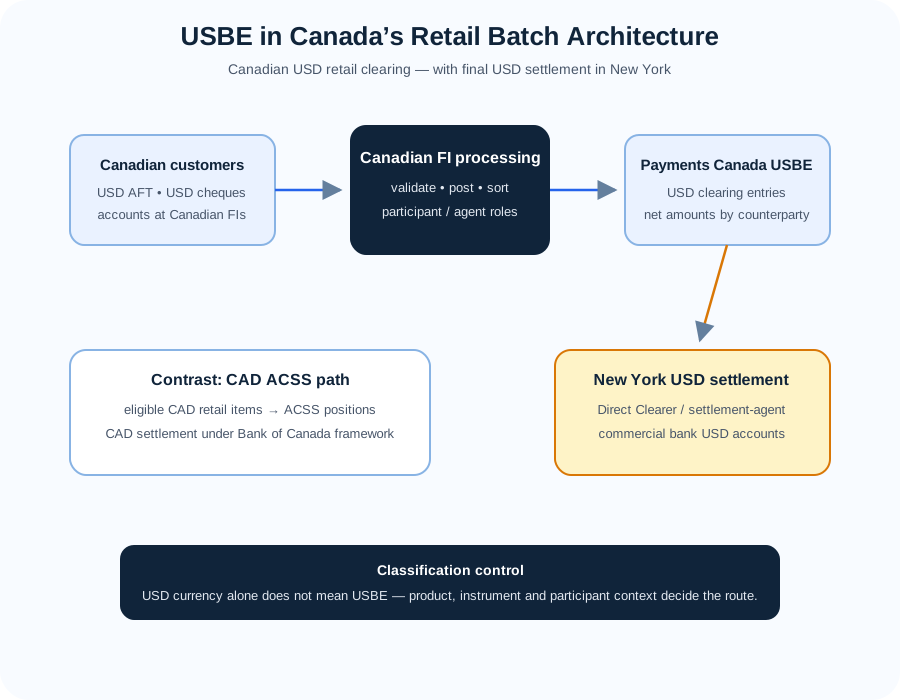
Domestic USD context
Imagine:
- Company A has a USD account at Canadian Bank A;
- Company B has a USD account at Canadian Bank B;
- Company A pays Company B using an eligible USD AFT credit.
Both accounts and FIs are in Canada, even though currency is USD.
This is a USBE/USD AFT context.
International USD wire context
Now:
- Canadian customer at Bank A sends USD to beneficiary at U.S. Bank X.
This is a cross-border correspondent/wire context.
The bank may use Swift and a USD correspondent.
Do not call it USBE simply because currency is USD.
U.S.-dollar cheque context
A USD cheque drawn on a Member/eligible office can enter the U.S.-dollar bulk-exchange rules if it meets the applicable Rule K1 definitions/standards.
Paper items and AFT are different streams but ultimately contribute to USD clearing/settlement relationships.
Why settlement is in New York
Payments Canada coordinates the Canadian participant clearing framework, but USD settlement uses U.S.-dollar accounts/arrangements in New York.
Rule K1 defines bulk settlement as electronic transfer of USD at New York by Direct Clearers to other Direct Clearers to whom settlement is due.
Rule K8 applies similar New York settlement to USD AFT transactions.
This is why USBE should not be described as Bank of Canada USD settlement.
System classification matters
Architects need three separate dimensions:
Jurisdiction of customer/FI
Canada.
Currency
USD.
Clearing framework
Payments Canada USBE.
Settlement location/asset
USD settlement in New York under rule arrangements.
Putting only “country=Canada” or “currency=USD” in route logic is insufficient.
2. Participants, agents and system boundaries
Payments Canada
Payments Canada:
- operates USBE application;
- publishes rules/procedures;
- maintains participant framework;
- provides automated calculation/reporting environment.
It does not replace participating banks’ USD settlement accounts.
Direct Clearer
A Direct Clearer participates directly in retail clearing according to Payments Canada requirements.
For USBE, Direct Clearers can be:
- participating in exchange/settlement arrangements;
- non-participating in certain exchange points/roles under Rule K1 arrangements.
Exact participant status is maintained under current Payments Canada documentation.
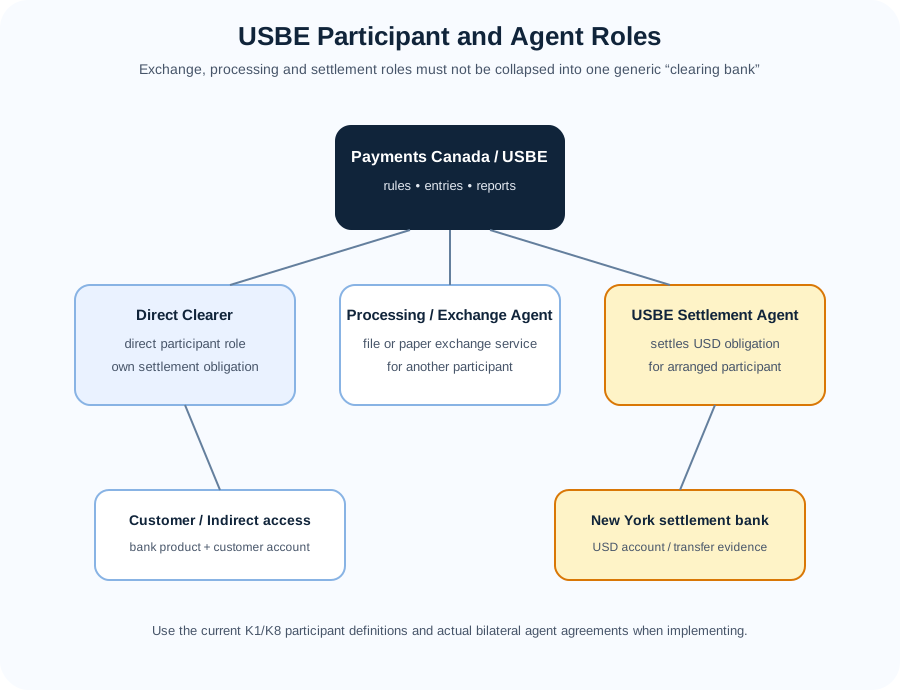
Exchange Agent
Rule K1 defines an Exchange Agent as a participating Direct Clearer that acts for a non-participating Direct Clearer in exchange of USD paper items.
This is an exchange role.
USBE Settlement Agent
Rule K1 defines a USBE Settlement Agent as a participating Direct Clearer responsible for settlement for a non-participating Direct Clearer’s U.S.-dollar items.
This is settlement role.
The same institution can potentially perform related services, but architecture should preserve role semantics.
Indirect Clearer
Indirect Clearers access clearing through arrangements with Direct Clearers according to Payments Canada rules.
Customer-facing product should not expose clearing-member complexity, but the bank’s accounting and settlement model must know who carries position.
Processing Direct Clearer for USD AFT
Rule K8 uses roles around Direct Clearers receiving/delivering USD AFT transactions, including cases where one Direct Clearer performs clearing services for another under separate agreement.
Importantly, K8 states settlement must be performed by each Direct Clearer on its own behalf under the rule arrangement.
Customer
Customer can be:
- originator of USD AFT credit;
- payee;
- PAD/debit originator/payor where USD AFT debit applies;
- depositor/drawer of USD paper item.
The customer interacts with bank product, not USBE application directly.
Bank systems
Inside a bank:
Channel/file intake
USD payroll/supplier/debit file or cheque capture.
AFT processor
validates file/ISO AFT.
Cheque/image processor
for paper/image items.
USBE clearing interface
records required entries/positions.
USD settlement service
manages New York settlement instructions/accounts.
Treasury
funds USD.
Accounting
books customer and settlement.
Reconciliation
matches all evidence.
3. U.S.-dollar paper-item exchange under Rule K1
Rule K1 is specifically titled Bulk Exchange and Settlement of U.S. Dollar Paper Items.
U.S. Dollar Item
Rule K1 defines a U.S. Dollar Item as an item payable on demand in USD drawn on a Member or on a U.S. office of a Member, subject to the full rule definition/current text.
Practitioners should use the rule for eligibility rather than create their own shorthand.
Qualified item
Rule K1 distinguishes qualified items conforming to applicable standards such as MICR encoding requirements.
Image/cheque standards intersect with processing.
Bulk Exchange Point
The rule provides for bulk exchange at defined exchange points, including national electronic arrangements.
The exchange process historically reflects paper-item delivery/receipt obligations and controls.
Current timing concepts
Rule K1 states that exchange at a Bulk Exchange Point is at an agreed central location/time and no later than 12:30 local time under the current rule wording.
This is an intermember rule deadline, not necessarily the customer deposit cutoff.
Banks need an earlier internal cutoff for:
- capture;
- image;
- outsort;
- balancing;
- transport/electronic exchange.
Imaging
Rule K1 requires delivering Direct Clearers to microfilm or image items and maintain controls for quality/integrity before exchange, subject to the exact current wording.
This links Chapter 49 cheque/image controls to USD paper items.
Clearing logs and totals
Paper exchange needs:
- delivery totals;
- item count;
- value;
- counterparties.
Those totals feed USBE position calculation.
Errors in balance
Receiving Direct Clearer balances items and should notify presenting Direct Clearer of errors in time for corrections before system closing when possible.
Errors after closing follow adjustment process.
Settlement failure
Rule K1 includes procedures if a participating Direct Clearer fails to provide New York settlement.
Items for which settlement will not occur can need to be returned/recalculated under rule procedures.
This illustrates a key USBE risk:
clearing exchange is not an unconditional settlement guarantee.
4. USD AFT processing under Rule K8
Rule K8 is the U.S. Dollar Automated Funds Transfer System rule.
It states the procedures for exchange and settlement of USD AFT files between Direct Clearers differ from CAD AFT.
Separate USD files
K8 explicitly requires USD AFT files to be delivered separately from CAD AFT files.
This is a critical implementation rule.
Do not mix currencies in one legacy AFT file and assume processing engine can split later unless current ISO usage/product explicitly supports a compliant representation.
Legacy and ISO AFT
K8 scope includes:
- AFT Logical Record Types under Standard 005;
- ISO AFT message formats under Canadian ISO AFT Usage Guidelines.
USD AFT modernization therefore has the same coexistence concept as CAD AFT:
legacy files and ISO 20022-enabled AFT under current rules.
Related rules
K8 points to:
- F1;
- F4;
- F7;
- F8;
- L1/L2;
- Standard 005;
- Standard 007;
- Standard 018;
- ISO AFT Usage Guidelines;
- account-number validation criteria.
Implementation teams should read K8 in conjunction with those sources.
Participation
K8 requires Direct Clearers to be able to receive USD AFT files, either directly or through another Direct Clearer under the arrangement.
If a Direct Clearer uses another Direct Clearer for clearing services, a separate agreement applies.
Registration and testing
K8 provides registration requirements for Direct Clearers to receive or receive/deliver USD AFT and to effect settlement.
The rule also requires production participants to exchange and successfully process test files with relevant Direct Clearers before production.
This is an explicit industry testing expectation.
File Creation Numbers
K8 requires Processing Direct Clearers to retain the last 10 File Creation Numbers for USD AFT files; a non-conforming number under Standard 005 is cause for rejection.
This supports duplicate/file-sequence control.
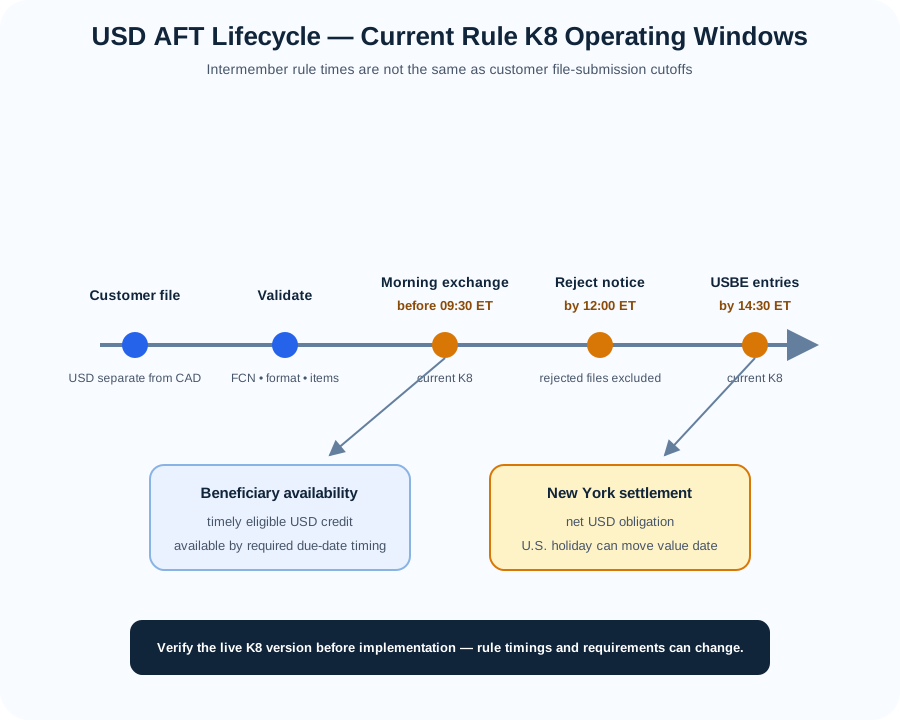
Funds availability
Under K8, USD AFT or ISO AFT credit transaction funds are to be credited and available to the payee by opening of business on due date, provided the transactions were exchanged within the relevant serviceability-code timeframes, unless applicable legislation requires otherwise.
This is a customer-impact requirement.
Morning exchange
Current K8 wording requires USD AFT files to be exchanged during the morning exchange before 09:30 ET, with file rejection notification no later than 12:00 ET.
These are specific rule timings as of the current K8 version and should always be checked against the live rule before system changes.
USBE entries
K8 defines USBE entry responsibilities for credits/debits.
At settlement day:
- receiving processing Direct Clearers initiate relevant entries for received credit transactions;
- originating Direct Clearers initiate relevant entries for delivered debit transactions;
- entries include total number and value;
- current rule deadline for those entries is no later than 14:30 ET.
The bank’s internal operational cutoff must be earlier.
5. USBE clearing positions and New York settlement
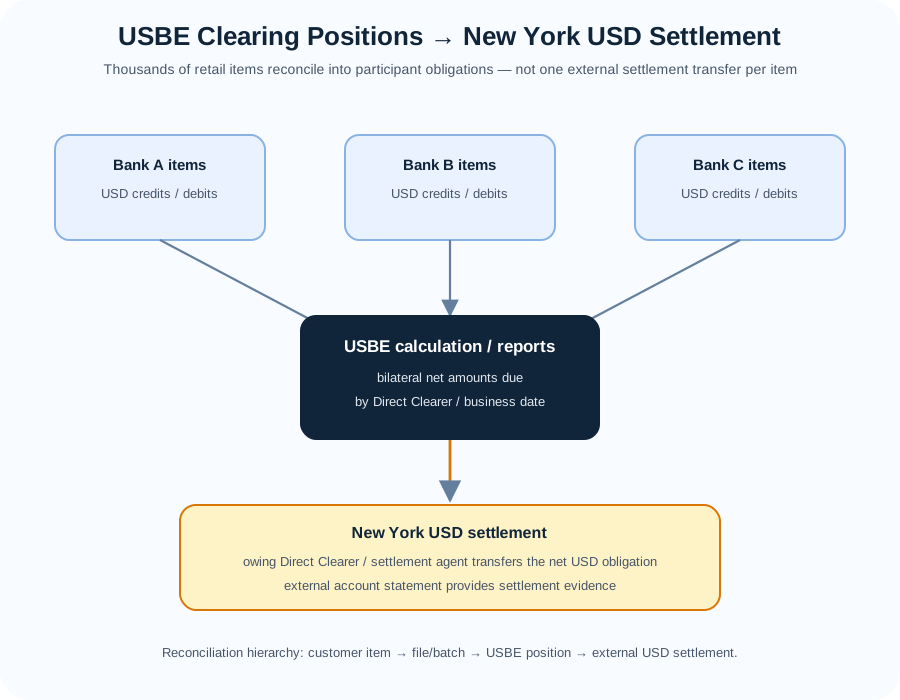
Clearing versus settlement
USBE records item/file clearing entries and supports calculation of net amounts due between Direct Clearers.
Settlement is a separate step:
USD funds are transferred in New York.
Bilateral net due
Rule K1 requires each Direct Clearer to determine the net amount due to/from each other Direct Clearer for its items and items covered by settlement-agent arrangements, using USBE information or manual summary under contingency.
This is not the same settlement design as ACSS CAD central-bank settlement.
Rule K8 USD AFT settlement
K8 similarly states:
- determine net amount due to/from each other Direct Clearer;
- use USBE or National Summary USBE Report;
- owing Direct Clearer provides settlement in New York;
- USD AFT settled on due date;
- rejected files are not settled.
New York accounts
Participating Direct Clearers maintain/identify arrangements needed to settle USD obligations in New York as specified by rules.
Treasury must fund these positions.
Value date
For paper exchange, Rule K1 says settlement is value-dated on exchange day, with specified treatment for New York bank holidays.
For USD AFT, settlement is on due date, with treatment for transactions delivered after due date and U.S. holidays under K8.
U.S. holidays
K1/K8 explicitly recognize that a Canadian exchange can occur when New York settlement is closed.
Then settlement value date moves to the next New York business day according to the rule.
This is an excellent example of non-aligned holiday risk.
Settlement agent
For non-participating arrangements, settlement agent handles obligation according to rules/agreements.
The originating bank’s internal accounting must map:
customer items → clearing service → settlement agent → USD external account.
No Bank of Canada USD account assumption
Do not model USBE as if Direct Clearers settle USD through Bank of Canada Lynx/settlement balances.
The rules explicitly point to New York USD settlement.
Credit risk
The Bank of Canada describes USBE as a parallel retail system for USD items drawn on USD accounts at Canadian financial institutions and settled in the United States. Deferred, bilateral settlement creates participant and settlement-agent exposures; the rules—not a generic ‘guarantee’ label—control the failure treatment.
This risk context explains the default/failure procedures.
6. Cutoffs, holidays, funds availability and customer impact
Customer cutoffs must be earlier
K8’s 09:30 ET exchange is not a safe customer upload cutoff at 09:29.
The bank needs time for:
- file receipt;
- authentication;
- syntax;
- business validation;
- duplicate check;
- account validation;
- sanctions/fraud where applicable;
- sorting;
- transmission.
Customer service cutoff can therefore be materially earlier.
Due date
USD AFT has a due-date concept.
The file can be delivered in advance according to AFT lead-time rules.
Bank should show customer:
- file accepted;
- due date;
- rejected items;
- funds availability expectation.
U.S. bank holiday
Customer may expect Canadian business-day processing.
If New York settlement holiday:
settlement value moves under rule.
Customer channel should not promise normal same-day settlement.
Canadian holiday
Payments Canada systems may be closed depending on system calendar.
Both Canada and New York calendars matter.
Funds availability
For qualifying timely USD AFT credit, payee availability by opening of business on due date is important.
Receiving bank operations need:
- posting batch complete;
- rejects processed;
- funds accessible.
Late file
If customer misses bank cutoff:
- next exchange;
- due date impact;
- possible late/after-due treatment.
The bank should not silently change due date without reporting.
7. Returns, rejects, adjustments and interest claims
File rejection
K8 says settlement may not be made for rejected USD AFT files.
A file can reject for:
- file creation number;
- format;
- transmission;
- other rule/standard reasons.
Bank must prevent customer posting/settlement mismatch.
Item return
AFT transactions can return according to AFT rules and Standard 007 reasons.
Returns should:
- reference original;
- update customer;
- affect USBE entries;
- reconcile settlement.
Payment reversal
ISO AFT/legacy rules can include reversal processes.
Use current F4/usage guidelines for exact messages/conditions.
Paper return
USD paper items have return processes under applicable rules.
Do not apply AFT return code logic to cheque returns.
Balance errors
K1 says errors found after final closing are adjusted through K4 procedures; value errors may create interest claims under K6.
Interest claim
K6 handles intermember USD interest claims.
This connects operational errors to financial compensation.
Bank should measure:
- number;
- cause;
- amount;
- interest cost.
Settlement failure
If Direct Clearer fails New York settlement, K1 describes returning items/recalculating net amounts and recovery procedures.
This is an exceptional default scenario.
Operations should have playbook.
8. Operational controls, liquidity and manual contingency
USD liquidity
Direct Clearer needs sufficient USD in New York settlement arrangement.
Treasury forecasts:
- paper net;
- AFT credit/debit net;
- returns;
- prior adjustments;
- buffer.
Bilateral obligation view
Treasury needs amounts due:
- to Bank B;
- from Bank C;
- etc.
USBE data supports net due by counterparty.
Settlement instruction
Each owing Direct Clearer sends USD settlement according to New York instructions.
Controls:
- correct counterparty;
- amount;
- value date;
- account;
- cutoff;
- dual approval.
Settlement confirmation
Treasury/operations confirms:
- transfer sent;
- receiving bank confirms/account debit;
- USBE position matched.
Manual contingency under Rule K5
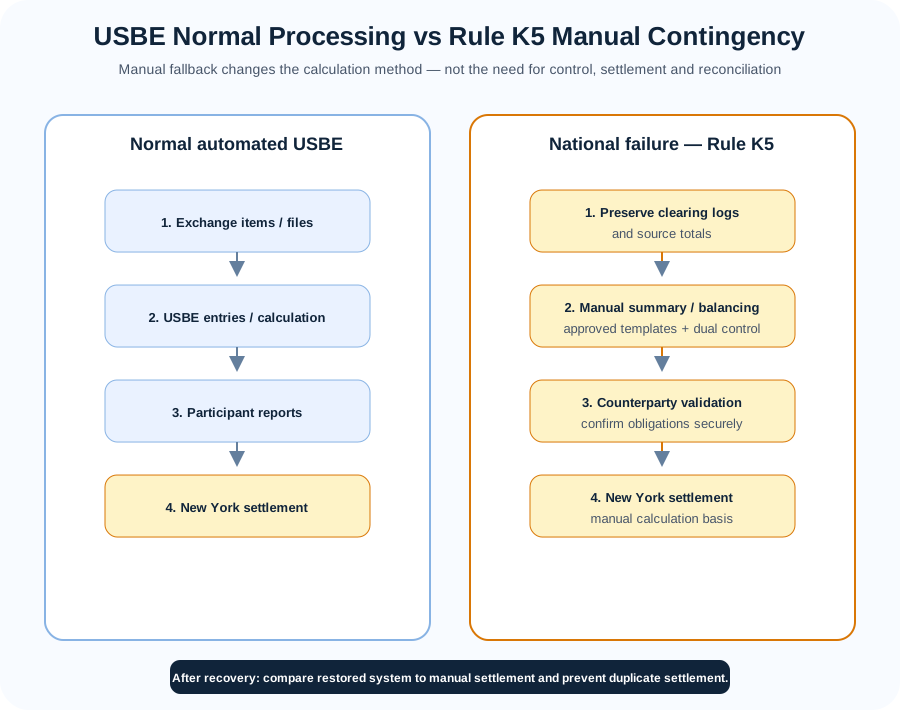
Rule K5 defines manual balancing/settlement when there is a national failure of automated ACSS/USBE.
Payments Canada makes available templates and clearing-exchange data available before failure under the rule process.
Participants:
- continue clearing logs;
- calculate balances manually;
- exchange required information;
- effect settlement.
Why manual contingency must be practiced
A procedure that exists only in PDF will fail under pressure.
Banks should test:
- staff access;
- templates;
- counterpart contacts;
- data extraction;
- manual calculations;
- dual control;
- settlement;
- reconciliation back to restored system.
File duplicate control
Retained File Creation Numbers help identify duplicate/invalid sequences.
Internal bank should also use:
- customer file ID;
- hash;
- creation timestamp;
- item IDs.
Security
USD files and settlement are high-value.
Controls:
- secure transmission;
- access;
- dual control;
- encryption;
- audit;
- privileged-user monitoring.
Operational dashboard
Show:
- files received;
- files accepted;
- rejected;
- items/value;
- USBE entries;
- bilateral net positions;
- settlement sent/received;
- unmatched;
- returns;
- New York holiday flag.
9. Posting, accounting, reporting and reconciliation
Customer posting
USD AFT credit originator:
- debit originator USD account according to product;
- payment clearing/control.
Receiving:
- credit payee USD account by required availability timing.
USD debit:
- follow debit/PAD authority and AFT processing.
Clearing accounting
Bank builds expected USBE positions by counterparty.
Expected should match USBE reports.
Settlement accounting
Owing:
- debit USBE payable/control;
- credit USD nostro at New York bank.
Receiving:
- debit USD nostro;
- credit USBE receivable/control.
Exact chart differs.
Four-way reconciliation
Customer/AFT items
count/value.
File/exchange
delivered/received.
USBE entries
counterparty totals.
New York settlement
actual USD transfer.
All must agree.
Paper reconciliation
Also:
- item exchange logs;
- images/items;
- batch totals.
Rejected file control
If file rejected:
- exclude settlement;
- reverse/hold any premature accounting;
- customer status.
Returns reconciliation
Return:
original item → return item → USBE entry → settlement → customer posting.
Statement matching
New York settlement account statement:
- payment reference;
- counterparty;
- amount;
- date.
Reconcile to expected settlement transfer.
Suspense
Unmatched entries to USD suspense:
Large USD suspense should escalate quickly.
Currency segregation
Do not mix CAD and USD control accounts.
Multi-currency ledger should carry currency dimension explicitly.
10. Implementation, testing and resilience
Product classification
First requirement:
is this item USBE-eligible or cross-border correspondent?
Route based on:
- instrument;
- FI domicile/account;
- payment type;
- currency.
Not currency alone.
USD AFT engine
Should support:
- separate USD files;
- legacy Standard 005;
- ISO AFT/F4 usage as implemented;
- due date;
- file creation number;
- serviceability;
- return/reversal.
Participant directory
Maintain:
- direct clearer;
- processing arrangement;
- settlement agent;
- exchange status;
- effective date.
New York settlement static data
High-risk master:
- settlement bank;
- ABA/routing where applicable;
- account;
- beneficiary institution;
- reference.
Dual control.
Testing K8 timing
Test:
- file before morning cutoff;
- file after cutoff;
- rejection;
- due date;
- U.S. holiday.
Do not hard-code times from this chapter without checking live K8 during implementation.
Testing legacy/ISO coexistence
Legacy USD AFT:
- valid;
- duplicate file number;
- return.
ISO AFT:
- valid usage guideline;
- schema reject;
- return/reversal.
Reconcile both to same USBE settlement framework.
Testing paper
- qualified item;
- image;
- batch totals;
- balance error;
- adjustment.
Testing settlement
- net payable;
- net receivable;
- multiple counterparties;
- one counterparty fails;
- holiday value date.
Testing contingency
Simulate USBE unavailable.
Teams manually:
- extract entries;
- build summary;
- validate;
- settle;
- record.
After restoration:
- reconcile manual outcome.
Resilience
Dependencies:
- Payments Canada CSN/application;
- AFT transmission;
- cheque exchange;
- bank core;
- New York settlement bank;
- treasury.
Failure modes need separate runbooks.
Observability
Metrics:
- USD AFT volume/value;
- file reject;
- late file;
- settlement due;
- settlement late;
- manual adjustment;
- interest claim;
- return rate;
- unreconciled.
10. Implementation, controls and evidence
The operational design must keep three contexts separate: Payments Canada rule obligations, bank-specific product and control choices, and fictional training examples. Currency alone is not a routing decision.
Route classification
A payment belongs in the USBE analysis only when the instrument and participant/account context satisfy the applicable Payments Canada rules. A USD wire to a beneficiary bank outside Canada is a correspondent/cross-border product, not USBE. A card transaction follows its card-scheme and acquirer/issuer arrangements. A CAD retail batch item follows the CAD ACSS path. The payment hub should therefore store product, instrument, customer and beneficiary FI domicile, currency, clearing route and settlement route as separate fields.
| Scenario | Route (conceptual) | What must not be inferred |
|---|
| USD AFT between Canadian FIs | Rule K8 / USBE | Not an instant payment or a New York customer wire |
| Eligible USD paper item | Rule K1 / USBE paper exchange | Not an AFT return flow |
| USD transfer to a U.S. beneficiary bank | Cross-border correspondent/wire | Not USBE merely because the currency is USD |
| CAD retail batch payment | ACSS rules | Not USBE |
| Card purchase or refund | Applicable card-network/acquirer rules | Not USBE merely because merchant settlement is in USD |
Current rule facts to encode
The live 2025 K8 PDF says USD AFT files must be separate from CAD AFT files and covers both Standard 005 logical records and ISO AFT message formats. It requires registration to receive or receive-and-deliver USD AFT transactions and test-file processing before production; new USD AFT exchange registrations are at least 180 calendar days before implementation. A processing Direct Clearer retains the last 10 USD AFT File Creation Numbers, and a non-conforming number is a rejection cause.
For qualifying USD AFT or ISO AFT credit transactions exchanged within the Rule F1 serviceability-code windows, the processing or indirect clearer must make funds available by opening of business on the Due Date, unless applicable legislation requires otherwise. K8 also says a Serviceability Code 0 branch is treated as Code 1 for this purpose. The processing Direct Clearer must maintain a one-year summary of USD AFT and ISO AFT debit and credit transactions by exchange point, file and Due Date.
K8 intermember timings are Eastern Time, with standard/daylight treatment tied to Ottawa: USD AFT files are exchanged only in the morning exchange before 09:30 ET; file-rejection notification is due no later than 12:00 ET; and the specified USBE debit entries are due no later than 14:30 ET. These are not customer channel cutoffs. K8 excludes rejected files from settlement and generally settles in New York on the Due Date, with the rule’s separate treatment for transactions delivered after the Due Date.
K1’s paper process is narrower than “any USD cheque.” Eligible items must meet the rule’s Item requirements, including the applicable domestic/US-office or payable-through conditions. Canadian-dollar items converted to USD, post-dated items and items in dispute are expressly disqualified. Items are exchanged by stream in bundles of no more than 300, with lists and clearing logs; delivering Direct Clearers must image or microfilm before exchange and maintain quality/integrity controls. Exchange time is agreed at each Bulk Exchange Point and is no later than 12:30 local time.
Messages, files, APIs and bank processing
A corporate channel may be H2H/SFTP or another bank-supported interface; the channel is a bank implementation choice, not a USBE rule. The bank must authenticate the sender and authorize the release before accepting a file. It should preserve the original file/message, transport identifier, file creation number, hash, timestamps, business date, due date and customer instruction ID. It should distinguish transport retry from a new business file and distinguish file rejection from transaction return.
A practical state model is RECEIVED → AUTHENTICATED → FILE_VALID → ITEM_VALIDATED → RELEASED → EXCHANGED → USBE_ENTRY → SETTLEMENT → RECONCILED, with explicit FILE_REJECTED, ITEM_RETURNED, ADJUSTED and MANUAL_CONTINGENCY states. Standard 005 and the current ISO AFT Usage Guidelines determine syntax and allowed data; do not invent a routing or account-number check that the applicable standard or bank service does not provide. Payments Canada’s ISO AFT onboarding page documents registration, participant testing, implementation and post-go-live support. Its published Part C and Part D materials cover payment returns and reversals; they are not evidence that every bank product supports every message.
The bank payment hub should normalize legacy and ISO data without collapsing their external rule semantics. It must enforce a separate USD clearing stream, preserve rich ISO data or record any truncation, and map customer-facing statuses to the actual exchange, rejection, return and posting evidence. The core ledger must keep CAD and USD control accounts distinct and carry currency explicitly.
Participants, exchange and settlement
Payments Canada operates the retail batch framework and its USBE application. Direct Clearers exchange items/files and calculate or receive positions; an indirect clearer reaches the system through its clearing arrangement. Under K1, participation at each paper Bulk Exchange Point can be participating or non-participating, with an Exchange Agent required for the latter. A USBE Settlement Agent settles for an arranged non-participating Direct Clearer. Under K8, a Direct Clearer may use another Direct Clearer for clearing services under a separate agreement, but each Direct Clearer must settle on its own behalf. Maintain the actual role, agreement, effective date and contact in participant reference data.
Clearing is not the same as settlement. The USBE information or the National Summary USBE Report supports the net amount due to or from each other Direct Clearer. An owing Direct Clearer provides USD settlement in New York through the applicable account/correspondent arrangement. A settlement agent adds an evidence layer: customer items → bank position → agent report → external New York settlement → bank/agent account. Do not assume every participant will have its own external New York debit; follow the actual arrangement and reports.
The current Payments Canada retail-batch page states that ACSS and USBE are a dual-currency retail-batch system and that USBE settlement is effected through correspondent banks in New York. It currently reports that the retail-batch system supports 99% of daily transaction volume and 13% of daily transaction value across Payments Canada systems; those figures are system-level statistics, not USD-USBE volume or value.
Calendar, liquidity and accounting
The rule calendar is a joined calendar: Payments Canada business day, Canadian system closure, and New York bank business day. K1 paper settlement is for value on the exchange day, except that an exchange in Canada on a New York bank holiday, Christmas Eve or New Year’s Eve is value-dated for the next New York business day. K8 contains its own Due Date and U.S.-holiday provisions. Store exchange date, Due Date, New York value date and actual settlement date separately; never turn 09:30 ET into a universal customer promise.
Treasury forecasts USD positions by stream, counterparty and agent, including returns and adjustments, and funds the New York arrangement. The settlement control should verify currency, counterparty, amount, value date, destination account, dual approval, release cutoff and confirmation. The expected position must not be marked settled until external account evidence or agent evidence is received.
A useful accounting pattern is product-specific: customer posting and a USD clearing/control account; then a USD settlement payable/receivable; then the New York nostro or settlement-agent account. The exact chart is bank-specific. Reconcile at four levels: customer items/files, exchanged items/files, USBE entries/reports and external/agent settlement. One external transfer can represent many retail items, so matching is hierarchical rather than one-to-one.
Returns, adjustments, disputes and interest
A file rejection means the file was not accepted and must be excluded from settlement. A transaction return is a later return of an accepted transaction. Use the applicable AFT rules, Standard 007 and current ISO AFT Usage Guidelines for return/reversal conditions and identifiers. Do not apply AFT return codes to K1 paper items. K4 governs clearing corrections after final closing; retain a case linking the original item/file, error, adjustment, USBE entry and settlement impact.
K6 applies to intermember USD bulk-exchange errors. It uses the Federal Funds Rate published by the Federal Reserve Bank of New York, a 360-day conversion and a maximum 90-calendar-day claim period in the ordinary case; individual claims under USD 500 are waived except for disputed items, and claims are generally notified within three months. These are intermember rules, not a blanket retail-customer compensation promise. Affected Direct Clearers must handle customer losses in an equitable way where the rule requires it.
K1 also includes a failure-to-settle example and return/recalculation treatment. A bank’s default playbook should identify the incident owner, Payments Canada contact, counterparties, treasury, legal/compliance and customer populations. Fraud investigations should preserve images/files, authentication evidence, device/channel details, screening decisions, approvals, returns and external settlement evidence.
AML, sanctions and operational controls
AML obligations attach to the applicable reporting entity and transaction context. FINTRAC’s EFT guidance states that financial entities report an international EFT of CAD 10,000 or more in a single transaction at initiation and final receipt; its examples cover a USD 10,000 Canada-to-U.S. SWIFT transfer. That guidance does not make every domestic Canadian USBE item an international EFT report. The bank must apply the Proceeds of Crime (Money Laundering) and Terrorist Financing Act/Regulations, sanctions law and its risk-based controls to the actual parties, route and correspondent exposure. Screening, fraud decisions and holds are bank controls unless a named rule or law says otherwise.
K4 local outage and K5 national failure
Do not treat every outage as a K5 event. K4 requires operational controls for the USBE web application over the CSN, workstations, backups and support. If online access is unavailable, manual clearing logs may accompany exchanges and the online clearing-data update is due within one hour after access is restored. K4 also provides the national electronic closing times and, after a national failure, a possible extension of final closing to 16:45 ET plus a possible 15-minute reopening; the current K4 table—not this chapter—controls implementation.
K5 is specifically for a National Failure when Payments Canada invokes manual balancing and settlement. It requires at least one coordinated national simulation each calendar year. Forms include Clearing Logs, USBE Exchange Statements and paper/electronic exchange reports. Payments Canada makes electronic templates and pre-failure Clearing Exchange data available under the User Guide. Direct Clearers prepare recap logs and exchange statements, verify net settlement figures with counterparties by the K5 regional deadlines, complete the National Summary Report, and settle under K1. Manual reports are retained for two years. After recovery, reconcile the manual result against restored data and prevent duplicate settlement.
Control and test matrix
Test evidence, not just a happy-path API response:
- classification: domestic USD AFT, eligible K1 paper item, cross-border USD wire, card transaction and CAD AFT;
- files: separate USD/CAD files, valid/invalid Standard 005, ISO schema/usage error, duplicate File Creation Number, authentication failure and item-level defect;
- timing: before/after the bank cutoff, 09:30 ET exchange deadline, 12:00 ET rejection notification, 14:30 ET entries, Due Date and after-Due-Date delivery;
- calendars: normal day, Canadian closure, New York holiday, Christmas Eve and New Year’s Eve treatment;
- settlement: payable, receivable, settlement agent, missing confirmation and counterparty failure;
- returns and corrections: file rejection, credit/debit return, reversal, K4 post-closing correction, K6 claim and customer investigation;
- resilience: local bank outage, CSN/USBE outage, K5 national failure, manual balancing, restored-system reconciliation and duplicate-settlement prevention.
Use zero-tolerance control totals for count, amount, currency and business date, with owned exceptions and ageing. Retain source files/messages, validation and authentication logs, exchange logs, USBE reports, agent reports, settlement statements, customer postings, returns, adjustments and manual-contingency evidence for the applicable legal, rule and bank-retention periods.
11. Practical Canadian USD examples
The examples below are fictional training examples, not customer promises or statistics.
Example 1 — domestic USD supplier AFT
Toronto Company A sends a USD 75,000 USD AFT credit to Vancouver Company B. Both accounts are at Canadian FIs. The bank validates a separate USD file, exchanges it under K8, enters the required position, funds its New York settlement obligation and posts the beneficiary credit under the Due Date/funds-availability rule. This is not an international wire.
Example 2 — cross-border USD wire
A customer sends USD 500,000 to a New York beneficiary bank. The payment hub routes it to the bank’s cross-border/correspondent product, applies the actual screening and reporting controls, and does not label it USBE merely because it is USD.
Example 3 — national failure
Payments Canada invokes K5 for a National Failure. Direct Clearers preserve logs, use the prescribed reports/templates, verify net positions, settle under K1 and reconcile after recovery. A local bank AFT-engine outage is handled under the bank’s own contingency and is not automatically a K5 event.
12. Key takeaways and authoritative references
USBE is the USD side of Canada’s retail batch framework for eligible items and files, not a general international USD wire rail. K1 governs USD paper-item exchange; K4 governs the automated application and local/system operation; K5 governs invoked national-failure manual balancing; K6 governs intermember USD interest claims; and K8 governs USD AFT exchange, funds availability, timing and New York settlement. Preserve the distinction between rule text, bank implementation and fictional examples.
Authoritative references
- Payments Canada — Retail batch payment system — ACSS/USBE scope, system statistics, direct/indirect clearers and New York correspondent settlement.
- Payments Canada — Rules & documentation — live versions and effective dates; the page states rules and standards are updated regularly and the posted versions are in force.
- Payments Canada — Rule K1, Bulk Exchange and Settlement of U.S. Dollar Paper Items — posted rule; eligibility, agents, paper exchange, timing and New York settlement.
- Payments Canada — Rule K4, U.S. Bulk Exchange Automated System — posted rule; USBE application, logs, closing times, corrections, backups and contingency operations.
- Payments Canada — Rule K5, U.S. Bulk Exchange System Manual Balancing and Settlement — posted rule; invoked National Failure, simulations, forms, reports, manual balancing and settlement.
- Payments Canada — Rule K6, Intermember U.S. Dollar Interest Claims — posted rule; interest basis, thresholds, notice and error conditions.
- Payments Canada — Rule K8, U.S. Dollar Automated Funds Transfer System — posted rule; separate USD/CAD files, registration/testing, FCN retention, funds availability, timings and settlement.
- Payments Canada — Automatic funds transfer / ISO 20022 — current onboarding, testing, message portfolio, returns and reversals.
- Bank of Canada — FMI Oversight Activities 2018 Annual Report, glossary — official description of USBE as USD items drawn on Canadian USD accounts and settled in the United States.
- FINTRAC — Reporting electronic funds transfers — international EFT reporting scope and CAD 10,000 threshold; not a rule that every domestic USBE item is an international EFT.
- Department of Finance Canada — Retail Payment Activities Act privacy impact assessment — RPAA registration context for payment service providers; distinguish PSP supervision from bank participation in Payments Canada systems.
This application uses JavaScript for the full interactive experience. This text summary is served for accessibility and search indexing.