SWIFT and CBPR+. Follow cross-border payment data through SWIFT CBPR+, bank validation, screening, routing, tracking and reporting.
Block 11 · Chapter 52 of 75
Swift’s Cross-Border Payments and Reporting Plus programme, usually called CBPR+, is the market-practice layer that tells financial institutions how to use ISO 20022 messages for cross-border payments and cash reporting over Swift. It is not a new settlement system, and ISO 20022 is not a currency. CBPR+ standardizes how banks describe the payment: the parties, accounts, agents, amount, currency, identifiers, remittance, status and related events. The actual value still settles through correspondent accounts, domestic payment systems, central-bank money or other settlement arrangements chosen for the route.
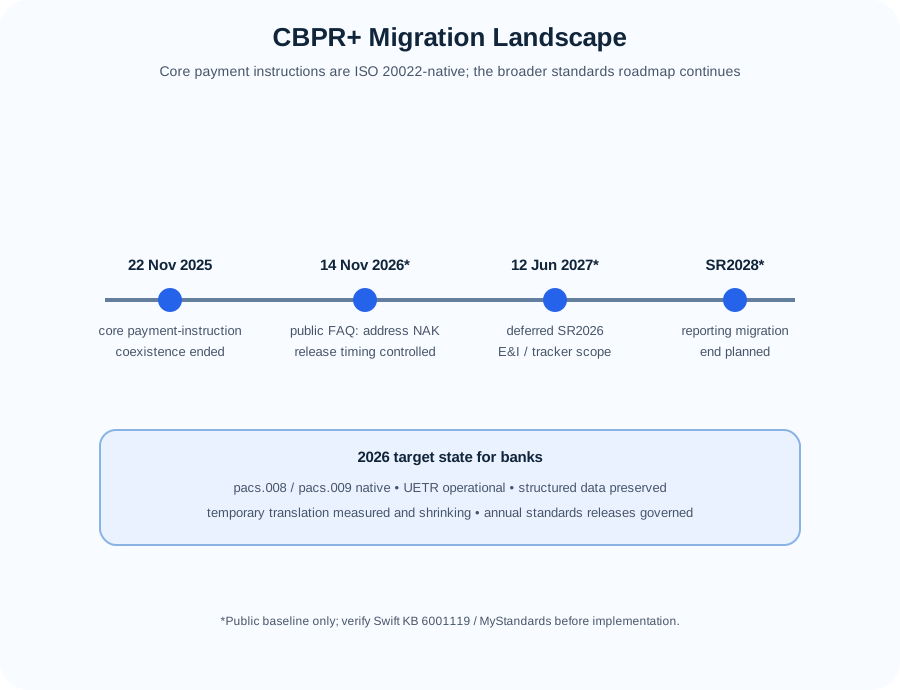
For Canadian banks, the most important current-state fact is that the coexistence period for the principal cross-border payment instruction messages ended on 22 November 2025. Swift states that after that date ISO 20022 became the standard language for cross-border payment instructions; legacy FIN MT payment instructions are no longer the normal end-to-end payment-instruction format. Swift has provided time-limited contingency/translation measures to protect operational continuity, but those are migration safety nets rather than a strategic target state. At the same time, CBPR+ migration continues beyond payment instructions: Swift’s roadmap phases other categories such as payment initiation, exceptions and investigations, and account reporting across later releases. A bank in October 2026 therefore needs to be fully ISO 20022-native for core cross-border payment instructions while still managing the wider multi-year standards roadmap.
This chapter explains CBPR+ from a bank operating-model perspective. It covers the message families, Business Application Header, pacs.008 customer payments, pacs.009 financial-institution and cover payments, UETR, serial and cover flows, payment status, returns, cancellation, cash reporting, data quality, sanctions screening, routing, translation boundaries, investigations, reconciliation, release management and testing. It intentionally does not reproduce schema tables or hard-code all current CBPR+ validation rules; those belong in Swift MyStandards and the current release documentation. The goal is to understand what the messages mean, where they sit in the payment lifecycle and what a bank must build around them.
What you should be able to do after this chapter
After working through this chapter, you should be able to:
- explain the difference between ISO 20022, CBPR+, Swift FINplus and the underlying settlement route;
- state what ended on 22 November 2025 and why the date matters operationally;
- describe the purpose of the Business Application Header separately from the ISO 20022 payment document;
- explain the functional purpose of pacs.008, pacs.009, pacs.002, pacs.004, camt.056, camt.029 and key camt reporting messages;
- distinguish pacs.009 core from pacs.009 COV and explain why cover data must preserve underlying customer-payment information;
- trace serial and cover customer-payment flows;
- explain how UETR supports end-to-end identity and tracking;
- describe how structured party and address data improves screening, repair and reconciliation;
- explain why converting rich ISO 20022 data back into lean legacy structures creates data-loss risk;
- separate payment-message validation, sanctions screening, route selection and settlement;
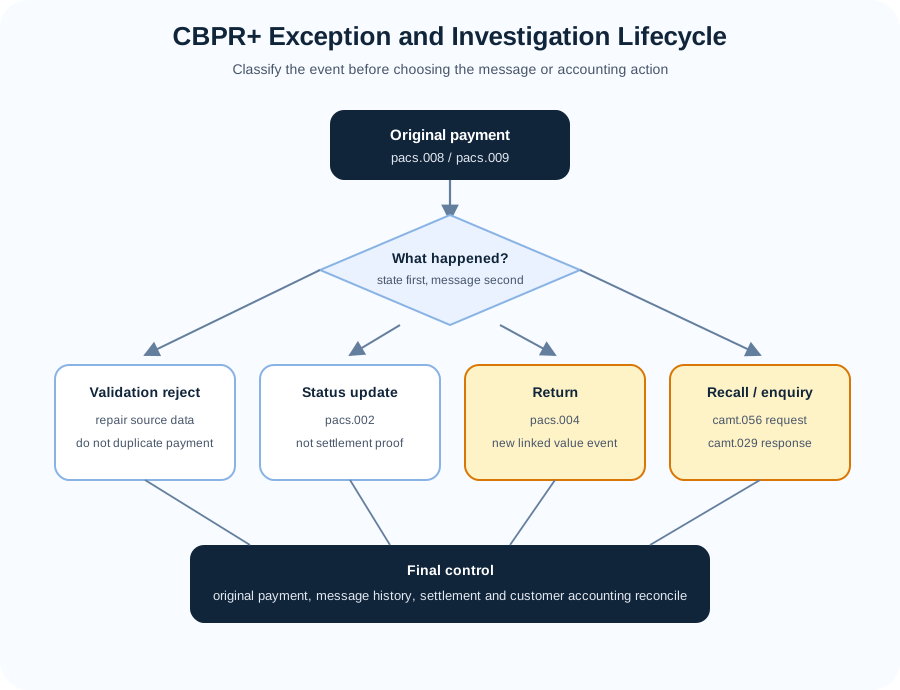
- trace rejection, return, cancellation and investigation flows without treating all exceptions as the same thing;
- connect CBPR+ messages to nostro/account reporting and payment reconciliation;
- design testing for usage-guideline changes, standards releases, translations, duplicate handling and contingency processing;
- explain Swift’s post-2025 roadmap without implying that every MT category disappeared on the same date;
- use current MyStandards/release material as the implementation source of truth.
For a roughly 60-minute core session, spend 10 minutes on Sections 1–2 with the CBPR+ landscape diagram, 15 minutes on Sections 3–4 with the serial/cover flow, 10 minutes on Sections 5–6 with the message family and data-quality sections, 10 minutes on Sections 7–9, 10 minutes on examples and 5 minutes on references.
Chapter navigator
- What CBPR+ changed and what it did not
- Actors, FINplus, BAH and message boundaries
- pacs.008 customer payments and the serial method
- pacs.009, cover payments and financial-institution transfers
- Status, returns, cancellation, investigations and reporting
- Structured data, UETR, addresses and data quality
- Validation, screening, routing and settlement
- Exceptions, translation and operational recovery
- Posting, nostro reporting and reconciliation
- Implementation, release management and testing
- Practical CBPR+ examples
- Key takeaways and authoritative references
1. What CBPR+ changed and what it did not
CBPR+ changed the language and market practice of cross-border bank messaging. It did not remove correspondent banking, and it did not create a universal global settlement account.
Before ISO 20022 migration, many cross-border payment instructions were represented using Swift MT messages such as MT103 for customer payments and MT202/MT202 COV for financial-institution and cover payments. Those messages were compact and highly standardized, but their field model could not carry the breadth and structure of data that modern payments, compliance and reconciliation need.
ISO 20022 provides a richer business model. CBPR+ then narrows that broad standard into cross-border usage guidelines that specify how the Swift community should use those messages consistently.
The result is not merely “XML instead of MT.” The real change is:
- more structured parties;
- richer identifiers;
- clearer agent roles;
- structured remittance;
- more explicit status and exception messages;
- better data reuse for screening and reconciliation;
- harmonized global market practice.
The 22 November 2025 milestone
Swift’s coexistence period ended on 22 November 2025 for the principal cross-border payment instruction messages. This means institutions can no longer design a target state around sending and receiving legacy MT payment instructions as the primary cross-border language.
Swift provided operational safety measures, including temporary conversion/translation options, to help institutions complete migration. Those measures should be treated as contingency, not as a reason to preserve an MT-native bank core indefinitely.
A mature 2026 bank should therefore ask:
- Can we receive and process ISO 20022 natively?
- Do we preserve all structured data?
- Can downstream systems consume ISO identifiers?
- Are manual repair tools ISO-aware?
- Can screening use the structured party model?
- Can reconciliation use UETR and ISO references?
- Have we removed unnecessary MT-shaped internal constraints?
The roadmap continues — and the current schedule is release-controlled
The end of payment-instruction coexistence is not the end of the CBPR+ programme. Swift’s March 2026 roadmap (version 4) says the remaining FI-to-FI categories have separate milestones: initiation remains in coexistence beyond November 2025; exceptions and investigations move to camt.110/camt.111 through Case Management; payment-cancellation messages move through Case Management; and statement/reporting migration is planned through SR2028. Those are Swift scheme milestones, not Canadian law.
There is an important current-date qualification. Swift’s 21 September 2026 update says the deferred SR2026 release covering exceptions and investigations is now scheduled for 12 June 2027. Swift’s public address FAQ still states 14 November 2026 for the CBPR+ unstructured-address NAK, while directing customers to Knowledge Centre article 6001119 for the latest scope and timing. Treat the customer-area release/usage guidelines as the operational source of truth, version the rule set used by the bank, and do not hard-code an old roadmap date into customer or operations logic.
This distinction matters in project planning. A bank may be fully migrated for pacs.008/pacs.009 while still operating legacy initiation or reporting interfaces. Do not state “all MT messages ended in November 2025”: that is factually wrong.
2. Actors, FINplus, BAH and message boundaries
Swift network versus bank processing
Swift provides the secure messaging infrastructure and market standards connecting institutions.
The bank still owns:
- customer authentication;
- customer account posting;
- FX;
- sanctions/AML controls;
- routing;
- correspondent liquidity;
- settlement;
- beneficiary posting;
- reconciliation.
A Swift ACK is therefore not proof of beneficiary settlement.
FINplus
CBPR+ ISO 20022 messages are exchanged through Swift’s ISO 20022 messaging environment, commonly referred to through FINplus service context.
Banks need interfaces between:
payment hub → Swift gateway/interface → FINplus → receiving institution
and
incoming FINplus → gateway → validation → payment hub / operations / reporting.
Business Application Header
The Business Application Header (BAH) provides business-message metadata distinct from the ISO document itself.
A good architecture preserves three layers:
- network/transport context;
- Business Application Header;
- ISO 20022 document.
The BAH can carry information used to identify sender/receiver and message/business context. The payment document carries the financial business content.
Flattening these layers into one legacy record makes troubleshooting difficult.
Instructing and instructed agents
ISO 20022 explicitly models agents and relationships.
Practitioners should understand that:
- debtor agent services debtor/originator side;
- creditor agent services beneficiary side;
- instructing agent sends a particular interbank instruction;
- instructed agent receives it;
- intermediary agents can exist in the chain.
These roles can change from hop to hop.
The bank should not assume “sender BIC” equals “debtor agent” in every context.
BIC and account relationships
BIC identifies the institution/address for messaging. It does not itself create a correspondent account relationship.
A route needs both messaging reachability and settlement capability.
3. pacs.008 customer payments and the serial method
The pacs.008 FIToFICustomerCreditTransfer is the core interbank customer credit-transfer message under CBPR+.
Functionally, it carries:
- underlying debtor;
- debtor account;
- debtor agent;
- creditor agent;
- creditor;
- creditor account;
- amount/currency;
- payment identifiers;
- remittance;
- agent chain;
- purpose/regulatory data where applicable.
The exact CBPR+ mandatory/optional rules belong in current MyStandards.
Serial method
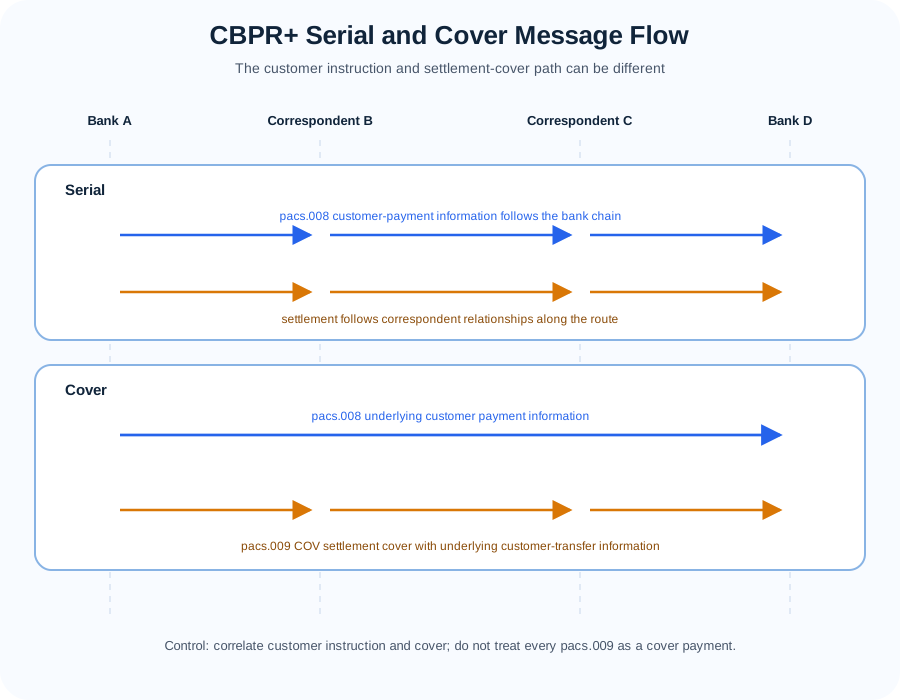
In a serial payment, the pacs.008 customer-payment instruction moves through the financial institutions in the payment chain.
Example:
Originating Bank A → Correspondent B → Intermediary C → Beneficiary Bank D.
Each instructed bank processes and forwards according to its role.
Payment identity
The message includes identifiers that operations must preserve.
The UETR is particularly important because it gives the payment a chain-wide tracking identity.
The bank should maintain:
- internal payment ID;
- UETR;
- EndToEndId;
- TxId/InstrId where applicable;
- network message identity.
Each serves a different purpose.
UETR generation and preservation
The UETR should be generated and retained according to Swift rules. Intermediaries should not create a new UETR simply because they forward the payment.
Changing UETR mid-chain can break:
- tracker visibility;
- investigation correlation;
- reconciliation;
- customer service.
Serial settlement
The message can move hop by hop, and settlement follows the correspondent relationships/domestic systems used by each leg.
Message forwarding and account debit are related but distinct events. A bank can accept the pacs.008 and hold it before settling/forwarding because of compliance or liquidity.
Remittance preservation
Structured remittance is valuable to corporate beneficiaries.
A bank should avoid flattening:
- invoice references;
- creditor references;
- additional remittance;
- related remittance data.
If a downstream route cannot support all data, the truncation/data-loss decision must be explicit.
4. pacs.009, cover payments and financial-institution transfers
The pacs.009 FinancialInstitutionCreditTransfer is used for financial-institution-to-financial-institution transfers.
CBPR+ defines different usage contexts, including core and cover.
pacs.009 core
A pacs.009 core represents an FI credit transfer where financial institutions are acting as the parties to the transfer rather than carrying an underlying customer credit transfer as cover.
Examples can include:
- liquidity transfers;
- settlement between institutions;
- certain treasury/interbank payments.
The actual allowed use cases must follow CBPR+ guidance.
pacs.009 COV
A pacs.009 COV provides cover settlement for an underlying customer credit transfer.
Swift/PMPG guidance explains that the cover message is identified by the presence of the Underlying Customer Credit Transfer information. This is the ISO 20022 counterpart to the transparency concept that existed in MT202 COV.
The purpose is not to duplicate the entire customer payment for fun. It ensures that intermediaries on the cover path have the underlying customer information needed for transparency and screening.
Cover architecture
A simplified cover flow is:
Customer-payment information path
Originating Bank A → pacs.008 → Beneficiary Bank D
Cover settlement path
Bank A → pacs.009 COV → Correspondent B → Correspondent C → Bank D
The customer-payment and settlement-cover paths meet conceptually at the beneficiary bank.
Underlying information integrity
The underlying customer information in the cover message must remain consistent with the underlying pacs.008 according to applicable guidance.
A bank should not:
- omit customer data to make screening faster;
- substitute intermediary data;
- regenerate inconsistent references.
Data discrepancies between pacs.008 and cover can trigger compliance and reconciliation issues.
pacs.009 advice
CBPR+ also defines advice usage for certain cover contexts. Practitioners should consult current Swift guidance for the precise use case rather than guessing from the message name.
Financial institution transfer is not automatically cover
Not every pacs.009 is a cover payment.
Architecture and operations should explicitly record the usage profile:
- CORE;
- COV;
- ADV where applicable.
This affects validation and investigation.
5. Status, returns, cancellation, investigations and reporting
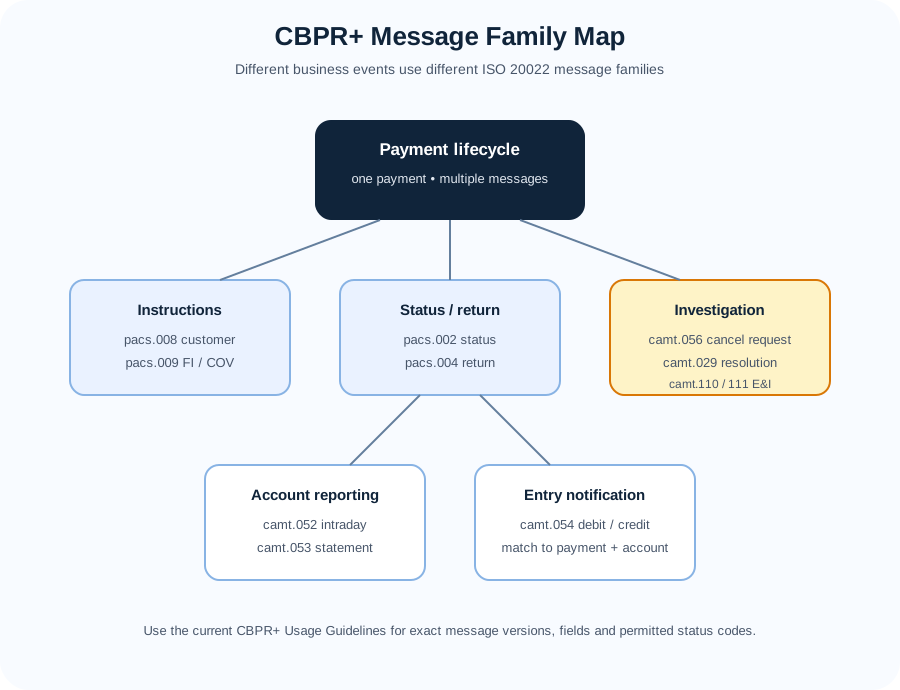
Cross-border payment processing needs more than instructions.
pacs.002 — payment status
The pacs.002 FIToFIPaymentStatusReport communicates status such as acceptance/rejection according to the applicable usage guideline.
A status report is not automatically settlement evidence.
It tells you the message/payment processing state in the reporting institution’s context.
pacs.004 — payment return
The pacs.004 PaymentReturn returns value and links to the original payment.
A return should preserve original identity and reason information.
Accounting should post it as a new linked event, not delete the original payment.
camt.056 — cancellation request
The camt.056 FIToFIPaymentCancellationRequest requests cancellation/recall of a prior payment.
It is a request.
Operations must not interpret sending camt.056 as proof the money was recovered.
camt.029 — cancellation / investigation resolution
The camt.029 ResolutionOfInvestigation is used in cancellation/recall-related response flows and other applicable resolution use cases according to the current usage guidelines. It is not a universal substitute for every investigation message: Swift’s current roadmap uses camt.110 for investigation requests and camt.111 for responses as the exceptions-and-investigations migration progresses.
The message choice is therefore release/profile dependent. It supports a structured response rather than free-form manual messages, but a bank must retain the original case, references, timestamps and accounting outcome regardless of the network family used.
camt.052 — intraday reporting
camt.052 supports account-reporting information useful for intraday views.
Treasury and reconciliation can use this to monitor positions before end-of-day.
camt.053 — statement
camt.053 is the account statement message family.
It supports end-of-day/account reconciliation.
camt.054 — debit/credit notification
camt.054 reports debit/credit entries.
Banks can use it for near-real-time account-entry notification and payment matching.
Roadmap discipline
The CBPR+ timetable for reporting and exceptions/investigations extends beyond the 2025 payment-instruction milestone.
Banks should maintain a standards roadmap by:
- message category;
- current legacy format;
- target ISO message;
- coexistence/end-of-life date;
- current release;
- application dependency.
This prevents the common mistake of treating “ISO migration” as one go-live date.
6. Structured data, UETR, addresses and data quality
Rich data is the business case
ISO 20022’s advantage is not XML syntax. It is semantic structure.
Examples:
Party
- name;
- structured address;
- organization/private identification.
Account
- IBAN or other identifier;
- account type/currency where relevant.
Agent
- BIC/institution identification;
- clearing member identification.
Remittance
- structured creditor reference;
- invoices;
- free text.
Purpose
- business purpose/category where used.
A bank benefits only if downstream applications preserve these concepts.
Structured and hybrid addresses
Swift’s public FAQ currently states that from 14 November 2026 town and country must be in designated fields, at minimum, for agents and parties in CBPR+ payment messages. It lists admi.024, camt.025, camt.052, camt.053, camt.054 and camt.060 as exceptions; for an agent, a BIC alone remains a valid option. After that date, the FAQ says unstructured-address payment messages will be NAK’ed. A valid address is fully structured or hybrid, with at least Town Name and Country in designated fields.
Swift’s 27 August and 21 September 2026 announcements also say that payment changes in the deferred SR2026 release are being re-timed, with the latest scope/timing maintained in Knowledge Centre article 6001119. Therefore the 14 November date is the public-FAQ baseline at this chapter’s 5 October 2026 cut-off, not a promise that a bank may ignore a later controlled release notice. Pin the effective rule and exceptions to the bank’s approved MyStandards/Usage Guidelines version.
For a bank, this is not only a gateway change. Corporate channels, beneficiary masters, host-to-host files, internal canonical models, sanctions screening and repair tooling all need to preserve the required structured data before the message reaches FINplus. The safest implementation is to reject or repair incomplete address data at customer intake rather than inventing town/country values at the network edge. Swift’s November 2025 release introduced the hybrid option alongside the transition arrangement.
The implementation principle is stable: capture the most structured reliable data you have; preserve it; do not deliberately degrade it.
UETR as an operational key
UETR should be searchable in:
- payment hub;
- Swift gateway;
- tracker interface;
- investigations;
- reconciliation;
- customer-service tooling.
If only the Swift team can search UETR, the bank has not operationalized it.
EndToEndId
EndToEndId can represent a customer/business-level reference intended to travel end to end.
Corporates often rely on it for reconciliation.
A bank should not replace meaningful customer references with its own internal ID unless standards/usage require a specific treatment.
Transliteration
Cross-border payments involve multiple scripts and character sets.
Banks need controlled policy for:
- original party name;
- transliteration;
- screening input;
- customer display;
- downstream constraints.
A transliterated value should not overwrite the original authoritative customer data.
Data-quality KPIs
Useful metrics include:
- structured address adoption;
- missing party data;
- placeholder values;
- repair request rate;
- CBPR+ validation reject rate;
- truncation events;
- remittance preservation rate;
- UETR coverage;
- duplicate UETR defects.
7. Validation, screening, routing and settlement
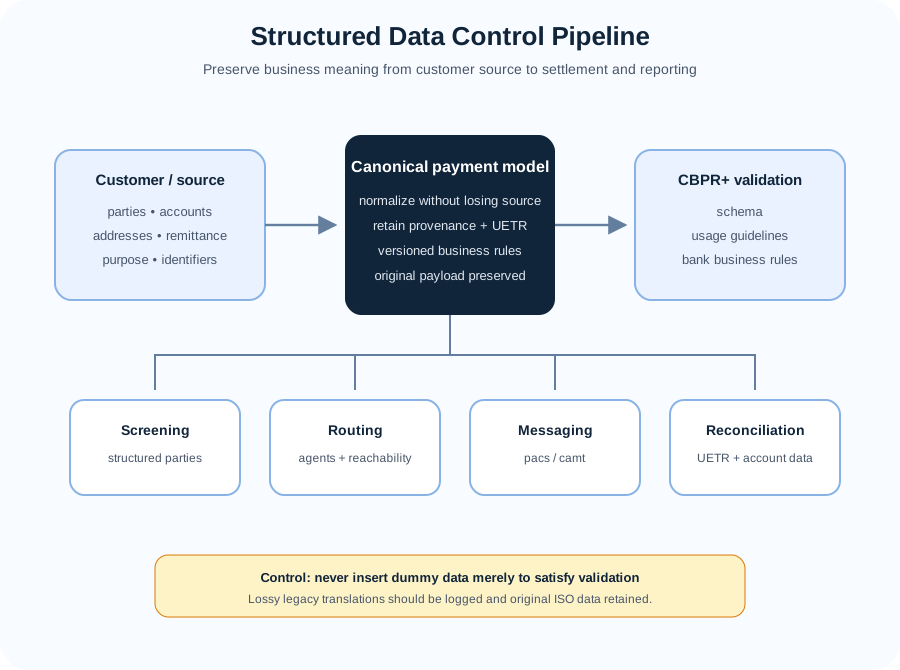
CBPR+ validation is one control layer.
A bank still needs:
- customer validation;
- ISO schema validation;
- CBPR+ usage-guideline validation;
- bank product rules;
- sanctions screening;
- AML/fraud controls;
- correspondent routing;
- account/liquidity checks;
- settlement;
- posting/reconciliation.
Schema validation
Does the XML conform to the ISO message schema?
Usage-guideline validation
Does it meet CBPR+ market-practice restrictions?
A message can be schema-valid but CBPR+-invalid.
Business validation
Examples:
- currency supported;
- account present;
- route available;
- date valid;
- amount within service range.
Sanctions screening
Structured party/agent data feeds sanctions screening.
Screening results should link to the payment ID and UETR.
Canada-specific regulatory overlays (regulatory rules, not CBPR+ rules)
For a Canadian financial entity, CBPR+ validation is only one control layer:
- FINTRAC Travel Rule: for international EFTs, and EFTs within Canada sent by SWIFT MT-103 or its equivalent, the originator’s name, address and account/reference (if any), plus the beneficiary’s name, address and account/reference (if applicable), must travel with the transfer. An intermediary must take reasonable measures to obtain missing information, must not remove received information, and must maintain written risk-based procedures for allowing, suspending or rejecting a transfer and for follow-up when the information cannot be obtained.
- EFT reporting: a financial entity reports an international EFT of $10,000 or more in a single transaction when it initiates it and when it finally receives it, and must aggregate qualifying transfers under FINTRAC’s static 24-hour rule. SWIFT and non-SWIFT transfers are aggregated together. The report is due within 5 business days after initiation or final receipt; the reported amount remains in the transaction currency rather than being converted to CAD merely for the report field.
- Canadian sanctions: Global Affairs Canada’s financial-sector guidance requires a sanctions-compliance programme and ongoing review of current measures and lists. Canadian sanctions can prohibit direct or indirect dealings and providing financial services to or for listed persons; suspected sanctions evasion is also relevant to FINTRAC reporting. Screening therefore covers customers, agents, beneficiaries, intermediaries and indirect relationships, with holds, escalation, evidence and release decisions separate from technical message acceptance.
These Canadian obligations apply alongside applicable PCMLTFA/PCMLTFR and sanctions legislation. They are not replaced by a positive FINplus ACK, a pacs.002 status, or a Swift usage-guideline result.
Routing
The payment hub selects correspondent/agent path.
The pacs message represents the chosen agent chain; it does not decide the bank’s treasury strategy automatically.
Settlement
Settlement can occur:
- across nostro/vostro accounts;
- through domestic RTGS;
- through other payment systems.
CBPR+ does not replace that.
Canadian boundary: a Canadian-dollar domestic leg may use Lynx, but Lynx is a separate Payments Canada high-value payment system, not a CBPR+ settlement rail. Payments Canada describes Lynx as RTGS with real-time settlement finality; direct participation requires Payments Canada membership, a Bank of Canada settlement account, collateral capability, technical requirements and Swift membership. Non-participant members arrange payments through a direct participant. The Bank of Canada confirms that final settlement for Lynx (and the other Payments Canada systems it names) occurs through settlement accounts on the Bank’s books. A cross-border payment hub must therefore record the actual correspondent/nostro or domestic-system evidence and must not infer Lynx settlement from a Swift message.
Posting
Customer posting and settlement can occur at different times.
A receiving bank may receive the message before funds/cover are available, depending on route.
Systems must handle those timing dependencies.
8. Exceptions, translation and operational recovery
Validation rejection
If MyStandards/network validation rejects the message:
- store exact error;
- map to actionable operator reason;
- correct source data where possible;
- avoid manual XML editing without audit;
- resend according to identity rules.
A repeated validation error should become a backlog item, not permanent manual work.
Translation after end of coexistence
Some banks still have legacy internal systems or use Swift contingency/translation services.
Translation risks include:
- name truncation;
- address loss;
- remittance loss;
- purpose loss;
- identifier loss;
- agent-chain ambiguity.
A bank should maintain a translation-loss register and prioritize removing high-risk dependencies.
In-flow translation
Swift’s in-flow translation has supported institutions during migration. After coexistence, relying on it permanently means the receiver may still be operationally dependent on an MT representation and can lose richness.
The target should be native ISO processing.
Contingency processing
Swift has also described temporary contingency conversion for certain legacy MT payment instruction senders after 22 November 2025.
This is an operational safety mechanism with additional validation, not a strategic long-term format.
Project plans should have an exit date.
Duplicate processing
A network retry must not create another customer payment.
Use:
- internal payment ID;
- UETR;
- message identity;
- idempotency logic.
Message acknowledged, payment not settled
This is a classic servicing error.
Swift/network acceptance means the message was accepted into messaging processing.
It does not prove:
- correspondent account debit;
- beneficiary-bank receipt;
- beneficiary credit.
Status and settlement evidence must be separate.
Return processing
When pacs.004 arrives:
- validate;
- match original;
- link UETR/original identifiers;
- post return;
- update customer status;
- reconcile nostro;
- handle FX implications;
- retain reason.
Cancellation processing
When customer requests cancellation:
- stop internally if still pre-release and product rules allow;
- otherwise send appropriate cancellation request;
- track response;
- recover funds;
- reconcile;
- then credit customer.
Do not credit customer merely because the request was sent unless product policy intentionally takes that risk.
Investigation workflow
A structured case should include:
- payment ID;
- UETR;
- original message;
- current status;
- route;
- settlement evidence;
- question;
- respondent bank;
- deadline;
- response;
- accounting outcome.
9. Posting, nostro reporting and reconciliation
CBPR+ becomes most valuable when messaging and account reporting share identifiers.
Payment-to-nostro matching
Expected outbound pacs.008/pacs.009 settlement can be matched to:
- camt.052 intraday entries;
- camt.054 debit notifications;
- camt.053 statement entries.
Where UETR is present and propagated, it can improve automatic matching.
Three-way reconciliation
A strong model:
Instruction/message
What did we send?
Settlement/account statement
What did our correspondent debit/credit?
Internal accounting
What did we post?
All three should agree.
Four-way for customer payments
Add:
downstream status
Was beneficiary credit confirmed or was payment returned?
Financial reconciliation and customer-service outcome then align.
Fee entries
Correspondents can book fees separately.
Reconciliation needs to distinguish:
- principal;
- bank fee;
- correspondent fee;
- FX;
- return.
Otherwise finance may match the wrong amount.
Account-reporting migration
As CBPR+ reporting moves to ISO families, banks should map reporting semantics into a canonical cash-management model rather than build separate logic for every MT/camt pair.
Treasury use
Intraday reporting helps treasury monitor:
- opening balance;
- actual debits;
- expected debits;
- incoming credits;
- funding gap;
- cutoff risk.
This links CBPR+ to liquidity management.
10. Implementation, release management and testing
Standards governance
A bank needs a standards function or clearly assigned ownership for:
- Swift Standards Release;
- CBPR+ Usage Guidelines;
- MyStandards;
- validation rules;
- BIC/reference data;
- message versions;
- market-practice changes.
Payment teams should not discover a November standards change in production.
Release calendar
Every annual standards release should have:
- impact assessment;
- schema/usage-guide update;
- mapping update;
- vendor/gateway update;
- regression;
- external/Swift test;
- operations training;
- deployment;
- hypercare.
Canonical model
The bank’s internal payment object should be richer than any one message version.
This allows message versions to evolve without rebuilding every core application.
Message versioning
Store:
- message family;
- schema version;
- CBPR+ usage profile;
- standards release;
- validation version.
An investigation months later needs to know which rules were active.
Validation architecture
Best practice is layered:
ISO schema validator
basic message structure.
CBPR+ rules validator
market practice.
bank business rules
product/routing.
compliance validator
screening/regulatory.
Errors should be categorized, not returned as one generic “invalid message.”
Testing matrix
pacs.008
- direct;
- intermediary;
- long party name;
- structured address;
- remittance;
- different currencies;
- rejection.
pacs.009
- core;
- cover;
- underlying data;
- liquidity/treasury use.
Status
- pacs.002 accept;
- pacs.002 reject.
Return
- pacs.004 matched;
- unmatched;
- partial/amount scenarios if supported by current guideline.
Cancellation
- camt.056;
- accepted/rejected response.
Reporting
- camt.052;
- camt.053;
- camt.054;
- reconciliation.
Identity
- UETR preserved;
- EndToEndId preserved;
- duplicate message.
Translation
- ISO→legacy internal;
- legacy internal→ISO;
- truncation logged.
Negative testing
Do not test only valid XML.
Test:
- missing mandatory party;
- invalid BIC;
- invalid currency;
- bad date;
- malformed UETR;
- agent inconsistency;
- duplicate UETR;
- invalid address combination;
- oversized remittance;
- unsupported characters.
The platform should reject early with an actionable reason.
Volume testing
ISO 20022 messages are larger than MT messages.
Capacity testing should cover:
- gateway CPU/memory;
- message queues;
- database size;
- log size;
- screening payload;
- archival;
- replay.
A system sized by “messages per second” but not average payload size can fail after ISO migration.
Operational tools
Investigators need rendered business views, not raw XML only.
A useful screen shows:
- parties;
- agents;
- amount/currency;
- identifiers;
- remittance;
- message history;
- validation errors;
- status;
- settlement references.
Raw XML should remain available for specialists.
Observability
Dashboards:
- outgoing/incoming count;
- message family;
- validation rejects;
- sanctions holds;
- network NAK/ACK;
- status latency;
- translation usage;
- UETR duplicates;
- return rate;
- cancellation ageing.
Contingency
Test:
- Swift interface outage;
- internal gateway outage;
- queue backlog;
- MyStandards validation unavailable;
- correspondent connectivity issue;
- duplicate replay after recovery.
Recovery must preserve payment identity. For a Canadian FRFI, OSFI Guideline E-21 also calls for tolerances for disruption of critical operations, severe-but-plausible scenario testing (including critical third parties), continuity/disaster-recovery plans, change management and lessons learned. The Swift interface, payment hub, screening service, correspondent and account-reporting dependencies should be included in that end-to-end evidence pack.
Deep dive: designing an ISO 20022-native cross-border bank
The most important architectural decision after the CBPR+ migration is whether ISO 20022 is merely a network format at the edge or the bank’s genuine internal business model. Banks that translate pacs.008 into an old MT-shaped internal record immediately after receipt may technically “support ISO 20022” while losing much of the structured information that justified the migration.
An ISO-native bank should preserve, as separate concepts:
- debtor;
- debtor account;
- debtor agent;
- ultimate debtor where present;
- creditor;
- creditor account;
- creditor agent;
- ultimate creditor where present;
- intermediary agents;
- instructed/instructing agents;
- payment identifiers;
- remittance;
- purpose;
- regulatory reporting data;
- charges;
- settlement method;
- dates;
- currency and amount.
The internal canonical model does not need to mirror one specific pacs schema line for line, but it should be rich enough to regenerate the required business meaning.
Canonical model versus message model
A message is a communication artifact. The payment is a longer-lived business object.
The payment can have:
- original customer instruction;
- multiple interbank messages;
- status messages;
- a return;
- a cancellation request;
- an investigation;
- account statement entries.
If the bank stores only the “latest XML,” earlier business events disappear.
A good design stores:
Payment object
- stable internal ID;
- customer intent;
- parties;
- amount/currency;
- route;
- identifiers;
- status.
Message events
- family;
- version;
- sender;
- receiver;
- creation time;
- network acknowledgement;
- raw payload/archive.
Settlement events
- nostro entry;
- domestic-system settlement;
- value date.
Exception events
- rejection;
- return;
- cancellation;
- investigation.
This event-based design makes audit and reconciliation much easier.
Message family decision table
A simplified functional guide can help teams avoid misuse.
| Business need | Typical CBPR+ family | Key point |
|---|
| Customer credit transfer between FIs | pacs.008 | Carries underlying customer payment |
| FI-to-FI credit transfer | pacs.009 core | Financial institutions as payment parties |
| Cover settlement for customer payment | pacs.009 COV | Includes underlying customer-transfer information |
| Payment status | pacs.002 | Status, not settlement proof |
| Return | pacs.004 | New linked value event |
| Cancellation/recall request | camt.056 | Request, not guaranteed recovery |
| Cancellation/recall resolution | camt.029 | Profile-dependent structured response |
| Exceptions and investigations | camt.110 / camt.111 | Roadmap-governed request / response |
| Intraday account report | camt.052 | Cash/liquidity view |
| End-of-day statement | camt.053 | Account reconciliation |
| Debit/credit notification | camt.054 | Entry notification |
This table is conceptual. Current MyStandards defines the exact usage.
Serial payment deep dive
In a serial flow:
Bank A creates pacs.008 to Bank B.
Bank B may create/forward the relevant pacs.008 instruction to Bank C according to the route.
Bank C ultimately reaches the beneficiary bank.
Every agent needs enough information to process its leg.
The operational risks include:
- intermediary changes party data;
- intermediary replaces UETR;
- remittance is truncated;
- different agent chain appears in downstream status;
- fees alter expected amount;
- correspondent holds for compliance.
A tracker should preserve the chain view.
Cover payment deep dive
Cover exists because the information path and settlement-account path can differ.
Suppose Bank A needs Bank D to credit the customer but settlement is through A’s correspondent B and D’s correspondent C.
Information:
A → D using pacs.008.
Settlement cover:
A → B → C → D using pacs.009 COV.
The cover message contains underlying customer-transfer information.
Why? Because B and C are moving the funds and need customer transparency for sanctions/AML controls even though they are not on the direct information path.
The bank should correlate:
- UETR;
- underlying payment identifiers;
- amount/currency;
- parties;
- settlement references.
An orphan cover without matching underlying instruction or an underlying instruction with missing cover is an exception.
pacs.009 core versus COV: control requirements
The bank should never choose core/COV based only on “both are pacs.009.”
Validation rules should include the usage profile.
For COV:
- underlying customer-transfer information expected;
- links to pacs.008;
- settlement method/profile consistent;
- screening sees underlying data.
For core:
- financial institutions are the business parties;
- no artificial customer payload should be invented.
Misclassifying a cover as core can remove transparency data.
Payment-status interpretation
pacs.002 status values have precise CBPR+ meaning in the applicable usage guideline.
Applications should not reduce all statuses to:
Instead, maintain:
- original status code;
- reason;
- reporting institution;
- timestamp;
- affected group/transaction;
- mapped customer-facing status.
The customer-facing wording can be simpler, but operations needs the source code.
Rejection versus return
A rejection generally means the instruction was not accepted for processing at a stage.
A return means value/payment is being sent back after processing progressed further.
The accounting implication differs.
A rejected payment may never have settled externally.
A returned payment can generate a credit back to the bank’s settlement account and needs customer re-credit/accounting.
Cancellation request lifecycle in CBPR+
A mature cancellation service records:
- original payment eligible for request?;
- cancellation request created;
- camt.056 validated;
- sent;
- network accepted;
- downstream response pending;
- camt.029/other applicable response;
- funds returned if successful;
- nostro reconciled;
- customer accounting completed.
“Request sent” and “payment cancelled” are very different statuses.
Investigation modernization
Historically, many cross-border investigations relied heavily on free-format messages and manual email/phone follow-up.
Structured CBPR+ investigation families provide the opportunity to automate:
- case creation;
- original-payment linkage;
- reason;
- requested information;
- response;
- timestamps;
- SLA.
Even when some counterparties remain on older workflows, the bank should use a canonical investigation model internally.
Reporting roadmap and operational planning
Swift’s published roadmap shows that account reporting messages have a later end-of-life timeline than core payment instructions.
This creates a coexistence challenge in bank systems:
- payment instruction may be pacs.008;
- correspondent statement may still arrive in MT reporting format during the transition;
- internal reconciliation must match them.
Do not wait for final reporting migration to build ISO-aware reconciliation.
A canonical account-entry model can ingest both legacy and camt reporting.
Swift contingency mechanisms: how to govern them
If a bank still uses temporary contingency conversion after the 2025 payment-instruction deadline, management should know:
- which sending systems depend on it;
- monthly volume;
- reasons;
- cost;
- validation failures;
- exit owner;
- target date.
A contingency used for years becomes an architecture.
Govern it like technical debt with measurable burn-down.
In-flow translation: data-risk review
Where an ISO message is translated to MT for an internal legacy receiver, compare:
ISO received
- full names;
- structured address;
- remittance;
- party IDs.
MT/internal representation
- what survives?;
- what is truncated?;
- where is overflow stored?;
- what does screening consume?;
- what does operations see?
The bank should preserve the original ISO payload as authoritative evidence even if a legacy system receives a reduced view.
Data-loss register
A practical migration control is a register:
| ISO data element/concept | Legacy target | Outcome | Risk | Control |
|---|
| Structured address | free text | partial | screening quality | original stored + new screening feed |
| Multiple remittance refs | one field | truncated | reconciliation | auxiliary data store |
| Party identifiers | not supported | lost | investigation | canonical payment record |
| Long legal name | shorter field | truncated | sanctions false positive | original-name screening |
The end goal is to eliminate the lossy boundary.
Address strategy
A party-address service should support:
- structured address;
- hybrid address where current standard allows;
- legacy unstructured input during migration;
- normalization;
- country validation;
- transliteration;
- original preservation.
Do not let every channel invent address formatting.
Data provenance
For every critical payment field, the bank should know where it came from.
Example:
Creditor name
- source: customer pain.001;
- normalized by: party service;
- screened value: structured original + transliteration;
- sent value: pacs.008 creditor name.
Provenance makes repair and audit easier.
Sanctions-screening integration with ISO 20022
Structured ISO data lets screening engines distinguish:
- party name;
- agent;
- address;
- country;
- account;
- organization ID.
That is better than screening one concatenated MT text line.
But a screening implementation must be deliberately redesigned to use the structure. Simply converting ISO into old screening text throws away the benefit.
False positives and ISO data
More structured data can reduce false positives because screening can use address/country context more accurately.
It can also initially increase alerts if new party fields are suddenly screened.
Banks should tune models while preserving risk appetite, not suppress new fields because alert volume rises.
Fraud and misdirected payments
CBPR+ is not only an AML project.
Rich beneficiary and account data can support:
- beneficiary validation;
- fraud models;
- scam detection;
- payment-confirmation services;
- investigation.
FATF’s strengthened Recommendation 16 direction also emphasizes tools to address fraud and error in cross-border payments by the global implementation deadline.
Banks should design data use across compliance and fraud rather than maintain isolated copies.
BAH/document consistency controls
The BAH and document should be logically consistent.
Controls can verify:
- sender/receiver context;
- business message identifier;
- message definition identifier;
- creation timestamp;
- service;
- document family.
A mismatch may indicate configuration or routing error.
Duplicate-message control
Network message duplication can occur during retry/recovery.
The bank should detect duplicates using:
- business message identifier;
- UETR;
- transaction identifiers;
- payload hash where appropriate;
- prior processing state.
The rule should distinguish:
- duplicate transport of same message;
- legitimate new status message for same payment;
- genuine second payment.
UETR collision/quality control
Because UETR is a UUID, accidental duplicate generation should be extremely unlikely, but implementation defects can reuse IDs.
Monitoring should flag:
- same UETR on unrelated customer instructions;
- malformed UETR;
- regenerated UETR mid-chain;
- missing UETR where required.
Customer-to-bank pain messages versus CBPR+ pacs
Corporates may send pain.001 to their bank.
That is a customer-to-bank initiation layer.
The bank then validates, books and creates the appropriate interbank pacs.008/pacs.009 flows.
Do not tell learners that pain.001 itself is the interbank settlement instruction.
Likewise, pain.002 can communicate customer initiation status depending on product, while pacs.002 is inter-FI payment status.
Charges data
ISO 20022 provides structured charge information.
The bank should:
- capture customer charge preference;
- map according to CBPR+ rules;
- preserve charge amounts/agents reported downstream;
- reconcile fees;
- expose appropriate transparency.
Do not hard-code legacy OUR/SHA/BEN labels into internal logic without mapping to the current ISO charge-bearer model.
Settlement method
ISO 20022 messages can express settlement method/context.
The bank should not infer the actual settled state solely from a settlement-method field.
The field describes intended arrangement. Settlement proof still comes from the account/payment system.
Reconciliation by UETR
A strong automatic match can be:
payment UETR → correspondent account entry UETR → status UETR.
Fallback identifiers remain necessary because not all reporting legs may carry the same data consistently during migration.
Exceptions should record which match method was used.
Statement migration design
For camt.053 adoption, banks need to handle:
- statement ID;
- account/currency;
- opening/closing balance;
- entry;
- transaction details;
- references;
- charges;
- value/booking dates.
Do not design the camt.053 parser as “an MT940 parser with XML tags.” The richer hierarchy should map into a canonical statement model.
Intraday camt.052
Treasury can use camt.052 to improve intraday liquidity view.
Use cases:
- expected vs actual;
- large outgoing debit confirmation;
- incoming funding;
- cutoff monitoring.
Latency and coverage should be defined by correspondent service.
camt.054 notifications
Debit/credit notifications can support near-real-time event-driven reconciliation.
The bank should avoid double-posting when the same entry later appears in camt.053.
Use a stable account-entry identity and lifecycle:
notification → statement confirmation.
Operational dashboards
CBPR+ dashboard examples:
Outbound
- pacs.008 count/value;
- pacs.009 count/value;
- rejects;
- holds;
- network NAK.
Inbound
- accepted;
- repair;
- rejected;
- sanctions holds.
Exceptions
- pacs.004 returns;
- camt.056 requests;
- aged investigations.
Data quality
- structured address rate;
- missing identifiers;
- translation usage;
- truncation.
Reconciliation
- matched by UETR;
- fallback matched;
- unmatched.
Release management across annual Swift Standards Release
A standards release should be treated like an externally mandated schema/API release.
Workstreams:
Standards
- new message versions;
- new validation rules;
- deprecated elements.
Application
- parsers;
- mappings;
- UI;
- screening.
Infrastructure
- Swift interface;
- certificates/config.
Testing
- FINplus pilot;
- MyStandards Readiness;
- bilateral/correspondent testing.
Operations
- new reject reasons;
- runbook;
- contingency.
Customer
- pain/file changes where relevant.
Testing source-to-destination data preservation
For a synthetic payment, define expected values at each layer:
customer input → canonical object → pacs.008 → receiving canonical object → statement/report.
Compare:
- exact name;
- address;
- account;
- UETR;
- EndToEndId;
- remittance.
Automate this as a golden-message regression.
Golden messages
Maintain a controlled pack of representative CBPR+ messages:
- standard customer payment;
- long structured party;
- organization IDs;
- multiple intermediaries;
- cover;
- financial institution transfer;
- return;
- cancellation;
- reporting.
Every standards release runs the pack through:
schema → usage validation → screening → mapping → downstream.
Performance
ISO 20022 increases payload size.
Performance test:
- 95th/99th percentile message size;
- burst traffic;
- XML parsing;
- validation;
- screening;
- archival;
- statement batches.
Avoid logging full XML at INFO level in production; it creates performance and data-privacy risk.
Security
Payment messages contain sensitive financial and personal data.
Controls:
- encryption in transit/at rest;
- access control;
- payload masking;
- audit;
- secure archive;
- limited production-data use in testing.
Swift security controls and the bank’s broader security framework apply in addition to CBPR+ business rules.
BA acceptance criteria examples
pacs.008 preservation
Given a customer payment with structured creditor address and two remittance references, when the bank creates pacs.008, then all supported structured data is populated without truncation and remains available in the internal canonical record.
Cover linkage
Given a cover-method payment, when the pacs.009 COV is created, then it links to the underlying customer payment and includes the required underlying customer-transfer information according to current CBPR+ guidelines.
Network acceptance
Given FINplus accepts a message, the payment status must not automatically change to “beneficiary credited.”
pacs.004
Given a valid return, when pacs.004 is received, then the system matches the original payment, creates a linked return event and posts/reconciles the return without deleting the original transaction.
camt.056
Given the customer requests cancellation after release, then the system sends the applicable request and shows “recall requested” until a downstream resolution is received.
Translation loss
Given an ISO field cannot fit a legacy downstream field, then the transformation logs the loss and preserves the original ISO data for screening/investigation.
Common implementation mistakes
Treating XML as the project.
The real project is business-data preservation and operating-model change.
Using MT names as permanent internal concepts.
This locks the bank into the old model.
One generic ISO parser with no usage-profile validation.
Schema-valid is not CBPR+-valid.
No message archive.
Investigators cannot prove what was actually sent.
Ignoring BAH.
Addressing/context issues become mysterious.
UETR hidden in gateway.
Operations loses end-to-end traceability.
Network ACK mapped to settlement.
Customer receives false information.
Cover path not correlated.
Beneficiary/settlement mismatches become manual.
Temporary translation becomes permanent.
Rich data remains unused.
Practitioner review checklist
Before calling a CBPR+ implementation complete, confirm:
- core payment instructions are ISO-native;
- current MyStandards rules are used;
- message versions are governed;
- BAH and document are preserved;
- UETR exists end to end;
- structured party data survives internal processing;
- pacs.008 serial routing is correct;
- pacs.009 core and COV are distinguished;
- underlying COV data is screened;
- pacs.002 does not masquerade as settlement;
- pacs.004 is a linked return;
- camt.056 is treated as a request;
- camt.029 can correlate investigation;
- reporting feeds reconcile to payments;
- translation boundaries are measured;
- contingency usage has an exit plan;
- annual standards releases are tested;
- operations has ISO-aware tooling;
- performance accounts for larger messages;
- no placeholder data is inserted merely to pass validation.
A bank that meets those controls has migrated the payment business, not merely the message format.
Advanced practice: CBPR+ operating model by lifecycle stage
A strong bank implementation makes the message family visible to operations without forcing every user to read XML. The easiest way is to organize the lifecycle by business event.
Customer instruction received
The customer-to-bank instruction may arrive through a portal, API, pain.001 file, host-to-host channel or internal treasury system. At this point the bank owns customer authentication, entitlement, funding and product validation. CBPR+ has not yet started simply because the customer mentioned an international beneficiary.
Interbank payment created
The payment hub creates the appropriate pacs message based on business type. A customer payment normally drives pacs.008. A financial-institution transfer drives pacs.009 core. A cover settlement leg drives pacs.009 COV. The selection should be rule-based, not a manual operator choice.
Message released
The message passes schema validation, CBPR+ usage validation, bank business rules, sanctions screening and route controls. Release creates durable evidence of exactly what was sent.
Status received
pacs.002 or network-level acknowledgements update processing state. The bank should retain the source status and map it into an internal status model. A positive status must not be converted automatically into “beneficiary credited.”
Settlement/account evidence received
Correspondent reporting or domestic settlement evidence proves the financial entry. This may arrive through camt reporting or another agreed account-reporting channel.
Return or investigation
A pacs.004 return or camt investigation/cancellation workflow creates a linked event. The original payment remains immutable historical evidence.
The bank’s operating model is therefore payment-centric and event-driven, while the message families provide the standardized language used for each event.
Message identity and business identity
CBPR+ contains several layers of identifiers, and teams often misuse them because “an ID is an ID.” They are not interchangeable.
A practical model separates:
Internal payment ID
The bank’s durable database key. It should never change, even when a message is repaired or resent.
Business Message Identifier
Identifies a particular business message in the BAH/network context.
Instruction ID / Transaction ID
Identifies instruction or transaction within the ISO message context.
EndToEndId
Carries business-level end-to-end identity where populated according to usage.
UETR
Provides the cross-bank tracking identity for the payment.
Original references
Returns and investigations need references back to the original message/payment.
A repair can create a new network message while still belonging to the same underlying payment. Systems therefore need both message identity and payment identity.
Validation should happen as early as possible
Validation cost increases as a payment moves downstream.
A missing beneficiary country caught in the digital channel is cheap to fix. The same defect caught after message construction creates repair. The same defect caught by an intermediary can create hours of delay and external fees.
A validation hierarchy can be:
- channel validation — obvious customer fields;
- canonical model validation — complete payment business object;
- CBPR+ construction validation — mapping to correct message;
- schema validation — XML structure;
- usage-guideline validation — CBPR+ restrictions;
- network validation — service-level acceptance;
- downstream bank validation — receiving institution’s own rules.
The goal is not to duplicate every rule in every layer. The goal is to catch errors at the earliest sensible point and provide actionable customer/operator feedback.
MyStandards and rule governance
Swift MyStandards is the implementation reference for current CBPR+ usage guidelines and validation assets. A bank should manage those rules as versioned external dependencies.
A standards inventory can track:
- message family;
- current schema version;
- current CBPR+ usage guideline;
- next release;
- mandatory change;
- affected applications;
- test pack;
- owner.
This avoids a common failure mode where the gateway is upgraded but the payment hub still populates fields according to the previous release.
Data ownership between channel and payment hub
The payment hub should not “invent” missing customer data unless there is an approved enrichment source.
Examples of legitimate enrichment:
- BIC from authoritative bank directory based on beneficiary bank selection;
- country code derived from validated IBAN;
- bank address from governed institution reference data.
Examples of risky invention:
- guessing beneficiary street from free text;
- replacing missing ultimate debtor;
- copying debtor address into creditor address to satisfy validation;
- inserting dummy postcodes.
Placeholder data may make XML valid but create compliance and investigation risk.
Structured remittance for corporate customers
Corporate cross-border payments often carry invoice-level information.
The bank should preserve:
- creditor reference;
- invoice number;
- invoice date;
- amount;
- unstructured remittance if also present.
If the beneficiary bank/customer can consume structured remittance, straight-through cash application improves.
If a downstream legacy internal application cannot store all remittance, the bank should keep the rich data in the canonical record and expose it through reporting rather than permanently discarding it.
Agent-chain integrity
ISO 20022 can express debtor agent, creditor agent and intermediary agents.
Route planning should produce a coherent agent chain, and message mapping should reflect it.
Controls should detect:
- same institution populated in conflicting roles without reason;
- missing required intermediary;
- agent incompatible with route;
- account and agent country mismatch;
- BIC/institution identifier inconsistencies.
A syntactically valid but semantically impossible agent chain should not be released.
Cover-flow correlation controls
Cover is one of the highest-value areas for explicit system linkage.
The bank should record:
- underlying pacs.008 message ID;
- underlying UETR;
- pacs.009 COV message ID;
- cover settlement route;
- amount/currency;
- status of both legs.
Exception scenarios include:
Underlying received, cover missing
Beneficiary bank may wait for settlement.
Cover received, underlying missing
Settlement cover cannot be applied confidently.
Amount mismatch
Potential mapping or fraud/control defect.
Underlying party mismatch
Compliance risk.
UETR/reference mismatch
Traceability broken.
These scenarios belong in regression testing.
Status semantics and customer wording
A bank’s customer status vocabulary should be smaller than the full interbank status universe, but mapping must be controlled.
Example internal mapping:
| Source event | Internal state | Customer wording |
|---|
| Channel accepted | ACCEPTED | Payment accepted |
| FINplus accepted | SENT | Sent to banking network |
| pacs.002 accepted by downstream agent | IN_PROCESS | Processing by receiving bank |
| Beneficiary-credit confirmation where available | COMPLETED | Credited |
| pacs.004 return | RETURNED | Returned |
| camt.056 sent | RECALL_REQUESTED | Recall requested |
The exact wording can vary, but SENT is not COMPLETED.
Return handling in more detail
When pacs.004 arrives, the bank should:
- validate the return message;
- locate the original payment;
- verify original references and amount;
- create a linked return event;
- update downstream status;
- reconcile correspondent credit;
- post customer re-credit according to product rules;
- handle fees;
- handle FX if payment currency differs from customer account;
- notify customer with a clear reason.
The original payment should remain in the ledger/history as an executed payment that was later returned.
Cancellation and investigation SLAs
A recall request can cross several institutions. The bank should manage ageing.
Example categories:
- under 2 hours;
- same business day;
- 1–2 days;
- older.
The actual SLA depends on product/counterparties, but the bank should have escalation thresholds.
Cases should expose:
- last outbound request;
- last response;
- bank currently holding action;
- customer dependency;
- expected next step.
This prevents duplicate free-format enquiries.
Account reporting modernization
Even when cross-border instruction messages are ISO-native, account reporting can still be transitioning.
A bank can receive:
- legacy MT reporting from some correspondents;
- camt reporting from others.
The reconciliation layer should normalize both into one canonical account-entry model.
Fields include:
- account;
- statement ID;
- entry reference;
- amount/currency;
- debit/credit;
- booking date;
- value date;
- UETR;
- bank transaction code;
- charges;
- narrative.
That model can survive the final reporting migration without rewriting every matching rule.
Avoiding double counting across camt.054 and camt.053
A correspondent may send a debit notification in camt.054 and later include the same booked entry in camt.053.
The bank must treat those as two reports of one account entry, not two financial movements.
Use stable entry references and account-entry lifecycle:
NOTIFIED → STATEMENT_CONFIRMED → RECONCILED
Reconciliation confidence
Automatic matching can record confidence:
High confidence
UETR + amount + currency.
Medium
correspondent reference + amount + date.
Low/manual
amount/date/narrative.
Low-confidence matches should remain visible to control teams.
CBPR+ and sanctions-screening evidence
Screening systems should preserve:
- which fields were screened;
- normalized values;
- list/version;
- decision;
- analyst;
- release time.
When structured address data changes between standards releases, compliance can then prove what data was available for screening at the time.
CBPR+ and fraud prevention
Cross-border fraud controls can use:
- beneficiary novelty;
- account change;
- country;
- amount;
- corporate user behaviour;
- payment purpose;
- device/IP;
- approval path.
ISO 20022’s richer data should feed fraud models rather than remain only in Swift gateway.
Post-implementation data-quality programme
A successful migration should continue with monthly KPIs:
- percentage structured addresses;
- messages with meaningful EndToEndId;
- messages with remittance;
- validation reject rate;
- manual repair rate;
- translation usage;
- UETR preservation;
- return reason distribution;
- cancellation success;
- false-positive screening.
The goal is to move from “ISO compliant” to “ISO useful.”
Standards-release regression strategy
Each annual release should run:
Syntax pack
all message families parse.
Business pack
representative customer/FI flows.
Negative pack
known invalid cases.
Data-preservation pack
long names, addresses, remittance.
Operational pack
return, recall, investigation.
Reporting pack
account matching.
Performance pack
peak-size/volume.
This is more effective than testing only one happy-path pacs.008.
Deployment sequencing
A safe release can follow:
- gateway supports new version;
- parser supports old/new during transition;
- mappings deployed;
- outbound validation switches at agreed date;
- inbound accepts expected versions;
- monitoring checks reject spikes;
- operations trained.
The exact sequence depends on Swift release rules.
Production hypercare
Monitor immediately after standards cutover:
- NAK rate;
- pacs.002 rejects;
- top validation reason;
- manual repairs;
- correspondent-specific failures;
- message size;
- latency;
- screening alerts.
A spike concentrated on one correspondent may indicate bilateral profile differences, not global defect.
BA acceptance criteria: message version
Given the production date after the standards-release activation, outbound CBPR+ messages must use the configured current message version, and any attempt to send an obsolete version must be blocked or routed through the approved contingency mechanism.
BA acceptance criteria: statement de-duplication
Given an account debit is first received through camt.054 and later appears in camt.053, the reconciliation service must update the same canonical account entry and must not create a second debit.
BA acceptance criteria: rich-data preservation
Given the customer instruction contains a structured creditor address and structured invoice reference, the canonical payment record and outbound pacs.008 must retain the information unless the applicable usage guideline prohibits it; any lossy downstream mapping must be logged.
BA acceptance criteria: network timeout
Given the gateway sends a message and the application times out before receiving an acknowledgement, the payment service must query/reconcile message state using the original identity before any resend.
BA acceptance criteria: return reconciliation
Given a pacs.004 return and matching correspondent credit, the system must link both to the original UETR and customer payment before re-crediting the customer.
Operating model ownership
Standards team
owns CBPR+ interpretation and release calendar.
Payments product
owns business use case.
Architecture
owns canonical model.
Gateway team
owns Swift connectivity.
Compliance
owns screening policies.
Operations
owns repair/investigation.
Treasury
owns settlement accounts/liquidity.
Finance
owns reconciliation/accounting.
If ownership collapses into “the Swift team,” the programme will miss business and accounting impacts.
Final CBPR+ readiness questions
Can the bank:
- process without translating to MT?
- search every payment by UETR?
- explain BAH separately from document?
- identify usage profile of each pacs.009?
- correlate cover to underlying pacs.008?
- distinguish status from settlement?
- process returns as linked events?
- treat recall as request?
- reconcile camt reporting without double counting?
- preserve structured data to customer reporting?
- survive a gateway timeout without duplicate payment?
- upgrade annual standards without emergency manual repair?
If those answers are yes, CBPR+ is embedded into the bank rather than bolted onto the network edge.
Final operational deep dive: translating CBPR+ events into customer and bank controls
A production payment should have a single lifecycle view even though different messages arrive asynchronously. The payment hub should not ask operations to reconstruct the story from separate Swift queues.
For one payment, the timeline should show:
- customer acceptance;
- sanctions/fraud decision;
- outbound pacs message;
- network acknowledgement;
- downstream status;
- settlement-account entry;
- beneficiary-credit evidence where available;
- return/recall/investigation;
- final reconciliation.
Every event should display its source. This prevents a servicing user from mistaking an internal inference for a downstream bank confirmation.
Exception ownership by event
A useful rule is to assign ownership based on the last proven successful event.
If customer validation failed, product/channel owns it.
If ISO/CBPR+ validation failed before release, payments technology/operations owns it.
If Swift accepted but correspondent has not processed, correspondent operations owns the enquiry.
If settlement debit exists but beneficiary bank has not posted, beneficiary/intermediary investigation is required.
If beneficiary credit is confirmed but customer still complains, the issue has moved outside payment transport into beneficiary/customer reconciliation.
This “last good event” approach dramatically reduces handoff confusion.
Data-quality feedback loop
Every manual repair should generate structured metadata:
- field repaired;
- source channel;
- reason;
- correspondent;
- value/date;
- operator;
- repeat occurrence.
Monthly analysis can then identify whether 40% of repairs come from one corporate channel or one address-mapping defect. The strongest CBPR+ programmes use operations data to remove repairs at source.
Release-readiness evidence
Before each standards release, the bank should be able to produce:
- impacted message families;
- mapping changes;
- MyStandards validation evidence;
- golden-message results;
- negative-test results;
- performance results;
- operations runbook;
- rollback/contingency plan;
- correspondent testing status;
- sign-offs.
The goal is not just to show that XML validates. It is to prove that payments can be initiated, screened, routed, settled, returned, investigated and reconciled under the new release.
What “native ISO 20022” should mean by 2026
A bank can reasonably call itself ISO 20022-native for cross-border payments when:
- customer and interbank data are held in a rich canonical model;
- core payment instructions do not require MT as the system of record;
- UETR is a bank-wide operational key;
- sanctions and fraud consume structured party data;
- operations tools render ISO business concepts;
- payment status is evidence-based;
- account reporting is normalized for reconciliation;
- temporary translation usage is measured and shrinking;
- annual standards change is routine rather than a crisis.
That is the practical outcome CBPR+ was intended to enable.
11. Practical CBPR+ examples
Example 1 — straightforward pacs.008 serial payment
A Canadian corporate customer pays EUR 50,000 to a supplier in Germany.
The bank creates a pacs.008 with:
- debtor/customer data;
- creditor data;
- agent chain;
- amount/currency;
- UETR;
- EndToEndId;
- structured invoice reference.
The route uses a euro correspondent.
The correspondent forwards the payment to the beneficiary bank.
The supplier receives the EUR payment and can reconcile the structured invoice reference.
The bank reconciles its euro nostro.
The educational point is not the XML. It is the preservation of business identity from customer instruction to cash application.
Example 2 — cover payment
A customer payment is sent directly from Bank A to Bank D as pacs.008, but Bank A does not hold the settlement account needed with Bank D.
Bank A sends pacs.009 COV through Correspondent B/C to provide cover.
The cover contains underlying customer-transfer information as required for transparency.
If the pacs.008 reaches Bank D before cover, Bank D’s process may wait for settlement according to its procedure.
The two flows must be correlated.
Example 3 — sanctions false positive
A pacs.008 contains a beneficiary name similar to a listed entity.
The payment hub has passed technical validation. Screening places it on hold.
This proves:
CBPR+ valid ≠ compliance cleared.
The analyst clears the false positive, and the payment resumes.
Example 4 — invalid structured address
A standards release changes an address validation rule. The bank’s channel still creates an invalid party combination.
MyStandards/network validation rejects the outgoing message.
Operations repairs manually for several days.
The correct long-term fix is the source data/channel mapping, not a permanent operations workaround.
Example 5 — customer cancellation
A customer asks to recall after pacs.008 has been sent.
The bank sends camt.056 according to applicable process.
The servicing screen shows recall requested, not cancelled.
Only after receiving downstream response and recovered funds does the bank complete the customer financial outcome.
Example 6 — return and FX
A CAD-funded USD payment returns in USD.
The pacs.004 links the return to the original.
The bank receives the USD back to its correspondent account and reconciles.
If the customer requires CAD re-credit, the bank applies its product/FX-return policy. The original exchange rate is not automatically reusable days later.
12. Key takeaways and authoritative references
CBPR+ is the cross-border ISO 20022 market practice over Swift. It standardizes payment and reporting messages; it does not replace correspondent accounts or domestic settlement systems.
The main payment-instruction coexistence period ended on 22 November 2025. Core customer and FI payment instructions should be treated as ISO 20022-native. Swift’s broader roadmap continues for other message categories, so standards teams need a multi-year plan rather than one migration date.
pacs.008 carries FI-to-FI customer credit transfers. pacs.009 carries FI transfers and cover use cases. pacs.009 COV includes underlying customer-transfer information to support transparency. pacs.002 reports status. pacs.004 returns value. camt.056 requests cancellation, camt.029 supports investigation/resolution, and camt.052/053/054 support account reporting. UETR is a core chain identity and should be operationally searchable.
The most important implementation principles are:
- preserve ISO structure internally;
- keep BAH, business document and network context distinct;
- preserve UETR;
- do not confuse network acceptance with settlement;
- separate serial and cover logic;
- validate schema, CBPR+ and business rules independently;
- treat screening as another control layer, not ISO validation;
- make returns/cancellation explicit linked events;
- reconcile payment messages to nostro/account reporting;
- manage the Swift standards roadmap continuously.
Authoritative references
This application uses JavaScript for the full interactive experience. This text summary is served for accessibility and search indexing.