RPAA, PSP Supervision and Consumer Protection. Map retail PSP supervision, operational-risk, safeguarding and consumer-treatment obligations to payment controls.
Block 13 · Chapter 65 of 75
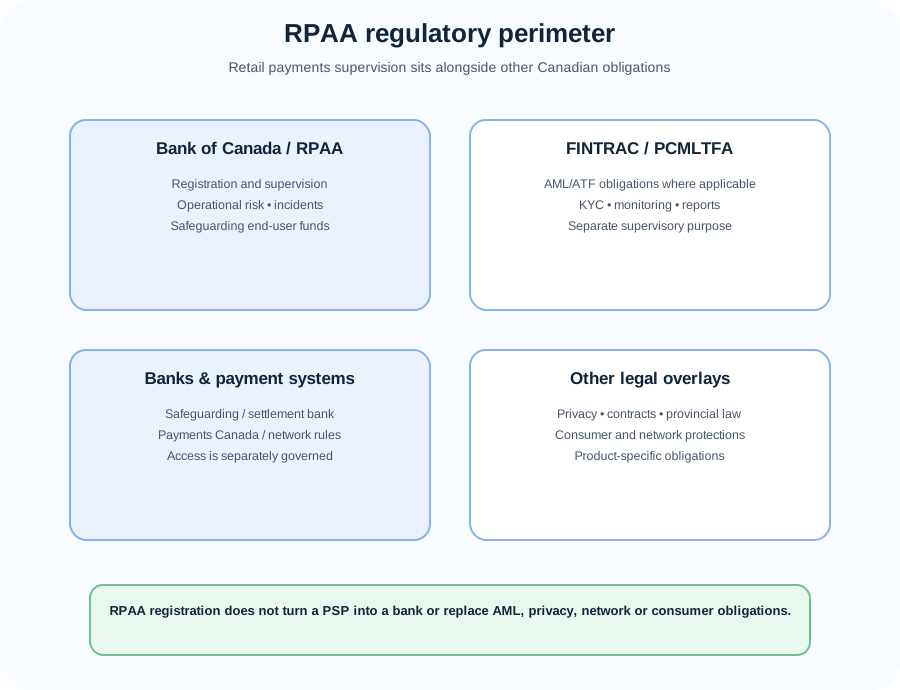
Canada's Retail Payment Activities Act (RPAA) created a federal supervisory framework for payment service providers that perform in-scope retail payment activities. The Bank of Canada is the supervisor. The regime is not a general replacement for banking prudential regulation, AML supervision, privacy law or the consumer-protection framework that applies to banks. It focuses on operational risk, incident response and the safeguarding of end-user funds, alongside registration and reporting obligations. This chapter is checked against the Act current to September 21, 2026, the Regulations current to the audit date, and Bank of Canada and Payments Canada material available on October 5, 2026.
This distinction is essential.
A PSP can be compliant with the RPAA and still have separate obligations under:
- FINTRAC/PCMLTFA;
- privacy legislation;
- provincial law;
- contractual/network rules;
- consumer-protection requirements that apply to its particular business;
- Payments Canada participation rules if it becomes a member/participant.
The RPAA's core operational and safeguarding requirements came into force on September 8, 2025. As of October 5, 2026, PSPs subject to the regime should be operating their risk-management and safeguarding frameworks, meeting incident/significant-change obligations and preparing or submitting required annual reporting according to the regulatory calendar.
The consumer-protection connection is therefore specific rather than broad. The RPAA protects users in important ways by requiring operational resilience and by safeguarding end-user funds against a PSP's insolvency. It does not create a universal fraud-reimbursement guarantee or card-style chargeback right for every PSP payment. Product teams should not market "RPAA regulated" as if it meant the Bank of Canada guarantees a customer's payment outcome.
This chapter maps the supervisory regime to real payment architecture: registration scope, five payment functions, operational-risk frameworks, third-party controls, incident response, safeguarding, end-user ledgers, significant-change notices, annual reports, records, bank/PSP interfaces and practical evidence.
What you should be able to do after this chapter
After working through this chapter, you should be able to:
- explain the purpose of the RPAA and the Bank of Canada's retail payments supervision role;
- distinguish the RPAA from prudential banking regulation, AML supervision and general consumer-protection law;
- identify the five retail payment functions at a functional level;
- understand that registration and supervision apply according to the Act's scope and exclusions;
- explain the written risk-management and incident-response framework requirement;
- explain why third-party service providers and agents remain within the PSP's control framework;
- explain incident investigation, transaction-status recovery and notification responsibilities;
- explain the permitted approaches for safeguarding end-user funds;
- explain trust-account versus insurance/guarantee safeguarding at a practical level;
- explain the end-user ledger and reconciliation requirements;
- explain annual framework reviews and independent-review requirements;
- explain annual reporting by March 31;
- explain significant-change/new-activity notice timing;
- explain record retention and evidence controls;
- connect RPAA controls to bank-PSP integration;
- avoid overclaiming what RPAA supervision means for fraud reimbursement;
- design practical implementation and testing controls.
Chapter navigator
- What the RPAA supervises
- PSP scope and payment functions
- Operational risk and incident-response framework
- Third parties, agents and resilience
- Incident detection, response and notification
- Safeguarding end-user funds
- End-user ledger, reconciliation and insolvency readiness
- Significant changes, annual reports and records
- Consumer treatment and the limits of RPAA protection
- Bank-PSP integration, implementation and testing
- Practical RPAA/PSP scenarios
- Key takeaways and authoritative references
1. What the RPAA supervises
The Bank of Canada's retail payments supervision framework is directed at PSPs performing retail payment activities subject to the RPAA.
The regime's principal operational objectives include:
- managing operational risk;
- responding to incidents;
- safeguarding end-user funds.
Not prudential supervision
The Bank of Canada does not supervise a PSP under the RPAA as though it were a deposit-taking bank.
The RPAA does not turn a PSP balance into a bank deposit.
Not AML supervision
FINTRAC administers PCMLTFA reporting-entity obligations.
A PSP can have:
- RPAA obligations to the Bank of Canada;
- FINTRAC obligations if it falls within a reporting-entity category, such as an MSB;
- both.
Not payment-system membership
RPAA registration is not automatically:
- Payments Canada membership;
- direct access to ACSS/Lynx/RTR;
- settlement-account access.
Those have separate criteria.
Effective date
The RPAA came into force in stages. Registration provisions began on November 1, 2024; the requirements to establish risk-management and funds-safeguarding frameworks came into force on September 8, 2025. The Bank supervises registered PSPs and applicants, and PSPs must not treat registration as a substitute for the separate access, membership, contract and reporting rules of a payment system.
This is the correct baseline for an October 5, 2026 chapter.
2. PSP scope and payment functions
The Act defines retail payment activity by reference to payment functions performed in relation to electronic funds transfers, subject to scope and exclusions.
Section 2 of the RPAA defines five payment functions. A PSP need perform only one (subject to the Act's exclusions and incidental-activity rule):
- provision or maintenance of an account held on behalf of one or more end users in relation to an EFT;
- holding funds on behalf of an end user until withdrawal or transfer;
- initiation of an EFT at an end user's request;
- authorization of an EFT, or transmission, reception or facilitation of an instruction in relation to an EFT;
- provision of clearing or settlement services.
The functions are tied to the statutory EFT, end-user, currency/geographic-scope and exclusion tests; a business should assess its actual service model rather than decide based on the label "fintech."
A business should assess its actual service model rather than decide based on the label "fintech."
Scope analysis
Questions:
- Which legal entity performs each function?
- For which users?
- In which currencies?
- Where does the PSP have a place of business?
- Does it direct services at end users in Canada?
- Does a statutory exclusion apply?
- Is the activity incidental as prescribed?
Architecture follows legal entity
In a group, one mobile app can hide several legal entities.
Create a function map:
customer → PSP entity → processor → sponsor bank → payment network.
Then identify which entity:
- holds funds;
- initiates;
- transmits;
- settles;
- owns customer contract.
Registration status
Do not hard-code "registered" based on a marketing page. Keep:
- legal entity;
- registration/application status;
- Bank of Canada identifier/reference where applicable;
- effective date;
- restrictions/conditions where applicable.
3. Operational risk and incident-response framework
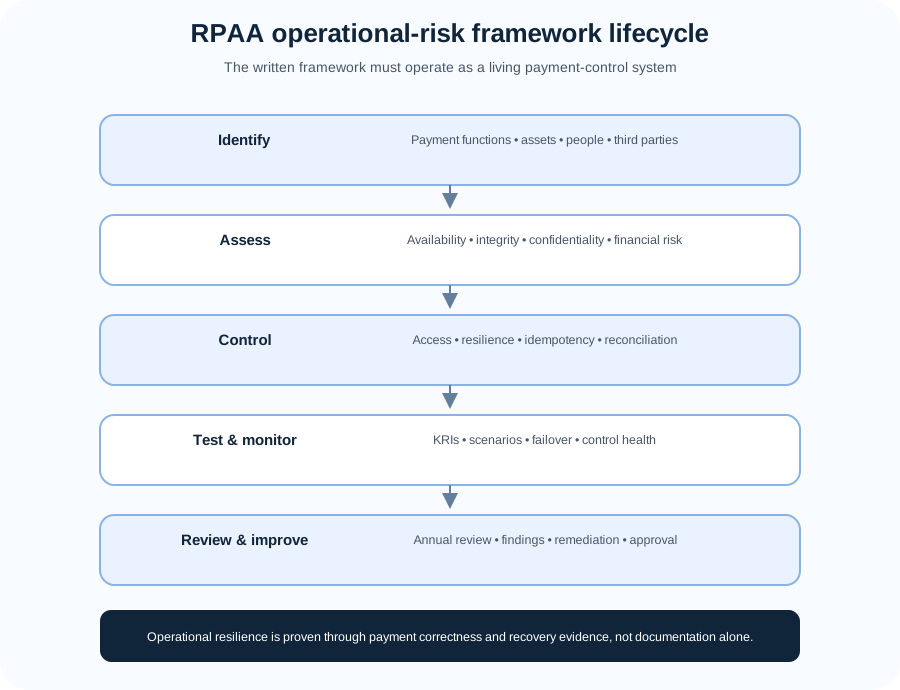
Section 17 of the RPAA requires a PSP performing retail payment activities to establish, implement and maintain a risk-management and incident-response framework in accordance with the regulations.
The Regulations require a written framework.
Objectives
The framework includes objectives aimed at preventing reduction, deterioration or breakdown in retail payment activities and protecting the integrity, confidentiality and availability of related systems, data and information.
Asset and process identification
A PSP should identify:
- critical systems;
- data;
- payment processes;
- third-party dependencies;
- people;
- facilities;
- credentials/keys;
- safeguarding accounts.
Risks
Examples:
- API outage;
- ledger corruption;
- cyberattack;
- cloud region loss;
- credential compromise;
- processor failure;
- settlement-bank outage;
- reconciliation defect;
- data breach.
Controls
Examples:
- redundancy;
- access control;
- encryption;
- monitoring;
- backups;
- idempotency;
- capacity;
- reconciliation;
- incident playbooks.
Annual approval/review
The Regulations require annual review of the framework and approval by the senior officer and board where applicable, as well as review before material changes to relevant operations/control environment.
Testing
The Regulations require a testing methodology considering high-likelihood and high-impact risks, internal and external stakeholders and material changes.
Testing is not only penetration testing.
It includes:
- failover;
- transaction recovery;
- data integrity;
- third-party outage;
- operating procedures.
4. Third parties, agents and resilience
Outsourcing does not outsource accountability.
Third-party service providers
Where services related to a payment function are provided by third parties, the framework must address assessment of matters including:
- data protection;
- connection security;
- change notification;
- performance monitoring;
- incident notification;
- provider risk-management practices.
Assessments are required at specified intervals and contractual events.
Cloud provider example
A PSP uses a cloud provider for payment APIs.
The PSP should know:
- regions;
- encryption;
- recovery objectives;
- incident notification;
- data location;
- subcontractors;
- failover;
- access.
"Cloud provider certified" is not the PSP's risk framework.
Processor
A processor may execute:
- authorization;
- message conversion;
- clearing interface.
The PSP still needs:
- transaction status;
- reconciliation;
- incident escalation.
Agents/mandataries
If agents perform retail payment activities, the PSP must set criteria, assess them and allocate responsibilities.
Sponsor bank
A bank can provide:
- safeguarded account;
- settlement service;
- payment-rail access.
The PSP and bank should define:
- data;
- cutoffs;
- incidents;
- reconciliation;
- funds ownership;
- customer support.
Concentration
One third party may support:
- API;
- ledger;
- fraud;
- payment connection.
Concentration risk should be identified.
5. Incident detection, response and notification
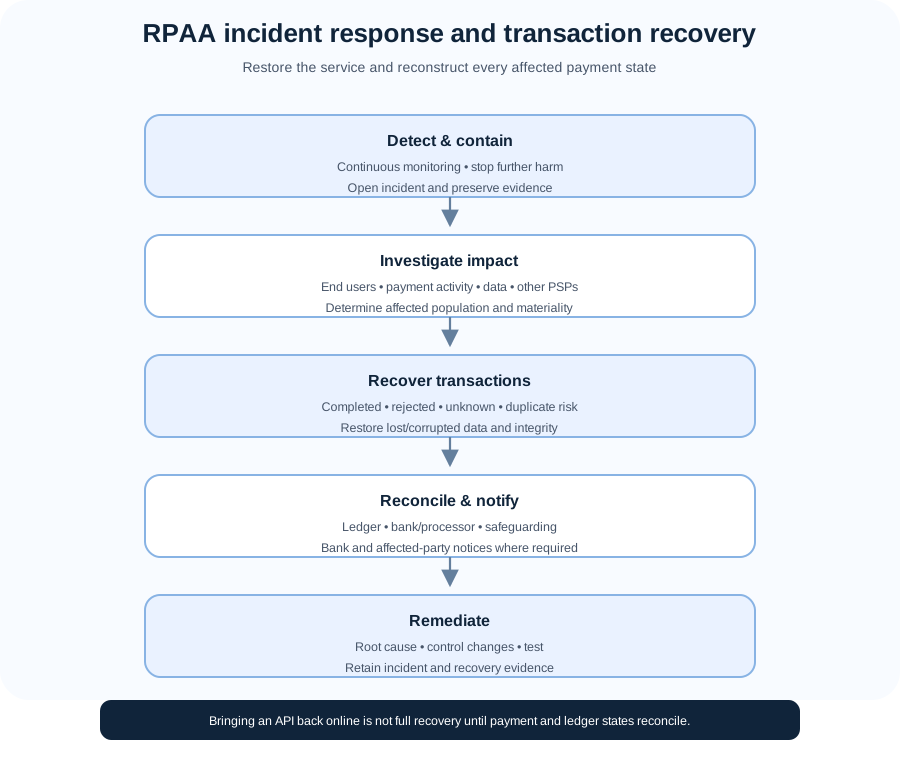
The Regulations require continuous monitoring for incidents, anomalous events and control lapses.
Investigation
On becoming aware of an incident, the PSP must immediately investigate matters including:
- root cause;
- impact on payment activities;
- impact on end users;
- impact on other PSPs/designated clearing systems;
- systems/data impact.
Mitigation
While investigation proceeds, the PSP should take immediate measures to prevent or mitigate further harm.
Transaction-state recovery
One of the most payment-specific requirements is the need to identify the status of transactions during service reduction/breakdown and recover lost/corrupted data and correct integrity issues.
This is fundamental.
A PSP cannot recover from an outage simply by bringing the API back up. It must know:
- which payments completed;
- which failed;
- which are uncertain;
- whether customer balances match external payment state.
Incident records
The framework must keep records of:
- incident facts;
- impacts;
- measures;
- reporting/coordination;
- transaction-status recovery;
- data recovery.
Notice to the Bank
Section 18 of the Act and the Regulations require notice when an incident has a material impact on an end user, another PSP or a clearing house of a designated clearing and settlement system. The initial notice must be made without delay and no later than 48 hours after the PSP determines that the incident is material. The Bank's current guideline expects the notice through PSP Connect and supports initial, interim and final notices; an exceptional degraded-technology route is provided in the guideline.
Notice to affected parties
The PSP must also notify every materially affected end user, PSP or clearing house without delay and no later than 48 hours after materiality is determined, using the latest contact information or a website notice where contact information is unavailable. The notice identifies the PSP, incident timing, impact and any corrective action the recipient can take. This duty is separate from any network, privacy or other regulatory notice.
Customer communications should be coordinated with regulatory notification but should not be delayed solely to make wording identical.
6. Safeguarding end-user funds
Safeguarding applies when the PSP holds end-user funds until withdrawal or transfer.
Section 20 of the RPAA provides the principal methods.
Trust approach
The PSP may hold end-user funds:
- in trust;
- in a trust account;
- not used for any other purpose.
The Bank's guidance expects the trust arrangement to be legally valid and properly documented.
Insurance/guarantee approach
The PSP can hold funds in an account not used for another purpose and maintain insurance or guarantee in an amount at least equal to the safeguarded funds, subject to requirements.
Prescribed account/manner
Section 20 also contemplates prescribed alternatives, but product teams should implement only methods currently provided by law/regulation and validated by legal/compliance.
Segregation
Safeguarding accounts must not be used as normal corporate operating accounts.
Do not pay ordinary expenses from safeguarded funds.
No set-off
The RPAA prohibits the account provider from asserting set-off/compensation against safeguarded funds in the specified accounts.
This protects users from PSP debt claims by the account provider.
Deposit insurance misconception
Ordinary CDIC or provincial deposit insurance on an account held at a bank or credit union is not automatically RPAA safeguarding for a PSP: it ordinarily protects deposits against the account provider's insolvency, not the PSP's own insolvency. The RPAA has a specific exception where the PSP itself is a qualifying member of a provincial deposit-insurance program, so the legal status of both the PSP and account provider must be checked rather than stated categorically.
Objectives
The safeguarding framework must ensure:
- end users have reliable access without delay to funds;
- if PSP insolvency occurs, funds or insurance/guarantee proceeds can be paid to end users as soon as feasible.
Senior officer and board
The safeguarding framework requires oversight/approval at least annually and after material changes as specified.
7. End-user ledger, reconciliation and insolvency readiness
The Regulations require the safeguarding framework to include a ledger.
The ledger includes:
- end user's name/contact;
- amount belonging to each end user held at end of each day.
Operational ledger
A production PSP normally needs more granular intraday data.
Fields:
- end user;
- available;
- pending;
- held;
- safeguarding allocation;
- last reconciled timestamp.
The statutory end-of-day ledger does not prevent better operational detail.
Reconciliation equation
At minimum:
total end-user obligation
↔ safeguarded funds / insured-guaranteed coverage.
Breaks:
- safeguarding shortfall;
- orphan ledger entry;
- bank account mismatch;
- duplicate customer balance;
- pending settlement mismatch.
Insolvency readiness
The framework must contemplate how an insolvency administrator/trustee or insurer/guarantor can:
- access records;
- contact end users;
- identify errors/shortfalls;
- return funds.
If the ledger exists only in a running production database requiring unavailable staff, insolvency readiness is weak.
Independent review
The Regulations require an independent safeguarding review at least once every three years by a sufficiently skilled person with required independence.
Shortfall detection
The PSP should detect safeguarding shortfalls promptly and investigate/correct root causes.
Liquidity versus safeguarding
Safeguarding protects ownership/return of end-user funds.
Liquidity ensures the PSP can meet withdrawals/transfers promptly.
A PSP can be fully safeguarded on paper yet operationally unable to provide timely access if liquidity/process design is weak.
8. Significant changes, annual reports and records
Significant change/new activity
The RPAA requires notice before a significant change or new retail payment activity.
The Regulations require notice at least 5 business days before the change/new activity.
The notice includes:
- PSP;
- contact;
- change/activity;
- reason/date;
- operational-risk and safeguarding assessment;
- relevant documentation changes;
- senior-officer approval indication where applicable.
Annual report
A registered PSP must submit its annual report through PSP Connect by March 31 each year. The report generally uses the previous calendar year's activity and compliance information; financial metrics use the most recent details based on the PSP's financial year-end. The Bank may change the form and request more information.
The report covers prescribed information related to:
- risk framework;
- safeguarding;
- activities/metrics;
- changes;
- third parties/agents;
- financial metrics.
2026 reporting context
The Bank's August 2026 FAQ notes that the first annual report generally covers 2025 and that the reporting form is provided through PSP Connect. Registration-information updates are a separate obligation: changes to items such as address, website, third-party relationships, directors/major shareholders and collected personal or financial data have their own prescribed timelines and are not replaced by an annual report or a significant-change notice.
Records
The Regulations require sufficient records to demonstrate compliance and retention until five years after the day on which the record ceases to demonstrate current compliance.
This wording is more nuanced than "keep everything five years from creation."
Protective measures
Records must be protected against:
- loss/destruction;
- falsification;
- inaccuracy;
- unauthorized access/use.
9. Consumer treatment and the limits of RPAA protection
RPAA supervision benefits end users but must be described accurately.
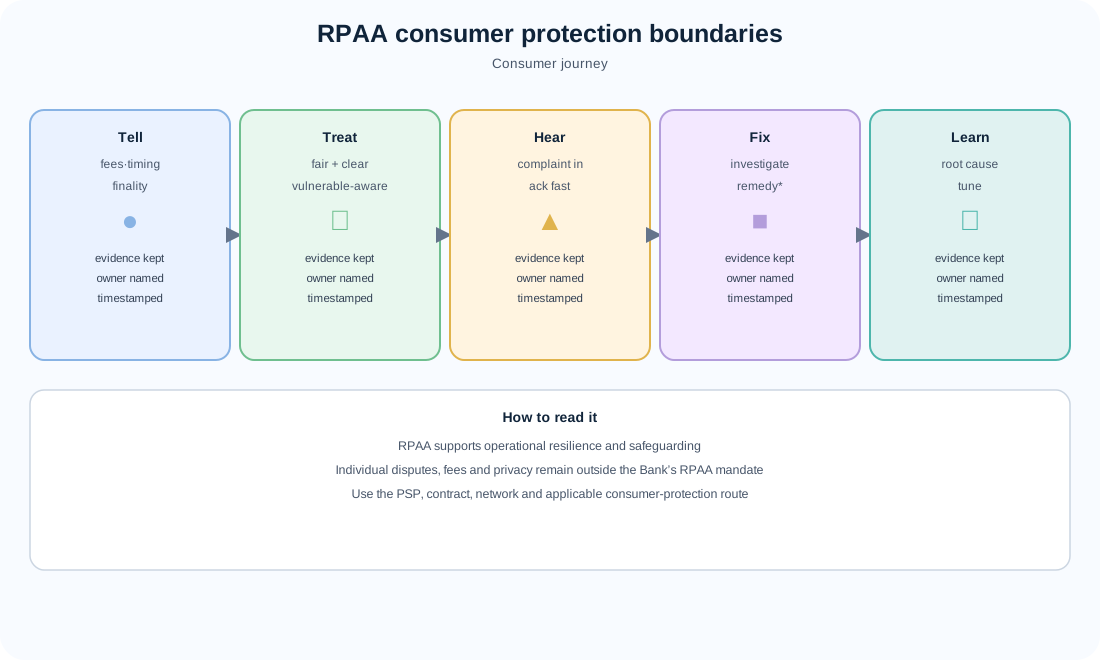
The consumer-journey diagram above keeps the protection story honest: it shows what the RPAA covers at each journey stage and where its limits fall.
What it protects
Operational risk requirements support:
- reliable payment service;
- transaction-state recovery;
- incident response.
Safeguarding supports:
- segregation/protection of held end-user funds;
- return of funds after PSP insolvency.
What it does not automatically provide
The RPAA does not itself create:
- a universal chargeback;
- a universal fraud reimbursement promise;
- deposit insurance for PSP balances;
- a guarantee by the Bank of Canada;
- prudential capital regulation equivalent to banks.
Customer disclosures
Product teams should state:
- who holds funds;
- how users access/withdraw;
- payment fees;
- complaint/contact;
- relevant fraud/error terms;
- safeguarding language approved by legal/compliance.
Avoid:
"Your money is insured by the Bank of Canada."
That is wrong.
Unauthorized payments
Consumer rights can arise through:
- financial-institution law;
- network commitments;
- card rules;
- contracts;
- provincial law.
A PSP must map the actual regime relevant to its product.
Complaint operations
The Bank of Canada expressly says its RPAA mandate does not provide broader consumer protection such as resolving individual PSP/end-user disputes, deciding PSP fees or handling privacy complaints. Those issues must be routed to the PSP and then to the applicable federal/provincial consumer or privacy authority. Even where RPAA is not a general conduct regime, incidents and fund-access failures generate customer complaints that can expose operational-control weaknesses.
10. Bank-PSP integration, implementation and testing
A PSP often depends on a bank for:
- safeguarding account;
- settlement account/service;
- AFT/Interac/wire connectivity;
- FX;
- fraud/AML services.
The contract and technical design should define:
- ownership of funds;
- reconciliation;
- service levels;
- incident notification;
- file/API evidence;
- settlement cutoffs;
- access controls.
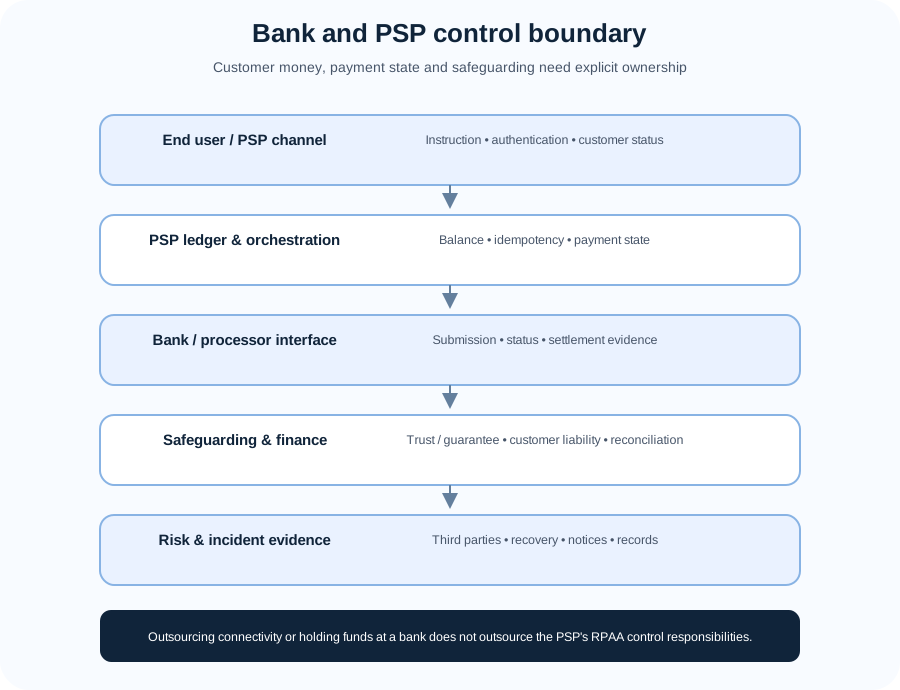
Payment-state model
PSP should maintain states such as:
- ACCEPTED;
- AUTHORIZED;
- SENT;
- SETTLED;
- POSTED;
- FAILED;
- UNKNOWN;
- RETURNED.
An incident playbook must reconstruct these states.
Idempotency
If the PSP retries a bank API after timeout:
- same idempotency key;
- query status;
- no duplicate payment.
Safeguarding reconciliation test
Simulate:
- customer balance CAD 10m;
- trust account CAD 9.98m;
- CAD 20k break.
System should:
- alert shortfall;
- prevent concealment in suspense;
- identify cause;
- restore safeguarding according to framework;
- preserve evidence.
Incident test
Simulate:
- cloud outage;
- 2,000 payments in flight;
- bank API replies delayed.
Prove:
- payment statuses reconstructed;
- no duplicates;
- customer balances correct;
- Bank notification decision made;
- affected users informed where required.
Third-party test
Test:
- processor outage;
- fraud provider outage;
- bank outage;
- cloud failover.
Change test
Before new product:
- update risk framework;
- assess safeguarding;
- determine significant-change notice;
- test controls;
- approve.
Audit pack
For one payment, show:
- customer instruction;
- PSP ledger;
- bank/rail result;
- safeguarding effect;
- reconciliation;
- incident/case if any.
RPAA control framework mapped to a PSP payment lifecycle
A PSP should be able to map each payment state to the operational-risk framework and, where it holds end-user funds, the safeguarding framework.
Customer funds arrive
Possible events:
- bank transfer to PSP;
- card funding;
- payroll or merchant settlement;
- another user transfer.
Controls:
- payment identification;
- customer ledger credit;
- safeguarding allocation;
- bank-account reconciliation.
Funds held
Controls:
- end-user ledger;
- safeguarding balance;
- segregation;
- access controls;
- liquidity/access monitoring.
Payment initiated
Controls:
- customer authentication;
- entitlement;
- fraud/AML/sanctions as applicable;
- amount and balance;
- idempotency;
- processor/bank availability.
External processing
Controls:
- API/network status;
- uncertain outcome handling;
- settlement evidence;
- incident detection.
Completion
Controls:
- customer balance;
- bank/settlement account;
- fee;
- safeguarding release/allocation;
- reconciliation.
Incident
Controls:
- identify affected transactions;
- recover lost/corrupted data;
- reconcile;
- notify where material;
- preserve incident record.
The same transaction must remain traceable across all stages.
Operational-risk inventory in practice
The written framework should reflect the actual technical estate.
Critical services
Examples:
- mobile/web API;
- identity/authentication;
- ledger;
- payment orchestration;
- bank connector;
- fraud service;
- KYC/AML service;
- notification;
- safeguarding reconciliation;
- cloud platform.
Assets
- customer data;
- balances;
- payment instructions;
- credentials;
- certificates;
- encryption keys;
- source code/configuration;
- business-continuity resources.
Dependencies
For each service:
- provider;
- region;
- SLA;
- RTO/RPO;
- failover;
- data;
- incident contact.
Risk scenarios
Examples:
- cloud outage;
- ledger database corruption;
- duplicate payment replay;
- cyber ransomware;
- certificate expiration;
- bank API outage;
- processor mismatch;
- safeguarding-account feed delay;
- insider unauthorized access.
Control mapping
Each risk needs:
- prevention;
- detection;
- response;
- recovery;
- evidence.
"Covered by cloud provider" is not a control mapping.
Incident materiality and notification decision
Not every incident requires Bank notification under RPAA, but every significant incident needs controlled assessment.
Incident impact questions
- Are end users unable to initiate/receive/access funds?
- Are balances or payment statuses unreliable?
- Is another PSP affected?
- Is a designated clearing/settlement system affected?
- Is confidential/integrity data compromised?
- How many users/payments?
- What duration/value?
Material-impact assessment
Record:
- facts;
- metrics;
- impacted parties;
- decision whether statutory notice threshold met;
- approver;
- time.
Notification cannot wait for perfect root cause
If notification is required, the initial notice can describe known facts and response measures while investigation continues, following current Bank requirements.
Customer notification
Materially affected users need clear information under applicable requirements:
- what happened;
- impact;
- actions;
- what user should do;
- contact.
Avoid exposing security-sensitive detail.
Transaction recovery design
The Regulations make transaction-status recovery a core resilience issue.
Status inventory after outage
For each payment:
- never sent;
- sent and confirmed failed;
- sent and confirmed succeeded;
- sent but unknown;
- reversed/returned;
- duplicate risk.
Unknown is a valid temporary state
Do not map UNKNOWN to FAILED.
Recovery process:
- query provider/bank;
- correlate external reference;
- compare ledger;
- resolve;
- only then permit retry where appropriate.
Idempotency
Use stable idempotency keys for:
- API submit;
- ledger posting;
- webhook/event handling;
- refunds.
Replay
After system recovery, event replay must not duplicate:
- customer debit;
- external payment;
- fee;
- safeguarding movement.
Reconciliation as recovery proof
An incident is not financially closed until:
- PSP ledger;
- bank/processor records;
- safeguarding;
- customer statements;
agree.
Safeguarding architecture in depth
Safeguarding is about end-user property protection and access, not only an account label.
Trust model
Design questions:
- valid trust structure;
- eligible account;
- trustee/beneficiary terms;
- interest treatment;
- no commingling/use for expenses;
- account-provider acknowledgment where required/appropriate;
- insolvency access.
Legal validation is critical.
Insurance/guarantee model
Design questions:
- provider eligibility;
- coverage >= safeguarded amount;
- beneficiary mechanics;
- exclusions;
- cancellation/termination;
- claims;
- insolvency payout;
- monitoring.
Coverage calculation
At time t:
end-user funds liability
≤ safeguarded trust amount + eligible insurance/guarantee coverage according to chosen method.
The exact framework depends on structure.
Intraday versus end of day
The Regulations specify ledger requirements including end-of-day balances, but a fast-growing PSP should monitor safeguarding intraday to detect shortfalls earlier.
Customer fees
Define when fee becomes PSP revenue versus remains part of end-user funds.
Accounting policy and legal analysis should align with safeguarding calculation.
Pending outgoing payment
If customer balance is debited before external settlement:
- is amount still end-user funds held by PSP?
- when does safeguarding treatment change?
Document state-by-state treatment with legal/accounting input.
Pending incoming
Do not credit safeguarded liability before PSP has entitlement/control of funds unless design supports it.
Safeguarding reconciliation
Run at least:
- ledger-to-bank;
- customer sub-ledger total-to-general ledger;
- general ledger-to-safeguarding account/coverage;
- unsettled payment population.
Break classification
Timing
Data
- missing customer ledger event.
Financial
Duplicate
Unknown
- needs urgent investigation.
Shortfall runbook
If genuine:
- alert senior owner;
- restore required coverage;
- stop activity if framework requires;
- root-cause;
- assess incident materiality/reporting;
- record.
Do not hide shortfall in suspense.
End-user ledger design
Minimum regulatory data
Follow current Regulations.
Operationally, PSP should also retain:
- user ID;
- balance type;
- currency;
- available/pending;
- transaction references;
- safeguarding location/method;
- timestamp.
Multiple currencies
If holding CAD/USD/EUR:
- ledger by currency;
- safeguarding account/coverage;
- FX risk not confused with customer liability.
Omnibus safeguarding account
If many users share one account, the internal ledger is essential to know ownership.
Insolvency export
Periodically test export of:
- user;
- contact;
- amount;
- account/ledger evidence.
An insolvency administrator should not need production engineers to reverse-engineer balances.
Independent review readiness
The three-year independent-review requirement should not be treated as a last-minute audit.
Maintain:
- current framework;
- risk register;
- tests;
- incident records;
- third-party assessments;
- safeguarding reconciliation;
- annual approvals;
- remediation.
Independence
The reviewer must meet the applicable independence criteria.
Do not assign the person who designed the framework to independently review it.
Remediation
Track:
- finding;
- severity;
- owner;
- due date;
- evidence;
- closure.
Senior officer receives required reporting.
Third-party governance in depth
Pre-contract
Assess:
- security;
- resilience;
- data;
- subcontractors;
- incident process;
- financial/operational dependency.
Contract
Include appropriate:
- service scope;
- SLAs;
- incident notification;
- security;
- audit/information;
- change notification;
- termination/transition.
Ongoing
Monitor:
- service;
- incidents;
- changes;
- control reports;
- concentration.
Exit
Plan:
- data retrieval;
- credential revoke;
- in-flight payments;
- reconciliation;
- customer continuity.
Fourth parties
Know material subcontractors where dependency matters. "Our vendor uses cloud" may hide concentration across several critical services.
Bank-PSP financial control model
A PSP often maintains:
- customer ledger;
- operating bank account;
- safeguarding account;
- settlement/funding account;
- processor receivables/payables.
These should not be conflated.
Example
Customer wallet balances total CAD 12m.
Safeguarding:
Operating expenses:
- separate operating account.
Payments in flight:
- tracked with clearing/settlement receivable/payable as appropriate.
If salaries are paid from the safeguarding account, segregation is compromised.
Bank statement reconciliation
Automate:
- opening balance;
- credits;
- debits;
- closing;
- unmatched.
Breaks should have owners.
Consumer experience and operational resilience
Even though RPAA is not a universal conduct framework, operational controls affect customers directly.
Accurate balance
Customer should not see:
- duplicate debit;
- phantom credit;
- stale "completed" payment.
Incident message
Good:
"Your transfer is processing. Do not send it again. We are confirming its status."
Bad:
"Payment failed" when status is unknown.
Access to held funds
Safeguarding objective includes reliable access without delay to end-user funds held by PSP.
Monitor:
- withdrawal failures;
- cash-out latency;
- bank connector incidents.
Complaints as control evidence
A spike in:
- missing transfers;
- delayed withdrawals;
- balance errors;
can indicate an operational incident.
Feed complaint metrics into risk monitoring.
Significant-change governance
Create a change classification at project intake.
Questions:
- new retail payment activity?
- material change to how activity is performed?
- operational-risk impact?
- safeguarding impact?
- new third party?
- new bank?
- new cloud region?
- new ledger?
- new currency?
Five-business-day notice
If notice applies, submit at least five Bank business days before the change/new activity.
This is a minimum regulatory timing, not the ideal project lead time.
Change evidence
Retain:
- assessment;
- notice;
- documents amended;
- approval;
- test results;
- implementation date.
Emergency change
If emergency remediation is needed, follow current legal/supervisory procedure and internal escalation. Do not assume ordinary advance notice logic fits every incident; obtain compliance/legal direction.
Annual reporting operating model
Data sources
Annual report can require:
- framework changes;
- metrics;
- safeguarding information;
- significant changes;
- third parties;
- agents;
- record keeping;
- financial metrics.
Build data capture throughout year.
Reporting calendar
- reporting year = calendar year for relevant report information;
- due March 31 following year.
Start data validation before year-end.
Evidence
For each annual-report response:
- source;
- owner;
- calculation;
- review;
- approval.
Avoid manually reconstructing 12 months from tickets in March.
RPAA records architecture
Control records
- framework versions;
- approvals;
- risk assessments;
- tests;
- independent reviews;
- incident records;
- third-party assessments;
- safeguarding records;
- notices;
- annual reports.
Retention
The Regulations' record-retention wording depends on when a record ceases to demonstrate current compliance; implement record type-specific retention logic.
Protection
Controls:
- access;
- immutable/versioned storage;
- backups;
- tamper logging.
RPAA metrics
Operational
- uptime;
- payment success;
- p95 latency;
- unknown payment outcomes;
- incidents;
- recovery time.
Data integrity
- duplicate payment;
- ledger breaks;
- missing events;
- reconciliation breaks.
Safeguarding
- end-user liability;
- safeguarded amount/coverage;
- shortfall count/duration;
- reconciliation breaks.
Third party
- SLA breach;
- incidents;
- dependency availability.
Customer
- access-to-funds failure;
- complaints;
- support volume.
Metrics should link to framework objectives and thresholds.
RPAA business analyst requirements
Unknown payment
If a bank/processor response is not received, the PSP must retain the payment in UNKNOWN_PENDING_RECONCILIATION, preserve the idempotency key and query the external provider before permitting a replacement economic payment.
Safeguarding
The safeguarding reconciliation service must compare end-user liability to the relevant safeguarded trust balance or eligible insurance/guarantee coverage and raise an owned exception when the approved coverage requirement is not met.
Incident
An incident case must identify affected payments and users, financial/data integrity impact, external PSP/system impact, mitigation, recovery and regulatory-notification assessment.
Significant change
Every product initiative introducing a new retail payment activity or material change to an existing activity must complete an RPAA change assessment before production scheduling.
RPAA comprehensive test pack
- normal wallet funding;
- normal withdrawal;
- duplicate bank API callback;
- bank API timeout;
- cloud outage;
- ledger corruption;
- safeguarding bank-feed delay;
- genuine safeguarding shortfall;
- new third-party processor;
- new international product;
- customer data breach;
- 5,000 payments with unknown status;
- failover to secondary region;
- end-user ledger export;
- insolvency-return simulation.
For each:
- payment correctness;
- customer balance;
- safeguarding;
- incident evidence;
- notification assessment;
- reconciliation;
- recovery.
PSP control architecture and system-of-record design
A PSP under RPAA needs clear systems of record for money, payment state and compliance evidence.
Customer ledger system of record
Authoritative for:
- end-user balance;
- pending/available;
- transaction history.
Payment orchestration
Authoritative for:
- payment instruction;
- idempotency;
- external status;
- references.
Bank/processor evidence
Authoritative external evidence:
- accepted;
- settled;
- returned.
Safeguarding record
Authoritative for:
- safeguarded account/coverage;
- reconciliation;
- shortfall.
Risk/incident system
Authoritative for:
- risk register;
- incident;
- tests;
- remediation.
A spreadsheet should not be the only system of record for critical balances or in-flight payments.
Ledger design and double-entry principles
A PSP can use double-entry accounting to reduce balance ambiguity.
Example wallet funding CAD 100:
- debit safeguarded cash/receivable as appropriate;
- credit customer liability CAD 100.
Outgoing payment:
- debit customer liability;
- credit settlement payable/cash according to actual movement.
Fees:
Why this matters
If customer balance changes are implemented as mutable numbers without journal history:
- incident recovery is difficult;
- duplicates are harder to identify;
- insolvency ledger is harder to prove.
Journal identity
Every journal:
- transaction ID;
- business event;
- amount;
- timestamp;
- reversal/correction linkage.
Corrections use new entries rather than editing posted history.
Safeguarding state by payment stage
A PSP should obtain legal/accounting interpretation for each stage.
Example conceptual table:
| State | Customer liability | External payment | Safeguarding treatment |
|---|
| Funds credited and held | Yes | None | safeguarded |
| Payment initiated, not released | Usually still obligation | None | framework-defined |
| External payment sent, unsettled | depends on legal/economic state | pending | explicitly documented |
| Payment completed | customer liability reduced | complete | release aligned to actual state |
| Payment failed | liability restored | failed | safeguarding restored/retained |
The point is not one universal answer. The point is documented, reconciled treatment.
Liquidity management versus safeguarding
Safeguarding amount can be correct while customer withdrawals fail because the PSP lacks operational access/liquidity.
Monitor:
- bank account availability;
- payment rails;
- withdrawal queue;
- intraday liquidity.
Safeguarding objective includes reliable access without delay to held funds.
Multiple safeguarding banks
Using more than one bank can reduce concentration but creates:
- allocation logic;
- multiple reconciliations;
- transfer between safeguarding accounts;
- insolvency complexity.
Design explicitly.
Safeguarding account change
Changing the safeguarding bank can be a material operational event.
Plan:
- new legal/trust arrangement;
- account validation;
- migration;
- reconciliation;
- no gap in coverage;
- significant-change assessment;
- customer/operational impact.
Do not close old account until all in-flight/reconciliation issues are resolved.
Insurance/guarantee monitoring
If using this method, monitor:
- coverage limit;
- end-user balance;
- provider status;
- expiry;
- cancellation notice;
- conditions;
- claims process.
Alert before coverage can become insufficient.
Coverage stress
End-user balances can grow quickly during:
- payroll;
- merchant peak;
- promotions.
Coverage must remain at least the required amount, not only at month end.
Operational risk appetite and indicators
The framework needs objectives and indicators.
Examples:
- payment success >= internal target;
- unknown outcomes below tolerance;
- no unresolved ledger imbalance beyond threshold/time;
- safeguarding shortfall = zero tolerance;
- critical third-party availability;
- maximum incident recovery time.
Targets are PSP governance decisions, not invented legal thresholds.
KRI examples
- ledger reconciliation breaks;
- certificate days to expiry;
- failed backups;
- high-risk vulnerability;
- third-party SLA breach;
- safeguarding break age.
Escalation
Each KRI:
- warning;
- breach;
- owner;
- action.
Business continuity and disaster recovery
RTO/RPO
Set by service criticality.
Ledger:
- low acceptable data loss.
Marketing site:
Regional failure
Test:
- failover;
- DNS;
- secrets;
- database replication;
- payment connector.
Cyber event
Scenario:
ransomware affects operations.
Need:
- isolate;
- recover clean data;
- identify payment status;
- preserve evidence;
- notify under applicable requirements.
Workforce
Continuity includes:
- key-person dependency;
- remote operations;
- contact lists.
Incident taxonomy
Classify:
- availability;
- integrity;
- confidentiality;
- financial;
- third party;
- cyber;
- safeguarding.
One incident can have several.
Example
Bank API duplicate responses cause double customer debits.
Impact:
- integrity;
- financial;
- customer.
Root cause:
- third-party behavior + PSP idempotency defect.
Incident record should capture both.
Material incident case example
PSP ledger database has corruption.
Symptoms:
- 500 users show wrong available balances;
- bank balances intact.
Actions:
- stop risky balance-changing activity;
- preserve data;
- investigate;
- reconstruct journals;
- reconcile bank/payment status;
- correct balances;
- assess RPAA material-impact notice;
- notify affected users as required;
- remediate root cause.
Restoring the database without reconciliation is incomplete.
Third-party service provider register
Maintain:
- provider;
- service;
- payment function dependency;
- data;
- criticality;
- subcontractors;
- contract dates;
- incident SLA;
- owner;
- last assessment.
Concentration map
Identify same provider supporting:
- cloud;
- identity;
- fraud;
- processor.
One outage may hit several "independent" services.
Agent and mandatary controls
Where agents/mandataries perform retail payment activities:
- criteria;
- onboarding;
- responsibilities;
- monitoring;
- termination.
Customer experience should clearly identify whom to contact.
Agent incident
If agent causes incident:
- PSP still needs its incident framework;
- obtain facts quickly;
- assess impact.
Record keeping lifecycle
The nuanced RPAR rule means record retention should be event-driven.
Example:
framework version v1 is current 2025–2027.
It ceases to demonstrate current compliance when superseded.
Retention then continues for required period.
Implement:
- record type;
- effective from/to;
- retention end;
- legal hold.
Do not delete based only on creation date.
Supervisory evidence pack
A PSP should be able to provide, for selected period:
Risk
- current framework;
- annual approval;
- risk register;
- tests;
- independent review.
Incident
- incidents;
- materiality decisions;
- notices;
- remediation.
Safeguarding
- framework;
- ledger;
- reconciliation;
- independent review;
- coverage.
Third party
- contracts/assessments;
- monitoring.
Reporting
- annual report;
- significant-change notices.
PSP/bank API controls
Submission
Use:
- authentication;
- idempotency;
- payment reference.
Response
Map:
- accepted;
- rejected;
- pending.
Do not treat HTTP 200 as settlement.
Webhooks
Verify:
- signature;
- replay;
- event ID;
- ordering.
Reconciliation
Independent:
PSP payment records ↔ bank statement/API report.
Bank outage
Queue safely and communicate status.
Consumer-facing balance and transaction status
Customer UI should map complex backend states to truthful simple labels.
Example:
Internal:
EXTERNAL_STATUS_UNKNOWN
Customer:
"Processing — do not send again."
Internal:
RETURN_PENDING
Customer:
"Return in progress."
Never say:
"Completed" before the PSP's defined completion evidence.
Product launch RPAA gate
Before go-live:
Scope
- in-scope payment function?
- legal entity?
Risk
- framework updated?
- tests?
Safeguarding
- end-user funds?
- treatment?
Third parties
Change notice
- significant/new activity?
- timing?
Operations
- incident runbook;
- transaction recovery.
Reporting
- annual-report data captured.
Independent-review preparation checklist
- reviewer independence;
- scope;
- control evidence;
- sampling population;
- remediation process.
Do not create evidence only when reviewer arrives. Controls should produce evidence naturally.
Annual-report data-quality controls
For metrics:
- definition;
- system source;
- reporting period;
- legal entity;
- reconciliation.
Review changes year over year.
Large unexplained change:
- investigate before submission.
Supervisory change calendar
Maintain calendar for:
- March 31 annual report;
- framework annual reviews;
- board/senior approvals;
- third-party assessments;
- independent-review cycle;
- insurance expiry;
- significant changes.
Automated reminders should create work items early.
RPAA anti-patterns
"We use a big cloud provider"
Not a risk framework.
"Funds are at an insured bank"
Not sufficient safeguarding of PSP insolvency risk by itself.
"API is back, incident closed"
Not until payment/ledger integrity restored.
"Processor owns the incident"
PSP retains obligations.
"RPAA registered means customer funds guaranteed"
Incorrect.
"We keep logs somewhere"
Record keeping needs retrievable, protected evidence.
RPAA maturity model
Foundational
- documented framework;
- manual reconciliation;
- basic incident process.
Managed
- automated monitoring;
- systematic safeguarding reconciliation;
- third-party governance.
Resilient
- tested failover;
- transaction reconstruction;
- automated control evidence;
- mature change process.
Adaptive
- KRIs linked to risk;
- proactive capacity;
- continuous learning from incidents;
- integrated supervisory reporting.
The goal is not documentation maturity alone. It is reliable payment operation and end-user fund protection.
PSP operating model for safeguarding and payments teams
The PSP should assign clear first-line owners.
Payments operations
Own:
- in-flight payments;
- bank/processor status;
- returns;
- reconciliation.
Ledger/finance
Own:
- journals;
- customer liability;
- general ledger;
- safeguarding reconciliation.
Risk/resilience
Own:
- framework;
- risk register;
- tests;
- incidents.
Treasury
Own:
- safeguarding account funding/transfers;
- liquidity/access.
Compliance/legal
Own:
- RPAA interpretation;
- notices/reports;
- framework challenge;
- safeguarding legal structure.
Technology/security
Own:
- systems;
- cyber;
- availability;
- recovery.
One person can wear several roles in a small PSP, but responsibilities still need explicit assignment.
Payment-state reconciliation examples
Example A — bank says settled, PSP says pending
Risk:
- customer may resend;
- balance may be wrong.
Action:
- update from authoritative evidence;
- idempotent ledger transition;
- customer notification.
Example B — PSP says completed, bank has no payment
Serious integrity break.
Action:
- stop affected process;
- investigate event/gateway;
- correct ledger;
- incident assessment.
Example C — duplicate external payment
PSP ledger debited once, bank sent twice.
Risk:
Action:
- identify duplicate;
- recovery;
- fix idempotency;
- assess incident.
Safeguarding interest and fees
Trust/insurance structures need legal review for:
- interest;
- fees;
- bank charges;
- FX.
Bank of Canada's 2026 FAQ specifically cautions that retaining interest must not compromise the validity of the safeguarding arrangement.
PSP should document:
- who earns interest;
- accounting;
- safeguarding calculation.
Insurance/guarantee termination risk
The safeguarding framework should understand:
- provider termination rights;
- notice period;
- replacement coverage.
Alert:
- coverage expiry;
- balance approaching limit;
- provider rating/eligibility issue as relevant.
A policy that can terminate before replacement creates end-user risk.
Insolvency simulation
Conduct tabletop:
PSP becomes insolvent Friday 17:00.
Can an insolvency professional determine:
- who end users are;
- contact;
- amount each is owed;
- safeguarded account/insurance;
- pending payments;
- breaks?
Can records be accessed if:
- staff credentials disabled;
- cloud bills unpaid?
This scenario tests the actual safeguarding objective.
Third-party outage case study
Processor stops responding.
There are:
- 800 submitted payments;
- 600 confirmed complete;
- 150 confirmed rejected;
- 50 unknown.
Correct response:
- do not replay all 200 non-complete;
- investigate 50 unknown;
- restore 150 rejected according to product;
- reconcile 600 completed;
- assess customer/material impact.
Unknown-outcome discipline prevents duplicates.
Cyber incident and payment integrity
If attacker obtains privileged access:
- payment data may be altered;
- ledger may be corrupted;
- credentials stolen.
Incident response must include financial integrity, not only data confidentiality.
Questions:
- were beneficiaries changed?
- were journals changed?
- were payment statuses manipulated?
- are backups trustworthy?
Change-management pipeline
For every product/technical change:
- product requirement;
- RPAA scope/change assessment;
- risk impact;
- safeguarding impact;
- third-party impact;
- testing;
- significant-change notice if required;
- approval;
- deployment;
- post-implementation review.
This should be integrated into normal SDLC rather than a compliance form after release.
Monitoring control failures
The risk framework should detect failure of the controls themselves.
Examples:
- backup not running;
- reconciliation job skipped;
- safeguarding feed stale;
- fraud service disabled;
- certificate expiring;
- incident alerting unavailable.
Control health is a KRI.
Customer-balance correction governance
Manual balance adjustments are high risk.
Require:
- reason;
- original transaction;
- approval according to value;
- audit;
- reconciliation.
Do not allow support agent to "fix" a customer complaint by editing balance directly without journal evidence.
PSP record searchability
Records must be retrievable by:
- end user;
- payment;
- incident;
- provider;
- framework version;
- date.
A regulatory request should not require weeks of manual log mining.
Evidence index
Create controlled index:
- record ID;
- type;
- owner;
- effective period;
- retention.
Annual framework review workshop
Participants:
- senior officer;
- payments;
- risk;
- security;
- finance/safeguarding;
- technology;
- compliance.
Review:
- incidents;
- tests;
- KRIs;
- third parties;
- changes;
- safeguarding;
- independent findings.
Output:
- approved framework;
- remediation plan.
RPAA and other regulatory overlays
A PSP may also face:
- FINTRAC/MSB obligations;
- privacy;
- provincial requirements;
- card/network rules;
- Payments Canada rules if participant/member;
- bank contract.
Create a regulatory obligation map.
Do not use RPAA registration as evidence that every other regulatory obligation is met.
Final PSP production readiness checklist
Scope
- legal entity/function mapping.
Risk
- framework;
- risks;
- controls;
- indicators;
- tests.
Incident
- monitoring;
- transaction reconstruction;
- notification decision.
Safeguarding
- method;
- ledger;
- reconciliation;
- insolvency plan.
Third parties
- assessment;
- contracts;
- exit.
Reporting
- annual report data;
- significant-change workflow.
Records
- retention;
- access;
- evidence.
Customer
- accurate status;
- access to funds;
- incident communication.
A PSP ready for supervision should be able to demonstrate each item with current evidence, not just policy language.
Safeguarding reconciliation design patterns
Daily liability snapshot
At a defined end-of-day cut:
- calculate amount held for each end user;
- aggregate by currency/legal entity;
- compare with safeguarding arrangement.
Preserve:
- snapshot ID;
- timestamp;
- source ledger version.
Intraday control
For high volume PSP:
- monitor liability versus safeguarded balance/coverage during day;
- alert before shortfall.
This supports reliable access and avoids waiting until nightly reconciliation.
Pending bank transfer
If money is moving between safeguarding accounts:
- track in transit;
- avoid double counting both accounts;
- preserve bank references.
Reconciliation break workflow
States:
- NEW;
- INVESTIGATING;
- TIMING_CONFIRMED;
- SHORTFALL;
- CORRECTED;
- CLOSED.
A true shortfall needs immediate escalation under framework.
PSP incident severity framework
A PSP can score an incident using:
- number of end users;
- payment value;
- duration;
- financial loss;
- data integrity;
- confidentiality;
- other PSP/system impact;
- safeguarding impact.
The score supports internal escalation; statutory materiality still follows the Act/Regulations and Bank guidance.
Incident timeline
Record:
- detectedAt;
- startedAt if known;
- containedAt;
- recoveredAt;
- reconciledAt;
- notifiedAt.
Technical recovery can precede financial reconciliation.
Transaction integrity control totals
For every processing cycle/time slice:
instructions accepted
= completed + rejected + pending/unknown
Financially:
opening customer liabilities
- customer debits
± adjustments
= closing customer liabilities.
External cash/safeguarding should reconcile according to the approved accounting model.
Control totals quickly detect missing events.
Data recovery after outage
Backup restore
After restoring ledger:
- identify restore point;
- replay events exactly once;
- compare external payments;
- reconcile balances.
Event gap
If payment gateway events between backup and failure exist:
- obtain from external provider;
- correlate;
- replay safely.
No blind replay
Never resend all instructions after backup recovery merely because local "sent" flags were lost.
Safeguarding versus settlement timing case
Customer pays another user:
- sender liability decreases;
- receiver liability increases;
- total PSP end-user liability may remain unchanged.
External safeguarding cash may not move.
Customer withdraws to bank:
- liability decreases;
- external safeguarded cash leaves when payment completes.
Accounting must reflect economic event correctly.
This is why safeguarding reconciliation needs payment-state knowledge.
Fees and negative balances
PSP should define:
- whether fees are deducted from end-user funds;
- when revenue recognized;
- whether customer can go negative;
- effect on safeguarding.
A fee journal error can create safeguarding break.
Multi-entity PSP group
Group has:
- Canada PSP A;
- overseas affiliate B.
Do not combine:
- customer liability;
- safeguarding;
- annual report;
without legal-entity analysis.
Shared technology must tag legal entity on every payment/ledger event.
Operational risk testing programme
Annual/periodic plan can include:
Availability
Integrity
Cyber
Third party
Safeguarding
People
Data
For each:
- objective;
- expected result;
- evidence;
- findings;
- remediation.
Third-party assessment case study
Fictional control test, not a statement that RTR is in production: a new processor is proposed for instant-payment processing. Payments Canada's current system page says Canada's Real-Time Rail is scheduled to launch in Q4 2026 and remains in testing/onboarding; RPAA registration alone does not give a PSP RTR participation or production access.
New processor handles instant payments.
Assess:
- uptime/history;
- security;
- data;
- incident notification;
- subcontractors;
- financial stability as appropriate;
- BCP/DR;
- change management.
Contract:
- status APIs;
- reconciliation;
- service credits are not enough—need operational incident duties.
Significant-change examples requiring assessment
Potential examples:
- new international payment rail;
- replacing ledger;
- new safeguarding bank;
- moving critical cloud region;
- new third-party processor;
- changing safeguarding method.
Not every code release is significant. PSP compliance function applies current criteria.
Customer access-to-funds measurement
Measure:
- withdrawal success;
- p95 withdrawal time;
- failed withdrawal age;
- safeguarding-related holds;
- complaints.
This operationalizes the objective that end users have reliable access without delay to held funds.
Insolvency data pack
Prepare:
- end-user ledger;
- contact;
- balance;
- safeguarding account/insurance details;
- pending withdrawals;
- reconciliation breaks;
- last certified snapshot.
Store securely and test retrieval.
Regulatory-report data pipeline
Annual report should not be assembled from ad hoc estimates.
Maintain:
- metric definitions;
- source data;
- monthly/quarterly snapshots;
- owner;
- evidence.
Significant changes
Maintain register:
- assessment;
- notice required?
- submission;
- implementation date.
PSP Connect operational governance
Restrict users who can:
- submit annual report;
- update registration information;
- submit notices.
Use:
- named owners;
- MFA/security;
- review.
Keep copies/acknowledgments in controlled record store.
RPAA control testing acceptance
A control is not tested simply because procedure was read.
Example safeguarding reconciliation:
- introduce known CAD 10k mismatch;
- prove alert;
- owner;
- investigation;
- correction;
- evidence.
Example incident:
- create 50 unknown payments;
- prove status recovery;
- no duplicates.
Example records:
- retrieve last year's superseded framework and current framework with correct retention metadata.
Final RPAA architecture principle
A supervised PSP must maintain three forms of truth:
- payment truth — what happened to each instruction;
- customer-money truth — what is owed to each end user and how it is safeguarded;
- control truth — what risks, incidents, reviews and regulatory reports demonstrate compliance.
When those three truths reconcile, the framework becomes operational rather than documentary.
PSP financial close and continuous payments
A 24/7 PSP still needs accounting periods.
Period close
At cut:
- capture customer-liability snapshot;
- safeguarding snapshot;
- bank balances;
- in-flight payment population;
- reconciliation breaks.
Payments continue; accounting date logic must not create duplicates or stop the service.
Late events
A payment initiated before midnight may settle after midnight.
Store:
- event timestamp;
- accounting date;
- customer statement date according to policy.
Reconciliation should explain cross-date timing.
Operational handover and on-call
Critical PSP services require:
- primary/secondary owner;
- incident severity;
- contact;
- decision rights.
On-call staff should know:
- stop new payments;
- fail over;
- contact bank/processor;
- escalate safeguarding break;
- assess material incident.
A phone list that has never been tested is not resilience.
Customer support as an incident sensor
Support contacts can reveal:
- withdrawal failures;
- duplicate debits;
- missing incoming payments;
- balance errors.
Create thresholds for:
- complaint spike;
- common error code;
- geographic pattern.
Feed them to incident monitoring.
PSP release readiness evidence pack
Before release:
- scope assessment;
- updated framework;
- risk assessment;
- safeguarding treatment;
- third-party assessment;
- test results;
- significant-change decision/notice;
- operational runbook;
- rollback;
- customer communication.
After release:
- monitor KRIs;
- reconcile;
- review incidents;
- confirm safeguarding.
Control exceptions
Every exception needs:
- owner;
- due date;
- severity;
- compensating control if approved.
Examples:
- delayed third-party assessment;
- reconciliation defect;
- test finding.
Do not let temporary waivers become indefinite.
Final supervisory mindset
RPAA readiness is best tested with evidence questions:
- Show the latest risk framework and approval.
- Show a critical incident and transaction recovery.
- Show yesterday's end-user ledger and safeguarding reconciliation.
- Show a third-party assessment.
- Show a significant-change decision.
- Show annual-report source data.
- Show an independent-review finding and remediation.
If the PSP can answer quickly and the evidence matches production behavior, the control framework is functioning.
RPAA design review checklist for new PSP capability
Scope
- legal entity;
- payment functions;
- RPAA applicability/exclusions;
- Bank registration status.
Operational risk
- process/system map;
- risk assessment;
- controls;
- KRIs;
- BCP/DR;
- incident response.
Third parties
- service provider;
- criticality;
- contract;
- assessment;
- exit.
Safeguarding
- does PSP hold end-user funds?
- method;
- ledger;
- reconciliation;
- insolvency process;
- independent review.
Reporting/change
- significant change/new activity?
- five-business-day notice?
- annual-report fields;
- record retention.
Payment correctness
- idempotency;
- unknown outcomes;
- transaction reconstruction;
- ledger-to-bank reconciliation.
Customer
- truthful status;
- access to funds;
- incident communication.
Case study — new currency wallet
PSP currently holds CAD only and plans USD balances.
Questions:
- new payment activity/significant change?
- new safeguarding account or insurance coverage?
- FX provider/third party?
- multi-currency ledger?
- insolvency record in currency?
- operational-risk changes?
- AML/sanctions changes?
The feature is not just a new UI toggle.
Reconciliation design
For each currency:
customer liability
↔ general ledger
↔ safeguarded account/coverage.
FX conversions:
- separate conversion journal;
- rate;
- fees;
- original/converted amounts.
Case study — safeguarding feed outage
Bank balance feed unavailable for six hours.
PSP still has last confirmed safeguarding balance but end-user liabilities continue changing.
Procedure should define:
- whether activity continues;
- conservative buffer;
- alternate balance evidence;
- alert/escalation;
- later reconciliation.
Do not treat "bank is probably fine" as evidence.
Supervisory evidence quality
Good evidence:
- system-generated reconciliation;
- signed approval;
- timestamped test;
- incident timeline.
Weak evidence:
- undated screenshot;
- verbal assurance;
- document that does not match production.
Design controls to produce audit evidence automatically.
Final RPAA practitioner model
For every PSP product, be able to answer:
What can fail?
Operational-risk framework.
What happened to each payment?
Transaction-state recovery.
What is owed to each user?
End-user ledger.
Where is that money protected?
Safeguarding.
Who else do we depend on?
Third-party controls.
What must the Bank be told?
Incident/change/annual reporting.
This model connects the Act and Regulations to daily payment operations.
RPAA evidence-by-design
Controls should generate evidence as part of normal operation.
Examples:
- reconciliation produces signed/versioned result;
- incident system records materiality decision;
- deployment workflow records significant-change assessment;
- third-party register records assessment date;
- safeguarding service stores daily snapshot.
This is stronger than collecting screenshots during a supervisory request.
Control-health monitoring
Monitor the controls themselves:
- reconciliation job missed;
- backup stale;
- list of incident contacts expired;
- safeguarding insurance near expiry;
- independent review overdue;
- annual-report data source missing.
A control that silently stops running creates false confidence.
PSP product decommissioning
When a product closes:
- resolve in-flight payments;
- return/transfer end-user funds;
- preserve records;
- terminate third-party access;
- update safeguarding liability;
- assess registration/reporting changes.
End-of-life needs the same control discipline as launch.
PSP ledger and safeguarding case study
Assume a PSP has 100,000 users.
End-user liabilities:
Trust safeguarding account:
During the day:
- CAD 2m new funding;
- CAD 1.5m withdrawals/payments complete;
- CAD 300k outgoing payments remain pending.
The PSP must have a documented accounting/safeguarding treatment for each state so that:
- customer balances are correct;
- safeguarded amount is sufficient;
- pending items are not double counted.
Reconciliation break
At 16:00:
ledger liability = CAD 18.9m
trust account confirmed = CAD 18.85m
Break = CAD 50k.
Do not assume timing.
Investigate:
- bank feed;
- pending transfer;
- duplicate customer credit;
- fee;
- genuine shortfall.
If genuine, invoke safeguarding framework and escalation.
PSP transaction-recovery case study
A bank connector times out after sending 1,000 withdrawals.
Local status:
Bank status query:
- 930 settled;
- 50 rejected;
- 20 pending.
Correct recovery:
- update 930 without resend;
- restore/release 50 customer balances according to product;
- continue query for 20;
- reconcile bank statement.
Incorrect:
Idempotency protects against duplicate external payments but does not remove the need to reconstruct actual status.
Incident communication design
Internal
Incident channel should show:
- severity;
- impacted service;
- payment population;
- safeguarding/ledger impact;
- regulatory-notification assessment;
- next update.
Customer
If materially affected:
- what service affected;
- payment/balance status if known;
- whether to retry;
- expected next update/contact.
Bank/regulator
Use current required content and channels.
Keep messages consistent on facts while tailoring confidential detail by audience.
Third-party change control
Provider makes material platform change.
PSP should receive notice according to contract and assess:
- resilience;
- data;
- security;
- payment behavior;
- incident response.
If the PSP's way of performing retail payment activity materially changes, assess RPAA significant-change notice.
Vendor release notes are an input, not the PSP's compliance assessment.
Safeguarding independent-review evidence
Reviewer should be able to test:
- legal structure;
- ledger;
- reconciliation;
- coverage;
- shortfalls;
- insolvency procedure;
- governance.
The PSP should not rely on a bank statement alone to prove each user's ownership.
Payment-operations metrics feeding RPAA framework
Useful indicators:
- payment success by provider;
- unknown outcomes;
- duplicate prevention;
- ledger-posting latency;
- reconciliation breaks;
- customer withdrawal failure.
Link each indicator to:
- threshold;
- owner;
- escalation.
This creates a feedback loop from live operations into annual framework review.
PSP de-risking without customer harm
When a critical provider becomes unreliable, PSP may need:
- new provider;
- temporary product restriction;
- migration.
Plan:
- in-flight payments;
- end-user access;
- safeguarding;
- communication;
- significant-change assessment.
Operational-risk remediation should not create an uncontrolled safeguarding or transaction-integrity problem.
Final bank-grade PSP requirement
For every end-user dollar held or moved, the PSP should be able to demonstrate:
- whose money it is;
- where it is;
- what payment state applies;
- how it is safeguarded while held;
- what happened during any incident;
- how all records reconcile.
That is the practical core linking payment operations to RPAA supervision.
11. Practical RPAA/PSP scenarios
Scenario 1 — wallet PSP holds funds
A PSP lets users store CAD balances and send payments.
Because it holds end-user funds until withdrawal/transfer, safeguarding applies.
It chooses trust arrangement:
- dedicated trust account;
- end-user ledger;
- daily reconciliation;
- insolvency procedures.
It cannot use the account to pay payroll or vendors.
Scenario 2 — PSP cloud outage
A cloud region fails while 4,000 transfers are in flight.
The PSP:
- invokes failover;
- identifies transaction status;
- reconciles with bank/processor;
- restores data;
- determines material impact;
- sends required notices.
"API restored in 20 minutes" is not sufficient evidence if 200 payment states remain unknown.
Scenario 3 — new payment activity
A PSP currently initiates domestic transfers and plans to launch international payments.
Before launch:
- risk assessment;
- safeguarding impact;
- new AML/sanctions dependencies;
- third-party review;
- significant-change/new-activity assessment.
If notice required, it is submitted at least five Bank business days before launch.
Scenario 4 — insurance safeguarding
A PSP uses insurance/guarantee approach.
It must ensure:
- dedicated account;
- eligible provider;
- sufficient coverage;
- insolvency payout for end-user benefit;
- ongoing monitoring.
Ordinary deposit insurance is not a substitute.
Scenario 5 — customer fraud claim
A customer sends money to a scammer through a PSP.
RPAA registration does not automatically mean the customer receives reimbursement.
The PSP:
- secures account if needed;
- traces payment;
- applies product/contract/legal protections;
- investigates;
- recovers where possible;
- treats any operational incident under RPAA framework.
Do not misrepresent supervision.
12. Key takeaways and authoritative references
Key takeaways
- RPAA is a federal retail-payments supervisory framework administered by the Bank of Canada.
- Core risk/safeguarding requirements came into force September 8, 2025.
- The regime is distinct from prudential banking supervision and FINTRAC AML supervision.
- PSPs must maintain written operational-risk and incident-response frameworks.
- Outsourced providers remain inside the PSP's control responsibility.
- Incident response includes reconstructing transaction status and data integrity.
- End-user funds can be safeguarded through trust or eligible insurance/guarantee structures according to the Act/Regulations.
- Ordinary deposit insurance on a PSP account is not sufficient by itself.
- End-user funds need a ledger and reconciliation.
- Annual reports are due by March 31 for the prior calendar year.
- Significant change/new activity notice is generally due at least five Bank business days beforehand.
- RPAA supervision does not create a universal fraud reimbursement guarantee.
Authoritative references
This chapter is educational. The RPAA, Retail Payment Activities Regulations and current Bank of Canada supervisory guidance govern live compliance.
This application uses JavaScript for the full interactive experience. This text summary is served for accessibility and search indexing.