Reconciliation, Liquidity and Operational Resilience. Reconcile instructions, clearing or network evidence, settlement and books while managing liquidity, monitoring and incident recovery.
Block 14 · Chapter 70 of 75
Payments do not become safe because individual transactions completed successfully.
A bank also has to prove that every instruction, clearing record, settlement movement and ledger entry agrees; maintain enough liquidity and collateral to meet obligations when they fall due; and continue operating when systems, networks, service providers or participants fail.
These three disciplines are tightly connected.
A reconciliation break may reveal missing settlement. A settlement shortfall may create a liquidity emergency. A technology incident can generate duplicate postings, uncertain payment states and large reconciliation populations. A poorly controlled recovery can then create a second incident.
The operating principle is:
Know what should have happened, know what actually happened, know where the money is, and preserve the ability to keep processing safely while differences are investigated.
This chapter brings together transaction reconciliation, settlement-position control, treasury liquidity, collateral, monitoring, incident response, fallback, recovery and customer impact across ACSS, Lynx, Interac-related bank processing and the planned Real-Time Rail (RTR).
Scope and evidence labels. Regulatory requirements are labelled as RPAA/Bank of Canada/FINTRAC/OSFI requirements. Payments Canada and Interac requirements are scheme or system rules. Channel, payment-hub, ledger, treasury and routing controls are bank-specific implementation patterns, not universal Canadian rules. Dollar amounts and named institutions in examples are illustrative; NorthRiver Bank is explicitly fictional. This chapter does not reproduce Visa, Mastercard, correspondent-bank or SWIFT rulebooks; those scheme and cross-border controls must be checked in the applicable current rulebook or agreement.
What you should be able to do after this chapter
After working through this chapter, you should be able to:
- design reconciliation from customer instruction through settlement and books;
- distinguish transaction, position, account and general-ledger reconciliation;
- explain why ACSS item populations must reconcile to participant net settlement;
- explain why Lynx liquidity is managed continuously during the payments processing cycle;
- understand the Bank of Canada settlement-account and collateral context;
- distinguish operational liquidity from solvency;
- explain queue, collateral and treasury controls for high-value payments;
- design continuous liquidity monitoring for future real-time payments;
- manage breaks through suspense, ageing and ownership;
- detect duplicates and missing transactions through population and amount controls;
- explain how operational resilience connects technology, people, third parties and payment rules;
- use incident classification, containment, recovery and reconciliation as one process;
- explain the role of Lynx Rule 12 emergency procedures;
- connect RPAA operational-risk expectations to PSP resilience;
- design disaster-recovery tests that include financial integrity, not only system availability.
Chapter navigator
- Reconciliation as proof
- The reconciliation layers
- Break management and suspense
- Liquidity in Canadian payment systems
- Lynx liquidity, collateral and queues
- ACSS settlement positions and treasury
- Continuous liquidity for real-time payments
- Operational resilience and incident response
- Fallback, recovery and customer impact
- Architecture, monitoring and controls
- Practical resilience scenarios
- Implementation, testing and authoritative references
1. Reconciliation as proof
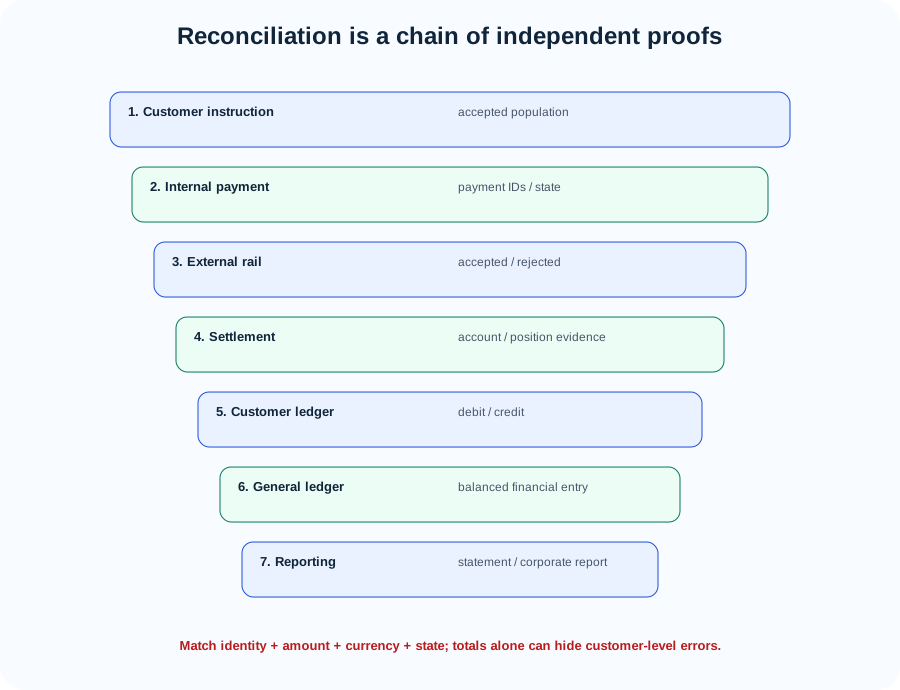
Reconciliation answers a simple question:
Do independent sources agree about the same financial event?
A single system cannot reconcile itself.
If a payment hub says 10,000 payments were completed and the reconciliation process compares the hub to a copy of the hub’s own table, that is not strong control.
Independent evidence can include:
- customer/channel instructions;
- payment-hub events;
- external rail/network reports;
- settlement-account statements;
- sponsor/clearing reports;
- core ledger;
- general ledger;
- nostro/correspondent statements.
Why reconciliation is more than totals
Suppose:
- expected total = CAD 1,000,000;
- actual total = CAD 1,000,000.
This can still be wrong:
- one customer missing CAD 10,000;
- another duplicated CAD 10,000.
Therefore use:
- count;
- amount;
- currency;
- identity;
- status.
Reconciliation equation
For a simple population:
Opening position
+ confirmed inflows
- confirmed outflows
± approved adjustments
= closing position
Then compare with independent closing balance.
For transaction population:
Expected IDs - observed IDs = missing
Observed IDs - expected IDs = unexpected
Duplicate IDs = duplicates
Amount mismatch = value breaks
Status mismatch = state breaks
Reconciliation timing
Not every control waits until end of day.
High-value:
- intraday, subject to the Lynx operating schedule and participant cut-offs.
Real time:
- continuous/near-real-time.
Batch:
- cycle + day, using the applicable ACSS stream calendar and exchange/settlement schedule.
GL:
These are control cadences, not universal deadlines. Payments Canada’s current system pages and rules are authoritative for system hours, closure days, exchange and settlement windows; a bank’s customer cut-off can be earlier. Lynx is described as operating Monday to Friday except statutory holidays, while ACSS settles the previous day’s net balances during the morning of each business day. Do not infer a customer promise from a reconciliation checkpoint.
Good architecture uses multiple checkpoints.
2. The reconciliation layers
A mature bank has several reconciliations.
Instruction-to-payment
Compare:
- customer accepted instructions;
- internal payment objects.
Detect:
- lost instruction;
- duplicate creation;
- amount transformation error.
Payment-to-external
Compare:
- bank released payments;
- external accepted payments.
Detect:
- gateway failure;
- duplicate send;
- external reject;
- missing acknowledgement.
External-to-settlement
Compare:
- clearing/exchange evidence;
- settlement evidence.
Detect:
- unsettled obligation;
- wrong settlement amount;
- missing cycle.
Settlement-to-ledger
Compare:
- settlement-account movement;
- customer/internal ledger.
Detect:
- settlement succeeded but posting failed;
- posting occurred without settlement;
- duplicate posting.
Ledger-to-GL
Compare:
- customer/payment subledger;
- general ledger.
Detect:
- interface omission;
- wrong GL;
- wrong business date.
Statement/reporting
Compare:
- ledger;
- statement/camt/corporate reporting.
Detect:
- customer not informed;
- reference lost;
- duplicate line.
Return reconciliation
Returns require their own population:
- original;
- return instruction;
- return settlement;
- corrective customer entry.
Do not net returns invisibly into the original population.
3. Break management and suspense
A reconciliation engine without a break workflow only produces reports.
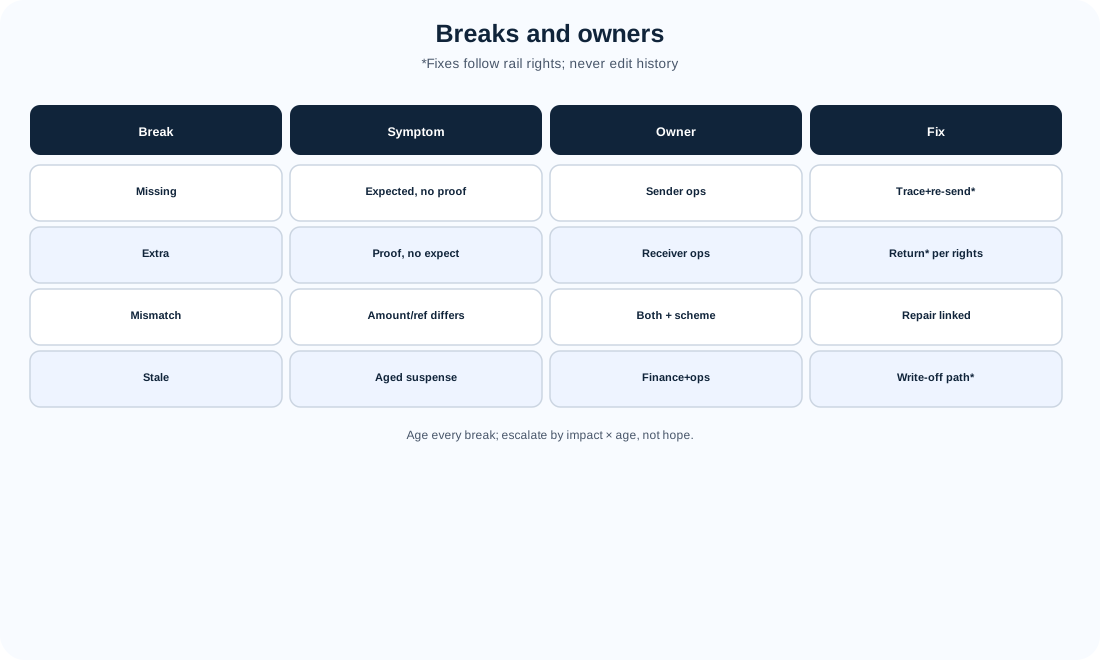
The breaks-and-owners diagram above gives every break category below an owner and a fix path that follows rail rights without ever editing history.
Break categories
Missing expected
Expected transaction not observed.
Unexpected
Observed transaction no expected source.
Duplicate
Same business event represented twice.
Amount mismatch
Identity matches, amount differs.
Currency mismatch
Dangerous in cross-border.
Date mismatch
Can cause false break around midnight/business date.
Status mismatch
One system says settled; another says pending.
Reference mismatch
Can prevent automation even if money is correct.
Materiality
Not every break has same priority.
Risk factors:
- amount;
- customer impact;
- settlement-account impact;
- fraud;
- regulatory significance;
- age;
- high-value payment;
- payroll;
- concentration.
Suspense
Use suspense for financial differences that cannot yet be allocated.
Do not use “recon break” as an excuse for unowned suspense.
Every item:
- amount;
- source;
- date;
- payment reference;
- owner;
- case;
- age;
- next action.
Auto-match and tolerances
Auto-match rules should be controlled.
Exact match preferred:
- transaction ID;
- amount;
- currency.
Fuzzy matching can assist but should not silently clear high-risk breaks.
Example:
same amount/date + similar name is not enough for high-value payment.
Break closure
Require evidence:
- correct transaction found;
- duplicate reversed;
- missing posting created;
- external settlement confirmed;
- suspense cleared.
Do not close with comment “explained” while financial difference remains.
4. Liquidity in Canadian payment systems
Liquidity means having usable funds or credit when payment obligations must settle.
It is not the same as capital or solvency.
A solvent bank can have an intraday liquidity problem if funds are not available at the right time/place.
Sources of liquidity
Depending on institution/system:
- settlement-account balance;
- incoming payments;
- intraday credit;
- collateralized central-bank facilities;
- interbank funding;
- internal treasury transfer.
Liquidity demand
Driven by:
- customer outgoing payments;
- securities settlement;
- ACSS settlement;
- payroll/government peaks;
- market activity;
- returns;
- unexpected large payments.
Direct versus indirect
Direct participant:
manages central settlement position.
Indirect:
manages funding with sponsor/group clearer.
Both need limits and forecasts.
Settlement accounts
The Bank of Canada provides settlement accounts to eligible direct participants/direct clearers in Payments Canada systems under its policies.
Final settlement in central bank money reduces settlement risk but requires participants to manage operational, collateral and funding requirements.
5. Lynx liquidity, collateral and queues
Payments Canada’s current Lynx Rule 8 — Management of Settlement Mechanisms covers collateral pledges, credit limits, intraday loans, apportionment, settlement mechanisms, queues and duplicate settlement instructions. It is a system rule, not a bank’s treasury policy.
The current rule states that each participant is responsible for managing its own liquidity.
Available liquidity depends on the Lynx settlement mechanism and applicable credit/liquidity resources.
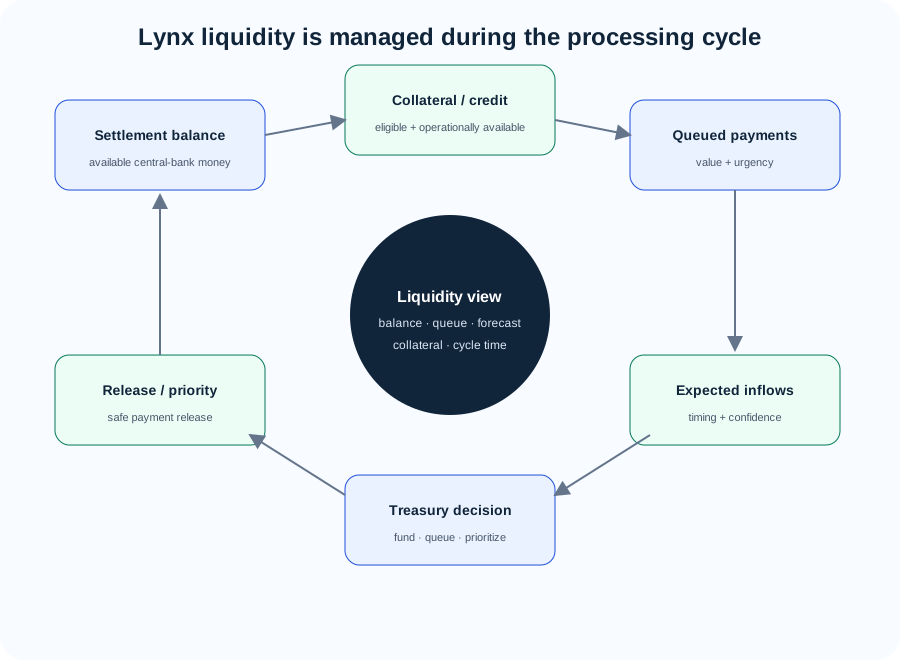
Liquidity dashboard
Treasury/operations should see:
- settlement balance;
- available liquidity;
- intraday loan/credit;
- collateral;
- queued payments;
- high-priority payments;
- expected incoming;
- expected ACSS settlement;
- remaining cycle time.
Queue risk
If liquidity insufficient:
- payment can queue under system arrangements;
- customer payment may delay;
- queue can grow;
- end-of-cycle pressure increases.
A bank should prioritize according to:
- scheme rules;
- customer commitments;
- market obligations;
- internal policy.
Collateral
Bank of Canada settlement-account policy expects applicants/holders to support collateral requirements.
The Bank’s Standing Liquidity Facility and collateral framework are important to Lynx liquidity.
Collateral management includes:
- eligible assets;
- valuation/margins;
- pledging;
- concentration;
- operational readiness.
Treasury cannot discover at 4 p.m. that securities needed as collateral are operationally unavailable.
Intraday versus overnight
Intraday liquidity supports payment settlement during the day.
If borrowing extends overnight, different facility/risk implications apply.
Payments specialists should understand enough to coordinate with treasury rather than treat liquidity as a black box.
Liquidity is payment risk
Payment hub release logic may include:
- amount thresholds;
- queue priority;
- treasury approval;
- liquidity reservation;
- settlement-mechanism selection.
Fraud/compliance and liquidity controls must not conflict.
Example:
payment cleared sanctions at 15:50 but treasury has no liquidity.
Status is not “compliance failed.”
6. ACSS settlement positions and treasury
ACSS is batch and net.
Many retail items create clearing positions.
Direct clearer settles net obligation, not each individual AFT item separately in RTGS.
Bank of Canada settlement-account policy notes that ACSS settlement account holders meet net settlement obligations by Lynx payments. An ACSS settlement account holder that is not a direct participant in Lynx needs an arrangement with a Lynx direct participant to perform settlement on its behalf.
Treasury forecast
Inputs:
- AFT credit files;
- AFT debits;
- cheque/items;
- returns;
- historical cycles;
- corporate payroll;
- government flows.
Forecast:
- likely net debit/credit position;
- funding requirement;
- stress buffer.
Reconcile item to net
Operations must prove:
- item totals by stream;
- accepted/returned;
- clearing position;
- net settlement;
- GL.
This is why a one-to-one settlement model fails for ACSS.
Indirect participant
Indirect’s sponsor may aggregate many institutions.
Indirect reconciles:
- its customer items;
- sponsor reports;
- sponsor account/settlement position.
Sponsor reconciles:
- all indirects;
- own items;
- ACSS position;
- settlement.
Default/resilience
ACSS has rule frameworks for direct clearer obligations/default.
Treasury and risk teams should include stressed settlement in resilience exercises.
7. Continuous liquidity for real-time payments
Real-time payments change liquidity timing.
As checked on 2026-10-05, Payments Canada’s public plan says RTR will launch in Q4 2026 with initial direct-to-Exchange participants. The same plan places initial Interac e-Transfer clearing-and-settlement migration participants in Q1 2027, with additional migration phases thereafter. RTR is therefore planned/pre-production in this chapter, not a current production capability; participant readiness and the published launch plan can change.
The Bank of Canada has published a July 31, 2026 settlement-account access policy for the planned RTR. It says RTR settlement accounts are funded and defunded by Lynx payments in the name of the applicable RTR direct participant; an RTR direct participant that is not a Lynx direct participant needs a Lynx direct participant arrangement. The policy also expects sufficient payment capacity and distinguishes restricted from unrestricted accounts. These are policy requirements for planned access, not evidence that RTR is live.
Continuous position
Traditional treasury:
“fund business day.”
Real-time:
“maintain readiness evenings, weekends and holidays.”
Monitoring
Real-time liquidity platform should monitor:
- current settlement balance;
- inflow/outflow velocity;
- client/sponsor positions;
- thresholds;
- projected exhaustion time;
- funding sources;
- collateral;
- anomalies.
Thresholds
Illustrative:
- Green: normal;
- Amber: forecast breach within horizon;
- Red: imminent funding shortfall.
Thresholds are bank-specific.
Automated actions
Potential:
- alert treasury;
- adjust client limits;
- obtain funding;
- move liquidity if system permits;
- slow/restrict non-critical flows under policy.
Do not invent scheme functionality. Implement only supported mechanisms.
Sponsor model
Sponsor must manage:
- each client position;
- aggregate position;
- prefunding/credit limits;
- client default;
- concentration;
- 24/7 support.
A fintech’s “instant payment” product can create liquidity exposure for sponsor bank.
8. Operational resilience and incident response
Operational resilience asks:
Can the payment service continue or recover without losing financial integrity?
Availability alone is not enough.
A system can be online but unsafe if:
- duplicate risk exists;
- reconciliation disabled;
- sanctions unavailable;
- ledger inconsistent.
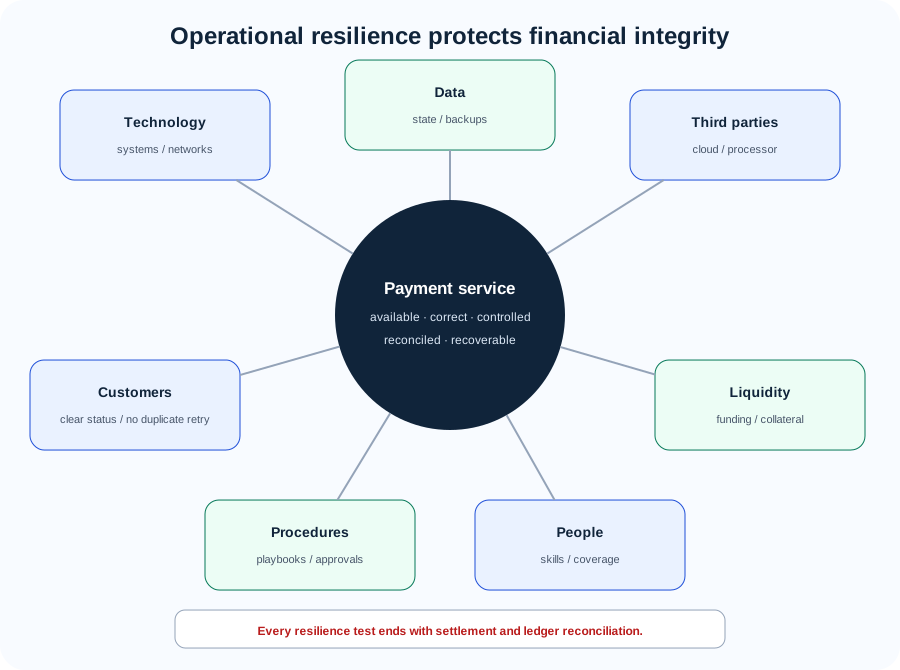
Resilience dimensions
- technology;
- data;
- cyber;
- people;
- premises;
- third parties;
- utilities;
- networks;
- liquidity;
- procedures.
Lynx emergencies
Payments Canada Rule 12 supports Lynx emergency procedures.
The rule allows system-level actions in disruptions, including changes to operating conditions and contingency measures.
Banks must maintain:
- contacts;
- emergency procedures;
- contingency connectivity;
- trained staff;
- communication path;
- post-recovery reconciliation.
RPAA PSP obligations
For a PSP that is subject to the RPAA, the Bank of Canada’s current supervisory framework says the PSP must manage operational risk, respond to incidents and, where it holds end-user funds, safeguard those funds. The RPAA excludes banks and several other regulated entities from its PSP application in section 9; a bank’s own payment operations therefore should not be described as an RPAA-registered PSP merely because it performs payment functions. A bank can still be a Lynx/ACSS participant and can have separate system-rule, prudential, AML and privacy obligations.
Risk framework includes:
- identify;
- protect;
- detect;
- respond;
- recover;
- roles;
- resources;
- testing;
- third-party risk.
Material incidents require notification under the applicable requirements. For an RPAA-covered PSP, the Bank’s incident-notification guideline says a material incident affecting an end user, another PSP or a clearing house must be reported without delay and no later than 48 hours after the PSP determines that the incident is material; affected parties must also be notified. Payments Canada/Lynx participation rules can impose separate reporting duties. “Without delay” and the 48-hour outer limit must not be confused with a general bank incident deadline.
Third-party risk
Examples:
- cloud;
- payment processor;
- fraud vendor;
- connection service provider;
- telecom.
Outsourcing does not outsource accountability.
AML, sanctions and reporting gates
Reconciliation and resilience do not replace financial-crime controls. Where a bank or PSP is a FINTRAC reporting entity, the applicable FINTRAC obligations and guidance cover compliance-program governance, client identification, ongoing monitoring, suspicious-transaction reporting, electronic-funds-transfer reporting, record keeping and sanctions-evasion reporting. The exact trigger depends on the entity, activity and transaction; this chapter does not invent a universal amount or deadline.
Operationally, preserve the payment ID, parties, routing data, decision, hold/release reason, analyst or service identity, timestamps and evidence. A sanctions or mandatory screening dependency that is unavailable needs a pre-approved compliance decision (hold, reject or approved alternate control); a technology team must not silently bypass it. Fraud scoring, confirmation of payee and risk-list services described for RTR are planned centralized RTR capabilities, complementing—not replacing—participant controls.
9. Fallback, recovery and customer impact
Fallback is not simply switching data centre.
A payment service needs safe state recovery.
Recovery questions
After outage:
- what instructions were received?
- what were acknowledged?
- what were externally sent?
- what settled?
- what posted?
- what timed out?
- what may duplicate?
- what customers saw?
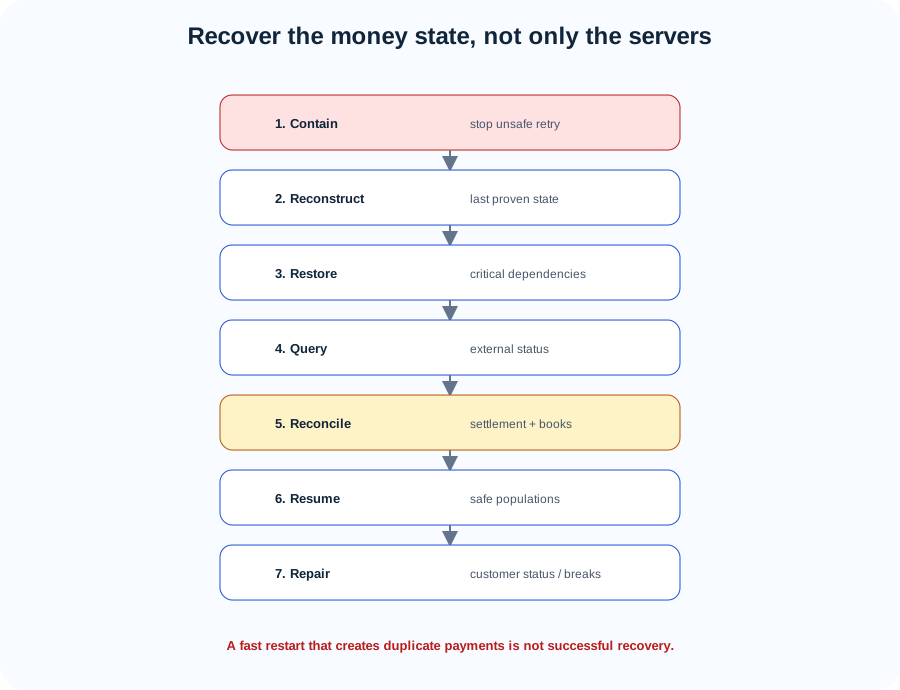
Recovery sequence
Preferred:
- freeze risky automated retry;
- establish authoritative last-known state;
- restore critical dependencies;
- query external state;
- reconcile;
- resume;
- repair customer statuses;
- clear backlog.
RTO versus financial integrity
Recovery Time Objective matters.
So do:
- RPO;
- duplicate risk;
- unreconciled amount;
- backlog;
- customer harm.
Recovering in 10 minutes with duplicate payments is not successful resilience.
Customer communication
Tell customers:
- what service affected;
- whether payments may be delayed;
- whether they should retry;
- when status will update.
Critical phrase during uncertain outcome:
Do not resubmit unless instructed.
Manual fallback
Manual processing can be riskier than outage.
Controls:
- authorization;
- amount limits;
- dual control;
- reference;
- post-recovery reconciliation.
10. Architecture, monitoring and controls
A resilience-ready payment architecture should expose business state.
Implementation boundary: channels, messages and routing
The control model must be instantiated at each bank’s actual integration boundary:
- Channels and authentication: mobile, online, branch, contact centre, host-to-host file and API channels pass through identity, device/session controls, account entitlement, transaction limits and (where policy requires) maker-checker or dual approval. The specific factors, tokens and step-up rules are bank-specific.
- Payment hub: normalize the instruction into an immutable payment ID, validate account/transit/institution or other rail routing data, apply duplicate/idempotency checks, run fraud/AML/sanctions controls and record the decision before release. Keep the customer-facing status separate from external settlement proof.
- Messages and files: AFT/ACSS processing uses bank file and stream controls; Lynx participants exchange ISO 20022 payment messages over the participant connectivity model, with Payments Canada’s published specifications and Swift service arrangements governing the external interface. Internal event schemas, APIs, queues and retries are implementation choices and are not evidence of rail acceptance.
- Settlement and reports: capture rail acknowledgements, rejects/returns, cycle or settlement-window identifiers, external references, account/position reports and ledger postings as separate evidence. For ACSS, reconcile item populations to the direct clearer’s calculated net balance; for Lynx, reconcile each payment obligation and settlement-mechanism evidence; for planned RTR, reconcile participant Exchange/settlement-account evidence only once the system is in production.
- Exceptions: a timeout after a request may be unknown, not rejected. Query the strongest available external evidence before retrying. A repair, return, reversal or dispute must retain the original identity and scheme/rail authority; do not edit history.
Interac e-Transfer is an Interac service delivered through participating financial institutions, with its own governing documents and participant controls. It is not interchangeable with ACSS net settlement or Lynx RTGS. For cards, cross-border wires and correspondent payments, this chapter provides only the shared reconciliation/resilience control pattern; current Visa/Mastercard, SWIFT/correspondent and bank agreements govern the specific message, dispute, chargeback, screening and cut-off rules.
Event store
Events:
- instruction accepted;
- authorized;
- released;
- external accepted;
- settled;
- posted;
- returned.
Immutable events support recovery.
Reconciliation service
Inputs:
- internal event stream;
- external reports;
- settlement statements;
- ledger.
Outputs:
- matched;
- breaks;
- metrics;
- cases.
Liquidity service
Inputs:
- settlement balance;
- queues;
- forecast;
- collateral;
- client positions.
Outputs:
- alerts;
- limits;
- treasury actions.
Monitoring
Monitor technical and business indicators.
Technical:
- latency;
- errors;
- queue depth;
- connectivity.
Business:
- accepted count;
- settlement count;
- unmatched;
- duplicate;
- value;
- return rate;
- liquidity usage.
Kill switches
Controlled ability to:
- stop sending;
- stop a product;
- stop a channel;
- block high-risk batch;
- prevent retry.
Kill switch should be granular.
Stopping inbound receipt unnecessarily can cause more harm.
11. Practical resilience scenarios
Scenario A: settlement confirmed, ledger unavailable
Lynx payment settles outbound.
Core ledger becomes unavailable before final customer posting confirmation.
Unsafe:
- resend payment after system returns.
Controlled:
- preserve settlement event;
- mark posting pending;
- restore ledger;
- retry idempotent posting;
- reconcile customer debit to settlement;
- communicate if customer status affected.
Scenario B: ACSS position larger than forecast
Payroll peak makes bank’s net settlement obligation much larger than expected.
Treasury:
- validates clearing position;
- checks for duplicate file;
- funds obligation;
- updates forecast model;
- investigates concentration.
Reconciliation confirms whether high position is real or data defect.
Scenario C: duplicate batch file
Corporate payroll file submitted twice.
Duplicate control catches before exchange.
No liquidity consumed.
If duplicate only discovered after exchange:
- operations and treasury assess settlement;
- return/recovery process;
- customer accounting;
- incident/root cause.
Scenario D: fraud service outage
Instant-payment product cannot obtain required fraud service decision.
Bank’s fail-open/fail-closed behavior must be pre-defined and compliant.
Do not improvise during incident.
Customer message should reflect temporary unavailability without exposing security logic.
Scenario E: network outage and uncertain payments
Gateway loses connection.
100 messages have uncertain state.
Recovery:
- no blind resend;
- identify unique IDs;
- query external state;
- classify settled/rejected/unknown;
- reprocess only safe population;
- reconcile all 100;
- incident report/root cause.
Scenario F: participant liquidity stress
Large outgoing corporate flows consume liquidity faster than expected.
Dashboard moves amber/red.
Treasury:
- assesses incoming flows;
- mobilizes collateral/funding;
- manages queue;
- communicates with operations.
Payment operations should not override treasury control to meet customer SLA.
Deeper operating practice: connecting reconciliation, treasury and resilience
The strongest operating model treats reconciliation, liquidity and resilience as one control system.
Reconciliation tells the bank where actual financial state differs from expected state.
Liquidity tells the bank whether it can meet the next settlement obligation.
Resilience tells the bank whether it can continue to make those decisions correctly during disruption.
If these functions operate independently, incidents become harder to control.
Reconciliation design: expected population first
A common weak design starts with whatever settlement file arrived and asks:
“Can we match these records?”
A stronger design starts with:
“What population should exist?”
For an outbound payment cycle:
- accepted customer instructions;
- released payments;
- externally accepted payments;
- settled payments;
- customer debits;
- GL entries.
Expected population is built from authoritative internal events.
Observed population comes from independent external/ledger evidence.
Then calculate differences.
Population-control example
Suppose corporate AFT file has:
10,000 accepted items
CAD 18,500,000 total
Bank releases:
9,998 items
CAD 18,496,200
Before even reading settlement, reconciliation identifies:
- 2 accepted items not released;
- CAD 3,800 difference.
Those items may be:
- repair;
- rejected internally;
- stuck.
The investigation begins early.
Position reconciliation versus transaction reconciliation
Transaction reconciliation:
Position reconciliation:
- aggregate balance/obligation.
Both are necessary.
Example ACSS:
- 50,000 credits;
- 30,000 debits;
- returns;
- net participant position.
Even if net position matches, individual transaction errors can exist.
Even if every item matches internal records, wrong net-settlement aggregation can exist.
Bank of Canada settlement account reconciliation
Direct participants/direct clearers should reconcile:
- opening settlement balance;
- payment-system settlements;
- liquidity/credit movements as applicable;
- settlement transfers;
- closing balance.
The Bank of Canada account is an external source.
Internal treasury ledger should agree.
A difference here is high priority.
Sponsor reconciliation
Indirect institution should reconcile:
- customer items;
- sponsor-reported position;
- sponsor settlement/funding;
- fees;
- returns.
Sponsor bank should reconcile:
- each client;
- aggregate client population;
- own population;
- external system position.
A sponsor cannot rely only on total net settlement because client-level errors create credit/exposure problems.
Settlement-risk view
For every unresolved reconciliation break, classify financial state:
- No settlement impact — metadata/reporting only.
- Customer-only impact — ledger/report issue.
- Settlement exposure — external value moved incorrectly/unmatched.
- Liquidity impact — changes available funds.
- Systemic/participant risk — could affect ability to settle.
This prioritizes work.
Break ageing and value-at-risk
A dashboard should show:
Break count
Break gross value
Net value
Oldest age
High-value breaks
Settlement-account breaks
Customer-impact breaks
Fraud-related breaks
A net zero is not comforting if gross unmatched is CAD 500 million.
Reconciliation tolerance governance
Tolerances can help with:
- fee rounding;
- FX rounding;
- timing.
But tolerances must be:
- approved;
- product-specific;
- currency-aware;
- monitored.
Never use broad tolerance to auto-clear principal payment differences.
Auto-match hierarchy
Suggested:
- unique transaction ID + exact amount/currency;
- external ref + exact amount;
- controlled composite keys;
- manual review.
Fuzzy matching is a candidate suggestion, not final proof for high-value.
Reconciliation during incident
During outage, reconciliation becomes part of recovery.
Maintain a recovery population:
- received before outage;
- in processing;
- externally released;
- acknowledged;
- unknown;
- settled;
- posted.
When service restores:
- classify each unique payment;
- do not bulk-retry unknown population.
Liquidity forecasting by horizon
Treasury should view several horizons.
Seconds/minutes
- real-time outgoing surge;
- queue growth.
Intraday
- large corporate wires;
- securities obligations;
- ACSS settlement.
Day
- payroll/government flows;
- known customer schedules.
Multi-day
- holidays;
- quarter-end;
- tax dates;
- large corporate events.
Forecast errors should be measured and models improved.
Liquidity buffers
A bank holds operational buffers based on:
- volatility;
- stress;
- intraday credit;
- collateral mobilization time;
- market conditions;
- customer concentration.
Payments staff should not invent buffer amount.
Treasury/risk policy owns it.
Customer limits and liquidity
Payment limits serve multiple purposes:
- fraud;
- credit;
- operational;
- liquidity.
A sponsor bank may impose client real-time payment limits partly to manage settlement exposure.
Limit engine should explain:
- customer limit;
- product limit;
- sponsor limit;
- liquidity limit.
Do not show “fraud decline” when liquidity limit caused rejection.
Queue management
Queued high-value payments require:
- amount;
- age;
- priority;
- customer;
- settlement mechanism;
- reason queued;
- release condition.
Treasury and operations should share view.
A queue item delayed by sanctions review is not equivalent to one delayed by liquidity.
Collateral operations
Collateral has a lifecycle:
- eligible asset identified;
- available;
- pledged;
- valued with margin;
- released/substituted.
Operational resilience includes:
- staff with access;
- CDSX/custodian connectivity;
- procedures;
- backup contacts.
Liquidity can fail operationally even if bank owns enough assets.
Standing Liquidity Facility context
The Bank of Canada’s Standing Liquidity Facility supports direct Lynx participants with collateralized liquidity under its framework.
Payments professionals should understand:
- intraday/overnight credit is secured;
- eligible collateral/margins apply;
- facility use is treasury/central-bank relationship, not a customer payment feature.
ACSS stress
ACSS direct-clearer stress scenario may include:
- unexpected net debit;
- participant default;
- additional collateral/funding need.
Bank settlement-account policy notes stress collateral expectations for ACSS.
Resilience testing should include:
- forecast miss;
- collateral call;
- sponsor client default.
Real-time liquidity rollover
Continuous payments cross calendar boundaries.
Treasury model must handle:
- weekend;
- holiday;
- midnight;
- statement cycle;
- collateral availability;
- reduced staffing.
A “business day” liquidity model alone is insufficient.
Operational resilience critical-service map
Map each payment service to dependencies.
Example high-value wire:
Corporate channel
↓
Identity / entitlement
↓
Payment hub
↓
Fraud
↓
Sanctions
↓
Lynx gateway / network
↓
Lynx
↓
Settlement account / treasury
↓
Core ledger
↓
Statements / reconciliation
For each dependency:
- primary;
- backup;
- RTO;
- RPO;
- fail behavior;
- owner.
Dependency criticality
Some services can fail degraded.
Example:
marketing notification down → payment may continue.
Some cannot:
settlement connectivity down → external send impossible.
Some require policy:
fraud analytics down → fail behavior must be pre-defined.
Do not treat every dependency with same recovery priority.
Incident taxonomy
Availability
service unavailable.
Integrity
data incorrect/duplicate.
Confidentiality
data exposure.
Settlement
financial completion impaired.
Liquidity
funding unavailable.
Third party
external provider.
Cyber
malicious event.
A single incident can have multiple categories.
Incident command model
Roles:
- incident commander;
- payments operations;
- technology;
- treasury;
- fraud/compliance;
- communications;
- customer service;
- vendor;
- regulatory liaison.
The commander coordinates.
Financial decisions remain with authorized function.
Incident phases
- detect;
- assess;
- contain;
- communicate;
- recover;
- reconcile;
- remediate.
Reconciliation is explicitly a phase.
Payment freeze versus service shutdown
A granular control is better.
Possible:
- stop outbound high-value only;
- stop one channel;
- hold one participant route;
- stop client with defect;
- continue inbound.
Global shutdown can worsen customer/system impact.
Safe retry policy
For each integration define:
- idempotency key;
- retryable errors;
- non-retryable errors;
- unknown state handling;
- max retries;
- backoff.
Example:
HTTP timeout after request sent:
unknown, not safe retry unless idempotency guarantees.
Validation reject:
safe to correct then submit new version under controlled identity.
Data recovery
Database backup is not enough.
Need recover:
- sequence/order;
- idempotency keys;
- case state;
- settlement refs;
- message state;
- reconciliation checkpoints.
If idempotency keys lost during DR, duplicate risk rises.
Active-active considerations
Active-active architectures can improve availability but create:
- split-brain;
- duplicate processing;
- ordering conflict.
Payments need strong uniqueness/consensus controls.
Do not adopt active-active simply because “zero downtime” sounds attractive.
Third-party resilience
For critical provider:
- contract SLA;
- incident contacts;
- data portability;
- exit plan;
- testing participation;
- subcontractor awareness.
RPAA supervisory expectations for PSPs include third-party risk management.
Incident notification under RPAA
For PSPs subject to the RPAA, the current Bank guideline treats loss of integrity (including incorrect routing, incorrect clearing/settlement or compromised transaction records), material outage, unrecoverably lost end-user funds and certain confidentiality events as examples that may meet the material-impact test. The PSP must investigate every incident and determine whether the material threshold is met. Once it determines that the incident is material, notice to the Bank and materially affected end users, PSPs or clearing houses is due without delay and no later than 48 hours. The PSP must still meet separate Payments Canada/system, privacy and other reporting duties where applicable.
This is a regulatory rule for covered PSPs, not a universal SLA for banks. Use the current RPAA text, Bank incident-notification guideline and applicable system rulebook when classifying an event.
Customer-impact measurement
During incident track:
- customers unable to initiate;
- delayed payments;
- uncertain payments;
- duplicate exposure;
- trapped funds;
- failed notifications.
Value + count + duration.
Communication wording
Bad:
“Payments are failing. Please try again.”
This can create duplicates.
Better:
“We are experiencing a payment-status delay. If you already submitted a payment, do not submit it again while we confirm its status.”
Backlog recovery
After outage, backlog may exceed capacity.
Prioritize:
- time-critical high-value;
- payroll;
- regulatory/market obligations;
- customer harm.
But priority must comply with rail rules/internal policy.
Reconciliation after backlog
Backlog recovery often creates:
- reordered events;
- retries;
- delayed acknowledgements.
Run dedicated post-incident reconciliation.
Do not assume normal end-of-day reconciliation will catch everything quickly enough.
Disaster recovery test design
A useful DR test injects real payment states:
- instruction created;
- instruction authorized;
- payment released;
- settlement pending;
- settlement complete;
- posting pending;
- return pending.
Fail primary site.
Recover.
Assert:
- no duplicate;
- no lost event;
- correct state;
- reconciliation matches;
- customer status correct.
Cyber incident
Cyber containment may require:
- isolate channel;
- rotate keys;
- suspend participant connectivity;
- invoke scheme emergency contact.
Payment and security teams must coordinate because abrupt shutdown can leave unknown financial state.
Ransomware scenario
If back-office systems unavailable:
- external payment may still be processing.
Do not assume inability to see status means external payment stopped.
Secure trusted read-only evidence sources.
Liquidity during technology incident
A connectivity outage can trap outgoing/incoming flows and alter liquidity forecast.
Treasury needs:
- known settled balance;
- unknown messages;
- expected backlog.
Technology incident becomes liquidity issue.
Fraud surge as resilience event
A fraud campaign can overload:
- decision engine;
- case team;
- customer support;
- receiving-bank contacts.
Resilience capacity planning should include fraud-volume stress.
Reconciliation service failure
If reconciliation itself fails:
- payment processing may continue only under risk-approved conditions.
Need:
- monitoring of recon outage;
- backfill capability;
- independent settlement balance checks;
- escalation if duration exceeds threshold.
Observability architecture
Correlate by payment ID across:
- logs;
- metrics;
- traces;
- business events.
Technical observability without business IDs is slow during incidents.
SLOs versus SLAs
SLO:
internal reliability target.
SLA:
commitment/contract.
Examples:
- availability;
- processing latency;
- recon completion.
Do not promise customer SLA based solely on internal component SLO.
Resilience metrics
Beyond uptime:
- % payments fully reconciled within target;
- duplicate rate;
- unknown-state count;
- settlement-account breaks;
- liquidity alerts;
- recovery payments requiring manual repair;
- time to financial integrity;
- post-incident customer corrections.
“Time to financial integrity”
Useful metric:
time from incident start until:
- all affected payment states classified;
- settlement reconciled;
- customer ledger reconciled;
- suspense controlled.
This may be later than service availability restoration.
Scenario: active service, broken reconciliation
Payment engine processes normally.
Recon feed stops for six hours.
Risk:
- duplicates/missing postings invisible.
Response:
- alternative control checks;
- restrict risky manual actions;
- restore recon;
- backfill six-hour population;
- sign off.
Scenario: real-time liquidity threshold breach
At 02:00 weekend, sponsor client sends unusual large burst.
System:
- detects outflow velocity;
- liquidity forecast red;
- client limit engaged;
- treasury on-call alerted;
- unaffected clients continue.
This is controlled degradation.
Scenario: ACSS settlement break
Internal expected ACSS net position differs from external by CAD 2 million.
Before funding blindly:
- verify stream totals;
- returns;
- duplicate file;
- sponsor client positions.
Treasury still must meet settlement obligations according to applicable rules, while investigation determines root cause.
Scenario: Lynx emergency procedure invoked
Payments Canada communicates emergency condition under Rule 12.
Bank:
- activates playbook;
- follows participant instructions;
- adjusts customer expectations;
- coordinates treasury;
- tracks queued/unsettled payments;
- reconciles after normalization.
Training drills should include official-contact validation to avoid acting on fraudulent emergency communication.
Operational readiness review
Before launching a new rail/product, confirm:
Reconciliation
- sources;
- matching;
- breaks;
- suspense.
Liquidity
- funding;
- collateral;
- limits;
- forecasts.
Resilience
- failover;
- third-party;
- incident.
Customer
- statuses;
- communications.
Governance
- owners;
- approvals;
- metrics.
Final integrated principle
Reconciliation answers “is our record true?”
Liquidity answers “can we settle what comes next?”
Resilience answers “can we keep those two answers reliable during stress?”
A bank-grade payment service needs all three simultaneously.
Stress design and operational playbooks
Resilience is best learned by rehearsing failures before they occur.
A payment program should maintain scenario playbooks that include:
- detection signal;
- payment state risk;
- immediate containment;
- treasury impact;
- customer impact;
- external contacts;
- recovery sequence;
- reconciliation proof;
- regulatory/incident-reporting assessment;
- root-cause follow-up.
Scenario library: high-value liquidity
Large unexpected corporate wire
Customer submits CAD 750 million instruction.
Controls:
- customer entitlement/limit;
- sanctions/fraud;
- treasury notification;
- settlement liquidity;
- collateral;
- queue priority.
Possible decisions:
- release immediately if funded;
- queue under applicable mechanisms;
- obtain liquidity/collateral.
Customer service should not promise completion before treasury/settlement conditions are met.
Incoming liquidity expected but delayed
Treasury forecast assumes CAD 500 million incoming.
It does not arrive.
Outgoing queue grows.
Actions:
- verify incoming not merely reporting delay;
- adjust forecast;
- mobilize alternative liquidity;
- reprioritize under policy;
- monitor cycle deadlines.
This shows why forecast is not evidence.
Scenario library: ACSS
Payroll concentration
Friday payroll produces unusual net debit.
Reconciliation checks:
- file duplicated?
- item count expected?
- returns unusual?
- sponsor client concentration?
Treasury funds real position.
Root cause may simply be legitimate seasonal payroll.
Sponsor client fails to fund
Indirect client owes sponsor large settlement amount but does not prefund/pay.
Sponsor still has external settlement obligations under its arrangements.
Controls:
- client limits;
- prefunding;
- collateral/credit;
- default procedure;
- concentration monitoring.
Scenario library: real time
Weekend liquidity drain
Multiple corporate/fintech clients send high volumes Saturday night.
Monitoring predicts settlement balance breach.
Automated escalation:
- amber threshold;
- client-level source identified;
- sponsor risk/limit controls applied;
- treasury on-call.
Continuous payments need continuous financial monitoring.
Intraday liquidity metrics
Useful:
- opening liquidity;
- peak usage;
- minimum balance;
- queue value;
- average queue time;
- largest single payment;
- collateral pledged;
- intraday credit;
- forecast error.
Trend by:
- weekday;
- month-end;
- quarter-end;
- holiday.
Liquidity stress tests
Stress assumptions:
- top client sends peak;
- largest incoming absent;
- market funding unavailable;
- collateral value haircut increases;
- participant disruption;
- cyber outage delays incoming;
- sponsor client default.
Measure:
- can obligations settle?
- buffer exhausted when?
- actions available?
- operational time to mobilize collateral?
Reconciliation stress tests
Inject:
- 1% missing messages;
- duplicate settlement report;
- wrong currency;
- delayed file;
- out-of-order events;
- corrupted reference;
- settlement statement unavailable.
System should:
- detect;
- not auto-clear falsely;
- preserve break population.
Resilience capacity testing
Test not only normal TPS.
Include:
- payment peak;
- return peak;
- investigation peak;
- reconciliation catch-up after outage;
- fraud surge.
A system may process payments fast but collapse when 1 million events need post-outage reconciliation.
Operational staffing resilience
Critical roles need:
- primary;
- backup;
- on-call;
- succession.
Examples:
- Lynx operator;
- treasury;
- sanctions;
- incident manager;
- reconciliation.
A resilient system with one knowledgeable person is not resilient.
Contact management
Maintain verified:
- Payments Canada contacts;
- Bank of Canada operational contacts where applicable;
- sponsor;
- network;
- major vendors.
Test call tree.
Beware phishing during incidents: verify emergency instructions through approved channels.
Change management as resilience
Many incidents follow releases.
Payment change should assess:
- processing;
- accounting;
- reconciliation;
- liquidity;
- reports;
- DR.
Deploy:
- canary where possible;
- rollback;
- data migration validation;
- post-deploy recon.
Rule change management
Payments Canada rules update.
Bank should:
- identify change;
- assess systems/process;
- update requirements;
- test;
- update runbooks/training;
- evidence compliance.
Do not rely on static course content as current production rule.
Reference-data resilience
Critical data:
- institution numbers;
- routing;
- calendars;
- participants;
- limits.
Controls:
- source;
- version;
- maker-checker;
- rollback;
- effective date.
A wrong routing table can create mass misdirection without any system outage.
Reconciliation data lineage
For every external source know:
- producer;
- transport;
- frequency;
- expected sequence;
- completeness control;
- retention.
If source file missing, recon should say source unavailable, not “zero breaks.”
Reconciliation false positives
Common causes:
- timezone mismatch;
- date rollover;
- delayed report;
- FX rounding;
- reference formatting.
Fix matching logic rather than training analysts to ignore breaks.
Reconciliation false negatives
More dangerous:
- totals net;
- fuzzy match too broad;
- duplicate masked by missing equal amount;
- tolerance too high.
Control via transaction-level identity.
Liquidity and reconciliation interaction
A settlement-account break affects liquidity view.
If internal ledger says balance CAD 1 billion but external settlement account CAD 800 million:
- treasury must use reliable external balance;
- investigate CAD 200 million discrepancy.
Do not release based on optimistic internal figure.
Incident and liquidity interaction
During outage:
- outgoing stops;
- incoming may continue;
or opposite.
Liquidity profile changes.
Incident dashboard should feed treasury.
Incident and fraud interaction
Fraud controls unavailable.
Options may include:
- stop certain payments;
- degrade with approved alternate controls;
- lower limits.
Decision must be pre-approved.
Incident and sanctions interaction
If mandatory sanctions control unavailable:
- bank follows compliance-approved fail behavior.
Technology cannot decide to bypass.
Third-party outage runbook
For each critical provider:
- detect outage independently;
- invoke SLA/contact;
- switch fallback;
- estimate affected transactions;
- customer communication;
- reconcile vendor backlog.
Cloud-region failure
If multi-region:
- failover data;
- preserve idempotency;
- avoid split processing.
After failover:
- compare event offsets;
- duplicate check;
- settlement reconciliation.
Message-queue corruption
If event queue loses/duplicates messages:
- rebuild from immutable event store;
- do not rely on queue as financial book;
- reconcile external and ledger.
Database point-in-time recovery
Restoring database to earlier time can “forget” payments already settled.
Never resume sending immediately.
Need:
- external settlement comparison;
- reconstruct lost events;
- rebuild idempotency.
Cyber credential compromise
If payment operator credentials compromised:
- disable account;
- review actions;
- suspend high-risk manual functions;
- check unauthorized returns/reversals;
- reconcile.
Ransomware with data integrity uncertainty
Recovery from clean backup.
Before payment resumption:
- identify settlement since backup;
- restore event state from external records;
- avoid replay.
Customer channel outage with core payments healthy
Customers cannot initiate new payments.
In-flight processing can continue.
Do not unnecessarily stop settlement.
Communication distinguishes:
- initiation unavailable;
- existing payments processing normally.
Core ledger outage with channel healthy
If balance/posting unavailable:
- may need stop initiation;
- preserve queued instructions only if product allows;
- avoid accepting promise bank cannot fulfill.
Settlement gateway outage
Customer may initiate but bank cannot release.
Product can:
- reject;
- queue with clear status;
depending on design.
Do not show completed.
Reconciliation backlog recovery
After 6-hour outage:
- load missing external reports;
- validate sequence;
- run transaction matching;
- isolate breaks;
- compare settlement balances;
- sign off before normal closure.
Treasury handover during 24/7
Handover:
- current balance;
- forecast;
- queued payments;
- collateral;
- alerts;
- known incidents;
- sponsor client exposures.
Resilience governance
Management information:
- critical-service availability;
- incident count/severity;
- recovery performance;
- financial-integrity time;
- recon breaks;
- liquidity stress;
- test findings;
- overdue remediation.
Testing evidence
A test is not “passed” because system restarted.
Evidence should include:
- payment counts before/after;
- settlement matches;
- ledger matches;
- no duplicate;
- customer status;
- open breaks.
Audit trail for incident
Record:
- detection;
- decisions;
- stop/start commands;
- manual payments;
- liquidity actions;
- communications;
- external instructions;
- recovery;
- reconciliation sign-off.
Final go-live checklist
Before new rail/product:
- reconciliation sources ready;
- liquidity model approved;
- stress tests passed;
- DR exercised;
- vendor fallback;
- incident notification assessed;
- customer messages approved;
- runbooks current;
- contacts tested;
- post-launch hypercare metrics defined.
Practitioner operating dashboards
A single screen should not mix all controls into one traffic light, but operations should be able to correlate them.
Reconciliation panel
- expected/observed counts;
- unmatched value;
- settlement-account breaks;
- aged suspense.
Liquidity panel
- available liquidity;
- queued value;
- forecast;
- collateral;
- client exposures.
Resilience panel
- critical-service status;
- incident;
- failover mode;
- backlog;
- recovery population.
Correlation example:
- gateway incident → outgoing drops;
- queue builds;
- liquidity remains unusually high;
- reconciliation sees accepted instructions not released.
The combined view tells the story.
Treasury/payment handoff requirements
When payments operations asks treasury for urgent release, include:
- amount/currency;
- rail;
- settlement deadline;
- customer/business criticality;
- queue position.
Treasury responds:
- funded;
- pending funding;
- not currently releasable.
Do not communicate customer completion before settlement can be supported.
Reconciliation runbook
At start of cycle/day:
During:
At cutoff/settlement:
At close:
- transaction match;
- balance proof;
- breaks;
- sign-off.
If source missing:
- mark incomplete, not zero.
Liquidity runbook
- check opening position;
- forecast major flows;
- verify collateral;
- monitor queues;
- watch sponsor clients;
- respond to threshold;
- hand over;
- reconcile closing.
Incident runbook
- classify;
- contain;
- protect idempotency;
- notify internal owners;
- assess scheme/regulatory notification;
- preserve evidence;
- recover;
- reconcile;
- communicate customers;
- root-cause remediation.
Controlled degradation examples
Safe degradation may be:
- disable new high-risk payments while allowing inbound;
- lower limits;
- queue future-dated batch;
- route customer to alternate supported payment type.
Unsafe degradation:
- bypass sanctions;
- bypass required fraud service;
- post without settlement evidence;
- resend unknown payments.
Resilience test scorecard
For each test capture:
| Dimension | Evidence |
|---|
| Availability | service restored |
| Integrity | no data corruption |
| Uniqueness | no duplicates |
| Completeness | no lost payments |
| Settlement | external position reconciled |
| Accounting | customer/GL reconciled |
| Liquidity | obligations met |
| Customer | status/communication correct |
| Governance | approvals/notifications followed |
A test passes only when the financial controls pass.
BA non-functional requirements examples
- payment state must survive single-region failure;
- retries must be idempotent;
- reconciliation must detect missing/duplicate external events;
- liquidity alerts must operate during out-of-hours;
- critical reference data must be versioned;
- open cases must survive DR;
- external settlement statements must be completeness-checked;
- manual fallback requires dual control;
- incident recovery must produce a reconciled affected population.
Operational resilience anti-patterns
- “uptime = resilience”;
- backup never restored/tested;
- DR loses idempotency keys;
- recon runs only next morning for instant payments;
- treasury learns incident from customer complaints;
- vendor outage has no internal detection;
- broad manual retry after timeout;
- fail-open security control not pre-approved;
- no post-recovery financial sign-off.
Lessons for future RTR operations
Before launch, banks/PSPs should prove:
- weekend treasury coverage;
- continuous fraud/compliance decisioning;
- real-time posting;
- liquidity thresholds;
- settlement-account monitoring;
- incident notification process;
- reconciliation across date rollover;
- return/exception handling;
- sponsor client limits;
- customer communication for unknown states.
A real-time rail shifts operational work; it does not remove it.
Final practitioner test
Ask a team during an outage:
- Which payments are definitely not sent?
- Which are definitely settled?
- Which are unknown?
- What is our current settlement balance?
- What is queued?
- What reconciliation source is missing?
- Can we safely retry?
- What are customers being told?
- Which notification obligations are triggered?
- What proves we are financially clean before full resumption?
If the team can answer quickly with evidence, the service is genuinely resilient.
Integrated failure-mode matrix
| Event | Reconciliation impact | Liquidity impact | Resilience response |
|---|
| Duplicate payment | extra external/ledger item | extra outflow | stop retry, recover, reconcile |
| Lost settlement report | source incomplete | balance uncertainty | obtain alternate evidence |
| Gateway outage | accepted-not-released breaks | outgoing profile changes | state reconstruction |
| Ledger outage | settlement-to-ledger breaks | external liquidity still moves | idempotent catch-up |
| Large client burst | normal transactions | rapid liquidity drain | thresholds, treasury escalation |
| Fraud service outage | possible held/rejected items | volume pattern changes | approved fail behavior |
| Participant disruption | unresolved external status | queues/position uncertainty | scheme playbook |
| DR failover | replay risk | duplicate outflow risk | preserve idempotency + recon |
Reconciliation source hierarchy
For each control, identify authoritative source.
Examples:
- customer instruction → channel/payment database;
- external acceptance → rail/network evidence;
- settlement → system/Bank/sponsor statement;
- customer posting → core ledger;
- GL → finance ledger.
Copies, dashboards and reports are useful but should not become circular evidence.
Liquidity data quality
Treasury decisions depend on data freshness.
Monitor:
- last settlement-balance update;
- queue timestamp;
- forecast refresh;
- collateral update;
- sponsor-client position update.
A stale green dashboard is more dangerous than a red alert.
Incident decision log
During major incident record:
time
decision
decision owner
evidence
financial risk
customer impact
next review
Example:
“14:10 stop outbound retries because 82 payments have unknown external state.”
This protects later investigation and audit.
Recovery sign-off
Before incident closure:
- services stable;
- unknown payment population = 0 or controlled;
- external settlement reconciled;
- customer ledger reconciled;
- duplicate check complete;
- suspense controlled;
- liquidity position confirmed;
- customer corrections issued;
- required notifications assessed;
- root-cause owner assigned.
Technical incident can close later than server recovery.
Resilience knowledge check
A service recovered but 300 payments have unknown state. Is recovery complete?
No.
Internal settlement balance differs from external Bank/sponsor balance. Which should drive immediate caution?
The independently authoritative external evidence, while the difference is investigated.
A real-time rail is 24/7. Can treasury remain business-hours only with no out-of-hours control?
Not if liquidity obligations continue outside those hours.
A DR system replays a settled payment. What control should stop duplicate settlement?
Preserved payment identity/idempotency plus state verification.
Chapter 70 practical takeaway
The operational definition of “healthy payments” is not merely:
the system is up.
It is:
payments are processed, settlement is funded, books reconcile, exceptions are controlled, and the bank can prove all of that even after a disruption.
Full integrated stress scenario
A fictional direct participant, NorthRiver Bank, starts a business day with healthy Lynx liquidity.
At 13:15:
- a major corporate customer releases several large payments;
- one expected CAD 600 million incoming payment is delayed;
- Lynx outgoing queue grows;
- treasury dashboard turns amber.
At 13:20:
- payment gateway latency rises;
- some customer channels time out;
- 40 payments have uncertain external state.
At 13:22:
- operations activates incident command;
- automatic blind retries are disabled;
- treasury is given exact value of known queued, settled and unknown payments.
The bank separates three populations:
A — definitely not sent
B — definitely settled
C — unknown
For population C:
- query external/payment-system evidence;
- classify each payment before retry.
Treasury meanwhile:
- confirms settlement balance;
- reviews collateral;
- revises incoming-flow forecast;
- mobilizes liquidity under approved process.
At 13:35:
The bank does not immediately replay all 40 payments.
Reconstruction shows:
- 25 settled;
- 10 were rejected before external acceptance;
- 5 remain unknown.
The 25 are repaired in customer status/ledger where required.
The 10 can be safely reprocessed only under their original business instructions and idempotency controls.
The 5 remain held pending proof.
At 14:00:
- delayed incoming CAD 600 million arrives;
- liquidity moves back to green.
Incident is still not closed.
Post-recovery reconciliation verifies:
- all 40 original IDs;
- no duplicate external settlement;
- settlement-account balance;
- customer debits;
- GL;
- outstanding unknown population = 0.
Only then does financial-integrity sign-off occur.
What this scenario teaches
Technology recovery and financial recovery are different clocks.
Treasury needs accurate state during technology incidents.
Reconciliation is not a back-office afterthought; it is how the bank proves safe resumption.
Customer communication must prevent harmful behavior such as resubmission.
Resilience review questions
- Which source proves the 25 payments settled?
- Which system owns the idempotency key?
- What happens if the five unknown payments remain unresolved at system close?
- Which customer statuses are safe during uncertainty?
- Does the incident meet notification criteria under applicable regulatory frameworks?
- How would this differ on a 24/7 real-time rail at 02:00 Sunday?
A resilient team rehearses these questions before production incidents.
Building a daily control rhythm
A resilient payment operation has a repeated control rhythm rather than waiting for incidents.
Start of operating period
- confirm critical systems;
- confirm connectivity;
- verify settlement/liquidity opening positions;
- validate calendars/reference data;
- confirm unresolved previous breaks.
During processing
- monitor volumes/value;
- monitor queues;
- reconcile critical external events;
- track liquidity;
- review incidents.
Before critical settlement/cutoff
- validate outstanding queues;
- confirm funding;
- escalate compliance/repair cases;
- understand customer-critical items.
At accounting close
- prove settlement balances;
- reconcile transaction populations;
- review suspense;
- sign off manual journals;
- carry forward controlled breaks only.
For 24/7 services, the rhythm becomes rolling rather than one daily shutdown.
Recovery population design
When an incident starts, capture a recovery snapshot containing every payment potentially affected.
Fields:
- payment ID;
- last proven internal state;
- last proven external state;
- settlement evidence;
- ledger evidence;
- retry eligibility;
- customer status.
The population is the incident’s financial perimeter.
New payments after a controlled restart can be separated from the affected population.
Measuring backlog risk
Backlog is not only count.
Track:
- count;
- gross value;
- oldest age;
- high-value items;
- payroll;
- time-critical corporate items;
- fraud/sanctions holds.
A backlog of 20 high-value payments can be riskier than 200,000 low-value informational events.
Capacity after recovery
After an outage, systems may need to process:
- normal new traffic;
- accumulated backlog;
- reconciliation backfill;
- notifications;
- returns.
Capacity testing should include this combined load.
Otherwise the recovered service can fail again under catch-up pressure.
Liquidity effects of backlog release
Releasing a large backlog at once can create a liquidity shock.
Treasury should know:
- backlog value;
- expected release rate;
- incoming offsets.
Operations may need controlled release under policy.
Technology should not flush all queues blindly.
Settlement certainty hierarchy during an outage
Use the strongest available evidence.
Possible sources:
- payment-system/settlement statement;
- trusted participant gateway;
- internal event store;
- application status;
- customer UI.
If stronger evidence contradicts weaker evidence, investigate the weaker system rather than re-executing the payment.
Operational resilience and data integrity
Resilience includes protection from silent data corruption.
Controls:
- checksums;
- sequence numbers;
- immutable logs;
- database constraints;
- reconciliation.
A system can be 100% available while silently dropping one in 100,000 payments. Reconciliation reveals what availability monitoring cannot.
Third-party concentration
A bank may depend on one provider for:
- cloud;
- fraud;
- connectivity;
- messaging.
Assess:
- alternative route;
- contractual recovery;
- geographic concentration;
- operational contacts;
- exit.
A common vendor used by many participants can create industry-wide concentration.
Resilience testing with participants/vendors
Internal DR test is not enough if the real failure occurs at an external interface.
Where supported, test:
- alternate connectivity;
- participant communication;
- vendor escalation;
- file/message recovery;
- settlement reconciliation.
Liquidity and sponsor-client controls
For sponsored/indirect clients, maintain:
- opening funded position;
- outgoing;
- incoming;
- intraday limit;
- collateral/prefund;
- available limit.
If client reaches limit, the bank should have a deterministic response.
Customer-facing reason should not mislabel a sponsor-credit/liquidity decision as technical failure.
Reconciliation ownership matrix
| Break | Primary owner | Supporting owner |
|---|
| Customer instruction missing internally | channel/payment ops | technology |
| External settlement missing | payment ops | treasury |
| Settlement balance mismatch | treasury/recon | payment ops |
| Customer posting missing | ledger ops | payment ops |
| GL mismatch | finance/recon | technology |
| Return unmatched | payment ops/recon | customer service |
| Sponsor client mismatch | sponsor ops | treasury/client team |
Ownership can differ by bank, but it must be explicit.
Incident severity and financial materiality
Severity should include:
- availability;
- customer count;
- value;
- settlement risk;
- regulatory significance;
- data integrity;
- recovery complexity.
A five-minute duplicate-payment defect can be more severe than a one-hour read-only reporting outage.
Post-incident review questions
- What first broke?
- What customer/payment states became uncertain?
- How quickly was blind retry prevented?
- Did treasury receive correct information?
- Did reconciliation identify the full population?
- Were customer messages safe?
- Were notifications made as required?
- Did recovery create secondary errors?
- What control should prevent recurrence?
Chapter 70 final practitioner checklist
A payment service is ready for production only if the team can prove:
- transaction completeness;
- settlement accuracy;
- ledger accuracy;
- adequate liquidity;
- collateral/funding readiness;
- break ownership;
- incident containment;
- safe retry;
- customer communication;
- disaster recovery;
- post-recovery reconciliation.
Technology availability is one line of that checklist, not the whole checklist.
12. Implementation, testing and authoritative references
Implementation checklist
Reconciliation:
- independent sources;
- transaction IDs;
- count/value;
- automated matching;
- controlled tolerances;
- breaks;
- suspense;
- ageing.
Liquidity:
- real-time balance;
- forecast;
- collateral;
- queues;
- alerts;
- sponsor limits;
- stress scenarios.
Resilience:
- RTO/RPO;
- failover;
- third party;
- contacts;
- kill switches;
- customer communication;
- financial state reconstruction.
Test scenarios
Test:
- data centre failure;
- network partition;
- duplicate message;
- lost acknowledgement;
- delayed settlement report;
- corrupted file;
- ledger outage;
- fraud service outage;
- sanctions service outage;
- treasury interface outage;
- high liquidity usage;
- collateral unavailable;
- participant failure;
- long weekend;
- midnight rollover;
- disaster recovery;
- cyber containment;
- third-party outage.
Every resilience test should finish with reconciliation.
Metrics
Reconciliation:
- unmatched count/value;
- age;
- auto-match rate;
- manual break rate.
Liquidity:
- peak usage;
- queue value;
- collateral utilization;
- forecast error.
Resilience:
- availability;
- RTO achieved;
- RPO achieved;
- payments requiring manual repair;
- duplicates;
- customer impact;
- financial breaks after recovery.
Authoritative references
This application uses JavaScript for the full interactive experience. This text summary is served for accessibility and search indexing.