Personal and Business PAD Agreements. Distinguish personal and business PAD agreements, required terms, notices and evidence.
Block 5 · Chapter 22 of 75
A pre-authorized debit is a promise that runs in reverse. In most payments the payer acts — writing a cheque, approving a transfer, handing over a card. In a PAD the payer acted once, sometimes months ago, and now the payee acts every cycle on the strength of that earlier moment. The gym collects February dues because of a form signed in September. The supplier collects a lease instalment because an officer signed an authorization when the equipment arrived. Everything between that signature and this morning's debit — the notices, the amount changes, the cancellations, the evidence files — is what this chapter is about.
Canada clears these collections through the Automated Clearing Settlement System, the live retail batch system operated by Payments Canada, under a rulebook family that gives PADs their own dedicated rule: Rule H1, Pre-Authorized Debits. Rule H1 does something unusual and important. It does not treat all PADs alike. It sorts them into categories — personal, business, cash management and funds transfer — and attaches different protections to different categories. A debit against a consumer's chequing account for a utility bill carries stronger recourse than a debit against a corporation's operating account for inventory. That distinction is the spine of this chapter, and misunderstanding it is the single most expensive mistake a bank or biller can make in this business.
This chapter is educational, not legal. It describes how Rule H1 works in functional terms — what agreements must address, what notices must go out, what evidence must be kept, what happens when any of that fails. It states current H1 limits as operational summaries, not legal advice. Wherever obligations, liability or enforceability turn on wording, the chapter says so plainly and tells you to consult counsel. Bank policies, customer scripts and product copy must always be built from the current published rule plus legal review, never from a training chapter.
A note on currency anchors everything that follows. ACSS is live: it is the system that actually carries PAD value between banks today, settling net positions through direct clearers’ settlement accounts at the Bank of Canada. The current Rule H1 PDF is marked 2026 and records amendments effective July 27, 2026; it also says paper PADs will no longer be eligible for exchange after December 1, 2028. For production use, replace memory with the binding text and the bank’s current schedules. Among the operative limits are: confirmation at least 10 calendar days before the first PAD, or within 5 calendar days after that PAD if the payor authorized a waiver; pre-notification at least 10 calendar days before each variable PAD after the first and before fixed-amount or date changes, subject to H1’s exceptions and waivers; no-agreement claims within 90 calendar days after posting; declared-condition claims within 90 calendar days for Personal PADs and eligible Funds Transfer PADs, and within 10 Business Days for Business PADs; cancellation best efforts in the next business, billing or processing cycle and no later than 30 calendar days; a minimum H1 audit trail of 12 months after the last PAD; and one permitted NSF/Funds Not Cleared re-presentment within 30 calendar days for the exact original amount with no added charges. Confirm each item against the in-force H1 and participant schedule before release.
What you should be able to do after this chapter
After working through this chapter, you should be able to:
- explain in plain language what a pre-authorized debit is and why the agreement, not the clearing entry, is the legal and operational foundation of every collection;
- distinguish personal PADs from business PADs — and place cash-management and funds-transfer PADs on the same map — by purpose, capacity assumption and protection level;
- state the functional elements every payor PAD agreement must address and explain why each one exists, without reciting rule text;
- describe the payee letter of undertaking and the sponsoring bank's duties toward a biller that originates PADs;
- explain confirmation before the first debit and pre-notification of amount or date changes, including how waivers work and where they must be prominent;
- describe what a complete evidence package looks like and why retrieval speed decides dispute outcomes;
- explain reimbursement and recourse in functional terms — which circumstances trigger it, why windows differ by category, and who bears the cost;
- classify agreement defects and trace each one to its predictable dispute consequence;
- handle cancellations from both sides — payor-initiated and payee-initiated — with correct effective-date discipline;
- describe posting, accounting, reporting and reconciliation for PAD portfolios from the bank operations view;
- work through fictional but realistic Canadian cases — a gym membership personal PAD, a supplier business PAD, and a variable-amount utility collection — and extract the control lesson from each;
- navigate confidently to the current Rule H1, the official PAD guidance and your bank's schedules whenever a binding answer is needed.
For a roughly 60-minute core session, spend about 10 minutes on Section 1 and the comparison diagram, 15 minutes on Sections 2–4 with the checklist and evidence diagrams, 10 minutes on Sections 5–6 with the pre-notification flow, 10 minutes on Sections 7–9, 10 minutes on the fictional cases in Section 11, and 5 minutes on takeaways and references in Section 12.
Chapter navigator
- Business context and customer need
- Participants, responsibilities and system boundaries
- Initiation, validation and bank processing
- Clearing or exchange, settlement and finality
- Data, identifiers, messages and references
- Rules, cutoffs, service levels and customer impact
- Fraud, compliance and operational controls
- Exceptions, investigations and recovery
- Posting, accounting, liquidity, reporting and reconciliation
- Bank implementation, testing and resilience
- Practical Canadian examples
- Key takeaways and authoritative references
1. Business context and customer need
Begin with two ordinary Canadian mornings. In the first, a fitness member in Mississauga checks her bank statement and finds a $64.99 debit from a gym she joined in the autumn. The amount looks slightly higher than she remembers. She wonders whether she agreed to this, whether the gym told her about an increase, and what she can do if it did not. In the second, the accounts-payable lead at a food distributor in Calgary sees a $18,400 debit from an equipment lessor — expected, but drawn two days earlier than the lease schedule suggested, which nudges the operating account uncomfortably close to its limit. Both customers call their banks, not the clearing system. Both ask versions of the same question: was this debit allowed, and if not, what happens now?
These two mornings explain why PAD agreements matter more than PAD mechanics. The clearing entry is trivial — a batch debit record moving through ACSS like millions of others. The agreement behind it is everything. It answers whether the debit was authorized at all, whether the amount and date match what was promised, whether the customer was told about changes in advance, whether a cancellation was honoured, and what remedy applies when any answer is no. A bank that understands agreements resolves both calls in minutes. A bank that understands only clearing entries opens investigations that take weeks and usually ends by reimbursing the customer anyway.
The business need differs by side of the collection, and a banker should hold both sides in mind at once. Payees — billers, lessors, gyms, insurers, charities, suppliers — want predictable cash flow without chasing every invoice. PADs convert receivables into a timetable: money arrives on schedule, collection cost falls, and reconciliation becomes matching rather than pursuit. That is why whole industries are built on PAD rails. But the timetable is conditional on authority, and authority is perishable. Customers move, cancel, dispute, close accounts and forget. Every PAD portfolio therefore carries a decay rate, and managing that decay — keeping authority fresh, notices timely and evidence retrievable — is the real operating cost of the product, far larger than the per-item clearing fee.
Payors want the opposite convenience: bills paid without attention. The PAD customer trades control for convenience, authorizing future debits against a present account. That trade only works while trust holds. Each surprise — an amount that changed without warning, a debit after cancellation, a collection from an unfamiliar company name — taxes trust, and trust lost at one biller spreads to the rail itself. Customers who have been burned by one bad PAD experience start declining all of them, which is why banks and the rulebook alike protect the mechanism by protecting the payor. Strong recourse is not charity. It is the confidence infrastructure that keeps the pull model viable.
The personal-versus-business distinction follows from who is making that trade. A consumer authorizing utility debits against a household account is presumed to need structural protection: clear disclosure, advance notice of changes, generous time to notice problems on a statement, and a reimbursement path that does not require hiring a lawyer. A corporation authorizing supplier debits against an operating account is presumed to have commercial capacity: staff who reconcile daily, signing authorities governed by corporate process, and the ability to manage disputes commercially. Rule H1 encodes these presumptions as different PAD categories with different protections — stronger recourse for personal PADs, narrower and faster windows for business PADs. The categories are not labels for marketing. They determine who can claim what, for how long, and at whose cost.
There is a third and fourth category a banker will meet often enough to need on the map. Cash-management PADs move funds between accounts of related entities — a parent sweeping a subsidiary, for example — and assume a degree of common control that makes consumer-style recourse inappropriate. Funds-transfer PADs move funds between accounts of the same individual at different institutions — contributions to savings, investments and registered plans — and likewise sit outside the consumer-versus-commercial dispute model. This chapter concentrates on personal and business PADs, the two categories that generate nearly all agreement, notice and dispute work, and treats the other two as boundary markers: know they exist, know they carry different treatment, and route any live question about them to the current rule and counsel.
Scale sharpens every point in this section. A biller collecting from hundreds of thousands of payors turns a one-percent defect rate into thousands of disputes a month. A bank sponsoring dozens of billers turns one weak onboarding review into a portfolio of unenforceable authorities. The PAD business is therefore a quality-at-origin business: almost everything expensive about it — reimbursements, investigations, sponsor liability, customer attrition — is determined before the first debit, in the agreement form, the verification method, the notice process and the evidence store. Sections 2 through 10 walk that chain in order. Section 11 makes it concrete with fictional cases. Read the whole chapter as an answer to the two customers who opened it: was this debit allowed, and if not, what happens now.
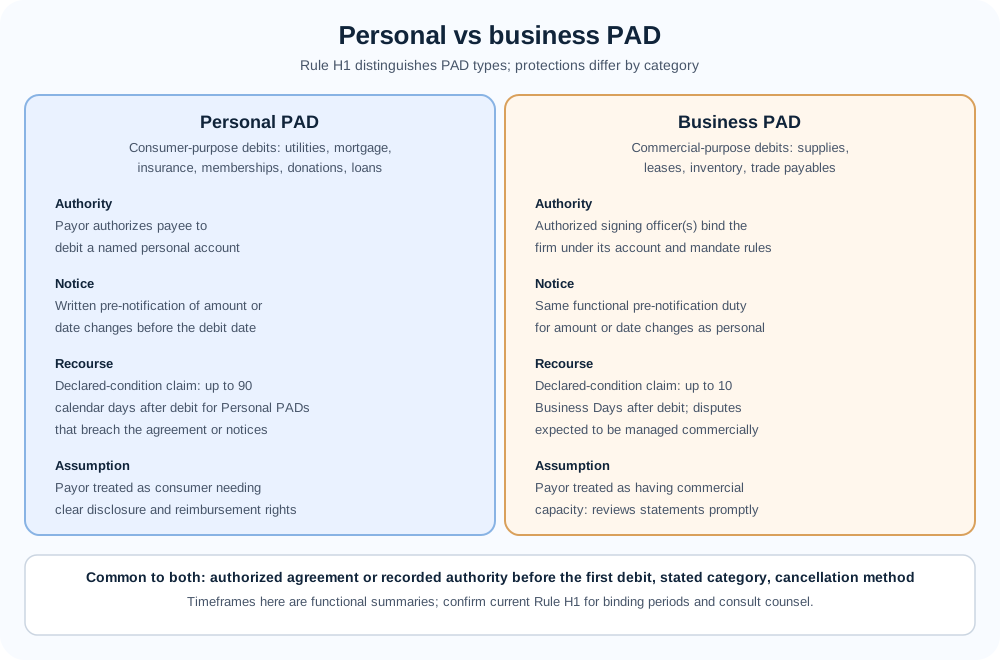
The diagram above is the chapter's anchor. Keep it visible while reading: every section is an elaboration of one row — authority, notice, recourse — or of the shared foundation both columns stand on.
2. Participants, responsibilities and system boundaries
A PAD collection involves more parties than the two names on the debit, and each owns a distinct slice of the agreement-to-cash chain. Confusing any two produces the classic failures of this business: the biller who assumes the bank validated its agreement forms, the bank that assumes the biller verified the payor, the payor who assumes the clearing system approved the debit. The chain has no gaps and no overlaps once it is drawn correctly, so draw it carefully.
Start with the payor — the person or firm whose account is debited. The payor owns the only decision that ultimately matters: authorizing the payee to collect. That authorization must be given in a form the payor's own account agreement recognizes, because the payor's bank will judge authority partly through its own account contract. For a personal PAD this is usually an individual signing for a household account. For a business PAD it is an authorized signing officer binding the firm, and the validity of that signature depends on corporate signing authority, not merely on a name on a form. A form signed by someone without authority is not an agreement. It is paper that will fail exactly when it is needed.
The payee — the biller, lessor, gym, charity or supplier whose account is credited — owns everything about the collection except the payor's decision. The payee designs the agreement form, obtains the authorization through a verification method that is commercially reasonable for the circumstances, issues confirmations and pre-notifications, honours cancellations, keeps evidence, and answers when a debit is challenged. This is a heavier load than most billers expect, and underestimating it is the standard biller failure mode. Collecting money is easy. Proving, months later, that a specific debit on a specific date for a specific amount was authorized under a specific agreement, with notices properly sent — that is the actual business, and payees that treat it as paperwork discover the difference during their first dispute wave.
The sponsoring bank — the payee's bank, which introduces the payee's PADs into clearing — owns the gatekeeping. Before a payee originates its first PAD, the sponsor enters a written arrangement with the payee, commonly called the payee letter of undertaking, in which the payee commits to follow the PAD rule and to carry the responsibilities the rule assigns. The sponsor reviews the payee's standard agreement forms and processes before they go live, confirms the payee has a commercially reasonable verification method for establishing agreements, keeps the payee informed of the rule and of material changes to it, and stands behind the consequences when the payee's forms or methods fail. This last duty deserves emphasis because it reverses the intuition: the sponsor indemnifies the system for losses flowing from its payee's defective agreements and non-compliance. Sponsoring PAD origination is therefore an underwriting decision, not a sales decision. A bank that onboards billers like deposit accounts will pay for the confusion through dispute losses.
The processing bank — the payor's bank, which holds the account being debited — owns the debit side. It posts debits presented through clearing, makes statements intelligible enough that payors can spot problems, receives reimbursement claims and disputes, judges them against the category's claim window and grounds, reimburses qualifying claims, and passes the consequences back through the return and recourse machinery toward the payee's side. It is also the party the payor actually talks to, which makes its front-line knowledge decisive. A contact-centre agent who knows the difference between personal and business claim windows, and who asks for the right facts in the first call, saves the bank days of investigation and saves the customer the experience of being bounced between institutions.
Around these four stand the supporting parties. Payment service providers and processors may act for payees — building agreement flows, sending notices, submitting files — but responsibility does not migrate with the outsourcing. If a provider collects on behalf of another entity that supplies the underlying goods or services, the agreement must describe that arrangement so the payor knows who is who. The rulebook's answer to "our vendor handles that" is consistent across every section: delegation of work is permitted, delegation of responsibility is not. Payments Canada owns and operates the clearing infrastructure and publishes the rulebook; it holds no customer accounts and decides no individual dispute. The Bank of Canada provides the settlement accounts on whose books net ACSS positions settle and oversees the system as a designated prominent payment system. Neither is a party to any PAD agreement, and neither can validate one.
Two boundary principles close the section and recur throughout the chapter. First, authority flows payor-to-payee while liability for defective authority flows payee-to-system: the payee warrants, through its sponsor, that each debit rests on a proper agreement, and when that warranty fails the cost lands on the payee's side. Second, the agreement is judged at the moment it is made and at every moment it is used: a valid agreement poorly evidenced, or a valid agreement followed by skipped notices and ignored cancellations, fails just as surely as no agreement at all. Sections 3 and 4 show how that authority travels from signature to settlement; Sections 5 through 8 show how each link is documented, noticed, controlled and, when necessary, unwound.
3. Initiation, validation and bank processing
Every PAD begins before any value moves, in the unglamorous work of turning a customer's willingness to pay into an enforceable, processable authority. This section follows that work in order: establishing the agreement, confirming it before the first debit, validating each collection before release, and handling the timing variants — set intervals, one-time and sporadic — that change what "valid" means on any given day.
Establishing the agreement is the payee's job under the sponsor's review. The payee presents its standard form or process — paper, online or telephone script — and the payor authorizes it. Before that form goes live, the sponsoring bank reviews it to confirm it addresses the required content elements, and confirms the payee operates a verification method suited to the channel and relationship: something that genuinely ties the authorizing person to the account being charged, proportionate to the risk. The modern rule deliberately avoids prescribing one method for all situations. A face-to-face sign-up with identification, an online flow with account validation, a telephone script with recorded authorization — each can satisfy the standard in its context, and each can fail it if performed carelessly. The test the rule contemplates is ultimate rather than procedural: would the method survive scrutiny if the authority were ever questioned in a serious forum. Payees should choose methods they would be comfortable defending, not methods that merely complete a signup funnel, and sponsors should review them with the same seriousness. Consult counsel on what suffices in any particular context; this chapter states the functional shape, not the legal conclusion.
Confirmation before the first debit is the step that prevents the most common payor complaint — the debit that arrives as a stranger on the statement. Under current Rule H1, the payee must provide or make available a written confirmation at least 10 calendar days before the first PAD. The confirmation may be the agreement or a key-terms summary. A payor may authorize a waiver or reduction, but if the pre-first-debit confirmation is waived, the payee must provide or make it available within 5 calendar days after the first PAD; a waiver or reduction clause in an agreement must be prominent, while a separate authorization must be properly authenticated. Telephone-originated agreements deserve special care: a recorded authorization can be a valid recorded authority, but the written confirmation still supplies the terms the payor can retain. The discipline is simple and expensive to skip: no payor should first learn the terms of their PAD agreement from a bank statement.
Validation before each release is the bank-side counterpart, and it runs on every collection, not just the first. The payee's bank — or the payee's processor acting under its discipline — confirms the file's authorities are in order, amounts and dates match what agreements and notices support, cancellation lists have been applied, and the batch totals balance before the file enters clearing. The payor's bank validates routing and account state on presentment as it would for any batch debit. The PAD-specific content of validation is the linkage check: does each item point to a live agreement, has any required pre-notification for this amount and date gone out, has any per-debit authorization required for sporadic items been obtained, has any cancellation taken effect. A collection file that cannot answer these questions item by item should not be released. Release is a warranty, and a warranty given blindly is a loss booked in advance.
Timing variants change the validation logic, so they must be understood as distinct products sharing one rail. PADs recurring at set intervals — weekly, monthly, on defined dates — are the standard case: one agreement supports a series, and each collection in the series must match the agreed schedule or a properly notified change. One-time PADs are exactly what they sound like: a single authorized collection that automatically exhausts its agreement once completed, so any subsequent debit needs a fresh agreement rather than a repeat of the old reference. Sporadic PADs — occasional, irregular collections under a standing agreement — invert the normal logic: the standing agreement alone does not authorize any particular debit, and the payee must obtain the payor's authorization before each individual collection, by a method such as a recorded instruction or credential that the agreement itself discloses. This per-debit requirement cannot be waived by the payor, which surprises billers accustomed to treating a signed form as blanket permission. Product owners should treat the three variants as three validation rules in their systems, not as one rule with exceptions, because the exceptions are where disputes breed.
Cancellation handling belongs in this section because cancellation is initiation in reverse — a live authority being switched off under time pressure. Under Rule H1 section 30, a written or properly authorized oral revocation requires the payee to use best efforts to cancel in the next business, billing or processing cycle and to stop issuing new PADs within no more than 30 calendar days, unless the agreement sets a shorter period. The payee may also terminate under the agreement or, where it is silent, with at least 30 calendar days’ written notice; if termination is authorized by the payor, the payee must provide or make available a statement of the final PAD and effective termination date within 10 calendar days of that final PAD. The operational discipline that matters is list hygiene: the cancellation must propagate from the request to the agreement record to the next collection file without fail. Every PAD operation needs a cancellation register with effective dates, and every collection run must be checked against it. A debit after an effective cancellation is a defined reimbursement ground, subject to the applicable category window.
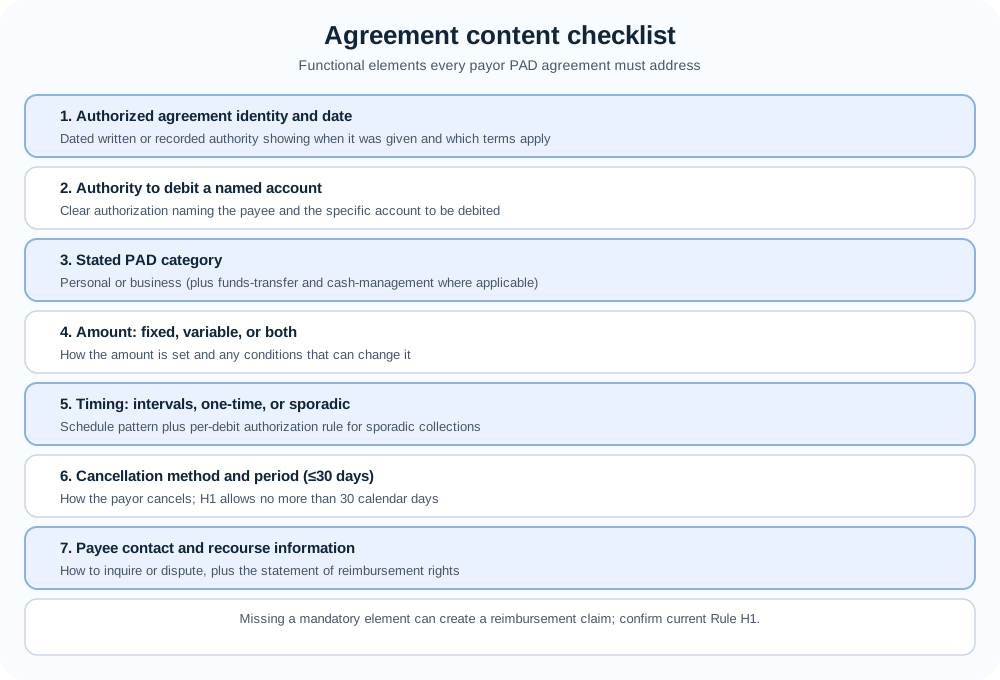
Measure every agreement form and every collection run against the checklist above. If any element is missing at signing, repair the form. If any element fails at release, hold the item. The cost of holding is a delayed collection. The cost of releasing is a dispute.
4. Clearing or exchange, settlement and finality
Once agreements are established and a collection file is validated, the PAD enters machinery this chapter can treat briefly, because the clearing and settlement of PAD debits follows the standard retail-batch pattern taught across this programme. The PAD-specific content of this section is not how batch works — it is where agreement logic touches batch mechanics, and where batch mechanics create agreement risk.
The payee's bank releases the collection file into ACSS exchange, directly or through its clearing arrangements, and the items move through the familiar batch sequence: exchange of items and data between participants, clearing that validates, sorts and positions them, calculation of net positions per direct clearer, and settlement of those positions on the following business morning through accounts at the Bank of Canada. PAD debits are simply one stream family riding this sequence alongside credits, cheques and other batch items. Nothing about the agreement travels with the clearing record in full; the clearing entry carries routing, amount, date and references, while the agreement stays where it was made — with the payee, retrievable on demand. That separation is the architectural fact behind every PAD dispute timeline: the money moves in hours through batch, while the proof moves in days through banks on request. Design expectations accordingly.
Finality in this model must be described with the programme's standard vocabulary, used exactly. Exchange delivers the debit instruction. Clearing positions it. Settlement extinguishes the interbank obligation finally in central-bank money. Posting debits the payor's account and credits the payee's account on the banks' books. Availability and statements tell the payor what happened. None of these words means "unchallengeable." Defined return and recourse rights survive settlement for PADs — that is the entire subject of Section 8 — so a settled PAD is final between banks in the settlement sense while remaining reversible in the recourse sense when the agreement or notices failed. Bankers who tell customers that a posted PAD "has settled so nothing can be done" misunderstand both settlement and recourse, and create the complaints that regulators remember.
Three batch realities create specific agreement risk for PAD portfolios. First, value dating and weekends: a debit scheduled against a non-business day behaves per the agreement and the banks' business-day calendars, and agreements that promise specific calendar dates without business-day language generate the small mismatches — a day early, a day late — that irritate payors and, at volume, generate notice disputes. Agreement drafters should address business-day treatment explicitly, and operations should apply it consistently; consult counsel on wording. Second, the payee's collection date versus the payor's posting date: the date the payee submits and the date the payor sees are separated by the batch cycle, so pre-notifications and confirmations must be anchored to the date the payor experiences, not the date the payee's system stamps. Third, returns and re-presentment: H1 permits one electronic re-presentment after a return for “Non-Sufficient Funds” or “Funds Not Cleared,” within 30 calendar days, for the exact original amount and with no interest, NSF fee or other added charge. Other returns, retries, and any bank-specific retry controls must be handled under the applicable F rules, the payee undertaking and the bank’s schedule; a retry outside the permitted terms is a fresh dispute wearing the clothes of an old one.
One forward pointer matters. The full mechanics of batch exchange windows, netting, the settlement morning and return cycles belong to the ACSS chapters of this programme, not here. This chapter assumes that machinery and teaches what rides on top of it: authority established before release, notices sent before changes, evidence available after challenge. A PAD operation that masters batch mechanics but neglects agreements will clear efficiently and reimburse constantly. The reverse operation — careful agreements on shaky batch handling — at least keeps its disputes winnable. Master both, in that order of priority.
5. Data, identifiers, messages and references
PAD disputes are won and lost on data long before anyone discusses law. The payee who can produce the authorized agreement or recorded authority, the dated confirmation, the provided pre-notification and the per-debit authorization, each linked to the challenged collection, wins quickly. The payee who holds fragments across four systems — the agreement in a filing cabinet, the notices in a marketing platform, the cancellation in an email inbox, the collection reference in a processor file — loses slowly and pays throughout. This section describes the data discipline that makes evidence retrievable.
Every PAD needs a durable identity chain with four links, and the chain must be designed at origination, not reconstructed during disputes. The agreement identifier anchors authority: which authorized agreement or record, which version, dated when. The payor and account reference anchors the target: which person, which account at which institution, verified how. The collection reference anchors the debit: which item in which file on which date for which amount, traceable through clearing. The notice linkage anchors communication: which confirmation and which pre-notifications were sent when, with waiver records where applicable. Drop any link and a different team pays: drop the agreement identifier and the dispute desk cannot find the authority; drop the account reference and the wrong-account debit cannot be distinguished from fraud; drop the collection reference and the return cannot be matched to its original; drop the notice linkage and the amount-change dispute becomes one person's word against another's. Reference discipline is unglamorous and decisive.
Account identification follows the national routing structure taught elsewhere in this programme — institution, transit and account — and PAD operations must preserve the authority trail when banking details change. A payor-requested change may update the existing agreement or create a new one, but the instruction must be retained with the original agreement. A Notice of Change (NOC) received through the sponsoring member under Rules F1/F4 must be accepted and acted on; H1 treats that administrative routing change as the payor’s authorization, so a fresh customer authorization is not required for the NOC. A move to a different processing member, an unverified customer request, or a migration mapping that changes authority is a different control event and should be handled under the bank’s verification policy. The control is not “always re-verify”; it is “never lose the source and type of the change.”
Payee identification on statements deserves its own paragraph because it is the cheapest dispute prevention available and the most commonly neglected. The name a payor sees beside the debit is often the first and only notice that a collection occurred — especially for small recurring amounts the payor no longer actively tracks. Cryptic processor descriptors, abbreviated trading names and unfamiliar corporate entities manufacture "unauthorized" claims out of authorized debits: the payor does not recognize the name, assumes fraud, and disputes a collection they actually agreed to. Payees should ensure statement descriptors map recognizably to the name on the agreement, keep descriptors stable across cycles, and confirm with their sponsor what descriptor control they actually have. Banks should coach sponsored payees on this point during onboarding, because every unrecognizable-descriptor dispute costs both banks work and costs the payee a customer.
Message and format handling for PADs is straightforward in principle: collection files follow the ACSS/AFT conventions of the stream they travel in. H1 section 20 requires AFT PADs to carry the dedicated ISO AFT transaction-code classification (for example, Business PADs use 700–749; Cash Management uses 420 or 717; other PADs use the specified ranges in H1), with routing, amount, date and references carried in the payment item while agreement evidence remains outside the clearing record and available on request. H1 does not prescribe a customer-facing API; a bank or processor may expose files, host-to-host, portal or API channels, but the sponsor remains responsible for the rule controls. The practical risks concentrate at conversions and migrations — a new processor, a new file format, a core conversion — where references get rewritten “for convenience” and notice histories get archived into inaccessibility. Three rules prevent the damage: original references travel forever and system-added identifiers are appended, never substituted; notice and authorization records migrate with the agreement records, not separately; and every migration is tested with a dispute drill before the old system is decommissioned.
Retention has a binding H1 floor and potentially longer legal or policy requirements. H1 section 21 requires the payee’s audit trail — the PAD agreement, authorization evidence where applicable, and information needed to retrieve or trace the PAD — for at least 12 months after the last PAD processed under that agreement. This is not a ceiling: bank records schedules, tax, AML/ATF, litigation holds and other law may require longer retention. The functional requirement is retrieval, not merely storage: a warehouse of unindexed images that cannot answer “produce the authority for this debit within days” fails the operational test.
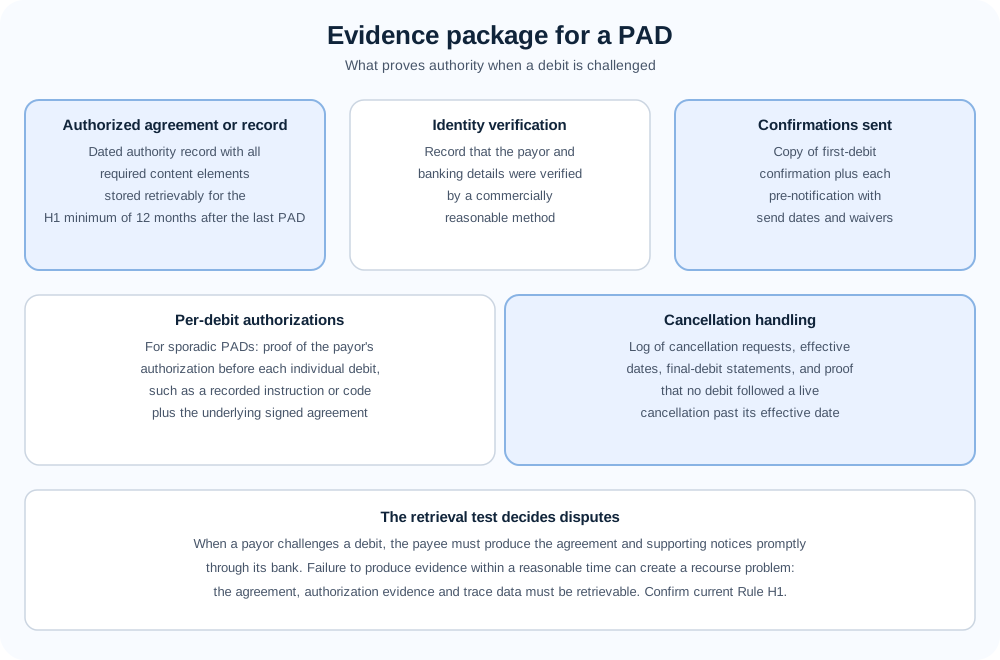
Assemble every challenged collection against the package above before contacting any counterparty. If any panel comes back empty, the investigation is already over.
6. Rules, cutoffs, service levels and customer impact
Customers experience PAD rules as promises: the debit will arrive on the agreed date, for the agreed amount, with warning of changes, and with a way out. Banks experience the same rules as calendars, obligations and evidence. This section states the current Rule H1 deadlines where the rule is binding and separates them from participant cutoffs and service levels, which remain bank-specific and schedule-dependent. Any study note, job aid or customer script must still be checked against the in-force Rule H1 and the bank's published schedules before production use.
The rulebook layering for PADs is simple in shape. Rule H1 governs the clearing and settlement of pre-authorized debits: the categories, the agreement content, the confirmation and pre-notification duties, the cancellation handling, the reimbursement regime and the sponsor obligations. Appendices carry the mandatory content elements for agreements, confirmations, undertakings and cancellation-related records. The general ACSS rules, by-laws and standards govern the batch mechanics underneath — exchange, returns, settlement — exactly as for other batch items. Functionally, every PAD question therefore has two addresses: the H1 layer for authority, notice and recourse, and the batch layer for movement, timing and settlement. Answering a PAD question from only one layer produces the characteristic half-answers of this business — "the debit settled correctly" when the agreement failed, or "the agreement looks fine" when the return missed its window.
Confirmation and pre-notification timing is the heart of this section. Under H1 section 16, the payor must receive or be able to access written confirmation at least 10 calendar days before the first Personal or Business PAD, unless the payor authorizes a reduction or waiver; if the pre-first confirmation is waived, the confirmation must be provided or made available within 5 calendar days after the first PAD. Under section 17, a Set-Interval Personal or Business PAD requires written pre-notification specifying the amount and date at least 10 calendar days before each fixed-amount change, payment-date change and every variable-amount PAD after the first. No notice is required for a decrease caused by a reduction in municipal, provincial or federal tax, or for a payor-requested amount change if the agreement specifically provides for it. The parties may separately reduce or waive pre-notification, but an agreement clause must be prominent and separately authorized waivers must be properly authenticated. Per-debit authorization for Sporadic PADs cannot be waived. Confirm the in-force H1 before drafting or coding any exception.
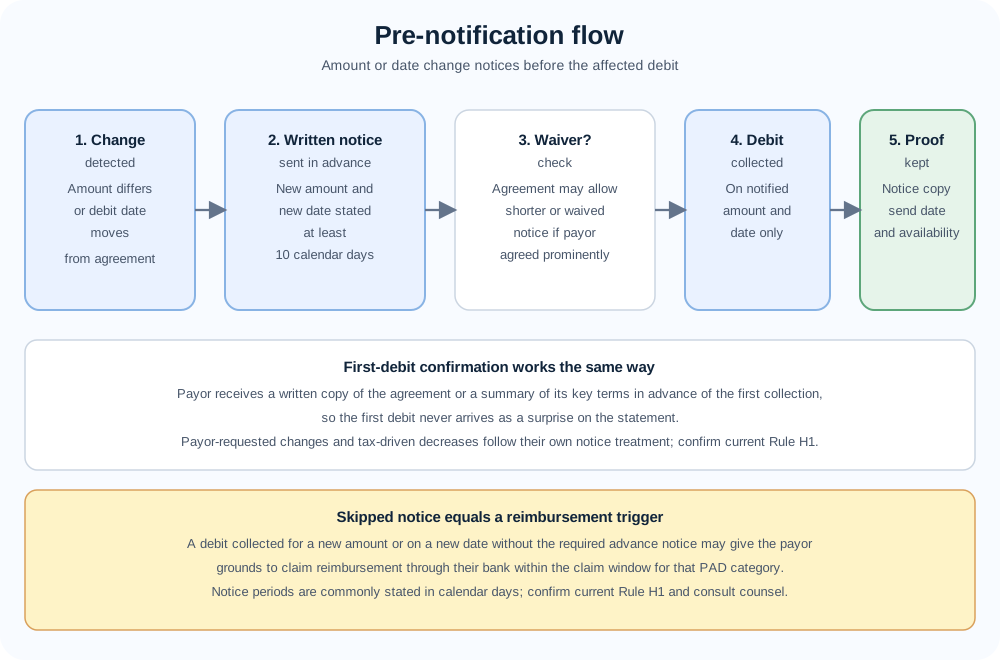
Run every amount or date change through the flow above, and file the proof panel's contents with the agreement. A change without a notice is not a saving. It is a reimbursement waiting for a statement cycle.
Claim windows for reimbursement are not merely “longer” or “shorter.” For a claim that no Payor’s PAD Agreement, Payee Letter of Undertaking or other Cash Management agreement existed, H1 section 23 permits a claim within 90 calendar days after the posting date for all categories; after that, the existence dispute is outside the rules. For the declared conditions in section 24 (not drawn in accordance with the agreement, revoked agreement, or missing confirmation/pre-notification/required notice), the Processing Member must accept a claim up to 90 calendar days after debit for Personal PADs and eligible Funds Transfer PADs, and up to 10 Business Days for Business PADs. Funds Transfer PADs coded 650/83 and Cash Management PADs have different recourse exceptions. The dispute desk must establish category and code before applying the clock.
Cancellation timing completes the calendar. A written or properly authorized oral payor revocation triggers best efforts to cancel in the next business, billing or processing cycle and a hard H1 outside limit of 30 calendar days, unless the PAD agreement states a shorter cancellation period. A payee termination follows the agreement or, if silent, requires at least 30 calendar days’ written notice unless otherwise authorized; an authorized termination requires a final-PAD/effective-date statement within 10 calendar days of the final PAD. Internal service levels should log requests same-day, apply effective dates to the cancellation register, and check that register before every release. A customer told “it takes effect immediately” when the file already left creates a dispute out of a success. Promise only what the release cycle supports.
Service levels for PAD portfolios bundle all of this into commitments a bank can actually operate. For sponsored payees: onboarding review turnaround, agreement-form approval, descriptor setup, notice-process validation, dispute-response turnaround, and periodic portfolio review. For payors: dispute acknowledgement, claim decision communication, reimbursement posting for qualifying claims, and statement clarity. None of these needs a number in this chapter; each needs an owner, a metric and a review cadence in the bank. The customer impact of getting this right is quiet and cumulative: debits that match expectations, notices that prevent surprises, cancellations that stick, disputes that resolve on evidence in days. The impact of getting it wrong is equally cumulative and far louder, as Section 8 will show.
7. Fraud, compliance and operational controls
Boundary: The sanctions, AML/ATF, fraud and monitoring controls below are regulatory-programme or bank implementation controls; they are not additional Rule H1 mandates unless H1 is named.
PADs attract a distinctive fraud landscape because they invert the normal payment attack. Most payment fraud forges an instruction. PAD fraud forges — or exploits — an authority: a standing permission that keeps paying until someone notices. The controls in this section are arranged by where they bite in the lifecycle, because a control on the wrong side of the event it governs is decoration.
Origination fraud attacks the agreement itself. Fictitious payors are enrolled with stolen banking details so collections can be drawn against victims' accounts. Unscrupulous or compromised payees originate debits against agreements that never existed or that were obtained through deception. The defences sit at onboarding and verification: the sponsor's review of the payee's business, agreement forms and verification methods before the first file; commercially reasonable verification that ties each payor to each account; anomaly monitoring on new payees — sudden volume, unusual account mixes, rapid-fire first collections; and descriptor discipline so victims and their banks can identify the source quickly. The sponsor that onboards a biller without understanding its signup channel — face-to-face, online, telephone — has accepted a risk it cannot price. Underwriting standards for PAD originators belong in credit and operations policy, not in sales targets, and they should be reviewed with counsel.
Ongoing-collection fraud exploits the standing nature of authority. Amounts creep upward without notices. Cancelled agreements keep collecting. Account details harvested from one context are reused in another. Dormant agreements reactivate without fresh authorization. The defences are lifecycle controls: pre-notification enforcement with evidence of sending, cancellation-register hygiene with pre-release checks, per-debit authorization enforcement for sporadic items, account-change re-verification, and payor-side transaction monitoring that flags PADs inconsistent with the customer's history — a first-time payee, an amount far outside pattern, a debit shortly after an account change. Payor banks carry special responsibility here because they see the debit against the customer's whole behaviour. A monitoring engine that scores only outgoing wires while ignoring PAD pulls watches the wrong door.
Social engineering and deception deserve separate emphasis because PAD authority is particularly vulnerable to it. A fraudster who persuades a consumer to "authorize" debits for a fictitious service, or who talks a small-business clerk into signing a supplier authorization, creates a dispute that looks like a valid agreement on paper and a victimization in fact. Front-line and onboarding controls should look for the markers: pressure tactics, unfamiliar payees, agreements signed far from the underlying commercial relationship, payors who cannot describe what they authorized. No rulebook eliminates deception, but verification methods with genuine challenge — not merely a pre-ticked box — raise its cost substantially.
Sanctions, anti-money-laundering and record-keeping obligations attach to PAD operations like any payment business, with PAD-specific placement. Parties to collections are screened under the bank’s sanctions programme; the batch structure — hundreds of payors per file — means screening must handle volume without stranding clean items when one item hits. Transaction records feeding the bank’s reporting obligations are captured at origination and preserved through clearing, because batch scale makes after-the-fact reconstruction unreliable. Do not treat every domestic PAD as an automatic FINTRAC electronic-funds-transfer report: FINTRAC’s published EFT reporting rules focus on international EFTs at the applicable thresholds and reporting-entity obligations. Client identification, suspicious-transaction escalation, sanctions controls and retention must be mapped to the institution’s applicable obligations and current government guidance. This chapter’s control rule is to screen and identify before release, capture at initiation, preserve through clearing, and report from complete data.
Operational controls tie the families together into release discipline: no collection file reaches clearing without passing agreement linkage, notice verification, cancellation-register check, limits, fraud scoring, sanctions disposition and approval, each decision logged. Overrides — manual releases, verbal instructions, after-cutoff exceptions — must themselves be controlled, dual-approved, time-bound and reviewed, because the history of batch losses is largely a history of overrides that bypassed the order. Segregation of duties keeps the payee's file-preparer separate from the bank's file-releaser. Evidence preservation runs underneath everything, per Section 5. And contingency — alternative file paths, communication trees, manual-reconciliation capacity — ensures a systems outage pauses collections safely rather than releasing them blindly. A PAD operation that can stop cleanly is safer than one that can only go faster.
8. Exceptions, investigations and recovery
Every PAD portfolio generates exceptions daily — returns for insufficient funds, closed accounts, stopped debits — and manages disputes episodically. Banks that classify first recover cheaply. Banks that act first — re-crediting, re-debiting, editing records — create duplicates and audit breaks that dwarf the original error. This section teaches the classification and the recovery discipline at the depth this chapter requires; full return-code and adjustment mechanics belong to the programme's exceptions coverage.
Start with the taxonomy, because precise words are the cheapest control in exception handling. A reject happens before clearing: the file or item is refused for invalid routing, failed validation or incomplete data, and nothing settles. A return happens after entry: the payor's side sends the debit back for insufficient funds, a closed or invalid account, or a disputed collection, with reason codes and timeframes defined by the rulebook. A reimbursement claim is the payor's assertion of recourse — no agreement, breached agreement, ignored cancellation, missing notice — judged against the category's grounds and window, and paid by reimbursing the payor with consequences passed back toward the payee's side. A reversal corrects a bank or system error through a defined mechanism, never by silent editing. An adjustment handles the small-value consequences the rules allocate. An investigation tracks an uncertain outcome. Each word means something different, and using them interchangeably in customer communication or incident tickets guarantees confusion the incident itself did not require.
Reimbursement is the remedy this chapter must get functionally right, because it is where agreements become money. The grounds cluster into a short list: the debit rested on no agreement at all; the debit breached the agreement's amount, timing or account terms; the payor had cancelled and the debit followed anyway; the required confirmation or pre-notification never arrived. The payor claims through their own bank within the H1 window for the PAD category. For the declared conditions described above, that is up to 90 calendar days for Personal PADs and eligible Funds Transfer PADs, and up to 10 Business Days for Business PADs; no-agreement claims have the separate 90-calendar-day posting rule. The bank judges the claim on evidence: the agreement produced or not produced, the notices sent or not sent, the cancellation logged or not logged. Qualifying claims are reimbursed to the payor, and the value flows back against the payee through the system's recourse machinery, landing ultimately where the defect originated. Confirm the current Rule H1 for coding, grounds and flow mechanics.
Investigations run on the evidence package from Section 5, assembled in a fixed order. Start from the challenged collection's references — date, amount, descriptor, clearing trace — and pull the linked agreement, its version date and the verification record. Check the confirmation and pre-notification log for this amount and date, including any waiver. Check the cancellation register for requests effective before this debit. Only then contact the counterparty — the payee through the sponsor chain — with a precise, reference-carrying query. Most PAD investigations close at step two or three: the agreement is produced and valid with notices intact, or it is not produced and the claim pays. The investigations that drag are reference failures — the collection cannot be joined to its agreement — which is why Section 5 called reference discipline decisive. Status communication follows the vocabulary rule: state what is known and what is being done, never upgrade "tracked" to "resolved" before the evidence arrives.
Recovery follows one iron rule: never mutate history; always create a linked new event. A rejected item is repaired and re-originated with linkage to the original. A return for insufficient funds is retried only where the agreement permits retries and within disclosed limits — retries outside the agreement's terms are fresh disputes, not continuations. A reimbursement is processed as its own event referencing the original debit, preserving the audit trail from collection through claim to repayment. A duplicate collection is reversed through the defined mechanism with the original preserved. Every recovery carries the original references forward so reconciliation and audit can follow the thread. The bank that re-debits "the same PAD again" without linkage has created two debits and will discover the second one from the customer, at the worst moment.
Containment deserves a final word because PAD scale punishes slow containment. A compromised payee credential originating unauthorized files, a corrupted collection run debiting wrong amounts, a cancelled portfolio still releasing: first stop the bleeding — suspend the payee's origination, hold pending files, quarantine the repair queue, notify sponsors and affected payor banks where required — and only then diagnose. Containment decisions need pre-assigned authority reachable during every release window, not an escalation tree that convenes tomorrow. And prevention closes the loop: every dispute is data. Defect patterns — which payees, which channels, which agreement versions, which notice failures — should feed back into sponsor reviews, form redesigns and verification upgrades. A PAD operation that reimburses without learning buys the same dispute twice.
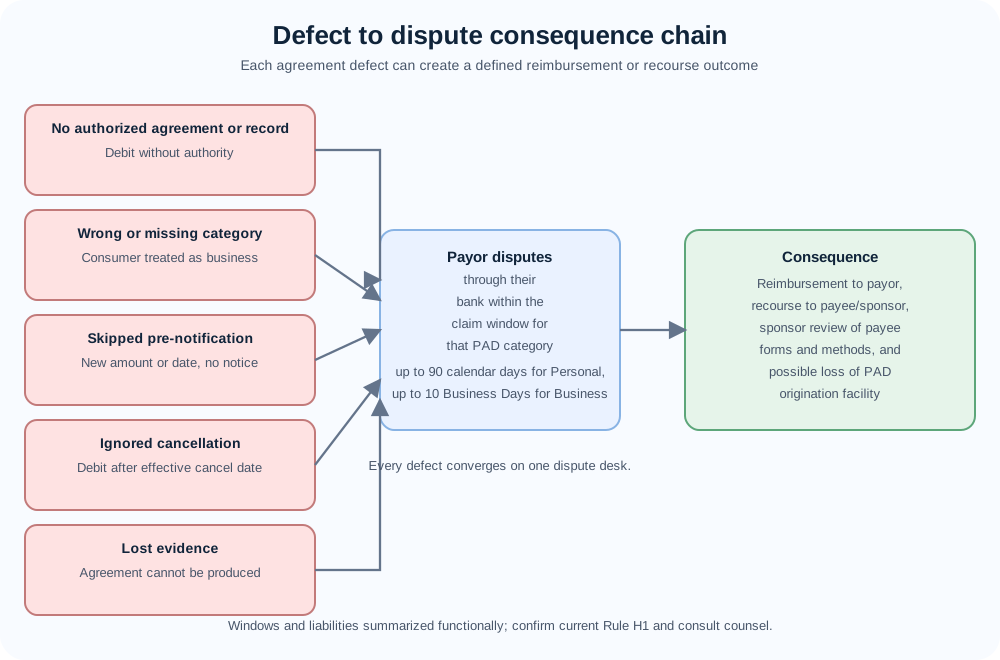
Read the chain above right to left when a dispute lands — consequence to defect — and left to right when designing controls. Every arrow is a place where money, evidence or both change hands.
9. Posting, accounting, liquidity, reporting and reconciliation
PADs look simple on a ledger — debit payor, credit payee — and behave like a portfolio business everywhere else. This section describes the posting, accounting, reporting and reconciliation discipline from the bank operations view, for both sides of the collection.
Posting follows the batch cycle. On the payor's side, presented debits post to the designated account on the applicable business day, subject to holds, funds availability and return rights the statement should reflect honestly. Descriptions must carry the payee identifier the agreement taught the payor to expect, because the statement line is the payor's primary control — the place where unauthorized or surprising debits surface. On the payee's side, collected funds credit the payee's account per the sponsor arrangement, net of fees and subject to recourse exposure: a credited collection is not yet an unchallengeable one while claim windows run. Both banks' posting engines must handle the full exception vocabulary — rejects that never post, returns that reverse posting with reason codes, reimbursements that move value back with linkage — without breaking the customer's running narrative. A statement that shows a debit, a mysterious credit and a second debit with no explanation generates the call that a linked description would have prevented.
Accounting treats PAD portfolios as what they are: fee income against recourse exposure. Origination fees, per-item charges and dispute-handling fees accrue to the sponsor; reimbursement outflows and return-handling costs offset them. Prudent operations accrue for recourse: a new payee with weak evidence practices is a contingent liability wearing a revenue line, and portfolio reporting should present the two together — collections and fees beside returns, claims, reimbursements and ageing, by payee. Payee-side accounting mirrors this from the biller's books: collected revenue recognized against the risk of reversals, with reserves where dispute history warrants. Neither side should book PAD economics on a cash-collected basis alone. The claim window is part of the revenue recognition whether finance acknowledges it or not.
Liquidity effects are modest per item and material in aggregate. For payor banks, PAD debits are predictable outflow demand concentrated on cycle dates — month-ends, billing anniversaries — and large billing dates should appear in the funding forecast like any other expected outflow. For payee banks, incoming PAD credits fund payee balances on posting while net batch positions settle the following morning, the standard deferred-settlement pattern. For business payors with tight cash management, the exact debit date matters operationally — the Calgary lessor drawing two days early in Section 1's example is a liquidity event for the customer even when every document permits it — which is why date discipline and date-change notices carry weight beyond compliance. Treasury teams should know the portfolio calendar: which payees collect when, in what volumes, with what retry behaviour after return dates.
Reporting serves three audiences with three different questions. Payors need statements and alerts that make each debit recognizable and challengeable: clear descriptors, amounts, dates and a visible path to dispute. Payees need collection reports that reconcile promise to cash: expected versus presented versus collected versus returned versus reimbursed, aged and reason-coded, with identifiers that join to their receivables. Banks need portfolio dashboards: origination volumes by payee, return rates, claim rates, reimbursement outflows, evidence-response times, cancellation-register hygiene. The payee report deserves design attention because it is where billing operations live: a report that cannot distinguish "payor short of funds, retry permitted" from "agreement cancelled, stop collecting" will produce exactly the illegal-feeling retry that creates the next dispute.
Reconciliation for PADs is three-way at minimum and daily by discipline. The payee reconciles agreements to collections to cash: every debit presented must trace to a live agreement, and every expected collection must appear as presented, returned or explained. The sponsor reconciles payee files to clearing records to settlement positions: what was released, what the system accepted, what settled. The payor's bank reconciles presented items to postings to returns and reimbursements: what arrived, what posted, what came back. Breaks age visibly with owners — unpresented expectations, unmatched returns, unlinked reimbursements — and no break idles past its review date. Month-end adds the fourth reconciliation: fees and recourse accruals against portfolio performance, so economics stay honest. The PAD business tolerates no suspense account as a permanent residence. Every unreconciled item is either a customer about to call or a loss about to surface.
10. Bank implementation, testing and resilience
Boundary: This section describes bank-specific implementation, product and resilience controls. Treat a control as a Rule H1 requirement only where the text attributes it to H1; other controls require the institution's policy, risk appetite and legal review.
Offering PAD origination to billers and PAD acceptance to payors is a product decision with an operations tail measured in years. This section describes what a bank must build, test and sustain — functionally, without vendor or platform specifics — so the tail does not wag the institution.
Implementation starts with policy, not software. The bank defines which PAD categories and timing variants it supports, its sponsor risk appetite for payee onboarding — which industries, which signup channels, which volumes — its agreement-form review standard, its verification-method expectations, its notice and evidence requirements for sponsored payees, its descriptor conventions, its cancellation-handling standards, its dispute-handling turnaround commitments and its fee and recourse-accrual approach. Each policy needs an owner and a review date, because PAD practice drifts: payees change processors, add channels, redesign forms and outgrow limits. Policy without review is a snapshot mistaken for a system. Legal review belongs at this stage — agreement templates, waiver prominence, undertaking wording, disclosure copy — with counsel engaged before launch, not after the first dispute wave. That sentence is worth the price of the whole section.
Systems implement the policy across the standard payment architecture: channels and onboarding flows that capture agreements completely; a mandate or authority repository that stores agreements with versions, verification records and lifecycle states rather than delete buttons; a notice engine that issues confirmations and pre-notifications with send evidence and waiver handling; a cancellation register with effective dates consulted before every release; a collection and validation layer enforcing agreement linkage, notice verification and limits; gateway adapters releasing into ACSS with confirmation matching; posting engines with linked exception handling; reporting and reconciliation feeds per Section 9; and a case-management surface joining all of it by reference for dispute desks. Build order follows the evidence chain: authority repository and notice engine before new origination volume, cancellation register before portfolio growth, dispute tooling alongside the first live payee rather than as a later phase. A bank that onboards its tenth payee on spreadsheets has not saved money. It has scheduled an incident.
Testing must prove the unhappy paths, not just the sunny-day collection. Form-review testing walks sample agreements — including telephone scripts and online flows — against the content checklist with deliberately defective variants to confirm review catches them. Verification testing attempts enrolment with mismatched identities and accounts to confirm challenge works. Notice testing advances system clocks through amount changes, date changes, variable-amount cycles and waiver scenarios to confirm notices issue with correct content and timing. Cancellation testing requests cancellation at every point in the release cycle — before file build, after file build, after release — to confirm each takes effect correctly. Dispute drills pick historical collections and assemble full evidence packages against the clock, proving retrieval works under pressure. Migration testing, per Section 5, replays all of this across every conversion. Each test needs pass criteria written before execution; a test without criteria is a demonstration, not a control.
Resilience for PAD operations means failing paused, never failing blind. File-path outages queue collections rather than releasing unvalidated ones. Notice-engine failures hold affected debits rather than collecting without notice. Repository outages suspend releases that cannot verify authority rather than assuming it. Each degraded mode needs a written playbook with authority, communication templates for payees and payors, and a recovery sequence that re-validates everything queued before release — because a backlog released without re-validation replays every cancellation and change the outage outlasted. Incident reviews feed the learning loop from Section 8: defect patterns become policy updates, form redesigns and onboarding changes. And horizon discipline applies: retail-batch modernization initiatives and rule amendments arrive on their own timetables, tracked through official publications, adopted through change control, never improvised into production. A PAD operation that treats the current rule as current — checking, versioning, updating — stays boring in the best sense. One that runs on remembered rule text eventually defends the wrong version in the wrong forum.
11. Practical Canadian examples
Three fictional cases — labelled as such — carry the chapter's lessons into situations a banker will recognize. Names, amounts and institutions are invented. The control logic is real.
Example (fictional): the gym membership personal PAD
North Star Fitness, an invented chain with locations across Ontario, signs up Amara, an invented member, in September: $59.99 monthly plus tax, drawn on the 15th of each month from her chequing account, under a written agreement completed on a tablet in the club. The agreement states the personal PAD category, the fixed amount with tax treatment, the monthly interval, the cancellation method — written notice with effect before the next scheduled debit — the club's contact details and the reimbursement-rights statement. Amara receives a copy of the agreement by email the same evening. The first debit collects on October 15th for the agreed amount. So far, a textbook origination.
In January the club raises dues to $64.99 and updates its billing engine — but the pre-notification email goes only to members with "marketing consent" flagged, a segmentation error nobody catches. Amara, who opted out of marketing, is debited $64.99 on February 15th without advance notice of the change. She spots the unfamiliar amount on her statement, does not recognize the club's abbreviated descriptor — "NSF*FIT812" — assumes the worst, and disputes the debit through her bank in early March, within the personal PAD claim window.
The investigation follows the fixed order. The collection reference joins to Amara's agreement — valid, personal category, $59.99 plus tax. The notice log shows no amount-change pre-notification sent to her. The agreement's waiver clause, even if present, cannot cure a notice that was never attempted for this payor. The claim succeeds on the missing-notice ground: Amara is reimbursed the disputed debit, the value flows back against the gym, and the gym's sponsor — which had approved the agreement form but never reviewed the notice-sending process — opens a file review.
Three lessons, each mapping to a section. First, notices are a sending discipline, not a template: the agreement form was perfect and the operation still failed, because marketing segmentation governed a compliance communication (Sections 3, 6). Second, descriptors are dispute prevention: a recognizable name might have produced a question to the club instead of a claim to the bank (Section 5). Third, sponsor review must cover processes, not just forms: the verification method and the notice engine are part of what the sponsor stands behind (Sections 2, 10). The gym fixes all three — notices decoupled from marketing consent with send evidence, descriptor corrected, sponsor re-review — and its dispute rate falls by an order of magnitude. Authority was never the problem. Communication was.
Example (fictional): the supplier business PAD
Prairie Cold Storage, an invented food distributor in Calgary, leases refrigeration units from Western Equipment Leasing, an invented lessor, under a service contract with quarterly lease instalments of $18,400 drawn by business PAD. The payor's agreement is signed by Prairie's controller with proper signing authority, states the business category, the fixed quarterly amount, the set-interval schedule anchored to specific dates, the cancellation method, contact details and the recourse statement. Both sponsor review and the lessor's file discipline are sound. The first three quarterly debits collect cleanly.
The fourth instalment goes wrong in two small ways at once. The lessor's new billing analyst, working from the contract's "first business day of the quarter" language rather than the PAD agreement's specific-date schedule, releases the file two days early. Separately, a $240 property-tax pass-through added to this quarter's invoice is included in the PAD amount without pre-notification — the analyst assumed a disclosed contract formula needed no notice. Prairie's account, managed tightly around the expected date, dips near its limit; the controller spots the early, inflated debit and disputes through Prairie's bank within days — comfortably inside the shorter business PAD window, because commercial reconciliation runs daily.
Here the investigation splits the two defects. The date defect turns on what the agreement and its business-day treatment actually say — a question for the agreement text and counsel, with the early debit vulnerable if the specific-date schedule governed. The amount defect is cleaner: a fixed-amount agreement collected a different amount without the required advance notice, and a contract formula does not substitute for pre-notification unless the rule's specific treatment covers it — again, confirm the current Rule H1 and consult counsel. The claim succeeds at least on the amount ground; the date question determines the scope. The lessor absorbs the reimbursement, corrects its process — PAD schedule decoupled from contract shorthand, amount-change notices with send evidence, analyst training on the difference between what the contract allows and what the PAD agreement authorizes — and keeps the customer. Prairie, for its part, tightens its own control: large expected PADs now carry diary alerts a week out, so the next surprise surfaces before posting rather than after.
The business-PAD lessons differ instructively from the gym case. The H1 window was 10 Business Days, and the payor was faster — commercial reconciliation working as the regime assumes. The dispute turned on operational precision rather than missing foundations: valid agreement, verified authority, working relationship, two small deviations. And the relationship survived because both firms treated the reimbursement as quality feedback rather than litigation. Business PAD recourse at its best is commercial hygiene, not consumer rescue — narrower, faster and routine.
Example (fictional): the variable-amount utility collection
Lakeshore Hydro, an invented municipal utility, collects monthly electricity charges by personal PAD from an invented customer, Daniel, under an agreement that correctly states variable amounts on a monthly interval. Because every month's amount differs, each collection is effectively a change, and the utility's notice engine emails the bill — functioning as pre-notification with the new amount and date — twelve days before each debit. Daniel pays without incident for two years. Then a smart-meter migration corrupts the notice feed: bills render correctly in the customer portal but the pre-notification emails silently stop for four percent of accounts, Daniel's among them. Three monthly debits — $142.10, $168.44, $131.87 — collect without any advance notice to him.
Daniel notices on the third statement and disputes all three. The investigation finds a valid variable-amount agreement, proper verification, no cancellation — and a notice log with a three-month gap for his account. Each debit breached the notice requirement independently, so each stands or falls on its own notice evidence, and none has any. If the claims are made within H1’s 90-calendar-day Personal PAD window, all three claims succeed under the declared-condition process. The utility’s exposure is not merely three debits to one customer; extrapolated across four percent of its PAD base over three months, it is thousands of reimbursable debits, plus the sponsor’s review, plus the regulator-visible pattern of a notice control failing silently.
The lesson is the chapter's most operational one: notice controls need their own monitoring. The utility had a notice engine but no notice assurance — nothing counted notices sent versus debits released, nothing alerted when the ratio moved, nothing sampled receipt. The fix is a control the bankers reading this chapter should demand of every sponsored payee with variable amounts: a pre-release notice check that holds any debit lacking its linked pre-notification, a daily sent-versus-released reconciliation with alerting thresholds, and a periodic end-to-end test debiting nothing but proving the notice path. Agreements decay, systems drift, migrations corrupt feeds. The PAD operation that monitors its own compliance stays ahead of all three. The one that assumes the engine runs will learn otherwise from its customers, in bulk.
12. Key takeaways and authoritative references
Twelve points carry the chapter. First, the agreement is the product: every PAD debit stands on an authorized PAD agreement or recorded authority established before the first collection, and clearing mechanics never cure a defective foundation. Second, Rule H1 sorts PADs into categories — personal, business, cash management and funds transfer — and the category sets the protection level, so classify before anything else. Third, personal PADs carry stronger consumer recourse with longer claim windows; business PADs assume commercial capacity with shorter windows and commercially managed disputes. Fourth, every payor agreement must address the same functional elements — identity and date, account authority, category, amount, timing, cancellation, contact and recourse information — and a missing element is a future dispute. Fifth, payees originate under a written undertaking to their sponsoring bank, and sponsors review forms and verification methods, keep payees current on the rule, and stand behind the consequences of failure. Sixth, confirmation before the first debit and pre-notification of amount or date changes are sending disciplines with evidence, not templates — and waivers must be prominent, with per-debit sporadic authorizations never waivable. Seventh, one-time agreements exhaust on use and sporadic agreements need per-debit authorization; the three timing variants are three validation rules. Eighth, a payor revocation is subject to best efforts in the next business, billing or processing cycle and no more than 30 calendar days under H1 (unless a shorter agreement period applies); payee termination has its own notice and final-statement rules, with register hygiene consulted before every release. Ninth, the evidence package — agreement, verification, notices, per-debit authorizations, cancellation log, all joined by reference — decides disputes, and retrieval speed is the test. Tenth, reimbursement follows fixed grounds judged within category windows, with value flowing back to where the defect originated; recovery always creates linked new events, never edited history. Eleventh, posting, accounting, reporting and reconciliation treat PADs as a portfolio business with recourse-aware economics and daily three-way matching. Twelfth, and above all: confirm the current Rule H1 for every binding period, keep bank policy and customer copy aligned to the published version, and consult counsel wherever wording determines liability. This chapter teaches the shape. The rule plus counsel supply the binding answers.
This chapter uses official sources and functional descriptions. Binding dates, limits and coding requirements below are summaries of the current Rule H1 and must be checked against the in-force PDF, participant schedules and legal review before customer or examination use.
- Payments Canada — Pre-authorized debit guide for businesses. Operator guidance on PAD setup, the payor's PAD agreement, mandatory elements, confirmation and pre-notification, cancellation and reimbursement windows for personal and business PADs. https://www.payments.ca/payment-resources/support-guides/business-guides/pre-authorized-debit
- Payments Canada — Rule H1, Pre-Authorized Debits (current PDF). Binding procedures for clearing and settlement of PADs, categories, agreement and undertaking requirements, notices and recourse; confirm this is the in-force version. https://payments.ca/sites/default/files/h1eng.pdf
- Payments Canada — Rules and documentation centre. Current source for ACSS rule families, by-laws, standards and procedure documents with versions in force. https://www.payments.ca/systems-services/rules-documentation
- Payments Canada — Retail batch payment system (ACSS and USBE). Operator description of ACSS as the live retail batch system carrying PAD value, with direct and indirect participation and morning settlement. https://www.payments.ca/systems-services/payment-systems/retail-batch-payment-system
- Bank of Canada — Payment systems the Bank of Canada oversees. ACSS scope, PAD clearing, direct/indirect participation and central-bank settlement-account context. https://www.bankofcanada.ca/regulatory-oversight/financial-market-infrastructures/payment-systems-the-bank-of-canada-oversees/
- Financial Consumer Agency of Canada — Pre-authorized debits (PAD). Consumer setup, telephone/electronic confirmation, cancellation, 90-day consumer guidance and unauthorized-debit handling. https://www.canada.ca/en/financial-consumer-agency/services/banking/preauthorized-debit.html
- FINTRAC — Reporting electronic funds transfers to FINTRAC. Current reporting scope for international EFTs and reporting-entity obligations; do not treat it as a generic domestic PAD rule. https://fintrac-canafe.canada.ca/guidance-directives/transaction-operation/eft-dt/eft-dt-eng
- FINTRAC — Record keeping requirements for financial entities. Current records and retention obligations that may exceed H1’s PAD-specific minimum. https://fintrac-canafe.canada.ca/guidance-directives/recordkeeping-document/record/fin-eng
This application uses JavaScript for the full interactive experience. This text summary is served for accessibility and search indexing.