Payments Canada, Bank of Canada and Key Participants. Understand the roles of Payments Canada, the Bank of Canada, financial institutions, PSPs and other key participants.
Canada Payments & Collections · Block 1: Canada Payments Foundations · Chapter 3 of 75
Every Canadian payment answers two questions at once. The first is the customer's question: where is my money, and when can the other side use it? The second is the banker's question: who is accountable for each step between those two points? This chapter is about the second question, because in Canadian payments the second question is what makes the first one answerable. When a payroll file settles, when a wire is final, when a debit comes back NSF, when a customer phones to say a payment has gone missing, the only thing that lets a bank respond with confidence is knowing exactly which institution owned each handoff — initiation, validation, clearing, settlement, posting, and support — and which rulebook governed it.
Canada makes this harder, and more important, than it looks. To newcomers the names sound interchangeable — Payments Canada, the Bank of Canada, the Department of Finance, Interac, SWIFT — but each does a different job. One operates the core systems but settles nothing. One settles everything but operates no customer system. One writes the law and approves the by-laws but touches no payment. One moves messages but never moves money. Confuse any two and you will chase the wrong institution in an incident, promise what no participant can deliver, or place a control with an actor who cannot enforce it. Bankers learn this map the way pilots learn airspace: it tells you who to call, who decides, and who pays when something goes wrong.
The scale is worth stating plainly, because it explains why the accountability structure is so formal. In 2025, the Automated Clearing Settlement System (ACSS) recorded 10.606 billion delivered items worth $10.009 trillion, while Lynx recorded 13.6 million delivered items worth $93.3 trillion. Combined, that is about $103.3 trillion in a year — about $411.8 billion per business day — flowing through two systems owned and operated by one statutory corporation and settled through Bank of Canada accounts. The published system statistics count items delivered through clearing; by-law purposes may use totals that include both delivered and received items. A third system, the Real-Time Rail (RTR), remains in implementation: its by-law and rules were approved on 30 June 2026, come into force on 24 August 2026, and support a planned Q4 2026 launch with sequenced onboarding. At the 5 October 2026 audit baseline, the RTR is not live. Nothing in this chapter treats it as live, and any banker who does will mislead customers and misplan projects.
What you should be able to do after this chapter
After working through this chapter, you should be able to:
- explain why every Canadian payment handoff needs a named owner, and what breaks — for customers, operations, and investigations — when ownership is vague;
- describe Payments Canada's role as the statutory corporation under the Canadian Payments Act that owns and operates Lynx and the ACSS (and will operate the RTR), makes by-laws, rules, and standards, and admits members;
- describe the Bank of Canada's four distinct payment roles — overseer of designated systems under the PCSA, settlement agent through HABS settlement accounts, monetary-policy operator through Lynx, and supervisor of retail PSPs under the RPAA — without blending them;
- describe the Department of Finance and Minister of Finance role: legislation, by-law approval, and directive powers, but no operation and no settlement;
- distinguish direct participants and direct clearers (own settlement account, own liquidity, own responsibility to the system) from indirect participants, group-clearer members, sponsored clients, and Lynx non-participant partners;
- explain the PSP path under the RPAA — registration, supervision, Payments Canada membership eligibility, RTR participation requirements, settlement-account access — as separate gates owned by different institutions;
- explain what Interac Corp. and SWIFT each do in Canada, and what neither does: Interac operates e-Transfer and the IMN as a separate company and is not part of Payments Canada; SWIFT provides messaging and connectivity for Lynx participants and is not a settlement system;
- place connected infrastructures (CDS, CLS), vendors, agents, and sponsors in the map, and trace responsibility boundaries end to end: who initiates, validates, clears, settles, posts, and owns the customer's problem at each stage;
- connect each actor to its fraud, sanctions, AML (including FINTRAC reporting touchpoints), operational, and liquidity controls;
- describe who owns exceptions and investigations, what evidence each actor must produce, and why a customer always deals with its own bank or provider;
- describe posting, accounting, liquidity, reporting, and reconciliation duties by actor, including collateral and credit-limit mechanics at the Bank of Canada;
- outline what a bank or PSP must do to join, connect, test, certify, and stay resilient on Lynx, ACSS, and (as planned) the RTR;
- correct the five classic misunderstandings: Bank of Canada versus Payments Canada confusion, "SWIFT settles," "all banks are direct," "Interac is part of Payments Canada," and "the RTR is already live."
Chapter navigator
- Business context and customer need
- Participants, responsibilities and system boundaries
- Initiation, validation and bank processing
- Clearing or exchange, settlement and finality
- Data, identifiers, messages and references
- Rules, cutoffs, service levels and customer impact
- Fraud, compliance and operational controls
- Exceptions, investigations and recovery
- Posting, accounting, liquidity, reporting and reconciliation
- Bank implementation, testing and resilience
- Practical Canadian end-to-end example
- Key takeaways and authoritative references
How to study this chapter in 60 minutes
For a roughly 60-minute core session, spend about 20 minutes on Sections 1–2 with the Section 2 diagrams (the institutional map everything else hangs on). Spend about 20 minutes on Sections 3–4, naming the owner at each step of one payment. Spend about 10 minutes on Section 11, working the credit-union example end to end. Spend the final 10 minutes on Section 12, testing yourself against the five misunderstandings. Remaining sections deepen the same map as follow-up study.
1. Business context and customer need
Start with the moment that makes this chapter necessary. It is a Tuesday morning. A corporate customer phones its bank: a $4.8 million supplier payment sent yesterday by wire has not arrived, and the supplier is threatening to halt deliveries. The customer's treasurer asks three questions that sound simple and are not: did the money leave our account, where is it now, and who can get it to the supplier today? The banker who answers needs the institutional map in her head before she touches a terminal. If the payment went through Lynx, "where is it" has a precise technical answer — it either settled payment-by-payment in Bank of Canada money, in which case it is final and the receiving bank has it, or it never settled, in which case it never left the sending bank's control. If the payment went through the ACSS as an AFT credit, "where is it" means something completely different: it sits inside a batch cycle, inside a clearing stream, inside a net position that has not yet settled, and the right question is which window it missed and what the next one is. If the customer assumed it would travel "instantly" on the Real-Time Rail, the banker needs to say plainly that the RTR is not live yet and no Canadian bank can send an RTR payment today. Every one of those answers depends on knowing which institutions do which jobs.
That is the business context for the whole chapter: roles are the accountability chain that turns a customer's anxiety into an owned investigation with a named party at each stage. When the chain is vague, the customer complains to the wrong institution — to Payments Canada, which holds no customer accounts, or to the Bank of Canada, which has no relationship with the end customer — while time burns on re-routing. Or the sending bank blames "the system" for a payment its own validation held, while the receiving bank blames "the sender's bank" for funds that settled but posted to suspense on defective remittance data. The discipline this chapter teaches is simple to state and hard to practise under pressure: name the stage, name the owner, name the evidence.
There is a second business reason roles matter, and it belongs to product and operations managers. Every design decision is a decision about where responsibility sits. When a small credit union joins the ACSS indirectly through a group clearer, it buys simplicity at the price of dependence: the group clearer settles for it, funds for it, and answers to the system for it. When a fintech registers under the RPAA, it accepts Bank of Canada supervision as the price of credibility and, eventually, of direct RTR access. When a corporate chooses wire over AFT for a time-critical payment, it pays for Lynx finality — irrevocable settlement in central-bank money, with no recall if the beneficiary details were wrong. None of these trade-offs can be priced without the participant map, because the map says who bears the risk.
A third reason is regulatory reality. Canadian payments sit under overlapping layers — the Canadian Payments Act, the PCSA, the RPAA, FINTRAC obligations, sanctions law, Payments Canada by-laws and rules — and each layer binds different actors. A control the law requires of the sending bank cannot be delegated to the system operator by contract. Supervisors and auditors all ask one question in different words: who was supposed to do this, and where is the proof? Banks that answer with a clean responsibility matrix pass; banks that answer "we all share responsibility" discover that shared, undocumented responsibility means no responsibility.
Finally, there is the customer-experience reason. Customers do not see systems; they see their bank's promise: "sent," "processing," "completed." Each word is a claim about a specific institutional event. "Sent" should mean the sending bank accepted and released the instruction. "Completed" for a wire should mean Lynx settlement is final and the receiving participant holds the funds — not merely that a message was dispatched. "Completed" for an AFT credit means something weaker and slower, and honest banks say so. When status language maps to real events owned by real parties, customers can plan around truth instead of optimism. When it does not, every delay becomes a dispute about what "completed" meant.
Roughly $103 trillion a year — around $411 billion per business day — leaves no room for informal accountability. Keep the Tuesday-morning call in mind: by Section 11 you will handle it.
2. Participants, responsibilities and system boundaries
The Canadian payments institutional map has four layers: legislate, oversee, operate, participate. Parliament, the Minister of Finance, and the Department of Finance legislate. The Bank of Canada oversees designated systems and supervises retail PSPs. Payments Canada operates the core systems and makes the by-laws, rules, and standards that govern them. Financial institutions and (on the planned RTR path) supervised PSPs participate — directly, with their own settlement accounts, or indirectly, through someone who settles for them. Around these layers sit the neighbours every banker must place correctly: Interac Corp., SWIFT, CDS, CLS, vendors, agents, and sponsors. The diagram shows the whole structure at a glance; the rest of this section walks through each box and each boundary.
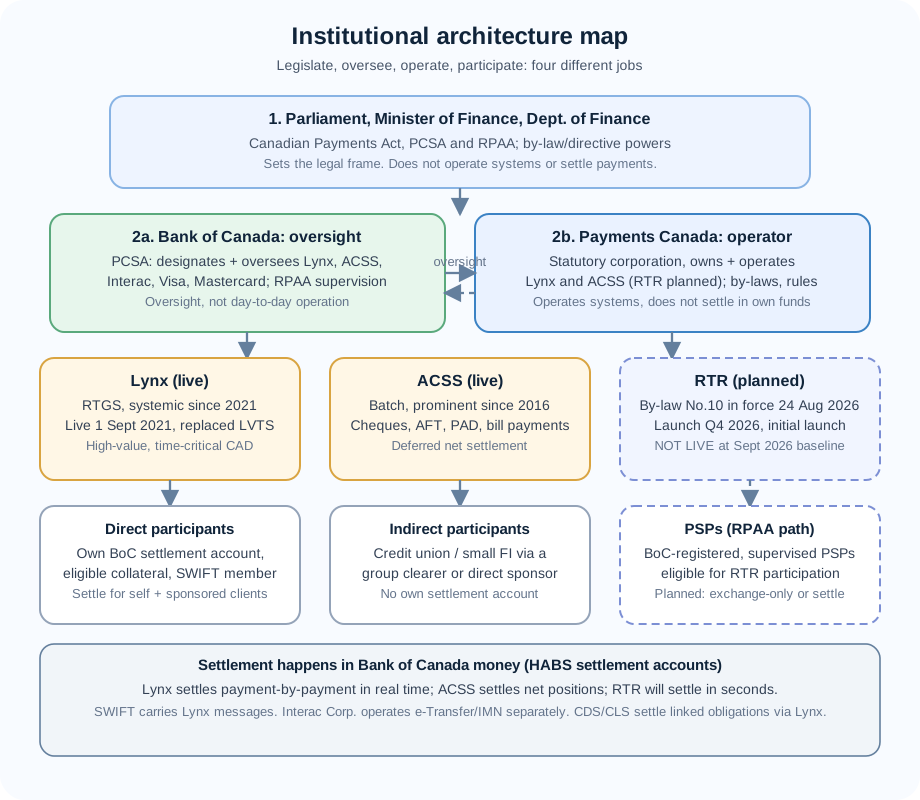
At the top is the layer that touches no customer payment. Parliament enacts the statutes — principally the Canadian Payments Act, the Payment Clearing and Settlement Act (PCSA), and the Retail Payment Activities Act (RPAA) — that establish the roles in this chapter. The Minister of Finance has statutory powers over Payments Canada by-laws and general directives, and under the PCSA the Governor’s designation also requires the Minister’s public-interest opinion. Under the RPAA, the Minister has national-security powers. The Department of Finance develops policy and legislation, including regulations. Their output is law and approved rule; neither operates a payment system or posts to a customer account.
The Bank of Canada does four different payments jobs that look like one. First, overseer of designated financial market infrastructures under the PCSA: The Governor designates systems that could pose systemic risk (systemically important) or payments-system risk (prominent payment systems), and oversees them against risk-management standards. The payment-system list is short and worth memorising: Lynx is designated systemic (since 2021, when it replaced the Large Value Transfer System); the ACSS is prominent (since 2016); Interac e-Transfer and the Inter-Member Network are prominent; and the Visa and Mastercard card systems (VisaNet and Mastercard's GCMS/SMS) are prominent. Oversight sets standards and follows up on findings; it does not run the systems day to day.
Second, the Bank is the settlement agent: Lynx payments and ACSS net positions settle through Bank of Canada settlement accounts, with account services accessed through the High Availability Banking System (HABS). Payments Canada operates the system and generates the relevant settlement instructions; the Bank debits and credits the settlement accounts and sets access terms, making it the practical gatekeeper for direct settlement.
Third, the Bank implements monetary policy through Lynx: settlement balances between the Bank and participants transmit policy — one reason systemic designation is a stability matter.
Fourth, the Bank supervises in-scope retail payment service providers under the RPAA; banks, credit unions and other entities listed in RPAA section 9 are excluded. Subject to those scope rules, PSPs must register, maintain operational-risk and incident-response frameworks, safeguard end-user funds in a segregated account used for no other purpose (in trust, or with insurance/guarantee equal to the protected funds), and file the required reports. The annual report is due 31 March; incident and change reporting follows the Act and regulations. The safeguarding and risk-management requirements have applied since 8 September 2025. Supervision is distinct from FMI oversight and is backed by compliance agreements, notices of violation and administrative monetary penalties, compliance orders and court orders.
Payments Canada's identity repays precision. The Canadian Payments Act establishes it as a corporation and expressly says it is not an agent of Her Majesty. In practice it owns and operates Lynx and the ACSS, and is building and will operate the RTR. It admits members, sets participation requirements, and makes by-laws, rules and standards: Lynx By-law No. 9 and rules, ACSS by-law and rules including Rule H1, and RTR By-law No. 10 and rules. It runs compliance through its framework including By-law No. 6, coordinates participant groups, provides training, and maintains system documentation including ISO 20022 specifications. It does not hold customer accounts or act as a customer’s bank; settlement occurs through Bank of Canada settlement accounts. Customer complaints should go to the customer’s own financial institution or PSP, not to Payments Canada.
Membership in Payments Canada is the doorway to participation. Historically banks, centrals, and trust companies; registered PSPs are now eligible too. But membership is not participation: each system has separate operational, technical, financial, and risk requirements, plus a separate Bank settlement account for direct settlers. Members that do not directly participate in a given system are member non-participants for that system: they serve customers through participants. Keep member of Payments Canada, participant in a system, and direct settler in central-bank money apart.
The fourth layer is where customer money moves. One principle governs participation: whoever holds the settlement account bears the settlement responsibility. Lynx direct participants hold a Lynx settlement account at the Bank, maintain eligible collateral arrangements (through CDSX or an eligible custodian), meet the technical requirements in the Lynx rules, and are SWIFT members for messaging. They send customer wires plus inter-FI payments settling obligations between institutions from customer activity. Other members arrange Lynx payments for their customers through direct participants as non-participant partners. For Lynx, a participant either settles in its own Bank of Canada account or uses a direct participant; the customer-facing member need not be a Lynx direct participant.
In the ACSS the vocabulary is direct clearer versus indirect, with group clearers as the distinctive Canadian arrangement. Direct clearers hold ACSS settlement accounts at the Bank, exchange and clear items directly, and settle net positions. Indirect clearers — including some credit unions, smaller banks and trust companies — clear through a direct or group clearer. A group clearer aggregates its members’ positions, manages settlement funding and answers to the system for the group’s obligations; members settle with the group clearer under their own arrangements. The system looks to the direct clearer for the net position. Direct clearers also face ACSS credit exposure: the Bank’s settlement-account policy describes a survivors-pay loss-allocation mechanism if another direct clearer defaults. The clearer recovers from an indirect under its client agreement.
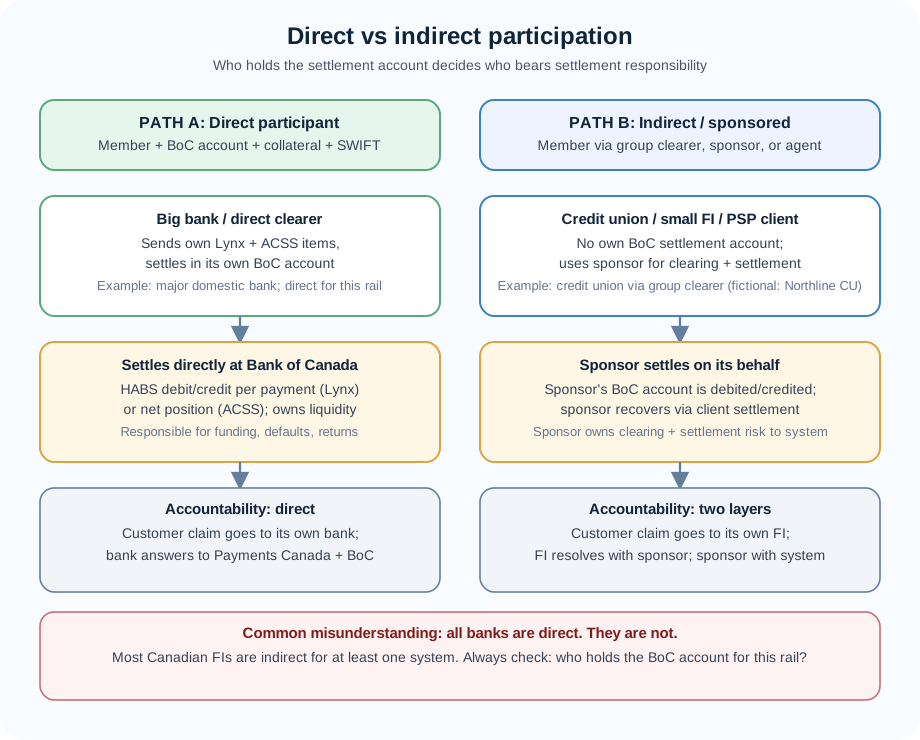
For an in-scope PSP, registration and supervision are separate from system access: register with the Bank of Canada, maintain the required risk-management and safeguarding frameworks, become eligible for and join Payments Canada, meet the RTR participation requirements (By-law No. 10 plus the RTR rules), choose an exchange connection (own link or a provider) and settlement model (direct with an RTR settlement account, or indirect through a settlement agent), then pass system tests before sending a first RTR message. Direct RTR settlement accounts may be restricted to the holder’s own payments or unrestricted for an approved settlement agent. Each gate has a different owner and evidence; clearing one gate never implies clearing the next. Registration alone, membership alone or a connection contract alone does not authorize an RTR payment.
The most misfiled neighbour comes first. Interac Corp. is a separate company that operates Interac e-Transfer and the Inter-Member Network. It is not part of Payments Canada; prominent-designated, it answers to Bank of Canada oversight directly. The e-Transfer customer journey — notification, acceptance, deposit, autodeposit, request money — is Interac's scheme and the participants' customer experience, governed by Interac rules and bilateral arrangements, not by Payments Canada by-laws.
For SWIFT the placement rule is one sentence: it carries the messages; the Bank of Canada carries the money. For Lynx, SWIFT provides the messaging and connectivity; participation requires SWIFT membership, and Lynx ISO 20022 specifications sit alongside MyStandards resources with CBPR+ alignment. None of that makes SWIFT a settlement system, a clearer, or a custodian of funds. A SWIFT message is an instruction and evidence of instruction; settlement is the HABS debit and credit. When a message and a settlement disagree, the settlement is the truth about money and the message is the evidence about intent.
CDS and CLS are connected financial market infrastructures that settle linked obligations through Lynx. CDS (operating CDSX) settles securities-related obligations and CLS settles FX obligations with Canadian-dollar legs reaching Lynx participants, adding volume and time-criticality to the high-value day.
Finally, vendors, agents, and sponsors: real work, no systemic responsibility. Banks outsource processing, connectivity, screening, or reconciliation; participants offer connection services; clearers sponsor indirects. In every case the member or participant retains full responsibility to the system for compliance, funding, and settlement. Outsourcing the work never outsources the accountability — a principle supervisors enforce through the member, never by chasing the vendor.
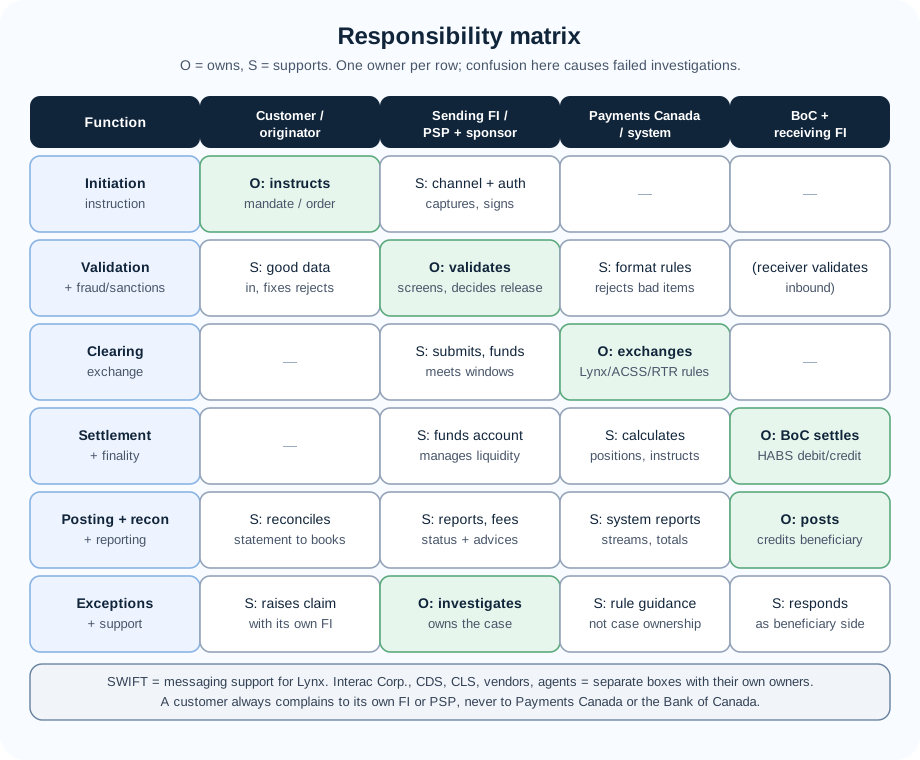
Two boundary principles close the section. First, the customer boundary: the end customer — consumer, business, originator, beneficiary — has a relationship with its own bank or provider and with no one else in this map. That institution then pursues system-level or interbank remedies in its own name. Payments Canada and the Bank of Canada do not take customer cases. Second, the evidence boundary: each handoff between owners must produce evidence the next owner can rely on — an authorised instruction, a validation record, a system acceptance, a settlement confirmation, a posting advice. Reconciliation joins those evidences end to end; investigations repair broken joins. The matrix below fixes each function to its owner so the rest of the chapter can assume it.
3. Initiation, validation and bank processing
Initiation is the moment a customer asks for money to move, and the customer's own institution owns the intake decision. The channels vary — branch, online and mobile banking, host-to-host and file upload for corporates, APIs for integrated clients, PSP apps for fintech users — but a bank’s or PSP’s implementation must authenticate the originator, confirm authority, capture complete payment details and retain a durable record of what was instructed, when and by whom. For PADs and other mandate-based collections, initiation also includes proving that the mandate exists and is current. For wires, purpose and beneficiary data must be sufficient for the institution’s sanctions, fraud and routing controls. These are institution-level controls, not a single universal Payments Canada channel specification. The RTR, when live, will compress decisioning and exchange into a real-time envelope rather than remove those controls; participants must also meet the RTR’s published funds-availability, fraud and exception requirements.
Validation is where the sending institution earns its responsibility, and working bankers should think of it as a stack of gates, each owned by the sender, each producing evidence. Account and mandate gates confirm the debit account exists, is open, is in good standing, and is authorised for this payment type and amount. Funds and limit gates confirm available balance or credit, against product limits, customer-set limits, and regulatory or scheme limits. Data-integrity gates confirm routing identifiers (institution number, transit, account structure), reference formats, character sets, and field completeness against the destination system's specifications, including Lynx ISO 20022 schemas where applicable. Duplicate gates check that this instruction is not a re-submission of something already accepted — same reference, same amount, same beneficiary inside a detection window — because duplicate release is one of the commonest self-inflicted payment losses. Sanctions, fraud, and AML gates screen parties, detect anomalous behaviour, and hold or escalate where the controls require it; they sit with the sender before release, not with the system after it. For sponsored flows, validation is layered: the indirect validates its customer, and the sponsor validates what it accepts into clearing.
Bank processing between validation and system submission is the quiet machinery customers never see and operations teams live inside: payment hubs that route instructions to the right rail, queue management that sequences releases against cutoffs and liquidity, format transformation that maps channel data into clearing formats (including legacy-to-ISO-20022 mapping for Lynx and AFT coexistence), and status management that tracks each instruction from accepted through released, acknowledged, settled, confirmed, or exception. Two distinctions matter here. First, "accepted by the bank" is not "accepted by the system." A payment the bank has validated and queued has no standing in Lynx or the ACSS until the system accepts it under its rules; anything the bank tells the customer before that point is the bank's own representation, owned by the bank. Second, for indirect participants, bank processing includes the handoff to the sponsor: file delivery, exposure reporting, and settlement funding for the client's obligations. The sponsor's processing of its clients' work is a service; the sponsor's submission to the system is a responsibility.
PSP initiation follows the same logic with different plumbing. An in-scope fintech PSP captures the customer’s instruction in its app or API, performs its own authentication and fraud checks, and — depending on its model — initiates an EFT, moves funds it holds for the end user, or instructs a sponsor. It must do this inside its RPAA operational-risk, incident-response and safeguarding framework. At the 5 October 2026 baseline, it cannot initiate an RTR payment because the RTR is not yet in production. A product may describe itself as RTR-ready, but it must not present the planned RTR as a live rail.
Vendors and agents process but do not decide. A processor that formats files, a connection provider that carries messages, a screening vendor that scores transactions — each executes inside parameters the responsible institution sets, and each returns evidence the institution relies on. The institution's processing duty includes supervising these parties: monitoring their output, reconciling their reports to its own books, and holding tested fallback and exit plans. When a vendor's transformation corrupts a field that later causes a system rejection or a misdirected payment, the investigation starts with the vendor's logs but the accountability stays with the member.
4. Clearing or exchange, settlement and finality
Clearing, settlement, and finality are three different events, and Canadian bankers must never let the vocabulary blur them. Clearing (or exchange) is the agreement stage: participants exchange payment information, net or match obligations, and establish who owes what. Settlement is the money stage: obligations are discharged by debits and credits in settlement accounts at the Bank of Canada. Finality is the legal and operational certainty stage: the point after which settlement cannot be unwound. Lynx, the ACSS, and (as planned) the RTR arrange these three events differently, which is why the same customer instruction has completely different timing, certainty, and recovery properties depending on the rail it enters.
Lynx is a real-time gross settlement system: each payment settles individually, in full, in central-bank money, in real time. A direct participant submits an instruction over SWIFT messaging; the system validates it, and if the participant has sufficient payment capacity, the Bank’s settlement account debits and credits. Settlement is final and irrevocable. A payment cannot be revoked after settlement, but Lynx has a payment-return message (pacs.004); a return is a new counterparty process, not a recall of the settled entry. Lynx is used for time-critical customer wires, inter-FI payments and linked FMI obligations. The price of certainty is liquidity: participants manage payment capacity, collateral and any applicable intraday credit, queues and treasury funding. Recovery of a misdirected settled wire depends on the beneficiary-side process and, ordinarily, the beneficiary’s cooperation.
The ACSS is the opposite architecture: deferred net settlement of batched retail items. Participants exchange payment items through clearing streams — cheques and paper, AFT credits and debits including payroll and PADs, bill payments and other listed retail items — accumulate positions, and settle net obligations through Bank of Canada settlement accounts. Direct clearers settle their own positions; group clearers settle for their groups; indirects settle through their clearers. Payments Canada says the previous day’s net balances settle during the morning of each business day. Finality is tied to completion of the applicable settlement and return procedures, not merely to exchange: returns, adjustments and NSF debits follow their own stream rules. The 10.6 billion-item scale therefore supports customer promises about cycles, windows, cutoffs, return rights and funds availability — not instantaneous finality.
The RTR is designed to provide instant, data-rich exchange, clearing and settlement 24/7/365. Direct settlement participants will settle through RTR settlement accounts at the Bank of Canada; indirect settlement participants will use a settlement agent. The access page requires funds to be made available to customer accounts within 60 seconds, subject to the applicable rules and exceptions. The Bank’s RTR access policy says RTR accounts are funded and defunded by Lynx payments, so participants need payment-capacity monitoring beyond ordinary business-day batch cycles. This remains planned capability: the official launch target is Q4 2026 with sequenced onboarding, and the RTR was not live at the audit baseline.
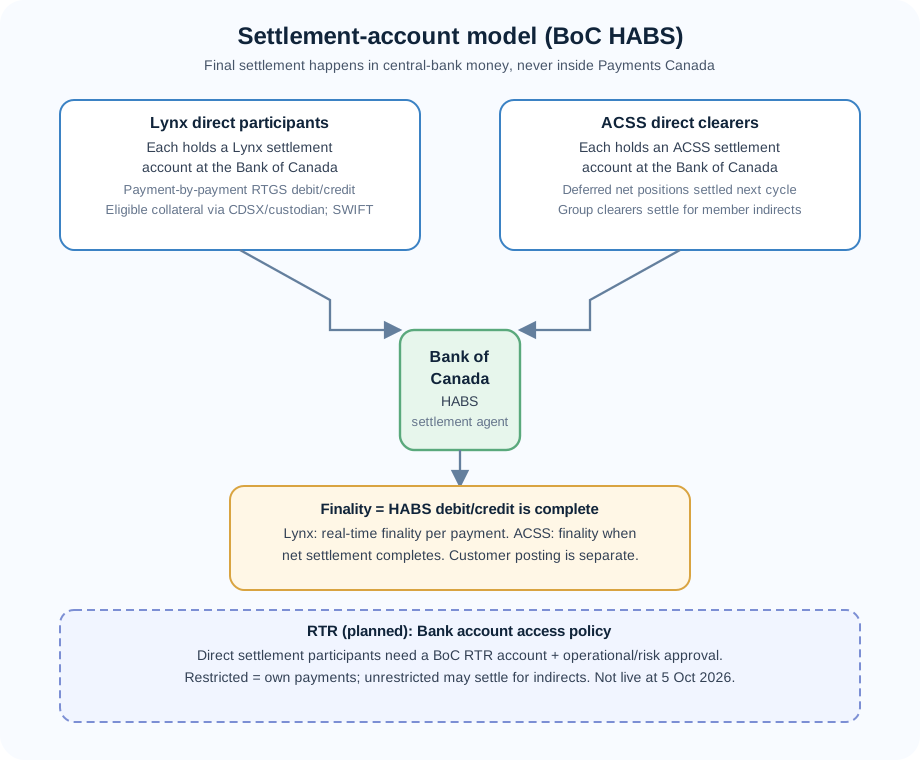
The Bank of Canada, through HABS, is where Lynx payments become final one by one and where ACSS net positions become final in settlement. Payments Canada computes, instructs, and reports; the Bank debits and credits. The separation is deliberate: operator problems and participant credit problems become separately manageable risks. For the banker, the practical consequence is evidentiary: the proof that a Lynx payment settled is the settlement confirmation tied to the HABS movement, and the proof that ACSS obligations discharged is the completed net settlement, not any interim exchange report. Status screens, customer advices, and investigation responses should all be traceable to those settlement facts.
One boundary closes the section: customer posting is not settlement. A receiving bank may credit its customer's account before, at, or after interbank settlement depending on the rail, the product, and its own funds-availability policy — provisional credit against expected ACSS settlement is routine retail banking, and real-time beneficiary availability is the RTR's design promise. But the customer credit is the bank's own liability; interbank settlement discharges obligations between participants in central-bank money. The two coincide in Lynx and routinely diverge in ACSS; confusing them misdiagnoses failure in both directions.
5. Data, identifiers, messages and references
This section maps what actors say to each other — the data, identifiers, messages, and references that let a payment survive five institutional handoffs without losing its identity. The principle is continuity: the instruction the customer gave, the item the system cleared, the obligation the Bank settled, and the entry the receiving bank posted must all be joinable to one story. When references break, reconciliation fails and settled money sits unfindable in suspense.
Start with the Canadian routing identifiers that Block 2 covers in depth and this chapter places in institutional context. The institution number identifies the financial institution; the transit number identifies the branch; the account number identifies the customer account; together with the Financial Institutions File — Payments Canada's authoritative reference data for reachability and routing — they determine where an instruction can go and who is responsible for handling it. The institutional point is that these identifiers are validated by the sending bank at initiation, enforced by system rules at exchange, and relied on by sponsors and group clearers to attribute client activity to the right settlement position. A defective identifier is never "just a typo": the system surfaces it as a reject.
Messages differ by rail, and each rail’s message standard reflects its architecture. Payments Canada’s current Lynx specifications list pacs.008 for FI-to-FI customer credit transfers, pacs.009 core and cov for FI credit transfers, pacs.004 for payment returns and camt.053 for bank-to-customer statements. Participants must use the applicable usage guidelines and their SWIFT connectivity. Cross-border wires may also involve SWIFT CBPR+ and the UETR; the Lynx Payment Confirmation Reference Number (PCRN) identifies a Lynx wire in the domestic process. The ACSS world remains more heterogeneous, with AFT files and other stream formats alongside ISO 20022-enabled processing. The RTR is planned as an ISO 20022, data-rich system; its participant specifications, not generic ISO 20022 assumptions, determine the fields and flows that production systems must support.
References are the thread that stitches handoffs together, and preserving them is a core bank implementation control. The originator’s instruction ID, AFT file and batch IDs, or PAD mandate reference should remain joinable to the bank’s hub record, sponsor submission, system evidence and customer report wherever the applicable rule or specification supports it. Lynx’s PCRN, system message identifiers and cross-border UETR provide stronger investigation keys than amount-and-date matching. Receiving banks should preserve inbound references and remittance data through posting and reporting so the beneficiary can apply cash; truncation is a reconciliation risk. RTR identifiers and return/status references remain subject to the published production rules.
Data duties extend to reference-data maintenance and message-version management. Banks and sponsors should consume and version the Financial Institutions File so routing does not rely on stale data. Lynx publishes usage guidelines by release, and participants must manage versions, test changed schemas and coordinate vendor upgrades. RTR participants must use the actual RTR specifications and pass the required tests before sending a first message; a roadmap is not production certification. These are implementation controls, not additional statutory duties.
6. Rules, cutoffs, service levels and customer impact
Canadian payments are governed in layers, and each layer binds different actors. Statutes include the Canadian Payments Act, the PCSA and the RPAA with its regulations. Payments Canada by-laws establish system legal and participation frameworks, including Lynx By-law No. 9, the ACSS by-law, RTR By-law No. 10 (SOR/2026-133), in force 24 August 2026, and the compliance framework in By-law No. 6. Rules and procedures then specify operations; standards and specifications specify messages, files, reference data, connectivity and security. Alongside them sit Interac and card-scheme rules, SWIFT usage conventions and bilateral sponsor agreements. A cross-border wire may therefore touch CBPR+ conventions, Lynx rules, sanctions law and the bank’s customer agreement. The responsible institution must cite the layer that actually answers the customer or operations question.
Cutoffs translate rules into customer time. Lynx operates Monday to Friday except statutory holidays, with operating hours and submission rules set in its procedures; a bank’s internal cutoff may be earlier than the system cutoff, so a late instruction may wait for the next operating window. ACSS cutoffs are stream- and window-specific: AFT credit and debit exchange, cheque-clearing and bill-payment flows each have business-date and holiday logic. Indirects must meet their sponsor’s cutoff before the sponsor meets the system’s. Banks should publish funds-availability schedules that distinguish acceptance, exchange, settlement, posting and return rights. The planned RTR is intended to operate 24/7/365, but the participant still needs always-on liquidity, fraud, support and exception processes; its published access requirement is funds availability within 60 seconds, subject to the applicable rules and exceptions.
Service language should promise only events the responsible institution controls. A bank’s or PSP’s customer promise should distinguish intake, validation, release, system acceptance, settlement, posting and investigation status. Sponsor agreements should state file windows, exposure limits, funding, reporting and incident duties. Payments Canada’s published system rules and closure schedule govern system operation; the Bank’s settlement-account policies govern account access and funding arrangements; the receiving institution controls customer posting and availability. Calling an ACSS item “guaranteed” or marketing the pre-launch RTR as “live” is not an acceptable status description.
Change control is the final rules topic, because Canadian payment rules change on schedules bankers must track. By-law amendments require Board action plus Minister approval and Gazette publication — the RTR By-law's journey from Board making through ministerial approval to 1 July 2026 Gazette publication as SOR/2026-133 is the textbook example. Rule changes follow Payments Canada's consultation and approval processes with implementation lead times. Message specification versions (Lynx usage-guideline years, RTR specification updates) require development, testing, and coordinated migration. RPAA supervisory guidance evolves through published policies and FAQs. A bank's regulatory-change function should maintain a single calendar across all these sources, map each change to affected systems and procedures, and track attestation.
7. Fraud, compliance and operational controls
Controls in Canadian payments follow the ownership map: each actor controls what it can see and stop, and no actor’s controls substitute for another’s. The sending bank or PSP sees the customer, instruction and behavioural context, so its implementation owns authentication, authority checks, transaction monitoring and the release decision. The system operator owns format and system-rule validation and, for the planned RTR, will provide centralized fraud services. The Bank of Canada controls settlement-account access and supervises in-scope PSPs. FINTRAC receives prescribed reports and develops financial intelligence; it does not approve individual payments. Sanctions law binds each institution that handles the relevant value or message.
The sender’s fraud stack is deepest because the sender has the richest signal. Authentication proves the instructing party is who they claim; authorization proves they may instruct the payment. Banks and PSPs implement transaction limits, velocity checks, payee controls, destination-risk scoring, holds and step-up authentication according to their risk appetite. Behavioural monitoring watches for account takeover, social engineering, impersonation, scams and mule activity. For the planned RTR, the sender’s stack must make decisions quickly enough for the participant’s service and funds-availability obligations. Payments Canada’s published RTR fraud services include confirmation-of-payee capability, a transaction safety score, a risk list and a fraud-intelligence platform. These national controls supplement participant controls; they do not replace authentication, authorization or customer-side monitoring.
Compliance controls run alongside fraud controls on every payment, owned by the institutions that touch the instruction. Sanctions and payment screening, travel-rule information, hold-and-escalate procedures, false-positive management and decision evidence sit with the relevant sending, receiving and intermediary institutions; outsourcing a screening engine does not outsource the institution’s liability. AML and reporting duties connect payments to FINTRAC: client identification and records, suspicious-transaction reports, large-cash reports and electronic-funds-transfer reports where statutory conditions apply. FINTRAC’s current EFT guidance covers international EFTs and domestic EFTs sent by SWIFT MT-103 or equivalent, including the $10,000 threshold, 24-hour aggregation and five-business-day reporting deadline. The travel rule requires specified originator and beneficiary information for covered EFTs and risk-based procedures if it is missing. In-scope PSPs also carry RPAA operational-risk, incident and safeguarding duties; RPAA exclusions mean this does not make every bank or credit union an RPAA PSP.
System-level and settlement-level controls complete the picture. Payments Canada's systems enforce format and business-rule validation, monitor participant behaviour against rules, operate the compliance framework that backs enforcement, and publish the standards that make everyone else's controls interoperable. The Bank of Canada's settlement-account controls — eligibility, collateral terms, credit limits, HABS risk parameters — bound the liquidity and credit risk that settlement concentrates, and its FMI oversight standards push operators toward cyber resilience, operational reliability, and recovery capability. Direct clearers and sponsors add the client-risk layer the system cannot see: exposure limits for sponsored indirects, prefunding or collateral requirements under bilateral agreements, and intraday monitoring of client flows against those limits. Vendors and connection providers sit inside the responsible institution's control perimeter: due-diligence selection, contractual security and incident-notification terms, ongoing performance monitoring, and tested exit. The test of the whole stack is a single question per payment: if this instruction is fraudulent, defective, or criminal, which control, owned by whom, stops it — and what evidence proves the stop worked?
8. Exceptions, investigations and recovery
Exceptions are not failures of the map; they are what the map is for. Every payment system defines the wrong outcomes, evidence and recovery path, so rail identification is the first investigation step. A settled Lynx payment is final and cannot be revoked, but the Lynx message catalogue includes pacs.004 payment returns. A return is not a recall of the settled entry; it requires the applicable participant procedure and, for a misdirected payment, ordinarily beneficiary-side cooperation. Pre-release validation is therefore the principal inexpensive control on an irrevocable payment. A misdirected wire is not “stuck in the system”: it is settled and requires a beneficiary-side return or legal process.
ACSS exceptions live inside stream procedures built for volume: rejects before acceptance, returns after posting (NSF and other debit returns, AFT credit returns for invalid details, closed accounts, and similar), adjustments and correction entries for clearing errors, and dispute-adjacent processes for unauthorised debits under PAD rules including reimbursement and recourse mechanics. Group clearers and sponsors intermediate their clients' exceptions: the indirect reports to its clearer, the clearer processes through the system, and settlement positions adjust accordingly. Cheque returns with holds and image-quality defects, bill-payment misapplications, and PAD disputes each follow their own sub-procedures; the discipline is generic: classify the exception by rail and stage, identify the owning procedure, assemble the evidence that procedure requires, and track the case against that procedure's clock.
Interac e-Transfer exceptions belong to Interac's world: cancellation before acceptance, expiry, failed deposits, fraud cases through participant processes. Misrouting one into ACSS or Lynx channels wastes the critical early hours.
Ownership of investigations is the section's core institutional rule, and it mirrors the customer boundary from Section 2. The customer's own bank or PSP owns the case: it takes the complaint, identifies the rail and stage, gathers its own records (instruction, validation, screening, submission, system acknowledgements, settlement evidence, posting), requests what it needs from counterparties through interbank channels, and reports back to the customer. Counterparty banks respond as the other side — providing beneficiary-side facts, approaching their customer where consent is needed, confirming posting or returning funds where procedures allow. Payments Canada provides rule guidance and system-level records access under its procedures but does not investigate customer cases. The Bank of Canada does not investigate customer cases at all. SWIFT provides message-tracking evidence (UETR-based tracking for cross-border) but owns no case. Sponsors investigate for their sponsored clients' system-level issues while the client handles its own customer. Vendors supply logs under contract. Every handoff in the investigation mirrors a handoff in the payment, with the same owners.
Evidence standards decide whether investigations close or circle. The minimum viable evidence pack for any Canadian payment investigation is: the original instruction with authentication and authority proof; the validation and screening record with dispositions; the submission record with system acceptance or rejection; the settlement evidence (HABS-tied confirmation for Lynx, net-settlement completion for ACSS positions, and, when live, RTR settlement confirmations); the posting record with references preserved; and the complete status-communication log with the customer. Amount-and-date resemblance is not identification; regenerated references are not continuity; verbal assurances are not evidence. Cases should be aged against procedure clocks with escalation triggers.
The planned RTR compresses the investigation timeline. Funds must be made available within the published 60-second requirement, subject to rules and exceptions, so pre-release validation and sender-side fraud controls are primary defences and post-settlement recovery may be the main remedy. Participants must build 24/7 exception handling, customer communication and reconciliation around the final RTR rules and message specifications; they should not assume that a batch-style recall window exists.
9. Posting, accounting, liquidity, reporting and reconciliation
Posting turns system events into customer and ledger reality, and each actor posts only what it owns. The receiving bank posts the beneficiary credit and sets availability under its product policy: final Lynx settlement supports immediate posting decisions, while ACSS availability depends on the batch and return rules. When the RTR launches, the participant must meet the published funds-availability requirement rather than promise an unsupported “instant” status. The sending bank posts the originator debit and fees, with status tied to real events such as release, system acceptance and settlement. Direct participants post settlement-account debits and credits, collateral and funding records; sponsors and group clearers post client positions and fees. An in-scope PSP holding end-user funds posts them to a segregated safeguarding structure, in trust or protected by equal insurance/guarantee, and reconciles those liabilities to funds held. Every posting should retain the applicable references.
Accounting follows posting with the internal ledgers supervisors and auditors examine: customer deposits and provider liabilities, interbank clearing and settlement suspense accounts, fee income, settlement-account balances at the Bank, collateral pledged, and the nostro-style correspondent positions for cross-border legs. The institutional discipline is separation: client money, system-settlement positions, and own funds must be distinguishable at all times, in every ledger, under every stress — which is why RPAA safeguarding frameworks demand written, demonstrable structures rather than intentions, and why sponsor accounting must keep each client's settlement position distinct from the sponsor's own. Proofs of the instruction-to-posting-to-settlement chain must be producible on demand.
Liquidity is the requirement behind every settlement event, and it concentrates where settlement accounts sit. Lynx participants manage payment capacity, eligible collateral and any applicable intraday credit, queues and treasury funding. ACSS direct and group clearers fund net positions on cycle and manage client exposure under their agreements; direct clearers also face the ACSS default-allocation risk described by the Bank. The planned RTR requires payment-capacity monitoring around the clock. Its settlement accounts are funded and defunded by Lynx payments, so a direct RTR participant that is not a Lynx participant needs a Lynx direct participant for that funding leg. Indirects and PSP clients fund positions with their sponsor or settlement agent under bilateral terms.
Reporting is how institutions prove all of this to customers, counterparties and supervisors. Customer reporting — advices, statements, online status and corporate reports — must promise only owned events and keep references intact. Lynx participants use applicable settlement confirmations and the camt.053 statement specification; ACSS and sponsor reporting follows the applicable stream and agreement. Supervisory reporting includes the RPAA annual report (due 31 March), required change and incident notices, FMI information provided under oversight, and FINTRAC reports when conditions apply. Every report needs a named owner and an evidence trail.
Reconciliation closes the loop by joining, for every value movement, three populations that disagree by nature: what was instructed (customer and channel records), what the system did (exchange, clearing, and settlement evidence), and what the books show (postings, suspense resolutions, fee applications). Disciplined reconciliation joins all three on identifiers, clears suspense daily with ageing and ownership, and treats breaks as findings with root-cause remediation. For sponsored flows, reconciliation is two-tier: the indirect reconciles its customers to its sponsor position, and the sponsor reconciles client positions to system settlement. For PSPs, safeguarding reconciliation proves end-user funds are whole and correctly held, every day, as a supervisory matter — not as a month-end exercise.
10. Bank implementation, testing and resilience
Joining a Canadian payment system is a programme, not a purchase. An implementation plan should separate membership, system participation, connectivity, functional readiness, testing and ongoing resilience; a direct settler also needs the Bank of Canada’s settlement-account approval. A vendor milestone is not a regulatory or system-access approval.
Membership comes first: application, criteria for the institution type, and acceptance of the by-law and compliance framework — the right to seek participation, not participation itself. For RPAA-registered PSPs, membership follows registration and supervision-readiness: the Bank's registration confirms the PSP is supervised, and Payments Canada's membership process confirms it is fit to join the club. Governance, legal review, and compliance alignment take months; do not build connectivity before membership terms settle.
Participation requirements come second, per system. For Lynx, the four published criteria are: maintain a Bank of Canada settlement account, have facilities to pledge collateral, meet the technical requirements in the Lynx rules and be a SWIFT member. The Bank’s account policy adds prudential, financial-crime, cyber, operational, testing, contingency and collateral requirements. For ACSS, direct-clearer requirements cover exchange capability, settlement-account and funding arrangements, and operational capacity; group-clearer arrangements add aggregation, risk management and member servicing. For the RTR, By-law No. 10 and the RTR rules support direct or indirect settlement and direct-to-exchange or connection-provider connectivity. The Bank’s RTR policy distinguishes restricted accounts from unrestricted accounts, with stricter expectations for an unrestricted settlement agent. Member non-participants still need a clear sponsor agreement covering limits, funding, reporting, incidents and exit.
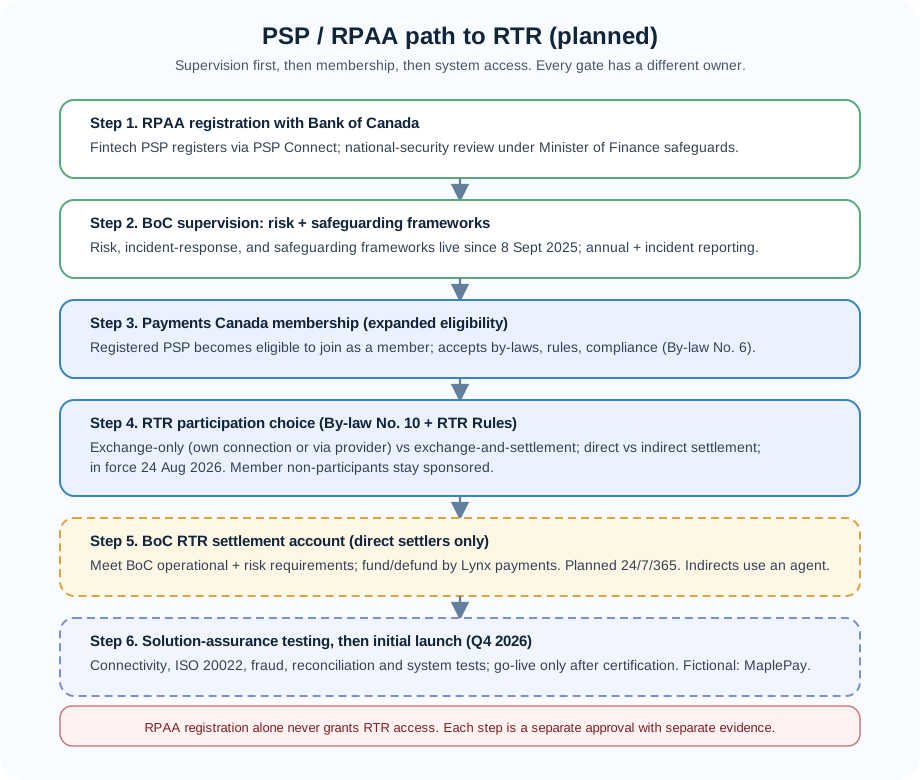
Connectivity and functional build come third. Connecting to Lynx means SWIFT connectivity, ISO 20022 message generation and validation, payment-capacity and queue management, and integration among channels, payment hub, core banking, screening and reporting. Connecting to ACSS means file exchange, stream processing, returns and adjustments, and sponsor or group interfaces where applicable. Preparing for the RTR means 24/7 intake and validation, participant fraud controls plus national fraud services, payment-capacity monitoring, posting and notification within the applicable funds-availability requirement, and always-on exception handling. Data-rich ISO 20022 capability belongs in channels and posting engines, not only gateways. Vendors may supply components, but the member owns integration, evidence and data integrity.
Testing and certification come fourth, and they are gates, not formalities. Payments Canada's onboarding and solution-assurance processes — industry testing phases for the RTR programme are the current large-scale example — verify connectivity, message conformance, functional behaviour including exceptions and returns, reconciliation output, and operational readiness, before any production access. Settlement-account approval involves the Bank's own operational and risk assessment. Banks should plan testing as a multi-cycle activity with dedicated environments, production-like volumes, failure injection, and full evidence packs proving each requirement. Certification criteria should be written into vendor contracts so a vendor's "ready" matches the system's "accepted."
Resilience and ongoing operation come fifth and never end. System rules, RPAA requirements and prudential expectations demand business continuity, incident response, cyber resilience, tested contingency operations and change management. PSP incident notices go to the Bank when the statutory material-impact threshold is met; system participants also follow their system’s incident-notification rules. OSFI’s operational-risk and resilience guideline expects clear accountabilities, tolerances for disruption and severe-but-plausible scenario testing, including critical third parties. Direct participants carry funding and collateral continuity risk; sponsors plan for concentration and client default. Every institution should maintain current procedures, trained backups and evidence of passed tests.
11. Practical Canadian end-to-end example
Two fictional scenarios — invented Northline Credit Union and MaplePay — carry the map into working reality. Their institutions, names, volumes, dates and bilateral arrangements are fictional; the rail and regulatory boundaries are the sourced framework. Follow each handoff and name each owner.
Scenario A: payroll through a group clearer. Northline Credit Union (fictional, 40,000 members in southern Ontario) provides payroll services to 300 local employers. Northline is a Payments Canada member and an ACSS indirect participant clearing through its group clearer, CentraClear (fictional). On a Wednesday, an employer, Lakeside Foods (fictional), uploads a 180-employee payroll file totalling $412,000 for a Friday payday. The Thursday-cycle timing, prefunding, posting time and return path here are illustrative and must be replaced by the applicable participant agreement and ACSS schedule. Northline captures the authenticated file, validates funds, duplicates and AFT format, and sends it to CentraClear. CentraClear validates what it accepts, includes it in the applicable ACSS exchange and funds its group position. Net positions settle through CentraClear’s ACSS settlement account at the Bank; Northline’s client position is updated under the bilateral agreement. Receiving banks decide customer posting and availability. If two credits reject for closed accounts, the returns follow the applicable AFT procedure to CentraClear, Northline and Lakeside with reason codes. Northline owns the customer conversation; CentraClear owns the system leg; neither Payments Canada nor the Bank of Canada is the customer’s account provider.
Scenario B: a fintech plans RTR access. MaplePay (fictional, a Toronto payments fintech) offers gig-economy payouts and targets the initial Q4 2026 launch cohort. If it is an in-scope PSP, it applies through PSP Connect, builds the RPAA operational-risk, incident-response and safeguarding framework, applies for Payments Canada membership, chooses direct or indirect settlement under By-law No. 10 and the RTR rules, and obtains the Bank’s account decision if it will settle directly. Its build includes direct-to-exchange or provider connectivity, the published RTR message specifications, participant fraud controls, national fraud-service integration, payment-capacity monitoring and 24/7 exception handling. Payments Canada and the Bank must accept the relevant tests and account readiness before production access. A September 2026 campaign saying “instant RTR payouts — live now” would be false because the RTR is still scheduled for Q4 2026 launch. “RTR-ready for the initial launch cohort” is the accurate forward-looking claim; a currently offered service must name its actual rail, such as Interac e-Transfer.
12. Key takeaways and authoritative references
Five misunderstandings cause most of the damage in Canadian payments discussions, and correcting them is the fastest test of whether this chapter landed. First, Bank of Canada versus Payments Canada confusion. The Bank oversees designated systems, settles through Bank accounts, implements monetary policy using Lynx, and supervises in-scope PSPs; Payments Canada owns and operates Lynx and ACSS, is building the RTR, makes by-laws, rules and standards, and admits members. Second, “SWIFT settles.” It does not; SWIFT carries Lynx messages while the Bank’s settlement accounts record settlement. Third, “all banks are direct.” Participation is system-specific, and many members use direct participants or clearers. Fourth, “Interac is part of Payments Canada.” Interac Corp. operates Interac e-Transfer as a separate prominent payment system under Bank oversight. Fifth, “the RTR is already live.” At the 5 October 2026 baseline it is not: the by-law and rules are in force, but official Payments Canada pages still target a Q4 2026 launch with sequenced onboarding.
The takeaways compress to a working creed. Name the owner at every handoff — initiation, validation, clearing, settlement, posting, support — and demand the evidence each handoff produces. Remember the four layers: Finance legislates, the Bank oversees and settles, Payments Canada operates and rule-makes, participants (direct or sponsored, bank or supervised PSP) move customer money. Build controls where the signal lives (sender-side fraud and screening), settlement where the money lives (HABS accounts with collateral and limits), and investigations where the relationship lives (the customer's own institution). Promise customers only what your institution's rules guarantee, on the calendar the system actually keeps. When the Tuesday-morning call comes, start from the map: which rail, which stage, which owner, which evidence. The money is always somewhere specific, held by someone specific, provable by something specific. Your job is to know all three.
Authoritative references
Only official sources are cited in this chapter. Core system, legal and control sources:
- Payments Canada, “High-value payment system — Lynx” (RTGS, finality, five key players, four participation criteria, monetary-policy role and 2025 headline statistics): https://www.payments.ca/systems-services/payment-systems/high-value-payment-system-lynx
- Payments Canada, “Retail batch payment system” (ACSS/USBE scope, direct clearers, settlement, streams and 2025 headline statistics): https://www.payments.ca/systems-services/payment-systems/retail-batch-payment-system
- Payments Canada, “ACSS statistics” (exact 2025 volumes and values, measurement notes): https://www.payments.ca/automated-clearing-settlement-system-acss-statistics
- Payments Canada, “Lynx statistics” (official statistics files and measurement note): https://www.payments.ca/high-value-payment-system-lynx-statistics
- Payments Canada, “Lynx ISO 20022 message specifications” (pacs.008, pacs.009 core/cov, pacs.004 and camt.053): https://www.payments.ca/payment-resources/iso-20022/high-value-payment-system-lynx
- Payments Canada, “Explainer: Lynx wire payments and the Payment Confirmation Reference Number” (PCRN identifies a Lynx wire settled through Lynx; only Lynx-settled wires receive one): https://www.payments.ca/explainer-lynx-wire-payments-and-payment-confirmation-reference-number
- Payments Canada, “Real-Time Rail payment system” and “Testing and launch” (planned Q4 2026 launch, always-on design and sequenced onboarding): https://www.payments.ca/systems-services/payment-systems/real-time-rail-payment-system and https://www.payments.ca/systems-services/payment-systems/real-time-rail-payment-system/testing-and-launch
- Payments Canada, “Accessing the Real-Time Rail” (60-second funds availability, connection providers, direct/indirect settlement and settlement agents): https://www.payments.ca/systems-services/payment-systems/real-time-rail-payment-system/access
- Payments Canada, “Fraud services” (planned centralized confirmation-of-payee, safety score, risk list and intelligence platform): https://www.payments.ca/systems-services/payment-systems/real-time-rail-payment-system/rtr-fraud
- Payments Canada, “Critical milestone achieved: By-law and rules approved for Canada’s Real-Time Rail” (30 June 2026 approval milestone; 24 August 2026 coming into force; Q4 2026 launch): https://www.payments.ca/critical-milestone-achieved-law-and-rules-approved-canadas-real-time-rail
- Canada Gazette, Part II, “Canadian Payments Association By-law No. 10 — RTR,” SOR/2026-133 (eligibility, settlement accounts, testing, irrevocability and compliance): https://gazette.gc.ca/rp-pr/p2/2026/2026-07-01/html/sor-dors133-eng.html
- Justice Canada, “Canadian Payments Act,” current to 21 September 2026 (corporation, membership including PSPs, by-laws and directives): https://laws-lois.justice.gc.ca/eng/acts/c-21/page-1.html
- Justice Canada, “Payment Clearing and Settlement Act,” current to 21 September 2026 (designation, oversight, directives, netting and settlement finality): https://laws-lois.justice.gc.ca/eng/acts/P-4.4/page-1.html
- Justice Canada, “Retail Payment Activities Act,” current to 21 September 2026 (scope/exclusions, registration, operational risk, safeguarding and enforcement): https://laws-lois.justice.gc.ca/eng/acts/R-7.36/page-1.html
- Bank of Canada, “Oversight of designated clearing and settlement systems” and “Payment systems the Bank of Canada oversees” (designation, prominent systems, Lynx/ACSS/Interac/card list and roles): https://www.bankofcanada.ca/regulatory-oversight/financial-market-infrastructures/oversight-designated-clearing-settlement-systems/ and https://www.bankofcanada.ca/regulatory-oversight/financial-market-infrastructures/payment-systems-the-bank-of-canada-oversees/
- Bank of Canada, “Settlement account access policy for Lynx and ACSS” (prudential, cyber, operational, testing, collateral and ACSS default-allocation requirements): https://www.bankofcanada.ca/core-functions/financial-system/bank-canadas-settlement-account-policies-for-payments-canada-payment-systems/
- Bank of Canada, “Settlement account access policy for the Real-Time Rail” (restricted/unrestricted accounts, payment capacity and Lynx funding leg): https://www.bankofcanada.ca/core-functions/financial-system/bank-canadas-settlement-account-policies-for-payments-canada-payment-systems/bank-canada-settlement-account-access-policy-real-time-rail/
- Bank of Canada, “Retail payments” and “Supervisory framework” (RPAA scope, 8 September 2025 effective requirements, reporting and enforcement): https://www.bankofcanada.ca/regulatory-oversight/retail-payments/ and https://www.bankofcanada.ca/regulatory-oversight/retail-payments/supervisory-framework/
- Bank of Canada, “Safeguarding end-user funds” and “Frequently asked questions about retail payments supervision” (segregation, trust/insurance/guarantee options and 31 March annual report deadline): https://www.bankofcanada.ca/regulatory-oversight/retail-payments/safeguarding-end-user-funds/ and https://www.bankofcanada.ca/2026/08/frequently-asked-questions-about-retail-payments-supervision/
- Interac, “Interac e-Transfer” (separate operator, participant model and customer journey): https://www.interac.ca/en/consumers/products/interac-e-transfer/
- SWIFT, “What is a Unique End-to-end Transaction Reference (UETR)?” (36-character end-to-end reference for payment instruction messages carried over SWIFT): https://www.swift.com/payments/what-unique-end-end-transaction-reference-uetr
- FINTRAC, “Reporting electronic funds transfers,” “Travel rule for electronic funds and virtual currency transfers” and obligations index (thresholds, aggregation, deadlines, information and records): https://fintrac-canafe.canada.ca/guidance-directives/transaction-operation/eft-dt/eft-dt-eng, https://fintrac-canafe.canada.ca/guidance-directives/transaction-operation/travel-acheminement/1-eng and https://fintrac-canafe.canada.ca/guidance-directives/transaction-operation/1-eng
- OSFI, “Operational Risk Management and Resilience — Guideline” (accountability, tolerances, scenario testing and critical third parties): https://www.osfi-bsif.gc.ca/en/guidance/guidance-library/operational-risk-management-resilience-guideline
The 2025 headline figures in this chapter are drawn from the linked Payments Canada statistics pages: ACSS 10,606,975,666 delivered items and $10,009,139,582,000 value; Lynx 13.6 million delivered items and $93.3 trillion value. The ACSS page supplies exact totals; the Lynx page supplies the headline figures and an official statistics file. Daily averages are rounded calculations, not additional source statistics.
This application uses JavaScript for the full interactive experience. This text summary is served for accessibility and search indexing.