PAD Processing, NSF, Returns and Retries. Trace presentment, debit decisions, NSF or other returns and permitted retry or re-presentment handling.
Canada Payments & Collections · Block 5: Pre-Authorised Debits in Practice · Chapter 24 of 75
Trace presentment, debit decisions, NSF or other returns and permitted retry or re-presentment handling.
A pre-authorised debit looks calm on a customer statement. One line, one amount, one date, paid. Behind that line sits a pull payment the customer did not push, a biller who asked for money on the strength of an agreement, two banks who must honour that agreement without seeing it, and a clearing system that moves value first and handles objections afterwards. Most months everything works and nobody thinks about the machinery. Then a payday lands a day late, an account runs short by forty dollars, a customer cancels an agreement the biller never records, a gym retries a failed collection four times in a week — and the contact centre, the biller's receivables team and both banks learn exactly how well the return machinery was built.
This chapter follows one PAD from presentment to its ending: either posted as a debit or returned through clearing with a functional reason, then either recovered through a permitted retry or an alternate payment, or closed as a hard fail needing fresh authority. The working rule is short: the payor-side FI decides whether the item posts; every return comes back through the AFT/ACSS process to the originating side; only a debit returned for Non-Sufficient Funds or Funds Not Cleared may be electronically re-presented once, within 30 calendar days of the original return, for the original amount and without added charges; every fee is disclosed before it surprises anyone. Hold that sentence and the chapter stays simple. Lose it and PAD operations feel like weather — things happening to you — instead of a process you run.
A note on discipline that readers of Chapter 15 will recognise. Rule families are described functionally here, but the controlling retry limits are stated because they are material: current Rules H1, F1 and F4 permit one electronic re-presentment only for Non-Sufficient Funds (901) or Funds Not Cleared (908), within 30 calendar days of the return, for the same PAD amount and with no added charges. Payments Canada updates its retail-batch rules regularly; the rules library says versions posted online are in force. Wherever this chapter says "the live Rule H1 text," it means H1 together with applicable AFT rules, standards and procedures in that official library.
ACSS is live. Every return in this chapter travels through live clearing: exchanged as a batch item, netted into participant positions, settled deferred-net with funding through accounts at the Bank of Canada, and reversed only by a linked return entry through clearing — never by a phone call or favour. Lynx appears only as contrast: Canada's live high-value system settles each payment gross in real time with finality and has no PAD-style return lifecycle.
What you should be able to do after this chapter
After working through this chapter, you should be able to:
- explain the PAD presentment lifecycle from biller-bank release through ACSS clearing to the payor bank's debit decision;
- list the four checks the payor bank applies — authority, account status, funds and holds — and state who owns each decision;
- describe the four functional return families — non-sufficient funds, account closed or transferred, no authority or PAD disputed, stopped or frozen — without inventing codes;
- walk an NSF return from the payor bank's decision back through clearing to the biller bank and onward to the biller and payor;
- explain why re-presentment is tightly constrained, what gates a permitted retry must pass, and where to confirm the current Rule H1 position;
- distinguish a permitted linked retry from dunning with an alternate method, and choose correctly between them;
- describe how NSF and return fees are disclosed and communicated by banks and billers, and what honest advices contain;
- design posting, suspense, accounting and reconciliation behaviour that stays truthful while returns and retries are in flight;
- place fraud, sanctions, AML and authority controls at the correct gates so prevention stays cheaper than recovery;
- interpret cutoffs and service levels as customer-impact promises for collections, returns and recovery;
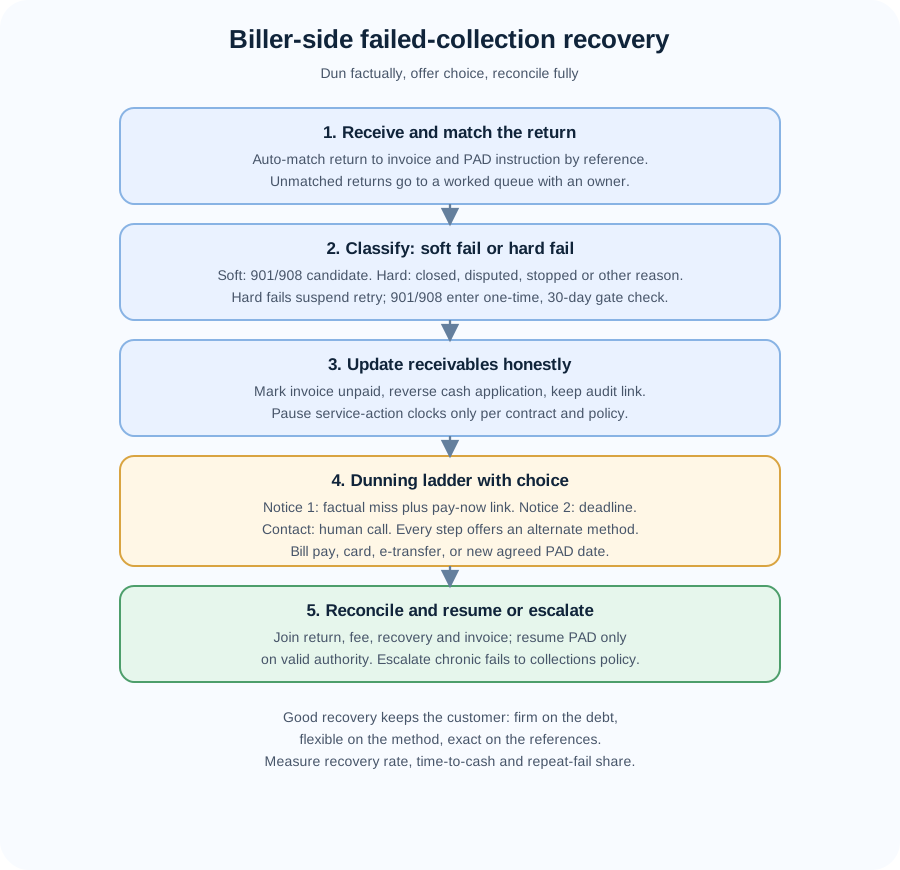
- run biller-side failed-collection recovery — classification, receivables update, dunning ladder, alternate method, reconciliation — without harassing the payor or breaching the rules;
- know what a bank and a biller must build, simulate and test before volumes grow, including return storms and retry discipline;
- find the authoritative answer in the live Payments Canada rulebook, the retail batch system documentation and FCAC consumer material instead of memorising training slides.
For a roughly 60-minute core session, spend about 20 minutes on Section 1 and Section 8 up to the return taxonomy diagram, 15 minutes on Section 3 with the presentment-to-debit diagram, 15 minutes on Section 11 working the utility NSF wave and the gym retry stories, and 10 minutes on Section 12. The remaining sections are follow-up study that repays a second hour.
Chapter navigator
- Business context and customer need
- Participants, responsibilities and boundaries
- Initiation, validation and bank processing
- Clearing, exchange, settlement and finality
- Data, identifiers and messages
- Rules, cutoffs and service levels
- Fraud, compliance and controls
- Exceptions, investigations and recovery
- Posting, accounting, liquidity, reporting and reconciliation
- Implementation, testing and resilience
- Practical fictional Canadian examples
- Key takeaways and authoritative references
1. Business context and customer need
Start with the Tuesday every utility receivables manager knows. A mid-size Ontario electricity distributor collects around 60,000 monthly PADs on the same due date — furnace season, bills higher than autumn, several thousand customers paid the day before payday. The file releases cleanly on Monday. Tuesday morning the returns start landing: hundreds of NSF returns where the balance fell short by twenty or two hundred dollars, a smaller set of closed-account returns from customers who moved and never updated their banking, a handful of disputed items where the agreement was cancelled by phone and nobody wrote it down. By Wednesday the receivables ledger shows a hole, the contact centre shows a queue, and the finance director asks the only question that matters: which of these can we retry, which need a phone call, and which need fresh paperwork before we touch the account again?
That morning is the whole chapter in miniature. The biller experiences obligations, due dates and cash-flow consequences: bills that must be collected without alienating customers who mostly intend to pay. The payor experiences timing, balances and fairness: money taken on the agreed date for the agreed amount, with honest notice when something fails and a clear path to fix it. The banks experience instructions, clearing windows, debit decisions, returns, fees and advices. PAD handling is where those languages meet, because the pull model means the biller initiates and the payor's bank disposes — and the payor only learns the outcome after the decision is made.
Customers choose PADs for reasons worth respecting. A mortgage holder wants the payment to go out on time every month without logging in. A utility customer wants winter bills paid before late charges compound. An insurer wants premiums collected before coverage questions arise. A charity's monthly donor wants giving to be automatic. Employers collecting loan repayments, landlords collecting rent, gyms collecting memberships — each wants predictable cash in with low unit cost. The bank's product promise underneath is equally plain: collect on the agreed date for the agreed amount under a valid agreement, tell both sides promptly and truthfully what happened, and never take money the bank was not entitled to take.
The economics explain why returns handling deserves a full chapter rather than a page in an operations manual. A clean PAD costs cents to process: validate once, clear once, post once, reconcile once. A returned PAD costs multiples: the payor bank's decision work and advice, the clearing of the return itself, the biller bank's advice, the biller's receivables rework and dunning, the payor's time and sometimes a fee on each side, management attention on the cases that escalate, and dispute handling where authority is contested. Post-incident reviews show the same pattern operations teams recite from memory: most PAD cost originates upstream — stale mandates, wrong account data, poorly timed collections, undisciplined retries — while most pain is felt downstream in receivables, contact centres and reconciliation. When a product owner asks why the business case includes mandate validation, account verification, pre-notifications and retry locks, this asymmetry is the answer.
The pull character of PADs changes the psychology of failure. When a push payment fails, the payer sees the refusal immediately. When a PAD fails, the payer often learns second-hand: a bank alert, a biller email, a fee on the statement. That delay concentrates the fairness burden on communication quality — a payor who receives a same-day advice naming the failed debit, the reason, the fee and the fix will mostly act that day, while one who discovers it a week later inside a statement calls the contact centre at multiples of the cost of the advice that would have prevented it.
Timing design prevents more NSF than any retry discipline: collections landing the day before payday produce predictable waves that look like customer failure but are really scheduling design, and mature billers move vulnerable cohorts to payday-aligned dates by agreement with proper notice.
Authority risk is the quieter sibling. Every PAD rests on an agreement, and agreements decay: customers cancel, move, renegotiate or dispute what they signed. A collection operation that cannot produce mandate evidence during a dispute wave reverses first and investigates later. PAD specifics sit in the live Rule H1 text and FCAC consumer material linked in Section 12; this chapter uses them functionally rather than paraphrasing them into rot.
"Controlled PAD operations" in this chapter's scope means something specific: an operation that can answer five questions about any collection, any day — was it authorised, was it correctly presented, what did the payor bank decide and why, what recovery path is permitted, and what evidence proves each step. Controlled does not mean return-free; no pull collection book of size is. It means every presentment is authorised and traceable, every return is classified on the shared functional taxonomy, every retry passes its gates with linkage intact, every fee was disclosed in advance, and every case closes with joined evidence rather than hope. Auditors, finance, corporate billers and payors feel the difference within minutes. Uncontrolled operations argue about facts. Controlled operations argue about actions, because the facts are already on record.
PAD failures concentrate around predictable moments — month-ends and pre-payday NSF waves, January closed-account returns from movers, mandate failures on newly acquired books, holiday-weekend clearing compression. A bank and a biller that know their shared calendar pre-position explanations, capacity and dunning cadence for the failure load they know is coming.
2. Participants, responsibilities and boundaries
A PAD only collects cleanly when each participant does its bounded job and hands over clean evidence. Blurred responsibilities are how returns become disputes, so this section draws the boundaries crisply for the presentment, decision, return and retry mechanics in Sections 3, 4 and 8.
The payor authorises, funds and monitors. The payor signs the PAD agreement (or gives it electronically or by telephone under the applicable framework), keeps the account funded on collection dates, updates banking details after a move, reviews advices and statements, and cancels through the proper channel when the arrangement should end. The payor's exception duties are responsiveness and candour: read the pre-notification, act on the first dunning notice rather than the third, and raise genuine authority disputes promptly through the bank with the facts. Banks and billers under-invest in payor education and pay for it in returns. For declared H1 conditions, a Personal PAD or eligible Funds Transfer PAD claim is generally up to 90 calendar days after debit; a Business PAD claim is up to 10 business days. A separate no-agreement claim has a 90-calendar-day limit. These are rule-based horizons, not a universal FCAC promise. A payor who understands collection dates, NSF consequences, stop-payment timing and the applicable recourse horizon is a control, not an audience.
The biller (originator, payee) creates the economic need and the collection instruction — the utility, insurer, landlord, lender, municipality, charity or subscription merchant owed the money. Its duties are authority, accuracy, timing and recovery discipline: hold a valid agreement for each payor, present the correct amount on the correct date within agreed terms, give required pre-notifications for variable amounts and dates, and when returns arrive, classify first and recover only by permitted paths. Critically, the biller owns the decision to stop retrying: to suspend auto-retry on hard fails, to divert to dunning and alternate methods, to seek fresh authority rather than hammering an account that already said no through a return. A biller that cannot stop cleanly cannot run PADs safely, whatever its cash-flow pressure says.
The biller's bank (originating bank) owns validation, release and the consequences of release: mandate-evidence checks where procedures require them, duplicate detection, fraud and sanctions screening, stream selection, cutoff compliance, and the release record. When the defect surfaces after clearing as a return, it owns the biller conversation: matched return advices with repair-grade detail, retry-gate guidance hedged to the live rule text, and reconciliation support. It also owns the refusal to release: a file with corrupted references, a suspicious volume spike, a biller demanding retry behaviour the rules do not permit.
The payor's bank (receiving bank, drawee bank) owns the debit decision — the heart of this chapter. On receipt of presentment through clearing it validates receipt and routing, confirms the account is open and postable, evaluates available funds after holds and memo items, honours stops, freezes and legal holds, applies fraud and compliance dispositions, and then either posts the debit or raises a return using the applicable return reason. The payor-side FI will not ordinarily hold the biller’s PAD agreement; authority evidence and an authority dispute are handled through biller/payee records and H1 reimbursement or recourse. No other participant can make this decision or override it. The biller cannot instruct the payor's bank to "just pay it." The biller's bank cannot convert a return into a payment by re-sending the same instruction louder. Much payor anger comes from availability and finality language at this boundary, and Section 9 separates posted, available and final with care.
Payments Canada owns and operates ACSS (and Lynx) under the Canadian Payments Act. It sets clearing rules, exchange mechanics and the operating calendar through by-laws, rules, standards and procedures — including the PAD rule commonly cited as Rule H1 and the returned-items family commonly cited as Rule A4. It does not judge the underlying commercial deal, hold customer accounts, decide whether a mandate was valid, or order a bank to pay. When this chapter says "the live rule text," it means the current ACSS rules, standards and by-laws in the official rules and documentation library. Keep this boundary in mind whenever someone suggests "asking Payments Canada to force the debit through." The operator provides the processes — presentment, return, limited re-presentment, dispute — through which participants move and recover value. It does not reach into participant books on request.
The Bank of Canada touches this chapter in two roles. First, as settlement agent: ACSS net positions are funded through accounts at the Bank, so every PAD clearing cycle depends on participants meeting funding obligations there, and every wave of returns reshapes those positions after forecasts. Second, as overseer under the Payment Clearing and Settlement Act: Lynx is designated systemically important, ACSS prominent. Oversight concerns system safety and resilience, not individual PAD returns. "The Bank of Canada will sort out our NSF wave" is a category error — an NSF wave is a participant-to-participant and bank-to-customer process under Payments Canada rules and commercial agreements.
Indirect participants, correspondents and service providers complete the map. Institutions that are not direct clearers reach ACSS through a direct participant's arrangements, with their own cutoff, evidence and return-handling obligations even when the customer sees one brand. Hubs, core vendors, mandate vaults and screening utilities act as agents: outsourcing the work never outsources accountability. Contracts should mirror the chapter's taxonomy — who detects, who notifies, within what time, with what evidence — so a 2 a.m. duplicate triggers a rehearsed response, not a blame negotiation.
Two principles recur throughout. First, returns and permitted retries are participant-to-participant processes; the customer relationship sits on top of them, not inside them. The payor's bank translates network events into payor outcomes; the biller's bank translates them into biller outcomes. Customers never touch clearing, and clearing never owes any customer an explanation. Second, every boundary needs a handoff record — biller to biller's bank, bank to clearing, clearing to payor's bank, decision to advice, return through clearing back to biller's bank, advice to biller, dunning to payor — each timestamped and reference-keyed. Investigations, retry decisions and reconciliation are only as good as these records. When a return cannot be matched, the cause is usually a missing handoff record, not a mysterious network event.
3. Initiation, validation and bank processing
Most PAD returns are conceived at initiation, born at validation and merely discovered at the payor bank's decision. The cheapest NSF return is the well-timed collection that never failed; the cheapest authority return is the mandate verified before first presentment; the cheapest closed-account return is the banking-details update captured at the move.
Initiation must capture intent in a form the bank can act on without guessing, and every field it collects is a future return prevented or invited. Biller channels — portals, host-to-host, APIs, service bureaus — must enforce the minimum complete dataset: who pays, from which account, to whom, how much, in what currency, on what date, under which agreement, with what references. They must bind authentication to the instruction and enforce release discipline: who prepared, who approved, whether dual approval applied, whether the file was already released. Duplicate release of a collection file is the classic initiation failure no clearing engine can fix; it dies at source with file hashes, control totals, release locks and "already released" warnings that cannot be clicked through casually. Pre-notifications for variable amounts and dates must generate as part of initiation, not as an afterthought somebody remembers during the dispute.
Initiation must also keep look-alike intents apart. A future-dated collection is not yet releasable. A recurring PAD needs mandate linkage so each occurrence inherits authority without re-keying risk. A permitted retry is not a new collection and must carry linkage to the original presentment and its return. Test every channel against one question: can a reasonable biller clerk express the wrong intent by accident — re-upload last month's file, collect a cancelled payor — and would the bank notice before release?
Validation at the biller's bank is the layered gateset that earns the right to collect: format and completeness, authority confirmation against mandate evidence where procedures require it, duplicate detection against recent history, reachability on the intended date, and fraud, sanctions and AML screening before release — because holding before release is always cheaper than recovering after settlement.
Those outcomes deserve precise handling. Accepted means the item may proceed, and the acceptance record anchors reconciliation. Rejected means the bank stopped the item and must tell the biller why with repair-grade specificity: which item, which field, which rule, what correction unblocks it. Held means it awaits approval, funding or screening disposition, with a named owner and an expiry — never an indefinite shelf. Repaired means a defect was corrected under controlled rules and re-validated from scratch, never patched silently mid-flight. Weak banks validate silently and release hopefully, then meet their rejects downstream as payor-bank returns. Strong banks reject early and keep every rejection in the instruction's history, so reconciliation can explain why an expected collection never reached clearing.
Presentment and the payor bank's debit decision are the core the diagram teaches. Read it with the flow beside you.
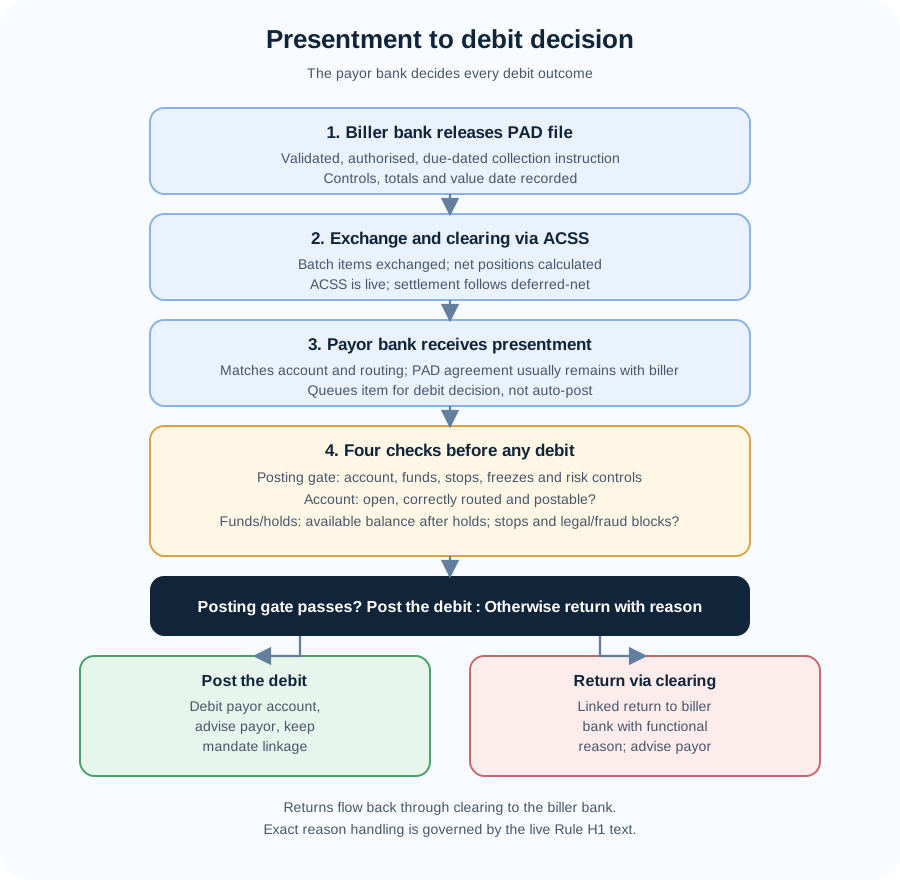
Walk the flow as an operator. The biller's bank releases a validated, due-dated PAD file. Items exchange through ACSS batch streams and net into participant positions. The payor's bank receives presentment, matches the account and joins the item to mandate and stop records. The payor-side FI validates whether the item can be posted: account and routing, account status, available funds after holds and memo items, and stop, fraud or legal restrictions. A PAD agreement is normally held by the biller/payee rather than supplied to the payor-side FI with every presentment, so authority is not a universal up-front bank check. If the item posts and the payor later claims it was unauthorized or off-terms, H1’s reimbursement and recourse process uses agreement, notice and cancellation evidence. If the posting gate fails, the FI returns the debit with the applicable reason and advises the payor.
Three disciplines separate competence from chaos at this gate. First, decide on facts, not pressure. Paying into an uncovered account as a favour converts a return into an overdraft decision with its own policy and pricing, which must be explicit rather than drifted into. Second, record the decision with its reason at decision time. A return whose reason is selected carefully at the gate auto-matches at the biller and routes to the correct recovery path; a careless default manufactures next week's investigation queue. Third, never let presentment bypass the gate. Every re-presentment, manual urgent request and bureau repair re-enters through validation and the four checks, never around them.
4. Clearing, exchange, settlement and finality
Everyday language collapses five distinct events into "the PAD went through." In return and retry handling, confusing them causes real harm: a biller told "it cleared" hears "collected and irreversible," while operations should ask which stream, accepted or returned, netted into which cycle, funded at settlement, posted where, subject to what retry rights and what recourse.
Exchange is delivery of instructions between participants per the rail's rules: PAD items and totals into ACSS streams on the operating calendar, with acceptance or rejection evidence per submission. A file can be exchanged yet partially rejected at item level — the first fork in handling. Rejected items go back for repair; accepted items enter clearing. Banks that treat exchange as a single yes-or-no lose this distinction and spend days reconciling collection files whose control totals stopped agreeing the moment one item was refused.
Clearing is the agreement and calculation layer: exchanged PADs aggregate into net participant positions due at a future settlement moment. A PAD can be cleared but not yet settled, and that gap is where liquidity planning, cutoff promises and biller communication live. Returns operate here too — an NSF return is itself an entry through clearing, recalculating positions — which is why returns show up in clearing evidence as expected reconciling items rather than surprises. Billers who understand this stop asking "where is our money" on the day of presentment and start asking the reconcilable question: which items cleared, which returned, what netted, what settles when.
Settlement discharges clearing's obligations in central-bank money. ACSS settles deferred-net: positions from clearing are funded through accounts at the Bank of Canada after the exchange window, with settlement of the previous day's net balances occurring during the morning of each business day. Settlement evidence is the proof value moved between participants. An NSF wave reshapes positions after forecasts — fewer successful debits netting as expected, more return entries recalculating what is owed between participants — which is why treasury models return assumptions rather than forecasting the happy path. Settlement breaks — positions that cannot be funded or balanced as expected — are treasury incidents first and operations incidents second, covered at family level in Chapter 15 and not repeated here.
Posting applies outcomes to accounts — payor debits, biller credits, fee legs, suspense, general ledger — and belongs to each bank, not the network. The critical discipline is truthful reflection of uncertainty: a biller credit posted while payor-side return rights and recourse may still operate is a different promise from one posted with finality, and statements, displays and advices must not blur it. Nothing matters more for biller trust than honest funds-availability language during the window when value has moved but returns and payor recourse remain possible. Advancing funds to a biller before that window closes is a credit and risk decision — knowing, funded, priced and minuted — not a display default that drifts into place.
Finality is a legal and operational state, not a screen message. In Lynx it is real-time: each payment settles gross across Bank of Canada settlement accounts, irrevocable, confirmed per payment — which is precisely why Lynx has no PAD return lifecycle. In ACSS batch, finality on the interbank leg is conditional in the specific sense that the framework provides defined processes for reversing through returns and contesting through disputes after clearing, plus payor recourse rights for unauthorised or off-terms debits within their horizons. Payor availability of any re-credited amount is a further separate decision owned by the payor bank's posting policy. Promising a biller "irrevocable same-day finality" on a PAD clearing record sells Lynx certainty on an ACSS chassis, and the complaint will arrive dressed as an operations failure when it was a promise failure.
Use these as diagnostic tools. "The collection came back" is a return with a functional reason in clearing evidence, not a malfunction. "The position does not fund" is a settlement event, not a retry queue. "The payor says they never agreed" is an authority and recourse matter under the live Rule H1 text and FCAC guidance. Locate the missing event before choosing the tool.
5. Data, identifiers and messages
PAD returns are resolved with references, not adjectives. Every return must join to its original presentment, every permitted retry must cite the original and its return, every dunning notice must identify the missed collection, every fee must attach to the item that caused it, every dispute must identify the debit contested.
The foundation is end-to-end item identity: references letting every system agree a collection is the same collection. At initiation, biller file and item references plus control totals, due dates and agreement identifiers. Through processing, enrichment without erasure — routing added, originals carried forward, never replaced by internal sequence numbers nobody downstream can see. At exchange, acceptance records preserving sender references so rejected items are precisely identifiable. At clearing, returns and any permitted re-presentments linked to the originals they reverse or continue. At posting, payor and biller narratives containing enough of the original reference for both sides and their reconciliation teams to match. Test any data design with one question: if this PAD returns and is then recovered by an alternate payment six weeks later, can a junior operator join all three events without fuzzy matching? If the answer needs memory or amount-and-date guessing, the design is already generating its future investigation queue.
Batch formats deserve a frank paragraph. AFT processing has both the legacy Rule F1 path and the ISO 20022 Rule F4 path. F4’s current summary identifies pacs.003 for AFT debits, pacs.004 for returns and pacs.007 for reversals; applicable usage guidelines and standards control the fields. Never let a gateway conversion silently drop or reformat references: map fields explicitly, validate lengths, reject rather than truncate, and preserve the biller’s remittance data alongside internal identifiers.
Return and retry linkage is the mechanical standard this chapter demands: every return carries the original presentment reference, the original file or cycle identifier, the functional reason in the form the process requires, and a distinct return reference of its own; every permitted retry carries the original reference plus the return reference it continues, with its own distinct presentment reference. Linked chains, every time. A return that does not cite its original is operationally anonymous — no auto-match, no intelligible advice, a suspense booking that ages. A retry reusing the original reference reads as a duplicate; one with no link reads as an unexplained new collection that will alarm the payor. Banks enforcing linkage in hub and gateway software resolve returns in hours. Banks leaving it to operator discipline resolve them in weeks.
Payor-facing and biller-facing narratives deserve the same rigour as clearing references. A payor advice reading "Pre-authorized debit returned — insufficient funds — [biller name] — [date] — [amount] — [what happens next]" lets a household act that morning. A biller advice reading "Collection returned — NSF-type — invoice [X] — original reference [Z] — check live Rule H1 before re-presenting" lets a receivables team act that morning. Codes alone invite callbacks, and callbacks are the unit cost of poor data.
Finally, evidence retention and retrieval: clearing records, validation logs, release approvals, agreement evidence where held, pre-notifications, decision journals, return entries, advices, dunning records and posting journals must be retrievable by item reference long after the cycle closed — across the full horizon in which returns, retries, recourse claims and disputes can still arrive. Policy and legal advice set schedules; operations guarantees retrievability. If you cannot produce the agreement evidence, the decision record or the original advice when a dispute ripens, you lose arguments you should have won. Archive by reference, index by reference, retrieve by reference.
6. Rules, cutoffs and service levels
Every PAD presented, returned, re-presented or contested draws authority from the Payments Canada rulebook — the by-laws, rules, standards and procedures participants accept as a condition of clearing — overlaid with consumer protection material for payors. This section maps that rulebook functionally and instils the most important habit in PAD operations: read the live text, never memorise it.
The structure is straightforward at the level this chapter needs. Association By-law No. 3, the Payment Items and ACSS By-law, establishes what may travel through the system. Beneath it sit the lettered rules: the A-series governing items and handling, the B-series governing settlement and balancing, with standards and procedures carrying operational detail, and the PAD rule — commonly cited as Rule H1 — governing pre-authorised debits specifically. Four neighbourhoods matter here, each described by function only. The PAD rule (H1 family) sets PAD agreement, dishonour, reimbursement and recourse requirements. AFT debit return and re-presentment mechanics are in F1 for the legacy path and F4 for ISO 20022. The A4 family, Returned and Redirected Items, is the general returned-item rule; it does not replace H1/F1/F4 for PAD disputes and AFT debit returns, and its scope excludes H1 sections addressing PAD disputes. The A6 family, Items in Dispute, and the A9 family, Arbitration, provide the contesting path where participants disagree on liability — family level here, detail in Chapter 15. The B-family manual balancing processes correct settlement-level imbalances where needed.
The current rule limits belong in the operating control, not a vague “limited retry” label. F1 and F4 permit one re-presentment only for return reason 901 (Non-Sufficient Funds) or 908 (Funds Not Cleared), within 30 calendar days following the original return, for the same PAD amount and without added charges; if dishonoured a second time, the debit may not be re-presented by the originating clearer/member. Exact reason definitions, field layouts and procedures still belong to the live rules library, which records the July 27, 2026 ACSS update and says posted versions are in force. A retry request must therefore pass the reason, 30-day, one-attempt, amount and no-added-charge checks. The July 27, 2026 ACSS amendment also formalizes the phase-out of paper PADs, effective December 1, 2028; this chapter’s operating path is the electronic AFT flow.
Consumer protection sits alongside the rulebook, not inside it. FCAC’s consumer guidance says variable-amount PADs generally require written notice at least 10 days before withdrawal unless waived or shortened; electronic or telephone setup should be confirmed in writing at least 3 days before the first withdrawal. It also explains cancellation, stop payment, NSF fees and consumer recourse, while H1 distinguishes Personal, Business and Funds Transfer PAD claims. Every PAD procedure — advices, dunning templates, dispute handling and fee disclosure — should be tested against both the live rules and the applicable consumer regime. A dunning letter threatening consequences the agreement does not support converts a recoverable NSF into a complaint and frequently a regulatory one.
Cutoffs translate the operating calendar into collection promises. Billers who see the cutoff — displayed at the channel, confirmed at release, restated on the confirmation — experience a miss as their own scheduling fact. Billers who never saw it experience the same event as a bank failure and call the service team. Holiday weekends and month-ends deserve explicit advance cutoff communication. When a miss happens, the repair is scheduling honesty: next eligible cycle, value date restated, pre-notifications re-issued where terms require.
Service levels extend the same honesty to the return lifecycle: how fast returns are matched, unwound and advised; how long a biller may sit on a return before dunning starts; how often suspense and unmatched returns are aged and escalated. These are bank and biller policy choices inside the rulebook's outer limits — written down, monitored, reported. A service level the operation cannot meet is worse than none: it converts a routine NSF into a broken promise.
The rulebook habit, once more: versions posted online are in force, and confirmation is an email away. Build it into procedures — playbooks cite families functionally and link the library rather than quoting numbers; training decks carry a "verified against the live text on" date; every amendment triggers review of affected mappings, monitors, retry gates, advice templates and test cases. Banks and billers that do this absorb amendments as maintenance. Those that memorise absorb them as incidents.
7. Fraud, compliance and controls
PAD returns and fraud share territory: both concern debits that should not have produced their outcome. The difference is intent, and intent is often unknowable at detection. A disputed PAD is usually a mandate disagreement — unless weak validation is being systematically exploited by a fictitious biller. An NSF wave is usually timing — unless a compromised payor account is being tested with small debits before a larger fraud. Place controls at the correct gates so prevention stays cheaper than recovery and collections do not become the channel losses walk in through.
Pre-release screening is the highest-leverage control because every downstream process assumes the released collection was legitimate. Screen parties and transactions, hold and escalate suspected sanctions matches under applicable sanctions legislation and institutional policy, and do not describe every screening hit as automatically reportable. FINTRAC requires a suspicious transaction report when a transaction or attempted transaction gives a reporting entity reasonable grounds to suspect a money-laundering or terrorist-financing offence; the report is due as soon as practicable after that threshold is established. A return reverses value but does not erase a compliance event. Fraud scoring runs on the same side of the gate: biller behaviour, file-pattern anomalies, first-time large collections, round amounts at scale, velocity against history, newly added payors in bulk, with clear hold-and-review outcomes and named owners. AML monitoring spans release and post-release: structuring across files, layering through mule accounts, business profiles inconsistent with collection patterns. Validate twice, release once is the cost curve made audible.
Authority controls for pull payments carry special weight because PADs move money the payer did not push. Collections need agreement evidence, agreed timing and amounts, pre-notification discipline for variable items, and honest handling when payors dispute authority — detail in the live Rule H1 text, family level here. The general principle from Chapter 15 holds with extra force: authority evidenced before release and retrievable during dispute, with doubt resolving to hold, not hope. A collection operation that cannot produce agreement evidence during a dispute wave reverses first and investigates later. Billers with telephone-originated agreements need confirmation handling that satisfies the live framework; banks with billers whose sales channels originate agreements need onboarding diligence that verifies what those channels actually sell. Pay special attention to newly acquired books: first collections against migrated mandates produce the highest dispute rates in PAD operations, and a validation pilot with parallel monitoring beats a confident full-volume release every time.
Duplicate and anomaly detection earns its own paragraph as the highest-volume preventable return source after NSF. File hashes against recent history catch the re-released collection file. Control totals against history catch the doubled file. Per-item reference checks catch the payor collected twice inside one file — the duplicate debit that generates an authority dispute even where the mandate was valid. Behavioural baselines per biller — counts, totals, release times — catch the compromised session releasing at 3 a.m. The response ladder matters: block exact duplicates automatically, hold near-duplicates for biller confirmation, alert behavioural anomalies to fraud operations rather than to the biller who may be the problem. Every blocked duplicate is a return wave and a dispute wave that never happened. Report the block rate; it is the clearest evidence the control plane earns its keep.
Payor-side controls mirror the biller side. Stop-payment handling must be fast, exact and honoured through the decision gate: a stop recorded before the decision must never be bypassed by a re-presentment that "looks new." Balance alerts help payors fund accounts before collection dates and reduce NSF volume at negligible cost. Fraud holds and legal freezes flow to the gate as hard stops with named authority, never as informal notes.
Segregation, approval and access form the human perimeter. Preparation and release must be separable with dual approval above thresholds. Retry decisions need their own authority: who may approve a re-presentment, under what gate evidence, within what count — because an undisciplined retry permission is a harassment engine with a login. Privileged access to hubs, gateways, mandate stores and reconciliation tools must be logged.
Retention and regulatory honesty close the section. Validation logs, screening dispositions, release approvals, agreement evidence, pre-notifications, decision journals, return entries, advices, dunning records and posting journals must be retrievable by item reference across the full horizon in which returns, recourse claims and disputes can arrive. When controls fail, report as obligations require: suspected fraud, sanctions matters, control breakdowns through their proper channels. An operation that hides misses to protect metrics discovers, via auditor or regulator, that hidden misses compound while disclosed ones get fixed. Candour is a control.
8. Exceptions, investigations and recovery
This is the core of the chapter. Read it with the taxonomy diagram beside you. Every PAD failure resolves to one of four functional families, each with its own recovery path, owner, evidence and customer story — and the most expensive mistake in the discipline is retrying the wrong family with great efficiency.
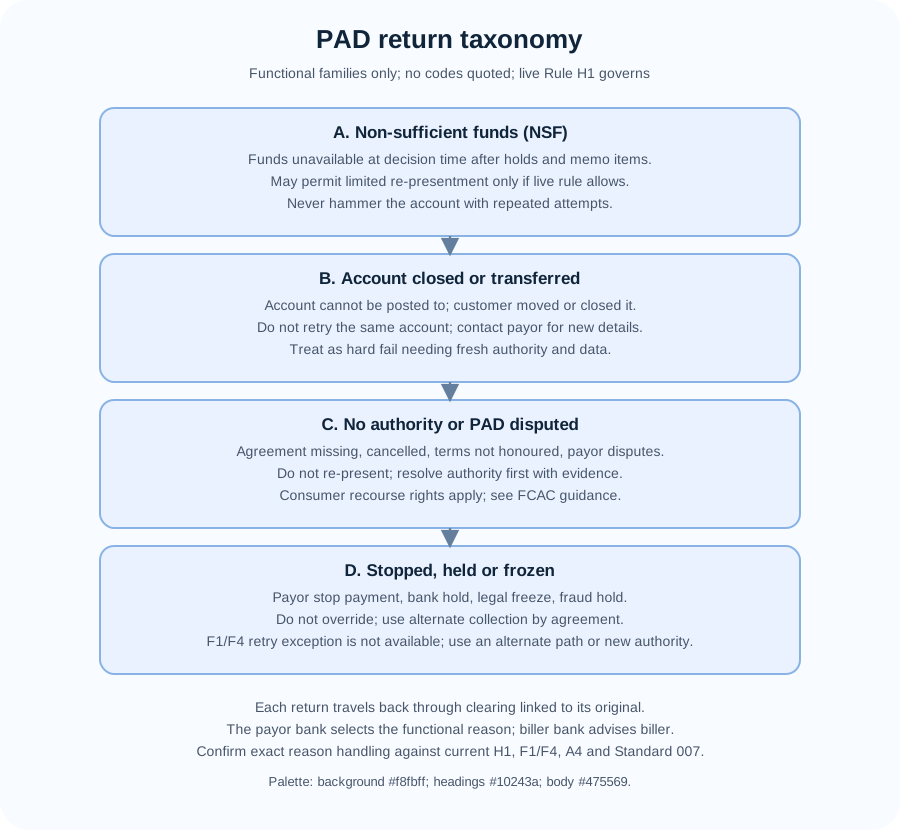
A non-sufficient funds return means funds were unavailable at decision time after holds and memo items; the related Funds Not Cleared reason is treated with it for the narrow F1/F4 retry rule. Recovery may include one linked electronic re-presentment only where the return is 901 or 908, it occurs within 30 calendar days of the return, it is for the original amount with no added charges, and it has not already been re-presented. An account closed or transferred return means the account cannot be posted to; recovery seeks fresh banking details and continuing authority rather than re-presenting the returned debit. A no-authority or disputed return is an H1 evidence and reimbursement/recourse matter, not a retry candidate. A stopped, held or frozen return is not eligible for the F1/F4 re-presentment exception; use an alternate collection by agreement, or obtain fresh authority for a new item after the restriction is resolved. This four-family map is an operational teaching taxonomy, not an exhaustive list of Standard 007 return reasons.
NSF returns: the lifecycle that defines PAD operations
NSF is the signature PAD return: high-volume, timing-driven, mostly honest, and mishandled at scale by operations that treat every instance as identical. Walk the lifecycle as an operator. 1, presented and cleared: the PAD netted into its cycle. 2, cannot debit: the funds check refuses the item under the bank's disclosed policy. 3, return entry created: a new entry citing the original references with the functional reason — without this linkage, the return lands in suspense and starts a needless investigation. 4, return exchanged: the return travels through clearing and positions recalculate, so the biller's bank learns of it after the return clears, not when the payor bank decides. 5, unwind and advise on both sides: the payor bank advises the payor; the biller's bank matches and advises the biller with retry-gate guidance. 6, recover or close: a permitted linked retry where the gates pass, or dunning with an alternate method, or escalation under collections policy.
Three disciplines separate competence from chaos. First, never hammer. Rapid-fire re-presentment of an NSF item stacks payor fees, breaches the constrained retry posture the live Rule H1 text sets, and converts a timing miss into a harassment complaint and frequently an authority dispute. Second, match the recovery to the payor, not the queue. A first-time NSF from a ten-year customer wants a gentle notice and a one-tap alternate payment; a chronic pattern wants a due-date move or a different method. Third, advise in the customer's language with the network's facts. Billers receiving repair-grade advices with joinable references dun correctly the same morning; billers receiving codes call the bank for clarification at everyone's expense.
Closed, disputed and stopped returns: hard fails with different treatments
Closed-account returns look like NSF in a receivables ageing report but demand the opposite treatment. The account is gone; no retry of the same account can succeed. Recovery is data repair: contact the payor, obtain new banking details through a trusted channel, confirm continuing authority, then present as a new collection with history linkage.
No-authority and disputed returns suspend the collection logic entirely and start the evidence logic. Recovery does not re-present the returned debit. It assembles the agreement record, terms, pre-notifications and cancellation records. H1 reimbursement claims are made through the payor’s FI and can require the prescribed written or recorded claim; the biller/payee side then handles the applicable recourse and dispute process. Where evidence does not support the debit, the biller reverses promptly and fixes the control that allowed it. During dispute, pressing the payor with dunning converts a participant disagreement into a customer complaint.
Stopped, held and frozen returns demand obedience, not creativity. A payor stop, legal freeze or fraud hold is never overridden by a retry: F1/F4 reserve re-presentment for 901/908 only. Recovery uses an alternate collection by agreement, or a genuinely new authorized PAD after the restriction is resolved.
Retry and re-presentment: the gates every retry must pass
Re-presentment is where PAD operations most often drift from process into habit, so this chapter makes the gates explicit and hedges every one to the live Rule H1 text. Read the diagram as a checklist, not a suggestion.
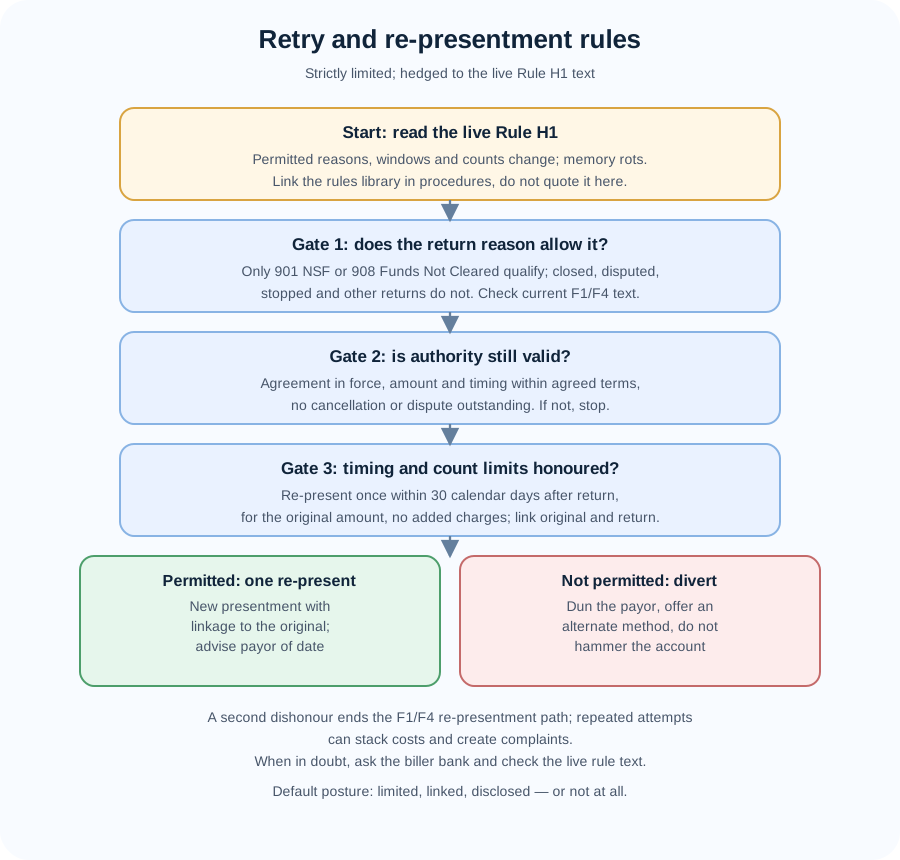
Gate zero is always the live text. As of current F1/F4, permitted re-presentment reasons are 901 or 908, the limit is one attempt within 30 calendar days of the return, and the amount must equal the original PAD with no added charges. Procedures still link the rules library, record the version date, and review amendments before changing the control.
Gate one: does this return reason allow re-presentment at all? Under current F1/F4, only 901 Non-Sufficient Funds and 908 Funds Not Cleared qualify. Closed, disputed, stopped, account-status and other returns do not qualify for this exception. A retry gate in hub software should encode the live mapping and refuse to release a retry it does not permit.
Gate two: is authority still valid? Agreement in force, amount and timing within agreed terms, no cancellation or dispute outstanding, pre-notification obligations satisfiable for the new date where terms require. If authority fails this gate, the retry conversation ends and the alternate-method conversation begins. No timing window cures missing authority.
Gate three: are timing and count limits honoured? Re-present no more than once, within 30 calendar days following the return, for the same original PAD amount and without added charges. A second dishonour ends the F1/F4 re-presentment path. Keep original and return references linked, and communicate the new date under the applicable agreement and service policy. One disciplined, disclosed attempt beats five hopeful ones on every metric that matters: recovery rate, fee load, complaint rate, dispute rate, and the biller's reputation with its own customers.
The default posture for everything the gates do not clearly permit is: limited, linked, disclosed — or not at all. Limited in count, linked by reference, disclosed to the payor — or diverted to dunning with an alternate method. Hub software should enforce the default: retry requires gate evidence attached, counts tracked per original, duplicates blocked, undisciplined bulk retry impossible without override authority that is itself logged and reviewed. The gym story in Section 11 shows what happens without it.
Investigations: finding facts while both customers wait
Between a return and its recovery lies investigation: assembling facts across systems, participants and time. From the best available reference, pull every handoff record: release logs, exchange acceptances, clearing evidence, the decision journal, return linkage, advices sent. Establish the item's state — presented, decided, returned, retried, recovered, disputed — and the permitted path follows. Name the next-action owner. Then communicate outward: established, pending, who holds it, when the next update arrives. Never promise outcomes on assumptions about another participant's process.
Cross-participant investigation adds structured counterparty contact: references, facts and a specific question — not "where is our collection" but "PAD item X, reference Y, cycle Z, return received with this functional reason; please confirm decision timestamp and whether authority records show cancellation." Log every contact from the first call: disputes ripening months later are won on contemporaneous notes, not recollection.
Recovery, ageing and the registers
Recovery ends in few states — name them to keep case management truthful. Recovered by permitted retry: linked re-presentment collected with reconciliation confirming. Recovered by alternate method: bill pay, card, e-transfer or fresh PAD date joined to the original return. Repaired and re-presented as new: corrected account data with continuing authority, history linked. Unwound and absorbed: the return stands final — debt pursued through collections policy or written off under the authority matrix, never buried quietly in suspense. Decided and complied: dispute outcome posted exactly and documented. Open cases sit in working states with owners and next-action dates; closed cases carry ending states with linked evidence. Cases without owners age; cases without ending states accumulate.
Two registers hold the operation together. The return and retry register records every classified return from detection to closure with its recovery path and gate evidence. The suspense and unmatched register records every value outside its intended account with amount, age, owner and expected path. Review both daily for high-value and aged items. Report upward in summary: volumes by family, retry counts and recovery rates, ageing buckets, write-offs, dispute inventory.
9. Posting, accounting, liquidity, reporting and reconciliation
Section 8 handled returns item by item. This section covers the financial and evidentiary machinery keeping the PAD business truthful while returns and retries fly: posting puts value on accounts, accounting keeps the bank's and biller's books honest, liquidity funds positions, reporting tells the story, reconciliation proves it.
Posting: truthful balances while rights are still open
Posting's central tension is timing: billers pull toward immediate availability while return rights and payor recourse push toward caution. Receiving and originating banks resolve it through posting policy — when payor debits become final, when biller credits become available, what language statements and displays use — and the only standard is honesty. A biller credit posted while payor-side returns or recourse may still operate must never present as irreversible collected funds. Accelerated availability as a commercial choice — crediting the biller before the position is beyond recall — must be knowing, funded, priced and minuted in a risk committee, not drifted into through vague display language. Product owners note: every "instant available" promise on PAD-sourced funds is a risk decision in marketing costume.
Posting mechanics must survive return and retry paths without heroics. Returns auto-match to originals and reverse the correct legs with narratives naming the original collection. Permitted retries post as linked new presentments. Alternate-method recoveries post as what they are — bill payments, card credits, transfers — joined by reference to the failed PAD. Suspense postings carry reason, age and owner from creation. Test posting logic against Section 11's two stories before production does it for you.
Fees: disclosed before they surprise anyone
Fees concentrate more payor anger per dollar than any other PAD topic, so they get their own subsection and their own diagram.
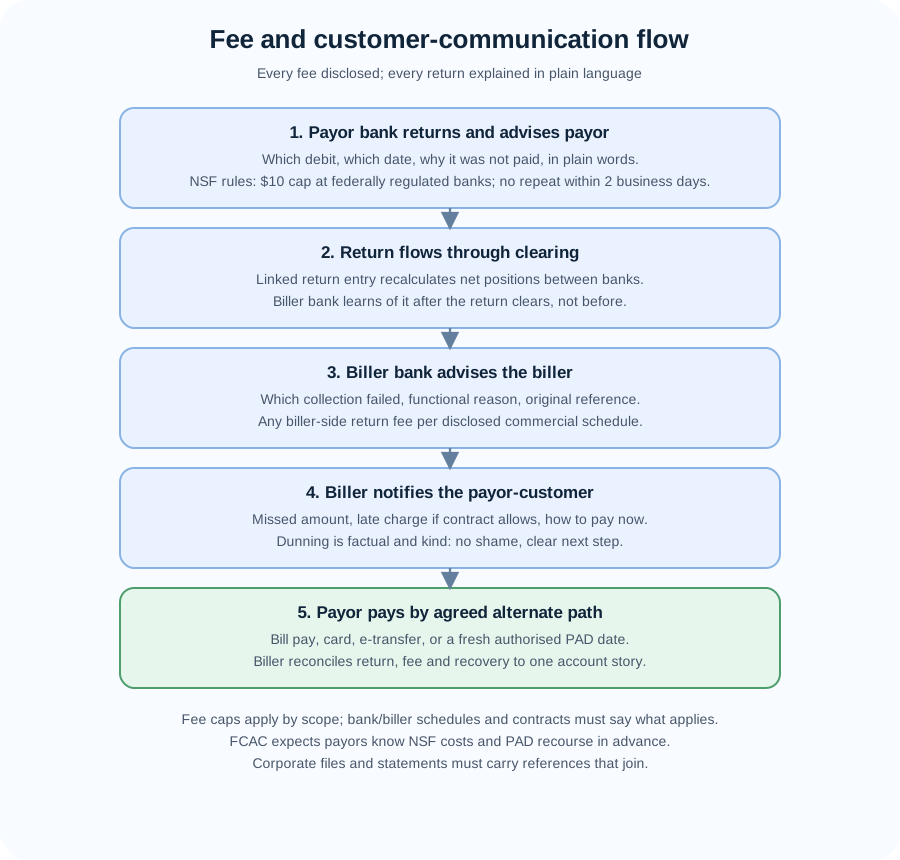
The facts are plain and stated without hedging because they are commercial and consumer-protection facts, not rule-text detail. Banks disclose NSF and return fees; billers disclose late charges and collection fees; FCAC expects payors to know these costs and their PAD recourse in advance. For a federally regulated bank, the Financial Consumer Protection Framework Regulations cap an NSF charge on a natural person’s personal deposit account at $10, prohibit more than one NSF charge for that account within two business days, and prohibit the charge where the unauthorized overdraft is less than $10. Those rules do not turn every biller-side or commercial return fee into an NSF fee and do not apply universally to every institution or account type. Bank and biller schedules and contracts must identify what fee actually applies. The biller’s bank may charge a disclosed commercial return fee, and a biller may apply only contract-permitted late charges. No fee in this chain should be a surprise or be mislabelled as a network rule: surprise fees generate the complaints, disputes and account closures that cost multiples of the fee revenue.
Communication quality is the fee control that matters most after disclosure itself. The payor advice names the failed debit, its date and amount, the functional reason in plain words, the fee applied, and the fastest path to pay now. The biller advice names the failed collection, its invoice linkage, the functional reason, any biller-side fee, and the retry-gate position. The biller's dunning states the missed amount, any contract-permitted charge, and offers an alternate method in the same message — never a demand without a path. Batch these communications honestly: a same-day electronic advice beats a month-end statement line every time, and corporate return files must carry references that join without manual repair.
Accounting: the books under return load
Clearing-position general-ledger accounts must reflect returns and permitted retries as linked entries so finance sees operations' story. Suspense accounts must be owned, aged and escalated. Fee treatment follows stated policy: which fees stand, which reverse, who decides, how each side is told. Write-offs travel the authority matrix with evidence attached. Billers mirror the discipline in receivables: failed PADs reverse cash application with linkage intact, alternate recoveries apply against the same invoice with the full chain visible, and ageing reports distinguish timing misses from hard fails.
Liquidity: funding positions that returns reshape
ACSS settles deferred-net with positions funded through Bank of Canada accounts, making PAD returns a liquidity event: NSF waves and return storms reshape positions after forecasts. Three disciplines follow. Forecast with returns modelled — NSF assumptions from history by biller, due-date cohort and season, January mover uplifts, payday-adjacent peaks. Monitor intraday against forecast with divergence alerts. Maintain a rehearsed settlement-break playbook owned jointly by treasury, settlement and payments operations.
Reporting: telling both customers and management what happened
Customer reporting — statements, advices, online detail, corporate files — must show returns, retries and recoveries as what they are: linked to the original, reasoned, actionable. Biller reporting should include return content by design — returns received by family, retry-gate positions, recoveries joined, items awaiting dunning — because receivables teams plan cash application around these inputs. Management reporting covers the Section 8 registers in summary plus fee income with complaint rates alongside.
Reconciliation: proving the story end to end
The model is three-way with a biller-side mirror: collections released (counts, control totals, due dates, release records) against clearing evidence (acceptances, payor-bank returns in flight, permitted retries pending, flagged disputes) against settlement and books (Bank of Canada-funded positions, general-ledger entries, payor debits, biller credits, suspense, fees, recoveries). Match on reference, amount, date and status — all four — and treat in-flight returns and permitted retries as expected reconciling items, provided each links to its original. The biller mirrors with invoice-to-return-to-recovery matching in receivables: every failed PAD joined to its invoice, every recovery joined to its failure, every fee joined to its cause.
Breaks point to owners. Released-versus-clearing (partial acceptance, rejection, duplicate release, cutoff miss) belongs to payments operations with the biller. Clearing-versus-settlement (cleared but position short, funding delayed, balancing entry missing) belongs to settlement and treasury. Released-versus-books (settled but unposted, suspense, wrong account, fee mismatch, unmatched biller recovery) belongs to posting and reconciliation teams with the biller's receivables team alongside. Route on detection, not after a general queue ages it: misrouted breaks turn one-day timing differences into three-week investigations.
Two habits keep reconciliation controlled. Age everything daily and escalate value breaks first. Timing breaks clear as linked entries arrive; value breaks never self-heal. Close the day deliberately: define what "reconciled today" means, which in-flight returns and retries are explicitly accepted as reconciling items with owners, who signs, what carries forward with a named next action.
10. Implementation, testing and resilience
Banks and billers acquire competent PAD return operations by building systems that enforce the taxonomy and the retry gates, simulating feared failures, rehearsing dreaded incidents and staffing the desks — not by writing procedures. Retrofitting control onto a running collection book is surgery on a moving patient, so build it before volumes grow.
Build the taxonomy and the gates into systems, not manuals. Hubs and gateways should classify returns on receipt from clearing evidence and route each family to its queue with owner, deadline monitor and evidence template attached. Returns auto-match on linkage with defined manual tolerance. Retry release should require gate evidence as structured data — reason permits, authority valid, window and count satisfied — not a clerk's assurance in a free-text box. Counts track per original presentment so hammering is structurally impossible without a logged override. Dunning engines should suspend auto-retry on hard fails automatically and divert to alternate-method templates. Reconciliation runs the three-way match with class-based break routing. Size queues, staffing and auto-matching for the return storm — thousands of linked NSF returns from one large biller's due date landing the same morning — not the average day. Storms convert manual workarounds into backlogs overnight.
Test return and retry paths like origination. Harnesses should simulate the catalogue: NSF waves at scale, closed-account clusters, disputed items with missing agreement evidence, stops recorded before and after decision, duplicate collection files, unmatched returns with truncated references, suspense ageing. Retry tests should prove the gates: permitted NSF retry releases with linkage, while closed, disputed, stopped and count-limit-breaching retries refuse. End-to-end tests prove customer-visible outcomes: payor advices in plain language, biller advices with joinable references and gate positions, dunning with alternate paths. And test the human path: staffing, contact lists, escalation matrices, biller service-team scripts for the morning after a storm.
Resilience means continuing to classify, decide, advise and reconcile while degraded: redundant return-queue capture across hub failover; reference-keyed idempotency so replays and retries cannot duplicate; reconciliation runnable on backup feeds with explicitly degraded confidence; incident communication templates for payors, billers and counterparties. Cross-train and roster so storms never meet skeleton crews holding undocumented knowledge — on the bank's desks and in the biller's receivables team alike.
Change and vendor management close the section because PAD operations change constantly. Biller migrations — new billing platforms, ERPs, service bureaus — arrive as return waves unless onboarding runs validation pilots, parallel runs and reference-mapping sign-off. Vendor and hub upgrades regression-test against the return-and-retry catalogue with rollback criteria in operational terms. Biller-book acquisitions get mandate-validation pilots before full presentment. Rule amendments trigger the Section 6 review cycle with a named owner and completion before effect.
11. Practical fictional Canadian examples
Theory classifies; stories teach judgement. Both examples below are fictional — invented companies and figures, realistic mechanics — one exercising an NSF wave with correct recovery, one exercising retry indiscipline with its consequences. For each, ask the chapter's questions in order: classification, next-action owner, permitted recovery path with gate evidence, what each customer hears, and what evidence joins the story.
Example (fictional): the utility NSF wave
HydroLine Power Inc., a fictional mid-size Ontario electricity distributor, collects about 60,000 residential PADs on the 15th of each month — January, furnace season, bills running 30 per cent above autumn. The file releases cleanly on the 14th: validated, within limits, dual approval recorded, control totals agreed, exchange accepted without item rejections. Presentment flows through ACSS clearing overnight. On the morning of the 16th the returns begin landing at HydroLine's bank and auto-matching to invoices by original reference: roughly 1,800 NSF-type returns where balances fell short, about 120 closed-account returns from customers who moved over the holidays, and a dozen disputed items where customers say they cancelled by phone.
Classification happens before any recovery, and it happens fast because the hub enforces it. The 1,800 NSF-type items route to the soft-fail queue with retry-gate positions attached: the live F1/F4 mapping permits at most one linked re-presentment for reason 901 or 908, within 30 calendar days of the return, for the original amount with no added charges, and the bank’s procedures require reason, timing and prior-attempt checks before any retry releases. The 120 closed-account items route to the hard-fail queue with auto-retry suspended — no re-presentment of the same account under any timing argument. The dozen disputed items route to the evidence queue with collection paused and agreement records pulled.
The payor side shows quality the same morning. Each payor bank advises its payors with the failed debit identified, the functional reason in plain words, the disclosed NSF fee where the schedule applies, and the fastest path to pay. No codes standing alone. No surprise fees — every fee was disclosed in schedules the payors could have read before the failure, and balance alerts had been offered to those who wanted them.
HydroLine's receivables team works the soft fails with judgement rather than a single rule. First-time NSF customers with clean histories receive a factual, kind notice the same day: missed amount, any contract-permitted late charge stated plainly, a pay-now link offering bill payment, card, e-transfer or a fresh agreed PAD date. Chronic patterns receive a human call offering a due-date move to follow payday. Only a narrow segment — a 901/908 return, no prior re-presentment, within 30 calendar days, original amount only and no added charges — is re-presented through the PAD channel, each retry linked to its original and its return. The 120 closed-account payors receive a different notice: update banking details through the verified channel and confirm continuing authority. The dozen disputed payors receive evidence handling, not dunning: agreement records searched, unsupported debits reversed promptly, valid debits pursued bilaterally with facts.
Reconciliation closes the story the way it must. Invoices reverse cash application with linkage intact. Permitted retries join their originals and returns. Alternate-method recoveries apply against the same invoices with the full chain visible. The month-end close records the wave honestly: January return assumptions were light, the 15th due-date cohort carries structural timing risk, and the model changes — cohort-based assumptions with January uplifts plus a payday-aligned due-date option for vulnerable segments.
The lessons are the chapter in miniature. Timing design beats retry volume: moving vulnerable payors to payday-aligned dates prevents more NSF than any retry discipline recovers. Classification beats speed: the three queues prevented closed-account retries and dispute-pressing that would have manufactured complaints. Linkage beats memory: every return, retry and recovery joined by reference, so reconciliation proved the story instead of arguing about it. And kindness with firmness beats both harshness and passivity: firm on the debt, flexible on the method, exact on the references.
Example (fictional): the gym retry
NorthFit Studios Ltd., a fictional Calgary fitness chain with about 8,000 monthly memberships, collects dues on the 1st through a service bureau. February brings a routine NSF cluster — a few hundred first-of-month fails, mostly timing. What happens next is the chapter's cautionary tale. The service bureau’s retry configuration, carried over from another client’s settings and never reviewed against the live F1/F4 text, re-presents every NSF return automatically: day two, day four, day seven, day nine — four attempts per failed item. That exceeds the one-time 901/908 exception after the first retry, and the configuration also lacks linkage, amount/no-charge controls and payor date advice. The biller's dashboard shows "aggressive recovery enabled" as a feature. The payors experience it as something else.
Payor impact compounds with each attempt. Each re-presentment that meets a still-short account generates a fresh return and, where schedules apply, a fresh fee — fees disclosed in principle but never expected at this frequency. Payors who funded the account on day five and paid by e-transfer on day six watch two further PAD attempts arrive against the settled invoice. A dozen payors cancel their agreements outright. Three file authority disputes, converting timing misses into evidence cases. Two file complaints citing harassment.
Detection comes from the biller's bank, not the biller — Friday's monitoring flags a retry-to-original ratio no legitimate gate would produce, plus unmatched returns from regenerated references breaking auto-match. Containment starts immediately: remaining retries suspended, the retry population re-linked from bureau logs, dunning switched to factual notices with alternate methods, dispute and cancellation handling prioritised over collection. Recovery is mostly repair and apology: confirm each invoice's true state, reverse pressure on paid and cancelled accounts, and handle the authority disputes with evidence and prompt compliance where the facts require it.
The commercial reckoning is honest. Short-term "recovery" numbers looked energetic while the retries ran, but net recovery after disputes lost, agreements cancelled and members churned runs negative against the disciplined alternative: one advised retry where gates pass, then dunning with choice. The biller moves retry authority inside the bank's gated release — structured gate evidence, per-original counts, linked references, payor date advice — and rewrites its notices so retry practice is disclosed before it surprises anyone. The bank tightens onboarding for every service-bureau client: retry configurations reviewed against the live rule text with sign-off before first volume, monitoring on retry ratios with alerts.
Note the restraint this story teaches, because restraint is the skill. Limited, linked, disclosed — or not at all. The gym's four blind attempts recovered less cash, kept fewer members and created more disputes than one disciplined attempt plus a pay-now link would have. Slow is smooth, and smooth collects faster. Every retry gate in Section 8 exists because some real operation once paid to learn it.
12. Key takeaways and authoritative references
Twelve points carry the chapter. Pin them where your team — and your billers — can see them.
- The payor bank decides every debit outcome. Authority, account, funds, holds — four checks, one owner, recorded at decision time with its functional reason. Nobody upstream overrides the gate.
- Every return flows back through clearing linked to its original. NSF, closed, disputed, stopped — four functional families, each with its own recovery path. Linkage on every entry; auto-match on it; intelligible advices from it.
- NSF is timing until proven otherwise — treat it that way. First-time misses get gentle notices and alternate paths; patterns get due-date moves and method changes; only narrow gated cases get a PAD retry.
- Closed means new data, disputed means evidence, stopped means obedience. Never retry the same closed account; never re-present a disputed debit; never override a stop. Divert each to its correct path.
- Re-presentment is tightly constrained — hedged to the live Rule H1. Reason permits, authority stands, window and count honoured, linked, disclosed — or not at all. Check the current text before every retry posture.
- Never hammer. Rapid-fire NSF attempts stack fees, breach the constrained posture, manufacture disputes and churn payors. One disciplined attempt plus a pay-now link beats four blind ones.
- Fees are disclosed before they surprise anyone. Bank schedules, biller contracts, FCAC plain-language material — every fee traceable to a disclosure, every advice stating what applied and why.
- Advise in the customer's language with the network's facts. Which item, which date, why in plain words, what happens next, with references that join. Same-day electronic advices beat statement archaeology.
- Post honestly while rights are open. Posted, available and final differ. Suspense carries reason, age and owner from birth. Retries link; alternate recoveries post as what they are.
- Fund the positions returns reshape. Forecast with return assumptions by biller, cohort and season; monitor intraday; rehearse the settlement-break playbook across treasury and operations.
- Reconcile three ways, route breaks to owners, escalate value first. Released versus clearing evidence versus settlement and books — plus the biller's invoice-to-return-to-recovery mirror. Timing waits; value escalates.
- Read the live rule text; never memorise it. Reasons, retry counts, windows, forms and timelines change. Procedures link the library, carry verification dates, and review every amendment with a named owner.
Authoritative references
Official sources only — these links outrank anything quoted from memory, including from this chapter. URLs were checked on 2026-10-05; if any moves, start from the Payments Canada, Bank of Canada, FINTRAC or Canada.ca home page and navigate to the named section.
- Payments Canada — Payment systems overview (ACSS retail batch and Lynx high-value systems, live status, modernisation including the planned Real-Time Rail): https://www.payments.ca/systems-services/payment-systems
- Payments Canada — Retail batch payment system (ACSS clearing of cheques and electronic items including pre-authorised debits, deferred-net settlement, direct-clearer funding through Bank of Canada accounts): https://www.payments.ca/systems-services/payment-systems/retail-batch-payment-system
- Payments Canada — Rules and documentation library (the live text: the PAD rule commonly cited as Rule H1, the A4 Returned and Redirected Items family, A6 Items in Dispute and A9 Arbitration families, B-family settlement and balancing material, by-laws, standards and procedures; versions posted online are in force): https://www.payments.ca/systems-services/rules-documentation
- Bank of Canada — Payment systems oversight (Lynx as systemically important, ACSS as prominent, settlement-account and designation context for this chapter's funding and finality claims): https://www.bankofcanada.ca/regulatory-oversight/financial-market-infrastructures/payment-systems-the-bank-of-canada-oversees/
- Financial Consumer Agency of Canada — Pre-authorised debits (PAD) (consumer source for agreement contents, 10-day variable-amount notice, 3-day first-withdrawal confirmation, cancellation, stop payments, NSF fees, alerts and consumer recourse): https://www.canada.ca/en/financial-consumer-agency/services/banking/preauthorized-debit.html
- Payments Canada — Rule F1, Rules applicable to Automated Funds Transfer (AFT) Transactions (current legacy AFT return and one-time 901/908 re-presentment rule): https://www.payments.ca/sites/default/files/f1eng.pdf?v=1785157155
- Payments Canada — Rule F4, Rules applicable to AFT Transactions using ISO 20022 messages (current ISO AFT return and one-time 901/908 re-presentment rule; pacs.003/pacs.004/pacs.007 summaries): https://www.payments.ca/sites/default/files/f4eng.pdf?v=1785156747
- Justice Laws Website — Financial Consumer Protection Framework Regulations, section 10.1 (current $10 NSF cap and two-business-day / under-$10 restrictions for federally regulated institutions): https://laws-lois.justice.gc.ca/eng/regulations/SOR-2021-181/nifnev.html
- FINTRAC — Reporting suspicious transactions (reasonable grounds to suspect, attempted transactions and “as soon as practicable” reporting): https://fintrac-canafe.canada.ca/guidance-directives/transaction-operation/str-dod/str-dod-eng
Diagrams in this chapter: presentment-to-debit decision flow; PAD return taxonomy (functional families; no codes quoted); retry and re-presentment rules (F1/F4 one-time 901/908 limit); fee and customer-communication flow; biller-side failed-collection recovery (dunning, alternate method) — all under /diagrams/payment-stories/canada/chapter-24/. Rule families are described functionally; current F1/F4 retry limits are stated above, while exact reason definitions, forms, field layouts and future amendments remain governed by the live rules linked above. ACSS is live; Lynx is live; the Real-Time Rail is shown as planned. Stories and companies are fictional.
This application uses JavaScript for the full interactive experience. This text summary is served for accessibility and search indexing.