PAD Authorization and Mandate Lifecycle. Follow mandate creation, authorization, amendment, retention and operational proof of authority.
Canada Payments & Collections · Block 5: PAD Collections and Mandate Operations · Chapter 23 of 75
Every pre-authorized debit that clears through the Automated Clearing Settlement System rests on a piece of paper, a web session, or a phone call that happened days, months, or years earlier. A gym member signed a membership form with a small box authorizing monthly withdrawals. A homeowner clicked through a utility enrolment portal at midnight. A small business owner told an insurer over the phone to take premiums from the company account. Each of those moments created a mandate — the payor's authorization that lets a biller pull money from someone else's bank account. Everything in this chapter follows that mandate from the moment it is created, through verification, storage, everyday use, amendment, and eventual cancellation, to the day somebody challenges it and the biller must prove it existed.
This is the least glamorous chapter in the collections programme, and arguably the most load-bearing. Clearing mechanics can be fixed with a re-transmission. A missing mandate cannot be reconstructed. When a payor tells their bank "I never authorized that debit," the entire dispute turns on one question: can the biller produce the authority, linked to the right payor, the right account, and the disputed date, inside the dispute window? Billers that answer within the agreed service level preserve their operational and recourse position. Billers that answer in weeks — or cannot answer at all — create reimbursement, liability and investigation exposure. Banks on both sides of the debit live with the consequences either way: the payor's bank processes the authenticated claim under Rule H1, while the biller's bank manages sponsor recourse and customer evidence.
A few status facts anchor the chapter, stated once so later sections can build on them. A pre-authorized debit is a debit-pull instrument: the payee's side initiates collection against the payor's account on the basis of an authorization given in advance, and the payor's bank processes, returns, or reimburses it under the applicable rule. Authorization must pre-date the first debit — always, without exception, in every channel; a Sporadic PAD additionally needs a separate authorization before each item is exchanged and cleared. The biller retains the proof of authority; the payor's bank may request that proof when a debit is disputed, but a timely authenticated reimbursement claim is not an adversarial proof trial (see Section 8). The binding procedures for clearing and settling every PAD live in Payments Canada's current Rule H1, described here functionally; the rulebook's published text governs, not this chapter. ACSS itself is live — it is the operating batch system that carries PAD debits alongside credits, cheques, and remittances — and nothing in this chapter routes to RTR. As of this audit, Payments Canada describes RTR as launching in Q4 2026 and still in testing/assurance, so any RTR design is explicitly future-state, not current PAD production. Rule H1 requires a minimum 12-month audit trail after the last PAD; longer statutory, contractual, tax, privacy, legal-hold, or bank-policy periods may apply.
What you should be able to do after this chapter
After working through this chapter, you should be able to:
- explain what a PAD mandate is, why authorization must pre-date the first debit, and what "proof of authority" means in operations terms;
- name the parties — payor, payee/biller, payor bank, biller bank (sponsoring member), and Payments Canada as rule-maker — and state who holds the proof at each stage;
- walk a mandate through creation, verification, storage, use, amendment, and cancellation without skipping the evidence handoffs;
- describe the functional controls for paper, online, and phone authorization channels and why each channel needs different evidence;
- process the three amendment families — account change, amount change, payor change — and explain why a payor change is a new mandate, not an edit;
- explain how amount and date changes are pre-notified, what waiver means functionally, and what happens when notice is skipped;
- trace a disputed debit from payor claim through proof request, retrieval, and the reimburse-or-deny decision;
- recognize unauthorized-PAD fraud in its common shapes and place the preventive controls before the first debit;
- classify mandate-related exceptions — no authority, inconsistent amount, cancelled mandate, re-used one-time authority — and route each to the right recovery;
- explain posting, accounting, and reconciliation for mandate-driven debits, including return linkage back to the original mandate;
- describe what a bank and a biller must implement, test, and evidence to stay audit-ready, including retention discipline and retrieval drills;
- work through fictional but realistic Canadian mandate cases — a disputed gym collection, an insurer's account migration, a charity's amount change — and extract the control lesson from each;
- navigate confidently to the programme's companion chapters on PAD fundamentals and Rule H1, PAD processing with NSF and retries, and cancellation, disputes, and reimbursement for working depth.
For a roughly 60-minute core session, spend about 10 minutes on the lifecycle and Sections 1–2 with the mandate-lifecycle diagram, 15 minutes on Sections 3–4 with the authorization-channels diagram, 10 minutes on Sections 5–6 with the amendment-flow diagram, 10 minutes on Sections 7–8 with the proof-retrieval diagram, 10 minutes on the fictional cases in Section 11, and 5 minutes on takeaways and references in Section 12. The retention model in Section 9 repays a second pass during audit season.
Chapter navigator
- Business context and customer need
- Participants, responsibilities and system boundaries
- Initiation, validation and bank processing
- Clearing or exchange, settlement and finality
- Data, identifiers, messages and references
- Rules, cutoffs, service levels and customer impact
- Fraud, compliance and operational controls
- Exceptions, investigations and recovery
- Posting, accounting, liquidity, reporting and reconciliation
- Bank implementation, testing and resilience
- Practical Canadian examples
- Key takeaways and authoritative references
1. Business context and customer need
Start with three ordinary Canadian mornings. A property manager in Mississauga wakes up on the first of the month knowing several hundred rent PADs will land without anyone writing a cheque. A mutual-insurance policyholder in Moncton never thinks about her monthly premium; it simply leaves her account on the same date it has left for six years. A charity fundraiser in Victoria plans a spring campaign around monthly donors whose five-dollar and twenty-dollar PADs arrive with metronome regularity. None of these people thinks about mandates. Each of them depends on one completely: the authorization, captured once and honoured repeatedly, that converts a billing relationship into a collection flow.
The PAD mandate exists because recurring billing has a shape that suits debit-pull collection. Amounts are predictable or notifiable, timing is rhythmic, volumes are high, and per-transaction instruction would be absurd — nobody wants to log in twelve times a year to approve the same electricity bill. The mandate collapses all of that future instruction into a single durable authorization: take the agreed amounts, on the agreed rhythm, from the agreed account, until I tell you otherwise. For the biller, the prize is collection certainty and low cost per debit. For the payor, the prize is never missing a payment, never paying a late fee, never thinking about it. For the banking system, the prize is batch efficiency — thousands of authorized pulls exchanged and netted through ACSS at a cost per item no real-time rail can touch.
But the mandate is also the entire legal and operational basis of the pull, which makes it a single point of failure wearing everyday clothes. A credit push carries its authority fresh with every payment: the payer instructs, the bank acts. A debit pull carries authority by reference to something stored elsewhere: this debit is proper because that agreement, signed months ago, says so. If the agreement is defective, unverifiable, amended without record, or cancelled without effect, the debit it supposedly supports is just money taken from someone's account. That is why disputes feel so personal and escalate so fast. The payor experiences the debit as money removed without a fresh instruction, and the only thing standing between the biller and a reimbursement order is a retrievable record.
Customers experience mandate operations through a short list of recurring questions, and every section of this chapter equips you to answer one or more of them honestly. Is my authorization safe with this biller — who holds it, who can see it, how do I change it? Why did the amount change without anyone asking me — was I notified, did I agree to that? I cancelled weeks ago, so why did another debit arrive — where did cancellation get stuck? I never authorized this at all — how do I get my money back, and how fast? I changed banks — do I need a new authorization, or does the old one travel with me? Each question maps to a lifecycle stage: capture, amendment, cancellation, dispute, migration. A banker or biller operations analyst who can place the question on the lifecycle in seconds has already halved the handling time, because the lifecycle tells you where the evidence should be and who should hold it.
The economics deserve a plain statement because they explain why mandate quality is a business asset rather than a compliance cost. Acquiring a mandate — onboarding a payor, verifying identity and account, capturing consent, confirming, filing — is the most expensive step in the PAD lifecycle per unit. Using it — originating each periodic debit against the stored authority — is among the cheapest operations in Canadian payments. That cost curve rewards doing capture properly once: a verified, well-stored mandate pays for itself across dozens or hundreds of low-cost collections, while a sloppy capture generates disputes, returns, re-verification work, and lost customers that dwarf the saving. Billers that treat mandate onboarding as a conversion funnel to be minimized — fewer clicks, fewer confirmations, thinner verification — are borrowing against their own dispute future at a terrible exchange rate. The lifecycle diagram below is, among other things, a picture of where the money is spent and where it is earned.
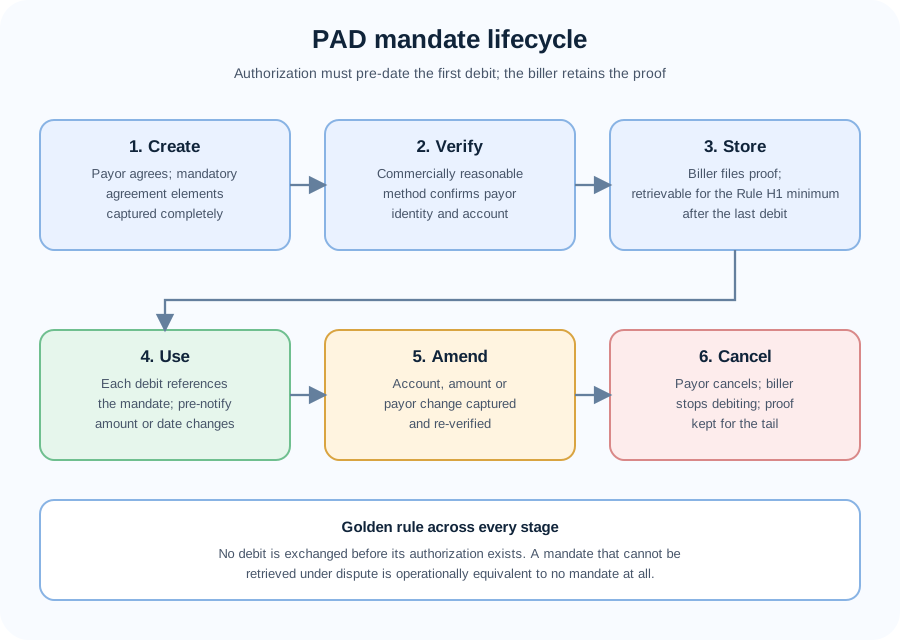
The diagram above is your anchor for the whole chapter. Read it left to right and top to bottom: create, verify, store, use, amend, cancel — with the golden rule printed underneath because it governs every arrow. Authorization always pre-dates the first debit. A mandate that cannot be retrieved under dispute is operationally equivalent to no mandate at all. Every later section is a deeper pass over one box or one arrow in that picture:
2. Participants, responsibilities and system boundaries
A PAD mandate always involves more parties than the two names on the agreement, and the bank professional must keep five layers straight: the payor who authorizes, the biller who collects, the two banks that stand behind them, the system and rulebook that carry the debits, and the service providers in between. Confusing any two produces the classic errors this chapter corrects — treating the biller's bank as the holder of the mandate, treating the system as the party that owes the payor protection, or treating a software vendor as if it warrants the authorizations.
Start with the two signatures, real or electronic. The payor is the holder of the account to be debited — a consumer, a small business, sometimes a larger organization paying by PAD — who gives the authorization and who can amend, cancel, and dispute. The payee, usually called the biller in operations conversation, is the organization entitled to collect: the landlord, the utility, the insurer, the gym, the charity, the lender. The mandate is a contract between these two directly, not with either bank. Banks facilitate and warrant; they are not parties to the authorization itself. That boundary matters the day a payor phones their bank saying "cancel my gym PAD": the bank can place an account-side stop payment and accept a reimbursement claim, but only the payor's instruction to the biller revokes the PAD agreement. The underlying contract dispute between member and gym lives outside the payment rules, and honest bankers say so plainly.
The biller's bank — the sponsoring member in rulebook language — is the institution that lets the biller originate PADs into clearing. Its responsibilities are heavier than they look from the outside. Before the first file flows, it contracts with the biller under a payee undertaking, satisfies itself that the biller uses commercially reasonable methods to verify payors, and sets the operational terms: file specifications, cutoffs, return handling, liability. With every file, it warrants the items it introduces into clearing — including, functionally, that the underlying authorizations exist. When a payor bank comes asking for proof after a dispute, the biller's bank is the channel the request travels through and the party that leans on its customer to produce. Sponsoring a biller is therefore an underwriting decision that never quite ends: the bank rents out its clearing access, and the rent is paid in ongoing oversight of the biller's mandate practices.
The payor's bank — the processing member holding the debited account — is the payor's champion inside the machinery. It posts or returns each debit, receives the payor's authenticated reimbursement claim, requests proof from the biller side where there are reasonable grounds, and reimburses promptly when the current Rule H1 declared-condition and time-limit tests are met. Its powers are real but bounded: a payor-bank stop payment is an account control, not cancellation of the biller's PAD agreement; the bank cannot adjudicate the underlying billing contract or manufacture authority the biller never captured. Under Rule H1, a payee or sponsoring member that disputes a reimbursement claim addresses that dispute with the payor/customer outside the Rules. The practical consequence is that payor-bank teams live or die on clock management and claim authentication, while biller-side teams must preserve and retrieve evidence in reasonable time.
Payments Canada sits above the bilateral relationships as the rule-maker and system operator: Rule H1 sets the procedures for exchanging PADs for clearing and settlement, the appendices define mandatory agreement content and forms, and ACSS carries the resulting debit items through exchange, clearing, and deferred net settlement. What the operator does not do is equally important: it holds no mandates, judges no individual disputes, funds no positions, and guarantees no collection. When this chapter says "the rules," it means the published Rule H1 framework as currently in force — functionally described here, binding only in its published text. Rule-level mechanics, category definitions, and form-level detail belong to the companion Rule H1 chapter; here, know the shape and the habit of checking currency, because rule text is amended and transition provisions have real operational tails.
Around these core parties sit the intermediaries that originate scale: billing platforms, payment service providers, payroll and property-management software, charity fundraising vendors. They capture authorizations in their screens, store mandate images in their vaults, generate the collection files banks release — and the bank's duty to validate, warrant, and control does not move to the vendor just because the vendor pressed the keys. Each intermediary's responsibility should be written down before volume flows: who authenticates the payor, who verifies the account, who captures which mandatory elements, who stores the proof, who produces it within what turnaround when a dispute arrives, who survives a vendor migration with the archive intact. Every painful mandate incident involves a handoff where both sides assumed the other owned a step — most often storage and retrieval.
Responsibility, in short, is a chain with no gaps. The payor authorizes and monitors. The biller captures, verifies, stores, pre-notifies, and produces proof. The biller's bank sponsors, warrants, and oversees. The payor's bank posts or returns, receives claims, requests proof, and reimburses where required. The operator provides the rules and the rails. Vendors execute whatever the written agreement assigns them and nothing more. Every dispute in Section 8 walks this chain, which is why learning the chain once, here, pays for itself in every later chapter.
3. Initiation, validation and bank processing
Every mandate starts in the same place: a payor's decision, captured in a channel, passing through the biller's onboarding before any bank or system sees it. The channel varies — a paper form handed across a gym counter, an online enrolment portal completed at midnight, a phone call with an insurance agent — but the biller's job converges on the same discipline: turn a decision into a complete, verifiable, storable authorization, or stop and repair while repair is still cheap. An authorization rejected at capture costs a conversation and a corrected form. An authorization released into collection with defective content costs a dispute, a reimbursement, and a customer. The whole economics of this section is that ordering.
Creation captures the mandatory content plus the evidence of consent. Functionally, every PAD agreement must identify who pays whom — payor and biller with enough precision to be unambiguous — which account is authorized, the PAD category (Personal, Business, or Funds Transfer), the amount or how the amount will be determined, the timing or rhythm of debits, cancellation information, accurate payee contact information, and the prescribed recourse statement. These are Rule H1 Appendix II elements; Cash Management PADs use the separate Payee Letter of Undertaking framework. The agreement may be paper or electronic/otherwise Recorded: Rule H1's 2022 amendments removed a separate paper-versus-electronic onboarding regime. Fixed-amount recurring mandates state the amount plainly. Variable-amount mandates must define how the amount is set — metered usage, invoiced balance, contribution chosen per cycle — because a debit whose amount cannot be derived from the agreement plus its notices is the raw material of disputes. One-time-only authorities must say so explicitly on their face: a single debit on a set date, after which the agreement terminates by itself and any further collection needs a fresh agreement. The biller's onboarding must also capture the consent record itself — signature, click-trail, recording reference — with a timestamp and the version of terms the payor saw, because years later the dispute will ask exactly those questions.
Verification is where most preventable failures are caught, and it must complete before the first debit. Functionally, the biller must use a commercially reasonable method to confirm that the personal and banking information actually belongs to the payor — reasonable meaning proportionate to the circumstances, the relationship, and operational capability, and ultimately defensible if a court ever asks. In practice that spans a spectrum: visual identity checks for in-person paper, micro-deposits or bank-login confirmation for online enrolment, callbacks to known contacts for high-value business mandates, account-ownership confirmation where the relationship is new or thin. Verification is not a single technique but a standard of care, and the biller's bank is expected to satisfy itself that its customer's methods meet that standard before sponsoring volume. A mandate file that cannot show its verification method is operationally equivalent to an unverified file, and dispute outcomes will reflect that equivalence.
Between verification and first use sits the confirmation step, and its order matters as much as its contents. The payor receives a copy of the agreement or a compliant confirmation notice — what was authorized, for how much, on what rhythm, from which account, with recourse information — delivered so that the payor can check it before money moves. Where the payor has authorized a shortened introduction — waiving the default advance notice before the first debit — the confirmation follows promptly after the first collection instead, and the biller must be able to prove the waiver was genuinely given rather than pre-ticked. Confirmation is the cheapest dispute prevention ever invented: a payor who sees the mandate in writing corrects errors before the first debit; a payor who never sees it discovers them through the statement, as a claim.
Only after all of this does the mandate become usable for collection, and usability has its own pre-first-debit checklist on the bank side. The biller's bank validates the biller's file against specifications, confirms the biller's sponsorship is in good standing, screens where screening applies, and assigns the file to its window. The payor's bank, receiving the first debit, validates routing and account state and posts or returns on the item's merits — it does not, and cannot, validate the mandate behind each item in real time. A later Rule H1 reimbursement claim is a separate recourse process. That architectural fact is worth absorbing: the clearing does not carry the mandate with each debit, so same-day mandate checking at the payor bank is impossible by design. The system trusts the biller's bank's warranty, and corrects failures through dispute and return rights afterwards. Prevention therefore lives entirely in capture, verification, and sponsorship oversight — everything downstream is detection and recovery.
Amendments after creation are narrow by design and covered in depth in Section 5; the architectural point here is that the mandate record is append-only. Account changes add a verified new account linkage, or a preserved and validated bank NOC where Rule H1 deems the NOC to be authorization. Amount changes add notices and any required waiver/consent evidence. Cancellations add a termination record. Nobody edits the original agreement in place, because the original agreement is the evidence a future dispute will examine. The reference discipline that makes all of this work — one durable internal mandate identifier linked to each collection record, amendment, retrieval and clearing trace — is introduced here and detailed in Section 5. Two principles decide whether mandate operations survive reality. First, capture completely or do not collect: a thin mandate is a future reimbursement wearing a conversion-rate costume. Second, verify before first debit, not after first dispute: verification after the fact is testimony, not control.
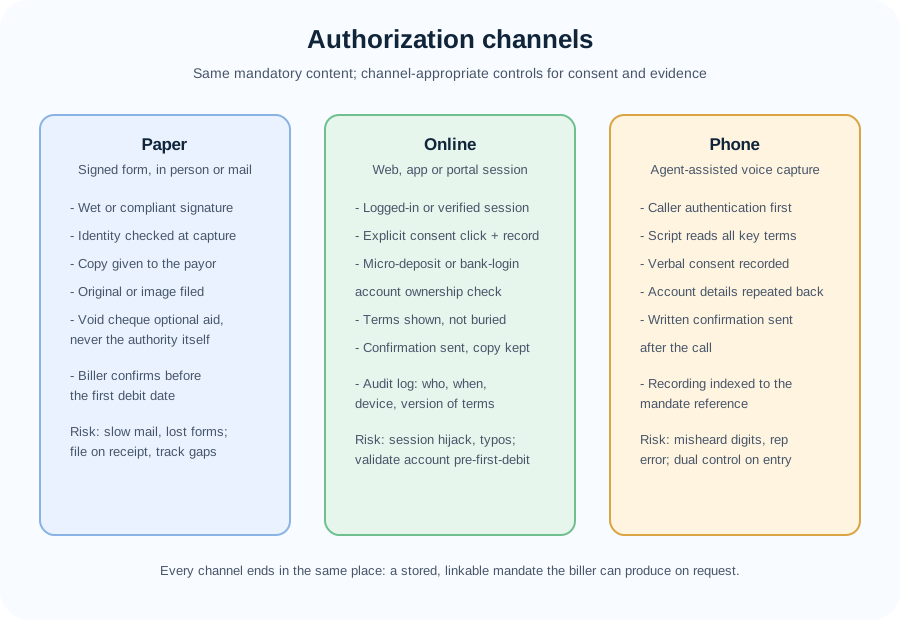
The diagram above deserves a slow read, because it answers the operational question behind half of all mandate incidents: what evidence should this channel have produced? Paper should have produced a signed form, an identity check, a filed image, and a copy in the payor's hands. Online should have produced a session log, an explicit consent record, an account-ownership check, and a confirmation. Phone should have produced authentication, a scripted disclosure, a recording indexed to the mandate, and a written confirmation afterwards. When a dispute arrives and the channel's expected evidence is missing, the investigation already knows where the capture failed — which is exactly the triage Section 8 teaches.
4. Clearing or exchange, settlement and finality
If Section 3 is about the biller's decision, this section is about the system's promise — and the most expensive misunderstandings in PAD operations come from blending events that are genuinely different. Exchange delivers debit items between participants. Clearing validates, sorts, and positions those items. Settlement moves value finally between settlement accounts. Posting debits and credits customer accounts on the bank's books. Availability tells the biller the collected funds may be used. Finality tells the system the value movement cannot be unwound through the settlement mechanism — subject, crucially for PADs, to surviving return and reimbursement rights. Learn the six words, use them exactly, and half of collections confusion disappears.
PAD debits clear through ACSS as batch debit items, and ACSS defers settlement by design. The biller's bank releases collection files into exchange in its operating windows; each direct clearer enters the volumes and values of the items for which it is owed funds; those entries combine into net positions; and settlement of the previous cycle's net balances occurs during the following business morning, with settlement-account balances extinguished through payments to and from the Bank of Canada. Thousands of individual debits — gym memberships, premiums, rents, donations — collapse into net settlement positions. That is the documented batch model; exact exchange windows, file cutoffs and any interbank funding message are participant operating details, not a universal PAD promise.
Finality in this model is positional and rule-governed, not per-item and instant — and for PADs the qualification matters more than anywhere else in batch. When morning settlement completes, interbank positions settle finally in central-bank money; yet the payor's rights over the underlying debits survive for defined reasons and windows: unauthorized or inconsistent debits can be claimed, cancelled mandates can be enforced, returns for funds and account reasons flow on their own cycles. A biller can post collected funds while the payor retains recourse. That is the PAD bargain stated precisely: cheap, scalable collection at the price of return exposure that lasts well beyond settlement. Each half without the other misleads — the biller who treats settled-as-collected as final-as-yours spends money that may come back, and the payor bank that treats settlement as the end of its duties mishandles the claims that arrive weeks later.
Contrast this with real-time collection thinking, because billers increasingly ask why debits cannot be "instant and final." In a real-time rail, each payment settles individually with immediate finality and no unilateral recall — the right answer when the business event needs certainty today and accepts wholesale pricing. PAD inverts those properties deliberately: authorization is captured once and reused, items accumulate into batch windows, settlement follows in a later cycle, and defined payor protections survive afterwards. The two models serve different business events. A biller that needs guaranteed, irreversible funds on a deadline — a property closing, a same-day release of goods — should not be collecting by PAD with a wish attached; it should be using a push instrument or a same-day-final rail and pricing accordingly. Never promise finality on PAD timing. The channel may only offer what operations confirms for this collection, this amount, this business day, with return rights stated honestly.
Posting policy sits at the seam between settlement and customer experience, and both banks need explicit versions. The payor's bank debits the payor's account under its posting schedule, with statement descriptions that identify the biller well enough for the payor to recognize the debit — unrecognizable descriptors manufacture "unauthorized" claims out of authorized debits, a self-inflicted dispute stream. The biller's bank credits collected funds to the biller under agreed availability, which prudent agreements separate from interbank settlement and recourse: funds may be usable for operations while still subject to return/reimbursement exposure, and the biller's cash planning should reflect that gap rather than discovering it during a large return event. Memo-versus-hard discipline matters on both sides, because provisional entries that look final create the complaints that erode trust fastest.
5. Data, identifiers, messages and references
If clearing is the road network, mandate data is the addressing — and PAD operations fail far more often from bad linkage and thin references than from system outages. The discipline, captured in three verbs — capture completely, verify early, preserve identity end to end — determines whether collection, amendment, dispute, and audit succeed or generate exceptions. This section maps what each mandate needs, which references must survive the whole journey, and where amendment handling concentrates the risk.
Every mandate record needs the same functional core regardless of channel. Payor identity with enough precision to be unambiguous — name plus an identifier the biller can match when the payor phones in. Biller identity as it will appear to the payor, because descriptor mismatch is a dispute factory. The authorized account's routing and account data, validated as reachable before first use. The amount term — fixed amount, or the method by which variable amounts are determined — stated so that any future debit can be tested against it. The timing term — rhythm, dates, start point — stated so that an off-rhythm debit is recognizable as such. The consent record — what was agreed, when, in which channel, under which version of terms. The verification result — which method confirmed payor and account, and when. The confirmation record — what copy or notice the payor received and when. And an internal mandate identifier, assigned at birth and never reused, which the biller/processor maps to the clearing trace and later events. Drop any one and a different team pays: drop the amount method and amount disputes become unanswerable; drop the verification result and the dispute defence collapses; drop the internal identifier/trace mapping and amendments and returns cannot be matched reliably.
References are what let humans and systems agree they are discussing the same authority, and four must survive every mandate journey. The mandate identifier anchors the agreement itself from capture through disposal. The per-debit linkage is primarily an internal biller/processor mapping from each collection record to its mandate and to the clearing trace or return reference; do not assume ACSS carries a universal customer mandate ID. The amendment linkage — each account, amount, or notice event referencing the mandate it modifies — anchors the change history, so a dispute about a March debit examines the mandate as it stood in March, not as it stands today. The customer-facing reference — the descriptor, invoice, or account number the payor sees — anchors the payor's recognition, so authorized debits are recognized rather than claimed. The amendment-flow diagram below shows where each linkage is created, and the dispute section shows what breaks when any of them is missing.
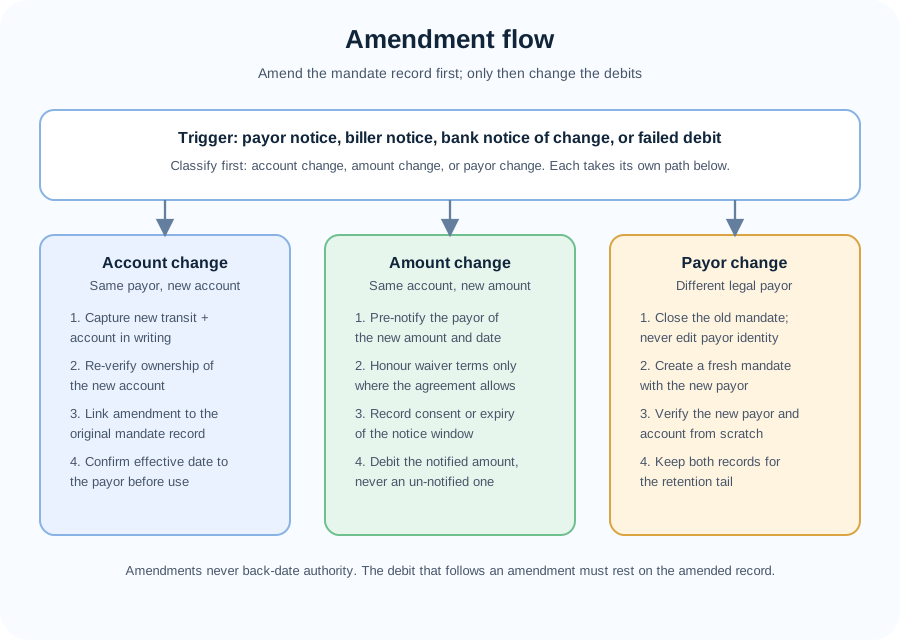
Amendments divide into three families, and the classification decides everything downstream — which is why the diagram insists on classifying first. An account change keeps the same legal payor and moves the authority to a new account: capture the new routing in writing, re-verify ownership of the new account with the same care as a new mandate, link the amendment to the original record, and confirm the effective date to the payor before debiting the new account. The failure mode is debiting the new account on the strength of the old verification — a different account is a different fact and needs its own proof. A payor instruction to change the account, or a bank-originated Notice of Change (NOC), triggers this path. A payor instruction may update the existing agreement or create a new one, with the instruction retained. A valid NOC for an administrative routing change that does not move the account to another Processing Member is deemed the Payor's authorization under Rule H1; it does not require a fresh payor authorization, but the payee must accept and act on it, validate the update, preserve the NOC and keep the effective-date/linkage controls. A move to another Processing Member needs a new onboarding decision.
An amount change keeps the same payor and account and varies what is taken: provide the required Pre-notification of the amount and date, honour only a specifically and prominently authorized waiver or a Rule H1 exception, record the notice and its delivery, and debit exactly what was notified. The failure modes cluster here because variable billing tempts operational shortcuts: debiting before the notice window expires, debiting a different figure from the one notified, or treating a general terms-and-conditions update as notice of a specific debit change. Pre-notification is a Rule H1 condition and evidence requirement, not a substitute for the PAD Agreement; the current rule sets the claim consequences and exceptions.
A payor change — a different legal person or entity now to be debited — is not an amendment at all. Close the old mandate with a termination record, create a fresh mandate with the new payor, verify from scratch, and keep both records for the retention tail. The temptation to "just update the name" concentrates in divorces, roommate turnovers, business successions, and estate situations, all sympathetic and all irrelevant to the rule: authority from one person cannot be edited into authority from another. The bank-side analogue is equally strict — account-ownership validation must confirm the new payor's authority over the account to be debited, not merely the old payor's say-so. Every auditor and every dispute handler checks this boundary first, because crossing it creates debits with no authority whatsoever.
Master-data quality is therefore a collections control, not an administrative nicety: clean biller customer masters, validated banking details at onboarding, disciplined amendment intake, and descriptors the payor will recognize prevent more disputes than any downstream recovery process. And evidence preservation starts at origination: agreements, consents, verification results, confirmations, notices, and release records must be retained retrievably for the full window in which disputes, returns, and audits can arise. Storage is cheap. Reconstruction is expensive. Adverse dispute findings are most expensive.
6. Rules, cutoffs, service levels and customer impact
Customers experience rules as promises: will the debit arrive on the date stated, will I be told before the amount changes, what happens if I cancel, how do I get money back. The bank and the biller experience rules as obligations and evidence. This section gives the current Rule H1 timing anchors for orientation; the published rulebook, applicable law and each bank's operating schedules remain binding. Cutoff hours are not universal Rule H1 values and must come from the relevant participant.
The rulebook layering is straightforward in shape. The PAD procedures under Rule H1 govern what may be exchanged as a PAD, what each PAD agreement must contain, how authorization is captured and confirmed across channels, how changes are notified, how cancellation works, and how reimbursement claims are handled — with appendices carrying the mandatory agreement elements and standard forms. For implementation, Rule H1 section 20 identifies AFT PADs in the dedicated ISO AFT transaction-code element or Standard 005 and paper PADs under the A Rules/Standard 006; the biller's mandate ID, API contract, file envelope and internal trace mapping remain bank/processor-specific and must not be presented as ACSS-standard fields. Around Rule H1 sit the general clearing rules for exchange, returns, and adjustments, the technical standards for file formats and codes, and each bank's own operating schedules for cutoffs and availability. Functionally, every operational question — may we debit this, must we notify that, who produces what by when — has a binding answer in the published framework, and operational habit is never a substitute for checking the current version. Rule text is amended from time to time with transition provisions; procedures written against a superseded version drift into non-compliance silently, which is why Section 10 puts rule-currency review on a calendar rather than leaving it to memory.
Authorization timing is the load-bearing rule of the whole lifecycle, and it is absolute: the payor's authorization must exist before the first debit is exchanged. Not "in the mail," not "captured but not yet filed," not "the payor said yes and the form follows." Existing, complete, verifiable, and stored. For Personal and Business PADs, the default Confirmation is provided or made available at least 10 calendar days before the first due date; a specifically authorized waiver/reduction moves the Confirmation to within 5 calendar days after the first PAD. For Set Interval PADs, Pre-notification specifying amount and date is generally at least 10 calendar days before a changed fixed amount/date and before each variable amount after the first; Rule H1 contains limited exceptions and prominent waiver rules. One-time authorities terminate automatically once the single debit completes; the biller that treats a one-time authority as the start of a recurring relationship manufactures its own unauthorized-debit stream.
Current Rule H1 claim clocks must be read by PAD category: a no-agreement claim is generally up to 90 calendar days after the posting date; a declared-condition claim for a Personal PAD (and a Funds Transfer PAD not coded for the recourse exception) is up to 90 calendar days after debit, while a Business PAD claim is up to 10 Business Days after debit. The Processing Member obtains the required signed, authorized, or otherwise authenticated Reimbursement Claim and reimburses on a best-efforts basis; claims outside those windows are addressed outside the Rules.
Business days and cutoffs bound every promise in collections. The batch system operates on business days under a published closure calendar, and each bank layers its own file cutoffs, release discipline, and availability schedules on top. A collection file released after the applicable cutoff belongs to the next window — not to "today with a wish attached" — and customer communication should state the effective debit timing honestly at release rather than explaining slippage after payors complain. Cutoff hours and file/API schemas are bank or processor operating details; Rule H1 and Payments Canada standards govern the clearing fields and transaction coding. Holiday weeks shift value dates, settlement mornings, and the clocks that dispute and return windows run on; every collections calendar for affected weeks should reflect the shift proactively. Channels must never promise what the operations calendar cannot deliver, which means biller promises about debit dates and bank promises about posting must share one clock: the commitment made to the payor is only what processing confirms for this mandate, this amount, this business day.
Service levels bundle timing with certainty, information, and recourse, and the advisory job is to match the business event to the bundle honestly. PAD offers low-cost, high-certainty collection for recurring obligations — at the price of return exposure and payor recourse rights that survive settlement. Same-day-final rails offer immediacy and irrevocability at wholesale pricing with no unilateral recall. The honest conversation compares bundles, not speeds, and a biller sold on PAD's price while expecting wire-like finality will experience every routine return as a betrayal. Availability language needs the same honesty: collected funds usable for operations are not the same as funds immune from return, and biller cash planning should carry an explicit returns assumption rather than discovering the gap during a large claim event.
Customer communication must reflect authority honestly at every touchpoint. "Authorized" means a complete agreement exists, verified and stored, covering this payor, this account, this amount logic, this rhythm. "Notified" means the payor received the specific change notice the authority requires, inside its window. "Cancelled" means the revocation is recorded and the biller is using the required best efforts to stop the next cycle and all new PADs within the applicable period — with the effective-date honesty that debits already in flight may still arrive and will be handled through the return/reimbursement path, not as silent edits. "Refunded" versus "reimbursed" should follow the programme's vocabulary discipline: commercial goodwill from the biller is a refund; rule-driven repayment through the dispute mechanism is reimbursement. Most mandate complaints are vocabulary failures wearing operational costumes: the payor heard "cancelled" and understood "nothing will ever arrive again," and nobody corrected the translation until a debit in flight landed.
7. Fraud, compliance and operational controls
Controls fail most often not by absence but by placement. A verification check that runs after the first debit has cleared, a dispute defence assembled only after the proof request arrives, an account-ownership confirmation skipped because the payor "seemed legitimate" — each is a control that exists and still loses, because it runs on the wrong side of the event it was meant to govern. This section places each control family at the point in the mandate lifecycle where it can still change the outcome. Rail-level fraud landscapes and screening-system detail live in the programme's risk and compliance coverage; here the lesson is architectural: prevention sits before first debit, detection sits across capture and collection, and evidence sits everywhere.
Unauthorized-PAD fraud is the signature threat of this instrument, and it wears several faces worth learning by shape. Fabricated mandates attack capture: à fraudster enrols a victim's account — harvested from a stolen cheque, a compromised invoice, a purchased lead list — and the first sign is a debit the account holder never authorized. Friendly misrepresentation attacks the dispute path: a genuine payor who did authorize the debits claims otherwise after receiving goods or services, betting the biller cannot produce the proof. Mule-supported collection fraud attacks the biller side: sham billers enrol complicit or deceived "payors," collect debits, and cash out before disputes mature. Insider manipulation attacks amendment: account numbers on live mandates are altered toward controlled accounts, with the amendment disguised as routine maintenance. Each shape is met primarily before first debit — verification proportionate to relationship newness and amount risk, confirmation copies that surface fraud to the real payor early, velocity and anomaly checks on new mandates, dual control over amendment entry — and only secondarily through dispute handling. A confirmation letter the real payor receives and challenges within days converts a six-month fraud drain into a single stopped mandate.
Authorization controls deserve separate emphasis because pulls move money on claimed authority. The biller must be able to evidence the payor's authorization when challenged: the agreement showing mandatory content, the consent record showing the payor's act, the verification result showing the ownership check, the confirmation showing the payor was told, and the linkage showing this debit rests on that agreement as amended. The biller's bank must satisfy itself its customer can do this before sponsoring volume and must test the claim periodically — sample retrievals with a clock running are worth more than attestations. The payor bank must authenticate and classify the reimbursement claim against the current Rule H1 declared conditions and time limit; the biller-side evidence request remains important for recourse, investigation and any outside-the-Rules dispute. Authorization evidence is created at onboarding and preserved at origination, never assembled during a dispute. The biller must be able to provide the agreement or other evidence within a reasonable time after a reasonable request; separately, the payor bank's Rule H1 reimbursement decision is driven by the authenticated claim, declared condition and time limit, not a discretionary proof trial. A missing archive still creates recourse, liability and investigation risk.
Sanctions, watchlist, and record-keeping controls may attach to PAD operations, but they are not substitutes for PAD authorization and their legal applicability depends on the regulated entity and activity. Banks and other reporting entities apply their AML/sanctions programmes and document screening decisions under their own policies; a biller or PSP must not be treated as a bank merely because it uses a sponsor. FINTRAC expressly excludes direct deposits and pre-authorized debits from the statutory "electronic funds transfer" definition used for EFT reporting, so this chapter must not imply that every domestic PAD is an EFT report. Capture client, transaction and screening data required by the applicable PCMLTFA/PCMLTFR obligations, preserve it untruncated and route suspicious activity/reporting decisions through the responsible reporting entity. Thresholds and filing mechanics belong to current FINTRAC guidance and the entity's compliance programme.
Consumer-protection expectations run alongside the rulebook and constrain how billers sell, notify, and cancel. Agreements must be understandable rather than merely signed — plain language, visible key terms, no pre-ticked waivers, genuine copies. Amount and timing changes must be communicated so the payor can act, not buried in statements. Cancellation must be effective through reasonable channels without retention gauntlets; a payor who must phone three times, visit in person, and then watch another debit arrive has experienced a mandate failure regardless of what the file says. Front-line bank staff need the same fluency: recognizing a PAD descriptor, explaining recourse in plain language, starting the claim clock immediately, and never adjudicating the underlying bill. Supervisors and audit will ask for exactly what this chapter has been building — who authorized, how verified, what notified, when cancelled, how retrieved — and a biller or bank that keeps that evidence as a by-product of disciplined processing answers easily.
Operational controls tie the families together: entitlements and dual approval over mandate creation and amendment, limits and velocity on new mandates and amount changes, cutoff enforcement on collection files, queue ownership with ageing on verification gaps and retrieval requests, amendment discipline per Section 5, evidence preservation per Section 9, and segregation between the teams that enrol billers, release files, and handle claims. The control that binds them is release discipline carried over from batch fundamentals — no collection file reaches clearing without passing validation, screening, cutoff, and approval in order, each decision logged. Overrides must themselves be controlled, dual-approved, time-bound, and reviewed, because the history of collections losses is largely a history of overrides that bypassed the order.
8. Exceptions, investigations and recovery
Every mandate breaks differently, but every break is managed the same way: detect fast, classify correctly, contain within the rules' rights, recover as a new linked event, and reconcile with evidence. Billers and banks that classify first recover cheaply. Those that act first — re-debiting aggressively, manually crediting without linkage, editing a mandate record in place — create duplicate collections, duplicate credits, and audit breaks that dwarf the original error. This section teaches the classification and the recovery discipline at lifecycle depth. Full dispute mechanics, timelines, and reimbursement flows belong to the companion cancellation, disputes, and reimbursement chapter, which this section summarizes and points to throughout.
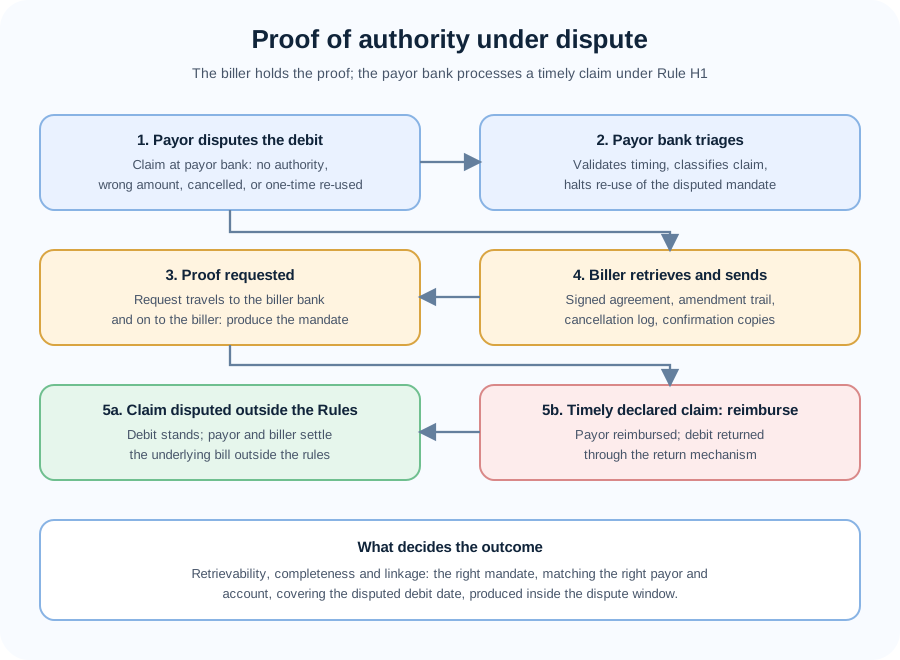
Start with the taxonomy, because precise words are the cheapest control in exception handling. A capture defect means the mandate was never sound — missing content, no verification, no evidence — and the remedy is to stop collecting and repair the mandate before any further debit, not to keep debiting while paperwork catches up. A notice failure means debits rest on authority whose change-notification step was skipped: the remedy is to notify properly and re-establish authority for future debits, accepting that challenged debits without notice support fall. A cancelled-mandate debit means collection continued after termination took effect: the remedy is to stop, reimburse through the defined path where required, and fix the cancellation propagation that let an in-flight or scheduled debit escape. A re-used one-time authority means a second debit against an agreement that terminated with its single use: the remedy is a fresh agreement, not an argument. An amount inconsistency means the debit taken differs from the debit authorized and notified: the remedy turns on the notice and agreement evidence, not on what the underlying bill genuinely owed. A true no-authority claim means the payor denies the mandate entirely: for a timely claim, the Processing Member obtains the required authenticated Reimbursement Claim and reimburses/returns under the applicable Rule H1 process; evidence production remains necessary for sponsor recourse, fraud investigation and any dispute outside the Rules. Each word means something different, and using them interchangeably in customer communication or incident tickets guarantees confusion the incident itself did not require.
Investigations run on evidence assembled from the chain in Section 2, and the proof-retrieval diagram below is the runbook picture. Start from the disputed debit's linkage — which mandate, as amended when — then assemble the pack: the agreement as signed, every amendment since, the verification result, the confirmation and notice records covering the disputed date, and the collection record showing this debit. Under Rule H1, the Processing Member accepts a timely claim under a declared condition, obtains the required signed/authorized Written or Recorded Reimbursement Claim, and on a best-efforts basis immediately reimburses and returns the PAD. The biller-side evidence pack is still required within a reasonable time for the sponsor's recourse, fraud investigation and any validity dispute, but a "valid proof means the bank denies" decision tree is not the current Rule H1 model; disputes by the Payee are addressed outside the Rules. For the biller's bank, the investigation path runs through its customer with a clock running — requests for proof must reach the biller fast enough to leave retrieval and assessment time inside the dispute window. Status communication follows the vocabulary rule from Section 6: state what is known and being done, never upgrade "retrieval in progress" to "resolved" before the evidence arrives.
Containment deserves a final word because collection scale punishes slow containment. A compromised biller credential originating debits against harvested accounts: first hold pending releases from the affected biller, quarantine the mandate intake under suspicion, notify the sponsoring and payor banks through defined channels — and only then diagnose. A batch of debits issued under a defective new agreement version: first suspend that cohort's future collections, assess how many debits lack notice support, provision for the reimbursement exposure honestly — and only then fix the template. An amendmentapture failure that redirected debits to wrong accounts: first freeze the amendment queue, identify every mandate touched by the faulty process, re-verify each before resuming. Containment decisions need pre-assigned authority reachable during every collection window, not an escalation tree that convenes tomorrow. Recovery follows one iron rule carried over from batch discipline: never mutate history; always create a linked new event. A defective mandate is repaired by a new authorization event linked to the old record. A wrongly taken debit is corrected by a reimbursement or a properly notified re-collection, each referencing the original. Every recovery carries its references minimum: the mandate identifier, the disputed debit's trace, and the new event's own identifier. This linkage is what makes reconciliation possible and what auditors verify.
9. Posting, accounting, liquidity, reporting and reconciliation
This is the section where mandates become money on statements and evidence in archives — where operations, finance, and audit meet. Posting moves customer balances. Accounting records what the bank and biller did in their own books. Reporting tells payors, billers, and counterparties what happened. Reconciliation proves the whole story agrees. Retention keeps the proof alive for the applicable Rule H1, legal and policy windows in which disputes and examinations can still arrive. Each is a distinct discipline with distinct owners, and mandate failures at month-end, under dispute, or in front of examiners almost always trace to blurring two of them. Keep them separate and each becomes manageable.
Posting translates collection outcomes into customer account entries. The payor's bank debits payor accounts under its posting schedule with descriptors that identify the biller recognizably — statement clarity is a dispute control, because unrecognizable descriptors convert authorized debits into claims. The biller's bank credits collected funds under agreed availability that prudent agreements separate from interbank settlement and recourse: usable-for-operations is not immune-from-return, and the biller's cash planning should carry an explicit returns assumption sized from history rather than optimism. Memo-versus-hard discipline matters on both sides because provisional entries that look final create the complaints that erode trust fastest. Returns and reimbursements post as their own linked entries with the clearing trace, reason information and claim evidence the recipient can act on — never as edits to history, never as unexplained reversals the payor or biller must phone to decode.
Accounting records each party's own position through every stage. Functionally, mandate accounting separates three things that must never be netted prematurely: amounts due to and from customers, amounts due to and from clearing through positions and settlement accounts, and the fees and adjustments that are each party's own income or expense. Clearing and suspense accounts carry items between exchange and settlement; settlement accounts carry the final interbank movement for direct clearers; agency accounts carry the indirect bank's position with its agent. Reimbursements, adjustments, and compensation post as linked entries referencing the original debit and mandate — the linkage auditors trace. Each suspense balance must clear to zero on its own cycle, and ageing in any mandate-related suspense account is an exception to be worked, not a balance to be tolerated.
Reporting closes the loop to everyone with a stake in the outcome. Payors receive statements and advices whose descriptors, amounts, and dates let them match each debit to an authorization they remember — plus notifications of amount changes, confirmations of new mandates, and acknowledgements of cancellation, each a dispute prevented. Billers receive acceptance, rejection, return, and dispute reporting on cycles that let them repair within the next window: which debits cleared, which returned for funds versus account versus authority reasons, which mandates face claims with what clocks running. Agents report positions, settlement, and returns to indirect clearers in sufficient detail for the indirect bank to post, reconcile, and answer its customers. Management receives lifecycle dashboards: mandates by status, verification gaps ageing, amendment volumes, retrieval turnaround, dispute outcomes by reason, retention compliance. Each audience needs its own cut of the same truth, generated from the same anchored identifiers.
Reconciliation proves the story, and mandate reconciliation is linkage verification at its core. Internal records — mandates created versus mandates stored, debits released versus debits posted — must agree: every released debit links internally to a live mandate covering its date, amount logic, and account, and to the bank/clearing trace used to match returns. Internal records must agree with clearing evidence — exchanged, positioned, and returned as reported. Clearing evidence must agree with settlement evidence for direct clearers, and indirect clearers reconcile through their agent's reporting. Breaks get worked by category — timing breaks clearing next cycle versus genuine breaks signalling missing mandates, broken linkage, or processing defects — with ownership and ageing on every open break. Unreconciled differences compound with age, and mandate breaks compound fastest of all, because each day without linkage is another day of potentially unauthorized collection.
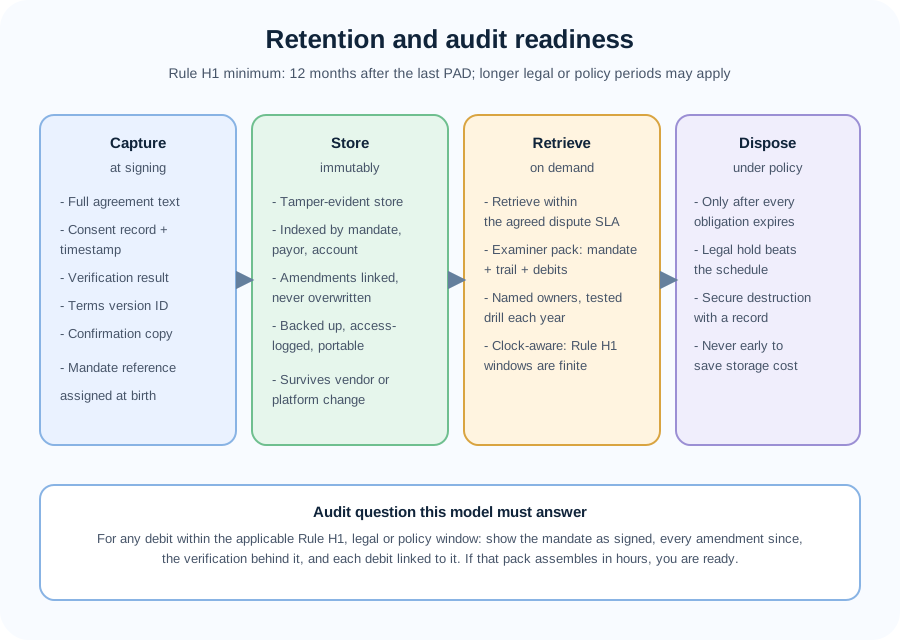
Retention is the discipline that keeps all of the above provable for as long as it can be challenged. Functionally: retain complete mandate evidence — the agreement, consent record, verification result, confirmations, notices, amendments, cancellation records, and the internal debit-to-clearing-trace linkage — retrievable for at least the Rule H1 minimum of 12 months following the last PAD, and longer where another statutory, legal, contractual, tax, privacy, legal-hold or bank-policy requirement applies. The retention-and-audit-readiness diagram below shows the model: capture completely at signing, store immutably with linkage intact, retrieve within the agreed dispute/examination SLA, and dispose only under policy once every obligation has expired — with legal holds overriding any schedule. Design choices follow directly: tamper-evident storage rather than editable shares, indexing by mandate, payor, and account rather than by date alone, amendment trails rather than overwritten records, portability across vendor and platform changes, access logging that proves who saw what, and tested retrieval drills — because a retention policy that has never been timed against a dispute clock is a hope, not a control. Never destroy early to save storage cost; storage is the cheapest line in the mandate budget and reconstruction the dearest.
10. Bank implementation, testing and resilience
Onboarding PAD collection — as a biller's bank sponsoring originators, as a payor's bank posting debits and processing claims, or as a biller building its own mandate operations — is an implementation project with regulatory, operational, and customer dimensions. This section maps it at the level a product owner, analyst, or operations manager needs. It does not replace vendor documentation, testing guides, or the rulebook. It tells you what the work consists of, where the risk concentrates, and how to tell a ready institution from an unready one.
Sponsorship implementation comes first for the biller's bank: product definition for PAD origination services, the payee-undertaking contracting with each biller, due diligence on the biller's capture channels and verification methods, file specifications and testing with the biller's platform, cutoff and return-handling configuration, dispute-workflow integration with retrieval turnaround commitments, and commercial terms including liability allocation and provision for reimbursement exposure. The diligence step deserves weight proportionate to its consequences: sampling the biller's actual mandates, timing a test retrieval, reviewing confirmation and notice templates against mandatory content, and walking an amendment and a cancellation end to end. A sponsorship approved on the biller's attestation alone is an underwriting decision made blind, and blind underwriting in debit-pull collection eventually invoices itself through someone else's dispute queue.
Payor-bank implementation mirrors it from the account side: posting-schedule configuration with recognizable descriptor standards, return-reason handling with straight-through matching to originals, dispute-intake workflows with clock management from the debit date, proof-request channels to biller banks with turnaround tracking, reimbursement processing with linkage discipline, and customer communication templates that use the Section 6 vocabulary correctly under stress. Front-line readiness is the binding constraint: dispute clocks start when the payor complains, and a branch or contact-centre team that cannot recognize a PAD claim, start its clock, and route it the same day has already spent a material share of the window. Training must therefore cover recognition, intake, and routing — not rule citations — with job aids that fit on one page and procedures that survive a new hire's first month.
Biller-vendor integration is where most institutions actually live after go-live, because capture screens, mandate vaults, and collection engines usually belong to vendors. Every vendor selection, migration, and upgrade is a mini-implementation: contractual assignment of who captures, verifies, stores, retrieves, and within what turnaround; data-mapping validation so mandatory elements and references survive; retrieval testing with a clock running, not a screenshot; exit and portability terms so the mandate archive outlives the vendor relationship; and access-control alignment so amendment entry carries dual control and audit trails. The question that kills troubled integrations is embarrassingly simple — show me the archive leaving the vendor intact — and it should be asked before signing, not during the dispute that discovers the answer.
Testing must cover the unhappy paths with at least the energy given to the happy ones: defective mandates rejected at capture, verification failures, amount changes without notice, cancellations racing in-flight debits, re-used one-time authorities, proof requests against amended mandates, retrieval under time pressure, holiday-week calendars shifting every clock, vendor failover with archive continuity. Parallel operation — running new flows alongside old with full reconciliation comparison — earns its cost the first time it catches a mapping defect. Cutover needs a rollback plan with a named decision-maker and a clock: collection windows do not wait while committees convene.
Resilience is the supervisory-grade expression of all of this. Backup file paths and contingency connectivity must be tested, not merely documented. Missed-window procedures must state plainly what happens: collections belong to the next window, billers and payors are told so promptly, funding forecasts are revised. Dispute-surge contingency — a failed biller's customer base claiming at once, a template defect invalidating a cohort's notices — needs pre-assigned authority, extra retrieval capacity, and honest provisioning. Rule-currency review belongs on a calendar: assign an owner, track published amendments with their transition provisions, impact-assess procedures and templates against each change, and re-test before the transition expires. Modernization readiness closes the section with the same honesty this programme applies everywhere: prepare architectures with rail adapters and disciplined reference carriage so future capabilities arrive as adapters plus testing rather than rebuilds, track official operator and central-bank publications, and keep routing customers to the live systems that serve them today.
11. Practical Canadian examples
Theory settles when you watch it work on recognizable business. The three cases below are fictional — invented organizations, invented figures, realistic mechanics — each labelled as required. They cross a consumer dispute, a business account migration, and a charity amount change so you see the same lifecycle serving different needs, and each ends with the control lesson a banker, analyst, product owner, or operations lead should take back to work. None of them requires dispute-mechanics depth beyond this chapter; where deeper timelines appear, the case notes which companion chapter teaches them.
Example (fictional): Lakeside Fitness and the member who says she cancelled. Lakeside is a fictional Ontario fitness chain collecting about 6,000 monthly memberships by PAD. A member emails the club in mid-January asking to cancel at month-end; the request is logged in the club's front-desk system but never forwarded to the billing team. February's debit goes out on schedule. The member sees it, phones her bank, and claims the debit was unauthorized because she had cancelled. The payor bank opens a claim, and the biller side is asked for evidence through Lakeside's bank. Lakeside retrieves the original signed membership authorization quickly — that part of the archive works — but the retrieval exposes the gap: the agreement is valid, the amount matches, the account is right, yet the cancellation record is missing because the front-desk log never became a mandate-system termination. The timely claim is reimbursed and the debit is returned under the applicable Rule H1 mechanism; whether Lakeside disputes the claim is a matter for Lakeside, its sponsor, and the payor/customer outside the Rules. Lakeside fixes the actual defect: one cancellation intake feeding both the club system and the mandate system, with termination records and effective dates.
Control lesson: cancellation is a lifecycle stage with the same evidence standard as creation. A mandate system that captures brilliantly and terminates sloppily will lose disputes it should win, because the dispute examines the mandate as it stood on the debit date — including whether a termination should have been recorded. The companion cancellation, disputes, and reimbursement chapter teaches the claim mechanics in full; this chapter's lesson is that the termination record is part of the mandate, and its absence is evidence too.
Example (fictional): Prairie Mutual and the broker-block account migration. Prairie Mutual is a fictional Alberta insurer collecting premiums from about 40,000 policyholders, many through brokers. A mid-sized broker moves its client premium accounts to a new banking arrangement and sends Prairie Mutual a spreadsheet of 900 updated account numbers with a cover letter asserting policyholder consent. The operations analyst assigned to the file faces the decision this section exists to teach: treat the spreadsheet as 900 account-change amendments, or treat it as an unverified list. She chooses correctly — each row becomes an account-change task requiring written payor confirmation and re-verification of ownership of the new account before any debit migrates. Roughly 700 policyholders confirm within the notice cycle and migrate cleanly with linked amendments and effective-date confirmations. About 150 never respond; their debits continue against the old accounts until confirmed, with broker follow-up rather than silent migration. A dozen turn out to have changed insurers entirely and their mandates are terminated instead. One row carries an account number that fails ownership verification and is quarantined for fraud review — the exact case verification exists to catch.
Control lesson: an account change is a new fact needing its own proof, and third-party assertions — however reputable the broker — are intake, not authority. The batch that migrates 700 mandates cleanly while holding 200 back is not slow operations; it is the control working, and the quarantined row is the return on the whole discipline. Section 5's amendment paths and Section 7's verification standard are the working references; the fraud coverage elsewhere in the programme teaches the harvesting patterns that make brokerBatch lists attractive cover.
Example (fictional): Harbour Lights Charity and the five-dollar increase. Harbour Lights is a fictional Nova Scotia charity with about 12,000 monthly donors, most giving fixed amounts by PAD. The board approves an optional five-dollar monthly increase, communicated as an opt-in campaign: donors who consent move to the higher amount; donors who do nothing stay where they are. The campaign team drafts the notice carefully — new amount, effective date, how to accept, confirmation of what happens without action — and the operations team builds the consent capture before a single increased debit is scheduled. About 3,000 donors opt in with recorded consents linked to their mandates; their increased debits begin on the notified date with the notice records attached. A control failure in week three makes the case instructive: a file-scheduling error queues the increased amount against 400 donors who had not consented, and the error is caught the morning after release but before the debit date. The team pulls the affected debits, re-issues at the original amounts, notifies the impacted donors proactively with an apology and an explanation, and logs the near-miss with its root cause — a scheduling flag decoupled from the consent linkage. No dispute follows, because no wrong debit was exchanged; the incident becomes a testing case for the consent-gated release check that should have blocked the file.
Control lesson: amount authority is per-debit — agreement plus notice plus consent — and the release gate must enforce that linkage mechanically. Caught before exchange it is a repair; caught after, a reimbursement exposure across hundreds of donors.
Read together, the three cases rehearse the chapter's core moves: capture completely, verify before first debit, confirm so the payor can correct, amend through the right family path with linkage, terminate with the same rigour as creation, produce proof in hours, and recover as linked new events. If you can walk any one of these cases from authorization to archive without confusing capture with verification or notice with consent, the lifecycle is yours.
12. Key takeaways and authoritative references
Twelve points carry this chapter. If you retain nothing else, retain these — and know where each one deepens in the companion chapters.
- A PAD mandate is the durable authorization behind every debit-pull collection. One capture supports many debits across months or years, which makes capture quality the highest-leverage investment in collections operations.
- Authorization must pre-date the first debit — always, in every channel. "In the mail," "form follows," and "the payor said yes" are not authorizations. Existing, complete, verifiable, and stored is the standard.
- The biller retains the proof; the payor's bank may request it under dispute. Retrievability within the agreed service level, completeness of content, and linkage to the disputed debit support recourse, investigations and sponsor controls. A missing mandate pack creates material recourse and liability risk.
- Every channel produces the same mandatory content with channel-appropriate evidence. Paper yields signed forms and filed images; online yields session logs, consent records, and ownership checks; phone yields authentication, recordings, and written confirmations. Missing channel evidence locates the capture failure.
- Verify with commercially reasonable methods before first use. Proportionate to relationship, amount risk, and capability — and demonstrable afterwards. Verification after the fact is testimony, not control.
- Confirm so the payor can correct before money moves. Copies or compliant confirmations before the first debit — or promptly after where a genuine waiver shortens introduction — are the cheapest dispute prevention available.
- Amend through the right family: account change, amount change, or payor change. Re-verify new accounts, pre-notify amount changes with genuine waiver handling, and treat payor changes as new mandates — never edits.
- Pre-notification is a Rule H1 condition and evidence requirement, not a substitute for the PAD Agreement. The notice record for amount and timing changes must exist and be producible; a timely claim alleging missing notice is handled under the applicable recourse rules.
- Cancellation terminates with effective-date honesty. Record revocation promptly, confirm the effective date and use best efforts to cancel the next business, billing or processing cycle; under Rule H1, cease issuing new PADs within no more than 30 calendar days (or the clearly stated contractual period, capped at 30). Handle in-flight items through the applicable return/reimbursement path — never as silent edits.
- Unauthorized-PAD fraud is met before first debit. Layered verification, confirmations that surface fraud early, velocity checks on new mandates, and dual control over amendments beat any post-event defence.
- Recover as linked new events; never mutate history. Mandates are append-only, reimbursements reference their originals, and every recovery carries mandate identifier, debit trace, and its own identifier for audit.
- Retain complete evidence for at least 12 months after the last PAD under Rule H1, and longer where another obligation requires it. Tamper-evident storage, linkage-preserving amendments, indexed retrieval, tested drills, and policy-governed disposal are the audit-readiness model.
Forward map for this programme: the companion chapters take each summarized topic to working depth — PAD fundamentals and Rule H1 for instrument design and rule mechanics, PAD processing with NSF and retries for debit-by-debit return operations, cancellation, disputes, and reimbursement for the full claim machinery, and the fraud coverage for threat landscapes. Study them in order; each assumes the lifecycle vocabulary this chapter built. Do not write operational procedures from this lifecycle chapter alone.
Authoritative references (official sources only)
This chapter uses only official sources. Sources and live pages were checked on 2026-10-05; re-check time-sensitive pages before customer or examination use. Rule H1's exact timing, reimbursement and retention values are stated here for orientation but the current published rulebook, applicable law and each bank's operating schedules remain binding. Rules are described functionally throughout; this chapter is not a substitute for the rulebook.
- Payments Canada — Rule H1 for pre-authorized debits (PADs). Binding procedures for the exchange, clearing, and settlement of every PAD, with current published text, appendices, and version history. https://payments.ca/sites/default/files/h1eng.pdf
- Payments Canada — Pre-authorized debit business guide. Operator guidance for businesses issuing PADs, including the payee undertaking, commercially reasonable verification, mandatory agreement elements, one-time PADs, and recourse and return timelines at a functional level. https://www.payments.ca/payment-resources/support-guides/business-guides/pre-authorized-debit
- Payments Canada — Amendments to Rule H1 facilitating the PAD user experience. Operator announcement of the revised Rule H1 in effect 3 October 2022, including the uniform onboarding experience, revised verification expectations, and one-time PAD termination. https://www.payments.ca/amendments-rule-h1-facilitate-pre-authorized-debit-pad-user-experience
- Financial Consumer Agency of Canada — Pre-authorized debits (PAD). Government consumer guidance on setting up, cancelling, and disputing PAD agreements, including agreement contents, cancellation, and recourse for debits not approved. https://www.canada.ca/en/financial-consumer-agency/services/banking/preauthorized-debit.html
- Payments Canada — Rules and documentation page. Source for the current rules, standards, and by-laws in force, with versions and update history for confirming the binding text behind any functional description in this chapter. https://www.payments.ca/systems-services/rules-documentation
- Payments Canada — Retail batch payment system. Current ACSS/USBE scope, direct/indirect clearers, netting and morning settlement, and AFT PAD stream description. https://www.payments.ca/systems-services/payment-systems/retail-batch-payment-system
- Bank of Canada — Payment systems the Bank oversees. Current ACSS scope, exchange/clearing/settlement definitions, direct/indirect participation, and RTR modernization status. https://www.bankofcanada.ca/regulatory-oversight/financial-market-infrastructures/payment-systems-the-bank-of-canada-oversees/
- FINTRAC — Reporting electronic funds transfers. Current reporting-entity scope and statutory exclusion of direct deposits and PADs from the EFT definition. https://fintrac-canafe.canada.ca/guidance-directives/transaction-operation/eft-dt/eft-dt-eng
- Payments Canada — Real-Time Rail payment system and FAQ. RTR launch is stated as Q4 2026 and the system is in testing/assurance; its intended capabilities and proposed launch transaction limit are future-state, not current PAD production. https://www.payments.ca/systems-services/payment-systems/real-time-rail-payment-system and https://www.payments.ca/systems-services/payment-systems/real-time-rail-payment-system/frequently-asked-questions
Diagrams in this chapter: PAD mandate lifecycle; authorization channels and functional controls; PAD amendment flow; proof-of-authority retrieval under dispute; retention and audit-readiness model — all under /diagrams/payment-stories/canada/chapter-23/. The diagrams show ACSS as the live batch system and do not show RTR as a production path. Rule H1 minimum retention is 12 months after the last PAD; any longer period is legal/policy dependent. Stories, companies, and figures are fictional.
This application uses JavaScript for the full interactive experience. This text summary is served for accessibility and search indexing.