pacs.009 and Interbank Payments. Understand FI-to-FI payment data, settlement context and the role of pacs.009 in interbank processing.
Block 9 · Chapter 43 of 75
This chapter is about the payments customers never see and treasury never forgets. When a business pays a supplier, the customer watches one movement: money leaving its account and arriving at the beneficiary. Behind that single customer experience, banks move money between themselves — funding their own accounts, settling what retail batch clearing produced, meeting obligations to market infrastructures, and reimbursing each other for customer value already promised. In Canada's ISO 20022 world, the message family that carries those bank-to-bank movements is pacs.009, the financial-institution credit transfer. This chapter teaches you to read those movements the way an operations manager, a treasury dealer and an auditor read them: who owes whom, on which account, for what reason, with what proof.
The distinction at the heart of the chapter is simple and constantly blurred in practice. A pacs.008 customer credit transfer speaks for a customer: the originator bank acts on its customer's instruction toward the beneficiary bank, carrying customer, beneficiary and remittance context end to end. A pacs.009 speaks bank to bank: one financial institution moves value to another for settlement purposes — its own funding, a batch net position, a market-infrastructure obligation, or cover for a customer payment already advised. The sender and receiver are institutions. The customer, where one exists at all, is referenced rather than instructing. Confuse the two and every downstream discipline breaks: validation checks the wrong parties, screening reads the wrong risk, reconciliation looks on the wrong account, and investigations chase a customer leg when the break sits in the interbank leg, or the reverse.
This chapter keeps you at the operating-table level introduced in the end-to-end ecosystem view. It does not teach message schemas, field specifications or sample XML — there are none here, deliberately. It teaches what each interbank payment is for, who owns each side of it, what data must be complete before release, how it settles, how it is controlled, what happens when it fails, and how it reconciles across nostro and vostro books and settlement accounts at the Bank of Canada. Baseline is 5 October 2026. Lynx, Canada's real-time gross settlement system for high-value and time-critical payments, replaced LVTS effective September 2021 and operates as a designated systemically important system settling in central-bank money. Lynx messaging uses the live ISO 20022 (MX) standard, and that is the live context in which pacs.009 matters in Canada: interbank value moving with same-day finality during business-day settlement windows, surrounded by batch, correspondent and infrastructure obligations that never stop.
A note on how to read amounts, names and timings in this chapter. Every company, bank nickname, amount and scenario is fictional and labelled where it matters. Amounts illustrate decision logic — why a treasurer funds early, why an FMI payment jumps the queue, why a cover leg waits for its instruction — not pricing, limits or thresholds. No exact cutoff times appear anywhere: windows are described relatively (morning build, midday throughput, afternoon funding decisions) because binding times live in your bank's published schedules and the payments.ca business-day calendar, not in a study chapter. Every time this chapter says "functional," it means a business description you can act on without needing a specification document open beside it.
What you will be able to do after this chapter
After working through this chapter, you should be able to:
- explain what a pacs.009 financial-institution credit transfer is, in plain language, and why it exists separately from a pacs.008 customer credit transfer;
- draw the boundary between the customer leg and the interbank leg of a payment and state which parties, promises and proofs belong on each side;
- name the four functional interbank settlement use cases — own-account funding, ACSS net funding, financial market infrastructure settlement, and correspondent cover — and state what triggers each one;
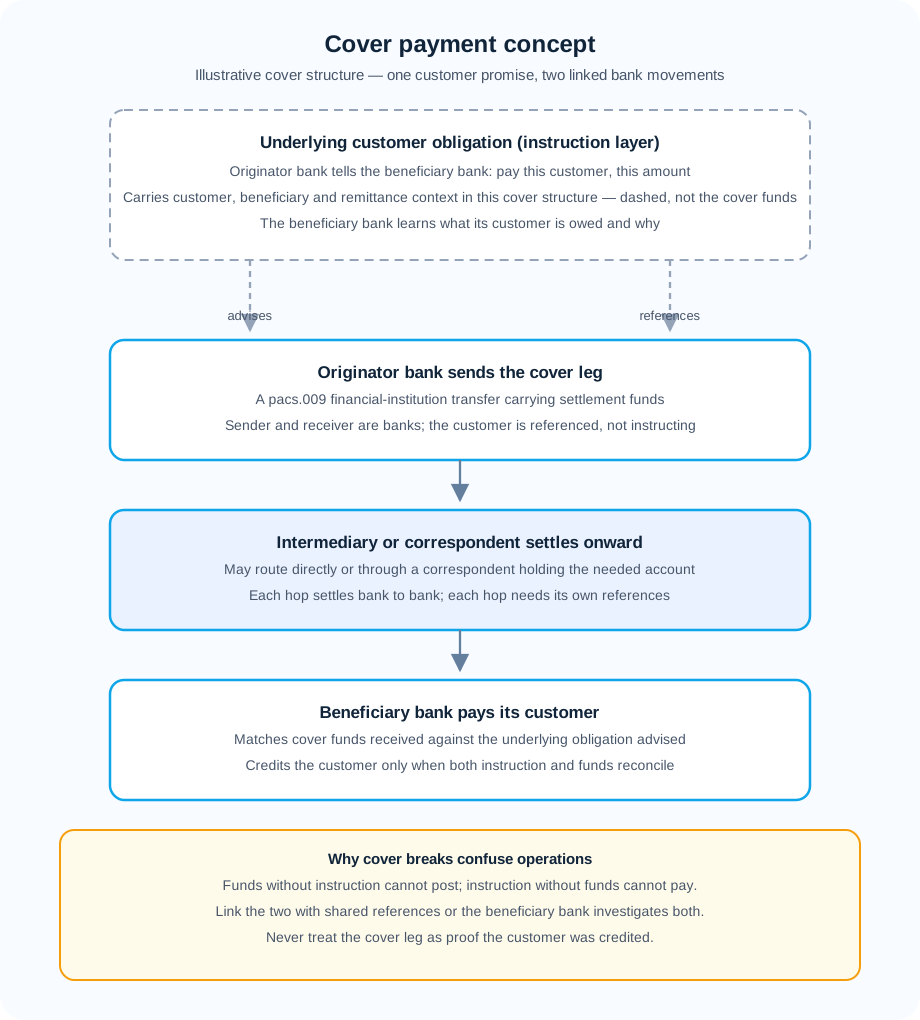
- explain the cover payment concept: how an underlying customer obligation and an interbank cover leg travel separately, link together, and break independently;
- describe what each participant owns in an interbank payment — sending and receiving institutions, intermediaries and correspondents, Payments Canada as system operator, and the Bank of Canada as settlement-account provider and overseer — without confusing messaging with settlement;
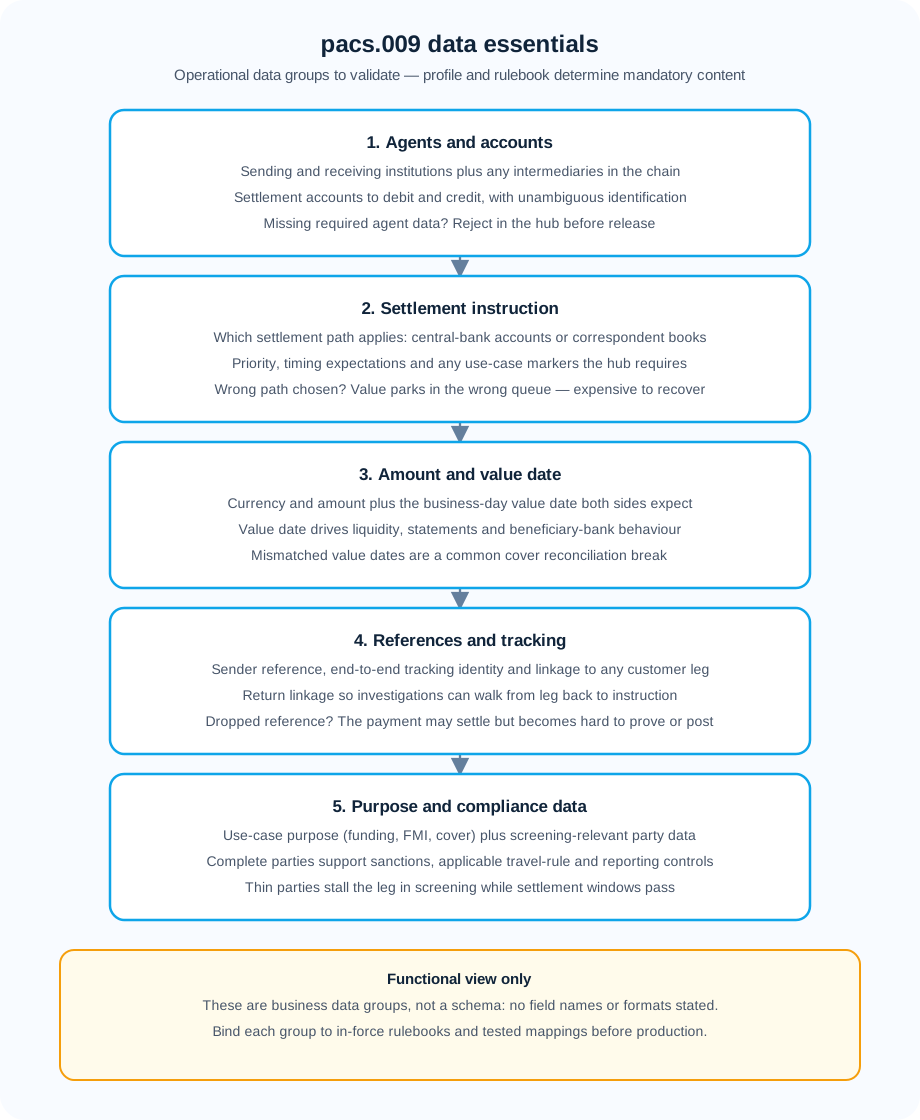
- list the functional data every pacs.009 needs before release — agents and accounts, settlement instruction, amount and value date, references and tracking, purpose and compliance data — and explain why incompleteness must stop release;
- trace an interbank payment from treasury or operations initiation through validation, approval, screening, release, Lynx settlement or correspondent posting, and confirmation;
- explain how interbank settlement achieves finality in central-bank money and why settled interbank value cannot be unilaterally unwound;
- place fraud, sanctions, travel-rule and reporting controls at the correct point in the interbank flow and explain why screening after settlement is recovery rather than prevention;
- classify interbank exceptions — rejects, settlement failures, misdirected legs, unmatched covers, duplicate funding — and describe recovery that preserves the original identity and never edits settled value;
- explain interbank posting, nostro and vostro accounting, settlement-account accounting at the Bank of Canada, and three-way reconciliation so that every leg is proved, not assumed;
- work through fictional end-to-end cases — an ACSS net funding payment and an FMI settlement payment, plus a correspondent cover — and extract the control lesson from each;
- navigate confidently to authoritative sources for binding rules, and correct the common misunderstandings that make interbank work expensive.
For a roughly 60-minute core session, spend about 10 minutes on the boundary diagram and Sections 1–2, 15 minutes on Sections 3–4 with the use-case diagram, 10 minutes on Section 5 with the data diagram, 10 minutes on Sections 7–9 with the reconciliation diagram, 10 minutes on the fictional cases in Section 11, and 5 minutes on takeaways and references in Section 12.
Chapter navigator
- Business context and customer need
- Participants, responsibilities and system boundaries
- Initiation, validation and bank processing
- Clearing, settlement and finality for interbank value
- Data, identifiers, messages and references
- Rules, cutoffs, service levels and customer impact
- Fraud, compliance and operational controls
- Exceptions, investigations and recovery
- Posting, accounting, liquidity, reporting and reconciliation
- Bank implementation, testing and resilience
- Practical Canadian interbank examples
- Key takeaways and authoritative references
1. Business context and customer need
No customer ever asked a bank to send a pacs.009. Customers ask for outcomes: payroll funded on time, a supplier paid today with certainty, a market obligation met before a cutoff, a US-dollar invoice settled on its value date. Interbank payments are how the bank keeps the promises its customer-facing payments imply. When retail batch items clear through the Automated Clearing Settlement System, somebody must fund the resulting net position. When a bank's balance sits in the wrong place for the afternoon's obligations, somebody must move it. When a market infrastructure calls for margin, somebody must pay it in final money. When a correspondent has paid out on a bank's behalf, somebody must reimburse it. Each of those somebodies is an operations or treasury desk sending a bank-to-bank transfer, and the quality of that unseen work decides whether the visible customer payment ever completes.
Consider a fictional Tuesday at a fictional mid-size bank — call it Harborview Trust — to make the abstraction concrete. Overnight, Harborview's retail customers originated thousands of batch items: payroll credits for several employers, supplier payment files from two distributors, and pre-authorized collections for three utilities. By mid-morning those items have been exchanged and clearing positions are taking shape; Harborview will owe a net amount at settlement and must fund it. At the same time, Harborview's treasury desk sees that its operating balance at its US correspondent is running thin against this week's cross-border outflow, so it plans an own-account funding movement. Shortly before noon, a market infrastructure to which Harborview belongs calls for a settlement payment with a hard afternoon deadline. And throughout the day, Harborview's wire desk advises customer payments whose interbank reimbursement must travel as cover legs to correspondent banks. Four different triggers, four different owners inside the bank, one shared settlement window, one shared pool of liquidity. If Harborview treats each as an isolated wire, the afternoon becomes a scramble for funds and the evening becomes a stack of unmatched breaks. If it operates one interbank discipline — use cases tagged, priorities set, data validated once, funding sequenced — the day closes with every obligation met and every leg proved.
That discipline matters because interbank payments concentrate risk precisely where they concentrate value: one funding or FMI leg can outweigh ten thousand retail items. A delayed funding payment leaves the bank short against a system obligation; a misdirected cover parks large value in the wrong account while two banks investigate. The asymmetry is stark — minutes of validation before release against days of recovery after settlement — and this chapter pushes effort to the cheap side of it.
The customer impact is indirect but absolute: no cover leg, no prompt crediting; no funding payment, no completed payroll position; no margin leg, no market access. The bank professional's job is translational — to win the same control investment for invisible bank-to-bank movements as for visible customer products, and to design operations where those movements cannot silently fail.
Modernization sharpens the point. Lynx settles interbank legs finally and individually in central-bank money with ISO 20022-enabled messaging: richer information rewards clean party data and disciplined references, and finality rewards validation before release, because there is no unilateral unwind after settlement. The surrounding chapters teach the customer leg, the batch world and the cross-border world; this chapter teaches the connective tissue without which none of those worlds settle.
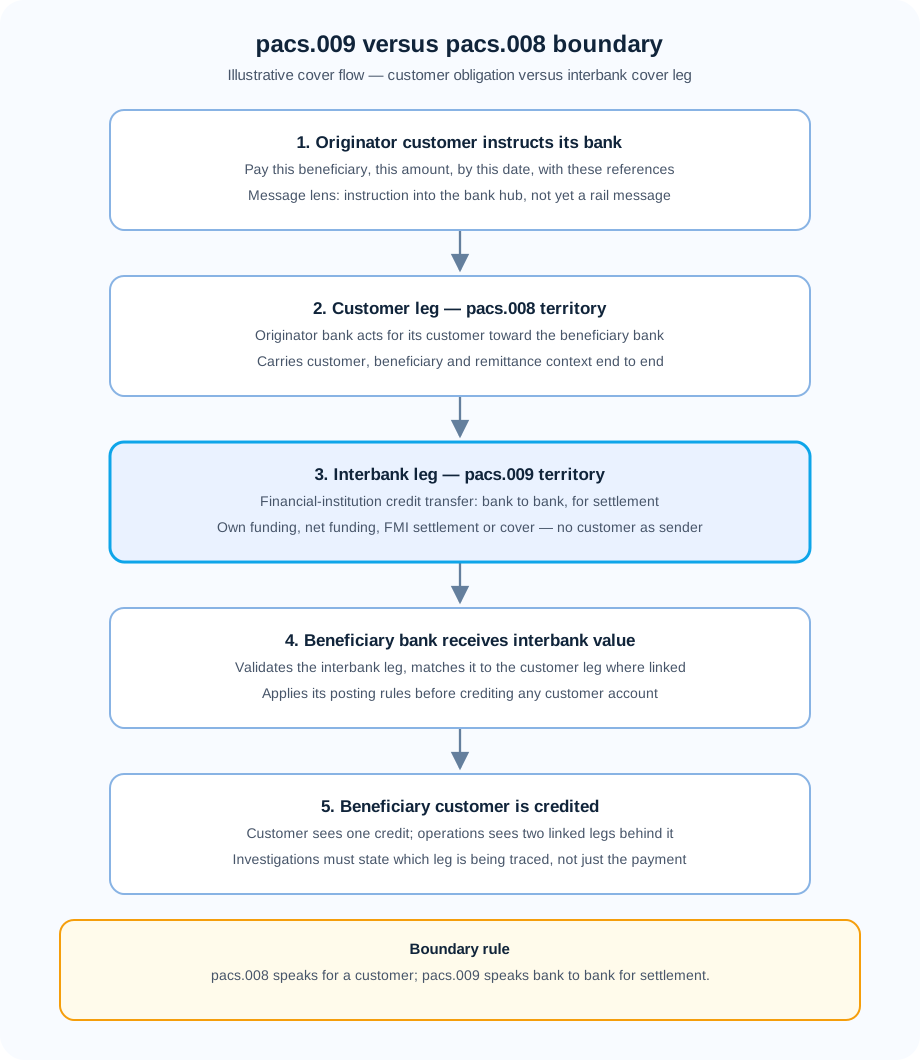
The diagram above is the chapter's anchor. Read it top to bottom as the life of value: a customer instructs, the customer leg carries the instruction between banks, the interbank leg moves settlement funds bank to bank, the beneficiary bank receives and matches, and the beneficiary is credited. Every later section is a deeper pass over one box in that picture — who owns it, what data it needs, how it settles, how it is controlled, and how it is proved.
2. Participants, responsibilities and system boundaries
An interbank payment involves fewer parties than a customer payment chain but grants each of them sharper responsibility, because every participant is a financial institution acting for its own account or for settlement purposes rather than a customer giving instructions. Keeping the cast straight prevents the two costliest confusions in this space: treating an intermediary as the party that owes the customer money, and treating a messaging network as the place where value settles.
Start with the two principals. The sending institution — sometimes called the instructing agent in message terminology — owns the decision to pay, the funding behind it, and the accuracy of everything the leg asserts. It warrants that it is authorized to move the funds, that the receiving institution is correctly identified, that the amount and value date are as stated, and that the purpose and references are truthful. The receiving institution — the instructed agent — owns validation on arrival, correct crediting to the right account, matching against any underlying customer obligation, and prompt confirmation or exception handling. Between them there is no customer to absorb ambiguity: if the sending bank misidentifies the receiving account, the receiving bank cannot ask a customer what was meant. It can only return, query or hold under its rules, while value sits idle.
Intermediaries and correspondents extend the chain where the sending bank has no direct settlement path to the ultimate beneficiary institution. An intermediary passes the leg onward, typically along a chain defined by account relationships; each hop is its own bank-to-bank settlement with its own references and its own finality. A correspondent holds accounts — nostro from the sender's view, vostro from the holder's view — across which reimbursement settles. The boundary that matters operationally is this: every hop settles on somebody's books, and messaging a hop is not settling it. A bank that has forwarded instructions but has not moved funds on an account has advised, not paid. Investigations in Section 8 walk hop by hop precisely because each hop can succeed or fail independently.
Payments Canada owns and operates Lynx and ACSS. Lynx is the high-value RTGS used by participating financial institutions for Canadian-dollar wire and FI-to-FI payments; ACSS calculates retail batch net balances and applies its own exchange, clearing and settlement rules. SWIFT provides the message service used for Lynx instructions, but it transports messages rather than settling value. Payments Canada provides the infrastructure, rules, standards, system calendar and participant procedures. It does not originate a bank's payment, decide whether a funding movement was commercially necessary, or guarantee that a cover leg matches its underlying obligation. Matching instruction to funds is the banks' job; the relevant system moves what participants validly submit.
The Bank of Canada provides the settlement accounts through which Lynx payments and ACSS obligations achieve final settlement in central-bank money. It also oversees designated financial market infrastructures, including Lynx, which replaced LVTS effective September 2021 and is designated as systemically important. The operational boundary is important: a bank must meet the access, collateral, technical and security conditions for direct participation or use an eligible participant arrangement; oversight is not the same as a counterparty guarantee. The practical boundary for the bank professional: if you need final Canadian-dollar settlement, you need the Bank of Canada's books, reached as a participant or through an agent arrangement; if you need assurance that the settlement system itself is sound, you look to oversight, not to your counterparty bank.
Treasury, operations and correspondent-banking teams inside each bank complete the map, and their internal boundaries cause as many failures as external ones. Treasury typically owns liquidity and funding decisions — how much sits where, which funding legs go first, what intraday position is acceptable. Operations owns instruction integrity — validation, release, confirmation matching, exception handling. Correspondent banking owns the account relationships and advices across nostro and vostro books. A funding leg that treasury wants but operations cannot validate, or a cover leg that operations releases but correspondent banking cannot match to an advice, is an incident in waiting. Well-run banks define a single interbank ownership table: every use case has a named decision-maker, a named releaser, and a named reconciler, and no leg moves when any of the three is absent.
Two non-parties are routinely mistaken for parties. A market infrastructure receiving an FMI leg is a beneficiary institution, not a supervisor of it; the leg still passes the sending bank's full control stack. A customer referenced in a cover leg is not a party to it and cannot amend, cancel or confirm it. Asked to "recall the cover," the correct answer is that the cover is the bank's settlement with another bank — what can be investigated is the underlying customer payment, with beneficiary cooperation where value settled.
Responsibility, then, is a short chain with no gaps and no overlaps. The sending bank decides, funds, validates and warrants. Intermediaries pass onward with fidelity. The receiving bank validates, credits and confirms. The system operator moves value finally under its rules. The Bank of Canada provides the final settlement asset and the oversight regime keeps the system sound. Every investigation in this chapter walks that chain in order, and every control is placed where its owner can still change the outcome.
3. Initiation, validation and bank processing
Interbank payments begin in fewer places than customer payments, but each origin carries institutional authority that must be verified rather than assumed. The four use cases from the previous sections each have a natural home: treasury initiates own-account funding and usually the ACSS net funding decision; market-operations or treasury initiates FMI settlement in response to an infrastructure call; the wire or correspondent desk initiates cover legs linked to customer payments already advised. In well-run banks all of these flow through one payment hub with an interbank lane, rather than through separate terminals per desk. The hub is the bank's shared layer for instruction capture, validation, approval, screening, release, tracking and proof — and the interbank lane exists because bank-to-bank legs need different validation rules, different approval authorities and different settlement paths than customer legs, even when they share the same rails.
Initiation quality decides everything downstream, so each use case has its own completeness test at capture. An own-account funding request must state the source account, the destination account, the amount and currency, the value date, the reason in treasury's position plan, and the authority of the dealer or officer instructing it. An ACSS net funding instruction must tie to a calculated position from the batch world — which window, which stream family contributed, what the funding obligation is — rather than existing as a round number somebody estimated. An FMI settlement instruction must carry the infrastructure's call: which obligation, which deadline, which beneficiary account, what happens on late payment. A cover leg must link to its underlying customer obligation with the references the receiving bank will need to match funds to instruction. A hub that accepts "send funds to our correspondent, you know the one" has already failed; a hub that refuses incomplete interbank instructions at capture pays for itself within weeks.
Validation for interbank legs is stricter than for customer legs in one respect and narrower in another. It is stricter because there is no customer to confirm intent: duplicate detection, amount-reasonableness against the position plan or the underlying obligation, value-date coherence with the business-day calendar, and account-existence checks on settlement accounts must all pass before release, since recovery after settlement needs counterparty cooperation. It is narrower because beneficiary-customer validation does not apply — the receiving party is an institution the bank has a relationship with, and the check is whether the institution identification, the account, and the settlement path are correct and reachable. The classic preventable failures all sit here: a funding leg sent to yesterday's value date, a cover leg carrying the wrong correspondent account, an FMI leg addressed to the infrastructure's general account instead of its settlement account, a duplicate funding leg released twice because the first release lacked visible status.
The control stack between validation and release follows the same order as the customer world, with authorities adjusted for institutional value. Authentication and entitlement confirm the desk and the individual may instruct this use case at this amount — treasury dealers within dealing mandates, operations officers within release authorities, with dual approval above defined thresholds and always for FMI and large funding legs. Limits check amount, cumulative intraday outflow and counterparty exposure. Fraud monitoring scores the instruction against internal-threat and compromise signals: interbank legs are a prized target for internal fraud and for external compromise of bank systems precisely because they move large value with no customer callback available, so behavioural and segregation checks matter more here than anywhere else. Sanctions and watchlist screening runs before release on the institutions, parties and narrative data the leg carries. Cutoff and calendar logic assigns the leg to today's settlement window or the next business day and sets expectations honestly — a funding leg released after its window does not fund today. Only then does the hub release: to the Lynx gateway for Canadian-dollar RTGS legs, or to the correspondent instruction channel for book-transfer legs.
After release the hub stays active in ways the initiating desk often underestimates. For Lynx legs it tracks queueing, settlement confirmation and beneficiary-bank responses. For correspondent legs it watches for intermediary confirmations and beneficiary-bank advices. It ages every unconfirmed leg visibly, escalates at defined thresholds, and preserves the original instruction identity through every status change, amendment attempt and re-origination. Amendments after release are narrow — cancellation where the mechanism still permits it, never silent editing — and amendments after settlement are not amendments at all but new linked legs requiring the receiving bank's cooperation. The internal discipline that ties this together is status honesty: at any moment, for any interbank leg, the hub must answer whether it is captured, validated, approved, released, settled or confirmed — and the initiating desk must look at that status before acting, never assume it.
Two design principles from the end-to-end view apply with extra force here. First, route by policy: the hub, not the desk's habit, decides whether a leg settles across Bank of Canada accounts or correspondent books, based on currency, use case, counterparty reachability and timing. Second, fail visibly and early: an interbank hub that rejects incomplete instructions with reasons and repair paths creates one phone call; a hub that releases everything and reconciles later creates month-end findings.
4. Clearing, settlement and finality for interbank value
If Section 3 is about the bank's decision, this section is about the system's promise — what "settled" means for each kind of interbank leg, and why the differences determine funding plans, investigation paths and customer communication. Three settlement contexts cover the chapter's Canadian interbank practice: real-time gross settlement across Bank of Canada accounts for Canadian-dollar legs, deferred ACSS batch-position settlement, and correspondent-book settlement for legs that travel outside Lynx. Each gives finality differently, and the bank professional who blends them misstates liquidity, mishandles exceptions and misleads everyone waiting on the funds.
Lynx is the primary context and deserves precise understanding. Lynx settles each payment individually, in real time, in central-bank money, across settlement accounts at the Bank of Canada. There is no netting, no batch window, no deferred position for the leg itself: once the system settles a payment it is final and irrevocable through the system. Lynx also publishes a pacs.004 payment-return message for a returned pacs.008 or pacs.009; that is a distinct, separately settled return subject to the applicable rules, not an undo or unilateral reversal. Queueing, priority and intraday liquidity govern when during the business day a released leg settles, which is why treasury manages its Lynx position actively through the day rather than funding once and forgetting. Lynx replaced LVTS effective September 2021 as a designated systemically important system, and its messaging is ISO 20022-enabled — the live environment in which pacs.009 legs move with structured party, settlement and reference data. The overview lesson for this chapter: a Lynx-settled interbank leg collapses instruction and finality into one RTGS event during business-day windows, which is exactly why pre-release validation carries the whole weight of error prevention.
ACSS provides the second context: it clears retail items and calculates net balances across direct and indirect participation arrangements. Payments Canada states that the previous business day's net balances settle during the morning of the next business day by entries to and from direct clearers' settlement accounts on the books of the Bank of Canada. Do not describe the ACSS position itself as a pacs.009 travelling through Lynx. A bank may separately move liquidity by a pacs.009 or another approved process, but the authoritative ACSS evidence is the position/settlement record and the corresponding Bank of Canada account entry. Clearing calculates what is owed; ACSS settlement extinguishes the net obligation. The interbank lesson is to link any internal liquidity movement to the position it supports without confusing that movement with ACSS settlement.
Correspondent-book settlement is the third context, governing legs that travel across nostro and vostro accounts rather than Bank of Canada accounts — typically foreign-currency legs, legs to institutions without a shared RTGS path, and onward hops in a cover chain. Here settlement means coordinated debits and credits across the two banks' books, evidenced by advices and statements rather than by a central-system confirmation. Finality is per agreement and per booking rather than per system event: the leg is settled when the account entries are final under the account terms, which the reconciliation discipline in Section 9 verifies rather than assumes. The practical differences from Lynx are timing (dependent on correspondent processing and time zones rather than RTGS windows), evidence (advices to match rather than system confirmations), and recovery (governed by bilateral terms and beneficiary cooperation rather than RTGS irrevocability — though settled correspondent value is equally unavailable for unilateral clawback).
The comparison below compresses the section into the reference a treasury or operations manager keeps mentally available. Read it row by row for any funding or cover decision.
| Dimension | Lynx RTGS leg (live) | ACSS position it may fund (live) | Correspondent-book leg (live) |
|---|
| What it settles | The interbank leg itself, individually | The prior-day batch net position, settled on Bank of Canada books under ACSS rules | The interbank leg, across two banks' books |
| Settlement asset | Central-bank money, Bank of Canada accounts | Central-bank money through direct-clearer settlement accounts | Commercial-bank money on nostro/vostro accounts |
| Timing | Real time during business-day windows; queued by liquidity and priority | Deferred; positions calculate then settle in defined windows | Correspondent processing cycles and time zones |
| Finality | Per-payment final on settlement; no unilateral unwind | Positional under batch rules; return rights survive for items | Per booking under account terms; no unilateral clawback of settled value |
| Evidence | System settlement confirmation plus statements | ACSS position/settlement reports plus Bank of Canada account evidence | Advices and statements matched to the instruction |
| Failure mode | Queued for liquidity; misdirected needs a new leg | Short funding; wrong amount in the wrong place | Unmatched or unadvised legs; value-date and charge breaks |
| pacs.009 role | The leg itself travels as a financial-institution transfer | ACSS position settlement is not itself a pacs.009; a separate FI-to-FI pacs.009 remains a Lynx message | The cover or funding leg travels as one, hop by hop |
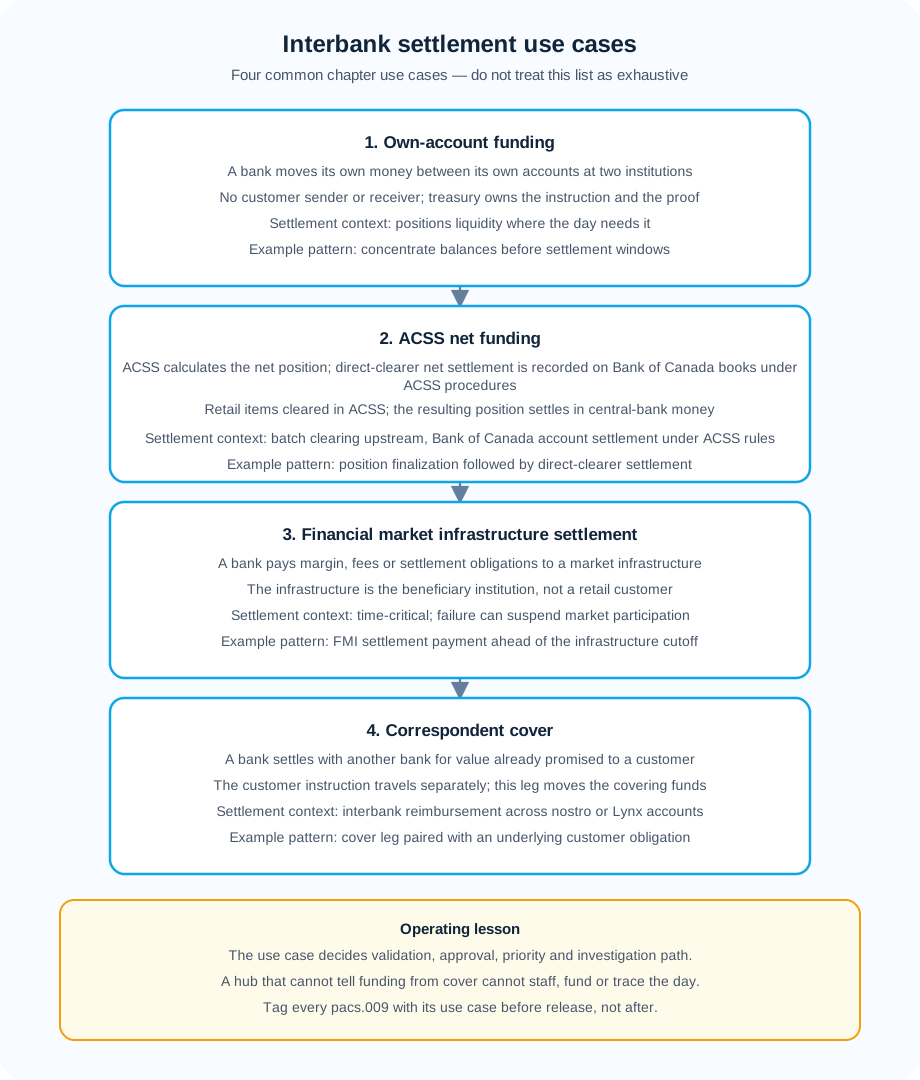
Three implications follow, and each corrects a misunderstanding this academy sees repeatedly. First, messaging is not settlement on any path: a forwarded instruction, a hub "sent" status, or a network acknowledgement confirms data moved, not value settled. Only the settlement-account entry, the position-settlement record, or the matched correspondent booking proves settlement. Second, there is no unilateral undo: Lynx finality is systemic (with pacs.004 as a separate return event where permitted), while correspondent finality is contractual and recovery depends on the account terms and receiving-bank cooperation. Every control, every approval and every validation step exists because of that irreversibility. Third, liquidity is the invisible requirement behind every leg: Lynx needs intraday central-bank balances managed through the day, batch needs funding sequenced to positions, and correspondent paths need nostro balances positioned before value dates. A bank that promises interbank legs without funding them is writing cheques on an empty account, whatever the message format.
5. Data, identifiers, messages and references
If settlement paths are the roads, data is the addressing — and interbank addressing fails differently than customer addressing. A customer leg fails on wrong account numbers and thin remittance. An interbank leg fails on wrong institutions, wrong accounts at those institutions, wrong settlement paths, mismatched value dates, and dropped references that leave settled funds unmatchable. The amounts are larger, the windows are tighter, and there is no beneficiary customer to call for clarification. This section maps the operational data groups a bank validates for a pacs.009 flow, how that data relates to the customer leg where one exists, and which references must survive the whole journey. It stays strictly functional: business groups and their purpose, no field names, no formats, no sample messages.
The first group is agents and accounts: the sending institution, the receiving institution, any intermediaries in the chain, and the settlement accounts to debit and credit. Identification must be unambiguous at institutional level — the bank professional thinks in terms of correctly identified financial institutions and valid settlement accounts, validated against the bank's master data for counterparties and accounts, not typed freehand under time pressure. The most expensive data error in this chapter is a valid-looking leg addressed to the wrong institution or the wrong account at the right institution: it routes, it settles, and then two banks must negotiate its return while the intended obligation waits. Hub validation must therefore confirm counterparty reachability and account validity before release, with standing settlement instructions maintained as controlled master data rather than per-payment typing wherever the corridor allows.
The second group is the settlement instruction itself: which settlement path the leg uses and with what timing expectations. A Canadian-dollar leg settling across Bank of Canada accounts behaves differently from a leg settling across correspondent books, and the hub must record which path was chosen, why, and what priority and timing the leg carries. Priority matters because it governs queue behaviour in RTGS and handling order at correspondents; use-case tagging matters because an FMI settlement payment and a routine own-account movement must not compete silently for the same liquidity. A leg whose settlement path is missing or contradictory — instructed for central-bank settlement but addressed to a correspondent account — is the interbank equivalent of a letter with two addresses. Reject it in the hub.
The third group is amount and value date: currency, amount, and the business-day value date both sides are expected to apply. Value dating deserves emphasis because it is a common cover reconciliation break and the quietest funding error. The sending bank's value date drives its liquidity outflow and its statement entries; the receiving bank's applied value date drives its credit decisions and its onward behaviour; correspondents in the chain apply their own value-date conventions per agreement. When those dates differ unexpectedly, reconciliations break symmetrically — both sides are correct by their own books and the pair does not match. The hub must therefore set value dates by policy against the business-day calendar at capture, communicate them in confirmations and advices, and flag mismatches on arrival rather than carrying them into month-end.
The fourth group is references and tracking: the sender's reference for the leg, an end-to-end tracking identity that follows the leg across hops, linkage to any underlying customer obligation for cover legs, and return linkage so that investigations can walk from the leg back to its instruction. Reference discipline is what makes the boundary diagram in Section 1 operational. The customer leg and the interbank leg are distinct movements that must be linkable: the cover leg references the underlying obligation it reimburses, and the underlying obligation's records reference the cover leg that funded it. Either side alone is a loose end. Tracking identity serves the same purpose across intermediaries: each hop carries the identity forward so that a leg can be traced hop by hop when confirmations stall. And return linkage preserves identity through failure — a returned or recovered leg must point back to its original instruction, never appear as a new unexplained movement. Dropped references are uniquely damaging because a payment may settle while provability is destroyed, and operations discovers the gap days later during reconciliation or audit.
The fifth group is purpose and compliance data: the use-case purpose of the leg and the party information screening and reporting controls need. Purpose — funding, batch position funding, FMI settlement, cover — tells every downstream control how to treat the leg: which approval was required, which priority applies, which reconciliation path it joins. Party data must be complete enough for applicable sanctions, watchlist and travel-rule controls to assess real content rather than stall on thin data while settlement windows pass. Truncation is the enemy here: a party name shortened to fit an assumption, a purpose narrative stripped in mapping, a country or institution detail lost between systems. The hub must validate completeness against the destination path's needs, log what was transformed, and carry the original record forward so that reporting and investigation see what was truly sent.
Where a cover relationship exists, the two legs share linkage but not content: the customer leg carries the context the beneficiary bank needs to credit its customer, while the cover leg carries the settlement context the banks need to reimburse each other, referencing the obligation without duplicating its remittance detail. Hubs that merge the two into one record can validate, screen and reconcile neither; hubs that keep them distinct and linked get both.
Two modernization notes shape investment. First, ISO 20022 coexistence is a multi-year condition, not a cutover event: richer structured data is available on Lynx-settled legs, and banks must fund parallel validation, explicit mapping rules, controlled truncation handling and counterparty-master hygiene as permanent capabilities rather than project work. Second, the discipline pays back immediately outside Lynx: cleaner institution masters, tagged use cases, carried references and explicit value dates improve correspondent matching, batch funding accuracy and investigation speed on every path the bank operates.
RTR status at the audit date. The Real-Time Rail is not a current production route for this chapter. Payments Canada's current system page says RTR is launching in Q4 2026 and that industry solution-assurance testing with participants is underway. Treat RTR access, 24/7 operation, participant workflows, settlement and fraud services as planned/implementation material until the operator publishes the in-force by-law, rules, operating procedures and production notice; do not describe a live pacs.009 RTR path or use RTR to explain today's Lynx/ACSS operations.
6. Rules, cutoffs, service levels and customer impact
Interbank obligations live under rules the way customer payments do, but the audience for those rules is institutional: participation agreements, system rulebooks, bilateral correspondent terms, and infrastructure membership conditions rather than consumer disclosures. This section connects those rule layers to daily behaviour without stating a single clock time. Exact times vary by bank, by clearer, by leg type and by day, and they move with holidays and system calendars. This chapter therefore speaks only in relative windows — morning liquidity build, midday throughput, afternoon funding decisions on business days Monday to Friday excluding holidays — and directs you to your bank's published schedules and the payments.ca business-day and closure calendar for the times that bind your institution. Any procedure, job aid or examination answer that quotes a specific hour from this chapter is misusing it.
Business days anchor every interbank commitment in this chapter. Lynx settlement, ACSS position settlement, FMI calls and correspondent value dates all operate on business-day calendars with published closures for weekends and holidays. A funding leg that misses its window does not "just make it"; it waits under the bank's published policy while the obligation it was meant to cover ages. A value date that falls on a holiday is not a minor labelling issue; it shifts liquidity, statements and beneficiary-bank behaviour. The hub must therefore assign every interbank leg to a business-day window at capture, validate the value date against the calendar, and communicate the window honestly to the initiating desk. Treasury plans built on assumed settlement dates rather than calendar-validated ones are how banks discover short positions at the worst hour.
Relative windows differ by path in ways the operations day makes visible. Lynx-settled legs move during business-day RTGS windows with intraday queueing: morning positions are built, midday throughput carries the bulk, afternoon decisions resolve what remains, with FMI and time-critical legs sequenced ahead of routine funding by policy. Batch funding legs follow the batch rhythm upstream — positions calculate after exchange and clearing, then funding delivers — so their urgency spikes around position finalization rather than spreading evenly. Correspondent legs follow correspondent processing cycles overlaid with time-zone reality: a leg to a distant correspondent booked late in the Canadian day may wait for the next processing cycle abroad, and its value date must reflect that rather than wish otherwise. The customer-impact translation is indirect but real: the employer's payroll, the supplier's certainty, the market membership all depend on interbank windows nobody outside the bank ever sees, which is why the bank must manage them conservatively and communicate customer-facing promises only from confirmed interbank completion, never from assumed.
Service levels for interbank legs bundle timing with certainty, information and recourse — and each use case carries a different bundle. Own-account funding offers the bank control over its own liquidity at the price of its own discipline: mis-sequenced funding starves higher-priority legs. ACSS net-position settlement support offers completion of batch obligations at the price of precision: the wrong amount or the wrong window leaves a system position uncovered. FMI settlement offers continued market participation at the price of absolute deadline discipline: lateness can suspend access, not merely incur a fee. Correspondent cover offers global reach at the price of multi-hop timing, charge practices and investigation cost. The bank's internal service promise — which legs jump the queue, which approvals apply, which confirmations are chased first — must be written down, understood by every desk, and enforced by the hub's priority logic rather than by whoever shouts loudest in the afternoon.
Customer communication must reflect interbank reality without exposing customers to interbank vocabulary. A beneficiary customer told "the funds are settled" hears finality; operations must ensure the interbank leg behind that statement has actually settled rather than merely been released. A corporate customer promised same-day supplier payment must be promised only when the funding and cover chain supports it, with the value date stated explicitly. And when interbank legs fail — a queued funding leg, an unmatched cover, a delayed correspondent hop — customer-facing colleagues need honest, jargon-free status plus a next value date, not a lecture on settlement mechanics. The five status words from the end-to-end view apply here: sent means released, accepted means the gateway or correspondent took it, settled means interbank value moved finally, posted means the beneficiary account was credited, and final means the movement cannot be unwound through the settlement mechanism. Training every colleague who touches wires, treasury or corporate service on those five words prevents more escalations than any dashboard.
7. Fraud, compliance and operational controls
Controls on interbank legs fail for a different reason than controls on customer legs. Customer-leg controls usually fail by misplacement — right check, wrong side of release. Interbank controls usually fail by deference — the leg looks internal, institutional and trusted, so it receives lighter scrutiny than a customer payment of a hundredth its value. This section corrects that deference. An interbank leg moves large, potentially final value on institutional authority alone, with no customer to confirm intent and no unilateral cancellation after settlement. It deserves the heaviest control in the bank, placed where it can still stop the leg.
Fraud controls start from the threat model. External compromise of bank systems aims at interbank release capability precisely because one compromised instruction can move what thousands of compromised customer instructions move. Internal fraud aims at the same capability because authority over funding and cover legs is authority over the bank's own money. The controls that answer both are authentication and entitlement with hardware-backed rigour, segregation between initiation, approval and release so that no single individual completes a leg alone, dual approval above thresholds with genuinely independent second approvers rather than routine countersignatures, behavioural monitoring of desk activity including after-hours and threshold-skirting patterns, and positive-pay-style verification of changed settlement instructions for correspondents and infrastructures. A changed correspondent account or a new FMI settlement account communicated by message alone must be verified through an independent channel before any leg uses it; the chapters on fraud detail these patterns, and the interbank lesson is that the verification must complete before release, because after settlement the funds are gone and only negotiation remains.
As a bank control policy, sanctions and watchlist screening should gate interbank release; applicable Canadian sanctions laws and the bank's risk framework determine the exact scope. The interbank context adds two wrinkles. First, the parties screened include institutions and any parties carried for compliance purposes, not just ordering and beneficiary customers — screening scope must be configured for bank-to-bank content, including the narratives and purpose data the leg carries. Second, correspondent chains re-screen per hop, so complete party data matters multiplicatively: thin data that scrapes through one screen stalls at the next, while the settlement window passes and value dates slip. Dispositions follow the standard pattern — pass, false-positive release with recorded reason, or true-hit hold with escalation — and every decision is logged with what was checked, when, against which list version, and by whom. A leg held in screening needs the same visible ageing and escalation as a leg queued for liquidity; silent holds are how FMI deadlines get missed.
FINTRAC's travel rule is not a blanket requirement for every pacs.009. FINTRAC says it applies to EFTs for which an EFT record must be kept, including international EFTs and EFTs within Canada sent by SWIFT MT-103 or its equivalent. When it applies, the sender must include the originator's name, address and account/reference number (if any), plus the beneficiary's name and address and, if applicable, account/reference number; an intermediary or final recipient must take reasonable measures to ensure the information travels with the EFT and may not remove it. If the information is missing, written risk-based procedures must say when to allow, suspend or reject and what follow-up is required. Separately, a financial entity reports an international EFT of $10,000 or more in a single transaction when it initiates or finally receives it, subject to the Act and Regulations. Treat these as regulatory requirements; the hub linkage, preservation and screening workflow are bank implementation controls, not proof that every domestic pacs.009 is reportable.
Operational controls complete the plane: dealing mandates and release authorities with current signatory records, amount and cumulative-outflow limits including intraday counterparty exposure, cutoff enforcement that cannot be overridden by the desk that owns the leg, queue and priority management owned by treasury with operations visibility, amendment discipline that forbids editing released or settled legs, evidence preservation from capture through confirmation, and segregation of duties across the whole chain. The control that ties them together is release discipline: no interbank instruction reaches any settlement path without passing authentication, validation, limits, fraud monitoring, sanctions screening, cutoff assignment and use-case-appropriate approval in that order, with each decision logged. Exceptions — manual releases, verbal instructions, after-window overrides — must themselves be controlled, dual-approved, time-bound and retrospectively reviewed, because overrides that bypass the order are a recurring control risk. Resilience controls — backup connectivity to settlement paths, contingency funding procedures, failover correspondent arrangements, communication trees for treasury, operations and correspondents — belong in the same plane and return in Section 10.
8. Exceptions, investigations and recovery
Every interbank leg breaks differently, but every break is managed the same way: detect fast, classify correctly, contain within the path's rights, recover as a new linked event, and reconcile with evidence. Banks that classify first recover cheaply. Banks that act first — re-sending a funding leg on assumption, manually crediting against an unmatched cover, editing a settled leg's record — create duplicate funding, duplicate credits and audit breaks that dwarf the original error. This section teaches the classification and the recovery discipline; the operations chapters teach each mechanism fully.
Start with the taxonomy, adapted to bank-to-bank value. A reject happens before settlement: the hub, the gateway, the receiving institution or a screening control refuses the leg for an invalid institution, a closed or invalid settlement account, a limit breach, failed screening, or incomplete data. Nothing settled; the sending bank repairs and re-originates as a new leg linked to the original instruction. A settlement failure or queue stall happens after release but before finality: the leg waits on liquidity, misses its window, or fails correspondent processing. The funds have not finally moved; the response is to fund, reprioritize, repair or re-date — visibly, with the initiating desk informed. A misdirected leg happens when settlement completes to the wrong institution or account: value has moved finally, and recovery requires a new return leg with the receiving bank's agreement. No unilateral pull-back should be assumed: Lynx has a pacs.004 return process where permitted, while correspondent recovery is governed by bilateral terms and receiving-bank cooperation. An unmatched cover happens when funds arrive without a matchable instruction, or instruction arrives without matchable funds: both sides hold their half while investigations pair them, and neither side may post or reuse the value on assumption. A duplicate funding happens when the same obligation is funded twice — the original plus an assumed re-send: one leg must be returned or applied by agreement, with both legs' identities preserved. Each word means something different, and using them interchangeably in incident tickets guarantees that treasury funds the wrong recovery.
Rail and path rights constrain recovery, so classify before acting. Lynx-settled legs cannot be cancelled unilaterally after settlement. A pacs.004 payment-return message can return a pacs.008 or pacs.009 where permitted, but it is a new settlement event with original-transaction references, not a system reversal. Correspondent-book legs are recovered under bilateral terms and beneficiary cooperation, hop by hop. FMI obligations missed at a deadline are cured under the infrastructure's rules, which may involve penalties or access consequences rather than simple re-payment. ACSS shortfalls are handled through corrected balances and settlement procedures under the applicable batch rules. The hub must prevent impossible offers: no "reversal" of a settled interbank leg, no "cancellation of settled value," no reuse of unmatched funds as if they were free liquidity.
Investigations walk one path regardless of use case. Confirm the instruction and its authority: who initiated, who approved, what use case, what references. Confirm release: which path, when, with what value date and priority. Confirm settlement evidence: system confirmation, position-settlement record, or correspondent booking — messaging milestones do not count. Confirm the counterparty view: what the receiving bank or correspondent actually received, booked and matched. Then communicate state: settled and confirmed, settled but unmatched, queued, rejected, or unknown with a next check time. For cover chains the walk repeats per hop, using the end-to-end tracking identity carried forward at each step; a common failure is investigating only the first hop while the break sits two hops downstream. Preserve the original instruction identity throughout: every query, every status update and every recovery leg references the original, so that the audit trail reads as one story rather than scattered fragments.
Recovery follows four rules that admit no exceptions. Never edit settled value — originate a linked corrective leg with its own approvals and its own references back to the original. Never re-send on assumption — confirm the original leg's state first, or a timeout becomes a duplicate and a duplicate becomes a loss. Choose the recovery path by current urgency and current liquidity, not by the original path: a failed correspondent leg may best be recovered across Bank of Canada accounts if timing demands it. Communicate state plus next value date, not activity: "the funding leg settled at the afternoon window and the position is covered" closes an incident, while "we re-sent the payment" reopens it.
Two ageing disciplines separate controlled operations from hopeful ones. Every unconfirmed leg ages visibly from release, with escalation thresholds that summon senior attention before windows close rather than after. Every unmatched cover — funds without instruction or instruction without funds — carries an owner, a reason and a next action from the moment it is detected, and as a bank-specific control, no unmatched item should carry overnight without all three recorded. Month-end must never be the first time anyone looks at an interbank break.
9. Posting, accounting, liquidity, reporting and reconciliation
If settlement moves value, this section proves it — and proves it three ways, every day, for every use case. Posting records the leg on customer and internal accounts where applicable; accounting records it on nostro, vostro and settlement-account ledgers; reconciliation proves the three views agree. A settled interbank leg that nobody matched is not a completed payment; it is an audit finding waiting for month-end and, in the case of large funding or FMI legs, a liquidity misstatement that distorts the next day's decisions. This section teaches the full proof chain at operating depth.
Posting for interbank legs differs from customer posting in one decisive respect: the counterparty is an institution, so the entries land on institutional accounts rather than customer deposits. An own-account funding leg debits one of the bank's settlement or correspondent accounts and credits another; the treasury position updates as the entries post. An ACSS settlement entry reflects the bank's net position on its Bank of Canada settlement account, with the position record and any separate internal liquidity movement cross-referenced so batch operations and treasury share one balanced story. An FMI settlement leg debits the bank's account and credits the infrastructure's account, with the infrastructure's call and deadline attached to the entries. A cover leg debits the sending bank's account at the correspondent or settlement system and credits the receiving bank, with linkage to the underlying customer obligation preserved on both sides. Value dating governs all of it: entries must carry the business-day value date the leg was released for, and any value-date mismatch between the two banks' books becomes a reconciliation break by definition, not by accident.
Nostro and vostro accounting is the lens for correspondent legs. From the sending bank's view, its nostro — its account at the correspondent — is an asset that the cover or funding leg depletes; from the correspondent's view, the same account is a vostro liability owed to the sending bank. Every leg therefore has two truthful book entries in two banks, and reconciliation is the discipline of proving they mirror each other after adjusting for timing, value dates and charges. Charge practices deserve attention as the commonest high-volume break: where intermediary charges are deducted along a cover chain, the received amount differs predictably from the sent amount, and matching rules must expect that pattern. Unexpected differences are held for investigation, never force-matched.
Settlement-account accounting at the Bank of Canada is the lens for Lynx-settled legs and batch positions. Entries here are settlement fact: the system's confirmation plus the account statement together prove the leg settled finally in central-bank money. Intraday, treasury watches these balances to manage queueing and priority — releasing FMI and time-critical legs ahead of routine funding, ensuring the required ACSS balance and position settlement. End-of-day, operations proves that every released leg has its matching settlement entry and that every settlement entry traces to an authorized release. An entry without an authorized release is a control incident; a release without a settlement entry is an exception to chase under Section 8. Neither may wait.
Reporting turns entries into decisions and evidence. Intraday liquidity reports tell treasury what has settled, what is queued, and what remains to fund. Counterparty and correspondent reports tell relationship owners what moved across each account and what advices are still missing. Customer-linked reporting tells the wire desk which cover legs confirm the customer payments waiting behind them. Regulatory and management reporting draws on the same authoritative hub record so that positions, exposures and payment activity reconcile to one source rather than to competing spreadsheets. Statements — both the bank's own settlement-account statements and correspondents' advices — are the external half of the proof; cash-management reporting families carry balance and entry detail functionally, and the reconciler's job is to match them entry by entry rather than to sample them hopefully.
Reconciliation itself is three-way, every day, per use case: the internal leg record (what the hub authorized, released and tracked) against the settlement-account or correspondent-book entry (what actually moved) against the external evidence (system confirmation, position record, or correspondent advice). Breaks fall into a short list with standard handling: unmatched releases (released but no settlement entry — chase under Section 8), unmatched entries (settlement entry without an authorized release — control incident, contain immediately), value-date mismatches (both sides booked, different dates — agree the correct date and adjust forward, never back-edit), amount breaks from charges (expected pattern — match by rule; unexpected — investigate), and unmatched covers (funds without instruction or instruction without funds — owner, reason, next action from first detection). Sign-off closes the day: operations attests the match, treasury accepts the resulting position for next-day funding decisions, and exceptions carry forward with owners rather than as anonymous ageing items.
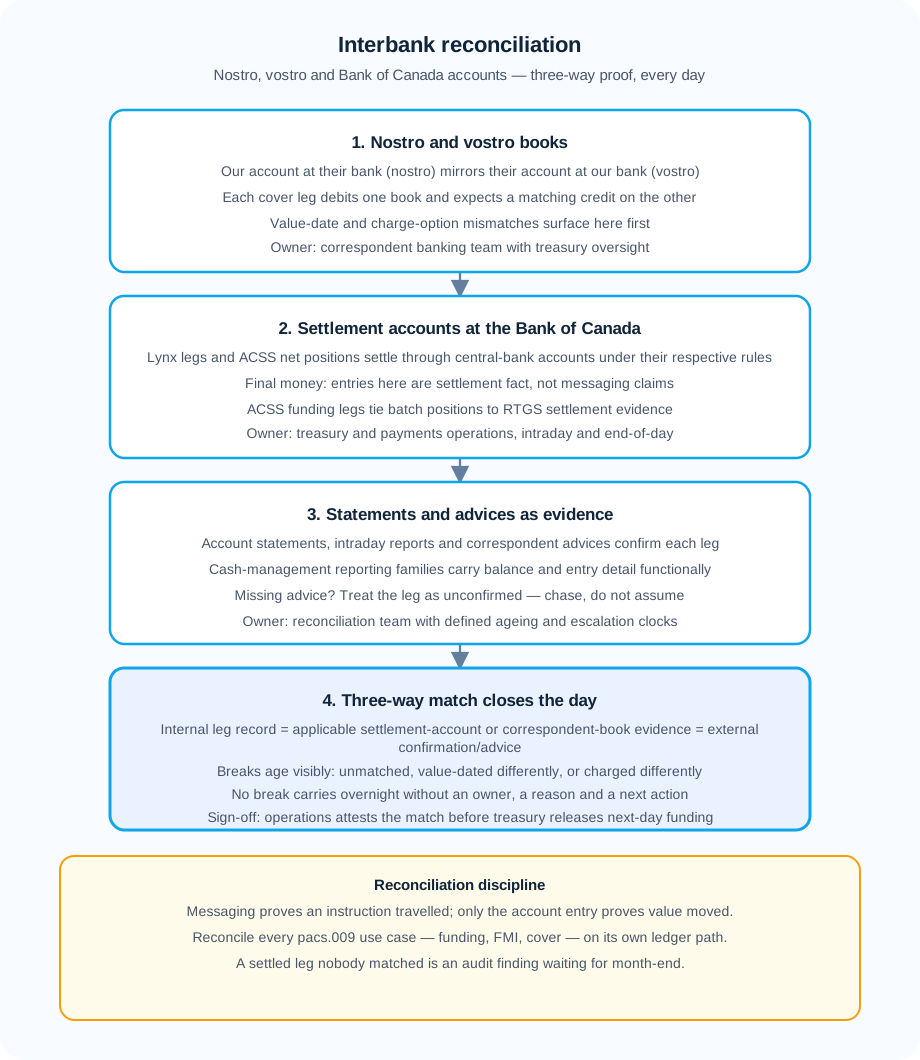
The diagram above compresses the section into an operating poster: mirror books for correspondent value, central-bank accounts for final settlement, statements and advices as evidence, and a three-way match that closes the day with no orphan breaks. Print it mentally on the reconciliation wall. The discipline it depicts is daily, unglamorous and non-delegable — and it is what lets treasury fund tomorrow with confidence in today.
10. Bank implementation, testing and resilience
Interbank capability is built once and relied upon every business day, which makes implementation quality a direct determinant of daily risk. This section describes how a bank wires its interbank lane, tests changes safely, and survives the failures that statistics guarantee — at operating depth, without specifying any vendor product, schema or configuration value.
Architecture starts with the hub's interbank lane as a first-class citizen. Capture enforces the Section 3 completeness tests at entry. A counterparty and settlement-account master — institutions, accounts, standing instructions, verification status — is maintained under dual control; it is the most valuable control asset here because most misdirected legs trace to stale or free-typed details. Validation applies institution, account, value-date, duplicate and reasonableness checks with use-case rules; approval routes by use case and amount with genuine independence; screening runs on bank-to-bank content with disposition logging. Release gateways connect to Lynx and correspondent channels, recording time, path, value date, priority and references. Tracking ages every leg and matches confirmations; reconciliation performs the Section 9 three-way match. Every component logs to an evidence store keyed on the original instruction identity.
Testing treats interbank changes as high-consequence. New or changed settlement masters are verified through independent channels under dual control. Mapping changes are tested with representative legs per use case, including truncation cases, with before-and-after evidence retained. Priority changes are rehearsed against simulated settlement days; authority changes are tested with attempted violations the hub must refuse. Failover tests confirm backup connectivity and contingency funding actually move value under exercise conditions. Evidence is retained per change — auditors will ask what was tested, with what data, and with what result.
Resilience assumes four failure classes and prepares a runbook for each. Settlement-path outage — the Lynx gateway or a correspondent channel unreachable — triggers backup connectivity, reprioritized queues, honest status to initiating desks, and value-date reassignment by policy rather than improvisation. Data corruption — stale masters, bad mapping, duplicated files — triggers release freezes for affected use cases, quarantine of suspect legs, and re-validation before any re-release. Counterparty or infrastructure stress — a correspondent slow to confirm, an FMI call arriving with unusual urgency — triggers senior treasury involvement, pre-positioned funding, and direct communication rather than repeated re-sends. Internal compromise or fraud suspicion — anomalous interbank instructions, authority violations, after-hours activity — triggers immediate containment: freeze affected release capability, preserve evidence, invoke the fraud and incident response disciplines from the dedicated chapters, and notify oversight and management under the bank's incident policy. Every runbook names an owner, a deputy, a communication tree reaching treasury, operations, correspondents and senior management, and a definition of done — because an interbank incident without a declared end becomes a rolling funding distortion.
Change governance binds the three together. Every production change to masters, rules, mappings, authorities or gateways carries a risk rating, an approver independent of the implementer, a back-out plan, and a post-implementation reconciliation proving that legs released after the change match as expected. Emergency changes follow the same discipline on compressed timelines with retrospective review, since the emergencies most likely to demand shortcuts — settlement outages, missed FMI calls, funding shortfalls — are precisely those where a shortcut creates the next incident. Staffing completes the picture: interbank desks need depth, not heroes — cross-trained releasers, empowered reconcilers, treasury dealers who understand operations evidence, and operations officers who understand liquidity consequences. A bank whose entire funding capability depends on one dealer's memory has not implemented an interbank lane; it has documented a single point of failure.
11. Practical Canadian interbank examples
Theory in this chapter compresses into habits only through worked cases. The three fictional cases below each follow one interbank leg from trigger to proof, naming the use case, the owner, the data, the settlement path, the controls and the lesson. All names, amounts and timings are fictional and illustrative; they demonstrate decision logic rather than any threshold, price or schedule. Read each case twice: once for the story, once asking at every step which box of the boundary diagram you are in and who owns it.
Example (fictional): the ACSS net funding payment. Harborview Trust closes its morning batch activity with a familiar position: overnight payroll credits and supplier files have cleared against modest incoming collections, leaving the bank owing a net amount at ACSS settlement. The ACSS position report states the business date and the stream totals that produced the obligation; treasury owns liquidity and operations owns the settlement record. The internal instruction is captured with that position linkage — business date, contributing streams, amount and calendar-validated value date — rather than as a round-number wire. Validation confirms the direct clearer's settlement account, the amount against the ACSS position, the absence of a duplicate internal liquidity movement for the same obligation, and the reasonableness of the outflow against the intraday plan. The direct clearer then ensures the required balance and the position settles through entries on the Bank of Canada's books under ACSS procedures. Do not label that ACSS settlement entry a pacs.009 unless a separate FI-to-FI liquidity transfer was also originated. End-of-day, the three-way match closes: internal position record equals Bank of Canada settlement-account evidence equals ACSS settlement report. The control lesson is linkage: an internal funding movement without a position reference is just a large unexplained transfer, while an ACSS position without settlement evidence is an open exception.
Example (fictional): the FMI settlement payment. Shortly before noon, Harborview's market-operations desk receives a settlement call from a market infrastructure: margin is due with a hard afternoon deadline, to the infrastructure's designated settlement account, with late payment carrying access consequences. This is the highest-priority use case in the bank, and the hub treats it that way. Capture enforces the call's completeness — which obligation, which deadline, which beneficiary account, what reference the infrastructure expects — and refuses to queue an approximate instruction. Validation confirms the beneficiary account against the verified master (a changed infrastructure account would require out-of-band verification before any leg uses it), checks the amount against the call notice, and confirms no duplicate leg for the same call. Approval is dual by policy for all FMI legs regardless of amount, because the risk is access rather than value. Screening runs before release; priority is set above routine funding in the release queue. The pacs.009 leg settles across Bank of Canada accounts with same-day finality, and the hub chases confirmation actively rather than ageing it passively — an unconfirmed FMI leg fifteen minutes before the deadline is a senior-management incident, not a reconciler's queue item. Confirmation is matched to the call notice, the entries post with the call reference attached, and the infrastructure's own receipt closes the evidence loop. The control lesson is priority with proof: jump the queue by policy, verify the account independently, and chase the confirmation as if access depended on it — because it does.
Example (fictional): the correspondent cover pair. Harborview's wire desk advises a customer payment to a beneficiary whose bank is reachable only through a correspondent chain: the underlying customer obligation travels as instructions toward the beneficiary bank, carrying customer, beneficiary and remittance context, while the covering funds must travel bank to bank as a pacs.009 cover leg. Capture creates two linked records, not one: the underlying obligation with its customer-leg references, and the cover leg with its settlement path, correspondent accounts, value date and linkage back to the obligation. Validation checks the chain — sending institution, intermediary, receiving institution, accounts at each hop — against standing settlement instructions, confirms the value date against both the business-day calendar and the correspondent's processing reality, and screens all carried parties. Release sends the cover leg along the correspondent path with the tracking identity that each hop carries forward and the reference the beneficiary bank needs to pair funds with instruction. The break, when it comes, is instructive: the beneficiary bank reports instruction received but funds not yet matched — the cover is stalled one hop upstream awaiting the intermediary's processing cycle. Because the two records are linked, Harborview answers honestly within minutes: the obligation is advised, the cover is confirmed to the intermediary with onward value date stated, and the beneficiary bank knows exactly what to expect and when. No re-send on assumption, no duplicate cover, no manual credit against unmatched funds. When the cover arrives, the beneficiary bank pairs it with the obligation and credits its customer; Harborview matches the intermediary's advice to its nostro record and closes both halves. The control lesson is separation with linkage: keep instruction and funds distinct so each can be validated, traced and recovered on its own terms, and link them so neither becomes a loose end.
Three habits generalize across all three cases. First, tag the use case at capture — funding, FMI, cover — because everything downstream (approval, priority, screening emphasis, reconciliation path) keys off it. Second, record the business-day window and value date explicitly and validate them against the calendar before release, because assumed dates are the root of most funding and cover breaks. Third, preserve identity from trigger to proof: position report to settlement evidence (and any separate liquidity movement) to account entry; call notice to FMI leg to infrastructure receipt; obligation to cover leg to correspondent advice. An interbank operation that does those three things visibly will survive audits, outages and afternoons alike.
12. Key takeaways and authoritative references
Ten points carry the chapter. First, pacs.009 is a financial-institution credit transfer: bank to bank, for settlement — own funding, batch position funding, FMI obligations and cover — and it is distinct from the pacs.008 customer leg in sender, content, promise and proof. Second, the boundary between the customer leg and the interbank leg decides every downstream discipline; investigations must always state which leg is being traced. Third, cover payments are pairs: an underlying customer obligation plus an interbank settlement leg, travelling separately, linked by references, breaking independently. Fourth, settlement paths differ — Lynx RTGS in central-bank money, ACSS net positions settled on Bank of Canada books, and correspondent books via nostro and vostro — and messaging is never settlement on any of them. Fifth, settled interbank value cannot be unilaterally unwound anywhere; validation, approval and screening exist because recovery needs the receiver's cooperation. Sixth, completeness before release is the whole game: agents and accounts, settlement path, amount and value date, references and tracking, purpose and compliance data — a hub that rejects incomplete legs is cheaper than a team that recovers settled ones. Seventh, value dates and business-day windows are matched deliberately, never assumed, and no clock time in any study chapter binds any bank. Eighth, fraud and sanctions controls run before release with institutional threat models in mind, because interbank legs move the largest value on authority alone. Ninth, exceptions are classified before they are acted upon — reject, queue stall, misdirected leg, unmatched cover, duplicate funding — and recovered as new linked legs, never by editing settled value. Tenth, every leg is proved three ways daily: hub record against settlement or book entry against external evidence, per use case, with owners and ageing on every break.
The misunderstandings to leave behind: a pacs.009 is not a customer payment minus customer details but a different instrument for a different purpose; messaging or hub "sent" status is not settlement — only account entries prove value moved; a cover leg does not prove the beneficiary was credited; a funding estimate is not a position; and a silently carried break is an incident ageing into a finding.
Authoritative references (official sources only, baseline 5 October 2026)
This chapter uses only official sources. Re-check time-sensitive pages before customer or examination use. Baseline: 5 October 2026. No exact cutoff times are stated in this chapter; for binding times use your bank's published schedules with the Payments Canada system-closure schedule and applicable rules.
- Payments Canada — Lynx system page. Operator description of Lynx as Canada's RTGS system for high-value and time-critical payments: fast, irrevocable payments with real-time settlement finality, inter-FI payments between institutions, designation as systemically important, Bank of Canada oversight, settlement accounts at the Bank of Canada, and published ISO 20022 message specifications for customer and financial-institution wires. https://www.payments.ca/systems-services/payment-systems/high-value-payment-system-lynx
- Payments Canada — Retail batch payment system. ACSS/USBE scope, direct and indirect clearing, net-balance calculation, prior-day settlement on Bank of Canada books, and 2025 system statistics. https://www.payments.ca/systems-services/payment-systems/retail-batch-payment-system
- Payments Canada — “Payments Canada introduces data-rich messages to high-value payments in Canada with Lynx Release Two” (21 March 2023). Release Two introduced ISO 20022; the article says Lynx launched in August 2021 and replaced LVTS. https://www.payments.ca/payments-canada-introduces-data-rich-messages-high-value-payments-canada-lynx-release-two
- Bank of Canada — “Lynx.” Effective September 2021 replacement of LVTS; settlement of obligations from other FMIs and liquidity channel functions. https://www.bankofcanada.ca/core-functions/financial-system/lynx/
- Bank of Canada — “The Bank of Canada’s settlement account policies for Payments Canada payment systems.” Current policy for Lynx, ACSS and planned RTR settlement accounts and finality in central-bank money. https://www.bankofcanada.ca/core-functions/financial-system/bank-canadas-settlement-account-policies-for-payments-canada-payment-systems/
- FINTRAC — “Travel rule for electronic funds and virtual currency transfers.” Applicability, required originator/beneficiary information, missing-data procedures and intermediary duties. https://fintrac-canafe.canada.ca/guidance-directives/transaction-operation/travel-acheminement/1-eng
- FINTRAC — “Reporting electronic funds transfers to FINTRAC.” $10,000 single-transaction international-EFT reporting rule and report mechanics. https://fintrac-canafe.canada.ca/guidance-directives/transaction-operation/eft-dt/eft-dt-eng
- FINTRAC — “Financial Transactions and Reports Analysis Centre of Canada.” Mandate and regulated-entity context. https://fintrac-canafe.canada.ca/intro-eng
- Payments Canada — “High-value payment system - Lynx” ISO 20022 resource centre. Current UG2026 pacs.008, pacs.009 core/cover, pacs.004 and camt.053 publications. https://www.payments.ca/payment-resources/iso-20022/high-value-payment-system-lynx
- Payments Canada — “Lynx Payment Return V09 pacs.004.001.09” (23 March 2026). Current return-message usage guideline and original-transaction linkage. https://www.payments.ca/sites/default/files/lynx_payment_return_pacs.004.pdf
- Payments Canada — “Real-Time Rail payment system.” RTR launch is stated as Q4 2026; current page describes participant assurance testing rather than production capability. https://www.payments.ca/systems-services/payment-systems/real-time-rail-payment-system
- Justice Canada — “Payment Clearing and Settlement Act.” Current federal legal framework for designated systems and settlement protections. https://laws-lois.justice.gc.ca/eng/acts/p-4.4/
- OSFI — “Technology and Cyber Risk Management.” Risk-based identity/access, logging, segregation, change control and resilience expectations for FRFIs; implementation guidance, not a pacs.009 scheme rule. https://www.osfi-bsif.gc.ca/en/guidance/guidance-library/technology-cyber-risk-management
- Global Affairs Canada — “Current sanctions imposed by Canada.” Current sanctions regimes and underlying UNA, SEMA and JVCFOA legal authorities. https://www.international.gc.ca/world-monde/international_relations-relations_internationales/sanctions/current-actuelles.aspx?lang=eng
Diagrams in this chapter: pacs.009 versus pacs.008 boundary; interbank settlement use cases; cover payment concept; pacs.009 data essentials; interbank reconciliation — all under /diagrams/payment-stories/canada/chapter-43/. No exact cutoff times are shown. No message schemas, field specifications or sample XML are stated. Stories, companies, amounts and timings are fictional.
This application uses JavaScript for the full interactive experience. This text summary is served for accessibility and search indexing.