pacs.004, camt Messages, PCRN and UETR. Connect returns, cash-management messages, Canadian reference requirements and end-to-end transaction identification.
Canada Payments & Collections · Block 9: ISO 20022 in Canada · Chapter 44 of 75
This chapter is about what happens after a Canadian high-value payment leaves the sending bank — and how everyone involved stays pointed at the same payment. Earlier chapters in this block introduced the ISO 20022 message families that Lynx runs on: customer credit transfers, interbank payments, and the data that travels inside them. This chapter connects four things that only make sense together: the return message that brings a payment back, the cash-management messages that report and reconcile it, the Canadian reference that proves a Lynx payment settled, and the end-to-end reference that lets institutions in the chain talk about the same payment without confusion.
If you take one idea from this chapter, make it this: a payment that cannot be identified cannot be returned, reported, reconciled or investigated. For a SWIFT-carried payment, the UETR gives participating institutions a common end-to-end reference. The PCRN proves the payment settled in Lynx. The pacs.004 return carries the original identity home with the reason attached. The camt family turns settled facts into statements, advices and intraday views the customer and the back office can trust. Each of these is simple on its own. Together they are the difference between a bank that answers "where is my payment" in minutes and a bank that answers it in days.
A note on status dates. Baseline is 5 October 2026. Lynx is Canada's real-time gross settlement system for high-value and time-critical Canadian-dollar payments. Payments Canada's current UG2026 core message specifications cover pacs.008, pacs.009 Core/COV and pacs.004, carried in the applicable head.001 business application header. Payments Canada separately publishes a Lynx bank-to-customer camt.053 statement specification (labelled UG2025 on the current resource page). Its corporate-to-bank guidance also includes pain.001, pain.002, camt.052, camt.053 and camt.054 for information purposes, but those guidelines are not the same thing as the Lynx rail-level message set. This chapter therefore distinguishes current Lynx rail messages from broader ISO 20022 corporate reporting and cross-border investigation concepts.
RTR status boundary (regulatory/system status, not a fictional production flow): As of the October 2026 baseline, Canada's Real-Time Rail is not a production capability described in this chapter. Payments Canada says RTR is undergoing industry solution assurance and other testing, with a sequenced launch targeted for Q4 2026. The planned RTR service is intended to exchange, clear and settle data-rich payments 24/7/365; those future characteristics must not be projected onto today's Lynx flow. No production RTR transaction is asserted here, and no RTR-specific identifier or procedure should be inferred from the Lynx PCRN/UETR model.
What you will be able to do after this chapter
After working through this chapter, you should be able to:
- explain what the UETR is — a UUID end-to-end reference generated once and carried unchanged across the payment chain — and state who creates it, who forwards it and who confirms against it;
- explain what the PCRN is — the confirmation number Lynx generates when a payment settles — and explain to a customer what it proves, how to ask for it, and when no PCRN will exist;
- describe functionally how a pacs.004 return works: which payment it answers, what original identity it carries back, and what reason information tells the originator;
- distinguish the current Lynx rail-level camt.053 statement from information-purpose corporate-to-bank guidance for camt.052 intraday reports and camt.054 debit/credit notifications, and explain how a bank may use those views without presenting all three as Lynx core rail messages;
- trace a payment from original instruction through settlement, reporting, a return or an investigation without losing the original identity at any step;
- explain how reference preservation supports settlement certainty, customer communication, reconciliation and audit evidence in a Lynx participant bank;
- place returns, investigations, posting and reconciliation for Lynx payments in the correct order and explain why that order matters;
- classify common Lynx exceptions — unsettled instructions, settled payments the beneficiary cannot apply, missing reports, broken references — and describe the recovery for each;
- explain the posting, accounting and three-way reconciliation picture for Lynx payments, including where UETR and PCRN appear in the books and the statements;
- describe what a bank must build and test to carry, validate and preserve UETR and PCRN across its hub, gateways, statements and investigations;
- work through two fictional Canadian business stories — a law-firm house closing and a manufacturer paying a US supplier's Canadian account — and extract the reference-discipline lesson from each;
- correct the ten most common misunderstandings about returns, reports, PCRN and UETR, and navigate to the authoritative references in Section 12.
For a roughly 60-minute core session, spend about 10 minutes on this introduction and Sections 1–2, 15 minutes on Sections 3–5 with the UETR, return and camt diagrams, 10 minutes on Sections 6–7, 10 minutes on Sections 8–9 with the investigation diagram, 10 minutes on the fictional stories in Section 11, and 5 minutes on takeaways and references in Section 12.
Chapter navigator
- Business context and customer need
- Participants, responsibilities and system boundaries
- Initiation, validation and bank processing
- Clearing or exchange, settlement and finality
- Data core: messages, identifiers and references
- Rules, service levels and customer impact
- Fraud, compliance and operational controls
- Exceptions core: returns, investigations and recovery
- Posting, accounting and reconciliation core
- Bank implementation, testing and resilience
- Practical Canadian examples
- Key takeaways and authoritative references
1. Business context and customer need
Every bank employee who has sat across from a customer waiting on a large payment knows the moment this chapter is about. A couple sits in a lawyer's office waiting for keys to their first home, and the down payment has to move from one bank to another today, finally and provably. A treasurer releases a seven-figure supplier payment at 2 p.m. and needs to know before the close of business that it settled — not that it was sent, not that it is probably fine, but that it settled. A finance manager sees a payment come back the next morning and needs to know why it returned, which original payment it belongs to, and what to fix. An auditor asks, six months later, for proof that a specific payment settled on a specific day. Four different customers, four different questions, one shared need: certainty about a specific payment, expressed in references everyone can agree on.
That need is sharper for high-value payments than anywhere else in Canadian banking, for three reasons. First, the amounts concentrate risk: a single Lynx payment can be worth more than a whole day of retail batch items, so one unidentified or misapplied payment is a treasury event, not a rounding error. Second, settlement is final between participants: once Lynx settles a payment, there is no system mechanism that unwinds it, so getting the identity right before and after settlement is the only safety net. Third, the chain is often longer than the customer imagines: the payment may pass through the sending bank, Lynx, a receiving participant, and then onwards to a non-participant institution or a beneficiary account at another bank, with each party keeping its own records under its own reference numbers. Without shared references, each party describes the same payment differently, and the investigation becomes a translation exercise.
Without that discipline, each party describes the same payment differently: the sending bank records an internal sequence number, the receiving participant posts under another reference, a downstream institution adds a third, and the operations team matches amounts and dates hoping no two similar payments went through that day. Returns arrive that cannot be matched to originals, suspense accounts carry breaks nobody can explain, and month-end becomes archaeology. No system failed — every message arrived. The failure is identification, and it is entirely preventable.
The four subjects of this chapter answer different questions. The UETR answers "are we talking about the same SWIFT-carried payment?" and the PCRN answers "did this obligation settle in Lynx?" The pacs.004 return links returned value to the original payment. For reporting, the currently published Lynx rail-level ISO statement message is camt.053 bank-to-customer statement. Payments Canada also publishes information-purpose corporate-to-bank guidance for camt.052 intraday reporting and camt.054 debit/credit notifications. Those can be valuable in a bank's client-reporting architecture, but they must not be described as if all three are current Lynx core rail messages.
A simple way to hold these four together is the registered-letter analogy: the UETR is the tracking number scanned by every handler, the PCRN is the carrier's own delivery stamp proving handover, the pacs.004 is the return-to-sender sticker still bearing the original tracking number, and the camt messages are the carrier's daily logs. A bank that keeps all four does not lose parcels.
The business value shows up in four places: faster customer answers from references instead of investigations, lower operations cost as returns match automatically, evidenced finality through the PCRN instead of asserted finality, and stronger audit trails from instruction to reconciliation under stable identifiers. None of this requires new rails or products — only treating references as seriously as amounts.
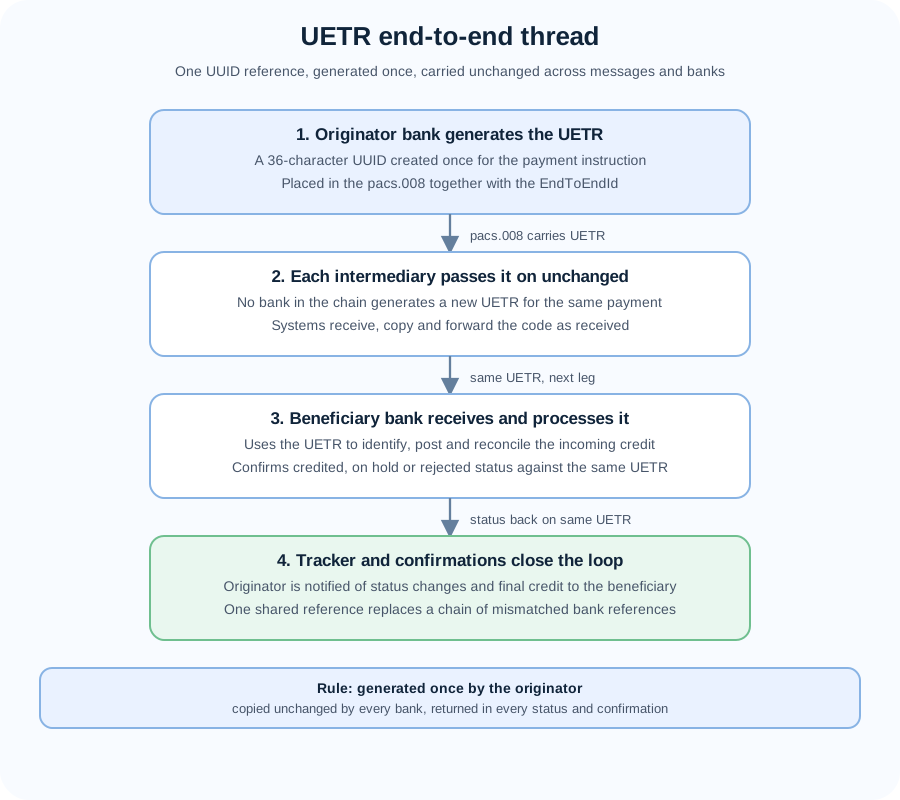
The diagram above is the chapter's anchor. It shows the single rule every later section depends on: the UETR is generated once and never changed in flight. Sections 2 to 4 place that rule inside the Canadian system and its settlement promise. Section 5 teaches the full data core. Sections 6 and 7 cover rules and controls. Sections 8 and 9 work the exceptions and the books. Section 10 tells a bank how to build all of it, and Section 11 makes it concrete with fictional Canadian stories.
2. Participants, responsibilities and system boundaries
A Lynx payment with full reference discipline involves more parties than the two customers, and each party owns a different piece of the identification story. Confusion about who owns which piece is the root cause of most reference breaks: the sending bank assumes Lynx will reconcile for it, the receiving bank assumes the sender's reference is sufficient, the non-participant assumes its clearing agent's reference is the PCRN, and the customer assumes the number on their receipt proves settlement. This section assigns each piece to its owner so the rest of the chapter has someone responsible for every reference.
Start with the two customers. The originator instructs the payment and supplies the business identity: who is being paid, how much, in what currency, for what purpose, with what remittance detail. The beneficiary is entitled to receive the funds and supplies the receiving end of the identity: the account to be credited and the remittance the beneficiary needs to close its own books. Customers own the economic purpose and the instruction, and they consume references — the UETR is invisible to most of them, while the PCRN is the one reference a payee may explicitly request as proof. What customers never do is settle interbank value or generate system references. Any process that asks a customer to supply a PCRN, or that treats a customer receipt number as settlement evidence, has confused the boundary.
The sending participant — a Lynx direct participant, which may be acting for itself or as clearing agent for a non-participant institution — owns origination discipline. It generates or passes on the UETR, builds the pacs.008 or pacs.009 message with complete identification, validates before release, submits to Lynx through its gateway, receives the settlement notification carrying the PCRN, and reports to its customer. Where the originator is a customer of a non-participant institution, there are two banks on the sending side: the customer's institution, which owns the customer relationship and the first capture of identity, and the Lynx participant acting as its agent, which owns submission to Lynx and receipt of the PCRN. The handoff between those two is a classic reference-loss point, and Section 10 returns to it: the agent must pass the PCRN and the UETR back to the instructing institution, not merely confirm that "the wire went through."
Lynx itself — owned and operated by Payments Canada, settling across settlement accounts at the Bank of Canada — owns two things and only two things in this chapter's story: settlement and the PCRN. Lynx settles each payment obligation individually in real time in central-bank money, and at the moment of settlement it generates the unique PCRN that identifies that settled payment. Lynx does not hold customer accounts, does not decide whether a beneficiary's account gets credited, does not reconcile any bank's books, and does not investigate on anyone's behalf. Understanding this boundary prevents a whole class of errors: asking Payments Canada to "find a payment" misunderstands the system, because finding payments is the participants' job using the UETR and PCRN the system gave them. The system provides the facts — settlement plus confirmation number — and the participants do everything else.
The receiving participant owns application of the funds and the return decision. It receives the payment information carrying the UETR and the PCRN, decides whether the beneficiary account can be credited, posts or holds accordingly, and — where the funds cannot be applied — originates the pacs.004 return carrying the original identity back with reason information. Where the ultimate beneficiary is served by a non-participant institution downstream, the receiving participant passes the payment onwards with its references, and the downstream institution owns the final credit and must preserve the references it received rather than substituting its own. A frequent operational failure is reference substitution at this boundary: the downstream bank credits the customer under a purely internal number and discards the UETR and PCRN, so that when the customer later queries or the payment returns, nobody can connect the credit to the chain. Preservation is cheaper than reconstruction, and this chapter repeats that line deliberately.
Correspondent and intermediary banks appear wherever the Canadian leg connects to a cross-border journey. A payment arriving from abroad for settlement through Lynx, or a Lynx-settled Canadian leg continuing abroad, carries its UETR across the boundary between the SWIFT cross-border world and the Lynx domestic world. The responsibility here is continuity: intermediaries must receive, copy and pass on the UETR without generating a new one, and beneficiary banks must be able to receive and process UETRs to reconcile payments even if they are not themselves tracking-service subscribers. The UETR was designed for exactly this continuity — it is carried on SWIFT payment instruction messages as standard — so a Canadian bank that mangles or drops the UETR at the domestic-to-cross-border handoff breaks a chain that the global system built deliberately.
The Bank of Canada acts as settlement agent — the settlement accounts are its books, which is what makes Lynx settlement central-bank money and therefore final — alongside its separate oversight roles that matter less directly here. Inside the bank, the hub, investigations, reconciliation, statements, client support and audit teams are participants in the reference chain too: each must receive, store and quote the UETR and PCRN rather than minting local substitutes. A reference that dies at the gateway, trapped in a message log nobody queries, might as well not exist.
The boundary summary is short enough to post on an operations wall. Customers own purpose and instruction. Sending banks own origination and the UETR. Lynx owns settlement and the PCRN. Receiving banks own application, returns and preservation. Intermediaries own untouched forwarding. Internal teams own storage and quotation. Every investigation in Section 8 walks this wall from one side to the other, asking each owner in turn what their reference says.
3. Initiation, validation and bank processing
Every UETR thread and every return in this chapter begins in the same place: a customer instruction entering the sending bank's payment hub before Lynx ever sees it. The hub is the bank's shared layer for intake, validation, approval, release, gateway formatting, tracking and reconciliation, and this chapter assumes one exists, because reference discipline cannot survive when each channel talks directly to the gateway with its own numbering. A hub that mints one durable internal identifier per instruction, generates or captures the UETR at intake, and carries both through every later stage gives investigations, returns and reconciliation a spine. A bank without that spine discovers, usually during its first difficult investigation, that it has several partial truths about the same payment and no way to choose between them.
Initiation for Lynx payments arrives through familiar channels: branch and online banking for single wires, business portals and host-to-host files for corporate batches of wires, treasury and FX desks for large-value and cross-border instructions, and APIs and ERP integrations for straight-through corporate origination. Whatever the channel, the hub must converge the instruction onto the same data question: who pays whom, how much, in what currency, by when, with what references, and under what authority. At this point the hub performs the act this whole chapter depends on: it ensures the payment has a UETR. If the corporate customer supplied one under bilateral agreement, the hub keeps it and never changes it through the life of the payment. If none was supplied, the bank's systems generate one before the pacs message is built. Either way, from this moment the UETR is the payment's permanent travelling name, and every later process — release, tracking, settlement notification, reporting, investigation, return — quotes it rather than replacing it.
Validation before release is where reference failures are cheapest to catch, and the checks specific to this chapter sit alongside the standard payment controls. Account and beneficiary validation confirms the debit account and the beneficiary-agent identification are complete and routable, because a Lynx payment released with defective beneficiary data settles and then returns — an expensive round trip that pre-release validation would have prevented. Reference-completeness validation confirms the UETR is present and well-formed, the EndToEndId is present and meaningful to the originator's reconciliation, and any remittance the beneficiary needs is structured rather than stuffed into free text that downstream systems truncate. Duplicate validation compares the incoming instruction against recent history on amount, beneficiary and EndToEndId, because a re-sent file that silently mints a new UETR looks like a new payment to everyone downstream, while a re-sent file that reuses the original UETR is recognisable as the same payment. Repair or reject happens here, in the hub, with the customer still available to supply a missing detail — not in Lynx, where the payment has already consumed liquidity and attention.
The control stack between validation and release runs in its order: authentication and entitlement, limits, fraud monitoring, sanctions and watchlist screening, cutoff and calendar assignment, and dual approval where the bank's policy requires it. Two points in that stack matter especially for this chapter. First, sanctions screening must complete before release, because Lynx settlement is final between participants and a payment that settles cannot be unilaterally pulled back when screening later flags it — recovery then needs beneficiary cooperation, which is a negotiation, not a process. Second, the hub must record, at release, the full reference set it sent: the UETR, the EndToEndId, the message type, the release timestamp and the gateway acknowledgement. Investigations start from release records, and a release record without the UETR is a locked door with the key thrown away. Log the references at release and every later question is answerable; fail to log them and every later question becomes archaeology.
Release commits the pacs.008 or pacs.009 message to the gateway for submission to Lynx, where it enters the settlement queue governed by liquidity and priority. Release is not settlement, and customer communication must preserve that distinction from the first minute: "released to Lynx" means the instruction left the bank, while only the settlement notification with its PCRN means the payment settled. Banks that blur this at release pay for it in investigations, explaining queues and business-day clocks to already anxious customers. Precision at release prevents confusion downstream.
After release the hub stays on duty as the reference custodian: matching settlement notifications to instructions by UETR, storing the newly arrived PCRN against the same record, watching for returns quoting the same identifiers, and ageing anything unmatched. A payment released but never matched to a settlement notification may be queued for liquidity, rejected at the gateway, or lost between hub and gateway — and the UETR is what lets the hub ask gateway logs and Lynx-side records about the same payment.
4. Clearing or exchange, settlement and finality
Lynx does not clear in the batch sense at all, and understanding what replaces clearing is essential to everything this chapter teaches about returns and references. Lynx is not a batch exchange or multilateral net-settlement process. Each payment obligation is submitted individually, registered and, where liquidity and other conditions permit, settled individually in real time across settlement accounts at the Bank of Canada. Lynx still has an operating schedule, processing windows and queue/settlement mechanisms; “real time” does not mean every released instruction settles immediately. This per-payment gross model is what makes Lynx suitable for time-critical and settlement-critical payments — and it is what makes reference discipline load-bearing rather than decorative. A payment that settles with defective beneficiary data is recovered after finality through the applicable return or other recovery process, not by editing the settled record.
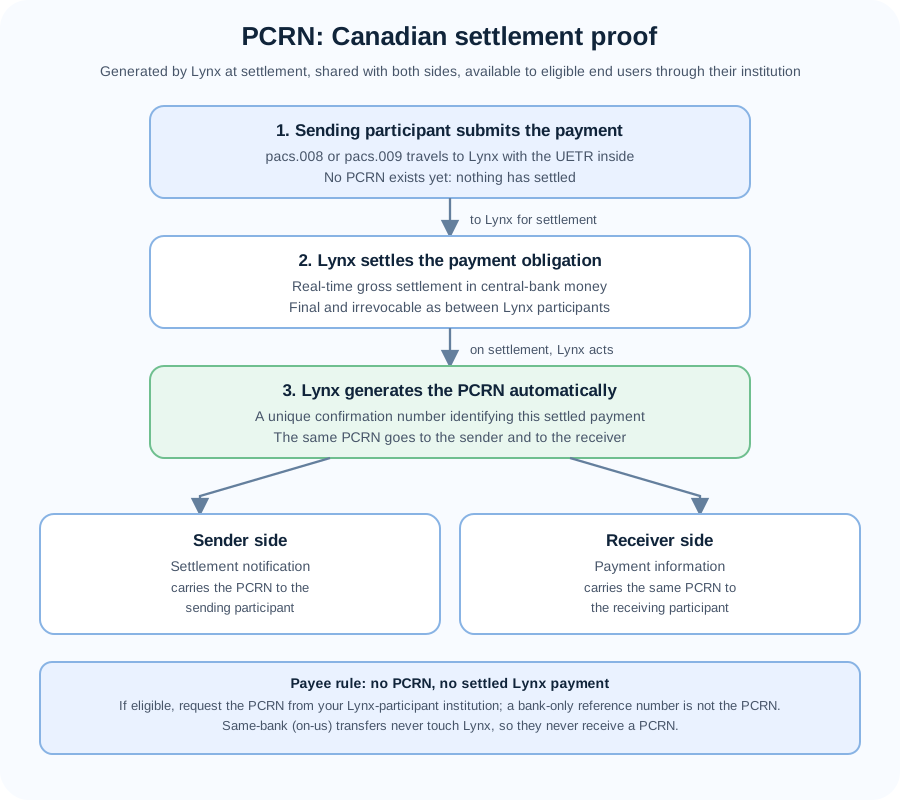
Settlement in Lynx is settlement in central-bank money, which gives it two properties the rest of the chapter assumes. First, it is final and irrevocable as between Lynx participants the moment it occurs: the sending participant cannot unilaterally unwind it, reverse it or cancel it through the system. Recovery of a misdirected or erroneous payment requires the cooperation of the receiving side — a return, a new payment back, or an agreed correction — and cooperation takes time, goodwill and sometimes negotiation. Second, settlement generates the PCRN automatically: every settled Lynx payment obligation receives its unique confirmation number at settlement, and that number is communicated to the sending participant in the settlement notification and to the receiving participant in the payment information it receives. Finality and proof arrive together, as one event with one reference. Teach staff to treat them as inseparable: a claim of Lynx finality without a PCRN is an assertion, while finality with a PCRN is evidence.
Queueing deserves a plain explanation because it causes most "where is my payment" calls. A released payment that has not yet settled is normally waiting for intraday liquidity or queue priority during the Lynx business day, or waiting for the next business day if released after the relevant cutoff, on a weekend or on a holiday. The operations response is to check queue and settlement status keyed on the UETR and tell the customer the actual state — not to re-send, which would create a duplicate, and not to mint a fresh UETR, which would split one payment's story into two.
Finality needs one careful qualification that staff must be able to explain to customers. "Final and irrevocable as between Lynx participants" means the interbank settlement cannot be unwound through the system — it does not mean the beneficiary's account was credited, and it does not mean the beneficiary cannot be asked to return funds. The receiving participant still has to apply the payment to the beneficiary's account, and that application can fail — closed account, wrong details, compliance hold — which is precisely when the pacs.004 return of Section 8 comes into play. Nor does finality defeat fraud or error recovery in the legal sense; it defeats only the fantasy of a system-level undo button. A customer told "your payment is final" should understand it as "the settlement cannot be reversed by the system, and here is the PCRN that proves it settled" — never as "nothing can ever go wrong from here."
Availability follows settlement but is not identical to it. The receiving participant posts according to its own processes and any downstream handoff to a non-participant, each with its own checks including anti-money-laundering procedures — and intermediary institutions, institution cutoff times, incomplete information and the business-day clock can all put time between Lynx settlement and the end user's access to funds. Set that expectation at instruction time, and use the UETR and PCRN to pinpoint whether a queried payment is queued, settled-but-not-yet-applied, or applied: three states, three owners, and the references tell you which is which.
5. Data core: messages, identifiers and references
This section is the chapter's data core, and it repays slow reading. It describes each message family functionally — what it is for, what identity it carries, who sends it to whom — and it names only well-established elements. It specifies no schemas, no field formats and no code values, because those live in the Lynx ISO 20022 message specifications and your bank's implementation guides. What it gives you instead is the working model a banker, an operations analyst or a product designer needs: which message answers which business question, and which references must survive every handoff.
Start with the original instruction, the pacs.008 customer credit transfer and its interbank sibling pacs.009. Functionally, the pacs.008 is the sending bank telling the chain: move this amount, in this currency, from this originator to this beneficiary, with this remittance, under this identity. It carries the UETR — the chain-wide travelling name — and the EndToEndId — the originator's own reference that must appear on statements and advices so the originator's ERP can match the debit to the instruction it issued. The pacs.009 family carries interbank payments of the same spirit between financial institutions, including cover-style arrangements where applicable. Both travel to Lynx in the Lynx MX format over the network, and both must meet Lynx's format requirements to qualify as valid payment messages — anything that fails those requirements is rejected before settlement, which is the system's first and cheapest quality gate. The lesson for the sending bank: completeness at origination is not politeness, it is economics, because anything defective either fails at the gate after consuming operations time or settles defective and must be recovered through returns.
The UETR deserves its full description here, because it is the most misunderstood reference in the building. A UETR is a string of 36 unique characters in UUID form, and it functions like the tracking number a courier puts on a parcel: the sender issues one unalterable reference, and every party in the chain uses that same reference to locate the payment, report status and confirm the outcome. Three rules govern it, and all three are absolute. First, the ordering institution's systems generate and include the UETR for each payment instruction as standard — every SWIFT-carried payment instruction bears one, and the Lynx chain inherits the same discipline. Second, intermediary institutions must not generate a new UETR when routing payments; their systems must receive, copy and pass on the code exactly as received, which means every bank's platform must be able to handle UETRs even on payments it merely forwards. Third, beneficiary banks must be able to receive and process UETRs to reconcile payments, and confirmations — credited to the beneficiary, on hold, rejected, or transferred outside the network — are reported against the same UETR, feeding tracking views such as the SWIFT gpi Tracker and its basic tracker that let banks follow payments end to end in real time. The practical consequences are direct: a bank that regenerates UETRs mid-chain forks one payment into two identities and orphans every downstream confirmation, while a bank that drops the UETR at a format boundary blinds every party downstream of the cut. Generate once, forward untouched, confirm against the same code — the diagram in Section 1 is the whole rule, and there are no exceptions to learn later.
The PCRN is the Canadian complement to the UETR: where the UETR names a SWIFT-carried payment across the relevant message chain, the PCRN proves the Canadian settlement event. As defined in Lynx Rule 1 and the Lynx By-law, the PCRN is the unique alphanumeric confirmation number generated by Lynx to identify a Lynx payment obligation that has been settled through Lynx. Four properties matter operationally. First, it is generated by the system, not by any bank, which is what makes it independent evidence rather than a self-serving claim. Second, it is assigned automatically when — and only when — the payment settles, so its existence proves settlement: a PCRN present means settled in Lynx, while a missing PCRN means settlement is not yet evidenced in the record and must be checked against status and notification records. Third, the same PCRN is communicated to both the sending participant, in the settlement notification, and the receiving participant, in the payment information it receives, so both sides of the settlement share one confirmation number. Fourth, it belongs to settled Lynx payments only: transfers between customers of the same institution never touch Lynx and never receive a PCRN, and a bank's own internal transaction reference assigned when crediting an account is a different number entirely — staff who present an internal posting number as "the PCRN" mislead the customer and corrupt the evidence trail. For the payee, the PCRN demonstrates finality and irrevocability; for the banks, it is the key that joins the settlement record to the customer record; for the auditor, it is the independent anchor of the whole story. An end user may be entitled to the PCRN only where the financial institution is a Lynx participant, the end user has requested it, and the institution has it; a non-participant's institution-specific reference is not the PCRN.
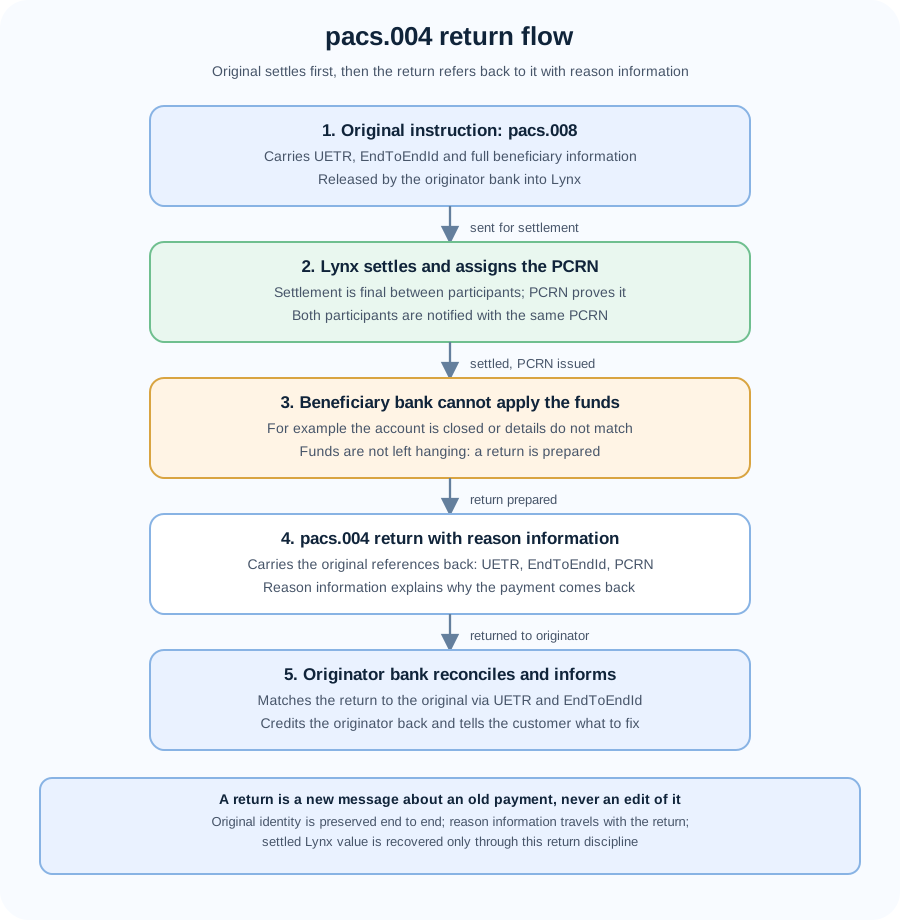
The pacs.004 return message closes the loop the original instruction opened. Functionally, the payment settled, the receiving side cannot apply it, and the funds must come back with an explanation. The pacs.004 carries two things home together: the original payment's identity — the UETR, the EndToEndId and the PCRN that tie the return to exactly one original — and reason information explaining why it returns, so the instruction can be corrected and, if still wanted, re-originated as a new payment. The discipline is strict: the return references the original, never edits it; the original UETR travels inside the return so matching is deterministic. Returns without original identity are orphans; returns without reason information are riddles.
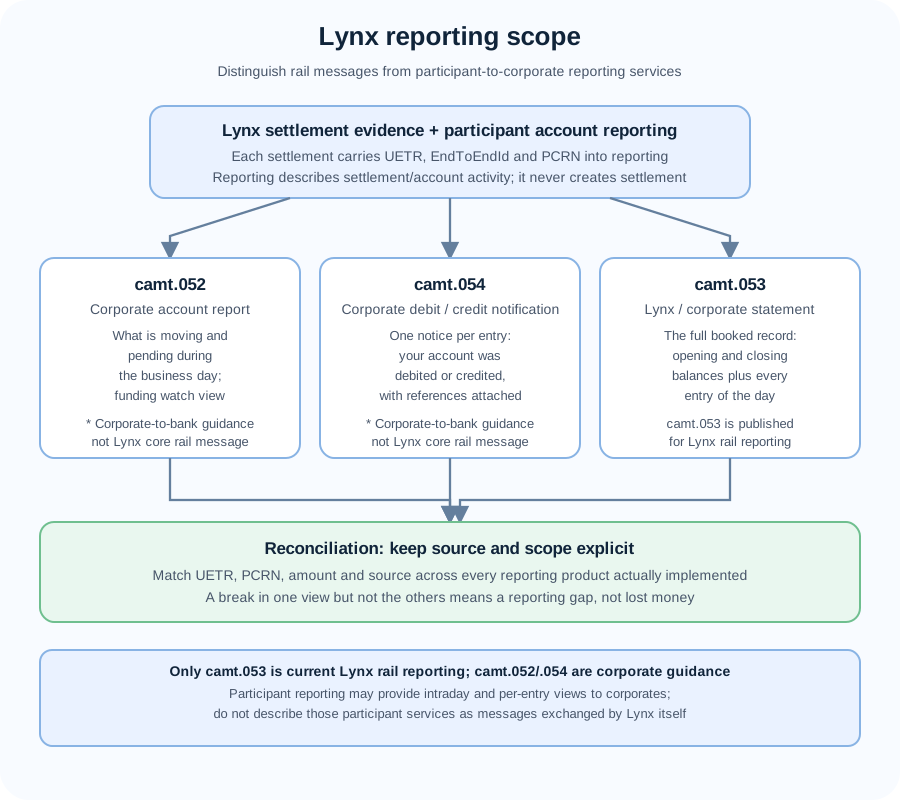
Reporting needs a precise scope boundary. In the currently published Lynx reporting portfolio, Payments Canada publishes camt.053 as the bank-to-customer statement message. Separately, Payments Canada's corporate-to-bank guidelines — provided for information purposes and subject to each financial institution's implementation — include camt.052 for account reports, camt.053 for statements and camt.054 for debit/credit notifications. A bank can therefore design intraday, per-entry and end-of-day client reporting around these ISO concepts, but it should not claim that Lynx itself exchanges camt.052 and camt.054 as core rail messages. Likewise, camt.056 and camt.029 are important in other ISO 20022 payment-cancellation or investigation contexts, particularly CBPR+, but they are not part of the current Lynx UG2026 core message shelf. Lynx investigations should follow the current Lynx rules, message portfolio and participant procedures, using UETR and PCRN as evidence where applicable.
Reference preservation fails at exactly three places: at origination, when channels submit without a UETR or a meaningful EndToEndId; at boundaries, when conversions or downstream handoffs truncate, substitute or discard references; and at rest, when banks store references in logs nobody queries instead of in the payment record every team works from. The prescription is threefold: validate reference completeness at intake and refuse to release without it; forward references untouched across every boundary and require clearing agents to return both UETR and PCRN to the instructing institution; and persist all three references in the core payment record, the statements engine, the reconciliation keys and the investigation desktop.
6. Rules, service levels and customer impact
Customers experience this chapter's machinery as promises, and the bank experiences it as obligations under rulebooks. This section connects the two without inventing a single cutoff time, code value or format detail. Exact times vary by bank, by gateway, by payment type and by day, and they move with holidays and the system calendar. This chapter therefore speaks only in relative terms — business-day operation, morning liquidity build, afternoon funding decisions, next-business-day deferral — and directs you to your bank's published schedules and the system closure calendar for the times that bind your institution. Any study note, job aid or customer script that quotes a specific hour from this chapter is misusing it.
The legal framework is compact and worth naming correctly. Lynx operates under Payments Canada's By-law No. 9 and the Lynx rules, which together set out the rights and responsibilities of participants and Payments Canada, including settlement finality, participation, and the operational requirements behind messaging, liquidity and returns. The PCRN itself is defined in the Lynx By-law and Rule 1, which is why this chapter can state its meaning with confidence: a confirmation number generated by Lynx identifying a settled Lynx payment obligation. ISO 20022 as a standard is the multi-part international standard prepared by ISO Technical Committee TC68 for financial-industry messaging — the shared grammar inside which the pacs and camt families are defined — while the Lynx-specific usage, the MX format requirements and the acceptable message set are Payments Canada matters published through its Lynx ISO 20022 specifications and technical documents. Staff need this layered picture because customers and auditors ask layered questions: "is my payment final" is answered from the By-law and rules, "what does this reference prove" from Rule 1, and "why did our message fail" from the message specifications. One framework, three shelves, no confusion between them.
Service levels bundle timing with certainty, information and recourse. Lynx offers business-day RTGS finality with UETR-based payment identity and PCRN settlement evidence. Returns use pacs.004 under the current Lynx portfolio. Rail-level ISO reporting uses camt.053, while a participant may also provide intraday reports or debit/credit notifications to corporate clients under its own implementation of the published corporate-to-bank guidance. Keeping rail messages separate from client-reporting services avoids false assumptions about what Payments Canada itself exchanges.
Customer communication must reflect finality honestly, and five words carry the whole load: released, settled, posted, available and final. "Released" means the instruction left the sending bank's hub for Lynx. "Settled" means interbank value moved finally across the settlement accounts — evidenced by the PCRN. "Posted" means the beneficiary's account was credited. "Available" means the beneficiary may use the funds. "Final" means the settlement cannot be unwound through the system. A payment can be released without being settled, settled without being posted, and posted without being available, and each gap has a different owner and a different next step. Train every customer-facing colleague on those five words and on the two references: quote the UETR when discussing where a SWIFT-carried payment is, quote the PCRN when asserting that it settled, and never quote an internal sequence number as either. The institutions that handle payee queries well do one more thing: they explain to eligible customers that a PCRN may be requested for a settled Lynx payment — subject to the entitlement conditions above — because a customer who knows the proof exists asks better questions and accepts honest timing with less friction.
Cutoffs and calendars shape every promise. Lynx settles on business days within published operating hours; instructions arriving after the bank's internal cutoff, on weekends or on holidays wait for the next business day; and individual institutions set their own processing deadlines inside the system's hours. The hub must therefore assign every instruction to a business-day window at intake, communicate that window honestly, and never let a channel promise what the rail calendar cannot deliver. A Friday-afternoon instruction that misses the window does not "just make it" — it waits, and the customer should hear that at instruction time with the next value date stated plainly. The reference discipline of this chapter supports that honesty: a payment that waits keeps its UETR, so Monday's settlement is recognisably the same payment Friday's customer instructed, and the statement tells one continuous story instead of two disconnected ones.
7. Fraud, compliance and operational controls
Controls fail when they are complete but misplaced, and nowhere is placement more unforgiving than around final settlement. A sanctions check that runs after Lynx settlement, a fraud hold that triggers after the settlement notification has gone out, a beneficiary-detail verification performed only when the return arrives — each is a control that exists and still loses, because settled value cannot be unilaterally recovered. This section places each control family at the point in the flow where it can still change the outcome, and explains how reference discipline strengthens every one of them.
Fraud controls span initiation, transaction risk and post-event response, and references serve all three. At initiation, authentication, beneficiary-change verification and dual approval decide whether the instruction is genuine before release — because a payment released to a fraudster settles exactly as efficiently as a legitimate one, acquires a valid PCRN, and then needs beneficiary cooperation to recover. After settlement, the UETR lets every team and correspondent flag, track and communicate about the tainted payment with zero ambiguity, and the PCRN fixes the settlement facts for reporting and legal proceedings. Mule-activity monitoring on the receiving side catches the collection end that origination controls never see.
Anti-money-laundering and FINTRAC obligations attach to applicable payment events without being payment approvals, and reference quality determines whether they are satisfiable. FINTRAC's current EFT guidance requires financial entities to report an international electronic funds transfer of CAD 10,000 or more in a single transaction when they initiate it at a client's request or finally receive it; that reporting rule is not a blanket filing rule for every domestic Lynx payment. Complete originator and beneficiary data must be captured where required, the instruction-to-settlement linkage preserved through the bank's reference set, and reporting fed with untruncated data. The architectural point stands: the reference spine this chapter builds supports AML records and investigations, but it does not replace the legal test for whether a report or record is required.
Sanctions and watchlist screening gates release — before the hub commits anything to Lynx — with three dispositions: pass, false-positive release with documented reason, or true-hit hold with escalation. Screening must cover parties, remittance text and routing, and the bank must log what was checked, when, against which list version, and by whom, all keyed to the payment's identifiers so the screening evidence joins the payment record rather than sitting in a separate system. Cross-border legs repeat screening per hop, which is why complete, untruncated data matters: a truncated name creates multi-day false positives at downstream banks, each of which investigates by UETR and each of which consumes the very transparency the reference was meant to provide. Domestic discipline matters equally even without a border crossing, because the finality rule does not pause for screening that ran late. Screen before release or prepare to negotiate after settlement; those are the only two options, and only the first is a control.
Operational controls complete the plane: entitlements and dual approval for releases and overrides, amount and velocity limits, cutoff enforcement with a single shared clock between channels and the hub, queue management with ownership and ageing, amendment discipline that never edits settled value, evidence preservation across the full retention horizon, and segregation of duties between instruction, approval, release and reconciliation. Two of these deserve emphasis in a chapter about references. First, manual releases, verbal instructions and after-cutoff overrides must themselves be controlled, dual-approved and time-bound, with the UETR generated and logged exactly as for straight-through instructions — every major loss in payment operations history involves an override that bypassed the order, and overrides that also bypass reference discipline create losses nobody can even investigate cleanly. Second, evidence preservation must explicitly include the reference set: the UETR, EndToEndId and PCRN retained with the payment record for the full horizon, retrievable by any of the three, because an archive searchable only by internal sequence number is an archive that fails its first audit request for "all payments to this beneficiary on this value date."
8. Exceptions core: returns, investigations and recovery
Every payment system breaks differently, but every break is managed the same way: detect fast, classify correctly, contain within the system's rights, recover as a new linked event, and reconcile with evidence. Banks that classify first recover cheaply. Banks that act first — re-sending on assumption, manually crediting on hope, editing a settled payment — create duplicates, double credits and audit breaks that dwarf the original error. This section teaches the classification and the recovery discipline for Lynx payments; the academy's operations blocks teach each mechanism at full procedural depth.
Start with the taxonomy, because each word means something different and using them interchangeably in customer communication or incident tickets guarantees confusion. A reject happens before settlement: the hub, the gateway or Lynx itself refuses the instruction for invalid format, failed validation or unmet requirements, and nothing settles — the originator repairs and re-originates. A return happens after settlement where the framework permits it: the receiving side sends the funds back because they cannot be applied, with the original identity and reason information travelling in the pacs.004 as Section 5 described. A recall or return request happens after settlement on the basis of ask, not of right: the originator asks the beneficiary's side to send the funds back, which requires beneficiary agreement, because settled Lynx value cannot be pulled back unilaterally — there is no system-level undo. A reversal corrects a bank or system error through a defined corrective mechanism, never by silent editing of a settled record. An investigation tracks an uncertain outcome — a payment with no settlement notification, a beneficiary who cannot see expected funds, a return nobody can match — through status inquiry, tracker views and beneficiary-bank confirmation, all keyed on the UETR. A dispute invokes legal or rulebook rights beyond the payment mechanics. Six words, six different procedures, six different customer messages. Get the word right before doing anything else.
Rail rights constrain recovery, so classify before acting. Settled Lynx value needs a return or a new payment back with beneficiary agreement — never a "reversal" promised to the customer as if the system could rewind. Rejected instructions need repair and re-origination, not investigation. Uncertain states need confirmation of the original's fate before any corrective payment, because re-sending an unsettled-but-actually-queued payment manufactures a duplicate that then needs its own recovery. The hub must prevent impossible offers at the source: no "cancellation of settled value," no "recall" described as a right, no timeline promised before the beneficiary bank has answered. Every impossible promise becomes a complaint, and every complaint about final payments becomes a trust event the bank cannot afford.
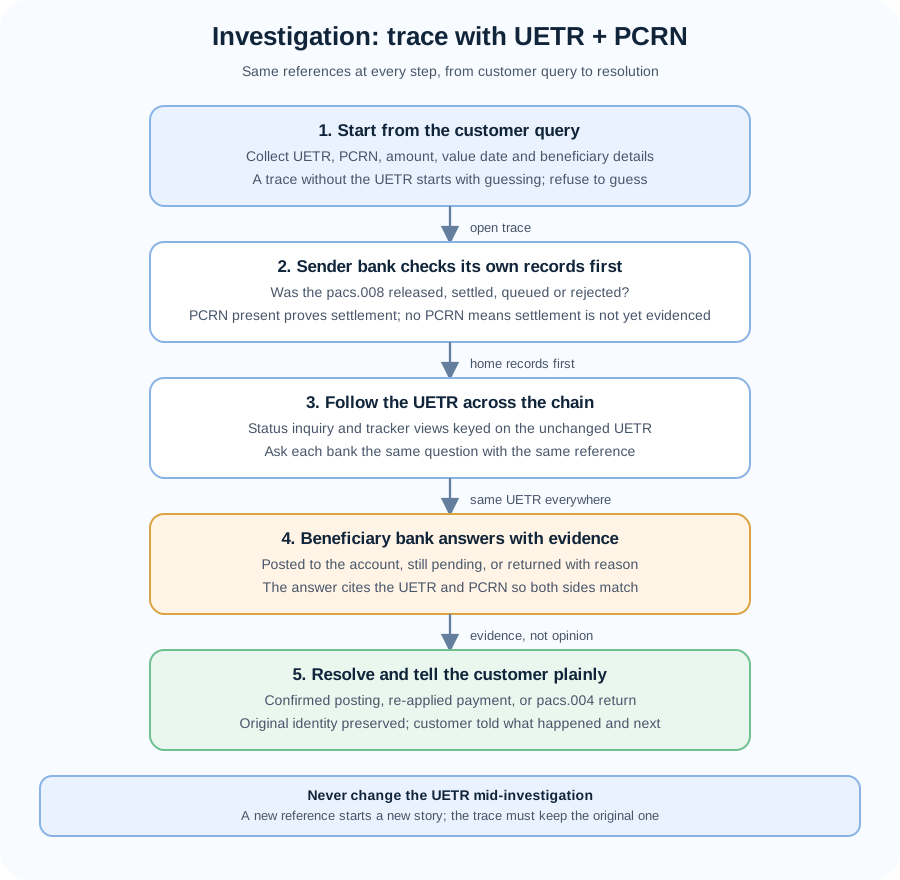
Investigations walk one path, and the diagram below is its poster. Confirm release and references first: was the message released, with which UETR and EndToEndId, and with what gateway acknowledgement. Then settlement evidence: a PCRN fixes settlement as fact. If the PCRN is absent, settlement is not yet evidenced; check Lynx status and participant notifications before deciding whether the payment is queued, discarded, removed or affected by a reconciliation break. Then the chain: follow the unchanged UETR through tracker views and status inquiries, asking each bank the same question with the same reference. Then the beneficiary end: posted, pending, or returning with reason — answered with evidence citing UETR and PCRN. Then tell the customer the state plus the next value date. Throughout, never change the UETR mid-investigation: a new reference starts a new story and orphans every confirmation gathered so far. The two most expensive errors are both reference errors — tracing by amount and date instead of by UETR, and quoting an internal number to another bank — and both are fixed by desktop design that puts the UETR and PCRN at the top of every screen.
Recovery follows four rules. Never edit settled value — originate a linked corrective payment with its own lifecycle and its own references pointing back to the history. Never re-send on assumption — confirm the original's state first, or timeouts become duplicates. Choose the recovery vehicle by current urgency and current data quality, not by nostalgia for the original instruction: a corrected re-origination after a return is a new payment that deserves full validation, not a photocopy of the failed one. And communicate state plus next value date, never activity: "your payment settled with PCRN X, the beneficiary bank could not apply it for this reason, we have recredited you and the corrected payment settles on this date" closes a case, while "we are following up with the other bank" extends one. Returns, done right, are customer-service assets: a pacs.004 with clear reason information lets the sending bank call the customer the same day with the cause and the fix, which is the kind of competence customers remember and recommend.
9. Posting, accounting and reconciliation core
Posting turns settlement facts into account balances, accounting turns postings into a controlled ledger, and reconciliation proves the two agree with the outside world. For Lynx payments, settlement is intended to occur within the system's business-day processing cycle when liquidity and other conditions permit, while posting and availability remain participant responsibilities. This makes breaks more visible and less forgivable than in batch, where a one-day float can hide many sins. This section follows a Lynx payment through the books and shows where each reference of this chapter appears, because a reference that never reaches the ledger cannot serve audit, and a ledger without references cannot serve investigation.
Posting begins where Section 4 ended: settlement with a PCRN in hand. The sending participant posts the debit to the originator's account — or to the settlement or suspense account structure the bank uses for Lynx activity — citing the UETR and EndToEndId so the originator's statement line matches the instruction the originator issued. The receiving participant posts the credit to the beneficiary's account — or onward to the downstream non-participant institution — citing the same UETR and EndToEndId plus the PCRN, so the beneficiary sees one continuous identity from instruction to credit. Downstream handoffs preserve rather than replace: the non-participant institution credits its customer with the chain's references attached, because substituting a purely internal number at the last mile destroys the customer's ability to match the credit to the expected receipt and destroys the sending bank's ability to confirm application by reference. Value dates and customer availability follow the Lynx operating schedule and each institution's procedures; do not promise settlement-day posting or next-business-day treatment without the applicable bank and system rule. A customer should be told which date the statement line belongs to and which instruction it answers.
Accounting wraps those postings in control. Lynx activity flows through settlement accounts at the Bank of Canada on one side and customer and suspense accounts on the other, with fees separated from principal so the booked amount equals the messaged amount. Returns post as their own entries linked to the original, citing the return with the original UETR and PCRN carried forward. Suspense treatment is time-bound and owned: any settlement without a matched posting, any return without a matched original, ages visibly with an owner and an escalation clock.
Reconciliation for Lynx payments is three-way and daily, and each way uses this chapter's references. First, internal matching: every released instruction matched to its settlement notification by UETR, every settlement matched to its customer posting by UETR and EndToEndId, every return matched to its original by the same keys — with the PCRN alongside as the settlement proof on each matched set. Anything unmatched at the end of the day is an exception with an owner, not a timing difference to carry casually: a released-but-unsettled instruction is queued, rejected or lost; a settled-but-unposted payment is a posting failure or a downstream handoff gap; a return without an original is a matching defect or a misdirected message. Second, external and client-reporting matching: the bank's record of Lynx settlements agrees to the rail-level camt.053 statement and to any participant-provided corporate reporting such as camt.052/camt.054 where that bank has implemented the information-purpose corporate guidelines. UETR, PCRN, amount and participant references support correlation, but the bank must distinguish what came from Lynx from what its own reporting layer generated. Third, customer matching supported rather than suffered: statements and advices that carry UETR, EndToEndId and PCRN let corporate customers auto-match in their ERPs, which converts reconciliation from a dispute factory into a quiet background process — while statements that carry only internal numbers push the matching burden onto the customer and generate the query volumes operations teams complain about. The economics are blunt: references on statements cost almost nothing to print and save whole teams of reconciliation labour on both sides of every payment.
Liquidity and reporting close the loop operationally. Intraday activity views let treasury and liquidity desks watch funding needs build through the day, with the afternoon funding decision informed by actuals. End-of-day statements let finance assert positions and audit sample with references leading straight back to instructions. The metrics that manage the function — release-to-settlement times, return rates with reason breakdowns, unmatched-item ageing, investigation cycle times — should be segmented by reference quality, because reference discipline is the cheapest performance lever in the department.
10. Bank implementation, testing and resilience
Everything this chapter has described must be built somewhere: in the hub, the gateways, the statements engine, the reconciliation function and the investigation desktop. This section tells a bank what to build, how to test it, and how to keep it running when parts fail. It stays at the level of capabilities and test strategy, not vendor selection or project planning, because the academy's implementation blocks own those depths. But no bank should leave this chapter without a build list, so here it is, ordered the way implementations should sequence it.
The hub comes first, because every reference in this chapter is either born, preserved or lost there. The hub needs a durable payment record carrying, for the payment's full life, the internal identifier, UETR, EndToEndId, message type, release and settlement timestamps, the PCRN once notified, return linkage, and the screening and approval history. It needs intake validation that refuses Lynx-bound instructions without a well-formed UETR and a meaningful EndToEndId, a release log recording exactly what was sent, a matching engine joining notifications to instructions by UETR with owned exceptions for anything unmatched, and a single shared business-day clock with every channel. Hubs that cannot carry a 36-character chain reference alongside internal numbering should treat that gap as a scheduled defect: every process in this chapter pays rent on that missing field forever.
Gateways and boundaries come second. The Lynx gateway must build and validate MX messages to the bank's implementation guides, enforce the acceptable message set, handle rejections with repair paths that preserve the UETR, and deliver settlement notifications and received payment information — with PCRN content — into the hub's matching engine rather than into a log nobody reads. Format and network boundaries need explicit reference-preservation rules: whatever enters a conversion or a handoff with a UETR and PCRN must exit with the same UETR and PCRN, verified by testing rather than assumed by design. The clearing-agent boundary needs a contractual and technical commitment: the agent returns settlement notifications with PCRN content and received-payment information to the instructing institution promptly and completely, because a non-participant whose agent confirms only "the wire went through" cannot evidence finality to its customer, cannot reconcile by PCRN, and cannot investigate by UETR. Test every boundary with payments designed to break references — long remittance, special characters where permitted, maximum-length identifiers — and confirm character-for-character preservation at the far end.
Statements, advices and reconciliation come third, because they are where reference discipline becomes visible to customers and auditors. The statements and client-reporting engines should preserve UETR, EndToEndId and PCRN in the reporting products the bank supports. The currently published Lynx rail reporting message is camt.053; camt.052/camt.054 may be offered to corporates under the participant's implementation of Payments Canada's information-purpose corporate guidance. The reconciliation function needs the three-way daily process of Section 9 tooled, not manual: auto-matching on UETR with PCRN and amount as confirming keys, owned queues for breaks, ageing with escalation, and metrics that distinguish reference-quality segments. The investigation desktop needs the UETR and PCRN at the top of every screen, one-click access to release records, settlement notifications, tracker views and statement lines for the same payment, and templates that quote chain references — not internal numbers — in every message to another bank and every update to the customer. Tools shape habits: a desktop that leads with internal numbers produces investigators who trace by internal numbers, and Section 8 already priced that habit.
Testing strategy must cover the full lifecycle, not just happy-path settlement. Build a reference test pack: standard payments across message types, payments with customer-supplied versus bank-generated UETRs, returns that must match originals automatically, investigations that must resolve from UETR alone, statements that must carry all three references, boundary cases with maximum-length and edge-content references, and agent-handoff cases verifying PCRN delivery to the instructing institution. Run dual-format and coexistence checks wherever legacy and MX representations meet, with explicit truncation rules that are logged, never silent. Rehearse the failure modes: gateway rejection, queued-then-settled timing, settlement notification delayed or lost, return with reason information, recall request needing beneficiary agreement, downstream application failure. Each rehearsal should end with the same questions: did the UETR survive, did the PCRN arrive, did the return match, did the statement tell the truth. Promote to production only when the pack passes end to end, and re-run the pack on every hub, gateway or statements-engine change — reference handling is exactly the kind of capability regressions silently destroy.
Resilience is the standing commitment behind all of it. Backup connectivity and contingency submission paths must preserve reference handling, not just payment flow — a contingency channel that moves money without UETRs trades an outage for an investigation backlog. Failover must carry the reference-bearing payment record store intact, and capacity planning must cover investigation and reconciliation as well as submission. Drill until every participant can state, from their own systems, the UETR and PCRN of any payment they handled that day — that single ability is the operational definition of everything this chapter teaches.
11. Practical Canadian examples
Two fictional stories now put the chapter to work. Both are invented — fictitious people, firms and amounts — and each is labelled as required. What is real in them is the mechanics: the references, the messages, the settlement promise and the recovery discipline all behave exactly as Sections 1 to 10 describe. Read each story twice: once for the plot, once watching the references move.
Example (fictional): the Friday house closing that hinged on a PCRN
A young couple, the Tremblays, are buying their first home in Longueuil, Quebec, and the closing is set for a Friday afternoon at the notary's office. The down payment — $85,000 — must move that morning from their account at a Lynx participant bank to the notary's trust account at another participant. Their adviser submits the wire through the branch, and the hub builds the pacs.008 with a freshly generated UETR and the file's EndToEndId, validates the beneficiary-agent details for the trust account, screens, approves and releases. By mid-morning the settlement notification arrives carrying the PCRN, the hub matches it to the instruction by UETR, and the couple's debit advice shows the references. So far, a routine morning.
At noon the notary's assistant calls the couple: the funds have not arrived. The branch adviser does three things in the right order. First, she reads her own records: released at 9:40, settled with a PCRN at 9:52 — settlement is fact, evidenced, not asserted. Second, she quotes the state honestly using the five words of Section 6: released, settled, but not yet confirmed posted — and she gives the couple the PCRN, explaining that it proves the payment settled in Lynx and that the receiving bank can locate the payment with it instantly. Third, she calls the receiving participant's operations team quoting the UETR and PCRN rather than an internal number. The receiving bank finds the payment within minutes: it settled correctly, but application to the trust account is held pending a routine verification on a large first-time credit to that account — a receiving-side process, not a payment failure. The hold clears early in the afternoon, the trust account is credited with the chain's references attached, and the closing proceeds at 3:30.
Three lessons anchor the story. The PCRN converted an anxious dispute into a located payment with proven settlement, changing the conversation from panic to process. The UETR let two banks talk about the same payment without translation, collapsing a potential day of matching into a single call. And honest state language — settled but not yet posted — kept the customers' trust through a delay the sending bank did not cause. The references did not move the money faster; they moved certainty faster, which is what the customers were actually waiting for.
Example (fictional): the manufacturer's returned supplier payment
Prairie Edge Equipment, a fictional agricultural-machinery maker in Saskatoon, pays a Canadian supplier — Lakeland Hydraulics of Regina — $214,500 for a shipment of hydraulic assemblies. Prairie Edge banks with a non-participant institution served through a Lynx participant as clearing agent; Lakeland banks with a different participant. On a Tuesday morning Prairie Edge's controller releases the payment through the business portal. The company's bank captures the instruction, forwards it to its clearing agent with the EndToEndId the ERP needs, and the agent generates the UETR, builds the pacs.008, and releases it to Lynx. Settlement follows within the morning window, the PCRN is generated, and both participants are notified — the agent receives the settlement notification with the PCRN and passes the confirmation, with UETR and PCRN, back to Prairie Edge's bank, which debits Prairie Edge and reports both references on the advice. Clean origination, clean settlement, complete handoffs.
On Wednesday morning the story turns: a pacs.004 return arrives at the agent quoting the original UETR, EndToEndId and PCRN, with reason information explaining that the beneficiary account details did not match — Lakeland had changed banks the previous month and the accounts-payable clerk at Prairie Edge used a saved beneficiary profile with the old account number. Because the return carries the original identity, the agent's matching engine joins it to Tuesday's payment automatically, recredits Prairie Edge's bank, which recredits Prairie Edge, all within the morning. The controller gets a call the same day with three facts: which payment returned, identified by the EndToEndId her ERP recognises; why it returned, in plain language from the reason information; and what to fix, the beneficiary profile. She corrects the profile, confirms the new account details with Lakeland by callback, and re-originates — a new instruction with its own lifecycle, validated fully, settling Wednesday afternoon with a new PCRN. Thursday's production schedule, which depended on the assemblies shipping on payment, holds.
The lessons run deeper than "check account numbers." The agent-to-institution handoff worked because the PCRN and UETR travelled back to the instructing bank rather than stopping at the agent. The return matched automatically because the original identity travelled inside it. The customer conversation took one call because reason information arrived with the return. And the re-origination was treated as a new payment with full validation rather than a photocopy of the failed one. Nobody "reversed" the settled payment, nobody edited history, nobody re-sent on assumption. A $214,500 error cost one day and one phone call instead of one week and one customer relationship.
12. Key takeaways and authoritative references
Ten misunderstandings account for most of the trouble banks experience with this chapter's subjects, and correcting them is the fastest test of whether the chapter landed. First, the UETR is not a generic Canadian domestic identifier: it is a SWIFT payment-instruction reference, and Lynx ISO 20022 guidance uses UETR in the relevant message chain. Second, intermediaries do not mint their own UETRs — forwarding means copying exactly as received, and a regenerated UETR forks one payment into two identities. Third, the PCRN is not assigned by any bank — it is generated by Lynx at settlement, which is precisely what makes it independent evidence. Fourth, a bank's internal posting number is not the PCRN — quoting one as the other misleads customers and corrupts evidence. Fifth, a PCRN present proves Lynx settlement; its absence means settlement is not yet evidenced and may reflect a queued, discarded, removed or not-yet-reconciled payment, so operations must check status rather than infer “never settled.” Same-bank transfers never touch Lynx and never receive one. Sixth, "final" does not mean "credited" — settlement finality between participants and posting to the beneficiary account are different events with different owners. Seventh, a return is not an edit — the pacs.004 references the original and carries reason information home; history is never rewritten. Eighth, settled value cannot be unilaterally recalled — recovery after settlement needs the receiving side's agreement, so promises of "reversal" are promises no system can keep. Ninth, every reporting view a participant actually implements must agree with the same underlying payment and settlement evidence; do not infer that camt.052 and camt.054 are Lynx core rail messages merely because they are available as corporate-to-bank guidance. Tenth, tracker and status views describe the payment, they do not move it — messaging evidence and settlement fact must never be confused, in either direction. RTR remains a planned, separately governed capability until production launch; do not present its intended 24/7 model as current Lynx capability.
The working rules compress to a pocket list. Generate the UETR once and forward it untouched. Log every reference at release. Quote the UETR when locating, the PCRN when proving. Settle first, then report, then reconcile — never in any other order. Match returns to originals by reference, never by amount. Classify before acting, recover as a linked new event, communicate state plus next value date. Print references on every statement and advice. Preserve across every boundary, especially the agent-to-institution handoff. Test the whole lifecycle, including failures, before production and after every change. Drill until anyone can state any payment's UETR and PCRN from their own systems. A bank that keeps these ten rules keeps its payments identified, its customers informed and its auditors satisfied — which is the entire business case for this chapter in one paragraph.
Forward links keep the learning going. Returns connect to the academy's rejects, returns, recalls and reversals material and to the wire returns, investigations and reconciliation chapter. Reporting connects to posting, accounting and statements; investigations to payment investigations and exception management; fraud and screening to the fraud, sanctions, travel-rule and FINTRAC chapters. The Lynx mechanics underneath connect to the Lynx high-value, RTGS settlement and pacs.008/pacs.009 chapters of this block.
Authoritative references
All references below are official sources used functionally in this chapter. Message specifications, code values and formats are intentionally not reproduced here — consult the Lynx specifications and your bank's implementation guides for anything beyond functional description.
- Payments Canada — Explainer: Lynx wire payments and the Payment Confirmation Reference Number (what Lynx is, the Lynx By-law and rules framework, what the PCRN proves, when no PCRN exists, and end-user entitlement): https://www.payments.ca/explainer-lynx-wire-payments-and-payment-confirmation-reference-number
- Payments Canada — High-value payment system Lynx: current UG2026 core messages (head.001, pacs.008, pacs.009 Core/COV, pacs.004), Lynx camt.053 reporting, and separate information-purpose corporate-to-bank guidelines for pain.001/pain.002/camt.052/camt.053/camt.054: https://www.payments.ca/payment-resources/iso-20022/high-value-payment-system-lynx
- Payments Canada — Lynx system page (RTGS, participant and non-participant model, SWIFT network, partial payment copy, operating days and 2025 statistics): https://www.payments.ca/systems-services/payment-systems/high-value-payment-system-lynx
- Payments Canada — Lynx Rule 10 update (pacs.004 standardized for initiating the return of a Lynx payment message, effective 24 November 2025): https://www.payments.ca/payments-canadas-latest-rule-updates-streamline-operations-and-global-alignment
- Payments Canada — Lynx ISO 20022 pacs.004.001.09 specification (OriginalUETR, OriginalEndToEndId and PCRN in OriginalClearingSystemReference): https://www.payments.ca/sites/default/files/lynx_payment_return_pacs.004.pdf
- Payments Canada — Lynx camt.053.001.08 specification (statement References includes EndToEndId and UETR; ClearingSystemReference is populated with PCRN): https://www.payments.ca/sites/default/files/lynx_bank_to_customer_statement_camt.053.pdf
- Bank of Canada — settlement-account policies for Payments Canada systems (central-bank-money final settlement, Lynx direct participants and RTR planned access): https://www.bankofcanada.ca/core-functions/financial-system/bank-canadas-settlement-account-policies-for-payments-canada-payment-systems/
- FINTRAC — Reporting electronic funds transfers (international EFT reporting obligations and CAD 10,000 single-transaction threshold for financial entities): https://fintrac-canafe.canada.ca/guidance-directives/transaction-operation/eft-dt/eft-dt-eng
- Payments Canada — Real-Time Rail testing and launch (industry solution assurance; sequenced Q4 2026 launch target; not current Lynx production): https://www.payments.ca/systems-services/payment-systems/real-time-rail-payment-system/testing-and-launch
- SWIFT — What is a Unique End-to-end Transaction Reference (UETR) (36-character UUID, single source of truth, originator generation, intermediary pass-through, beneficiary processing, Tracker confirmations): https://www.swift.com/payments/what-unique-end-end-transaction-reference-uetr
- SWIFT — SWIFT gpi (end-to-end traceability and transparency, payment confirmation, UETR-based tracking and the Tracker): https://www.swift.com/products/swift-gpi
- ISO 20022 — Universal financial industry message scheme (the international standard by ISO Technical Committee TC68; message catalogue and repository): https://www.iso20022.org/
This application uses JavaScript for the full interactive experience. This text summary is served for accessibility and search indexing.