Lynx pacs.008 and Customer Credit Transfers. Understand customer credit-transfer data and Lynx processing patterns around pacs.008.
Block 9 · Chapter 42 of 75
Purpose
Understand customer credit-transfer data and Lynx processing patterns around pacs.008.
This chapter is about one message family and the business discipline behind it. The pacs.008 customer credit transfer is the ISO 20022 interbank message a participating financial institution uses when its customer — a business, a government department, a financial institution acting for its customer, or an individual — asks it to push Canadian-dollar funds to a beneficiary at another participating institution through Lynx. The interbank message can carry the debtor and creditor, their agents, amount, currency, end-to-end identification, UETR and remittance. Lynx itself receives a partial copy for routing and settlement; Payments Canada says that copy does not include client information, account numbers or transit numbers, so do not treat the Lynx system record as the beneficiary-posting record. Everything else in this chapter — agent chains, validation gates, screening placement, settlement behaviour, returns discipline, posting and reconciliation — exists to make that data arrive complete, settle finally, and reconcile cleanly.
This chapter stays functional. It names business elements only where they are well established across Lynx and ISO 20022 practice — debtor, creditor, debtor agent, creditor agent, intermediary, settlement amount, UETR, end-to-end identification, remittance information, purpose — and it does not reproduce message schemas, tag paths, or format specifications. For binding message construction, your bank's Lynx gateway specifications and the current Payments Canada documentation govern. Any study note that copies a supposed full pacs.008 sample from training material into production code is misusing this chapter. What this chapter teaches instead is the harder skill: reading a customer instruction, judging whether it is complete enough to become a pacs.008, building it without losing identity, screening it before release, settling it through Lynx, and proving afterwards that the right beneficiary was paid for the right reason with evidence that survives audit.
A note on status dates. Baseline is 5 October 2026. Lynx has been live since 1 September 2021 as Canada's real-time gross settlement system for high-value and time-critical Canadian-dollar payments, settling across settlement accounts at the Bank of Canada. Payments Canada’s current ISO 20022 resource centre lists Lynx UG2026 core specifications for pacs.008, pacs.009 and pacs.004, and UG2025 reporting specifications for camt.053. Treat those posted versions as the binding production reference for this audit date; do not describe a generic ‘2025 migration’ as the specification version. The Automated Clearing Settlement System remains the live retail batch system. The Real-Time Rail is not live at the 5 October 2026 audit baseline: Payments Canada's By-law No. 10 and the RTR Rules were approved 30 June 2026 with coming into force 24 August 2026, and industry planning points to initial launch in Q4 2026. Whenever this chapter mentions the RTR, that planned distinction is intentional. No exact cutoff times, fees, thresholds, or character limits are stated in this chapter; banks publish their own schedules, and this chapter speaks only in relative terms such as morning, midday and afternoon operating windows on business days.
What you will be able to do after this chapter
After working through this chapter, you should be able to:
- explain in plain language what a pacs.008 customer credit transfer is, when a bank uses it instead of a batch item or an interbank pacs.009, and what the customer buys by choosing it — same-day individual settlement with finality, subject to the bank’s own service and fee policy and Lynx operating windows;
- name every party in a pacs.008 journey — debtor, debtor agent, any intermediary, creditor agent, creditor — and state what each owns, including who warrants data quality, who owns settlement funding, and who owns beneficiary posting;
- trace a customer instruction from channel to hub to gateway to Lynx queue to settlement to beneficiary posting, naming the evidence created at each handoff;
- describe the business anatomy of a pacs.008 — who and how much, which banks, why plus traceability — and explain why the UETR thread must be created once and never rewritten;
- compare unstructured, structured and reference-only remittance options, recommend one for a given business situation, and explain what breaks downstream when remittance is truncated or stripped;
- explain the instructing versus instructed agent relationship functionally, decide when an intermediary belongs in the chain, and reject incomplete agent data before release rather than after;
- apply hub validation in the right order — completeness, authority, funds and limits, duplicates, screening, approval, cutoff — and distinguish repairable pre-release defects from post-settlement errors that need a recall request;
- place fraud, sanctions, travel-rule and reporting controls at the point where they can still change the outcome, and explain why data-driven screening depends on complete pacs.008 party and remittance data;
- classify rejects, returns, recalls and return requests, reversals and investigations around pacs.008 correctly, and describe recovery that preserves the original transaction identity through UETR and related references;
- explain posting, accounting, liquidity, reporting and reconciliation for pacs.008 from the bank operations view, including intraday liquidity consumption, settlement-account entries, advices and camt-family reporting, and same-day matching;
- describe how a bank implements, tests and operates pacs.008 safely — gateway wiring, parallel validation, character-set handling, contingency handling and staff readiness — without treating training material as a specification;
- work through fictional customer stories — a supplier payment, a property closing flow, and a payroll shortfall rescue — and extract the control lesson that generalises to your next business day.
For a roughly 60-minute core session, spend about 10 minutes on this introduction and Sections 1–2, 15 minutes on Sections 3–4 with the instruction-to-settlement flow, 10 minutes on Section 5 with the business-anatomy and remittance diagrams, 10 minutes on Sections 6–7 with the agent-chain and screening material, 10 minutes on the fictional stories in Section 11, and 5 minutes on takeaways and references in Section 12. The remaining depth — validation detail, exception mechanics, posting and implementation — is follow-up study; completing the whole chapter takes longer.
Chapter navigator
- Business context and customer need
- Participants, responsibilities and system boundaries
- Initiation, validation and bank processing
- Clearing, RTGS settlement via Lynx and finality
- Data core — pacs.008 business anatomy, identifiers and references
- Rules, cutoffs, service levels and customer impact
- Fraud, compliance and data-driven screening
- Exceptions, investigations and recovery
- Posting, accounting, liquidity, reporting and reconciliation
- Bank implementation, testing and resilience
- Practical Canadian pacs.008 examples
- Key takeaways and authoritative references
1. Business context and customer need
Every pacs.008 starts with a business promise that batch timing cannot keep. A manufacturer must pay a steel supplier this morning or lose a production slot. A law firm's client must move purchase funds with same-day irrevocable settlement or the property closing fails and keys do not transfer. A pension administrator must fund a settlement obligation by a market deadline. A corporate treasurer must concentrate balances before the afternoon funding decision. A municipality must release emergency grant funds today with proof each payment settled. None of these customers wakes up wanting a pacs.008. Each wants certainty about three things: the right beneficiary will be paid the right amount today, the settlement cannot be unwound through the system afterwards, and the bank can prove it with references both sides can quote. The pacs.008 customer credit transfer through Lynx is how a Canadian bank delivers that combination for Canadian-dollar value.
That promise costs more than batch and demands more discipline than batch, which is why bankers must position it honestly. A payroll of eight hundred credits belongs in batch files where unit cost is low, return mechanics exist, and advance planning absorbs the deferred settlement. A single time-critical supplier payment of several hundred thousand dollars belongs on Lynx where individual real-time gross settlement gives finality during operating windows. Confusing the two creates the two classic commercial failures this chapter prevents. The first is selling urgency and delivering batch timing — the customer pays wire pricing in expectation and receives next-window value. The second is using Lynx for bulk convenience — the bank consumes intraday liquidity, pays wholesale handling cost, and surrenders return rights for payments that never needed finality. The operating question is therefore never whether pacs.008 is better than batch in the abstract. It is whether this obligation, today, needs individual finality badly enough to justify the price, the operating window, and the data completeness Lynx demands.
Consider the fictional Ontario manufacturer that will recur through this chapter — call it Northline Foods of Guelph. On a Thursday, five business events compete for the operations team's attention. Payroll for four hundred employees must credit Friday morning and is already staged as a batch file. A flour supplier collects its monthly invoice by pre-authorised debit on the same day. A replacement oven costing a six-figure sum must be paid today or the weekend production run is lost. A food-service customer that overpaid last week wants a refund. A United States packaging supplier invoices in dollars due next Tuesday. Four of those events belong on batch, Interac, or correspondent paths. One — the oven payment — needs Lynx, because only individual settlement with finality, released this afternoon with complete beneficiary data, holds the weekend slot. The bank's job is to see all five at once, route each to the rail whose timing, finality, data and cost fit, and explain the choice so the customer stops asking for everything to be a wire and starts planning each obligation on its correct clock. This chapter teaches the Lynx leg of that judgement in depth so the rest of the routing decision stays honest.
The stakes behind the choice repay attention because Lynx concentrates value even though batch concentrates items. Payments Canada’s current Lynx page reports 2025 totals of 13.6 million items and $93.3 trillion in value (daily averages: 54,229 items and $371.9 billion). This chapter does not repeat an ACSS total here because the cited Lynx page does not establish one. The practical implication is direct. One delayed or misdirected Lynx payment can be a treasury event, a failed closing, or a lost production weekend. One thin remittance line can leave a settled payment unapplied for days. One skipped callback can turn an urgent instruction into an irrevocable payment to a fraudster. Batch errors are measured in repair files and return cycles. Lynx errors are measured in recall requests that need beneficiary cooperation and may not come back.
Because the current Lynx UG2026 pacs.008 specification supports structured agents, parties, references and remittance, the pacs.008 a bank builds today can be data-rich by design: structured parties, explicit agents, settlement detail, purpose where needed, and remittance the beneficiary can consume without retyping. That richness is capability, not automatic usage. If the channel captures a bare account number and a free-text note, the gateway cannot invent the structured detail the beneficiary needs. If the hub truncates a long legal-entity name or drops an invoice line, the payment still settles and both postings still balance, yet the beneficiary cannot apply the cash and opens an investigation costing more than the payment's margin. The most common successful payment failure is settled but unapplied — funds moved, business purpose did not.
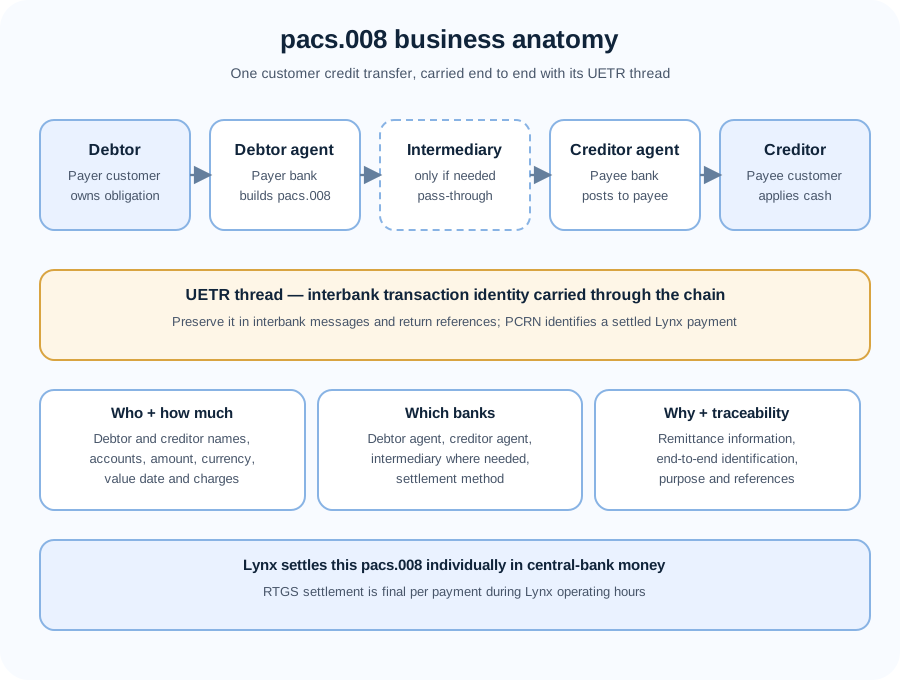
The diagram above is the chapter's anchor. Read it left to right for the party chain — debtor, debtor agent, any intermediary, creditor agent, creditor — and top to bottom for the data layers — who and how much, which banks, why plus traceability — with the UETR thread running beneath everything. Every later section is a deeper pass over one part of that picture: Section 2 assigns ownership of each box, Section 3 builds the picture from a customer instruction, Section 4 settles it, Section 5 details the data inside it, Section 6 times it, Section 7 protects it, Section 8 repairs it, Section 9 proves it, and Section 10 keeps it running.
2. Participants, responsibilities and system boundaries
A pacs.008 journey involves more parties than the two customers who experience it as one business paying another, and the bank professional must keep each party's responsibility distinct. Blending any two creates the errors this academy corrects — treating the debtor agent as a mere pipe, treating an intermediary as the party that owes the creditor money, treating Lynx as the party that decides whether the beneficiary account gets posted, or treating SWIFT as the settlement system behind a Lynx payment. This section names each participant once, states what each owns, and draws the boundaries that investigations and audits walk backwards.
Start with the customers. The debtor is the payer — the business, government body or individual whose obligation the payment discharges and whose account is debited. The creditor is the payee — the supplier, vendor, law-firm trust account, government recipient or other beneficiary entitled to receive the funds and whose account is credited. The debtor owns the economic obligation, the instruction authority, and the funding. The creditor owns the application of the cash — matching the credit to invoices, ledgers or trust records — and owns cooperation if a misdirected payment must come back, because settled Lynx value cannot be pulled back unilaterally. Both customers quote the same references — the end-to-end identification they agreed, the UETR the banks generated, and the remittance detail — and reconciliation breaks the moment either side retypes or drops one.
The banks carry the payment between those customers. The debtor agent is the payer's bank: it authenticates the debtor, validates the instruction, screens it, debits the payer, constructs the pacs.008, warrants its completeness, funds or queues it against intraday liquidity, and releases it to Lynx. The creditor agent is the payee’s participating institution (or the receiving institution’s designated payee arrangement): it receives the payment information and settlement outcome, applies the credit under its account and operational procedures, preserves available remittance for posting/reporting, and handles any permitted return or exception with references the creditor can reconcile. Where a direct chain is not available or operating design requires it, an intermediary agent sits between them and forwards the payment without changing its economic purpose — adding reach at the price of another validation hop and another party that must preserve identity intact. The boundary that matters operationally is this: agents own exchange, funding, validation and evidence, while only the customers own the underlying commercial obligation and only the settlement agent owns final interbank value movement.
Payments Canada operates Lynx and publishes the rulebooks, specifications and operating procedures under which pacs.008 payments are built, validated, queued, settled and investigated. It does not hold customer accounts, does not decide whether an individual beneficiary posting succeeds, and does not guarantee any creditor payment. It provides the RTGS infrastructure, system rules and procedures, queue and settlement mechanics, the business-day calendar including closures, and the return and investigation frameworks. Participants and their SWIFT/gateway controls validate the complete business message; Lynx’s settlement copy is not the full customer-account record. When this chapter says the system, it means that Payments Canada-operated infrastructure plus the rulebook that governs it — never the bank's internal hub or gateway.
The Bank of Canada plays the roles that make Lynx settlement final. It provides settlement accounts on its books through which Lynx obligations settle individually in central-bank money. As overseer of designated financial market infrastructures it supervises systemic risk in Lynx as a systemically important system. Those two hats must never be blended in customer or staff explanations: settlement accounts answer where final value moves, oversight answers why the system can be trusted with that value. The planned Real-Time Rail, when live, will add its own settlement and supervision picture; until then, every Canadian-dollar pacs.008 finality claim in this chapter points to Lynx settlement across Bank of Canada accounts during Lynx operating windows.
Correspondents, SWIFT, vendors and sponsors complete the map without owning the Lynx leg. SWIFT provides messaging standards, connectivity and, for cross-border legs, tracking built on the UETR — it does not settle Lynx value. Correspondents provide accounts and legs for foreign-currency value that may precede or follow a Lynx leg; each leg finalises under its own system's rules. Vendors supply channels, hubs, gateways and screening engines under contract but own no payment case. Sponsors and clearing agents act for indirect participants under agreements with defined cutoff, funding and evidence obligations.
Responsibility is therefore a chain with no gaps and no overlaps. The debtor authorises and funds. The debtor agent validates, screens, approves, builds, releases and warrants. Any intermediary forwards faithfully. Lynx validates, queues and settles finally. The creditor agent posts and reports or explains why it could not. Supervisors and overseers set the rules and expect the evidence. Every investigation in Section 8 walks that chain backwards from the same starting question — who did what, with which reference, at which time — which is why this chapter teaches the walk once, generically, before the fictional stories exercise it.
3. Initiation, validation and bank processing
Every pacs.008 begins in the same place: a customer instruction entering a bank channel and passing through a payment hub before any external system sees it. The hub is not a single product. In this chapter’s illustrative bank architecture, it is the shared layer for instruction intake, validation, decisioning, release, gateway formatting, tracking and reconciliation, with adapters for Lynx, batch, Interac, cards, bulk dollar exchange and correspondent paths. That architecture is bank-specific, not a Payments Canada requirement. Banks that operate one hub with a Lynx adapter scale, control and modernise. Banks that let each channel talk directly to the Lynx gateway duplicate controls, fragment evidence, and relearn every pacs.008 lesson per product. The operating view in this chapter assumes a hub, because that is how well-run Canadian banks absorb ISO 20022 richness, screening obligations and liquidity discipline without rebuilding the bank each time a specification version moves.
Initiation varies by channel but converges on the same data question: who pays whom, how much, in what currency, by when, with what references, and under what authority. Branch and private-banking desks capture single wires and closing payments with face-to-face authentication and entered beneficiary details. Business online portals capture supplier wires with templates, beneficiary libraries and approval chains. Host-to-host files and APIs submit single or small-batch urgent instructions from enterprise resource planning systems with instruction identifiers, value dates and remittance payloads. Treasury and foreign-exchange desks capture instructions whose Canadian-dollar leg will settle through Lynx alongside a foreign-currency or cross-border leg. The hub's first job is to normalise these into one instruction model with a durable internal identifier that survives every later stage even when external references are added — the UETR at build time, the Lynx settlement evidence at settlement time, the creditor agent's posting reference afterwards. Drop that internal identifier and the bank cannot answer the only question an anxious customer asks: where is my payment, proved by what evidence.
Validation is where most preventable pacs.008 failures are caught, and it must happen before release in a fixed order. Account validation confirms the debit account exists, is open, is authorised for wire-class debits, and holds or will hold sufficient funds including fees. Beneficiary validation confirms the creditor agent identification, the creditor account structure, and any intermediary requirement — an unreachable or ambiguous beneficiary is a hub reject, never a release-and-see. Duplicate and anomaly checks compare the instruction against recent history, expected supplier patterns and velocity limits, because the second identical six-figure instruction within an hour is either a duplicate file submission or a fraud test. Data-completeness checks confirm the pacs.008-mandatory business data is present: complete debtor and creditor identification, complete agent chain, amount and currency, settlement method, end-to-end identification, UETR readiness, and remittance in the agreed option. Repair or reject happens here. A payment rejected in the hub costs a phone call and a repair window. A payment rejected at the gateway costs a business day and a customer apology. A payment released with bad data costs an investigation and, if it settles to the wrong beneficiary, a recall request that may not come back.
The control stack sits inside the hub between validation and release, and its order is load-bearing. Authentication and entitlement confirm the user may instruct and the approver may release — dual approval for business wires above the bank's threshold, file-release authority for batched urgent instructions, verified authority for trust-account debits. Limits check amount, daily, per-payee and intraday-liquidity thresholds so the release decision accounts for funding, not just authority. Fraud monitoring scores the instruction against device, behavioural, payee-change, mule and account-takeover signals, with payee-detail changes and first-time large beneficiaries attracting the strongest challenge. Sanctions and watchlist screening checks parties, remittance text and routing against lists with a disposition of pass, false-positive release with recorded reason, or true-hit hold with escalation — Section 7 details the data-driven mechanics. Record-keeping capture ensures the instruction-to-settlement linkage and party detail needed for reporting and audit are preserved untruncated. Cutoff and calendar logic assigns the instruction to today's Lynx window or the next business day and sets the customer value-date expectation honestly. Only after all of these does the hub release. Screening after release is recovery, not prevention, and on Lynx-settled payments recovery requires beneficiary cooperation.
Release is distinct from initiation and from settlement, and staff and customer language must keep all three separate. Release commits the built pacs.008 to the Lynx gateway: the gateway performs its own schema and completeness checks and presents the payment to Lynx; Lynx applies its operating, liquidity and priority/queue mechanics to determine settlement timing within the business day. For Lynx, release before the bank's internal cutoff means today's operating window; after means the next business day under the bank's published policy — there is no evening or weekend Lynx settlement to promise regardless of how the channel framed the instruction. The hub records release time, gateway acknowledgement and the UETR at release, because every inquiry, investigation and reconciliation join starts there. Amendments after release are narrow — pre-settlement cancellation where the gateway and Lynx mechanics permit it, never silent editing of amount, beneficiary or remittance — and the original identifier follows every cancellation and re-origination so duplicates cannot masquerade as repairs.
After release the hub stays active rather than standing down. It tracks gateway acceptance and rejection, watches queue and settlement evidence, handles creditor-agent responses, posts debit and fee entries, generates advices and statements, feeds intraday liquidity reporting, and ages every pending state with an owner. Two design principles decide whether this survives reality. First, route by policy with a recorded reason: urgency, value, data completeness, push authority and currency determine Lynx versus batch, subject to reasoned override. Second, fail visibly and early: a hub that rejects with reason, repair path and next-window promise creates one phone call, while a hub that accepts everything and fails later creates a week of investigations.
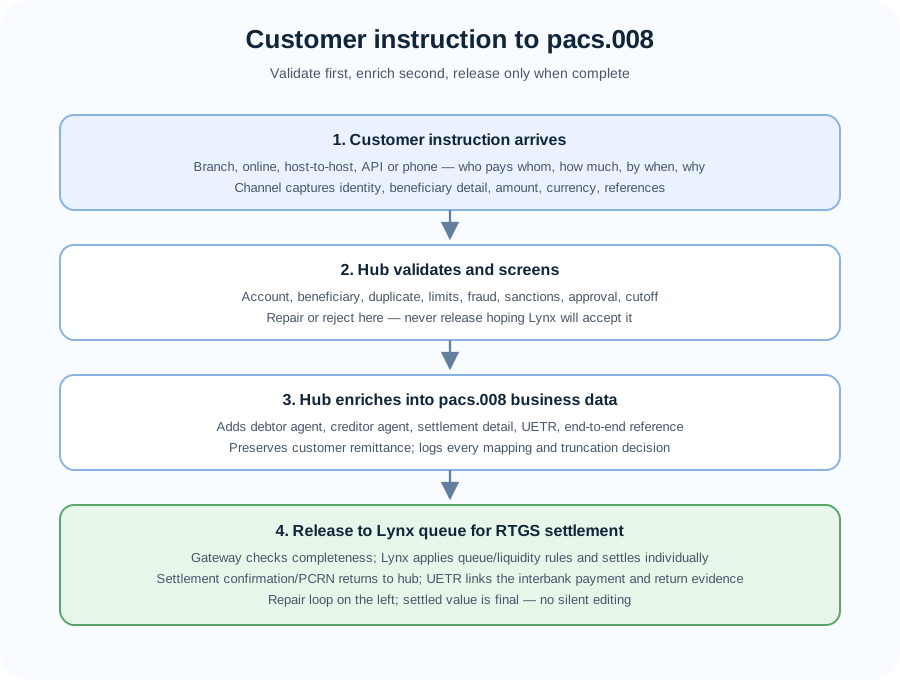
The diagram above compresses the section into an operating poster for the hub wall. Read it top to bottom as the only permitted direction of travel: instruction in, validation and screening with repair-or-reject authority, enrichment into pacs.008 business data with identity preserved, release into the Lynx queue with evidence captured. Any arrow that skips a box — a channel that builds pacs.008 directly, a release that bypasses screening, an enrichment that rewrites identity — is an incident in design form, and Section 10 treats it as a finding rather than a shortcut.
4. Clearing, RTGS settlement via Lynx and finality
If Section 3 is about the bank's decision, Section 4 is about the system's promise. Clearing and exchange, settlement, posting, availability and finality are five different events that staff, customers and even experienced bankers routinely blend. Clearing compares, positions or queues instructions. Exchange delivers items and data between participants. Settlement moves value finally between settlement accounts. Posting debits and credits customer accounts. Availability tells the beneficiary the funds may be used. Finality tells the system the value movement cannot be unwound through the settlement mechanism. Every rail combines these differently, and Lynx combines them in the way that makes pacs.008 valuable and unforgiving at once: per-payment real-time gross settlement with immediate finality and no unilateral unwind.
Lynx settles each pacs.008 individually in real time in central-bank money across settlement accounts at the Bank of Canada. The RTGS model is not a deferred retail netting cycle. Once settled, the payment is final and irrevocable through the system; its amount, beneficiary and remittance cannot be edited or reversed in place. Lynx also has a distinct pacs.004 payment-return message for returning a single pacs.008 or pacs.009 to the original debtor. A misdirected or fraud-induced payment may instead require a linked return/recall process and receiving-institution or payee cooperation under the applicable Lynx rules and bank procedures. Queueing, priority and intraday liquidity determine when during the business day a released payment settles: morning liquidity build, midday throughput, afternoon funding decisions and cutoff discipline shape the settlement minute, but settlement itself, when it occurs, is gross and immediate. That is why Lynx carries time-critical, large-value and settlement-critical payments, including Canadian-dollar legs that support correspondent activity and financial-market settlement, and why its operating day is a business-day construct with published closures for weekends and holidays. Detail on queue mechanics, liquidity provisioning and operating calendars lives at block level; the pacs.008 lesson is that Lynx collapses clearing and settlement into one RTGS event with same-day finality during its windows.
The contrast with batch clarifies what the customer buys and surrenders. Batch systems exchange items, build clearing positions by stream and window, and settle net positions through accounts at the Bank of Canada on a deferred cycle, with return rights surviving settlement for defined reasons and timeframes — insufficient funds, closed accounts, authorisation disputes, image returns. A payroll credit can post to the employee while the interbank position settles later, and a debit collection can post to the biller while the payer retains dispute and return rights. None of that applies to a settled pacs.008. There is no batch-style standing return or adjustment window that reopens a settled payment. A permitted pacs.004 return is a separate, linked payment with its own message, settlement and reconciliation evidence; it is not a reversal of the original settlement. The debtor agent cannot promise the customer a recall right it does not hold, and the creditor agent cannot treat a settled pacs.008 credit as provisional pending some later batch confirmation. Training every customer-facing colleague on that single contrast prevents more complaints and more conduct risk than any system upgrade: batch availability with return rights versus Lynx settlement with finality.
Status language must reflect that finality honestly at every handoff, because each word commits the bank to a different evidence burden. Sent means released from the hub to the gateway. Accepted means the gateway and Lynx took the payment into queueing. Queued means it awaits liquidity or priority sequencing. Settled means interbank value moved finally across Bank of Canada accounts — the only word that carries finality. Posted means the creditor agent credited the beneficiary account. Available means the beneficiary may use the funds. Final means the settlement cannot be unwound through the system. A pacs.008 that is accepted or queued must never be described to a customer as settled, and a settled pacs.008 must never be described as reversible on request. The hub's tracking screens, customer notifications and operations scripts must enforce that vocabulary mechanically, because improvisation under pressure — telling a closing lawyer the funds are final when they are only queued — creates a second incident on top of the first.
Three operational implications follow. First, fund the clock you promise: Lynx needs intraday liquidity on business days with ownership of queue priority and funding decisions. Second, staff the window you sell: pacs.008 expertise must be present during operating windows, because an instruction arriving after the internal cutoff belongs to the next business day. Third, price the certainty you deliver: urgency, liquidity consumption and irrevocability cost more than batch, and customers accept that when the tradeoff is explicit. The hub's cutoff engine and the channel's promise engine must share one clock.
5. Data core — pacs.008 business anatomy, identifiers and references
If rails are the roads, pacs.008 data is the addressing, the letter inside the envelope, and the tracking number on the parcel combined. Canadian Lynx payments fail far more often from bad addressing and thin remittance than from system outages, and the bank hub's data discipline — capture completely, validate early, preserve identity end to end — determines whether queueing, settlement, posting and reconciliation succeed or generate exceptions. This section details the business anatomy of a pacs.008 at functional depth: the three data layers, the identifiers that must survive the whole journey, the agent chain in business terms, and the remittance options that decide whether the beneficiary can apply the cash without calling the bank.
The first layer is who plus how much: the debtor and creditor with their identifications and accounts, the amount and currency, the value date, and the charge arrangement. Debtor identification must let the debtor agent debit the correct account and support screening and reporting. Creditor identification must let the creditor agent post without manual repair. Amount and currency are single-valued and exact; there is no tolerance band in RTGS settlement. Value dating ties the payment to the business-day calendar. Weakness here produces the most expensive failures: a one-digit account error settling to the wrong beneficiary, a name variant triggering a screening hold, an amount error that can only be recalled and re-paid.
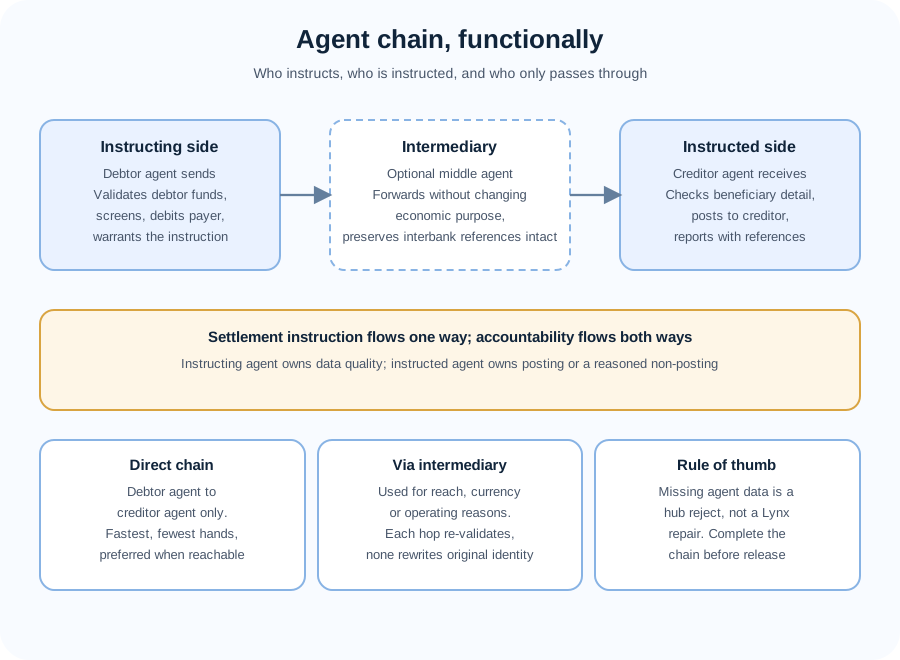
The second layer is which banks: the debtor agent, the creditor agent, any intermediary, and the settlement method. Functionally, the debtor agent is the instructing party that warrants the payment and the creditor agent is the instructed party that posts it, with Lynx discharging the interbank obligation in central-bank money. Where an intermediary participates, it forwards without changing economic purpose and must preserve every end-to-end reference intact. The practical rule is uncompromising: missing or ambiguous agent data is a hub reject with a repair path, never a gateway repair or a release-and-hope.
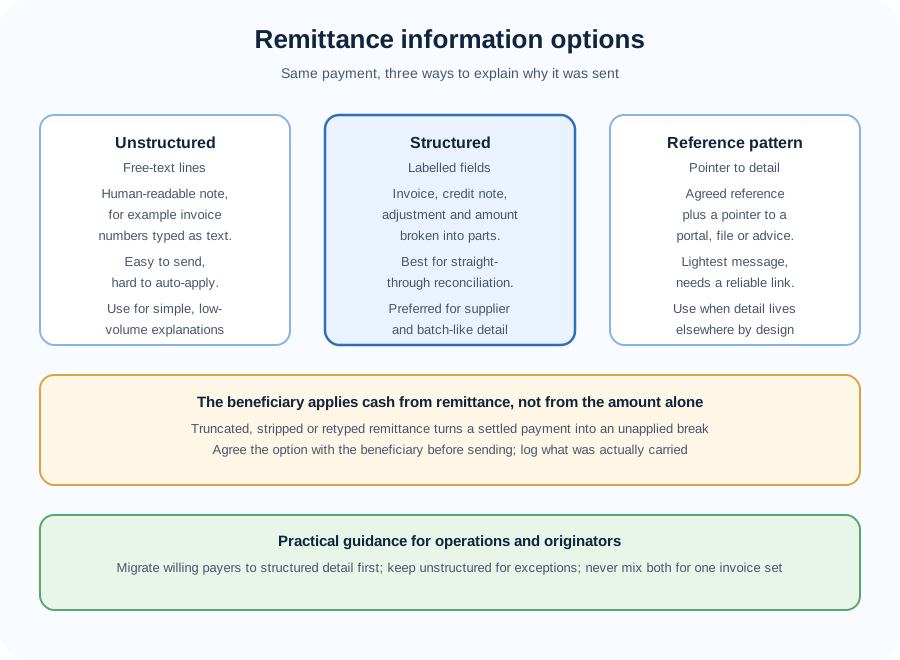
The third layer is why plus traceability: end-to-end identification, the UETR, purpose where the corridor or obligation requires it, and remittance information. End-to-end identification is the reference the debtor and creditor agreed — the instruction number, the file line, the closing number — carried without alteration so both companies' ledgers can match the same payment. The UETR is a globally unique transaction reference carried in the interbank payment identity and original-reference fields. Preserve it unchanged across the interbank chain and use it to link inquiries and returns; it does not replace the Lynx-generated PCRN, the payment’s settlement reference that evidences a settled Lynx wire, or a bank’s customer-account posting reference. Purpose explains the payment's nature where screening, reporting or corridor rules need it — payroll, supplier settlement, trust transfer, settlement obligation — and must be chosen honestly rather than defaulted. Remittance information explains the business detail the creditor needs to apply the cash, and its three functional options deserve the diagram below plus sustained attention because they decide whether settlement becomes applied cash or an open investigation.
Unstructured remittance carries free-text lines a human can read — invoice numbers typed as text, a short note, a closing address. It is easy to send and hard to auto-apply: the beneficiary's receivables team reads it, interprets it, and keys the application manually, which works for simple low-volume explanations and fails for supplier runs with dozens of invoices. Structured remittance breaks the business detail into labelled parts — invoice references with amounts, credit-note references with adjustments, discount and tax detail where agreed — so the beneficiary's enterprise system can match and apply the cash straight through without human reading. It is the preferred option for supplier and recurring business payments and the option operations teams should migrate willing payers toward first, because every structured payment that auto-applies is an investigation that never opens. ‘Reference-only’ is a functional bank/customer operating pattern, not a separate Lynx message type: it carries an agreed reference or pointer to detail held in a portal, file or advice. It keeps the message light but depends entirely on the reliability of that link. It suits arrangements where the detail already flows through another channel by design, and it fails wherever the link is stale, permission-gated, or unknown to the person applying the cash.
Four references must survive every pacs.008 journey. The bank's internal instruction identifier joins channel, hub, gateway and posting evidence inside the sending bank. The end-to-end identification joins debtor and creditor ledgers. The UETR joins every bank, tracker and investigation case including any recall construction. The customer remittance joins the payment to the invoices, trust ledger or obligation it discharges. Two notes shape hub investment. First, coexistence elsewhere in the bank — legacy batch formats alongside MX — must never leak into pacs.008 construction as truncation or re-keying. Second, character-set discipline is daily operations: accented Quebec names, long legal-entity titles and transliterated names must survive capture, screening, settlement, posting and advice without corruption, proven by test cases before production.
6. Rules, cutoffs, service levels and customer impact
Customers experience pacs.008 rules as promises — will it arrive today, when can the beneficiary use it, what will it cost, what reference will appear, what happens if it fails — while the bank experiences the same rules as windows, obligations and evidence. This section connects the two without inventing a single exact cutoff time, fee, threshold or character limit. Exact times vary by bank, by gateway, by participant arrangement and by day, and they move with holidays and operating calendars. This chapter therefore speaks only in relative windows — morning liquidity build, midday throughput, afternoon funding and cutoff discipline on business days Monday to Friday excluding holidays — and directs every reader to their bank's published schedules and the payments.ca business-day and closure calendar for the times that bind their institution. Any study note, job aid or customer script that quotes a specific hour from this chapter is misusing it.
Business days anchor everything about pacs.008 timing. Lynx operates on business days with published closures for weekends and holidays; there is no evening, weekend or holiday Lynx settlement to promise regardless of how urgently the customer frames the instruction. An instruction that arrives after the bank's internal cutoff does not just make it; it belongs to the next business day under the bank's published policy and must be scheduled honestly with a stated next-window value date. A Friday-afternoon instruction ahead of a Monday holiday does not compress into Friday; it shifts value dating and funding expectations and must be explained before release rather than apologised for afterwards. The hub must assign every instruction to a business-day window at intake, communicate that window in the channel before the customer leaves, and never let a channel promise what the Lynx calendar cannot deliver. Block-level calendar mechanics and the bank's own operations schedule carry the binding detail; this chapter carries the discipline.
Relative windows within a Lynx business day differ in ways operations teams feel directly. Morning is liquidity build and queue seeding — funding positioned, closing-critical and market-deadline payments sequenced first. Midday is throughput — customer pacs.008 volume settling individually with monitoring for holds and repairs. Afternoon is funding decisions and cutoff discipline — late instructions triaged into today-versus-next-day with explicit customer agreement. The customer-impact translation must be scripted: a complete instruction with passed screening released in the morning window settles same day with finality; the same instruction arriving after the internal cutoff settles next business day; an incomplete instruction at any hour settles never until repaired.
Service levels bundle timing with certainty, information and recourse, and pacs.008 occupies a distinct position in that bundle. What the customer buys is same-day individual settlement with finality, complete agent and beneficiary handling, intraday status with UETR-indexed evidence, and irrevocability through the system — at wholesale wire pricing, within business-day windows, with no unilateral recall and with screening and approval obligations that cannot be waived for urgency. What the customer surrenders relative to batch is low unit cost, return-cycle protection, and any expectation of evening or weekend value. The bank's product and advisory job is to match the business event to that bundle explicitly: the oven payment that holds a production weekend justifies Lynx; the four-hundred-line payroll does not; the trust closing with a market deadline justifies Lynx with a morning arrival; the routine intercompany top-up with no deadline does not. Selling every payment on speed alone fills the Lynx queue with batch-suitable volume, consumes liquidity the bank needs for genuinely time-critical payments, and teaches customers to expect instant behaviour the business-day calendar cannot support.
Customer communication must reflect finality and evidence honestly, using the status vocabulary from Section 4 without improvisation. Accepted is not settled. Queued is not settled. Settled is final through the system but posted depends on the creditor agent's clock. Available depends on the creditor agent's posting and any hold the beneficiary arrangement permits. A recall request is a request, not a reversal, and its outcome depends on beneficiary cooperation. Operations teams should script these sentences per channel and test that new hires can produce them under pressure without inventing reassurance: your instruction was accepted and queued with this UETR; it settled at this time with this evidence; the beneficiary bank posts per its own clock and your advice quotes these references; if the beneficiary detail was wrong we have sent a recall request quoting the UETR and here is the clock and owner. Pricing and cutoffs interact with that language directly — urgency costs, and customers accept the cost when the tradeoff and the window are explicit — which is why the channel may only offer what the hub confirms for this instruction, this amount, this business day, and no channel copy may promise same-day finality without hub confirmation behind it.
7. Fraud, compliance and data-driven screening
Controls fail when they are complete but misplaced. A sanctions check that runs after Lynx settlement, a fraud hold that triggers after the creditor agent has posted, a reporting extract built from truncated party data, a callback performed against a phone number supplied inside the fraudulent instruction itself — each is a control that exists on paper and still loses, because on settled Lynx value prevention is the only effective control and recovery depends on cooperation. This section places each control family at the point in the pacs.008 flow where it can still change the outcome, explains how screening draws directly on pacs.008 data quality, and shows why richer data makes screening faster and more accurate rather than merely more complete.
Fraud controls span initiation, transaction risk and post-event response. Initiation attack — takeover, social engineering, insider misuse — is met with authentication, device and behavioural signals, entitlement enforcement and dual approval, with changed beneficiary detail and first-time large beneficiaries attracting callbacks to verified numbers on file. Instruction-truth attack — business-email compromise, invoice fraud, scam-induced instructions — is met with beneficiary-change discipline, template controls and verification against masters rather than the instruction's own assertions. Receiving-side abuse is met by scoring incoming pacs.008 credits as well as outgoing payments. Post-event response is met with UETR-indexed case ownership and honest expectation-setting. Every disposition — pass, step-up, hold, release with reason — is logged with who decided, when, and on what evidence.
Sanctions and watchlist screening may gate release, and pacs.008 data is their fuel. Travel-rule and other PCMLTFA information obligations are not a generic ‘screening’ result: apply them only when the transaction and reporting entity are in scope, with the required data and records. Complete structured party data resolves quickly while thin or ambiguous data queues for manual disposition and consumes the window the customer paid for. Data-driven screening answers with feedback loops — disposition outcomes flowing back into hub rules, master hygiene and template governance, so the same supplier's next payment screens straight through. Screening repeats per hop wherever intermediaries or cross-border legs participate, so truncation anywhere manufactures false positives downstream. Log what was checked, when, against which list version, and by whom.
Reporting, record-keeping and supervision attach to pacs.008 events without being payment approvals, and they depend on the same untruncated data. FINTRAC’s current guidance distinguishes international EFT reports for financial entities (including $10,000-or-more initiation or final receipt) from broader EFT record-keeping and suspicious-transaction duties; do not label every domestic CAD Lynx transfer an EFTR. OSFI E-21/B-13 expectations apply to federally regulated financial institutions’ critical operations and technology/cyber resilience, while RPAA registration, operational-risk, incident and safeguarding duties apply to PSPs in scope—not automatically to every Lynx participant. Client identification, transaction records and prescribed reporting draw on the debtor, creditor, agent, amount, date and reference detail the pacs.008 carried; a reporting extract rebuilt from a truncated posting view inherits every upstream data loss and compounds it with lateness. Supervision boundaries complete the plane: prudential, oversight, financial-intelligence and consumer-protection roles each ask different questions of the same payment, and the bank's evidence — instruction, validation log, screening disposition, approval record, gateway acknowledgement, settlement confirmation, posting entry, advice copy — must answer each without reassembly. Where a payment service provider or corporate originator sits between the end customer and the bank, the bank must define before volume arrives who authenticates, who screens, who holds funds, who communicates status and who evidences each stage, because post-incident negotiation of those duties is how accountability evaporates.
Operational controls tie the families together through release discipline: no instruction becomes a pacs.008 without passing authentication, validation, limits, fraud scoring, sanctions disposition, record-keeping capture, cutoff assignment and approval in that order, with each decision logged and each exception — manual release, verbal instruction, after-cutoff override — itself dual-approved, time-bound and evidenced. Segregation of duties, template governance, beneficiary-library change control and verifier independence are not bureaucratic overhead; they are the reason the single most dangerous pacs.008 in any bank — the large first-time payment to a newly changed beneficiary, released late in the afternoon under urgency pressure — meets four independent eyes before it meets Lynx. Resilience controls belong in the same plane and are covered in Section 10: backup connectivity, contingency queuing, failover handling and communication trees that preserve screening order even on the worst business day.
8. Exceptions, investigations and recovery
Every pacs.008 break is managed the same way: detect fast, classify correctly, contain within the rights Lynx actually provides, recover as a new linked event, and reconcile to evidence. Banks that classify first recover cheaply. Banks that act first — re-sending on assumption, manually crediting the beneficiary, editing a settled payment's detail — create duplicate payments, duplicate credits and audit breaks that dwarf the original error. This section teaches the classification and the recovery discipline at pacs.008 depth, so that the pressure of a closing deadline or an angry supplier never converts a repairable defect into a duplicate payment.
Start with the taxonomy, because each word authorises a different tool and misusing them guarantees confusion in tickets, customer calls and audit trails. A reject happens before settlement: the hub, the gateway, Lynx validation or the creditor agent refuses the payment for invalid routing, closed or unreachable beneficiary account, limit breach, failed screening, incomplete agent chain or defective business data. Nothing settled; the debtor agent repairs with the originator and re-originates as a linked new instruction preserving the commercial intent with a fresh settlement attempt. A return in the pacs.008 context is narrowly bounded: defined Lynx return mechanics — functionally carried around pacs.004 concepts detailed at block level — apply only where the rulebook permits, and there is no general batch-like return right that pulls settled value back. A recall or return request is a post-settlement recovery case, often requiring receiving-institution or payee cooperation for a misdirected, duplicate or fraud-induced payment. A formal pacs.004 return can return a single pacs.008 or pacs.009 to the original debtor; either way, the new message/case quotes the original UETR and references without altering the settled payment. Where the bank's procedures use the Canadian PCRN processing reference alongside the UETR for domestic return linkage, it is quoted as a reference on that new message — never as an edit to the settled payment. A reversal corrects a bank or system error through a defined mechanism with linked evidence, never by silent editing of a settled payment's amount, beneficiary or remittance. An investigation is the case around uncertainty — a queued payment with no settlement confirmation, a settled payment the beneficiary says never posted, a recall request with no response yet — worked through status inquiry, Lynx and gateway evidence, creditor-agent confirmation and UETR-indexed tracking with one owner and one clock.
Rail rights constrain every recovery, so classify before acting and teach every operator the three sentences that prevent the worst errors. Settled Lynx value cannot be edited or reversed in place. Use a rule-governed pacs.004 return where applicable, or a separate linked corrective payment/recall process; misdirected recovery may require receiving-institution or payee cooperation, and there is no batch return window to wait for. Pre-settlement problems need repair and re-origination, not hopeful re-sending alongside the original — confirm the original's state first or a timeout becomes a duplicate. Uncertain outcomes need investigation with evidence before customer promises — confirm release reference, gateway acceptance, queue and settlement evidence, then posting or reasoned non-posting, then communicate state plus next value date rather than activity. The hub must prevent impossible offers mechanically: no pacs.008 reversal button that edits settled value, no recall promise that guarantees return, no re-send function that does not first check settlement state. Each prevention is cheaper than one duplicate six-figure payment.
Investigations walk one path with UETR-indexed evidence at every step. Confirm the instruction and its internal identifier, the hub validation and screening dispositions, the gateway acceptance and queue placement, the Lynx settlement evidence with time and references, and the creditor agent's posting confirmation or reasoned non-posting — then report that state to the customer with the next step and owner rather than a narrative of effort. For a queued-but-unsettled payment, the questions are liquidity, priority, cutoff and gateway completeness. For a settled-but-unposted payment, the questions are beneficiary detail accuracy, creditor-agent posting clock, and any hold the beneficiary arrangement permits. For a misdirected settled payment, the questions are recall-request construction with UETR linkage, creditor-agent engagement speed, beneficiary cooperation, and parallel fraud-case handling where inducement is suspected. Preserve the original transaction identity throughout — UETR, end-to-end identification, instruction reference — and accumulate evidence in one case with one owner, because a payment with two open investigations and no shared reference gets paid twice or written off wrongly.
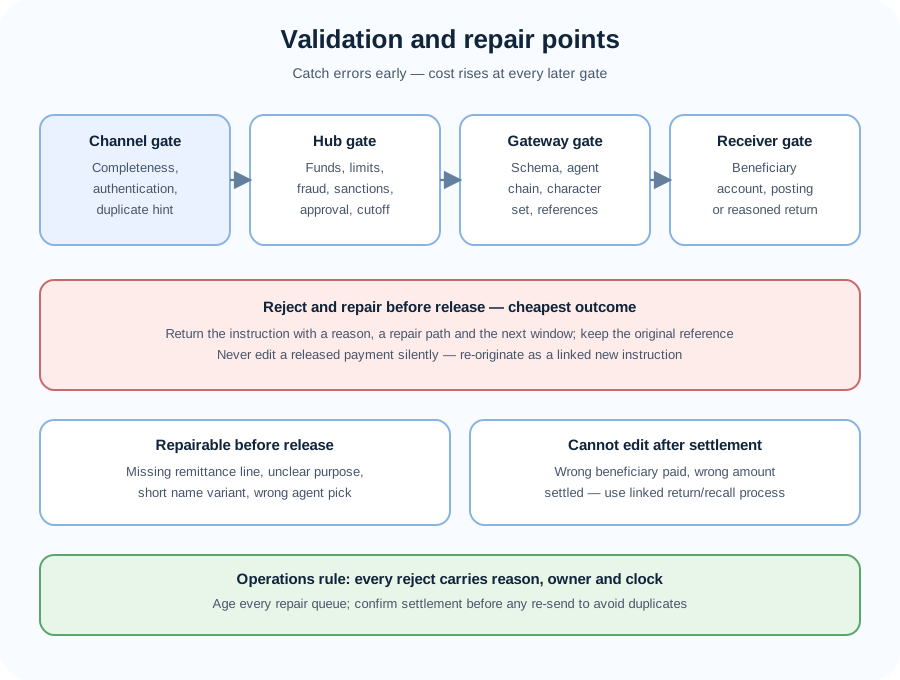
Recovery follows four rules that hold under deadline pressure. Never edit settled value — originate a linked corrective payment with fresh approval and screening, because the correction is itself a payment with its own fraud and sanctions risk. Never re-send on assumption — confirm the original's settlement state first, or timeouts and gateway rejections become duplicates that double the loss. Choose any recovery movement by current urgency and window rather than by original rail habit — a recall-related re-payment that must settle today is itself a pacs.008 decision with its own cutoff and liquidity check. Communicate state plus next value date with references, not activity — the customer needs to know what settled, what is queued, what was recalled with which reference and clock, and when value will be available, not how many phone calls operations made. Age every exception queue visibly, because the pacs.008 repair that drifts past the afternoon cutoff becomes tomorrow's value date whether anyone announced it or not.
9. Posting, accounting, liquidity, reporting and reconciliation
Posting, accounting, liquidity, reporting and reconciliation are where a pacs.008 proves it happened correctly — to the customer, to finance, to auditors and to supervisors — and where weak operations convert a settled payment into a suspense balance, a nostro break, or a customer dispute. This section follows a settled pacs.008 from the settlement account into customer accounts, general-ledger entries, intraday liquidity reporting, customer advices and the same-day reconciliation that closes the loop, keeping the debtor-agent and creditor-agent views distinct throughout.
Posting begins the moment settlement evidence arrives, and the two banks post mirror images with different risks. The debtor agent posts the debit to the debtor's account plus any fee debit the charge arrangement requires, with value dating consistent with the business-day window and with the advice quoting the end-to-end identification, the UETR and the remittance as carried. Its posting risk is authorisation and funding — debiting the wrong account, double-debiting on a re-send, or posting fees the customer did not agree — controlled through the internal identifier discipline and duplicate checks from Section 3. The creditor agent validates beneficiary detail against the pacs.008 as received, posts the credit to the creditor's account, and preserves remittance through posting into reporting without stripping or truncating — because the beneficiary applies cash from remittance, not from the amount alone, and a stripped posting converts settlement into an unapplied break at the customer. Its posting risk is mis-posting and delayed application — crediting a similar-name account, holding a credit without a reasoned status, or delivering an advice so thin the creditor cannot match invoices — controlled through beneficiary validation, posting-clock discipline, and advice completeness standards. Both banks post against settlement evidence rather than against messaging optimism: queued is not settled, and no customer account moves finally on the basis of a gateway acceptance alone.
Accounting translates those postings into the bank's books with Lynx-specific entries. Settlement-account entries at the Bank of Canada discharge the interbank obligation per payment — gross, individual, final — while customer-account entries discharge the bank-customer obligation on each side. Fee entries, suspense entries for repair and investigation states, and intermediary entries each carry the UETR and instruction references. Suspense hygiene is the visible test: every repair, hold, recall-related receipt and unapplied credit sits in a named suspense with an owner and an ageing clock.
Liquidity is the invisible requirement behind every pacs.008 release, and this section states it functionally without inventing mechanics that belong at block level. Intraday liquidity funds the debtor agent's queue: each released pacs.008 consumes funding when it settles, queue priority determines sequencing when funding is constrained, and afternoon funding decisions determine what still settles today. The hub's release decision is therefore a funding decision as well as an authority decision — amount, daily, per-payee and intraday thresholds checked before release, queue monitored after release, funding positioned before cutoff. Treasury, operations and the customer channel share one view of that position: treasury sees consumption and forecast, operations sees queue depth and ageing, the channel sees honest today-versus-next-day promises. A bank that releases without liquidity awareness queues hopefully and apologises in the afternoon; a bank that integrates release with funding control settles predictably and prices urgency sustainably.
Reporting serves three audiences from the same evidence base. Customers need status and proof: acknowledgements with UETR, settlement confirmations quoting amount, time and references, creditor advices carrying full remittance, and recall confirmations with reference and clock. Operations need control reports: cutoff compliance, screening holds, repair queues, queue depth, investigation ageing and suspense by owner. Finance, risk and supervision need position reports: liquidity usage, settlement-account activity, fee capture, recall volumes and data-quality trends. Cash-management reporting in the camt family supports statements, intraday activity and notifications for treasurers and enterprise systems. Every report quotes the references the recipient needs; no report substitutes activity narrative for settlement evidence.
Reconciliation matches instruction to gateway evidence to settlement entry to customer posting, and investigates the unmatched remainder daily with no idle breaks. The pacs.008 match keys are the section's core control: internal instruction identifier to gateway acknowledgement to Lynx settlement confirmation to customer debit and advice on the sending side, and settlement receipt to beneficiary validation to creditor posting to advice and statement on the receiving side, joined across banks by the UETR and end-to-end identification. Automate the matched middle — straight-through matching of settled payments with complete references — and staff the edges: repair queues, screening holds, recall cases, suspense items, and any settled-but-unapplied creditor credit. Three-way discipline closes the loop: the hub's instruction record, the settlement account's movement, and the customer ledger's postings agree per transaction per day, with breaks owned, aged and evidenced rather than carried. A bank that reconciles pacs.008 same-day finds its data defects while the repair window is still open; a bank that reconciles weekly finds them as customer complaints and audit findings.
10. Bank implementation, testing and resilience
A pacs.008 capability is built once and operated every business day, which means implementation decisions compound — good mappings, validations and monitors pay daily dividends while shortcuts tax every payment for years. This section describes how a bank wires pacs.008 safely, tests it credibly, and keeps it resilient, without reproducing any specification text and without treating this chapter as a build document. For binding construction, gateway specifications and current Payments Canada documentation govern; this section governs the diligence around them.
Wiring starts with a hub-and-gateway architecture that enforces the order from Section 3 mechanically rather than aspirationally. Channels submit instructions to the hub with authentication, entitlement and duplicate signalling. The hub performs validation, limits, fraud scoring, sanctions disposition, record-keeping capture, cutoff assignment and approval, then builds the pacs.008 business data with explicit mapping rules — which channel field populates which business element, what defaults are forbidden, what truncation is prohibited, how the UETR is generated and stored, how the end-to-end identification is preserved verbatim, how remittance options are selected and logged. The gateway performs its own completeness and schema checks, manages queue placement and settlement monitoring, and returns evidence the hub persists against the internal identifier. Each boundary is versioned and logged: channel-to-hub format version, hub-to-gateway mapping version, gateway-to-Lynx specification version. When a specification version moves, the bank changes one adapter with regression proof rather than rebuilding the customer experience or the control plane. The single-clock requirement from Sections 4 and 6 is an implementation feature here: channel promise screens may only display windows the hub's cutoff engine confirms for this instruction, this amount, this business day.
Data implementation deserves special attention because richness fails silently where testing is thin. Character-set handling must prove round-trip fidelity for the names the bank serves — accented French names, long corporate titles, multi-part surnames — through capture, screening, build, settlement, posting and advice. Template governance must control who creates and changes stored beneficiary detail, with changes triggering verification, because the most dangerous pacs.008 is the legitimate template with substituted detail. Mapping tables must forbid invention: no default purpose where none was stated, no synthetic address where none was captured. Every mapping decision is auditable.
Testing proves the wiring with Canadian-realistic content before production carries customer value. Functional testing walks representative journeys — direct chain, intermediary chain, each remittance option, each screening disposition, each repair path — with fictional data exercising accents, long names, multi-invoice remittance and similar-name hits. Negative testing proves the gates: incomplete chain rejected, duplicate blocked, over-limit release refused, post-cutoff instruction scheduled honestly. Performance testing proves the feared afternoon — peak queue depth with constrained funding — without touching production accounts. Interoperability testing proves references survive: UETR echoed, end-to-end identification verbatim, remittance intact into advices.
Resilience keeps pacs.008 running on the worst business day, and it is rehearsed rather than improvised. Connectivity failover, gateway redundancy, queue-visibility continuity, screening-engine fallback with preserved disposition order, and manual-but-controlled release procedures for contingency states each have a named owner, a documented trigger, and a rehearsal record. Contingency handling distinguishes pre-settlement from post-settlement states explicitly: queued payments with known state are sequenced or carried forward honestly, while uncertain-state payments are investigated before any re-origination so contingency does not manufacture duplicates. Communication trees reach operations, treasury, channels, counterparties and affected customers with status-plus-next-window language rather than technical narrative. Staff readiness completes the plane: validators, screeners, approvers, gateway operators, investigators and reconcilers each know their gate, their evidence standard, and their clock — and new hires prove the status vocabulary from Section 4 before they touch a live queue. A bank that implements pacs.008 as a control plane with a message adapter survives specification changes, volume peaks and incident days; a bank that implements it as a message format with controls attached relearns Section 8 under pressure.
11. Practical Canadian pacs.008 examples
Theory becomes judgement through cases. The three fictional stories below exercise the full pacs.008 discipline — instruction, validation, screening, agent chain, remittance choice, settlement, posting and reconciliation — in situations a Canadian bank meets routinely. Every name, amount, identifier and timing is fictional and illustrative; no value, reference or outcome is drawn from any real payment. Read each for its control lesson rather than its numbers, because the lesson generalises to your next business day while the numbers never recur.
Example (fictional): Northline Foods pays its oven supplier today. Northline Foods of Guelph must pay its equipment supplier, a fictional Ontario company called Grand River Thermal Systems, a fictional sum of 248,500 dollars before the close of today's Lynx window or the weekend production slot is lost. The payables clerk builds the instruction in the business portal from the approved supplier template, attaching two invoice references the companies agreed — fictional references INV-4471 and INV-4472 — and selecting structured remittance so the supplier's system can auto-apply. The hub validates: debit account open and funded, beneficiary agent complete from the template, no duplicate, amount within thresholds. Fraud scoring flags a first-time large amount and routes to dual approval; the finance director approves after a callback to the supplier's verified number on file. Sanctions disposition passes with a recorded false positive cleared by address detail. The hub builds the pacs.008 with debtor and creditor, debtor agent as instructing party and creditor agent as instructed party with no intermediary, the settlement amount and value date, the UETR, the instruction reference verbatim, and the two invoice lines as structured remittance. Lynx settles the payment individually in the afternoon window; the bank records the UETR and the Lynx settlement confirmation/PCRN where available. The creditor agent posts and delivers an advice quoting both invoices; the supplier's system applies both lines straight through and the weekend slot holds.
Example (fictional): a Toronto property closing funded through pacs.008. A fictional Toronto law firm, Bayfront Law LLP, acting on a residential purchase, must move a fictional 685,000 dollars from the purchaser's bank to the vendor's bank with same-day irrevocable settlement so the deal can close and keys can transfer. The purchaser's instruction arrives in branch mid-morning with identity verification, source-of-funds discussion, and full beneficiary detail including the vendor's bank, the trust account, and the trust-ledger reference the firms agreed — a fictional reference CLOSING 88 KING ST W UNIT 1204 — carried as remittance the receiving trust ledger can match. Validation is severe by policy: large-value dual control, duplicate check, sanctions screening with a recorded disposition resolved by address detail, fraud callback to the verified firm number confirming the beneficiary. The debtor agent builds the pacs.008 with complete agents, the UETR, the closing reference verbatim, and unstructured remittance carrying the ledger line the trust system reads manually — correct here because the receiver is a human trust ledger rather than an auto-matching engine. The payment settles gross around midday and the confirmation quotes the UETR. The creditor agent posts to the vendor's trust account and confirms with a reference the firm's ledger reconciles that afternoon.
Example (fictional): a payroll shortfall rescued without breaking payroll. The same week, Northline's payroll bureau discovers on Friday morning that a missed bonus approval left one executive's 18,750-dollar payment out of Thursday's batch file while 399 other credits processed normally. The bonus cannot ride any batch and still meet today's expectation, so the bank proposes a pacs.008 rescue with explicit wire pricing and same-day finality, and the customer accepts the tradeoff in writing. The instruction enters through the business portal with full beneficiary detail, dual authorisation and a callback to the chief financial officer on a known number; screening passes; the hub builds a direct-chain pacs.008 with reference-only remittance pointing to the payroll advice the employee's bank statement will accompany — the correct option because the payroll detail already flows through the employer's advice channel by design. The payment settles in the morning window, posts to the executive's account, and reconciles against the payroll exception report the same day; the bank’s customer advice carries its own posting reference, while the Lynx settlement evidence is kept separately.
12. Key takeaways and authoritative references
Carry twelve behaviours into your next business day, one per section. Route by policy with a recorded reason — urgency, value, data completeness, push authority and currency — and never let a channel promise what the Lynx business-day calendar cannot deliver. Assign every party its ownership — debtor funds and authorises, debtor agent validates and warrants, any intermediary forwards faithfully, Lynx settles finally, creditor agent posts and reports — and investigate across those boundaries with shared references. Build pacs.008 only through the hub order — authentication, validation, limits, fraud, sanctions, record-keeping, cutoff, approval — and reject incomplete agent data before release rather than after. Treat Lynx settlement as what it is — individual real-time gross settlement in central-bank money with immediate finality and no unilateral unwind — and speak the status vocabulary exactly: accepted is not settled, queued is not settled, settled is final, posted follows the creditor agent's clock. Preserve identity absolutely — internal instruction identifier, end-to-end identification, UETR created once and never rewritten, remittance carried as agreed — because every downstream process joins on those references. Match remittance to the receiving application — structured for auto-matching suppliers, unstructured for human-read ledgers, reference-only where detail already flows — and log what was actually carried. Screen before release with data-driven feedback — complete party data screens straight through, thin data queues falsely, dispositions flow back into masters and templates — and log every disposition with list version and decider. Classify before recovering — reject and repair before settlement, recall-request with UETR linkage after, never silent editing, never re-sending on assumption. Post against settlement evidence, account per payment with UETR-indexed entries, consume liquidity knowingly, report evidence rather than activity, and reconcile instruction to settlement to posting same-day with owned ageing on every break. Implement as a control plane with a message adapter — versioned mappings, proven character-set fidelity, template governance, realistic testing, rehearsed resilience — and never treat training material as a specification. Exercise the stories above until their lessons are reflex: callback before release, morning arrival for closings, pacs.008 as rescue alongside batch rather than instead of it.
This chapter uses official sources and labels bank-specific controls and fictional examples. Re-check the live rules, specification versions and system pages before customer or examination use. No exact cutoff times, fees, thresholds or character limits are stated in this chapter; for binding times use your bank's published schedules with the payments.ca business-day and closure calendar, and for binding message construction use your bank's gateway specifications with the current Payments Canada documentation.
- Payments Canada — High-value payment system Lynx page. Operator description of Lynx as the RTGS system for high-value and time-critical payments, live since 1 September 2021, with current participation, settlement, closure, ISO 20022 and 2025 statistics. https://www.payments.ca/systems-services/payment-systems/high-value-payment-system-lynx
- Payments Canada — Payment systems overview page. Operator description of Canada's clearing and settlement infrastructure including the Lynx high-value system, the retail batch system, and the planned Real-Time Rail programme context. https://www.payments.ca/systems-services/payment-systems
- Payments Canada — Rules and documentation page. Source for the current Lynx rules, by-laws, standards and procedures in force, including message, validation, return and investigation material referenced functionally in this chapter. https://www.payments.ca/systems-services/rules-documentation
- Bank of Canada — Settlement account policies for Payments Canada systems. Central-bank description of settlement accounts for Lynx and related systems, settlement finality in central-bank money, and eligibility and application for settlement accounts. https://www.bankofcanada.ca/core-functions/financial-system/bank-canadas-settlement-account-policies-for-payments-canada-payment-systems/
- Bank of Canada — Payment systems overseen by the Bank. Central-bank description of oversight under the Payment Clearing and Settlement Act, including Lynx as a systemically important system and live since 2021. https://www.bankofcanada.ca/regulatory-oversight/financial-market-infrastructures/payment-systems-the-bank-of-canada-oversees/
- FINTRAC — Introduction to FINTRAC publication. Government source for the financial-intelligence mandate, client identification, record-keeping and prescribed reporting context applied to payment operations in this chapter. https://www.fintrac-canafe.gc.ca/intro-eng
- Payments Canada — Lynx ISO 20022 message specifications (UG2026 core and UG2025 reporting). Current production message versions for pacs.008, pacs.009, pacs.004 and camt.053; the pacs.008 specification is dated 23 March 2026. https://www.payments.ca/payment-resources/iso-20022/high-value-payment-system-lynx
- Payments Canada — Explainer: Lynx wire payments and the Payment Confirmation Reference Number. Defines the PCRN, distinguishes it from institution-specific references, and explains participant, cutoff, intermediary and same-business-day caveats. https://www.payments.ca/explainer-lynx-wire-payments-and-payment-confirmation-reference-number
- Payments Canada — Wire payments (business guide). Official customer-facing guidance on Lynx finality, on-us wires, required sender/beneficiary/routing data, STP, fees and posting. https://www.payments.ca/payment-resources/support-guides/business-guides/wire-payments
- Payments Canada — System closure schedule. Current business-day and statutory-holiday closures. https://www.payments.ca/system-closure-schedule
- FINTRAC — Reporting electronic funds transfers; Record keeping requirements for financial entities. Current international-EFT reporting, EFT record-keeping and reference-data requirements. https://fintrac-canafe.canada.ca/guidance-directives/transaction-operation/eft-dt/eft-dt-eng ; https://fintrac-canafe.canada.ca/guidance-directives/recordkeeping-document/record/fin-eng
- OSFI — Guideline E-21, Operational Risk Management and Resilience; Guideline B-13, Technology and Cyber Risk Management. FRFI operational resilience and technology/cyber expectations relevant to critical payment operations. https://www.osfi-bsif.gc.ca/en/guidance/guidance-library/operational-risk-management-resilience-guideline ; https://www.osfi-bsif.gc.ca/en/guidance/guidance-library/technology-cyber-risk-management
- Bank of Canada — Retail payments supervision. RPAA scope, PSP registration, operational risk, incident response, safeguarding and reporting boundaries. https://www.bankofcanada.ca/regulatory-oversight/retail-payments/
- FCAC — How to file a complaint with your bank. Bank complaint process and FCAC/OBSI escalation boundary. https://www.canada.ca/en/financial-consumer-agency/services/complaints/file-complaint-financial-institution.html
- Interac — Interac e-Transfer Disclosure. Official distinction between Interac’s low-value domestic service and Lynx. https://www.interac.ca/en/interac-e-transfer-disclosure/
- Payments Canada — Real-Time Rail payment system. Current RTR status: launching in Q4 2026, with industry solution-assurance testing; not a production substitute for Lynx at this audit date. https://www.payments.ca/systems-services/payment-systems/real-time-rail-payment-system
This application uses JavaScript for the full interactive experience. This text summary is served for accessibility and search indexing.