Lynx High Value Payment System. Understand Lynx architecture, participants, connectivity, settlement accounts and the high-value operating model.
Canada Payments & Collections · Block 8: Lynx and High Value Payments · Chapter 36 of 75
Some payments can wait for the next batch window, and some cannot. A business closing a property purchase today, a bank covering a position before its funding window shuts, a government disbursing funds that must be usable now, a clearing house settling obligations that unlock everyone else's day — these need a system that moves each payment individually, settles it in central-bank money, and makes that settlement final within the business day. In Canada, that system is Lynx.
Lynx is Canada's high-value payment system. It is owned and operated by Payments Canada, built on a real-time gross settlement model, and designated by the Bank of Canada as a systemically important payment system. It went live on 1 September 2021, replacing the Large Value Transfer System (LVTS) that had served Canada from 1999 to 2021. Lynx settles CAD payment obligations between Lynx participants; it does not process every Canadian-dollar wire. On-us wires between customers of one financial institution and other non-Lynx arrangements do not receive a Lynx PCRN. Lynx can also carry the Canadian leg of an international wire.
This chapter stays at that level: architecture, participants, connectivity, settlement accounts and the high-value operating model. It explains what Lynx is, who does what, how a payment gets in, how settlement happens, what data travels, which rules bind everyone, where controls sit, how exceptions behave, how money posts and reconciles, and what a bank must build to participate. It points forward wherever depth belongs elsewhere: the domestic wire journey, settlement mechanics and finality, liquidity and treasury decisions, and return requests, investigations and reconciliation are deepened in Chapters 37 to 40, while message-level ISO 20022 detail — pacs.008, pacs.009, pacs.004, camt messages, PCRN and UETR — lives in Block 9 (Chapters 41 to 45). Read this chapter first so those chapters land on solid ground.
A note on status dates. Baseline is 5 October 2026. Lynx has been live since 1 September 2021, and the industry completed migration to ISO 20022 formats on Lynx in 2025. The scale figures cited here — about 13.6 million payments worth about $93.3 trillion in 2025 — come from Payments Canada's published Lynx statistics and convey scale, not material for memorization. This chapter does not state bank-specific customer cutoffs, fees or monetary thresholds. The current Rule 2 system schedule (Eastern Time, subject to emergency or other permitted variance) is: Open Value Day at 19:00 on the day before the business day; Payments Processing Cycle 00:30–19:00; Settlement Window 1 00:30–18:00; Settlement Window 2 18:00–18:30 for pacs.009 core and pacs.004 transfers only; Finalization Window 18:30–19:00; and End Value Day Event at 19:00. Customer and bank cutoffs can be earlier and remain product-specific. At this baseline, the Real-Time Rail is not a Lynx production path: Payments Canada lists a Q4 2026 launch and ongoing industry testing. Treat RTR as planned/pre-production modernization, not as current Lynx capability.
What you should be able to do after this chapter
After working through this chapter, you should be able to:
- explain what Lynx is, why Canada replaced LVTS with it, and what "real-time gross settlement in central-bank money" means for finality;
- name the five key players — Payments Canada, SWIFT, Lynx participants, the Bank of Canada and the Minister of Finance — and state what each owns;
- distinguish direct participants from non-participant partners and explain how a non-participant's customer wire reaches settlement;
- describe the access gates — Payments Canada membership, a Bank of Canada settlement account, collateral capability, technical readiness plus SWIFT membership — in plain language;
- trace a payment message from bank release over SWIFT transport into Lynx, through validation, mechanism designation, conditional release or queuing, to gross settlement;
- explain the functional difference between urgent immediate-gross settlement and liquidity-saving queued settlement with offsetting, without inventing parameters;
- describe conditional release, settlement queues, sender removal, rejection cases and the payment confirmation reference number at operating-model depth;
- state when a settled Lynx payment becomes final and irrevocable, and what a receiving participant owes the payee afterwards;
- explain settlement accounts, intraday loans, collateral pledging through CDSX or a custodial arrangement, and end-of-cycle consolidation and repayment at overview level;
- place fraud, sanctions, FINTRAC and oversight controls before release, and explain why post-settlement screening is recovery, not prevention;
- classify Lynx exceptions correctly and explain why a settled payment needs a new payment for recovery rather than a reversal;
- describe posting, accounting and three-way reconciliation for Lynx activity, work through fictional operating examples, and navigate to Chapters 37–40 and Block 9 for deeper layers.
For a roughly 60-minute core session, spend about 10 minutes on this introduction and Sections 1–2 with the architecture and participant diagrams, 15 minutes on Sections 3–4 with the settlement-mechanisms diagram, 10 minutes on Sections 5–6 with the connectivity diagram, 10 minutes on Sections 7–9, 10 minutes on the fictional examples in Section 11, and 5 minutes on takeaways and references in Section 12.
Chapter navigator
- Business context and customer need
- Participants, responsibilities and system boundaries
- Initiation, validation and bank processing
- Clearing, settlement and finality
- Data, identifiers, messages and references
- Rules, operating schedule, service levels and customer impact
- Fraud, compliance and operational controls
- Exceptions, investigations and recovery
- Posting, accounting, liquidity, reporting and reconciliation
- Bank implementation, testing and resilience
- Practical Lynx operating examples
- Key takeaways and authoritative references
1. Business context and customer need
A small number of Canadian-dollar payments carry consequences far larger than their count suggests. A manufacturer closing a property purchase must move funds the seller's lawyer accepts only as same-day final. A pension fund meeting a margin call must deliver value that cannot unwind overnight. A bank treasury desk covering a short position must pay before its funding window closes. A clearing house settling member obligations must complete its transfers before anyone else's timetable proceeds. None of these payers wants speed as a luxury. Each wants certainty: settlement today, in full, finally, in money carrying no bank credit risk.
That certainty is what Lynx provides, and its difference from every other Canadian rail is precise. Batch systems such as the Automated Clearing Settlement System (ACSS) move millions of items efficiently and settle net positions afterwards; the customer experience of "paid" arrives before interbank settlement, and return rights survive. Interac e-Transfer is a separate account-based service offered through participating financial institutions; its service rules and settlement are not Lynx. Cards authorize instantly and fund merchants later under network rules. Lynx does something narrower and stronger: it settles each payment individually, in real time, across accounts at the Bank of Canada, complete the moment the system moves the value. No netting and no deferred settlement for a payment that is settled; queued obligations remain subject to funding and timing risk until settlement. Once settled, a Lynx payment obligation is final and irrevocable between the sending and receiving participants. That property is why high-value, time-critical and settlement-critical payments belong on Lynx.
Scale makes operating discipline non-negotiable. For 2025, Payments Canada reported Lynx settling about 13.6 million payments worth about $93.3 trillion — roughly 54,000 items worth roughly $372 billion every business day. One delayed or misdirected payment can be a treasury event, a failed closing, a missed margin call or a stalled market settlement. The item count is modest; the value concentration is extreme. Operations must therefore manage Lynx per payment with liquidity awareness while managing batch per file with window awareness. Bankers must explain what the wire premium buys: immediacy, finality and irrevocability — not merely speed.
History explains the system's shape. From 1999 to 2021, the Large Value Transfer System let financial institutions and their customers send large payments securely with certainty of settlement. By the mid-2010s, Payments Canada's modernization programme concluded Canada needed a new core system: compliant with current Canadian and international risk standards for designated infrastructures, built on modern technology, resilient to cyber and operational threats, and adaptable to richer data including the ISO 20022 messaging standard. Lynx was that replacement, going live on 1 September 2021 with a new risk model and new technology. Message detail belongs to Block 9; the operating lesson is that Lynx was designed for data-rich payments.
It helps to say plainly what Lynx is not. Not a batch system: it collects no files and settles no net positions. Not a messaging network: SWIFT carries payment messages but never settles value — confusing the two is among the most persistent errors this academy corrects. Not a customer-facing service: no business or consumer holds a Lynx account or logs into Lynx; customers instruct their banks, and banks participate. Not a 24/7 system: Lynx operates on business days, Monday to Friday excluding holidays, under a published operating schedule that shapes every cutoff, liquidity and staffing decision in Sections 6 and 10. Not a reversals system: settlement is final and cannot be unilaterally unwound, but current Rule 10 contains narrow post-settlement return procedures in specified circumstances, using a new pacs.004 payment. A misdirected payment already made available to the wrong payee is handled through the guideline, investigation and cooperation rather than an automatic reversal.
Consider a fictional Ontario equipment distributor — Lakeside Machinery — to anchor the chapter. On a Tuesday morning, Lakeside closes a warehouse purchase: the vendor's lawyer requires a seven-figure Canadian-dollar payment, same-day final, before releasing the keys. At midday, Lakeside's bank must cover an interbank obligation from the morning's customer activity. In the afternoon, the company pays a time-critical supplier balance to release a shipment held at the port. Three payments, one rail, one demand: each settles today, finally, provably. This chapter teaches the understanding; Chapters 37 to 40 teach the execution.
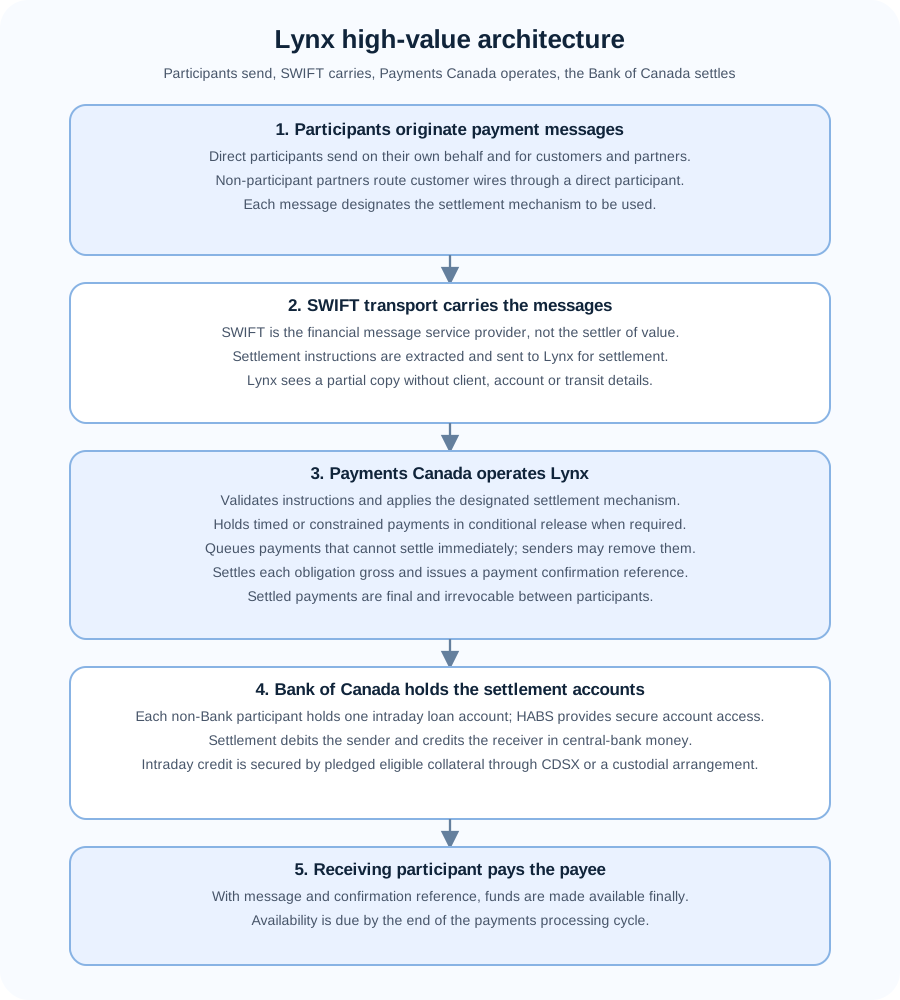
The diagram above anchors the chapter. Read it top to bottom for flow and note the separation at each layer. Participants own instructions and funding. SWIFT owns transport. Payments Canada owns operation and settlement execution. The Bank of Canada owns the settlement accounts and the credit funding them. Receiving participants own payee availability. Every section that follows is a deeper pass over one layer of that picture.
2. Participants, responsibilities and system boundaries
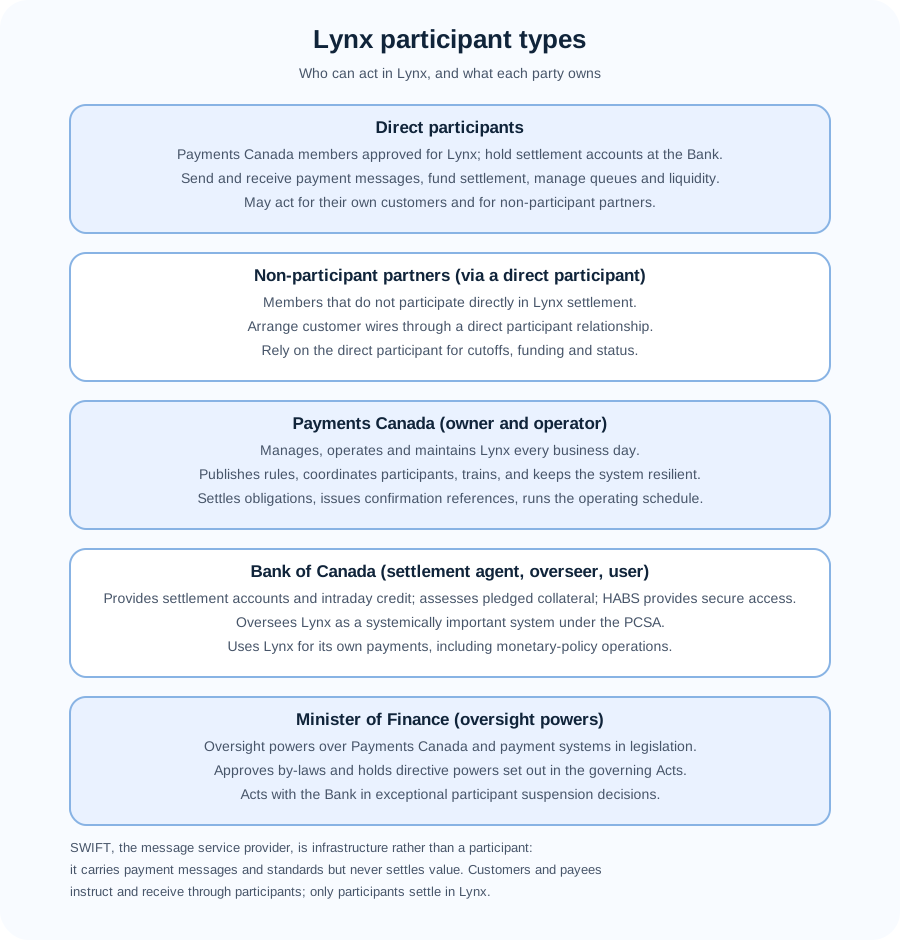
A Lynx payment always involves more parties than the two customers experiencing it as "we wired the money." The bank professional must keep five players straight, because each owns a different piece of the outcome — and blending them produces the classic errors: treating SWIFT as the settler, treating Payments Canada as guarantor of a beneficiary credit, or assuming any bank can reach directly into Lynx. Payments Canada names the five key players, and this chapter uses exactly that framing: Payments Canada, SWIFT, Lynx participants, the Bank of Canada, and the Minister of Finance.
Start with the customers, essential yet outside the settlement boundary. The originator — a business, a government, a financial institution acting for itself — instructs its bank to move a fixed Canadian-dollar amount to a payee. The payee may be another business, an individual, a government account or a financial institution. Customers own the economic obligation and the instruction, including accurate beneficiary details, but they never settle interbank value. When a customer asks "where is my wire," the bank traces its own release, Lynx activity, settlement evidence and the receiving participant's posting — the chain taught in Chapter 37.
Lynx participants are Payments Canada members — financial institutions — approved to participate directly. In practice the group includes domestic banks, some foreign bank branches and other eligible institutions, plus the Bank of Canada itself for its own payments. A direct participant sends and receives payment messages, designates settlement mechanisms, funds its settlement activity, manages its queues, and stands responsible for every obligation it introduces. Approval is not automatic with membership: a member applies to the President of Payments Canada, demonstrates it meets technical and testing requirements, pays applicable fees, establishes its Lynx accounts and intraday loan account, and enters into the required agreements with the Bank. Participation is therefore a deliberate, supervised status — suspendable or revocable for lost account access, failed technical requirements or unpaid fees — with an exceptional Minister-and-Governor process for participants under regulatory control.
Non-participant partners form the second participation category, and understanding them prevents a common customer-facing error. These are Payments Canada members that do not participate directly in Lynx. They still serve customers needing wires by arranging Lynx payments through a direct participant relationship. The direct participant introduces the payment, funds its settlement and receives the confirmation evidence; the non-participant manages its customer, its own cutoffs and its agency arrangement. The interparticipant obligation still settles finally when introduced by the direct participant, but the non-participant's customer remains subject to its institution's earlier internal cutoff, agency terms and receiving-side availability process. Staff must never promise the direct participant's window as the customer's window. Block 2 covers direct and indirect participation generically; this chapter applies that pattern to high value, where the agency leg's funding discipline is tightest.
Payments Canada is the owner and operator of Lynx. Ownership means holding the system as national infrastructure; operation means running Lynx every business day to the published schedule, validating settlement instructions, operating the mechanisms and queues, executing settlement entries, issuing payment confirmation reference numbers, monitoring throughput and availability, coordinating participant groups, publishing rules and procedures, training participants, maintaining resilient technology, and keeping the system compliant with its legal framework. It holds no customer accounts, decides no individual beneficiary posting, and guarantees no commercial outcome. When this chapter says "Lynx settles," it means Payments Canada's operation moves value between participant accounts on the Bank's books under the by-law and Rules — not that a payment has reached a human beneficiary. That last step belongs to the receiving participant, as Section 4 explains.
The Bank of Canada wears three hats that must never blend. As settlement agent, it provides the Lynx accounts and intraday loan accounts on its books, values pledged collateral, sets daily credit limits, advances intraday credit, and supports end-of-cycle repayment including overnight advances where needed. Account services run through the Bank's High Availability Banking System (HABS) under cyber-security and operational requirements. As overseer, it supervises Lynx as a systemically important system designated under the Payment Clearing and Settlement Act, expecting observance of its risk-management standards for designated financial market infrastructures. As a user, the Bank makes its own payments through Lynx — and fundamentally, Lynx provides the setting for monetary policy: reinforcing the policy interest rate, settling obligations from other financial market infrastructures, and channelling liquidity to financial institutions in stress. The practical boundary: final Canadian-dollar settlement needs the Bank's books; systemic soundness assurance looks to oversight; a rate decision's plumbing looks to the monetary-policy setting.
The Minister of Finance holds oversight powers over Payments Canada and payment systems under the governing legislation, including general directive powers and responsibilities for by-laws, rules and standards made by the Payments Canada board, alongside powers over certain designated systems. Concretely, the Minister approved By-law No. 9, and the Minister's concurrence joins the Governor's in exceptional suspension and reinstatement decisions for troubled participants. Bank professionals rarely touch this layer directly but must know it exists: the rulebook binding their daily operations carries ministerial approval, and the system's public-purpose character is not decorative.
SWIFT, the Society for Worldwide Interbank Financial Telecommunication, is the financial message service provider for Lynx. It supplies the payment-message network over which participants exchange instructions, monitors the network for payment processing, and maintains the message standards. Two clarifications matter. First, SWIFT never settles Lynx value; settlement happens on the Bank's books when Payments Canada executes the entries. Second, the model anticipates SWIFT-path difficulty: if technical problems stop the provider receiving a message or extracting instructions, or stop the sender reaching the provider, the sending participant may extract the settlement instructions itself and send them to Lynx. That fallback keeps settlement moving under contingency — governed by the by-law and Rules, never a routine choice.
Responsibility forms a chain with no gaps: originator, originating participant, SWIFT, Payments Canada, the Bank, receiving participant — authorized by the Minister's framework. Every Chapter 40 investigation walks that chain backwards.
3. Initiation, validation and bank processing
No payment reaches Lynx by accident. Long before settlement, a customer instruction enters a bank channel, passes through the payment hub and control stack, and is released as a Lynx payment message only after validation, screening and approval. This section follows that pre-settlement journey at operating-model depth. The full domestic wire journey — channels, hub checks, release, tracking and beneficiary posting — is traced in Chapter 37; here the goal is understanding what the bank must get right before Lynx sees the payment, and what Lynx expects to receive.
Initiation starts with the customer event. A treasurer pays a supplier on closing day through a business portal. A lawyer's office sends closing-funds instructions checked against the statement of adjustments. A treasury desk generates an interbank payment to cover a position. A government department releases a disbursement file with today's value date. Different doors — branch, online banking, host-to-host file, API, treasury workstation — but all converge on one normalized instruction: who pays whom, how much, in Canadian dollars, for what value date, with what beneficiary-agent identification and references. The hub assigns a durable internal identifier surviving every later stage.
Validation is where most preventable wire failures are caught — and it must happen before release, because Lynx settlement is irrevocable. Account validation confirms the debit account exists, is open, is authorized for wires, and holds or is approved for sufficient funds or credit. Beneficiary validation confirms the receiving institution is addressable through Lynx, the account or client identifier is structurally sound, and any intermediary or special-handling need is captured. Amount and currency checks confirm a fixed Canadian-dollar amount without ambiguity. Duplicate and anomaly checks compare against recent history, expected patterns and velocity limits — a second identical seven-figure instruction minutes after the first must be challenged, not released. Data-completeness checks confirm everything Lynx and the receiving participant will need: complete beneficiary-agent data, payment date, amount, and references letting the receiver route the payment to the customer's account. Repair or reject happens here: a hub rejection costs a phone call, while a defective release becomes a Chapter 40 investigation — or a settled payment to the wrong payee.
The control stack sits between validation and release, and its order is the whole point. Authentication and entitlement confirm the instructing user may act and the approver may release — dual approval for business wires, file-release authority for bulk instructions, dealer authority for interbank payments. Limits check amount, daily, per-payee and intraday-liquidity thresholds so no single release endangers the funding plan. Fraud monitoring scores takeover, impersonation, scam, mule and behavioural signals; wires attract authorized-push-payment fraud precisely because they are final, so beneficiary-change verification and callbacks for new or amended payees belong here. Sanctions and watchlist screening checks parties, remittance text and routing with three dispositions — pass, false-positive release with reason, or true-hit hold with escalation — before release, because screening after irrevocable settlement is an incident report, not a control. FINTRAC-relevant capture ensures identification, record-keeping and future reporting can be satisfied from untruncated data. Cutoff and calendar logic assigns the instruction to today's cycle or the next business day and sets an honest value-date expectation. Only then does the hub release. Sections 6 and 7 expand rules and controls; the architectural lesson is that release discipline is the last point where the bank changes the outcome cheaply.
Release commits the instruction to the Lynx path. The gateway formats the payment message to the applicable Lynx standard, designates the settlement mechanism, and sends it over SWIFT to the financial message service provider. The provider extracts the settlement instructions — the Lynx payment obligation plus the details to settle it — and passes them to Lynx, while participants receive the payment messages with, after settlement, the confirmation reference. The hub records release time, references and gateway acknowledgements — the starting evidence for every later inquiry. The by-law's sender-extraction fallback covers SWIFT-path technical difficulty; operations should know of it without treating it as routine.
After release the bank stays active. Treasury and operations monitor progress: accepted, conditionally held, queued for funds, settled with reference, or rejected with reason. Queued payments may need funding decisions; timed payments need nothing until their moment; rejected payments need repair and re-origination as new instructions. The hub tracks each transition against the original identifier, matches the confirmation reference at settlement, and communicates precisely: released, settled with reference, or rejected with reason and next steps. Post-release amendments are narrow — a sender may remove its own queued instructions, but settled value cannot be edited — and the original identifier follows every re-origination so a timeout never becomes an accidental duplicate.
Two design principles decide whether this machinery survives reality. First, route by policy with reasoned override: urgency, value, finality need, data richness and cost determine whether an instruction belongs on Lynx, and the hub enforces that while recording each human override's reason. A closing-day payment belongs on Lynx; a routine large supplier run may belong in batch at lower cost. Second, fail visibly and early: a hub rejecting with reason and next-cycle promise creates one phone call; a hub failing at settlement creates a week of investigations.
4. Clearing, settlement and finality
If Section 3 is about the bank's decision, Section 4 is about the system's promise. Lynx has no separate clearing phase as batch bankers understand it — no item exchange, no multilateral net positions, no deferred settlement. Each payment settles individually, in real time, across accounts at the Bank of Canada. This section explains that real-time gross settlement behaviour at operating-model depth: mechanism choice, conditional release, queuing, the settlement event, confirmation, finality, and what the receiving participant then owes the payee. Full mechanics of settlement evidence, irrevocability and finality are taken apart in Chapter 38; here the objective is a working mental model accurate enough to fund, release, explain and troubleshoot.
Begin with the core concept. Gross means each payment settles for its full amount: the sender's account is debited and the receiver's credited for the entire sum, with no offset against other payments at the settlement moment. Real-time means this happens during the payments processing cycle as each payment becomes ready, not at a designated hour. Central-bank money means the accounts sit on the Bank of Canada's books, so settlement carries no commercial-bank credit risk between participants. Once a payment settles, the settled obligation carries no ongoing receiving-participant credit exposure; before settlement, queued obligations and funding conditions still create timing and liquidity risk. Participants therefore manage liquidity rather than relying on deferred net settlement. That tradeoff is the fundamental Lynx bargain, taught as treasury practice in Chapter 39.
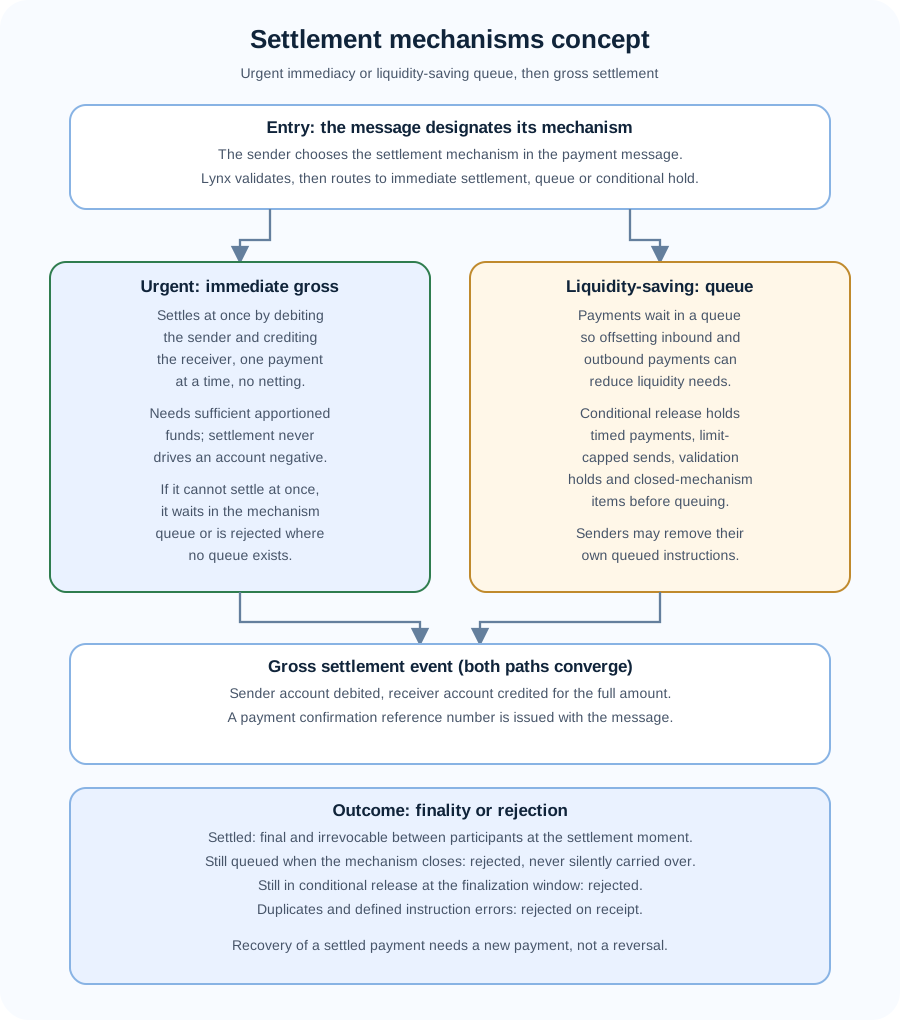
The sending participant designates the settlement mechanism in each payment message. Functionally the model offers two settlement characters, best understood as behaviours rather than labels. The urgent behaviour settles immediately on a gross basis: validated instructions go straight to the mechanism, and with sufficient apportioned funds, settlement executes at once. The liquidity-saving behaviour uses a queue with offsetting: payments wait so inbound and outbound flows offset, reducing the liquidity each participant must commit while each payment still settles gross in turn. Participants apportion credit-limit funds across mechanisms, and may move funds between mechanism accounts and repay intraday borrowing during the cycle under the by-law's procedures. Mechanism choice per payment balances immediacy against liquidity efficiency, and the designation travels in the message itself.
Before queuing or settlement, instructions may pass through conditional release, a holding behaviour the by-law defines functionally. Instructions divert to conditional release rather than straight to the mechanism when the sender set a specific later transfer time, when either participant is temporarily unable to settle, when the designated mechanism is not open, when the transfer would exceed the sender's own net send limit, or when the Rules require the sender to validate first. Each case has a plain meaning worth internalizing. Timed release stages payments for the right moment. Inability handling parks instructions during a participant outage instead of failing them. Closed-mechanism holding respects the operating schedule. The net send limit is the sender's self-imposed brake on net sends — a risk control, not a system constraint. Validation holds keep human judgement in the loop where the Rules demand it. Conditional holds are temporary by nature: instructions still held when the finalization window begins are rejected, never carried silently into the close.
Queuing is the second waiting behaviour, distinct from conditional release. If an obligation cannot settle immediately after reaching the mechanism — typically for insufficient apportioned funds — the instructions wait in that mechanism's settlement queue in the Rules' sequence for later processing. Queues are working tools, not parking lots: participants monitor, fund, re-sequence where permitted, and remove their own instructions when plans change. A sender may at any time pull its own queued instructions out — the pre-settlement escape hatch for customer cancellations or corrections before settlement. Mechanisms without a queue offer no patience: unsettleable instructions are rejected. And queues respect the clock: instructions still queued at mechanism close are rejected, not deferred by default. The operational moral is that a queued payment is a funding task with a deadline, and the deadline is real.
Rejection is therefore a defined outcome with defined causes, not a vague failure. Instructions reject on duplicate messages or specified instruction errors; on outstaying the queue past mechanism close; on outstaying conditional release past the finalization window; or where no queue exists to hold them. Each rejection needs repair and re-origination as a new instruction with lineage preserved — never silent editing, never blind resending. Operations should treat every rejection as a small, cheap, same-day event provided it is detected fast and classified correctly; Chapter 40's discipline begins here.
The settlement event itself is spare and decisive. When the obligation is ready and funds suffice, Payments Canada transfers the amount from the sender's Lynx account for the designated mechanism to the receiver's Lynx account for the same mechanism, making the corresponding entries on the Bank's books. Settlement through Lynx occurs at that transfer with those entries — with the guardrail that, for any participant except the Bank, settlement must not drive the mechanism account negative. Afterwards, Lynx generates the payment confirmation reference number identifying the settled obligation, which accompanies the payment message the service provider delivers to participants. That reference is the settlement evidence the downstream chain keys off: confirmations, statements, investigations and reconciliation all cite it. At the settlement moment, the sender's payment to the receiver is final and irrevocable. Finality is an event, not a process, happening per payment.
What the receiving participant owes the payee follows from settlement but is a distinct duty worth stating carefully. Once the obligation settles and the receiver holds the message with the confirmation reference, it must make the amount finally and irrevocably available to the payee — by the end of the payments processing cycle at the latest, sooner on reasonable request during the cycle. Availability becomes real when the receiver credits the payee's account, lawfully applies the amount against the payee's debt, or otherwise makes it accessible. The receiver may deduct a service charge under the Rules' procedures, must provide the confirmation reference on the payee's request, and — importantly — may rely on the account identifier in the message even where it conflicts with the payee name, with no duty to detect the inconsistency. That reliance rule is why initiation accuracy is critical: the system never second-guesses the address the sender gave. Exceptional circumstances displace the standard duty under defined procedures: message errors, receipt past the Rules' time, required currency conversion, branch-action timing, events beyond control, restrictions on the payee or account, legal or court orders, and the payee's own request not to be paid. Each is a procedure to follow, not discretion to improvise — with handling taught in Chapters 37 and 40.
Against batch, Lynx settles each interparticipant obligation gross and finally. Finality does not permit an unwind, but Rule 10 allows limited returns in specified cases, sent as a new pacs.004 payment; a misdirected payment already made available to the wrong payee normally requires the guideline's investigation, cooperation and any necessary consent or legal process. Against correspondent chains, value moves finally on the Bank's books. That is why Lynx carries the Canadian-dollar legs other arrangements depend on, and why its operating day constrains everyone downstream.
5. Data, identifiers, messages and references
Payments fail far more often from bad addressing and thin references than from system outages — and on Lynx a data error's cost is amplified by finality, since a well-formed payment to the wrong account settles just as finally as a correct one. This section maps what Lynx needs, what travels with each payment, and which references must survive the journey, at operating-model depth. Message-level ISO 20022 detail, field definitions and mapping practice live in Block 9 (Chapters 41 to 45); here the goal is knowing what to capture, what to validate, and what to cite afterwards.
Start with what Lynx itself sees, because it surprises newcomers. Lynx receives a partial copy of the payment message containing the settlement essentials: the sending institution, the receiving institution, the date, the amount, and routing references directing the payment to the customer's account at the receiving institution. That partial copy excludes client information, account numbers and transit numbers. Lynx thus settles the interbank obligation on lean data while full customer detail travels in the participants' message. The hub must validate both before sending: complete settlement instructions for Lynx, complete beneficiary information for the receiver.
Beneficiary-agent completeness is the discipline that follows. The sending bank must capture the receiving institution's identification, the payee's account or client identifier exactly as the receiver expects it, the fixed Canadian-dollar amount, the payment date, and the customer references — invoice, file, closing identifiers — both ends need for reconciliation. Because the receiver may rely on the account identifier without checking it against the payee name, as Section 4 noted, no safety net catches transposed digits or stale account numbers. Callback verification for new payees, master-data hygiene for recurring beneficiaries, and character-level confirmation for closing-day payments are not niceties; they are the controls keeping finality from becoming regret. Chapter 37 teaches capture and verification; Block 9 teaches the ISO 20022 mapping.
References let humans and systems agree they discuss the same payment, and four must survive every Lynx journey. First, the bank's internal instruction identifier, assigned at intake and carried through release, settlement, posting and reporting — the thread tying the customer conversation to system evidence. Second, the Lynx payment confirmation reference number, generated at settlement and accompanying the message to both participants — proof this specific obligation settled, cited on confirmations, statements and investigations. Third, the end-to-end transaction references tracking the payment across systems and borders, notably the universal end-to-end reference and Canadian return-linkage concepts taught in Block 9 — carried faithfully even where Lynx settles on leaner data, so cross-system investigations and reconciliations join the dots. Fourth, customer remittance: the invoice, claim, closing or file reference originator and beneficiary businesses need to close their books. Each absence causes a distinct pain: without the internal identifier the bank cannot find its instruction; without the confirmation reference it cannot prove settlement; without end-to-end references it cannot track across systems; without remittance the beneficiary cannot apply the cash.
Lynx's ISO 20022 capability shapes all this without needing field-level treatment here. The system was designed for the ISO 20022 standard, letting rich remittance data — invoice details, purchase information, structured party identification — travel with each payment. Industry migration from legacy formats to ISO 20022 formats on Lynx is complete, and specifications, corporate-to-bank guidelines and field definitions live in Block 9 with the pacs.008 customer-transfer, pacs.009 interbank, pacs.004 return and camt reporting treatments. The operating-model lesson is mapping rather than syntax: the hub must validate against the destination schema, log mappings and truncations, and carry original references forward so statements still match enterprise systems.
Two data boundaries deserve explicit statement because examinations and audits probe them. First, settlement data versus customer data: Lynx settles participant obligations on the lean partial copy, while customer protection — right payee, right account, right amount — depends on the full message the banks handle. Controls must cover the full message, not merely the settlement extract. And reconciliation must join instruction identity (what the bank was asked to do) with settlement proof (what the system settled) rather than assuming one implies the other.
6. Rules, operating schedule, service levels and customer impact
Customers experience rules as promises — arrival today, usability timing, cost, visible reference, failure handling — while banks experience them as windows, obligations and evidence. This section connects the two without inventing bank-specific promises. The current Lynx system windows are stated in the status note above; customer cutoffs, fees and amount thresholds remain in the applicable Rules, procedures and bilateral or product agreements. The skill taught is reading the rule layers correctly and translating them into honest customer commitments.
The legal foundation has three layers, each answering a different question. The Payment Clearing and Settlement Act is the statute under which the Bank designates Lynx as systemically important and oversees it; it answers why the system is supervised and to what standard. By-law No. 9 — made by the Payments Canada board under the Canadian Payments Act and approved by the Minister of Finance — sets the legal skeleton: participation, accounts, liquidity, payment messages, settlement, payments to payees, loan repayment, emergencies and coming into force. The Lynx Rules, procedures and operating schedule supply working detail: technical and testing requirements, message standards, the timetable with its processing cycle and finalization window, throughput expectations, and procedures for routine and exceptional events. Beneath sit the Bank's account policies and agreements, bilateral agency terms, and each bank's own customer cutoffs. Finality comes from the by-law, today's window from the schedule, the customer's deadline from the bank's own cutoff.
Business days anchor everything. Lynx operates every business day — Monday to Friday excluding holidays — per the operating schedule, and participants in good standing receive access every business day including all mechanisms. Participants must connect every business day unless technical difficulty prevents it. The closure calendar publishes through the system closure schedule, and bank value-date logic must respect it: a Thursday-evening instruction belongs to the next business day rather than "missing by minutes," a holiday Monday shifts funding and return expectations, and no channel may promise what the calendar cannot deliver. The hub must therefore assign every instruction to a processing cycle at intake and communicate that assignment honestly.
Service levels bundle timing with certainty, information and recourse, and Lynx's bundle is distinctive. Timing: same-business-day settlement for payments released within the cycle, with intraday queuing governed by funding and priority rather than batch windows. Certainty: per-payment finality and irrevocability at settlement, with confirmation references as evidence. Information: intraday status visibility — released, conditionally held, queued, settled, rejected — plus structured-data capability for reconciliation. Recourse: no unilateral unwind of settled value; Rule 10 provides limited returns as new pacs.004 messages in specified cases, while misdirected recovery runs through investigation and cooperation. Batch offers low-cost scale with deferred settlement and return rights; Interac offers round-the-clock experience; correspondent paths offer global reach with multi-hop timing. Pricing is a bank or product term, not a Lynx system promise; quote it separately from system finality and the applicable cutoff.
Throughput expectations deserve a functional mention because operations teams meet them as daily discipline. Lynx operates service and throughput expectations under TSP-004 and applicable procedures — expectations on the pace and distribution of submission and settlement across the day that keep liquidity flowing and prevent end-of-day concentration. This chapter states no parameters; those belong to the procedures and evolve with experience. The operating lesson is behavioural: release steadily across the cycle rather than warehousing for late submission, monitor the submission profile, and treat throughput compliance as shared responsibility — a participant dumping its day at the deadline harms the system's liquidity rhythm, not only itself. Chapter 39 connects this rhythm to liquidity practice; the Rules state the numbers.
Payments to payees complete the service picture. As Section 4 established, the receiving participant must make settled funds finally available to the payee by end of cycle — sooner on reasonable request — subject to defined exceptional procedures. That duty converts system finality into same-business-day customer availability: the promise the beneficiary's banker can actually keep. The sending banker's matching promise stays narrow: "settled with confirmation reference" means interbank finality achieved; "available to the payee" is the receiving participant's duty to confirm. Training every customer-facing colleague on those two sentences prevents more complaints than any technology upgrade, because most wire disputes are expectation disputes in operational clothing.
Pricing, cutoffs and communication interact as one commercial control. The channel may offer only what the hub confirms for this instruction, amount and cycle: urgency pricing for Lynx, an honest internal cutoff inside the system's window, status words used precisely — sent means released, settled means finally moved with a reference, posted means credited, available means usable, final means irrevocable. A bank whose channels, hub and treasury share one clock and one vocabulary sells high-value certainty at a premium with confidence; one whose channels freelance its promises pays the difference in investigations, compensation and lost trust.
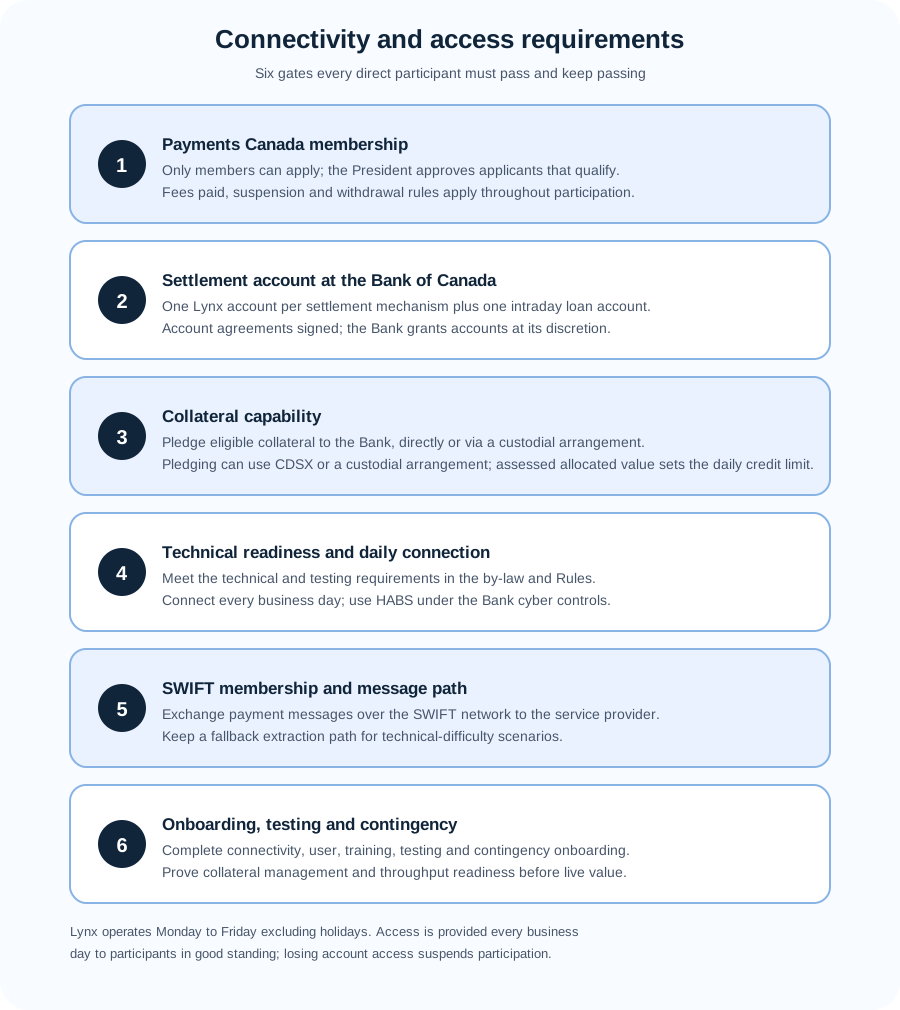
The connectivity diagram above collects the access gates in one view. Each gate is a continuing obligation, not a one-time ticket: membership standing, account access, collateral sufficiency, technical compliance, message-path health and testing currency must hold every business day. Section 10 turns these gates into an implementation programme.
7. Fraud, compliance and operational controls
Controls on a final-settlement system fail differently than on a reversible one. A sanctions check running after Lynx settlement, a fraud hold triggering after release, a FINTRAC report built from truncated data, a beneficiary verification performed only after the customer complains — each exists and still loses, because Lynx offers no unilateral unwind to fall back on. This section places each control family where it can still change the outcome. Rail-level typologies, AML mechanics, sanctions operations and PSP supervision are taught in Block 13; here the focus is placement, interaction and the stakes finality creates.
Fraud controls must concentrate before release — the last cheap decision point. Takeover and social-engineering attacks target initiation: authenticate the user, verify device and behaviour, challenge anomalous payees before the instruction becomes a message. Authorized-push-payment scams target instruction truth: the customer genuinely instructs, but to a fraudster-controlled account — so beneficiary-change verification, dual approval and out-of-band callbacks for new or amended wire payees are the controls that matter, not monitoring tuned only for stolen credentials. Mule activity targets the receiving side: incoming credits, including settled Lynx receipts, should be scored alongside outgoing sends, since a customer receiving a large unexpected wire may be a laundering cut-out rather than a fortunate vendor. Business-email compromise deserves special attention: fraudulent change-of-details messages arrive with authentic letterheads and plausible urgency, and the only reliable defence is verifying through a known-good channel before release — every time, without exception for seniority or deadlines. After release, fraud work becomes detection and response — incident management on irrevocable value, not prevention.
AML and FINTRAC obligations attach to wire events without being payment approvals, and data quality is their foundation. Complete originator and beneficiary information must be captured at initiation, preserved through hub processing without truncation, and available for identification verification, record-keeping and prescribed reporting where applicable. FINTRAC reporting is not a filing for every domestic Lynx payment: for example, financial entities report an international EFT of CAD 10,000 or more in a single transaction (with the applicable 24-hour aggregation rules), while the travel rule applies to prescribed EFTs, including international EFTs and Canadian EFTs sent by SWIFT MT-103 or equivalent. Because Lynx settles on a lean partial copy while the full message carries customer detail, bank records must join both: internal instruction, full message as sent, settlement evidence with confirmation reference, and posting entries. Thresholds and filing mechanics live in Block 13 and current FINTRAC guidance; the operating principle here is that wire teams must capture everything once, at initiation, in structured form.
Sanctions and applicable AML/travel-rule controls must be resolved before release. Screen the parties and relevant payment data before the hub releases to Lynx, with three dispositions: pass, false-positive release with documented reason, or true-hit hold with escalation. Placement is non-negotiable for the same finality reason: a true hit found after settlement means the bank moved value it was prohibited from moving — converting screening into a legal and reporting crisis. Screening quality depends on complete data; truncated beneficiary information causes multi-day false-positive delays or missed matches, another return on Section 5's data discipline. Cross-border wires touching Lynx for their Canadian-dollar leg need per-hop screening with complete data throughout; domestic wires need equal rigour, since settled domestic value is equally irrevocable. Every decision logs what was checked, when, against which list version, and by whom: the audit trail is the control's proof.
Oversight and rule compliance form the outer ring. The Bank's risk-management standards for designated systems set the bar Lynx as a whole must clear; its settlement-account policy sets each applicant's bar — comprehensive Canadian prudential supervision, business need, credit quality, cyber security around HABS access, operational capability including collateral pledging, and legal agreements. Payments Canada's compliance framework, in By-law No. 6 and the Lynx Rules, sets conduct expectations carrying suspension and revocation consequences. RPAA registration and Bank supervision apply to in-scope retail payment activities; they do not by themselves confer Lynx participation or settlement-account access. FCAC's cited unauthorized-transaction protections focus primarily on consumer card and debit contexts, so teams must not import card chargeback or zero-liability assumptions into wire recovery. Audit and examination probe one seam: does daily practice match the rulebook. Evidence preservation — instructions, decisions, references, statements — is how the bank proves it.
Operational controls complete the plane: least-privilege entitlements, dual approval for releases and overrides, amount and velocity limits, cutoff enforcement on a single shared clock, queue ownership with ageing, amendment discipline forbidding settled-value edits, segregation across initiation, approval, treasury funding and reconciliation, and incident communication trees. The binding control is release discipline: no instruction reaches Lynx without passing authentication, validation, limits, fraud, sanctions, cutoff and approval in that order, each logged — with every override itself dual-approved, time-bound and reviewed. Resilience controls — backup connectivity, the sender-extraction fallback, contingency procedures, failover staffing — sit in the same plane and are built in Section 10.
8. Exceptions, investigations and recovery
Every Lynx payment either settles finally or rejects cleanly — but the edges generate the exceptions consuming operations teams: queued payments ageing toward close, timed instructions caught by outages, defective messages, misdirected settled value, system-level emergencies. Classify first and recovery stays cheap; act first and duplicates cost more than the original error. This section teaches the Lynx exception taxonomy and recovery discipline at operating-model depth. Full investigation procedure, return-request handling and settlement reconciliation belong to Chapter 40; the classification here is its prerequisite.
Start with the taxonomy, because words drive actions. A rejection happens before settlement: Lynx refuses instructions for duplicate messages, defined instruction errors, queue expiry at mechanism close, conditional-release expiry at the finalization window, or absence of any queue to wait in. Nothing settled; the sender repairs and re-originates as a new instruction preserving lineage. A queue removal is the sender's own act: withdrawing its instructions from a queue before settlement — the legitimate pre-settlement cancellation path, available any time while instructions wait. A conditional-release expiry is a distinct rejection flavour: a timed or constrained instruction never becoming releasable before the finalization window, rejected rather than carried over. A misdirected settled payment is the hard case: value moved finally to the wrong participant or payee through valid settlement. No unilateral system reversal exists; recovery follows Rule 10 where its conditions apply, or the misdirected-payment guideline's investigation, cooperation, consent and possible legal process. An investigation tracks an uncertain outcome: a release with no confirmation yet, an unmatchable reference, a non-receipt claim against a settled reference. An emergency is system-level — interrupted communications, impaired processing, threatened safe operation — invoking the President's powers with the Bank's prior agreement. Each word implies different rights, handlers and clocks; using them interchangeably in tickets and customer calls guarantees confusion and delay.
Rail rights constrain every recovery, so classify before acting. On Lynx-settled value the receiving participant owes duties to its payee, not the sender: the by-law states those obligations run to the payee, so the sending participant cannot order value handed back. Misdirected-wire recovery therefore follows the Lynx misdirected-payments guideline and Rule 10: contact, explanation, investigation and a request for reimbursement or debit consent where the unintended recipient has already received the funds; a new pacs.004 return may follow when the Rules permit or require it. Assemble the instruction, message and confirmation reference to support the request. Contrast batch, where returns and adjustments run through system mechanisms, or cards, where chargebacks invoke network rights: Lynx offers no unilateral pull-back mechanism, but Rule 10 does impose limited return procedures for specified restrictions, legal or court-order situations, or an agreed payee non-availability request. Misdirection after credit remains a cooperation, consent and possible legal-process case. The hub must therefore prevent impossible offers — no "Lynx reversal," no "cancellation of settled value," no promised recovery date. Honest early framing preserves trust that false promises destroy.
Investigations walk one path regardless of trigger: confirm release and references, confirm extraction and mechanism routing, confirm settlement evidence or rejection reason, confirm posting or non-receipt, then communicate state with next steps. For released-but-unconfirmed payments, operations checks gateway acknowledgement, Lynx acceptance, hold or queue status, and funding — most "missing" wires are queued or held, not lost. For settled-but-disputed payments, the confirmation reference plus delivered message settles the interbank question; the remainder is the receiver's posting and availability handling under its by-law duties. For rejections, the reason determines repair: data defects return to initiation, duplicates to hub deduplication logic, expiries to funding and timing decisions. Throughout, the original internal identifier follows every inquiry, re-origination and corrective payment, so a timeout under investigation never becomes a duplicate release when the original surfaces.
Recovery follows four rules for the operations wall. Never edit settled value: originate a linked corrective payment with its own references and lineage. Never resend on assumption: confirm the original's state first, or recovery becomes a duplicate. Never promise what the rail cannot deliver: no unilateral recall or reversal of final value, no backdated settlement, no availability commitment on the receiving participant's behalf. Use Rule 10's return path where its conditions apply. Never close without evidence: every exception ends with matched references — instruction, message, confirmation, posting — or an open investigation with an owner and an ageing clock. System emergencies follow the President-with-Bank-agreement path.
The deepest lesson here is cultural. On reversible rails, teams learn mistakes unwind and controls can be approximate; on Lynx, prevention is the only cheap control and precision the only safe habit. Every misdirected-payment story in Chapter 40 traces to a skipped verification, an overridden limit or an assumed payee detail in the minutes before release. Spend care before release and the exception queue stays a trickle; rely on recovery and it becomes a caseload.
9. Posting, accounting, liquidity, reporting and reconciliation
Settlement moves value between participants; posting, accounting and reconciliation prove it happened correctly and place it in the right customer accounts. This section follows Lynx value into the books at operating-model depth: participant accounts, customer posting, intraday credit and repayment, reporting, and the three-way reconciliation tying instruction to settlement to ledger. Treasury mechanics — funding strategy, collateral optimization, queue management — are taught in Chapter 39; investigation-grade reconciliation in Chapter 40. Here the objective is knowing what posts where, what funds it, and what evidence proves it.
Participant accounting starts with the account structure on the Bank's books. For each participant, Payments Canada operates one Lynx account per settlement mechanism plus, for every participant except the Bank, one intraday loan account. Settlement debits and credits run through mechanism accounts; borrowing and repayment run through the loan account. During the cycle, participants apportion funds from their credit limit into mechanism accounts, move funds between mechanism accounts, and repay intraday borrowing from mechanism balances under the by-law's procedures. Before the finalization window, remaining balances consolidate into the real-time mechanism account; at finalization, consolidated balances repay the intraday loan, any shortfall converts to an overnight advance under standing agreements, and the cycle ends when all transfers and entries complete. That is the day's financial shape in miniature: allocate in the morning, settle through the day, consolidate and repay at the close. The Bank's own account arrangements and the reserved-collateral mechanism are mastered in Chapter 39.
Customer posting translates system settlement into customer reality. On the sending side, the originator's account is debited — before or at release depending on product design — with fees applied and disclosed under the Rules, and the payment leaves the bank's books against the settlement obligation. On the receiving side, once the obligation settles and the message with confirmation reference arrives, the receiver credits the payee's account, applies the amount against a lawful debt, or otherwise makes it accessible, by end of cycle at the latest. Internal ledgers mirror each leg: settlement-account entries for interbank movement, customer-account entries for debit and credit, fee income entries, and suspense or investigation accounts for anything unpostable. Same-day finality does not mean same-instant posting: the receiver has until end of cycle, subject to its reasonable-request duty, and banks should staff posting and exception queues to use that window rather than promising instantaneous credit on every receipt.
Liquidity is the funding behind postings, described functionally with treasury depth forward-pointed. Each business day the Bank assesses pledged collateral and sets a credit limit equal to the allocated assessed value; available liquidity at any moment equals the credit limit plus receipts from settled inbound payments minus settled outbound sends. Intraday loans formalize credit actually drawn as funds apportion into mechanisms. Eligible collateral pledges through CDS CDSX or a custodial arrangement, and sufficiency — including under stress — is a standing Bank-policy obligation, not a morning ritual. A queued payment is usually a collateral-and-allocation story, resolved fastest through the treasury desk's funding decision. Chapter 39 teaches allocation strategy, queue funding, limit management and contingency funding; this chapter establishes liquidity, not system capacity, as the normal constraint.
Reporting turns events into usable evidence. Participants confirm release, settlement with reference, queue and hold states, and rejections through portal status, host-to-host acknowledgements, statements and advices. Structured reporting should state every payment's condition — released, settled with reference, queued for funds, held for time, rejected with reason — so no customer, auditor or investigator must phone to learn it. Receiving participants additionally provide confirmation references to payees on request, closing the beneficiary-end evidence loop.
Reconciliation proves the story end to end: a three-way match with no tolerance for idle breaks. First leg, instructions versus release — every customer instruction and treasury order matches a released message or documented rejection, with nothing released twice and nothing lost between hub and gateway. Second leg, release versus settlement — every released message matches a settlement with confirmation reference, a live queue or hold state with an owner, or a rejection with reason. Third leg, settlement versus books — every settled obligation matches balanced debits and credits across mechanism, customer and fee ledgers, with HABS statements and Bank reporting agreeing to the participant's records. Breaks age visibly with owners: unmatched releases, orphan references, unbalanced postings, unapplied receipts — each with a clock and escalation path. End-of-day adds cycle disciplines: consolidated balances match finalization entries, the intraday loan balance is zero or matched to an overnight advance under agreement, and the next day opens from a proven position. Reconciliation is part of the payment product: performed daily, evidenced always, never deferred.
10. Bank implementation, testing and resilience
Joining Lynx is a programme, not a purchase. A bank must assemble legal standing, accounts, collateral capability, message connectivity, treasury competence, operations staffing, control integration and contingency readiness — then prove all of it in testing before live value flows. This section maps that programme at operating-model depth for sponsors, operations leaders and control owners.
The programme begins with standing and sponsorship. Executive ownership must span operations, treasury, technology, compliance and the wire-selling business lines jointly, since Lynx touches funding, controls, platforms and customer promises at once. Legal and regulatory work runs first and longest: membership standing, the participation application with technical, testing and fee demonstrations, the Bank's settlement-account approval with prudential, business-need, credit, cyber, operational, collateral and legal requirements, the account and ancillary credit agreements, custodial collateral arrangements where needed, and agency agreements for non-participant partners served — or the agency agreement signed if joining as a non-participant. Each approval is discretionary and continuing — treat them as gated milestones with real lead times, not paperwork.
Technology and connectivity work follows the gates. The bank builds or adapts its hub's Lynx adapter: instruction normalization, validation, screening and approval integration, message formatting to current Lynx standards, mechanism-designation logic, SWIFT connectivity with the service-provider path, the technical-difficulty fallback procedure, status tracking across release, hold, queue, settlement and rejection, and confirmation-reference capture and propagation. HABS access is established under the Bank's cyber requirements — restricted external access, encryption, vulnerability management, physical and personnel security — with user management, attestation and ongoing compliance. Collateral connectivity is built and proven: funding cannot be an opening-day discovery. Throughout, the bank validates against the destination schema, maps explicitly, logs truncations and enrichments, and carries original references end to end per Section 5's discipline.
Treasury and operations readiness is the programme's heart. Treasury establishes the collateral pool and pledging routine, daily allocation and apportionment, credit-limit monitoring, queue-funding decision rights and escalation, throughput-profile management under TSP expectations, and contingency funding for stress days. Operations establishes the business-day rhythm: morning allocation and connectivity checks, intraday queue and hold monitoring with ageing ownership, customer-status communication standards, posting and exception-queue staffing to the end-of-cycle window, and close discipline covering consolidation, loan repayment and next-day readiness. Staffing must cover the whole cycle — finalization pressure punishes thin afternoons. Training covers Section 3's release discipline, Section 8's exception taxonomy, Section 9's evidence standards and Section 6's customer language, with certification before go-live and refreshers after.
Testing proves the programme before value is at risk, across five dimensions. Technical testing demonstrates message validity, mechanism designation, SWIFT-path and fallback behaviour, HABS interaction and statement matching. Functional testing walks every state — release, conditional hold, queue, removal, settlement, rejection, repair, re-origination — with references joined correctly. Control testing attempts the failures: duplicate submission, limit breach, screening hit, unauthorized release, after-cutoff instruction, payee-detail error — each confirming the hub stops, holds or routes correctly. Volume and throughput testing proves steady submission across a simulated day within TSP expectations without warehousing. Contingency testing rehearses participant outages, SWIFT-path difficulty, collateral shortfalls and incident communications with Payments Canada. Only with all dimensions passed and evidenced should the bank progress from monitored pilot value to full production — and the pilot should include a deliberate misdirection drill, since Section 8's recovery procedure is learned cheapest in rehearsal.
Steady-state resilience keeps the participant safe afterwards. Payments Canada maintains resilient technology — including additional data-centre capacity added in recent years — with continuous monitoring, administration, configuration and incident management targeting very high availability, plus participant committees and touchpoints keeping practice current. The participant's matching duties are daily connection, continuous queue and throughput monitoring, current rules knowledge, patched compliant systems, trained available staff, tested contingency paths, and honest incident escalation to the operator at the first sign of trouble rather than the first failed settlement. Emergency powers exist for system-level events with the Bank's prior agreement, but no participant should plan to need them: the resilient participant experiences most incidents as brief queue lengthening handled through funding and communication, not customer impact.
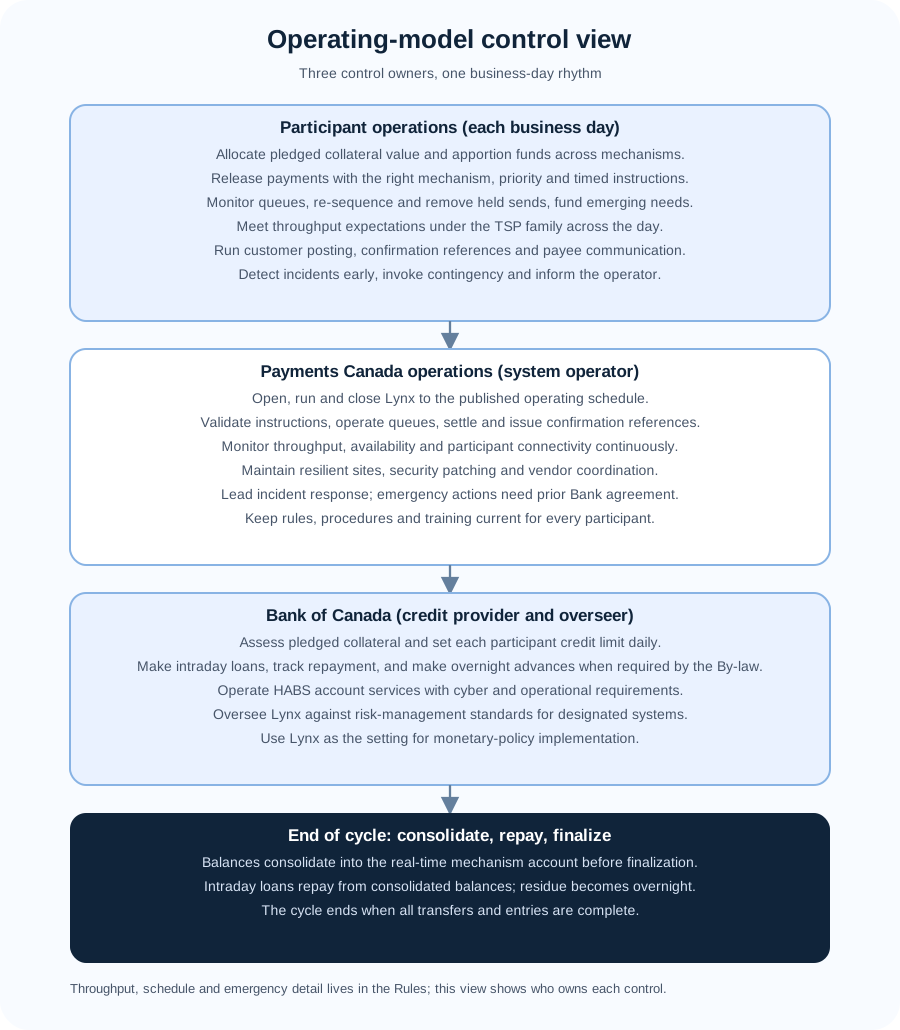
The control view above summarizes the section: participants fund and queue, the operator runs and settles, the Bank credits and oversees, and the day ends in consolidation and repayment. Programme managers can map every workstream to one box; operations leaders can map every shift task the same way.
11. Practical Lynx operating examples
Theory becomes judgement through cases. The three examples below are entirely fictional — invented companies, people, amounts and timings showing how the operating model behaves under realistic pressure. Each follows the chapter's chain from instruction to evidence and closes with the control lesson for the working day.
Example (fictional): the closing-day supplier payment on the urgent path
Northwood Cabinets, a fictional Ottawa manufacturer, closes a finishing-line purchase on a Wednesday. The vendor releases the equipment for Thursday installation only against a same-day-final Canadian-dollar payment received before its lawyer's office closes. Treasurer Priya instructs her bank through the business portal in the morning: full beneficiary-agent details from the lawyer's direction, the closing file reference, explicit same-day-final instruction.
The hub validates — account standing, funds availability, beneficiary-agent completeness, duplicate check against a smaller deposit the previous day — and routes for dual approval given the size. Fraud screening shows nothing on record, but the payee is new, so policy requires a callback to the lawyer's office on a known-good number; the office confirms, and the approver releases. Screening passes, cycle assignment is today, and the gateway formats the message with urgent settlement behaviour — immediacy chosen deliberately for a closing deadline. Over SWIFT the message reaches the service provider, instructions extract to Lynx, validation passes, the morning's apportioned funds cover it, and gross settlement executes within the cycle. The confirmation reference returns; the hub matches it to Priya's instruction, updates the portal to settled with reference, and the receiving participant makes the amount available to the vendor's lawyer by end of cycle. The keys change hands on schedule.
The lesson is the chain, not the speed. Every link held because it was built before release: complete details at initiation, new-payee verification despite deadline pressure, mechanism choice matched to commercial need, funding arranged in the morning, evidence — instruction, message, reference, posting — joined for the file. Had any link failed, finality would have amplified it: a transposed digit settles finally to the wrong payee, recoverable only through cooperation. The cheapest minute of the whole transaction was the callback.
Example (fictional): treasury flow through the liquidity-saving queue with a timed release
Meridian Trust, a fictional mid-sized direct participant, faces a busy Thursday: heavy customer wires plus large interbank payments from the morning's flows. Treasury lead Daniel allocates the day's collateral value across mechanisms in the morning and sets a steady submission profile consistent with throughput expectations — no warehousing for the afternoon.
One large interbank payment is due to a counterpart needing value only later in the day, so the team releases it with a timed instruction designating liquidity-saving behaviour. Lynx holds it in conditional release until its moment, then queues it, where offsetting inbound customer receipts reduce the liquidity its gross settlement needs. Mid-morning, a customer cancels an unrelated queued payment after a contract falls through; operations removes the sender's instructions from the queue cleanly — no value moved, no recovery needed — and the funding plan adjusts. A second payment briefly queues for funds in the midday peak; the desk, watching queue ageing rather than awaiting complaints, apportions additional funds and it settles in turn. Every settlement returns its reference; the hub matches each one; throughput stays smooth; consolidation and loan repayment complete normally at finalization.
The lesson is that queues are instruments, not incidents. Timed release staged the payment to its commercial moment, offsetting economized on liquidity without compromising gross finality, sender removal handled a legitimate cancellation at zero cost, and active monitoring converted a funding gap into routine treasury action. No heroics — only morning allocation, a steady profile, and ownership of every queued item with a clock. The contrast writes itself: a desk warehousing releases for late submission, ignoring queue ageing, and discovering its gap at finalization turns the same system into a crisis.
Example (fictional): a misdirected settled payment recovered by a new payment
Harbourview Logistics, a fictional Halifax importer, pays a port-services invoice through Atlantic Gateway Bank. A clerk retypes the beneficiary's account identifier from a PDF invoice instead of the verified master, transposing two digits. Validation checks structure, not truth — the identifier is well-formed — the payee is recurring so no callback fires, and the payment releases, settles finally, and returns a reference. The receiving participant, following its duty, makes the amount available to the stated account's holder — a different, innocent customer — relying on the identifier as the rules permit.
Harbourview notices next morning when the port reports non-receipt. The bank classifies before acting: settled and final, no system reversal available, receiver obligations running to its payee rather than the sender. Operations assembles the evidence — instruction, message as sent, confirmation reference, postings — contacts the receiving participant with a cooperative recovery request, and informs Harbourview honestly: value moved finally to the stated account, recovery needs the beneficiary's agreement, the request is underway with this reference, no date promised. The innocent recipient, contacted by its own bank, agrees to return the funds; a new payment travels back with lineage referencing the original; both directions reconcile with references joined. The bank then fixes the cause: the master is corrected, PDF retyping is banned for wires above a policy threshold, recurring-payee verification is tightened.
The lesson is finality's double edge. The system worked exactly as designed — settling the stated obligation finally, the receiver serving its payee under the identifier rule — and the failure sat in initiation data quality. Recovery succeeded through speed, evidence, honest communication and interbank cooperation, but it depended on goodwill that may not always exist. The preventive control cost nothing: using the verified master instead of retyping. On Lynx, data quality is not an administrative virtue; it is the primary risk control.
12. Key takeaways and authoritative references
Ten points carry the chapter. First, Lynx is Canada's high-value payment system — Payments Canada owned and operated, real-time gross settlement, central-bank money, live since 1 September 2021 after LVTS (1999–2021) — defined by per-payment finality with irrevocability at settlement. Second, five players share the work: participants instruct and fund, SWIFT transports, Payments Canada operates and settles, the Bank of Canada provides accounts, credit and oversight plus its own payments and the monetary-policy setting, and the Minister of Finance holds legislative oversight powers including by-law approval. Third, only approved direct participants settle in Lynx; non-participant partners serve customer wire needs through direct participants under agency arrangements with earlier customer cutoffs. Fourth, access rests on continuing gates — membership, a Bank settlement account with agreements, collateral capability via CDSX or a custodial arrangement, technical readiness with SWIFT membership — plus onboarding, testing and contingency proof. Fifth, each message designates its settlement behaviour: urgent immediate-gross settlement or liquidity-saving queued settlement with offsetting, fronted by conditional release for timed, constrained, unvalidatable or closed-mechanism instructions. Sixth, settlement is a gross debit-and-credit event that must never drive a participant's mechanism account negative; it produces the payment confirmation reference number, and at that moment the interbank payment is final and irrevocable. Seventh, the receiving participant must make settled funds finally available to the payee by end of cycle, may rely on the stated account identifier, and follows defined procedures in exceptional circumstances. Eighth, controls belong before release — validation, fraud, sanctions, FINTRAC capture, approval, cutoff — because post-settlement screening is incident management on irrevocable value. Ninth, exceptions classify first: queued instructions can be removed, expired instructions reject, and settled obligations cannot be edited or unilaterally reversed. Rule 10 provides limited returns as new pacs.004 messages, while misdirected payments require the guideline's recovery process; emergencies follow the President-with-Bank-agreement path. Tenth, the day has a financial shape — allocate, apportion, settle, monitor queues, consolidate, repay, finalize — proven daily by three-way reconciliation of instruction to settlement to books.
The forward map is precise. Chapter 37 traces the domestic wire lifecycle from instruction through bank controls, Lynx settlement and beneficiary posting. Chapter 38 takes apart real-time gross settlement mechanics, settlement evidence and finality. Chapter 39 teaches liquidity and participant processing — collateral, credit limits, apportionment, queue funding and treasury decisions. Chapter 40 handles wire returns, investigations and reconciliation. Block 9 (Chapters 41 to 45) supplies the ISO 20022 message layer. Block 13 deepens fraud, AML, sanctions and supervision; Block 14 deepens cutoffs, investigations, posting and resilience operations. Return with this chapter's model in mind and each reads as procedure filling a known structure rather than new concepts from scratch.
Authoritative references — official sources only. Consult these for the binding detail this chapter describes functionally; where this chapter and a reference differ, the reference governs.
- Payments Canada — High-value payment system (Lynx): system description, key players, participation criteria, operating days and statistics — https://www.payments.ca/systems-services/payment-systems/high-value-payment-system-lynx
- Payments Canada — Rules and documentation: the Lynx Rules, procedures, by-laws and standards in force — https://www.payments.ca/systems-services/rules-documentation
- Bank of Canada — Lynx: the monetary-policy setting, LVTS history and the joint Lynx overview primer — https://www.bankofcanada.ca/core-functions/monetary-policy/lynx
- Bank of Canada — Settlement account access policy for Lynx and ACSS: prudential, business, credit, cyber, operational, collateral and legal requirements including HABS and CDSX pledging — https://www.bankofcanada.ca/core-functions/financial-system/bank-canadas-settlement-account-policies-for-payments-canada-payment-systems/
- Bank of Canada — Payment systems overseen: designation context, direct and indirect participation, and Lynx among overseen systems — https://www.bankofcanada.ca/regulatory-oversight/financial-market-infrastructures/payment-systems-the-bank-of-canada-oversees/
- Department of Justice Laws — Payment Clearing and Settlement Act: the statute under which the Bank designates and oversees Lynx as a systemically important system — https://laws-lois.justice.gc.ca/eng/acts/P-4.4/
- Department of Justice Laws — By-law No. 9 (Lynx), SOR/2021-182: participation, liquidity, payment messages, settlement, payments to payees, loan repayment and emergencies — https://laws-lois.justice.gc.ca/eng/regulations/SOR-2021-182/FullText.html
- Payments Canada — System closure schedule: published business-day and closure calendar governing Lynx operating days — https://www.payments.ca/system-closure-schedule
- Payments Canada — Lynx explainer: PCRN, non-Lynx wires, operating hours, intermediaries and same-business-day availability — https://www.payments.ca/explainer-lynx-wire-payments-and-payment-confirmation-reference-number
- Payments Canada — Current Lynx rules filter: Rule 2 operating schedule; Rules 7–10 queues, mechanisms, finality and return; TSP-004 throughput target — https://www.payments.ca/systems-services/rules-documentation?field_rules_type=2
- Payments Canada — Rule 10, Finality and Return (current PDF): specified returns, pacs.004, late receipt and payee-identifier procedures — https://www.payments.ca/sites/default/files/rule_10_finality_and_return.pdf?v=1785155586
- Payments Canada — Guideline, Misdirected Lynx Payments: investigation, cooperation, consent and legal-process boundaries — https://www.payments.ca/sites/default/files/Guideline_Misdirected_Lynx_payments.pdf?v=1671633807
- Payments Canada — Lynx ISO 20022 message specifications (UG2026 core messages): pacs.008, pacs.009, pacs.004 and camt.053 — https://www.payments.ca/payment-resources/iso-20022/high-value-payment-system-lynx
- Payments Canada — Real-Time Rail payment system: Q4 2026 launch plan and pre-production status — https://www.payments.ca/systems-services/payment-systems/real-time-rail-payment-system
- FINTRAC — Reporting electronic funds transfers: international EFT CAD 10,000 threshold and 24-hour rule — https://fintrac-canafe.canada.ca/guidance-directives/transaction-operation/eft-dt/eft-dt-eng
- FINTRAC — Travel rule for electronic funds and virtual currency transfers: scope and required originator/beneficiary data — https://fintrac-canafe.canada.ca/guidance-directives/transaction-operation/travel-acheminement/1-eng
- Department of Finance Canada — Retail Payment Activities Act: PSP registration and supervision scope — https://www.canada.ca/en/department-finance/corporate/transparency/access-information-privacy/reports/rpaa-laapd.html
- FCAC — Fraud and oversight of unauthorized transactions: card/debit protections and wire-fraud complexity — https://www.canada.ca/en/financial-consumer-agency/corporate/transparency/briefing-packages-parliamentary-committee-appearances/standing-committee-finance-february-13-2024/fraud-fcac-oversight-unauthorized-transactions.html
- Interac — Interac e-Transfer consumer service page: separate participating-FI account-based service — https://www.interac.ca/en/consumers/products/interac-e-transfer/
This application uses JavaScript for the full interactive experience. This text summary is served for accessibility and search indexing.