Liquidity and Participant Processing. Connect payment release, queues, liquidity, collateral, participant operations and treasury decisions.
Canada Payments & Collections · Block 8 · Chapter 39 of 75
Every payment your bank releases is a promise that must be funded. A corporate customer sees an approval screen and believes the money has gone. Operations sees a validated instruction ready to leave. Treasury sees a claim on today's finite liquidity pool — and knows that releasing too much too early, or too little too late, turns a routine day into an incident. This chapter is about the machinery between approval and settlement: how participants watch intraday positions, how collateral pledged to the Bank of Canada becomes usable intraday credit, how queues hold payments safely until liquidity and conditions allow release, how offsetting lets opposite payments settle with less funding, and how treasury and operations decide together what leaves the bank and when.
If earlier chapters answered what the rails do, this chapter answers how a participant survives the day inside them. A bank that validates perfectly but funds poorly still fails its customers: wires queue past supplier deadlines, ACSS net positions arrive underfunded, and the customer screen says "sent" while nothing has settled. The discipline this chapter installs is to treat liquidity as a release constraint — as real as a cutoff, as binding as an approval — and to give every queued, held, or released payment an honest status, a named owner, and evidence that joins end to end.
The scope here is deliberately cross-cutting. Payment release, queue management, intraday liquidity, collateral, participant operations, and treasury decisions form one loop: releases consume liquidity, liquidity positions gate releases, collateral replenishes headroom, queues absorb the timing mismatch, and treasury judgement keeps the loop honest through payroll-day peaks, late receipts, and stressful afternoons. Read this chapter as the operator's companion to the settlement chapters: Lynx settles each payment gross in central-bank money and is therefore liquidity-intensive; ACSS nets positions in batch and funds them at settlement, which is structurally lighter but still forecast-dependent. Both demand the same habits — measure the position, fund before promising, show the queue honestly, reconcile the day — applied with different intensity.
What you should be able to do after this chapter
After working through this chapter, you should be able to:
- explain what intraday liquidity is, where it comes from — opening settlement balance, incoming settled payments, and intraday credit backed by collateral pledged to the Bank of Canada — and why only settled funds and live credit headroom can fund a release;
- describe the treasury and operations roles that own the intraday position, who decides what, and how the funding desk, payments operations, collateral management, and reconciliation teams hand work to each other through the day;
- walk a payment from approval through release, queuing, and settlement, and say exactly which checks — validation, screening, limits, liquidity, priority, cutoff — gate each step;
- explain how clearing and settlement consume liquidity differently in Lynx gross settlement versus ACSS deferred-net funding, including how ACSS net positions are funded with settlement flowing via Lynx as the high-value channel;
- identify the data a liquidity decision needs — positions, forecasts, queue depth and age, collateral headroom, priorities, value dates — and why stale or incomplete data produces wrong releases;
- describe throughput discipline functionally: why participants spread settlement activity through the day instead of back-loading it, and how a bank's release sequencing supports system-wide smoothness;
- place fraud, sanctions, limit, and mandate controls correctly relative to the liquidity decision so that a payment starved of funding is never confused with a payment stopped for risk;
- handle the standard exceptions — queued, held, reordered, recalled, returned — with precise language, linked references, and honest customer status;
- explain the postings, accounting entries, and reconciliation that prove the day balanced: settlement-account entries, intraday credit draws and repayments, collateral movements, fee capture, and position-versus-books agreement;
- specify what a bank must build, staff, test, and rehearse before trusting its liquidity operation on a payroll-day peak or a stress afternoon;
- work through payroll-day liquidity planning and queued-wire triage as fictional end-to-end stories, and extract the repeatable playbook each one teaches;
- correct common misunderstandings such as "approved means funded," "a queue means something broke," "collateral is only a regulatory formality," and "offsetting changes what is owed."
For a roughly 60-minute core session, spend about 25 minutes on Sections 1–3 (the liquidity loop, the people who own it, and the release journey) with the first three diagrams open, 15 minutes on Sections 4–6 (settlement consumption, data, and throughput discipline), 10 minutes on Section 11 (the two fictional stories — payroll-day planning and queued-wire triage), and 10 minutes on Section 12 (takeaways and references). The remaining depth — control placement, exception mechanics, posting detail, and implementation checklists — is follow-up study that later operational chapters deepen.
Chapter navigator
- Business context: the promise must be funded
- Participants: treasury, operations, and the people between them
- From approval to release: initiation, processing, and the queue door
- Clearing, settlement, and how each consumes liquidity
- Data: what the liquidity decision needs to be right
- Rules, service levels, and throughput discipline
- Fraud, compliance, and controls around the release
- Exceptions: queued, held, reordered, recalled, returned
- Posting, accounting, and proving the day balanced
- Bank implementation, testing, staffing, and resilience
- Practical stories: payroll-day planning and queued-wire triage
- Key takeaways and authoritative references
1. Business context: the promise must be funded
Every business day in a Canadian bank begins with obligations that cannot wait and ends with proof that each one was met. An employer must fund Friday payroll. A dealer must settle securities-related wires before counterparties close their books. A corporate treasurer must pay suppliers so production lines keep moving. A biller collects thousands of pre-authorised debits and expects the net proceeds on time. Each of these customers experiences the bank's promise in simple language — "it will be there today" — while the bank must translate that promise into a funded settlement reality across two very different systems: Lynx, the live real-time gross settlement system, and ACSS, the batch deferred-net retail system whose net positions are funded at settlement with funding movements flowing via Lynx as the high-value channel.
The translation matters because the customer's mental model and the bank's funding model disagree by default. The customer believes approval equals movement: the payment was approved, therefore it has gone. The bank knows approval is only permission: the payment may now compete for today's liquidity, wait in a queue, draw intraday credit against pledged collateral, or be sequenced behind more urgent items. When these two models collide — the customer told a supplier "the wire is sent" while the wire sits queued for liquidity — the damage is not technical but relational. The supplier doubts the customer; the customer doubts the bank; and the bank discovers that its status language ("sent," "processing," "released") promised something the funding position could not deliver. Strong participants fix this at the source: statuses describe verifiable states (approved, queued for liquidity, released, settled), never aspirations.
Consider why liquidity exists as a problem at all. If every bank received exactly what it pays out at exactly the same moment, no funding would be needed. Real days never look like that. Outflows cluster in the morning when dealers and treasurers release wires; inflows arrive when other participants release theirs. Payroll days concentrate enormous retail outflows against settlement positions that must be funded on cycle. Tax-date concentrations, month-ends, and quarter-ends amplify the pattern. Cross-border legs add foreign-holiday and correspondent-timing wrinkles. The intraday position — the running balance of what has settled in, what has settled out, and what credit headroom remains — swings through the day, and the participant's job is to keep every release covered without hoarding so much liquidity that the day's business stalls. Liquidity management is therefore not a treasury hobby; it is the daily proof that customer promises were fundable when made.
Three sources feed the day, and every release decision draws on their sum. The opening settlement balance — funds held in the settlement account at the Bank of Canada when the day begins — is the known floor. Incoming settled payments, principally Lynx receipts from other participants during the day, replenish the pool as they arrive; expected receipts shape the plan, but only settled receipts fund releases. Intraday credit from the Bank of Canada, backed by collateral the participant has pledged, bridges timing gaps: when morning outflows outpace morning inflows, the bank draws credit against its pledged cover and repays as receipts land. The sum — balance plus settled receipts plus undrawn credit headroom — is the available pool, and the rule is absolute: no release without cover in the pool. A validated, dual-approved, fully screened payment that lacks funding waits. That is not a system failure. That is the control working.
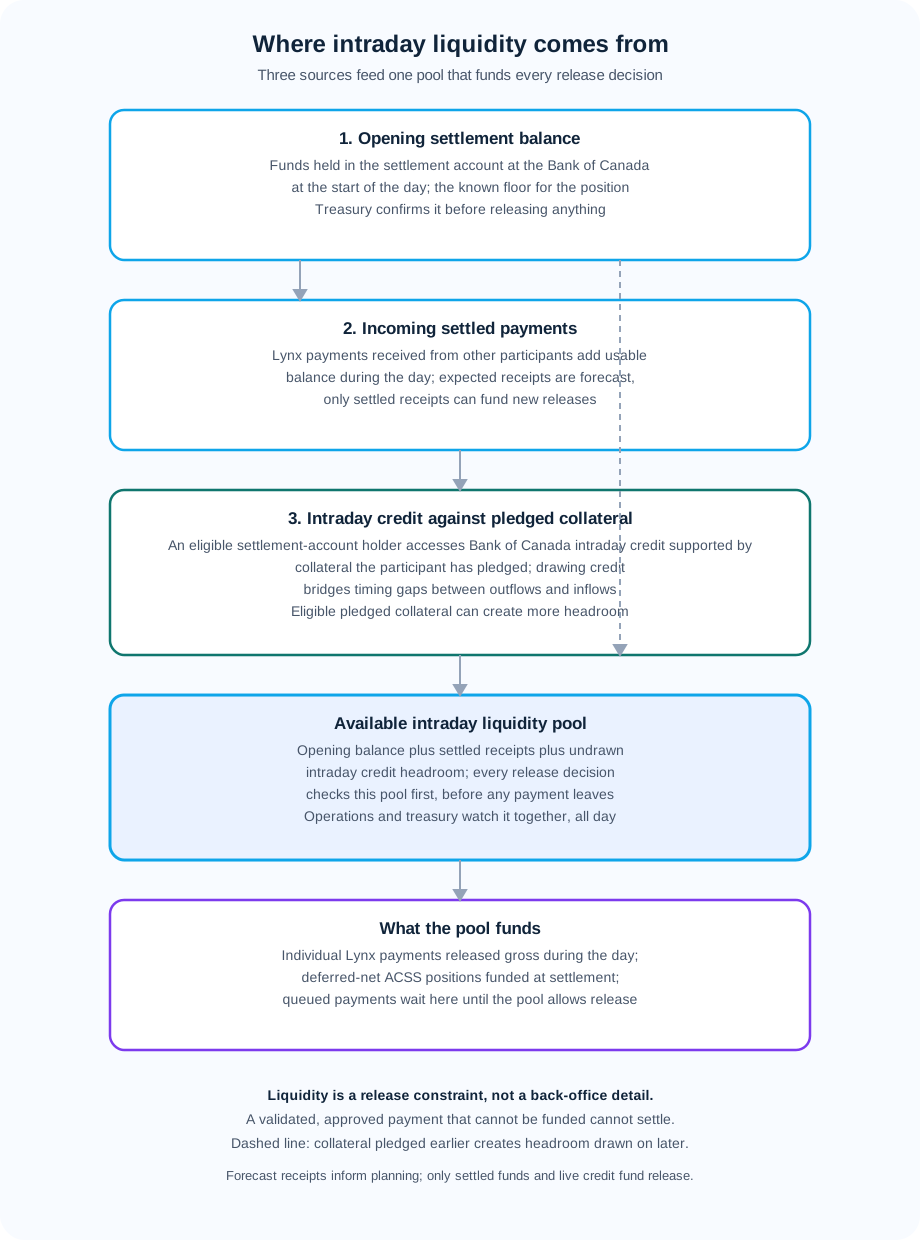
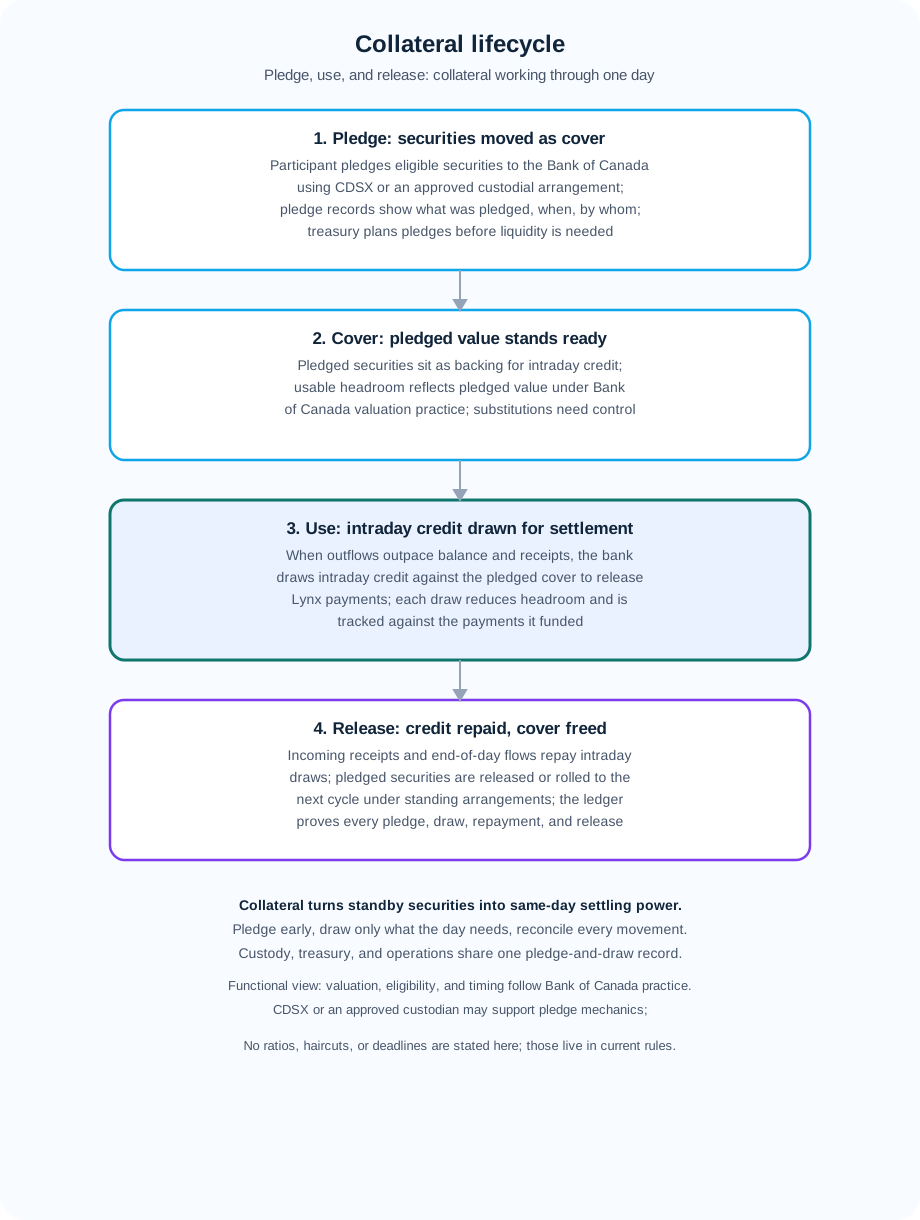
Collateral deserves its framing here because newcomers file it under regulation and forget it is daily fuel. Eligible securities pledged to the Bank of Canada — using CDSX or an approved custodial arrangement — do not sit idle as a compliance artefact. They stand as the cover that lets the bank draw intraday credit exactly when the queue is deepest. Pledging is therefore a morning decision with afternoon consequences: pledge too little and the bank rations releases under stress; pledge generously and the day has room to breathe. Treasury plans pledges before they are needed, monitors headroom as draws accumulate, and reconciles every pledge, draw, repayment, and release movement so that custody, treasury, and operations share one record. Section 4 follows the collateral lifecycle box by box; the context point is that collateral policy is liquidity policy.
Queues complete the context because they are where timing mismatches wait without becoming incidents. A bank's internal release queue holds accepted instructions that are not yet submitted or settleable — for liquidity, a future trigger, or a pending condition — preserving order, priority, and full detail until release is safe. That internal queue must be distinguished from a Lynx settlement-mechanism queue. Queues interact with liquidity in both directions: a thin pool lengthens queues, while offsetting — settling opposite payments together so only the difference needs funding — shortens them. The participant that explains queues honestly ("your payment is queued for liquidity with an expected release window") keeps customer trust through the wait; the participant that labels everything "sent" spends the afternoon explaining why settled proof never arrived. Hold this mental image for the whole chapter: releases drain the pool, receipts refill it, collateral widens it, queues buffer it, and treasury judgement steers it. Every later section is one component of that loop examined closely.
2. Participants: treasury, operations, and the people between them
Liquidity has owners, and incidents usually begin where ownership blurs. In a Canadian direct participant, five groups share the intraday position, each with a bounded job and a clean handoff. When a queued wire misses a supplier deadline, the post-mortem question is never just "where was the liquidity" but "who was watching it, who could reorder the queue, who could pledge more cover, and who was supposed to tell the customer." This section names each party so that every later decision, control, and exception has an owner.
Treasury and the funding desk own the intraday position itself. They open the day by confirming the settlement balance, reviewing the forecast of expected receipts and known outflows, checking collateral headroom, and setting the day's posture: normal sequencing, cautious rationing ahead of a payroll peak, or active stress management. Through the day they authorise releases against the pool, decide when to draw intraday credit, order additional pledges when headroom thins, sequence and reorder queued payments by priority, and monitor queue depth and age as their early-warning dials. Treasury's signature skill is saying no — or not yet — with reasons: holding a routine transfer so a settlement-critical wire can use the same liquidity, deferring a low-priority batch so offsetting can pair it with an incoming receipt. Every such decision is recorded against the payment so reconciliation and audit can later show why this item waited while that one settled.
Payments operations own the flow of instructions into and out of the queue. They monitor channels, hubs, and gateways; confirm that items reaching the release point are validated, screened, approved, and within limits; manage warehoused and future-dated work with its triggers; intervene in queues (reorder, reprioritise, escalate); and produce the honest statuses customers and counterparties see. Operations is also the first to notice when reality diverges from forecast: receipts expected by mid-morning have not arrived, a corporate file landed larger than advised, a gateway is slow. Their duty is to tell treasury early, with numbers, while options still exist. The strongest operations teams treat the forecast as a living document they co-own, not a treasury spreadsheet they occasionally glance at.
Collateral management — often sitting within treasury or custody operations — owns the pledge-and-draw record. They execute pledges and substitutions of securities to the Bank of Canada through depository records, track pledged positions and resulting headroom, confirm that draws sit within available cover, and reconcile custody records against treasury's liquidity view daily. Their characteristic failure mode is version drift: treasury believes cover is in place that custody has not yet completed pledging, or a substitution executed for inventory reasons quietly reduced headroom on a heavy day. The prevention is boring and total: one shared pledge-and-draw ledger, updated at execution, visible to both desks, reconciled before the peaks.
Risk, compliance, and fraud functions own the gates that must never be traded for liquidity convenience. Sanctions screening dispositions, fraud holds, limit enforcement, and mandate verification sit outside treasury's discretion: a payment stopped for risk does not release because liquidity is plentiful, and a payment starved of liquidity is not relabelled as a risk hold to make the queue look better. These teams also set the boundaries treasury operates within — daylight exposure tolerances, escalation triggers, stress thresholds — and review queue-ageing and hold-ageing reports for patterns that suggest controls are being bypassed or starved. Section 7 maps their placement precisely; the participant point is that their independence is structural, not ceremonial.
Finance, reconciliation, and customer teams close the loop. Finance owns settlement-account, suspense, fee, and nostro accounting and proves the day balanced. Reconciliation matches released instructions against clearing evidence, settlement confirmations, and book entries — the three-way discipline from the foundations chapters — and ages every break with an owner. Customer teams translate internal states into external language: queued with a window, released with a reference, settled with proof, held with a reason and a clock. Indirect participants add one more party: the clearing agent or direct clearer through whom they settle, whose cutoffs, funding arrangements, and queue visibility become part of the indirect participant's liquidity reality. An indirect participant that does not understand its agent's intraday timetable cannot promise its own customers anything reliable.
Two handoff principles keep these five groups (plus agents) operating as one participant. First, every handoff carries state plus evidence: operations does not tell treasury "a big file is coming" but "a file of this many items and this total value, validated, approved, value-dated today, needing release before this internal checkpoint." Treasury does not tell operations "we're tight" but "headroom covers this much; sequence these priorities first; re-check at this time." Second, ownership never gaps during the handoff: a queued payment always has exactly one owner and one next re-check moment, whether it sits with treasury for liquidity, with compliance for disposition, or with operations for repair. Payments that belong to everyone wait the longest; payments that belong to someone named get released, funded, or honestly explained.
3. From approval to release: initiation, processing, and the queue door
Stages 1 through 3 of the payment lifecycle decide whether the liquidity loop receives clean, fundable work or a stream of surprises. Treasury cannot manage what operations cannot describe, and operations cannot release what initiation never properly authorised. This section walks the journey from customer instruction to the queue door — the point where the liquidity decision takes over — and shows how each upstream choice changes the funding problem downstream.
Initiation captures the obligation in a form the bank can fund without guessing. Channels vary — branch and contact centre for assisted wires, online and mobile for transfers, file upload and host-to-host for payroll and supplier batches, APIs for embedded flows — but the liquidity-relevant dataset is constant: who pays, who is paid, how much, in what currency, on what value date, with what priority, under whose approval. Two initiation disciplines matter most for liquidity. First, value-date honesty: a future-dated instruction warehoused with a clear trigger lets treasury forecast accurately; a same-day instruction dumped late without warning breaks the forecast. Second, release discipline for files: who prepared, who approved, whether dual approval applied, and a hash or control total locking against duplicate release. A duplicated payroll file does not merely double customer credits — it doubles the day's funding need in an instant and turns a planned position into a scramble. Preventing that at source is a liquidity control wearing initiation clothing.
Validation and bank processing earn the instruction its place in the funding plan. Format, mandate, balance, limit, duplicate, reachability, fraud, and sanctions gates run before release — Section 7 details their placement — and enrichment adds routing, value-date assignment, stream or rail selection, and reference propagation. The routing decision directly shapes liquidity consumption: an on-us item posts internally and touches no settlement pool; a Lynx wire will demand gross funding at release; a batch item joins a deferred-net position funded at settlement. Recording the routing rule that fired matters because treasury forecasts by rail: a file split differently from plan changes which pool is drawn and when. Processing also owns scheduling — warehoused items with triggers tied to business days and cutoffs, Lynx-bound items sequenced against the forecast — so that the queue receives work in an order treasury already expects.
The release decision is where treasury judgement meets the instruction, and it follows the same questions in the same order every time. Is the payment ready — validated, screened, approved, within limits, cutoff still reachable? If not, it returns to operations for repair; unreadiness never enters the liquidity queue. Does the available pool cover it now — opening balance plus settled receipts plus undrawn intraday headroom? If yes, priority and timing decide whether the bank submits/releases it immediately or keeps it in the internal queue for sequencing. If no, the instruction remains in that internal queue with a position, reason, and re-check time — or, where risk, mandate, or screening doubt exists, it holds with a named owner and a clock. If submitted to Lynx, the applicable settlement-mechanism rules determine whether it settles, queues, or is discarded. Throughput discipline threads through every decision: releases spread through the day rather than bunching at the open or the close, which keeps the participant's own queues short and the system's settlement flow smooth. The decision and its reason attach to the payment record, because a release nobody can explain later is a control gap wearing efficiency clothing.
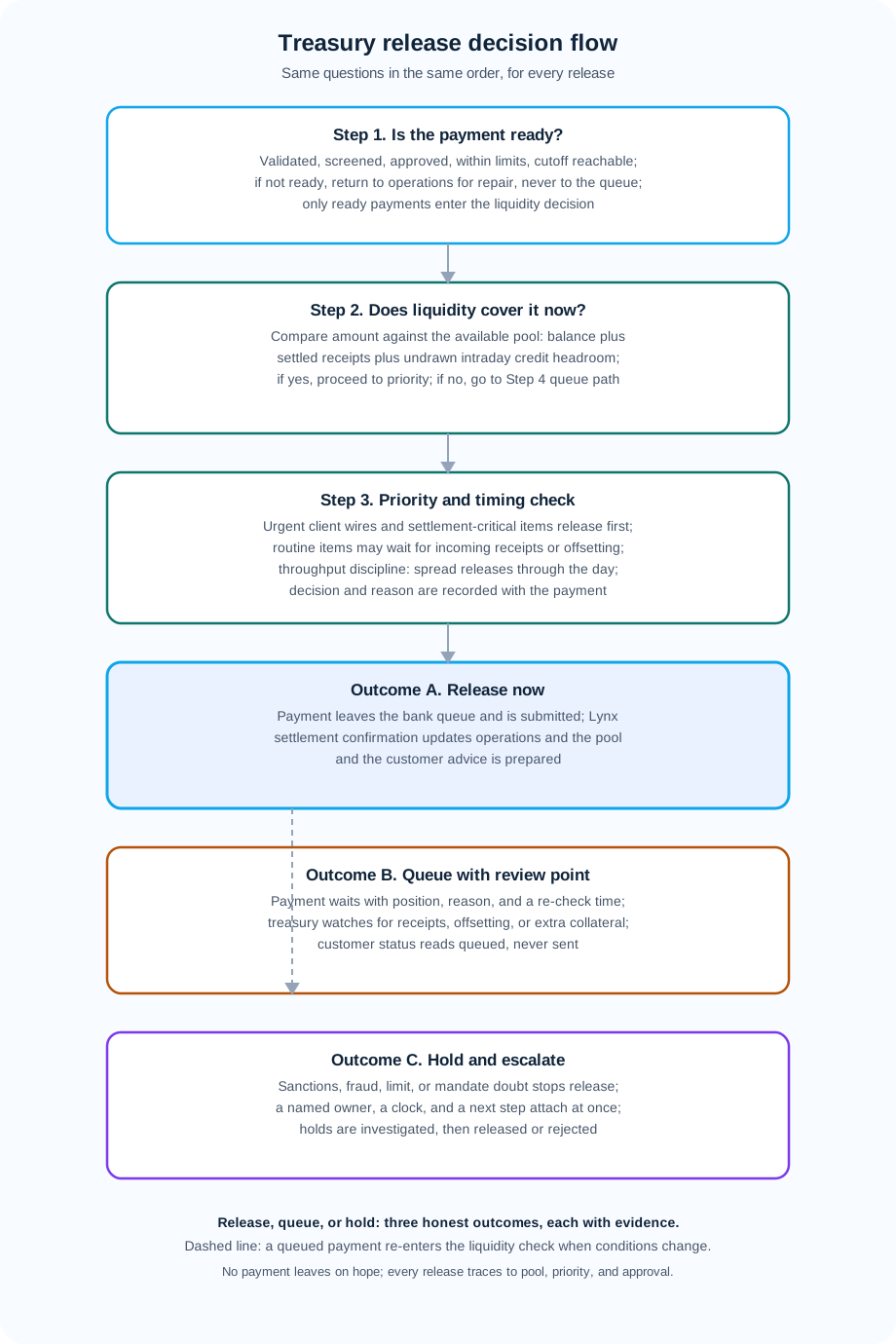
Queue management begins the moment the answer is "not yet." The queue preserves order and detail, applies ordering rules — priority flags, submission sequence, treasury intervention — and re-checks conditions before every release: liquidity now sufficient, approvals and screening still valid, cutoff still reachable. Offsetting is a Lynx LSM system function, not a universal bank-queue promise: Lynx liquidity recycling and Gridlock Buster can use incoming payments to fund queued payments and can offset queued interparticipant payments under the applicable mechanism rules. The bank may sequence its internal queue in anticipation, but it cannot promise that a particular incoming receipt will offset a particular customer payment. Operations and treasury review queue depth (how much waits) and queue age (how long it has waited) continuously; depth without age is normal flow, while growing age on high-priority items is the earliest honest signal of stress. Customer status throughout reads "queued" with a window — never "sent" — because the queue is a managed waiting room, and saying so preserves the trust that silent delay destroys.
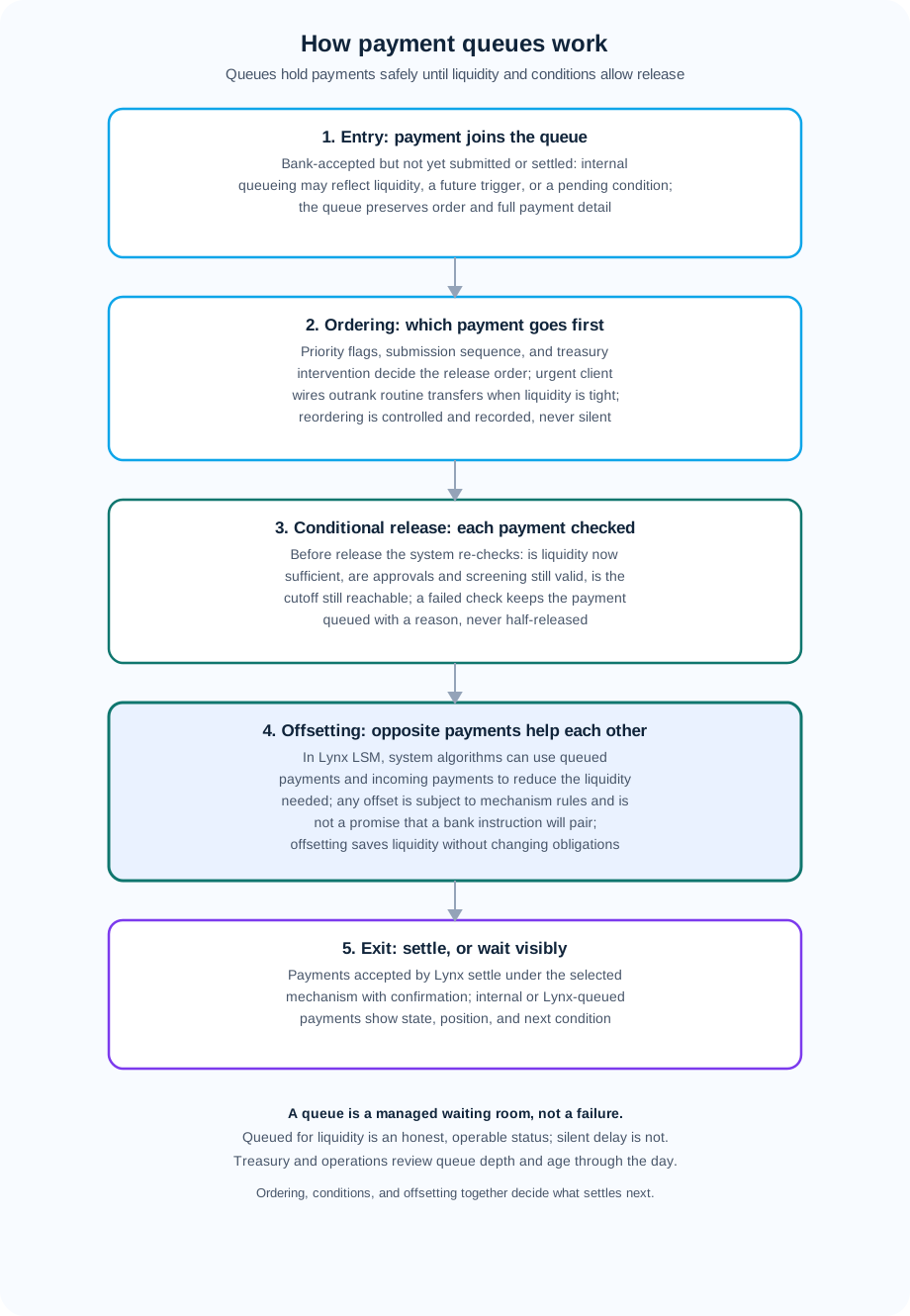
The handoff out of this stage is a funded, ordered, evidenced release — or a visibly managed wait. Either outcome must satisfy the same test: can the bank show, per payment, that readiness was confirmed, the pool covered it (or the queue reason was recorded), priority was applied, and the customer status matches reality? Banks that pass that test find settlement anticlimactic, which is exactly the point. Settlement should be the mechanical consequence of good release work, not the moment problems are discovered.
4. Clearing, settlement, and how each consumes liquidity
Clearing establishes obligations; settlement discharges them with money. The two Canadian systems discharge them on opposite funding models, and the participant's liquidity operation exists to serve both without confusing them. This section separates the models, traces how each consumes the intraday pool, and explains the collateral lifecycle that keeps the pool deep enough for the day's work.
Lynx is an RTGS system: payments settle in real time with finality in central-bank money across settlement accounts at the Bank of Canada. The statement is not that every submission follows one identical path. Lynx has multiple settlement mechanisms. Its Liquidity Saving Mechanism (LSM) queues payments and uses liquidity recycling and Gridlock Buster offsetting; its Real-Time Mechanism (RTM) has no queue and an item without capacity is discarded; other queue-enabled mechanisms apply their own rules. Thus a payment submitted to a queue-enabled mechanism may wait when liquidity is insufficient, while a bank's internal queue is a separate pre-submission control. This is why Lynx is called liquidity-intensive, and why everything in Section 3 — forecasting, sequencing, offsetting, intraday credit — exists in its sharpest form around Lynx releases. Finality attaches at settlement, which concentrates the mind wonderfully: pre-release rigour is the only cheap rigour, because once settled, a wire cannot be unilaterally pulled back. Lynx went live replacing the previous large-value system and operates today as Canada's high-value backbone; its settlement mechanisms, queue, liquidity-recycling, offsetting, and throughput guidance are the daily environment treasury works inside, not optional features to discover during stress.
ACSS clears retail batch items — AFT credits such as payroll and direct deposit, pre-authorised debits, cheques, and related streams — into deferred-net positions. ACSS direct clearers settle the previous day's net balances in the morning of each business day; ACSS settlement account holders meet their net obligations by Lynx payments, and non-Lynx direct participants arrange a Lynx direct participant to settle for them. The funding need is structurally lighter than Lynx because net positions, not each item gross, move at settlement; but "lighter" never means "automatic." Payroll days and tax-date concentrations swing net positions sharply, and forecasts must anticipate them. A participant that treats ACSS funding as background plumbing discovers otherwise on the Friday its payroll position exceeds forecast while its Lynx queue simultaneously holds afternoon wires: both draws come from the same pool, and only one pool exists. Return rights add the second ACSS wrinkle — batch items carry defined return windows after apparent completion, so funded does not mean finished, and treasury's day extends past settlement into returns-aware reconciliation. Interac e-Transfer is a separate prominent payment system, not a Lynx or ACSS settlement mechanism; its participant, customer, fraud and availability behaviour must be sourced to Interac and the participating financial institution rather than inferred from this chapter's Lynx/ACSS model.
RTR status boundary (checked 2026-10-05). Payments Canada states that the Real-Time Rail is launching in Q4 2026 and that industry solution-assurance testing is under way. It is therefore a planned/near-launch modernization programme on this audit date, not a current production liquidity venue to be treated like Lynx or ACSS. Its final rules, access model, settlement and liquidity arrangements must be rechecked at launch; do not present an RTR scenario as live production capability.
The collateral lifecycle is what keeps the pool equal to these demands. It runs in four functional stages. Pledge: the participant pledges eligible securities to the Bank of Canada using CDSX or an approved custodial arrangement; pledge records show what, when, and by whom, and treasury plans pledges before the need arrives. Cover: pledged securities stand as backing for intraday credit, with usable headroom reflecting pledged value under Bank of Canada valuation practice; substitutions and withdrawals follow controlled procedures so inventory management never silently hollows out the day's cover. Use: when outflows outpace balance and receipts, the bank draws intraday credit against its cover to release Lynx payments, each draw reducing headroom and tracked against the payments it funded. Release: incoming receipts and end-of-day flows repay the draws, and pledged securities are released or rolled to the next cycle under standing arrangements. Every stage leaves records — pledge, valuation, draw, repayment, release — that custody, treasury, and reconciliation share. Nothing in this chapter states ratios, haircuts, eligibility lists, or deadlines for any of this: those live in live Bank of Canada operating practice, and a training chapter that invented them would be worse than useless. The functional mechanics — pledge early, draw what the day needs, repay as receipts land, reconcile every movement — are stable knowledge; the parameters are looked up, never memorised.
Two cross-model disciplines close the section. First, fund before promising: customer cutoffs and availability language must reflect funded reality, not best-case flow. A same-day wire promise assumes pool, headroom, and cutoff all align; a Friday-payroll promise assumes the net position is forecast and fundable. Publish the most restrictive constraint as the customer commitment, with a fallback for late arrivals. Second, never let one system's demands blind the other: monitor Lynx queue and ACSS funding position on one screen, from one pool, with one owner for the consolidated view. Participants that watch two dials with two owners discover the shared pool only when it runs dry. The consolidated intraday position — balance, receipts, draws, headroom, queue depth, funding obligations outstanding — is the single most important management artefact this chapter describes, and Section 5 specifies the data that builds it.
5. Data: what the liquidity decision needs to be right
Treasury decisions are only as good as the data beneath them, and liquidity data goes stale faster than almost any other data in the bank. A position snapshot accurate at 9 a.m. misleads at 11 a.m. after a heavy release run and a delayed receipt cluster. This section inventories the data the release decision consumes, where each element comes from, and what breaks when any of it is late, wrong, or missing.
The intraday position itself is the foundation: opening settlement balance (from the Bank of Canada account record), settled receipts and settled outflows to the minute (from Lynx confirmations and settlement-account entries), intraday credit drawn and headroom remaining (from the pledge-and-draw ledger), and outstanding funding obligations such as ACSS net positions due at settlement. Each component needs a timestamp and a source; a position screen that blends confirmed balances with expected receipts without labelling which is which manufactures false confidence. The rule for position data is simple: settled fact and forecast expectation share a screen but never share a column.
The forecast layer turns the position into a plan. Expected incoming Lynx receipts by counterparty and timing window, known outgoing releases including warehoused items with today's triggers, corporate files advised but not yet arrived, ACSS net position estimates for the cycle, and known concentrations — payroll value dates, tax dates, month-end flows — all feed it. Forecasts come from history, customer advice, channel pipelines, and operations intelligence, and they carry uncertainty by nature: an expected receipt is a probability, not a balance. Strong desks version their forecasts through the day, compare expected-versus-actual receipts explicitly, and treat persistent shortfalls from a counterparty as information to act on (sequence around it, draw credit, call the relationship) rather than background noise to absorb. The forecast's job is not to predict the day perfectly but to make deviations visible early enough to manage.
Queue and collateral data complete the decision inputs. Queue depth (value and count waiting), queue age (how long the oldest priority items have waited), each queued payment's priority, condition, owner, and re-check time, plus offsetting opportunities visible in the queue — these tell treasury what patience costs and what release buys. Collateral data — pledged positions, headroom, substitution activity, upcoming maturities or corporate actions affecting pledged securities — tells treasury how much more room can be created and how fast. Priorities and value dates on the payments themselves tell treasury what waiting breaks: a supplier-release wire ages differently from a routine internal funding transfer, and the data model must carry that consequence tagging so triage under stress is principled rather than panicked.
References are the join keys that hold all of this together. The end-to-end payment reference, Lynx identifiers and Payment Confirmation Reference Number (PCRN), UETR where a SWIFT cross-border path applies, file and batch references for ACSS items, pledge and draw references for collateral movements, and settlement-confirmation references must survive every enrichment, conversion, split, and reassembly. When references break, the position screen shows money the bank cannot attribute, the queue shows payments operations cannot explain, and reconciliation shows breaks nobody owns. Reference preservation is therefore a liquidity-data control: fundable decisions require attributable data, and attributable data requires intact references.
Three data practices separate strong liquidity operations from fragile ones. Refresh to the decision cadence: position and queue data update continuously enough that no release decision reads a stale pool; forecasts re-version at defined points and whenever reality diverges materially. Label certainty: every figure shows whether it is settled fact, confirmed advice, or modelled expectation, so the release decision discounts appropriately. Single consolidated view: balance, receipts, draws, headroom, queue, and funding obligations appear together for one owner, rather than scattered across treasury, operations, and custody screens that each tell a partial truth. A bank that funds releases from fragmented, stale, or certainty-blind data is not managing liquidity; it is narrating it afterwards. The throughput and control sections assume this data foundation exists — without it, sequencing is guesswork and controls gate blindly.
6. Rules, service levels, and throughput discipline
Customers experience liquidity management as service levels: "same-day wire," "Friday payroll," "urgent supplier release." Operations experiences it as rules: release authorities, queue disciplines, sequencing expectations, escalation triggers. This section connects the two views and explains throughput — the discipline of spreading settlement through the day — as a functional obligation every participant honours and every bank builds into its release sequencing.
System rules set the frame. Lynx operating rules define settlement mechanisms, payment entry, queueing, priorities, interventions, liquidity recycling and offsetting; the applicable rules differ by mechanism. ACSS rules define exchange, stream mechanics, net settlement cycles, and return frameworks. Lynx throughput guidance/targets are not a substitute for the current rules or a bank's own service levels; consult the live Payments Canada documentation for the current measures and operating parameters. Bank of Canada practice governs settlement accounts, intraday credit, and collateral. None of these texts tells a bank what time to release a specific wire — that is the participant's judgement — but together they define the field it plays on: what the system accepts, when obligations crystallise, what finality attaches, and what good citizenship looks like. Bank policy translates the frame into the concrete: internal release cutoffs set ahead of system cutoffs, dual-approval thresholds, queue-age escalation triggers, headroom floors that prompt fresh pledges, and the priority taxonomy (settlement-critical, urgent client, routine) that triage follows under stress.
Throughput discipline deserves its own explanation because it is the least visible and most systemic liquidity behaviour. Functionally, it is the expectation that participants settle a reasonable share of their activity progressively through the day rather than warehousing everything for a late-day rush. The logic is collective: if every participant holds releases until late afternoon waiting for receipts, no receipts arrive because nobody releases — a standoff that congests the system, deepens every queue, and concentrates operational risk into the thinnest staffing window. By releasing steadily — routine items early against balance, priority items on schedule, offsetting pairs whenever visible — each participant both funds its own customers sooner and supplies the incoming receipts other participants' queues need. Throughput is therefore enlightened self-interest wearing a system-stability hat: the bank that sequences releases smoothly through the day experiences shorter queues, more offsetting, calmer afternoons, and fewer escalations than the bank that hoards liquidity until it cannot. Build release sequencing that defaults to steady flow, monitor each day's settlement profile for back-loading drift, and treat a growing habit of late-day concentration as a finding to fix, not a style to tolerate.
Service levels bundle all of this into customer promises with funding behind them. A same-day wire service level assumes pool plus headroom plus cutoff alignment; it needs a latest-acceptance time, a fee, a queue-and-communicate fallback for shortfall days, and status language that distinguishes queued from settled. A payroll service level assumes forecast net positions, file cutoffs, funding confirmation, and returns monitoring; it needs employer deadlines, re-dating rules for late files, and a funding summary the employer can reconcile. An urgent-release service level needs priority criteria, approval authority, and honest communication when even urgent items must queue. Present service levels as funded commitments with stated fallbacks rather than aspirations: "submit by this internal cutoff for same-day release; items arriving later are handled under the late-arrival procedure with these options." Every promise a service level makes, treasury must be able to fund; every constraint treasury faces, the service level must disclose or absorb.
Four practices hold the section together. Promise only funded availability, with the return caveat stated where batch return rights exist. Give every cutoff a fallback path so late arrivals meet procedure, not negotiation. Sequence releases for steady throughput by default, reserving rationing for genuine shortfall. And staff through the full funding day — settlement, funding confirmation, returns monitoring — not merely through release hours, because the service level's promise outlives the morning rush. A bank whose rules, sequencing, and promises agree with each other rarely needs heroics; a bank whose promises ignore its rules needs them constantly.
7. Fraud, compliance, and controls around the release
Controls around the release decide whether speed serves customers or serves criminals, and their placement determines whether they prevent loss or merely document it. The liquidity loop moves money fast, but a queued payment is not yet settled: Lynx settlement is final and irrevocable when it occurs between participants. Bank controls that are meant to prevent an unauthorised or prohibited release therefore need to resolve before submission. This section places fraud, sanctions, AML, limit, and mandate controls relative to the funding decision and explains why the two kinds of "stop" — stopped for risk, waiting for liquidity — must never share a label.
Fraud controls concentrate before release because recovery after settlement depends on the beneficiary's cooperation. Authentication strength matched to channel and amount, device and behavioural signals, payee-verification and callback discipline for changed supplier instructions, velocity and anomaly scoring, and dual approval for business payments all resolve to release, hold, step-up, or reject before routing commits. Two fraud patterns intersect liquidity directly. First, authorised-push scams and redirection fraud exploit the irrevocability that makes wires valuable: a convincingly instructed payment to a criminal-controlled account settles finally, and no liquidity operation can reverse it — only a recall request and the receiving side's cooperation can. Second, urgency manipulation — the fraudster's "release it now, the deal closes today" — pressures operations to skip sequencing, override priorities, or blur the queued-versus-sent distinction. The defence is procedural, not heroic: urgency changes priority within the queue; it never skips validation, screening, or approval. A fraud score arriving after release is a report, not a control.
Sanctions, AML, and data-completeness controls gate the same pre-release window and shadow the payment downstream. Bank policy should complete applicable sanctions screening — including false-positive disposition with recorded rationale — before a wire or cross-border item is submitted; statutory obligations and scope vary by transaction and party. Completeness of originator and beneficiary data is itself a control, because truncated party data that "passes" screening faster creates the exposure the control was meant to prevent. Holds need honest status with an owner and a clock, and lawful next steps that avoid tipping off. Critically, risk holds and liquidity queues are different states with different owners and different clocks, and the status model must keep them distinct: a payment held for sanctions disposition belongs to compliance with an investigation clock; a payment queued for liquidity belongs to treasury with a re-check time. Merging them — "it's just delayed" — hides risk work from its owner and funding work from its owner simultaneously, which is how both fail.
Operational and limit controls form the third ring: duplicate detection, balance and daylight-limit enforcement, mandate verification, cutoff enforcement, reference validation, release authority, and segregation of preparation, approval, and release. Each produces a decision record — who or what decided, on what data, when, with what outcome. Limit controls deserve emphasis in a liquidity chapter because they are where risk appetite meets the intraday pool: per-payment limits, per-customer daylight caps, and desk-level exposure boundaries must be enforced at release regardless of how comfortable the pool looks. A deep pool does not authorise an over-limit release; limits bind in abundance exactly as they bind in scarcity. Similarly, segregation means the hand that prepares never solely releases, and treasury's power to reorder a queue never becomes power to approve an unapproved payment. Reordering changes sequence; approval changes state; the system must enforce the difference.
The placement summary for the whole chapter: initiation owns authentication, authority capture, and value-date honesty; validation owns format, mandate, funds, duplicate, reachability, fraud, and sanctions gates; processing owns enrichment integrity, route eligibility, cutoff checks, and release authority; the release decision adds the liquidity check, priority sequencing, and throughput discipline; clearing and settlement own acceptance monitoring, position funding, and queue management; posting owns account-integrity checks; reporting and reconciliation own completeness proof and the feedback loop into forecasts, limits, and rules. Each gate needs a rule, a decision record, and a defined next state. And one standing warning: never borrow against controls to solve liquidity pressure. Delaying screening to "catch the cutoff," releasing over limit because "receipts are coming," or marking queued items sent to "calm the customer" converts a fundable delay into a loss, a breach, or a lie — each worse than the wait.
8. Exceptions: queued, held, reordered, recalled, returned
The vocabulary a bank uses when releases do not go to plan determines whether recovery is fast and reconcilable or slow and disputed. Liquidity operations add their own exception states to the standard lifecycle set, and precision here is operational, not academic: the wrong label sends the payment to the wrong owner, and the wrong owner lets it age. This section defines each state, places it in the flow, and sets the reference discipline that keeps every exception linked to its original.
A queued instruction is accepted by the bank but not yet submitted or settled — waiting for liquidity, a future trigger, or a pending condition — with position, reason, owner, and re-check time attached. A Lynx payment may then enter a separate system queue if the selected settlement mechanism permits queueing. Queued is a normal, managed state: the LSM can queue payments and apply liquidity recycling or Gridlock Buster, but those system functions are not a guarantee that any particular bank instruction will offset. The operational duties are visibility (depth and age monitored), communication (customer status reads queued with a window), and progression (re-checks happen, releases flow as conditions clear). A queue that grows in age on priority items is an early stress signal, not a failure — Section 10's playbook starts there. What queued must never become is a euphemism: labelling a compliance hold or a failed validation as "queued" steals the item from its true owner and its true clock.
A held payment is stopped for risk, authority, or defect reasons — sanctions or fraud disposition pending, mandate doubt, limit breach, missing approval — owned by the function that must resolve it, with a defined clock and next step. Holds investigate and then release or reject; they do not age indefinitely, and ageing holds escalate by rule. A reordered payment has had its queue position changed by authorised treasury intervention: an urgent client wire promoted, a routine transfer deferred for offsetting. Reordering is legitimate queue management, but it must be controlled (only authorised roles), recorded (old position, new position, reason, who decided), and bounded (priority taxonomy applied consistently, not per-customer improvisation). Silent reordering — effectively bumping one customer's payment for another's without record — is a fairness and audit failure even when the settlement outcome looks fine.
Recall and return belong to the post-settlement world and must not be confused with queue states. A settled Lynx wire sent in error or induced by fraud cannot be unilaterally pulled back; finality means recovery travels as a recall or return request — a new message referencing the original identifiers — and the beneficiary side's cooperation decides the outcome. Batch items, by contrast, carry defined return rights under the applicable ACSS rule and item type: coded send-backs (for example, insufficient funds, invalid account, or mandate dispute) within the applicable window, each linked to its original with reason code and date. There is no single universal ACSS return window for every item. A queued-then-released payment that later returns needs both linkages maintained: queue history explaining when and why it settled, plus return linkage explaining why value came back. Reversals — linked accounting unwinds where rail and law permit — need authority, reason, and a pointer to the original; the data model should refuse a reversal object without its original attached.
Three recovery principles govern all of it. First, never re-pay on pressure without locating the original: a "replacement" released while the original sits queued, held for screening, or delayed in clearing creates two live payments, and the duplicate will surface at the worst moment. Trace, classify (queued, held, recallable, returnable, reversible, delayed), then act with linkage. Second, communicate in states counterparties can verify: "queued for liquidity, position and window," "released, reference and timestamp," "Lynx settled with confirmation reference," "returned with code, linked to original," "recall requested, awaiting response." Third, age everything with an owner: queues, holds, recalls-awaiting-response, and unmatched returns each carry a clock and an escalation path, reviewed at least daily and intraday for liquidity states. Exceptions without clocks become write-offs with hindsight attached; exceptions with clocks become workload that resolves.
9. Posting, accounting, and proving the day balanced
Settlement moves value between participants; posting, accounting, and reconciliation prove it — to customers, to finance, and to supervisors. The liquidity day leaves a dense trail of entries: customer debits and credits, settlement-account movements, intraday credit draws and repayments, collateral pledges and releases, fee captures, suspense items awaiting application. This section follows that trail from posting engines to the reconciled close, because a funding operation that cannot prove the day balanced cannot claim to have managed it.
Posting applies value to accounts. Customer postings — payer debits, beneficiary credits, fee debits — follow the rail's finality logic: Lynx postings follow final settlement with no interbank value risk on that leg, while batch postings remain subject to defined return rights and must be described accordingly. Internal postings move settlement accounts, intraday credit and repayment positions, collateral-related entries, and suspense for items awaiting application or mapping repair. Posting discipline is mechanical and merciless: idempotent posting engines so retries never double-post, correct value-dating so statements and liquidity views agree, memo-versus-hard-post hygiene so intraday visibility never masquerades as final accounting, and suspense ageing measured in days with owners — never months floating as unexplained balances. A payment released from the queue must post exactly once, for exactly its value, with references intact; anything else is a reconciliation break manufactured at the last step.
Accounting translates postings into ledgers the bank controls against: settlement accounts at the Bank of Canada, intraday credit positions, collateral pledged and available, nostro positions for cross-border legs, fee income, suspense, and deposit liabilities. The liquidity-specific accounting — draws against pledged cover, repayments as receipts land, headroom consumed and restored, funding transfers for ACSS net positions — must tie exactly to treasury's operational view of the same day. The telltale of weakness is ledgers that each balance but disagree with each other: treasury's pool says one thing, finance's settlement account says another, custody's pledge record says a third. Strong accounting drives all three from the same lifecycle records — one release, one queue history, one settlement proof, one draw record, one posting — so operations, treasury, custody, and finance share one truth and the close confirms rather than discovers.
Reporting turns the day's events into usable information for each audience. Corporate customers receive funding debit advices, confirmed-paid detail keyed to original references, coded returns files, and funding summaries that let their accounts-payable teams reconcile without calling the bank. Treasury and management receive position histories, queue-depth and queue-age trends, forecast-versus-actual receipt analysis, headroom consumption, and throughput profiles showing how settlement spread through the day. Operations receives break reports with owners and clocks. Every report preserves references end to end and states each date precisely — release, settlement, posting, availability — rather than collapsing them into one "date." Corporate customers judge a bank disproportionately on this layer: a payroll of thousands of credits needs a funding debit advice, confirmed-paid detail, coded returns, and a summary that joins to the employer's own file references, delivered on rhythm, every cycle.
Reconciliation proves the chain with the standard three-way discipline applied to liquidity's full footprint: instructed and released, versus clearing and queue evidence, versus settlement, books, and collateral records. Instruction-versus-release breaks belong to channels, hubs, and release authorities; queue-versus-settlement breaks to treasury and network operations; settlement-versus-books breaks to posting, finance, and reconciliation; pledge-versus-draw-versus-custody breaks to collateral management and treasury jointly. Run it daily at minimum — intraday for Lynx flows and high-risk items — match on reference, amount, date, and status together, age breaks with owners, and feed repeat causes back into forecasts, validation rules, pledge sizing, and sequencing policy. A balanced reconciliation can still hide an un-actioned return or an un-repaid draw, so track status semantics, not just totals: every queued item resolved, every hold disposed, every draw repaid or explained, every return linked. The reconciled close — signed, evidenced, archived — is the artefact that turns a managed day into a provable one.
10. Bank implementation, testing, staffing, and resilience
Understanding the liquidity loop is necessary but not sufficient; a bank must build it, staff it, prove it, and keep it running through the afternoons when everything arrives at once. This section translates the chapter into implementation scope, testing discipline, staffing coverage, and resilience expectations — the decisions that determine whether the operation described so far is real or aspirational.
Implementation starts with architecture that respects the loop's boundaries: channels and payment hub feeding validated, approved work; a release and internal-queue layer applying liquidity checks, priorities, and sequencing; a Lynx gateway using the applicable SWIFT/ISO 20022 message specifications and settlement mechanism; ACSS exchange/file processing using the applicable current ACSS rules, AFT standards and legacy/ISO 20022 mappings; treasury position and forecasting services; a collateral pledge-and-draw ledger shared with custody; fraud and sanctions services gating pre-release; core banking posting idempotently from settlement evidence; reporting, reconciliation, and case management consuming reference-keyed events from every stage. Lynx's system queue and a bank's internal queue must be represented as different states. Common build errors cluster at the seams: position screens blending forecast with fact, queue interventions that bypass approval state, collateral ledgers visible to custody but not treasury, postings driven from channel status instead of settlement confirmation, status messages using "sent" for queued items. Direct versus indirect participation changes who funds, who queues, and who sees what: indirect participants must contract, staff, and evidence their agent's cutoffs, funding arrangements, and queue visibility as first-class parts of their own liquidity operation, not as vendor trivia.
Staffing and coverage deserve equal billing with systems because liquidity decisions are made by people under time pressure. The funding desk needs authority, experience, and cover through the whole funding day — including settlement, funding confirmation, and returns windows, not merely morning release hours. Operations needs queue-management authority with recorded interventions. Compliance needs disposition capacity when screening volumes spike. Customer teams need accurate status tools and the training to use honest language under pressure. Every role needs a named deputy, every escalation path needs testing, and payroll-day peaks, month-ends, and holiday-eve compressions need rostering plans, not hope. The single most cost-effective staffing control in this chapter is also the simplest: never leave the queue unwatched while releases can still flow.
Testing must prove the loop, not just connectivity: gates that reject invalid, duplicate, over-limit, unscreened, and unauthorised items with correct codes; release logic that queues rather than overdraws when the pool is thin; ordering, reordering, and offsetting behaviour under realistic queue shapes; collateral draws tracking headroom and repayments restoring it; throughput profiles that spread settlement rather than bunching it; posting that never double-posts on retry; reporting that joins back to original references; reconciliation that closes with break ownership; and full exception journeys for queued, held, reordered, recalled, and returned items. Test data must include realistic Canadian content plus failure injection: a counterparty's receipts arriving hours late, a corporate file landing double its advised size, a gateway slow during exchange, a pledge completing late, a posting engine paused mid-run. Certification proves the bank can exchange messages; liquidity testing proves it can fund its promises through a bad afternoon.
Resilience assumes components fail and requires graceful degradation without losing, duplicating, or mislabelling money. Duplicate-safe retry everywhere from channel through posting; warehoused work surviving outages with triggers intact; visible queue intervention with recorded decisions; re-driveable exchange without re-creating obligations; pausable posting engines that prove no gap or overlap on restart; status language that distinguishes delayed from missing; reconciliation that maps the outage's footprint and guides ordered catch-up. The stress playbook below turns these capabilities into rehearsed routine: detect early through queue and headroom signals, triage by consequence, act on liquidity (draw, pledge eligible cover, sequence, chase receipts), communicate honestly outward and upward, and review while memory is fresh. Every scenario drill must answer three questions per in-flight payment: which stages completed, which are pending, and what should the customer be told? If answering needs forensics, resilience is not built yet.
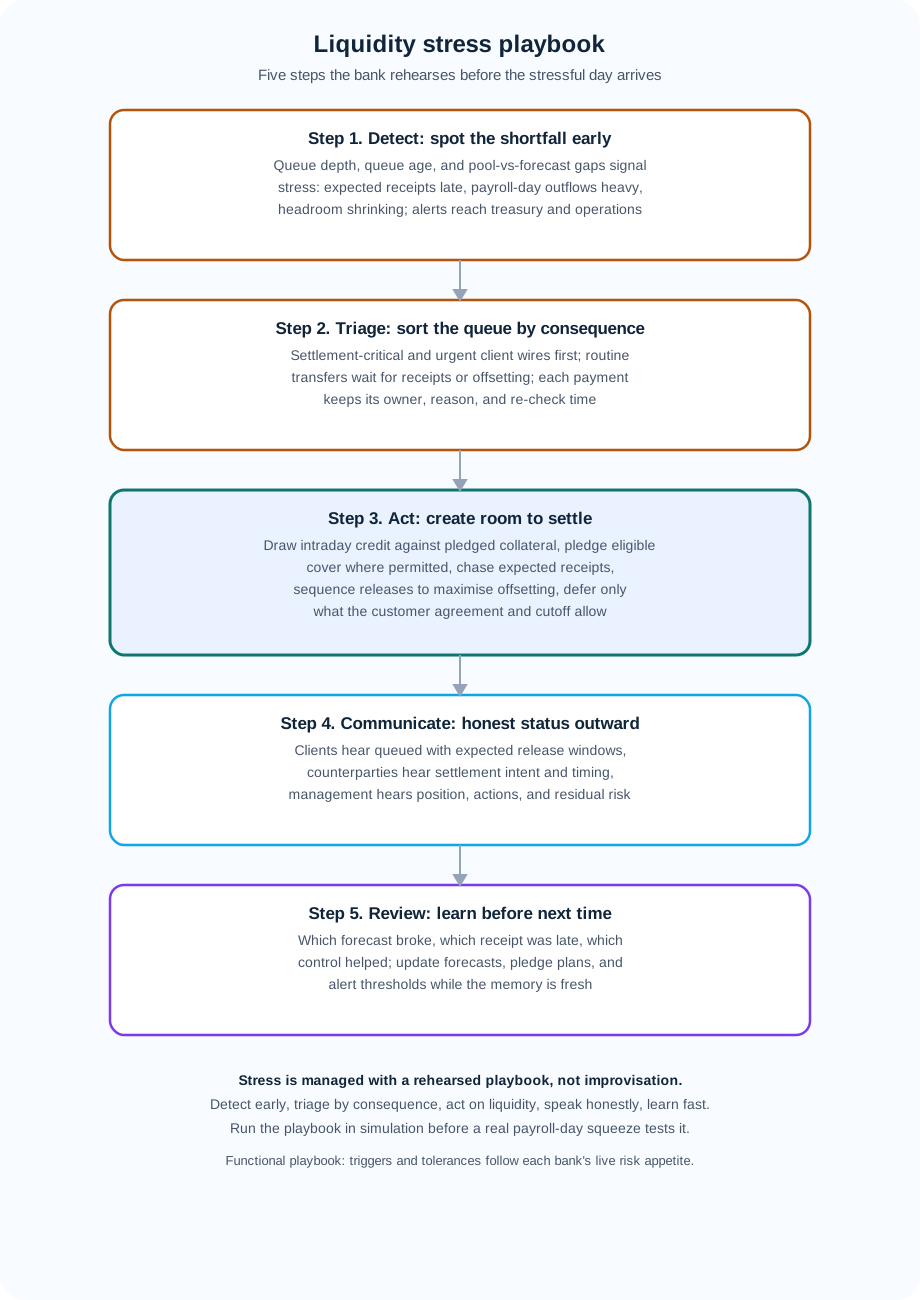
Rehearse the playbook in simulation before a real payroll-day squeeze or a late-receipt afternoon tests it for the first time. Tabletop exercises with treasury, operations, compliance, custody, and customer teams — using the previous quarter's heaviest day replayed with one complication added — surface the gaps that documentation hides: who can authorise an emergency pledge, who calls the late counterparty, who rewrites customer statuses, who decides which priority yields. Update forecasts, pledge plans, alert thresholds, and contact lists from every drill and every real event. Resilience in liquidity operations is not a system property; it is a practised team behaviour with systems that support it.
11. Practical stories: payroll-day planning and queued-wire triage
Mechanics settle when you watch them carry a real day. This section follows two fictional but realistic Canadian stories — a payroll-day liquidity plan executed end to end, and an afternoon of queued-wire triage when expected receipts run late — and extracts the repeatable playbook each one teaches. Amounts, times, and references are illustrative and labelled fictional throughout.
Example (fictional): payroll-day liquidity planning at a mid-size direct participant. Friday is payroll value date for several large employer clients of Lakeshore Trust, a fictional Ontario bank. Treasury's Thursday planning session sets the posture: the forecast shows heavy morning Lynx outflows (dealer wires plus supplier releases), the ACSS net position for the payroll cycle sharply larger than a normal day, and expected receipts concentrated after midday from two counterparties that historically pay late on Fridays. The desk agrees the plan before the pressure: pledge additional cover Thursday afternoon so headroom opens wide, sequence routine internal transfers behind client wires in the morning queue, pre-advise the two late-paying counterparties' relationship managers, and roster funding-desk cover through settlement plus returns monitoring. Friday opens as forecast — and then deviates usefully. A corporate supplier file arrives larger than advised, consuming morning headroom faster than planned; operations flags the size within minutes with exact figures, treasury draws intraday credit against the Thursday pledge rather than rationing client wires, and the queue stays short. Midday receipts land — one counterparty on time, the habitual late payer late again — and offsetting pairs the late payer's eventual receipt against queued routine items the moment it settles. The ACSS net position funds on cycle via the high-value channel with cover to spare. By late afternoon, draws are repaid, the queue is empty, reconciliation shows released-versus-settled-versus-posted agreement with two coded batch returns already linked, and the pledge rolls to next week under standing arrangements. The lesson is unglamorous and total: the calm Friday was manufactured Thursday. Forecast honestly, pledge before you need it, communicate deviations in minutes with numbers, draw rather than ration when cover exists, and let offsetting do its quiet work. Payroll-day liquidity is won in planning, not in heroics.
Example (fictional): queued-wire triage on a late-receipt afternoon. At 1:40 p.m. on a month-end Tuesday, the funding desk at fictional Prairie Mercantile Bank notices the dials moving wrong: queue depth climbing, two priority wires ageing past their normal wait, headroom thinning, and a large expected receipt from a correspondent-connected counterparty now two hours overdue with no advice. The desk lead calls the playbook, not a meeting. Detect is already done — the signals are named aloud so the whole floor shares one picture. Triage follows consequence: a settlement-critical funding transfer and a client's supplier-release wire (production line at stake, callback-verified that morning) go to the top; three routine treasury rebalancing transfers drop to wait for the overdue receipt; everything keeps its owner and re-check time. Act runs in parallel: draw intraday credit against existing cover to release the top two wires immediately, confirm headroom still covers the ACSS funding due later, call the counterparty's relationship channel for a receipt timing update, and hold — not cancel — the routine items so offsetting can pair them when the receipt lands. Communicate goes out in verifiable states: the supplier's bank receives a released reference with confirmation; the routine-transfer owners hear queued with a window tied to the expected receipt; management hears position, actions taken, and residual risk in one short update. At 3:05 p.m. the receipt settles, offsetting pairs it against two queued routine items, draws are partially repaid, and the queue drains to normal by mid-afternoon. Review the next morning is blunt: the forecast had over-weighted that counterparty's punctuality on month-ends, the alert threshold for priority queue-age was set looser than the desk actually needed, and both get fixed before month-end repeats. The lesson: triage is principled sequencing under pressure — consequence-ordered, evidence-recorded, honestly communicated — and every stress afternoon should leave the forecast, the thresholds, and the contact list better than it found them.
Hold the two stories side by side and the chapter's loop is visible in motion. Planning manufactures calm; triage manufactures order; both run on the same inputs — position, forecast, queue, headroom, priorities — and both end in the same proof: every payment released, queued, held, or settled with evidence, every draw repaid or explained, every customer status matching reality, reconciliation closed with owners on the breaks. Any analyst who can narrate both stories — what the desk knew, what it decided, what it told whom, and what the records show — understands participant liquidity operations well enough to question a real desk intelligently. Later operational chapters deepen each component; none replaces the loop.
12. Key takeaways and authoritative references
Takeaways — the liquidity loop you now own.
- Liquidity is a release constraint, not a back-office detail. Opening settlement balance plus settled incoming payments plus undrawn intraday credit headroom form the available pool, and no payment releases without cover in it — however validated and approved it is.
- Collateral pledged to the Bank of Canada, held through depository records, is daily fuel: it stands as cover for intraday credit that bridges timing gaps between outflows and inflows. Pledge before the need, track every draw and repayment, and reconcile custody, treasury, and books to one record.
- Queues are managed waiting rooms, not failures. Ordering, conditional release, and offsetting decide what settles next; queue depth and age are the desk's early-warning dials; customer status reads queued with a window, never sent.
- Offsetting saves liquidity without changing obligations: opposite payments settling together need only their difference funded. Sequence releases to maximise it and let queued items pair with incoming receipts.
- Release decisions follow the same questions in the same order: ready (validated, screened, approved, within limits, cutoff reachable), covered (pool check), prioritised and timed (throughput-aware sequencing) — then release, queue with review, or hold with an owner.
- Lynx gross settlement is liquidity-intensive — every wire needs its full value at release or it queues, with finality at settlement. ACSS deferred net is structurally lighter but still forecast-dependent, with net positions funded at settlement via the high-value channel. One pool serves both; watch it on one screen with one owner.
- Throughput discipline is collective self-interest: settle steadily through the day rather than back-loading, supplying the receipts other participants' queues need while keeping your own queues short and your afternoons calm.
- Risk stops and liquidity waits are different states with different owners and clocks. Sanctions, fraud, limit, and mandate gates resolve before release and are never traded for funding convenience; urgency changes priority, never skips validation.
- Name liquidity exceptions precisely: queued (waiting with position, reason, owner, re-check), held (stopped for risk or defect with a clock), reordered (sequence changed by authority with record), recall requested (post-finality cooperation sought), returned (coded batch send-back linked to its original). Never re-pay on pressure without locating the original.
- Prove the day balanced: idempotent postings from settlement evidence, ledgers for settlement accounts, credit, collateral, and fees that agree with treasury's view, customer reporting keyed to original references, and three-way reconciliation — released versus clearing and queue evidence versus settlement, books, and collateral records — with every break owned and aged.
- Build, staff, test, and rehearse the loop: consolidated position and queue tooling, a shared pledge-and-draw ledger, funding-desk cover through settlement and returns windows, failure-injected testing, and a stress playbook drilled in simulation before a real squeeze.
- Correct the costly misunderstandings wherever you hear them: approved does not mean funded; a queue does not mean something broke; collateral is not a regulatory formality but same-day settling power; offsetting does not change what is owed; and no ratio, haircut, limit, or timetable in this chapter substitutes for live operating rules — mechanics here are functional, parameters are looked up.
Common misunderstandings, stated plainly. "Approved means funded" — no, approval is permission while the pool is the constraint; funded releases need both. "A queue means something broke" — no, queues are the designed buffer between approval timing and funding timing; silent delay is the failure, queuing is the control. "Collateral is only compliance" — no, pledged securities are the cover that creates intraday headroom exactly when queues are deepest. "Offsetting changes what is owed" — no, both obligations settle in full; only the funding needed shrinks. "Throughput is someone else's problem" — no, every participant's sequencing shapes system-wide smoothness, and steady releasers enjoy shorter queues. "Queued and held are the same" — no, queued waits on liquidity or conditions under treasury, held stops for risk or defect under its resolving function, and merging them orphans both.
Authoritative references (official sources only; each supports a specific claim in this chapter).
- Payments Canada — Lynx: Canada’s high-value payment system (current RTGS description, finality, participation, Swift message network, system closure schedule and current system statistics): https://www.payments.ca/systems-services/payment-systems/high-value-payment-system-lynx
- Bank of Canada — Settlement account access policy for Lynx and the Automated Clearing Settlement System (settlement-account requirements, HABS, CDSX or custodial collateral arrangements, ACSS net settlement by Lynx payments): https://www.bankofcanada.ca/core-functions/financial-system/bank-canadas-settlement-account-policies-for-payments-canada-payment-systems/
- Bank of Canada / Payments Canada — An overview of Lynx, Canada’s high-value payment system (settlement mechanisms, LSM queue, liquidity recycling, Gridlock Buster, priorities and RTM no-queue behaviour; use with current rules): https://www.bankofcanada.ca/wp-content/uploads/2022/05/Overview-Lynx-Canadas-High-Value-Payment-System.pdf
- Payments Canada — Retail batch payment system (ACSS/USBE composition, direct/indirect clearers, previous-day net settlement, payment streams): https://www.payments.ca/systems-services/payment-systems/retail-batch-payment-system
- Payments Canada — Quick links: ACSS rules, standards and by-laws (current-version warning; Rule A4 returns, Rules F1/F4 AFT, Rule H1 PAD, Rule L3 collateral and applicable standards): https://payments.ca/sites/default/files/quick_links_-_acss_rules_and_standards.pdf
- Payments Canada — Rules for the ACSS updated, effective April 28, 2025 (current rule-change notice and links to updated Rules E3/F1/F4/H1; Standard 007 effective July 1, 2025): https://www.payments.ca/rules-automated-clearing-and-settlement-system-acss-updated-effective-april-28-2025
- Canadian Payments Association By-law No. 9 — Lynx (SOR/2021-182), Justice Laws (current to 2026-09-21; legal framework including liquidity, collateral, intraday loan, settlement and repayment provisions): https://laws-lois.justice.gc.ca/eng/regulations/SOR-2021-182/index.html
- Bank of Canada — Regulatory oversight of designated clearing and settlement systems (Lynx systemically important; ACSS and Interac e-Transfer prominent; PCSA oversight): https://www.bankofcanada.ca/core-functions/financial-system/oversight-designated-clearing-settlement-systems
- Payments Canada — Real-Time Rail payment system (current status checked 2026-10-05: Q4 2026 launch statement and industry solution-assurance testing; not current production in this chapter): https://www.payments.ca/systems-services/payment-systems/real-time-rail-payment-system
- OSFI — Liquidity Adequacy Requirements (LAR) – Guideline (2026) (effective May 1, 2026; intraday liquidity monitoring tools and supervisory context): https://www.osfi-bsif.gc.ca/en/guidance/guidance-library/liquidity-adequacy-requirements-lar-guideline-2026
- FINTRAC — Travel rule for electronic funds and virtual currency transfers (scope and required originator/beneficiary information; Canadian EFT caveats): https://fintrac-canafe.canada.ca/guidance-directives/transaction-operation/travel-acheminement/1-eng
- Interac — Interac e-Transfer (separate service, participant availability and FI-policy disclaimers): https://www.interac.ca/en/consumers/products/interac-e-transfer/
These sources support the chapter's verifiable system claims: Lynx as the live real-time gross settlement system with real-time settlement finality, owned and operated by Payments Canada and used for inter-financial-institution settlement transfers; Lynx designated systemically important and ACSS designated prominent under the Payment Clearing and Settlement Act; settlement accounts at the Bank of Canada for Lynx and ACSS holders with access via HABS; the Bank's expectation that settlement account holders can pledge eligible collateral via CDSX; ACSS settlement effected through credit and debit entries to direct clearers' settlement accounts with Lynx used to transfer funds to and from the Bank of Canada in that process; queues holding payments until liquidity and conditions allow release, with offsetting reducing the funding needed; ACSS as the batch deferred-net retail system whose net positions are funded at settlement; the Bank of Canada's combined settlement-agent, oversight, and supervisory roles; and the RTR as a programme whose Payments Canada page, checked 2026-10-05, says it is launching in Q4 2026 and is in industry solution-assurance testing rather than a live production liquidity venue on this audit date. All liquidity, collateral, queue, offsetting, and throughput mechanics in this chapter are described functionally; any ratios, haircuts, eligibility lists, limits, or timetables belong to live Bank of Canada and Payments Canada operating practice and must be confirmed there before operational use. Volume, value, and timetable figures from neighbouring chapters reflect reporting periods stated there; confirm current figures against authoritative releases before quoting externally.
Chapter close and handoff. You now hold the participant's intraday loop — release, queue, fund, pledge, settle, prove — that connects every customer promise to funded settlement reality. Later operational chapters deepen each component: queue mechanics and investigations, collateral operations detail, treasury systems, and resilience drills. As you continue, keep asking the five funding questions of every story: is it ready, is it covered, what priority does it carry, what status does the customer see, and do instruction, queue history, settlement proof, and books all join on one reference? Answer those, and you understand liquidity and participant processing in Canada.
This application uses JavaScript for the full interactive experience. This text summary is served for accessibility and search indexing.