ISO 20022 in Canada. Map where ISO 20022 is used or supported across Canadian payment infrastructure and bank channels.
Canada Payments & Collections · Block 9: ISO 20022 & Data · Chapter 41 of 75
ISO 20022 is the common data language now running underneath Canada's most important payments. It is live on Lynx, coexisting with legacy formats in retail batch, migrating on the cross-border SWIFT network, and designed in from day one on the planned Real-Time Rail. This chapter maps that footprint. It tells you where ISO 20022 is used or supported across Canadian payment infrastructure and bank channels, what changes for the people who send, screen, settle and reconcile payments, and what stays the bank's responsibility regardless of format.
One sentence carries the whole chapter, so learn it first: ISO 20022 is a data standard, not a rail. It does not move money. Rails move money — Lynx, the Automated Clearing Settlement System with its Automated Funds Transfer stream, Interac services, card networks, the United States Bulk Exchange, correspondent chains, and in time the Real-Time Rail. ISO 20022 describes the payment travelling on those rails: who pays whom, through which agents, with what references, and with how much remittance detail. A richer description means straighter processing, faster matching, sharper screening and fewer phone calls. A missing or truncated description means the opposite, whatever the rail's speed.
That distinction explains why this chapter sits where it does. Chapter 5 gave you the end-to-end operating view — channels, hub, rails, settlement, posting, reporting — and showed ISO 20022 coexistence as one column of that picture. The chapters around this one in Block 9 go deep on individual message detail. This chapter stays at the map level on purpose: which domains use the standard today, which message families do what work, how structured remittance changes reconciliation, how migration phases overlap, and how a bank wires its channels and hub so new rails arrive as adapters rather than rebuilds. Wherever message-level detail belongs to Chapters 42 to 44, this chapter says so and moves on.
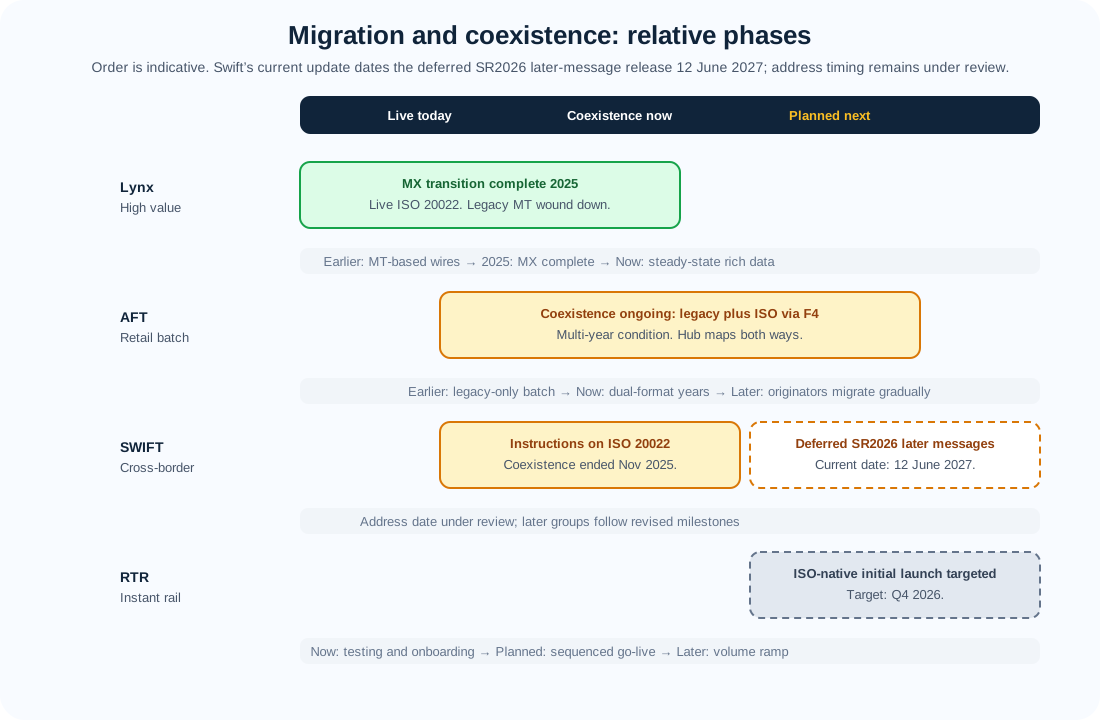
A note on status dates. Baseline is 5 October 2026. Lynx completed its migration from legacy MT messaging to ISO 20022 (MX) messaging in 2025 and operates as an ISO 20022-enabled system. Retail batch has an ISO AFT implementation path under Rule F4 alongside legacy formats; participant onboarding, registration and testing remain governed by Payments Canada's current AFT material. On SWIFT, the coexistence period for core CBPR+ payment-instruction messages ended on 22 November 2025. Do not use the older roadmap dates for later message categories as current commitments: on 27 August 2026 Swift deferred the payment changes planned for SR2026, and on 21 September it said the deferred release would be 12 June 2027 for the listed scope while the structured-address timing and other payment changes remain under review. Structured and hybrid addresses can already flow, but this chapter does not assert a current network-enforcement date. The Real-Time Rail is not live at the 5 October 2026 audit baseline: Payments Canada's By-law No. 10 and the RTR Rules came into force on 24 August 2026, while production launch remains targeted for Q4 2026 following successful testing. These dates describe different programmes and must not be collapsed into one generic 'ISO migration' milestone.
What you will be able to do after this chapter
After working through this chapter, you should be able to:
- explain what ISO 20022 is and is not — a data standard describing payments, not a rail that settles them — and correct colleagues who treat a message migration as a new settlement system;
- map where ISO 20022 is live, coexisting, migrating or planned across Lynx, AFT retail batch, SWIFT cross-border and the planned RTR, and state the status of each domain without inventing dates;
- describe the three message families at family level — pain for initiation, pacs for interbank clearing, camt for reporting and investigations — and say which family does what work in each domain;
- explain structured versus unstructured remittance in business terms, and show why labelled remittance information reconciles automatically while free text needs human matching;
- trace an instruction from channel through hub validation, screening, mapping and translation into rail-ready formats;
- place fraud, sanctions, FINTRAC and RPAA controls correctly in an ISO 20022 flow and explain how richer data sharpens screening rather than replacing it;
- classify rejects, returns, recalls and investigations in ISO 20022 terms — including UETR tracking, debtor and creditor agent identification, and remittance information carriage — without inventing field specifications;
- explain camt-based reporting and three-way reconciliation at concept level: statements, intraday reports, advices and the investigation pair;
- describe what coexistence costs — dual validation, truncation rules, parallel testing — and how the hub absorbs it permanently;
- work through fictional Canadian business days that cross ISO 20022 and legacy legs, extract the control lesson from each, and navigate to Chapters 42 to 44 for message-level depth.
For a roughly 60-minute core session, spend 10 minutes on the footprint map and Sections 1–2, 15 minutes on Sections 3–5 with the diagrams, 10 minutes on Sections 6–7, 10 minutes on Sections 8–9, 10 minutes on the stories in Section 11, and 5 minutes on takeaways and references in Section 12.
Chapter navigator
- Business context and customer need
- Participants, responsibilities and system boundaries
- Initiation, validation and bank processing
- Clearing or exchange, settlement and finality
- Data, identifiers, messages and references
- Rules, cutoffs, service levels and customer impact
- Fraud, compliance and operational controls
- Exceptions, investigations and recovery
- Posting, accounting, liquidity, reporting and reconciliation
- Bank implementation, testing and resilience
- Practical Canadian ISO 20022 examples
- Key takeaways and authoritative references
1. Business context and customer need
Ask a corporate treasurer what slows down their month-end and the answer is rarely the speed of money. It is the poverty of information travelling with the money. A supplier payment arrives with a free-text line that says "March invoices" and nobody can tell which of eleven invoices it covers. A payroll file posts cleanly but the exception report cannot say which three employees failed or why. A cross-border receipt lands in the account and the reconciliation team spends two days discovering which invoice the sender meant, because the sender's reference was shortened somewhere between Toronto and Frankfurt. An auditor asks for proof that a wire was screened, approved and settled, and the evidence sits in four systems that do not share a common identifier. Every one of these is a data problem wearing a payments costume. ISO 20022 exists to change the costume.
The standard does that by giving every payment a bigger, better-labelled envelope. Legacy formats were designed when bandwidth was expensive and every character cost money: short fixed fields, cryptic codes, remittance squeezed into a line or two of free text. Those constraints shaped decades of bank operations — entire reconciliation departments exist because the payment message could not say what the payment was for. ISO 20022, built on structured XML messaging, removes many legacy field constraints and adds labelling discipline: parties identified with their agents, amounts with their currencies and charges, and remittance information carried as structured business data. Where the applicable rail or market practice requires a UETR — notably Lynx, RTR and CBPR+ payment flows — that identifier can provide a persistent end-to-end transaction thread. UETR should not be described as a universal requirement for every Canadian ISO 20022 implementation; the applicable scheme usage guideline remains authoritative. The business need is therefore not technical elegance. It is fewer unmatched items, faster investigations, cleaner audits and screening decisions made on complete data instead of fragments.
Consider a fictional Ontario food distributor — call it Lakeside Produce — that pays forty suppliers every Friday. Today its bank sends those payments through a mix of rails and formats: some as legacy batch items with short remittance lines, some as wires, some cross-border to US vendors through correspondent chains. Monday morning brings the same ritual: three suppliers call to say the money arrived but they cannot match it; the bookkeeper opens remittance emails, bank statements and the ERP to triangulate; one cross-border payment needs a trace because the US beneficiary claims non-receipt. Nothing failed in the settlement sense. Every dollar moved. But the information around the dollars failed, and the distributor paid for that failure in staff hours, strained supplier relationships and a treasurer who cannot trust Monday's cash position. Now replay that Friday with ISO 20022 end to end: structured remittance the supplier's system can read, a UETR the bank can track without phone calls, and a Monday camt statement quoting the references Friday's ERP sent. Settlement speed barely changed. Everything else did. That is the customer need this chapter keeps returning to: certainty about what was paid, proven by data the receiver's system can consume without human translation.
The need looks different from each seat at the table, and a banker must speak to all of them. The accounts-payable manager needs invoice references to survive the journey so suppliers stop calling. The accounts-receivable manager needs incoming payments to arrive with debtor identification and remittance information rich enough for automatic matching, because every unmatched receipt is working capital in limbo. The treasurer needs intraday reporting with the same identifiers the payments carried, so the cash position at noon reflects reality rather than yesterday's batch. The compliance officer needs complete originator and beneficiary data — including the debtor agent and creditor agent that identify each side's bank — because screening a truncated name is how false positives multiply and true hits hide. The operations manager needs one tracking reference across channels, hub, rails and statements, because investigations that start by hunting for the payment waste the window in which recovery is still possible. ISO 20022 serves all five seats with the same mechanism: complete, labelled, end-to-end data.
Every payment tells its own story in the data it carries.
Two misunderstandings must be cleared first. ISO 20022 does not make payments faster: a batch payment with rich data still settles in batch windows, because speed comes from the rail's settlement model. And the standard does not remove the need for data discipline at origination: a structured message carrying an empty description reconciles no better than the legacy line it replaced. Banks that upgrade technology without fixing how channels capture creditor addresses, invoice references and purpose data will carry empty richness. Sections 3 and 10 return to this point because it decides whether migration investment pays.
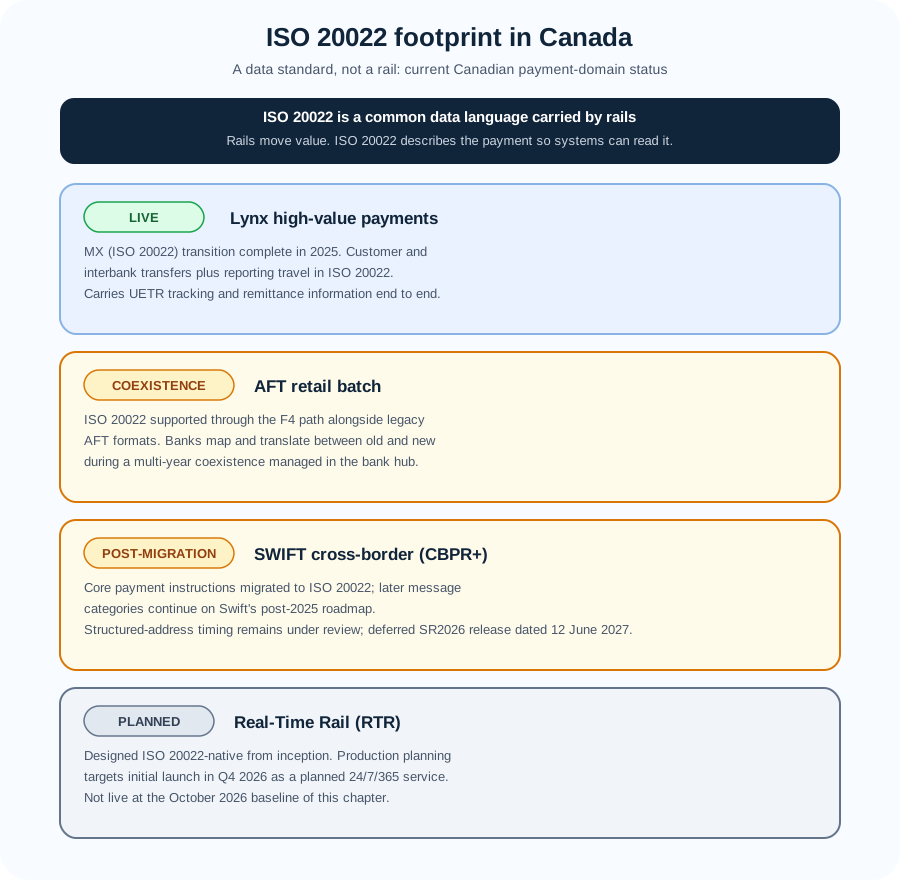
The diagram above is this chapter's anchor. Read it as four rows with four statuses: Lynx live in MX, AFT in coexistence, CBPR+ core payment instructions migrated with later message categories still transitioning, and RTR planned as an ISO 20022-native rail with its own published message portfolio. Every later section is a deeper pass over one aspect of that picture — who participates, how instructions flow, what the families carry, what rules govern, where controls sit, how exceptions recover, how reporting proves, how banks implement, and what it looks like on a real business day. The message-level detail behind each row — the individual pacs and camt variants, their validation and their mappings — lives in Chapters 42 to 44. Here you learn the map so those chapters land in the right place.
2. Participants, responsibilities and system boundaries
An ISO 20022 payment touches more parties than the two customers who think of it as "me paying you," and each party owns a different slice of the data. The bank professional must keep those slices straight, because most ISO 20022 failures are boundary failures: someone assumed someone else would complete the data, and nobody did. This section names the participants, assigns each one's data responsibility, and draws the lines where responsibility passes from one party to the next.
Start with the customers. The originator — a business, consumer or government — owns the economic obligation and the instruction: who should be paid, how much, in what currency, by when, and what the payment is for. Critically, the originator also owns the quality of the remittance information at source. No bank can invent an invoice number the supplier never provided; no translation layer can structure a creditor address the channel never captured. The beneficiary owns acceptance-side readiness: account details that route correctly, systems able to consume structured remittance, and — for businesses — master data clean enough that automatic matching can succeed. When a payment fails to reconcile, the investigation almost always ends at one of these two endpoints: incomplete instruction data going out, or unreadable master data coming in. Banks that coach originators on data quality at onboarding prevent more exceptions than banks that buy bigger repair queues.
The originating bank — the originator's bank — owns validation, screening, approval, formatting and release. In ISO 20022 terms this means confirming that required debtor, creditor and agent data are complete, preserving remittance information without silent truncation, carrying the rail-required external identifiers — including UETR where the applicable usage guideline requires it — and releasing a message that conforms to the destination rail's current specification. The receiving bank — the beneficiary's bank — owns posting, availability communication, reporting back through camt statements and advices, and returning or rejecting with proper reason linkage when it cannot post. Where the two banks are the same institution, the payment stays on-us and the interbank families never appear — but the data discipline still matters, because the customer statement and the reconciliation evidence must match what the channel captured.
Between the banks sit the system operators, and their boundaries are frequently confused. Payments Canada owns and operates Lynx and ACSS today and is building the RTR; it publishes the rulebooks, the ISO 20022 message specifications for Lynx and the RTR, the business-day calendar, and programme milestones — but it does not screen individual payments, complete missing data, or guarantee any beneficiary credit. SWIFT provides the messaging network and the CBPR+ usage guidelines over which Canadian banks exchange cross-border ISO 20022 messages; as Chapter 5 established, SWIFT tracks but does not settle value. Interac Corp and the card networks run their own addressing and message families outside ISO 20022 wholesale, with bank-integration points where translation happens. The Bank of Canada acts as settlement agent providing the accounts in which Lynx payments and ACSS positions settle, oversees designated systems, and supervises payment service providers under the Retail Payment Activities Act — three hats that answer three different questions, as Chapter 5 separated. The FINTRAC boundary matters equally: FINTRAC receives prescribed reports and intelligence built from payment data but does not approve payments; the bank's reporting obligation is satisfied by complete data capture at instruction time, not by after-the-fact reconstruction.
Two newer participant types change the map. Payment service providers, including PSPs newly eligible for Payments Canada membership, may initiate payments or hold funds without being the settlement institution. For every PSP arrangement the bank must define upfront who authenticates, screens, holds funds, formats the ISO 20022 message, communicates status and evidences each stage. Corporate originators form the second type: ERP and treasury systems generating pain initiation files under an initiation contract — mandatory fields, accepted address formats, handling of non-conforming files — because unstructured creditor addresses bound for a structured-only network become rejections the bank owns as customer experience.
Responsibility passes through four handoffs, each with a data test. Originator to bank: is the instruction complete enough to screen, route and reconcile. Hub to rail gateway: does the outbound message validate against the destination rail's usage guidelines, with truncation logged and all rail-required identifiers preserved, including UETR where applicable. Rail to receiving bank: did remittance information and references arrive unaltered. Receiving bank to beneficiary: does the statement carry the same references the payment carried. A break at any handoff creates the exceptions of Section 8 and the reconciliation work of Section 9.
The boundary that matters most is between format and obligation. ISO 20022 changes what a payment says; it does not change who owes whom, when value is final, or what rights survive settlement. A Lynx payment remains RTGS-final whether described in MT or MX. A PAD keeps its dispute rights whether initiated from a legacy file or a pain message. Format serves obligation; it never replaces it.
3. Initiation, validation and bank processing
For the customer-payment journeys in scope of this academy, ISO 20022 processing normally starts with a customer or bank instruction entering a controlled channel or payment hub before the external rail sees it. The hub is the bank's shared layer for instruction intake, validation, decisioning, release, gateway formatting, tracking and reconciliation, exactly as Chapter 5 described. ISO 20022 adds a translation responsibility to that layer but does not change its architecture: channels capture business intent in whatever format the customer uses, the hub controls and converts, and only the hub speaks to the rails. Banks that route every channel through one hub absorb each migration — Lynx MX, AFT F4, CBPR+, eventually RTR — as a new adapter and a new mapping table. Banks that let channels talk directly to rails relearn every lesson per product and carry one coexistence per channel instead of one coexistence in the hub.
Initiation varies by channel but converges on the same data question: who pays whom, through which agents, how much, in what currency, by when, with what references, and under what authority. Branch and online banking capture single wires and bill payments with customer-typed beneficiary details — often the weakest data in the flow, producing exactly the unstructured fragments that later break structured-address validation. Portals, host-to-host files, APIs and ERP integrations submit bulk files whose single malformed header can hold up thousands of payments. Mobile and trade desks capture cross-border instructions with intermediaries, charge options and purpose data. The hub's first job is to normalize these into one instruction model with a durable internal identifier plus the identifiers required by the selected rail. For Lynx, RTR and CBPR+ that includes UETR according to the applicable specification; AFT and other domains follow their own usage rules. This prevents a cross-rail architecture from incorrectly assuming that one external identifier is mandatory everywhere.
Validation is where most preventable ISO 20022 failures are caught, and it must happen before release against the destination rail's rules — not against a generic idea of the standard. Account validation confirms the debit account exists, is open, is authorized for this payment type, and holds or will hold sufficient funds or credit. Party and agent validation confirms debtor and creditor identification is complete, the debtor agent and creditor agent resolve to reachable institutions, and — for cross-border — beneficiary addresses meet the destination's current structured-address profile. Swift's 27 August 2026 postponement means the planned CBPR+ network-enforcement timing is not currently fixed; town and country in designated fields remains the readiness target described by Swift, but the bank must use the latest Swift and counterparty guidance rather than treating November 2026 as a settled deadline. Amount, currency, remittance-fit and duplicate checks complete the pass. Repair or reject happens here, in the hub, with a reason the channel can act on. A payment rejected in the hub costs a phone call. A payment rejected by the rail gateway costs a business day. A payment released with bad data costs an investigation that now spans two banks instead of one desk.
The control stack sits inside the hub between validation and release, and its order matters exactly as Chapter 5 placed it: authentication and entitlement, limits, fraud monitoring, sanctions and watchlist screening, FINTRAC-relevant data capture, cutoff and calendar assignment, then release. ISO 20022 changes the texture of two of these controls without changing their position. Fraud monitoring gains more signals — complete party chains, consistent agent pairs, remittance information that either matches the customer's business or conspicuously does not — which sharpens anomaly scoring but also demands retuned models, since a newly migrated corporate sending its first structured files will look anomalous until baselines adjust. Sanctions screening gains precision — separately identified parties, agents and remittance text give the matching engine cleaner inputs — but only if the hub screens the full ISO 20022 data set rather than a truncated legacy projection of it. A bank that screens the rich message prevents; a bank that screens a flattened extract approves blind and investigates later. Section 7 expands both points; the architectural lesson here is that screening must see what the rail will carry, not a summary of it.
Mapping and translation form the hub's ISO 20022-specific work, and they deserve to be named as a discipline rather than hidden inside "formatting." Mapping is the explicit, governed correspondence between the channel's fields and the rail message's elements: which source field feeds debtor identification, which feeds creditor agent, which remittance block feeds remittance information, what happens when the source has no equivalent. Translation is the execution of that mapping per payment, including the lossy decisions coexistence forces: a long structured remittance block flattened into a legacy AFT line, an address downgraded for a downstream system that cannot consume structure, a character set converted with replacements. Three rules keep translation honest: version every mapping, because usage guidelines evolve yearly and mappings decay silently; log every truncation, substitution and enrichment with the original preserved; and never translate silently at the edge — translation belongs in the hub where it is logged, tested and reversible, not in channel software or gateway scripts where it is invisible.
Release commits the instruction to the rail gateway: an MX message queued for Lynx RTGS, an AFT file — legacy or F4 — delivered for ACSS exchange, a SWIFT message sent into the correspondent chain, and in time an RTR message released into instant clearing. The hub records release time, rail, gateway acknowledgement and the applicable external references at release — including UETR where required — because every inquiry in Section 8 starts there. For batch, release before the hub cutoff means today's exchange and after means tomorrow; the format of the file changes nothing about the window. For Lynx, release enters the RTGS queue where liquidity and priority govern timing; MX or MT never did change that. After release the hub stays active — tracking acceptances, matching confirmations, watching settlement evidence, posting and reporting — with the UETR and internal identifier stitching every stage to the same payment.
Two design principles decide whether the hub survives the migration years. First, validate against the destination, not the source: channel-valid means nothing if the rail's schema rejects it, so the hub holds per-rail, per-release validation profiles. Second, fail visibly and early: a hub that rejects a structured-address violation in the morning with a repair path creates one correction; a hub that passes it to a network rejection creates a failed supplier payment and a week of correspondence.
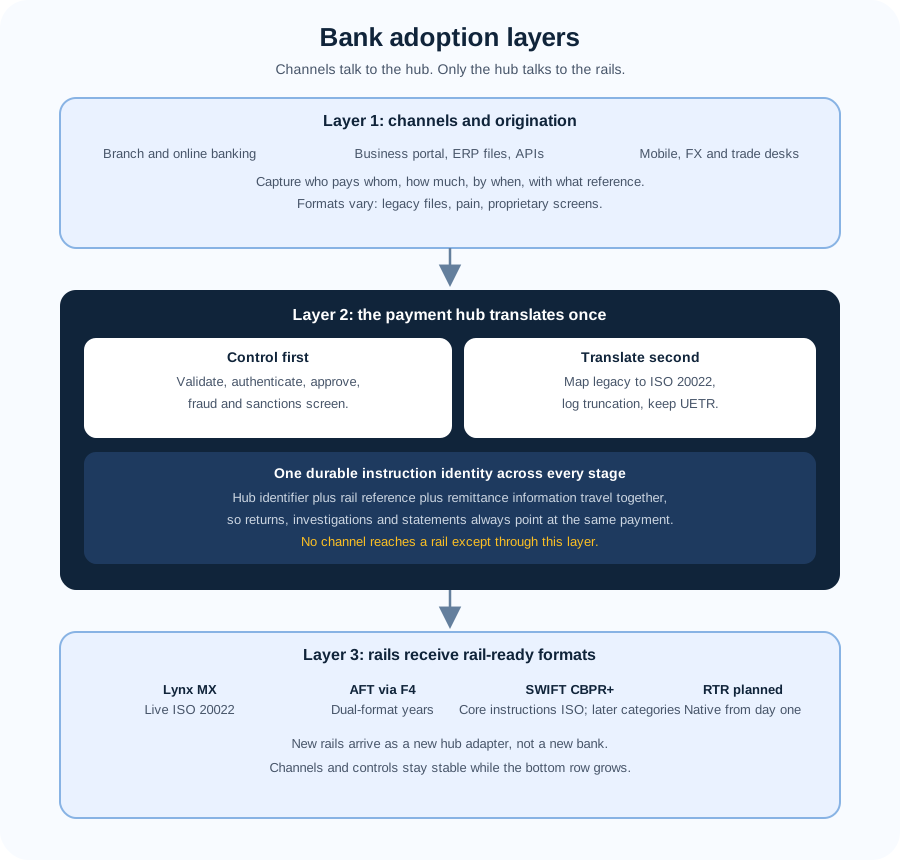
The diagram above compresses the section into an implementation poster. Read it top to bottom for flow and note the rule printed inside it: no channel reaches a rail except through the hub. Channels own capture, the hub owns control and translation, rails own exchange. When the RTR arrives, the bottom row gains one box and the rest of the picture stands still — which is precisely the return on hub investment.
4. Clearing or exchange, settlement and finality
If Section 3 is about the bank's decision, Section 4 is about the system's promise — and the promise does not change when the message format changes. Clearing and exchange, settlement, posting, availability and finality remain five different events on every rail, exactly as Chapter 5 separated them. ISO 20022 travels with the payment through all five but alters none of them: it cannot make a batch item settle gross, cannot make an RTGS payment returnable, cannot move a cutoff, and cannot convert a messaging milestone into final value. Every confusion in this section costs money, because customers who misunderstand finality release goods against unsettled funds, and operations teams that misunderstand settlement build reconciliation on messaging confirmations instead of value evidence.
Lynx settles each payment individually in real time in central-bank money across settlement accounts at the Bank of Canada, and the completion of the MX transition in 2025 changed nothing about that sentence except the language the payment speaks on its way to settlement. There is no netting, no batch window, no deferred position: once settled, a Lynx payment is final and irrevocable as between participants, and recovery of a misdirected payment requires a new payment with beneficiary agreement, not a system reversal. Queueing, priority and intraday liquidity determine when during the business day a released payment settles, and those mechanics are format-blind. What MX changed is everything around the settlement event: complete agent data reduces repair queueing, richer remittance posts faster, UETR tracking answers "where is it" without archaeology, and camt reporting carries the references pacs clearing carried. Same finality, better evidence.
ACSS defers settlement by design, and coexistence does not defer it differently. Participants exchange items — AFT credits and debits including payroll and PADs, imaged cheques and other batch items — through direct and indirect participation arrangements, build clearing positions by stream and window, and settle net positions through accounts at the Bank of Canada. Whether an AFT item travelled as a legacy record or through the F4 ISO 20022 path, the customer experience of "paid" still precedes interbank settlement, and return rights still survive settlement for defined reasons and timeframes: insufficient funds, closed accounts, PAD disputes, cheque returns. A payroll credit can post to the employee while the interbank position settles later; a PAD debit can post to the biller while the payer retains dispute rights. The batch bargain — efficiency and reach at the price of deferred finality and return exposure — is untouched by format. What coexistence changes is operational: dual validation paths, mapping tables between legacy and F4 representations, truncation risk wherever rich data meets a constrained leg, and exception handling that must read both formats. Detail on batch mechanics lives in its own blocks; the overview lesson is that F4 adoption improves data without accelerating value, and customer availability must still be explained with return rights attached.
Cross-border adds the correspondent dimension, where ISO 20022 migration is furthest along yet finality remains per-leg. A Canadian corporate paying a European supplier typically moves through the originating bank's SWIFT message, one or more intermediary banks, possibly a market-infrastructure leg abroad, and the beneficiary bank's domestic posting — each leg with its own settlement, finality and calendar. CBPR+ migration means those legs now describe the payment consistently in pacs with UETR tracking instead of MT, which transforms traceability: a payment's location and status can be followed across the chain rather than reconstructed hop by hop by phone and email. But no single global finality exists, messaging milestones are not settlement proof, and charges and FX value-date behaviour follow correspondent agreements rather than message standards. The planned CBPR+ address change sharpens this further: where the destination profile requires address data, fully structured or hybrid data with town and country in designated fields is the readiness target. Swift deferred the SR2026 payment changes in August 2026 and said the address timing would be revisited by December 2026, so an institution must not present 14 November 2026 as a current fixed enforcement date. Non-conforming payments can therefore be rejected or delayed, turning an origination-data defect in Toronto into a value-date problem in Frankfurt. Format discipline at origination is now a value-date control, and Section 6 prices that consequence.
Interac, cards, USBE and remaining domestic paths sit outside wholesale ISO 20022, and this chapter treats them as boundaries: the hub meets them at addressing, notification and settlement interfaces, carrying references across in both directions, and never lets a customer-facing status in one format contradict settlement evidence in another.
The planned RTR will combine real-time exchange, clearing and settlement using its own ISO 20022 portfolio, which is why its fraud, liquidity and operations design differs categorically from batch. The published RTR portfolio includes head.001, pacs.008, pacs.002, pacs.028 and admi.002/004/011. It should not be described as simply reusing the full pain/pacs/camt family model from another rail. Banks can reuse canonical data, UETR discipline where required, validation and reconciliation patterns, but must implement the RTR-specific messages and rules.
Three implications close the section. First, never equate a format milestone with a settlement change: MX-complete Lynx settles exactly as MT Lynx settled, and an F4 batch item is still a batch item. Second, never treat messaging confirmations as settlement evidence: SWIFT tracking, gateway acceptances and translation receipts confirm data moved, not value settled — reconciliation in Section 9 builds only on settlement and posting evidence. Third, staff and fund the clock you promise on each rail independently of format: Lynx needs intraday liquidity on business days, batch needs window discipline and return reserves, correspondent needs nostro funding and value-date management, and the planned RTR will need 24/7/365 liquidity and operations. The standard improves the description of value in motion. Only funding, windows and finality move value itself.
5. Data, identifiers, messages and references
If rails are the roads, data is the addressing — and ISO 20022 is the addressing upgrade. Canadian payments fail far more often from bad addressing and thin remittance than from system outages, and the bank hub's data discipline determines whether clearing, settlement, posting and reconciliation succeed or generate exceptions. This section maps the data core at concept level: the identifier disciplines each rail needs, the major ISO 20022 message families and the work they can do, the structured-remittance idea that changes reconciliation, and the references that must survive the applicable journey. It stays deliberately at family level throughout. The individual pacs and camt variants — which message carries a customer transfer versus an interbank payment versus a return, which camt message reports intraday versus end-of-day, how each validates and maps — are detailed in Chapters 42 to 44, and this chapter points there rather than duplicating them. No field specifications appear here beyond well-established element names: UETR, debtor agent, creditor agent, debtor, creditor, and remittance information.
Identifiers come first because without them nothing else attaches. Four reference categories should be considered when designing an ISO 20022 payment journey. The bank's internal instruction identifier is the hub's durable thread across validation, release, clearing, settlement, posting and reporting. A scheme-level end-to-end identifier may also be required: current Lynx UG2026 pacs.008 and RTR pacs.008 specifications require either a transaction identification or a UETR, while CBPR+ uses UETR under its usage rules. AFT follows its own specifications and should not be forced into a UETR model unless the applicable implementation requires it. The rail reference — Lynx settlement identifiers including the Payment Confirmation Reference Number that proves a Lynx wire settled, ACSS trace data, SWIFT network references — proves what the system did. The customer remittance — invoice numbers, employee identifiers, bill references — proves what the payment was for. Each missing reference creates a distinct failure — untrackable, unprovable or unmatchable — so the hub's data contract is four-deep on every payment, tested before release.
Parties and agents form the second layer, and ISO 20022's precision here is one of its genuine advances over legacy formats. Every payment names its debtor — the party whose money moves — and its creditor — the party entitled to receive — plus the debtor agent and creditor agent, the financial institutions that serve each side. Intermediaries and ultimate parties can be identified where the business requires: the ultimate debtor behind a payment on behalf of, the ultimate creditor where funds are for the benefit of someone beyond the account holder. Legacy formats often blurred these roles into a few short fields; the standard separates them so screening, posting and reporting can each use the right identity. The payoff is concrete: sanctions engines screen ultimate parties instead of guessing from a combined line, beneficiary banks post without interpretation, and statements show names customers recognize. The cost is equally concrete: every identity must be captured at origination, in structured form, which means channels and file specifications must ask for more than they did in the legacy years.
Messages carry the data, but family names do not create one universal lifecycle. The pain family is commonly used for customer-to-bank initiation and status. The pacs family carries bank-to-bank payment and return messages such as pacs.008, pacs.009 and pacs.004 where the scheme supports them. The camt family covers cash-management, reporting and a number of cancellation/investigation use cases, but exactly which camt messages are implemented is scheme-specific. Lynx's current rail-level portfolio is centred on pacs.008, pacs.009, pacs.004 and camt.053, with separate corporate-to-bank guidance for messages such as pain.001, pain.002, camt.052 and camt.054. RTR has a different published set. The implementation rule is therefore: learn the families, then use the current scheme usage guidelines as the source of truth.
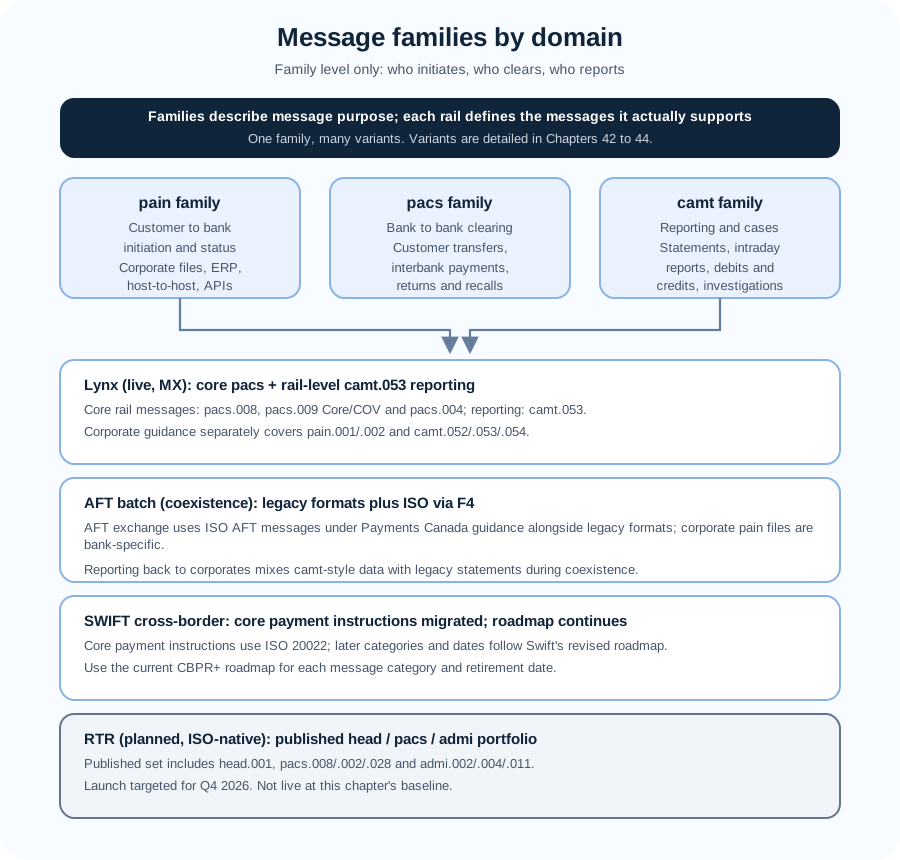
The diagram above places the families on the domains from Section 1 without pretending every rail implements the same portfolio. Lynx uses pacs for core payment messages and camt.053 for rail reporting, while its corporate-to-bank guidance also covers pain and additional camt reporting messages. AFT supports ISO 20022 through Rule F4 alongside legacy formats. CBPR+ core payment instructions have migrated to pacs while its wider pain/camt roadmap continues. RTR uses its published head/pacs/admi portfolio. Always answer the message question from the destination scheme's current specification, not from the family name alone.
Remittance information deserves its own passage because it is where ISO 20022 changes business life most visibly. Legacy remittance travelled as short free-text lines: enough for a human to guess, never enough for a system to match. Structured remittance carries labelled facts — invoice references with amounts, adjustment and discount lines, dates the receiver's system can parse — alongside or instead of free text, with room for the detail real commerce produces. The effect on reconciliation is categorical rather than incremental: matching moves from human triangulation across emails and statements to system comparison of labels the sender's ERP wrote and the receiver's ERP reads. But three cautions keep expectations honest. First, structure without content is theatre: a structured block carrying "misc payment" reconciles no better than free text, so originator coaching matters more than message capacity. Second, richness truncates at legacy boundaries: structured remittance flattened into a constrained downstream leg loses labels, which is why the hub logs what was truncated and preserves the original for investigations. Third, receivers must be ready: a supplier whose system cannot consume structured remittance gains nothing from a sender that transmits it, so adoption is a two-sided programme and banks serve both sides. The structured-versus-unstructured diagram below makes the comparison tangible; Section 11 shows it deciding a fictional month-end.
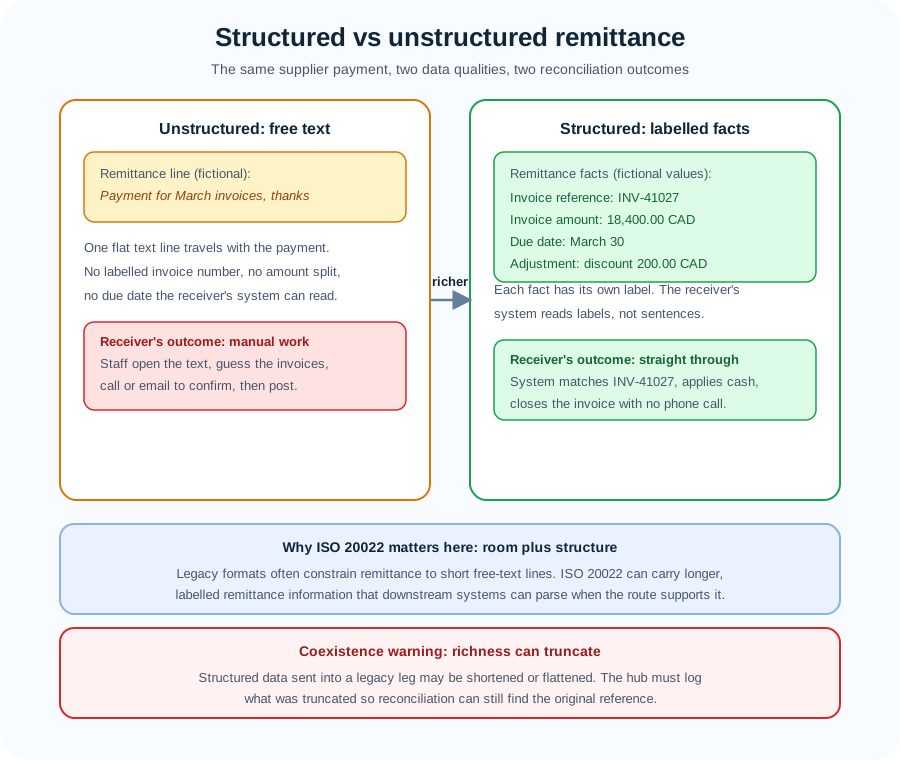
Two notes shape hub investment. Coexistence is a multi-year condition, not a cutover: fund parallel validation, versioned mappings, truncation rules, dual-format testing and originator coaching as permanent capabilities. And RTR preparation rewards cleaner masters, disciplined rail-specific identifier handling and complete agent identification today, without assuming that UETR is a universal identifier on every rail.
6. Rules, cutoffs, service levels and customer impact
Customers experience rules as promises: will it arrive today, when can the money be used, what will it cost, what reference will appear, what happens if it fails. ISO 20022 changes the texture of several of those promises without changing their structure. This section connects the standard to each promise honestly — what improves, what stays identical, and where new obligations hide — without inventing exact cutoff times. Exact times vary by bank, by direct clearer, by file type and by day, and they move with holidays and system calendars. This chapter therefore speaks only in relative windows — morning, afternoon and evening exchange and settlement windows on business days Monday to Friday excluding holidays, 24/7 authorization and acceptance for Interac and cards, planned 24/7/365 operation for the RTR — and directs you to your bank's published schedules and the payments.ca closure calendar for the times that bind your institution. Any study note, job aid or customer script that quotes a specific hour from this chapter is misusing it. RTR's 24/7/365 model remains planned until production launch.
Business days anchor everything the standard touches except the future 24/7 services. Lynx MX payments, AFT files whether legacy or F4, and correspondent value dates all operate on business days with published closures for weekends and holidays. A Thursday-evening supplier file does not miss by minutes; it misses the business-day window and belongs to the next one, whatever format it arrived in. A Friday-afternoon wire released after the bank's internal cutoff does not squeeze through because its message is modern; it queues or waits under the bank's published policy. A Monday holiday does not compress the week; it shifts value dates and return clocks. The hub must assign every instruction to a business-day window at intake, communicate that window honestly, and never let a channel promise what the rail calendar cannot deliver. Format upgrades tempt channels into exactly that over-promising — "now with rich data, same-day everything" — and operations must correct it before customers plan around fiction.
Relative windows differ by rail in ways the migration timeline keeps visible. Lynx settles during business-day RTGS windows with intraday queueing — morning liquidity build, midday throughput, afternoon funding decisions — and MX completeness increasingly decides whether a payment sails through or sits in repair: complete beneficiary-agent data and valid structure mean straight passage, while mapping errors and address defects mean queue-side delay. ACSS exchanges and clears in daytime batch windows with positions settling in defined settlement windows; F4 items ride the same windows as legacy items, so an originator that migrates to ISO 20022 gains data richness without gaining a minute of timing. Correspondent cross-border payments remain value-date driven across multi-hop chains, and the planned CBPR+ structured-address change adds a data gate to the value-date promise: an instruction that fails the destination's required town/country structure may be rejected or delayed and can therefore miss its intended value date. Swift's August 2026 postponement means the enforcement date is under review. The planned RTR is designed for 24/7/365 real-time processing and settlement, which is why its staffing, liquidity and fraud model differs categorically from batch. The customer-impact translation is direct and must be trained into every front-line colleague: richer data never converts a batch window into instant value, and missing data can now forfeit a value date that timing alone would have kept.
Service levels bundle timing with certainty, information and recourse, and the standard upgrades the information component across all of them. A Lynx wire remains same-day final and irrevocable — now with complete agent data, UETR tracking and consumable remittance information. An AFT batch item remains low-cost scale with return exposure — now optionally carrying structured remittance through F4. A cross-border payment remains multi-hop per correspondent agreements, with UETR-based traceability for the applicable CBPR+ flow and cleaner screening inputs. The planned RTR is designed to deliver real-time value with rich data while requiring real-time fraud controls and always-on operations. The advisory job is matching each event to that bundle and pricing data work honestly — including disclosing where truncation limits what the customer bought.
Customer communication must reflect finality with the same five words Chapter 5 trained: sent means released from the hub; accepted means the gateway or network took it; settled means interbank value moved finally; posted means the beneficiary account was credited; available means the beneficiary may use the funds, subject to holds or return rights; final means settlement cannot be unwound through the system. ISO 20022 adds vocabulary around those words rather than replacing them: "tracked by UETR" where the rail uses UETR is an identity/tracking capability, not proof of posting; "structured remittance sent" describes the envelope, not the receiver's ability to read it; "validated against the rail schema" means the gateway accepted the format, not that value settled. Training every customer-facing colleague on the distinction between data milestones and value events prevents more complaints than any system upgrade — because the most damaging sentence in modern payments is "the system confirms your payment," said about a tracking update for value that has not yet settled.
Migration carries cost — adapters, mapping governance, dual testing, onboarding — while customers enjoy richness they did not explicitly buy. Package data quality as service tiers rather than absorbing it silently, and hold the single-clock discipline: the channel may only offer what the hub confirms for this instruction, rail and business day — including the richness the destination leg can deliver intact.
7. Fraud, compliance and operational controls
Controls fail when they are complete but misplaced, and ISO 20022 moves the furniture: the same control families as Chapter 5 placed — fraud, FINTRAC and AML, sanctions and travel-rule screening, RPAA supervision, operational discipline — now operate on richer inputs with tighter timing. This section places each family at the point in the flow where it can still change the outcome, and explains the central bargain of richer data: it sharpens every control it feeds, but only for banks that feed their controls the full message rather than a flattened extract.
Fraud controls span initiation, transaction risk and post-event response, and the standard changes the signal environment in both directions. On the strengthening side, separated party identities — debtor, creditor, agents, ultimate parties — give anomaly models cleaner features than legacy free text: a first-time beneficiary with a changed creditor agent reads differently from an established supplier pair, and structured remittance lets models compare stated purpose against the customer's business. Behavioural signals gain anchors too — device, channel, velocity and approval patterns evaluated against a fully identified instruction rather than a fragment. On the demanding side, migration itself creates a fog window: corporates sending their first pain files, channels capturing structured addresses for the first time, and newly mapped hub paths all look anomalous until baselines adjust, and fraud teams must tune for that transition rather than blocking legitimate migration volume. Mule activity deserves special attention in richer-data flows: incoming credits scored only on amount will miss what incoming credits scored on party chains and remittance plausibility will catch, so receiving-side scoring must grow with the data. Cards keep their seconds-level issuer decisions, cheques keep capture validation and holds, PADs keep mandate evidence before presentment, and the planned RTR compresses all of it into seconds with irrevocable settlement — which is why Block 12 treats RTR fraud design as its own subject. The overview lesson: run fraud monitoring pre-release on the full ISO 20022 data set with one case queue across rails, retune through migration, and score receipts as well as sends.
Sanctions and travel-rule screening gate release, and richer data is the single largest screening upgrade in a generation — provided the hub screens what the rail carries. Screening the separated parties, agents and remittance text of a complete ISO 20022 message produces fewer false positives and fewer missed true hits than screening a truncated legacy projection, because the matching engine can weigh name, address, agent and purpose evidence independently instead of guessing from one combined line. Cross-border screening repeats per hop through the correspondent chain, so completeness at origination compounds downstream: a fully structured creditor address captured in Toronto prevents multi-day false-positive holds in two intermediary banks, while an unstructured fragment guarantees them. Domestic screening matters equally and for a harsher reason: settled Lynx value cannot be unilaterally unwound, so a true hit discovered after settlement is a recovery exercise requiring beneficiary cooperation rather than a prevention success. Log what was checked, when, against which list version, and by whom — and link that evidence to the payment's applicable durable identifiers, including UETR where the rail requires it. One operational trap needs naming: screening a translated or truncated extract while forwarding the full message means the control saw a different payment than the rail carried. The disposition of pass, false-positive release with reason, or true-hit hold must apply to the message that actually leaves the hub.
FINTRAC and AML obligations attach to payment events without being approvals. Complete party data, preserved instruction-to-settlement linkage and untruncated record-keeping feed transaction analysis with the quality those judgments require. This chapter cites no thresholds or filing mechanics — those live in Block 13 and current FINTRAC guidance. The architectural point: build reporting feeds from the hub's preserved originals, not from downstream statements that may reflect truncation.
RPAA supervision adds the PSP boundary: PSPs performing retail payment activities face operational-risk, safeguarding and consumer obligations under Bank of Canada supervision. Before volume arrives the bank must define who authenticates, screens, holds funds, formats and validates the ISO 20022 message, communicates status and evidences each stage with UETR linkage. Data-format responsibility is the clause most often left vague and most expensive to clarify during an incident. Block 13 teaches the supervisory detail.
Operational controls behave as Chapter 5 described, with translation governance as the ISO 20022 addition. Entitlements, dual approval, limits, cutoffs, queue management, amendment discipline and segregation of duties apply unchanged — a structured message from an unauthorized user is still unauthorized. The release discipline ties them together: no instruction reaches any rail without passing each control in order, with each decision logged. Overrides must be controlled, dual-approved and time-bound. Translation governance joins as a first-class control: mappings approved and tested like releases, truncation rules explicit, and no invisible channel-side or gateway-side translation.
8. Exceptions, investigations and recovery
Every rail breaks differently, but every break is managed the same way: detect fast, classify correctly, contain within the rail's rights, recover as a new linked event, and reconcile with evidence. ISO 20022 changes the instruments of that discipline — sharper classification from structured reasons, faster tracking from UETR, linked recovery through reference carriage — without changing its order. Banks that classify first recover cheaply. Banks that act first, re-sending or manually crediting before confirming state, create duplicate payments and audit breaks that dwarf the original error. This section teaches the classification and the recovery discipline at map level; Block 14 teaches each mechanism fully, and Chapters 42 to 44 teach the message-level investigation flows.
Start with the taxonomy, unchanged from Chapter 5 but now with data-quality causes attached. A reject happens before clearing: the hub, gateway or receiving participant refuses the instruction for invalid routing, closed account, limit breach, failed screening, incomplete party data, unstructured addresses bound for a structured-only network, or schema validation failure against the rail's usage guidelines. Nothing settled; the originator repairs and re-originates with the same business intent and a new instruction identity linked to the failed attempt. A return happens after entry: the receiving side sends the item back — NSF, closed account, PAD dispute, cheque return, ineligible item — with reason codes and timeframes defined by the rulebook, and in ISO 20022 flows the return carries the linkage back to the original pacs message so both banks' systems can match automatically rather than by description. A recall or return request happens after settlement on rails that permit it: the originator asks the beneficiary's bank to return funds under the applicable rail rules. Final value cannot be treated as a generic unilateral reversal; the procedure may require beneficiary cooperation or a specified rule-based exception. The message name alone does not create a right to pull value back. A reversal corrects a bank or system error through a defined mechanism, never by silent editing of settled value. A dispute or chargeback invokes network or rulebook rights — PAD reimbursement, card chargeback, Interac fraud claim — with evidence burdens and calendars the format does not alter. An investigation tracks an uncertain outcome through the mechanisms defined by the relevant rail: status inquiry, rail-specific cancellation/investigation messages where supported, UETR tracking where applicable, and counterparty confirmation. Each word means something different, and using them interchangeably in customer communication or incident tickets guarantees confusion that the standard's precision was meant to eliminate.
Rail rights constrain recovery, so classify before acting — and the classification now includes a data question. Lynx-settled value cannot be unilaterally reversed; use the applicable Lynx return, recall or recovery procedure and preserve the original linkage, with beneficiary agreement where the rules require it. The original UETR travels in the recovery record where the message and rules support it so both banks reconcile the pair. ACSS items use returns, adjustments or re-presentment within windows; where the original travelled F4, the return should carry the references the original carried so corporate systems match without manual work. Interac allows cancellation before acceptance with fraud paths after deposit. Cards use merchant refunds or network chargebacks. USBE follows batch returns. Correspondent payments are investigated hop by hop with repair or re-issue, and UETR tracking usually answers in minutes the question that used to take days of emails: which bank holds it, and in what state. The hub must prevent impossible offers in every format — no Lynx "reversal," no PAD "chargeback," no "cancellation of settled value" — and must add one data-era impossibility to the list: no silent repair of a settled message's content. Once value has settled, corrections travel as new linked events with their own identities, never as edits.
Investigations walk one path: confirm release, exchange acceptance and settlement evidence, then posting or return — then communicate state. The actual investigation or cancellation messages are rail-specific: CBPR+ uses its current Swift roadmap and case-management messages, while Lynx and RTR use their published portfolios and operating procedures. Swift's August 2026 postponement means later CBPR+ payment-change dates must be treated as under review. Quote the applicable transaction identifiers consistently — UETR where required — keep remittance information attached, and name the next check with owner and time. Vague updates waste the recovery window that precise ones protect.
Recovery follows four rules that format modernization makes more important, not less. Never edit settled value — originate a linked corrective payment carrying the original references. Never re-send on assumption — confirm original state first by UETR and settlement evidence, or timeouts become duplicates and duplicates become disputes. Choose the recovery rail by current urgency and current data readiness, not by the original rail: a failed batch item needed today belongs on Lynx if the customer accepts cost and finality, and a failed structured payment must not be "repaired" by flattening it into a channel that loses the data the receiver needs. Communicate state plus next value date, not activity: the customer needs to know what is true and when value will be usable, not how many systems the bank has queried. Then reconcile to evidence with no idle breaks, as Section 9 requires — every exception leaves a reconciliation item with an owner and an ageing clock, and an exception closed without matched evidence is an exception merely hidden.
9. Posting, accounting, liquidity, reporting and reconciliation
Posting, accounting, liquidity, reporting and reconciliation are where ISO 20022 either pays for itself or merely decorates the flow. Settlement moves value between settlement accounts; everything in this section turns that movement into customer balances, management truth and audit evidence. The standard contributes the same gift to each task: references that match across stages without human translation. This section explains the gift at concept level — including the camt reporting concept the chapter requires — and leaves message-level reporting detail to Chapters 42 to 44.
Posting debits and credits customer accounts on the back of clearing and settlement evidence, and richer messages post more accurately with less manual repair. A Lynx credit arriving with complete creditor identification, creditor-agent confirmation and structured remittance information posts straight through to the right account with the reference the beneficiary expects; the same credit arriving with a flattened description posts to a suspense queue where staff interpret it. An AFT payroll file with clean item records posts hundreds of employee credits while isolating the three failures with reasons; the same file with ambiguous items posts uncertainty across the batch. A cross-border receipt arriving with debtor identification and remittance information intact lets the beneficiary bank's system propose the match before a human sees it. Posting rules remain the bank's product and risk decisions, unchanged by format. What changes is the input quality those decisions work on, and therefore the share of volume that posts without touch. Operations leaders should measure exactly that: the straight-through posting rate by rail and by format, because it is the purest single number for what migration bought.
Accounting and liquidity translate postings into institutional truth. Settlement accounts at the Bank of Canada reflect Lynx RTGS movements individually and ACSS net positions by window; nostro and vostro accounts reflect correspondent legs with their value dates; suspense and reconciliation accounts hold what could not yet be matched. ISO 20022 does not change the chart of accounts or the funding obligation — Lynx still demands intraday liquidity on business days, batch still demands window funding plus return reserves, correspondent still demands nostro funding, the planned RTR will demand always-on liquidity — but it changes the intraday information treasury works with. Where camt-based intraday reporting is implemented between a bank and its clients or counterparties, carrying the applicable payment references lets funding desks see what is coming with enough identity to act: which large credits are confirmed, which debits are queued, which correspondent receipts have actually arrived versus merely been messaged. The treasurer's question from Section 1 — what settles today and what funding is needed — gets a data-rich answer instead of a balance snapshot. Liquidity management remains a funding discipline; the standard makes it an informed one.
Reporting is the camt concept stated once clearly: camt messages report what happened to money in the same data language the payment spoke. End-of-day statements report the posted truth per account with the references each entry carried, so customer ERPs match automatically. Intraday reports give the same truth in motion for cash positioning. Debit and credit advices confirm individual entries with linkage intact. The principle behind all of them is reference preservation: reporting must use the payment's own references — remittance unflattened, UETRs quoted — and where a legacy leg cannot carry the richness, the bank owes the translation log that bridges the gap.
Reconciliation proves the story end to end, and ISO 20022 turns it from detective work into comparison work. Three-way reconciliation — instruction versus clearing evidence versus settlement and posting — runs on shared identifiers instead of narrative matching: the hub's instruction identity plus the rail-required external identifiers — including UETR where applicable — must tie across channel record, gateway acknowledgement, exchange confirmation, settlement evidence, customer posting and customer statement, with remittance information confirming the business purpose at both ends. Breaks get classified the same day they appear: amount breaks, missing-credit breaks, reference breaks, timing breaks across value dates, truncation breaks where richness entered but flatness arrived. Each break gets an owner, an ageing clock and a rail-appropriate recovery path from Section 8. Nostro reconciliation for cross-border legs follows the same discipline with value-date awareness, matching UETR-tracked instructions against agent statements and FX confirmations. The unmatched rate by rail and format should fall with migration; break age shows whether exceptions are worked or merely watched.
10. Bank implementation, testing and resilience
Implementation is where migration strategy meets the bank's real constraints: channels that cannot be rebuilt, corporates that cannot be hurried, testing windows that cannot be extended, and operations teams that must run today's payments while building tomorrow's. This section describes the implementation path at map level — governance, hub adaptation, corporate onboarding, testing discipline and resilience — for a bank absorbing Lynx MX, AFT coexistence, CBPR+ phases and RTR preparation as one programme rather than four projects.
Governance comes first because migration fails as a technology project and succeeds as a business programme. A single accountable owner holds the roadmap, mapping standards, corporate communication plan and risk register. Sequence by obligation first — including structured-address readiness, whose Swift enforcement timetable is under review — then by data-quality value, with long-tail channel cleanup last. Govern mappings like product decisions: versioned, approved, regression-tested and documented with truncation behaviour. Name the migration risks explicitly — corporate unreadiness, mapping decay, dual-format reconciliation load, investigation skill gaps — with owners and mitigations.
Hub adaptation reuses one adapter pattern per rail — Lynx MX, F4 alongside legacy batch, CBPR+ gateways, RTR when it launches — plugged into shared validation, screening, release, tracking and reporting, so new rails arrive as configuration. Keep legacy and ISO paths under one roof — one release function, one case queue, one reconciliation view — and instrument migration as operations data: straight-through rates, rejection reasons, truncation volumes and break ages by rail.
Corporate and channel onboarding decides whether hub investment reaches the customer. Corporates need file specifications with mandatory structured fields stated plainly, validation feedback that teaches rather than merely rejects, test environments with realistic acceptance criteria, and migration timelines anchored to current programme milestones — with structured-address readiness still important even though Swift's August 2026 postponement moved the enforcement timetable into review. Channels need capture redesign wherever customers type free text that downstream networks will reject: creditor address fields that require town and country, remittance screens that encourage invoice references over prose, initiation flows that validate against the destination rail before promising success. Both audiences need honest communication about coexistence: what survives intact end to end today, what truncates at which boundary, what the bank logs to bridge the gap, and when each limitation lifts. The banks that migrate fastest are rarely those with the best gateways; they are those whose corporate onboarding teams and channel designers made data quality easy for customers who never asked for a messaging standard.
Testing discipline must match a multi-year, multi-rail programme. Dual-format testing runs both representations of the same business events through validation, screening, release, clearing simulation, posting and reporting, asserting identical business outcomes and explicitly asserted translation differences — not merely that both formats "process." Standards-release regression re-runs the corpus against each new usage-guideline version before activation, because mappings decay silently. Corporate acceptance testing proves the customer's ERP output against the bank's validation with the customer's real data shapes, including deliberate defect cases — missing towns, unstructured addresses, overlong remittance — so the first production failure happens in test. Industry testing windows for RTR onboarding, which the programme sequences deliberately with solution assurance phases, deserve dedicated teams rather than borrowed operations staff, because always-on instant payments punish part-time preparation. And negative testing — rejections, returns, recalls, investigation pairs — needs the same rigour as happy paths, since Section 8 showed that exception quality decides incident cost.
Resilience closes the programme: backup connectivity, contingency files, failover rails and communication trees all need re-proof after each hub change, joined by data-specific resilience — mapping rollback plans, truncation-log availability and archives indexed by the identifiers required for each rail. Supervisory expectations apply to the migrated estate exactly as to the legacy one; migration testing is not resilience proof. Change control with dual approval and complete evidence trails runs through everything, because migration multiplies both changes and chances to bypass control.
11. Practical Canadian ISO 20022 examples
The three examples below are fictional — invented companies, amounts and references — but every mechanism is real. Read each for its control lesson.
Example (fictional): the supplier Friday that reconciled itself. Northgate Kitchens, a fictional mid-sized Ontario manufacturer, pays thirty-two suppliers every Friday through its bank's business portal, uploading a single file its ERP generates. For years the file travelled as legacy batch items with short free-text remittance lines, and every Monday brought the ritual from Section 1: four or five suppliers unable to match, the bookkeeper triangulating across emails and statements, one strained relationship per month on average. As part of the bank's corporate onboarding programme from Section 10, Northgate migrates to pain initiation with structured remittance: each item carries labelled invoice references with amounts, a discount line where applicable, and complete creditor identification with structured addresses. The hub validates the file against the destination rails before release — two items fail on missing creditor towns and are repaired the same morning with the bank's feedback screenshots, a visible early failure of exactly the kind Section 3 prescribes. Twenty-nine items clear through batch via F4; three urgent items re-route by policy onto Lynx as MX payments with remittance intact. Monday's camt statement quotes the same references the ERP sent Friday, and all but one item match automatically — the exception a supplier-side master-data error fixed in a day. The control lesson is origination quality compounded: structured initiation plus destination validation plus preserved references turned a weekly ritual of manual matching into one phone call, and no rail moved faster than before. Speed never entered the story. Data did.
Example (fictional): the cross-border payment that almost lost its value date. Beacon Maritime, a fictional Halifax importer, pays a fictional Norwegian equipment supplier the equivalent of 240,000 Canadian dollars through its bank's trade desk, with a contractual value date both sides' treasury teams have planned around. The instruction enters the hub on a Wednesday morning with the beneficiary address captured as the customer typed it: a single unstructured address block, no separated town field, the way the channel has accepted for years. Hub validation flags it under the bank's destination profile, which requires town and country in designated fields; Swift's current timetable is under review, but counterparties and market infrastructures may validate ahead of any network deadline. The trade desk restructures the address with Beacon's confirmation before release. Screening passes on the complete party set, the pacs message leaves Wednesday afternoon, and UETR tracking shows beneficiary-bank posting Thursday with the value date intact. The counterfactual is the lesson: without destination-aware validation, the same instruction would have travelled to a network rejection, returned Thursday as a repair case across time zones, and re-entered the chain missing its value date — with penalty interest, a treasury scramble and a customer convinced the bank "lost" the payment. The control lesson is that format discipline at origination is now value-date protection: the hub's structured-address check did more for this payment than any funding decision, and the UETR trail gave both treasuries the same truth without a single tracer email. Screening on the full message rather than an extract kept the payment out of false-positive holds that would have cost the same value date through a different door.
Example (fictional): the coexistence break that the log solved. Prairie Co-op Fuels, a fictional Alberta distributor, collects monthly heating-plan instalments by PAD from several thousand rural customers and reconciles through a legacy reporting feed its back office has used for a decade. During coexistence, its bank carries the collections through the F4 ISO 20022 path while the co-op's statement feed remains legacy-shaped: rich remittance information enters, flattened descriptions arrive. In November — heating season, peak volume — forty-one collections post correctly as value but report thinly: truncated references the co-op's system cannot match. Instead of a week of triangulation, the bank joins the thin statement lines to preserved originals via the hub's translation log and delivers a bridge file the same afternoon — every line mapped to its full remittance information. Value never broke; only description did, and the log proved it within hours. The follow-up is structural rather than apologetic: the bank accelerates the co-op's camt-reporting migration so future statements arrive in the payment's own references, and the co-op cleans two hundred stale master records the incident exposed. The control lesson is coexistence honesty: translation must be logged with originals preserved, reconciliation must be funded as a migration capability rather than wished away, and a bank that discloses truncation with a bridge file keeps the trust that a bank explaining unmatched credits for a week would lose. The break that proves the logging works is cheaper than the break that proves it was missing.
12. Key takeaways and authoritative references
ISO 20022 is a data standard, not a rail: it describes payments so systems can read them, while rails, windows and finality move value exactly as before. In Canada the standard is live on Lynx with the MX transition complete in 2025, coexisting in retail batch with ISO 20022 supported through the F4 path alongside legacy formats, migrating on SWIFT cross-border under CBPR+ for core payment instructions, with later categories and dates subject to the revised Swift roadmap, and designed native into the planned RTR for initial launch targeted for Q4 2026. Three families divide the work — pain initiates, pacs clears, camt proves — and Chapters 42 to 44 teach each message behind those families. Structured remittance information reconciles automatically where free text needs human matching, but only when originators fill the labels and receivers can read them. The bank hub owns validation against the destination rail, screening on the full message, versioned mapping with logged truncation, UETR generation or carriage where the destination specification requires it, and reporting in the payment's own references. Richer data sharpens fraud and sanctions screening without replacing approval, limits, dual control or release discipline. Exceptions classify first and recover as new linked events — rejects before clearing, returns after entry, recalls and investigations under the applicable rail procedure, with UETR and camt case messages where supported — with no silent edits of settled value. Camt statements, intraday reports and advices prove the story when they preserve the references the payment carried, and three-way reconciliation on shared identifiers is where migration either pays or merely decorates. Coexistence is a multi-year condition to be governed, tested, logged and reconciled — not a cutover to endure once.
Message-level depth — individual pacs and camt variants, validation rules, mappings, investigation flows — lives in Chapters 42 to 44. Rail mechanics live where they always did: Lynx in Block 8, batch and AFT in Blocks 3 to 5, cross-border and USBE in Block 11, the planned RTR in Block 12, fraud and AML in Block 13, operations and reconciliation in Block 14.
Authoritative references below are official sources only, each verified as resolving on 5 October 2026. Consult them for the rules that bind — rail specifications, programme milestones and supervisory expectations change. Swift's 21 September 2026 update now gives 12 June 2027 as the deferred SR2026 release date for the listed later-message scope, while structured-address enforcement timing remains under review; this chapter treats both the date and the roadmap as controlled planning information, not a permanent promise.
This application uses JavaScript for the full interactive experience. This text summary is served for accessibility and search indexing.