Interac Ecosystem. Map Interac, participating financial institutions, customers and supporting service roles.
Block 6 · Chapter 26 of 75
This chapter maps the Interac ecosystem the way a working banker needs it: who Interac Corp is, what the sending and receiving institutions each own, where customers touch the system, which supporting roles keep it running, and where the Bank of Canada's oversight perimeter sits. Chapter 5 gave you the whole Canadian board — Lynx, ACSS batch, Interac, cards, USBE, correspondent paths and the planned Real-Time Rail. This chapter zooms into exactly one square of that board and stays there. You will learn to see an Interac payment as a chain of accountable owners, and to tell which questions belong here and which belong to the product journeys in Chapters 27 to 29.
A deliberate boundary runs through this chapter. Send-money mechanics, Autodeposit registration and behaviour, and request-money flows are summarized here and taught in full in Chapters 27 to 29. This chapter explains what those services are, who operates them, who participates, how they are overseen, and how a bank connects, controls, posts and reconciles them. When you feel the pull toward journey detail, follow the forward pointers — they are there by design, not by omission.
A note on status dates. Baseline is 5 October 2026. Interac Corp operates Interac e-Transfer and the Inter-Member Network (IMN). Interac e-Transfer was designated a prominent payment system by the Bank of Canada effective 10 August 2020 under the Payment Clearing and Settlement Act (PCSA), and the Inter-Member Network was designated a prominent payment system effective 16 October 2023. Interac e-Transfer is offered through the online and mobile banking of more than 250 financial institutions; Interac’s 30 April 2026 public disclosure identifies 38 service Participants (21 direct and 17 indirect) and distinguishes downstream entities from Participants. The e-Transfer service is available 24 hours a day, 7 days a week, but availability and channels for Interac Debit and the IMN are service-specific. The Real-Time Rail (RTR) is not live at the 5 October 2026 audit baseline; Payments Canada targets a Q4 2026 launch, with e-Transfer clearing-and-settlement migration planned in phases from Q1 2027. This chapter mentions RTR only as planned modernization. Every factual claim in this chapter stays inside those boundaries: no invented transaction limits, no invented fees, and no unsupported settlement mechanics.
What you will be able to do after this chapter
After working through this chapter, you should be able to:
- name the participants in the Interac ecosystem — Interac Corp, sending and receiving institutions, senders and receivers, supporting service roles and the Bank of Canada as overseer — and state what each owns and what each never owns;
- explain the separation between Interac e-Transfer, Interac Debit and the Inter-Member Network, and route a customer question, an incident or a control to the correct one;
- describe the oversight perimeter: what prominent designation under the PCSA means, which Interac systems carry it and since when, and what oversight assures versus what it does not do;
- trace an Interac instruction from customer channel through institution validation, screening and release, Interac routing and notification, acceptance or Autodeposit, and posting — without confusing the customer experience with interbank settlement;
- explain addressing, notification, authentication, deposit and acceptance, and status at ecosystem level, and point to Chapters 27 to 29 for journey-level detail;
- state the data, rulebook, service-level and control expectations an institution accepts when it offers Interac services, without inventing limits, fees or timings;
- place fraud, compliance and operational controls at the correct owner and the correct point in the flow, and explain why screening must precede release;
- classify cancellations, expiries, declines, fraud claims and other exceptions by which owner acts and what the customer is told;
- explain posting, accounting, reporting and reconciliation for Interac activity from the institution operations view, including the separation of customer posting from interbank settlement;
- describe what it takes for an institution to connect to, implement, test and operate Interac services resiliently, including direct and indirect connectivity and supporting service roles;
- work through two fictional ecosystem stories — a consumer refund evening and a small-business payday — and extract the control lesson from each;
- correct the most common misunderstandings about Interac and navigate confidently to official sources and to Chapters 27 to 29 for product depth.
For a roughly 60-minute core session, spend about 10 minutes on this introduction and Sections 1–2 with the participant map, 15 minutes on Sections 3–4 with the connectivity and settlement view, 10 minutes on Sections 5–6 with the service-separation diagram, 10 minutes on Sections 7–8 with the oversight and control diagrams, 10 minutes on the fictional stories in Section 11, and 5 minutes on takeaways and references in Section 12.
Chapter navigator
- Business context and customer need
- Participants, responsibilities and system boundaries
- Initiation, validation and bank processing
- Clearing or exchange, settlement and finality
- Data, identifiers, messages and references
- Rules, cutoffs, service levels and customer impact
- Fraud, compliance and operational controls
- Exceptions, investigations and recovery
- Posting, accounting, liquidity, reporting and reconciliation
- Bank implementation, testing and resilience
- Practical Canadian ecosystem examples
- Key takeaways and authoritative references
1. Business context and customer need
Ask a Canadian consumer how they repaid a friend for dinner, how they received a refund from a contractor, or how they sent emergency money to a child at university, and the answer is very often the same brand. Ask a small business how it pays a part-time crew on a Friday night or collects a rush invoice without waiting for a cheque to clear, and increasingly the answer is the same brand again. That brand familiarity is exactly why bankers need this chapter. Customers experience Interac as one simple thing — money moved inside their banking app, day or night. The institution behind the app experiences it as an ecosystem of operators, participants, channels, controls, postings and reconciliations, each with an owner and each capable of failing independently. When the customer says "the transfer didn't work," the banker who sees only the brand has one answer: try again. The banker who sees the ecosystem has a map: which institution acted, which service was used, where the instruction currently sits, who owns the next step, and what evidence proves each step happened.
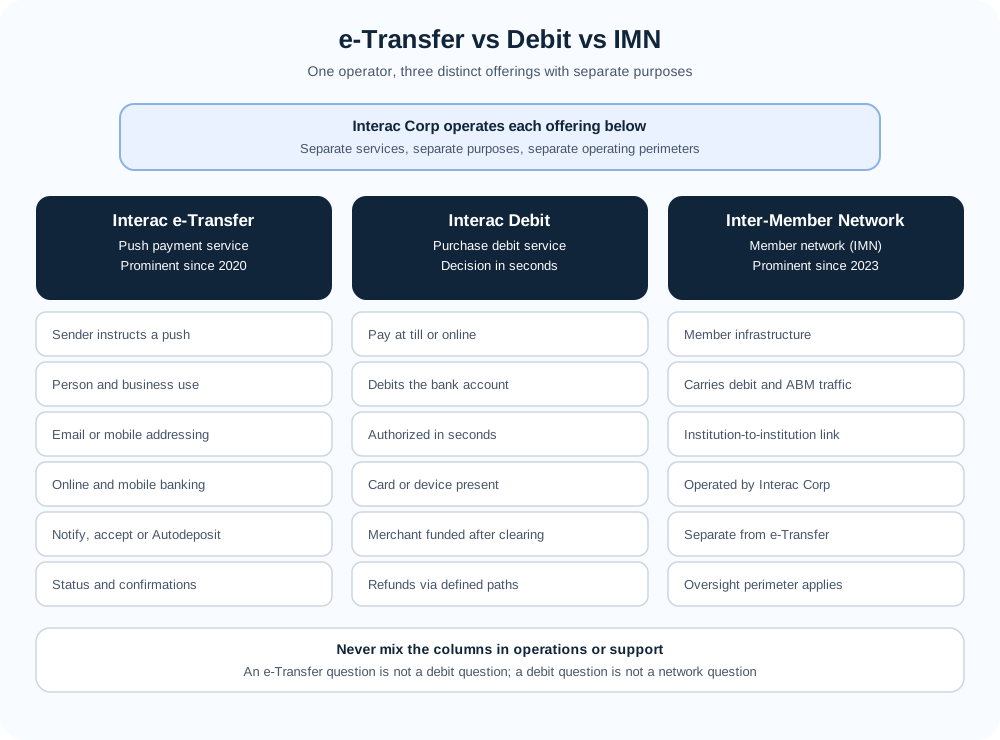
The business need this ecosystem serves is straightforward. Canadians need a way to move money between accounts at different institutions using only what they already have — a bank account, a banking app, and a way to reach the other person — without exchanging account numbers, without visiting a branch, and without waiting for a business-day window. Interac e-Transfer answers that need for person-to-person, person-to-business, business-to-person and business-to-business pushes through participating institutions' online and mobile banking, available 24 hours a day, 7 days a week. Interac Debit answers the adjacent need at the point of sale and online checkout: pay directly from the bank account with an authorization decision in seconds. The Inter-Member Network provides the member infrastructure over which debit and ABM traffic moves between institutions. Three offerings, one operator, distinct purposes — and the banker's first professional duty is never to blend them, because every operational question, every customer promise and every control belongs to exactly one of them.
Consider the Friday evening that will recur throughout this chapter. A Toronto home-services company — fictional Harbourline Property Care — finishes a week of repair jobs. The owner needs to pay six crew members tonight so Saturday's shifts are covered. Two suppliers sent invoices marked due Monday and will accept electronic payment over the weekend. One customer was overcharged on Wednesday and was promised a refund "tonight." The owner's bank offers Interac services inside its business banking app. From the owner's perspective this is one evening of taps and confirmations. From the bank's perspective it is a dozen ecosystem traversals: authentications, validations, fraud screens, releases into Interac routing, notifications, acceptances and Autodeposits, debits and credits, status confirmations, exception handling for the one crew member whose email address changed, and a reconciliation pack on Monday morning that must tie every tap to a posting. This chapter teaches you to stand on the bank's side of that evening and see every traversal clearly, while Chapters 27 to 29 teach each traversal's journey detail.
The ecosystem view also protects the institution commercially. Interac participation is not a logo on a login screen; it is a bundle of obligations — authenticate, validate, screen, release, settle, post, report, reconcile, support and operate resiliently around the clock — each with a cost, a control and an owner inside the bank. A product manager who promotes Interac services without understanding that bundle misprices the product. An operations leader who staffs only business hours for a 24/7 service discovers the gap at 11 p.m. on a Sunday.
Finally, the ecosystem view is what makes oversight intelligible. Customers sometimes assume that because the Bank of Canada oversees Interac e-Transfer and the Inter-Member Network as prominent payment systems, the central bank guarantees their transfer, protects them from fraud, or can reverse a payment gone wrong. None of that is true, and Section 2 together with the oversight diagram will give you the language to explain why: oversight assures that the system is safe, viable and resilient under risk-management standards; it does not settle customer payments, insure deposits, adjudicate disputes or chase fraudsters. The institution owes the customer authentication, screening, posting, reporting and support. Interac Corp owes the ecosystem a sound, well-run service. The Bank of Canada owes the country resilient systems. Three promises, three owners — and a banker who can state all three plainly earns more trust than one who hides behind any of them.
2. Participants, responsibilities and system boundaries
An Interac payment always involves more parties than the two customers who think of it as "me sending you money." The bank professional must keep five layers straight: the customers, the participating institutions, the system operator, the supporting service roles, and the overseer. Confusing any two creates the classic errors this chapter corrects — treating Interac Corp as the party that holds the customer's money, treating the Bank of Canada as a helpline for a missing transfer, treating a notification email as proof of settlement, or treating every Interac-branded event as an e-Transfer.
Start with customers. The sender instructs the payment from their own institution's channel; the receiver is entitled to claim or receive it at their own institution. That sentence carries the most important boundary in the ecosystem: no customer ever touches Interac Corp directly. Every sender acts through a sending institution that authenticates them, validates their instruction, screens it, releases it and debits their account. Every receiver acts through a receiving institution that verifies them, accepts the incoming payment on their behalf, posts the credit and notifies them. The sender and receiver may bank at the same institution or at different ones; the ecosystem handles both, but the responsibilities do not change — each institution serves its own customer and meets its settlement obligations through the applicable participant arrangement. When a sender asks "where is my money," the institution does not point at Interac Corp; it traces its own release, the Interac routing and status, and the receiving institution's acceptance, because the chain of evidence runs through owners, not around them.
Interac’s current e-Transfer disclosure distinguishes the service’s Participants from the wider group of financial institutions that offer it. The 30 April 2026 disclosure reports 38 Participants, of which 21 connect directly and 17 indirectly; it says downstream entities such as affiliates, credit unions and co-brand partners may access the service through a Participant without being Participants. Interac’s IMN participant page separately defines Direct Connectors, Indirect Connectors, issuers, acquirers, connection service providers and settlement agents. For a bank, the durable control point is not a generic claim that every institution settles bilaterally: it is knowing which service agreement, connector, settlement agent and Payments Canada evidence apply to its own path. An indirectly connected institution does not outsource its customer duties to its connection provider; technical connectivity and settlement arrangements must be documented separately from customer accountability.
Interac Corp is the system operator, and its role must be stated precisely: Interac Corp operates Interac e-Transfer and the Inter-Member Network. It provides the functional and operational management of the services — routing, addressing and notification for e-Transfer; member exchange infrastructure for debit and ABM traffic over the IMN — together with the rulebooks, participation arrangements, risk frameworks and ongoing development that keep the services safe and usable. It does not hold customer accounts or post to a customer’s account. Customer authentication, transaction screening and account posting remain institution-side controls and obligations; the public disclosure describes Interac’s functional and operational management of the service, not a role as the customer’s account provider. Those are institution duties, always. The operator's duties are systemic: keep the service available around the clock, route accurately, notify reliably, track status faithfully, manage risk to the prominent-system standard, and evolve the service. Governance roles around the operator — board, committees and executive management — are kept generic in this chapter and in the participant map for a reason: governance structures evolve, named individuals change, and the banker's durable knowledge is that accountable governance exists and sets the risk appetite, not who sat in which chair in a given year.
Supporting service roles surround the core flow and deserve explicit recognition, because outages and incidents so often live there rather than in the core. Connectivity providers carry institution traffic to and from Interac services. Technology operators run the institution's channels, payment hub, screening engines and posting systems that this chapter's later sections depend on. Fraud and security operations monitor, score and interdict around the clock. Customer support organizations in each institution carry the notification, status and exception conversations with senders and receivers. None of these roles appears on the customer's screen, but every one of them can delay, misroute or misreport a payment — which is why Section 10 treats implementation and resilience as an ecosystem discipline rather than a single-vendor exercise, and why the control-responsibilities diagram assigns every stage an owner with no gaps and no overlaps.
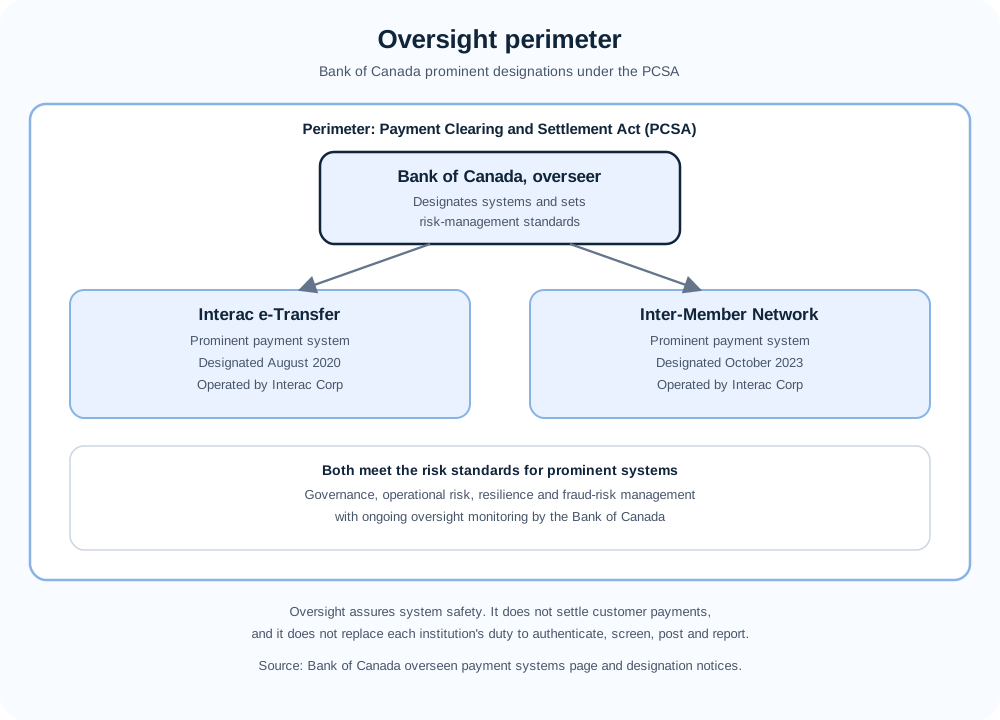
The Bank of Canada closes the map as overseer under the Payment Clearing and Settlement Act. Its designations are the facts to carry verbatim: Interac e-Transfer has been a prominent payment system since 10 August 2020, and the Inter-Member Network has been a prominent payment system since 16 October 2023. Prominent designation means the system could, through disruption or failure, affect economic activity or confidence in the payments system. It brings formal Bank oversight and requires adherence to the Bank’s risk-management standards, including resilience controls; it is not a customer-service or reimbursement guarantee. What oversight is not matters equally: the Bank does not operate the services, does not settle individual customer payments, does not provide consumer protection or fraud reimbursement, and does not adjudicate disputes between customers and institutions. Section 7 expands the control implications; here the boundary lesson is that oversight assures the resilience of the rails while institutions assure the correctness of every ride.
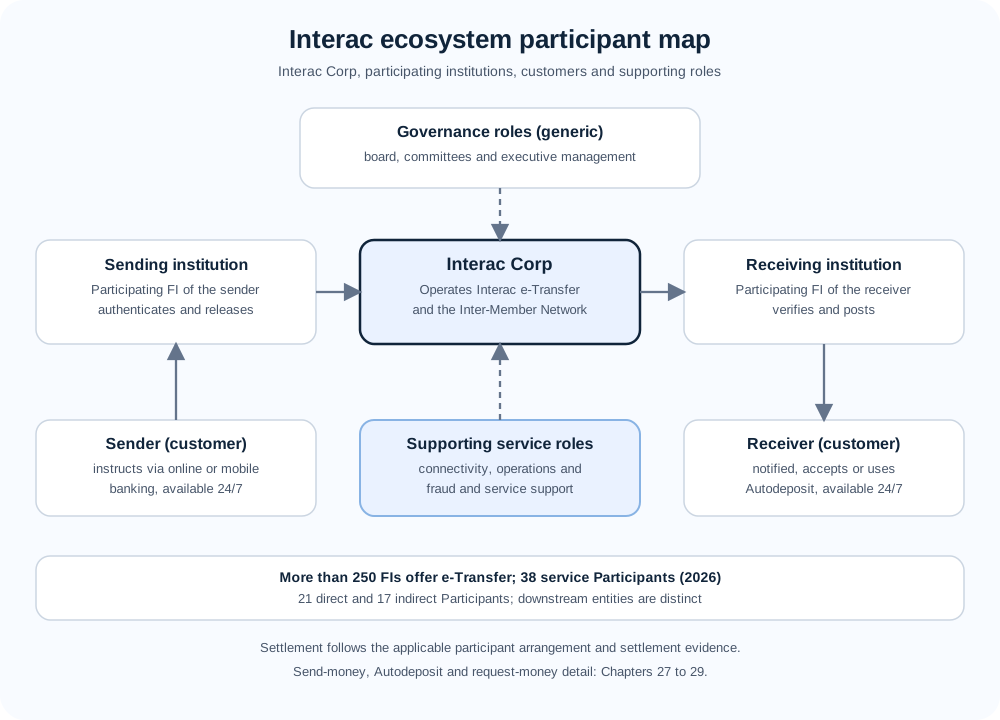
The diagram above is your anchor for the chapter. Read it from the outside in: customers act only through their institutions; institutions connect to Interac Corp directly or indirectly but stay accountable; supporting roles carry the traffic and the watches; the Bank of Canada oversees the perimeter. Every later section is a deeper pass over one relationship in that picture, and Chapters 27 to 29 are deeper passes over the journeys that cross it.
3. Initiation, validation and bank processing
An Interac customer payment begins with an instruction through the customer’s participating financial institution. The institution applies its own channel and payment controls before releasing the instruction to the relevant Interac service. The channel set is familiar — online banking, mobile banking, assisted branch service, ABMs for debit-side activity, and business portals or APIs for business senders — and the institution's job is identical across all of them: know who is instructing, check what they are asking, decide whether it may proceed, and only then release it into the ecosystem. Institutions that operate this as one shared control path across channels scale, control and modernize. Institutions that let each channel invent its own path duplicate controls, fragment evidence, and relearn every fraud lesson once per channel. The connectivity diagram below this section assumes a shared institution hub for exactly that reason: channels differ at the glass, but authentication, validation, screening and release must not differ underneath it.
Initiation varies by service, and this is where the chapter's forward-pointing discipline begins. For e-Transfer send-money, the sender names a receiver by address — an email address or mobile number — or selects a registered Autodeposit destination, enters an amount and any message the service supports, authenticates, and submits. For Autodeposit, the receiver has pre-registered an address so incoming payments deposit without an acceptance step. For request-money, the prospective receiver initiates a request that the payer then accepts or declines. For Interac Debit, initiation is the purchase itself — a card, device or credential presented at a till or checkout with authentication appropriate to the channel. Each of these is summarized here at ecosystem depth only: who initiates, through which channel, and which institution owns the step. The journey-level detail — addressing and notification behaviour, Autodeposit registration and routing, request lifecycle and expiry, acceptance and deposit confirmation, and the status events a customer sees — belongs to Chapters 27 to 29, and every banker who needs more than this section's summary should go there next rather than improvising from brand familiarity.
Validation is where many preventable failures are caught. In a bank’s controlled release path, the applicable validation and screening checks must complete before release; exact checks, holds and limits are set by the institution and the relevant service arrangements. Account validation confirms the sender's account exists, is open, is enabled for the requested service, and can fund the payment under the institution's own balance, hold and limit logic. Receiver-address validation confirms the address is well-formed and routable, and — for an Autodeposit destination — that the registered identifier resolves to the intended deposit account at a participating institution. Duplicate and anomaly checks compare the instruction against recent history: the same sender paying the same new receiver twice in ten minutes, a business sender suddenly paying at 3 a.m., a receiver address changed just before a large payment. Data-completeness checks confirm the service-mandatory fields are present and coherent. Repair or reject happens here, in the institution, in seconds — because a payment rejected at validation costs a conversation, while a payment released with bad data costs an investigation spanning two institutions and the operator.
The control stack sits between validation and release, and its order is the whole subject. Authentication and entitlement confirm the user may instruct and the amount is within their authority — with dual approval or file-release authority where the institution's business-banking policy requires it. Fraud monitoring scores the instruction against device, behavioural, mule, scam and account-takeover signals, tuned for the reality that Interac payments move at customer speed around the clock. Sanctions and watchlist screening checks parties and instruction data with a disposition of pass, false-positive release with reason, or true-hit hold with escalation. Record-keeping capture ensures the institution preserves the complete instruction, the authentication evidence, the screening dispositions and the release record — the evidentiary spine on which every later investigation, report and reconciliation depends. Cutoff and calendar logic assigns honest customer expectations: Interac services accept instructions 24/7, but the institution's own posting, support and funding rhythms still shape what the customer experiences and what operations must staff. Only after the institution’s applicable release controls pass does it release. Screening or review after release is a post-event control, not a substitute for pre-release decisioning; recovery across institutions is more complex than prevention inside the sending institution.
Release is the moment the institution commits the instruction to the ecosystem: a send issued into e-Transfer routing and notification, an Autodeposit-routed payment released to a registered destination, a request delivered for the payer's decision, a debit authorization forwarded for a seconds-level decision. The institution records release time, service, the Interac reference and its own internal identifier at release — every inquiry for the rest of the payment's life starts from that record. After release the institution stays active rather than standing down: tracking acceptance, deposit, decline, expiry and authorization outcomes; watching for the statuses that require customer communication; managing amendments only where the service permits them before acceptance; and preserving the original identifier across every follow-on event so that the customer's statement, the support conversation and the reconciliation pack all describe the same payment.
Two design principles decide whether this processing view survives contact with Friday night. First, authenticate the person, validate the instruction, screen the risk — in that order, every time, on every channel, with no fast lane that skips a step. A control review should test whether any required step was skipped, hurried or incorrectly delegated to the other side. Second, fail visibly and early: an institution that declines or holds with a clear reason, a repair path and a next-step promise creates one support interaction; an institution that accepts everything and fails inside the ecosystem creates a two-institution investigation and a customer who tells the story for years. The hub that rejects well is not being difficult. It is being a good sending institution.
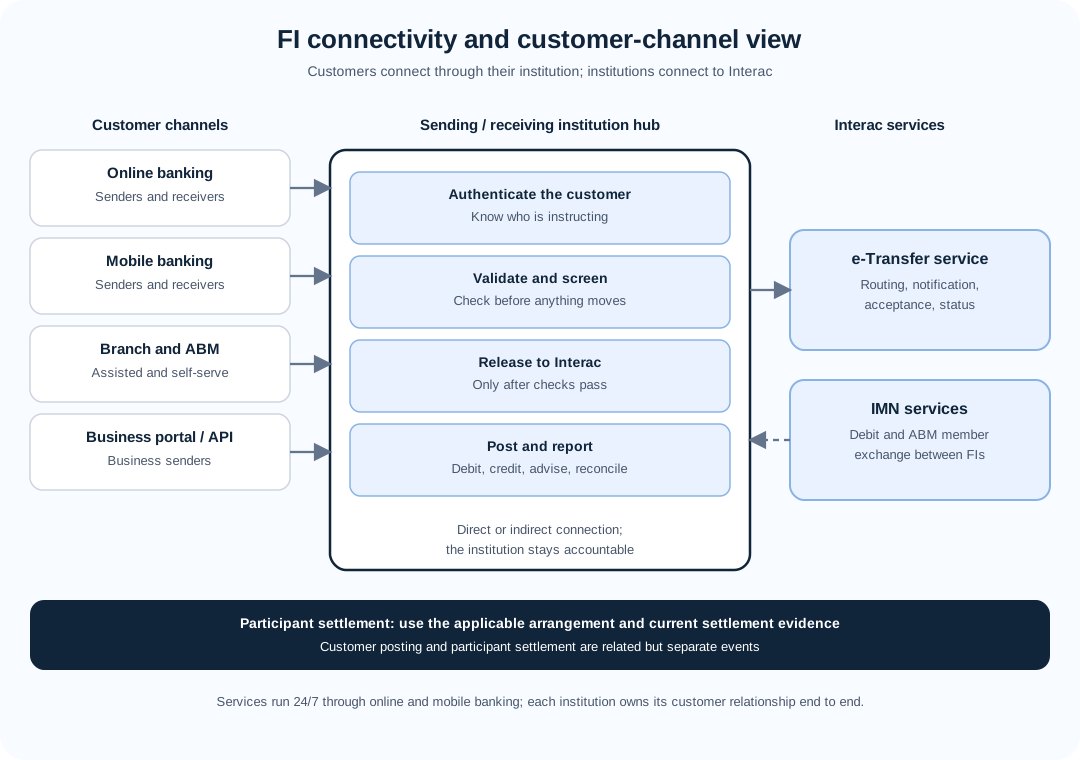
The diagram above compresses the section into an operating poster. Channels converge on one institution hub; the hub authenticates, validates, screens, releases, posts and reports; Interac services carry routing, notification, acceptance and status; Participant settlement follows the applicable arrangement and current settlement evidence. Print it mentally beside the participant map: the first picture shows who, this picture shows how an instruction crosses between them.
4. Clearing or exchange, settlement and finality
If Section 3 is about the institution's decision, Section 4 is about the ecosystem's promise — and the promise has exactly three parts that must never be blended: exchange, settlement and posting. Exchange is the movement of instructions and information between participants through Interac services: routing, notification, acceptance, authorization messaging, status. Settlement is the release of participant payment obligations under the applicable Interac and Payments Canada arrangements. It is distinct from exchange and customer-account posting. Posting is the debit and credit to the sender's and receiver's accounts at their own institutions. The customer experiences these as one event — "I sent it, they got it" — but the institution operates them as three, because each has a different owner, a different evidence trail and a different failure mode. Every reconciliation break, every confused customer conversation and every mishandled exception in Interac operations history traces back to blending two of these three.
Exchange through Interac Corp is the visible middle of the payment. For e-Transfer, exchange means routing the send to the correct receiving institution on the basis of the address, notifying the receiver, carrying the acceptance or Autodeposit outcome, and reporting status back to the sending institution so it can inform the sender. For request-money, exchange carries the request to the payer's institution and the payer's decision back. For Interac Debit, exchange carries the authorization request to the issuing institution and the decision back to the till in seconds, with clearing information following so the merchant can be funded. For ABM and member traffic over the IMN, exchange is the institution-to-institution messaging the network exists to carry. In every case the operator's duty is faithful, timely, around-the-clock carriage with reliable status — and the institution's duty is to submit only releasable instructions and to interpret every status honestly to its customer. "Sent" means released by the sending institution. "Notified" means the receiver was told. "Accepted" or "deposited" means the receiving side completed its step. None of these words means "settled," and training every customer-facing colleague on that distinction prevents more complaints than any technology upgrade.
The current public disclosure gives more precise evidence than a bilateral-settlement shorthand. Interac calculates settlement totals for each e-Transfer Participant; Participants are responsible for settlement payments with other Participants, and the disclosure states that those payments are made through Payments Canada’s Lynx. Interac’s settlement file contains participant totals, while its reconciliation file captures individual transactions. Do not infer a customer-level Lynx participation relationship, a specific cycle, netting rule, cutoff or guarantee from the customer experience. Treasury and operations must use the current Participation Agreement, operating rules, settlement file and reconciliation file for the institution’s actual arrangement. Interac does not hold customer funds or act as the customer’s account provider.
Posting translates exchange and settlement into the customer's reality. The sending institution debits the sender, normally at or around release, under its own holds and availability logic. The receiving institution credits the receiver upon acceptance or Autodeposit routing, under its own verification and posting logic. Posting is therefore an institution act, not an operator act, and the two postings need not be simultaneous with each other or with interbank settlement — they are related events, not the same event. That separation is operationally load-bearing. A receiver who sees a credit has good funds to use under the receiving institution's terms; the institutions still face each other for settlement directly. A sender who sees a debit has parted with funds under the sending institution's terms; the receiver's institution still owes its own verification and posting before anyone may claim completion. Availability language must respect the separation: "deposited and available" describes the customer account truthfully, while "settled" describes the interbank truth — and only the institution that owns each truth may state it.
Finality in the Interac ecosystem is best understood as the point after which no participant can unilaterally unwind what happened — and that point differs by service and by stage, which is why Section 8 classifies exceptions instead of promising reversals. Before acceptance, defined cancellation and expiry paths exist because nothing has completed on the receiving side. After acceptance and posting, recovery requires the cooperation of the receiving side or a defined dispute and claim path; there is no unilateral pullback of a completed customer credit. For debit authorizations, the seconds-level decision is binding on the authorization, while refunds and adjustments travel through their own defined paths rather than by editing the original authorization. The practical rule for every banker, analyst, product owner and operations colleague: never promise a customer that a completed Interac payment "can just be reversed." State what is possible at the current stage — cancel before acceptance where permitted, expire, decline, re-send, claim, dispute — and let Section 8's taxonomy carry the recovery conversation from there.
Three implications close the section. First, never equate notification with value: Interac states that email and text are used to notify and provide deposit instructions, while the transfer is carried through banking procedures. A notification alone is not settlement evidence. Second, never treat the operator as a party to value: Interac Corp routes, notifies, tracks and reports; institutions debit, credit and settle. Third, staff and fund the principle you operate: because participant settlement obligations are fulfilled under the applicable arrangements and, for e-Transfer, the current public disclosure says through Lynx, each institution’s treasury and reconciliation functions must reconcile participant settlement files and the relevant Payments Canada evidence — a duty that Section 9 expands and that no 24/7 customer experience can waive.
5. Data, identifiers, messages and references
If the ecosystem is the stage, data is the addressing that lets each payment find the right account at the right institution with the right story attached. Interac payments fail far more often from bad addressing and thin linkage than from system outages, and the institution's data discipline — capture completely, validate early, preserve identity end to end — determines whether routing, notification, posting and reconciliation succeed or generate exceptions. This section maps what the ecosystem needs at each step, which references must survive the whole journey, and where the boundary sits between ecosystem-level data knowledge and the journey detail of Chapters 27 to 29.
Addressing is the ecosystem's signature data act. E-Transfer routes on what the sender knows — an email address or mobile number — rather than on the account numbers the institutions use internally, and that design choice is both the service's genius and its principal risk surface. The sender never needs the receiver's institution, transit or account; the ecosystem resolves the address to the correct receiving institution and account through notification, acceptance and Autodeposit registration. Autodeposit registration binds an address to a specific deposit account in advance, removing the acceptance step and with it a whole class of misdirection risk. Request-money addressing runs the same directory in reverse: the requester is reachable at an address, and the payer responds from their own institution. Debit addressing is credential-based rather than directory-based: the presented card, device or credential identifies the issuing institution and account for the seconds-level authorization. The institution's duty at initiation is to capture the address exactly as the customer gives it, validate that it is well-formed and routable, resolve Autodeposit registrations faithfully, and refuse to release when the address cannot be resolved — because an unresolved address released into routing becomes somebody else's investigation.
Notification data is the second ecosystem signature. The receiver's notification — the message that money is waiting — must reach the right person through the right channel with enough context to act safely: who sent it, how much, what message accompanied it, where to accept or deposit, and by when before expiry. Institutions and the operator share this duty along the chain: the sending institution supplies accurate sender and instruction data, Interac routing and notification carry it faithfully, and the receiving institution presents acceptance and deposit faithfully inside its own authenticated channel. Fraudsters attack exactly this seam — spoofed notifications, lookalike addresses, urgency language — which is why Section 7 places notification-authenticity education and monitoring inside the control plane rather than treating it as a marketing concern. A banker who understands notification as ecosystem data, not as a courtesy email, will never dismiss a customer's "strange message" report as a minor complaint.
Authentication and acceptance data form the evidentiary core. Every payment must carry proof of who instructed it and what they authorized: the sender's authentication event at the sending institution, the instruction's amount, destination address and timestamp, the release record with the Interac reference, the notification and acceptance or Autodeposit events with their timestamps, and the posting records at both institutions. These references are what let humans and systems agree they are discussing the same payment. At minimum, the institution should preserve its internal instruction identifier, the Interac service reference, any receiving-side acceptance or posting references made available to it, and the customer-visible story — amount, addresses, message and timestamps — that ties the system's records to the customer's memory. Drop any one and some later conversation — a support call, a fraud claim, a reconciliation break, an audit sample — becomes unresolvable without disproportionate effort.
Messages in this chapter are described functionally rather than technically, and that restraint is intentional. Interac services exchange structured messages between institutions and the operator — routing requests, notifications, acceptance advices, authorization requests and responses, status reports — but the field-level specifications live in participation and implementation documentation, not in an ecosystem chapter. What the banker, analyst, product owner and operations colleague must carry from this section is the message discipline: every status the customer sees must correspond to a real ecosystem event, every event must be logged with its references intact, and no channel may display a status the hub cannot evidence. The rule that ties all of it together fits in one sentence: if it happened, it has a reference; if it has no reference, it did not happen.
6. Rules, cutoffs, service levels and customer impact
Customers experience rules as promises: will it go through tonight, when can the receiver use it, what will it cost, what reference will each side see, what happens if something goes wrong. Institutions experience rules as obligations: participation requirements, authentication standards, screening duties, notification and status duties, posting and reporting duties, exception-handling duties, and the evidence each duty must leave behind. This section connects the two without inventing a single number. No transaction limit, fee, cutoff hour or institution-specific timing commitment appears in this chapter — because limits, fees and timings are set by participation arrangements, institution policy and current official publications, all of which move, while the ecosystem logic of this chapter does not. Any study note, job aid or customer script that quotes a specific amount or hour from this chapter is misusing it.
Service availability is the headline rule and it is stated plainly: Interac e-Transfer is available 24 hours a day, 7 days a week through the online and mobile banking of participating institutions. That sentence shapes everything an institution must staff, fund and control. Fraud monitoring cannot keep business hours for a service that accepts instructions at midnight. Customer support cannot promise "we'll look at it Monday" for a payment whose receiver is waiting on Sunday. Technology operations cannot schedule maintenance windows as though the service slept. The 24/7 promise belongs to initiation, routing, notification, acceptance and status — the customer-facing half of the ecosystem — while each institution's back-office rhythms for funding, reconciliation and reporting follow their own calendars. The honest banker holds both truths at once: the customer may act at any hour, and the institution must be ready at every hour for the duties that cannot wait, while scheduling the duties that can wait without letting the customer feel the seam.
The service-separation rule is the chapter's most examined distinction, and the diagram below exists to make it unforgettable. Interac e-Transfer, Interac Debit and the Inter-Member Network share an operator and a brand family, but they are separate services with separate purposes, separate rulebooks and separate operating perimeters. E-Transfer is the push service: a sender instructs, the ecosystem routes and notifies, the receiver accepts or Autodeposits, status flows back. Debit is the purchase service: a credential presented at a till or checkout produces a seconds-level authorization against the account, with merchant funding following through clearing. The IMN is the member infrastructure: the institution-to-institution network over which debit and ABM traffic moves. Support, incident, control and audit work must land in the correct column every time. An e-Transfer that has not been accepted is not "a debit that failed." A debit authorization question is not "an e-Transfer delay." A connectivity symptom on member links is not "proof the customer's instruction was wrong." Every misrouted question costs a day; every correctly routed question saves one.
Participation rules form the second half of the section. Offering Interac services means accepting the operator's participation arrangements: connectivity and certification expectations, authentication and security standards, screening and risk duties, notification and status duties, posting and customer-reporting duties, exception-handling duties, record-keeping and audit duties, and the oversight cooperation that prominent designation entails. Institutions meet these duties either through direct connection or through indirect connection via another participant or service arrangement — and the accountability does not dilute with the distance: the institution whose customer instructed the payment owns the customer outcome regardless of how many technical hops carried it. New-product and new-channel proposals must therefore pass an ecosystem review before they pass a design review: which service is used, which rulebook governs, which connectivity carries it, which owner authenticates, screens, releases, posts, reports and supports, and what evidence each step leaves. Products launched without that review inherit every gap the review would have found.
Customer impact is where rules become reputation. The institution's promises must describe the customer experience truthfully in the vocabulary Section 4 established: released, notified, accepted, deposited, available — never "settled" as a customer-facing word, and never "instant and final" as a combined claim. Pricing communication must state what the institution charges under its own published schedule without implying anything about the operator's economics, and must never speculate about counterpart fees. Cutoff communication must be honest about what 24/7 means and what it does not: the customer can instruct at any hour, while the institution's own posting, support and back-office cycles still shape edge cases the colleague must be ready to explain. Exception communication must name the stage and the owner: "released by us, awaiting acceptance," "declined at validation for this reason," "expired before acceptance — here is how to re-send." Customers forgive staged honesty; they do not forgive confident vagueness that later proves wrong. Every promise in this section is therefore a control in disguise — the promise constrains the operation to be worthy of it.
7. Fraud, compliance and operational controls
Controls fail when they are complete but misplaced, and never more so than in a 24/7 push-payment ecosystem where the customer experience outruns the back office. A fraud score computed after release, a sanctions check run after acceptance, a notification-authenticity warning the customer never sees, a mule-credit screen that examines only outgoing payments — each is a control that exists and still loses. This section places each control family at the correct owner and the correct point in the flow, and the oversight and responsibility diagrams in this section exist to make the placement memorable: the Bank of Canada assures system resilience; Interac Corp assures service risk management; each institution assures every instruction it releases and every posting it makes.
Fraud controls span initiation, transaction risk and post-event response, and all three must run at institution level because that is where the customer and the instruction are known. Initiation attack — takeover, social engineering, credential theft — is defeated at authentication: strong customer authentication, device and behavioural signals, step-up challenges for anomalous payees, and callbacks or dual approval where business policy requires them. Instruction-truth attack — authorized-push scams, invoice-redirection fraud, address manipulation — is defeated at validation: payee-change discipline, new-payee caution, anomaly scoring against the sender's history, and holds with clear customer communication where the score demands it. Receiving-side abuse — mule activity, where a legitimate-looking account receives and forwards criminal proceeds — is defeated by screening inbound credits as well as outgoing payments, because an institution that watches only its senders is blind to half its risk. Notification attack — spoofed messages directing receivers to lookalike acceptance pages — is defeated by customer education that states the one rule simply (accept only inside your own institution's authenticated app or site), by monitoring and takedown discipline, and by support colleagues trained to treat every "strange message" report as intelligence rather than noise. The through-line is timing: every one of these controls must act before release or before posting. A control that reports yesterday's fraud beautifully while permitting tonight's is a reporting function, not a control function.
Compliance controls attach to Interac events without being Interac approvals, and the distinction matters for everyone who touches them. Sanctions and watchlist screening gates release: parties and instruction data are checked before the institution releases into the ecosystem, with dispositions of pass, false-positive release with reason, or true-hit hold with escalation — and with every disposition logged against the instruction's references. Record-keeping preserves the complete instruction, authentication evidence, screening dispositions, release records, status events and posting records so that financial-intelligence reporting, audit sampling and investigations can be satisfied from untruncated data. This chapter cites no thresholds, no filing mechanics and no list content, because all three live in current official guidance and in Block 13's control chapters — and a training chapter that quoted them would be stale before it was published. The ecosystem lesson is architectural rather than procedural: capture completely at initiation, screen before release, preserve everything against the payment's references, and feed downstream reporting from the preserved record rather than from reconstructed memory.
The oversight layer completes the control picture rather than duplicating it. Prominent designation brings Interac e-Transfer and the Inter-Member Network under formal Bank oversight and requires adherence to the Bank of Canada’s risk-management standards. The Bank’s designation notices describe resilience and risk controls; the Interac self-assessment describes its own governance and risk framework. These system-level duties do not replace an institution’s customer, fraud, AML or posting controls. That assurance flows downhill to every institution control designer in a precise way: the institution may rely on the service being available, routed faithfully and tracked reliably, and must therefore concentrate its own controls where only the institution can act — authenticating its customers, validating and screening its instructions, posting accurately, reporting honestly and supporting exceptions. Conversely, no institution control can substitute for service resilience, and no service resilience can substitute for institution authentication. The perimeter diagram below draws that line so it can be pointed at in design reviews: the overseer assures the system, the operator assures the service, the institution assures every instruction.
Operational controls bind the families together inside each institution: entitlements and dual approval for business origination, per-instruction and velocity restraint under institution policy, honest 24/7 staffing for monitoring and support, amendment discipline that permits only what the service permits before acceptance, evidence preservation against durable references, and segregation of duties across initiation, approval, release, posting and reconciliation. The control that ties them together is release discipline from Section 3: no instruction reaches the ecosystem without passing authentication, validation, fraud scoring, sanctions screening and approval in that order, with each decision logged. Exceptions to that order — manual releases, verbal instructions, after-hours overrides — must themselves be controlled, dual-approved and time-bound, because the override that bypasses the order is where losses enter. Resilience controls — backup connectivity, contingency procedures, failover capacity, communication trees — belong in the same plane and are expanded in Section 10. And the responsibility diagram referenced across this chapter assigns every stage exactly one accountable owner, so that when a control fails, the post-incident review asks "which owner, which stage" instead of "whose fault in general."
8. Exceptions, investigations and recovery
Every Interac payment that can succeed can also stall, expire, decline or be attacked — and every one of those outcomes is managed the same way: detect fast, classify correctly, act within the service's rights at the current stage, recover as a new linked event where recovery is needed, and reconcile with evidence. Institutions that classify first recover cheaply. Institutions that act first — re-sending on assumption, manually crediting on sympathy, editing a completed posting — create duplicate payments, duplicate credits and audit breaks that dwarf the original problem. This section teaches the ecosystem-level taxonomy and the recovery discipline; the journey-level paths for each service live in Chapters 27 to 29 and in the institution's own procedures built on the operator's rulebooks.
Start with the taxonomy, because each word authorizes a different action. A validation decline happens before release: the sending institution refuses the instruction for a bad address, an unfunded account, a failed screen or a breached entitlement. Nothing entered the ecosystem; the sender repairs and re-submits. A cancellation before acceptance ends a released-but-incomplete payment where the service permits it: nothing completed on the receiving side, so the instruction is withdrawn and the sender's funds are freed under the institution's posting logic. An expiry ends a payment the receiver never accepted within the service's window: same economics as cancellation, different trigger, and the customer communication must name the trigger honestly rather than calling everything "cancelled." A decline after release — an authorization refused, an acceptance that cannot complete — leaves the instruction uncompleted with its references intact for diagnosis. A fraud claim opens after completion or attempted completion: the customer alleges takeover, scam, spoofed notification or misuse, and the institution's fraud process takes ownership with its own evidence burdens and timelines. A dispute between private parties — "I paid, they say I didn't," "the goods never arrived" — is not a system exception at all until it becomes one: the payment completed correctly and the disagreement sits outside the ecosystem, where no operator or overseer can adjudicate it. Using these words interchangeably in customer conversations or incident tickets guarantees the two most expensive errors in exception handling: attempting an impossible recovery, and promising a recovery no owner can deliver.
Stage determines rights, so classify the stage before acting. Before release, the sending institution can do anything — decline, hold, repair, re-collect authentication — because nothing has left its walls. Between release and acceptance, the defined pre-completion paths apply: cancellation where permitted, expiry on its own clock, status inquiry through the service's tracking. After acceptance and posting, there is no unilateral unwind: recovery needs the receiving side's cooperation, a re-send by agreement, or a defined claim or dispute path with its burdens of evidence. For debit, the authorization decision binds the authorization; refunds and adjustments travel their own defined paths rather than by editing history. The institution's support scripts must therefore be stage-aware rather than symptom-aware: the first question is never "what went wrong" but "where is it" — unreleased, released-but-incomplete, completed — because the answer selects the entire playbook. Hub and support tooling must display the stage, the references and the permitted actions together; a screen that shows a failure without showing the stage is an invitation to improvise.
Investigations walk one path regardless of service: confirm the instruction and its references, confirm release and the Interac reference, confirm the exchange events and statuses, confirm the receiving-side outcome, then communicate state. A missing transfer is traced as release evidence, routing and notification evidence, acceptance or expiry evidence, and posting evidence — in that order, with each step either producing its record or identifying the owner who owes it. A suspected fraud is contained as authentication evidence, device and behavioural signals, address-change history, notification-authenticity checks and counterpart cooperation — with preservation of evidence taking precedence over speed of reimbursement, because the reimbursement decision depends on the preserved record. A duplicate credit is resolved by identifying the original and the copy through references before reversing anything, because reversing the wrong leg doubles the damage. Preserve the original identifier across every step: the re-send, the claim, the adjustment and the journal must all point back to the payment they descend from, or reconciliation in Section 9 inherits an untraceable family.
Recovery follows four rules that hold across every service. Never edit a completed posting into correctness — originate a linked corrective event the audit trail can follow. Never re-send on assumption — confirm the original's state first, or a delayed acceptance turns your recovery into a duplicate. Choose the recovery path by current stage and service rights, not by the customer's preferred vocabulary: a completed payment needs cooperation or a claim path, not a "cancellation." Communicate state plus next step, not activity: "released, awaiting acceptance, expires on this date, here is what to do" beats "we're looking into it" every time. And close every exception into reconciliation: the exception is not over when the customer is satisfied but when the references tie — instruction, release, exchange events, postings, corrective events — with no orphan debits, no orphan credits and no unexplained fees or adjustments. That closing discipline is what separates an institution that handles exceptions from one that merely survives them.
For federally regulated banks, a customer complaint follows the bank’s complaint-handling process; FCAC states that banks must provide a written final response within 56 days and an independent and impartial review route. That consumer-protection process is separate from Interac’s system operation and from Bank of Canada prominent-system oversight.
9. Posting, accounting, liquidity, reporting and reconciliation
Posting is where the ecosystem becomes the customer's statement, and accounting is where it becomes the institution's books — and both must be built on the separation Section 4 established between customer posting and interbank settlement. The sending institution debits the sender under its own posting logic, normally at or around release, with holds and messaging that match what the sender was promised at initiation. The receiving institution credits the receiver upon acceptance or Autodeposit routing, under its own verification and posting logic, with availability language that states the account truth without implying anything about the interbank leg. Neither posting is the settlement. The institutions’ settlement obligations are fulfilled under the applicable participant arrangements; for e-Transfer, Interac’s 2026 public disclosure states that Participant settlement payments are made through Lynx. An operations leader who can draw those three events on a whiteboard — sender debit, receiver credit, interbank settlement — with three different owners and three different evidence trails, has understood this section. Everyone who cannot will eventually mis-explain a delay, mis-post a correction or mis-reconcile a break.
Accounting follows posting with the journals that keep the institution honest. Each Interac instruction generates its touchpoints in the institution's books: the customer debit or credit, any fee the institution's own schedule imposes and discloses, suspense or clearing entries where the institution's design uses them between release and completion, and the interbank settlement entries that record the institution's position against its counterpart. Corrective events — re-sends, claim outcomes, adjustments — post as new linked entries carrying the original references, never as edits to history. Period-end discipline then proves the books: customer postings tied to instructions, interbank positions tied to counterpart records, suspense and clearing accounts aged and cleared with ownership, and every exception from Section 8 either resolved into the ledger or explicitly carried with an owner and a date. Auditors sample exactly this chain, from customer instruction through screening dispositions, release records, exchange statuses, postings, settlement records and reconciliation evidence — which is why the record-keeping discipline of Sections 3 and 5 is an accounting control, not merely an operational nicety.
Liquidity in this ecosystem is the institution’s capacity to meet participant settlement obligations while honouring the customer availability it promises. For e-Transfer, the current Interac disclosure identifies settlement payments between Participants through Lynx; the operator calculates totals but does not hold customer funds. Treasury must therefore monitor the institution’s applicable participant and Payments Canada positions, not treat Interac as the customer’s settlement account. The practical duties are familiar to any treasury function but take an Interac shape: forecast flows from history, seasonality and known business events; monitor positions as the 24/7 customer flow accumulates, including overnight and weekend hours when staffing thins; maintain buffers and escalation paths for surprise days — payroll Fridays, holiday weekends, major disbursements; and define who may act, with what authority, when a position needs attention at 2 a.m.
Reporting closes the loop to the customer and to management. Customer reporting — statements, transaction histories, alerts and confirmations — must describe each payment in the customer's vocabulary with the references the customer needs: amount, counterpart name as known, date and time, status in staged language, and a reference the support colleague can trace. Nothing erodes trust faster than a statement line the institution's own support team cannot explain. Management reporting tracks what the ecosystem costs and risks: volumes and values by service and channel, exception rates by stage and cause, fraud rates and losses by typology, support contacts per thousand payments, reconciliation break age and ownership, and availability and incident measures for channels, hub, connectivity and the services. The report that matters most is the one that connects customer pain to operational cause: every spike in "where is my transfer" contacts should resolve to a stage, an owner and a fix, not to a shrug about a busy week.
Reconciliation proves the whole story end to end, and in this ecosystem it is inherently three-way: customer postings against instructions, interbank positions against counterpart records, and both against the service's routing, status and reporting. The daily discipline runs in a fixed order. First, tie every released instruction to its outcome — accepted, Autodeposit-deposited, cancelled, expired, declined, or under exception ownership — with no released instruction lacking a current state. Second, tie every customer posting to an instruction or a linked corrective event, with no orphan debits or credits and no posting whose references cannot be produced. Third, tie every settlement-file position movement to the instructions it covers and to the relevant Payments Canada/Lynx evidence, with breaks aged, owned and escalated rather than carried silently. Fourth, tie service reporting to the institution's own records, investigating every divergence as a potential defect in capture, mapping or interpretation rather than assuming the service erred. Breaks are normal; unowned breaks are not. A reconciliation function that can state, every morning, what completed, what is pending with an owner, what broke with an owner and a date, and what corrected with its linkage intact, is performing the control on which every other control in this chapter depends.
10. Bank implementation, testing and resilience
Connecting an institution to the Interac ecosystem is a programme, not a procurement — and the institutions that treat it as a vendor switch inherit every gap this section exists to prevent. Implementation spans participation, connectivity, hub integration, control wiring, posting and reporting, support readiness, testing and cutover, and each span has an owner inside the bank who must be named before work begins. Participation establishes the commercial and rulebook footing: which services the institution will offer, under which arrangements, with which accountabilities, and with what evidence of readiness the operator requires. Connectivity establishes the technical path — direct connection or indirect connection through another participant or service arrangement — with certified interfaces, monitored links, and documented accountability at every hop, because the institution that cannot draw its own path cannot diagnose its own outage. Hub integration wires Interac initiation into the shared control path from Section 3 rather than bolting a sidecar onto one channel: authentication, validation, fraud scoring, sanctions screening, release, status tracking, posting and reporting must all flow through the same governed spine the institution uses for its other payment obligations. Posting and reporting wire the ecosystem into statements, alerts, journals and reconciliation packs from Section 9. Support readiness wires the exception taxonomy from Section 8 into scripts, tooling, staffing and escalation. Testing proves all of it before customers depend on any of it. Cutover moves volume in controlled stages with rollback criteria stated in advance. Skip any span and the go-live discovers it — always at the worst hour, always with customers watching.
Testing deserves its own emphasis because Interac testing fails in predictable ways. The first failure is testing the happy path only: sends that succeed, debits that authorize, postings that balance — while cancellations, expiries, declines, duplicate submissions, address changes mid-flight, Autodeposit collisions, request declines, fraud holds and connectivity loss go untested until production teaches them. The second failure is testing with production-shaped data only in volume but not in variety: a thousand identical test payments prove throughput and nothing else, while the exception taxonomy needs one careful test per branch, each asserting the stage, the references, the customer message and the reconciliation outcome. The third failure is testing the hub without the channels or the channels without the hub: the release discipline that works in a lab harness fails in a mobile app with different timeouts, retries and duplicate-submission behaviour. The fourth failure is testing day-one readiness without night-one readiness: cutover rehearsed for a Tuesday morning behaves differently on a Friday night with thin staffing and no one empowered to decide. The test plan that survives contact with reality therefore covers every service the institution offers, every channel it offers them on, every exception branch in Section 8, every posting and reconciliation assertion in Section 9, and every staffing and escalation assumption — with entry and exit criteria a non-specialist executive can understand and a rollback decision pre-authorized before it is needed.
Resilience is the operating form of everything above, and the 24/7 nature of the services makes it non-negotiable. Resilient institutions assume each dependency will fail and pre-assign the response: channel degradation routes customers to working channels with honest messaging; hub or screening-engine trouble holds releases safely rather than queuing them blindly; connectivity loss to the service triggers the documented contingency — holding, rerouting where permitted, communicating staged truth to customers — rather than improvisation; posting-system trouble protects the ledger's integrity first and catches up customer visibility second, because a wrong statement is worse than a late one; and fraud-signal loss defaults to caution, not to throughput. Each contingency names its decision-maker by shift, including nights, weekends and holidays, because a contingency that requires "the manager" without saying which manager, reachable how, empowered to decide what, is a hope rather than a plan. Communication trees, customer messaging templates in staged language, counterpart notification paths and operator-escalation routes are prepared, rehearsed and kept current. And every incident closes the same way: restore service, complete the postings, reconcile to evidence, review against the responsibility diagram below, and convert the lesson into a control, a test or a message — never merely into a memory.
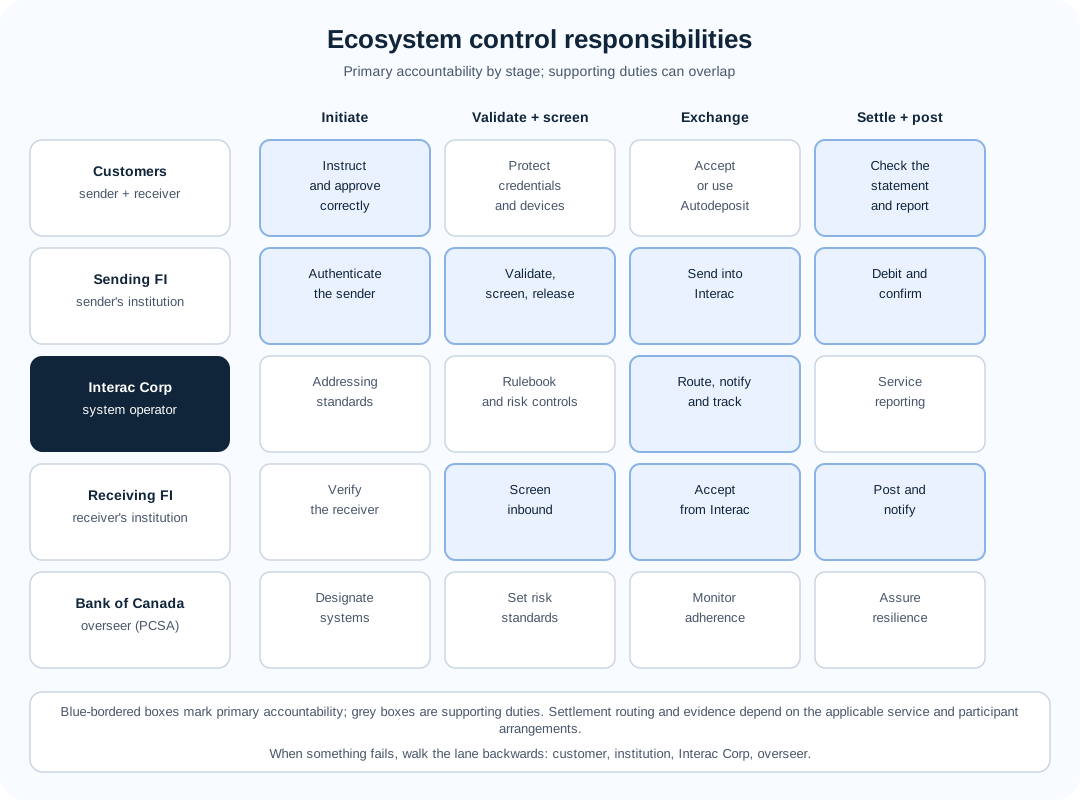
The diagram above is the section's accountability companion and the chapter's closing poster. Five lanes — customers, sending institution, Interac Corp, receiving institution, overseer — across four stages, with each lane's primary accountability marked. Use it in design reviews to assign every requirement an owner, in test planning to assert every handoff, in incidents to walk the chain backwards, and in post-incident reviews to ask "which owner, which stage" instead of "whose fault in general." An implementation that can map every paragraph of Sections 3 to 9 onto one box in this picture is ready. One that cannot has found its remaining work.
11. Practical Canadian ecosystem examples
The two stories below are fictional and labelled as such. Their people, businesses, amounts of effort and institution names are invented to teach the ecosystem; only the ecosystem mechanics — participants, services, oversight facts and the settlement principle — follow this chapter. Read each story twice: once for the customer experience, once for the owners behind it. The control lesson at the end of each is the point.
Example (fictional): the Friday-night refund evening. Maya runs a small Toronto catering company, variances and all — twelve staff, weekend events, tight cash. On a Friday at 7 p.m. she discovers a client was double-charged for a deposit and promises a refund "tonight." She opens her institution's business mobile app, authenticates, and sends an e-Transfer to the client's email address. Her institution validates the instruction, scores it against her history — Friday-evening refunds are normal for her — screens it, releases it, debits her account and reports the release. Interac routing carries the send, the client is notified, and the client — whose address is registered for Autodeposit — receives the deposit without an acceptance step. Maya's app confirms deposit; the client's statement shows the credit. Three participants acted visibly (sender, sending institution, receiving institution), one operated invisibly (Interac Corp routing, notification and status), and participant settlement followed the applicable arrangement and settlement evidence underneath. Now the variant that teaches: suppose Maya mistyped the address by one letter. Her institution's validation cannot catch a well-formed but wrong address — it routes correctly to the wrong person. The notification reaches a stranger, who accepts. Recovery is now post-completion: no unilateral unwind exists, so Maya's institution traces release, routing, notification and acceptance evidence, contacts the receiving institution, and pursues the defined recovery path while telling Maya the staged truth at each step. The control lesson is the chapter in miniature: prevention (address confirmation, new-payee caution, Autodeposit preference) lives before release and is cheap; recovery lives after completion and is slow. Every banker who has walked one mistyped-address case never again treats the confirmation screen as decoration.
Example (fictional): the small-business payday with one exception. Harbourline Property Care — the Toronto home-services company from Section 1 — pays six crew members on a Friday night through e-Transfer, plus two supplier invoices. The owner's institution authenticates the owner, validates six addresses against history (five known, one changed this week), scores the batch, screens it and releases. Five payments route, notify, accept or Autodeposit, and confirm within the evening. The sixth — the changed address — trips the anomaly check and is held for verification with a clear in-app message and a next step. The owner confirms the change by the institution's verification process, the payment releases, and the crew member is paid. Monday's reconciliation pack ties all eight payments: instructions, releases, statuses, postings and interbank positions, with the held-then-released payment carrying its hold reason and release authority in its references. The control lesson: the hold was not a failure but the system working — one well-placed validation check, acting before release, prevented either a misdirection or a fraud, while staged customer communication kept the owner's evening intact. Institutions are judged not by whether they ever hold a payment but by whether every hold carries a reason, a path and a clock. A hold with all three builds trust; a hold with none destroys it.
Example (fictional): the till that kept selling. On a Saturday afternoon, a Mississauga garden centre runs a sale with queues at every till. Every Interac Debit tap produces a seconds-level authorization decision; customers take their goods; funding follows through clearing and appears on the merchant's later statement. Mid-afternoon, one till's connectivity degrades: authorizations slow, then fail. Staff switch that till to the rehearsed contingency — honest customer communication and retry discipline that avoids duplicate charges — while the other tills keep selling. The ecosystem lesson: the authorization experience and merchant funding are separate events with separate owners. The issuing institution owns the authorization decision; the network and clearing carry it; the acquirer funds the merchant. Merchants forgive the outage they were prepared for; they do not forgive the afternoon when every symptom pointed everywhere and every call pointed nowhere.
12. Key takeaways and authoritative references
Carry twelve sentences from this chapter and you carry the ecosystem. Interac Corp operates Interac e-Transfer and the Inter-Member Network — one operator, distinct services. More than 250 financial institutions offer e-Transfer; Interac’s 30 April 2026 disclosure identifies 38 service Participants, 21 direct and 17 indirect, with downstream entities distinguished from Participants. The e-Transfer service is available 24/7 through participating institutions’ online and mobile banking. Every customer acts through their own institution; no customer touches the operator directly. E-Transfer pushes, Debit authorizes purchases in seconds, and the IMN carries member traffic — separate purposes, separate rulebooks, separate perimeters. The Bank of Canada oversees e-Transfer as a prominent payment system since 10 August 2020 and the IMN since 16 October 2023 under the Payment Clearing and Settlement Act. Oversight assures resilient systems; it does not settle payments, protect consumers or adjudicate disputes. A bank’s controlled release path should authenticate, validate and apply its applicable fraud, sanctions and entitlement checks before release; post-release review is not a substitute for pre-release decisioning. Exchange, settlement and posting are distinct events; e-Transfer Participant settlement is documented through the applicable arrangements, with the current Interac disclosure identifying settlement payments through Lynx. Exceptions are classified by stage before anything is attempted, and recovery travels defined paths, never unilateral reversal of a completion. Posting, accounting, reporting and reconciliation tie every instruction to its outcome with references intact. Implementation is a programme across participation, connectivity, hub, controls, posting, support, testing and cutover — proven before customers depend on it, resilient at every hour customers may act.
The misunderstandings to leave behind are equally compact. Interac is a separate operator from Payments Canada. Its current e-Transfer disclosure says Participant settlement payments are made through Lynx; the Bank of Canada says ACSS clears Interac Debit payment items. A customer does not become a Lynx or ACSS participant merely by using Interac. A notification is not proof of value; availability is not settlement; and no completed payment "can just be reversed." The operator does not hold customer money, screen individual payments or post to accounts — institutions do. The overseer does not guarantee transfers or chase fraud — it assures system resilience. Limits, fees and timings are institution and arrangement facts, not chapter facts, and anyone quoting them from memory rather than from current official sources is guessing with a customer's money. And send-money, Autodeposit and request-money depth lives in Chapters 27 to 29 — the banker who needs journey detail goes there rather than stretching this chapter's ecosystem summaries past their purpose.
Outlook is stated once, briefly. Payments Canada targets RTR launch in Q4 2026, with initial direct-to-Exchange participants at launch and phased migration of Interac e-Transfer clearing and settlement participants beginning in Q1 2027, with additional migration in Q2 2027. These are plans, not production capability at the October 2026 baseline. Nothing in Sections 1 to 11 assumes RTR, and all detailed RTR architecture belongs in the RTR chapters.
Authoritative references below are official sources only. They confirm the operator, the designations, the oversight perimeter and the outlook. Consult them before quoting any fact externally, and prefer them over any secondary summary including this chapter.
- Interac Corp — corporate home, services and participation information: https://www.interac.ca/en/
- Interac Corp — company overview, operator role and network background: https://www.interac.ca/en/company/about/company-overview/
- Bank of Canada — payment systems overseen, including Interac e-Transfer and the Inter-Member Network: https://www.bankofcanada.ca/regulatory-oversight/financial-market-infrastructures/payment-systems-the-bank-of-canada-oversees/
- Bank of Canada — designation of Interac e-Transfer as a prominent payment system, effective 10 August 2020: https://www.bankofcanada.ca/2020/08/interac-e-transfer-prominent-payment-system
- Bank of Canada — designation of the Inter-Member Network as a prominent payment system, effective 16 October 2023: https://www.bankofcanada.ca/2023/10/bank-canada-designates-additional-prominent-payment-systems
- FCAC — filing a complaint with a bank and complaint-handling rights (updated 16 September 2026): https://www.canada.ca/en/financial-consumer-agency/services/rights-responsibilities/rights-banking/make-complaint.html
- Interac Corp — Interac e-Transfer PPS Self-Assessment Public Disclosure (as at 30 April 2026), participants, settlement files and Lynx settlement: https://www.interac.ca/wp-content/uploads/2026/07/Interac-e-Transfer-PPS-Self-Assessment-Public-Discloser-2026.pdf
- Interac Corp — network participant definitions, direct/indirect connectors and IMN settlement agents: https://www.interac.ca/en/company/about/network-participants/
- Payments Canada — Real-Time Rail payment system, Q4 2026 launch target: https://www.payments.ca/systems-services/payment-systems/real-time-rail-payment-system
- Payments Canada — RTR testing and launch phases, including Q1/Q2 2027 e-Transfer migration: https://www.payments.ca/systems-services/payment-systems/real-time-rail-payment-system/testing-and-launch
- OSFI — Guideline E-21 operational risk and resilience backgrounder: https://www.osfi-bsif.gc.ca/en/news/backgrounder-guideline-e-21-operational-risk-resilience
- FINTRAC — Reporting electronic funds transfers guidance (international EFT scope): https://fintrac-canafe.canada.ca/guidance-directives/transaction-operation/eft-dt/eft-dt-eng
- Justice Canada — Payment Clearing and Settlement Act, current to 21 September 2026: https://laws-lois.justice.gc.ca/eng/acts/p-4.4/page-1.html
This application uses JavaScript for the full interactive experience. This text summary is served for accessibility and search indexing.