Institution Numbers and CACPA Routing. Explain Canadian institution identification and routing conventions used across payment processing.
Canada Payments & Collections · Block 2: Canadian Accounts, Routing and Infrastructure · Chapter 7 of 75
Many Canadian account-based payments carry a small string of digits that helps decide where they go, who is responsible for them, and which clearing path they use. Not every Canadian payment carries this address: for example, Payments Canada states that the Lynx copy used for routing does not include client account or transit numbers. When routing data is right, nobody notices it. When it is wrong, payroll credits land in the wrong accounts, pre-authorized debits bounce off closed branches, wires wait in repair queues while lawyers watch the clock, and reconciliation teams spend days unwinding items that should never have left the building. This chapter is about those digits: the three-digit institution number, the five-digit transit or branch number, the electronic direct payment routing number built from them in the D4 case, and the clearing arrangements that turn an address into an executable path.
The working idea for the whole chapter fits in one sentence. Routing data does not describe the customer or the amount; it describes the destination institution, the branch or processing point inside that institution, and the clearing path the item must follow to get there. If you can read a Canadian routing number, explain who issued each part of it, resolve it to a direct or indirect clearing arrangement, validate it at initiation, and trace where it is consumed from channel to reconciliation, you understand the addressing layer of the entire Canadian payment system. Everything else in this block — account structures, reference files, participation models, infrastructure maps — hangs on this addressing layer.
A note on names before we start. CACPA is the former Canadian Payments Association, the organisation now known as Payments Canada. Older documentation, cheque specifications, file layouts and bank operations manuals still say CACPA, and bankers still say "CACPA routing" the way they say "transit number" for what the formal standards call a branch number. This chapter uses both vocabularies deliberately: the formal current terms first, the working terms alongside, so you can read a forty-year-old specification and a current rule document without getting lost.
What you should be able to do after this chapter
After working through this chapter, you should be able to:
- read a nine-digit Canadian routing number and split it into its leading zero, three-digit institution number and five-digit transit number, and explain what each part identifies;
- name the well-known institution numbers used in this course (001 Bank of Montreal, 002 Bank of Nova Scotia, 003 Royal Bank of Canada, 004 Toronto-Dominion Bank, 006 National Bank of Canada, 010 Canadian Imperial Bank of Commerce) and explain why every other number you meet in examples must be treated as illustrative unless confirmed in authoritative reference data;
- explain who issues institution numbers, under which framework, and how the numbers reach every participant's validation and routing tables;
- distinguish institution numbers from transit numbers, account numbers and clearing arrangements, and explain who assigns each one;
- describe the CACPA routing conventions functionally: what the leading zero means, how the nine-digit form is constructed, and where it appears across paper, files and messages;
- explain how US-dollar items processed through the United States Bulk Exchange (USBE) carry their own routing and identification treatment, and why CAD routing assumptions must never be reused for USD items;
- resolve a routing number to a direct clearing arrangement or to an indirect clearer behind a clearing agent, and explain why the institution on the item is not always the settler;
- design initiation-time validation for routing data: format checks, institution recognition, transit plausibility, currency-context checks and repair-versus-reject decisions;
- trace where routing data is consumed at each stage of the end-to-end journey: initiation, validation, bank processing, clearing or exchange, settlement, posting, reporting and reconciliation;
- explain how routing interacts with clearing, settlement and finality without confusing an address with a guarantee;
- apply the functional content of Rule D4 (institution numbers and clearing arrangements) and Rule F8 (direct payment routing numbers) and the Rule K-series (USBE) without quoting rule text you have not verified;
- describe the fraud, compliance and operational controls that surround routing data, including diversion fraud, validation bypasses and reference-data staleness;
- handle routing exceptions — rejects, repairs, misdirects, stale agent mappings — with proper investigation, recovery and reporting discipline;
- explain how routing accuracy affects posting, suspense accounting, liquidity positioning, customer reporting and reconciliation;
- specify, test and harden routing tables, reference-data feeds and fallback behaviour for a bank implementation;
- work through realistic fictional Canadian scenarios and know which authoritative source confirms each fact you rely on.
For a roughly 60-minute core session, spend about 20 minutes on Sections 1–2 (why routing is a business problem and who owns each part), 20 minutes on Sections 3–5 (validation, clearing resolution and the anatomy of the routing number with the chapter's five diagrams), 10 minutes on one scenario in Section 11, and 10 minutes on Section 12. Treat the remaining sections as guided follow-up study; completing the whole chapter carefully takes longer, and that depth is intentional for the addressing layer the rest of the programme builds on.
Chapter navigator
- Business context and customer need
- Participants, responsibilities and system boundaries
- Initiation, validation and bank processing
- Clearing or exchange, settlement and finality
- Data, identifiers, messages and references
- Rules, cutoffs, service levels and customer impact
- Fraud, compliance and operational controls
- Exceptions, investigations and recovery
- Posting, accounting, liquidity, reporting and reconciliation
- Bank implementation, testing and resilience
- Practical Canadian examples
- Key takeaways and authoritative references
1. Business context and customer need
Start with a payroll Thursday, because payroll is where routing errors turn into human consequences. A mid-sized employer in Mississauga releases direct deposits for 900 employees on Thursday afternoon for Friday-morning availability. One employee opened a new account last week and typed the transit number from memory, swapping two digits. The file passes the employer's payroll software without complaint, because that software checks that the field is numeric, not that the branch exists. The bank's validation catches the invalid transit, but the file arrived after the repair cutoff, so the credit cannot be corrected in time for the morning posting run. One employee is not paid on payday. The employer's HR team spends Friday morning apologising, issuing an emergency Interac e-Transfer, and asking the bank why a two-digit typo cost a full day. The honest answer is that routing validation is a chain, and this item broke at the weakest link: capture without verification, submission without timely repair capacity, and a cutoff nobody explained to the employer when the service was sold.
Now change the failure mode and keep the pain. A property-management company in Calgary collects monthly rents by pre-authorized debit. A tenant moved apartments within the same bank and updated the account number but not the transit number, so the debit instruction points at the tenant's old branch. The old branch no longer holds the account. The debit returns, a late fee fires automatically, the tenant complains that money was in the account, and the collector's receivables report shows a delinquency that is really an addressing error. Nobody stole anything and no system malfunctioned. The routing data was simply stale, and every downstream process — the return, the fee, the delinquency flag, the collection call — treated an address problem as a customer-behaviour problem.
A third story, quieter but more expensive, belongs to corporate onboarding. A national distributor signs a new supplier in Vancouver and keys the supplier's banking details from a PDF invoice into the vendor master. The institution number is valid, the transit looks plausible, the account number has the right length. Payments flow correctly for eight months. Then the supplier's bank restructures its transit numbering after a systems migration, retires the old transit, and publishes the change in reference data the distributor never loads. Payments start returning. The distributor's response is to phone the supplier and ask for "the correct details," which the supplier reads off the same outdated void cheque. Two organisations, both acting in good faith, recycle a dead address for six weeks because neither side owns routing-data maintenance as a named responsibility.
These three stories share one lesson that this chapter exists to teach. Routing data feels like plumbing — fixed, boring, somebody else's problem — until the day it determines whether people get paid, whether collections succeed, and whether settlement positions reflect reality. For bankers, analysts, product owners and operations staff, routing competence is not memorising number ranges. It is owning four questions for every product and process you touch. Where does routing data enter our flow, and what proves it is correct at entry? What resolves a routing number to an executable clearing path, and what happens when the resolution fails? How fresh is the reference data behind every validation decision? And when routing fails downstream, who investigates, who repairs, who bears the cost of delay, and what evidence survives?
The customer need underneath is disarmingly simple. Senders need confidence that the address they provide reaches the intended beneficiary's account at the intended institution, on the promised date, with proof. Collectors need confidence that the debit they raise will arrive at the right account without creating disputes or returns that damage the customer relationship. Operations teams need items that clear first time, because every repair consumes expensive human attention and every reject consumes customer trust. Treasury teams need settlement positions that match expectations, because misdirected items distort funding. And every one of these needs depends on a nine-digit string that most customers cannot explain and many front-line processes never verify.
There is also a product-design dimension that product owners often miss. Routing capture is the worst-designed moment in most payment journeys. Customers are asked for institution, transit and account numbers in inconsistent orders and with inconsistent labels, and with validation that ranges from none to draconian. Designing capture well — consistent labels, verification against reference data, confirmation of key changes, readable error messages — is among the highest-return investments a payments product team can make, and this chapter gives you the domain knowledge to specify it.
A final piece of context sets the boundary of this chapter. Routing identifies the destination and the path; it does not move value, guarantee funds, or confer finality. A perfectly addressed payment can still fail for insufficient funds, still be returned under PAD dispute rights, still miss a cutoff, and still settle a day later than the customer hoped. Chapters later in this programme cover amounts, mandates, clearing streams, settlement mechanics and return rights in depth. This chapter answers a narrower question completely: how does the Canadian system name every institution and branch, how do those names become executable routing, and how does a bank use them correctly from capture to reconciliation.
2. Participants, responsibilities and system boundaries
Every routing number sits at the intersection of several organisations, and most routing failures are really boundary failures — two parties each assuming the other owns a check. This section names the participants, assigns each part of the addressing job to exactly one owner, and marks the boundaries where handoffs most often break.
Payments Canada owns the framework. Under Rule D4, it allocates an institution number to a Member and administers clearing agency or representative arrangements. Rule F8 governs Direct Payment Routing Numbers (DPRNs): for an institution that has a D4 institution number, the DPRN is the leading zero plus that institution number plus the institution-designated five-digit branch number; F8 also provides for Association-issued nine-digit DPRNs for other eligible entities. Payments Canada is therefore the rule-maker and numbering authority, but not the owner of every participant's front-end validation or vendor master. Its FIF is a subscription-based, proprietary AFT directory: the public Payments Canada page says it is updated weekly, while Rule F7 specifies delivery and effective-date mechanics. Participants consume that output under the applicable subscription and service-level documents; each participant remains responsible for applying current data.
Financial institutions own their slice of the address space and every use of it. Each institution holds its assigned three-digit number — the well-known ones used throughout this course are 001 for Bank of Montreal, 002 for Bank of Nova Scotia (Scotiabank), 003 for Royal Bank of Canada, 004 for Toronto-Dominion Bank (TD), 006 for National Bank of Canada, and 010 for Canadian Imperial Bank of Commerce (CIBC) — and designates five-digit branch numbers for its branches or processing points. The central authority administers the institution number and the clearing-arrangement framework; the institution and the relevant clearing agent must provide arrangement and branch changes through the processes in Rule F7 and the related service documents. The institution catalogue and the participant's load are therefore separate control responsibilities. When a transit retires and counterparties keep paying to it, the root cause may be the change notice, the participant's consumption, or both.
Direct clearers are institutions that exchange and settle payment items directly in the clearing systems, in their own name, through their own settlement accounts. Indirect clearers participate in clearing through a clearing agent — a direct clearer that presents and receives items on the indirect clearer's behalf under a formal clearing arrangement. The agent settles with the system; the indirect clearer settles bilaterally with its agent. This distinction is the single most consequential routing concept in Canadian operations, because it means the institution named on the payment is not always the institution that settles it. Routing must resolve through two hops — institution, then the clearing arrangement behind it — and any routing table that maps institution numbers directly to settlement destinations without the agent hop is wrong for every indirect clearer in the file.
The Bank of Canada provides the settlement accounts and the oversight backdrop against which all of this operates. Settlement accounts at the Bank of Canada are where clearing positions ultimately fund, and the Bank's oversight and settlement-account policies define who may settle and on what terms. For routing purposes the Bank is not an address in the routing number — you do not route to the Bank of Canada with an institution number — but it is the reason the clearing-agent mapping matters: every item's value must land in a settlement account owned by a direct participant, so resolving which direct participant stands behind an indirect institution is a funding question, not a clerical one.
Originators and collectors — employers, billers, property managers, distributors, government departments — own the customer side of capture. They collect banking details from employees, customers and suppliers, store them in payroll systems and vendor masters, and submit them in files and instructions. Their boundary failure is almost always maintenance: details captured once, never reverified, never refreshed against reference data, and corrupted slowly by customer moves, bank migrations and manual rekeying. Banks that serve originators well treat this as a service opportunity — pre-validation, repair reporting, change-confirmation workflows — rather than blaming the customer for bad data.
Beneficiary institutions — the receiving side — own posting decisions for inbound items. When an item arrives addressed to one of their transits, they decide whether the account exists, whether the name matches, whether to post, and what to do when anything looks off. Their routing-adjacent duty is to return or report misdirected items promptly and precisely, with reason information the originator can act on, rather than silently warehousing ambiguity.
Software, service and data providers — payroll platforms, treasury systems, payment hubs, validation vendors — sit between the parties and often perform the actual digit-checking. Their responsibility is to embed current reference data and surface failures with field-level reasons. A vendor whose bundled routing tables are three years old is a routing incident wearing a software licence.
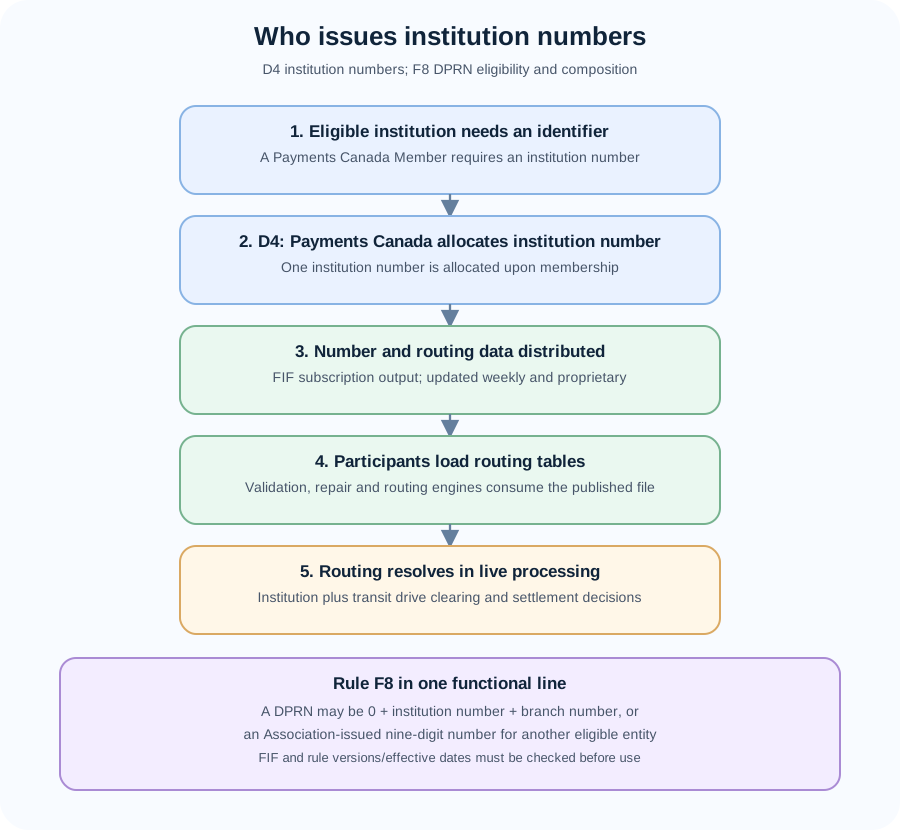
System boundaries worth memorising follow. Payments Canada assigns institution numbers; institutions assign their own transit numbers; neither assigns customer account numbers, which are the institution's own product-level identifiers. The Financial Institutions File distributes the shared truth; each participant's loading discipline determines whether that truth is actually used. Direct clearers face the system; indirect clearers face their agents; the agent mapping is reference data with an expiry date, not a permanent fact. And the routing layer ends where value logic begins: routing says where, amounts and mandates say whether and how much, settlement says when it is final. Hold those boundaries and most Canadian routing conversations become straightforward.
3. Initiation, validation and bank processing
Routing succeeds or fails in three acts — initiation, validation and bank processing — and the cheapest place to catch an error is always earlier than where it was caught. This section follows a routing number through all three acts the way a bank should engineer them, not the way incident reports describe them after the fact.
Initiation is the moment routing data enters the bank's sphere: a customer typing details into a mobile app, an employee record keyed by HR, a supplier form ingested by procurement, a cheque image captured at a branch, a treasury workstation importing a beneficiary template, or a file of AFT items uploaded by a corporate originator. Good initiation design treats routing fields as a structured address with three separately validated components — institution or DPRN, branch/transit where the selected rail uses one, and account — plus a currency and rail context. Poor initiation design treats them as free text. The practical controls at initiation are well understood and unevenly applied: constrain each field to its applicable format; verify the institution or DPRN against current reference data rather than a hardcoded list; check the branch pairing where the applicable directory supports it; select the regime before validation so USD items do not enter CAD AFT processing; and for high-risk changes — a new beneficiary or a changed transit on an existing payee — add a confirmation step before the first payment uses the new address. Cheque capture deserves a special note: paper MICR encoding is governed by paper-item standards and must not be assumed to be an electronic DPRN, so image quality and character-recognition confidence handling are separate controls.
Validation is where the bank proves the address before spending money on it. A well-built validation stack runs in layers, cheapest first, and each layer has a distinct job. Format validation must be rail-specific: for a D4 institution-number DPRN, F8 defines a nine-digit electronic number with a leading zero, institution number and five-digit branch number; F8 also permits an Association-issued nine-digit DPRN for other eligible entities, so a parser must not infer D4 ownership from every nine-digit value. Existence validation confirms the institution or DPRN is current in the applicable reference data. Pairing validation confirms the branch belongs with the institution where that relationship is defined. Context validation confirms the currency and rail regime: CAD AFT, USD AFT, USD paper USBE, Lynx, or a proprietary/on-us path are not interchangeable. Arrangement validation confirms the clearing or settlement path, including the responsible agent where the rail uses one. Each layer should produce field-level reasons — which field failed, against which check, with what evidence — because a reject that says "invalid routing" without saying which field offends is a second incident manufactured from the first.
Repair versus reject is the decision validation exists to feed, and it deserves explicit policy rather than operator instinct. Repair means correcting routing data under controlled authority and proceeding; reject means returning the item or instruction to the originator for correction. The governing principle is that repair is only legitimate from authoritative reference data with an audit trail: the original value preserved, the corrected value recorded, the source of authority named, and the correction visible to the originator so the source gets fixed. Classic legitimate repairs include restoring a dropped leading zero, correcting an obvious historic transit replaced by a published successor, and resolving an institution's renamed or renumbered identity from the reference file. Classic cases for rejection include unknown institution numbers, transits with no published relationship to the stated institution, currency-context mismatches, and any "correction" that would require guessing between two plausible destinations. A repaired payment that posts to the wrong account is worse than a clean reject in every dimension — customer harm, liability, investigation cost — so the repair policy should be written as a risk document, not a convenience procedure, with repair rates monitored as a quality signal and rising repair volumes treated as evidence of an upstream capture or reference-data problem.
Bank processing takes validated routing and turns it into an executable plan: which rail, which clearing stream, which clearer or agent, which settlement position the item will join. This is the routing-resolution step, and it is where the direct-versus-indirect distinction becomes operational. For a direct clearer destination, the item is presented through that clearer's own clearing presence. For an indirect clearer destination, the item must be presented through the mapped clearing agent, and the settlement expectation attaches to the agent, not the named institution. Processing also applies the currency split — CAD items into CAD batch and settlement flows, USD items into their USBE treatment — and the value split, where high-value items follow the high-value rail's addressing and timing rather than batch conventions. Processing systems that carry the original routing values alongside every derived decision — the resolved clearer, the chosen stream, the agent mapping version used — give investigations and reconciliation the lineage they need; systems that overwrite the original with the derived answer destroy evidence and should be remediated as a defect.
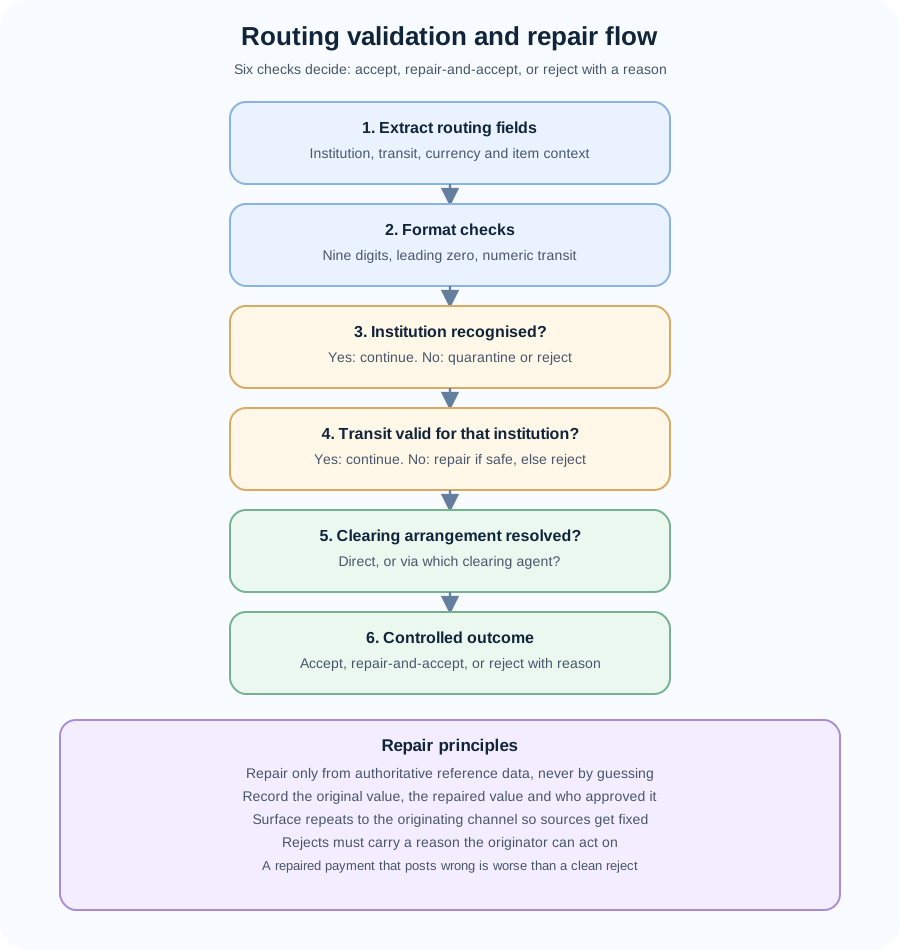
The diagram above gives you the six-check flow to standardise across channels: extract, format-check, recognise the institution, validate the transit pairing, resolve the clearing arrangement, and land a controlled outcome. Notice what the flow never permits: silent correction, guessing between candidates, or acceptance without a resolvable clearing path. Standardise this flow in every channel — mobile, branch, file upload, treasury workstation, API — and routing failures converge on a small set of well-understood, well-evidenced outcomes instead of a fog of channel-specific surprises.
Two disciplines complete the picture. First, reference-data freshness is a validation input: every decision is only as current as the Financial Institutions File load behind it, so file age should be monitored with an alerting threshold. Second, repair feedback loops close the quality circle: every repair and reject should be reported back to the originating channel, aggregated by failure type, so capture design improves instead of the same errors recurring forever.
4. Clearing or exchange, settlement and finality
Routing earns its keep after the bank releases the item, when clearing systems sort by destination, settlement systems fund the resulting positions, and finality rules decide when anyone can treat the money as truly moved. This section explains each stage strictly as it touches routing — the fuller mechanics belong to the ACSS, USBE and Lynx chapters — with one persistent message: routing determines the path and the settler, while finality is a separate property of the rail and the item type.
Clearing and exchange is where routing becomes physical sorting. In batch clearing through the live Automated Clearing Settlement System (ACSS), items carrying institution and transit data are grouped by destination so each receiving clearer — or each clearing agent acting for indirect clearers — gets the items it must handle. Correct routing produces clean sorts: every item reaches the clearer responsible for its destination institution, agent mappings hold, and the exchange balances. Incorrect routing produces the characteristic failure set of batch systems: items presented to the wrong clearer, returned as misdirected, repaired mid-stream at a cost, or held in exception queues while value dates slip. The practical implication for routing design is that the clearing arrangement encoded in your routing tables must mirror the live agency relationships, including recent changes. An agent switch that your tables have not absorbed is not a minor data lag; it is a systematic misdirection of every item for the affected institution until the tables catch up. This is also where the currency split bites: USD items follow their USBE exchange treatment with its own identification conventions, and feeding USD items into CAD sort logic — or validating them against CAD expectations — creates failures that look mysterious until someone checks the currency context field.
Settlement converts cleared positions into funded obligations, and routing decides whose obligation each dollar joins. For direct clearers, positions settle through their own settlement accounts; for indirect clearers, the clearing agent absorbs the indirect's items into its own settlement position and settles with the system, while the indirect clearer settles bilaterally with its agent outside system settlement. Trace what that means for a single misrouted item: it joins the wrong clearer 's position, distorts two settlement expectations (the clearer that should have received it and the one that did), and the correction — a return, an adjustment, a compensating entry — moves through exceptional paths with exceptional timelines. At portfolio scale, systematic routing errors do not just create exception work; they create funding noise, because treasury funds positions built from mis-sorted items. The settlement-stage routing lesson is therefore a treasury lesson: routing-table accuracy is a liquidity input, and the age and quality of agent mappings belong in the set of things funding teams monitor.
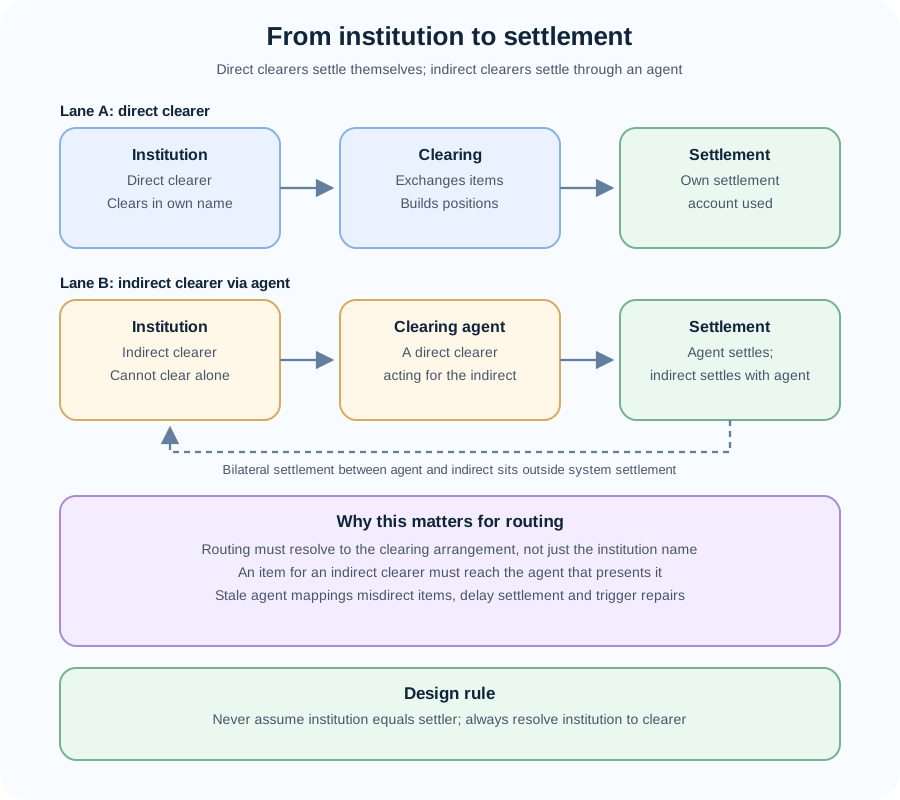
The diagram above shows both lanes side by side so the asymmetry is unmistakable: the direct clearer faces clearing and settlement in its own name, while the indirect clearer reaches both only through its agent, with bilateral settlement between agent and indirect sitting outside system settlement. Every routing table, every sort program and every settlement forecast in the bank should be able to reproduce this picture for any institution number presented to it.
Finality is the point the other stages are often confused with, so state it plainly: routing success is not finality, availability is not finality, and settlement is final only as the applicable rules define it for that system and item. A correctly routed batch credit can still carry return exposure after the beneficiary sees it; a high-value payment on Lynx — live since 1 September 2021 as Canada's high-value system — carries the finality properties of its own design, which differ fundamentally from batch processing. Product owners must keep these concepts separated in customer promises: "we sent it to the right place" and "the money is irreversibly yours" are different statements with different evidence. As of this audit, the Real-Time Rail is not yet in production: Payments Canada says it is launching in Q4 2026 after testing, with sequenced onboarding. Nothing in this chapter should describe RTR availability, cutoffs, or finality as current production behaviour.
On-us items — sender and beneficiary within the same institution — still need routing-grade discipline even though no external clearer is involved: the transit still identifies the branch or processing context, and skipped validation becomes the reservoir where the worst data quality hides.
5. Data, identifiers, messages and references
This section is the anatomy lesson: every identifier in the Canadian routing address, what it means, where it lives, and how it travels. Read it with the routing-construction diagram beside you, because the nine-digit form is simple to state and easy to mishandle in implementation detail.
The institution number is a three-digit identifier assigned to a financial institution and administered under the Payments Canada framework functionally described in Rule D4. It names the institution, nothing finer: 001 names Bank of Montreal, 002 names Bank of Nova Scotia, 003 names Royal Bank of Canada, 004 names Toronto-Dominion Bank, 006 names National Bank of Canada, and 010 names Canadian Imperial Bank of Commerce. These six are the only institution numbers asserted as fact in this course; every other three-digit value you encounter in worked examples and test data is illustrative or fictional unless you have confirmed it in current authoritative reference data. The institution number never identifies a branch, never identifies an account, and never by itself determines the clearing path — it is the first hop of the address, and it needs the transit and the arrangement mapping to become executable.
The transit number — called the branch number in formal standards and the transit number in daily banking speech — is a five-digit identifier assigned by each institution for its own branches and processing points. The assignment authority matters: your bank creates, renumbers and retires its own transits, and counterparties learn about those changes only through published reference data and bilateral communication. A transit can denote a physical branch, a processing centre, a virtual or centralised operations unit, or a historic branch preserved for account-number continuity after closures — which is why "branch" is sometimes a misleading mental model and "processing point" is often more accurate. Transit catalogues churn constantly through branch openings, closures, consolidations and systems migrations, and every churn event is a routing-data maintenance event for the whole industry. Treat any transit value in examples, including any transit paired with the real institution numbers above, as illustrative unless confirmed in the current file.
The electronic DPRN for an institution allocated an institution number under D4 is the nine-digit form 0IIITTTTT: a leading zero, followed by the three-digit institution number, followed by the five-digit branch number designated by that institution. F8 also permits an Association-issued nine-digit DPRN for other eligible entities, so this construction must not be applied blindly to every DPRN. The electronic DPRN is not a cheque encoding: F8 expressly says that no DPRN may be encoded on cheques or other paper Payment Items. Read the example in the diagram as 0-004-illustrative-transit: leading zero, institution 004 (TD, a real assignment), and a transit shown for structural illustration only. The routing or DPRN field identifies the institution and branch/processing point for the applicable electronic path; the customer account number travels separately and completes the address. This separation is load-bearing across every implementation in the chapter: concatenated strings that fuse routing and account digits into one field, screens that accept them in either order, and messages that truncate one to fit the other are defect patterns, not design choices.
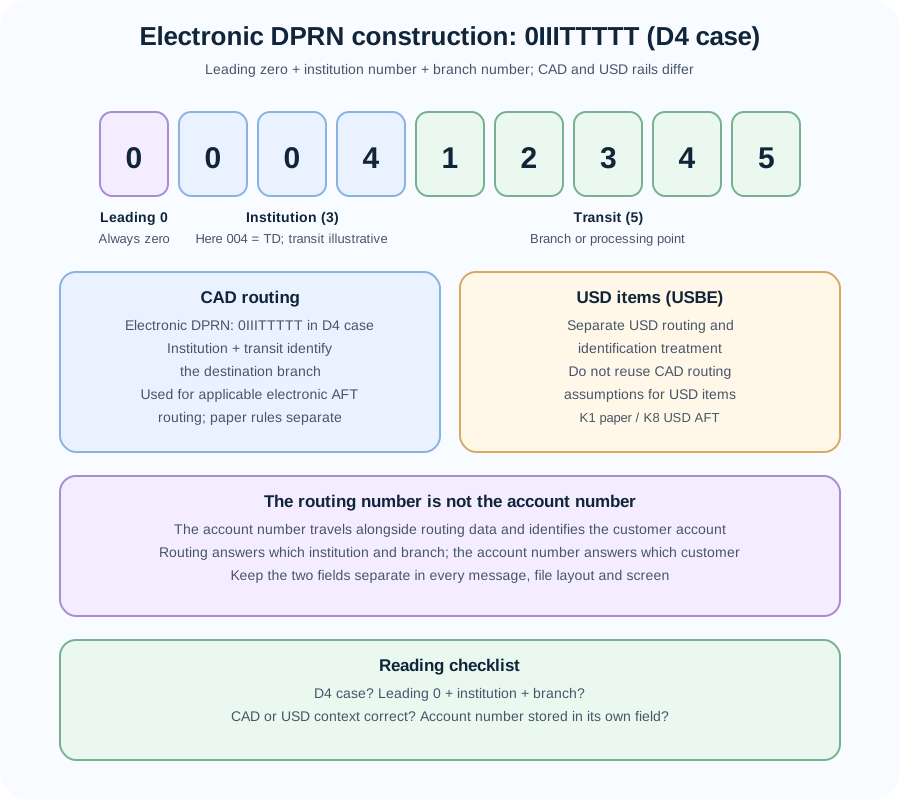
CACPA routing conventions functionally cover the electronic DPRN construction and usage: the leading-zero form in the D4 case, the placement of institution and branch fields, and the use of structured routing data in AFT files and applicable message standards. Paper instruments are a separate case. Rule F8 prohibits encoding a DPRN on cheques or other paper Payment Items; MICR encoding is governed by the paper-item standards and applicable rules. In electronic files and messages, the field positions and formats are defined by the applicable AFT, ISO 20022, Lynx, or proprietary specifications — details that belong in the file-format chapters. The functional point for this chapter is not that every physical encoding is identical, but that each rail preserves the meaning it is allowed to carry and that transformations do not silently lose the original address.
US-dollar routing and identification follows a separate Rule K treatment. For USD paper items, Rule K1 defines an ABA Routing Number and USBE exchange/settlement arrangements; for USD AFT, Rule K8 says USD AFT files must be delivered separately from CAD AFT files and sets separate exchange and New York settlement procedures. USD items therefore must not be validated or sorted by reusing the CAD D4/F8 assumption. Capture must record the currency and rail context, validation must apply the regime-appropriate checks, processing must select K1 paper or K8 USD AFT handling, and testing must cover the regime boundary — including hostile cases where CAD-valid fields arrive on USD items and vice versa. "The digits looked fine" is never sufficient without the regime question answered.
Account numbers complete the address and deserve a boundary restatement precisely because they are so often conflated with routing. The account number identifies the customer account within the institution; its format, length and check-digit behaviour are the institution's own product decisions, not part of the shared routing convention. Validation of account numbers — length, numeric shape, check digits where the institution uses them, existence at posting — is real and important, but it is institution-level validation, distinct from the system-level routing validation this chapter standardises. Never let account-number checks substitute for routing checks: an account number valid at the wrong institution is a misdirect waiting to happen, and only the routing layers catch it before value moves.
Messages and references carry routing as structured fields plus the lineage that makes them auditable. The routing fields should appear with their meaning preserved — institution in the institution field, transit in the transit field, account in the account field, currency context explicit — and derived decisions carried as additional data rather than overwriting the originals. Truncation, field reuse and reference overwriting turn routine routing queries into forensic exercises; specify them out of existence in every implementation review.
The Financial Institutions File is the subscription-based AFT reference behind much of this work. Payments Canada describes it publicly as an electronic directory of routing numbers and says it is updated weekly; Rule F7 governs its proprietary nature, delivery, effective dates, clearing-agent notifications and routing use. It is not a public, universal promise that every rail or every payment message will contain the same fields. Banks and other subscribers consume it into routing tables, validation engines and repair tooling; the consumption discipline — output version, receipt and load time, effective date, staleness monitoring, and fallback behaviour when a load fails — is as important as the file's own accuracy. The public Financial Institutions Branch Directory is a separate reference for branch routing information. Never design a validation, sort or settlement step that assumes a file's contents without naming the source, version, effective date and staleness response.
6. Rules, cutoffs, service levels and customer impact
Routing lives inside rulebooks and clocks, and customers experience both as promises — sometimes promises the bank never consciously made. This section maps the rules functionally, explains how cutoffs convert routing quality into availability dates, and shows how service levels turn addressing accuracy into customer language.
The rules, functionally described. Rule D4 covers allocation of institution numbers to Members and clearing agency or representative arrangements. Rule F7 governs the proprietary FIF service and the use of its data in AFT exchange. Rule F8 governs DPRNs, including their nine-digit composition for institutions with D4 institution numbers and the separate Association-issued case for other eligible entities. The K-series is not one generic USD routing rule: K1 covers USD paper-item bulk exchange, K4 the USBE automated system, and K8 USD AFT. This chapter describes those functions rather than quoting text, but the current rule PDFs remain the authority. Payments Canada says the online versions are the versions in force; confirm the effective date before specifying, building or promising behaviour.
Cutoffs are where routing quality meets the calendar. Every processing stage — file acceptance, validation and repair, clearing exchange windows, settlement funding, beneficiary posting runs — operates on clocks, and an item with routing problems consumes time at exactly the stage with the least slack. A clean item sails through automated checks in seconds; a repairable item waits for human attention, and human attention keeps business hours. The practical consequence is that routing failures are disproportionately expensive near cutoffs: the same transposed digits that cost ten minutes at 9 a.m. cost a full business day at 4:55 p.m., because the repair missed the exchange window, the settlement position, or the posting run. This asymmetry should shape both operations staffing (repair capacity aligned to submission peaks and cutoff approaches) and customer communication (honest cutoff language at every submission point, with the repair cutoff distinguished from the submission cutoff — the moment after which even a fixable error cannot be fixed in time).
Service levels translate all of this into customer-facing commitments. A Thursday-to-Friday batch-credit promise can be a useful fictional or bank-specific example, but it is not a universal Payments Canada availability standard. Its assumptions still need to be explicit: routing correct at capture, validation passed, no repair queue delay, applicable exchange window met, settlement funded, and posting completed. Mature service design differentiates first-time-clean items, repaired items and rejected items, but the exact cutoff, due date, availability, notification and return treatment must come from the product agreement, bank procedure and applicable rail rule. Vague speed language — "fast," "quick," "same-day" without cutoff and repair qualifications — is not a service level; it is a complaint generator.
Customer impact is the lens that justifies the entire control investment. A rejected payroll credit means a missed payday; a returned PAD means a late fee and a damaged biller relationship; a misdirected high-value item means delayed closings and penalty interest; a stale agent mapping means systematic delays until someone notices. The business case for initiation-time validation, current reference data and honest cutoff communication writes itself once both cost columns — customer harm and operational expense — are visible, which is why this chapter keeps returning to measurement: first-time-acceptance rates, repair volumes by cause, and reference-data age at each decision point.
7. Fraud, compliance and operational controls
Routing data looks like neutral infrastructure, which is exactly why it is attractive to defrauders and dangerous to neglect in control design. This section covers the fraud patterns that exploit addressing, the compliance duties that surround it, and the operational control stack that keeps both in check.
Diversion fraud is the headline pattern: the beneficiary address on a legitimate payment is changed so funds reach the fraudster's account instead of the intended recipient. The mechanics are mundane — a compromised email instructing a change of supplier banking details, a social-engineered call to accounts payable, a manipulated invoice PDF, an insider altering a vendor master — and the routing layer is where the change lands: a different institution number, a different transit, a different account, all individually valid, all combining into an authorised-looking instruction to pay the wrong person. Controls must therefore treat beneficiary-address changes as high-risk events regardless of channel: verify changes through an independent channel before the first payment uses them, confirm new addresses against known-good sources rather than the same compromised document, apply holds or dual authorisation to changed-beneficiary payments above thresholds, and monitor for the behavioural signals — urgency pressure, secrecy requests, first-time large amounts to new addresses — that accompany diversion attempts. The routing-specific discipline is verification of the new address as an address: confirm the institution number is assigned, confirm the pairing is plausible, and confirm through an out-of-band channel that the intended beneficiary actually controls the account — because validation that the digits are well-formed says nothing about whether the payee is the right payee.
Validation bypasses and data tampering form the second pattern family. Any path by which routing data reaches processing without passing validation is a bypass: manual overrides without approval, exception queues with "release as-is" buttons, file channels with weaker checks than interactive channels, converted or migrated data loaded directly into production masters, test data leaking into live tables. Tampering covers the complementary risk of routing data changed mid-flow — altered after validation, corrupted by a faulty transformation, truncated by a downstream system — so that what was validated is not what was settled. The controls are architectural: validate once at entry and carry the validated result with integrity protection rather than re-typing; log every post-validation change with before-and-after values and approver identity; reconcile routing fields between stages (submitted versus exchanged versus settled) so tampering surfaces as a break rather than a mystery; and review override and release-as-is rates as fraud and quality indicators, because a bypass used routinely for convenience is a bypass available for abuse.
Reference-data staleness is the slow-motion control failure: tables that were correct when loaded and wrong now, through lapsed loads, failed feeds nobody noticed, or mappings whose real-world relationships changed. Stale agent mappings misdirect whole portfolios; retired transits accepted as valid manufacture returns; renamed institutions break matching logic. Treat reference-data currency as a control with the same seriousness as a limit or an approval: monitored age, alerted thresholds, defined degraded-mode behaviour, tested fallback, and a named owner whose job description includes the words "routing tables are current."
Compliance duties surround routing without being routing rules. FINTRAC reporting is transaction- and entity-specific: for example, its guidance requires financial entities to report qualifying international electronic funds transfers of $10,000 or more and says suspicious-transaction reporting has no monetary threshold. A beneficiary-address change may be a monitoring signal, but routing validation is not KYC, sanctions screening or a FINTRAC reporting decision. Sanctions, AML/ATF, privacy and consumer obligations must be applied under the institution's compliance program and the applicable legislation. For federally regulated banks, FCAC complaint and disclosure duties also matter; for RPAA-supervised PSPs, the Bank of Canada expects operational-risk management, incident response, safeguarding and mandatory reporting. Routing accuracy is an input to duties owned elsewhere in the bank; trace those inputs explicitly without presenting this chapter as legal advice.
The operational control stack, assembled, runs from prevention through detection to response. Prevent with structured capture, layered validation, change-verification workflows, current reference data and channel-consistent checks. Detect with acceptance monitoring, override-rate tracking, data-age alerting, inter-stage field reconciliation and beneficiary-change surveillance. Respond with defined repair-versus-reject authority, quarantine procedures, diversion-escalation paths and mass-misdirection playbooks. Document each control with its risk, owner, evidence and metric — a control without evidence is a story, and stories do not survive audits.
8. Exceptions, investigations and recovery
However good the validation stack, routing exceptions will arrive — from other participants' customers, from legacy masters, from migrations, from fraud, from the ordinary entropy of millions of address fields. This section standardises the exception vocabulary, the investigation method and the recovery discipline so routing failures become managed events with owners and evidence rather than folklore and heroics.
The exception vocabulary needs precision because each term implies different rights, clocks and remedies. A reject stops the item before it proceeds: validation failed, no clearing path resolved, the instruction returns to the originator for correction. A repair corrects routing under authority and lets the item proceed, with the correction recorded. A return sends a cleared item back after exchange — for routing reasons typically misdirection, unknown account at a valid transit, or account closed — carrying a reason the originator can act on. A misdirect is the serious one: the item reached the wrong institution or branch, whether through bad source data, a stale mapping or a sorting error, and recovery means retrieving or redirecting value that moved under a false address. A recall or retrieval request asks the receiving side to return funds already credited, which depends on the receiving institution's cooperation and the applicable rights rather than on the requester's urgency. Use these terms exactly; calling a misdirect a return, or a recall a reversal, misstates who must act and by when, and imprecise language in exception handling is how value gets stuck between two institutions each waiting for the other.
Investigation of a routing exception follows the address backwards through the journey. Start with the item as it exists now: the routing values at the failing stage, the stage that failed, the reason recorded. Retrieve the original values carried from initiation and compare stage by stage — submitted, validated, processed, exchanged, settled — to find where the address changed or where a correct address met a wrong table. Check the reference-data versions behind each decision: was the institution recognised under a current file, was the transit pairing checked against current catalogues, was the agent mapping the live one. Check the currency context for regime errors. Check for human actions — overrides, manual repairs, master changes — with their recorded authorities. The output of investigation is a determined cause in a closed vocabulary (capture error, stale reference data, mapping error, regime error, bypass or override, fraud or tampering, counterparty error, system defect) plus the evidence for it, because cause determines both the remedy for this item and the fix that prevents the class.
Recovery depends on the failure type and the value's position. Rejected items recover through originator correction and resubmission, accelerated by field-level reasons and, where timelines allow, same-day repair-and-accept handling. Returned items recover through corrected resubmission plus customer remediation — fee reversals where the bank's addressing guidance contributed, delinquency-flag corrections where a return mislabelled behaviour, and proactive communication where trust is at stake. Misdirected items recover through the receiving institution's return or redirection processes, bilateral institution-to-institution communication for urgent or large values, and, where funds were credited to a wrong customer account, the applicable legal and procedural framework for recovery — a path that can be slow and uncertain, which is why prevention and same-day detection deserve the investment they get. Systematic failures — a stale agent mapping, a corrupted table load, a vendor feed failure — recover through emergency reference-data correction, reprocessing or re-presentation of affected items, impact quantification by institution and value date, and customer communication scaled to the blast radius.
Evidence and reporting close every exception. Each routing exception should leave a record containing the item identifiers, the original and failing routing values, the stage and reason, the reference-data versions, and the determined cause. Aggregate these records into quality reporting: exception volumes by cause, time-to-recover, and the trend lines that prove whether prevention investment is working.
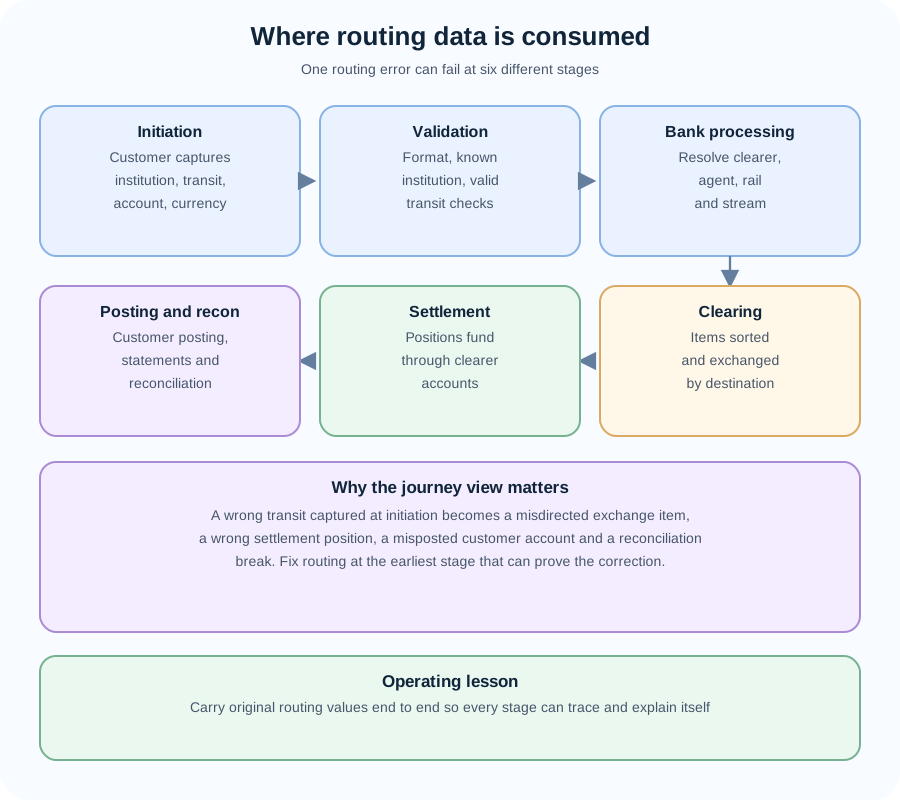
The diagram above is the investigator's map as well as the designer's: when an exception lands, locate the failing stage on this journey, pull the routing values as they existed at that stage, and walk backwards toward initiation comparing values and table versions. Most investigations end within three hops, because most routing failures are capture errors, stale tables or mapping mistakes — and the journey view tells you exactly which three hops to check first.
9. Posting, accounting, liquidity, reporting and reconciliation
Value that cannot be posted, accounted for, funded and reconciled has not finished moving, whatever the clearing system says. This section follows routing data into the financial and informational disciplines that complete the payment: customer posting, internal accounting, liquidity management, customer reporting and reconciliation.
Posting applies the routed item to customer accounts, and routing accuracy determines whether the right account is debited or credited on the first attempt. For inbound items the beneficiary institution matches the fields required by the applicable rail to a live account and applies its own account, status and any name-matching controls before posting or returning with a precise reason. Those checks are not universal across all rails. For outbound items the sender's institution debits the originator and stands behind the outward instruction. Misrouted items fail posting cleanly (account does not exist at that transit) or dangerously (account exists but belongs to a different customer — the wrong-account credit that creates recovery proceedings and customer harm). Posting controls therefore include existence and status checks before credit, prompt return handling under the applicable rule and cutoff, and suspense handling for the genuinely ambiguous: items that cannot be posted and cannot be immediately returned sit in suspense accounts under tight ageing control, with routing investigation — not indefinite warehousing — as the exit path.
Accounting records what posting did and what clearing and settlement require. Routing enters accounting through the clearing and settlement accounts the entries use: items for different clearers, agents and settlement positions must land in the right internal accounts. Misdirected items corrupt this layer twice — through the wrong expected entries, then through the exceptional entries that correct them — which is why accounting break reports should feed routing-quality metrics directly.
Liquidity is where routing errors become funding costs. Treasury funds the settlement positions that clearing produces, and those positions are built from items sorted by routing. Systematic misdirection shifts value between positions and forces late adjustments that cost more than planned funding. Settlement forecasts should be reconcilable to routed-item populations, and major reference-data changes should reach funding teams as liquidity events, not just operations notices.
Customer reporting translates routing outcomes into language originators and beneficiaries can act on. Originators need submission acceptances with item-level repair and reject detail — which items, which fields, which reasons, by when to fix for which value date — plus return reporting with actionable reasons rather than codes that require a decoder ring. Beneficiaries need credits described with the remittance and reference information that lets them apply cash, plus timely notification of returns and adjustments affecting them. Both sides need statements and advices in which the institution, transit and account identifiers appear consistently and correctly, because customers reconcile against these fields and mislabeled reporting manufactures customer-side breaks from bank-side accuracy. The reporting standard for routing is simple to state and demanding to meet: every report a customer uses for reconciliation must carry the routing values as processed, the original values where repair occurred, and reasons in words the customer can act on without phoning the bank.
Reconciliation proves the whole story and routing is one of its match keys. The standard discipline is multi-way: originator instructions matched to bank acceptances, bank records matched to clearing exchange records, clearing records matched to settlement positions and funding, settlement matched to beneficiary posting, and customer reports matched to all of the above. Routing fields participate at every match point — did the institution and transit submitted equal the institution and transit exchanged, settled, posted and reported — and mismatches at any point isolate the stage where the address changed or the table differed. Breaks age-stratified and cause-coded feed the same quality system as exceptions: a reconciliation break coded to routing cause is an exception wearing reconciliation clothes, and the investigation method of Section 8 applies unchanged. Banks that reconcile routing fields explicitly, rather than assuming them constant, catch tampering, truncation and table divergence that amount-based matching alone can never see.
10. Bank implementation, testing and resilience
Knowing how routing should work and building a bank that does it reliably are different achievements. This section is the implementation checklist: how to store and consume routing truth, how to test it, and how to keep it working when feeds fail, vendors change and migrations churn the address space.
Reference-data architecture comes first because every other component depends on it. If the institution subscribes to the FIF, consume its output through an automated, versioned process where appropriate: record the delivery version, receipt timestamp, effective date and record counts; stamp each downstream table with the source version; and keep validation, sorting and settlement-forecast components aligned rather than maintaining private copies. Monitor file age against a defined threshold with alerting, and define degraded-mode behaviour explicitly — for example, warn-and-queue above one age and restrict high-risk operations above another — rather than discovering the policy during an incident. Manage agent mappings as first-class reference data with effective dates, so an announced agent switch flows from publication to production tables on its effective date without manual rekeying, and retain superseded mappings with their validity periods so historical items remain interpretable. Test feed failure modes deliberately: late file, corrupt file, empty file, file received but load job failed — each with a designed system response and an operations runbook entry.
Validation and routing engines implement the Section 3 stack as shared services, not per-channel reinventions. Build one validation service with the layered checks — format, existence, pairing plausibility, currency context, arrangement resolution — consumed identically by mobile, branch, file upload, treasury workstation and API channels, so a routing number accepted in one channel is accepted in all and a reject in one carries the same reason everywhere. Build one resolution service that maps institution-plus-transit-plus-currency to clearer, agent, rail and stream, versioned against the reference file it used. Log every decision with its inputs, table versions and outcome; preserve original values alongside derived ones through every transformation; and expose repair as a privileged, audited operation with enumerated permissible correction types rather than free-text editing of routing fields. Review channel parity quarterly: any channel-specific validation logic is a bypass candidate until proven otherwise.
Masters and templates — vendor masters, employee records, beneficiary templates — need lifecycle management, not just initial capture. Require verification of new addresses before first use, with change-verification workflows for modifications as Section 7 demands; schedule periodic reverification for high-value and high-volume payees; consume transit-restructuring and institution-change publications into master hygiene reviews rather than waiting for returns to announce them; and quarantine bulk-imported or migrated addresses for validation before they reach production payment flows. Migration discipline deserves emphasis because migrations manufacture routing incidents at scale: source-system addresses must be mapped, validated against current reference data and reconciled by population — record counts, institution distributions, repair rates — before the new system releases its first payment, with a rollback criterion defined in advance.
Testing must cover the routing layer as a layer. Maintain a test pack with valid items for each arrangement type (direct and indirect-behind-agent), invalid items for each validation layer, boundary items (leading-zero handling, field-length edges), and change-event scenarios (agent switch effective dating, transit retirement). Use only the real institution numbers this course permits — 001, 002, 003, 004, 006, 010 — with all other institution values explicitly fictional and all transit values illustrative. Test the hostile cases: CAD-valid fields on USD items, concatenated routing-plus-account strings, truncated fields, and rolled-back table versions simulating staleness.
Resilience is the plan for routing's bad days: stale-table response, mass-misdirection reprocessing, vendor-feed failure sourcing, and diversion-fraud containment — each with owners, authorities and communication templates. Exercise these playbooks with the same seriousness as settlement-failure exercises, because a routing outage is a settlement-accuracy outage with customer names on every item.
11. Practical Canadian examples
Theory earns trust through worked cases. The three scenarios below are entirely fictional — institutions beyond the well-known numbers are illustrative, all transit numbers are illustrative, all company and personal names are invented, and all amounts are chosen for teaching, not drawn from any real payment. Each is labelled accordingly and each exercises a different part of the chapter.
Example (fictional): the payroll file with three bad addresses
A fictional Ontario food distributor, Lakeview Fresh Foods (fictional), submits a Thursday AFT payroll file of 240 credits through its bank's business portal. Three items carry routing problems from three different causes. Item one names institution 004 (TD, real) with an illustrative transit whose digits were transposed at HR keying — a capture error producing an invalid pairing. Item two names a fictional institution number that was never issued — a vendor-master corruption from a spreadsheet import months earlier. Item three is a USD-denominated payment to a cross-border commuter's US-dollar account, submitted into the CAD payroll flow without a currency-context flag — a regime error.
Walk the chapter's machinery over the file. Initiation controls should have caught item three at the portal by demanding a currency context and routing USD items to their separate handling. Validation layers dispose of the rest: existence checks reject item two's unknown institution, pairing checks flag item one's invalid institution–transit combination. Item two is rejected outright; item one is repaired only if the transposition resolves to exactly one published transit for 004 with recorded authority. The bank's repair-and-reject report goes back to Lakeview the same afternoon with item-level reasons, and the portal team receives a change request: currency-context selection before file acceptance, not after.
Example (fictional): the indirect clearer behind a new agent
A fictional small Ontario credit union, Frontenac Community Credit Union (fictional), clears indirectly through a clearing agent. On 1 March the credit union moves its clearing agency to a different direct clearer under a published arrangement change with an effective date. A fictional mid-sized utility, Rideau Valley Energy (fictional), collects PADs from 30,000 customers including several hundred whose accounts sit at Frontenac. Rideau Valley's bank consumes the updated Financial Institutions File on schedule and its resolution tables reflect the new agent from the effective date. A second fictional collector in the same market, processing through an older outsourced platform, loads reference data quarterly and misses the change.
Trace March's collections. The current-table collector's items resolve to the new agent, exchange cleanly and post normally — the customers notice nothing. The stale-table collector's items resolve to the former agent, which no longer presents for Frontenac; items return, value dates slip, and customers receive late-payment notices for debits that failed on addressing, not on funds. Investigation follows Section 8 backwards: the table version behind the resolution predates the effective date, and the determined cause is stale reference data. Recovery combines emergency refresh, corrected re-presentation, reversal of wrongly applied late fees, and plain-language customer communication.
Example (fictional): the supplier address change that was really a diversion attempt
A fictional Alberta equipment dealer, Prairie Ridge Equipment (fictional), receives an email appearing to come from a long-standing supplier, a fictional Calgary fabricator, advising that "new banking details effective immediately" are attached — a different institution number in the 001/002/003/004/006/010 family is not even needed for the attempt to look plausible, because the replacement address uses a valid institution number with a plausible transit and account. Prairie Ridge's accounts-payable clerk keys the new address into the vendor master without verification, and a $180,000 (fictional amount) progress payment is scheduled for the following week.
Apply the chapter's fraud controls before value moves. The vendor-master change workflow flags any beneficiary-address change as high-risk and holds the first payment pending out-of-band verification. The verification call uses a known-good number from the master agreement, not the reply-to on the email, and the supplier confirms no change was requested. The payment is stopped, the master change is reversed with full audit trail, and the incident is reported through the bank's fraud channels. Prairie Ridge's follow-up is structural: mandatory out-of-band verification for every beneficiary change and dual authorisation above a threshold.
12. Key takeaways and authoritative references
Twelve points carry the chapter. First, a Canadian routing number in the CACPA convention is the nine-digit form 0IIITTTTT — leading zero, three-digit institution number, five-digit transit number — and the account number travels separately; routing names institution plus branch, the account names the customer. Second, institution numbers are administered under the Payments Canada framework functionally described in Rule D4, while direct payment routing numbers follow the framework functionally described in Rule F8; know what each governs and confirm current text in the official rules documentation rather than quoting from memory. Third, the only institution numbers asserted as fact in this course are 001 Bank of Montreal, 002 Bank of Nova Scotia, 003 Royal Bank of Canada, 004 Toronto-Dominion Bank, 006 National Bank of Canada and 010 Canadian Imperial Bank of Commerce — every other number in examples and test data is illustrative or fictional. Fourth, transit numbers are assigned by each institution for its own branches and processing points and churn continuously; counterparties learn of changes only through published reference data they must actually consume. Fifth, US-dollar items through USBE carry their own routing and identification treatment under the Rule K-series umbrella; never validate, sort or settle USD items on CAD assumptions. Sixth, routing must resolve to the clearing arrangement, not just the institution: direct clearers settle in their own name while indirect clearers settle through a clearing agent, with bilateral settlement between agent and indirect outside system settlement. Seventh, validation runs in layers — format, existence, pairing plausibility, currency context, arrangement resolution — and repair is legitimate only from authoritative reference data with a recorded trail; a repaired-to-wrong posting is worse than a clean reject. Eighth, routing determines path and settler while finality belongs to the rail and the item: Lynx has operated since 1 September 2021 with its own finality properties, batch clearing settles deferred net with return exposures, and availability is never finality. Ninth, diversion fraud, validation bypasses and reference-data staleness are the routing threat model; beneficiary-change verification, override discipline and table-currency monitoring are the corresponding controls. Tenth, exceptions use exact vocabulary — reject, repair, return, misdirect, recall — and every exception leaves evidence and a determined cause that feeds prevention. Eleventh, routing accuracy flows into posting correctness, suspense levels, settlement funding, customer reporting and reconciliation matching; measure first-time acceptance, repair and reject rates by cause, and reference-data age at every decision. Twelfth, implementation means versioned reference feeds, shared validation and resolution services, lifecycle-managed masters, a routing-specific test pack using only permitted real numbers, and exercised playbooks for stale-table and mass-misdirection events.
Common misunderstandings deserve explicit correction. The institution number does not identify the branch; the branch/transit does where that rail uses one. The electronic DPRN does not include the account number. The institution on an ACSS item is not necessarily the settler; the applicable clearing-agent arrangement decides. CAD AFT routing rules do not apply to USD paper USBE or USD AFT. A valid format is not a valid address. Settlement is not finality. And RTR is not yet in production as of this audit: Payments Canada currently targets Q4 2026 launch with sequenced onboarding, so its future design must not be presented as a current operating fact.
Authoritative references
- Payments Canada, rules documentation (current rule text including the D4, F8 and K-series frameworks): https://www.payments.ca/systems-services/rules-documentation
- Payments Canada, Lynx high-value payment system (live since 1 September 2021): https://www.payments.ca/systems-services/payment-systems/high-value-payment-system-lynx
- Bank of Canada, payment systems oversight: https://www.bankofcanada.ca/regulatory-oversight/financial-market-infrastructures/payment-systems-the-bank-of-canada-oversees
- Bank of Canada, settlement-account policies for Payments Canada systems: https://www.bankofcanada.ca/core-functions/financial-system/bank-canadas-settlement-account-policies-for-payments-canada-payment-systems
- Payments Canada, Rule D4 — Institution Numbers and Clearing Agency/Representative Arrangements: https://www.payments.ca/sites/default/files/d4eng.pdf
- Payments Canada, Rule F7 — Automated Funds Transfer System Financial Institutions File: https://www.payments.ca/sites/default/files/f7eng.pdf
- Payments Canada, Rule F8 — Automated Funds Transfer System Direct Payment Routing Numbers: https://www.payments.ca/sites/default/files/f8eng.pdf
- Payments Canada, Rule K1 — Bulk Exchange and Settlement of U.S. Dollar Paper Items: https://www.payments.ca/sites/default/files/k1eng.pdf
- Payments Canada, Rule K4 — U.S. Bulk Exchange Automated System: https://www.payments.ca/sites/default/files/k4eng.pdf
- Payments Canada, Rule K8 — U.S. Dollar Automated Funds Transfer System: https://www.payments.ca/sites/default/files/k8eng.pdf
- Payments Canada, Financial Institutions File: https://www.payments.ca/systems-services/payment-services/financial-institutions-file
- Payments Canada, Financial Institutions Branch Directory and other directories: https://www.payments.ca/payment-resources/directories
- Payments Canada, Real-Time Rail payment system: https://www.payments.ca/systems-services/payment-systems/real-time-rail-payment-system
- Payments Canada, RTR testing and launch: https://www.payments.ca/systems-services/payment-systems/real-time-rail-payment-system/testing-and-launch
- FINTRAC, Reporting electronic funds transfers: https://fintrac-canafe.canada.ca/guidance-directives/transaction-operation/eft-dt/eft-dt-eng
- FINTRAC, Reporting suspicious transactions: https://fintrac-canafe.canada.ca/guidance-directives/transaction-operation/str-dod/str-dod-eng
- Bank of Canada, retail payments supervision under the RPAA: https://www.bankofcanada.ca/regulatory-oversight/retail-payments/
- FCAC, How to file a complaint with your bank: https://www.canada.ca/en/financial-consumer-agency/services/complaints/file-complaint-financial-institution.html
- OSFI, Third-Party Risk Management Guideline: https://www.osfi-bsif.gc.ca/en/guidance/guidance-library/third-party-risk-management-guideline
- Justice Canada, Canadian Payments Act: https://laws-lois.justice.gc.ca/eng/acts/c-21/FullText.html
- Justice Canada, Payment Clearing and Settlement Act: https://laws-lois.justice.gc.ca/eng/acts/p-4.4/index.html
- Justice Canada, Retail Payment Activities Act: https://laws-lois.justice.gc.ca/eng/acts/r-7.36/FullText.html
- Interac, Interac e-Transfer: https://www.interac.ca/en/consumers/products/interac-e-transfer/
This application uses JavaScript for the full interactive experience. This text summary is served for accessibility and search indexing.