How Money Moves in Canada. Follow a payment from customer initiation through bank processing, clearing or exchange, settlement, posting and reconciliation.
Canada Payments & Collections · Block 1: Canada Payments Foundations · Chapter 2 of 75
Canada has several payment rails, but one reusable lifecycle logic. Whether a Toronto employer pays 10,000 staff by direct deposit, a Montreal manufacturer wires CAD 4.2 million to a supplier, or a Vancouver renter sends CAD 900 to a roommate, the same operating stages recur: someone initiates, the bank validates, the bank processes and routes, the instruction is cleared or exchanged, obligations are settled, accounts are posted, someone is told, and someone proves it balanced. This chapter gives you that reusable mental model. Every later rail chapter — ACSS, AFT, PAD, Interac, Lynx, USBE, cross-border, and the planned Real-Time Rail (RTR) — reuses it and only changes the timing, the evidence, and the exception rights.
If Chapter 1 answered "what exists in Canada," this chapter answers "how anything moves, step by step, and how you know it finished." Read it slowly. Analysts, product owners, operations staff, and engineers all use this same vocabulary when they argue about cutoffs, returns, settlement risk, reconciliation breaks, and customer promises. Getting the vocabulary right now saves months of confusion later.
A working rule for the whole Canadian programme is simple: the eight operating stages and the settlement/posting states are related, but they are not the same event. Initiation, validation, bank processing, clearing or exchange, settlement, posting, reporting and reconciliation are the stages; availability and finality are states whose timing depends on the rail and bank policy. A customer can see a confirmation before settlement. A bank can post before finality. A network can accept a file that still contains one bad item. Reconciliation exists precisely because these events separate.
What you should be able to do after this chapter
After working through this chapter, you should be able to:
- walk any Canadian payment through the same 8 stages — initiation, validation, bank processing, clearing or exchange, settlement, posting, reporting, reconciliation — and say what evidence each stage leaves;
- explain who does what among the customer, the sending bank, the receiving bank, Payments Canada systems, the Bank of Canada, Interac Corp, correspondents, and service providers, and where each system boundary sits;
- decide whether a payment can stay on-us or must go interbank, and choose the plausible Canadian route (AFT/ACSS, Lynx, Interac e-Transfer, USBE, correspondent/SWIFT) from business facts;
- define clearing, exchange, settlement, posting, availability, and finality as distinct events with distinct timestamps and distinct proof;
- contrast deferred-net settlement (ACSS) with real-time gross settlement (Lynx) in terms of liquidity, timing, finality, and return rights;
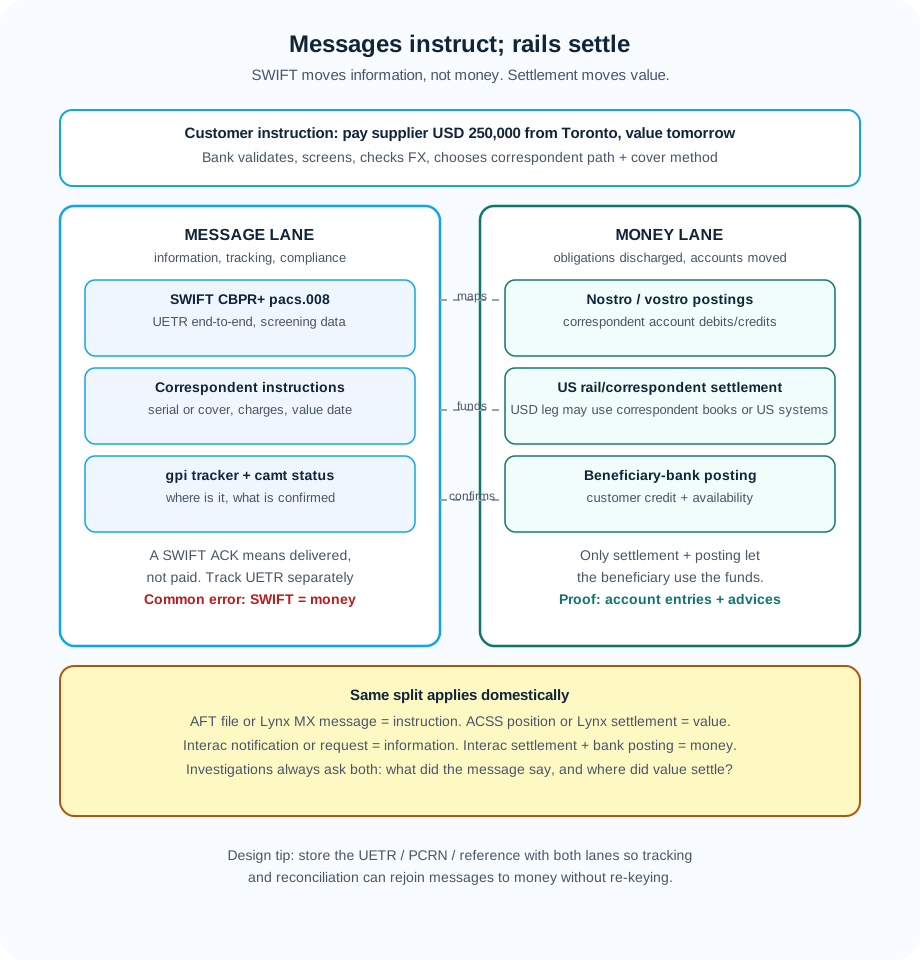
- explain why SWIFT and correspondent messages instruct and inform but do not themselves settle, and where the actual settlement happens;
- describe the data that travels with a payment — identifiers, references, UETR, PCRN, Lynx ISO 20022 MX versus AFT legacy formats — and why preserving references determines whether reconciliation and investigations work;
- interpret cutoffs, business days, and service levels as customer-impact promises, not just operations trivia;
- place fraud, sanctions, AML, and payment controls at the correct stage gates instead of treating them as afterthoughts;
- use reject, return, recall or return request, reversal, and investigation precisely, and explain why each preserves the original transaction identity;
- explain posting, accounting, liquidity, reporting, and three-way reconciliation as the proof layer that lets a bank tell a customer "it settled" with confidence;
- recognise the main operational risks and what a bank must build and test before going live;
- correct common misunderstandings such as "SWIFT moves money," "clearing equals settlement," and "Interac is the RTR."
For a roughly 60-minute core session, spend about 30 minutes on Sections 1–4 (the 8-stage model, participants, and clearing versus settlement), 15 minutes on Sections 5–7 (data, cutoffs, controls) using the five diagrams to trace one payment, 10 minutes on Section 11 (the three fictional Canadian stories), and 5 minutes on Section 12 (takeaways). The remaining depth — message details, exception mechanics, posting and liquidity nuance, and implementation checklists — is follow-up study that later chapters expand rail by rail.
Chapter navigator
- Business context and customer need
- Participants, responsibilities and system boundaries
- Initiation, validation and bank processing
- Clearing or exchange, settlement and finality
- Data, identifiers, messages and references
- Rules, cutoffs, service levels and customer impact
- Fraud, compliance and operational controls
- Exceptions, investigations and recovery
- Posting, accounting, liquidity, reporting and reconciliation
- Bank implementation, testing and resilience
- Practical Canadian end-to-end example
- Key takeaways and authoritative references
1. Business context and customer need
Every payment starts with a business obligation, not a rail. An employer owes wages on Friday. A utility has billed thousands of households and needs to collect. A student owes rent. A manufacturer must pay a supplier before goods ship. A charity must disburse grants and prove each one. The customer does not wake up wanting "an ACSS credit" or "a Lynx pacs.008." They want a promise kept: the right person is paid the right amount on the right date, with proof that stands up to audit, dispute, or a worried phone call.
That is why this chapter teaches one lifecycle instead of five rail manuals. Bank professionals constantly translate between two languages. The customer speaks in obligations, dates, and consequences: payroll must land before the long weekend, the supplier releases steel only against confirmed funds, the roommate needs the deposit tonight. The bank speaks in instructions, clearing windows, settlement positions, postings, and returns. The 8-stage journey is the translation table between those languages. When a product owner writes "payroll posts Friday morning," operations must hear "AFT file validated Thursday, exchanged in the correct ACSS stream, net position funded at settlement, beneficiary posting per receiving-bank policy, returns monitored Friday, reconciliation closed with linked exceptions." When a customer says "the wire is urgent," the analyst must hear "Lynx RTGS with intraday liquidity, immediate finality, no unilateral return — validate twice, release once." Practise this translation on every requirement you read: underline the customer promise, then write the eight lifecycle events it implies with the evidence each one leaves. Requirements that cannot survive that exercise — a promise with no identifiable settlement proof, a date with no cutoff behind it, a "guaranteed" batch payment with no acknowledgement of return rights — are not ready for design, however confidently they are written.
The Canadian context makes a single model especially valuable because the rails look deceptively different on the surface. A payroll file, a mobile Interac send, and a dealing-room wire feel like different businesses. Underneath, each still needs initiation evidence, validation gates, a routing decision, clearing or exchange, settlement, postings, reporting, and reconciliation. The differences that matter are timing (batch versus real-time), settlement money (central-bank money in Lynx, deferred net positions funded via Bank of Canada accounts for ACSS), finality (immediate and irrevocable in Lynx, conditional with return rights in batch), and message standards (Payments Canada ISO 20022 specifications for Lynx, ISO 20022 AFT onboarding alongside legacy formats, Interac’s own addressing/status flows, and SWIFT CBPR+ for applicable cross-border messages).
Consider the stakes from the bank's side. In 2025, Payments Canada reported 10.6 billion ACSS items worth CAD 10.009 trillion and 13.6 million Lynx items worth CAD 93.3 trillion—about CAD 103.3 trillion combined. These are system-reported totals, not a claim that every customer payment crossed an interbank system; on-us items are excluded from ACSS statistics. Those numbers explain why a small design error — a wrong cutoff, a dropped reference, a misunderstood return window — multiplies into thousands of customer impacts overnight. Payroll is the sharpest example. A single employer file with 10,000 credits becomes 10,000 promises to households. If the file misses its window, the bank cannot "hurry the network." It must explain, repair, re-release, manage liquidity for the new settlement date, handle returns, and reconcile every item so finance, the employer, and each employee's bank agree.
Collections deserve equal attention because newcomers often treat "payments" as payouts only. Pre-authorised debits, bill payments, card collections, and business receivables follow the same 8 stages with the direction reversed and authority playing a larger role. A PAD collection still needs initiation under an agreement, validation of mandate evidence and timing, routing, clearing, settlement, posting of the debit, reporting, and reconciliation — plus stronger return rights because the payer did not actively push each collection.
Finally, the lifecycle protects you against the most expensive category of error: confusing customer experience with money movement. An Interac sender sees "completed" quickly. A payroll employee sees a Friday credit. A wire beneficiary sees funds the same morning. None of those screens, by itself, tells you whether interbank settlement happened, whether finality attached, or whether a return is still legally possible. The discipline this chapter installs is to always ask four questions before declaring success: where is the instruction, where is the clearing or exchange record, where is the settlement proof, and where is the posting? If you can answer all four with references that join to each other, you understand the payment. If you cannot, you have a customer message without money, or money without proof — both of which become incidents.
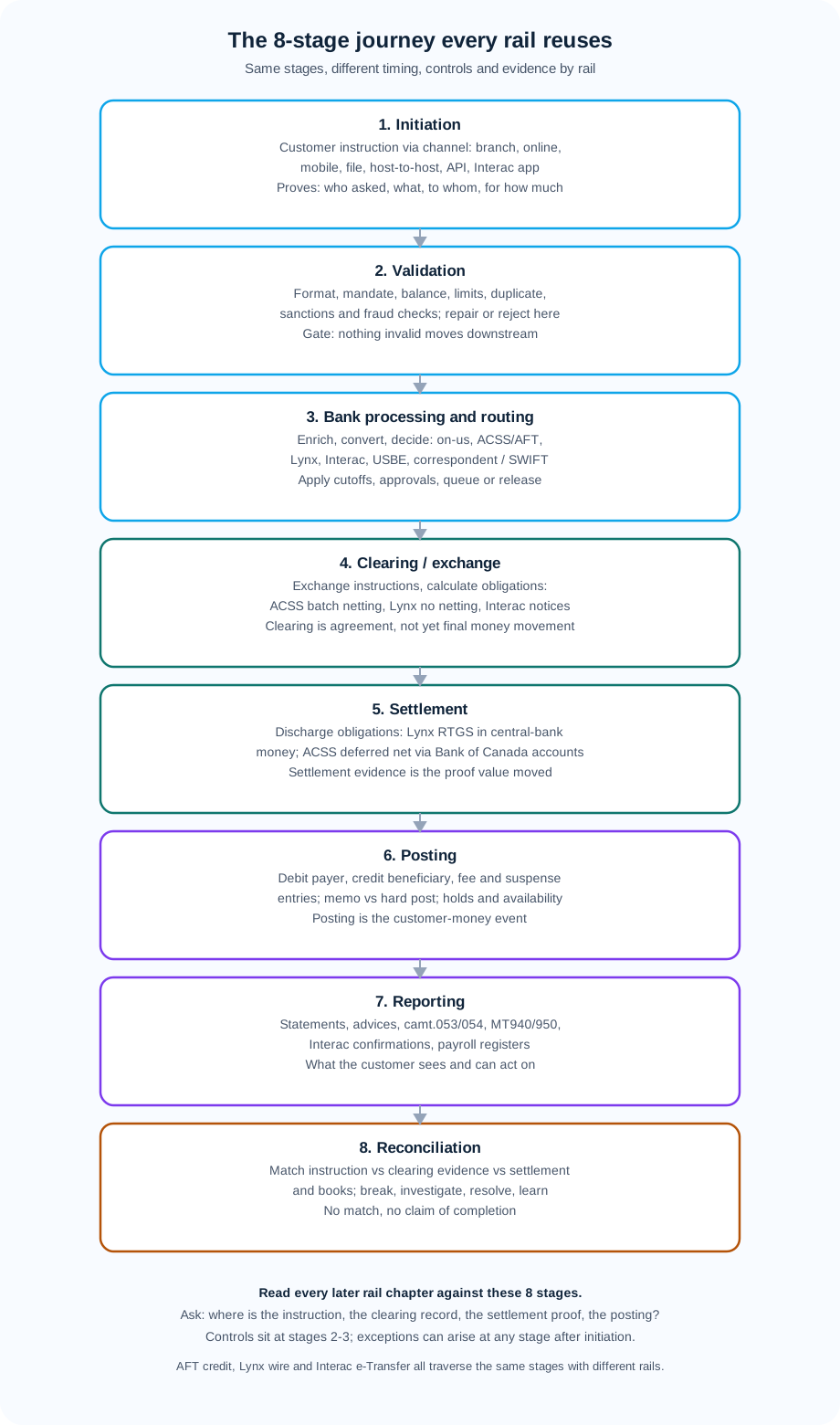
The diagram above is your anchor for the rest of the programme. Every rail chapter will map itself onto these eight boxes. When you feel lost in stream codes, message types, or by-law language later, return here and ask which box you are in. That habit — locating yourself in the lifecycle before debating detail — is the single most useful skill this chapter teaches.
2. Participants, responsibilities and system boundaries
A payment only moves when each participant does its bounded job and hands over clean evidence. Canadian payments involve more parties than the two customers, and blurring their responsibilities is how incidents start. This section draws the boundaries crisply so that later chapters on participation models, access, and sponsorship make sense.
The originator or sender creates the economic need and the instruction. For a payroll credit this is the employer; for a PAD it is the biller; for an Interac send it is the individual; for a wire it may be a corporate treasury team. Their responsibility is authority, accuracy, and funding: they must be entitled to instruct, the details must be right, and the sending account must be able to bear the debit plus fees on the intended date. Banks often under-invest in originator education, then pay for it in repairs. A payroll administrator who does not understand value dates, or a business user who re-sends a file "just in case," creates the duplicates that reconciliation must later untangle.
The originator's bank (sending bank) owns validation, processing, routing, and release: format, mandate, balance, limit, fraud, and sanctions checks; enrichment with routing and reference data; the routing decision; approvals and cutoffs; and release into the correct channel. Critically, it also owns the decision to stop. A bank that cannot reject cleanly cannot operate safely. Rejection at the bank boundary is cheap; recovery after settlement is expensive and sometimes impossible without the other party's consent.
The beneficiary's bank (receiving bank) owns receipt, validation, posting, and beneficiary communication. For wires, once Lynx settlement is confirmed it can post with finality on the interbank leg. For batch items, it posts subject to the rail's return framework — NSF or invalid-account returns remain possible inside defined windows. Much customer anger comes from availability language: "posted," "available," and "final" are different promises, and Section 4 separates them.
Payments Canada owns and operates Lynx and the retail batch system (ACSS/USBE) under the Canadian Payments Act framework, and is building the future RTR. It sets system by-laws, rules, exchange mechanics, and operating procedures. It does not hold customer accounts or judge the underlying business deal. When this chapter says "clearing," it usually means the Payments Canada-operated exchange and obligation-calculation layer; "settlement" means discharging those obligations with the Bank of Canada as settlement agent.
The Bank of Canada plays three roles newcomers often collapse into one. First, settlement agent: Lynx settles in central-bank money across settlement accounts at the Bank, and ACSS net positions are funded through accounts at the Bank. Second, overseer of designated systems under the Payment Clearing and Settlement Act—Lynx is systemically important, while ACSS and Interac e-Transfer are prominent payment systems. Third, supervisor of PSPs that are subject to the Retail Payment Activities Act. Settlement agency is daily plumbing; PCSA oversight is system designation and risk control; RPAA supervision covers registered PSPs and applicants within its scope, not every bank payment function. "Who regulates this payment" depends on which role is meant.
Interac Corp operates Interac e-Transfer. It is designated by the Bank of Canada as a prominent payment system but is not a Payments Canada system. Its addressing, notifications, and settlement arrangements differ from AFT and Lynx, so treating Interac as "another Payments Canada stream" produces wrong assumptions about rules, timing, and evidence.
Correspondents, intermediaries, and service providers complete the map for cross-border and USD activity. A Canadian bank sending foreign currency instructs through correspondent accounts and SWIFT CBPR+ messages, with value settling on a foreign rail or across correspondent books. The Canadian bank remains responsible to its customer for validation, screening, charges transparency, value-date honesty, and tracking. Payment hubs, core vendors, and screening utilities act as agents: outsourcing the work never outsources the accountability.
Two boundary principles recur throughout the programme. First, on-us versus interbank is a hosting fact, not a brand impression. Indirect participants route through a direct clearer; that handoff is an interbank boundary with its own cutoff and evidence even when the customer sees one brand. Second, every boundary needs a handoff record — channel to hub, hub to gateway, gateway to network, network to settlement, settlement to posting — each timestamped and reference-keyed. Investigations and reconciliation are only as good as these records.
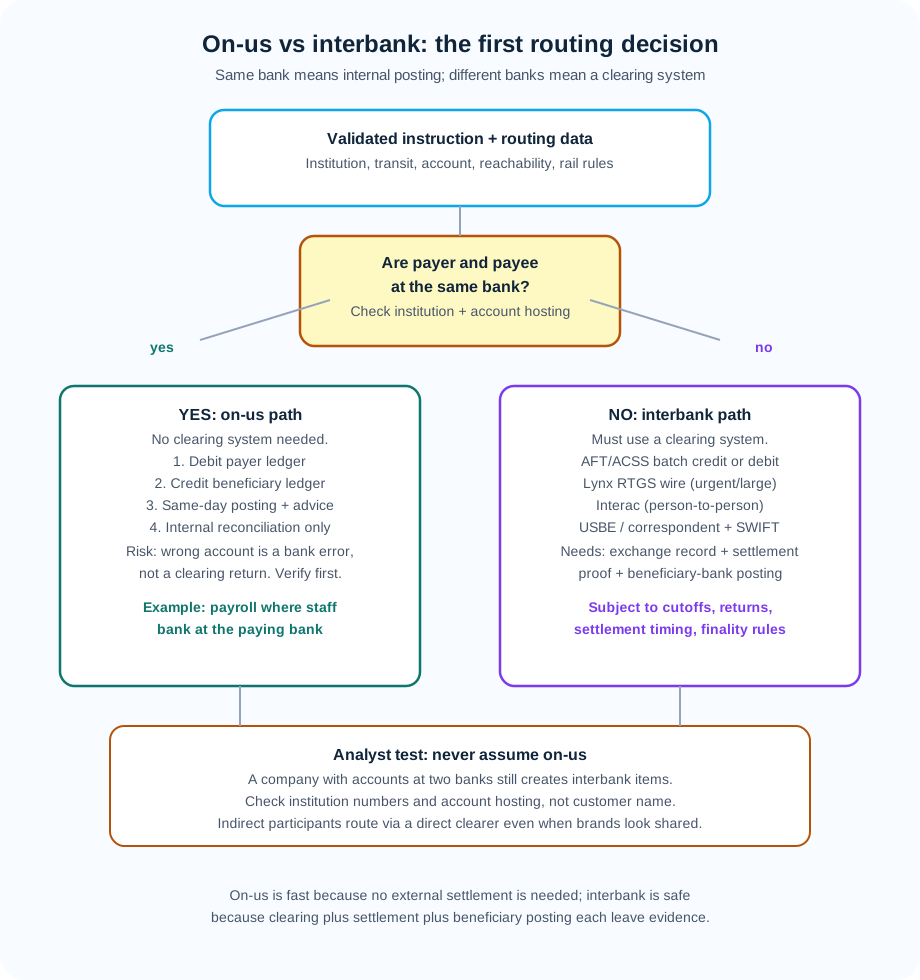
Use the decision diagram as a daily tool. Before debating message formats or settlement models, ask the on-us question with data: same legal entity, same core, same account hosting? If yes, design internal posting controls and duplicate protection. If no, design for clearing evidence, settlement timing, return rights, and beneficiary-bank posting lag. Most Canadian retail volume is interbank, which is why this programme spends so much time on ACSS, Lynx, and reconciliation — the interbank path is where proof matters most.
3. Initiation, validation and bank processing
Stages 1 through 3 determine whether everything downstream is smooth or painful. Industry data and post-incident reviews agree: most payment pain originates in initiation and validation, not in settlement engines. A clean instruction that is validated once, enriched once, and routed once flows. A dirty instruction that slips through generates repairs, returns, investigations, and reconciliation breaks that cost multiples of the original effort. This section walks the three stages as an operator would.
Initiation captures intent in a form the bank can act on without guessing. Channels vary: branch and contact centre for assisted wires; online and mobile for consumer transfers and bill payments; file upload and host-to-host for payroll, supplier batches, and PAD collections; APIs for embedded flows; the Interac experience for person-to-person sends and requests. Good initiation collects the minimum complete dataset: who pays, who is paid, how much, in what currency, on what date, with what references, under what authority. It binds authentication to the instruction and, for business files, enforces release discipline — who prepared, who approved, whether dual approval applied, and whether the file was released once. Duplicate release of a payroll file is a classic initiation failure no settlement engine can fix; it must be prevented at source with hashes, control totals, and release locks.
Initiation must also separate look-alike intents. A request for money is not a payment. A future-dated instruction is not yet releasable; warehousing it with a clear trigger is part of initiation. A recurring instruction needs mandate linkage so each occurrence inherits authority without re-keying risk. Test every channel and file specification against one question: can a reasonable user express the wrong intent by accident, and would the bank notice before release?
Validation is the layered set of gates that earns the right to move money. Format and completeness (valid transit, institution, account structure; valid Lynx MX; valid Interac addressing). Authority (mandate on file, dual approval above threshold, file release authority). Funds and limits (balance plus fees within intraday and file-level limits). Duplicates (hashes and references against recent history). Reachability (destination reachable by the route on the intended date). Risk and compliance — fraud scoring, sanctions screening, AML review — before release, because holding before release is always cheaper than recovering after settlement. Section 7 details placement; the lifecycle point is that validation is a gate, not a suggestion.
Validation outcomes must be explicit. Accepted means the item may proceed. Rejected means the bank stopped it before release and must tell the initiator why with repair-grade specificity. Held means it awaits approval, funding, or screening disposition, with a clear owner and expiry. Repaired means a defect was corrected under controlled rules and re-validated. Weak banks validate silently and release hopefully. Strong banks reject early and keep the rejection in the instruction's history so reconciliation can explain why an expected item never reached clearing.
Bank processing and routing turns a validated instruction into a releasable obligation on the correct path. Enrichment adds what the network needs: routing from institution and transit data, stream selection, value-date assignment, charge handling, reference propagation (UETR, PCRN awareness), and format conversion. The routing decision applies the on-us test first, then rail eligibility: amount, urgency, currency, reachability, cutoff feasibility, cost, and risk appetite. Each choice changes downstream evidence, timing, and exception rights — so the decision must be recorded. When a customer asks "why did it go that way," the bank should show the rule that fired.
Processing also owns scheduling and release. Future-dated items are warehoused with triggers tied to business days and cutoffs. Lynx queues are managed against intraday liquidity. Batch files are split so one bad item does not poison the file. Authorisation to release — who, when, under what limit and approval, with what liquidity check — becomes the anchor reconciliation ties back to. A payment without a clear release record is operationally orphaned.
Design initiation to prevent the errors you least want to reconcile: enforce reference formats, confirm beneficiary details, separate request from payment, lock released files, require dual approval where the rail offers no return. Design validation to fail safe and explain itself. Design processing to preserve identity: the same end-to-end reference must survive enrichment, conversion, and splitting so clearing, settlement, and postings join without fuzzy matching.
4. Clearing or exchange, settlement and finality
This is the section newcomers misunderstand most, because everyday language collapses five distinct events into one word like "cleared" or "completed." In Canadian bank practice, clearing or exchange, settlement, posting, availability, and finality each have their own meaning, timestamp, and proof. Confusing them creates wrong customer promises, wrong liquidity decisions, and wrong incident responses. This section defines each event, contrasts the two Canadian settlement models, and explains finality as a legal and operational state rather than a feeling.
Exchange is delivery of instructions between participants per the rail's rules: items and totals into ACSS streams, ISO 20022 messages into Lynx, notification and acceptance mechanics for Interac, SWIFT messages instructing correspondents cross-border. Exchange evidence answers: what was sent, to whom, when, in what format, accepted or rejected?
Clearing is the agreement and calculation layer on top of exchange. In ACSS batch, exchanged items aggregate into net participant positions; the previous business day's net balances settle during the next business-day morning on Bank of Canada settlement accounts. USBE is the USD component and settles through correspondent banks in New York. In Lynx there is no batch netting; each payment is validated, queued when necessary, and settled gross. A payment can be cleared but not yet settled, and that gap is where liquidity planning, cutoff promises, and customer communication live.
Settlement discharges clearing's obligations and ultimately touches central-bank money. Lynx settles each payment individually in real time across settlement accounts at the Bank of Canada. ACSS settles deferred-net: positions from clearing are funded through accounts at the Bank after the exchange window. Settlement evidence — Lynx confirmations per payment, ACSS records per cycle — is the proof value moved between participants. Without it, a bank has messages and intentions but not interbank value movement.
Posting moves customer and internal accounts: payer debit, beneficiary credit, fees, suspense, settlement-account entries. Ordering versus settlement varies by rail and bank policy. An ACSS credit may be posted or made available before or after the interbank settlement event, so a customer credit is not by itself settlement proof. A Lynx posting can follow the settled interbank leg, but beneficiary-bank screening, routing or posting can still delay end-user availability. Posting evidence lives in core banking and the ledger, not the network, which is why reconciliation must join network evidence to book evidence explicitly.
Availability is when the beneficiary can use the funds. It follows posting but is not identical; holds and risk policy can delay it after a technical credit appears. Availability language is a promise operations, risk, and legal must all agree on — over-promising on returnable batch items creates the overdraft and recovery cases that fill exception queues.
Finality is the point after which the payment cannot be unwound unilaterally under the system's rules. Lynx finality attaches at settlement; recovery then needs the beneficiary's cooperation. ACSS batch items carry defined return rights after apparent completion — NSF, invalid account, PAD dispute — so funded does not mean finished. The RTR is a separate system under build. Payments Canada says it is launching in Q4 2026; By-law No. 10 and the RTR Rules took effect on 24 August 2026 as the legal framework, but the production service is not live at the time of writing. Describe RTR clearing, settlement, fraud services and finality as planned capability until launch and a current rule/version are confirmed.
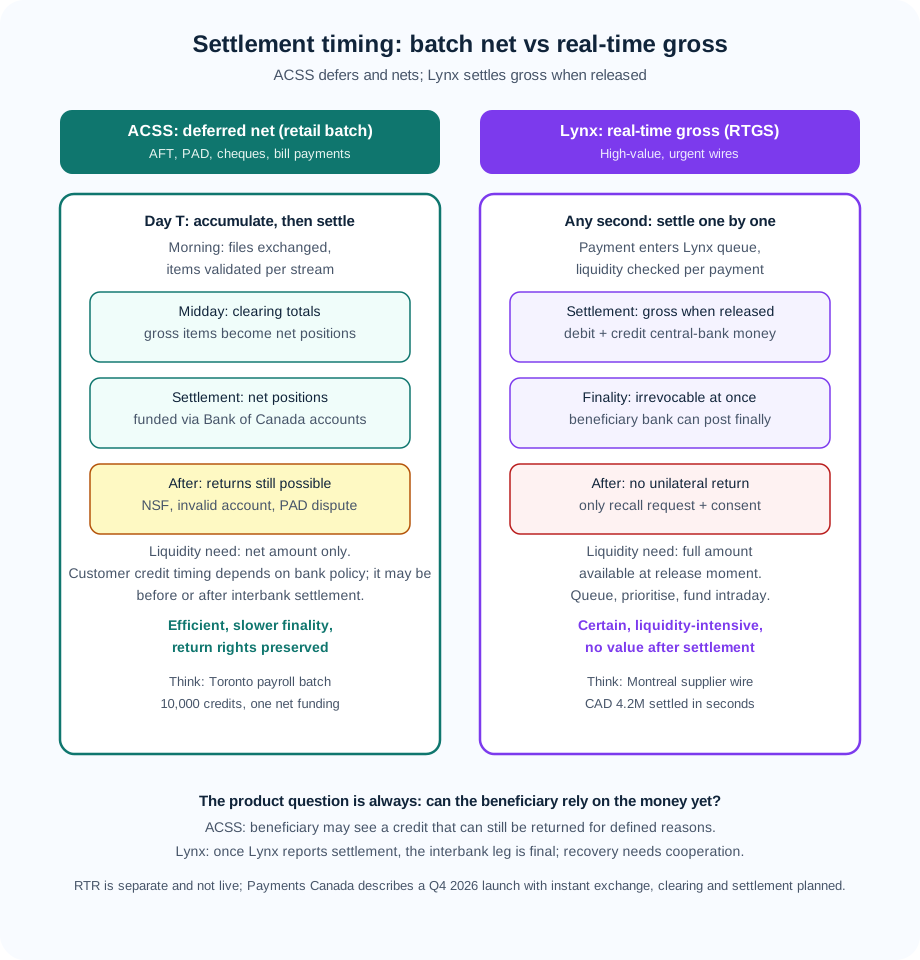
The timing diagram makes the trade-off tangible. Deferred net is liquidity-efficient and preserves retail return rights, but finality is slower and conditional. RTGS is liquidity-intensive but delivers immediate certainty. Match obligation urgency to settlement certainty: wages and recurring collections tolerate deferred net; a CAD 4.2 million release that unlocks shipment needs RTGS finality. Sending urgent value by batch while promising finality, or forcing routine volume through RTGS, is a design error the lifecycle makes visible early.
Two system facts anchor this section. Lynx is the live high-value Canadian-dollar RTGS system and is designated systemically important. Its current Payments Canada materials support ISO 20022 message specifications. ACSS/USBE remains the live retail batch system: ACSS clears Canadian-dollar retail items and USBE is its US-dollar component. Both ACSS and Interac e-Transfer are designated prominent payment systems. The RTR is a supervised build with legal foundations in force and launch activity pointed at Q4 2026 initial launch — labelled planned, not live, because that determines what a bank can promise today.
5. Data, identifiers, messages and references
Payments are data problems before they are money problems. If the data is wrong, incomplete, or dropped in translation, the money either goes to the wrong place or cannot be proven to have gone to the right place. This section introduces the Canadian data layer at lifecycle level — what travels with a payment, what identifies it end to end, how Lynx MX differs from AFT legacy formats, and why reference preservation is the difference between straight-through reconciliation and manual repair.
Start with three data jobs. Routing data gets the instruction to the right account: institution, transit, account, plus beneficiary-agent and correspondent path for wires and cross-border. Business data proves the obligation and lets the beneficiary apply the money: amount, currency, value date, invoice or payroll references, remittance detail, charge allocation. Control data lets banks and investigators track and reconcile: identity detail, screening-relevant parties, message identifiers, end-to-end references, handoff timestamps. A payment missing any of the three can be deliverable yet useless — routable but unappliable, or posted but untraceable.
At minimum, a payment needs a bank transaction identifier, a network identifier or sequence, and an end-to-end reference both sides can quote. For SWIFT/CBPR+ cross-border payments, the UETR supports chain-wide tracking. For Lynx, the PCRN is a unique alphanumeric number generated by Lynx for a wire payment that has settled; it is not assigned to on-us wires and is not a generic pre-settlement instruction ID. Keep the bank's end-to-end reference, UETR where the SWIFT flow uses one, and PCRN where Lynx generates one. Lynx return messages such as pacs.004 have their own rule-defined linkage. The rule is absolute: references created at initiation must survive enrichment, conversion, splitting, clearing, settlement, and posting. Any transformation that rewrites the end-to-end reference breaks tracking, investigations, and reconciliation at once.
Messages and formats differ by rail because each standardised at a different time for a different purpose. Lynx has Payments Canada ISO 20022 message specifications for relevant inter-FI and customer-payment flows, including payment, return and reporting messages. AFT supports ISO 20022 onboarding while legacy formats continue to coexist. Do not assume one format or one field set is universal. Banks must version their mappings and validate both directions so conversion does not truncate names, amounts, remittance or return keys. Interac flows use their own addressing and status model; cross-border instructions use SWIFT CBPR+ ISO 20022 with UETR. Know which format governs each leg, validate at the boundary, and never assume a field present in one standard survives another untouched.
Three practices separate strong operations from fragile ones. Validate at the boundary in the rail's own terms. Carry screening and compliance data with the payment, not beside it, so holds and reporting reference the exact payment. Design remittance for the beneficiary's reconciliation: a payroll credit with employer name and pay-period reference auto-applies; a supplier wire with "payment" in the reference becomes a manual investigation.
A concrete illustration shows why preservation matters. Take a Montreal-to-Toronto supplier wire for CAD 850,000 with invoice references INV-4471 and INV-4472. At initiation the corporate channel creates instruction reference MTL-2026-08841. The bank preserves that reference and builds the applicable Lynx ISO 20022 payment message with the invoice data; Lynx assigns a PCRN when the payment settles. A UETR is included only if the institution’s flow is also a SWIFT/CBPR+ flow. Both advices quote MTL-2026-08841 so the two companies’ accounts-payable and accounts-receivable teams can reconcile without calling either bank. Now imagine enrichment truncated remittance and dropped INV-4472: the money still settles, both postings balance, yet the beneficiary cannot apply CAD 425,000 of it and opens an investigation. The funds moved; the business purpose did not. That gap—settled but unapplied—is a preventable payment failure, and reference preservation is its prevention.
This chapter introduces UETR, PCRN, Lynx MX, and AFT legacy coexistence; tag-level construction belongs to Block 9 and the rail blocks.
6. Rules, cutoffs, service levels and customer impact
Customers experience rules as promises: "it will be there Friday," "same-day if you send by 2 p.m.," "you can cancel until…," "it cannot be reversed after…." Operations experiences the same rules as constraints: exchange windows, settlement cycles, business-day calendars, return windows, and staffing. This section connects the two views so that product, operations, and customer-facing teams describe the same reality.
Rules come in layers. System rules define what the network accepts, when, in what format, with what finality and return rights. Legal and supervisory overlays define what banks must do regardless — screen, report, safeguard, disclose. Bank policy translates both into cutoffs, fees, limits, and availability. Quoting one layer misleads: "the network accepts until 5 p.m." without "our stream cutoff is 3:30 p.m. and your file needs approval by 3 p.m." manufactures a miss. Publish the most restrictive applicable constraint as the customer cutoff.
Cutoffs and business days turn the stages into dates. A cutoff is the latest moment an instruction can enter a stage and still make the cycle — channel, release, exchange, settlement completion. ACSS batch follows business-day cycles with holiday effects that push value dates; Lynx runs its high-value schedule with intraday liquidity management; Interac availability still depends on bank posting; cross-border adds foreign holidays and correspondent cutoffs. Miss the release cutoff and the file misses exchange, settlement, and Friday pay for 10,000 employees. Recovery means re-dating, re-funding, re-communicating, and re-reconciling — because one cutoff was treated as advisory.
Service levels bundle speed, certainty, reach, transparency, and recoverability. Lynx offers speed plus certainty at higher cost with liquidity demands. ACSS batch offers reach plus efficiency with deferred finality and returns. Interac offers person-to-person convenience with its own limits. Correspondent cross-border offers global reach with tracking but multi-party timing. The planned RTR must not be sold as a current service level. Present trade-offs, not rankings: a same-day promise on a returnable batch item is not the same product as a same-day final wire, and pricing, disclosures, and support scripts must reflect that.
Four practices matter most. Promise the posting and availability the rail actually supports, with the return caveat stated where returns exist. Give every promise a cutoff and a fallback: "submit by 3:30 p.m. ET for Friday pay; after that, same-day wire until X at fee Y, otherwise value Monday." Communicate status in actionable lifecycle terms — received, validated, released, exchanged, settled, posted, available, returned — not "processing." Staff through return and investigation windows, not just release hours.
Make the timetable concrete with an illustrative, fictional example—not a Payments Canada rule or universal bank cutoff. For a Friday payroll in Ontario, a bank might require employer approval by noon Thursday, a channel submission by 2:00 p.m., validation and release before its configured AFT cutoff, and then schedule beneficiary posting for Friday. The actual ACSS stream calendar and the bank's customer cutoff must be checked against current Payments Canada rules, closure dates and bank policy. Returns and reconciliation continue after posting, with linked exceptions and customer communication. Each handoff needs a named owner and a visible clock, and the customer-facing promise — "submit by 2:00 p.m. Thursday for Friday pay" — is the most restrictive constraint in that chain, not the network's last acceptance moment. Publish the chain alongside the promise so that when a file arrives at 2:40 p.m., the conversation is about the documented fallback (late-wire options, Monday value dating, partial on-us posting) rather than a negotiation about whether the cutoff was real.
7. Fraud, compliance and operational controls
Controls are gates in the lifecycle, not stickers applied afterwards. Their placement determines whether they prevent loss or merely document it. This section maps fraud, sanctions, AML, and operational controls onto the 8 stages so that designers put each check where it can still stop, hold, or inform — and so that auditors can trace each decision to evidence.
Fraud controls concentrate before release because recovery after settlement is conditional or cooperative. Pre-release work: authentication strength matched to channel and amount, device and behavioural signals, payee verification and callback discipline for changed supplier instructions, velocity and anomaly scoring, dual approval for business payments. For Interac, request-money and impersonation patterns plus autodeposit-registration changes need dedicated scenarios. A fraud score arriving after release is a report, not a control — scores must resolve to release, hold, step-up, or reject before routing commits.
Sanctions and AML controls gate stages 2–3 and shadow the payment downstream. Screening must complete—including false-positive disposition with recorded rationale—before a wire or cross-border item releases. FINTRAC's travel rule applies to international EFTs and Canadian EFTs sent through SWIFT MT-103 or equivalent; it requires specified originator and beneficiary information and is not a blanket rule for AFT direct deposits or PADs. Completeness of required party data is itself a control: truncated data that "passes" screening faster creates the exposure the control was meant to prevent. Holds need honest status with an owner and a clock, and lawful next steps that avoid tipping off.
Operational controls prevent most volume-driven loss: duplicates, balance and limit enforcement, mandate verification, cutoff enforcement, reference validation, release authority, segregation of preparation, approval, and release. Each must produce a decision record — who or what decided, on what data, when, with what outcome. A duplicate check that silently drops the second file prevents double-pay but creates a reconciliation mystery; the same check with a clear duplicate-reject advice prevents both. Controls must be effective and legible: stop bad releases and explain every stop.
Placement summary: initiation owns authentication, authority capture, and intent clarity; validation owns format, mandate, funds, duplicate, reachability, fraud, and sanctions gates; processing owns enrichment integrity, route eligibility, cutoff and liquidity checks, and release authority; clearing/settlement own acceptance monitoring, position funding, and queue management; posting owns account-integrity checks; reporting/reconciliation own completeness and feedback into upstream rules. Each gate needs a rule, a decision record, and a defined next state. Do not treat the planned RTR's future fraud services as current mitigants — real-time irrevocable payments compress the decision window to seconds, so today's validation must stand on its own.
8. Exceptions, investigations and recovery
No lifecycle teaching is complete without its failure vocabulary, because the words banks use in failure determine whether recovery is fast, lawful, and reconcilable — or slow, disputed, and double-counted. Canadian operations use five terms that must never be interchanged: reject, return, recall or return request, reversal, and investigation. This section defines each, places it in the lifecycle, and explains the reference discipline that keeps recovery from becoming a second incident.
A reject happens before the item leaves the acceptance boundary — the sending bank rejects an invalid payroll line, Lynx refuses malformed MX, stream validation refuses a bad record. Nothing settled. Respond with a clear reject advice and reason codes enabling repair. Rejects are the cheapest exceptions and should be the most common: few rejects plus many returns means gates sit in the wrong place. Reconciliation treats a reject as an instruction that never reached clearing.
A return happens after clearing or posting entry, sent back under the rail's framework with a coded reason: NSF for PADs, invalid or closed account for AFT credits, PAD disputes inside rights windows. Returns carry the original reference plus code and date, as linked accounting — never an edit of history. Lynx settled wires have no unilateral return; finality means the sender alone cannot pull value back. Returns are normal, coded, reconcilable exercises of preserved rights — not system failures.
A recall or return request asks the beneficiary side to cooperate after settlement or acceptance made unilateral recovery unavailable: settled Lynx wires sent in error or induced by fraud, accepted Interac sends, cross-border legs paid downstream. It travels as a new message referencing the original bank identifier (UETR or PCRN where applicable). The beneficiary’s cooperation determines the outcome—the network alone cannot compel it. Set the expectation honestly: "we have asked the receiving bank; here is the reference and the clock."
A reversal is a linked accounting unwind permitted only where rail and law allow — original plus reversing entry, never an overwrite. It needs authority, reason, and a pointer to the original. Enforce linkage in the data model: no reversal object without its original.
An investigation is the case around uncertainty: where is it, what state, who holds it, next step. Preserve the original identity throughout — UETR, PCRN, instruction reference — and accumulate evidence in one case with one owner. A payment with two open investigations and no shared reference gets paid twice or written off wrongly.
Two recovery principles. Never re-pay on pressure without locating the original — a "replacement" released while the original is delayed in clearing, queued for liquidity, or held for screening creates two live payments. Trace, classify (reject, returnable, recallable, reversible, delayed), then act with linkage. And communicate in states the other bank can verify: "rejected, code X," "exchanged stream Y, settlement date Z," "Lynx settled HH:MM reference R," "returned NSF, linked S," "recall requested, awaiting response."
9. Posting, accounting, liquidity, reporting and reconciliation
Stages 6 through 8 are where money becomes proof. Customers judge the bank on posting and reporting; finance judges it on accounting and reconciliation; treasury judges it on liquidity. This section treats the four as one assurance chain: post correctly, account completely, fund sufficiently, report clearly, and prove it all balanced.
Posting applies value to accounts: customer debits and credits, suspense for items awaiting application, fees, settlement-account entries. Discipline: no double-post (idempotency at the posting engine), correct value-dating, memo-versus-hard-post hygiene, suspense ageing in days not months. For on-us items posting is the whole story; for interbank items it must reference the clearing and settlement evidence it reflects.
Accounting translates postings into ledgers the bank controls against: settlement accounts, nostro positions, fee income, suspense, deposit liabilities. The telltale of weakness is ledgers that each balance but disagree with each other. Strong accounting drives double-entry from the same lifecycle records operations uses — one release, one clearing record, one settlement proof, one posting — so finance and operations share one truth and month-end confirms rather than discovers.
Liquidity funds settlement when the timetable demands it. Lynx needs sufficient settlement balance or intraday credit per payment at release, or the payment queues — so prioritisation and funding decisions are a daily treasury-operations partnership. ACSS needs net-position funding at settlement, structurally lighter but still forecast-dependent: payroll days and tax-date concentrations change the need. Cross-border adds nostro funding and FX timing. Liquidity is a release constraint: a validated, approved payment that cannot be funded cannot settle, and the bank must show "queued for liquidity" honestly rather than "sent."
Reporting turns events into customer-usable information: statements, payroll registers and funding summaries, beneficiary and wire advices with references, and—where the bank/customer interface supports them—camt.052/053/054 or legacy formats for corporate reconciliation, plus exception advices. Preserve references end to end, state each date precisely (release, exchange, settlement, posting, availability) rather than one "date," and explain exceptions with codes plus next steps. Corporate customers judge a bank on this: a 10,000-credit payroll needs a funding debit advice, confirmed-paid detail keyed to original references, a coded returns file, and a funding summary.
Reconciliation proves the chain: three-way — (A) instructed and released, versus (B) clearing/exchange evidence, versus (C) settlement and books. Instruction-versus-clearing breaks belong to channels, hubs, gateways; clearing-versus-settlement to settlement, treasury, network operations; instruction-versus-books to posting, finance, reconciliation. Run it daily (intraday for Lynx and high-risk flows), match on reference, amount, date, and status together, age breaks with owners, and feed repeat causes back into validation and routing rules. A balanced reconciliation can still contain unpaid obligations — every item matched but one return not yet actioned — so track status semantics, not just totals.
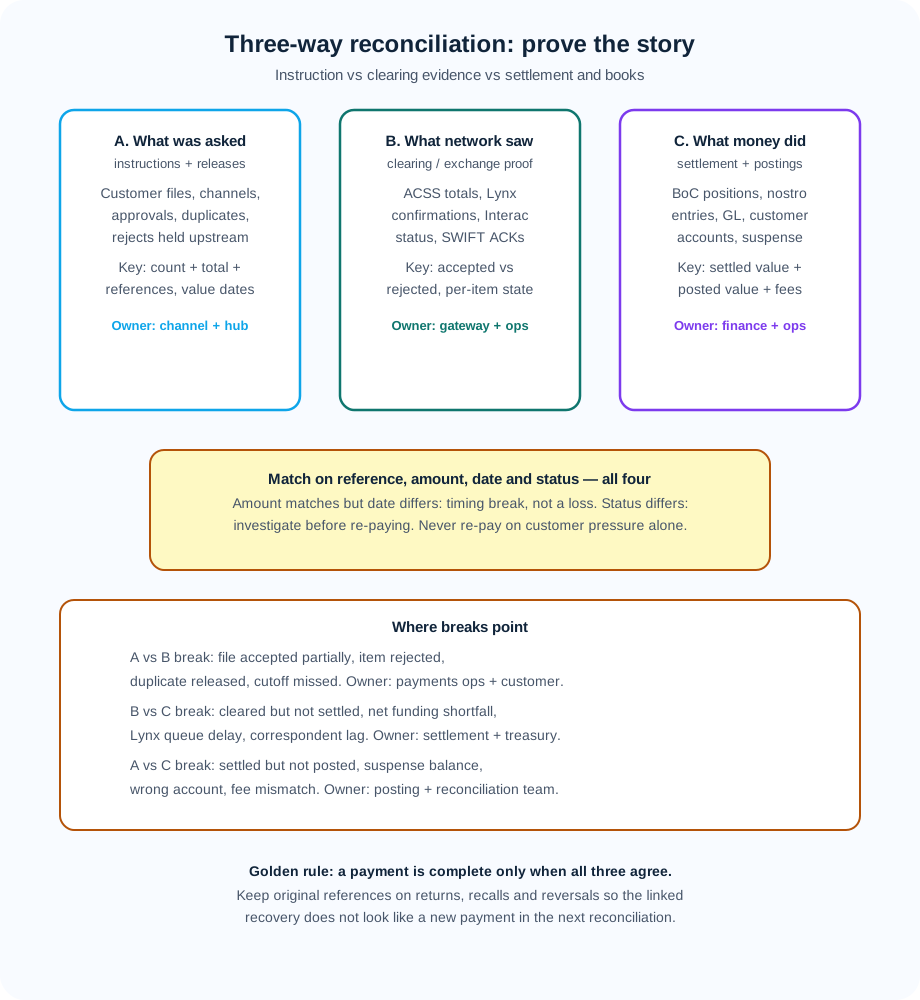
Treat the diagram as an operating contract between operations, finance, and technology: every stage emits reference-keyed, timestamped events; reconciliation consumes those events; breaks route to the owner the model names; management sees ageing and repeat causes. No payment is complete until all three sources agree — and the bank can show the agreement on demand.
A short worked case shows the model under stress. A corporate customer releases an AFT file of 2,000 supplier credits totalling CAD 9.4 million. Morning reconciliation reports: released 2,000 per the hub log; exchanged 1,998 per ACSS acceptance (two lines rejected for invalid transit, advices already sent); settlement position includes 1,998 items; postings show 1,995 customer credits plus a suspense balance of three items where the beneficiary branch merged and account mapping needs repair. The three-way view resolves cleanly: the A-versus-B break of two is owned by the channel team with the customer (repair and re-release as a corrected mini-file, never a duplicate of the whole file); the B-versus-C position is complete (all exchanged items funded); the A-versus-C suspense of three is owned by posting operations with a two-day clock and daily customer updates. Totals balance at every comparison once rejects and suspense are linked rather than hidden, and the repeat-cause feed records the merged-branch mapping so next month's file validates correctly at stage 2. That is reconciliation as a product feature: the customer sees exactly which suppliers were paid, which two need corrected detail, and which three follow within 48 hours — all proven from joined evidence rather than asserted from a screen.
10. Bank implementation, testing and resilience
Understanding the lifecycle is necessary but not sufficient; a bank must also build it, prove it, and keep it running through failures. This section translates the 8 stages into implementation scope, testing discipline, and resilience expectations that product owners, engineers, and operations managers can plan against. It stays at lifecycle level — rail-specific configuration belongs to later blocks — and focuses on the decisions that determine whether a launch is safe.
Implementation starts with architecture that respects boundaries: channels, payment hub, core banking, gateways (ACSS/AFT, Lynx, Interac, SWIFT/correspondent, USBE), fraud and sanctions services, reference data, accounting and reporting, reconciliation and case management — exchanging reference-keyed events rather than duplicating decisions. Common errors: validating only in the channel, screening only at release so warehoused items age past list updates, converting formats while dropping references, posting from channel status instead of settlement evidence. Direct versus indirect participation and vendor gateways change who validates, funds, monitors, and answers — responsibilities that must be contractual, staffed, and evidenced.
Name the operational risks explicitly so they can be owned. Cutoff-miss risk: a late payroll file re-dates 10,000 value dates and triggers employer compensation claims. Duplicate-release risk: a retried file or double-clicked wire pays twice, with batch recovery through returns but wire recovery only through cooperation. Reference-loss risk: truncated remittance or rewritten identifiers create settled-but-unapplied money and investigation queues. Liquidity-shortfall risk: queued Lynx payments miss supplier deadlines while the customer screen says "sent." Return-window risk: funds made available on batch credits are spent before an NSF or invalid-account return arrives. Fraud-acceptance risk: authorised-push scams and redirection emails exploit validation gaps before irrevocable release. Posting-integrity risk: double-posts, wrong-account credits, and unaged suspense silently misstate balances. Evidence-gap risk: a silent handoff between hub and gateway leaves reconciliation with nothing to join. Third-party risk: a vendor gateway or screening utility fails and the bank discovers accountability never transferred with the work. Calendar risk: a Quebec holiday, US holiday for USD legs, or daylight-saving boundary shifts value dates the promise did not anticipate. Assign each risk a control owner, a detection metric, and a tested playbook — that register is the practical output of this section.
The bank needs a canonical payment object carrying the instruction, all network identifiers (UETR, PCRN where applicable), enrichment and disposition history, routing decisions with rule citations, clearing and settlement pointers, posting records, and exception linkages. Format mappings must be versioned and tested with realistic Canadian content — accented Quebec names, long legal-entity titles, structured remittance — and proven to round-trip references without truncation. French-language communication support is daily volume, not an edge case.
Testing must prove the lifecycle, not just connectivity: gates that reject invalid, duplicate, over-limit, unscreened, and unauthorised items with correct codes and advices; routing correctness including cutoff-boundary behaviour; settlement-awareness (Lynx queueing under constrained liquidity, ACSS re-dating after a missed window); posting correctness (no double-post on retry, suspense handling); reporting that joins back to original references; reconciliation closure with break ownership; and full exception journeys (reject, coded return, recall request and response, linked reversal, single-case investigation). Test data must include realistic Canadian content plus failure injection: gateway outage during exchange, funding shortfall, posting delay, stale reference data, vendor failover. Certification proves the bank can exchange; lifecycle testing proves it can operate.
Resilience assumes components fail and requires graceful degradation without losing or duplicating money: duplicate-safe retry everywhere (idempotency from channel through posting), warehoused work surviving outages with triggers intact, visible Lynx queue intervention, re-driveable exchange without re-creating obligations, pausable posting engines that prove no gap or overlap, reporting that distinguishes delayed from missing, reconciliation that maps the outage's footprint and guides ordered catch-up. Add people and process: coverage through settlement, return, and investigation windows; incident communication in lifecycle states ("exchange delayed, settlement re-timed to X, postings follow with value date Y"); practiced fallback per rail. Every scenario must answer: for each in-flight payment, which stages completed, which are pending, and what should the customer be told? If that needs forensics, resilience is not built.
Banks building toward RTR initial launch should isolate integration behind the same canonical payment object and three-way reconciliation rather than a parallel proof stack. Instant settlement compresses timing but not the assurance obligation: instruction, clearing-plus-settlement evidence, and books must still agree within seconds, around the clock. Build the lifecycle once and let speed be a property of the rail, not an excuse to weaken proof.
11. Practical Canadian end-to-end example
Theory settles when you watch three different payments walk the same eight stages and diverge exactly where the lifecycle predicts. This section follows three fictional but realistic Canadian stories — a Toronto payroll AFT credit batch, a Montreal supplier Lynx wire, and a Vancouver Interac person-to-person send — and shows how initiation, validation, routing, clearing, settlement, posting, reporting, and reconciliation differ while the model stays constant. Each story is labelled fictional and uses illustrative amounts, times, and references.
Example (fictional): Toronto payroll — 10,000 AFT credits for Friday pay. Northline Foods Inc. submits its payroll file Thursday 1:45 p.m. ET: 10,000 credits totalling CAD 14.6 million, value Friday, with employee references and a control total. Initiation evidence is the file plus dual approval with a hash locking against re-release. Validation rejects three lines (two invalid transits, one closed account) with repair codes; 9,997 proceed. Processing assigns the ACSS stream and Friday value date, confirms the 3:30 p.m. cutoff, and diverts 400 on-us items (staff banking at Northline's own bank) to internal posting; 9,597 go interbank via AFT/ACSS. Clearing accepts all exchanged items; settlement funds the net position via the Bank of Canada account. Posting credits employees Friday morning while debiting the employer's funding account plus fees. Reporting gives a funding debit advice, a confirmed-paid file keyed to original references, and by Monday a coded returns file (12 items, mostly invalid-account discoveries). Reconciliation closes three ways: released 10,000 versus exchanged 9,997 plus 3 rejects; exchanged versus settled inclusion; settled versus posted minus 12 linked returns. The lesson: batch payroll succeeds on initiation discipline, cutoff management, and returns-aware reconciliation.
Example (fictional): Montreal supplier wire — CAD 4.2 million Lynx payment. Ateliers St-Laurent Inc. must pay Ontario Steel Supply CAD 4.2 million before 11 a.m. Friday or lose a production slot; different institutions, so no on-us shortcut. The analyst enters the wire at 8:40 a.m. with full beneficiary detail and invoice references. Initiation binds strong authentication plus dual approval. Validation is severe: applicable Lynx ISO 20022 message completeness, duplicate check against yesterday's look-alike CAD 4.2 million inquiry, sanctions screening with recorded disposition of a similar-name hit, fraud callback to the verified supplier number on file (catching a changed-details email redirection attempt), funds and limit confirmation. Processing selects Lynx, confirms intraday liquidity, preserves the bank's end-to-end references, and releases at 9:05 a.m. Lynx assigns a PCRN when the payment settles; a UETR should be stated only if the institution's cross-border/SWIFT flow uses one. The payment queues briefly, then settles gross at 9:11 a.m. with confirmation — finality attaches immediately. Posting credits the supplier within minutes; reporting gives both sides advices plus camt liquidity entries; reconciliation links instruction, UETR, confirmation, postings, and advices same-day. Had the account been mistyped by one digit, a settled Lynx payment would not have a unilateral batch-style return; recovery would require a bank return/recall request linked to the bank's payment identifiers (and PCRN once assigned), with the receiving side's cooperation and applicable rules deciding the outcome. The lesson: wires succeed on pre-release rigour and liquidity readiness, because post-settlement correction depends on cooperation.
Example (fictional): Vancouver Interac send — CAD 900 rent share. Maya sends CAD 900 by mobile at 9:20 p.m. Tuesday to her roommate's email, memo "September rent share." Initiation is device-bound in-app authentication. Validation checks limits, steps up authentication for the new-payee late-night pattern (passes), and confirms the roommate's autodeposit registration. Processing routes to Interac — interbank by definition. Exchange and acceptance are handled through Interac and the participating financial institutions; Autodeposit can deposit directly, while non-Autodeposit requires the recipient to follow the bank's deposit flow. Timing, limits and status are FI-dependent. Settlement between participants follows Interac's arrangements behind the scenes; Maya never sees it, but her bank's reconciliation must join the instruction, Interac status, settlement position and postings. If the transfer is not deposited or automatically deposited, it may be cancelled or expire under the applicable Interac/FI terms; the sender's bank handles the funds return. That is an Interac outcome, not a Lynx recall. Had Maya been tricked into sending to the wrong address and it was accepted, recovery would need beneficiary cooperation, like a wire recall. The lesson: Interac succeeds on addressing, fraud-aware validation, and status-accurate reporting — notifications are not settlement, and Interac is not the RTR.
Same eight stages, same demand for reference preservation and three-way proof — different cutoffs, settlement, finality, and reconciliation rhythms. Later rail chapters deepen each path; none replaces this map.
Hold the three stories side by side and the lifecycle's value becomes obvious. Initiation ranges from a locked 10,000-line file with dual approval, through a dealing-room wire with token approval, to a one-thumb mobile send with device authentication — yet each captures who, whom, how much, and under what authority. Validation ranges from batch record checks to severe wire screening with callbacks to fraud-aware step-up — yet each gates release the same way. Routing ranges from stream assignment with an on-us split, through a liquidity-checked Lynx release, to an Interac addressing decision — yet each records why this rail. Clearing ranges from ACSS totals, through Lynx queue acceptance, to Interac notification — yet each leaves exchange evidence. Settlement ranges from a funded net position, through a 9:11 a.m. gross confirmation, to background Interac arrangements — yet each answers where value moved. Posting, reporting, and reconciliation close each story with the same question: do instruction, network evidence, and books join on one reference? Any analyst who can fill that row for all three stories can read any later rail chapter without getting lost.
12. Key takeaways and authoritative references
Takeaways — the lifecycle you will reuse for the next 73 chapters.
- One model governs everything: initiation, validation, bank processing, clearing or exchange, settlement, posting, reporting, reconciliation. Locate yourself in these eight stages before debating any rail detail.
- On-us versus interbank is the first routing decision and a hosting fact. Same bank means internal posting with duplicate and wrong-account controls; different banks mean clearing evidence plus settlement proof plus beneficiary-bank posting.
- Clearing establishes obligations; settlement discharges them; posting applies them to accounts; availability lets the beneficiary use them; finality makes them irrevocable between participants. Each has its own timestamp and proof — never collapse them into "completed."
- ACSS deferred net funds net positions after batch exchange, preserves defined return rights, and is liquidity-efficient. Lynx RTGS settles each payment gross in central-bank money with immediate finality and is liquidity-intensive. Match urgency to certainty; do not promise wire finality on batch timing.
- Messages instruct and inform; rails settle. SWIFT moves information, not money. AFT files and Lynx MX instruct; ACSS positions and Lynx settlement move value; Interac notifications inform while their settlement arrangements and bank postings move and apply value.
- References are the lifecycle's join keys. Preserve the end-to-end reference plus UETR (wires/cross-border) and PCRN awareness (Lynx returns) through every enrichment, conversion, split, and reassembly, or tracking, investigations, and reconciliation all break at once.
- Cutoffs and business days are customer promises with operational consequences. Publish the most restrictive applicable constraint, give every promise a fallback, and staff through return and investigation windows — not just release hours.
- Controls gate stages 1–3 because recovery after settlement is conditional (batch returns), cooperative (wire/Interac recalls), or multi-party (cross-border). Fraud, sanctions, duplicate, mandate, balance, and release-authority checks must resolve to proceed, hold, or reject before the routing decision commits.
- Name exceptions precisely: reject (pre-acceptance stop), return (coded send-back under rail rights), recall or return request (cooperation-seeking ask after finality or acceptance), reversal (linked accounting unwind where permitted), investigation (the case that tracks uncertainty). Link every recovery to its original; never overwrite history and never re-pay on pressure without tracing first.
- No payment is complete until instruction, clearing evidence, and settlement-plus-books all agree on reference, amount, date, and status. Reconcile three ways, age breaks with owners, and feed repeat causes back into validation and routing rules.
- Correct the three costly misunderstandings wherever you hear them: SWIFT does not move money; clearing does not equal settlement; Interac e-Transfer is not the RTR. Interac is operated by Interac Corp and is a prominent payment system, not a Payments Canada system. RTR By-law No. 10 and the RTR Rules took effect on 24 August 2026, but Payments Canada describes the production launch as Q4 2026—so the service remains planned, not live, at this audit date.
- Build the lifecycle once in architecture, testing, and resilience — canonical payment object, duplicate-safe retry, reference-preserving mappings (including French-language and accented-name handling), settlement-aware posting, complete reporting, daily three-way reconciliation — then reuse it for every rail including the future RTR.
Common misunderstandings, stated plainly. "SWIFT moves money" — no, SWIFT messages instruct, inform, and enable UETR tracking; correspondent postings and foreign-rail settlements move value. "Clearing equals settlement" — no, clearing establishes obligations while settlement discharges them. "Interac equals the RTR" — no, Interac e-Transfer is a live Interac Corp service while the RTR is a separate Payments Canada programme with initial launch planned for Q4 2026. "A confirmation screen means finality" — no, confirmations and even postings can precede finality or remain returnable; only the rail's finality rule plus settlement evidence decides. "Lynx wires can be returned like batch items" — no, settled Lynx payments are final; errors need a recall request and cooperation.
Authoritative references (official sources only; each supports a specific claim in this chapter).
- Payments Canada — Lynx (system description, RTGS operation, ISO 20022, participation and 2025 statistics): https://www.payments.ca/systems-services/payment-systems/high-value-payment-system-lynx
- Payments Canada — Lynx statistics (2025 totals and methodology): https://www.payments.ca/high-value-payment-system-lynx-statistics
- Payments Canada — Real-Time Rail (Q4 2026 launch, ISA testing and migration plan): https://www.payments.ca/systems-services/payment-systems/real-time-rail-payment-system
- Payments Canada — Real-Time Rail quarterly update, 2026 Q3 (industry assurance testing and phased launch): https://www.payments.ca/canadas-real-time-rail-quarterly-update-jude-pinto-2026-q3
- Payments Canada — Retail batch payment system (ACSS/USBE model, morning net settlement, USBE correspondent settlement): https://www.payments.ca/systems-services/payment-systems/retail-batch-payment-system
- Payments Canada — ACSS statistics (2025 item-level totals and methodology): https://www.payments.ca/automated-clearing-settlement-system-acss-statistics
- Payments Canada — Lynx wire payments and PCRN (PCRN only for Lynx-settled wires): https://www.payments.ca/explainer-lynx-wire-payments-and-payment-confirmation-reference-number
- Payments Canada — ISO 20022 AFT onboarding and messages (ISO AFT/legacy coexistence): https://www.payments.ca/payment-resources/iso-20022/automatic-funds-transfer
- Interac — Personal FAQs and e-Transfer terms (Autodeposit, cancellation, finality, expiry and limits): https://www.interac.ca/en/resources/personal-resources/personal-faq/ and https://www.interac.ca/en/interac-e-transfer-terms-of-use/
- FINTRAC — Travel rule for electronic funds transfers (scope and required originator/beneficiary data): https://fintrac-canafe.canada.ca/guidance-directives/transaction-operation/travel-acheminement/1-eng
- FINTRAC — Reporting electronic funds transfers (international EFT reporting threshold and obligations): https://fintrac-canafe.canada.ca/guidance-directives/transaction-operation/eft-dt/eft-dt-eng
- Justice Canada — Canadian Payments Association By-law No. 9 — Lynx: https://laws-lois.justice.gc.ca/eng/regulations/SOR-2021-182/index.html
- FCAC — Financial Consumer Protection Framework (bank communications, disclosures and complaints): https://www.canada.ca/en/financial-consumer-agency/services/banking/rights-new-protections/consumer-protection-framework.html
- Bank of Canada — Oversight of designated clearing and settlement systems (Lynx systemic; ACSS and Interac e-Transfer prominent): https://www.bankofcanada.ca/regulatory-oversight/financial-market-infrastructures/oversight-designated-clearing-settlement-systems/
- Bank of Canada — Retail payments supervision (RPAA registration, operational risk, incident response, safeguarding and reporting): https://www.bankofcanada.ca/regulatory-oversight/retail-payments/
- Bank of Canada — Settlement account policies for Payments Canada payment systems (updated 31 July 2026; central-bank settlement and direct-participant access): https://www.bankofcanada.ca/core-functions/financial-system/bank-canadas-settlement-account-policies-for-payments-canada-payment-systems
- Justice Canada — Canadian Payments Association By-law No. 10 — RTR (SOR/2026-133; last amended 24 August 2026): https://laws-lois.justice.gc.ca/eng/regulations/SOR-2026-133/index.html
- Payments Canada — Critical milestone achieved: By-law and rules approved for Canada’s Real-Time Rail (approved 30 June 2026; coming into force 24 August 2026; Q4 2026 launch): https://www.payments.ca/critical-milestone-achieved-law-and-rules-approved-canadas-real-time-rail
These sources support the chapter's verifiable system claims: Lynx is the live Canadian-dollar RTGS system with finality between Lynx participants and settlement through Bank of Canada accounts; Payments Canada publishes current ISO 20022 specifications; ACSS/USBE is the live retail batch system (ACSS 2025 total 10.607 billion items and CAD 10.009 trillion; Lynx 2025 total 13.6 million items and CAD 93.3 trillion); Interac e-Transfer is Interac Corp-operated and designated prominent rather than a Payments Canada system; Payments Canada owns and operates its systems under the Canadian Payments Act framework; the Bank of Canada provides settlement accounts, oversees designated systems under the PCSA and supervises PSPs within the RPAA; USBE is the USD retail batch component with settlement through New York correspondents; and RTR By-law No. 10 and Rules came into force on 24 August 2026 while Payments Canada describes the production launch as Q4 2026. Volume and value figures are 2025 system reports and should be refreshed against the current Payments Canada statistics before external publication.
Chapter close and handoff. You now hold the generic lifecycle that every later rail chapter reuses. Chapter 3 introduces the institutions that operate it — Payments Canada, the Bank of Canada, direct and indirect participants, and PSPs — Chapter 4 separates instruments from clearing and settlement mechanisms, and Chapter 5 connects all rails in one operating view. As you continue, keep asking the four proof questions of every story: where is the instruction, where is the clearing or exchange record, where is the settlement proof, and where is the posting — and do all four join on the same reference? Answer those, and you understand how money moves in Canada.
This application uses JavaScript for the full interactive experience. This text summary is served for accessibility and search indexing.