Government Payments, Cash and Other Payment Methods. Place government disbursements and collections, cash access and other domestic instruments in the Canadian operating model.
Block 10 · Chapter 50 of 75
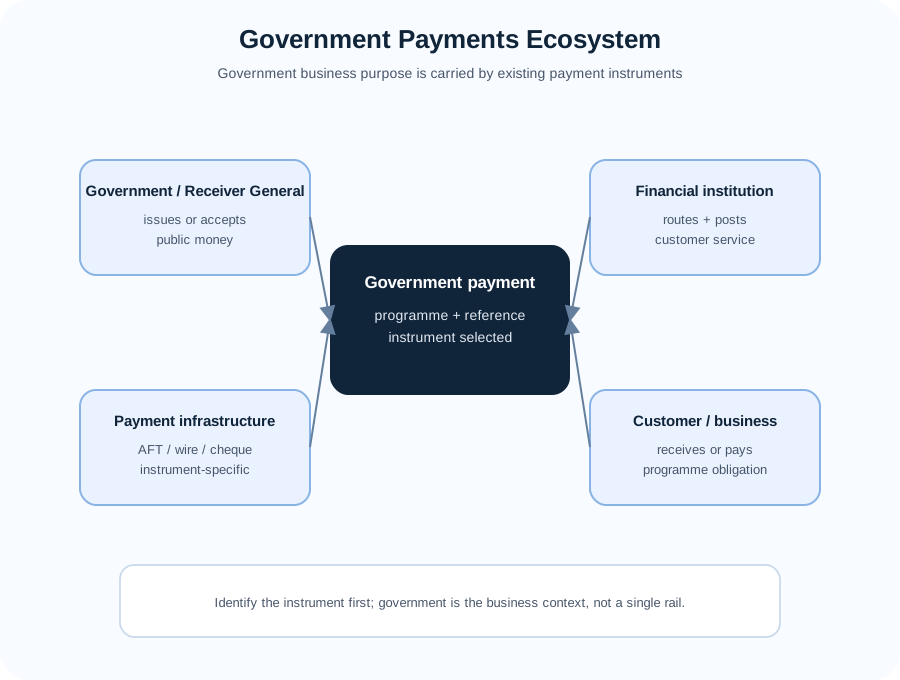
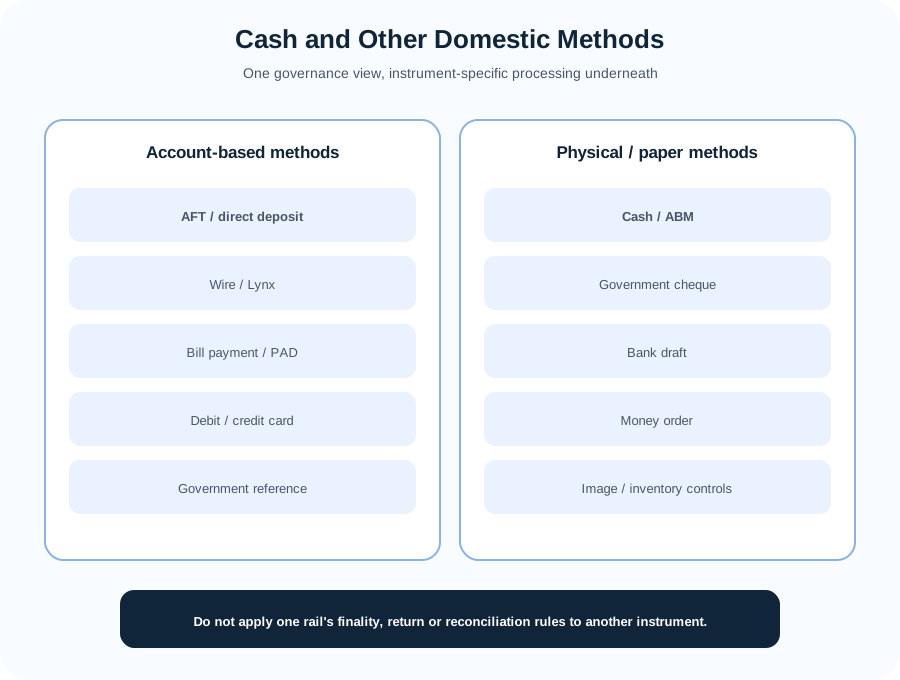
Government payment is a business purpose, not a single Canadian payment rail. A federal benefit or supplier credit may use direct deposit through the retail batch system; a government cheque is a Government of Canada paper instrument; a tax payment may be a bill-payment remittance, PAD, debit-card payment, cheque, cash, Interac e-Transfer or wire, depending on the program and current instructions. The first operational question is therefore: what instrument carried the value?
This chapter separates regulatory rules, Payments Canada and Interac scheme/system rules, generic bank implementation, and illustrative examples. It does not turn a bank’s internal design into a legal requirement. Exact bank contracts, program specifications, customer limits, return codes, cutoffs and card-scheme rules must be confirmed against the live source and product version.
Learning objectives
After this chapter, you should be able to:
- distinguish a government disbursement from a government collection;
- identify the underlying instrument and its participants, messages or files, exchange, clearing, settlement and posting steps;
- preserve the government program/reference separately from the bank transaction identity;
- explain current CRA channels and the limited scope of the $10,000 electronic-payment rule;
- handle Government of Canada paper instruments under Rules G2, G3, G4 and G8;
- reconcile bank postings, ACSS/Lynx or other network evidence, cash inventory and government reports;
- design return, correction, fraud, AML, sanctions, investigation and resilience controls; and
- distinguish the current production systems from the planned Real-Time Rail (RTR).
1. The government-payment operating model
The Receiver General for Canada is the federal government’s central Treasurer and Accountant. The Minister of Public Services and Procurement is responsible for funds entering and leaving government accounts, the Accounts of Canada and the Public Accounts. PSPC issues payments for federal departments and some provincial governments, including payments in Canadian and other currencies, and manages banking arrangements with financial institutions for payments to the federal government. 1
The practical boundary is:
- Department or program: determines entitlement, obligation, payee and program reference.
- Receiver General/PSPC or agency: issues or accepts public money under its program and treasury arrangements.
- Originating or payer financial institution: authenticates the instruction, applies account and fraud controls, formats/routes the item and records the customer-side debit or file status.
- Payment system or scheme: exchanges, clears and/or settles the item under its rules.
- Beneficiary or receiving financial institution: validates reachability, applies fraud and posting controls, credits the account or returns the item.
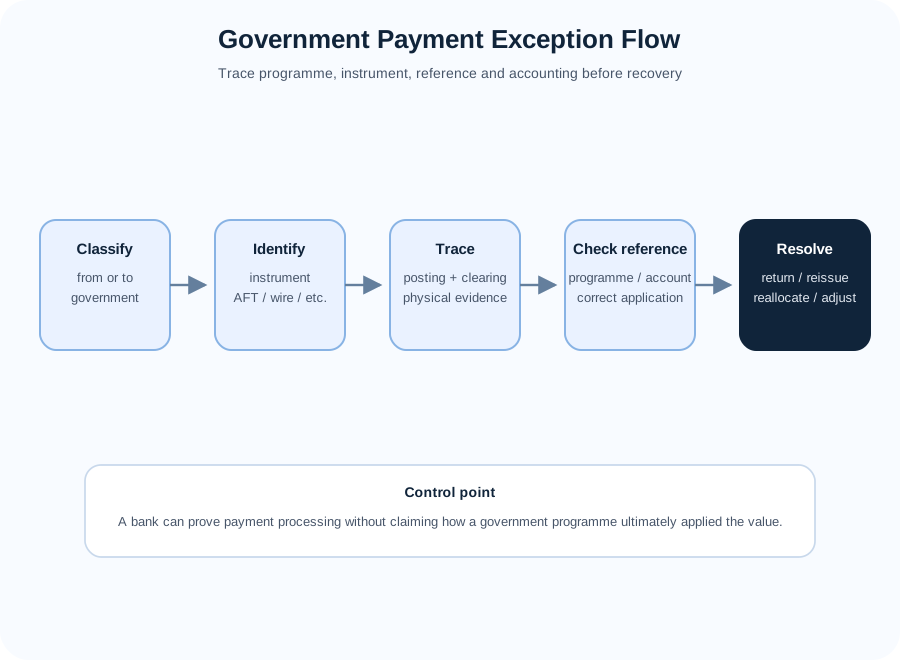
- Government receivables/accounting system: receives the value and applies the program reference. Bank confirmation of processing is not automatically proof of program application.
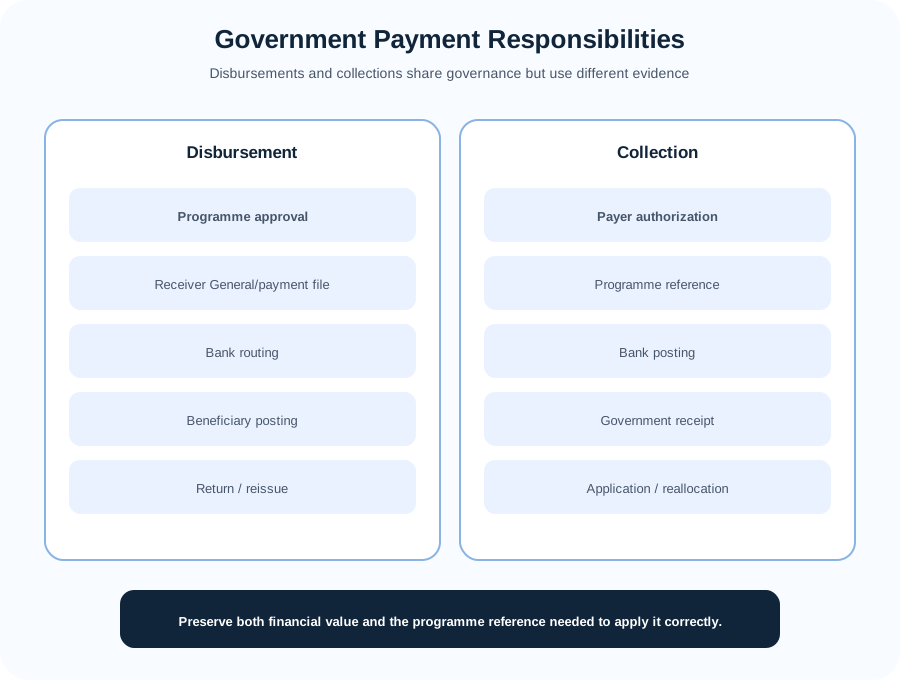
For an investigation, retain both payloads:
- Value: amount, currency, debit/credit, fee, date and settlement evidence.
- Identity: program/agency, account or remittance reference, payment ID, file/item ID, statement descriptor and any return/reissue link.
A valid amount paired with a wrong program reference can be a government application problem, not a clearing failure.
2. Current Canadian rails and participants
Payments Canada describes ACSS/USBE as Canada’s retail batch payment system. It clears paper and electronic items, including cheques, government items, direct deposits, electronic remittances, online debits and credits, PADs, shared ABM networks and other retail streams. Direct clearers connect directly or indirectly, calculate net balances, and maintain Bank of Canada settlement accounts. Settlement of the prior day’s net balances occurs during the morning of each business day. 2
The Bank of Canada describes exchange as transmitting payment instructions, clearing as reconciling or confirming obligations and establishing balances, and settlement as releasing those obligations. It also distinguishes direct participants, which instruct/clear/settle for themselves and may serve others, from indirect participants that rely on a direct participant. 3
A generic bank processing chain is therefore:
customer/program instruction → authentication and validation → bank orchestration → rail or scheme adapter → exchange/clearing → settlement → account posting → statements/reporting → reconciliation
The chain is illustrative. Not every channel exposes every intermediate event to a customer, and a bill-payment provider, card acquirer, correspondent, clearing agent or government concentrator may sit between the bank and the final government system.
Current production versus planned modernization
- ACSS/USBE, Lynx, Interac e-Transfer, Interac IMN, VisaNet and Mastercard systems are current systems identified by the Bank of Canada. 3
- RTR is not a current production rail in this chapter’s audit date. Payments Canada says RTR is launching in Q4 2026 and is in industry solution-assurance testing; it is a planned new real-time exchange, clearing and settlement system. 4
- The Bank of Canada’s RTR settlement-account policy is also written for a planned system. It says RTR settlement accounts will be funded and defunded by Lynx payments, and describes restricted and unrestricted account types and participant requirements. 5
Do not describe an RTR payment as available today, promise an RTR cutoff or finality outcome, or route a government payment to RTR unless the relevant production launch, participant certification, program acceptance and bank product are confirmed. Any RTR example below is explicitly future-state/illustrative.
3. Government disbursements
3.1 Direct deposit
PSPC describes direct deposit as a faster, convenient and secure way to receive government payments. Canadian account setup commonly needs institution number, branch/transit number and account number; the program may also hold an enrolment or recipient identifier. 1
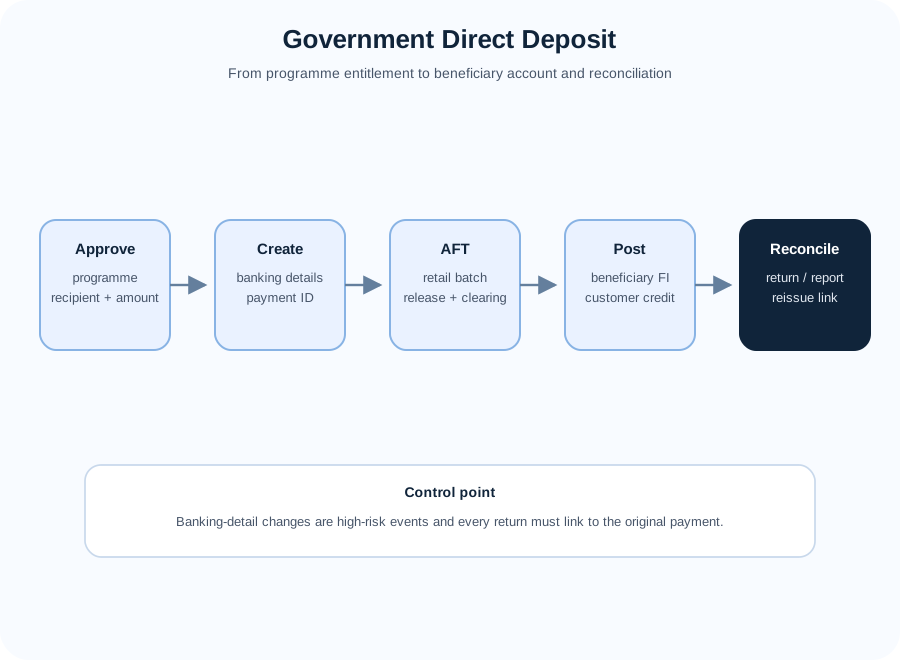
A generic direct-deposit lifecycle is:
- the program establishes entitlement and payee data;
- the government payment function creates an instruction or file;
- the originating bank authenticates the source, validates file/item identity and checks format, account data, limits, sanctions/fraud rules and duplicate state;
- the item enters the applicable AFT/retail batch exchange;
- ACSS positions are calculated and settled through the direct-clearer model where applicable;
- the beneficiary FI accepts, posts once to the destination account or creates a return;
- statements and customer notifications are produced; and
- the government originator and bank reconcile accepted, posted, returned and rejected populations.
Payments Canada’s current AFT ISO 20022 material identifies customer credit-transfer, customer direct-debit, payment-return, payment-reversal and identification-modification message portfolios, with registration, testing and implementation steps for participants. It also notes that corporate-to-bank examples on that page are drafts and must not be treated as production specifications. 6
Generic bank implementation (not a universal rule): persist file ID, item ID, checksum or equivalent integrity evidence, originator, beneficiary routing data, amount, requested/effective date, customer-facing descriptor, validation result, posting result, return reason and settlement/reconciliation references. Acknowledgement loss must not cause a second credit; file-level and item-level idempotency are both required.
3.2 Banking-detail changes and wrong-account credits
A change to government direct-deposit details is a high-risk servicing event. The control design should authenticate the requester, record old and new details, record effective date and source, use independent confirmation or risk-based step-up where appropriate, and preserve an audit trail. A receiving bank should not assume it owns the government program’s enrolment decision, but it can monitor suspicious new-account inflows, rapid cash-out and multiple unrelated government credits.
If valid routing data identifies a closed or restricted account, the beneficiary FI should not guess another destination. It should use the applicable return process and link the return to the original item. A reissue is a new instruction linked to the failed original; original history must not be overwritten. If funds posted to a live but unintended account, staff must not promise an instant recall or tell the customer to send funds back manually. Use the bank’s controlled investigation, privacy and recovery procedure and coordinate with the originator.
3.3 Cheques and other government paper instruments
A Government of Canada paper item is not an ordinary personal cheque for operating purposes. Payments Canada Rule G2 defines an RG Warrant and directs operations to Rules G3 and G8 for redemption, settlement and non-customer encashment. G2 states that RG Warrants dated six months or more before presentation may be verified or sent for collection under the applicable procedure; it also states that a Government Instrument exceeding $25,000,000 will not be redeemed or settled. 7
Rule G3 governs delivery, image-captured exchange, ACSS entries, returns, exceptions, lost/destroyed instruments, reconciliation and adjustments. It states that, for Government Instruments, delivering direct clearers initiate the relevant ACSS entry no later than 09:30 ET, and the Bank of Canada initiates Lynx payment messages in favour of the delivering direct clearer by 11:30 ET on the same day, subject to the rule’s conditions. These are government-instrument rule times, not a general cheque or AFT customer cutoff. 8
Rule G8 provides a special procedure for encashing RG Warrants for non-customers. Its indemnification procedure is limited to no more than $1,750, requires specified identification and requires the payee to endorse in the teller’s presence; altered items do not qualify. A bank may have stricter policy or decline the service. 9
Rule G4 covers FI acceptance of certain CRA GST/HST, excise, taxation and customs remittances. It requires separation by program, evidence such as remittance forms or scanned files, daily packaging/listing and reconciliation; it also describes correction/reimbursement handling for dishonoured taxpayer cheques. Rule G4 is not a generic rule for every CRA payment channel. 10
Paper controls: secure stock and serial control, image/item linkage, payee and endorsement checks, counterfeit/alteration escalation, return/reimbursement evidence, retention and physical-to-electronic reconciliation. A bank draft, certified cheque, money order and Government of Canada RG Warrant are different products; use the issuer’s terms and applicable rule before stating finality or recoverability.
3.4 Wires and foreign-currency disbursements
PSPC states that government payments can be made to recipients in Canada and around the world, in Canadian or other currencies. 1 A government-originated domestic high-value wire should use the bank’s normal wire controls and, where applicable, Lynx routing: authority, authentication, sanctions and AML screening, liquidity/limits, beneficiary data, message validation, settlement, posting, return/investigation and reconciliation. A foreign payment may add FX, correspondent routing, charges, value date and cross-border reporting. Government origin does not bypass those controls.
Do not force an international government wire into AFT, Interac or domestic bill-payment logic. For a cross-border electronic funds transfer, financial entities have FINTRAC reporting obligations for an international EFT of $10,000 or more in a single transaction at initiation or final receipt, subject to the applicable rules and exceptions. 11
4. Government collections
CRA’s current payment page lists online banking, CRA My Payment by debit card, scheduled PAD, cheque, money transfer platforms including Interac e-Transfer, wire transfer, cash and other options, while warning that not every method is available for every payment. 12
4.1 Online banking and bill-payment remittances
A bank channel typically presents a governed payee/program directory and captures the customer’s business number, program account, reference, amount and requested date. The directory and validation rules are bank/program integration data, not a universal Canadian format. Store and display the exact reference sent downstream.
Payments Canada Rule G4 shows why this is operationally significant for covered branch remittances: CRA payments are separated by program, remittance evidence is retained or transmitted, and concentrator-account and daily reconciliation arrangements are used. Online bill payment may use a different channel and evidence set; do not infer that the G4 paper-form workflow applies unchanged.
The customer’s bank debit date, bank acceptance date, government receipt date, government application date and statutory due date can differ. CRA’s current guidance says online-banking payments are considered paid the same or next business day depending on the bank/credit union, and the CRA account may update up to three business days after receipt. 12 The bank can prove what it accepted and debited; it should not claim program application without government evidence.
4.2 CRA My Payment and PAD
CRA My Payment is a distinct one-time online service using a debit card; CRA says credit cards cannot be used through My Payment. CRA states that My Payment is usually considered paid the same business day, but payments after 10:00 pm local time, on weekends or statutory holidays are dated the next business day, subject to bank/credit-union variation. 12
CRA scheduled PAD is a mandate-based channel, not an online-banking push. CRA says the first withdrawal must be scheduled at least five business days in advance. 12 Bank controls should retain authorization, scheduled date, presentment, debit or return outcome, notification, government receipt/application evidence when supplied, and reconciliation links.
4.3 Interac and cards
CRA’s current page includes Interac e-Transfer among money-transfer-platform options, but availability is payment-specific. Interac says e-Transfer is delivered through participating financial institutions’ online/mobile banking; email or SMS carries notification, not the funds themselves. Recipient availability is typically minutes or seconds after acceptance but can take longer, and transaction limits are set by the financial institution. 12 13
Interac e-Transfer is not a generic government-collection guarantee and should not be presented as interchangeable with CRA online banking, PAD or My Payment. For an accepted Interac flow, bank operations should retain sender/recipient addressing, authentication evidence, request/accept/autodeposit state, fraud decisions, network references, posting and any cancellation/return policy supplied by the product.
If a program accepts debit or credit card, authorization, clearing, settlement, chargeback/refund and scheme rules come from the applicable card product and acquirer/issuer arrangement. The Bank of Canada identifies Interac IMN, VisaNet and Mastercard GCMS/SMS among overseen payment systems. 3 Do not invent a card-specific government rule from the fact that the payee is public-sector.
4.4 The $10,000 electronic-payment rule
The Excise Tax Act, section 278(3) requires a person who must pay or remit an amount under that Part to the Receiver General to use an electronic payment when the amount is $10,000 or more, unless the person cannot reasonably pay or remit electronically. The section defines electronic payment and identifies qualifying institutions/means. 14
This is not a blanket rule that every government payment over $10,000, or every program, must use one bank channel. The applicable statute, program and CRA guidance must be confirmed. Product copy should version the legal text and should not reject unrelated payments merely because they are below or above this threshold.
5. Cash, ABMs and paper alternatives
Bank of Canada notes and Royal Canadian Mint coins are legal tender, but legal tender does not require a business to accept cash. Bank of Canada also says the $1, $2, $25, $500 and $1,000 notes from every Bank of Canada series ceased to be legal tender on January 1, 2021, although the Bank continues to honour them at face value. 15
5.1 ABM withdrawal and cash deposit
An ABM withdrawal has two separate financial events:
- Authorization: issuer/network approves or declines the card/account request.
- Dispense: terminal evidence records notes presented, taken, retracted, rejected or not dispensed.
A generic flow is card or token → authentication/PIN → account selection → authorization → dispense attempt → sensor/journal outcome → account posting or adjustment → network settlement and terminal/physical reconciliation. A timeout after authorization but before dispense creates an uncertain outcome; the authorization amount alone is not proof of cash delivered.
A no-dispense or partial-dispense investigation uses the authorization, terminal journal, dispenser counters/sensors, cassette count, retract/reject records, network messages, account posting, customer statement and camera/security evidence where policy permits. Final adjustment must follow the bank/network procedure exactly once. A physical cash variance requires a case with terminal, expected inventory, count evidence, amount, owner and accounting disposition.
Cash deposits add counting, denomination, counterfeit detection, customer credit policy, vault/transport and branch or ABM balancing. Treasury controls include cash forecasts, replenishment, dual control, vault limits, armoured transport, security and general-ledger reconciliation.
5.2 Suspected counterfeit notes
The Bank of Canada trains financial-institution staff on security features, quality standards and handling. Its current guidance says that when a branch or regional distribution centre receives a suspected Canadian or US counterfeit note, it should contact local police and provide the note promptly with useful origin information; special no-history handling is described for regional distribution centres. 16 Front-line staff should not improvise or guarantee reimbursement.
FINTRAC treats cash differently from cheques and money orders. A reporting entity that receives $10,000 or more in cash in a single transaction must submit a Large Cash Transaction Report within 15 calendar days, subject to applicable exemptions; the 24-hour rule may aggregate related transactions. 17 A cash withdrawal, cash deposit, government cheque and electronic transfer must not be treated as the same reporting event.
6. Data, controls and compliance
6.1 Minimum evidence model
A canonical internal record should contain:
- direction: government-to-customer or customer-to-government;
- program/agency and business purpose;
- instrument and channel;
- payer/payee and account identifiers, masked in routine views;
- amount, currency, fees and requested/effective/business dates;
- program account or remittance reference exactly as entered/transmitted;
- file, item, message, terminal, card or network identifiers as applicable;
- authentication, maker/checker and approval evidence;
- validation, fraud, sanctions and AML decisions;
- customer posting and statement descriptor;
- exchange, clearing, settlement, return/reversal/reissue evidence; and
- government receipt/application evidence only when actually received.
6.2 Fraud and scams
Controls should be instrument-specific and risk-based:
- step-up authentication and independent confirmation for direct-deposit detail changes;
- file/item replay protection and duplicate-payment detection;
- payee/reference confirmation and high-risk biller monitoring;
- supplier callback and segregation of duties for business changes;
- counterfeit/alteration escalation for paper;
- terminal and physical-cash evidence for ABM disputes;
- scam warnings for urgent government impersonation, gift cards, crypto, remote access or unusual wires;
- post-event holds, case management, recovery and law-enforcement/government escalation under applicable policy; and
- clear customer communication that never instructs a customer to send funds back manually without controlled authority.
A suspicious incoming government credit is an investigation signal, not proof of fraud. Government origin does not create an AML, sanctions or account-takeover exception.
6.3 AML, sanctions, RPAA and OSFI boundaries
Banks and other reporting entities must apply the Proceeds of Crime (Money Laundering) and Terrorist Financing Act/Regulations and FINTRAC guidance to the relevant customer and transaction. The large-cash and international-EFT examples above are reporting obligations, not a claim that every domestic benefit is reportable.
The Bank of Canada supervises PSPs subject to the RPAA. Its current page says registered PSPs must manage operational risks, respond to incidents, safeguard end-user funds and meet reporting requirements; it also states that the risk-management and safeguarding frameworks and annual report obligations apply from September 8, 2025. 18 A bank, government department, biller, Interac participant and PSP may have different legal roles.
For federally regulated financial institutions, OSFI Guideline B-13 expects technology and cyber risk governance, stable/scalable/resilient operations, recovery processes, confidentiality, integrity and availability. 19 Use that as supervisory context for file security, access control, key rotation, logging, incident response and recovery, not as a payment-message specification.
7. Reconciliation, accounting and investigations
7.1 Four-way reconciliation
For a disbursement, reconcile:
government instruction/file → bank acceptance/release → rail exchange/clearing → settlement → beneficiary posting/return → government report
For a collection, reconcile:
customer authorization → payer posting → bill/PAD/card/Interac/wire exchange → settlement → government receipt → program application (only if evidenced)
For cash, add:
authorization/posting → terminal journal → physical notes → vault/transport → cash GL → variance case
For paper, add image/item, pouch or file, delivery, return reason and applicable G-rule evidence.
Never close an exception merely because the customer was debited. A returned, rejected, unapplied, duplicated, suspended or manually adjusted item remains in the control population until owned and resolved.
7.2 Accounting and liquidity
Do not create one generic “government GL.” Map AFT/direct deposit, bill payment/PAD, card, Interac, wire, cheque and cash to their instrument-specific customer, clearing, settlement, suspense, fee, cash-inventory and adjustment accounts. Treasury should forecast expected government credits, tax-collection peaks, large wires, settlement timing and returns without exposing unnecessary personal program data.
Use separate statuses for accepted, posted, settled, returned, government received, government applied and case closed. A bank receipt proves the bank event; a government application report proves the downstream event.
7.3 Exception playbooks
Direct deposit missing: trace source/file/item, duplicate state, acceptance, release, clearing, destination routing, posting and return. Escalate account-detail-change or suspicious-inflow signals.
Closed or invalid account: do not force-post; return under the applicable AFT/instrument procedure, link to original and report to the originator.
Wrong live account: preserve original details, do not promise recall, open a controlled recovery/investigation case and coordinate with the originator and receiving FI.
Wrong government program/reference: prove what the customer authorized and transmitted. The bank may not be able to reallocate after release; the government program owns program-side reallocation.
Duplicate collection: determine whether the customer authorized twice or a retry duplicated the instruction. Prevent technical duplicates with idempotency; use the government/biller refund or reallocation process for economic duplicates.
Government cheque/RG Warrant: classify under the applicable G-rule, preserve image/item and return evidence, and route stale, lost, altered, counterfeit or non-customer cases to the prescribed process.
ABM no/partial dispense: reconcile authorization with terminal and physical evidence, apply the approved adjustment once and preserve the case.
Service outage: tell customers whether the instruction was accepted, whether retry is safe, the relevant bank/program date boundary and approved alternatives. Never direct customers to an unverified third-party site.
8. Implementation and testing
8.1 Reference architecture (generic bank design)
- Program directory: approved agency/payee, reference rules, channel availability, effective dates and source authority.
- Orchestrator: direction, business purpose, canonical payment ID and lifecycle state.
- Instrument adapters: AFT/ACSS, bill payment, PAD, card, Interac, wire/Lynx, cheque/image and cash/ABM.
- Message/file layer: authenticated transport, integrity, format validation, acknowledgements, item rejects, replay protection and versioned mappings.
- Control services: customer authentication, maker/checker, fraud, AML, sanctions, limits and sanctions-case holds.
- Ledger and posting: customer accounts, fees, suspense, settlement and cash inventory.
- Reconciliation/workbench: searchable program + instrument evidence, aged returns, unmatched items, manual approvals and downstream government reports.
- Resilience: durable idempotency, replay-safe recovery, key/certificate rotation, backup/restore, incident communications and DR tests.
8.2 Acceptance criteria
- One-time credit: Given an accepted direct-deposit item for an active account, the beneficiary account posts once and retains the available origin/reference evidence.
- Closed account: Given a closed destination, no alternative account is guessed; the item returns through the applicable process and remains linked to the original.
- Reference fidelity: Given a customer confirms payee/program P and reference R, history and downstream data preserve P and R exactly; later government reallocation is not represented as a bank reversal unless a bank financial reversal occurred.
- Duplicate file: Given an already processed file is received again after acknowledgement loss, the bank creates no second beneficiary postings and returns a durable duplicate/previous status.
- ABM no-dispense: Given authorization but confirmed no dispense, the final customer effect follows the approved adjustment once and retains terminal evidence.
- Cash variance: Given expected electronic inventory differs from physical count, create a case with terminal, count, amount, owner and GL disposition.
- Government paper: Given a Government of Canada instrument, route by item type and applicable G2/G3/G7/G8 procedure rather than ordinary-cheque assumptions.
- RTR boundary: Given a date before confirmed RTR production launch and participant certification, reject any design that claims a live RTR customer path; use the currently supported instrument or label the scenario future-state.
8.3 Test matrix
Disbursement: valid account; invalid transit/institution; closed/restricted account; duplicate file/item; late/holiday date; partial file rejection; return; corrected reissue; statement descriptor; settlement/reconciliation break; suspected redirected benefit.
Collection: correct and structurally invalid reference; wrong program; duplicate customer authorization; technical retry; insufficient funds; future-dated PAD; bank cutoff versus government date; government receipt mismatch; unapplied/suspense outcome; online banking, My Payment, PAD, Interac, card, cheque, cash and wire channel evidence.
Paper: valid RG Warrant; stale item; altered/counterfeit suspicion; non-customer encashment and identification; lost/destroyed item; image missing; return; G2 $25,000,000 boundary; G3 09:30/11:30 rule-timing controls; G4 remittance reconciliation.
Cash/ABM: full, no and partial dispense; retract; cassette empty; timeout; duplicate retry; counterfeit note; physical count mismatch; settlement mismatch; cash report aggregation.
Resilience: duplicate during DR; acknowledgement loss; return after cutover; wrong reference plus retry; outage near statutory date; key/certificate rotation; unavailable government report; manual adjustment with maker/checker.
9. Practical examples
Example A — benefit credit to a closed account (illustrative)
A government direct-deposit item reaches the beneficiary FI but the account is closed. The FI records the original item, declines forced posting, sends the applicable return, reconciles the return and reports the outcome. The program decides whether and how to reissue after corrected enrolment. The reissue is not a rewrite of the original.
Example B — business uses the wrong CRA program reference (illustrative)
A business authorizes a payment using a valid business number but the wrong program account. The bank can prove the payee, amount, date and exact reference transmitted. If the debit and clearing completed, this is not automatically a settlement failure; the business contacts CRA for program-side application or reallocation under CRA procedure.
Example C — ABM partial dispense (illustrative)
A customer requests $500 and the terminal evidence confirms $300 dispensed. The bank compares authorization, terminal journal, sensors, cassette count, account posting and network messages, then applies the approved $200 adjustment or claim process once. The authorization amount alone does not close the dispute.
Example D — future RTR scenario (explicitly non-production at audit date)
A future bank product could submit an ISO 20022 real-time credit transfer through a certified RTR participant, receive a response, post the beneficiary and settle through the approved RTR/Lynx funding model. As of this chapter’s audit date, Payments Canada says RTR is launching in Q4 2026 and is in assurance testing; this is a design scenario, not a claim that the path is available in production. 4 5
10. Release checklist
Before release, confirm:
- the direction, program and instrument are explicit;
- current program/payee/reference data has an owner, source and effective date;
- file, message, item, terminal and network identity survive retries;
- direct-deposit changes have authenticated, auditable controls;
- AFT returns, G-rule paper procedures, PAD returns, card disputes, Interac outcomes, wire investigations and ABM adjustments are not conflated;
- settlement accounts, business dates, permitted cutoffs and liquidity effects are instrument-specific;
- customer debit/credit, government receipt and government application are separate statuses;
- cash inventory and paper/image evidence reconcile to the GL;
- AML, sanctions, large-cash, international-EFT, RPAA and OSFI boundaries are assigned to the correct legal entity;
- RTR claims are labelled current production or future/planned and match the launch status; and
- every customer-facing promise is limited to evidence the bank actually controls.
The reliable operating principle is: identify the program, identify the instrument, preserve the reference, trace exchange/clearing/settlement, and reconcile the financial outcome.
References
This application uses JavaScript for the full interactive experience. This text summary is served for accessibility and search indexing.