Foreign Exchange and Cross Border Settlement. Connect FX execution, value dates, charges, liquidity and settlement evidence to the customer payment journey.
Block 11 · Chapter 54 of 75
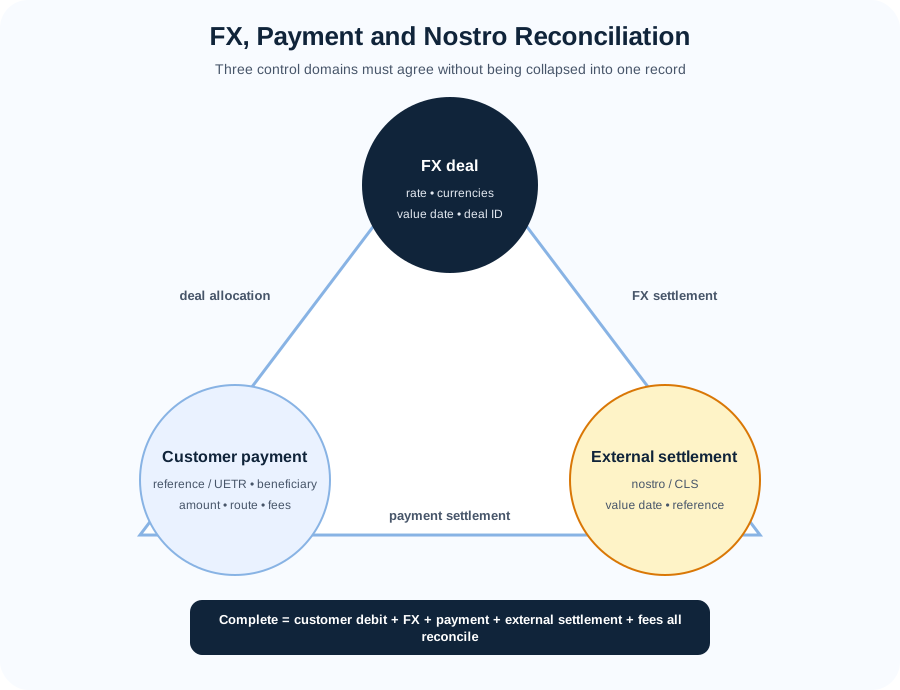
Foreign exchange and cross-border payment settlement are closely connected, but they are not the same transaction. A Canadian customer can ask a bank to send USD 100,000 while funding from a CAD account. The bank then has at least two linked economic events to manage: an FX conversion that changes CAD into USD and a payment that sends USD through the correspondent/settlement route to the beneficiary. The FX trade has its own quote, trade date, value date, market risk, accounting and settlement. The payment has its own customer instruction, payment reference (and a UETR when the payment uses SWIFT messages), agent chain, sanctions controls, correspondent account movement, beneficiary posting and investigation lifecycle. The labels regulatory rule, Payments Canada or network rule, bank-specific implementation, and fictional example are used explicitly below.
Banks get into trouble when they collapse these two into one vague status called “international transfer.” If the FX trade succeeds but the payment fails validation, the bank can be left with a currency position it did not intend. If the payment is released before the required currency liquidity is funded, it can miss a correspondent cutoff. If a payment returns days later, the original FX rate cannot simply be assumed to apply to a new customer conversion. Good design links FX and payment tightly while preserving their separate identities.
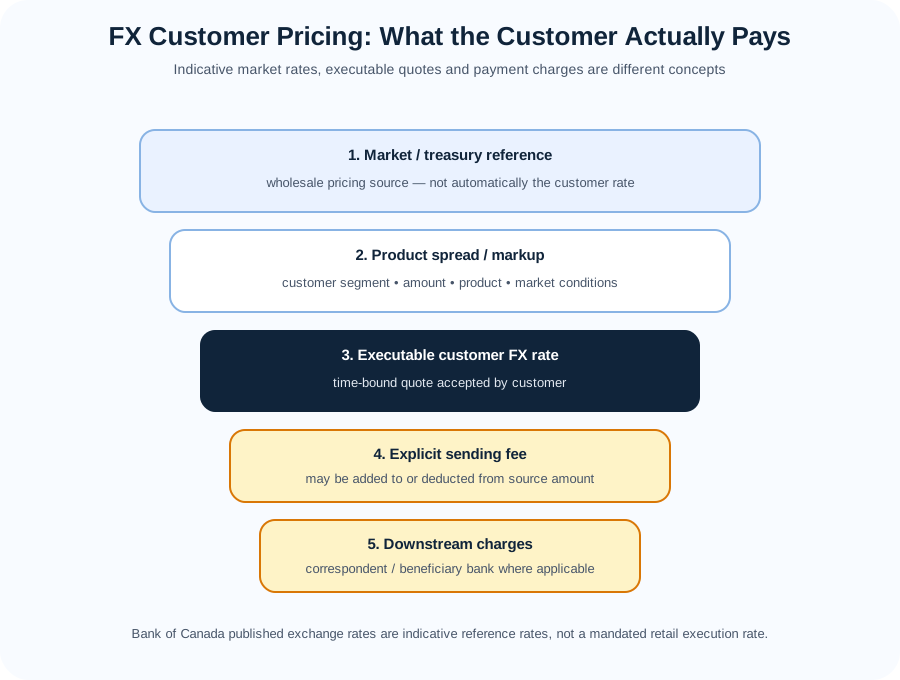
The Bank of Canada publishes daily exchange rates, but explicitly states that these are indicative rates only, obtained from averages of aggregated price quotes and not necessarily rates associated with actual currency trades. The daily average is published once each business day by 16:30 ET when the Bank is open, and is expressed as Canadian dollars for one unit of foreign currency; neither publication timing nor the rate is a customer execution guarantee 1. That distinction matters for customer complaints: a public central-bank reference rate is not the same as an executable bank customer rate. At the wholesale settlement layer, CLS provides payment-versus-payment (PvP) settlement for eligible FX transactions in 18 currencies, including CAD and USD 2. The Bank of Canada identifies the Canadian dollar arrangement as designated and oversees it through cooperative oversight; CLS reduces principal settlement risk for eligible FX trades, but it does not replace correspondent banking for every customer cross-border payment 3.
This chapter connects the full story: customer currency instruction, quote, pricing, FX booking, value dates, correspondent funding, payment release, bilateral versus PvP settlement, liquidity, charges, customer accounting, returns, failed trades, reconciliation and bank implementation.
What you should be able to do after this chapter
After working through this chapter, you should be able to:
- distinguish the customer cross-border payment from the linked FX conversion;
- explain base/quote currency and rate direction without confusing customer display with market notation;
- distinguish indicative rates from executable customer quotes;
- explain spread/markup and explicit fee as different pricing components;
- describe fixed-source and fixed-destination payment instructions;
- distinguish trade date, execution date, booking date and value date;
- explain why currency holidays and correspondent cutoffs affect achievable value date;
- describe how a bank funds foreign-currency nostro accounts;
- explain bilateral FX settlement risk and the payment-versus-payment principle used by CLS;
- explain that CLS settles eligible FX trades, not every customer cross-border payment;
- map FX trade settlement to underlying domestic RTGS/correspondent funding legs;
- explain how FX and payment records should be linked in accounting and reconciliation;
- describe what happens when FX books but the payment is rejected, or when a payment returns after FX settled;
- identify fraud, sanctions and operational controls across both the FX and payment lifecycle;
- design realistic test cases for quote expiry, holiday calendars, value-date mismatch, failed funding and returns;
- explain customer impact when rate, fee, intermediary charge and beneficiary amount differ.
For a roughly 60-minute core session, spend 10 minutes on Sections 1–2, 15 minutes on Sections 3–5 with the quote/value-date diagrams, 10 minutes on Sections 6–7 with CLS/liquidity, 10 minutes on Sections 8–9, 10 minutes on the practical cases and 5 minutes on references.
Chapter navigator
- Customer need and the two linked transactions
- FX rate basics, currency pairs and customer quotes
- Pricing, spread, fees and amount fixing
- Trade date, value date, cutoffs and calendars
- Cross-border payment settlement after FX
- FX settlement risk, PvP and CLS
- Liquidity, funding and treasury management
- Controls, compliance, fraud and customer transparency
- Exceptions, returns, accounting and reconciliation
- Implementation, testing and resilience
- Practical Canadian FX and settlement examples
- Key takeaways and authoritative references
1. Customer need and the two linked transactions
Consider a Toronto importer that owes USD 250,000 to a U.S. supplier. The importer holds CAD but not USD.
The customer instruction is:
Debit our CAD operating account and make USD 250,000 available to the supplier on the agreed date.
The bank must solve two problems.
Problem A — currency conversion
How many CAD should be debited to obtain USD 250,000 at the bank’s executable rate and pricing?
Problem B — payment
How will USD 250,000 reach the supplier’s beneficiary bank and account?
These problems are linked by:
- amount;
- currency;
- timing;
- customer authorization;
- value date.
But they have different settlement evidence.
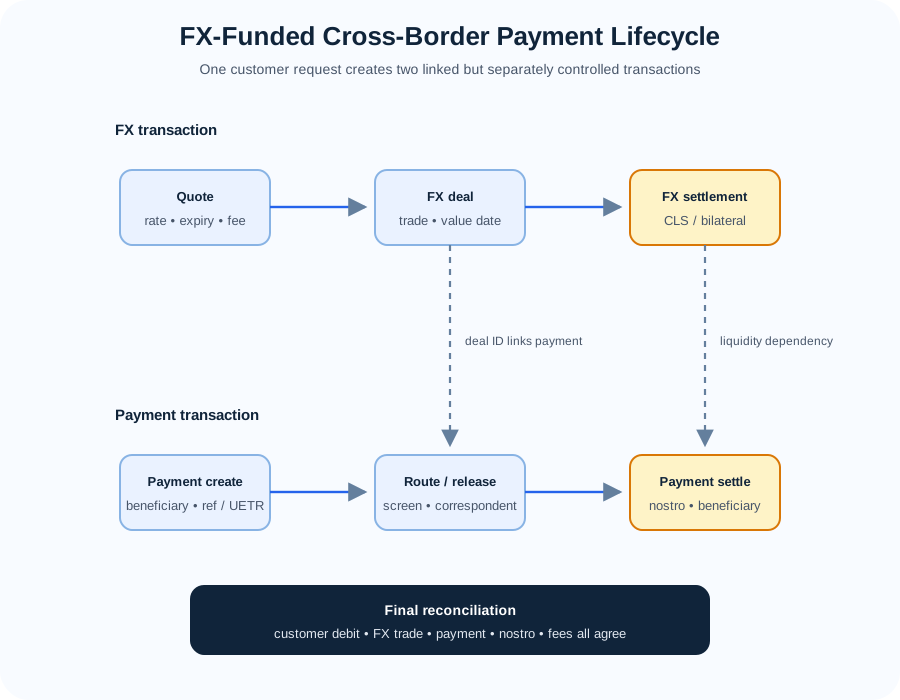
The FX trade object
The FX trade should have:
- deal ID;
- customer;
- currency pair;
- bought currency;
- sold currency;
- bought amount;
- sold amount;
- agreed rate;
- trade timestamp;
- value date;
- product/spread;
- dealer/auto-price source;
- status.
The payment object
The payment should have:
- payment ID;
- customer instruction;
- UETR when the payment uses SWIFT-supported message types (otherwise the applicable network/payment reference);
- payment currency/amount;
- beneficiary;
- route;
- requested/value date;
- status;
- correspondent settlement;
- return/investigation.
The records link:
payment.fxDealId = FX123.
The FX trade should not disappear into a field called exchangeRate on the payment.
No-FX payment
If customer already holds USD 250,000:
- debit USD account;
- no customer currency conversion;
- cross-border USD payment proceeds.
The bank still manages USD nostro liquidity.
Incoming payment with FX
A Canadian beneficiary may receive USD but want CAD.
The beneficiary bank can:
- credit USD account if customer has one;
- convert under product terms;
- ask customer for instruction;
- auto-convert if agreed.
Again, incoming payment and FX conversion are separate events.
2. FX rate basics, currency pairs and customer quotes
Currency pair
An FX rate relates two currencies.
For example, a bank can express:
The numerical rate direction changes depending on convention.
Systems should never rely on a human reading a number without knowing:
- base currency;
- quote currency;
- bought/sold currency.
Customer display
Customer-facing screens should avoid ambiguous rate direction.
Better:
1 USD = 1.36 CAD
than:
Rate: 1.36
Store machine fields as currencies + rate.
Indicative versus executable
The Bank of Canada’s daily exchange rates are indicative averages of aggregated price quotes. They are not executable bank rates 1.
A bank customer quote is executable only under the bank’s product conditions and validity period.
Customer service should not compare a complaint directly to the Bank of Canada daily rate without understanding:
- time;
- market;
- spread;
- product;
- amount;
- fee.
Quote validity
FX prices move continuously.
A digital quote can be valid for:
- seconds;
- until customer confirms;
- another defined period.
The bank should display expiry/refresh behaviour.
If the rate expires, the customer must receive a new quote before execution unless product terms define another mechanism.
Market rate versus customer rate
A bank may source a market/reference rate internally and add:
- spread;
- risk;
- product margin;
- operational cost.
The customer gets the final executable rate.
Rounding
FX conversion creates rounding.
The system needs:
- rate precision;
- amount precision by currency;
- rounding method;
- residual accounting.
A one-cent discrepancy across millions of trades becomes a reconciliation problem.
Rate inversion
If system receives USD/CAD but customer screen needs CAD/USD, inversion must be mathematically controlled.
Do not round before inversion unnecessarily.
3. Pricing, spread, fees and amount fixing
Spread versus fee
A customer can pay for FX through:
- rate spread/markup;
- explicit transfer fee;
- both.
Product disclosure should distinguish them where required.
A “no transfer fee” product can still earn FX spread.
Fixed destination amount
Customer says:
Beneficiary must receive USD 10,000.
The destination amount is fixed.
CAD source amount =
USD amount × applicable customer rate
plus applicable sending fees, depending on pricing model.
Downstream correspondent deductions can still affect what beneficiary receives unless product/charge arrangement prevents it.
Fixed source amount
Customer says:
Debit exactly CAD 10,000.
The bank computes USD amount.
If fee is taken from source amount, product must state whether:
- fee added on top;
- fee deducted before conversion;
- fee separate.
Quote example
Fictional example:
Customer wants USD 10,000.
Executable rate:
1 USD = 1.3650 CAD.
CAD principal:
13,650.00.
Bank wire fee:
CAD 25.
Customer total debit:
13,675.00.
This is an educational example, not a current market rate.
Intermediary charges
If the correspondent deducts USD 15 from principal:
beneficiary may receive USD 9,985.
A customer can reasonably ask:
I bought USD 10,000. Why did they receive 9,985?
The bank needs downstream charge evidence.
Fee model requirements
Store:
- customer fee currency;
- fee amount;
- fee debit method;
- correspondent fee known/unknown;
- beneficiary fee;
- charge bearer/instruction mapping;
- final charge reports.
Do not infer fees only from the difference between instructed and credited amount.
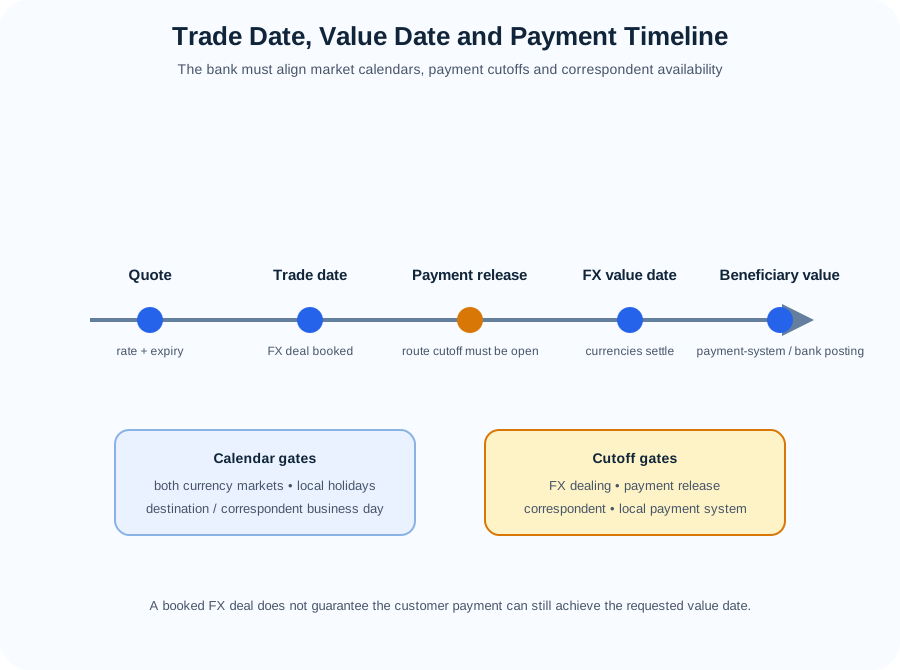
4. Trade date, value date, cutoffs and calendars
Trade date
Date/time when FX deal is agreed.
Value date
Date on which currency amounts are due to settle.
Payment execution date
Date the bank releases payment.
They can be same or different.
Spot convention
Many FX pairs have standard spot conventions, but they vary by pair and holiday calendar.
A bank should use market/calendar rules, not a hard-coded “spot = T+2 calendar days.”
Same-day / next-day products
Banks can offer value-today or value-tomorrow for some currencies/products if:
- market open;
- correspondent cutoff;
- liquidity;
- pricing.
These can cost more.
Holiday calendars
Valid value date requires relevant currencies/settlement systems open.
For CAD/USD:
- Canadian holiday matters;
- U.S. holiday matters;
- correspondent operating day matters.
If one currency cannot settle, PvP/FX settlement can move.
Cutoffs
FX desk cutoff and payment cutoff can differ.
Example:
- bank can quote FX until 17:00;
- USD correspondent same-day payment cutoff is 16:00.
Booking FX at 16:30 does not guarantee same-day payment.
The product engine should use the tighter feasible deadline.
Time zones
A EUR payment from Canada may hit European cutoff early in Toronto day.
Route engine must calculate destination-local time.
Daylight-saving transitions can temporarily shift time difference.
Value-date mismatch
If FX is value today but payment cannot release until tomorrow:
- bank may hold currency overnight;
- customer economics may be affected;
- treasury manages position.
Systems should flag mismatched value dates before execution.
5. Cross-border payment settlement after FX
After FX creates the payment currency, the bank still needs to settle the customer payment.
Correspondent account
For USD:
- bank funds/uses USD nostro at correspondent;
- sends payment instruction;
- correspondent debits account;
- beneficiary bank credited/routed.
CAD domestic leg
For incoming CAD cross-border:
foreign bank may use Canadian correspondent;
Canadian correspondent can use Lynx to beneficiary bank when the applicable inter-FI leg is CAD-denominated and the institutions/route are eligible 9 11.
Other currencies
The bank uses relevant correspondent/local infrastructure.
Payment settlement evidence
Evidence can include:
- nostro debit;
- SWIFT tracking, including UETR status where the message type supports it 10;
- domestic payment-system settlement;
- beneficiary-bank confirmation.
FX confirmation does not prove customer payment settled.
Current Canadian rail boundary: RTR is not yet a production route
Status at the audit date (2026-10-05): Payments Canada says the Real-Time Rail (RTR) is still undergoing participant and industry solution assurance testing and is scheduled to launch in Q4 2026. Its published launch plan starts with direct-to-Exchange participants in Q4 2026, followed by staged Interac e-Transfer migration in Q1 and Q2 2027, with full transaction volumes for the initial launch phases targeted for Q3 2027 4. Therefore this chapter must not describe RTR as a currently available production route for a Canadian cross-border FX-funded payment. The customer flow documented here is a current correspondent/SWIFT and domestic-settlement model; an RTR integration is a future-state design subject to final rules, participant readiness and onboarding. RTR is a Canadian exchange, clearing and settlement modernization, not an FX venue or a substitute for foreign correspondent settlement.
FX settlement versus customer payment settlement
The bank may hedge/book FX with another counterparty.
Example:
customer buys USD from Bank A.
Bank A covers market risk by buying USD from Bank X.
That wholesale FX trade can settle through CLS/other process.
Separately:
Bank A sends customer USD through Correspondent B.
These are different settlement chains.
Internal transfer pricing
Large banks may use internal treasury as FX principal.
Customer-facing business books FX with internal treasury.
Treasury hedges externally.
Accounting should separate:
- customer margin;
- treasury hedge;
- payment fees.
6. FX settlement risk, PvP and CLS
Principal settlement risk
Traditional bilateral FX can create “pay-away” risk.
Bank A pays currency 1.
Counterparty should pay currency 2.
If A irrevocably pays first and counterparty fails before paying second, A loses principal.
This is FX settlement risk, historically associated with Herstatt risk.
Payment-versus-payment
PvP makes settlement conditional:
one currency leg settles if and only if corresponding currency leg settles.
This reduces principal settlement risk.
CLSSettlement
CLS operates a multicurrency PvP settlement service.
CLS states that:
- it settles payment instructions simultaneously under PvP;
- it supports 18 currencies;
- Canadian dollar is eligible;
- direct settlement members and third parties use the service.
The Bank of Canada identifies CLS Bank as a designated system relevant to Canada and participates in cooperative oversight.
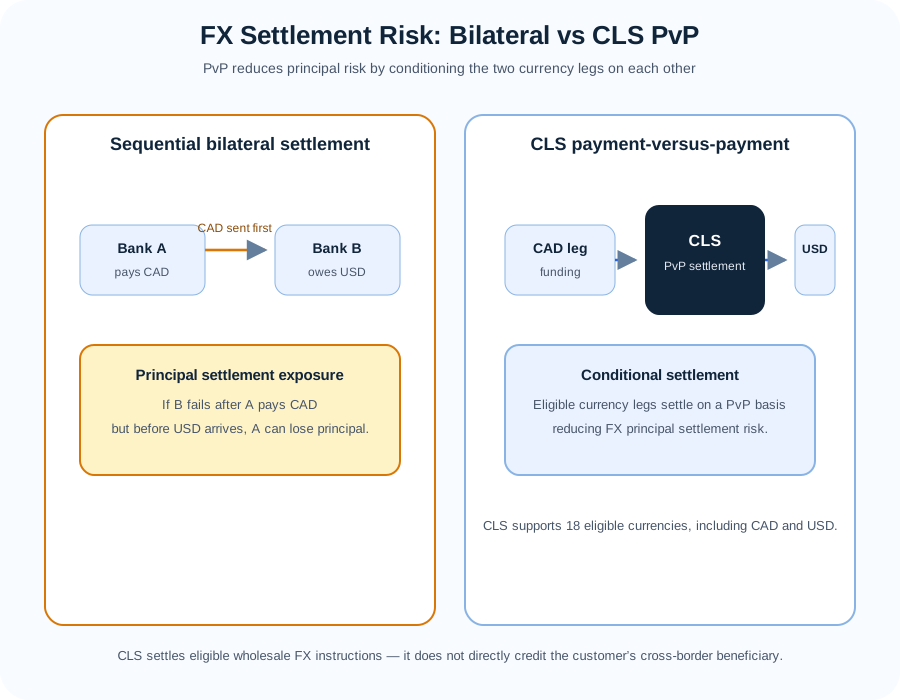
CLS does not settle every FX trade
Not all:
- currencies;
- products;
- counterparties;
- institutions;
- trades
are eligible/entered.
Banks need settlement-risk controls for non-PvP trades.
Third-party access
Institutions can access CLS through settlement members/service providers 14.
The service provider handles funding/payment instructions for third parties according to arrangement.
Multilateral netting
CLS’s process provides liquidity efficiency through netting.
Netting can reduce gross funding relative to gross settlement, but the actual requirement is governed by current CLS operating rules, the member or third-party arrangement and the pay-in schedule. Banks should understand:
- gross trade obligations;
- net funding requirement;
- pay-in schedule.
Domestic RTGS links
CLS maintains accounts/links in eligible currency central-bank payment systems.
For CAD, Bank of Canada/Canadian payment infrastructure supports CAD pay-in/out as part of CLS settlement arrangements.
A customer payment is not “sent through CLS” merely because the bank’s treasury hedged the FX via CLS.
Non-CLS settlement controls
For bilateral settlement:
- counterparty credit limit;
- settlement limit;
- payment timing;
- netting agreement;
- confirmation;
- correspondent monitoring.
PvP selection and controls for residual bilateral flows are bank-specific treasury policy, subject to counterparty agreements, risk limits and applicable law; this chapter does not treat an industry code as a Canadian payment-system rule.
7. Liquidity, funding and treasury management
FX and cross-border payment operations consume liquidity in multiple places.
Customer funding
Customer CAD debit provides CAD.
FX funding
Bank/treasury must deliver CAD leg of FX trade and receive USD.
Nostro funding
USD needs to be available where customer payment settles.
Timing must align.
Expected flow model
Treasury forecast:
CAD
- customer inflow from FX;
- FX market outflow.
USD
- FX market inflow;
- customer payment outflow.
A timing mismatch can create temporary funding need.
Prefunding
Bank can maintain USD balance before customer payments.
Pros:
Cons:
- idle liquidity;
- correspondent credit exposure.
Just-in-time funding
Treasury funds based on forecast.
Pros:
Cons:
Credit line
Correspondent overdraft/credit can bridge.
It has cost and limit.
Intraday liquidity dashboard
By currency/correspondent:
- opening balance;
- incoming;
- outgoing;
- FX settlements;
- customer payments;
- CLS pay-in;
- credit;
- buffer.
Large payment alerts
A single corporate payment can consume large balance.
Payment hub should notify treasury above threshold before cutoff.
Liquidity versus market risk
Liquidity risk:
can we pay when due?
Market risk:
does FX rate move against our position?
They are different.
An unhedged FX exposure can be liquid but risky.
A fully hedged position can still lack cash in the right account at the right time.
8. Controls, compliance, fraud and customer transparency
Customer authorization
FX confirmation should include:
- rate;
- currencies;
- amounts;
- fees;
- expiry;
- value date.
Payment confirmation:
- beneficiary;
- amount;
- currency;
- expected execution;
- UETR when the payment uses SWIFT-supported messages, otherwise the applicable payment reference.
Fraud
Business-email compromise can change:
- beneficiary bank;
- currency;
- invoice amount.
Large international/FX payments should support:
- maker/checker;
- beneficiary verification;
- out-of-band callback where policy;
- behavioural analytics.
Sanctions
Both payment and counterparties are screened according to policy.
FX counterparty relationship also has onboarding/compliance.
Market conduct
FX pricing/dealing should follow bank market-conduct policies and applicable codes/regulation.
The FX Global Code is an industry global code of good practice for wholesale FX markets; banks can align conduct as applicable.
Rate transparency
Customer should know:
- executable rate;
- fee;
- destination amount assumptions.
Avoid claiming Bank of Canada rate is “the official retail rate.”
Card boundary: A foreign-currency card purchase is a different scheme and credit product from this bank-wire model. FCAC describes card conversion charges as separate from the exchange rate, and a 2025 FCAC compliance decision required disclosure of the nature and amount of a card foreign-conversion fee 12 13. Do not apply those card-disclosure examples, card-network clearing, interchange or chargeback rules to a correspondent wire without checking the applicable product and scheme terms.
Quote manipulation controls
Dealer/manual quote changes should have:
- entitlement;
- tolerance;
- audit;
- approval where required.
Segregation
Front office quotes/trades.
Operations confirms/settles.
Finance reconciles.
Smaller organizations still need independent controls.
9. Exceptions, returns, accounting and reconciliation
FX booked, payment rejected
Scenario:
- customer accepts FX;
- USD booked;
- payment fails sanctions/data before release.
Bank now has FX position.
Policy options:
- hold USD for corrected payment;
- cancel/unwind;
- rebook.
Customer economics depend on terms and fault.
Payment sent, FX not settled
Dangerous if bank releases USD using expected FX proceeds that fail.
Treasury may need emergency funding.
The FX trade remains failed settlement and must be resolved separately.
Payment returned after days
USD returns.
Original CAD→USD FX settled earlier.
If customer wants CAD:
new USD→CAD conversion may be required.
Rate can differ.
Bank should not silently use original rate unless contract/product explicitly promises it.
Partial/fee difference
Beneficiary receives less due to intermediary fee.
FX trade may still be correct.
Investigation should not reopen FX merely because credited amount differs.
FX deal cancellation
If customer cancels before payment:
FX cancellation/unwind can create gain/loss.
Product terms define allocation.
Accounting model
Customer FX:
- debit source currency;
- credit destination currency/payment clearing;
- record spread/P&L.
Cross-border payment:
- debit destination currency payment clearing;
- credit/decrease nostro expectation.
Correspondent actual:
Exact journals depend on bank.
Three linked reconciliations
FX trade reconciliation
trade confirmation ↔ treasury system ↔ settlement.
Payment reconciliation
customer instruction ↔ Swift/payment status.
Nostro reconciliation
expected settlement ↔ correspondent statement.
Link all by payment/FX references.
CLS reconciliation
Treasury reconciles:
- submitted FX instructions;
- matched status;
- net pay-in;
- settlement;
- nostro/RTGS funding.
Break categories
- FX amount mismatch;
- rate mismatch;
- value date mismatch;
- trade unmatched;
- CLS unmatched;
- payment missing;
- nostro debit missing;
- return unmatched;
- fee difference;
- customer posting mismatch.
Interest/compensation
Late value can create interest cost.
Banks follow counterparty agreements/rules for compensation.
P&L attribution
Separate:
- customer FX margin;
- hedging P&L;
- settlement cost;
- payment fees;
- correspondent fees;
- operational loss.
This helps product profitability.
10. Implementation, testing and resilience
System architecture
Components:
- customer channel;
- payment hub;
- FX pricing;
- FX trade capture;
- treasury;
- market counterparty/venue;
- Swift;
- correspondent;
- CLS integration if applicable;
- accounting;
- reconciliation.
Quote service
Should:
- source rates;
- apply product spread;
- lock quote;
- expiry;
- return currencies/amounts;
- audit.
Deal booking
On customer acceptance:
- atomic linkage;
- prevent double booking;
- store deal ID.
If payment creation fails after FX acceptance, compensation workflow starts.
Calendar service
Must understand:
- currency holidays;
- payment-system holidays;
- correspondent calendar;
- product cutoff.
Rate precision
Test:
- direct;
- inverted;
- cross-rate;
- rounding.
Cross rates
Customer may convert currency pair without direct market quote.
Bank can derive through another currency internally.
Customer sees final executable rate only.
Architecture should store pricing method for audit.
Testing matrix
Quote
- valid;
- expired;
- refresh;
- manual dealer quote;
- rate unavailable.
Currency
- CAD/USD;
- CAD/EUR;
- foreign-to-foreign if product;
- unsupported.
Amount
- small;
- high-value;
- decimal precision.
Date
- same day;
- tomorrow;
- spot;
- holiday;
- cutoff passed.
Payment
- no FX;
- linked FX;
- beneficiary reject;
- return.
Treasury
- nostro funded;
- insufficient;
- credit line.
FX settlement
- CLS eligible;
- non-CLS;
- failed counterparty settlement.
Reconciliation
- rate mismatch;
- value-date mismatch;
- missing nostro;
- duplicate.
Failure atomicity
Customer presses confirm.
If system:
- books FX;
- crashes before creating payment,
recovery must know FX exists.
Use transaction orchestration/saga:
- FX_BOOKED;
- PAYMENT_CREATED;
- RELEASED.
Compensate consciously.
Resilience
FX price feed outage:
- stop instant quotes or use approved fallback;
- do not invent stale rate.
Treasury outage:
- restrict payment release if liquidity cannot be validated.
Swift outage:
- preserve payment/FX; release later if value date still feasible.
Correspondent outage:
- reroute if approved; reassess cutoff.
CLS issue:
- treasury follows CLS contingency and funding process.
Audit
Store:
- quote;
- acceptance;
- rate source;
- deal;
- payment;
- route;
- settlement;
- statement.
One case should reconstruct entire customer economics.
Deep dive: customer FX pricing and payment orchestration
A digital cross-border product needs a deterministic sequence from quote to final payment. The sequence should be written as a business process, not hidden inside front-end code.
A robust flow is:
- customer enters beneficiary and payment currency;
- product validates eligibility;
- system determines whether FX is required;
- if FX required, quote service returns executable rate, amounts, fees and expiry;
- customer authorizes;
- bank books FX deal;
- payment instruction is created;
- funds/limits are reserved or posted;
- compliance completes;
- route selected;
- payment released;
- settlement and reconciliation occur.
This sequence creates a coordination problem: steps 6 and 7 should either both succeed or enter a controlled recovery process. Distributed banking systems rarely offer one database transaction across FX and payments, so the bank needs explicit state management.
Saga-style recovery model
A simple state model can be:
QUOTE_CREATED
No financial commitment yet.
QUOTE_ACCEPTED
Customer accepted within validity.
FX_BOOKED
Bank now has a currency deal.
PAYMENT_CREATED
Cross-border instruction exists.
PAYMENT_FUNDED
PAYMENT_RELEASED
If the process stops after FX_BOOKED but before PAYMENT_CREATED, the recovery service should identify the orphan FX trade.
Options:
- create payment if customer instruction remains valid;
- cancel/unwind FX;
- escalate manual.
The bank must never let orphan trades remain invisible.
Fixed amount direction
A payment product should store an enum such as:
FIXED_DEBIT_AMOUNT
Customer fixed source currency.
FIXED_CREDIT_AMOUNT
Customer fixed payment amount.
This is more robust than inferring from which field happened to be populated.
For FIXED_CREDIT:
- destination amount authoritative;
- source amount calculated.
For FIXED_DEBIT:
- source amount authoritative;
- destination amount calculated.
If fee is separate, identify whether fee is included or added.
Rate calculation example with spread
Fictional only:
Wholesale indicative:
1 USD = 1.3500 CAD.
Bank customer spread:
1.00%.
Illustrative customer rate could be approximately:
1 USD = 1.3635 CAD
depending on bank convention/pricing calculation.
The exact pricing formula belongs to treasury/product.
The chapter should not teach customers to compute a bank’s rate from Bank of Canada daily average. Bank of Canada rate is an indicative benchmark constructed over the day.
Cross rate
Suppose customer funds CAD and pays GBP.
Bank could:
- price direct GBP/CAD;
- derive through USD internally.
If derived:
CAD → USD → GBP market legs
can produce a cross rate.
Customer does not need internal hedge path; customer needs final executable CAD/GBP economics.
Store:
- customer pair;
- customer rate;
- internal hedge details separately.
FX order types versus payment quote
Wholesale FX desks can use many order types.
A retail/corporate cross-border payment channel generally provides:
- immediate executable quote;
- pre-agreed contract rate;
- treasury deal reference.
Do not expose wholesale complexity unnecessarily.
Corporate customers can have:
- standing spreads;
- relationship pricing;
- dealer-negotiated rate;
- forward contracts.
Payment service should accept an authorized FX deal reference rather than always auto-price.
Forward FX and future payment
A corporate customer may hedge a future supplier payment with a forward FX contract.
At payment date:
- forward matures/delivers currency;
- payment uses delivered currency.
The forward trade lifecycle includes:
- trade date;
- forward rate;
- maturity/value date;
- counterparty/customer agreement.
The payment should link to forward allocation.
If invoice/payment amount differs from hedge amount:
- residual FX required;
- excess hedge handled.
This is treasury/product complexity beyond a simple spot conversion, but the architecture must support linkage.
Multiple payments against one FX deal
Corporate treasury can book one USD 1m deal and allocate across multiple payments.
Then relationship is:
FX deal 1 → Payment A 400k + Payment B 350k + Payment C 250k.
Data model should support one-to-many allocations.
Reconciliation should prove allocated total does not exceed deal amount.
One payment funded by multiple FX deals
A very large payment can also be funded from:
- existing USD balance;
- FX deal 1;
- FX deal 2.
Then funding allocation is many-to-one.
A mature treasury/payment model represents allocations explicitly.
Rate source hierarchy
Quote engine can obtain price from:
- internal treasury;
- market data;
- external liquidity providers;
- manual dealer.
It should record source.
If primary rate source fails, approved fallback might:
- secondary provider;
- manual dealer;
- disable quoting.
Using yesterday’s rate silently is generally unsafe.
Stale-rate control
Every rate should have:
- timestamp;
- validity;
- market status.
Quote service rejects if stale beyond threshold.
Monitoring should show:
- rate age;
- provider heartbeat;
- spread anomalies.
Extreme market movement
During volatility, bank can:
- shorten quote validity;
- widen spread according to approved policy;
- require dealer;
- temporarily restrict large automatic quotes.
Controls should be governed, not improvised by operations.
Customer cancellation after FX booked
This is often misunderstood.
If customer cancels after FX is booked but before payment release, the bank might need to unwind market exposure.
Suppose CAD weakens after original trade. Reversing at current rate can cause loss.
Product terms determine who bears cancellation cost.
System should:
- calculate unwind;
- obtain approval;
- post difference;
- explain to customer.
Payment return after FX booked
Return happens later.
Customer could choose:
- keep returned foreign currency;
- convert back.
If convert back, use current executable rate unless product promises otherwise.
This can create customer gain/loss.
Customer service needs a clear script.
Beneficiary amount guarantee
Some products promise fixed beneficiary amount.
To support this, bank must control:
- downstream charges;
- correspondent route;
- charge model.
If the bank cannot guarantee intermediary deductions, do not promise exact final credited amount.
Product wording must align with routing.
FX value date versus payment requested date
Suppose customer books EUR value Monday but beneficiary payment requested Tuesday.
Bank holds EUR one day.
That can be intentional.
If opposite:
payment requested Monday but FX only settles Tuesday,
bank needs bridge liquidity or cannot deliver Monday.
The orchestration engine should validate funding availability by payment settlement time, not just trade date.
Calendar engine in detail
A value-date service should have:
- currency calendar;
- market holiday;
- weekend;
- RTGS holiday;
- correspondent holiday;
- cutoffs;
- emergency closure.
A valid date usually needs both currency legs open for FX settlement.
For payment route, destination/correspondent calendar matters too.
The engine can calculate:
- earliest FX value date;
- earliest payment date;
- combined feasible date.
Daylight saving
Toronto, London, New York and other centres change DST on different dates.
Cutoff conversion should use IANA time-zone data, not fixed offsets.
A hard-coded “London = Toronto +5” fails several weeks per year.
Cutoff hierarchy
A customer payment can face:
- channel cutoff;
- FX auto-quote cutoff;
- treasury cutoff;
- Swift release cutoff;
- correspondent cutoff;
- domestic destination cutoff.
Earliest limiting cutoff determines same-day feasibility.
Post-cutoff customer experience
Options:
- schedule next business day;
- offer alternative route;
- offer different currency product;
- reject urgent same-day request.
The channel should show revised date before confirmation.
Treasury hedge timing
For many customer flows, treasury aggregates exposures before hedging.
Example:
Customer 1 buys USD 100k.
Customer 2 sells USD 60k.
Net bank exposure USD +40k.
Treasury may hedge net.
The customer trades remain individually booked even if market hedge is net.
Accounting must separate customer deals from hedge.
Market risk limits
Treasury sets:
- intraday open position limits;
- currency limits;
- dealer limits.
Payment product feeding FX demand affects these limits.
If limit breached, auto-pricing can pause or hedge immediately.
CLS eligibility model
CLSSettlement eligibility requires:
- eligible currencies;
- eligible settlement member/third-party arrangement;
- eligible trade/instruction;
- matched instructions.
A bank should not tag every CAD/USD trade “CLS” without checking actual settlement arrangement.
Store settlement method:
- CLS/PvP;
- bilateral;
- netting arrangement;
- other.
CLS matching
FX counterparties submit instructions.
Instructions must match on required trade economics.
Unmatched trades before deadlines create operational risk.
Treasury operations monitors:
- matched;
- unmatched;
- rescinded;
- settlement eligible.
An unmatched item can require urgent counterparty contact.
CLS pay-in liquidity
Even with netting, settlement members need currency pay-ins.
Treasury needs to fund:
- CAD pay-in;
- USD pay-in;
- other currencies.
CLS multilateral netting reduces gross funding but does not eliminate funding requirement.
CLS settlement evidence
Treasury reconciles:
- trade book;
- CLS instruction;
- settlement status;
- pay-in/out;
- currency account.
Customer payment operations generally should not use CLS status as beneficiary payment status.
Non-PvP risk waterfall
For trades not settled PvP, risk mitigation can include:
- netting;
- reducing gross bilateral settlement;
- shorter exposure window;
- counterparty limits;
- synchronized instructions where possible.
The updated FX Global Code emphasizes settlement-risk reduction.
Bank policy should classify residual non-PvP exposures.
Counterparty settlement limits
For bilateral FX, bank can set:
- gross settlement limit;
- pre-settlement credit limit;
- country/counterparty limit.
Operations should stop settlement beyond approved limit.
Herstatt risk scenario
Fictional:
Bank A pays JPY in Tokyo morning.
Counterparty is expected to pay USD later in New York.
Counterparty fails before USD payment.
A has paid full JPY but receives no USD.
PvP prevents this principal loss by making legs conditional.
This is why FX settlement risk can be huge even for creditworthy counterparties.
Nostro funding from FX
Suppose Bank A expects USD 50m CLS payout into its USD nostro.
Customer wires totaling USD 45m are queued after payout.
If CLS payout delayed:
payment release can be delayed.
Liquidity forecast should model dependencies:
expected CLS inflow → customer payment capacity.
Liquidity waterfall
A treasury funding hierarchy might be:
- existing balance;
- expected incoming confirmed;
- internal currency transfer;
- correspondent credit;
- money-market borrowing;
- contingency funding.
The actual hierarchy is bank-specific.
Payment hub only needs availability/decision, not all details.
Intraday overdraft cost
Correspondent may charge interest/fees.
Treasury can compare:
cost of prefunding vs overdraft.
Accurate flow forecast optimizes.
Payment queue by value date
Queue fields:
- payment ID;
- currency;
- amount;
- required value date;
- route;
- available liquidity;
- cutoff;
- priority.
Treasury can release selectively.
Same-currency incoming offset
Incoming USD can fund outgoing USD.
But do not rely on unconfirmed incoming.
A tracked payment upstream is not necessarily available balance.
Liquidity model should distinguish:
- expected;
- confirmed;
- booked;
- available.
Reconciliation architecture
Use separate ledgers:
FX deals
trade economics.
Payment
customer instruction.
Treasury funding
internal/market liquidity.
Nostro
external settlement.
Customer ledger
customer accounting.
A reconciliation engine links across but does not collapse.
Reconciliation example
Customer:
CAD -136,025 (principal + fee)
FX deal:
CAD 136,000 / USD 100,000
Payment:
USD 100,000
Nostro:
USD -100,000 plus correspondent fee if separate
Bank revenue:
CAD 25 fee + FX spread
All components explain customer statement and external settlement.
Rate complaint investigation
Customer says:
“Bank of Canada rate was 1.35 but you charged 1.365.”
Agent should retrieve:
- quote timestamp;
- executable rate;
- spread;
- fee;
- accepted confirmation.
Then explain Bank of Canada rate is indicative daily average, not retail executable quote.
Do not simply say “rates fluctuate.”
Missing FX deal
If payment record says FX required but no deal ID:
do not release blindly.
Create exception.
Possible:
- corporate provided external/prebooked deal reference missing;
- system booking failed;
- customer actually has foreign currency.
Resolve before settlement.
Duplicate FX booking
A payment retry could book FX twice.
Idempotency should cover:
quote acceptance/deal booking.
Use:
customer request ID + quote ID.
Second attempt returns existing deal.
Quote and payment concurrency
Customer may open same payment in two browser tabs.
Both attempt confirm.
Server-side optimistic locking/idempotency must prevent:
- two FX deals;
- two payments.
UI disable button is not sufficient.
Partial release
Bulk cross-border file can contain multiple currencies.
FX may be booked per item or aggregate.
If some items fail:
allocation/unwind logic needed.
Corporate file products should document this.
Corporate deal reference
A corporate treasury desk may prebook FX by phone/API.
Payment file includes deal reference.
Validation:
- deal belongs to customer;
- currency pair;
- value date;
- remaining amount;
- not already fully allocated.
Reject mismatches before payment release.
FX confirmation
Customers/corporates may receive separate FX confirmation and payment confirmation.
These documents should cross-reference.
Dispute resolution benefits.
Regulatory and tax reporting
Regulatory rule — FINTRAC: A financial entity must submit an Electronic Funds Transfer Report when it initiates, at a person’s or entity’s request, an international electronic funds transfer of CAD 10,000 or more in a single transaction, and when it finally receives one at that threshold. The 24-hour rule can aggregate related transactions, and exceptions and detailed field rules apply; the threshold is a reporting trigger, not a payment-rail limit or a customer transaction cap 5 6. FINTRAC’s current guidance also requires the report to preserve the transaction currency and the exchange rate used rather than silently converting every non-CAD amount to CAD 5.
Regulatory boundary — RPAA: The Retail Payment Activities Act covers in-scope retail payment functions performed by PSPs, including initiation, authorization/transmission, holding funds, and clearing or settlement, but it excludes banks and functions performed using a designated system. Subject to scope and exclusions, the Bank of Canada supervises PSP registration, operational-risk management, incident response, safeguarding of end-user funds and reporting; the framework is not a substitute for bank prudential supervision or FINTRAC obligations 7 8.
FX trade, tax, sanctions and AML records can have different retention and reporting bases depending on the institution and activity. Architecture should capture sufficient trade, payment, customer, screening and settlement data, and must not mix sanctions screening with FINTRAC reporting or market-transaction reporting.
Fraud scenario: beneficiary change plus FX urgency
Attacker compromises corporate email and sends:
“Change supplier bank to new country; pay urgently before rate moves.”
Red flags:
- new beneficiary;
- new country;
- urgent language;
- high amount;
- FX pair unusual.
Controls:
- callback;
- maker/checker;
- behavioural fraud scoring.
FX urgency should not bypass beneficiary verification.
Fraud scenario: rate manipulation social engineering
Fraudster impersonates bank dealer offering special rate and new payment instructions.
Customer channels/relationship procedures should authenticate dealer communications and beneficiary instructions separately.
Operational loss classification
Loss can result from:
- wrong rate;
- wrong amount;
- late FX;
- late payment;
- duplicate FX;
- failed unwind;
- correspondent fee;
- interest claim.
Root cause should be classified for process improvement.
BA acceptance criteria
Quote expiry
Given quote Q expires at T, when customer confirms after T, no FX deal is booked against Q and a new quote is required.
Fixed destination
Given customer fixes USD 10,000, when rate refreshes before acceptance, only CAD source amount changes; USD remains 10,000.
Deal linkage
Given FX deal D funds payment P, P cannot enter release-ready state until D is confirmed/funded according to product workflow.
Holiday
Given USD market/correspondent is closed on requested date, system does not promise same-day USD value and offers next feasible date.
Return
Given USD payment returns after original FX settled, return posts in USD and any CAD conversion is handled as a new FX event unless contractual rule says otherwise.
Nostro
Given expected USD payment debit has no matching nostro entry by checkpoint, reconciliation exception is created.
Test matrix expansion
Quote service
- price provider slow;
- provider unavailable;
- stale rate;
- spread config missing;
- quote reused;
- quote concurrency.
Deal
- booking success;
- booking timeout;
- duplicate;
- partial allocation;
- cancellation;
- forward deal.
Calendar
- both currencies open;
- one closed;
- DST transition;
- cutoff edge exact second.
CLS
- matched;
- unmatched;
- late funding;
- third-party provider failure.
Payment
- direct correspondent;
- intermediary;
- return;
- recall.
Accounting
- rounding;
- fee separate;
- correspondent fee;
- back-valued entry.
Operational dashboard
FX/payment dashboard:
- quotes requested;
- quotes accepted;
- conversion ratio;
- expired quotes;
- FX booked;
- orphan FX;
- payments awaiting FX;
- payments awaiting liquidity;
- value-date exceptions;
- returns;
- unreconciled nostro;
- rate-provider health.
Treasury dashboard:
- currency exposure;
- hedge;
- CLS pay-in;
- nostro liquidity.
Incident: rate feed frozen
If price feed stops updating:
- heartbeat alert;
- quote service stops/uses approved fallback;
- existing unexpired quotes handled according to policy;
- no silent stale pricing.
After recovery:
Incident: FX booking timeout
Customer receives “processing” not success.
Backend checks deal system:
- booked? retrieve;
- not booked? safely retry using idempotent ID.
Never book a second deal because response timeout.
Incident: correspondent cutoff unexpectedly moved
Correspondent announces emergency early close.
Route service updates operational cutoff.
Queued payments:
- alternate route;
- next day;
- customer notification.
FX already booked:
treasury manages currency overnight.
Incident: CLS outage
Treasury follows CLS contingency procedures.
Customer payment services assess:
- does outage affect funding/hedges?;
- foreign-currency liquidity?;
- payment cutoffs?
Do not tell customers “CLS payment delayed” unless their customer transfer actually depends operationally on that funding event.
Design-review checklist
- Are FX and payment separate objects?
- Is quote executable and time-bound?
- Are Bank of Canada indicative rates labelled correctly?
- Is rate direction unambiguous?
- Are source/destination fixed amount semantics stored?
- Are spreads and fees separate?
- Is FX deal idempotent?
- Can one deal allocate to multiple payments?
- Are value dates calendar-driven?
- Are cutoffs route-specific?
- Is liquidity checked in destination currency?
- Is CLS used only where actually applicable?
- Are non-PvP settlement risks controlled?
- Can returned foreign currency be held/converted under product rules?
- Are customer rate complaints auditable?
- Can orphan FX be detected?
- Are all ledgers reconciled?
- Is stale price feed fail-safe?
- Is beneficiary fraud controlled independently of FX?
- Are resilience dependencies tested?
Advanced treasury practice: aligning the FX trade, the payment and the funding account
A cross-border payment programme becomes operationally mature when it can answer three questions independently:
- What currency economics did the customer agree?
- What interbank payment did the bank send?
- How did the bank fund and settle the resulting currency obligation?
The FX trade answers the first. The payment object answers the second. Treasury/nostro records answer the third. Many production defects happen when these are hidden inside one application and teams cannot tell which layer failed.
Source-of-funds sequence
For a CAD-funded USD payment, an illustrative funding chain is:
customer CAD account → bank CAD liquidity → FX market/treasury conversion → bank USD liquidity → USD nostro → beneficiary route.
The bank might not literally move each customer’s CAD into a separate USD purchase; treasury may aggregate and hedge net exposure. But the customer-level accounting still needs to explain the conversion.
This distinction between customer economics and treasury hedge execution is important.
Customer deal versus hedge deal
The customer’s FX deal can be internal to the bank:
customer buys USD from the bank.
The bank may then hedge with:
- another bank;
- electronic venue/liquidity provider;
- internal group treasury;
- CLS-eligible counterparty.
The hedge amount/timing can differ from customer trade because treasury nets many customer flows.
Accounting should link:
customer deal → hedge strategy
without pretending they are the same trade.
Netting customer flows
Suppose during one hour:
- customers buy USD 20m against CAD;
- customers sell USD 12m against CAD.
The bank’s net USD demand is USD 8m before other positions.
Treasury can hedge USD 8m rather than gross USD 32m, subject to risk policy.
This reduces market transaction costs and funding requirements.
The customer trades remain individually priced and booked.
Position management
Treasury tracks:
- spot position;
- forward position;
- option/other exposures where applicable;
- customer orders;
- hedges.
Cross-border payment product contributes to that position.
An FX trade booked by a payment service should feed position management immediately, not only when the payment settles.
Pre-trade controls
Before offering a large automated quote, bank can check:
- customer limit;
- market availability;
- dealer threshold;
- currency product enabled;
- value date valid;
- market open;
- price source healthy.
For very large amounts, product may route to dealer.
Post-trade controls
After booking:
- trade confirmation;
- limit consumption;
- hedge/exposure;
- settlement instruction;
- payment linkage;
- reconciliation.
Missing post-trade feed can create unhedged market exposure.
Corporate negotiated rates
Large corporate customers can negotiate:
- live dealer rate;
- API rate;
- spread schedule;
- prebooked deal.
Payment initiation can include an FX deal reference.
Validation must prove:
- deal belongs to customer;
- currencies match;
- value date matches;
- amount allocation available;
- deal not cancelled.
Do not accept arbitrary deal references supplied by customer file.
Forward contracts and drawdowns
A customer can hedge future invoice with a forward.
Example:
- customer buys USD 1m forward for 30 November;
- on 30 November, invoices total USD 850k.
Possible product treatment:
- allocate USD 850k to payment;
- handle USD 150k residual under contract.
Payment platform needs allocation, not rate lookup only.
Window forwards
Some corporate products permit settlement within a date window.
The payment can draw value on selected date.
The system must check:
- window open;
- remaining amount;
- settlement instruction;
- product terms.
FX swaps and liquidity
Treasury can use FX swaps to obtain temporary currency liquidity.
Example:
bank needs USD today but expects USD inflow next week.
It can swap CAD for USD today and reverse later.
This is treasury funding, not customer FX.
Payment operations should simply see USD liquidity available.
Currency account hierarchy
A bank can hold multiple USD nostros:
- primary New York correspondent;
- backup;
- securities/custody;
- group entity.
Treasury decides which account funds route.
Payment routing should not select an account that treasury treats as unavailable for customer payments.
Payment-versus-payment eligibility controls
For wholesale FX trades intended for CLS/PvP, systems should verify:
- both currencies eligible;
- counterparties/access eligible;
- trade type eligible;
- settlement date supported;
- submission deadlines;
- instructions matched.
If trade misses CLS cutoff, treasury needs approved fallback.
Do not silently settle bilaterally without risk approval if PvP was expected.
CLS operational timeline concept
Without hard-coding exact intraday times, the lifecycle is:
- counterparties agree trade;
- settlement instructions submitted to CLS;
- instructions matched;
- funding/pay-in schedule determined;
- settlement members fund required currency positions;
- CLS settles eligible instructions on PvP basis;
- pay-outs/settlement reports complete;
- banks reconcile.
The exact schedule is controlled by CLS current rules/operating documentation.
Third-party CLS model
A bank that is not direct settlement member can use a settlement member/service provider.
Then dependencies include:
- service-provider cutoff;
- funding instruction;
- trade submission;
- settlement report.
Treasury should monitor service provider, not assume direct CLS visibility.
CLS and customer payment timing
A customer USD wire can be due before or after treasury’s CLS hedge settles.
The bank can use existing USD liquidity to bridge.
This is why customer-payment SLA should not expose internal hedge method.
If treasury changes hedge venue, customer product should not break.
Principal risk outside PvP
For a non-CLS eligible trade, bank can face full principal exposure during settlement window.
Risk controls can include:
- bilateral netting;
- counterparty settlement limit;
- timing coordination;
- prefunding restrictions;
- credit approval.
Operations should know which trades are non-PvP.
Market risk from failed customer payment
If payment fails after FX booked, bank owns currency exposure until resolved.
Example:
customer buys EUR 2m;
sanctions false-positive holds payment for two days.
If FX has already settled, bank holds EUR 2m.
This is liquidity/carry, not necessarily market exposure if customer transaction remains valid, but product terms and treasury treatment matter.
If customer cancels, bank may need unwind at new rate.
Return-rate analytics by corridor
Frequent returns in one corridor can create repeated reverse FX.
Banks should monitor:
- return rate;
- reasons;
- average delay;
- FX re-conversion loss/complaints.
Improve beneficiary validation to reduce unnecessary FX churn.
Charge and FX interaction
Suppose customer fixes CAD source amount.
If transfer fee is deducted from CAD source before conversion:
- less CAD converted;
- beneficiary USD lower.
If fee is added on top:
- full CAD source converted;
- customer debit higher.
The confirmation must make this clear.
A “CAD 10,000 payment” is ambiguous without fee treatment.
Intermediary deduction and fixed beneficiary amount
If product promises beneficiary receives exactly USD 10,000, bank might need:
- OUR-style charge arrangement where supported;
- correspondent pricing;
- route with fee protection.
If downstream still deducts fee, bank needs remediation.
Do not market fixed beneficiary amount without control over route economics.
FX margin disclosure and customer reporting
Corporate statement/advice can show:
- payment currency amount;
- source currency amount;
- exchange rate;
- transaction fee;
- bank reference;
- value date.
This improves reconciliation.
A corporate ERP can then book:
supplier expense/liability + FX difference/fee.
Foreign-currency account customers
A customer with USD account may still have an FX relationship:
- receives USD;
- later converts to CAD separately.
Bank should not auto-link later conversion to original payment unless customer/product does.
This preserves accounting clarity.
Incoming payment auto-conversion
Some products automatically convert incoming foreign currency into account currency.
Rules need:
- supported currencies;
- pricing;
- rate time;
- value date;
- fees;
- exceptions;
- customer agreement.
The incoming payment should first establish received foreign currency value, then FX conversion.
Failed incoming conversion
If payment arrives but pricing service unavailable:
- hold foreign currency;
- credit suspense/foreign-currency control;
- retry under product policy.
Do not reject the cross-border payment solely because the FX quote service is temporarily unavailable unless product/route requires it.
Multi-currency accounts
A multi-currency product can allow customer to hold multiple currencies.
Payment routing should select:
- matching currency pocket;
- no FX if sufficient;
- partial FX if product permits.
Partial funding needs clear allocation and rate.
Value-date interest economics
Holding currency one extra day can create:
- interest;
- funding cost;
- opportunity cost.
Large corporate payment delays can lead to value-date compensation claims.
Bank should capture:
- expected value date;
- actual;
- cause;
- financial impact.
FX settlement instruction static data
Wholesale FX settlement needs:
- counterparty;
- account;
- correspondent;
- currency;
- instructions.
Like payment nostros, these are high-risk static data.
Changes need authenticated verification and dual control.
SSI — standing settlement instructions
Wholesale markets use standing settlement instructions (SSIs) to define where currency should settle.
Controls:
- central SSI source;
- effective date;
- verification;
- counterparty approval;
- audit.
A wrong SSI can cause failed or misdirected FX settlement.
SSI versus customer beneficiary
Do not confuse:
- wholesale FX SSI;
- cross-border payment beneficiary account.
They belong to different linked transactions.
Matching FX confirmations
Treasury confirms trade economics with counterparty:
- currencies;
- amounts;
- rate;
- value date.
Mismatch must resolve before settlement.
Trade confirmation and customer payment confirmation are separate.
FX settlement reconciliation
For each trade:
- trade book amount;
- expected currency pay/receive;
- actual nostro/CLS settlement;
- fees;
- status.
Unmatched:
- missing instruction;
- amount difference;
- value date;
- counterparty.
Payment settlement reconciliation
For each payment:
- customer instruction;
- payment message;
- expected foreign-currency debit;
- actual correspondent debit;
- beneficiary status;
- return.
Then link payment currency funding to FX.
Profitability analytics
A cross-border product can earn:
- payment fee;
- FX spread;
- correspondent rebate/fee arrangements;
and incur:
- Swift/network cost;
- correspondent fee;
- liquidity cost;
- operations;
- fraud/compliance;
- claims.
Product P&L should allocate these separately.
Customer complaint taxonomy
Common:
- rate complaint;
- fee complaint;
- beneficiary received less;
- payment late;
- payment returned;
- wrong value date;
- duplicate debit.
First classify before investigating.
A rate complaint needs quote evidence.
A beneficiary shortage needs charge evidence.
A delay needs route/timeline.
A return needs downstream reason.
BA acceptance criteria: source/destination amount
Given FIXED_CREDIT_AMOUNT USD 25,000 and quoted rate R, when customer accepts before quote expiry, then USD payment amount remains 25,000 and source CAD principal is calculated using R according to product rounding.
BA acceptance criteria: orphan deal
Given FX deal is booked but payment creation fails, then the system creates an orphan-deal exception within the defined SLA and prevents the trade from disappearing from customer/payment operations visibility.
BA acceptance criteria: return currency
Given a returned payment arrives in original payment currency, the system must book the returned currency first and must not automatically apply the historical FX rate unless product rules explicitly require it.
BA acceptance criteria: calendar consistency
Given customer requests value date D, the payment and FX services must use the same governed calendar service; if D is invalid for either required currency/route, confirmation must not promise D.
BA acceptance criteria: CLS classification
Given a wholesale FX trade is tagged CLS, the settlement service must verify eligibility and submission/matching status; otherwise it enters exception and does not assume PvP protection.
Stress scenario: sharp CAD move
Market volatility causes CAD to move rapidly.
Controls:
- rate feeds update;
- quote validity shortens;
- large deals route to dealer;
- spread config monitored;
- customer accepted quotes honored under terms;
- treasury hedge limits monitored.
System should not freeze old rate.
Stress scenario: New York payment cutoff approaching
Customer books USD at 15:50.
Correspondent same-day cutoff 16:00.
Compliance review takes 20 minutes.
Payment misses route cutoff.
Product should decide whether:
- next-day value;
- alternate route;
- quote/value-date re-evaluation.
Do not show same-day completion merely because FX booked before cutoff.
Stress scenario: CLS pay-in shortfall
Treasury settlement member lacks enough CAD for CLS pay-in.
This is treasury crisis.
Potential impact:
- FX settlement;
- expected USD liquidity;
- customer payment funding.
Liquidity contingency should identify dependent customer flows.
Observability
FX dashboard:
- quote latency;
- stale quote blocked;
- acceptance;
- dealer referrals;
- booking errors;
- orphan trades;
- cancellations.
Settlement dashboard:
- CLS matched/unmatched;
- bilateral due;
- pay-ins;
- failed settlements.
Payment dashboard:
- awaiting FX;
- awaiting liquidity;
- released;
- returned.
Reconciliation control totals
Daily:
customer source debits
↔ customer FX deals
↔ payment currency amounts
↔ correspondent/CLS external entries.
Aggregate totals identify leakage; item-level links locate it.
Operations ownership
FX product/dealing
pricing and trade.
Treasury
hedge/liquidity.
Payments
beneficiary/route/message.
Compliance
screening.
Settlement ops
trade settlement.
Nostro reconciliation
external accounts.
Customer service
communication.
One case should traverse teams using same payment/deal IDs.
Final design-review questions
- What event commits the customer FX rate?
- What prevents duplicate FX booking?
- Which amount is fixed?
- How are fees applied?
- How are value dates calculated?
- What happens if payment fails after FX?
- What happens if FX fails before payment?
- What settlement method does treasury use?
- Which trades are PvP protected?
- How is USD/EUR liquidity funded?
- Can a returned currency be held?
- Are current vs historical rates distinguished?
- Can finance reconcile customer economics to external settlement?
- Can customer service explain all charges?
- Are quote, deal and payment states independently visible?
Final depth: settlement evidence, customer proof and auditability
The final control in an FX-funded cross-border payment is evidence. A bank should be able to prove the customer economics and the settlement outcome independently.
For the customer economics, retain:
- customer instruction;
- fixed source/destination amount;
- executable quote;
- quote timestamp and expiry;
- customer acceptance;
- FX deal ID;
- rate;
- explicit fee;
- source-currency debit;
- payment-currency amount.
For the FX settlement, retain:
- wholesale/treasury deal where applicable;
- counterparty;
- value date;
- settlement method;
- CLS or bilateral status;
- currency pay/receive entries;
- settlement references.
For the cross-border payment, retain:
- payment ID;
- UETR when the payment uses SWIFT-supported messages, otherwise the applicable payment reference;
- beneficiary;
- route;
- sent message;
- correspondent settlement entry;
- beneficiary status;
- return/recall if any.
An auditor or investigation team should be able to move from one layer to the next without relying on verbal explanation.
Evidence hierarchy for customer disputes
A customer says:
You debited CAD 136,500 but the beneficiary received only USD 99,970.
The investigation should not start with the rate alone.
Step 1:
Confirm the agreed USD payment amount.
Step 2:
Confirm the CAD conversion and fee.
Step 3:
Confirm the bank actually sent the agreed USD principal.
Step 4:
Check correspondent/intermediary charges.
Step 5:
Check beneficiary-bank credit.
This separates FX pricing from payment charge deduction.
If the bank sent USD 100,000 and an intermediary deducted USD 30, the FX rate is not the cause.
Value-date proof
For a “late payment” complaint, compare:
- requested payment date;
- quoted FX value date;
- actual FX settlement date;
- payment release date/time;
- correspondent cutoff;
- actual nostro debit value date;
- beneficiary-bank receipt/credit date.
The delay can belong to:
- customer initiation;
- compliance;
- FX;
- treasury funding;
- payment routing;
- intermediary;
- beneficiary bank.
This evidence supports fair compensation decisions.
Audit trail for manual dealer pricing
Where a relationship manager/dealer provides a manual rate, record:
- user/dealer ID;
- source market rate/reference;
- spread/price;
- timestamp;
- approval if needed;
- customer acceptance;
- linked deal.
Manual pricing without audit creates conduct and complaint risk.
Accounting for rounding residuals
When conversion produces more decimal precision than currency permits, the bank must apply approved rounding.
Example:
calculated CAD amount = 13,650.0047.
CAD posts to cents.
Residual should go to a controlled rounding/P&L account according to accounting policy.
Do not let different systems round differently:
channel 13,650.00;
FX system 13,650.01;
ledger mismatch.
A central amount/rounding service or shared rules prevent this.
Rate inversion test
If direct rate is:
1 USD = 1.36 CAD,
inverse is:
1 CAD = 1 / 1.36 USD.
If system rounds 1.36 to 2 decimals before inversion while treasury uses a higher-precision source, customer amounts can differ.
Testing should use full precision internally and display rounded rates/amounts under product policy.
Currency decimal differences
Not all currencies use two decimals.
A robust payment/FX engine uses ISO currency minor-unit definitions and product rules rather than a hard-coded 2-decimal assumption.
This affects:
- quote;
- payment;
- settlement;
- reconciliation.
End-to-end completion definition
For an FX-funded payment, “complete” should mean:
- customer debit correct;
- FX deal booked/settled according to model;
- payment released and externally settled;
- beneficiary outcome known to available evidence;
- fees accounted;
- nostro reconciled;
- no unresolved exception.
This definition is stronger than “Swift sent” or “FX booked.”
11. Practical Canadian FX and settlement examples
Example 1 — Canadian importer buys USD
Customer needs USD 100,000.
Bank quotes fictional 1 USD = 1.3600 CAD.
Customer accepts.
Bank books FX:
sell customer CAD 136,000;
deliver USD 100,000.
Bank links FX123 to payment P456.
Payment uses USD correspondent.
Correspondent debits USD nostro.
Supplier credited.
Reconciliation:
customer CAD debit → FX → USD payment → nostro.
Example 2 — quote expires
Customer gets rate at 10:00:00 valid 30 seconds.
Customer approves at 10:00:45.
System must re-quote.
It cannot quietly use old rate.
Example 3 — U.S. holiday
Canadian bank open but U.S. USD settlement/correspondent route closed.
Customer asks same-day USD.
System identifies no valid same-day value date and offers next available.
This is calendar/cutoff, not technical failure.
Example 4 — returned USD payment
CAD customer bought USD 50,000 Monday.
Payment returns Thursday because beneficiary account closed.
Bank receives USD 50,000 less/plus applicable charges according to route.
If customer wants CAD, Thursday FX rate applies according to product terms.
Original trade remains historical.
Example 5 — CLS treasury hedge
Bank aggregates customer USD demand and hedges CAD/USD with market counterparty.
The wholesale eligible FX trade settles via CLS PvP.
Separately customer USD wires settle through correspondent accounts.
CLS reduced treasury FX principal settlement risk; it did not directly credit customer beneficiaries.
Example 6 — missing nostro funding
Payment and FX are valid.
Treasury expects USD from an FX trade, but settlement is delayed.
USD nostro insufficient.
Payment hub queues USD wire before cutoff.
Treasury sources temporary USD funding and releases.
The root cause is liquidity timing.
12. Key takeaways and authoritative references
FX conversion and cross-border payment settlement are linked but distinct. The FX deal determines currencies, amounts, rate and value date. The payment determines beneficiary, route, UETR and correspondent settlement. Banks should maintain separate identities and reconcile both.
Bank of Canada exchange rates are indicative, not executable customer rates. Customer pricing can include spread and explicit fees. Value dates depend on currency conventions, holidays and cutoffs. Treasury must align FX settlement, nostro funding and customer payment release.
FX settlement risk arises if one currency is paid without receiving the other. PvP reduces that risk. CLSSettlement provides PvP for eligible trades in 18 currencies including CAD and USD and is a designated/overseen financial-market infrastructure relevant to Canada. CLS is an FX settlement service; it does not replace customer correspondent payments.
The practitioner rules are:
- separate FX trade and payment objects;
- store both currencies and rate direction;
- distinguish indicative and executable rates;
- control quote expiry;
- use market calendars for value date;
- align FX and payment cutoffs;
- forecast nostro liquidity;
- use PvP where eligible/appropriate under treasury policy;
- reconcile FX, payment and nostro separately;
- treat returned-payment FX as a new economic decision under product terms.
Authoritative references
This application uses JavaScript for the full interactive experience. This text summary is served for accessibility and search indexing.