Financial Institutions File and Payment Routing. Use authoritative financial-institution reference data to support reachability, validation, repair and routing.
Canada Payments & Collections · Block 2: Canadian Accounts, Routing and Infrastructure · Chapter 8 of 75
Every Canadian payment that leaves one institution for another depends on a quiet question answered long before the customer presses confirm: does the destination named on this instruction actually exist, can it receive this type of payment on this date, and which path should carry it there? In Canada that question is answered with authoritative reference data, and the most important batch-payments reference is the Financial Institutions File, the FIF. This chapter explains what the FIF is, how banks consume it, and how it combines with account, amount, rail and compliance facts to produce validation, reachability, repair and routing decisions that hold up in production, in audit and in front of an unhappy customer.
The FIF is Payments Canada reference data published under Rule F7. It is an electronic directory of routing information that helps participants direct payments to the appropriate deposit-taking institution in Canada. Banks use it for validation, reachability assessment, repair and routing of batch payments, particularly Automated Funds Transfer items exchanged through the Automated Clearing Settlement System. Freshness and versioning of the FIF are operational controls, not administrative preferences: every consumer inside a bank must use the same dated version, cut over on the same effective date, and be able to prove which version supported each decision. A bank that treats the FIF as background data will learn otherwise during its first payroll incident involving a retired transit number or a merger-driven institution change.
A working rule for this chapter is worth memorising: the FIF tells you where a branch lives in the clearing system and whether it can be addressed; it does not tell you whether the account is open, whether funds are available, whether the rail is open, or whether the payment is compliant. Routing is therefore always a combination decision. The FIF contributes reachability; account systems contribute account status; product logic contributes amount and urgency; rail calendars contribute cutoff feasibility; and fraud, sanctions and anti-money laundering controls contribute permission to proceed. Any design that lets one of those inputs overrule the others silently will eventually misroute, double-pay or wrongly reject.
What you should be able to do after this chapter
After working through this chapter, you should be able to:
- explain what the FIF is, who publishes it, who may subscribe, and why it is authoritative for batch-payment routing decisions;
- describe the weekly publication and Friday-effective rhythm in functional terms and explain why synchronized cutover is a control;
- place FIF consumption inside bank architecture: ingestion, version control, internal publication, validation, repair and routing;
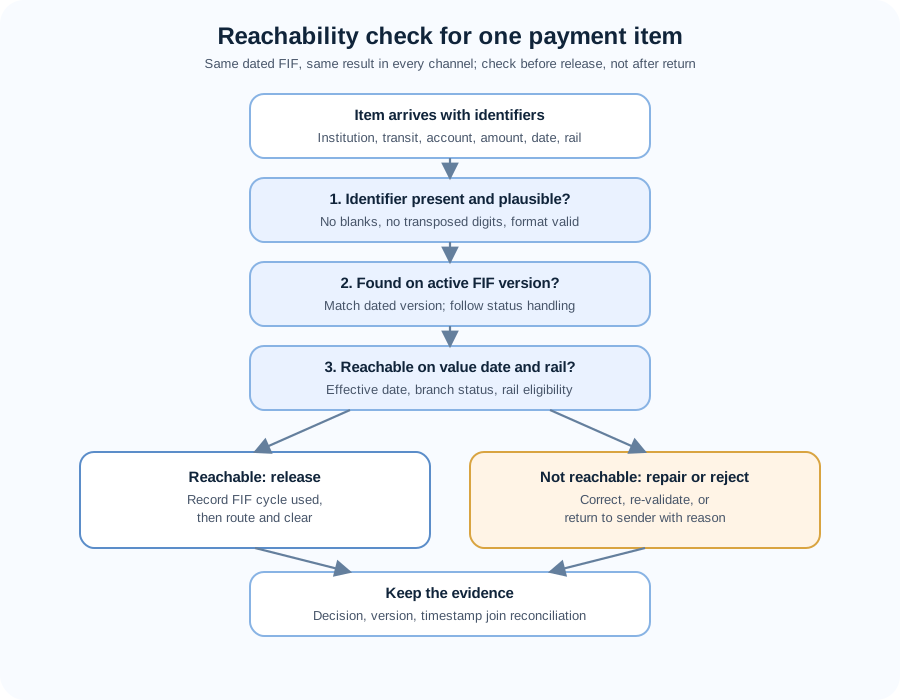
- run a reachability check for an outbound item using identifiers, the active FIF version, the value date and rail eligibility;
- distinguish validation, reachability, repair and routing as four separate decisions with four separate evidence trails;
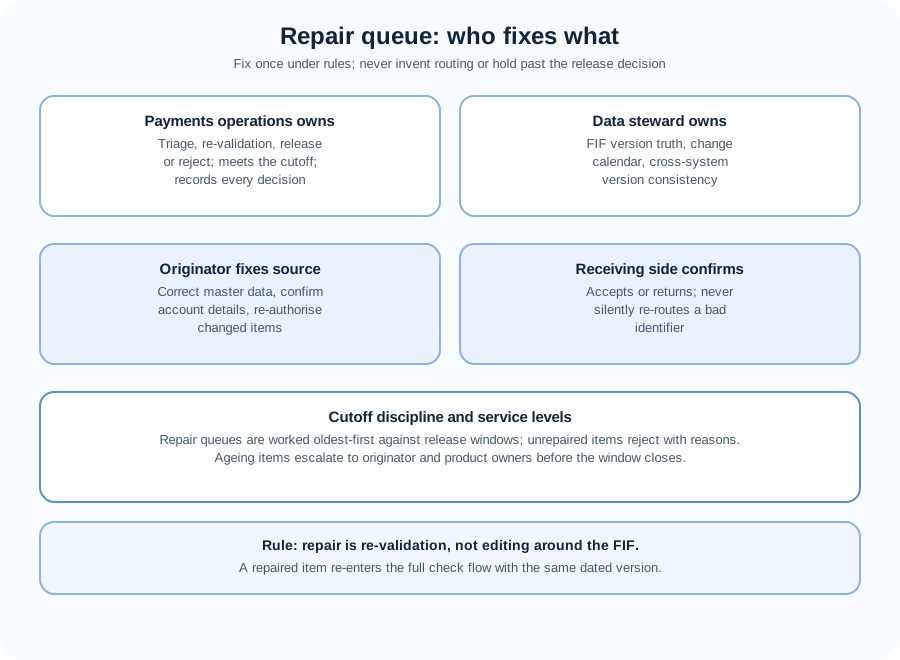
- operate or oversee a repair queue: who fixes what, what may never be repaired by invention, and how cutoffs force reject-or-release discipline;
- explain stale-reference-data risk: how one missed cycle becomes rejects, late payroll, ledger breaks and audit findings;
- combine FIF output with on-us analysis, amount and urgency, rail hours, account status and compliance disposition into a recorded routing decision;
- map this topic to clearing, settlement and finality: why batch items validated against the FIF still settle deferred-net in the ACSS with return rights, while Lynx wires settle gross with immediate finality;
- describe posting, accounting, liquidity, reporting and reconciliation consequences of routing-reference errors;
- specify what a bank must build, test and monitor before trusting a new FIF version in production;
- correct common misunderstandings, including treating the FIF as account validation, treating availability as finality, and treating the planned Real-Time Rail as a live routing option.
For a roughly 60-minute core session, spend about 30 minutes on Sections 1–4 (business need, participants, validation and settlement context), 15 minutes on Sections 5–6 (data and rules) tracing one payroll item through the two diagrams in those sections, 10 minutes on Section 11 (the three fictional Canadian stories), and 5 minutes on Section 12 (takeaways and references). The remaining depth on controls, exceptions, posting, implementation and resilience is guided follow-up study; completing the whole chapter carefully takes longer, and that is intentional for an infrastructure chapter that other blocks will assume you understand.
Chapter navigator
- Business context and customer need
- Participants, responsibilities and system boundaries
- Initiation, validation and bank processing
- Clearing, exchange, settlement and finality as it touches this topic
- Data, identifiers, messages and references
- Rules, cutoffs, service levels and customer impact
- Fraud, compliance and operational controls
- Exceptions, investigations and recovery
- Posting, accounting, liquidity, reporting and reconciliation
- Bank implementation, testing and resilience
- Practical Canadian end-to-end examples
- Key takeaways and authoritative references
1. Business context and customer need
Start with the payroll administrator in Winnipeg on a Wednesday afternoon, not with a rulebook. She has 2,400 employee credits to release for Friday payday, a file assembled from a human-resources system that merged two payroll calendars after an acquisition, and a service promise from her bank that credits will be in employee accounts on Friday morning with readable statement descriptions. She does not know what the Financial Institutions File is, and she should not need to. Her need is simpler: every valid employee gets paid on time, any invalid destination is caught early enough to fix without missing payday, and if something cannot be fixed she is told exactly which item failed and why while there is still time to act. Everything in this chapter exists to make that promise achievable at scale, thousands of times per week, across hundreds of originating businesses and millions of destination accounts.
Now widen the lens to the bank that serves her. On the same Wednesday the bank ingests dozens of business files: payroll credits, supplier payments, utility pre-authorized debits, government disbursements, and recurring collections. Each file contains hundreds or thousands of items, each item names a destination institution and branch, and each destination must be reachable through the intended clearing path on the intended value date. The bank cannot phone every receiving institution to confirm. It cannot rely on the originator's address book, which may be months or years out of date. It needs a single authoritative directory that says, for every routable destination in Canada, where it lives in the clearing system and how to address it — and it needs that directory to be current, consistently versioned, and identically understood by every validation engine, repair tool and routing service inside the bank. That is the business function of the FIF. It converts thousands of bilateral trust questions into one subscription: keep the current version, apply it uniformly, and prove you did.
The customer need behind reference data is therefore reliability of promises. When reference data is correct and fresh, the visible outcomes are uneventful: files validate cleanly, repair queues stay short, exchange accepts, settlement completes, employees see credits, suppliers reconcile, and nobody calls the bank. When reference data is stale, fragmented or inconsistently applied, the same files produce a cascade that customers experience as bank failure: valid-looking items rejected at exchange, repair queues overflowing near cutoff, value dates slipping, payroll landing late, supplier discounts lost, collection returns spiking, and reconciliation breaking because the sending hub and the receiving gateway disagreed about where a branch lives. Operations staff then spend the evening explaining a problem whose root cause was a missed weekly cycle three days earlier. Product owners who understand this causality design differently: they treat reference-data freshness as a customer-facing service level, fund the unglamorous work of version synchronization, and refuse roadmaps that assume routing works without it.
Three business patterns make the FIF indispensable. First, batch scale: a single file fans out to many destinations, so item-by-item bilateral confirmation is impossible and directory-driven validation is the only approach that scales. Catching one retired transit number at validation costs a repair message; catching it after exchange costs a return, a re-release, a second settlement obligation, customer communication, and a reconciliation exception. Second, change continuity: institutions merge, branches close or amalgamate, clearing arrangements shift, and new branches open while originator address books decay. The weekly cycle exists because the institution population is not static. Third, multi-system consistency: portals, host-to-host gateways, hubs and cores must all read the same version, or the same item passes in one channel and fails in another — which customers experience as arbitrariness.
Good looks different from each seat but depends on the same discipline. The small-business originator wants early, specific feedback: which rows failed, what exactly is wrong, and what to do before the cutoff. The corporate treasury team wants straight-through processing for clean files and a same-day repair path for the residue, with confirmation of the directory version used. The branch adviser wants a plain-language reason and next step for a rejected transfer. Operations wants a repair queue showing the failed check, the version consulted, and item age against the cutoff. Reconciliation wants every released item tagged with the directory version so a return traces to a decision. The auditor wants evidence of current-version use, timely cutover, and proper disclosure control.
There is also a negative business case worth stating plainly. The FIF answers the institution-and-branch question, not the account question. A branch can be perfectly reachable while the account number is wrong, closed or unauthorized for the transaction type. Banks that present FIF validation as proof that money will arrive over-promise and then absorb complaints that belong to account validation, mandate management or fraud control. The honest message is layered: the destination is recognized and reachable for this rail and date; the account-level outcome still depends on the receiving institution's posting rules and return rights.
Finally, place this chapter in the programme. Block 2 has introduced accounts, institution numbers, and transit routing. This chapter adds the directory binding those identifiers to operational reality. Later blocks on AFT, the ACSS, Lynx, cross-border and the planned Real-Time Rail assume reference-data literacy: AFT chapters assume you know why a file validates or repairs before exchange, ACSS chapters assume you know why exchange accepts or rejects, and Lynx chapters assume you understand why wire routing uses a different control set with same-day finality.
2. Participants, responsibilities and system boundaries
Canadian batch routing involves more parties than the two customers, and incidents usually begin where responsibilities blur. This section draws each boundary so that Sections 3 through 10 can assign work without ambiguity. The cast is stable: Payments Canada as publisher and rule-setter, subscribing members and sponsored subscribers as consumers, direct clearers with heightened duties, originators and originators' banks on the sending side, receiving institutions and their clearing agents on the destination side, and the Bank of Canada as settlement agent and overseer. Service providers and payment hubs act as agents inside those boundaries; outsourcing the work never outsources the accountability.
Payments Canada owns the FIF and its intellectual property, publishes it on a weekly rhythm, delivers the FIF Update Report to each Direct Clearer before each effective date, and sets the rules for subscription, use, disclosure and compliance through Rule F7 and its companion instruments. It does not validate any individual customer payment, repair any individual item, or judge the underlying business deal. Its responsibility is the integrity and timeliness of the directory itself: that the published version is coherent, that changes carry the correct effective date, that subscribers receive what they need to cut over, and that the rulebook states plainly what subscribers must do. The operational rule in this chapter is simple: when an originator's address book conflicts with the current FIF, the bank uses the FIF for AFT routing and records the version that supported the decision; the FIF is not account validation.
Subscribing members take the FIF directly from Payments Canada through a formal subscription stating output requirements, delivery arrangements, and operational and invoicing contacts. They must protect its confidential and proprietary character under the subscription agreement and comply with the applicable subscriber manuals and service-level description. In a bank, distributing one dated version to all internal consumers simultaneously and retaining version evidence are bank-specific implementation controls, not a claim that Rule F7 prescribes a particular internal architecture. A member that sponsors a non-member subscriber must use a signed three-party agreement and is responsible for ensuring that subscriber complies with the FIF service-level description — sponsorship is an accountability chain, not a favour.
Direct clearers carry the heaviest duties. They must remain in compliance with the FIF Service Level Description and provide an annual attestation for each calendar year, through their Senior Operational Committee representative, no later than January 31 of the following year. They must review each update report and return corrections to their own updates within the window before the effective date. Clearing-agent changes have explicit notice periods: at least 30 calendar days before a Clearing Agent acts for an Indirect Clearer, and at least 40 calendar days for an Indirect Clearer changing its Clearing Agent; later data changes follow the Rule F7 cycle and a change applied to the FIF is irrevocable except through the prescribed further notice. These are scheme-rule duties, not optional bank controls.
Originators — employers, billers, governments, disbursers — own source-data quality: authority, accuracy and funding. Banks under-invest in originator education and pay for it in repairs: unrevalidated payroll details, supplier masters never updated after a payee merger, duplicate file submissions. Strong banks push validation upstream — portals checking destinations against the current FIF before acceptance, acknowledgements distinguishing accepted from held — and make clear that acceptance for processing is not a promise of settlement.
The originator's bank (sending institution) owns validation, reachability, repair-or-reject, routing and release — including the decision to stop. A bank that cannot reject cleanly cannot operate safely: every doubtful item released becomes someone else's return or loss. It also owns enrichment and record-keeping: stamping each released item with the directory version, preserving the decision trail, and entering the correct exchange path with references intact. Vendor hubs and processors never transfer this accountability; contracts and attestations evidence control of it.
Receiving institutions, clearing agents and data centres own the destination side. Rule F7 makes the handling more specific than a generic reachability label: a V branch is forwarded to its registered servicing data centre; a C branch must not be delivered to the Processing Direct Clearer; an X branch requires cross-reference data and the Originating Direct Clearer must deliver the original AFT Transaction unaltered; and a branch absent from the FIF must not be delivered to the Processing Direct Clearer. The sending bank must respect those outcomes rather than improvising; the receiving side must apply them consistently and return cleanly what it cannot post. Silent re-routing or alteration of cross-reference content seeds reconciliation breaks neither side can later explain.
The Bank of Canada touches this topic in two capacities. As settlement agent it provides settlement accounts for direct Lynx participants and ACSS direct clearers; ACSS direct clearers maintain those accounts, and the previous day's net balances settle during the morning of each business day. As overseer under the Payment Clearing and Settlement Act it supervises designated systems — Lynx as systemic, the ACSS and Interac e-Transfer as prominent. Neither role makes it publisher or validator of the FIF, and no routing decision is Bank-approved: batch items validated against the current FIF enter ACSS exchange under Payments Canada rules with obligations settling through accounts at the Bank, while Lynx wires settle in central-bank money with immediate finality under the Lynx framework.
Two boundary principles recur throughout. First, every handoff needs a record: channel to hub, validation to repair, repair to release, release to exchange, exchange to settlement, settlement to posting — each timestamped and reference-keyed, stating what crossed, under which directory version, and by whose authority. Second, agency never dilutes accountability: sponsored subscribers, vendor hubs, processors and clearing agents extend capacity, while the appointing member or direct clearer remains answerable for version discipline, disclosure, cutoff behaviour and evidence.
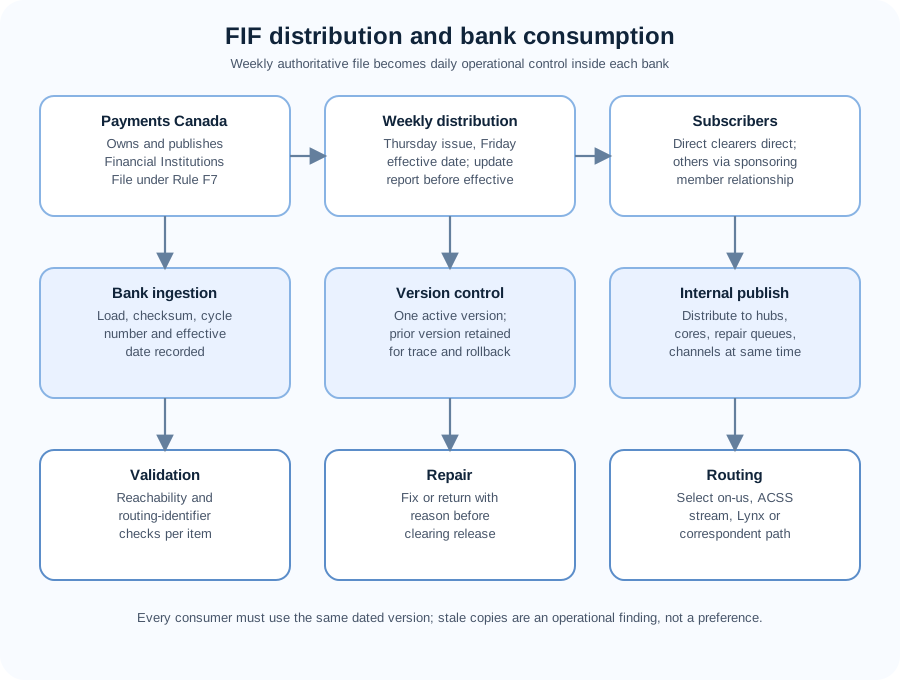
The diagram above is the chapter's anchor. Payments Canada publishes once; each bank ingests once, versions once, and publishes internally once to all consumers simultaneously. Validation, repair and routing then read the same dated truth. Whenever a later section discusses a failure — a reject, a late payroll, a ledger break — return to this picture and ask which box diverged. In a large share of real incidents, the answer is that one consumer read a different version than the others.
3. Initiation, validation and bank processing
Stages before exchange decide whether everything downstream is smooth or painful: most payment pain originates in initiation and validation, not settlement engines. A clean instruction validated once, enriched once and routed once flows; a dirty one slipping through generates repairs, returns and reconciliation breaks costing multiples of the original effort.
Initiation captures intent in a form the bank can act on without guessing: who pays, who is paid, how much, in what currency, on what date, with what references, under what authority. For business files it enforces release discipline — preparer, approver, dual approval above threshold, control totals, release locks preventing duplicate release. Duplicate payroll release is a classic initiation failure no settlement engine can repair; hashes, file-reference uniqueness and release-state machines must prevent it at source. Initiation must also separate look-alikes: a request for money is not a payment, a future-dated instruction is not yet releasable, and recurring instructions need mandate linkage. Test every channel against one question: can a reasonable user express the wrong intent by accident, and would the bank notice before release?
Validation is the layered gateset earning the right to move money, with the FIF serving specific gates rather than the whole wall: format and completeness, authority and limits, funds and exposure, duplicate screening, reachability, and risk and compliance review before release. Outcomes must be explicit and recorded: accepted, rejected with a repair-grade reason, held with a named owner and expiry, or repaired under controlled rules and re-validated. Weak banks validate silently and release hopefully; strong banks reject early and preserve the rejection so reconciliation can explain why an expected item never reached clearing.
The reachability check is a short sequence applied identically to every item, in every channel, against the same dated version. First, identifiers confirmed present and plausible. Second, the destination sought in the active version with status handling applied: directly deliverable, servable only through a designated arrangement, deliverable only with cross-reference content intact, or not deliverable down a path. Third, date and path eligibility: the version in use must be the applicable effective version for the next AFT exchange and the destination must be servable on the intended ACSS path. The FIF is an AFT/ACSS directory, not a Lynx or correspondent-bank directory. Only items passing all three release; the rest go to repair or rejection, never to exchange on the assumption the receiving side will sort it out. Two details separate mature banks: every check stamps the cycle identifier onto the item's history, and any repair touching routing identifiers re-runs the full check.
Repair is controlled correction plus re-validation, not creative editing around the directory. Operations triages, corrects what is correctable, re-validates and releases or rejects against the cutoff, recording every decision. Data stewardship owns version truth: the active cycle, cutover timing, cross-system consistency and the change calendar. The originator fixes source: master data, payee confirmation, re-authorisation of changed items. The receiving side confirms or returns without silent re-routing. Three prohibitions keep repair honest: never invent routing, never alter cross-reference content that must travel unaltered, and never hold a repairable item past the release decision hoping the directory changes. Queues work oldest-first with escalation before the window closes, staffed for the post-effective days when originator decay surfaces most.
Bank processing and routing turns a validated, reachable instruction into a releasable obligation on the correct path. Enrichment adds routing, path selection, value-date assignment, charge handling and reference propagation preserving end-to-end identity. For AFT, FIF handling determines the ACSS destination or servicing arrangement; it does not select a Lynx or correspondent-bank route. The bank's own routing engine then applies the on-us test and rail eligibility from amount, urgency, currency, reachability, cutoff feasibility, cost and risk appetite — each choice changing downstream evidence, timing and exception rights, so the decision is recorded with the rule that fired and the version consulted. Processing also owns scheduling and release: warehousing future-dated items against business-day triggers, splitting files so one bad item does not poison the file, and anchoring release with authority, timing, limits and liquidity consequence.
Design initiation to prevent the errors you least want to reconcile, validation to fail safe and explain itself with a deterministic version-stamped directory gate, repair to be honest about what only the originator can fix, and routing to preserve identity so clearing, settlement and postings join without fuzzy matching. Banks that do these four things find exchange, settlement and reconciliation become confirmations of earlier discipline rather than rescue operations.
4. Clearing, exchange, settlement and finality as it touches this topic
Newcomers often collapse five distinct events into one word like cleared or completed. Directory success feels like payment success but is not: a released item has only earned the right to enter exchange. Whether value moves, when it becomes final, and whether it can return depend on the rail's clearing and settlement model.
Exchange delivers instructions between participants: items and totals into ACSS streams for batch, ISO 20022 messages into Lynx for wires. The FIF's role ends at this boundary in the sense that matters — it determined fitness to offer, but exchange applies its own acceptance logic, and versions diverging between sender validation and exchange view cause rejects. Version-stamped items locate that divergence in minutes.
Clearing is the agreement and calculation layer above exchange. In ACSS batch, exchanged items aggregate into net participant positions, with the previous day's net balances settled during the morning of the next business day; in Lynx each payment settles gross with no batch netting. A payment can be cleared but not yet settled — the gap where liquidity planning, cutoff promises and customer communication live. For batch items, release plus exchange acceptance promises only that the item entered the batch calculation correctly addressed, not that funds were received.
Settlement discharges clearing's obligations in central-bank money. Lynx settles each payment individually in real time across settlement accounts at the Bank of Canada; it replaced the Large Value Transfer System in September 2021. ACSS settles the previous day's net positions during the morning of each business day through direct clearers' Bank of Canada settlement accounts. Reference data routes the instruction; settlement moves the value. Describing a well-validated batch file as settled on release overstates the bank's position and misleads liquidity management.
Posting moves customer and internal accounts: payer debit, beneficiary credit, fees, suspense and settlement-account entries. A batch credit may be available Friday morning while net settlement mechanics complete on their own timetable; a Lynx posting follows finality with no interbank value risk on that leg. Posting evidence lives in core banking and the ledger, not the network — reconciliation must join them explicitly.
Availability and finality are the promises customers feel and must never be conflated. Availability means the beneficiary can see or use funds under the receiving bank's policy; finality means the interbank obligation is discharged irrevocably under the system's legal framework. In Lynx, settlement brings prompt finality between participants, evidenced by the confirmation reference generated on settlement. In batch, availability routinely precedes expiry of return rights: insufficient-funds, invalid-account and mandate returns remain possible inside defined windows. A reachable branch reduces directory risk but does not guarantee posting or prevent a return by the receiving institution, clearing agent or applicable rule.
The Real-Time Rail deserves one careful paragraph and no more. Its by-law and rules received approval and came into force on August 24, 2026, but Payments Canada says production launch is targeted for Q4 2026 and current pages describe industry assurance testing, so it is not yet a live production routing option as of this chapter's October 5, 2026 audit date. Nothing in this chapter's batch routing assumes the RTR, and no production routing table should contain an RTR branch until authoritative sources say otherwise. When it launches, its addressing, participant interfaces and rules will be separate from the FIF; this chapter's version discipline may transfer, but its batch assumptions will not.
Reduce this section to four questions asked in order before declaring success on any item: where is the instruction, where is the exchange record, where is the settlement proof, and where is the posting? If all four join on the same references, you understand the payment. The FIF earns its keep in the first question; the rail earns its keep in the next three. Never let evidence from one answer for another.
5. Data, identifiers, messages and references
Payments move on data, and reference data is the data about the data. This section describes functionally — without reproducing any file layout or field specification — what the FIF contains, how it meets instruction identifiers, what reports surround it, and how references bind the story for reconciliation. The omission of layouts is deliberate: this course never asks bankers, analysts or product owners to memorise positions and codes, and never asks engineers to build from prose. Implementers work from the authoritative manuals under change control.
Functionally, the FIF is a directory of routable destinations and their clearing characteristics. For each destination it conveys, in effect: which institution it belongs to, how it is addressed for routing, its current delivery status, where items for it should be directed including through which servicing arrangement, what cross-reference information must accompany certain items, and when the information becomes effective. Each weekly issue carries its own cycle identity and effective date under the Friday-effective convention. Update reports issued ahead of the effective date let subscribers review, correct their own submissions, and prepare internal consumers. The directory never vouches for individual accounts, balances, mandates or compliance status — those live in account systems, mandate stores and control platforms. Treating a directory hit as a promise the beneficiary account will post is this topic's most damaging data misunderstanding.
The identifiers on the instruction meet the directory at validation. The originator supplies an institution identifier, a transit identifier and an account number with amount, currency, value date and references. The first two identify the destination branch in clearing terms; the third identifies the account at that branch in posting terms. The FIF validates the first pair and informs handling; the receiving institution validates the third at posting. Transposed digits, stale institution numbers after a merger, and retired transit numbers after a closure all look plausible at initiation and are indistinguishable without the directory — which is why upstream validation against the current version matters more than any downstream heroics.
Messages and reports around the FIF form a small, disciplined family: the weekly published version, the pre-effective update report, internal load confirmations and version-activation records, per-item validation and repair outcomes, and the exchange, settlement, posting and customer reports completing the chain outward. The bank's implementation should reference the governing specification version alongside the FIF cycle processed. Analysts add most value by insisting every artefact carry joinable identifiers — file reference, item reference, directory cycle, value date, clearing path and end-to-end reference — rather than by quoting layouts.
Reference preservation is where routing work meets reconciliation reality. References must survive enrichment, splitting, conversion and posting without mutation, and cross-reference content for designated destinations must travel unaltered — stripping or reformatting it converts a deliverable item into an exception. Lynx wires carry a richer ISO 20022 identity with per-payment settlement confirmation; batch items carry a leaner identity with less redundancy to recover from, making discipline more important. The test is joinability: from a customer enquiry, can operations walk from statement line to posting to settlement to exchange to release decision to directory version using keys, not recollection? If the walk needs fuzzy matching on amounts and dates, the bank has a data-architecture finding no staffing will permanently fix.
Data quality ownership is layered: the publisher owns directory quality under Rule F7, the bank owns consumption quality, and the originator owns source-data quality shaped by upstream validation and education. Each layer monitors itself — the publisher for coherence and timeliness, the bank's steward for ingestion completeness and version evidence, operations for repair outcomes, product for error clarity, reconciliation for join rates. Breaks tracing to a genuine directory miss are raised through proper channels with version evidence, never worked around with local overrides. Override tables shadowing the FIF diverge within weeks and convert one truth into two competing truths; any genuinely required override is time-bound, dual-approved, logged with expiry, and removed at the next cycle.
6. Rules, cutoffs, service levels and customer impact
Reference data feels technical until a cutoff makes it commercial. This section connects the rulebook, the weekly clock and the service promise. The stance is functional: what the rules require and what the clock demands, without reproducing rule text or invented timetables. Implementers work from the current rulebook under change control; everyone else works from the customer impact.
Rule F7 governs the FIF: its purpose for AFT exchange, subscriber rights and responsibilities, the file's property and confidentiality character, subscription mechanics including sponsored access, the weekly publication rhythm with its effective-date convention, update-report review discipline, annual compliance attestation by Direct Clearers, and the long-notice regime for clearing-arrangement changes including agent handover. Read with its companion batch rules and manuals, it describes how an item moves from origination to exchange. Three ideas matter most daily. First, the directory is authoritative and current-by-construction: the current version is treated as current and valid for its effective period, which is why using a superseded version is a control failure. Second, changes are prospective and calendared: an update must reach Payments Canada by 12:00 ET at least 2 Business Days before its Friday effective date; a later submission rolls to the next cycle. Direct Clearers receive the Update Report by 16:00 ET 2 Business Days before effectiveness, return corrections to their own updates by 12:00 ET on the Business Day before effectiveness, and the new FIF is available by 16:00 ET on that prior Business Day. A user may submit a change up to 28 calendar days before the appropriate effective date; earlier submissions may be returned under Rule F7. Third, sponsorship and agency are accountable: members answer for sponsored subscribers, agents coordinate handover, and applied arrangement changes stand until changed again under the same notice discipline.
The weekly clock is the chapter's heartbeat. The FIF output is delivered each Thursday, or on the immediately preceding Business Day when Thursday is not a Business Day; a new version becomes available after the week's last AFT Exchange Deadline for the following week's AFT files, and changes carry a Friday effective date. Holiday handling must follow the current rule text and ACSS calendar rather than a hard-coded Thursday/Friday assumption. Direct Clearers receive the Update Report ahead of effectiveness, review it, and return corrections inside the Rule F7 window. Mature banks verify ingestion on issue, assign review to a named steward, cut over internal consumers consistently, and re-validate warehoused items against the incoming version before effectiveness.
Cutoffs translate the clock into customer promises. Every batch exchange has a last moment after which items roll onward, and every originator promise — payroll available Friday, supplier payments dated month-end — implies a latest release time with repair completed, not a latest upload time. Reference-data failures consume that buffer first: a file that would have released cleanly spends its buffer in repair because destinations went stale. Product owners design promises backward from the exchange cutoff with repair time reserved and originator cutoffs that leave operations room; operations works repair oldest-first, escalates ageing items early, and rejects decisively while rejection-with-reason is still useful.
Service levels here are best expressed as freshness, consistency and explainability. Freshness: the effective version in use from its effective moment, provably. Consistency: every consumer reading the same version simultaneously, provably. Explainability: every reject naming the item, the failed check, the version consulted, and the remedy in actionable language. Mature banks instrument all three — version-activation dashboards, drift alerts, repair-ageing views, reject distributions, originator hygiene scores — and drive targeted outreach such as master-data clean-up before merger changes, which is invariably cheaper than staffing a larger repair queue.
Directory failures are easily mis-explained, so standardise the language. An unrecognised-destination reject is a destination-data problem with a named remedy — not an outage, funds problem or settlement failure. A late payroll from repair backlog is a validation-and-repair delay rooted in source-data decay, not an exchange delay. A return on a reachable branch is about account, funds or mandate, not routing — the directory did its job. Consistent language shortens investigations and stops the expensive misdiagnosis of waiting for a network fix while the repair queue ages past recovery.
7. Fraud, compliance and operational controls
Reference data commits no crime — but weak reference-data controls create the noise and gaps in which crime and compliance failures hide. Fraud monitoring, sanctions screening and AML review belong before release alongside validation and reachability, because holding before release is cheaper than recovering after settlement. The directory gate and the crime-and-compliance gates run in parallel on the same item and each can independently stop it: a reachable destination does not imply a trustworthy one, and a compliance hold does not imply a directory problem. Each gate stamps its own disposition so a later enquiry distinguishes held-for-screening from rejected-for-destination without conflating them.
Beneficiary-master-file fraud passes directory validation cleanly because the substituted destination is real and reachable — the FIF cannot detect that the right branch now serves the wrong person. Defence sits in master-data change control and behavioural analytics: dual approval for beneficiary additions and changes, confirmation callbacks for high-risk destination changes, velocity and new-destination alerts on payroll and supplier files, and segregation between editing payee details and releasing the file. The workable compromise is risk-tiered friction: known destinations flow, new or changed destinations above threshold challenge, and the challenge is fast and explainable.
Screening engines need complete originator and beneficiary information to decide precisely; truncated references or mutated beneficiary details degrade match quality both ways. This chapter's directory discipline — complete identifiers, unaltered cross-references, preserved end-to-end references — is therefore also a sanctions-effectiveness control, though the FIF itself is no sanctions list. Banks should verify that enrichment and conversion preserve every element screening depends on, and that repairs touching beneficiary details re-trigger screening rather than inheriting a prior clear.
AML review depends on the same joinable evidence: file lineage, directory version, release authority, destination consistency and reconciliation closure. A bank whose routing decisions are version-stamped and whose repairs are logged with authority will find AML review and examination straightforward; one whose routing ran on undocumented overrides will turn every review into forensics.
Operational controls bind this into daily assurance. Segregation separates directory administration from payment release, with both actions logged. Disclosure discipline limits directory access to those needing it for validation, repair and routing, with vendor and sponsored-subscriber access governed by agreement. Directory-consuming configuration changes ship under the same release with rollback tied to version retention. Monitoring watches freshness drift, repair-ageing, reject distributions and override usage as control indicators. Periodic confirmation — the attestation posture Rule F7 establishes for direct clearers — is a genuine self-assessment built from evidence filed through the year: timely cutover, consistent consumption, disclosure discipline.
8. Exceptions, investigations and recovery
Even with disciplined validation, exceptions are intrinsic to batch: accounts close, funds run short, mandates are cancelled, files contain items no directory can save. Vocabulary matters because loose language selects wrong recovery. A reject stops an item before exchange with a reason, value unmoved. A return sends it back after exchange under rail rules for account, funds or mandate causes the directory cannot prevent. A recall or return request asks the receiving side to send back a settled payment and succeeds only with consent or defined conditions. A reversal corrects a bank error under strict time discipline. An investigation traces an item across its evidence chain. Each preserves original transaction identity: exceptions reference the original item, never replace it with a look-alike.
Directory-related rejects form a recognisable family: unknown destination (absent from the active version, typically stale master data or validation against a superseded cycle), non-deliverable down the chosen path (wrong servicing arrangement, missing cross-reference content, wrong path), and date-ineligible (recognised but not effective for the value date). Each reason should name the item, the failed check, the cycle consulted, and the remedy. Reporting that omits the cycle forces the originator to guess whether the bank or the address book is out of date; including it converts a complaint into a correction.
Returns after exchange need different handling. Where the branch was reachable, a subsequent return is about account, funds or mandate — recovery follows rail return mechanics with originator notification, ledger adjustment and linkage to the original item. Where investigation shows the item should never have exchanged — versions diverged, an override shadowed the directory — the return is also a control finding with two tracks: make the customer whole, and fix the consumption defect so next week's file does not repeat it. Require every directory-implicated return to produce both a customer outcome and a consumption action.
Investigations follow the chain in order — instruction, validation and version, repair history, release authority, exchange, settlement, postings, customer reports — asking which cycle was effective, which cycle each consumer actually used, whether cross-references survived, and whether any override intervened. Version-activation records, per-item cycle stamps and retained update reports answer in minutes when they exist; their absence turns a routine trace into multi-day reconstruction. State investigation service levels in evidence terms: given file and item references, operations produces version, disposition and release authority within a defined time without calling three teams.
Recovery discipline closes the loop. Before release: repair-or-reject against the cutoff with the originator engaged early, or reject with a reason enabling same-day correction where the timetable allows. After settlement: rail return and consent mechanics with ledger integrity — no silent re-creation, no compensating duplicate release, no manual credit bypassing reconciliation linkage. For warehoused items: re-validate against the incoming version before the effective date and engage affected originators proactively. Recovery never invents routing: correct, re-date, re-address with payee confirmation, or decline.
9. Posting, accounting, liquidity, reporting and reconciliation
Routing-reference work reveals itself in the books. This section follows a released item into postings, ledgers, liquidity, customer reports and reconciliation: where directory errors surface financially and what proof the bank needs at each step.
Posting translates released items into account movements with matching value dates and fees separated from principal. Directory errors distort posting characteristically: items that should have rejected age in suspense, unvoided re-releases post twice, misdated items attract compensation claims. Each is preventable by version-stamped release, repair-or-reject before cutoff, and release locks — and diagnosable from posting references when those disciplines held.
Accounting gives postings control meaning: balanced entry sets per release, fee components separated, suspense used and cleared explicitly, control totals binding files to accounting at initiation, release, exchange and posting. Directory incidents break bindings recognisably: exchange totals diverging from release because rejects were never removed from accounting, suspense ageing because repair outcomes were never posted back, re-releases double-counting because the original was reversed operationally but not in the ledger. Per-file, per-cycle accounting with version annotation isolates an incident to affected files within the hour.
Liquidity is the quiet constraint behind batch promises. ACSS obligations settle on a deferred-net basis, concentrating funding need at settlement; Lynx wires require intraday liquidity for individual real-time settlement and participant queue management. Directory quality reaches treasury as forecast variance: repair backlogs shift value dates and settlement cycles, duplicates double funding need until reversed, post-settlement returns create funding whiplash. The bridge is communication discipline — operations telling treasury what released, rejected, rolled, and what that implies for funding, with directory incidents flagged as variance cause.
Reporting turns internal proof into customer confidence. Originators need file acknowledgements distinguishing accepted, held, repaired and rejected with actionable per-item reasons plus the cycle identifier. Beneficiaries need statement descriptions carrying originator references, not internal routing codes. Internal reporting needs version-activation confirmation, version agreement, repair-ageing, reject distributions and hygiene scores. The standard: every external statement — credited, rejected, returned, re-dated — traces to an internal record with the same references plus the directory version, without translation tables held in someone's head.
Reconciliation proves the story end to end. Three-way matching binds originator instruction, network confirmation and book entries item by item, with exceptions linked to originals. Version annotation adds the diagnostic dimension: release-without-exchange points to validation or cutoff failure, exchange-without-settlement-inclusion to stream or timing error, settlement-without-posting to posting or suspense failure, posting-without-originator-match to reference mutation or duplicate release, and any break citing different cycles to consumption drift. Close the loop with feedback: repeat originator breaks trigger master-data outreach, repeat destination-pattern breaks trigger directory-change review, repeat divergence breaks trigger architecture remediation. Reconciliation that merely balances is bookkeeping; reconciliation feeding back into validation and consumption is control.
10. Bank implementation, testing and resilience
Knowing what the FIF is matters less than building a bank that cannot use it wrongly. Product owners read this section as scope, engineers as requirements, operations as run-books, assurance as test plans. Throughout: describe functionally, never reproduce layouts, and build from the authoritative manuals under change control.
Consumption architecture starts with a single ingestion point and a single version authority. One service ingests each issue, verifies completeness, records cycle identity and effective date, retains the prior version for trace and rollback, and publishes to every consumer simultaneously — portals, gateways, hub, core tables, repair tools. Consumers receive on the authority's schedule and expose their active cycle on demand so drift is detectable. A freshness gate blocks batch release when the internal version is not the effective one. Overrides, if permitted at all, are first-class objects with dual approval, expiry at the next cycle, full logging, and a dashboard making their existence uncomfortable. Sponsored-subscriber and vendor interfaces follow the same pattern: publish the active cycle outward and verify application, never assume delivery equals application.
Validation, repair and routing rules are versioned, testable configuration, not scattered code. The reachability sequence is encoded once and invoked identically from every channel; status handling is table-driven from the directory; date eligibility reads the effective calendar. Repair permissions are explicit per failure type — operations-correctable, originator-required, never-correctable-by-invention. Routing tables combine directory output with on-us maps, rail eligibility, cutoff calendars and compliance dispositions, and every decision writes its rule identifier, cycle, timestamp and authority alongside the item. Refuse one-off routing favours bypassing the table; each favour without a rule change is a future reconciliation discovery.
Testing must prove version behaviour, not merely item behaviour. Beyond functional, integration and acceptance coverage: ingestion with completeness verification; simultaneous cutover verified by interrogating every consumer's active cycle; update-report handling with own-change correction inside the window; Friday-boundary testing for warehoused items dated either side of the change; merger scenarios with identifier changes and cross-reference redirects; per-failure-type repair flows with correct reasons and re-validation; override expiry; and rollback to the prior version with full evidence. Test with synthetic directories mirroring production change patterns — closures, amalgamations, agent changes, new branches — plus originator files seeded with real-world decay. Walk end-to-end tests from initiation through exchange simulation, settlement, postings and reconciliation breaks, asserting cycle stamps survive every hop and references join without fuzzy matching. Holiday-week testing should exercise displaced issue days, effective-date handling and compressed repair windows against the current F7 wording and ACSS calendar.
Resilience and operations convert architecture into sustained performance. Staff to the weekly cycle, with stewardship coverage for issue, review and cutover and operations depth for the post-effective days when originator decay surfaces. Monitor the predictors of customer impact: ingestion success, cross-consumer version agreement, repair depth and ageing, reject distributions, override count and age, originator hygiene scores, reconciliation join rates. Alert on drift, not merely failure. Run-books cover missed cycle, partial ingestion, divergent consumer, post-Friday exchange-reject spikes, merger-week master-data volume, and vendor application delay — each stating who decides reject-or-release when the clock is short, who tells originators what, and who records version evidence. Every routing-touching change ships with the cycle it was tested against, and production verification after each cutover confirms agreement before first release.
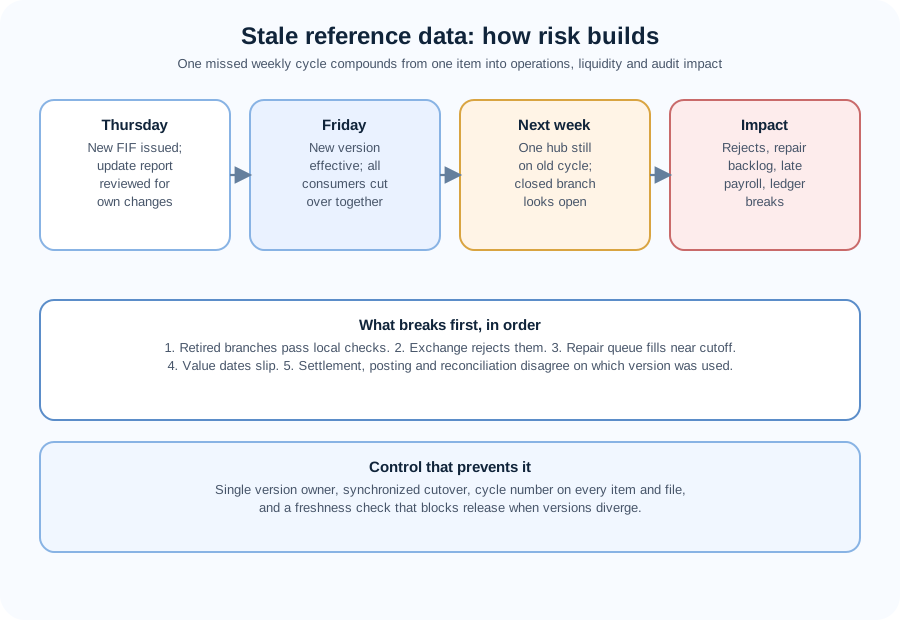
Governance closes the loop. Stewardship is a named role with a deputy, not a shared mailbox. Attestation preparation runs continuously — cutover evidence filed weekly, disclosure reviewed quarterly, sponsored-subscriber compliance confirmed periodically — so the annual confirmation assembles from retained proof rather than memory. Internal audit traces sample files from initiation to reconciliation with version evidence at each step, challenges override logs, and reperforms holiday-week and merger-period cutovers. Banks built and tested to this standard experience directory changes as routine; others experience them as incidents with customer names attached.
11. Practical Canadian end-to-end examples
Theory here is inexpensive; the repair queue on a Thursday before a long weekend is not. Three fictional stories show the disciplines under realistic pressure. All companies, people, amounts and institution names are invented; the directory mechanics, weekly rhythm, rulebook duties and rail behaviours are faithful to the Section 12 sources. Read each twice: once for the customer outcome, once for the control that produced or prevented it.
Example (fictional) — A payroll file with a retired transit number
Northwood Packaging Ltd., a fictional Manitoba manufacturer with 340 employees, uploads Friday payroll on Wednesday afternoon from a human-resources extract never revalidated after a branch consolidation: fourteen employees still carry the old transit number of a Winnipeg branch closed and amalgamated effective last Friday. The portal validates against the current cycle and fourteen items fail reachability with specific per-item reasons: destination not deliverable as addressed; confirm current branch details with the payee.
What follows separates disciplined banks from the rest. In the disciplined version, the portal holds fourteen items in repair while accepting 326 for processing, names the failing rows with remedies, and starts a repair clock against the originator cutoff. The administrator confirms successor branch details, corrects fourteen rows, re-uploads a correction file that re-validates cleanly, and both files release under the same cycle with version stamps intact. All 340 employees post Friday morning and the only trace is a repair log proving early detection. In the undisciplined version — divergent portal and hub cycles, vague reasons without cycle identification — the fourteen surface as exchange rejects Thursday evening, the administrator learns the file failed without row-level reasons, corrections miss the cutoff, and fourteen households miss payday before a long weekend amid manual tie-outs of partial releases. The directory never changed between these versions. Consumption discipline did.
The lessons to bank are specific. Validate upstream against the current version and report row-level reasons with the cycle identified. Split files so bad items do not poison good ones. Work repair oldest-first against a published originator cutoff with escalation before the window closes. Re-validate corrected items fully rather than patching them through. And feed the incident back into prevention: flag the employer's master-data hygiene score, offer a pre-payroll validation service before the next cycle, and confirm the HR extract process now tracks branch-change notices. None of this requires heroics. It requires the architecture of Section 10 operating as designed on an ordinary Wednesday.
Example (fictional) — A merger-driven institution change across supplier payments
Prairie Harvest Foods Inc., a fictional Saskatchewan distributor, pays 180 suppliers by batch credit on month-end. Its supplier master still carries the pre-merger institution number of a fictional Prairie Trust, amalgamated over the winter with a published changeover: old addressing remains servable through a defined arrangement for a transition period provided cross-reference content travels unaltered, then must use successor addressing. Accounts payable missed the notice. The April file, validated against the April-effective cycle, passes reachability — but only because directory handling routes those items transitionally and only because bank enrichment preserves references unaltered.
Operations sees yellow, not red: thirty items addressed to the retired number flow correctly but depend on transitional handling expiring next quarter. The bank does not hold them — they are valid — but hygiene monitoring flags the pattern and the product team acts before it becomes failure. Accounts payable receives a targeted notice naming affected suppliers with successor addressing and a validation report before the May run; the May file arrives corrected and the transitional dependency disappears. Settlement, posting and reconciliation never break because the directory was honoured twice: once for transitional handling, once for successor truth.
Consider the counterfactual the bank avoided. Had enrichment stripped the cross-reference content — a plausible defect after an untested hub upgrade — thirty valid-looking items would have failed at delivery. Had portal and hub run different cycles across the Friday change, the file's accounting would have split. Had a local override table shadowed the directory, it would have failed opaquely the week directory handling changed. Each traces to this chapter's disciplines: preserve cross-references unaltered, consume one version everywhere simultaneously, never shadow the directory. The happy ending is version-stamped validation, reference-preserving enrichment, hygiene monitoring and proactive outreach compounding.
Example (fictional) — An urgent supplier payment that must not travel by batch
A fictional Ontario equipment dealer, Lakeside Machinery, owes a supplier CAD 850,000 on Friday for steel released against confirmed funds. Its junior accountant prepares a Friday-dated batch credit expecting same-day certainty. Routing logic intervenes: amount, urgency and finality need say this item does not belong in batch. A batch credit would exchange correctly and settle deferred-net with return rights — the wrong promise for goods released against irrevocable funds. The channel instead offers a Lynx wire: individual real-time settlement across Bank of Canada accounts with immediate finality, screened, dual-approved, liquidity-checked and released in-window, its settlement confirmation reference evidencing finality.
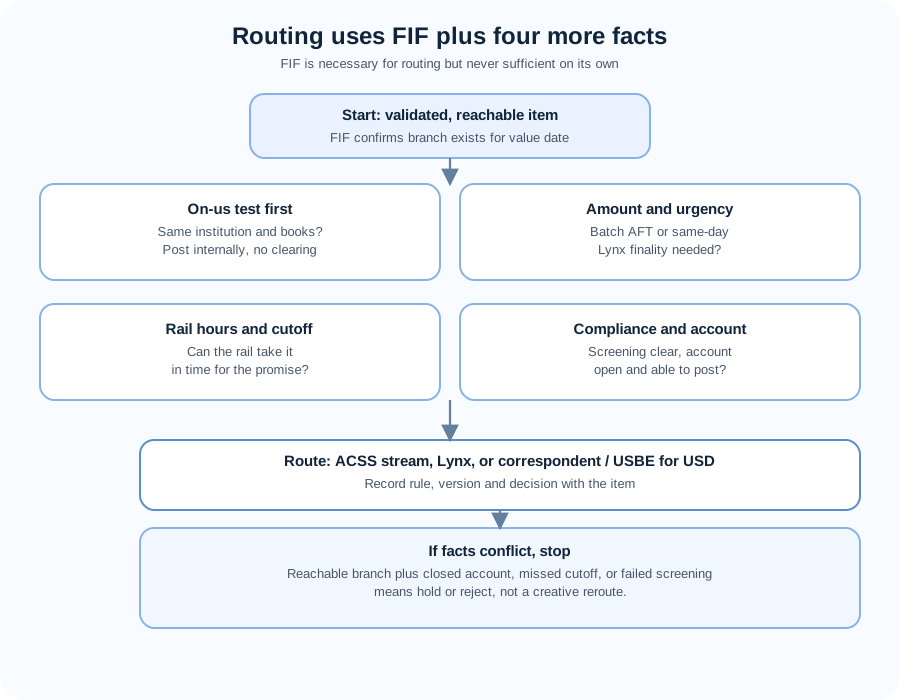
This story bounds the FIF's authority. The directory answered correctly — the branch is reachable — and routing overruled batch on non-directory grounds: finality, urgency, amount. Operations records the decision with the rule that fired and the version consulted; the supplier's confirmation of finality lets the dealer release steel with confidence, and the settlement confirmation joins to the release without ambiguity. Had the item travelled by batch, Friday would have brought availability mistaken for finality, weekend exposure on early goods release, and a possible next-week return no directory could prevent. Design channels to refuse inappropriate certainty: warn when batch cannot promise finality, offer the wire path with cost and cutoff plainly stated, and require the approvals irrevocability demands.
12. Key takeaways and authoritative references
This chapter reduced a large operational surface to a small set of durable truths. Keep these twelve, in order, and the rest of the programme's batch chapters will read as applications rather than surprises. First, the FIF is Payments Canada's authoritative directory for batch-payment routing under Rule F7: it says where destinations live in clearing terms and how to address them, and in any conflict with an originator's address book the current FIF prevails. Second, banks use it for four distinct decisions — validation, reachability, repair and routing — each with its own evidence, and conflating them produces exactly the incidents this chapter dramatises. Third, freshness and synchronized versioning are controls: one weekly issue, one Friday-effective date, one active version everywhere simultaneously, every decision version-stamped. Fourth, reachability is checked per item, per value date, per rail, against the same dated version in every channel, before release — never delegated to exchange or to the receiving side. Fifth, repair is controlled correction plus re-validation under cutoff discipline, owned jointly by operations, stewardship, originators and the receiving side, and it never invents routing around the directory. Sixth, routing combines FIF output with on-us analysis, amount and urgency, rail hours and cutoffs, account status and compliance disposition, and the decision is recorded with the rule that fired. Seventh, batch items that pass directory checks still settle deferred-net in the ACSS with return rights, while Lynx wires settle gross in real time with immediate finality — availability is not finality in either case, but the gap matters most in batch. Eighth, fraud, sanctions and AML gates run before release alongside the directory gate and can independently stop an item; repaired items re-trigger them. Ninth, rejects happen before exchange with reasons, returns happen after exchange under rail rules, and investigations walk the evidence chain in order using version stamps rather than memory. Tenth, posting, accounting, liquidity, reporting and reconciliation all depend on reference-preserving, joinable data: directory-version annotation, unaltered cross-references, and control totals that bind files to ledgers. Eleventh, implementation means single ingestion, single version authority, a freshness gate, table-driven rules, version-behaviour testing including holiday and merger scenarios, drift monitoring, and run-books that state who decides reject-or-release when the clock is short. Twelfth, the planned Real-Time Rail is not a live routing option and must never be presented as one; when it launches under its own rules and directories, this chapter's version discipline will transfer but its batch assumptions will not.
Carry two sentences into every design review and incident call. The FIF tells you where a branch lives and whether it can be addressed for this rail and date; everything else — account, funds, mandate, screening, rail hours, finality — is answered elsewhere and combined with it. And every routing decision must be provable: which version, which rule, which authority, which timestamp. Banks that can say both with evidence rarely miss payroll and rarely argue about what happened.
Authoritative references
The chapter relies on the authoritative sources below for rulebook, directory and system claims. Rulebook detail, publication mechanics, subscription terms and system facts change; verify the current version before relying on any statement in production, examination or customer communication.
- Payments Canada — Financial institutions file (directory description, weekly updates, subscription including sponsored access): https://www.payments.ca/systems-services/payment-services/financial-institutions-file
- Payments Canada — Rules and documentation library (Rule F7 and companion batch rules): https://www.payments.ca/systems-services/rules-documentation
- Payments Canada — Rule F7, Financial Institutions File (rule text): https://www.payments.ca/sites/default/files/f7eng.pdf
- Payments Canada — High-value payment system Lynx (RTGS model, finality, participation, ISO 20022): https://www.payments.ca/systems-services/payment-systems/high-value-payment-system-lynx
- Bank of Canada — Payment systems overseen by the Bank (Lynx systemic designation, ACSS and Interac prominence, Lynx replacing the Large Value Transfer System in September 2021): https://www.bankofcanada.ca/regulatory-oversight/financial-market-infrastructures/payment-systems-the-bank-of-canada-oversees/
- Bank of Canada — Settlement account policies for Payments Canada payment systems (settlement accounts for Lynx, ACSS and the planned Real-Time Rail; settlement in central-bank money): https://www.bankofcanada.ca/core-functions/financial-system/bank-canadas-settlement-account-policies-for-payments-canada-payment-systems/
- Bank of Canada — Designation of Lynx as a systemically important payment system (1 September 2021): https://www.bankofcanada.ca/2021/09/bank-canada-designates-lynx-systemically-important-payment-system/
- Payments Canada — Retail batch payment system (ACSS/USBE scope, netting, direct clearer settlement accounts, and 2025 statistics): https://www.payments.ca/systems-services/payment-systems/retail-batch-payment-system
- Payments Canada — Real-Time Rail payment system (Q4 2026 launch target and industry assurance testing): https://www.payments.ca/systems-services/payment-systems/real-time-rail-payment-system
- Payments Canada — Real-Time Rail frequently asked questions (Q4 2026 launch, 24/7/365 target model, $100,000 initial system limit): https://www.payments.ca/systems-services/payment-systems/real-time-rail-payment-system/frequently-asked-questions
- Payments Canada — Critical milestone achieved: By-law and rules approved for Canada's Real-Time Rail (rules in force August 24, 2026; launch Q4 2026): https://www.payments.ca/critical-milestone-achieved-law-and-rules-approved-canadas-real-time-rail
- Interac — Interac e-Transfer Disclosure (separate prominent payment service and participant/connectivity model): https://www.interac.ca/en/interac-e-transfer-disclosure/
Diagrams in this chapter: FIF distribution and bank-consumption architecture; reachability-check flow for an outbound payment; repair-queue operating model; stale-reference-data risk timeline; routing decision combining FIF with account, transit, amount and rail data — all under /diagrams/payment-stories/canada/chapter-8/. No file layouts or field specifications are reproduced. The Real-Time Rail is shown as planned, not live. All companies, people and institution names in stories are fictional.
This application uses JavaScript for the full interactive experience. This text summary is served for accessibility and search indexing.