Exceptions, Cancellation, Fraud and Reconciliation. Handle cancellations, failed or uncertain outcomes, fraud events, customer support and operational reconciliation.
Block 6 · Chapter 30 of 75
This chapter is the one your front line will reach for on a bad day. A sender who mistyped an email address and watched the money leave. A recipient who insists nothing arrived while the sender's account shows a debit. A daughter who realizes her father sent his savings to a polite voice on the phone. A small business whose Autodeposit suddenly points at an account nobody recognizes. A branch queue on a Friday afternoon full of people who all need the same answer: can you get it back, and if not, what happens now. This chapter teaches you to answer that question truthfully, to act inside the rights the system actually gives you, and to keep the books honest while you do it.
A note on status dates. Baseline is October 5, 2026. Interac e-Transfer is live and operated by Interac Corp, which is separate from Payments Canada. The Bank of Canada oversees Interac e-Transfer arrangements as a prominent payment system, alongside its oversight of Lynx as a systemically important system and ACSS as a prominent deferred net settlement system. The Real-Time Rail (RTR) is not live at the October 5, 2026 baseline: Payments Canada's By-law No. 10 and the RTR Rules were approved 30 June 2026 with coming into force 24 August 2026, and Payments Canada states that launch is scheduled for Q4 2026. Anything this chapter says about centralized fraud capabilities on the RTR is outlook only — it is not a live defense for e-Transfer volumes today. FINTRAC and reporting obligations appear here at functional level only; thresholds, reports and filing mechanics live in Block 13 and in current FINTRAC guidance, which is the binding source.
The single most important sentence in this chapter is also the shortest. Once an e-Transfer has been deposited, including by Autodeposit, Interac says the transaction is final. A sender may cancel only before the recipient has attempted to deposit it or it has been automatically deposited; a notification viewed or a security answer supplied is not a substitute for the financial institution’s recorded deposit state. After deposit, the case is recovery, not reversal, and no bank can promise a unilateral pullback. Recovery means asking, assisting, disputing through defined paths, or re-sending as a new linked transfer. It never means editing settled value or promising a pullback the system does not offer. Every section below is built on that distinction, because every expensive failure in this business starts with someone blurring it — a colleague who promised a reversal, a procedure that implied one, or a customer left believing one was coming.
What you will be able to do after this chapter
After working through this chapter, you should be able to:
- explain, in plain language a customer can repeat back, when an e-Transfer can be cancelled and why a deposited transfer cannot be pulled back;
- name the participants in an e-Transfer exception — sender, recipient, sending and receiving financial institutions, Interac Corp as operator, and the Bank of Canada as overseer — and state what each one owns when something goes wrong;
- walk an uncertain outcome (sender debited, deposit unclear) from confirmation through classification to resolution without creating a duplicate payment;
- describe the four fraud patterns in the chapter's map — phishing and social engineering, interception, Autodeposit hijack, and mule or scam cash-out — and the functional defense that answers each one;
- run a customer-support contact from intake to closure with a case reference, a named owner, honest status language, and written confirmation of the ending state;
- explain posting, settlement legs, reporting and three-way reconciliation for e-Transfer volumes from a financial-institution operations view;
- place FINTRAC, sanctions, and RPAA considerations at the correct functional point in exception handling without confusing operations work with compliance filing;
- describe how a bank builds, tests and staffs cancellation, dispute and reconciliation capability, and how it prepares for RTR centralized fraud capabilities without treating them as live;
- work through two fictional Canadian stories — a misdirected family transfer and a small-business Autodeposit hijack — plus a short uncertain-outcome case, and extract the control lesson from each;
- correct the ten most common misunderstandings about e-Transfer cancellation and fraud recovery, and navigate to Blocks 12, 13 and 14 for rail-level depth.
For a roughly 60-minute core session, spend about 10 minutes on this introduction and Sections 1–2, 15 minutes on Sections 3–4 with the cancellation diagram, 10 minutes on Sections 5–6, 10 minutes on Sections 7–8 with the fraud and support diagrams, 10 minutes on the fictional stories in Section 11, and 5 minutes on takeaways and references in Section 12.
Chapter navigator
- Business context and customer need
- Participants, responsibilities and system boundaries
- Initiation, validation and bank processing
- Clearing or exchange, settlement and finality
- Data, identifiers, messages and references
- Rules, cutoffs, service levels and customer impact
- Fraud, compliance and operational controls
- Exceptions, investigations and recovery
- Posting, accounting, liquidity, reporting and reconciliation
- Bank implementation, testing and resilience
- Practical Canadian examples
- Key takeaways and authoritative references
1. Business context and customer need
Nobody studies exceptions in the abstract. People meet exceptions at kitchen tables and shop counters, usually anxious and sometimes ashamed, and the bank is the first place they turn. A father in Surrey sends rent money to his son's old email address and watches the debit post. A newcomer in Mississauga pays a deposit for an apartment she found online and the landlord's number goes silent. A bakery owner in Halifax opens her banking app and finds that yesterday's customer payments landed somewhere she does not recognize. A retiree in Kelowna followed careful instructions from someone who sounded exactly like her bank's fraud department, and now her savings are gone. Each of these people walks into a branch or calls a contact centre expecting the bank to reverse what happened. What they need instead is something harder and more valuable: a professional who can tell them quickly what is still possible, do everything the system permits, explain what it cannot do, and stay with them through what comes next.
That professional needs two things this chapter provides. The first is a truthful map of rights: what cancellation covers, what recovery covers, and where the boundary sits between them. The second is a working method: confirm state before acting, classify before promising, recover as a new linked event, reconcile with evidence, and communicate in language the customer can act on. Banks that teach both handle ten thousand exception contacts a year with steady hands. Banks that teach only procedure — click here, file there — produce staff who sound confident until the first case that does not match the script, and then improvise. Improvisation in this business creates duplicate payments, broken promises, lost evidence and complaints that escalate far beyond the original amount.
The business context has also shifted under everyone's feet. E-Transfer volumes have grown from a convenience between friends into genuine financial infrastructure: rent, deposits, small-business takings, contractor payments, family support across provinces. That growth means exceptions now carry real stakes — a misdirected transfer can be a month's rent, and a hijacked Autodeposit can be a week's revenue. At the same time, fraud has professionalized. The polite voice on the phone works from a script refined over thousands of calls. Phishing notices are visually near-perfect. Mule networks move funds through willing and unwilling intermediaries faster than any single institution can follow. The bank's exception capability is therefore not a cost centre to be minimized. It is a core product surface — the moment customers judge whether their institution deserves the rest of their business.
There is a commercial angle that operations leaders sometimes miss. Exception handling is where customer loyalty is actually decided. Research across service industries repeats the same finding: a customer whose problem was handled well often trusts the institution more than one who never had a problem. The mechanism is simple. Anyone can move money when everything works. The institution that answers the phone on the worst day, tells the truth quickly, does everything possible, and writes it down so the customer does not have to call twice — that institution keeps the household, the small business, and the referrals that follow. This chapter treats every support contact as that kind of moment, and designs the operation to win it honestly rather than to close tickets fast.
Finally, a word about scope discipline, because this chapter sits inside a larger academy and must not swallow its neighbours. Rail-level rule text, message specifications and clearing mechanics for batch and wires live in Blocks 3, 4, 5, 8 and 14. Fraud typologies, AML obligations, sanctions screening and RPAA supervision in full depth live in Block 13. The RTR lifecycle and its centralized fraud capabilities live in Block 12. Where this chapter touches those territories it does so functionally — what the control achieves and where it sits — and points forward for the rest.
2. Participants, responsibilities and system boundaries
Every e-Transfer exception involves more parties than the two people who think of it as their money. The professional who keeps five layers straight — the customers, the two financial institutions, the operator, the overseer, and the wider compliance perimeter — resolves cases in days. The one who blends them promises things nobody can deliver and spends weeks unpicking the confusion. This section draws each boundary once, plainly, so every later section can assume it.
Start with the customers. The sender instructs the transfer, funds it from an account at the sending institution, and designates a recipient address. The sender owns the instruction: getting the address right, choosing whether to cancel while cancellation is available, and asking for the funds back when it is not. The recipient receives the notice and either deposits after the required authentication or is Autodeposited; after deposit, the recipient owns the decision to return funds when asked — nobody else can make that decision for them after deposit. Where a third party appears — a landlord who vanishes, a voice on the phone who directed the payment, a mule who forwarded it — that party sits outside the payment system's recovery rights entirely. The bank can investigate, report and assist, but it cannot reach into another person's account and take value back. Saying that sentence early, kindly, and clearly is one of the highest-value skills in this chapter.
The two financial institutions carry the operational weight. The sending institution authenticates its customer, validates the instruction, debits the sender, issues the transfer into the Interac network, maintains the pending inventory, executes cancellation while the window is open, and assists with recovery afterwards. The receiving institution maintains address registrations including Autodeposit, credits the recipient on completed deposit or Autodeposit, responds to assistance requests from the sending side, and applies its own fraud and account controls to inbound credits. Neither institution settles value directly with the other per transfer in the way a customer imagines; bank settlement legs follow bank and network settlement cycles distinct from the customer moment. That separation is why the customer can see near-instant availability while operations still has settlement and reconciliation work to complete — and why Section 9 exists.
Interac Corp operates the e-Transfer service and its supporting infrastructure: addressing and registration, notification, acceptance and deposit flows, and the network messaging between participating institutions. Three common confusions need correcting here because they surface in almost every incident. First, Interac Corp is separate from Payments Canada; it does not operate Lynx or ACSS and is not governed by their rulebooks. Second, Interac Corp does not hold customer accounts and does not decide individual disputes the way a court does; recovery of deposited value runs through the institutions and, where needed, through law enforcement and the courts. Third, the operator's fraud and risk capabilities are real but bounded — they complement institutional controls rather than replacing them. When staff understand what the operator owns, they stop telling customers that "Interac will reverse it" and start doing the institutional work that actually helps.
The Bank of Canada appears in this chapter in its oversight capacity. It oversees Interac e-Transfer arrangements as a prominent payment system, a designation that reflects the system's importance to the Canadian economy and subjects it to risk-management expectations — a role distinct from prudential bank supervision and from FINTRAC's financial-intelligence mandate. The Bank is also the settlement agent for Lynx and ACSS positions, which matters to this chapter only at the boundary: e-Transfer bank settlement legs are a different mechanism from Lynx RTGS settlement and ACSS deferred-net settlement, and none of those mechanisms offers a back door for pulling back an accepted e-Transfer. Later blocks separate these roles fully; here the operating lesson is that oversight sets expectations on the system while recovery still runs through the institutions case by case.
The wider perimeter — FINTRAC, sanctions authorities, law enforcement, and RPAA-supervised payment service providers — frames what institutions must do around an exception without changing the recovery rights themselves. A fraud case may need to be reported through prescribed channels, screened against lists, or handed to police with preserved evidence; a PSP that touched the payment may have safeguarding and reporting duties of its own. Those obligations are real and they are covered functionally in Section 7, with the binding detail in Block 13. But they do not create a reversal power. No report filed anywhere gives a bank the right to debit another person's account without authority. Holding that boundary — diligent reporting plus honest recovery — is what keeps the institution both compliant and truthful.
Responsibility, then, is a chain with no gaps and no overlaps. The sender owns the instruction and the address. The sending institution owns validation, the pending window, cancellation, and recovery assistance. The receiving institution owns registration integrity, posting, and cooperation. Interac Corp owns the network service. The Bank of Canada owns oversight expectations. Compliance and law-enforcement channels own reporting and investigation. Every case in Sections 8 and 11 walks that chain, and every paragraph that promises otherwise is a paragraph this chapter would ask you to delete.
3. Initiation, validation and bank processing
Every exception in this chapter was once an ordinary instruction entering a banking channel, and most exceptions were preventable at that moment. A mistyped address caught by confirmation. A first-time large transfer challenged by a limit. A changed Autodeposit registration flagged before the next payment used it. A scam interrupted by one well-timed question. This section walks the path from instruction to release and shows where each prevention sits — because the cheapest exception is the one that never becomes a transfer, and the second cheapest is the one whose data is complete enough to investigate.
Initiation looks simple from the customer's side: choose a contact, enter an amount, add an optional message, confirm. Behind that screen the bank captures far more — authenticated identity, device and session signals, source account and available balance, recipient address as entered, amount against limits and velocity, and the customer's history with this payee. Business initiation adds its own texture: payables clerks sending contractor payments, property managers collecting deposits, merchants issuing refunds to customers. Each context carries different risk — a business paying fifty suppliers a month mistypes more often and is phished more deliberately than a consumer sending birthday money — and the hub should know which context it is serving rather than treating every send identically.
Validation is where preventable failures are caught, and it must happen before the transfer leaves the institution. Address validation confirms the email or mobile number is well-formed and, where offered, whether it maps to a registered Autodeposit recipient the sender can confirm. First-time-payee logic should slow the sender down: display the destination as the system understands it, require explicit confirmation for new or edited contacts, and challenge amounts above the customer's normal pattern. Duplicate checks catch the double-tap that sends rent twice. Balance and limit checks confirm funding within the customer's limits.
The control stack sits between validation and release, and its order matters more than its completeness. Authentication and device verification confirm the person instructing is the account holder — the defense against takeover-driven sends. Fraud scoring weighs the instruction against scam, mule, velocity and behavioural signals — the defense against willing-victim sends and hijacked sessions. Sanctions and watchlist screening applies at the functional level described in Section 7. Limit and entitlement checks enforce what this customer may do through this channel. Only after all of these does the transfer go. The architectural point, repeated from the academy's foundations, is that screening after release is recovery rather than prevention — and for e-Transfer, release starts a clock the bank does not control, because acceptance can follow within minutes and Autodeposit within seconds.
Release commits the transfer to the network: the sender is debited, the notice goes out, and the pending state begins. The institution records the release time, the transfer reference that will follow the payment through every later stage, the address as entered, and the control decisions that authorized release. FI implementation note: the customer debit, hold, and release accounting treatment is institution-specific; Interac’s terms say the sending financial institution holds the funds until deposit, cancellation, or expiry. That record is the starting point of every investigation in Section 8, which is why its completeness matters more than its elegance. An institution that logs what it checked, when, and with what result can answer the hard questions — did we warn about the new payee, did the device change, did the amount breach pattern — in minutes. One that logs only the debit spends the investigation reconstructing what its own systems knew.
After release the institution stays active through the pending window. It tracks acceptances, declines and expiries; it maintains the cancellable inventory with accurate status the sender can see; it executes cancellation on demand while the window is open; and it watches for the signals that turn a pending transfer into a case — an address correction arriving after release, a customer calling about a notice they did not expect, a registration change on the receiving side. Amendments after release are narrow by design: cancel and re-send where permitted, never silent editing of a live instruction. The original reference follows every cancellation, expiry and re-send so the customer's statement tells one coherent story instead of three confusing lines.
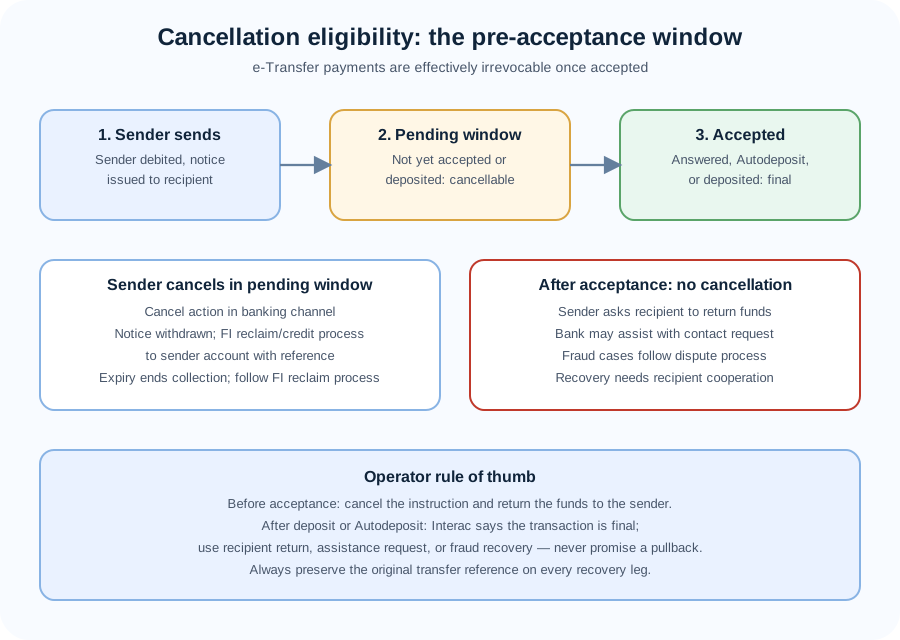
The diagram above is the chapter's anchor and deserves a minute of study. Read it left to right for flow and top to bottom for consequence. The pending window is the only place cancellation lives; everything right of acceptance is recovery with recipient cooperation. Two design principles decide whether this path survives contact with reality. First, slow down the sends that most need slowing — new payees, changed addresses, large first-time amounts — and speed up everything else. Second, fail visibly and early: an instruction rejected or challenged before release costs a moment of friction, while an instruction released with bad data costs an investigation, a complaint, and sometimes a customer.
4. Clearing or exchange, settlement and finality
Customers experience an e-Transfer as a single event — money leaves, money arrives — and much of the confusion in exception handling comes from that mental model colliding with a system built from several distinct events. This section separates the events the way operations must: the customer experience, the network exchange, the bank settlement legs, posting, availability, and finality. Each happens at its own time under its own rules, and recovery rights attach to specific events rather than to the transfer as a whole. The banker who can place any case on this timeline in thirty seconds resolves it in days; the one who cannot spends weeks arguing about which clock applies.
The customer experience runs send, notify, accept or Autodeposit, and confirm. The sender submits the instruction and the sending financial institution applies its own debit or hold treatment. The recipient is notified through the registered address. The recipient deposits — answering any required question and choosing a deposit account — or, where registered, the transfer deposits automatically without any action. Both sides receive confirmation. That whole sequence can complete in minutes and operates around the clock, including evenings, weekends and holidays when the batch systems sleep. Speed is the product's promise and its risk in equal measure: the same immediacy customers love compresses the fraud-intervention window and the sender's remorse window to nearly nothing on Autodeposit transfers.
Network exchange and bank settlement legs sit beneath that experience and follow their own cycles. Interac messaging carries the transfer state between institutions; bank settlement legs between participants follow bank and network settlement arrangements on their own timetable, distinct from the customer moment. This separation surprises newcomers but it is standard across payment systems — authorization and customer availability routinely precede interbank settlement — and it is operationally essential. It means the receiving institution can give its customer good funds promptly while the institutions complete their settlement discipline behind the scenes. It also means settlement evidence is an operations artifact for reconciliation under Section 9, not a customer-facing milestone and not a recovery lever. Nothing in the settlement legs lets anyone unwind a deposited transfer.
Posting and availability are the events customers actually see, so language about them must be exact. Posting debits the sender at initiation and credits the recipient at acceptance or Autodeposit. Availability follows posting promptly — the recipient can use the funds — subject to the receiving institution's standard account terms and any fraud hold the institution is entitled to apply. Holds deserve a careful sentence because they are widely misunderstood: a receiving institution may hold or review an inbound credit under its own risk authority, but that is an account-level control between the institution and its customer, not a reversal right exercisable by the sending side. The sender cannot ask the receiving bank to hold funds for them; the receiving bank decides for itself, on its own signals, under its own obligations.
Finality is where this chapter takes its firmest stand, because the industry's loosest language clusters here. For e-Transfer, finality is functional and recipient-side: once the transfer is accepted or Autodeposited, the credit to the recipient is effectively final as between the payment system and its participants. There is no return cycle comparable to batch returns, no representment, no network chargeback, no unilateral recall that pulls value back. What remains are the paths Section 8 teaches in detail: the recipient voluntarily sends the funds back as a new transfer, the institutions assist with contact and persuasion, defined fraud and dispute processes run their course, law enforcement acts where crime is involved, and civil remedies exist where the facts support them. Every one of those paths requires someone's cooperation or authority beyond the sending bank's. Stating that plainly — early, kindly, in writing — is not bad service. It is the only service that does not manufacture a second complaint from the wreckage of the first.
A comparison keeps e-Transfer finality honest against its neighbours. Lynx-settled value is final per payment with recovery only by new payment and beneficiary agreement. ACSS batch items carry defined return rights within rule windows — rights e-Transfer deliberately does not replicate. Card payments carry network dispute rights on network calendars. The planned RTR is outlook only, covered in Block 12, and no e-Transfer procedure may rely on it today.
Three implications close the section and open the rest of the chapter. First, never equate availability with reversibility: the recipient's ability to spend the funds says nothing about anyone's ability to take them back. Second, never treat messaging as settlement or settlement as recovery: notices confirm state, settlement legs complete institutional obligations, and neither unwinds the credit. Third, staff and fund the clock you actually operate — e-Transfer needs around-the-clock authorization, fraud coverage and support presence for the customer experience, plus business-day settlement and reconciliation discipline for the institutional legs — because a 24/7 product with business-hours controls is where both fraud and complaints breed.
<!--PART2-->
5. Data, identifiers, messages and references
Exceptions are investigated with data, not with adjectives. A case that arrives as "the customer says the money is gone" becomes solvable the moment it carries five facts: which transfer, from whom, to which address, for how much, and in what state. This section defines the data that makes every later section work — the addressing that routes the transfer, the references that identify it, and the evidence that proves each stage. The discipline is simple to state and demanding to operate: capture completely, validate early, preserve identity end to end, and log what was decided so the investigation starts from records rather than memories.
Addressing is the first failure surface because e-Transfer routes on human-typed contact data rather than on validated account numbers. The sender supplies an email address or mobile number, and the system's ability to deliver depends entirely on that string being correct. Autodeposit registration adds a layer of safety — funds addressed to a registered contact deposit to the registered account without an acceptance step — but it moves the failure surface rather than removing it: now the integrity of the registration itself matters, and a hijacked or stale registration misdirects every transfer sent to it. The operational consequences follow directly. Channels should confirm new and changed contacts explicitly, display what the system understands the destination to be, and treat first-time addresses to large amounts as higher-risk instructions. Receiving institutions should protect registration changes with verification, alerts and cooling logic, because a registration is a standing instruction to redirect future money.
References are what let humans and systems agree they are discussing the same transfer. Four must survive the whole journey. The sending institution's internal instruction identifier ties the transfer to the sender's session, validation decisions and debit posting. The Interac transfer reference identifies the transfer in network messaging and in any inter-institution communication about it — assistance requests, fraud cases and support contacts that omit it start with a day of searching. The customer-visible confirmation or receipt number is what the sender can quote on the phone and what the statement line should carry. And the recovery linkage — the reference of any cancellation, re-send, recipient return or corrective transfer joined explicitly to the original — is what keeps one business event from appearing as two unrelated payments. Drop any one of these and reconciliation breaks, investigations slow, and customers receive advices they cannot match to their own actions.
Messages and state transitions carry the transfer through its life, and support staff need a functional understanding of them without becoming message engineers. Functionally, the transfer moves through issued, notified, pending, and then one of several endings: deposited, Autodeposited, declined, expired, cancelled, or failed. Each transition generates evidence — timestamps, status records, confirmations to one or both parties — and that evidence is the raw material of Section 8. Two points matter operationally. First, status must be visible to the sender in the channel with the same vocabulary support uses; a channel that says "sent" for everything from pending to deposited manufactures half the contact volume. Second, notifications themselves are evidence-adjacent and fraud-adjacent at once: the notice tells the recipient money awaits, which is exactly why phishing imitates notices, so customer education about verifying notices belongs in the product, not just in brochures.
Evidence preservation completes the data picture and deserves explicit ownership. For every transfer the institution should retain the instruction as entered, the validation and control decisions with timestamps, the release record, the state transitions with timestamps, customer communications including cancellation requests and assistance requests, and the linkage of any recovery legs. Retention follows the institution's record-keeping obligations and the compliance perimeter described in Section 7; the functional point here is that evidence captured at the time is what makes later reporting, dispute handling and law-enforcement cooperation possible. Evidence reconstructed after the fact — from logs nobody designed for retrieval, in formats nobody can match — arrives too late and too thin. Design the record for the investigation you hope never happens, because hope is not a records policy.
Clean reference discipline also pays off beyond e-Transfer: the same habits improve wire and batch reconciliation immediately, and they prepare the institution for the richer confirmation data the planned RTR will bring.
6. Rules, cutoffs, service levels and customer impact
Customers experience rules as promises: when will it arrive, when can it be used, what does it cost, what happens if it goes wrong. The institution experiences rules as windows, obligations and evidence. This section connects the two for e-Transfer exceptions without inventing numbers this chapter has no authority to give. Exact limits, fees, expiry periods and processing times vary by institution and change over time; they belong to your institution's published schedules and the live service documentation, not to a course chapter. Any study note, job aid or customer script that quotes a specific dollar limit or day count from this chapter is misusing it. What this chapter teaches instead is the structure those numbers sit inside — which is stable, which is where staff judgment lives, and which is what customers actually need to hear.
The e-Transfer clock differs categorically from batch clocks, and staff who carry batch habits into e-Transfer work cause real harm. There is no evening cutoff after which today's transfer waits for tomorrow's exchange, no business-day window that reopens a cancellation right, no morning settlement that changes what is possible. The transfer moves when sent, the pending window runs on its own terms including weekends and holidays, and acceptance or Autodeposit can land at any hour. That continuity is the product's value and the exception handler's constraint: a sender who realizes the mistake at midnight faces the same rights as one who calls at noon, and a pending transfer does not become more cancellable because a branch opens. Procedures, staffing and status visibility must therefore cover the hours the product operates, not the hours the back office prefers.
Expiry and the pending lifecycle need functional description because they generate a large share of support contacts. A transfer that is never accepted does not hang forever; it expires, and expired funds return to the sender. Functionally, that makes expiry the quiet twin of cancellation — one initiated by the sender, the other by the clock — and both end with funds back in the sender's account carrying a reference the statement can show. The customer-impact translation is direct and reassuring when delivered well: a transfer to an address nobody monitors is not lost, it is pending and then returned, and the sender can watch that progression in the channel rather than calling daily. The failure mode to design against is silence — a pending transfer with no visible status, no reminder path, and no explanation of what happens next will generate exactly the anxious calls the status display was meant to prevent.
Service levels bundle timing with certainty, information and recourse, and e-Transfer's bundle must be stated honestly. Timing: near-instant customer experience around the clock. Certainty: institution-specific debit or hold on send, availability after deposit, finality on deposit. Information: status visible to the sender, confirmation to both parties, references that survive to statements. Recourse: cancellation before acceptance, recipient return after, defined fraud paths throughout. The bank's advisory job is to match expectations to that bundle before the send, not to renegotiate it after the loss. A sender warned that Autodeposit transfers complete in seconds sends differently from one who assumes every transfer can be stopped. A business told that first-time supplier addresses deserve a confirmation call makes that call. Prevention is a service-level conversation held at initiation; by the time it becomes an exception conversation, half its value is gone.
Customer communication is where rules become trust, and this chapter standardizes five words every colleague should use the same way. Sent means released from the institution with the sender debited. Pending means notified but not yet accepted, declined, expired or cancelled — the only state in which cancellation is available. Accepted or deposited means the recipient was credited and the transfer is effectively final. Returned means funds came back to the sender through expiry, cancellation or recipient action. Under review means a fraud or dispute process owns the case with a named owner and a next date. Training every customer-facing colleague on those five words prevents more complaints than any system change, because most escalations begin not with the loss but with a status the customer could not decode — "it says completed, so why can't you reverse it" is a vocabulary failure before it is a policy dispute.
Pricing, limits and cutoffs interact with exceptions in ways advisors should surface proactively. Limits bound both legitimate use and fraud blast radius; a customer frustrated by a limit today is protected by it the day their session is hijacked. Fees should be explained at initiation rather than discovered on the statement during a dispute. And the absence of batch-style cutoffs should be stated as a feature with a consequence: the money moves whenever you send it, which is exactly why checking the address matters more here than on a payment you can stop tomorrow morning.
7. Fraud, compliance and operational controls
Controls fail most often not by being absent but by being misplaced — complete on paper, positioned where they can no longer change the outcome. A fraud score that runs after Autodeposit has credited the mule, a registration alert the customer never reads, a report filed diligently while the same device sends five more transfers, an education page nobody sees until after the loss. This section places each control family at the point in the e-Transfer flow where it can still change what happens, and pairs each of the four fraud patterns with the functional defense that answers it. Rail-level typologies, filing mechanics and supervisory detail live in Block 13; what lives here is the operating map a banker needs before opening that block.
The four patterns deserve distinct mental models because each defeats a different assumption. Phishing and social engineering defeat the assumption that the person instructing understands what they are doing — the victim acts willingly on false premises, whether a fake notice, a fake bank caller, or a fake investment or romance that ends in a willing transfer. Interception defeats the assumption that the addressed recipient is the one who collects — an attacker with access to the notice or the answer collects a transfer meant for someone else. Autodeposit hijack defeats the assumption that standing registrations are trustworthy — account takeover changes where a trusted address points, and every subsequent transfer follows. Mule and scam cash-out defeat the assumption that screening the sender is enough — the sender may be a victim and the risk sits on the receiving side, where funds arrive to be forwarded, withdrawn or converted. One monitoring rule does not catch all four. The institution needs layered controls with a single case queue so a customer hit across two patterns is seen once, not twice in two systems.
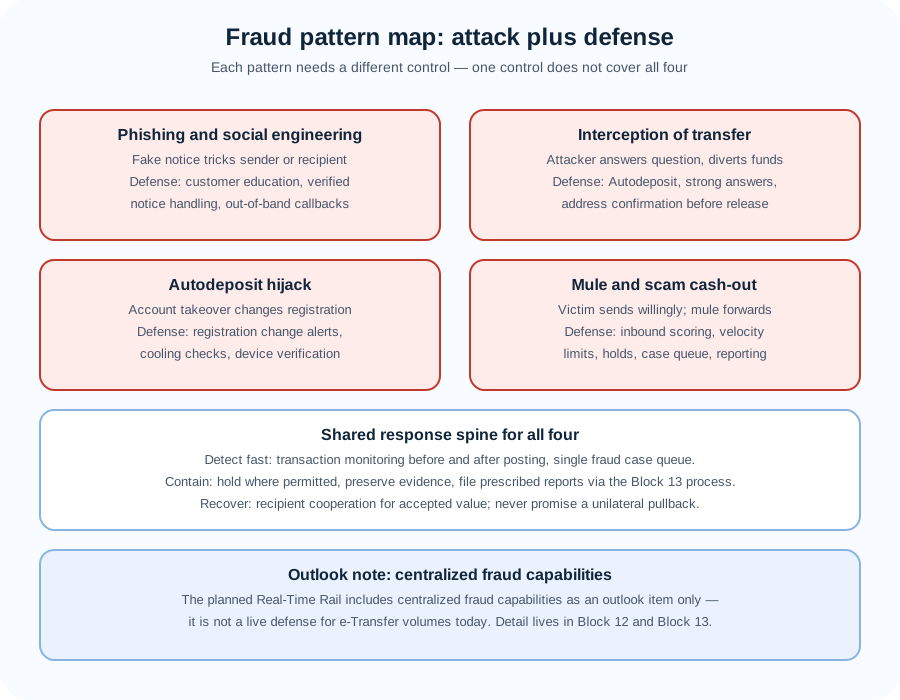
Walk the diagram's four defenses as operating capabilities, not slogans. Against phishing and social engineering: customer education delivered at the moment of risk rather than in annual campaigns, verified notice-handling habits, and out-of-band callbacks for instructions that arrive under pressure — the famous "call the number on your card, not the number on your screen" applied to transfers as well as wires. Against interception: Autodeposit adoption for recurring relationships, strong non-guessable answers where questions are still used, and address confirmation showing the sender what the system understands before release. Against Autodeposit hijack: verification on registration creation and change, alerts the customer actually receives, and cooling or challenge logic before the changed registration receives value. Against mule activity: inbound as well as outbound scoring, velocity and network limits, holds and review where the institution's authority permits, and a case queue that joins the fraud story across accounts. Each defense is owned, measured and tuned; each has a named control owner who can say what changed last quarter and why.
Post-event response is a control in its own right and belongs in this section because speed after detection changes loss the way prevention changes frequency. Detect fast through transaction monitoring before and after posting, with the single case queue joining signals across channels. Contain within authority: hold or restrict where permitted, preserve evidence before it ages out, and stop the bleeding — the compromised session, the hijacked registration, the mule account — before chasing the funds. Report through the prescribed channels that Block 13 defines, because reporting is both an obligation and a recovery asset: law-enforcement cooperation and inter-institution communication run on preserved evidence and timely filing. Recover through the Section 8 paths with honest expectations. And learn explicitly: every closed fraud case should change something — a rule, a limit, a message, a coaching point — or the institution will buy the same loss twice.
Compliance framing stays functional here by design. FINTRAC obligations attach to payment events: client identification, record-keeping and prescribed transaction reporting built from complete, untruncated data with instruction-to-outcome linkage preserved. This chapter cites only the FINTRAC introductory publication; thresholds, report types and filing mechanics live in Block 13 and in current FINTRAC guidance, which alone is binding. Sanctions and watchlist screening gates release functionally — screen parties and instruction data before the transfer goes, with pass, false-positive release with reason, or true-hit hold with escalation — and the disposition is logged with what was checked, when, against which list, and by whom. RPAA supervision adds the provider boundary: payment service providers performing retail payment activities face operational-risk, safeguarding and related obligations under Bank of Canada supervision, so an institution sponsoring or integrating with a PSP must define who authenticates, screens, holds funds, communicates status and evidences each stage before volume arrives. None of these obligations creates a reversal power, and procedures must never imply otherwise.
The outlook item closes the section with a deliberate fence around it. The planned Real-Time Rail is being designed with centralized fraud capabilities, and Block 12 teaches that design as the future of Canadian instant-payment defense. But outlook is not inventory. No e-Transfer procedure, control attestation or customer promise in this chapter may rely on RTR capabilities before they are live, and any planning document that lists them as current controls is inaccurate. The discipline this chapter asks of control owners is two-track: operate today's layered defenses at full strength, and prepare data, reference discipline and case-queue architecture so the institution can adopt centralized capabilities quickly when the RTR launches. Readiness without presumption — that is the whole stance in one phrase.
8. Exceptions, investigations and recovery
Every case in this section follows the same professional rhythm: detect fast, classify correctly, contain within actual rights, recover as a new linked event, and reconcile with evidence. The order is load-bearing. Institutions that classify first recover cheaply, because they spend their effort on the path the system actually offers. Institutions that act first — re-sending on assumption, manually crediting on sympathy, promising a reversal on hope — create duplicate payments, duplicate credits and audit breaks that dwarf the original error. This section is the chapter's core, and it repays slow reading: the taxonomy, the uncertain-outcome method, the recovery paths by state, and the support flow that carries customers through all of it.
Start with the taxonomy, because shared words are shared thinking. A cancellation ends a pending transfer at the sender's request before the recipient attempts deposit or the transfer is automatically deposited; the sender then follows the FI return or reclaim process. An expiry ends a pending transfer by the clock with the same result. A decline is the recipient's refusal; Interac says the decline is irreversible and the sender receives notice and instructions to reclaim the funds. A misdirected transfer reached an address the sender did not intend — still cancellable while pending, a recovery case once deposited. An uncertain outcome is a transfer whose state is unknown to the person asking — funds held/debited but deposit unclear, confirmed but unmatched — and it is resolved by investigation, never by assumption. A fraud case carries criminal signals — deception, takeover, interception, mule use — and runs the Section 7 response spine alongside the recovery paths below. An error case — wrong amount, duplicate send, wrong contact selected — is recovered by cancellation where available or by recipient return and linked re-send where not. Each word routes to a different queue with a different clock, and using them interchangeably in tickets and customer conversations guarantees the confusion this section exists to prevent.
The uncertain-outcome method deserves its full weight because it is the most mishandled case in the business. The situation: the sender is debited, the recipient says nothing arrived, and pressure builds to "just send it again." The method forbids exactly that until state is confirmed. Step one, confirm: check the transfer's actual status in the system — pending, deposited, Autodeposited, declined, expired, cancelled, failed — with timestamps, not with the customer's paraphrase of a screen. Step two, classify: a pending transfer needs waiting, reminding, or cancellation at the sender's direction; a deposited one needs deposit-leg tracing at the receiving side; an expired one needs the FI reclaim or credit instruction confirmed and only then a new transfer; a failed one needs the failure reason before any retry. Step three, resolve with linkage: any re-send is a new transfer explicitly joined to the original reference, so two debits never masquerade as one mystery. The duplicate-prevention rule is absolute — confirm original state before re-sending — because timeouts re-sent on assumption are how one anxious customer becomes two debits and a complaint about the institution rather than the delay.
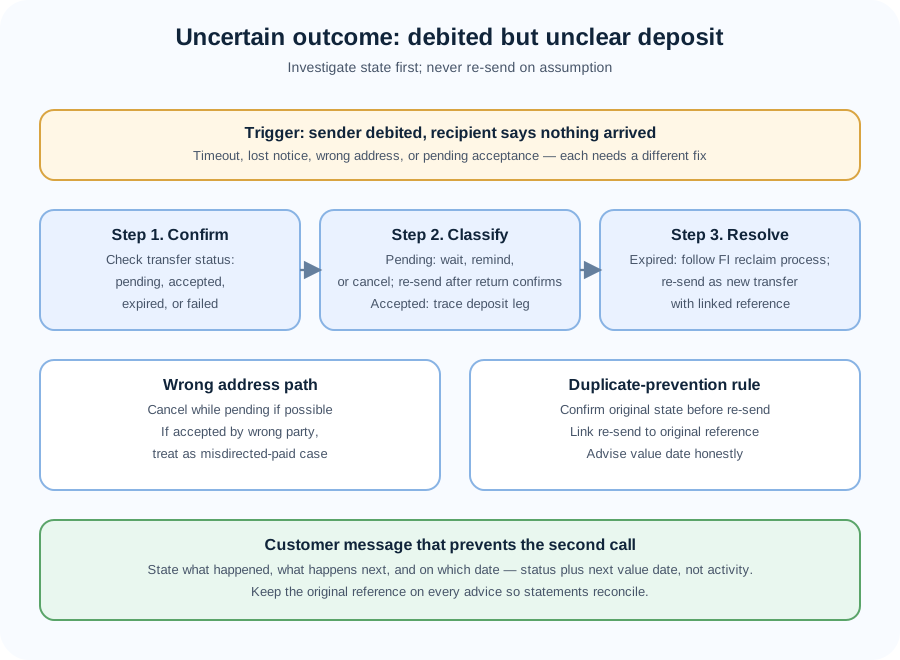
Recovery paths organize by state, and staff should be able to recite them without notes. While pending: the sender cancels in the channel, funds return with a statement reference, and a corrected transfer goes as a new instruction if still wanted — this is the clean path, and every procedure should make it the fastest thing in the building. After deposit without fraud signals: the sending institution assists — confirming state, providing the recipient-side reference the sender needs, issuing a contact or return request through institution channels — while the decision to return the funds belongs to the recipient; polite, documented, persistent assistance is the service, and honest timelines are its substance. After deposit with fraud signals: the fraud spine runs — secure the session and registrations, preserve evidence, file prescribed reports through the Block 13 process, cooperate with law enforcement and the receiving institution — with recovery pursued through every available path and no outcome promised that cooperation cannot guarantee. For errors of amount or duplication: cancel while pending, otherwise recover the excess through recipient return and correct with a linked new transfer carrying the right amount and a narrative the recipient can understand. In every path the original reference follows the recovery legs, advices name the original transfer, and nobody edits settled value — a corrective transfer is always a new event, never a modification of history.
The support and recovery flow carries the customer through whichever path applies, and it is designed around a truth about anxious people: they can tolerate bad news delivered clearly, and they cannot tolerate silence, jargon, or being asked to repeat their story to three teams. Intake captures the five facts — which transfer, from whom, to which address, how much, in what state — plus the customer's contact path and any vulnerability flags, issuing a case reference immediately. Triage routes by the taxonomy above with the four questions from the chapter's diagram: still pending, already deposited, fraud signals present, address or amount error. Investigation confirms state from systems, not stories, and sets the recovery path with an owner and a next date. Recovery executes the state-appropriate path with evidence preserved throughout. Closure confirms in writing: the ending state in plain language, the reference the statement will show, what to do if anything further arrives, and where to complain if dissatisfied. Vulnerability awareness threads through all of it — a customer who has been defrauded may be frightened, embarrassed or still in contact with the fraudster, and pace, privacy and safety planning matter as much as process.
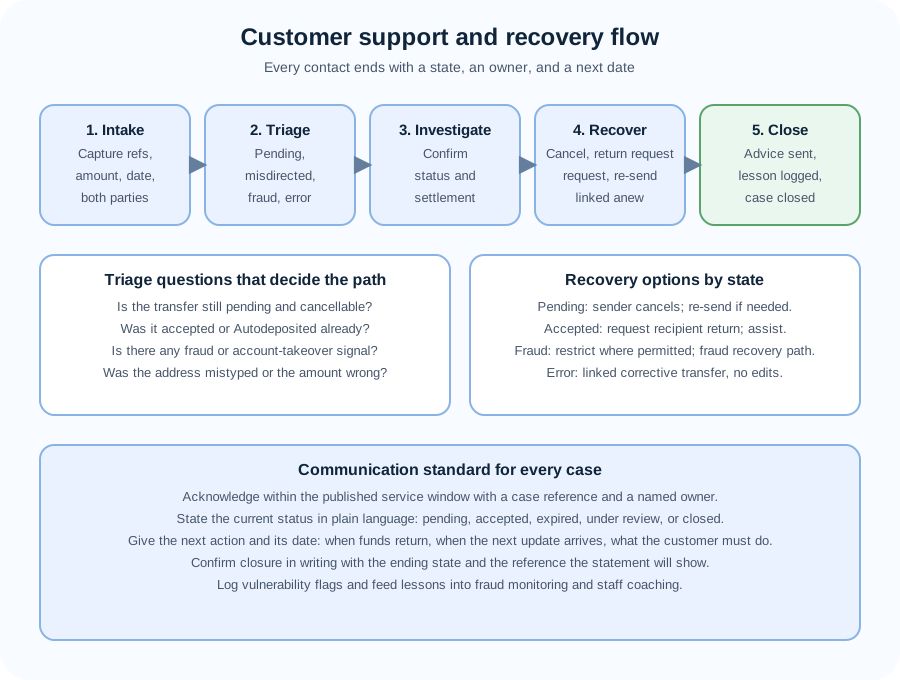
Close the section with ending states, because truthful case management names its outcomes. Cancelled and confirmed. Expired and returned. Declined and released. Returned by the recipient. Re-sent as a linked new transfer. Under fraud review with owner and date. Referred to law enforcement with evidence preserved. Closed with loss — stated plainly, with complaint and civil-remedy information provided, never with a quiet burial in suspense. Every open case carries an owner and a next-action date reviewed on a risk-set rhythm, daily for aged and high-value items. Every closed case carries its ending state with linked evidence and a lesson captured for Section 10's tuning loop. An institution that names its endings honestly earns something no procedure can manufacture: customers who trust the next thing it tells them.
9. Posting, accounting, liquidity, reporting and reconciliation
Section 8 moved decisions and customer promises. This section keeps the books truthful while the pieces land — because a cancellation posted opaquely, a re-send advised poorly, or a fraud wave unfunded turns a controlled process into a customer and treasury incident. E-Transfer volumes are high, individual values are mostly small, and the temptation is to treat the back office as an afterthought to the customer moment. That temptation is how institutions discover, usually at month-end, that thousands of small truthfulness failures have compounded into a reconciliation backlog nobody owns and a suspense balance nobody can explain.
Posting carries the first discipline: every debit and credit must tell the customer what happened without requiring a phone call. The sender's debit posts at initiation with the recipient address or name and the transfer reference visible. A cancellation or expiry return posts as a linked credit naming the original transfer — date, amount, recipient as originally addressed — so the sender recognizes it as the return of their own instruction rather than a mystery deposit. A re-send posts as a new debit joined by reference and narrative to the original, because two unexplained debits for the same rent generate the next complaint as surely as the original error did. Recipient-side posting mirrors the discipline: the credit names the sender and carries the message the sender attached, and any recipient return posts as a new transfer with its own reference linked back. Fee treatment, where the institution charges transfer or assistance fees, follows stated policy and must be visible on the same advice as the event it belongs to — nothing erodes exception trust faster than a customer refunded for the transfer but left paying a fee the error manufactured. Posting logic must survive all four Section 8 paths without heroics: auto-match cancellations and returns to originals on reference linkage with defined manual tolerance, carry suspense for unlinked items with reason, age and owner from creation, and test every narrative against the question a tired customer asks at 9 p.m. — does this line explain itself.
Accounting translates those postings into institutional truth. Suspense accounts for e-Transfer activity must show linked entries so finance sees operations' story. Unlinked items sit in suspense that is owned, aged and escalated. Write-offs travel the authority matrix with evidence attached. Period-end close includes explicit exception cutoffs: which in-flight items accrue, which provisions move, who signs that the registers reconcile to the ledger.
Liquidity and funding deserve explicit treatment, because e-Transfer settlement legs are a funding obligation in aggregate. Three disciplines follow, scaled to the business. Forecast settlement needs with exception behavior modelled — return rates from history, fraud-hold seasonality, event concentration such as a payroll-day surge. Monitor actuals against forecast with divergence alerts that reach someone empowered to act. Maintain a rehearsed position-break playbook jointly owned by treasury, settlement operations and payments operations.
Reporting tells customers and management what happened, and the two audiences need different cuts of the same truth. Customer advices — statements, in-channel history, case letters — must show each exception leg as what it is: linked to the original transfer, reasoned in plain language, actionable toward whatever the customer must do next. Intraday and end-of-day corporate reporting for business customers should include exception content by design — transfers sent, pending inventory, returns received with reasons and sender identities — because a small business reconciling its receivables plans its working day around these inputs. Management reporting covers the case registers in summary: volumes by class, ageing buckets, return and recovery totals, fraud-case inventory, decline rates with reasons, concentration by channel or segment. The question every report answers is the same one the customer asks: what happened, what happens next, and who owns it.
Reconciliation proves the story end to end, and the model is three-way. Collections released — sends, cancels, re-sends with counts, control totals, value dates and release records — against network evidence — deposits, declines, expiries, pending inventory and fraud holds — against settlement and books — funded settlement legs, general-ledger entries, customer postings, suspense, fees and corrections. Match on reference, amount, date and status, all four, and treat in-flight cancellations and pending returns as expected reconciling items provided each links to its original. A return that joins its original next cycle is timing. One that never joins is a value break, and value breaks escalate the day they are detected: unmatched debits, returns with no linked original, ownerless suspense growth never self-heal. Breaks point to owners by type — instruction-versus-network to payments operations with the customer, network-versus-settlement to settlement and treasury, books-versus-customer to posting and reconciliation teams — routed on detection, not after a general queue ages them. And the day closes deliberately: define what reconciled today means, which in-flight entries are explicitly accepted as reconciling items with owners, who signs, and what carries forward with a named next action.
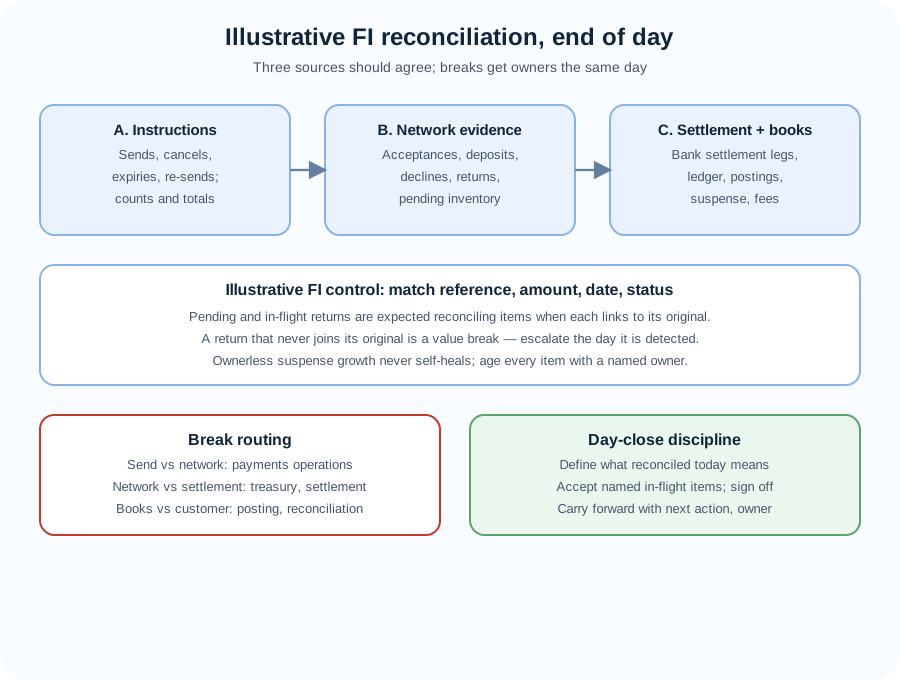
The diagram above compresses the section into an operating poster: three sources, four matching fields, same-day ownership, deliberate close. Print it mentally on the reconciliation wall. The discipline it depicts is unglamorous until the month it catches a systematic break on day one instead of day thirty — and then it is the most valuable page in this chapter.
10. Bank implementation, testing and resilience
Institutions acquire a competent exception operation by building systems that enforce the taxonomy, simulating feared failures, rehearsing dreaded incidents and staffing the desks — not by writing procedures and hoping. Retrofitting control onto a running high-volume transfer business is surgery on a moving patient, so the capabilities below should be built before exception volumes grow and tested before fraud volumes spike. This section describes what to build, how to test it, and how to keep it standing on the worst day.
Build the taxonomy into systems, not manuals. The controls in this section are implementation guidance for a participating FI, not claims about a uniform Interac interface or mandatory scheme rule. Send flows should validate addresses before release — well-formedness, new-or-changed-contact confirmation, first-time-payee challenge, duplicate detection — and block rather than warn where validation fails. Pending inventories should show accurate cancellable state in the channel with one-tap cancellation while the window is open, because every cancellation that requires a phone call is a failure of self-service design. Exception queues should classify on intake from system state and customer statements, route each class to its queue with owner, deadline monitor and evidence template attached, and calculate any time-bound steps from live parameters rather than operator memory. Recovery legs should auto-link to originals on reference with defined manual tolerance, and suspense for unlinked items should carry reason, age and owner from creation. Business portals should expose transfer history, pending inventory, return advices and case status in one place, because every capability withheld from the business customer becomes a phone call to the bank. Size queues, staffing and auto-matching for the storm — a fraud event that generates hundreds of linked cases, an outage that produces a re-send surge — not the average day, because storms convert manual workarounds into backlogs overnight.
Test with scenarios drawn from fear, not from convenience. The pre-deposit cancellation race: a sender cancelling seconds before deposit, verifying the system resolves the race deterministically with no double outcome. The wrong-address Autodeposit: a transfer deposited in seconds to a hijacked registration, verifying staff classify correctly and never promise a pullback. The outage re-send surge: a notice-delivery delay that produces mass uncertainty, verifying duplicate prevention holds when hundreds re-send at once. The mule-network morning: inbound fraud signals across dozens of accounts, verifying the single case queue joins them and holds apply within authority. The hijacked-registration wave: one takeover pattern redirecting many senders' transfers, verifying registration controls trigger and communications go out. Each scenario runs end to end — channel, hub, network state, posting, advice, reconciliation — with success defined as correct classification, honest communication, linked recovery and clean books, not as speed alone. Record evidence for every run; auditors and overseers rightly treat untested exception capability as absent capability.
Resilience is staffing plus contingency plus communication trees, and e-Transfer's around-the-clock character sets the bar. Authorization, fraud monitoring and status visibility cannot keep business hours while the product keeps all of them; minimum viable overnight and holiday coverage for holds, case triage and customer communication must be defined, funded and rostered. Contingency covers notice-delivery degradation, channel outages that strand pending inventory visibility, and settlement-leg delays that reshape funding — each with a playbook naming who decides, who communicates, and what customers are told. Communication trees reach from operations to fraud to treasury to corporate communications to front-line teams within the hour, because the fraud wave and the outage both become reputation events at the speed of social media. And resilience includes the humans: exception handlers absorb distress, anger and occasionally abuse, so rotation, debriefing, coaching and escalation paths that protect staff are operational controls, not perks. An institution that burns out its recovery team will relearn this chapter's lessons quarterly.
Prepare for the RTR future without spending today's credibility. The planned rail's centralized fraud capabilities, taught in Block 12, will eventually give Canadian instant payments new defensive depth — and institutions should prepare the ground now with clean reference discipline, case-queue architecture that can consume centralized signals, and fraud rules parameterized for new inputs. What readiness is not: referencing planned capabilities in current procedures, counting them as mitigants, or mentioning them to customers. Every planning document carries the same fence — outlook only, with RTR launch scheduled for Q4 2026 and not live at the October 5, 2026 baseline.
Governance ties implementation together. Name a single owner for e-Transfer exception capability across channel, fraud, operations and reconciliation. Set risk appetite explicitly — hold rates, review thresholds, write-off authorities. Review the registers on a risk-set rhythm, report capability health to a committee that can fund fixes, and audit closed cases against the chapter's standard: correct classification, honest advice, linked recovery, clean books.
11. Practical Canadian examples
Three fictional stories carry the chapter's lessons the way staff will actually remember them — as people, not processes. Each is labelled fictional, each ends with the control lesson, and each is designed to be retold in team huddles and training sessions. Names, amounts and institutions are invented; the failure modes are drawn from the patterns any Canadian exception team will recognize.
Example (fictional): the rent transfer to last year's address
Amara, a nursing student in Surrey, sends her $1,850 share of the rent to what she believes is her landlord's email address. It is the address from last year's lease; the landlord changed property managers in the spring and the new address differs by one word. The transfer shows as sent, the debit posts, and Amara only realizes the mistake that evening when the landlord replies that nothing arrived. She calls her bank the next morning, frightened and certain the money is gone — rent is due Friday and her account holds little else.
Walk the case the way Section 8 teaches. Intake captures the five facts: the transfer reference from Amara's history, sender and amount, the address as entered, the date, and the current state. The handler checks system state first rather than reassuring on hope: the transfer is pending — the old address has no Autodeposit and nobody has deposited it. Classification is immediate and fortunate: still cancellable. The handler cancels at Amara's direction while she is on the line, confirms the return with its reference, and helps her send a new transfer to the verified address — confirmed by a callback to the property manager on a known number. Closure arrives in writing with both references stated.
The control lesson is the cheapest in this chapter. The send flow should have slowed Amara down at the one moment that mattered: an address unused in over a year and an amount far above her usual pattern. A channel that surfaces "you have not sent to this address in 12 months — please confirm" prevents this case entirely.
Example (fictional): the bakery whose Autodeposit moved
Lena runs a neighbourhood bakery in Halifax taking weekend-market pre-orders by e-Transfer — forty or fifty small transfers a week, the business's working capital. On a Monday morning her bookkeeper notices that Friday's pre-order payments never arrived, though customers insist they sent them. Lena calls her bank, and the investigation finds something colder than a delay: her Autodeposit registration was changed the previous week after her email account was compromised, and every transfer since has deposited to an account she does not recognize. The senders did everything right. The registration underneath them was wrong.
Walk the response on both spines at once. The fraud spine runs first because the bleeding continues with every new order: secure Lena's email and banking sessions, verify her identity and devices, revert and re-protect the Autodeposit registration with alerts enabled, and review every transfer since the change for a complete impact picture. Evidence is preserved from the start — registration change records, transfer references, timestamps — and prescribed reporting runs through the Block 13 process with law-enforcement cooperation where the facts support it. The recovery spine runs in parallel with honest framing: each deposited transfer is final under Interac’s terms, so recovery means assistance requests to the receiving side and case-by-case pursuit — some funds may return, some may not, and nobody promises otherwise. Each customer who paid into the hijacked address gets a clear explanation and a path to re-pay through the verified registration once it is safe. Closure is a portfolio of named ending states with the loss position stated plainly.
The control lesson reshapes how the institution treats registrations. Changing an Autodeposit registration should be among the highest-friction actions in retail banking: strong verification, a notification the genuine customer cannot miss, and cooling logic before the changed registration receives value. Monitoring should have flagged the pattern — a changed registration followed immediately by normal-volume receipts diverting to a new account — as a hijack signature.
Example (fictional): the uncertain outcome that nearly became a duplicate
Devon, a contractor in Kelowna, sends a $4,200 supplier deposit on a patchy hotel connection the night before a job starts. The screen spins, times out, and shows no confirmation. His account shows the debit in the morning; the supplier says nothing arrived. Devon is ready to send it again — the job cannot wait — and his first call is to ask whether he should. The handler who takes that call earns their salary in the next ninety seconds.
The handler confirms state before advising anything: the transfer is pending, the notice was issued, the supplier's address carries no Autodeposit, and nothing has been deposited or returned. Classification follows: a pending transfer with a notice-delivery delay, not a lost payment. The handler advises against re-sending while the original is live — two live transfers for one deposit is how Devon pays twice and disputes with his supplier for a month — and instead offers the two clean options: wait with a reminder to the supplier and a watched status, or cancel the pending transfer and send one fresh linked transfer once the return confirms. Devon chooses cancellation and re-send; the return posts with its reference, the new transfer links to the original, and the supplier confirms receipt before noon. The advice names every leg so both sides reconcile on first pass.
The control lesson is the duplicate-prevention rule made vivid. Timeout plus pressure is the most reliable duplicate-payment generator in retail banking, and the only defense is discipline held under urgency: confirm original state, never re-send on assumption, link every retry to its original.
12. Key takeaways and authoritative references
Ten misunderstandings, ten corrections, and the sources that outrank this chapter. Read the corrections as the phrases to use with customers and colleagues, because each one replaces a sentence this academy has heard in branches and contact centres and would like never to hear again.
- "You can reverse an e-Transfer." Correction: Interac’s terms permit sender cancellation only before the recipient attempts deposit or the transfer is automatically deposited; once deposited, the transaction is final and recovery needs recipient cooperation or defined fraud paths — never a promised unilateral pullback.
- "If the recipient cannot spend it yet, we can still stop it." Correction: availability timing and recovery rights are different things; once Interac records the transfer as deposited, the transaction is final even if an account-level hold or access issue remains.
- "Interac will pull it back if we ask." Correction: Interac Corp operates the service and is separate from Payments Canada; it does not hold customer accounts or reverse deposited transfers — recovery runs through the institutions case by case.
- "Just send it again while we investigate." Correction: confirm original state before any re-send; timeouts re-sent on assumption become duplicates, and every retry links explicitly to its original reference.
- "A fraud report gets the money back." Correction: reporting is an obligation and a recovery asset, not a reversal mechanism; no filing anywhere authorizes debiting another person's account, and detail on reports and thresholds lives in Block 13 and current FINTRAC guidance.
- "Settlement legs can unwind it." Correction: bank settlement legs complete institutional obligations on their own cycles; they confirm nothing to customers and unwind nothing for anyone.
- "Cards can be charged back, so e-Transfers work the same way." Correction: card dispute rights belong to card networks with their own calendars and economics; Interac’s published e-Transfer terms do not provide a card-style sender chargeback after deposit, so cross-rail habits must not become promises.
- "The new real-time system already protects these payments." Correction: the RTR is planned, not live at the October 5, 2026 baseline, with launch scheduled for Q4 2026; any RTR fraud-service capability is outlook only for today’s e-Transfer procedures.
- "Small values do not need reconciliation discipline." Correction: three-way matching on reference, amount, date and status applies at any value; unmatched small items accumulate into the suspense balances that surprise committees.
- "Exceptions are a cost centre." Correction: the worst-day contact decides loyalty; institutions that classify fast, tell the truth early, recover within actual rights and write it down keep the household, the business and the referrals.
Carry-forward map. Block 12 owns the RTR lifecycle and its centralized fraud capabilities when they go live. Block 13 owns fraud typologies in depth, FINTRAC reporting mechanics, sanctions screening and RPAA supervision. Block 14 owns cutoff, investigation, posting and reconciliation operations across rails. This chapter owns the e-Transfer exception, from the pending window through the support conversation to the reconciled books — and it is complete at that scope.
Authoritative references. This chapter uses official sources only. Interac’s customer-facing service behavior and terms govern e-Transfer statements; institution-specific account terms, limits, fees, availability, and reclaim timing govern the FI implementation. Payments Canada and Bank of Canada sources govern the separate national systems and RTR outlook.
- Interac Corp — e-Transfer Help Topics (current service flow, Autodeposit, decline, 30-day expiry, reference number). https://www.interac.ca/en/interac-e-transfer-help/
- Interac Corp — Interac e-Transfer Terms of Use (provider role, holding of funds, cancellation before deposit, finality after deposit). https://www.interac.ca/en/interac-e-transfer-terms-of-use/
- Interac Corp — Personal FAQ: Interac e-Transfer (current timing, Autodeposit, and FI-first support). https://www.interac.ca/en/resources/personal-resources/personal-faq/interac-e-transfer/
- Interac Corp — Your Money. Secure Payments. Our Priority. (recipient-name confirmation, Autodeposit, phishing and fraud reporting). https://www.interac.ca/en/payments/personal/protect-your-payments/
- Payments Canada — Payment systems overview (live ACSS/Lynx systems and RTR modernization context). https://www.payments.ca/systems-services/payment-systems
- Payments Canada — Real-Time Rail payment system (launching Q4 2026; instant, data-rich, exchange/clearing/settlement system). https://www.payments.ca/systems-services/payment-systems/real-time-rail-payment-system
- Payments Canada — Critical milestone achieved: By-law and rules approved for Canada’s Real-Time Rail (approval and August 24, 2026 coming-into-force date). https://www.payments.ca/critical-milestone-achieved-law-and-rules-approved-canadas-real-time-rail
- Bank of Canada — Payment systems the Bank of Canada oversees (Interac e-Transfer, Lynx, ACSS, VisaNet, Mastercard systems; exchange, clearing and settlement definitions). https://www.bankofcanada.ca/regulatory-oversight/financial-market-infrastructures/payment-systems-the-bank-of-canada-oversees/
- Bank of Canada — Settlement account access policy for Lynx and ACSS (ACSS net obligations met by Lynx payments; settlement-account controls). https://www.bankofcanada.ca/core-functions/financial-system/bank-canadas-settlement-account-policies-for-payments-canada-payment-systems/
- FINTRAC — Record keeping requirements for financial entities (records, EFT scope, reference numbers, and retention). https://www.fintrac-canafe.canada.ca/guidance-directives/recordkeeping-document/record/fin-eng
- FINTRAC — Reporting suspicious transactions to FINTRAC (reasonable grounds, no monetary threshold, reporting as soon as practicable, facts/context/indicators). https://www.fintrac-canafe.canada.ca/guidance-directives/transaction-operation/str-dod/str-dod-eng
- Bank of Canada — Retail payments (RPAA/RPAR supervision, operational risk, incidents, safeguarding, reports; not individual dispute resolution). https://www.bankofcanada.ca/regulatory-oversight/retail-payments/
- Justice Laws Website — Retail Payment Activities Act (operational-risk framework, incident notice, safeguarding, annual report). https://laws-lois.justice.gc.ca/eng/acts/r-7.36/FullText.html
- Department of Finance Canada — Canada’s Anti-Money Laundering and Anti-Terrorist Financing Regime Strategy 2023–2026 (AML/ATF and sanctions compliance context). https://www.canada.ca/en/department-finance/programs/financial-sector-policy/canadas-anti-money-laundering-and-anti-terrorist-financing-regime-strategy-2023-2026.html
- Bank of Canada — Bank of Canada designates Interac e-Transfer as a prominent payment system (designation effective August 10, 2020; risk-management oversight and consumer-protection boundary). https://www.bankofcanada.ca/2020/08/interac-e-transfer-prominent-payment-system/
This application uses JavaScript for the full interactive experience. This text summary is served for accessibility and search indexing.