Domestic Lynx and Cross Border Wire. Trace domestic and international wire journeys through screening, routing, settlement, FX, reporting and investigations.
Block 15 · Chapter 74 of 75
Audit baseline: 5 October 2026. This chapter uses two fictional examples to show why “wire” is a customer label, not a settlement model. A domestic Canadian-dollar payment between Lynx participants is an RTGS payment in central-bank money. An international payment normally uses bank-to-bank messages and one or more correspondent or local-market settlement legs. Message transport, settlement, and beneficiary posting are separate states.
Core rule: a network acknowledgement proves a message event; a settlement reference proves a value movement; only a receiving-bank posting or a legitimate exception proves the customer outcome.
Labels used in this chapter
- Regulatory/legal: legislation, FINTRAC obligations, sanctions law, and Bank of Canada/RPAA supervision.
- Payments Canada system/rule: Lynx rules, procedures, specifications and guidelines.
- Swift/CBPR+ practice: Swift network and market-practice requirements; these are not Canadian law.
- Bank-specific: channel controls, limits, cut-offs, routing, FX pricing, screening policy, ledger design and customer status.
- Fictional example: Northern Forge Ltd., Canadian Machine Systems, and RheinWerk GmbH are invented.
1. The two stories
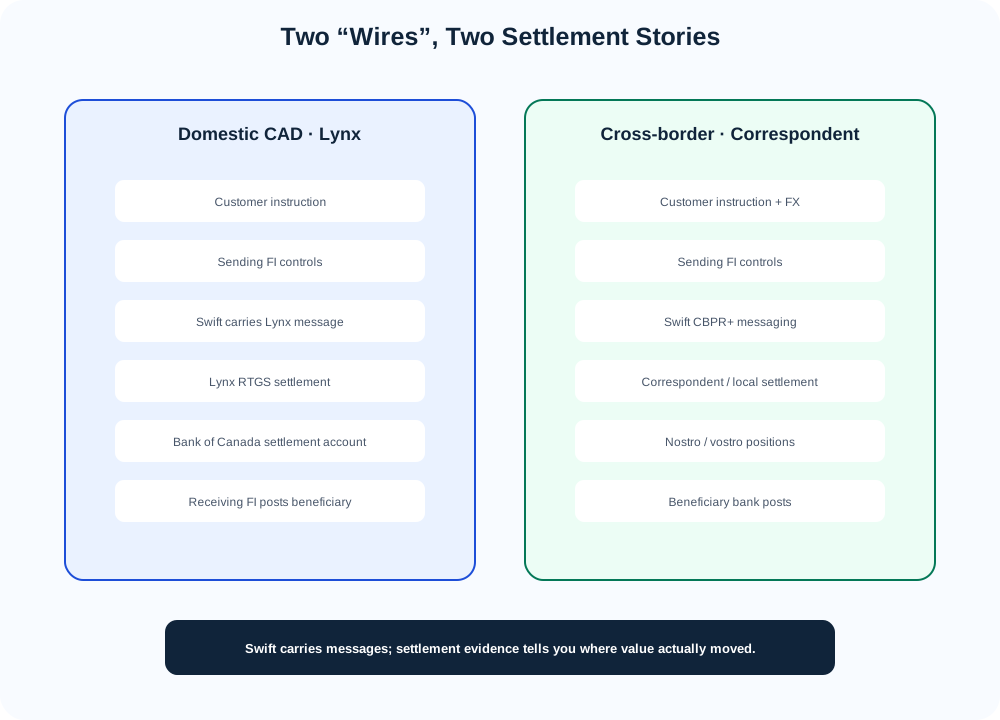
Story A — domestic Lynx
Northern Forge asks its Canadian bank to pay Canadian Machine Systems CAD 2.4 million. If the two end institutions are Lynx participants (or the beneficiary is reached through a participant/payee arrangement), the bank validates and releases an applicable Lynx payment message. Lynx clears and settles the participant obligation in real time gross settlement. Payment Confirmation Reference Number (PCRN) evidence is generated for a payment settled through Lynx. The receiving institution still has to identify the payee and make funds available under the Lynx By-law and Rule 10.
Not every Canadian-dollar wire is a Lynx payment. An on-us payment between customers of the same financial institution is settled on that institution’s books, not through Lynx. A non-participant financial institution can arrange a Lynx payment through a direct participant. These distinctions are Payments Canada/system facts, not product assumptions.
Story B — international correspondent payment
Northern Forge asks its Canadian bank to pay RheinWerk GmbH USD 1.8 million, funded from a CAD account. The bank must capture the beneficiary’s account/IBAN where applicable, bank identifier, address and purpose; authenticate and approve the instruction; apply fraud, sanctions and AML controls; execute or source FX; select an approved USD route; fund and reconcile the relevant nostro/correspondent leg; send the applicable Swift CBPR+ payment instruction; and confirm, return or investigate the beneficiary outcome. The route, charge treatment, value date and posting time are corridor- and bank-specific.
Swift carries messages. It does not itself debit the Canadian bank’s customer account or settle every correspondent leg. A UETR supports end-to-end correlation and tracking; it is not a settlement account or proof that the beneficiary’s account was credited.
2. Participants, channels and data
Domestic participant roles
| Role | What it does | Evidence to retain |
|---|
| Originator/corporate | Initiates through a portal, branch, host-to-host file or API; supplies beneficiary and remittance data | Original instruction, authentication, approval and version |
| Sending FI | Validates account/routing, funds, limits, duplicate, fraud and sanctions; creates the Lynx interbank message | Decision results, payment/message IDs and release timestamp |
| Lynx/Payments Canada | Provides the high-value clearing and settlement system and applicable rules | System acknowledgement, settlement record and PCRN where applicable |
| Bank of Canada | Provides participant settlement accounts and central-bank money; eligible participants use liquidity/collateral arrangements | Settlement-account and treasury evidence |
| Receiving participant/payee | Receives the payment, applies account/control rules and makes funds available or returns/handles the payment under applicable rules | Posting, hold/repair, return or exception record |
| Beneficiary | Receives usable funds or a customer-facing exception | Account statement or receiving-bank confirmation |
Lynx is owned and operated by Payments Canada. Direct participation requires, among other criteria, a Bank of Canada settlement account, collateral capability, technical compliance and Swift membership. Members that are not direct participants arrange payments through direct participants. Treat these as system participation facts, not as a promise that every bank offers the same customer wire service.
Bank processing model
A realistic payment hub usually separates:
- Channel intake: portal, host-to-host file, API, branch or operations desk; schema, entitlement, authentication and maker-checker approval.
- Canonical payment record: customer instruction ID, amount/currency, debtor and creditor, accounts, agents/BICs, value date, remittance, purpose, charge instruction, source channel and audit version.
- Decision services: available funds/credit, customer and transaction limits, duplicate/idempotency, beneficiary-change controls, device/behavioural fraud, sanctions/AML, and regulatory data completeness.
- Routing: Lynx eligibility and current usage specifications for domestic CAD; corridor, currency, beneficiary bank, correspondent, holidays, liquidity, sanctions risk, customer SLA and cut-off for cross-border.
- Message and settlement adapters: Lynx ISO 20022 or approved cross-border message; Swift/FINplus transport; participant or correspondent account events; acknowledgement and rejection handling.
- Posting and control: debit/credit or suspense, fees, FX booking, holds, release, return, statement generation and customer status.
- Operations and reconciliation: searchable raw and parsed messages, settlement/PCRN or nostro evidence, ledger, case, sanctions decision, customer communication and final disposition.
A schema-valid message can still be business-invalid. Preserve structured party data and references; do not flatten all addresses or names into a free-text field or silently replace beneficiary data after approval.
3. Domestic Lynx lifecycle
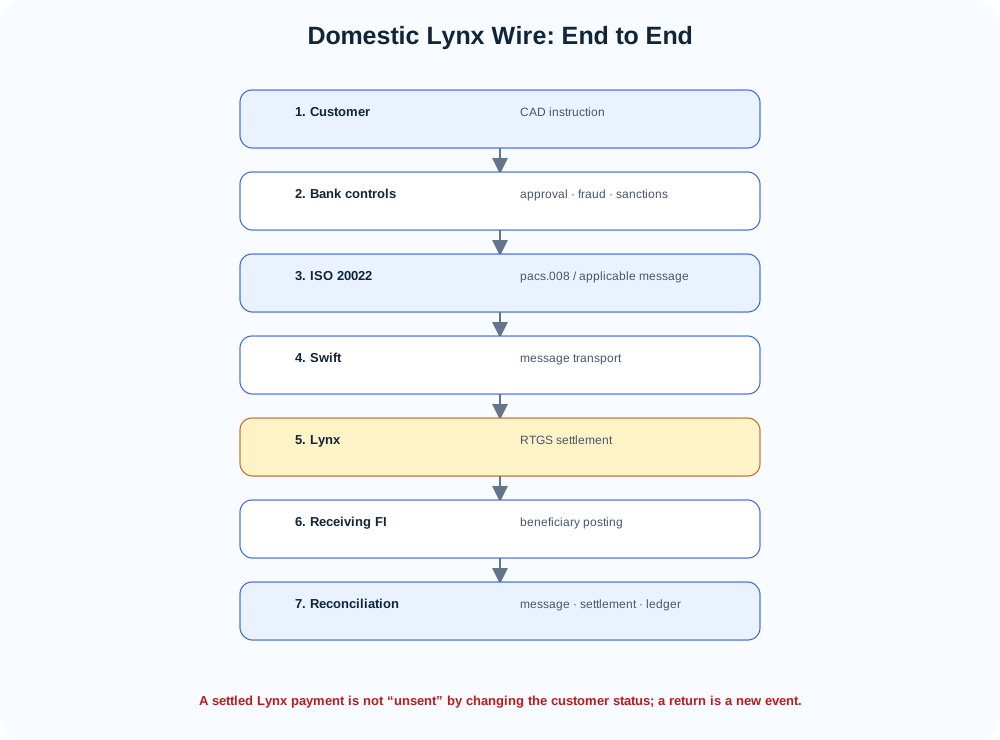
- Initiate and authenticate. The corporate submits CAD amount, beneficiary name/account, institution/routing data, requested value date and remittance. The bank authenticates the user, enforces entitlements and records the exact approval version.
- Validate before release. Check account status, funds/credit, customer/product limit, duplicate/idempotency key, beneficiary and CACPA/routing format, value date, sanctions/AML and fraud. A corporate channel may use
pain.001; the bank, not necessarily the customer, creates the applicable interbank Lynx message.
- Create the interbank message. Current Payments Canada Lynx ISO 20022 resources list the UG2026 core specifications for
pacs.008, pacs.009 core, pacs.009 COV and pacs.004, with companion specifications and controlled versions. The current Rule 6 title is Payment transmission; do not cite it as if it were the whole message catalogue. Use the current TSP/usage specifications for technical and business validation.
- Transmit. Swift is the message service provider for Lynx. Network acceptance, a technical acknowledgement or a bank “sent” status is not settlement.
- Fund and settle. Lynx settlement requires available participant liquidity and may involve the participant’s settlement mechanisms, intraday liquidity, collateral and queued processing. A participant can receive liquidity from incoming payments and use Bank of Canada facilities under the applicable framework. A payment is final/irrevocable when the Lynx settlement event occurs under the legal/rule framework—not merely when a message is accepted.
- Evidence settlement. Store the Lynx settlement record and PCRN. Payments Canada defines the PCRN as the unique alphanumeric number generated by Lynx for a settled Lynx wire; it is not the same as a bank’s own transaction reference. Same-institution/on-us wires do not have a Lynx PCRN.
- Receive and post. The receiving FI/payee identifies the account, applies controls and makes funds finally and irrevocably available within the applicable timing rules, or handles an exception. The customer’s usable balance is a separate event from inter-FI settlement.
- Report and reconcile. Reconcile instruction → outbound message → Lynx acceptance/settlement/PCRN → customer debit → receiving posting → statement. A missing beneficiary posting after confirmed settlement is a receiving-bank/account exception, not grounds for a blind resend.
Finality and returns
Payments Canada Rule 10 is current as updated 27 July 2026. It sets exceptions to crediting the payee and return procedures. A receiving participant may return for specified errors, restrictions or legal reasons; a return is a new pacs.004 payment message with a return reason. Rule 10 includes timing provisions for late receipt, foreign-currency accounts, branch timing and events beyond control. For a return over $25 million, the current rule requires notice to the sending participant’s Lynx Payment Operations contact by telephone or email before return. Do not generalize a customer error, a bank posting error, a sanctions hold and a system emergency into one “reversal” status.
A valid but wrong account can be credited under the account/identifier rules even when the name differs. The sending bank should preserve the original settled event and use the misdirected-payment/recovery process. It must not edit the original payment to change the beneficiary.
Bank-specific controls: customer cut-offs can be earlier than Lynx’s current operating window; queues, priority, holds, repair, limits and available intraday liquidity are participant implementation decisions constrained by current rules. Do not put a static clock in customer code without reading the current controlled system parameters and closure schedule.
4. International correspondent lifecycle
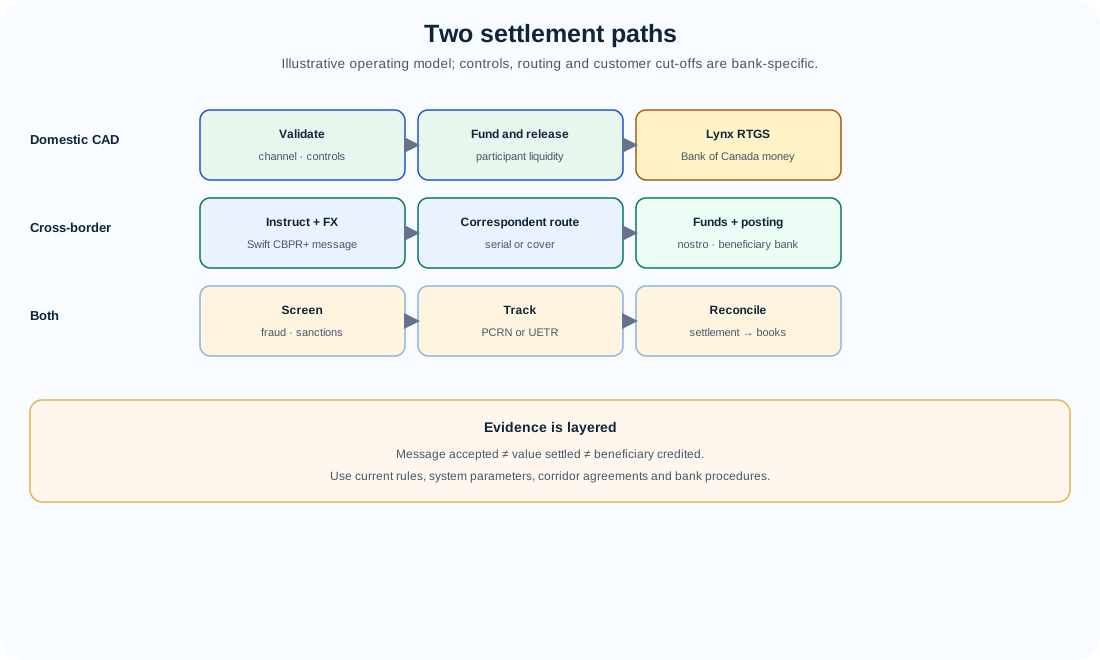
Serial and cover
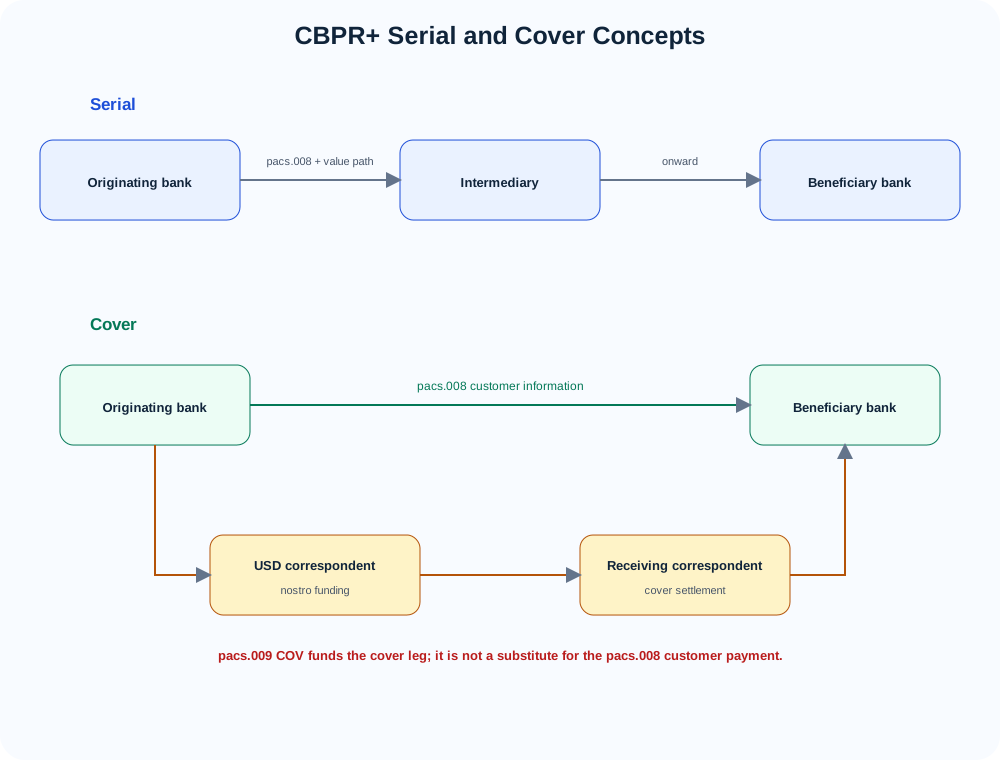
- Serial: the customer-credit instruction and the value path move through the chain of sending bank, intermediary/correspondent(s) and beneficiary bank. Each bank applies its own acceptance, screening, account and posting controls.
- Cover: the customer payment information is sent toward the beneficiary bank while a separate FI-to-FI cover leg supplies funds through correspondent(s). In the applicable ISO 20022 practice,
pacs.008 is the customer credit transfer and pacs.009 COV carries cover funds and the required underlying customer-transfer information. pacs.009 COV is not an alternative replacement for the customer pacs.008.
Serial/cover selection is Swift/corridor/bank-specific, not a Canadian statutory choice. The bank must correlate the information and funds legs, preserve the original UETR/reference as required by the applicable message practice, prevent duplicate funding, and reconcile message and account evidence. A pacs.008 without cover may be pending/unapplied; cover without a matching customer instruction is an investigation—not an instruction to resend.
FX, charges, value date and liquidity
A bank-specific product may quote a USD amount, CAD debit, rate/spread, validity, fees and value date. Persist quote/trade ID, rate, timestamps, currency pair, amount, approvals and settlement status. If the quote expires before release, obtain a new quote and customer confirmation under product terms; do not silently alter an approved debit.
Treasury forecasts the USD nostro/correspondent balance, expected incoming funds, outgoing wires, overdraft/collateral, correspondent cut-off and currency holidays. Customer CAD availability does not prove bank USD liquidity. The route may be delayed, changed under approved policy or rejected under product terms. The customer-facing promise must account for Toronto, USD/correspondent and beneficiary calendars; “message sent” and “beneficiary credited” are different dates.
Charge bearer codes and corridor/market practice determine whether the beneficiary receives less. Show the sending fee and, where available, intermediary/receiving deductions. Do not promise the beneficiary receives exactly USD 1.8 million unless the product explicitly guarantees that outcome. On return, reconcile original currency, returned currency, charges, FX reconversion and customer credit; the original outbound event remains in history.
Tracking and investigations
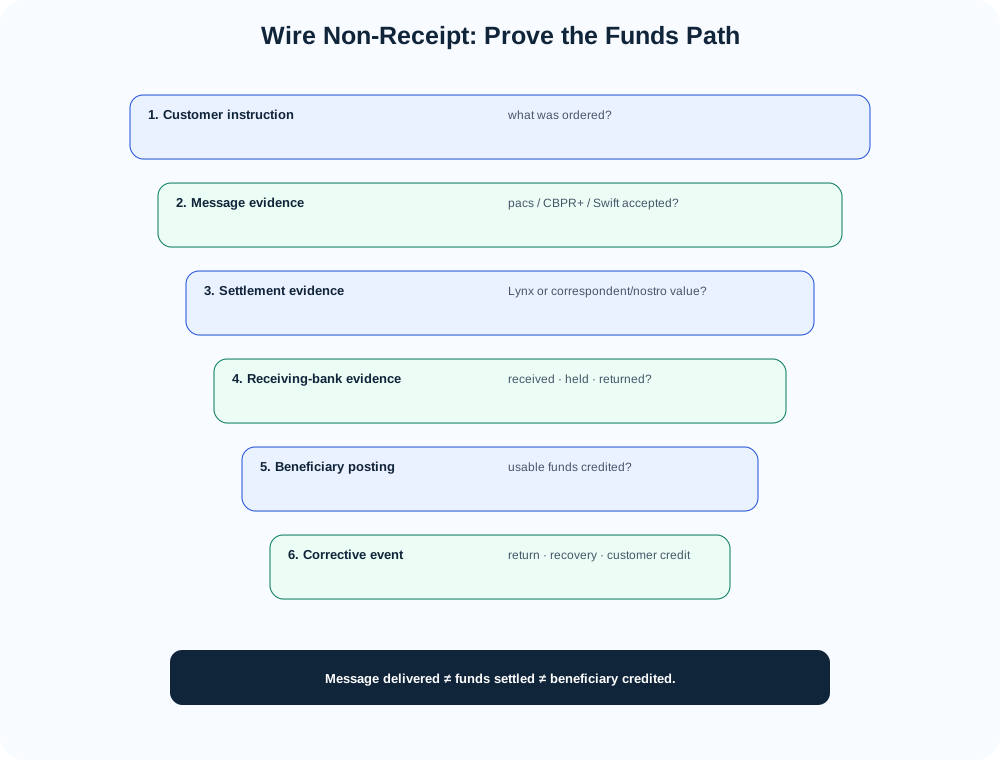
A UETR is a 36-character reference in Swift payment instruction messages. Intermediaries should pass it on rather than generate a new end-to-end reference. Swift tracking/confirmation can show routing and bank-reported status, including beneficiary credit or rejection, but the bank must still reconcile its customer ledger and nostro/correspondent evidence.
The investigation ladder is:
- exact customer instruction and approval;
- message ID, UETR, acknowledgement and validation outcome;
- correspondent route and debit/credit statement evidence;
- intermediary/beneficiary-bank receipt, hold, repair, rejection or return;
- beneficiary posting or customer account evidence;
- recall/return/recovery and final accounting.
A recall or cancellation request is not recovery. If fraud or business-email compromise is suspected, place the case in the bank’s fraud process, preserve evidence, contact correspondents/receiving banks through approved channels, and consider applicable recall, reporting and legal steps. Do not send a duplicate while the first payment’s financial state is uncertain.
Current Swift change status
The 22 November 2025 CBPR+ coexistence end for cross-border payment-instruction messages is current. Swift’s August 2026 announcement then deferred the planned SR2026 payments changes, including the structured-address cutover, after community requests for more time. As of this audit date, Swift has not published a replacement effective date for that payment change; its 21 September update says the deferred release for listed message areas is scheduled for 12 June 2027, while the structured-address timing/scope is to be confirmed through Swift’s governance updates. Therefore, do not teach 14 November 2026 as an already-effective or fixed address deadline.
Banks should still migrate toward fully structured or hybrid addresses because Swift states town and country are the minimum target data in the planned model and because better data supports screening and straight-through processing. But label this as planned/deferred Swift change, not a current Canadian legal requirement. Recheck Swift’s customer-area guidance and the relevant CBPR+ usage guidelines before implementation.
5. Canadian compliance and customer controls
FINTRAC/PCMLTFA (regulatory)
For an international electronic funds transfer of CAD 10,000 or more equivalent, reporting entities may have initiation/final-receipt reporting obligations, subject to the PCMLTFA/PCMLTFR rules and applicable exceptions. FINTRAC guidance says the report is generally due within 5 business days after initiation or final receipt, and the 24-hour rule aggregates qualifying international EFTs totalling $10,000 or more for the same person/entity or third party. SWIFT and non-SWIFT transfers are aggregated for that rule. Treat the threshold, direction, amount currency and timing as regulatory data—not as a customer wire limit.
The FINTRAC travel rule applies to international EFTs and Canadian EFTs sent by SWIFT MT-103 or equivalent. Required information includes the originator’s name, address and account/reference, and the beneficiary’s name, address and account/reference where applicable. If incoming information is missing, the entity must take reasonable measures and apply written, risk-based policies for allowing, suspending or rejecting the transfer. These requirements explain why an intermediary information request can be a compliance repair rather than a failed settlement.
Sanctions and fraud
Canadian sanctions and AML obligations are legal/regulatory controls; the exact screening lists, escalation, blocking/return treatment and disclosure decisions are bank-specific and corridor-specific. Screen the customer, beneficial owners where relevant, debtor/creditor, agents, correspondents, payment text and new information before release and when a payment is received or repaired. A possible match is not automatically a confirmed prohibition. Do not disclose prohibited information or tip off a suspicious-transaction investigation; follow the bank’s compliance process.
For high-value corporate payments, step-up authentication, dual approval, new-beneficiary cooling periods, independent callback, device/behaviour analytics and post-release recall playbooks are bank controls. A fraud hold is not a Lynx outage, and an AML/sanctions hold is not proof that settlement occurred.
Customer outcome and status design
Use evidence-based statuses rather than one generic “completed”:
| Domestic Lynx | Cross-border |
|---|
| Received/approved | Received/approved |
| Under review or repair | FX/currency pending |
| Transmitted/accepted | Sent/in progress |
| Lynx settled (PCRN) | Correspondent/nostro in progress |
| Beneficiary posted | Beneficiary credited (only when supported by evidence) |
| Returned/recovered | Information required, rejected/returned or recovery |
Status labels are bank-specific. Customer disclosures should separate bank fees, correspondent deductions, expected value date, posting conditions and return/FX treatment.
6. Accounting, reporting and reconciliation
Domestic
Illustrative accounting is bank-specific, but the evidence chain is not:
Customer instruction/approval
  ↔ canonical payment record
  ↔ Lynx pacs.008 (or applicable message)
  ↔ Swift/Lynx acknowledgements
  ↔ Lynx settlement + PCRN
  ↔ customer debit and fees
  ↔ receiving posting or pacs.004 return
  ↔ statement and reconciliation
A return credits or places funds in suspense as a new event according to product and rule treatment. It does not erase the original settlement. Include the PCRN and bank reference in operations’ searchable view.
Cross-border
Customer instruction
  ↔ FX quote/trade
  ↔ CBPR+ message + UETR
  ↔ serial or pacs.009 COV relation
  ↔ nostro/correspondent statement and charges
  ↔ beneficiary-bank status/posting
  ↔ return/recall/recovery
  ↔ customer ledger, FINTRAC records/reports and case closure
Support one-to-many mapping: one customer payment may have a customer message, cover message, several correspondent postings, statement entries, charge adjustments, status confirmations and a return. Reconcile opening/closing nostro balance, credits, debits, fees, statement sequence, duplicates and unmatched suspense. A missing statement file is not zero activity.
7. Architecture and test depth
Production-oriented control points
- Authentication: channel entitlement, MFA/step-up, signing keys or API credentials, approval separation and immutable audit.
- Validation: XML/schema, Payments Canada Lynx usage, Swift/CBPR+ usage, corridor rules, account/BIC/IBAN format and regulatory-data completeness.
- Idempotency: preserve business identity across retries; do not resend after timeout until message, settlement and account evidence are reconciled.
- Routing and liquidity: current Lynx participant/settlement status; correspondent reachability; currency liquidity; cut-offs; holidays; approved alternate route.
- Screening: pre-release and event-driven screening, repair queue, match disposition, case owner, audit trail and legal hold/return treatment.
- Ledger: customer debit/credit, FX, fees, settlement account, nostro, suspense and return events are separately posted and linked.
- Operations: parsed business fields plus raw message, PCRN/UETR, acknowledgements, statement evidence, posting evidence, case communications and retention.
- Resilience: use current Lynx emergency procedures and controlled Swift/correspondent contingency. Never improvise a high-value instruction over consumer email or replay a payment from an unverified backup.
Minimum test set
Domestic: happy-path pacs.008; invalid/routing field; beneficiary name/account mismatch; duplicate; fraud or sanctions hold; liquidity queue; late/holiday receipt; receiving account closed; receiving ledger incident after Lynx settlement; pacs.004 return; misdirected payment; PCRN/ledger/statement reconciliation; Swift/Lynx outage and recovery classification.
Cross-border: serial and cover; delayed cover; cover without customer instruction; expired FX quote; insufficient USD nostro; correspondent outage with controlled alternate route; structured-data repair; sanctions information request; UETR preservation; tracker unavailable; beneficiary rejection; partial return/charges; fraud/BEC recall; statement gap and unmatched nostro; ledger debit with no external send; external send with missing beneficiary posting.
Acceptance requires evidence of the exact customer approval, message(s), settlement/nostro movement, posting or return, accounting, compliance decision and reconciliation. Passing XML schema validation alone is not a production acceptance test.
8. RTR boundary: planned modernization, not today’s Lynx
As of 5 October 2026, Payments Canada describes the Real-Time Rail (RTR) as launching in Q4 2026, subject to successful testing. It is planned to exchange, clear and settle data-rich payments in real time, 24/7/365. Payments Canada’s FAQ states an initial $100,000 system transaction limit at launch, with participants able to set lower end-user limits, and says mandatory network fraud-mitigation services are planned for launch. These are RTR programme statements, not current production capabilities.
Do not say that a customer payment has used RTR unless the bank has actually enabled the relevant production service and can prove the RTR message, participant response, settlement and posting. Do not infer RTR cut-offs, finality, returns, APIs, participant eligibility or fraud workflow from Lynx. Use the then-current RTR By-law, Rules, participation model, technical specifications and Bank of Canada settlement-account policy. RTR rules and implementation status can change before launch.
9. Takeaways and authoritative references
- Lynx: Payments Canada system; Swift transports the message; Lynx settles participant obligations; Bank of Canada settlement accounts support final central-bank-money settlement; PCRN is evidence for a settled Lynx wire; receiving posting remains a separate customer event.
- Cross-border: Swift/CBPR+ carries instruction and tracking data; correspondent/local market arrangements move value; UETR correlates; FX, charges, calendars, sanctions and beneficiary controls affect outcome.
- Returns: a return is a new financial event; never silently edit or blindly resend an uncertain original.
- Change management: CBPR+ payment-instruction coexistence ended 22 November 2025. The planned 2026 structured-address payment change was deferred; treat its effective date and scope as unresolved until Swift confirms them.
- Regulatory boundary: FINTRAC/PCMLTFA obligations and sanctions law are not the same as Payments Canada or Swift scheme rules, and neither defines a bank’s customer service promise.
Authoritative references (accessed 5 October 2026)
- Payments Canada — Lynx: Canada’s high-value payment system — system role, participants, Swift transport, central-bank settlement context and 2025 statistics.
- Payments Canada — Lynx ISO 20022 message specifications — current UG2026
pacs.008, pacs.009 core, pacs.009 COV, pacs.004 and reporting resources.
- Payments Canada — Lynx rules and documentation — controlled rule index and 27 July 2026 Lynx update notice.
- Payments Canada — Rule 6, Payment transmission — current controlled Rule 6.
- Payments Canada — Rule 10, Finality and return — current 27 July 2026 rule, exceptions, returns, PCRN and $25 million notice.
- Payments Canada — Explainer: Lynx wire payments and the PCRN — PCRN, participants/payees, on-us exclusion and timing caveats.
- Bank of Canada — Settlement account policies for Payments Canada payment systems — settlement accounts, central-bank money and Lynx/RTR access.
- Bank of Canada and Payments Canada — An overview of Lynx — RTGS, finality, liquidity mechanisms and legal framework.
- Justice Canada — Canadian Payments Association By-law No. 9—Lynx — current legal framework and participant/payee provisions.
- Swift — ISO 20022 for financial institutions — 22 November 2025 coexistence end and CBPR+ roadmap.
- Swift — Structured-address migration extension, 27 August 2026 (updated 21 September) — payment-change deferral and 12 June 2027 deferred release information.
- Swift — UETR — UETR, pass-through and tracking/confirmation.
- Swift — Transforming exceptions and investigations — 2026 Case Management rollout and 2027 mandatory transition stages.
- FINTRAC — Reporting electronic funds transfers — $10,000 international EFT reporting, five-business-day timing and 24-hour aggregation.
- FINTRAC — Travel rule for electronic funds transfers — originator/beneficiary information and missing-data policy.
- Justice Canada — PCMLTFA — current Act text and reporting/compliance framework.
- Department of Finance Canada — Canada’s AML/ATF Regime Strategy — federal AML/ATF roles and reporting-entity framework.
- Bank of Canada — Criteria for registering payment service providers — current RPAA scope and bank exclusion/PSP boundary.
- Payments Canada — Real-Time Rail payment system and RTR FAQ — planned Q4 2026 launch, 24/7/365 model and launch limit; not evidence of current production use.
- Interac — Interac e-Transfer — separate account-based consumer service; not the Lynx or correspondent settlement rail described here.
This application uses JavaScript for the full interactive experience. This text summary is served for accessibility and search indexing.