Cutoffs, Calendars and Business Days. Understand rail-specific cutoffs, business dates, holidays, 24/7 services and customer service implications.
Block 14 · Chapter 66 of 75
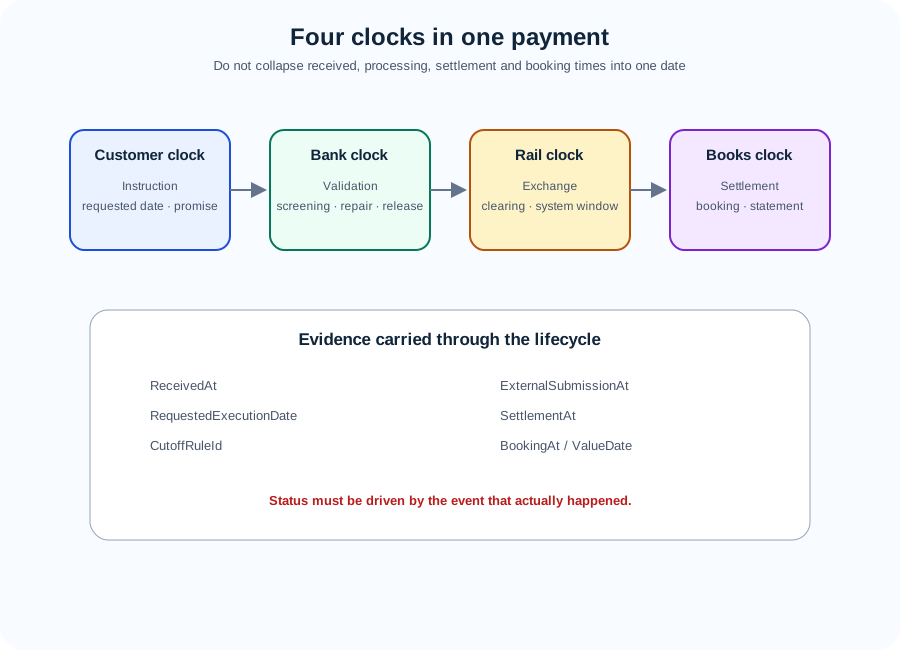
Canadian payment operations run on several clocks at once. A customer sees a date and an expected arrival time. A channel has an acceptance cutoff. A bank has internal release, screening and repair deadlines. A payment system has its own processing cycle. A settlement process may use a different business date again. Some services are available continuously, while others remain tied to business-day windows.
That is why “the payment was sent today” is not an operationally complete statement.
The useful questions are: when was the instruction accepted, for which value date, on which rail, before or after which cutoff, under which calendar, when did clearing or exchange occur, when did settlement occur, and when did the receiving institution make funds available?
This chapter builds that operating model across Automated Funds Transfer (AFT), the Automated Clearing Settlement System (ACSS), Lynx, Interac services and Canada’s planned Real-Time Rail (RTR). It deliberately avoids inventing universal bank cutoffs. Payments Canada rules define system-level obligations and processing arrangements, while individual financial institutions set customer-facing and internal cutoffs around those rules. A corporate portal may therefore stop accepting same-day instructions before the underlying rail closes because the bank needs time for validation, sanctions screening, fraud controls, repair, funding and operational release.
What you should be able to do after this chapter
After working through this chapter, you should be able to:
- distinguish customer cutoff, bank processing cutoff, exchange cutoff and settlement deadline;
- explain why business date, value date, booking date and statement date can differ;
- describe how weekends and statutory holidays affect batch and high-value payment journeys;
- explain why a 24/7 customer channel does not automatically make every underlying payment rail 24/7;
- distinguish ACSS batch processing from Lynx high-value processing and continuous real-time designs;
- identify the operational controls needed around cutoff breaches, late files and holiday schedules;
- explain how treasury, liquidity, accounting, reconciliation and customer support depend on calendar discipline;
- design cutoff and calendar reference data rather than hard-code dates and times in application logic;
- test daylight-saving changes, year-end processing, leap years and holiday exceptions;
- communicate realistic customer expectations without promising a rail capability the bank does not own.
Chapter navigator
- Why payment calendars are a control
- The four clocks in a payment
- ACSS and AFT business-day processing
- Lynx processing cycles and high-value cutoffs
- Interac and bank-dependent digital journeys
- RTR and the move toward continuous operations
- Bank architecture for calendars and cutoffs
- Accounting, liquidity and reconciliation implications
- Exceptions and customer communication
- Implementation and testing
- Practical scenarios and implementation patterns
- Key takeaways and authoritative references
1. Why payment calendars are a control
A payment calendar is part of the product contract and part of the bank’s risk control.
Consider a payroll file for Friday payday. The employer may upload it on Wednesday evening. The bank may accept the file immediately but assign a later processing date because the same-day internal release window has closed. The AFT item may then be exchanged in the relevant ACSS stream and ultimately posted by receiving institutions according to the applicable processing arrangements. “Uploaded Wednesday” is therefore not the same thing as “cleared Wednesday” or “available Wednesday.”
The same distinction matters for a Lynx wire. A customer can create a wire instruction outside the bank’s staffed operational period, but the bank may queue it for validation and release during the next supported processing cycle. The customer instruction exists; the interbank payment does not yet exist.
Calendar controls protect against several risks:
- releasing a payment with an impossible or unsupported value date;
- sending a file after a scheme or system window and assuming it was accepted;
- posting customer funds before the bank has reliable settlement evidence;
- failing to fund a settlement position because treasury is using the wrong business date;
- treating a weekend as an ordinary processing day for a batch rail;
- applying a holiday from the wrong jurisdiction to a cross-border payment;
- closing the general ledger while late payment activity is still expected;
- showing “completed” to a customer when the payment is only scheduled.
The calendar is therefore shared reference data used by channels, payment hubs, fraud and sanctions services, treasury, accounting, reconciliation, statements, operations and customer support.
2. The four clocks in a payment
A practical operating model separates at least four clocks.
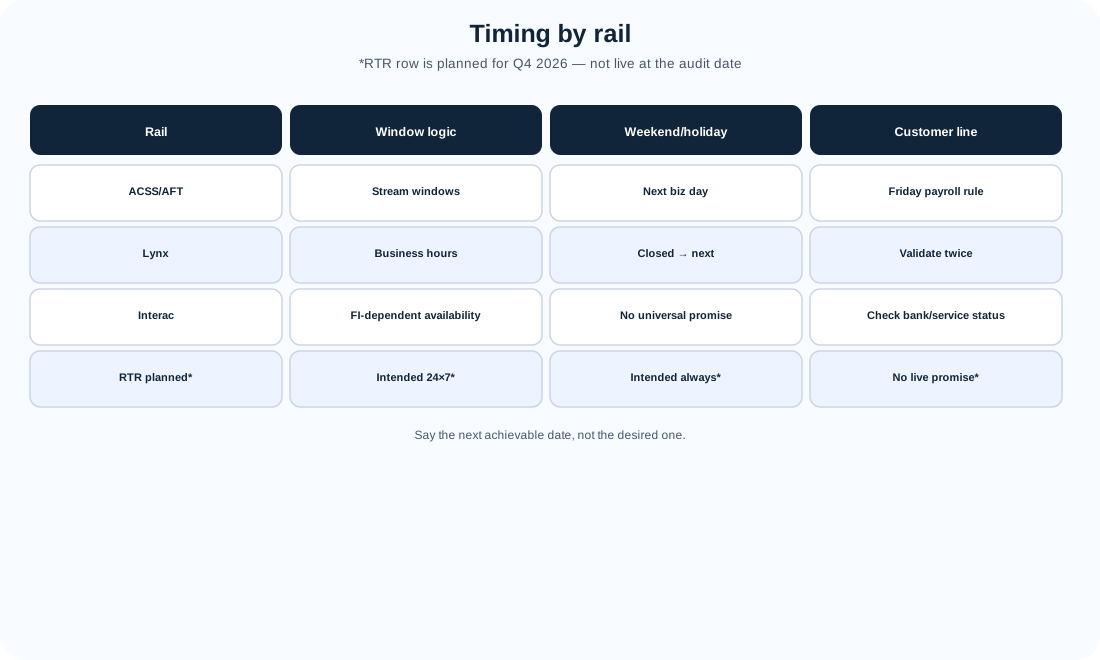
The timing-by-rail diagram above shows how those four clocks run differently on each rail; keep it beside the clock definitions below when promising availability to customers.
Customer clock
This is what the payer experiences.
Typical data includes:
- instruction timestamp;
- requested execution date;
- requested value date where the product supports it;
- channel cutoff displayed to the customer;
- estimated availability;
- status such as scheduled, processing, sent or completed.
The customer clock belongs to the bank product. It should be expressed in the customer’s relevant time zone and should not expose internal system jargon.
Bank processing clock
The bank needs time to:
- validate account and entitlement;
- verify balance or credit;
- perform fraud controls;
- screen sanctions where applicable;
- enrich routing;
- repair data;
- obtain approvals;
- assemble files or messages;
- fund settlement;
- release to the external rail.
A corporate file cutoff may therefore be earlier than the system’s final exchange opportunity.
Clearing or exchange clock
This is controlled by the payment arrangement.
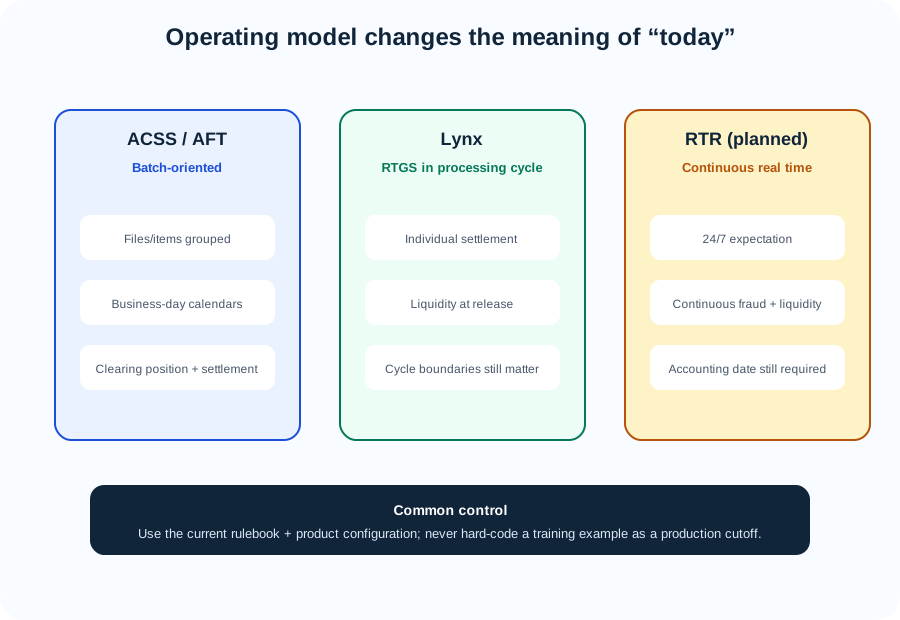
For ACSS, different payment streams have defined exchange and processing arrangements. AFT credits and debits are batch-oriented and use the ACSS framework. Payments Canada publishes rules, standards and system documentation; those are the authoritative source for current windows.
For Lynx, payment processing occurs within Payments Canada’s defined processing cycle and settlement windows. Rule 9 addresses the end of the payments processing cycle and Rule 10 addresses finality and return.
For a continuously available real-time rail, the exchange clock is intended to operate continuously rather than around a traditional business-day batch window.
Settlement and books clock
Settlement can be final before every downstream customer ledger, fee, statement and reconciliation process has completed.
A bank may track:
- external settlement timestamp;
- settlement account date;
- customer booking timestamp;
- customer value date;
- general-ledger business date;
- reconciliation business date.
These fields should not be collapsed into one “date.”
A useful data model
A mature payment record can carry:
| Data element | Meaning |
|---|
| ReceivedAt | When the bank accepted the instruction |
| RequestedExecutionDate | Date requested by customer |
| BankProcessingDate | Internal date used for processing |
| ExternalSubmissionAt | When sent to rail/network |
| SettlementAt | When settlement evidence says value settled |
| BookingAt | When customer/internal account was posted |
| ValueDate | Economic date applied to balance/interest rules |
| StatementDate | Date under which event is reported |
| CalendarId | Calendar version used |
| CutoffRuleId | Rule that selected the processing path |
Keeping these values separately makes investigations much easier.
3. ACSS and AFT business-day processing
The ACSS is Canada’s retail batch clearing and settlement system. Payments Canada’s 2025 statistics show large continuing volumes in AFT credits and AFT debits, illustrating why batch calendars remain operationally important even as real-time payments develop.
AFT processing is governed through Payments Canada rules and standards, including Rule F1 for traditional AFT transactions and Rule F4 for AFT transactions using ISO 20022 messages. Standard 005 and Standard 007 support file/data and transaction/return-code conventions.
The batch lifecycle
A simplified AFT credit journey is:
- originator prepares payroll or supplier payment file;
- originator submits to its financial institution;
- bank validates file structure, originator authority, funding and duplicates;
- bank assigns the correct processing date and stream;
- items are exchanged under ACSS arrangements;
- clearing positions are calculated;
- settlement occurs according to the ACSS operating model;
- receiving institutions post eligible credits;
- exceptions and returns are processed;
- all parties reconcile file, clearing, settlement and posting populations.
A cutoff can exist at several of these stages.
The employer’s upload cutoff is not necessarily the bank’s internal release cutoff. The bank’s release cutoff is not necessarily identical to the system exchange deadline. The receiving institution’s customer-posting window is a separate control again.
Future-dated items
Payroll and recurring corporate disbursements frequently require future dating.
The system should distinguish:
- file received date;
- intended due date;
- valid processing date;
- actual release date.
A bank should reject or repair impossible dates according to product and rule requirements, not silently change them without evidence.
Weekends and holidays
Batch products require a maintained business-day calendar.
A good calendar service contains:
- national holidays relevant to the payment rail;
- Payments Canada processing-day information;
- bank-specific non-processing periods where applicable;
- special year-end instructions;
- effective version and change history.
The calendar should be centrally managed. Ten applications each maintaining their own holiday spreadsheet is an operational incident waiting to happen.
Late files
A late file should have an explicit outcome:
- reject immediately;
- roll to next valid processing date;
- accept under a product-specific late-processing service;
- place in repair/manual review.
The choice must be visible to the customer and auditable.
“Accepted” should never be used if the bank means only “we received the bytes.”
4. Lynx processing cycles and high-value cutoffs
Lynx is Payments Canada’s high-value payment system and is overseen by the Bank of Canada as a systemically important payment system. It provides real-time gross settlement between direct participants using settlement accounts at the Bank of Canada.
High-value payment operations are not simply “batch versus real time.” A Lynx payment can settle individually in real time during the system’s permitted processing cycle, while the cycle itself still has operating boundaries.
Payments Canada publishes Lynx rules and procedures, including:
- Rule 4 on commencement;
- Rule 9 on end of the payments processing cycle;
- Rule 10 on finality and return;
- Rule 12 on emergencies;
- technical procedures and system parameters.
Banks should consume the current controlled documentation rather than copy a time from a training chapter into production logic.
Internal wire cutoff
A customer wire cutoff normally allows time for:
- account and entitlement checks;
- four-eyes approval for corporate customers;
- sanctions screening;
- fraud controls;
- beneficiary/routing validation;
- FX booking where required;
- liquidity checks;
- manual repair;
- release through the bank’s Lynx gateway.
For that reason, the customer-facing cutoff may precede the final external processing boundary.
Finality and returns
Lynx finality changes how late operational errors are handled.
Once settlement is final, “cancel” is no longer equivalent to stopping an unsettled instruction. A return is a new payment event governed by the applicable rules and participant actions. Rule 10 should be used for current finality and return requirements.
This is a key calendar lesson: the stage of the payment matters as much as the clock.
Treasury dependency
High-value cutoffs are closely tied to treasury.
Before release, the participant must have adequate settlement liquidity and collateral arrangements. Near the end of a processing cycle, operations and treasury need a shared view of:
- queued payments;
- customer priority;
- available settlement balance;
- collateral;
- expected incoming payments;
- remaining processing time;
- unresolved sanctions or repair cases.
A cutoff engine that is disconnected from treasury can release instructions the participant cannot settle efficiently.
5. Interac and bank-dependent digital journeys
Interac e-Transfer is a digital service offered through participating financial institutions. Interac describes it as a fast and convenient alternative to cheques and cash, but its official help material does not establish a universal 24/7 service-level promise. Availability, limits, fees and maintenance windows remain product- and financial-institution-specific.
The notification channel is not the movement of money itself. Interac explains that email or text messages notify users; money moves through established banking procedures.
Autodeposit further changes the receiving journey: a registered email address or mobile number can direct an incoming transfer to a selected account without a security question, subject to the financial institution’s controls.
Why “fast” still needs operations
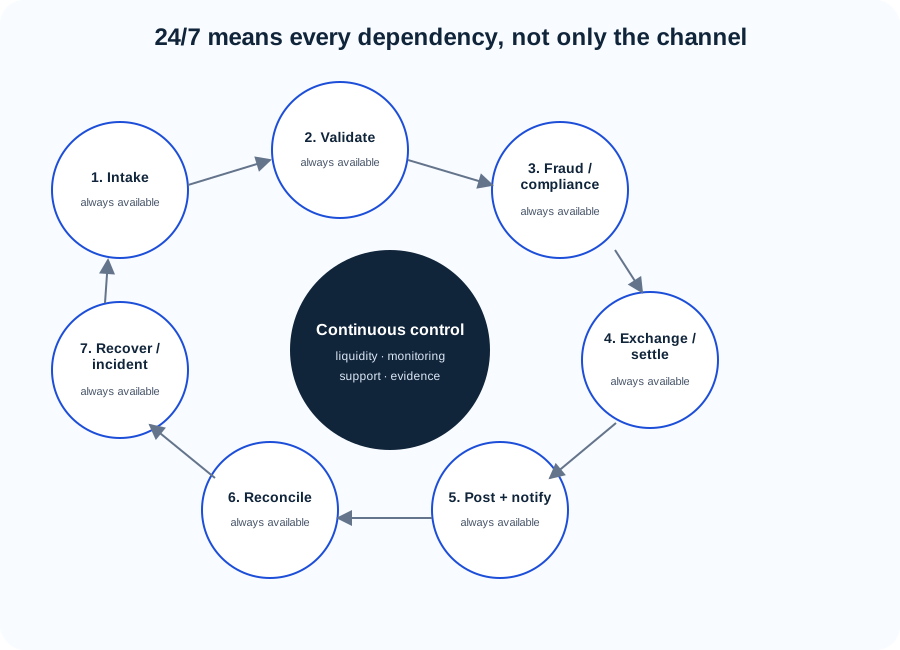
A digital transfer service that a bank markets as available outside branch hours still requires:
- online channel availability;
- account and balance service availability;
- real-time authentication;
- fraud monitoring;
- sanctions/compliance treatment where applicable;
- posting;
- notifications;
- reconciliation;
- incident response;
- customer support and fraud escalation.
If a required dependency goes offline, the bank must not describe the end-to-end service as continuously available merely because the front-end remains open.
Maintenance windows
Banks still need maintenance.
The correct design is not to pretend maintenance never occurs. It is to:
- minimize planned interruption;
- use resilient deployment patterns;
- communicate known unavailability;
- preserve in-flight transaction state;
- prevent duplicate retry;
- reconcile uncertain outcomes after recovery.
6. RTR and the move toward continuous operations
As of 2026-10-05, Canada’s Real-Time Rail is not live. Payments Canada targets launch in Q4 2026, with sequenced onboarding: initial direct-to-Exchange participants in Q4 2026, initial Interac e-Transfer clearing-and-settlement migration participants in Q1 2027, additional migration participants in Q2 2027, and full transaction volumes for the initial launch phases in Q3 2027. These are programme targets, not a current production capability.
Payments Canada describes RTR as a future real-time exchange, clearing and settlement system with data-rich payments and 24/7/365 operation. The approved RTR by-law and Rules 1–10 are now posted in the controlled rules index with an August 24, 2026 date. The operational consequence is more important than the marketing phrase “instant”; implementation must follow the current participant rules and specifications.
A continuous rail means traditional “end of day” assumptions must be redesigned.
There is still a business date
24/7 processing does not eliminate accounting dates.
The bank still needs to decide:
- which ledger day owns a transaction;
- when interest/fees are calculated;
- when statements roll;
- when daily reconciliation closes;
- how finance recognizes late-night activity;
- how treasury measures intraday and overnight liquidity.
A real-time payment at 23:59 and another at 00:01 may sit in different accounting dates while only two minutes apart operationally.
Continuous liquidity
A real-time rail moves liquidity risk into evenings, weekends and holidays.
Controls should include:
- settlement balance monitoring;
- alert thresholds;
- intraday and overnight forecasts;
- automated funding actions where supported;
- escalation coverage;
- sponsor/client limits for indirect models.
Continuous fraud and sanctions capability
A manual review team available only during office hours cannot be the default decision path for an instant product.
The bank needs:
- automated fraud scoring;
- central fraud-service integration where required;
- sanctions policy for real-time processing;
- deterministic timeout behaviour;
- controlled reject/hold decisions;
- post-event case handling.
7. Bank architecture for calendars and cutoffs
Calendar logic should be a reusable capability.
Calendar service
A central calendar service can provide:
- IsBusinessDay(date, rail, currency);
- NextBusinessDay(date, rail, currency);
- PreviousBusinessDay(...);
- IsHoliday(...);
- ProcessingDateFor(timestamp, product);
- CustomerCutoff(product, segment, channel);
- SystemWindowStatus(rail);
- CalendarVersion.
The service should be versioned and effective-dated.
Cutoff rules engine
Cutoff selection can consider:
- product;
- rail;
- channel;
- customer segment;
- currency;
- amount;
- requested execution date;
- repair requirement;
- funding model;
- time zone;
- exceptional operating notice.
The result should explain itself.
Example:
Decision: NEXT_BUSINESS_DAY
Reason: CORPORATE_AFT_CREDIT_CUTOFF_PASSED
Received: 18:42 America/Toronto
Requested date: 2026-12-24
Resolved processing date: next eligible ACSS business day
Rule version: AFT-CUTOFF-v17
The example is illustrative. It does not assert a scheme cutoff time.
Time zones
Store event timestamps in an unambiguous technical format, normally UTC plus the relevant local business context.
Display and business logic must still understand the rail’s operational time zone.
Daylight-saving transitions are especially dangerous for:
- scheduled jobs;
- duplicated clock times;
- missing clock times;
- overnight batches;
- settlement reports.
Configuration ownership
A useful ownership model is:
| Configuration | Typical owner |
|---|
| Scheme/system calendar | payments operations with rule governance |
| Customer cutoff | product + operations |
| Treasury funding cutoff | treasury |
| FX cutoff | FX/treasury product |
| Sanctions/manual-review cutoff | compliance operations |
| Accounting close | finance |
| Technical maintenance | technology/service management |
One team may administer the data, but ownership must remain explicit.
8. Accounting, liquidity and reconciliation implications
Cutoff errors often first appear as accounting breaks.
Posting date versus settlement date
The customer account may be posted:
- before external settlement under a controlled prefunding model;
- immediately on settlement;
- after settlement when a downstream posting service processes the event.
The model should be documented per product.
Suspense
Late or uncertain items may enter suspense when:
- customer debit succeeded but external submission failed;
- external settlement occurred but beneficiary posting failed;
- return arrived after the original business day closed;
- fee or FX posting failed;
- duplicate status is uncertain.
Suspense should carry:
- original payment identifier;
- amount/currency;
- business date;
- source event;
- owner;
- ageing;
- expected clearing action.
Reconciliation by business date
A mature reconciliation process does not simply compare total amount per calendar date.
It reconciles:
- accepted instructions;
- released instructions;
- external exchange/clearing evidence;
- settlement evidence;
- customer postings;
- general-ledger entries;
- returns/reversals.
Cutoffs define which population belongs in which cycle.
Liquidity forecasting
Calendar data feeds forecasts.
For AFT:
- expected payroll peaks;
- PAD collections;
- return patterns;
- net ACSS position.
For Lynx:
- high-value outgoing schedule;
- expected incoming;
- collateral and settlement balance.
For RTR:
- continuous inflows/outflows;
- weekend behaviour;
- sponsor client positions;
- automated alerts.
9. Exceptions and customer communication
The most damaging cutoff defect is often a misleading status.
Better status language
Use stages such as:
- Scheduled;
- Accepted for processing;
- Under review;
- Released;
- Settled;
- Credited;
- Returned;
- Failed.
Avoid a single “processed” status for every stage.
Cutoff passed
If a cutoff is passed, tell the customer:
- what happened;
- what date will now apply;
- whether they can cancel;
- whether urgent alternatives exist.
Do not say “system error” when the product behaved exactly as configured.
Holiday mismatch
A Canadian customer sending cross-border may encounter two calendars:
- Canadian processing calendar;
- correspondent/beneficiary currency calendar.
A payment can leave Canada but fail to achieve expected foreign value date because the destination market is closed.
Customer estimates should therefore use corridor-aware calendars.
Emergency operating changes
Lynx has emergency rules and procedures. Other services also maintain incident processes.
A bank should support temporary overrides that are:
- approved;
- time bounded;
- logged;
- communicated;
- automatically expired.
No operator should edit a production cutoff directly in a database without traceability.
10. Implementation and testing
Calendar testing should be scenario-based.
Core tests
Test:
- ordinary business day before cutoff;
- exactly at cutoff;
- one second after cutoff;
- Friday before long weekend;
- holiday Monday;
- year-end;
- leap day;
- daylight-saving start/end;
- customer requests past date;
- customer requests non-business date;
- system window extended;
- emergency closure;
- maintenance outage crossing midnight;
- duplicate retry after date rollover.
Cross-system tests
The hardest defects occur when systems disagree.
Example:
- channel says execution date Monday;
- payment hub calculates Tuesday;
- core ledger posts Monday;
- reconciliation expects Tuesday.
A good end-to-end test asserts the date in every relevant system.
Reference-data controls
Calendar changes should use:
- maker-checker approval;
- effective dating;
- version history;
- automated validation;
- pre-production simulation;
- regression testing;
- monitoring after activation.
Observability
Monitor:
- instructions received after cutoff;
- rolled payments;
- late external submissions;
- rejected files due date/calendar;
- manual overrides;
- unsettled items near closing window;
- reconciliation breaks by business date;
- customer complaints about timing.
These measures often reveal product design defects before they become incidents.
11. Practical scenarios and implementation patterns
11.1 Scenario A: payroll before a long weekend
A fictional employer, Northern Orchard Ltd., needs 2,400 employees paid on Friday before a Monday holiday.
The employer uploads the file on Wednesday.
The bank:
- validates authority and file structure;
- verifies requested date against its AFT product calendar;
- checks duplicates and funding;
- releases items into the correct AFT processing path;
- reconciles acceptance and exchange;
- monitors receiving exceptions;
- reports file and item statuses to the employer.
Two employees have closed accounts.
Those items return through the applicable AFT return process. The bank must not move the entire payroll file to “failed.” It should show the file as processed with item-level exceptions, credit the returned funds appropriately and preserve references for payroll reconciliation.
The calendar lesson is that the employer’s required payday determines the planning point. The bank should not teach customers to rely on the last technically possible exchange window.
11.2 Scenario B: wire created after customer cutoff
A customer creates a CAD wire at night.
The online channel records the instruction but clearly shows it is scheduled for the next supported processing period.
The bank does not:
- debit as if Lynx settlement already occurred;
- label it settled;
- create a false SWIFT/Lynx confirmation.
Next processing period, operations complete screening, liquidity and release. The payment then settles in Lynx. Customer status changes based on real events.
11.3 Scenario C: always-on service during ledger maintenance
A bank performs a core-ledger upgrade while an instant service remains open.
The architecture uses:
- resilient balance reservation;
- durable payment state;
- idempotent posting;
- queued ledger completion;
- reconciliation after maintenance.
If the ledger outcome is uncertain, the customer receives an honest pending/technical status rather than a duplicate retry path.
The lesson is that 24/7 is an end-to-end property, not a front-end badge.
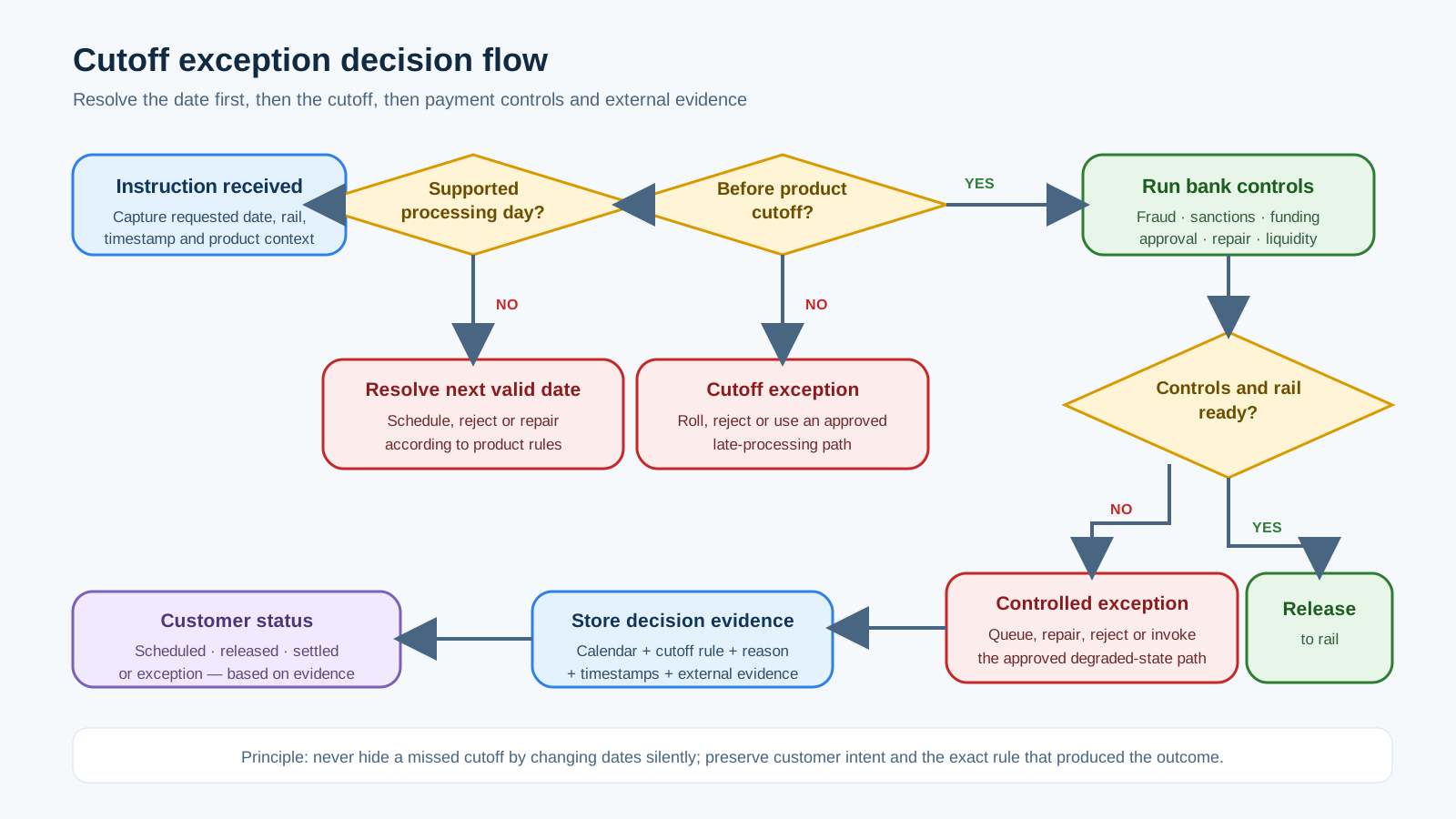
11.4 Build a rail-by-rail operating-day model
The most reliable way to design payment calendars is to stop asking whether “Canada is open” and instead ask whether a specific service, rail and processing step is available for a specific business purpose.
A bank may need separate calendar profiles for at least:
- ACSS AFT credit processing;
- ACSS AFT debit processing;
- cheque and image-clearing activity;
- USBE processing;
- Lynx high-value payments;
- Interac customer services;
- cross-border correspondent payments by currency;
- internal book transfers;
- FX settlement;
- the planned RTR service;
- finance and general-ledger close;
- treasury funding and collateral operations.
The calendar profile is not just a holiday list. It is a controlled set of operating characteristics.
A useful profile can contain:
| Attribute | Example purpose |
|---|
| Rail or service | Identifies the external or internal processing domain |
| Calendar jurisdiction | Identifies the governing business-day calendar |
| Operating-day flag | Says whether the service is normally open |
| Opening boundary | Earliest supported processing point |
| Closing boundary | Latest supported processing point |
| Customer cutoff | Product promise, not necessarily rail deadline |
| Internal release cutoff | Latest safe point after bank controls |
| Repair cutoff | Latest point for manual correction without rolling the item |
| Funding cutoff | Treasury or settlement funding boundary |
| Value-date rule | How requested dates are resolved |
| Holiday override | Exceptional opening or closure instruction |
| Time zone | Required for deterministic evaluation |
| Rule version | Makes later investigation possible |
| Effective from / to | Supports controlled change |
For existing Payments Canada systems, the published system closure schedule remains a primary operational source. As currently published, Payments Canada systems operate Monday to Friday except statutory holidays; the page lists 2026 closures, including Boxing Day observed on Monday, December 28. This supports ACSS and Lynx operating-day planning but does not provide customer-specific cutoffs. RTR is different: Payments Canada describes it as an always-on 24/7/365 service scheduled for Q4 2026, with sequenced participant onboarding. A bank therefore cannot apply one national “Payments Canada calendar” blindly across every rail.
The same design principle applies to Interac and cross-border services. An Interac customer journey may remain available outside traditional banking hours, but a downstream bank support function, correspondent currency market or separate settlement process may have its own calendar and the bank must not imply a universal Interac 24/7 promise. Product wording must reflect the actual end-to-end dependency chain.
A strong implementation treats the operating calendar as reference data with business ownership, maker-checker approval, effective dating and audit history. A weak implementation places dates in application code or lets each system maintain its own spreadsheet. The weak model usually fails first at long weekends, year-end or emergency schedule changes.
11.5 Separate payment date semantics explicitly
Many payment defects that appear to be “cutoff defects” are actually date-definition defects.
Consider these terms:
- instruction date;
- received date;
- requested execution date;
- processing date;
- exchange date;
- settlement date;
- customer value date;
- customer booking date;
- statement date;
- ledger business date;
- reconciliation date.
They may all be equal on a simple business-day transaction. They do not have to be equal.
For example, a customer may submit a future-dated payroll file on Wednesday for a Friday payday. The bank receives the file Wednesday, may validate it Wednesday, may hold it pending the configured release point, and may exchange the AFT items according to the relevant processing timetable. The customer’s required payday is Friday, but that does not make every internal event a Friday event.
A second example is a Lynx payment created after the bank’s customer cutoff. The instruction can be received and stored today while its supported release and settlement occur on the next valid system day. If the channel writes one field called PaymentDate and every downstream service interprets it differently, customer support and reconciliation will eventually disagree.
The bank should publish a data dictionary that defines every date and timestamp used in the payment domain. For each field, document:
- who sets it;
- whether the value is customer supplied or system derived;
- the time zone;
- whether it can change;
- which event makes it final;
- whether it is used for accounting;
- whether it is shown to the customer;
- whether it is sent externally;
- how it is reconciled.
The event model should also preserve the original requested value even when the bank resolves a different executable date. A useful pattern is:
- RequestedExecutionDate = what the customer asked for;
- ResolvedProcessingDate = what the product and calendar engine determined;
- ResolutionReason = why the value changed or was accepted;
- CalendarVersion = which calendar made the decision;
- CutoffRuleVersion = which cutoff rule applied.
This is especially important when a payment rolls because a cutoff was missed. Without the original request and the decision evidence, operations can see only the final date and cannot explain why it changed.
Date semantics also matter for interest, fees and customer compensation. A bank should not derive financial value dates from a generic server timestamp. The applicable product, account, rail and legal rules determine how value is assigned.
11.6 Design customer cutoffs from the end backwards
Customer cutoffs should not be copied from a rail document.
The correct design starts with the last external event that must occur safely and works backwards through the bank’s required controls.
Assume a hypothetical external processing boundary at time T. The bank may need time before T for:
- final technical submission;
- settlement liquidity or funding checks;
- sanctions disposition;
- fraud decisioning;
- repairs;
- approval;
- FX booking;
- account and entitlement validation;
- bulk-file decomposition;
- duplicate detection;
- channel acknowledgement.
The customer cutoff should leave enough time for the full controlled path under normal conditions. A premium service might have a later cutoff because it uses stronger automation, dedicated staffing or a different route. A low-touch batch product may need an earlier cutoff.
This is why a bank may have several cutoffs for the same external rail.
For a corporate AFT product, there can be:
- standard file-submission cutoff;
- same-day service cutoff if supported by the product;
- exception-repair cutoff;
- funding cutoff;
- holiday or year-end special cutoff.
For a wire product, there can be:
- channel acceptance cutoff;
- same-day FX cutoff;
- manual sanctions-review cutoff;
- repair cutoff;
- final internal release cutoff.
The customer-facing experience should translate these into clear outcomes.
Poor wording:
Processing complete.
Better wording:
Instruction received after today’s same-day cutoff. Scheduled for the next supported processing day.
Poor wording:
Payment sent.
Better wording:
Payment released to the payment system.
The bank should reserve “settled” for an event supported by settlement evidence and “credited” for beneficiary posting evidence where the bank can legitimately know it.
Cutoff configuration should also be channel independent unless the product intentionally differs. If web banking and an API offer the same payment product, they should normally call the same cutoff service. Duplicating cutoff logic in each channel creates inconsistent customer outcomes.
11.7 Long weekends and year-end are production stress scenarios
Long weekends concentrate calendar risk because normal Monday-to-Friday assumptions are interrupted while customer demand may continue.
A controlled long-weekend plan covers:
- expected file volumes before closure;
- payroll and pension dates;
- government disbursements;
- PAD collection dates;
- high-value customer deadlines;
- liquidity forecasts;
- exception staffing;
- maintenance freezes;
- customer communication;
- reconciliation cutover;
- restart sequencing.
The risk is not only that an external system is closed. The bank can create its own failure by allowing one internal component to advance the business date while another remains on the prior date.
A strong readiness review asks:
- Have all channels loaded the same holiday calendar version?
- Has the payment hub loaded it?
- Has the core ledger loaded it?
- Has treasury loaded it?
- Has reconciliation loaded it?
- Are scheduled jobs aware of the closure?
- Are future-dated queues sized correctly?
- Are customer messages correct?
- Are support teams aware of alternative urgent-payment routes?
- Have month-end and quarter-end interactions been checked?
Year-end adds accounting and reporting pressure. The last banking day of the year, the calendar year boundary and the first supported processing day of the next year can create three distinct control points.
Banks should test:
- file accepted before year-end but processed after year-end;
- payment settled on the final system day but posted internally after accounting cutover;
- return received in the new year for an original item from the prior year;
- fee or FX posting crossing year-end;
- daily reconciliation still open when finance wants to close;
- holiday schedule changes published late by an external operator.
The operating principle is simple: the bank’s calendar is not complete until every dependent function agrees on the same controlled date model.
11.8 24/7/365 changes the control model, not the need for controls
The planned RTR service makes an important distinction visible.
If RTR operates as specified, its 24/7/365 rail availability removes the traditional weekend closure for the rail, but it does not remove:
- customer authentication;
- fraud controls;
- account availability;
- settlement funding;
- operational monitoring;
- incident management;
- accounting;
- reconciliation;
- sanctions policy where applicable;
- customer support.
Payments Canada’s current RTR material states that the system is scheduled to launch in Q4 2026 and is designed for real-time exchange, clearing and settlement on a 24/7/365 basis. Its rules index lists Association By-law No. 10 and RTR Rules 1–10 with an August 24, 2026 date. The official FAQ states an initial CAD 100,000 system transaction limit at launch, while allowing participants to impose lower end-user limits. It also states that RTR fraud-mitigation services will be mandatory for participants in addition to each participant’s own controls; Payments Canada describes confirmation of payee, a real-time safety score, a risk list and a fraud-intelligence platform as the planned centralized controls.
Those are system-level design facts. They do not mean every bank product will have the same customer limit or identical operating policy.
A bank may set:
- lower customer limits;
- segment-specific limits;
- velocity limits;
- risk-based limits;
- channel limits;
- new-beneficiary controls;
- nighttime thresholds;
- manual review policies.
The challenge is to avoid reintroducing a hidden business-day dependency into an always-on product.
Examples of hidden dependencies include:
- fraud model batch refresh available only once per day;
- account service unavailable during nightly maintenance;
- sanctions list deployment requiring manual restart;
- customer limit service reset tied to local midnight without resilience;
- reconciliation that cannot ingest weekend activity;
- treasury alerts staffed only during weekday office hours;
- certificate rotation performed with a full outage.
The operational objective is not “no maintenance ever.” It is controlled resilience so maintenance and failure do not create ambiguous transaction outcomes.
A mature 24/7 design distinguishes:
- service availability;
- payment acceptance availability;
- settlement availability;
- support availability;
- maintenance mode;
- degraded mode;
- participant unavailable mode;
- fraud-service unavailable mode.
Each state should have a predefined customer and system response.
11.9 Treasury and liquidity need the same calendar truth
Payment calendars are often treated as an operations topic, but treasury is a direct consumer.
For Lynx, the bank needs liquidity and collateral arrangements during the processing cycle. For batch systems, treasury needs to understand expected net settlement positions. For a future always-on real-time rail, liquidity monitoring extends across nights, weekends and holidays.
Calendar information should therefore feed:
- projected outgoing payments;
- projected incoming payments;
- settlement-account balances;
- intraday liquidity dashboards;
- collateral utilization;
- prefunding requirements;
- sponsor or indirect-participant positions;
- threshold alerts.
A useful treasury handoff does not say only “payments are high today.” It explains which payment populations will become settlement obligations and when.
For example:
| Population | Treasury question |
|---|
| AFT payroll files | Which business date will create the settlement effect? |
| Large Lynx payments | How much liquidity is required before release? |
| Cross-border wires | Which currency value dates and correspondent calendars apply? |
| RTR payments | What continuous settlement balance is required through weekend periods? |
| Returns | When will returned value re-enter the settlement position? |
Treasury and payment operations should also share incident playbooks.
If liquidity falls below a threshold, the response might include:
- alert treasury;
- classify the condition;
- prioritize critical payments according to policy;
- obtain or move liquidity where permitted;
- avoid uncontrolled release;
- communicate operational impact;
- preserve queued payment evidence;
- reconcile after recovery.
The queue, liquidity and cutoff models must agree. A system that accepts customers until a published cutoff but routinely cannot fund the corresponding external release has a product-design problem, not just a treasury problem.
11.10 Reconciliation must be calendar aware
Reconciliation is where date-model mistakes become visible.
Suppose the channel counts 10,000 payments as “today,” the payment hub moves 9,700 of them to the next business date because a cutoff passed, and the external rail accepts 9,650 after another 50 enter repair.
A simple total-by-calendar-date reconciliation will report a break even though the systems may be behaving correctly.
The reconciliation model should use business-event populations.
A useful hierarchy is:
- received;
- accepted;
- scheduled;
- released;
- externally accepted;
- cleared or exchanged;
- settled;
- posted;
- reported;
- returned or reversed.
Each event should carry the relevant business date and identifier.
For a rolled payment, reconciliation should be able to show:
- instruction received on Day 1;
- same-day cutoff failed;
- ResolvedProcessingDate = Day 2;
- external release on Day 2;
- settlement on Day 2;
- customer statement treatment according to product rules.
The bank should maintain a reconciliation bridge rather than forcing all events into one date.
A strong exception record includes:
- payment identifier;
- original customer reference;
- amount and currency;
- rail;
- source system;
- source event;
- event timestamp;
- business date;
- settlement date where known;
- expected matching event;
- ageing;
- owner;
- reason;
- action history.
Weekend and holiday reconciliation needs explicit treatment. A 24/7 rail can generate external activity while finance or some internal control processes still use scheduled accounting cutovers. Reconciliation must continue to ingest, store and match activity even when a formal daily close occurs.
11.11 Investigation playbook for timing disputes
A customer timing complaint should be investigated using evidence, not assumptions.
Question: “Why did my payment arrive a day late?”
The investigator should determine:
- When did the customer submit it?
- Which channel accepted it?
- What execution date did the customer request?
- Which cutoff rule applied?
- Which calendar version applied?
- Did the bank change the processing date?
- Was the item held for approval, fraud, sanctions, repair or funding?
- When was it externally released?
- What did the external system report?
- When did settlement occur?
- When did beneficiary posting occur?
- Was the customer message accurate?
That sequence separates three very different outcomes:
Expected rollover
The customer submitted after the published product cutoff and the bank correctly scheduled the next supported day.
Operational delay
The payment should have met the supported date but an internal defect or manual delay prevented release.
External or receiving-side delay
The bank released correctly, but a downstream participant, correspondent or beneficiary-posting process affected final availability.
The evidence pack should include the rule version. Without it, an investigation six months later may use the current cutoff to judge a payment that was processed under an older cutoff.
This is why effective dating and audit history are mandatory design features for the calendar service.
11.12 Business analyst requirement set
For implementation, the business analyst should turn calendar concepts into testable requirements.
Examples:
Calendar resolution
The payment orchestration service shall determine whether the requested execution date is a supported processing day for the selected product and rail using an effective-dated centrally governed calendar.
Cutoff decision
The service shall evaluate the customer instruction timestamp against the applicable product cutoff in the configured business time zone and return the resulting processing date and decision reason.
Evidence
The payment record shall store the calendar version and cutoff-rule version used to make the decision.
Customer communication
When the requested same-day processing date cannot be supported because the applicable cutoff has passed, the channel shall display the resolved processing date before final authorization where the customer journey permits.
Override
Any emergency override to a production calendar or cutoff shall require authorized approval, effective start and end timestamps, a reason, and a complete audit record.
Failure handling
If the calendar service is unavailable, the payment service shall use the approved failure policy for the product and shall not assume that the current calendar day is a valid processing day.
24/7 service
A service marketed as continuously available shall not depend on a scheduled nightly outage in any component required for payment acceptance and deterministic outcome handling.
Reconciliation
Reconciliation shall group and match events using the relevant processing and settlement dates rather than only the channel receipt date.
These requirements are much stronger than “system should support holidays.”
11.13 Test catalogue for calendars and cutoffs
A production-grade test pack should include ordinary and adversarial cases.
Boundary testing
Test the exact cutoff boundary:
- one second before;
- exactly at;
- one second after.
The specification must define whether the boundary is inclusive or exclusive.
Time-zone testing
Test:
- customer in a different Canadian time zone;
- data centre using UTC;
- rail using a defined local operating time;
- daylight-saving transition;
- duplicated local time during autumn clock change;
- non-existent local time during spring clock change.
Holiday testing
Test:
- ordinary federal system closure;
- weekend adjacent to holiday;
- year-end holiday sequence;
- holiday override;
- cross-border corridor where Canada is open but destination currency market is closed;
- destination open while Canadian system is closed.
Queue testing
Test:
- payment enters queue before cutoff and leaves after cutoff;
- manual repair crosses the boundary;
- fraud review crosses the boundary;
- funding approval crosses the boundary;
- retry after technical failure crosses midnight;
- restart after outage on the next business date.
Bulk-file testing
Test:
- whole file valid;
- one item invalid;
- partial rejection;
- late file;
- duplicate file;
- duplicate item;
- file with future-dated and same-day items if the product supports mixed dating;
- file spanning a holiday boundary.
Continuous-service testing
For an always-on design, test:
- Saturday afternoon;
- Sunday night;
- statutory holiday;
- midnight date rollover;
- accounting-day close while payments continue;
- participant unavailable;
- fraud-service degradation;
- settlement-service restart;
- duplicate customer retry during uncertain outcome.
The expected result should be defined before execution. “System did not crash” is not a sufficient test result.
11.14 Control matrix for production ownership
A production service needs named owners for each decision.
| Control | Primary owner | Evidence |
|---|
| External system calendar | Payment operations / scheme governance | Published operator schedule and approved configuration |
| Customer cutoff | Product with operations | Product approval and configured rule |
| Treasury funding boundary | Treasury | Funding procedure and alert thresholds |
| FX cutoff | FX product / treasury | Currency calendar and product rules |
| Sanctions review boundary | Compliance operations | Approved operating procedure |
| Fraud service availability | Fraud operations / technology | Monitoring and incident evidence |
| Accounting close | Finance | Close schedule and ledger controls |
| Emergency override | Authorized incident governance | Approval, timestamps and audit log |
| Calendar deployment | Technology/reference-data team | Change record and validation result |
| Customer wording | Product / legal / operations as applicable | Approved content and version |
Ownership should not be confused with administration. A technology team may load a holiday file, but it should not decide whether a system closure date is correct. The authoritative business owner must approve that data.
Metrics should also be owned.
Useful metrics include:
- percentage of payments rolled due to cutoff;
- number of late-file exceptions;
- number of manual calendar overrides;
- percentage of cutoff decisions using current configuration version;
- reconciliation breaks caused by date mismatch;
- customer complaints about timing;
- payments released within a defined interval of external closing boundary;
- weekend/holiday incident count;
- calendar-service availability;
- continuous-service dependency availability.
These metrics help distinguish healthy customer behaviour from poor product design.
11.15 Integrated case study: one Friday, four payment products
A fictional corporate customer, Maple Works Inc., initiates four payments on the Friday before a statutory holiday Monday.
Payment A: AFT payroll
The company uploads payroll during the supported submission period for the required pay date.
The bank validates:
- file identity;
- originator entitlement;
- funding;
- item structure;
- duplicates;
- processing date.
The payment hub uses the AFT calendar and applicable rule version. The file is released according to the supported batch timetable. Reconciliation links file acceptance, item release, external clearing evidence, settlement and employee posting outcomes.
Payment B: domestic high-value wire
The company submits a large CAD wire before the bank’s customer cutoff.
The bank performs:
- authorization;
- fraud controls;
- sanctions screening;
- beneficiary validation;
- liquidity checks;
- release.
The payment is transmitted through the supported Lynx processing cycle and receives settlement evidence. The bank can then report a settled status based on evidence, not merely because a message was sent.
Payment C: late wire
A second wire is created after the bank’s supported same-day customer cutoff.
The channel accepts the instruction only if the product supports scheduling. It clearly shows the next supported processing date. The bank preserves:
- received timestamp;
- requested date;
- resolved date;
- cutoff reason;
- calendar version.
The instruction is not labelled settled or sent during the closed period.
Payment D: future RTR product
After RTR launch, a comparable real-time payment product would not use the Lynx or ACSS weekend closure model. The rail is designed for continuous operation. The bank would instead evaluate:
- RTR product availability;
- customer limit;
- participant reachability;
- fraud controls;
- account availability;
- settlement funding;
- technical state.
If accepted and successfully settled, the payment could complete during the weekend. If a required dependency is degraded, the product follows the approved real-time failure policy rather than silently moving the payment to Tuesday as if it were a batch item.
The case study shows why the same customer and same calendar date can produce different valid outcomes. The rail and product determine the operating model.
11.16 Practitioner checklist before go-live
Before a new payment product or material calendar change goes live, confirm:
Reference data
- authoritative source identified;
- calendar complete;
- cutoff rule effective-dated;
- time zone explicit;
- holiday overrides controlled;
- configuration version stored.
Customer
- same-day promise accurate;
- next processing date visible;
- scheduled versus sent status clear;
- holiday wording tested;
- cancellation options correctly described.
Processing
- channel, payment hub and ledger agree;
- repair behaviour defined;
- late file behaviour defined;
- duplicate handling survives date rollover;
- external submission boundary understood.
Treasury
- funding dependency documented;
- liquidity alerts active;
- weekend/holiday coverage defined where needed;
- escalation route tested.
Risk and compliance
- fraud service operating hours match product;
- sanctions policy matches product;
- manual review dependency understood;
- timeout and degraded-state behaviour approved.
Accounting and reconciliation
- booking date defined;
- value date defined;
- settlement date captured;
- reconciliation business date defined;
- open items survive close;
- returns link to originals across date boundaries.
Operations
- runbook complete;
- support teams trained;
- monitoring active;
- emergency override process tested;
- year-end and long-weekend scenarios tested.
Evidence
- decision reason stored;
- external acceptance stored;
- settlement evidence stored;
- configuration version stored;
- customer notification stored where applicable.
When these controls are implemented together, the calendar stops being a static list of holidays and becomes what it should be: a governed operating capability connecting customer promise to safe payment execution.
11.17 Reference architecture and acceptance criteria
A bank-grade implementation usually works best when calendar and cutoff decisions are separated from individual channel code.
A practical architecture can contain these logical components:
- Channel adapter — captures customer instruction time, requested date, product, channel and customer context.
- Payment orchestration service — determines which payment product and rail are being used and requests a calendar decision.
- Calendar service — answers whether a date is operationally valid and resolves the next or previous supported processing day.
- Cutoff service or rules engine — evaluates the instruction timestamp against product and operational boundaries.
- Reference-data store — holds effective-dated calendars, holiday exceptions, time zones and approved overrides.
- Rail adapter — applies external submission-window logic and translates the bank’s internal state into the rail-specific submission process.
- Treasury/liquidity service — supplies the funding or liquidity status needed before release where applicable.
- Risk services — provide fraud, sanctions and other decision outcomes.
- Accounting service — derives the relevant posting and ledger treatment from actual payment events.
- Reconciliation service — matches internal events to clearing, network, settlement and posting evidence.
The design should return more than a yes/no answer. A useful calendar decision response contains:
| Field | Why it matters |
|---|
| RequestedProcessingDate | Preserves customer intent |
| ResolvedProcessingDate | Gives the executable date |
| IsBusinessDay | Explains calendar eligibility |
| CutoffStatus | Shows before, at or after applicable boundary |
| Decision | Same day, schedule, reject, repair or other approved outcome |
| DecisionReason | Supports customer service and investigation |
| CalendarId | Identifies the governing calendar |
| CalendarVersion | Reconstructs historical decisions |
| CutoffRuleId | Identifies the product rule |
| EvaluatedTimeZone | Prevents time-zone ambiguity |
| EvaluationTimestamp | Provides audit evidence |
| OverrideId | Links emergency exceptions where used |
The orchestration service should store this response with the payment. It should not call the calendar service later and assume the answer will still be the same. A calendar may be corrected after an incident; the historical payment still needs evidence of the rule that was actually used.
Failure modes and safe behaviour
Calendar capability is critical infrastructure. The bank needs a defined policy for failure.
If the calendar service is unavailable, possible product responses include:
- fail closed and reject new same-day instructions;
- accept as scheduled pending resolution;
- use a locally cached signed configuration for a controlled period;
- route to manual operations for a narrowly defined product.
The correct choice depends on the product. What should not happen is an undocumented fallback to “today is a business day” or “use yesterday’s cutoff.”
Cached configuration must have:
- version;
- integrity validation;
- expiry;
- last successful refresh time;
- monitoring;
- alert thresholds.
Emergency changes must also be controlled. If Payments Canada or another external operator publishes an exceptional schedule change, the bank should be able to deploy an override quickly without bypassing governance.
An emergency override record should include:
- affected rail or product;
- start time;
- end time;
- new operating status or cutoff;
- source of instruction;
- approver;
- implementation timestamp;
- systems updated;
- customer communication requirement;
- rollback or expiry rule.
Non-functional expectations
Calendar decisions are frequently in the synchronous payment path, so non-functional requirements matter.
The service should be designed for:
- high availability;
- deterministic low latency;
- horizontal scalability;
- read-heavy workloads;
- resilient caching;
- strong configuration consistency;
- complete auditability;
- observability by product and rail.
For bulk files, the service should avoid a separate external lookup for every item if the same rail, processing date and cutoff context can be safely evaluated once at file level. Item-level exceptions can then be evaluated separately when needed.
For always-on services, deployment patterns should prevent the calendar service itself becoming a nightly outage dependency.
Acceptance criteria for Chapter 66 capabilities
A delivery team should be able to demonstrate the following before production approval:
AC1 — valid business day
Given a supported processing day and an instruction before the product cutoff, the service returns the requested date as the resolved date and records the active rule version.
AC2 — cutoff passed
Given an instruction after the same-day cutoff, the service returns the next supported processing date or the configured rejection outcome and provides a machine-readable reason.
AC3 — statutory holiday
Given a requested date that is closed for the selected rail, the service resolves the next supported date according to product rules without modifying the original requested date field.
AC4 — rail difference
Given the same timestamp for two products using different operating models, the service can return different valid outcomes. For example, a closed batch rail and a continuous real-time rail must not be forced into the same calendar result.
AC5 — time-zone boundary
Given an instruction around midnight or daylight-saving transition, the decision uses the configured business time zone rather than the application server’s local clock.
AC6 — emergency override
Given an approved temporary override, the service applies it only during its effective window and stores the override identifier with affected payment decisions.
AC7 — historical reconstruction
Given a payment from a prior calendar version, operations can retrieve the exact calendar and cutoff rule used at the time.
AC8 — customer consistency
Given the same product instruction through web and API channels, both channels receive the same resolved processing date unless an approved channel-specific rule exists.
AC9 — reconciliation consistency
Given a payment rolled to the next processing day, downstream reconciliation can distinguish receipt date from processing and settlement dates and does not create a false break solely because the dates differ.
AC10 — degraded state
Given loss of the central calendar service, the product follows its documented fallback policy, raises monitoring alerts and never silently assumes an operating day.
These criteria make the subject testable. They connect the chapter’s operational ideas to real delivery work for architects, business analysts, developers, testers, operations, treasury and support teams.
12. Key takeaways and authoritative references
Cutoffs are not merely times on a webpage. They connect customer promise, bank readiness, rail availability, settlement, liquidity, accounting and support.
The most important operating principles are:
- never use one timestamp to represent the entire payment lifecycle;
- maintain authoritative calendars as governed reference data;
- separate customer, bank, rail and settlement cutoffs;
- do not publish system-level times as universal customer cutoffs;
- treat 24/7 payments as a continuous operational model;
- make calendar decisions explainable and versioned;
- use event evidence to drive customer status;
- test holidays, midnight, daylight-saving and emergency overrides as seriously as ordinary days.
Authoritative references
- Payments Canada — Rules and documentation (ACSS and Lynx updates effective July 27, 2026; RTR rules index dated August 24, 2026): https://www.payments.ca/systems-services/rules-documentation
- Payments Canada — ACSS Rule F1 (Rules applicable to AFT transactions): https://www.payments.ca/sites/default/files/f1eng.pdf
- Payments Canada — ACSS Rule F4 (AFT transactions using ISO 20022 messages): https://www.payments.ca/sites/default/files/f4eng.pdf
- Payments Canada — Lynx Rule 4 (Commencement), Rule 9 (End of payments processing cycle), Rule 10 (Finality and return), and Rule 12 (Emergencies): https://www.payments.ca/systems-services/rules-documentation?field_rules_type=2&page=1
- Payments Canada — System closure schedule: https://www.payments.ca/system-closure-schedule
- Payments Canada — RTR testing and launch (sequenced onboarding targets and testing phases): https://www.payments.ca/systems-services/payment-systems/real-time-rail-payment-system/testing-and-launch
- Payments Canada — RTR frequently asked questions (CAD 100,000 launch system limit, 24/7/365 design and mandatory fraud services): https://www.payments.ca/systems-services/payment-systems/real-time-rail-payment-system/frequently-asked-questions
- Payments Canada — High-value payment system, Lynx (RTGS, finality, participants, settlement accounts and Monday–Friday system operation): https://www.payments.ca/systems-services/payment-systems/high-value-payment-system-lynx
- Payments Canada — Lynx ISO 20022 specifications and message resources: https://www.payments.ca/payment-resources/iso-20022/high-value-payment-system-lynx
- Payments Canada — Automated Clearing Settlement System (ACSS) statistics (2025 annual data, published January 20, 2026): https://www.payments.ca/automated-clearing-settlement-system-acss-statistics
- Payments Canada — High-value payment system - Lynx statistics (published June 9, 2026): https://www.payments.ca/high-value-payment-system-lynx-statistics
- Payments Canada — Real-Time Rail payment system (Q4 2026 target; real-time exchange, clearing and settlement): https://www.payments.ca/systems-services/payment-systems/real-time-rail-payment-system
- Payments Canada — RTR access and participant eligibility: https://www.payments.ca/systems-services/payment-systems/real-time-rail-payment-system/access
- Bank of Canada — Payment systems the Bank of Canada oversees (Lynx, ACSS and Interac e-Transfer roles and direct/indirect participation): https://www.bankofcanada.ca/regulatory-oversight/financial-market-infrastructures/payment-systems-the-bank-of-canada-oversees/
- Bank of Canada — Retail payments supervision and RPAA resources: https://www.bankofcanada.ca/regulatory-oversight/retail-payments/
- Interac — Interac e-Transfer help (notifications, existing payment networks, Autodeposit and FI participation): https://www.interac.ca/en/interac-e-transfer-help/
- Payments Canada — RTR fraud services (planned centralized confirmation-of-payee, safety-score, risk-list and intelligence services): https://www.payments.ca/systems-services/payment-systems/real-time-rail-payment-system/fraud-services
- Bank of Canada — Settlement account policies for Lynx, ACSS and planned RTR (central-bank-money settlement and direct-participant requirements): https://www.bankofcanada.ca/core-functions/financial-system/bank-canadas-settlement-account-policies-for-payments-canada-payment-systems/
- Justice Canada — Retail Payment Activities Act (current to September 21, 2026): https://laws-lois.justice.gc.ca/eng/acts/R-7.36/
- Payments Canada — ACSS rule-change announcement (July 27, 2026 amendments to Rules F1/F4 and Standard 007): https://www.payments.ca/acss-rule-changes-enhance-payment-system-processes
This application uses JavaScript for the full interactive experience. This text summary is served for accessibility and search indexing.