Correspondent Banking and Intermediaries. Understand correspondent accounts, intermediary routing, serial and cover concepts and operational responsibilities.
Block 11 · Chapter 53 of 75
Correspondent banking is the account-and-service network that lets one bank provide payment reach in a currency or jurisdiction where another bank does not directly operate. It is the quiet infrastructure behind a large share of international commerce. A Canadian bank does not need to own a branch, central-bank account or payment-system membership in every country to serve its customers. Instead, it can hold accounts with selected correspondents, send payment instructions through standardized messaging, and use those correspondents to settle value and reach beneficiary institutions.
That model creates enormous reach, but it also creates dependency. A correspondent relationship is simultaneously a payment route, a liquidity location, a financial-crime risk relationship, an operational service and a source of external accounting evidence. Every additional intermediary can add cost, delay, screening, data transformation and investigation complexity. Banks therefore need to understand correspondence not as a list of BICs but as a governed portfolio of accounts, permissions, services, currencies, cutoffs, controls and obligations.
Payments Canada says that nearly all cross-border payments leverage correspondent-banking relationships and uses a Canadian-bank nostro example: a Canadian bank can hold a foreign-currency account with another bank and instruct payments against that account. CPMI describes correspondent banking as an essential component of the global payment system because it gives banks access to services in jurisdictions and payment systems they cannot reach directly. FATF Recommendation 13 adds the relationship-level AML/CFT baseline for cross-border correspondent banking, while the Wolfsberg Group’s Correspondent Banking Due Diligence Questionnaire provides widely used industry structure for gathering financial-crime-control information. Payments Canada’s current explainer is the Canadian source for the flow described here.
This chapter turns those ideas into a bank operating model. It explains nostro/vostro accounts, direct and indirect correspondent routes, intermediary banks, serial and cover payment structures, nested relationships, payable-through-account risk, account funding and intraday liquidity, fees, sanctions and due diligence, transaction monitoring, payment investigations, statement reconciliation, service governance, resilience and testing. It also keeps one key principle visible throughout: Swift messaging can tell another bank what to do; the correspondent account relationship is where the financial claim between the banks is held and settled.
Canada status note (checked 5 October 2026). The Real-Time Rail (RTR) is not a production replacement for a foreign-currency correspondent route at the date of this chapter. Payments Canada currently describes RTR as launching in Q4 2026, with testing and sequenced participant onboarding still underway. RTR’s planned exchange, clearing and settlement model, including direct and indirect settlement participation, is therefore a modernization context—not evidence that a correspondent payment can use RTR today. RTR also does not remove the need for foreign-currency nostro/liquidity arrangements. See Payments Canada’s RTR system page, testing and launch page, and RTR access page.
What you should be able to do after this chapter
After working through this chapter, you should be able to:
- explain why correspondent banking exists and why it remains central to cross-border payments;
- define nostro and vostro from each bank’s perspective without treating them as two separate accounts;
- distinguish a respondent bank from a correspondent bank;
- map direct, intermediary and multi-hop correspondent routes;
- explain nested correspondent access and why it changes risk visibility;
- describe payable-through-account risk at a functional level;
- distinguish serial and cover payment structures;
- explain why a pacs.009 COV carries underlying customer-transfer information;
- connect correspondent routing to currency, account ownership, local clearing access and beneficiary reachability;
- describe how treasury funds a nostro and manages cutoff/intraday liquidity;
- explain correspondent-bank fees and how they affect customer pricing and beneficiary amount;
- describe FATF Recommendation 13-style due diligence and the role of Wolfsberg CBDDQ information;
- distinguish correspondent-relationship due diligence from transaction-level payment screening;
- trace queries, repairs, returns, recalls and investigations across multiple banks;
- reconcile expected payments to nostro statements and identify unmatched/duplicate/fee entries;
- design governance, service-level monitoring and contingency arrangements for correspondent relationships;
- write bank-grade requirements and test cases for correspondent routing and reconciliation.
For a roughly 60-minute core session, spend 10 minutes on Sections 1–2 with the network/account diagram, 15 minutes on Sections 3–4 with intermediary and serial/cover flows, 10 minutes on Sections 5–6 with routing/liquidity, 10 minutes on Sections 7–9, 10 minutes on practical examples and 5 minutes on references.
Chapter navigator
- Why correspondent banking exists
- Nostro, vostro, respondent and correspondent relationships
- Direct, intermediary, nested and payable-through models
- Serial and cover settlement mechanics
- Route selection, fees and service design
- Nostro liquidity, cutoffs and treasury controls
- Due diligence, sanctions, AML and transaction monitoring
- Exceptions, enquiries, returns and investigations
- Accounting, statements and nostro reconciliation
- Governance, implementation, testing and resilience
- Practical correspondent-banking examples
- Key takeaways and authoritative references
Example and rule convention. Bank A/B/C/D, customer names, amounts, dates and route choices are fictional illustrations, not Canadian tariffs, limits, cutoffs or service commitments. Statements labeled as Canadian statutory requirements, Payments Canada rules or standards, or Swift CBPR+ market practice are normative only to the extent of the cited source. Controls described as a bank implementation, operating model or test are illustrative and must be mapped to the bank’s contracts, policies, technology and regulator expectations.
1. Why correspondent banking exists
A bank can serve domestic customers because it has accounts, infrastructure and payment-system access in its home market. Cross-border banking breaks that assumption. A Canadian bank may not have direct membership in the U.S., euro-area, U.K., Japanese or other local payment systems. It may not have central-bank accounts in those jurisdictions. Yet its customers still need to send and receive those currencies.
Correspondent banking solves the access problem.
Bank A in Canada opens an account with Bank B in the United States. Bank B provides USD payment services to Bank A. Bank A can now offer USD cross-border payment services without becoming a U.S. deposit-taking bank or direct participant in every U.S. payment system.
The relationship can support:
- customer payments;
- FI-to-FI transfers;
- trade finance;
- cash management;
- securities-related cash;
- FX settlement;
- cheque/collection services;
- account reporting;
- liquidity.
The exact service set is contractual.
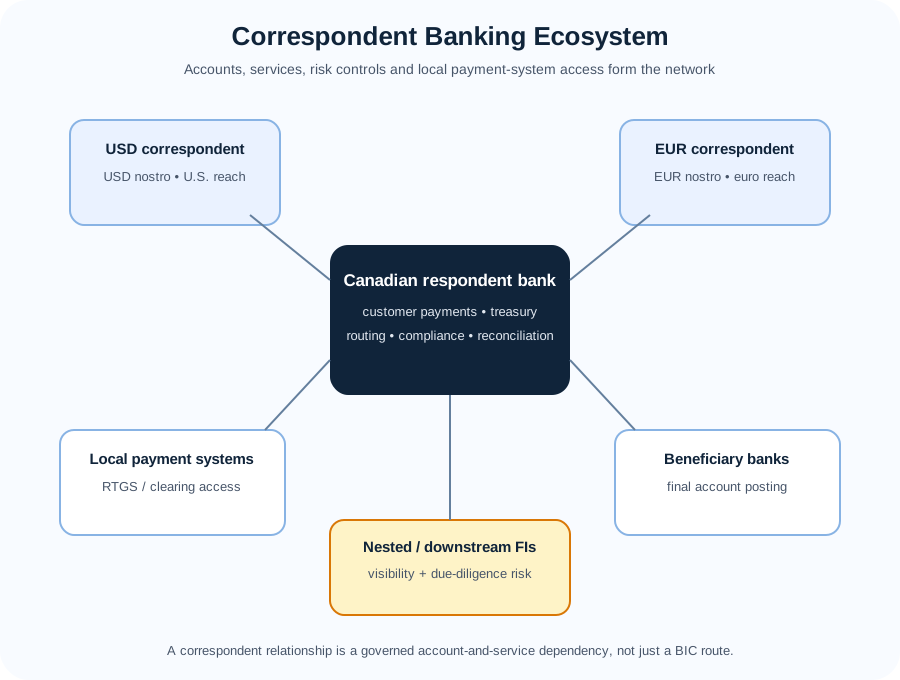
Reach without universal membership
Correspondent banking is a network solution.
No bank has direct bilateral accounts with every other bank. A payment reaches distant institutions because correspondents themselves have relationships and local system access.
This creates a graph:
Bank A → Correspondent B → Bank C
or
Bank A → B → C → D.
The payment hub’s job is to choose an approved path through that graph.
Why correspondence is still needed in an ISO 20022 world
ISO 20022 standardizes data. It does not provide the account balance needed to settle USD, EUR or another currency.
Swift provides secure messaging. It does not replace the nostro.
A correspondent remains necessary whenever the sending bank relies on another institution for:
- account holding;
- currency liquidity;
- domestic payment-system access;
- beneficiary-bank reach.
New settlement models may change some routes over time, but correspondent banking remains central today.
Commercial and risk relationship
Correspondence is not only technology.
The banks negotiate:
- account;
- currencies;
- services;
- fees;
- credit;
- overdraft;
- cutoffs;
- statements;
- liability;
- compliance responsibilities;
- termination.
The correspondent also decides whether the respondent’s AML/CFT controls are acceptable.
That is why onboarding a correspondent can take much longer than configuring a network address.
2. Nostro, vostro, respondent and correspondent relationships
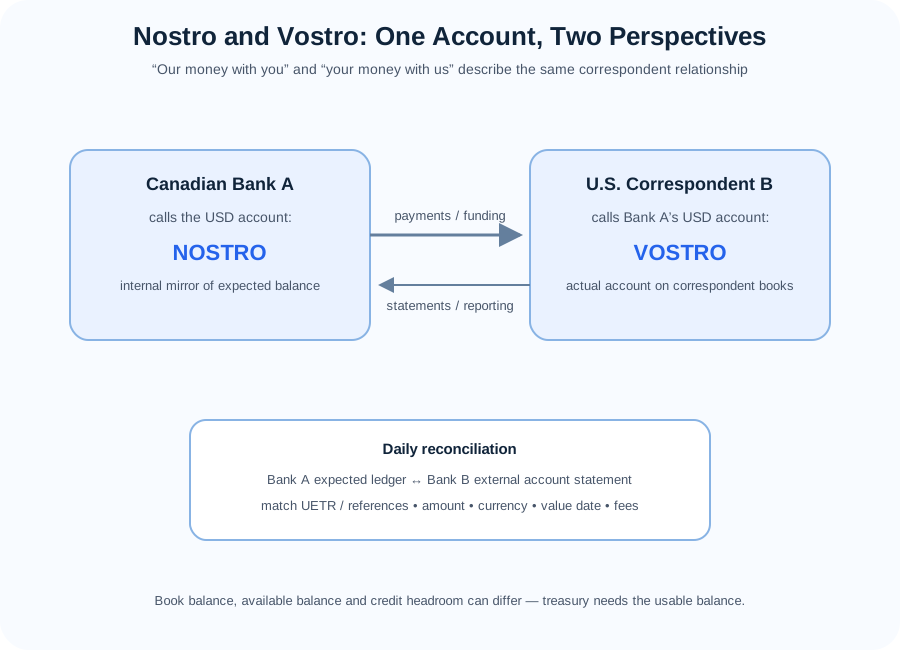
Nostro
From Bank A’s perspective:
Our USD account at Bank B.
Bank A calls it its nostro.
The nostro is an asset/account balance in Bank A’s accounting model because Bank B owes those funds to A, subject to the account agreement.
Vostro
From Bank B’s perspective, the same account is:
Your account with us.
Bank B calls it a vostro.
There is one underlying account relationship viewed from opposite sides.
Respondent bank
The bank receiving correspondent services is commonly the respondent.
Bank A is respondent when it holds the account and uses Bank B’s payment services.
Correspondent bank
Bank B is correspondent because it holds the account and executes services for A.
A large global bank can be correspondent in one relationship and respondent in another.
Account currency
The nostro is usually associated with a specific currency.
A Canadian bank may maintain:
- USD account in New York;
- EUR account with euro correspondent;
- GBP account in London;
- JPY account in Japan.
Treasury monitors each separately.
Mirror accounts
Bank A normally maintains an internal mirror or nostro ledger representing what it believes Bank B owes it.
Bank B maintains the actual account statement.
Reconciliation compares:
Bank A internal expected ledger
to
Bank B external statement.
A mismatch is a nostro break.
Available balance versus book balance
Correspondent services may expose:
- booked balance;
- available balance;
- intraday credit;
- pending entries.
Treasury needs to understand which balance controls payment release.
A book balance of USD 10 million does not necessarily mean USD 10 million is available if holds, value dates or credit limits apply.
3. Direct, intermediary, nested and payable-through models
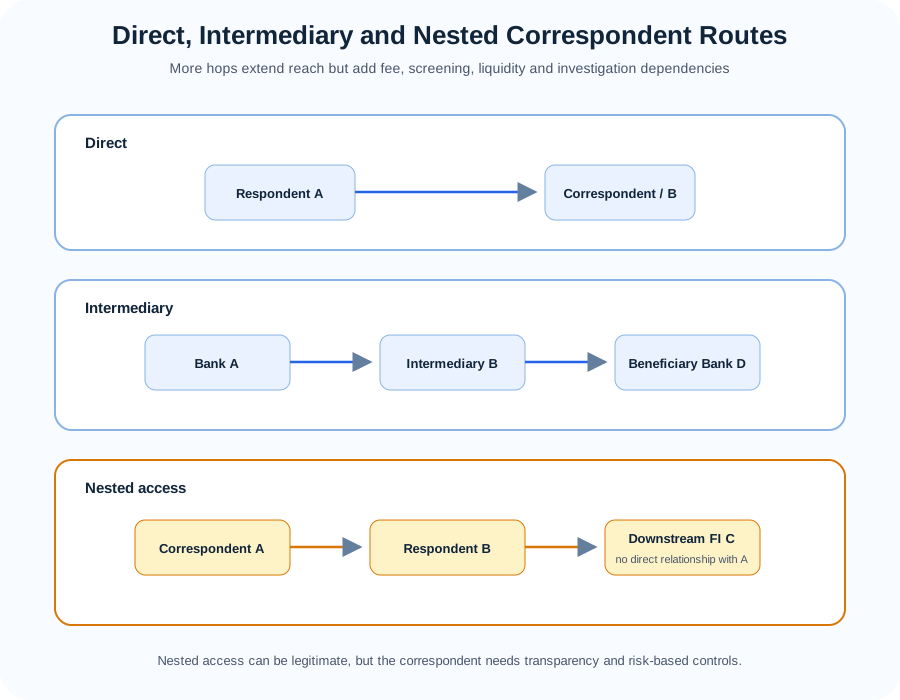
Direct correspondent payment
Bank A has a direct relationship with beneficiary Bank B.
If A holds the required account and B can credit the beneficiary, the route is simple.
Customer → Bank A → Bank B → Beneficiary.
Fewer institutions often means:
- lower cost;
- less screening duplication;
- faster processing;
- easier investigation.
Intermediary route
Bank A has no direct relationship with beneficiary Bank D.
It routes through B and C.
Customer → A → B → C → D → Beneficiary.
Each bank performs its own controls.
The route can be necessary because:
- B has local clearing access;
- C has relationship with D;
- currency settlement requires C;
- product arrangement specifies intermediaries.
Nested correspondent banking
A nested relationship exists where a respondent bank uses its correspondent account to provide access/payment services to other financial institutions that do not themselves have a direct relationship with the correspondent.
Example:
Correspondent A services Respondent B.
B services smaller Bank C.
C’s payments flow through B’s account at A.
A may see C in payment data but does not have a direct customer relationship with C.
This can be legitimate, but risk visibility changes.
The correspondent must understand the nature and extent of nested use according to its risk-based framework.
Downstream correspondents
Banks sometimes distinguish known downstream institutions using the respondent.
Controls can include:
- allowed institution list;
- geography;
- volumes;
- transaction monitoring;
- enhanced due diligence.
A bank should not discover nested FI activity only from a sanctions alert.
Payable-through accounts
A payable-through arrangement can permit customers of a respondent to transact more directly through the correspondent account.
This increases risk because the correspondent may be exposed to underlying customers without a conventional direct customer relationship.
FATF Recommendation 13 includes specific expectations around payable-through accounts, including confidence that the respondent has performed customer due diligence and can provide information when requested.
Banks should avoid using “payable-through” as a generic synonym for all correspondent payments.
Shell-bank risk
Correspondent due diligence must address shell-bank restrictions.
A bank should not establish or continue prohibited correspondent relationships with shell banks and should have controls to avoid its accounts being used by shell banks through respondents, in line with applicable law and policy.
Relationship maps
Correspondent-risk systems should map:
- direct correspondents;
- respondent institutions;
- nested access;
- ownership/group;
- countries;
- services;
- currencies.
The payment engine and AML teams should use consistent relationship data.
4. Serial and cover settlement mechanics
Serial method
In a serial correspondent payment, the customer credit-transfer instruction travels through the chain of banks.
Bank A instructs Bank B.
B instructs C.
C instructs beneficiary Bank D.
Each bank updates its correspondent account relationships.
The settlement path and information path largely follow the same chain.
Accounting intuition
Assume A holds USD nostro at B.
When A sends USD 100,000:
Bank A:
- customer debited/funded;
- nostro receivable at B reduces.
Bank B:
- A’s vostro reduces;
- onward settlement position/funds move to next bank.
This is simplified but captures the bilateral-account mechanism.
Cover method
Cover separates customer information and settlement cover.
Customer-payment information can go directly toward beneficiary bank.
Settlement funds travel through correspondent chain.
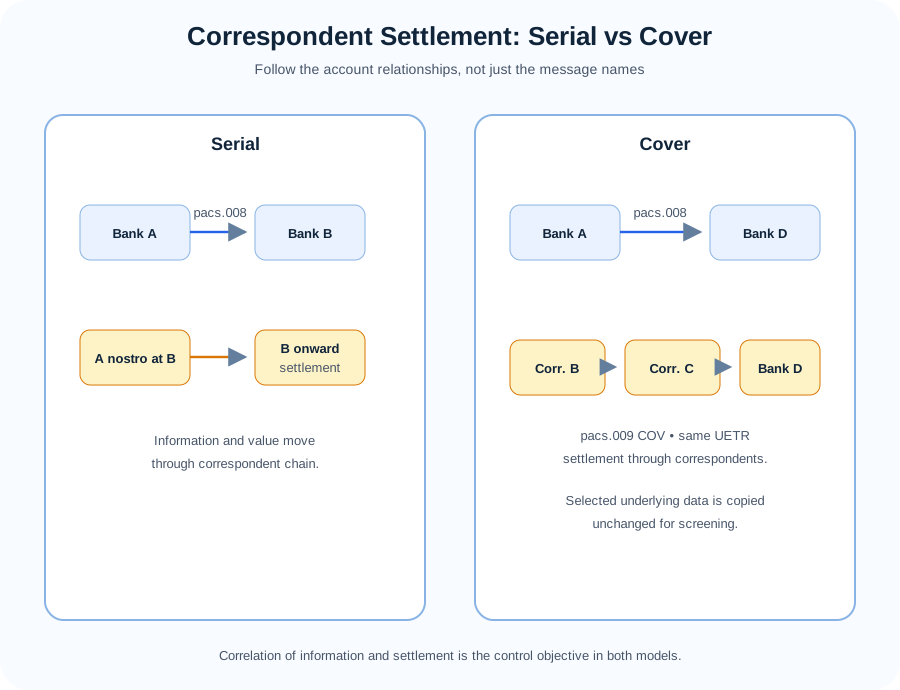
Under the applicable CBPR+ usage guidelines, a direct customer credit transfer uses pacs.008 and the cover leg uses pacs.009 COV. This is a Swift market practice, not a Payments Canada rule; a correspondent’s bilateral agreement and any coexistence/legacy requirement still govern the actual message path. A pacs.009 COV is identified by its Underlying Customer Credit Transfer element; it is not an alternative to pacs.008. The cover version carries the selected underlying data, including the parties needed for screening, and the PMPG says the underlying elements and UETR are carried unchanged through the cover chain. Where an advance advice is needed, CBPR+ also defines pacs.009 ADV; it is distinct from pacs.009 COV. See Swift’s Cover Payments Market Practice Guideline.
Why cover exists
Cover can allow:
- direct customer instruction to beneficiary bank;
- separate currency correspondents to settle;
- operational separation of information and settlement.
It can improve routing flexibility.
Cover transparency
Historically, cover transparency was a major compliance concern because settlement intermediaries needed underlying customer information.
The cover message includes underlying customer-transfer data so correspondents on the cover path can screen appropriately.
That data should remain unchanged/consistent according to the market-practice guidance. The originating and cover records should therefore be linked by the same UETR, not merely matched by amount and date.
Correlation problem
Beneficiary Bank D may receive pacs.008 before the cover funds arrive.
It needs to correlate:
- UETR;
- payment IDs;
- amount/currency;
- sender;
- settlement information.
The bank’s system should represent:
customer instruction received
and
settlement cover received
as separate events.
FI transfers
Not every FI-to-FI movement is cover.
A bank can send its own treasury liquidity payment using an FI credit-transfer use case without an underlying customer payment.
Operations should not require customer data where none exists.
5. Route selection, fees and service design
A bank route catalogue should model correspondent relationships as services, not BICs.
For each route:
- currency;
- correspondent;
- account;
- destination reach;
- local system access;
- cutoff;
- product eligibility;
- fee;
- value date;
- expected processing time;
- risk restrictions;
- backup.
Preferred correspondent
A bank may designate a preferred correspondent by currency/corridor.
Preference can reflect:
- cost;
- service quality;
- liquidity;
- tracking;
- operational support;
- compliance quality;
- strategic relationship.
Backup correspondent
Critical currencies should have contingency where commercially reasonable.
But a backup route must be genuinely tested.
It needs:
- funded/credit-capable account;
- routing configuration;
- compliance approval;
- operational contact;
- current keys/connectivity;
- settlement/reconciliation process.
An unopened dormant account is not resilience.
Intermediary fees
Every intermediary can charge.
The customer may see:
- sender fee;
- intermediary deduction;
- beneficiary-bank deduction;
- FX spread.
The originating bank should disclose what it controls and what can vary.
Fee reconciliation
Correspondents may:
- deduct fee from principal;
- book separate debit;
- invoice periodically.
Finance needs to map fee entries to:
- payment;
- service;
- correspondent;
- product P&L.
Repeated unexplained fee differences can indicate incorrect route or tariff.
Route quality metrics
Measure by correspondent:
- straight-through rate;
- repair rate;
- return rate;
- average completion time;
- enquiry response time;
- fee variance;
- tracking coverage;
- statement timeliness;
- outages.
Product routing should use operational evidence, not only negotiated price.
6. Nostro liquidity, cutoffs and treasury controls
A correspondent account must contain sufficient usable liquidity when payments need to settle.
Daily liquidity cycle
Treasury begins with:
- opening balance;
- expected incoming;
- expected outgoing;
- value-dated entries;
- credit/overdraft availability;
- liquidity buffer.
It then funds or sweeps accounts.
Payment forecast
The payment hub can improve treasury by sending expected flows.
Example:
USD outgoing:
- payroll USD 8m;
- corporate wire USD 20m;
- securities cash USD 5m.
Incoming expected:
Treasury can forecast net need.
Intraday monitoring
Large payments can consume liquidity quickly.
Dashboard:
- starting available;
- actual outgoing;
- actual incoming;
- pending approved payments;
- expected returns;
- projected balance;
- credit headroom;
- cutoff.
Payment release controls
A bank can implement:
- hard liquidity limit;
- soft warning;
- queued payment;
- route switch;
- treasury approval for exceptional amount.
Product priority can matter.
A regulatory/market-critical treasury payment may have higher priority than a non-urgent customer payment, subject to policy.
Cutoffs
Correspondent cutoffs can differ by:
- currency;
- payment type;
- destination;
- same-day versus future;
- local clearing.
Route selection should use current operational cutoffs.
Time zones
A Toronto operations team can still be processing while an Asian market has closed.
Systems should store cutoffs in market-local time and convert correctly with daylight-saving rules.
Non-aligned holidays
If Canada is open and U.S. USD settlement is closed for a holiday, USD value may move to another date.
The bank should compute value date using the currency/route calendar.
Intraday credit
Some correspondents provide intraday/overnight credit under limits.
Treasury should treat credit as a governed facility, not assume negative balance will be accepted.
Monitor:
- limit;
- usage;
- cost;
- collateral where applicable;
- expiration.
Trapped liquidity
Maintaining many correspondent accounts can fragment liquidity across currencies/banks.
This is one reason correspondent networks have operational cost.
Banks optimize by:
- account rationalization;
- sweeping;
- concentration;
- accurate forecasting;
- fewer strategic correspondents;
- improved intraday visibility.
7. Due diligence, sanctions, AML and transaction monitoring
Correspondent banking has two distinct financial-crime layers:
- relationship due diligence on the respondent/correspondent;
- transaction controls on payments flowing through the relationship.
FATF Recommendation 13
At a high level, Recommendation 13 requires additional measures for cross-border correspondent relationships.
Banks should understand:
- respondent business;
- reputation;
- quality of supervision;
- AML/CFT controls;
- responsibilities;
- senior-management approval as applicable;
- payable-through arrangements;
- shell-bank exposure.
Local regulation implements these standards, so legal/compliance teams must map the FATF framework into Canadian and counterparty requirements.
Canadian statutory overlay (regulatory rule)
For a Canadian financial entity acting as correspondent for a prescribed foreign financial institution, the Proceeds of Crime (Money Laundering) and Terrorist Financing Act (PCMLTFA) section 9.4 requires prescribed information, confirmation that the foreign entity is not a shell bank, senior-management approval, and a written statement of each party’s obligations before the relationship is entered. The Act prohibits any person or entity from having a correspondent relationship with a shell bank. This is a Canadian statutory overlay, not a claim that every jurisdiction applies identical rules. See PCMLTFA s. 9.4.
FINTRAC’s current guidance says the Canadian entity must also obtain and retain records covering the foreign institution’s identity, business, directors, annual report or audited financial statements, licence or incorporation evidence, agreement, anticipated account activity/products, no-shell-bank and AML/ATF statements, clientele and markets, penalties/reputation, supervisory quality, and copies of relationship-generated suspicious-transaction and listed-person-or-entity property reports. Ongoing monitoring is required at a risk-appropriate frequency. These are evidence and recordkeeping requirements for the Canadian entity; they are not a generic “CBDDQ completed” shortcut. See FINTRAC, Correspondent banking relationship requirements and PCMLTFR s. 16.
FINTRAC’s international electronic funds transfer (EFT) reporting is role-specific. The reporting entity that initiates or finally receives an international EFT may have a report obligation under the applicable threshold and aggregation rules; an entity acting only as an intermediary in the sending does not report that transfer as an initiation or final receipt, but must keep records and transmit requester/beneficiary information under the travel rule. Do not treat every correspondent hop as a separate EFT report or invent a universal “$10,000 correspondent limit.” See FINTRAC, Reporting international electronic funds transfers and FINTRAC, Travel rule.
Correspondent onboarding
A due-diligence pack can include:
- legal identity;
- ownership;
- licensing/regulator;
- countries;
- products;
- customer base;
- AML programme;
- sanctions policy;
- transaction monitoring;
- PEP controls;
- nested relationships;
- payable-through services;
- shell-bank policy;
- audit/testing;
- law-enforcement/regulatory actions;
- fraud controls;
- data quality.
Wolfsberg CBDDQ
The Wolfsberg Correspondent Banking Due Diligence Questionnaire gives institutions a standardized format for financial-crime due diligence.
Version 1.4 added/enhanced areas such as fraud and data-quality-related topics.
The questionnaire supports due diligence; it does not replace risk assessment.
Banks should verify responses, assess risk and refresh at an appropriate frequency.
Relationship risk rating
Factors can include:
- country;
- regulatory regime;
- products;
- nested activity;
- customer type;
- volumes;
- sanctions exposure;
- transparency;
- history;
- audit/control quality.
Risk rating drives enhanced due diligence and monitoring.
Sanctions screening
Transaction-level screening still happens.
A correspondent can screen:
- ordering party;
- beneficiary;
- agents;
- underlying parties in cover;
- remittance;
- countries.
Each bank is responsible for its controls.
A correspondent does not normally rely on the upstream bank saying “we screened it” as a replacement for its own legal obligations.
Transaction monitoring
Correspondent-account monitoring looks for patterns such as:
- unexplained high-risk corridors;
- rapid pass-through;
- nested-bank activity inconsistent with profile;
- unusual volume jump;
- high-risk customers/industries;
- repeated near-threshold transfers;
- unexplained return patterns.
The model should understand the respondent-bank profile, not compare it directly to a retail customer.
Payment transparency
Recommendation 16-type information enables each financial institution to understand originator and beneficiary context.
CBPR+ structured data helps.
A correspondent relationship with poor-quality payment data creates:
- screening false positives;
- manual enquiries;
- regulatory risk;
- slower processing.
Data quality should be part of relationship scorecards.
For the customer-facing leg, FCAC says federally regulated financial institutions must disclose the fee they charge to send money abroad, while charges in the receiving country may still apply. FCAC also warns that exchange rates and delivery times can change the amount received and that delivery can range from minutes to days depending on the service. This supports the chapter’s distinction between the originating bank’s controlled fee and downstream deductions; it is not a promise of a fixed completion time. See FCAC, Sending money to someone in another country.
8. Exceptions, enquiries, returns and investigations
Correspondent operations is where small data issues become multi-bank cases.
Payment repair
A correspondent can hold/reject because of:
- invalid account;
- missing party address;
- unsupported currency;
- missing purpose;
- sanctions query;
- invalid agent chain.
The respondent needs a structured repair process.
Requests for information
A correspondent may ask:
- who is underlying customer?;
- what is purpose?;
- provide full address;
- explain transaction;
- provide invoice;
- identify intermediary.
The bank should route the question to the correct data owner.
Enquiry SLA
Cases need:
- received time;
- correspondent;
- payment/UETR;
- question;
- response owner;
- customer dependency;
- compliance dependency;
- deadline;
- sent response.
A late answer can cause return.
Return
When value returns, the bank needs to reconcile:
- return message;
- nostro credit;
- original payment;
- customer credit;
- FX/fees.
The correspondent may deduct fees.
Recall request
A recall is a request to downstream institutions.
The correspondent may need beneficiary-bank cooperation.
The respondent should track state rather than promise success.
Unmatched nostro debit
Sometimes the first evidence of a problem is a debit in the nostro statement that the bank cannot match to a payment.
Possible causes:
- missing internal message;
- duplicate debit;
- fee;
- manual treasury transfer;
- correspondent correction;
- reference loss.
Unmatched external debits are high priority.
Unmatched credit
Possible:
- return;
- incoming customer payment;
- interest;
- fee refund;
- treasury movement.
Automated classification plus operations review is needed.
Intermediary investigation chain
If A routed through B and C to D, A may not have a direct operational channel to D.
Enquiry can travel:
A → B → C → D.
Every hop adds delay.
This is why direct UETR/tracking data and standardized investigations are valuable.
9. Accounting, statements and nostro reconciliation
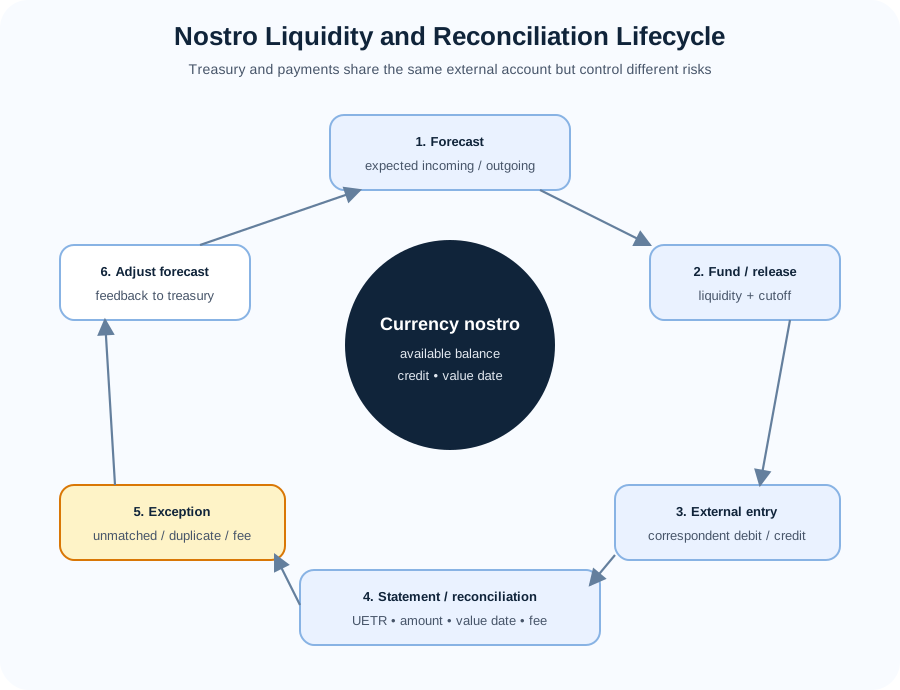
Internal nostro ledger
The respondent bank records expected movements.
For outgoing customer payment:
- customer funded;
- expected nostro debit.
For incoming:
- expected nostro credit;
- beneficiary/internal settlement.
External statement
The correspondent provides account reporting.
Under ISO migration this may include camt account reporting (for example, account notifications/statements where the correspondent offers them); legacy or proprietary formats can still exist depending on the correspondent’s service and the bilateral migration roadmap. Do not infer a Canadian system message or settlement finality merely from receipt of an account-reporting message.
Typical bank implementation boundary (bank-specific, not a Canadian scheme rule)
The customer channel may submit a payment through a bank API, file or assisted-operations screen. The bank’s payment hub normally validates account/agent data, creates the bank’s internal payment ID and UETR, applies sanctions/fraud/AML controls, selects an approved route, and releases the appropriate message through the bank’s authenticated Swift or other correspondent channel. The correspondent may return an acceptance/rejection/status message, a cover/direct message, and account-entry reporting. The bank then posts customer and internal ledgers, expects the nostro entry, and reconciles the external account evidence. Exact APIs, file formats, authentication factors, cutoffs, message variants and posting events are contractual or bank-specific; this chapter does not imply that every correspondent supports the same interface.
Matching
Strong match keys:
- UETR;
- payment reference;
- correspondent reference;
- amount/currency;
- value date.
Use amount/date only as fallback.
Break categories
Expected debit missing
Payment sent but no external debit.
Unexpected debit
Correspondent charged account without matched internal expectation.
Duplicate debit
Amount mismatch
Value-date mismatch
Fee entry
Return credit
Manual adjustment
Statement gap
Every break has owner and ageing.
Balance reconciliation
End-of-day:
internal opening + internal movements = internal closing.
External opening + external entries = external closing.
Internal closing should agree to external closing after known timing items.
Intraday reconciliation
Large-value correspondents need intraday monitoring before final statement.
This detects:
- settlement failure;
- duplicate;
- liquidity shortfall;
- unexpected large debit.
Suspense
Unmatched entries go to suspense temporarily.
Suspense needs:
- reason;
- owner;
- age;
- amount;
- currency;
- source;
- escalation.
Permanent suspense is a control failure.
Interest and claims
Incorrect value date can create interest impact.
Payments/correspondent agreements can support claims/compensation.
The bank should calculate and process according to the applicable agreement/rules rather than manually negotiate every case.
10. Governance, implementation, testing and resilience
Relationship inventory
Maintain one authoritative inventory:
- correspondent;
- BIC/legal entity;
- account;
- currency;
- service;
- country;
- regulator;
- risk rating;
- due-diligence date;
- owner;
- cutoff;
- statement type;
- fee schedule;
- credit;
- backup.
Payment routing and compliance should consume the same data.
Onboarding workflow
- business case;
- due diligence;
- risk approval;
- legal agreement;
- account opening;
- operational setup;
- Swift/RMA/messaging setup as applicable;
- routing;
- statement;
- funding;
- testing;
- production approval.
No one team owns all steps.
Relationship closure
Closing a correspondent requires:
- stop new routing;
- drain pending payments;
- resolve investigations;
- settle fees;
- close balances;
- redirect incoming;
- update directory;
- archive evidence.
A premature routing cut can strand payments.
Service monitoring
Monthly/quarterly scorecard:
- volume/value;
- STP;
- repair;
- return;
- sanctions holds;
- outage;
- enquiry SLA;
- fee;
- statement quality;
- reconciliation breaks.
Testing direct route
Test:
- standard payment;
- high value;
- cutoff;
- insufficient nostro;
- return;
- statement match.
Testing intermediary route
Also test:
- intermediary data;
- fee deduction;
- downstream hold;
- enquiry;
- route change.
Testing cover
- pacs.008 reaches beneficiary bank;
- pacs.009 COV route;
- underlying data consistency;
- cover correlation;
- cover delayed;
- cover returned.
Liquidity tests
- account prefunded;
- near limit;
- credit usage;
- funding delayed;
- balance-report delay.
Compliance tests
- due-diligence expiry;
- sanctioned bank;
- nested bank;
- suspicious corridor;
- underlying cover screening.
Resilience
Primary correspondent outage options:
- queue until recovery;
- route to approved backup;
- advise customer delay.
Backup route must have:
- account;
- liquidity;
- agreement;
- compliance;
- tested messaging.
Cyber and operational security
Correspondent-account access and manual-payment capability are sensitive.
Controls:
- privileged access;
- MFA;
- dual approval;
- limits;
- segregation;
- audit;
- anomaly detection.
Manual fallback should never weaken control.
Deep dive: correspondent account architecture inside the respondent bank
A correspondent account should be represented as a governed financial object, not merely an account number in a routing table.
A strong account master contains:
- correspondent legal entity;
- BIC and relevant clearing identifiers;
- account number;
- currency;
- account type;
- booking location;
- service scope;
- opening/closing status;
- effective dates;
- overdraft/credit terms;
- cutoff calendar;
- statement/reporting format;
- fee schedule reference;
- product eligibility;
- relationship owner;
- treasury owner;
- compliance risk rating;
- contingency route.
This record is sensitive. A routing change to the wrong nostro can misdirect millions in customer payments.
Segregating routing and settlement instructions
A bank route record should not embed uncontrolled free-text settlement instructions.
Instead, separate:
Route
- destination;
- currency;
- preferred correspondent;
- intermediary.
Settlement account
- nostro;
- account servicer;
- currency.
Message configuration
- Swift service;
- message family;
- agent population.
Commercial terms
This makes changes easier to approve and test.
Effective dating
Correspondent changes often occur at a future date.
Example:
- old EUR correspondent active until 29 October;
- new correspondent active from 30 October.
Payments created before the change but executed after it need a defined rule.
Systems should store:
- route-selection date;
- execution date;
- route version.
Without effective dating, a payment created Friday can execute Monday using unexpected account data.
RMA and messaging relationship
Swift Relationship Management Application arrangements can control whether institutions are permitted to exchange certain Swift traffic.
RMA is a messaging authorization control. It is not the correspondent account itself and does not prove financial settlement permission.
A bank needs both:
- permitted messaging relationship;
- valid commercial/account relationship.
Operations should avoid treating “RMA open” as “correspondent route ready.”
Correspondent account opening: operational checklist
Before first production payment:
- legal agreement executed;
- KYC/due diligence approved;
- account opened;
- currency confirmed;
- settlement instructions exchanged securely;
- BIC/RMA/messaging configured;
- routing table configured;
- statement delivery tested;
- fee treatment understood;
- cutoffs loaded;
- liquidity funding tested;
- return flow tested;
- operations contacts exchanged;
- contingency documented.
A penny test or low-value controlled payment can validate the path before high-value use, subject to bank policy.
Secure exchange of settlement instructions
Changing correspondent bank account details is a high-risk fraud event.
Controls can include:
- authenticated channel;
- callback;
- dual approval;
- known-contact verification;
- change freeze before large payments;
- post-change monitoring.
Business email alone should not be considered adequate evidence for a critical nostro change.
Relationship-level due diligence lifecycle
Correspondent due diligence does not end at onboarding.
A lifecycle can include:
Onboarding
Periodic review
- refresh legal/regulatory and control data.
Trigger review
- ownership change;
- regulator action;
- sanctions event;
- country-risk change;
- material nested activity;
- adverse media;
- unusual transaction pattern.
Exit
- risk unacceptable;
- commercial closure;
- service no longer needed.
The review frequency should be risk-based under bank policy and applicable law.
CBDDQ operational use
The Wolfsberg CBDDQ can be integrated into workflow.
Data fields from the questionnaire can populate:
- relationship risk assessment;
- sanctions-control assessment;
- transaction-monitoring assessment;
- nested-relationship assessment;
- fraud/control assessment.
But a completed questionnaire should not be auto-approved.
Analysts should assess:
- completeness;
- inconsistencies;
- outdated answers;
- evidence;
- public regulatory information.
Respondent risk and transaction risk are different
A low-risk respondent can still send one suspicious transaction.
A high-risk respondent can send many legitimate transactions.
Relationship risk influences:
- monitoring intensity;
- limits;
- review frequency;
- permitted services.
Transaction risk evaluates each payment/behaviour.
Do not block every transaction from a higher-risk correspondent without a risk-based rule, and do not relax payment screening because the respondent has a strong control environment.
Nested correspondent detection
Nested access can be identified through:
- ordering institution fields;
- repeated FI originators not equal to respondent;
- payment narratives;
- transaction patterns;
- declared downstream institutions.
Banks can compare actual observed FI population with declared nested relationships.
An unknown financial institution repeatedly appearing behind a respondent should trigger review.
Downstream FI inventory
For significant nested relationships, the correspondent may maintain:
- downstream FI name;
- BIC;
- jurisdiction;
- service;
- risk classification;
- expected volume.
This supports transaction monitoring and correspondent governance.
Payable-through account controls
If a service allows underlying respondent customers more direct transaction capability, controls should confirm that the respondent:
- performed CDD;
- can provide customer information promptly;
- monitors activity;
- maintains records;
- restricts access according to agreement.
The correspondent should understand who can actually use the account.
Correspondent sanctions controls
Relationship screening includes:
- institution name;
- owners;
- directors where relevant;
- country;
- regulators;
- connected entities.
Transaction screening includes:
- payment parties;
- agents;
- underlying cover parties;
- free text/remittance where policy requires.
A sanctions hit on a respondent itself can affect the entire relationship and require urgent payment/routing changes.
Emergency route migration
If a correspondent becomes unavailable because of sanctions or regulatory action, the bank may need to stop routing immediately.
A contingency playbook should identify:
- affected currencies;
- queued payments;
- payments already sent;
- incoming payments;
- trapped balance;
- backup correspondent;
- customer communications;
- settlement-account closure/freeze implications;
- regulatory reporting.
This is much harder if route/nostro dependencies are undocumented.
De-risking and access
CPMI has noted concerns about decline in correspondent relationships and the potential impact on cross-border payment access.
Banks balance:
- financial-crime risk;
- operational cost;
- revenue;
- strategic reach.
Wholesale termination of relationships can shift activity into less transparent channels. Risk-based management and improved information-sharing can support safer access.
This is a policy/business issue, not a reason to weaken controls.
Intermediary routing data
For each intermediary hop, the bank should know:
- institution;
- role;
- currency;
- account relationship;
- expected fee;
- jurisdiction;
- cutoff;
- message data.
The payment record should capture the route actually used, because a different intermediary can explain:
- unexpected fee;
- delay;
- sanctions hold;
- return path.
Dynamic routing versus static instructions
Historically, some correspondent routing was highly static.
Modern payment hubs can select among approved routes dynamically.
Dynamic routing can consider:
- service;
- cost;
- liquidity;
- outage;
- cutoff.
But dynamic does not mean uncontrolled.
Every candidate route must be pre-approved.
The engine should not invent a new intermediary from directory data in real time without governance.
Payment priority
Banks may classify:
- customer urgent;
- standard;
- treasury;
- regulatory/time-critical.
Queue management can prioritize within product and fairness rules.
Liquidity controls should understand priority.
A low-priority payment should not consume the last USD liquidity needed for a time-critical obligation if policy says otherwise.
Intraday queue management
A correspondent payment queue can show:
- ready to release;
- compliance hold;
- liquidity hold;
- cutoff risk;
- technical hold;
- future value date.
Operations should see reason and owner.
A payment should not remain in generic “pending” for hours.
Nostro funding methods
A bank can fund a nostro through:
- incoming customer/wholesale flows;
- treasury transfer from another correspondent;
- FX trade;
- money-market transaction;
- central liquidity arrangement;
- credit line.
The exact funding method differs.
The payment platform only needs to know whether usable liquidity is available, while treasury manages source.
Nostro buffer methodology
Treasury may maintain a buffer based on:
- expected volatility;
- historical outflow;
- stress scenario;
- cutoff uncertainty;
- credit availability.
Too much buffer creates idle liquidity cost.
Too little creates payment delays.
Accurate payment forecasts reduce both.
Statement frequency
A correspondent may provide:
- real-time notifications;
- intraday reports;
- end-of-day statement.
The respondent should define which feed drives:
- operational monitoring;
- liquidity;
- accounting finality.
Do not double-book the same entry from both intraday notification and end-of-day statement.
Entry lifecycle
A canonical nostro entry can have:
NOTIFIED
Received via debit/credit notification.
BOOKED
Correspondent booked.
STATEMENT_CONFIRMED
Appears in final statement.
RECONCILED
Matched to internal expectation.
This prevents duplicates across reporting messages.
Nostro reconciliation matching hierarchy
Strong matching can use:
- UETR;
- correspondent transaction reference;
- internal mapped reference;
- amount/currency/value date with additional attributes.
Fallback matches should be marked lower confidence.
Manual match should record user and rationale.
Aged nostro breaks
A USD 5 fee unmatched for one day and a USD 5 million customer debit unmatched for one hour do not have the same risk.
Prioritization can use:
- amount;
- currency;
- age;
- customer impact;
- settlement criticality.
Escalation should be risk-based.
Statement completeness control
Reconciliation is not only item matching.
The bank also needs to prove it received all expected statements/pages/sequences.
A missing statement can make every item appear “not yet received.”
Control:
- expected account list;
- expected reporting frequency;
- receipt time;
- sequence/statement ID;
- opening balance continuity.
Balance confirmation
Opening balance of today should reconcile to prior closing balance, adjusted only by defined statement/account mechanics.
A break can indicate:
- missing statement;
- back-valued adjustment;
- data-load issue.
Correspondent fee analysis
Fees can be monitored per:
- route;
- transaction type;
- currency;
- amount band.
Unexpected fee increase can mean:
- tariff changed;
- wrong route used;
- new intermediary;
- beneficiary charge.
This is useful for product pricing.
Service-level agreement dimensions
A correspondent SLA should be more than uptime.
Dimensions:
- payment processing cutoff;
- status availability;
- enquiry response;
- return handling;
- statement delivery;
- incident notification;
- planned maintenance;
- data quality.
Performance should be reviewed with evidence.
Major incident coordination
If a correspondent has an outage:
Payment operations
Treasury
- assess liquidity/trapped funds.
Product/customer service
- identify customer impact.
Compliance
- ensure reroute remains approved.
Technology
- confirm messages not duplicated.
Relationship manager
- coordinate with correspondent.
One incident commander should coordinate.
Failover risks
Rerouting to backup can change:
- intermediary;
- fee;
- settlement time;
- data requirements.
The bank must know whether customer authorization remains valid.
A contingency route should be tested with representative payment types.
Correspondent concentration risk
A bank can become highly dependent on one global correspondent for many currencies.
Concentration can create:
- outage risk;
- commercial pricing power;
- sanctions/regulatory dependency.
Risk teams should measure:
- percentage of payment value by correspondent;
- currencies;
- critical customer products.
Operational contact management
Keep current:
- payments operations contact;
- sanctions escalation;
- treasury/liquidity;
- technical support;
- relationship manager.
Contacts should be verified periodically.
During a high-value incident, an outdated email list costs hours.
Secure manual payment controls
Contingency can require manual instruction.
Manual capability should have:
- dual control;
- independent verification;
- strict limits;
- approved templates;
- secure channel;
- post-event reconciliation.
Do not disable controls because “the system is down.”
Audit evidence
For each correspondent relationship, audit may request:
- approval;
- due diligence;
- risk rating;
- agreement;
- account opening;
- routing controls;
- fee schedule;
- monitoring;
- periodic review;
- transaction samples;
- reconciliation;
- incidents.
A central relationship record should make this retrievable.
BA acceptance criteria
Approved route
Given a payment to destination Bank D, when only Correspondent B is approved for the currency and destination, then route selection must not use an unapproved directory institution even if it appears technically reachable.
Nostro liquidity
Given expected outgoing payments exceed available USD balance plus approved credit, then payments requiring funding must enter a liquidity queue/treasury workflow according to priority rather than fail unpredictably.
Nested detection
Given payments through respondent R repeatedly identify an undeclared financial institution X as ordering institution, then the monitoring process creates a correspondent-risk review alert.
Statement reconciliation
Given a nostro debit with UETR matching a released payment, then the reconciliation engine links the entry automatically and records the match method.
Unexpected debit
Given a debit has no matching internal expectation above the materiality threshold, then an exception is created immediately with account/currency/amount and assigned owner.
Correspondent outage
Given the primary route is unavailable, then only pre-approved backup routes can be selected, and the route version/contingency reason is stored.
Test matrix
Relationship
- active;
- due diligence expired;
- account closing;
- service suspended.
Routing
- direct;
- intermediary;
- nested;
- backup.
Liquidity
- sufficient;
- low;
- credit used;
- funding late.
Messaging
- normal;
- network timeout;
- duplicate;
- invalid agent.
Compliance
- respondent risk event;
- downstream FI undeclared;
- sanctions hit.
Statements
- debit notification;
- end-of-day;
- missing statement;
- duplicate entry;
- back-valued item.
Investigation
- repair;
- return;
- recall;
- fee dispute.
Practitioner design-review checklist
Before approving a correspondent-banking operating model, ask:
- Is each account tied to a legal correspondent entity?
- Is nostro/vostro perspective understood?
- Is there one authoritative relationship inventory?
- Are routing and account master changes dual-controlled?
- Is RMA distinguished from financial account permission?
- Are nested and payable-through services declared and risk-assessed?
- Is FATF R13-style due diligence documented?
- Is the Wolfsberg questionnaire assessed rather than merely stored?
- Is account liquidity visible before payment release?
- Are cutoffs and holidays current?
- Are backup routes truly funded and tested?
- Is every nostro statement received and reconciled?
- Can fees be traced to payments/routes?
- Can UETR be used for reconciliation?
- Are unmatched entries risk-prioritized?
- Are manual contingency payments dual-controlled?
- Can operations contact the correspondent quickly?
- Is route concentration monitored?
- Are relationship closure steps controlled?
- Can audit reconstruct both relationship and transaction controls?
If not, the bank has a correspondent account, but not yet a mature correspondent-banking capability.
Advanced practice: correspondent payment lifecycle by ownership
Correspondent banking becomes easier to operate when each stage has an explicit owner and evidence.
Customer/business owner
- customer instruction;
- product eligibility;
- fee disclosure;
- customer communication.
Payments processing
- route selection;
- message creation;
- UETR;
- release;
- status.
Treasury
- nostro balance;
- funding;
- credit line;
- value date.
Compliance
- correspondent relationship approval;
- payment screening;
- AML monitoring;
- nested relationship risk.
Finance
- ledger;
- fees;
- statement reconciliation;
- suspense.
Correspondent relationship manager
- SLA;
- pricing;
- service review;
- escalation.
A high-value payment should not sit because everyone assumes another team owns the issue.
Relationship versus route versus account
These three objects should remain separate.
Relationship
Bank A ↔ Bank B correspondent agreement.
Account
Bank A USD account at B.
Route
Use B’s USD account to reach beneficiary banks in defined markets/products.
One relationship can contain several accounts. One account can support several routes. One route can be changed while the relationship remains active.
This separation makes data governance cleaner.
Currency clearing agents
Some currencies have a small number of banks with strong local clearing access.
A respondent may use a currency correspondent because:
- it is direct participant in local RTGS;
- it has domestic branch network;
- it provides strong nostro services;
- it has extended cutoff.
The route engine should know which services the correspondent genuinely supports.
Payment system access through correspondent
A correspondent can act as gateway to a domestic payment system.
The respondent sends instruction to correspondent.
Correspondent:
- debits respondent vostro;
- creates domestic payment;
- settles through local system.
The respondent may receive:
- correspondent status;
- account debit;
- downstream payment confirmation.
It may not receive the domestic system’s raw settlement record directly.
This affects evidence hierarchy.
Evidence hierarchy in investigation
For each leg, classify evidence strength.
Customer authorization
proves customer instruction.
Swift network acceptance
proves message accepted by network/service.
Correspondent acceptance/status
proves correspondent processing state.
Nostro debit
proves respondent account charged.
Domestic-system settlement evidence
proves correspondent’s domestic leg where available.
Beneficiary-bank credit confirmation
proves final customer credit.
A bank should not claim a stronger outcome from a weaker evidence type.
Correspondent account credit risk
When Bank A holds a balance at commercial Bank B, A has credit exposure to B because B owes that balance.
This differs from central-bank money.
Risk management considers:
- correspondent creditworthiness;
- balance size;
- concentration;
- legal jurisdiction;
- intraday/overnight exposure.
Treasury may minimize idle balances partly for this reason as well as liquidity cost.
Settlement-bank risk
If a payment system settles in commercial bank money, participants face settlement-bank credit/liquidity risk.
CPMI’s Principles for Financial Market Infrastructures emphasize managing risks from settlement banks, nostro agents and liquidity providers.
Even outside an FMI context, the principle is useful: account-servicing banks are operational and financial dependencies.
FX-related correspondent movements
A customer FX trade can create two currency legs.
Example:
Canadian bank buys EUR from FX counterparty.
CAD leg may settle through Canadian infrastructure.
EUR leg may settle through euro correspondent/CLS depending on trade arrangement.
The customer cross-border payment then consumes the EUR liquidity.
Treasury should link:
FX settlement → nostro funding → customer payment.
A failure in one can cascade into another.
CLS and correspondent accounts
CLS reduces FX principal settlement risk through payment-versus-payment for eligible currencies/trades.
But CLS does not eliminate the need for correspondent accounts in general.
Members/third parties still need funding/pay-in arrangements in eligible currencies and customer cross-border payments continue to use correspondent networks.
Bank training should therefore avoid:
“CLS replaced correspondent banking.”
It did not.
Investigation communication discipline
When contacting a correspondent, use chain identifiers.
Good enquiry:
- UETR;
- amount/currency;
- value date;
- sender/receiver;
- original message reference;
- clear question.
Poor enquiry:
Can you check our USD 50,000 payment yesterday?
Large correspondents process millions of entries. Precise identity reduces response time.
Repair-at-source principle
If a correspondent repeatedly requests the same missing data:
- identify source channel;
- change validation;
- fix mapping;
- measure reduction.
Operations should not become a permanent data-enrichment team.
Manual repair should be exception, not normal path.
Intermediary change during investigation
Sometimes a correspondent routes through an intermediary different from the sender’s expected assumption.
The payment record should capture actual downstream status/agents where reported.
This matters for:
- fee;
- sanctions;
- delay;
- return route.
If product promises “no intermediaries,” routing must enforce it, not merely display it.
Incoming correspondent payments
Correspondent banking is bidirectional.
A Canadian bank can also act as correspondent for foreign institutions.
Incoming process:
- receive Swift instruction;
- identify respondent account;
- validate authorization/message;
- screen underlying payment;
- debit respondent vostro;
- route/credit Canadian beneficiary;
- report statement/status.
The Canadian bank now carries respondent-risk and downstream customer-payment obligations.
Correspondent as service provider to respondents
If a Canadian bank offers correspondence, it needs:
- respondent onboarding;
- limits;
- account service;
- transaction screening;
- routing;
- statements;
- investigations;
- fees;
- relationship monitoring.
The same concepts apply from the other side.
Incoming message versus account authority
Receiving a valid Swift message from a known BIC is not sufficient on its own.
The bank must validate:
- message authentication/service;
- RMA/permission;
- respondent account;
- signing/authorization rules inherent in service;
- sufficient funds/credit;
- product entitlement.
Message identity and account authority work together.
Account overdraft
A correspondent may permit a respondent to go negative within credit terms.
If so:
- limit;
- interest;
- collateral;
- intraday/overnight terms;
- breach process;
- suspension.
Payment engine should not assume infinite overdraft.
When limit exhausted:
- queue;
- reject;
- request funding;
according to agreement.
Value-date accounting
Correspondent statements include value dates.
A debit booked today but valued yesterday can affect:
- interest;
- liquidity;
- reconciliation.
Finance must distinguish:
- booking date;
- value date.
Incorrect value date can trigger claims.
Back-valued entries
Correspondents may post adjustments with prior value date.
Reconciliation needs:
- historical-period reopening or adjustment;
- interest calculation;
- audit trail.
Do not force every entry into today’s value date to make balancing easier.
Account fees
Correspondent charges can include:
- transaction;
- account maintenance;
- investigation;
- statement;
- overdraft/interest;
- repair.
Fee analytics should distinguish product P&L from customer pass-through.
Relationship profitability
A correspondent relationship can be strategically useful even if one payment product margin is low.
Banks may evaluate:
- payment revenue;
- FX;
- trade finance;
- deposits;
- securities/custody;
- liquidity.
Risk and operations still need transaction-level cost visibility.
Service review meeting
A strong quarterly review covers:
Commercial
Operations
- STP;
- repair;
- incidents;
- enquiries.
Treasury
- balances;
- credit;
- liquidity.
Compliance
- due diligence changes;
- data quality;
- unusual patterns.
Technology
- releases;
- upcoming standards.
Actions should have owner/date.
Data-quality scorecard by respondent
For a correspondent servicing respondents, track:
- structured address rate;
- missing beneficiary account;
- invalid purpose;
- repair requests;
- sanctions false positives driven by poor data;
- duplicate UETRs.
Poor data can lead to service restrictions or remediation.
Contingency communication to customers
If correspondent outage prevents same-day settlement, customer-facing teams need approved wording.
Good:
Your payment has been accepted by us but cannot be released on the original route because the USD correspondent is unavailable. We are assessing the approved contingency route. We will update the expected value date.
Bad:
Swift is down.
The issue may not be Swift at all.
Risk of manual rerouting
Manual rerouting can accidentally:
- change fee;
- use wrong intermediary;
- create duplicate;
- bypass compliance approval;
- select unfunded account.
If manual override exists, require:
- authorized role;
- allowed route list;
- reason;
- dual approval for high value;
- audit.
Static data validation
Correspondent static data should be validated periodically against:
- account confirmation;
- BIC directory;
- legal agreement;
- fee/cutoff notice;
- contact list.
Stale static data is a major operational risk.
Mergers and legal-entity changes
If correspondent merges or changes legal entity:
- account numbers may change;
- BIC may change;
- RMA;
- legal contract;
- KYC;
- tax;
- statements.
Treat as controlled migration, not simple name update.
New currency onboarding
To add a new currency:
- business demand;
- select correspondent;
- due diligence;
- open account;
- treasury funding;
- routing;
- FX support;
- accounting;
- statements;
- test;
- customer product.
Do not expose currency in channel before settlement capability is ready.
Key operational metrics
By correspondent:
- outgoing count/value;
- incoming count/value;
- average balance;
- peak debit;
- intraday credit use;
- STP;
- repairs;
- returns;
- sanctions holds;
- investigations;
- statement delays;
- unreconciled amount;
- fee per payment;
- outage minutes.
By route:
- average delivery time;
- intermediary count;
- beneficiary-credit confirmation rate.
Incident postmortem structure
After a major correspondent incident:
What happened?
Timeline.
What payments affected?
Currency, count, value, customers.
What evidence was available?
Messages/statements.
What controls worked?
Queue, backup.
What failed?
Routing/static data/liquidity.
Customer impact?
Delayed/fees.
Financial impact?
Interest/claims.
Actions?
Owner/date.
Operations training scenarios
Train staff with realistic cases:
- outgoing message ACK, no nostro debit;
- nostro debit, beneficiary not credited;
- cover received late;
- unexpected intermediary fee;
- sanctions hold;
- duplicate statement debit;
- correspondent outage;
- nested institution detected;
- back-valued adjustment.
The goal is to classify state before sending an enquiry.
Final correspondent capability test
Pick one live test payment and ask teams to reconstruct:
- customer instruction;
- route selected;
- correspondent account;
- Swift message;
- compliance result;
- treasury liquidity;
- nostro debit;
- beneficiary status;
- fee;
- reconciliation.
If all ten can be linked from one payment ID/UETR, the operating model is mature.
Advanced relationship management: from onboarding to controlled exit
A mature correspondent relationship has a lifecycle just like a payment.
Proposed
Business identifies the need for currency or market reach.
Due diligence
Legal entity, regulation, ownership, financial-crime controls, services and risk are assessed.
Approved
Senior management and required control functions approve the relationship according to policy.
Implemented
Accounts, messaging permissions, settlement instructions, statements, cutoffs, fees and operational contacts are configured.
Active
Payments flow and service/risk monitoring continues.
Restricted
One or more services can be suspended because of risk, liquidity or operational concerns.
Exit planned
New routing stops, balances and open cases are reduced.
Closed
Accounts are closed, residual entries reconciled and evidence retained.
Systems should store the relationship state. Payment routing should not rely on an email saying “do not use Bank X anymore.”
Respondent and correspondent limits
Banks commonly apply financial and operational limits.
Possible controls include:
- maximum account balance;
- intraday credit;
- overnight overdraft;
- transaction amount;
- daily payment volume/value;
- country/currency;
- downstream/nested institutions;
- product/service.
Limits should be machine-readable where they affect payment release.
A relationship can remain active while one service is temporarily blocked. The route engine needs service-level status, not only an account active flag.
Correspondent change notifications
Correspondents can notify respondents of:
- new cutoff;
- fee change;
- BIC/legal entity change;
- account migration;
- new statement format;
- standards release;
- service outage.
A central change-management process should assess:
- payment-routing impact;
- treasury;
- accounting;
- compliance;
- customer pricing;
- testing.
Forwarding the email to one operations mailbox is not change governance.
Settlement-instruction verification
Settlement instructions are among the highest-risk static data in wholesale banking.
A fraudulent instruction change can redirect treasury/payment funds.
Best-practice controls can include:
- authenticated source;
- callback to known contact;
- dual approval;
- independent verification;
- effective date;
- first-payment monitoring;
- threshold escalation.
The bank should preserve both old and new instructions for audit.
Correspondent communications and case identity
Every investigation should use the strongest shared identity available.
For payment cases:
- UETR;
- original message reference;
- amount/currency;
- value date.
For account cases:
- account number;
- statement/entry reference;
- amount/value date.
For relationship cases:
- legal entity/BIC;
- service;
- agreement.
This reduces ambiguity across global operations centres.
Incoming respondent payment controls
When a Canadian bank acts as correspondent, the incoming process should include:
- authenticate/validate message;
- identify respondent;
- verify service/account entitlement;
- check respondent balance/credit;
- screen payment and underlying parties;
- apply transaction monitoring;
- debit respondent vostro;
- route onward;
- report status and account entry;
- reconcile.
A respondent having passed due diligence does not mean every payment is automatically acceptable.
Respondent-balance control
If a respondent has no overdraft and insufficient funds:
- queue or reject according to agreement;
- notify respondent;
- prevent unauthorized negative balance.
If an overdraft exists:
- check limit;
- price interest/fee;
- monitor exposure.
Payment operations and credit-risk systems need consistent limits.
Downstream local-system cutoff
A correspondent can receive a payment before its own local system closes but still miss an intermediary/product-specific cutoff.
The service catalogue should publish the effective customer/correspondent cutoff, not only the underlying RTGS closing time.
Buffer is needed for:
- screening;
- repair;
- queue;
- technical recovery.
End-of-day account sweeps
Respondents may sweep excess balances between correspondents or treasury centres.
A sweep is a separate treasury payment and must be identifiable so reconciliation does not mistake it for customer traffic.
Sweep design can use:
- target balance;
- threshold;
- schedule;
- value date;
- counter-account.
Treasury sweeps can also change available liquidity shortly before customer-payment cutoff, so coordination matters.
Intraday credit monitoring
If the correspondent grants intraday credit, monitor:
- limit;
- current use;
- peak use;
- expected repayment;
- collateral/terms;
- breaches.
An overnight balance can have different pricing/risk.
The payment engine should not assume credit is free or unlimited.
Settlement-agent concentration
A non-participating bank can depend on a settlement agent for multiple services.
This creates concentration:
- operational outage;
- credit;
- legal;
- compliance.
Business continuity should understand whether backup requires a completely different agent setup.
Correspondent relationship scorecard
A useful scorecard can combine five dimensions.
Service
availability, processing time, repair rate.
Financial
fees, credit cost, balances.
Liquidity
cutoff, intraday visibility, funding.
Risk/compliance
CDD freshness, data quality, sanctions/AML issues.
Operations
statement quality, enquiry response, reconciliation breaks.
A route can be cheap but operationally poor. The scorecard should inform route strategy.
Quality review of nested activity
For respondents permitted to support downstream FIs, periodic review can compare:
- declared downstream list;
- actual payment originators;
- volumes by FI;
- new jurisdictions;
- high-risk sectors.
Material deviation should trigger review.
The objective is transparency, not automatic rejection of all nested activity.
Relationship remediation
If due diligence finds weakness, the bank may:
- request remediation;
- increase monitoring;
- restrict service;
- lower limits;
- prohibit nested use;
- set deadline;
- exit.
The response should be proportionate to risk and legal obligations.
Correspondent exit migration
A controlled exit plan should identify:
- last date for new outgoing payments;
- replacement routes;
- incoming-payment redirection;
- customer communication;
- remaining balance;
- outstanding returns/recalls;
- unresolved investigations;
- fee/interest claims;
- statement archive;
- account closure confirmation.
Do not close the account while a major return is expected without a receiving arrangement for residual funds.
Reconciliation after route migration
When payments move from Correspondent A to B, monitor both accounts for a transition period.
A can still receive:
- late returns;
- fees;
- investigations;
- incoming payments sent using stale instructions.
Keep old-account reconciliation active until residual activity ceases.
BA acceptance criteria: relationship status
Given a correspondent service is marked RESTRICTED effective at time T, then route selection after T must exclude that service while preserving historical routes for payments selected before T according to policy.
BA acceptance criteria: static-data change
Given a nostro settlement instruction changes, the new instruction must not become active until required dual approvals and verification evidence are complete.
BA acceptance criteria: respondent insufficient funds
Given an incoming respondent instruction exceeds available balance plus approved credit, the correspondent must not post an unauthorized overdraft and must apply the agreed queue/reject workflow.
BA acceptance criteria: nested activity
Given a respondent is not approved for nested FI access, when payment data identifies repeated underlying financial institutions inconsistent with profile, the monitoring process must create a relationship-risk alert.
Final correspondent-operations checklist
For every major currency, operations should know:
- primary correspondent;
- account;
- backup;
- cutoff;
- holiday calendar;
- liquidity owner;
- statement feed;
- investigation contact;
- fee model;
- relationship risk status.
For every payment, operations should know:
- route;
- UETR;
- last proven processing event;
- expected account entry;
- current external evidence.
For every account, finance should know:
- expected statement;
- opening balance;
- entries;
- closing balance;
- unmatched items;
- ageing.
Those three views — relationship, payment and account — form the core of correspondent-banking control.
11. Practical correspondent-banking examples (fictional illustrations)
The six examples below are deliberately fictional. Their amounts and outcomes illustrate control logic only; they are not representative Canadian limits, prices, service levels or correspondent commitments.
Example 1 — direct USD correspondent
A Canadian bank holds USD at U.S. Bank B.
Its corporate customer pays a beneficiary who also banks at B.
Bank A sends the customer payment.
B debits A’s vostro and credits beneficiary.
A sees the USD nostro debit.
This is direct, easy to reconcile and normally fewer fees.
Example 2 — intermediary required
Beneficiary banks at D.
A routes:
A → B → C → D.
C provides local reach.
The payment arrives but C deducts an intermediary fee.
The beneficiary complains amount is lower.
The sending bank must explain fee arrangement and actual downstream deduction.
Example 3 — nostro liquidity shortage
A has USD 3m available at B but approved outgoing payments total USD 5m before cutoff.
Treasury sees the forecast and sends USD funding from another source.
Without forecast, customer payments queue and miss value date.
The payment defect is liquidity, not messaging.
Example 4 — nested respondent risk
B is correspondent for smaller Bank C.
C begins sending payments for another financial institution E through B’s account.
B’s monitoring detects new originator-bank patterns inconsistent with B’s profile of C.
Compliance investigates nested access.
The lesson: relationship monitoring must understand institutions, not only amounts.
Example 5 — cover payment delayed
Beneficiary Bank D receives pacs.008 customer instruction, but cover through B/C is delayed by a correspondent issue.
D does not yet have expected cover.
Operations correlates customer instruction and cover using the payment identifiers.
The case is a settlement-cover delay, not a missing customer instruction.
Example 6 — unexpected nostro debit
A’s reconciliation system finds a USD 125,000 debit at B with no expected customer payment.
Investigation finds it is a treasury transfer manually initiated outside the payment hub.
The financial value is legitimate, but the control gap is that treasury movement did not feed the central expected-entry service.
The fix is integration, not journal-only matching.
12. Key takeaways and authoritative references
Correspondent banking is an account-and-service network that gives banks cross-border and foreign-currency reach. The correspondent holds an account and provides execution/access services; the respondent uses them. Nostro and vostro describe the same account from opposite bank perspectives.
Intermediaries extend reach but add dependencies. Nested relationships and payable-through access require clear risk understanding. Serial and cover methods organize customer-payment information and settlement differently. Cover settlement needs underlying customer information for transparency. Swift/CBPR+ messaging and the correspondent account are different layers.
Treasury must manage each nostro as a currency liquidity location. Operations must manage cutoffs, statements, fees and investigations. Compliance must perform relationship due diligence and transaction controls. Finance must reconcile the external account to internal expected entries. Route governance should use correspondent quality, cost, liquidity and risk together.
The core practitioner rules are:
- treat correspondent relationships as accounts and services, not BIC entries;
- maintain one inventory across routing, treasury and compliance;
- distinguish nostro/vostro perspective;
- minimize unnecessary intermediaries;
- preserve underlying data in cover flows;
- understand nested and payable-through exposure;
- keep due diligence current;
- forecast and monitor currency liquidity;
- reconcile every external statement entry;
- test and fund backup routes before calling them resilient.
Authoritative references (checked 5 October 2026)
This application uses JavaScript for the full interactive experience. This text summary is served for accessibility and search indexing.