Corporate and Supplier Payments. Apply AFT credits to supplier, pension, government and other high-volume business disbursements.
Canada Payments & Collections · Block 4: AFT Credits and Business Disbursements · Chapter 19 of 75
Every month, a Canadian manufacturer pays four hundred suppliers. A pension administrator pays tens of thousands of retirees on the same morning. A provincial government releases grant funding to hundreds of community organizations before quarter-end. A national retailer settles freight invoices with dozens of carriers every Friday. None of these payers writes cheques anymore, and none of them sends four hundred wires. They all do the same thing: they build a payment run, approve it, release a file to their bank, and let the batch system carry hundreds or thousands of credits to accounts across the country at a cost of cents per item.
This chapter is about that motion — the routine, high-volume business disbursement through Automated Funds Transfer (AFT) credits clearing through the Automated Clearing Settlement System (ACSS). Supplier payments are the headline case, but the mechanics are shared by pension payrolls, government transfers to businesses and individuals, dividend and rebate runs, insurance claim batches, and any other push of many credits from one payer to many payees. Learn the supplier run properly and you have learned them all; the differences between these use cases sit in approval policy, remittance richness and timing promises, not in the clearing path.
A few status facts anchor everything that follows, stated once so later sections can build on them. AFT credits exchanged through ACSS are a live, everyday capability: a batch rail used for routine business disbursements in Canadian dollars. Lynx, Canada's high-value system, is live alongside it and is the bank-specific choice when a single disbursement needs same-day finality and the payer accepts the price and irrevocability. The Real-Time Rail (RTR) is a planned instant system with Payments Canada targeting a Q4 2026 launch — it is not live, and nothing in this chapter routes to it; it appears only where bank planning must leave room for it. Timing in this chapter is always relative — this window versus next window, routine batch versus same-day final — because exact cutoffs vary by bank, clearer, file type and day, and the binding times are your bank's published schedules read with the published system closure calendar. Nothing here replaces the rulebook: AFT exchange is governed by Payments Canada's published rules, standards and by-laws, described functionally throughout this chapter, with the binding text in the current published versions.
What you should be able to do after this chapter
After working through this chapter, you should be able to:
- explain why routine supplier, pension and government disbursements travel as AFT credits through ACSS rather than as wires, and what the payer trades away for batch economics;
- name the participants in a disbursement run — the paying business, its bank, clearing capacities, the system operator, the settlement agent, receiving banks and suppliers — and state what each owns;
- trace a payment run from approved invoices through run creation, dual approval, file release, bank validation, ACSS exchange, morning settlement, supplier posting and cash application;
- contrast a routine supplier AFT run with an urgent Lynx wire choice across timing, finality, cost, data and recall rights, and advise a payer honestly on which bundle fits the business event;
- describe what remittance and electronic data accompany a disbursement, how the EDI family of records carries structured detail at family level, and why thin remittance creates unapplied cash at the supplier;
- explain the functional role of the AFT rules — commonly referenced under the F-series including Rules F1 and F4 — covering what may be exchanged, warranties, returns and adjustments, and where to find the binding current text;
- place fraud and compliance controls at the correct point in the disbursement flow, with special attention to business email compromise and supplier-master fraud, sanctions screening and record-keeping;
- classify rejects, returns, reversals and adjustments in a disbursement context, and recover as linked new events that preserve the original run's identity;
- explain posting, accounting, liquidity, reporting and reconciliation for disbursement runs, including funding the payer's account, reading bank reports and running a daily three-way match;
- describe what a bank must do to offer disbursement services to business customers — onboarding, file testing, entitlements, resilience — and how to prepare for the planned Real-Time Rail without treating it as live;
- work through fictional but realistic Canadian cases — a manufacturer supplier run with a compromised change request, a pension batch with returns — and extract the control lesson from each;
- navigate confidently to the neighbouring chapters of this block for AFT mechanics, returns and reconciliation, format coexistence and payroll depth.
For a roughly 60-minute core session, spend about 10 minutes on Section 1 and the lifecycle diagram, 15 minutes on Sections 2–4 with the lifecycle and approval-matrix diagrams, 10 minutes on Sections 5–6 with the remittance diagram, 10 minutes on Sections 7–8 with the onboarding diagram, 10 minutes on the fictional cases in Section 11 with the reconciliation diagram, and 5 minutes on takeaways and references in Section 12.
Chapter navigator
- Business context and customer need
- Participants, responsibilities and system boundaries
- Initiation, validation and bank processing
- Clearing or exchange, settlement and finality
- Data, identifiers, messages and references
- Rules, cutoffs, service levels and customer impact
- Fraud, compliance and operational controls
- Exceptions, investigations and recovery
- Posting, accounting, liquidity, reporting and reconciliation
- Bank implementation, testing and resilience
- Practical Canadian examples
- Key takeaways and authoritative references
1. Business context and customer need
Start with the Friday that every Canadian accounts-payable department knows. Four hundred supplier invoices are due. The steel vendor offers two per cent discount for payment within ten days. The freight carrier will hold next week's capacity if last week's invoices stay open. The pension administrator must credit thirty thousand retirees on the first business day of the month, without exception and without publicity. The provincial ministry must land grant money in community organizations' accounts before the fiscal quarter closes, with a reporting trail an auditor can follow line by line. Each of these payers thinks about the same four things: every payee paid correctly, on the promised date, at a supportable cost, with proof that stands up months later.
The disbursement run exists because these obligations share a shape with payroll: numerous payees, individually ordinary values, a predictable rhythm, and tolerance for value that arrives in a later window rather than this second. Sending each payment as its own wire would give each one same-day finality — and would charge wholesale pricing, demand per-item handling, and offer no structured return path when an account number is wrong. Accumulating approved payables into one run, releasing one file, and letting the batch system fan the credits out to every receiving bank in the country costs a fraction per item and carries structured remittance the supplier's receivables team can process straight through. That is the economic logic of the disbursement run. AFT credits are a major ACSS electronic stream, but the current ACSS statistics also report AFT debits, POS, EDI, electronic remittances, cheques and other items; do not treat the public totals as a statistic about supplier payments alone.
Scale turns small errors into large workloads: one wrong transit number propagated across a run can create hundreds of receiving-bank events, supplier calls and a returns queue. A single missed cutoff shifts value for every payee behind it. The fundamentals discipline applies with full force — validate before release, respect the window, reconcile every position — plus a fourth this chapter repeats: never pay an unvalidated payee.
Customers experience disbursements through recurring questions about timing, certainty, cost, information and recourse: will the supplier be paid Friday (windows and value dates), can the funds be used that day (posting versus settlement and return rights), what will four hundred payments cost (batch versus wire pricing), what reference will the supplier see (remittance discipline), and what happens when an account is wrong (returns and re-origination). Every section of this chapter equips you to answer one or more of these honestly, whether you sit in the paying business, its bank, or the supplier's bank.
It helps to place the disbursement run on the map before going deeper. Routine high-volume credits — supplier runs, pension batches, government disbursements, dividend and rebate files — travel as AFT credits through ACSS: exchanged in batch, netted into positions, settled on a deferred cycle, with defined return rights afterwards. A single urgent or high-value disbursement — the completion payment on a plant acquisition, the time-critical tax remittance, the supplier payment that unlocks a seized shipment — travels as a Lynx wire: settled individually in real time in central-bank money, final and irrevocable through the system, at wholesale pricing. Pre-authorized debits pull collections under mandate authority on their own rules and timelines; they are the mirror image of disbursements, not a variant, and the programme's collections coverage treats them separately. Cross-border supplier payments in foreign currency leave this chapter's path for correspondent and cross-border rails. The planned Real-Time Rail, when it launches, will add a 24/7 instant capability that will change the choice set for some disbursements — without changing today's routing, because it is not a system you can send to yet. Interac e-Transfer for Business is another separate, participant-dependent option: Interac describes bulk payables, rich data and most payments landing in seconds, with limits and availability set by the financial institution. It is not an AFT/ACSS transaction and must not be presented as one. A banker who can place a disbursement event on this map in thirty seconds — routine batch or urgent wire, push or pull, domestic or cross-border, today-final or next-window — has the single most valuable skill this chapter teaches. The rest is execution.
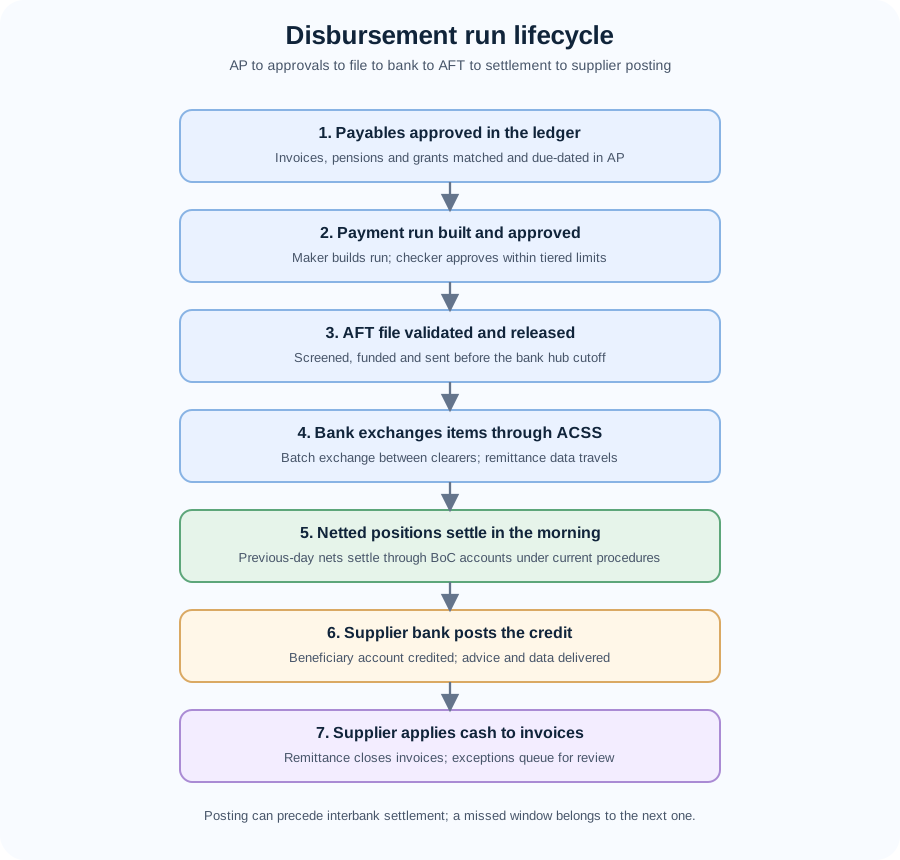
The diagram above is your anchor for the whole chapter. Read it top to bottom for flow — approved payables, run approval, file release, ACSS exchange, morning settlement, supplier posting, cash application — and notice the two truths it carries. First, the payer's clock and the interbank clock run at once: the supplier may see a credit before interbank positions settle, and the payer's ledger clears before the supplier applies cash. Second, the remittance travels with the value the whole way down: the payment answers "how much," the remittance answers "for what," and a run that carries the first without the second has paid without communicating. Every later section is a deeper pass over one box or one arrow in that picture.
2. Participants, responsibilities and system boundaries
A disbursement run involves more parties than the payer who thinks of it as paying its suppliers. The bank professional must keep six layers straight: the paying business and its internal actors, the originating bank, the clearing capacities behind that bank, the system operator, the settlement agent, and the receiving banks with their suppliers. Confusing any two produces the classic errors this chapter corrects — treating the file transmitter as the party that warrants payment, treating the system as the party that owes the supplier money, or treating a supplier's bank posting as interbank settlement.
Start with the paying business, because disbursements differ from consumer payments in one decisive respect: the originator is an organization with its own internal control chain. Inside the payer sit at least four roles that must stay separate. Accounts payable owns the liability: matching invoices to purchase orders and receipts, applying discount terms, proposing which invoices enter this week's run. Treasury or finance management owns the decision to pay: approving the run, confirming funding, enforcing approval tiers where larger runs need more senior or additional approvers. The vendor-master owner owns payee truth: creating and changing supplier banking details under dual control, the single most fraud-sensitive duty in the whole flow. And IT or the service bureau owns the plumbing: the enterprise system or outsourced processor that formats the AFT file exactly as the bank agreed. Every painful disbursement incident involves two of these roles collapsed into one person, or a handoff between them where both sides assumed the other owned a step. Section 7 returns to this with the control matrix; here, learn the shape: propose, approve, validate the payee, release — four verbs, ideally four different accountabilities.
The originating bank — the payer's bank — is where the run becomes a warranted batch. The bank authenticates the releaser, checks entitlements, validates the file against the agreed format and limits, screens parties, confirms the payer's account will be funded, and releases the items into clearing with its warrant implied: the bank stands behind the items it introduces, including data quality and authority, under the rulebook. What the bank does not do is equally important: it does not approve which suppliers deserve payment, does not negotiate discount terms, and does not repair the payer's vendor master. The boundary between company responsibility and bank responsibility should be written down before volume flows — in the cash-management agreement, the file specification and the approval procedures — because every dispute after a bad run starts with both sides pointing at that unwritten line.
Banks participate in ACSS in distinct capacities, and the capacity constrains what the payer's bank can promise. A direct clearer exchanges items directly, enters volumes and values into the clearing calculation, holds a settlement account at the Bank of Canada, and funds its net position on settlement mornings. A group clearer does this for a group of member institutions under group arrangements. An indirect clearer participates through a direct clearer as its clearing and settlement agent, which exchanges on its behalf and settles for it under an agreement with defined cutoffs, funding, return-handling and reporting duties. The practical consequence for disbursements is direct: a business customer of an indirect bank lives inside the agent's timetable. The payer's file cutoff, late-file ability, return turnaround and incident communication are all bounded by arrangements the payer never sees — which is why the bank's published cutoffs must already include the agent's margin, and why front-line staff must never improvise timing promises beyond them.
Payments Canada sits in the middle as owner and operator of ACSS: the rulebook anchored by By-law No. 3, the exchange and clearing infrastructure, the calculation turning entered volumes and values into net positions, and the published operating framework including the business-day and closure calendar. It holds no payer or supplier accounts, does not decide whether an individual supplier credit posts, does not fund any participant's position, and does not guarantee any supplier payment. When this chapter says "the system," it means the operated clearing infrastructure plus the governing rulebook — never the bank's internal systems, and never a party to the commercial obligation between payer and supplier.
The Bank of Canada wears two hats that must never be blended. As settlement agent, it provides the settlement accounts on whose books net ACSS positions are extinguished — reached in practice through Lynx settlement payments by direct clearers. As overseer, it supervises ACSS as a designated prominent payment system. Final Canadian-dollar batch settlement needs the Bank of Canada's books; assurance that batch risk is governed comes from oversight.
The receiving bank and the supplier close the chain, and their responsibilities mirror the originator's in reverse. The receiving bank validates the destination account, posts the credit with awareness of return rights, delivers the remittance advice, and handles returns where the account is closed, invalid or frozen. The supplier owns cash application: matching the incoming credit and its remittance to open receivables and closing them, or raising the exception the payer must answer. Around these core parties sit the intermediaries that originate scale: payroll and pension administrators, corporate service bureaus, government disbursement platforms and enterprise-system vendors. Each intermediary's responsibility should be written down before volume flows. The bank's duty to validate, warrant and control the file does not move upstream to the bureau just because the bureau pressed the keys.
Responsibility, in short, is a chain with no gaps. The payer authorizes and funds. The payer's bank validates, screens, approves, releases and warrants. The clearing layer exchanges and positions. The settlement agent moves value finally. The receiving bank posts and reports. The supplier applies cash. Agents stand in for their sponsored institutions at the clearing and settlement steps. Every investigation in Section 8 walks this chain backwards, which is why learning the chain once, here, pays for itself in every later section.
3. Initiation, validation and bank processing
Every disbursement run starts in the same place: approved payables sitting in the payer's enterprise system, waiting for someone with authority to turn liability into money movement. The channel varies — an ERP payment-proposal screen, a treasury workstation, a host-to-host file from a shared service centre, a government disbursement platform generating thousands of lines — but the discipline converges on the same sequence: select, approve, format, validate, screen, fund, release. Items rejected inside the company cost a conversation and a same-week fix. Items rejected by the bank cost a business day. Items released with bad payee data cost returns, supplier goodwill and, in the worst case, money sent to a fraudster's account with no structured recall. The whole economics of this section is that ordering.
Selection turns approved liability into a proposed run. Accounts payable pulls due and discountable invoices, pension administrators pull the month's entitlement roster, government officers pull the approved grantee list. The proposal carries five facts plus authority for every line: who is paid, how much, from which payer account, for which value date, with what references, and under what approval. Control totals — item count and total value — are struck at selection and must survive every later stage unchanged; any break between proposal totals and file totals means the file was corrupted or tampered with between approval and release, and the run stops until the break is explained. Duplicate and anomaly checks run against history at selection: a supplier appearing twice with the same invoice number, a run total far above the rolling average, a payee whose amount jumped tenfold since last month. These are the cheapest detections in the entire lifecycle, because nothing has moved yet and the people who know the commercial truth sit in the next room.
Approval is where the payer's governance becomes evidence. The standard is maker-checker at minimum: the person who built the run cannot approve it. Larger runs add tiers — a second approver above a threshold, a treasury officer confirming funding, a segregation rule that the vendor-master owner cannot approve runs containing payees they created. Approval must be explicit, authenticated and timestamped, captured in a form the auditor can replay months later: who approved, what totals, when, under which delegated authority. Verbal approvals, shared passwords and after-the-fact sign-offs are not approvals; they are the findings that appear in the audit report after the incident. For pension and government batches, approval often includes a compliance attestation — eligibility confirmed, legislative authority cited — which travels with the run's documentation even though it never enters the clearing record.
Formatting turns the approved proposal into the bank-agreed file. The enterprise system or bureau maps each line to the agreed AFT layout: batch headers, item records with institution, transit and account structure, amounts, dates and control totals that must balance. Remittance lines are attached here — invoice numbers, adjustment references, discount taken — because after this point nobody with commercial knowledge touches the run again. Format validation confirms every record parses, every required field is present, every amount is positive and within agreed limits, every value date falls on a processable business day. Anything that fails here returns to AP for repair while repair is still cheap and still inside the company's walls.
Release is the moment the run leaves the company, and its controls decide whether the payer sleeps well. Authentication confirms the releaser is who they claim. Entitlement confirms they may release this account, this amount, today. Cutoff logic assigns the run to this window or the next and communicates that honestly — a run released after the bank's file cutoff belongs to the next window, full stop, and pretending otherwise manufactures a broken supplier promise. Funding confirmation verifies the payer's account will cover the run's total on debit day; many banks enforce this as a hard limit, and payers that run hot learn to pre-fund or to split runs across value dates. Transmission itself runs over the agreed secure channel — authenticated host-to-host or the bank's business portal — with a hash or checksum discipline that lets both sides prove the file received is the file sent. The bank's acknowledgement is the payer's most precious document: transmission accepted, item count and totals confirmed, window assigned. No acknowledgement, no sleep — an unacknowledged file is an unreleased run, and re-sending "just in case" without confirming is how duplicate runs are born.
The bank's processing after receipt mirrors the payer's discipline on the other side of the wall. The bank re-validates format and totals, re-checks entitlements and limits, screens parties, verifies funding, and only then releases the items into ACSS exchange with its warrant implied. The bank records release time, window assignment and external references at release, because every later inquiry starts from that record. The control order holds: authentication, entitlement, limits, fraud, sanctions, cutoff, approval — each decision logged before clearing sees anything.
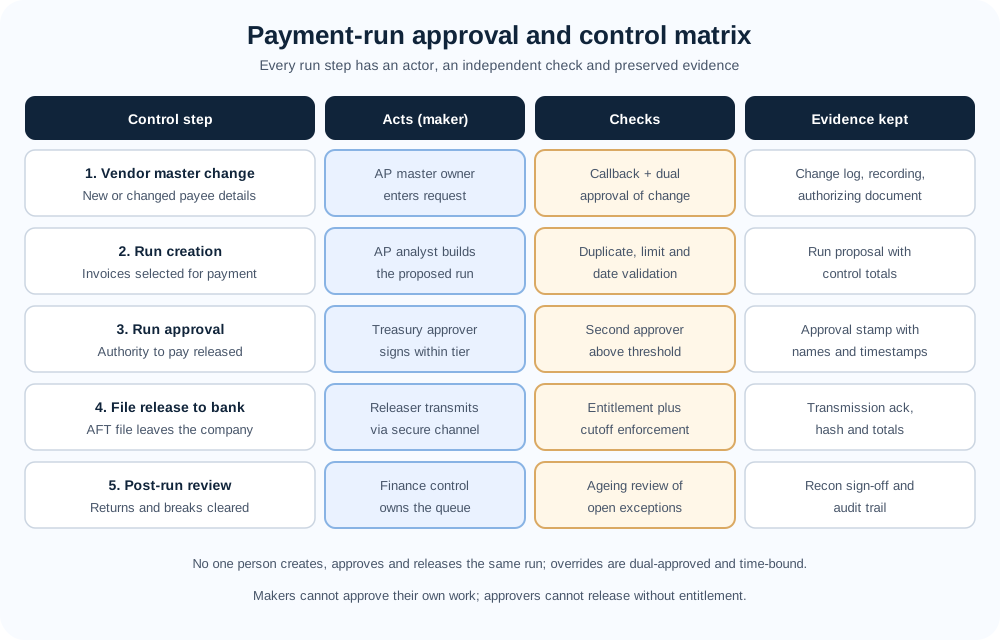
The matrix above deserves a slow read, because it answers the question behind half of all disbursement failures: who was supposed to check this? Read each row left to right — the step, the actor, the independent check, the evidence — and notice the two rules that hold the whole structure up. Makers cannot approve their own work, and approvers cannot release without entitlement. Every override of those rules — the verbal instruction, the after-cutoff exception, the shared token during month-end pressure — must itself be controlled, dual-approved, time-bound and reviewed, because the history of disbursement losses is largely a history of overrides that bypassed the matrix. Print this diagram, walk your next run against it, and fix the row that makes you uncomfortable before volume teaches you the same lesson.
Two principles from the fundamentals chapter decide whether all of this survives reality. First, route by policy rather than habit: the time-critical payment that missed its batch window belongs on a same-day-final rail if the payer accepts the cost — not in batch with a wish attached. Second, fail visibly and early: a bank that rejects a malformed file with a reason, a repair path and a next-window promise creates one phone call; a bank that accepts everything and fails in clearing creates a week of investigations across hundreds of suppliers.
4. Clearing or exchange, settlement and finality
If Section 3 is about decisions before release, this section is about the system's promise afterwards — and the most expensive misunderstandings in disbursements come from blending six events that are genuinely different. Exchange delivers items and data between participants. Clearing validates, sorts and positions those items by stream and window. Settlement moves value finally between settlement accounts. Posting debits and credits customer accounts on the bank's books. Availability tells the supplier the funds may be used. Finality tells the system the value movement cannot be unwound through the settlement mechanism. Every rail combines these differently, and the professional who blends them misleads payers, misstates funding and mishandles exceptions. Learn the six words, use them exactly, and half of disbursement confusion disappears.
ACSS defers settlement by design, and the deferral is the whole point of batch economics. The payer's bank releases AFT credit items into daytime batch exchange — directly or through its agent — alongside the rest of the day's retail batch traffic. Each direct clearer enters the volumes and values of the items for which it is owed funds, and those entries combine with paper totals to determine net balances: a single net amount each direct clearer owes to the system or is owed by it. Settlement of the previous day's net balances then occurs during the morning of the following business day through payments to and from direct-clearer settlement accounts on the Bank of Canada's books. The exact operational message or payment path is governed by current ACSS/Lynx procedures, not by this chapter. Thousands of supplier credits collapse into one funding event per clearer. That collapse is the efficiency of net settlement — and the reason treasury teams forecast nets rather than items, as Section 9 explains.
Finality in this model is positional and rule-governed, not per-item and instant. When the morning settlement completes, interbank positions settle finally in central-bank money — yet defined return rights for the underlying customer items survive for their reasons and timeframes: closed or invalid accounts, frozen accounts, ineligible items. A receiving bank may post or make funds available under its applicable bank and rule obligations before the payer can infer that interbank settlement has completed; posting is not proof of finality. That is the batch bargain stated precisely — efficiency and reach at the cost of deferred settlement and return exposure. Each half without the other misleads. A payer that hears "posted" and understands "irrevocable" will learn the difference from a fraud case, at the worst moment, which is why Section 7 insists that availability language always carries return-rights awareness.
Contrast this with the urgent wire, because the routine-versus-urgent choice is the advisory moment this chapter exists to teach. In Lynx, each payment settles individually in real time across Bank of Canada accounts, with no netting and no deferred position. Once settled, a Lynx payment is final and irrevocable through the system; recovering a misdirected payment requires a new payment with the beneficiary's agreement. Batch inverts every one of those properties: items accumulate, positions net, settlement follows in a later window, and defined returns remain available afterwards. The bridge between the two models is the settlement morning itself, when deferred batch nets are extinguished through payments between direct-clearer settlement accounts under the applicable system procedures — gross item flows producing a net result.
The choice between routine AFT and urgent Lynx wire is therefore a comparison of bundles, not speeds. Timing: AFT pays in a later window on business-day rhythm; Lynx settles today with immediate finality. Cost: AFT prices in cents per item by construction; Lynx prices as a wholesale service the payer should feel on a four-hundred-line run. Data: an AFT or EDI service may carry structured remittance when the payer's bank and the supplier's bank support the agreed format; a wire's remittance conversation must be arranged, not assumed. Certainty: Lynx finality is per-payment and irrevocable; AFT certainty is positional with surviving return rights. Recall: a misdirected AFT credit has defined return paths for defined reasons; a misdirected wire needs beneficiary cooperation. The decision rule fits on a card: routine, numerous, predictable disbursements go by AFT; the single payment whose delay costs more than the bank-specific wire price goes by Lynx with its pricing accepted explicitly.
Never promise same-day finality on batch timing. The channel may only offer what operations confirms for this run, this amount, this rail, this business day — and "late but urgent" batch is a contradiction the bank resolves by offering the wire, not by improvising around the window. The full exchange mechanics and the settlement lifecycle step by step belong to the dedicated chapters later in this programme; this section gave you the vocabulary, the shape and the advisory conversation. Do not design operational procedures from this section alone.
5. Data, identifiers, messages and references
If clearing is the road network, data is the addressing — and disbursement runs fail far more often from bad addressing and thin references than from system outages. The discipline fits in three verbs that this section keeps returning to: capture completely, validate early, preserve identity end to end. What each run needs, which references must survive the whole journey, and where the data travels — payment versus remittance — determines whether exchange, settlement, posting and reconciliation succeed or generate the exceptions that Section 8 must then clear.
Domestic routing starts with the Canadian account identifier triple: institution number, transit (branch) number and account number, subject to the applicable bank and file-format rules. Payments Canada's Financial Institutions File is the weekly electronic directory of routing numbers used to facilitate delivery to the appropriate deposit-taking institution; it is not, by itself, proof that a particular customer account is open or owned by the named supplier. Reachability is therefore a data question before it is a rail question, and an unreachable or malformed destination must be rejected or repaired in processing — never released "to see what happens." Each rail prices that error differently: batch can produce a return cycle measured in days, while a wire may require a new payment and beneficiary cooperation. The cheapest place to fix addressing is always before release, which is exactly why the vendor-master validation in Section 3 sits where it does, and why the onboarding diagram in Section 7 treats a changed account as a new payee.
Each AFT file then adds its own data layer on top of the triple. Batch headers identify the originator, the value date and the file's control totals. Item records carry the destination triple, the amount, the date and the transaction coding that identifies what kind of record each line is. Control totals must balance — item counts and values, plus any bank-specific integrity checks — because that balance lets operations detect a truncated or corrupted file before it poisons clearing. Return reason codes identify why an item came back, defined by the current rule and standard set and used exactly rather than approximated with free text, which is what makes returns machine-processable instead of manually researched. None of this requires quoting any standard in this chapter. It requires respecting that the standards exist, using current published versions, and validating against them before release.
The distinction that matters most in disbursements is between the payment and the remittance, because they answer different questions for different people. The payment item moves value and identifies the accounts: the payer's bank debits, the supplier's bank credits. The remittance answers the supplier's question — which invoices does this money settle — with invoice numbers, dates, gross amounts, discounts taken, adjustments and the payer's reference. The payment without the remittance is money without meaning: it arrives, and the supplier cannot use it. The diagram below shows the two travelling together and converging at the supplier's receivables desk, where they either auto-match or join the exception queue.
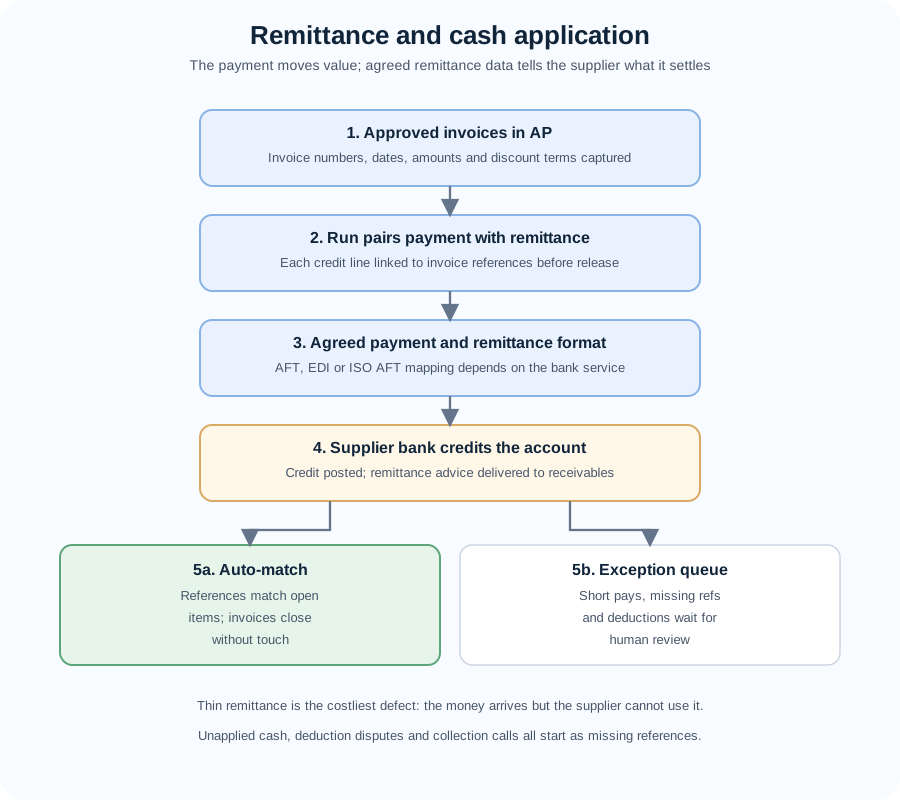
Structured electronic remittance is valuable at the receiving end, but the route must be named accurately. Payments Canada's Rule E3 governs a distinct credit-driven Canadian-dollar EDI payment item and says the payment may be sent with or without related remittance information; EDI is not a universal remittance companion to every Standard 005 AFT credit. ACSS separately reports EDI and electronic-remittance streams. Described at family level — the level this chapter stays at, with message-level detail belonging to the programme's format coverage — the EDI path can carry machine-readable payment and related financial data, while an AFT or ISO AFT service may expose remittance fields under its own bank and scheme mapping. The coarser alternatives — a free-text reference line, a separate remittance advice, or a spreadsheet the supplier must reconcile by hand — scale badly. The practical guidance for payers is therefore blunt: send the richest structured remittance the selected bank channel and the supplier's systems can both support, confirm whether that means AFT, EDI or ISO AFT, and treat "no remittance" as a defect with a measurable cost in supplier calls, unapplied cash and damaged discount economics — not as a cosmetic gap.
Messages and files are the carriers, and Canada is living through coexistence: legacy Standard 005 batch layouts sit alongside ISO 20022 AFT processing, meeting at mappings where truncation and repair risk concentrates. Payments Canada publishes an ISO AFT onboarding, registration and testing process; corporate-to-bank message examples on its resource page are labelled draft and for information only. Payer, bureau and bank must validate against the destination schema, map explicitly, and carry the original customer reference forward. Coexistence is a multi-year condition to be engineered for, not a cutover to wait out — and every format change is a full re-test of the run under Section 10.
References are what let humans and systems agree they are discussing the same payment, and five must survive every disbursement journey. The payer's internal run identifier anchors tracking from proposal through investigation. The per-item instruction identifier anchors each supplier line within the run. The clearing reference — file, batch and item traceability through exchange — anchors the system's view. The return linkage anchors the round trip when an item comes back, so the return finds its original without manual matching. The customer remittance — invoice numbers, claim identifiers, grant references — anchors the supplier's reconciliation. Drop any one and a different team pays: drop the run identifier and investigations stall; drop the clearing trace and operations cannot match bank reports; drop the return linkage and returns become research projects; drop the remittance and the supplier's receivables team phones the payer. Reference discipline is unglamorous and decisive, which is exactly why it belongs in this chapter rather than being left to a technical appendix.
Two practical consequences follow. First, master-data quality is a payments control: clean vendor masters, validated banking details and disciplined invoice referencing prevent more exceptions than any downstream repair process. Second, evidence preservation starts at origination: approvals, validation results, screening dispositions and release records must be retained retrievably for the full window in which returns, disputes and audits can arise. Storage is cheap. Reconstruction is expensive. Audit findings are most expensive.
6. Rules, cutoffs, service levels and customer impact
Payers experience rules as promises: will suppliers be paid Friday, when can the funds be used, what will it cost, what reference will appear, what happens if an account is wrong. The bank experiences rules as windows, obligations and evidence. This section connects the two — and it does so without stating a single exact cutoff time, because exact times vary by bank, by clearer, by file type and by day, and they move with holidays and calendars. This chapter speaks only in relative windows, and any study note, job aid or payer script that quotes a specific hour from this chapter is misusing it. Binding times come from your bank's published schedules read together with the published system closure calendar. That sentence is worth memorizing.
The rulebook layering is straightforward in shape, and shape is all this chapter requires. By-law No. 3 establishes the system's legal foundation for payment items and ACSS. Rules under it govern what may be exchanged, participant conduct, stream requirements, returns and adjustments, and the obligations of each capacity. Standards govern the technical detail: file formats, encoding, codes, documents. Functionally, the AFT rules — the F-series family that practitioners reference, including Rule F1 and Rule F4 — govern the exchange of AFT credit and debit items: what records may travel, the warranties the originating bank gives when it introduces items, how receiving sides return items for defined reasons, and how adjustments allocate small-value consequences. That functional description is deliberately pitched at family level: the binding content, current versions and amendment history live in the published rules and documentation, and "we have always done it this way" is never a substitute for checking the current text. The detailed map of which rule governs which stream belongs to the streams-and-windows coverage; here, know the layers, know that AFT disbursements sit inside them, and build the habit of checking currency before advising any payer.
Business days anchor everything in batch. The system operates Monday to Friday excluding holidays, with closures published in the system closure schedule. A Thursday-evening run file does not "miss by minutes"; it misses the business-day window and belongs to the next one. A Friday-afternoon instruction that falls after the bank's internal file cutoff does not "just make it"; it waits under published policy. A Monday holiday does not compress the week; it shifts value dates, settlement mornings and return clocks by a day, and every payer communication for that week should reflect the shift proactively — the pension administrator warns retirees, the AP team resets supplier promises — rather than explaining it after complaints arrive. The logic that assigns each run to a business-day window at intake, and communicates that window honestly at intake, is the single most payer-visible control in this chapter. Channels must never promise what the rail calendar cannot deliver, which means channels and operations share one clock: the channel may only offer what processing confirms for this run, this amount, this originator, this business day.
Relative windows within a business day differ by stream in ways the lifecycle diagram makes visible: file intake with validation and release, daytime exchange windows when items move between clearers, clearing and calculation activity that turns entries into positions, the morning settlement when previous-day nets are extinguished, and post-settlement periods when posting, reporting, returns and adjustments flow. Each stream has its own rhythm inside that shape, taught in full by the streams coverage. The disbursement lesson is the discipline, not the timetable: release before the applicable cutoff means this window; after means the next; and "late but urgent" batch is a contradiction the bank resolves by offering the same-day-final wire, not by improvising around the window. Discount economics make this concrete: the supplier paid a day late because the run missed its window just cost the payer the early-payment discount on the whole run — a visible, calculable loss that belongs in every business case for cutoff discipline.
Service levels bundle timing with certainty, information and recourse, and the bank's advisory job is to match the business event to the bundle. The routine disbursement bundle offers low-cost scale with structured remittance and defined returns — at the price of deferred settlement and return exposure. The urgent wire bundle offers immediacy and irrevocability — at wholesale pricing with no unilateral recall. Pension and government batches add a third dimension to the bundle: the promise is not just timing but universality and auditability — every entitled payee, every time, with a trail. The honest conversation compares bundles, not speeds, and it states value-date conventions explicitly: which date the payer's account is debited, which date the supplier should expect the credit, and what each date assumes about windows and holidays.
Payer communication must reflect finality honestly, using the six words from Section 4 exactly. "Sent" means released from processing. "Accepted" means clearing took it. "Settled" means interbank value moved finally. "Posted" means the supplier account was credited. "Available" means the supplier may use the funds, subject to holds or return rights. "Final" means the value cannot be unwound through the settlement mechanism. A disbursement "posted" must always be stated with return-rights awareness. Most batch complaints are vocabulary failures wearing operational costumes: the supplier heard "sent" and understood "final," and nobody corrected the translation until a return moved money unexpectedly. Train every payer-facing employee in the six words, and half the escalations never happen.
7. Fraud, compliance and operational controls
Controls fail most often not by absence but by placement. A sanctions check that runs after value has settled, a fraud hold that triggers after the supplier has been told funds arrived, a callback that happens after the changed account has already been paid — each is a control that exists and still loses, because it runs on the wrong side of the event it was meant to govern. This section places each control family at the point in the disbursement flow where it can still change the outcome. Rail-level control detail for fraud landscapes, reporting mechanics and screening systems lives in the programme's later risk and compliance coverage; here the lesson is architectural: prevention sits before release, detection sits across processing and clearing, and evidence sits everywhere.
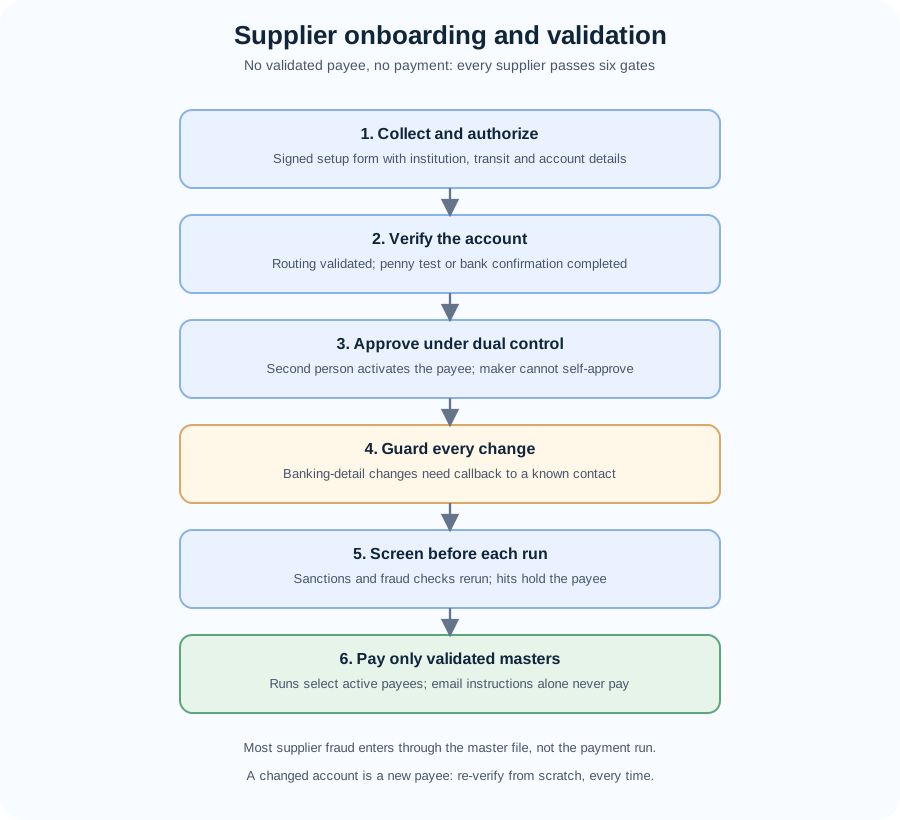
Supplier disbursements attract fraud precisely because they are routine. High volume dulls attention, repeating payees breed familiarity, month-end pressure rewards speed over scrutiny, and the authority to move money concentrates in a few hands and systems. The dominant threat is business email compromise aimed at the vendor master: a message that looks like a known supplier announces new banking details, sometimes with a forged letter on stolen letterhead, sometimes as a thread hijack inside a genuine conversation, sometimes as an "urgent" instruction from the requestor's own executive whose mailbox has been spoofed. The payment run that follows is completely legitimate in every respect except one — the money goes to the fraudster — which is why run-level controls cannot catch it and master-level controls must. The defence is procedural and unglamorous: every new payee and every banking-detail change is verified against a source independent of the change request itself — a callback to a known contact on a known number, a penny-test confirmation, a document authenticated through the existing relationship — under dual control, with the verification evidence preserved. A changed account is a new payee: re-verify from scratch, every time, with no exception for urgency, familiarity or seniority of the requestor. The diagram below shows the six gates; the callback gate is the one fraudsters work hardest to bypass, usually by manufacturing the urgency that makes staff skip it.
Origination fraud attacks the run itself rather than the master: fictitious suppliers inserted by an insider, inflated amounts on genuine payees, duplicate invoice lines slipped into month-end volume, a pension roster padded with ineligible names. The defences are the matrix from Section 3 made real: segregation between master ownership and run approval, maker-checker with tiered second approvers, duplicate and anomaly detection against history, and post-run review that actually reads the exception queue instead of clearing it. Incoming-side awareness matters too: mule networks collect batch credits and move them on within hours, which means the receiving bank's scoring of incoming credits complements the payer's controls. Any business running both pushes and pulls must not let pull-authorization habits leak into push behaviour — a debit mandate is never authority for a credit, and netting a supplier's receivable against its payable without agreement manufactures the dispute Section 8 must then unwind.
Authorization controls in disbursements mean delegated financial authority, and they deserve the same seriousness as mandate evidence in collections. The bank must be satisfied the releaser acts within the payer's mandate: signing authorities on file, entitlements current, approval tiers respected, dormant authorities revoked when treasurers change. The payer must be able to evidence the run's approval when challenged months later: who approved, what totals, under which delegation. An approval file that cannot be found is operationally equivalent to no approval at all, and dispute and audit outcomes will reflect that equivalence.
Sanctions and watchlist screening are bank-specific controls that must comply with applicable Canadian sanctions law and the bank's risk policy; they should gate release, with documented dispositions and escalation. The FINTRAC travel rule and electronic-funds-transfer reporting duties are fact-specific and principally attach to prescribed international EFT scenarios for reporting entities, not automatically to every domestic AFT credit. A bank may also screen domestic batch parties and remittance data under its own controls. Complete, untruncated data matters: missing information can create false positives and escalation queues, while a true hit must be held and investigated under the bank's procedure. Log what was checked, when, against which lists, by whom, with what disposition. That log is the difference between a defensible process and an anecdote.
Anti-money-laundering and record-keeping obligations attach according to the entity, activity and applicable law; they are not themselves payment approvals. For reporting entities, FINTRAC requires prescribed international EFT reporting and associated information in the circumstances set out in its guidance, while domestic AFT processing may still be subject to applicable client-identification, transaction-record and compliance-program duties. Capture relevant data at origination, preserve it untruncated through clearing, and retrieve it for the applicable retention window. Government disbursement programmes add their own transparency duties — eligibility records, legislative authority, publication and audit regimes — created at selection and approval, not assembled during the audit.
Operational controls tie the families together: entitlements and dual approval, limits and velocity, cutoff enforcement, queue ownership with ageing, amendment discipline, evidence preservation and segregation of duties. The control that binds them is release discipline — no run reaches clearing without passing authentication, validation, limits, fraud, sanctions, cutoff and approval in that order, each decision logged. Overrides of that order must themselves be controlled, dual-approved, time-bound and reviewed. Contingency connectivity, alternative file paths and communication trees belong in the same plane and return in Section 10 under resilience. Oversight completes the plane: designation of the batch system as prominent brings risk-management expectations proportionate to payments system risk, expressed in participant banks as governance over clearing operations, documented procedures, tested resilience, incident reporting and evidence that controls run every window. Supervisors and audit will ask for exactly what this chapter has been building: who instructed, who approved, what was checked and when, which window carried it, how it settled, where it posted, how exceptions were handled. A bank that keeps that evidence as a by-product of disciplined processing answers easily. A bank that reconstructs it after the fact answers expensively.
8. Exceptions, investigations and recovery
Every disbursement window breaks differently, but every break is managed the same way: detect fast, classify correctly, contain within the rail's rights, recover as a new linked event, and reconcile with evidence. Banks and payers that classify first recover cheaply. Those that act first — re-sending the run, manually crediting the supplier, editing a settled record — create duplicate payments, duplicate credits and audit breaks that dwarf the original error. This section teaches the classification and the recovery discipline at working depth, with the mechanism-level timelines, codes and adjustment flows living in the programme's dedicated exceptions coverage, pointed to throughout.
Start with the taxonomy, because precise words are the cheapest control in exception handling. A reject happens before clearing: the bank's processing, the gateway or the receiving side refuses the instruction for invalid routing, a closed account, a limit breach, failed screening or incomplete data. Nothing settled; the payer repairs and re-originates, and the communication to the supplier states the reason, the repair path and the next window. A return happens after entry: the receiving side sends the item back for a closed or invalid account, a frozen account, or an ineligible item, with reason codes and timeframes defined by the rulebook. Returns are normal batch traffic, not scandals — a well-run operation processes them daily with straight-through matching and only escalates the exceptions within the exceptions. A reversal corrects a bank or system error through a defined mechanism — a duplicate file, a wrong amount released by the bank — never by silent editing of a settled record. An adjustment handles the small-value consequences the rulebook allocates: fees, compensation and corrections that keep the economics fair without relitigating the item. A recall or return request asks the beneficiary's side to send funds back — which requires cooperation, because settled value cannot be unilaterally pulled back, and which payers must understand before they promise a supplier that an error "will be reversed." An investigation tracks an uncertain outcome: a run with no acknowledgement, a return without a matching original, a settlement figure that does not agree. Each word means something different, and using them interchangeably in payer communication or incident tickets guarantees confusion the incident itself did not require.
Return reasons in disbursements cluster into a short list worth learning by shape. Account reasons dominate — closed, invalid, frozen — because vendor masters decay: suppliers change banks, accounts close after acquisitions, a transit digit is mistyped at setup. Recourse is master-data repair before re-origination, plus a standing hygiene practice: validate the master before every run, not after every return. Funds reasons are rarer on the credit side but real — the payer's account short on debit day, a limit breached by an unusually large run — and recourse is funding policy and treasury communication, not system escalation: pre-fund large runs, split value dates, confirm limits before release week. Authorization and eligibility reasons appear in pension and government batches — ineligible payees, duplicate entitlements — and recourse is eligibility evidence or acceptance of the return with recovery through the programme's own overpayment process, never through editing the payment record. Administrative reasons — ineligible items, malformed records, duplicates — say the payer's or bank's own processing failed; recourse is internal, starting with the control totals that should have caught the break before release.
Recovery follows one iron rule: never mutate history; always create a linked new event. A rejected line is repaired and re-originated with linkage to the original run. A returned credit is re-paid only after the master is corrected, as a new instruction carrying the original run and line references. A duplicate run is reversed through the defined mechanism with the original preserved for audit — and the supplier who received twice is contacted promptly, because the second credit is theirs to return and the relationship is worth more than the recovery timetable. An adjustment is raised as its own entry referencing the original. Every recovery carries three references minimum: the original run identifier, the clearing trace of the failed or returned item, and the new event's own identifier. This linkage is what makes reconciliation possible and what auditors verify. The payer that re-sends "the same run again" without linkage has created two runs and will discover the second one from its suppliers, at the worst moment.
Investigations run on evidence assembled from the chain in Section 2. Start from the release record — transmission acknowledgement, window assignment, control totals — check clearing and posting records and bank reports, and only then contact the counterparty or agent with a precise, reference-carrying query. For indirect clearers, the agent is part of the investigation path by contract. Status communication follows the vocabulary rule from Section 6: state what is known and what is being done, never upgrade "tracked" to "resolved" before the evidence arrives. Most disbursement investigations close within return and reporting cycles; the ones that do not are usually reference failures — which is why Section 5 called reference discipline decisive.
Containment deserves a final word because run scale punishes slow containment. A corrupt file, a compromised releaser credential, a fraudster's account inside the master: first stop the bleeding — hold pending releases from the affected source, quarantine the repair queue, freeze the suspect payee, notify the bank and, where required, counterparties — and only then diagnose. Containment decisions need pre-assigned authority reachable during every window, not an escalation tree that convenes tomorrow. The runbook mindset this section establishes — classify, contain, recover as linked events, reconcile with evidence — is what Section 10 turns into tested procedure.
9. Posting, accounting, liquidity, reporting and reconciliation
Posting is where the run becomes balances, and disbursement posting has two sides that must never be confused. On the payer's side, the originating bank debits the payer's account for the run total on the agreed value date — one debit for the whole run in the normal case — and the payer's enterprise system clears open AP items against that debit while accruing for any lines still in flight. On the supplier's side, each receiving bank credits its payees' accounts under its funds-availability practice, delivers remittance advices, and the supplier's receivables system applies cash against open invoices. Between those two postings sits the interbank settlement from Section 4, which neither side's customer sees directly but both sides' treasury teams must respect: the payer's bank funds a net position on the settlement morning, and the receiving bank manages return exposure until the return windows close. Posting can precede settlement. Availability can precede finality. The professional states each event with its own verb and never lets one imply the others.
Accounting for a run follows the liability, not the file, but the exact treatment is the payer's accounting policy and contract context. At selection, the books still show the obligation. At release with a confirmed bank acknowledgement, a payer may reclassify cash as committed or disbursement in transit; that acknowledgement is not, by itself, proof of legal discharge or supplier cash availability. Returns are recorded as linked new events and the payable may reopen under policy. Pension and government batches add entitlement accounting — eligibility periods, overpayment receivables, recovery instalments — on the same spine: obligation, commitment, settlement, closure, every state change evidenced and dated.
Liquidity in disbursements is a forecasting discipline with a weekly heartbeat. The payer's treasury forecasts the run's funding need against the debit date and confirms limits before release week — a shortfall on debit day converts four hundred promised payments into four hundred broken promises simultaneously. The payer's bank forecasts the net position across all originators' runs, funded once on the settlement morning. The receiving bank manages return exposure until the return windows close. Three different liquidity questions, three owners, one shared calendar of relative windows plus the holiday schedule.
Reporting is the product the payer actually experiences after release, and its quality decides whether reconciliation is a routine or a research project. At minimum the payer receives the transmission acknowledgement with totals and window assignment, the debit advice for the run total, item-level status including rejects with reasons, return reports with reason codes linked to original lines, and periodic statements that carry the run's references into the general ledger feed. The standard that separates adequate reporting from excellent reporting is linkage: every report line carries the payer's run and item identifiers back, so the payer's systems match automatically instead of manually. Payers negotiating cash-management agreements should specify this linkage explicitly — identifiers preserved, returns coded, reports timed — because reporting agreed vaguely is reporting delivered thinly, and thin reporting is the unapplied-cash queue of Section 5 wearing a bank logo.
Reconciliation closes the loop daily, and the diagram below shows its shape: four evidence sources converging on one match. The run control totals say what the company authorized. The bank debit and status reports say what the bank accepted and moved. The settlement positions say what the interbank layer extinguished. The ledger postings say what the books recorded. The daily three-way match — run equals bank equals ledger, with settlement confirming behind — clears everything that agrees and ages everything that does not, with an owner and a date on every open break. Returns and adjustments re-enter the chain as new linked events against the original run, never as edits. Unmatched today is investigated tomorrow; unmatched this month is a finding. That sentence, enforced, is the whole of reconciliation discipline.
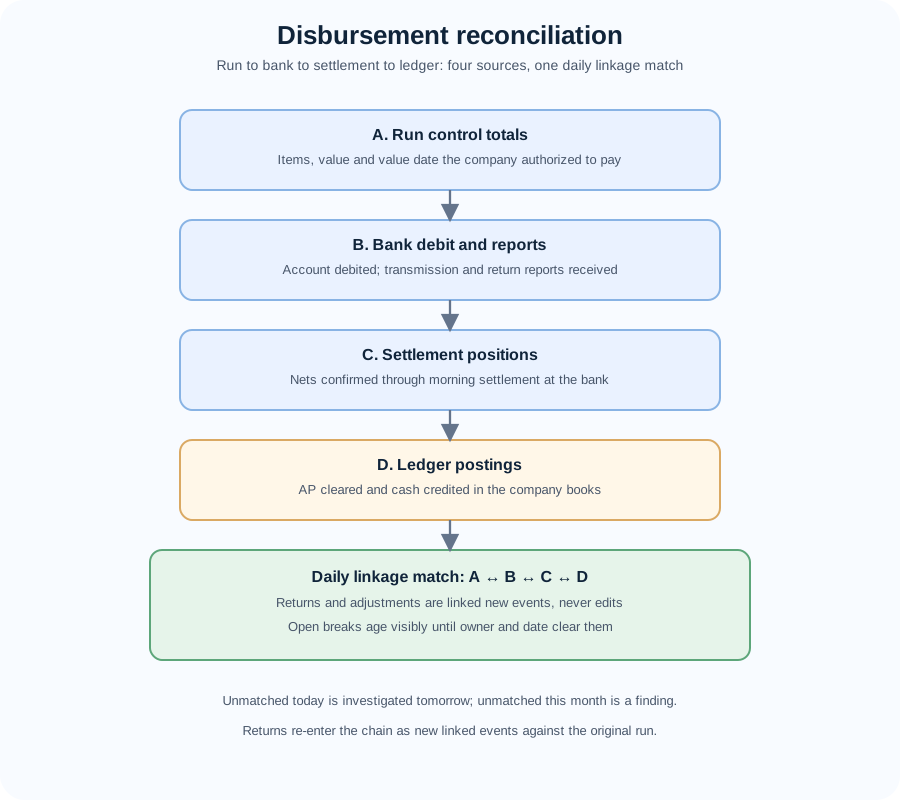
Read the diagram bottom-up as well as top-down. Top-down it is the flow of evidence; bottom-up it is the investigation path — every break in the match walks back up the chain to the source that disagrees. The single most useful habit this section can give either side of the run: reconcile to linkage, not to amounts. Amounts that agree by coincidence across mismatched references are the breaks that explode quarter-end; references that link properly make amount breaks trivially diagnosable. On-us items, where payer and payee bank at the same institution, never enter the interbank clearings at all — which is why the company's "what we sent" and the system's "what cleared" never match exactly, and why the reconciliation must track on-us lines on their own path rather than hunting them in clearing reports.
10. Bank implementation, testing and resilience
Offering disbursement services to business customers is a programme, not a feature, and banks that treat it as a file-upload screen learn the difference from their first large incident. Implementation spans onboarding, channel and format readiness, entitlements and limits, testing with the payer, operational coverage, and resilience — each with its own owner and none safely skipped. This section maps the programme at working depth; platform specifics belong to the bank's own documentation, and nothing here substitutes for the current published rulebook or the bank's change governance.
Onboarding the payer starts with the commercial relationship and ends with a tested file. In between sit the cash-management agreement with cutoffs, value-date conventions, limits, funding duties and return-handling responsibilities; the file specification with layouts, coding, control totals and remittance options agreed line by line; the entitlement design mapping the payer's maker-checker tiers into channel users, tokens and authorities; and the funding arrangement — pre-funding, daylight limits, or split value dates — sized to the payer's largest plausible run rather than its average one. Pension and government payers add eligibility and audit clauses; bureaus and shared service centres add tripartite clarity about who warrants what. Every element that Section 2 said should be written down gets written down here, before volume flows, because the first month-end is the wrong time to discover the agreement is silent on late files.
Testing earns its own emphasis because disbursement files fail in ways unit tests miss. Format testing confirms the payer's file parses exactly, across month-ends and holidays. End-to-end testing follows a small live run through validation, acknowledgement, posting, reporting and return handling, verifying identifiers survive every stage and reports match automatically. Remittance testing confirms the supplier's advice carries what the payer sent, untruncated. Regression testing repeats the suite with every enterprise-system, bureau or bank platform change — the most common cause of a broken run is a change nobody classified as payments-related.
Operational coverage means staffing the run's rhythm, not just the bank's hours. File intake peaks before cutoffs, return queues drain on their own cycles, month-ends and pension dates concentrate volume, and holiday weeks shift everything by a day with no reduction in payer anxiety. Queue ownership with ageing, published turnaround commitments, escalation trees reachable during every window, and incident communication templates that use the six vocabulary words correctly — these are the unglamorous assets that decide whether a bad Tuesday becomes a bad week. Indirect clearers add the agency dimension: the bank's timetables must already include the agent's margin, and incident communication must coordinate with the agent rather than improvising around it.
Resilience turns the runbook into survival. Contingency file paths — the alternative channel when the primary is down — are agreed, entitled and tested before they are needed, because a contingency first tried during an outage is a second outage. Releaser-credential compromise procedures freeze release authority without freezing the payer's business beyond necessity. Vendor-master compromise procedures quarantine suspect payees and hold affected runs while the callback discipline re-verifies from scratch. Settlement-morning disruption procedures reflect the batch reality that today's problem settles tomorrow: positions, funding and communication sequenced in that order. And the planned Real-Time Rail is treated here in its proper role: the bank's disbursement roadmap leaves architectural room — data richness, 24/7 operational thinking, channel flexibility — for the instant capability when it launches, without routing a single live instruction to it today or promising any payer a date beyond Payments Canada's current Q4 2026 target. Planning for the planned is prudence; selling the planned is misrepresentation.
11. Practical Canadian examples
The two cases below are fictional training stories — invented companies, invented figures, realistic mechanics. Each is labelled as required, each carries one control lesson, and neither replaces the rulebook or the bank's procedures. Work each one by walking the lifecycle diagram, naming the box where the outcome was decided, and stating what evidence would have changed it.
Example (fictional) — the changed bank details that almost paid a fraudster. A mid-sized Ontario food manufacturer pays roughly three hundred suppliers every second Friday by AFT. On the Monday of run week, accounts payable receives an email that appears to continue a genuine thread with a packaging supplier: new banking details "effective immediately," with a letter attached on plausible letterhead, and a follow-up call from a number the email helpfully provides. The AP clerk, under month-end pressure and praised in the past for clearing queues quickly, updates the vendor master and includes the supplier's $84,000 invoice in Friday's run. On Thursday the run's anomaly check flags the payee: amount triple its rolling average combined with banking details changed within the last ten days. The flag routes to the finance manager under the bank's recommended control, and she calls the supplier's operations number from the master file's history — not from the email. The supplier has changed nothing. The master change is reversed, the line is pulled from the run, credentials and logs are preserved, the bank's fraud contact is notified, and the incident becomes the quarter's best-attended training session. The lesson is the one Section 7 states without exception: a changed account is a new payee, verified against a source independent of the change request, under dual control, with no urgency override. The run-level controls worked exactly as designed — but only the master-level callback prevented the loss, because the fraudulent line was a legitimate instruction to the wrong account. Ask yourself: in your process, who can change banking details alone, and what would stop them on a busy Monday?
Example (fictional) — the pension batch with forty returns and one principle. A western Canadian pension administrator credits twenty-two thousand retirees on the first business day of each month by AFT, with eligibility confirmed the prior week and funding pre-positioned two days before debit day. In the January run, forty credits return over the following days: closed accounts, a handful of invalid transit numbers from a roster import, two frozen accounts under estate administration. The administrator's operations team works the returns queue the way Section 8 prescribes: each return matched automatically to its original line by clearing trace, payables reopened with linkage rather than edited, master records corrected from authenticated sources — estate documents for the frozen accounts, direct confirmation for the changed banks — and a single re-origination run the next week carrying every original reference forward. Retirees whose payments were delayed receive a plain-language explanation with the new date, and the two estate cases transfer to the programme's overpayment and recovery process rather than lingering in the payments queue. The month-end reconciliation matches run to bank to ledger with forty linked exceptions and zero unexplained breaks. The lesson is quieter than the fraud case and more widely applicable: returns are normal traffic, and a team that classifies first, repairs the master before re-originating, and reconciles to linkage instead of amounts turns forty failures into forty closed loops. Ask yourself: in your last return queue, how many lines were re-paid before the master was fixed — and how many returned twice?
A third pattern, compressed because its lesson is brief: the grant disbursement that honoured the holiday calendar. Example (fictional) — a provincial agency schedules a five-hundred-line grantee run for the Friday before a Monday holiday, releases the file after its bank's cutoff on Thursday evening, and discovers the run belongs to the next business-day window with settlement shifted accordingly. Because the agency's procedures state window assignment honestly and its communication templates use the six words exactly, community organizations receive Thursday notice that credits will post after the holiday rather than Monday complaints that money "was sent but never arrived." The lesson: the cheapest control in disbursements is an honest window stated early. Channels must never promise what the rail calendar cannot deliver.
12. Key takeaways and authoritative references
Ten sentences carry this chapter into practice. Routine supplier, pension, government and other high-volume disbursements can travel as AFT credits through ACSS — batch economics in exchange for deferred settlement and return exposure. The run is a chain of accountabilities — propose, approve, validate the payee, release — and collapsing any two is how incidents start. No validated payee, no payment: a changed account is a new payee, re-verified from an independent source under dual control. The payment moves value; the remittance moves meaning — send the richest structured remittance both ends can support, or budget for unapplied cash. Routine batch versus urgent wire is a comparison of bundles — timing, cost, data, certainty, recall, rhythm — never of speed alone, and same-day finality is never promised on batch timing. Timing is always relative windows plus the holiday calendar; binding times come from the bank's published schedules with the system closure calendar. Returns are normal traffic managed as linked new events; history is never mutated, references always preserved. Reconciliation is a daily three-way match — run equals bank equals ledger — with an owner on every open break. Evidence captured by disciplined processing answers auditors easily; reconstructed evidence answers expensively. And the planned Real-Time Rail changes future planning, never today's routing.
Authoritative references (official sources only)
This chapter uses only official sources. Re-check any time-sensitive page before customer or examination use. No exact cutoff times are stated in this chapter; for binding times use your bank's published schedules with the published system closure calendar. Rules are described functionally throughout; the binding text is the current published rulebook, not this chapter.
How to read the labels: statutory and regulatory duties are identified as such and belong to Justice Laws, FINTRAC, OSFI or other government sources; Payments Canada and Interac statements describe scheme/system or product rules, not universal bank promises; bank-specific implementation covers channels, entitlements, cutoffs, limits, screening, posting, reporting and accounting; and every training story is explicitly marked fictional.
- Payments Canada — Retail batch payment system. ACSS/USBE composition; direct and indirect clearers; net balances; morning settlement through payments to and from the Bank of Canada; electronic AFT, EDI and remittance streams. https://www.payments.ca/systems-services/payment-systems/retail-batch-payment-system
- Payments Canada — ACSS statistics (2021–2025). Current public volumes and values by payment-item category; notes on on-us items and what ACSS totals do and do not measure. https://www.payments.ca/automated-clearing-settlement-system-acss-statistics
- Payments Canada — Rules & documentation. Current versions in force, including the July 27, 2026 ACSS update and the rule/standard catalogue. https://www.payments.ca/systems-services/rules-documentation
- Payments Canada — Rule F1: Rules applicable to Automated Funds Transfer (AFT) Transactions (2026). Standard 005 AFT scope, exchange, processing, returns, tracing, settlement and incidents. https://www.payments.ca/sites/default/files/f1eng.pdf
- Payments Canada — Rule F4: Rules applicable to AFT Transactions exchanged using ISO 20022 messages (2026). ISO AFT scope, exchange, return/reversal messages, exception processing and settlement. https://www.payments.ca/sites/default/files/f4eng.pdf
- Payments Canada — Rule E3: Rules applicable to Electronic Data Interchange (EDI) Transactions (2026). Distinct credit-driven EDI payment items and whether related remittance is included. https://www.payments.ca/sites/default/files/e3eng.pdf
- Payments Canada — Rule F7: AFT System Financial Institutions File. FIF use and routing procedures for AFT; current rule text. https://www.payments.ca/sites/default/files/f7eng.pdf
- Payments Canada — Financial institutions file. Weekly directory of routing numbers for delivery to Canadian deposit-taking institutions. https://www.payments.ca/systems-services/payment-services/financial-institutions-file
- Payments Canada — Automatic funds transfer: ISO 20022 onboarding, registration and testing. AFT ISO adoption phases and draft corporate-to-bank message caveat. https://www.payments.ca/payment-resources/iso-20022/automatic-funds-transfer
- Payments Canada — System closure schedule. Monday–Friday operating calendar and 2026 statutory-holiday closures. https://www.payments.ca/system-closure-schedule
- Payments Canada — High-value payment system: Lynx. RTGS, irrevocability/finality, participation and ISO 20022 remittance capability. https://www.payments.ca/systems-services/payment-systems/high-value-payment-system-lynx
- Bank of Canada — Payment systems the Bank oversees. ACSS oversight and designated payment-system context. https://www.bankofcanada.ca/regulatory-oversight/financial-market-infrastructures/payment-systems-the-bank-of-canada-oversees/
- Bank of Canada — Settlement account policies for Payments Canada payment systems. Central-bank-money final settlement and direct-participant settlement-account policy for Lynx, ACSS and planned RTR. https://www.bankofcanada.ca/core-functions/financial-system/bank-canadas-settlement-account-policies-for-payments-canada-payment-systems/
- Payments Canada — Real-Time Rail payment system and About the Real-Time Rail. Current Q4 2026 launch target; planned 24/7 instant exchange, clearing and settlement; finality subject to RTR rules. https://www.payments.ca/systems-services/payment-systems/real-time-rail-payment-system https://www.payments.ca/systems-services/payment-systems/real-time-rail-payment-system/about-real-time-rail
- Interac — Interac e-Transfer for Business. Separate participant-dependent business product; bulk-payables scale, data-rich payments, limits and availability caveats. https://www.interac.ca/en/payments/business/send-receive-money-with-interac-e-transfer-for-business/
- FINTRAC — Reporting electronic funds transfers. Prescribed international EFT reporting, threshold and information requirements for reporting entities. https://fintrac-canafe.canada.ca/guidance-directives/transaction-operation/eft-dt/eft-dt-eng
- OSFI — Guideline E-21: Operational Risk Management and Resilience. Federally regulated financial institution expectations for critical operations, dependencies, monitoring, scenario testing and resilience. https://www.osfi-bsif.gc.ca/en/guidance/guidance-library/operational-risk-management-resilience-guideline
- Department of Finance Canada — Retail Payment Activities Act privacy impact assessment. PSP registration with the Bank of Canada and operationalization context. https://www.canada.ca/en/department-finance/corporate/transparency/access-information-privacy/reports/rpaa-laapd.html
- Justice Laws — Canadian Payments Association By-law No. 3: Payment Items and ACSS (SOR/2003-346). Current statutory definitions, participation, exchange, clearing, settlement and return framework. https://laws-lois.justice.gc.ca/eng/regulations/SOR-2003-346/index.html
- Justice Laws — Proceeds of Crime (Money Laundering) and Terrorist Financing Regulations (SOR/2002-184). Federal AML/ATF reporting and record-keeping regulation; apply provisions to the relevant entity and transaction. https://laws-lois.justice.gc.ca/eng/regulations/SOR-2002-184/index.html
Diagrams in this chapter: disbursement run lifecycle; payment-run approval and control matrix; remittance and cash-application link; supplier onboarding and payee validation; disbursement reconciliation — all under /diagrams/payment-stories/canada/chapter-19/. No exact cutoff times are shown. The Real-Time Rail is shown as planned. AFT rules including F1 and F4 are described functionally at family level; the binding text is the current published rulebook. Stories and companies are fictional.
This application uses JavaScript for the full interactive experience. This text summary is served for accessibility and search indexing.