Clearing Streams, Windows and Business Days. Understand stream-specific processing windows, business dates, cutoffs and operational calendars.
Canada Payments & Collections · Block 3: ACSS and Retail Batch Payments · Chapter 14 of 75
A payroll file that misses its window by twenty minutes does not arrive twenty minutes late. It arrives on the next business date, with a new settlement position, a new posting story, and ten thousand employees asking questions on Friday morning. This chapter explains why that is true, how to prevent it, and how to explain it when prevention fails. It is the operating-clock chapter of the Canadian programme: the place where clearing streams, processing windows, business dates and cutoffs stop being background trivia and become the promises your bank actually sells.
The scope of this chapter is exactly what the manifest says: understand stream-specific processing windows, business dates, cutoffs and operational calendars. It does not replace the Payments Canada rules, and it deliberately states no specific cutoff clock times. Times change and schedules republish each year — any time printed in a training manual becomes wrong the moment a rule is amended. Instead you will learn the conceptual machinery: what a window is, what a business date is, how streams differ, how weekends and holidays queue work, and where to look up the authoritative time for any given day.
Evidence labels used here. Regulatory/legal claims point to Canadian legislation or regulator guidance. Payments Canada and Interac scheme claims point to the current rule, standard or official service page. Bank-specific implementation describes a bank's own cutoff, posting, risk and control choices and is not a network rule. Examples explicitly marked fictional are teaching scenarios, not service commitments.
What you should be able to do after this chapter
After working through this chapter, you should be able to:
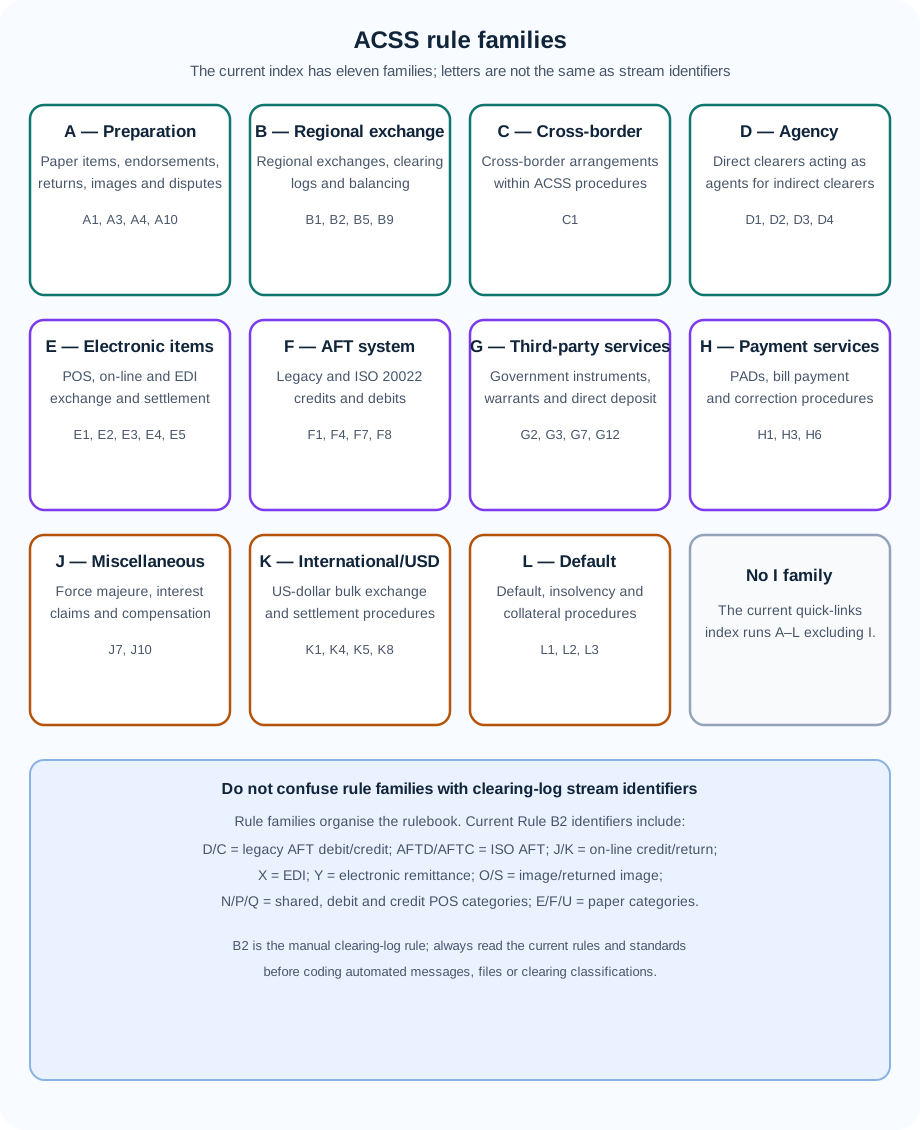
- explain what a clearing stream is, why Canada sorts retail items into streams, and what the eleven current ACSS rule families (A, B, C, D, E, F, G, H, J, K and L; there is no I family in the current index) each govern;
- distinguish a rule family from a clearing stream identifier and know where each is defined in the Payments Canada framework;
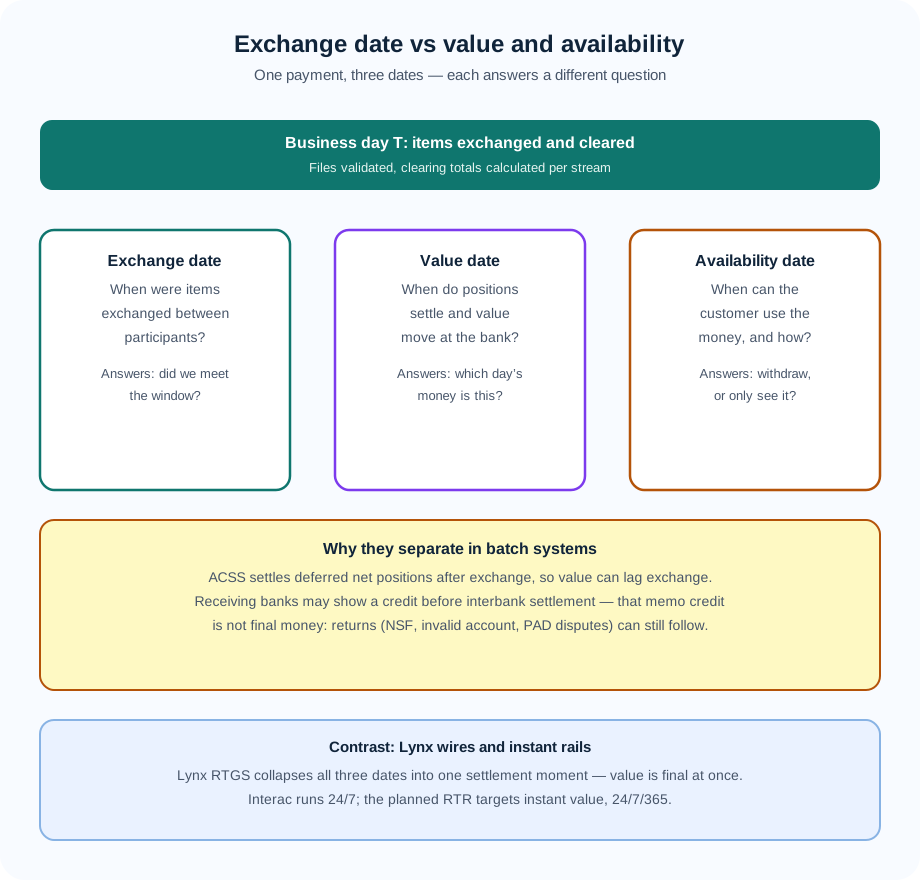
- define business day, business date, exchange date, value date and availability date, and explain why one payment can carry several different dates;
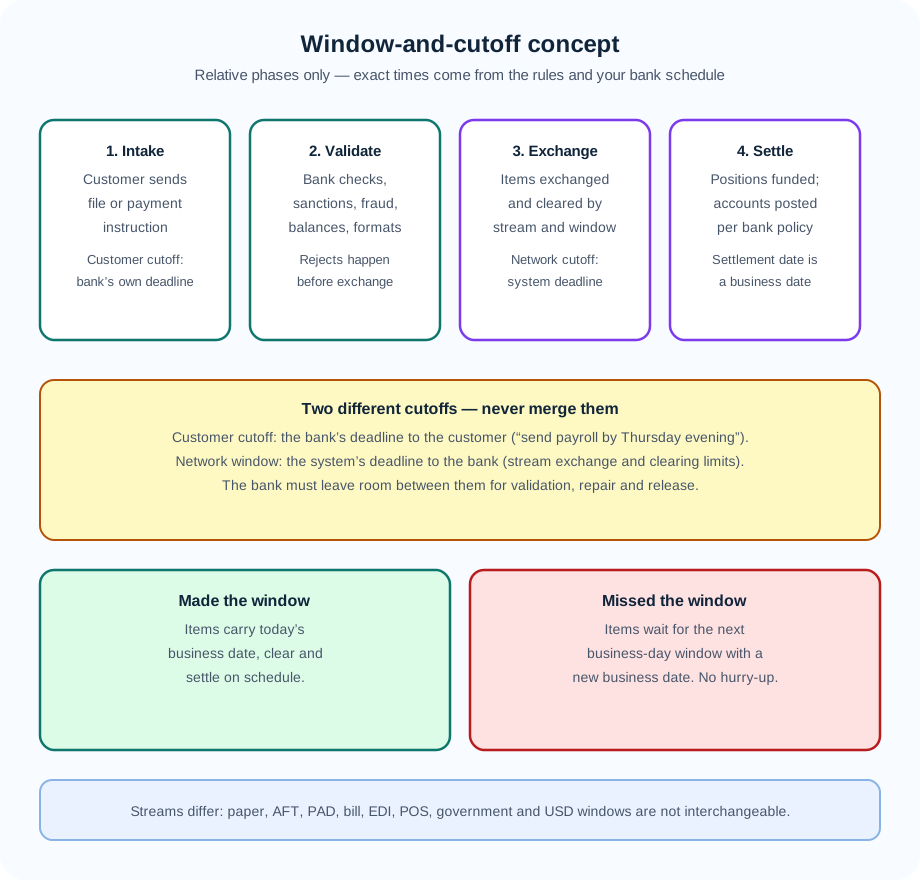
- describe the four relative phases of any batch window — intake, validation, exchange and clearing, settlement and posting — without inventing clock times;
- separate a customer cutoff (your bank's promise to its customer) from a network window (the system's deadline to your bank) and explain the buffer your bank must hold between them;
- trace AFT credits and debits (Rules F1 and F4), PADs (Rule H1), bill payment remittances (Rules H6 and H3), EDI items (Rule E3), point-of-sale items (the E family), paper items (the A series), government items (the G series) and US-dollar bulk items (the K series and USBE) to their correct processing homes;
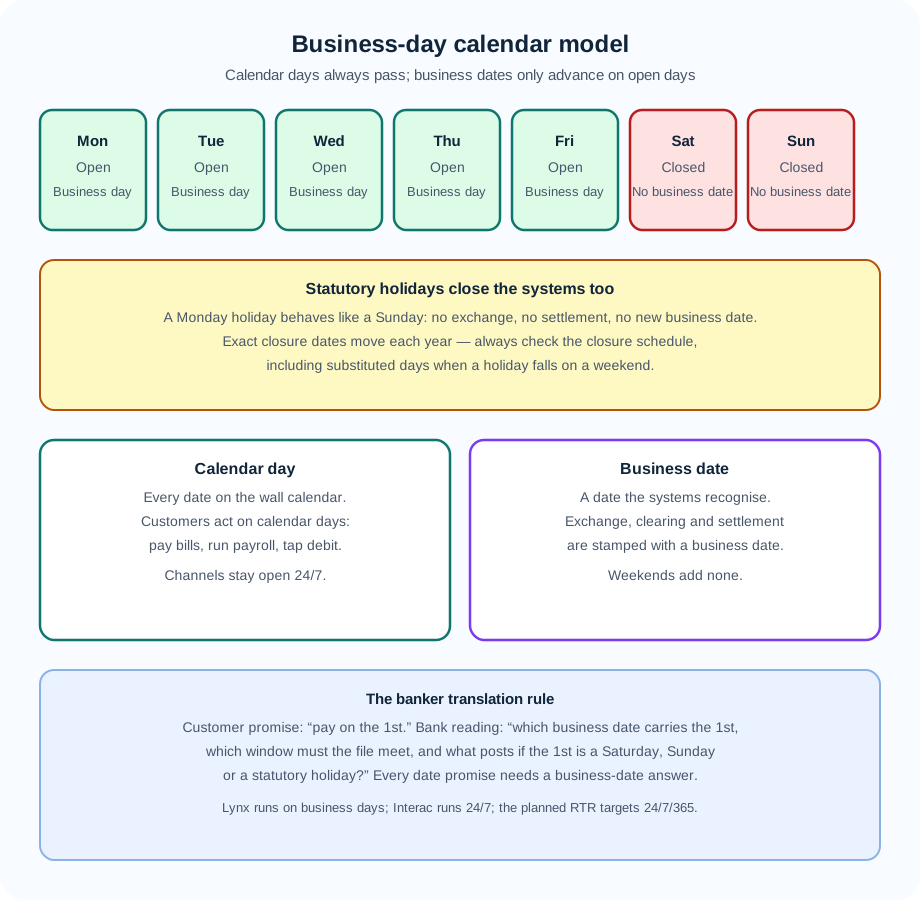
- read the Payments Canada system closure schedule and explain what closes, what keeps running, and what queues for the next business day;
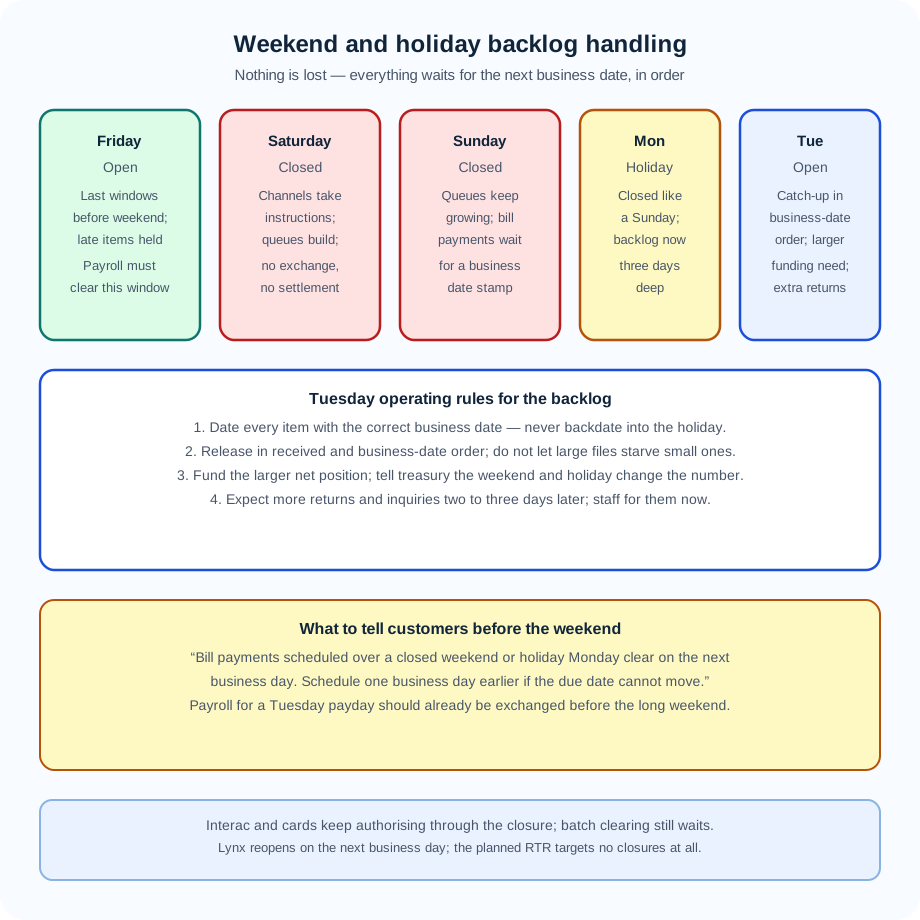
- explain how a Friday file, a weekend and a holiday Monday combine into a Tuesday backlog, and what operations, treasury and customer teams must each do about it;
- contrast batch business-day operation (ACSS, Lynx) with Interac e-Transfer's service and the RTR programme's announced Q4 2026 launch target; clearly separate current production capability from planned RTR capability;
- handle window misses, date disputes, late payrolls and holiday bill runs with the right vocabulary, the right evidence and the right customer language;
- point any colleague to the authoritative source for any window, holiday or rule question instead of guessing.
For a roughly 60-minute core session, spend about 25 minutes on Sections 1–3 (why windows are the product, who owns what, and the four-phase window model), 20 minutes on Section 6 (the core: rules, cutoffs and service levels) using the five diagrams to trace one payroll file and one bill run, 10 minutes on Section 11 (the fictional Friday payroll and holiday Monday stories), and 5 minutes on Section 12 (takeaways and where the authoritative answers live). The remaining depth — message formats, fraud and compliance placement, exception mechanics, posting and liquidity nuance, implementation checklists — is follow-up study that later chapters expand stream by stream.
Chapter navigator
- Business context and customer need
- Participants, responsibilities and system boundaries
- Initiation, validation and bank processing
- Clearing, exchange, settlement and finality
- Data, identifiers, messages and references
- Rules, cutoffs, service levels and customer impact
- Fraud, compliance and operational controls
- Exceptions, investigations and recovery
- Posting, accounting, liquidity, reporting and reconciliation
- Bank implementation, testing and resilience
- Practical fictional Canadian examples
- Key takeaways and authoritative references
1. Business context and customer need
Every date a customer cares about is a window question in disguise. "Pay my staff on Friday" means a payroll file must clear a Thursday window. "My bill is due Monday" means a bill payment must carry a business date the biller accepts as on time. "Why is my deposit on hold until Tuesday?" means a weekend crossed a paper or electronic window and the funds are queued behind a closure. Customers speak in paydays, due dates and availability. Banks deliver those dates through windows, business dates and cutoffs. This chapter is the translation table between the two languages, and fluency in it is what separates a banker who can answer the worried phone call from one who can only read the schedule aloud.
Start with the employer's Friday payroll, because it concentrates every idea in this chapter into one event. A mid-sized Ontario manufacturer with 800 employees pays biweekly on Fridays. From the employer's side the requirement is one sentence: everyone is paid Friday morning. From the bank's side that sentence unfolds into a chain of dated obligations. The employer must release a validated AFT credit file before the bank's customer cutoff on the correct day. The bank must validate, screen and process that file, then exchange the items inside the correct ACSS stream window so they carry the intended business date. Clearing must produce the expected totals, settlement must fund the resulting net position through the Bank of Canada, and each receiving bank must post its employees' credits under its own availability policy. If any link slips its window, the payday moves — not by minutes but by business dates — and the employer's one-sentence requirement fails in a way that reaches 800 households at once. The window was the product all along. The file format, the stream code and the settlement account were just how the product was built.
Bill payments tell the same story from the collection side. A customer scheduling a credit-card payment due Monday does not think about Rule H6, exchange dates or biller posting cycles. They think "paid on time." But "on time" for an interbank bill payment means the remittance was exchanged in the bill-payment stream with a business date the biller treats as timely, travelled with a reference the biller could match, and posted inside the biller's own cycle. For a batch bill-payment instruction, scheduling on a Saturday or a holiday Monday does not create an ACSS exchange date until the next open system day; a bank may accept the instruction and show a scheduled status before then, so the customer's sense of punctuality can collide with the calendar's reality. Banks that explain this before the weekend keep the customer. Banks that explain it after the late fee do not.
The deeper point for analysts, product owners and operations staff is that windows turn time into inventory. Every minute a bank spends validating, repairing or queueing a file consumes window capacity that cannot be recovered once the cutoff passes. Unlike a slow web page that can catch up by running faster, a missed clearing window has no faster gear — the next window belongs to the next business date. That is why cutoff discipline is a design property of banking products, not a personality trait of operations teams. Product owners who promise "same-day payroll" without naming the customer cutoff, the validation buffer and the stream window have promised something operations cannot build. Operations teams that accept files "a few minutes late, just this once" have taught every customer that cutoffs are negotiable, until the day a genuinely immovable network window proves they are not.
There is also a competitive dimension worth naming honestly. Customers increasingly compare batch payments with instant experiences — an Interac e-Transfer that arrives in minutes — and ask why a payroll file cannot behave the same way. The honest answer is architectural: ACSS batch clearing deliberately accumulates items into economical net settlement on business days, while Interac e-Transfer offers an around-the-clock customer service and the RTR programme is being built for that model but is not yet a production rail at this audit date. No employer wants to fund 800 individual gross settlements with per-payment liquidity, and no roommate splitting rent wants to wait for Tuesday's net cycle. Your job is to match each obligation to the clock that serves it and make sure the customer understood the promise before the money moved.
A useful working rule for the whole chapter is simple: every customer date is a business-date promise backed by a window, and every window has a cutoff, an owner and a published source. When you read any requirement — a payroll service agreement, a biller's "pay by" date, a product specification that says "T+1 availability" — underline the date, then ask four questions. Which business date must the item carry? Which stream and window produce that date? What is the customer cutoff that leaves room for validation? And where is the authoritative schedule that proves the answer for this specific week, with this specific holiday calendar? Requirements that survive those four questions are ready for design. Requirements that cannot answer them are wishes, and wishes miss paydays.
2. Participants, responsibilities and system boundaries
Windows work because every participant owns a defined slice of the clock. When a payroll misses payday, the post-mortem question is never "what time is it?" but "whose cutoff slipped, and who owed whom a buffer?" This section maps the owners so that every later section can assign each failure, repair and customer message to the right party.
Payments Canada sits at the centre of the batch clock. It operates the ACSS and sets the rule framework — including the stream structure, the exchange discipline and the clearing obligations — under its by-laws and rules. Critically for this chapter, Payments Canada also publishes the system closure schedule that declares which days are business days and which days the systems rest. That schedule is the single authoritative answer to "is Monday a business day?" for any given week. Individual banks, employers and billers may keep their branches open, their apps online and their staff working on a closure day, but none of that activity creates a business date. Only the systems' operating calendar does that, and Payments Canada publishes it.
The Bank of Canada provides the settlement foundation that gives business dates their financial meaning. ACSS direct clearers hold settlement accounts at the Bank of Canada, and the net positions accumulated through a business day's clearing are extinguished by payments to and from the Bank. This is why a "business date" is not an administrative label but a funding event: each business date's clearing produces positions that must actually be funded. Treasury teams live this reality daily, and Section 9 returns to it. For now, the boundary to remember is that Payments Canada operates the clearing clock while settlement finality for the net positions rests on central-bank money. Lynx, the high-value system, settles each payment individually in central-bank money in real time during its own business-day operating cycle — a different clock with different promises, covered in the Lynx chapters and contrasted throughout this one.
Direct and indirect clearers divide the operational responsibility for meeting windows. Direct clearers exchange items directly in the ACSS, maintain Bank of Canada settlement accounts, and carry clearing responsibility for themselves and for the indirect clearers they sponsor. Indirect clearers — typically smaller institutions — rely on a clearing agent, which is usually a direct clearer, to exchange and settle on their behalf. The D family of rules governs these agency relationships. The practical consequence for windows is that an indirect clearer faces two clocks, not one: its agent's internal cutoff (when the agent needs the file to do its own validation and packaging) and the network window (when the agent must have the items exchanged). File plans that ignore the agent cutoff fail just as surely as files that ignore the network window, and with less sympathy available, because the agent warned about its cutoff in writing.
Originators and billers — employers, utilities, governments, merchants — own the start of the clock. The employer's payroll officer, the utility's billing system and the government disbursement office each decide when to release instructions into the banking system. Their release discipline determines everything downstream: a file released with hours to spare can absorb a validation repair; a file released minutes before the customer cutoff cannot. Banks influence this through service agreements, cutoff communication, file validation feedback and, where offered, pre-validation or same-day correction services. But the boundary is firm: the bank cannot release what the customer has not sent, and cannot backdate what the window has already closed. Much of Section 6's service-level discussion is really about how banks push originator behaviour earlier in the day without losing the business.
Receiving institutions — the employees' banks, the biller's bank, the beneficiary's bank — own the end of the clock: posting, availability and customer reporting. Each applies its own funds-availability policy within the constraints of law, rules and risk appetite. Customers experience the whole chain through this final decision, which is why two employees of the same payroll can have different Friday-morning experiences at different banks. Investigations about "late" payments very often resolve at this boundary: the items cleared and settled correctly, but one receiving bank's availability policy posted later than the customer's expectation. Naming that boundary early in any complaint saves days of misdirected tracing.
Service providers, payment processors and corporate treasury workstations sit alongside the chain rather than inside it. They prepare files, validate formats, transmit instructions and report status, but the clearing and settlement responsibility remains with the regulated participants. This matters for accountability design: outsourcing file preparation never outsources cutoff accountability. If a processor delivers the employer's file to the bank after the customer cutoff, the bank's obligation is to the window, not to the processor's excuse. Contracts between originators and their processors should therefore mirror the bank's cutoffs with their own earlier internal deadlines — a buffer inside a buffer — and Section 10 returns to how banks test these handoffs before they carry live payrolls.
Finally, the customer owns the consequences and, in a well-run relationship, shares the discipline. Banks that publish clear cutoffs, explain holiday calendars in plain language, send window reminders before long weekends and confirm file acceptance promptly are not doing customer service favours — they are operating the first and cheapest control in the whole window chain. An employer who understands that Thursday evening is the real deadline for Friday payday is worth more than any amount of overtime in operations. Section 6 shows how to write those promises; Section 11 shows what happens when nobody reads them.
3. Initiation, validation and bank processing
Everything that happens inside a window depends on work done before the window opens. Initiation, validation and bank processing are the three stages where a bank earns the right to exchange items — or discovers, too late, that it cannot. This section walks those stages in order, with the clock always visible.
Initiation is the moment an instruction enters the bank with the customer's authority behind it. For batch payments this usually means a file: an AFT credit file carrying payroll or supplier payments, an AFT debit file carrying PAD collections, a bill-payment instruction from digital banking, a business EDI instruction with remittance detail, or a point-of-sale batch from a merchant acquirer. Paper initiation — cheques deposited at branches, ABMs or by image — follows its own capture path but obeys the same logic. Each initiation event must capture three things the window machinery will need later: what is to move (amount, currency, stream), when it must move (requested date, which the bank will convert to a business date), and proof of authority (a payroll mandate, a PAD agreement, a signed bill instruction, a cardholder authorisation). Files that arrive without one of the three cannot be repaired inside the window — they can only be rejected back to the customer, which is itself a clock event with its own deadline pressure.
Validation is where the bank decides whether the instruction is good enough to exchange, and it is the hungriest consumer of window time. Format checks confirm the file structure matches the expected standard — legacy AFT record layouts or ISO 20022 messages under Rule F4, EDI structures under Rule E3, bill-payment references under the H-family conventions. Content checks confirm routing numbers against reference data such as the Financial Institutions File, account numbers against validity rules, and amounts against reasonableness limits. Authority checks confirm PAD mandates exist and are current, bill-payee registrations match, and originator limits have not been breached. Risk checks screen sanctions lists, evaluate fraud signals and verify behavioural patterns. Balance checks confirm the originator can fund the file. Each check is individually fast and collectively expensive: a 10,000-item payroll file with a 2 percent repair rate generates 200 decisions, 200 customer contacts or automated repairs, and 200 opportunities to consume the buffer between the customer cutoff and the network window. Banks that measure validation throughput per stream — items validated per hour, repair turnaround time, reject rates by originator — are measuring window capacity directly, whether they use that language or not.
Bank processing converts validated instructions into exchange-ready clearing entries sorted by stream. This is the stage newcomers underestimate, because it looks like plumbing and behaves like strategy. Sorting by stream means the AFT credits, PAD debits, bill remittances, EDI items, POS batches, paper items and government items each accumulate into the correct clearing presentation with the correct identifiers, totals and logs. Totals must balance: the sum of items must equal the control totals, and any imbalance stops the whole presentation, not just the offending item. Dating assigns each item the business date its window will carry — and here the calendar intrudes for the first time, because a file processed on Friday afternoon for a Monday holiday weekend cannot carry Monday's date as a business date. Queuing holds validated work in release order so that a late-arriving large file cannot silently displace an earlier small one. Release commits the presentation to exchange, crossing the boundary from "the bank's work" to "the system's work," and generates the evidence — transmission reports, clearing-log entries, acceptance acknowledgements — that later proves the window was met.
Three design decisions dominate this stage, and each belongs to a different role. Product owners decide the customer cutoff: how late the bank accepts originator files while still promising today's window, and how that promise varies by stream, by channel and by customer segment. Operations owns the processing buffer: the minimum time between the customer cutoff and the network window needed to validate, repair, balance and release reliably, including staffing, system capacity and contingency for partial failures. Technology owns straight-through reliability: the straight-through processing rate from intake to release without manual touch, because every manual repair is a random tax on the buffer. When a window is missed, exactly one of these three decisions failed — the cutoff was too generous, the buffer was too thin, or the machinery needed hands it did not have. Honest post-mortems name which one.
Holds and pending states deserve explicit attention because they confuse customers and junior analysts alike. A validated file awaiting its window is not "sent" in any sense the customer means — it is staged and dated, but the interbank movement has not occurred. Status language should say so plainly: "accepted, scheduled for the next business-day window" is honest; "processing" breeds payday-morning phone calls. Similarly, an ACSS item received by a bank on a Saturday may be queued for the next business-day presentation even though the bank records the Saturday intake timestamp. Section 5 formalises this in data terms; here the operational rule is enough: never let a receipt acknowledgement imply a business date the calendar cannot deliver.
4. Clearing, exchange, settlement and finality
Once the bank releases its presentation, the items leave the bank's hands and enter the shared machinery: exchange, clearing, settlement and the conditional finality that defines batch payments. This section follows them through, keeping the four events rigorously distinct, because confusing them is the root cause of most window misunderstandings.
Exchange is the physical or electronic delivery of items between participants for clearing. In the ACSS world this happens through the regional exchange framework and electronic delivery mechanisms defined across the rule families — paper and image items through their capture and exchange paths, electronic items through their network deliveries, AFT through file exchange, bill remittances through interbank remittance exchange under Rule H6. Each exchange event is stamped with a business date and classified by stream, and the clearing logs record what moved, in which stream, for what value. The exchange date answers one question only: when did participants hand these items to each other? It does not answer when value moved or when the customer can spend the money. Those are later events with later dates, and Section 5's date model exists precisely to keep them apart.
Clearing is the calculation that turns gross items into obligations. For each business date and stream, the system nets what each participant delivered against what each participant is owed, producing clearing positions — the amounts each direct clearer must pay or receive. This is the economic heart of batch design: instead of funding every item individually, each participant funds only its net position. The Toronto payroll with 10,000 credits becomes, for the sending bank, one net debit position; the receiving banks see corresponding net credits. Netting is what makes high-volume retail payments affordable, and it is also what makes the business date financially real — each business date's clearing produces positions that must be funded, as Section 9 explains. Errors discovered at clearing stage — unbalanced logs, misclassified streams, duplicate deliveries — trigger the adjustment and re-clearing mechanics that the exceptions chapter will detail. For this chapter the point is simpler: clearing converts items into money owed, per business date, per participant.
Settlement extinguishes those obligations. ACSS direct clearers settle their net positions through settlement accounts at the Bank of Canada. Payments Canada says the previous day's net balances are settled during the morning of each business day; the Bank of Canada states that ACSS account holders meet net obligations by Lynx payments, with a Lynx direct participant acting for an ACSS holder that is not a Lynx participant. Keep settlement date (the system/accounting event) distinct from a bank's value date convention: they may align, but they are not interchangeable fields. This typically lags the exchange that created the positions, which is exactly why the exchange date and the value date must be modelled as separate fields. Lynx contrasts sharply: each payment settles individually in central-bank money in real time during the Lynx business-day cycle, so exchange, value and finality collapse into a single moment. Interac e-Transfer for Business advertises 24/7 initiation and that most payments land within seconds, subject to the participating financial institution and account. That customer-facing service claim should not be treated as proof that every underlying FI settlement entry bypasses all batch or correspondent arrangements. The RTR programme is intended to provide real-time exchange, clearing and settlement 24/7/365, but Payments Canada currently says launch is targeted for Q4 2026, so it is not a current production capability. Holding these three clocks side by side — deferred net on business days, real-time gross on business days, instant around the clock — is the single most useful mental image in Canadian payments operations.
Finality in batch systems is conditional, and honesty about that conditionality is a professional obligation. When ACSS positions settle, the interbank obligation for that business date is extinguished — but individual items remain returnable for defined reasons inside defined windows. An AFT credit can come back for an invalid account. A cheque can return NSF. A PAD can be disputed by the payer under the Rule H1 recourse framework. A bill payment can be corrected under Rule H3. None of these returns reopens the settled net position directly; each travels as its own new clearing entry with its own business date. But from the customer's perspective the effect is identical to un-settlement: money that appeared credited disappears. This is why receiving-bank availability policy is a risk decision, not a courtesy: every hour of earlier availability is an hour of exposure to returns that have not yet arrived. Lynx finality differs categorically — once Lynx reports settlement, the interbank leg is irrevocable, and recovery needs the receiving party's cooperation, not a rule-based return.
5. Data, identifiers, messages and references
Windows run on data, and dates are data. This section defines the fields, identifiers and message standards that let every participant agree on which window an item belongs to, which business date it carries and which original instruction any exception refers back to. Banks whose data model cannot answer those three questions will reconcile by spreadsheet and investigate by memory.
The date fields come first because every other field serves them. The receipt or intake timestamp records when the instruction reached the bank — a calendar-day fact, down to the second, that proves whether the customer met the customer cutoff. The business date records which operating day the item belongs to — a system fact drawn from the closure calendar, not the wall clock. The exchange date records when the item was exchanged between participants. The settlement or value date records when the corresponding position was funded. The availability date records when the customer could actually use the funds, under the posting bank's policy. Posting timestamps record when each bank applied its own debit or credit. A single payroll credit therefore carries a small constellation of dates, and each downstream process reads a different star: operations reads the business date, treasury reads the value date, the employee reads the availability date, and investigations read all of them. Systems that collapse these into one "date" field manufacture disputes that no amount of goodwill can resolve, because each party is correctly reading a different event.
Stream classification is the second critical data element. Every clearing entry must declare its stream so the receiving side can apply the right validation, the right return rules and the right posting logic. Here precision about vocabulary pays for itself. The current ACSS index lists eleven lettered families: A (preparation of clearings), B (regional exchange), C (cross-border arrangements), D (direct clearers acting as agents), E (electronic items), F (AFT), G (industry agreements for government and other joint services), H (payment services), J (miscellaneous procedures), K (international/USD procedures) and L (default and insolvency). The colloquial language of "streams" usually means instruments and clearing classifications within those families: AFT credits and debits under Rules F1 (Standard 005) and F4 (ISO 20022), PADs under H1, bill-payment remittances under H6 with error correction under H3, EDI under E3, point-of-sale and on-line items under E1/E2/E4/E5, paper and images under the A rules, government items under G, and USD bulk under K/USBE. Separately, current Rule B2 (manual clearing logs) defines exact stream identifiers, including D/C for legacy AFT debits/credits, AFTD/AFTC for ISO AFT, J/K for on-line credits/returns, X for EDI, Y for electronic remittances, O/S for image and returned-image files, and N/P/Q for POS categories. Rule families organise the rulebook; stream identifiers classify entries. Implementers must code from the current rule and standard, not from this chapter's summary.
Identifiers and references are what make windows auditable. Each item needs an identity that survives the whole journey: the originator's reference (payroll run number, invoice number, bill account number), the bank's internal transaction identifier, and the clearing-level identifiers that tie the item to its file, its log entry and its business date. Returns, adjustments and investigations must carry the original identity forward — a return that cannot be matched to its original is just a mysterious debit, and a mysterious debit is a complaint, a write-off or a regulatory finding waiting to happen. Bill payments make the point most sharply: the H6 remittance exchange moves the funds, but the biller's posting depends entirely on the account reference travelling intact. A bill payment with the right amount, the right business date and a corrupted reference is operationally perfect and commercially useless — the money arrived and the bill stayed unpaid. Reference preservation is therefore a window concern: truncated, reformatted or dropped references should be treated as validation failures before exchange, not as biller problems after it.
Message standards add a generational dimension that implementers must respect. Legacy AFT formats still carry enormous batch volumes under Rule F1, while Rule F4 governs AFT using ISO 20022 messages — the same modern data language that Lynx uses natively for high-value payments. EDI items under Rule E3 carry structured remittance detail that batch systems must preserve end to end. Paper items carry MICR-line data and, increasingly, image representations under the image rules. Each standard has its own field definitions for dates, references and return reasons, and each stream window therefore validates a different data shape. Migration and coexistence work — running F1 and F4 in parallel, mapping legacy fields to ISO 20022 elements without losing the business date or the original reference — is among the highest-risk implementation activity in Canadian batch payments, and Section 10 treats it as such. The product-level lesson belongs to everyone: richer data improves straight-through rates and cleaner reconciliation, but only if every handoff preserves it. A reference dropped at mapping time is a window met and a customer failed.
6. Rules, cutoffs, service levels and customer impact
This is the core of the chapter: how the rule framework, the two kinds of cutoffs and the bank's service levels combine into the customer promises that windows either keep or break. Read it as an operator, a product owner and a customer advocate in turn, because each role owns part of the outcome.
The rule framework sets the outer boundary inside which every bank's schedule must fit. Payments Canada's ACSS rules, organised in the current A, B, C, D, E, F, G, H, J, K and L families mapped in this chapter's first diagram, define what can be exchanged, in which stream, with what evidence, subject to what return rights — and the exchange discipline, anchored by the regional and electronic exchange rules and the clearing-log requirements, defines how each business day's work is presented, balanced and netted. The system closure schedule declares which days count as business days at all. Together, rules plus schedule answer the structural questions: which streams exist, what each stream carries, which days the machinery runs, and what happens to items presented on days it does not. No bank schedule can grant a customer a window the rules do not offer, a business date the schedule does not recognise, or a return right the rules do not allow. Product owners sometimes ask whether the bank can "just process" a file on a holiday Monday as a favour to a large employer. The answer is architectural, not attitudinal: there is no exchange, no clearing and no settlement to process it into until the next business day, and pretending otherwise manufactures exactly the payday failure the favour was meant to prevent.
Current rule timing (network deadlines, not a customer promise). The live F1 and F4 PDFs currently show three AFT exchange deadlines on business days — 09:30:00, 16:30:00 and 21:00:00 Eastern Time — and define the applicable exchange periods around those deadlines. They also set serviceability-code lead times: code 0 is exchanged on the earlier of the business day before the due date (when available) or the due date; code 1 requires one business day before; code 2 requires two business days before. For qualifying AFT credits, funds-availability rules then refer to the exchange deadline, the indirect-clearer cut-off and the due date. These are current Payments Canada rule requirements; a bank's customer cutoff must be earlier where it needs time for validation, screening, repair and release. Recheck the live F1/F4 versions before implementation.
Within that outer boundary, each bank sets two distinct cutoffs, and confusing them causes more customer harm than any other single habit this chapter addresses. The customer cutoff is the bank's published deadline to its own customers: submit payroll files by this time on this day for this business date, schedule bill payments by that time for next-day exchange, deposit cheques by that hour for same-day capture. The bank sets these cutoffs in its service agreements, fee schedules, digital-banking screens and operations guides, and it may differentiate them by stream, channel, customer segment and even individual large originators. The network window is the system's deadline to the bank: the point by which the bank's presentations must be exchanged, balanced and accepted for the intended business date. Between the two sits the processing buffer — the bank's own working time for validation, sanctions screening, fraud review, repair, balancing, release and contingency. The buffer is the bank's shock absorber, and its size is a business decision with a price: an earlier customer cutoff buys operational safety and sells customer inconvenience; a later customer cutoff buys competitiveness and sells operational risk. Neither choice is wrong in the abstract. What is wrong is setting the customer cutoff from the network window without pricing the buffer — promising customers the system's deadline as their own and leaving validation nowhere to live.
Service levels translate these mechanics into promises customers can plan around, and honest service levels name the business date explicitly. "Payroll released before the customer cutoff on business day T is exchanged for business date T" is a service level. "Submit by Thursday for Friday payday in a normal week" is the same service level in customer language, with the holiday caveat attached. "Bill payments scheduled before the digital-banking cutoff carry the next business date" is a service level. "Cheques deposited after the branch capture time are processed the next business day, and weekend deposits clear from Monday evening's business" is a service level. Each of these follows the same anatomy: a customer action, a customer cutoff, a resulting business date, and the posting and availability consequences that follow. Service levels that omit any element — especially the business-date consequence — are not simpler for customers. They are vaguer, and vagueness becomes a complaint the first time a weekend intervenes. The strongest service-level documents in Canadian practice share three traits: every promise resolves to a business date, every holiday and weekend rule is stated once in plain language and referenced everywhere else, and every promise links to the closure schedule rather than restating it.
Stream differences are where generic window knowledge becomes operational skill. Paper items depend on capture: a cheque deposited in time for the day's capture and encoding joins that business date's clearing; a late, mutilated or unencoded item waits, and weekend deposits queue from the next business week's opening exchange. AFT credits for payroll and supplier payments depend on file discipline: validated files exchanged in the AFT window carry their business date, while files needing repair consume the buffer and risk the next date. PAD debits under Rule H1 add the authority dimension: presentment timing must respect the agreement terms and notice requirements, and returns for insufficient funds or disputes arrive days later through their own windows — so the "window" for a PAD collection really spans presentment plus the return horizon, and cash-application teams must plan for both. Bill-payment remittances under Rule H6 depend on interbank remittance exchange plus biller posting cycles: the bank controls the exchange business date but not the biller's ledger, so service levels should promise the exchange date and describe the biller posting as a separate, biller-owned step. EDI under Rule E3 depends on data completeness: rich remittance detail that fails validation is worse than useless, because the funds may move while the application fails. Point-of-sale batches sit between instant authorisation and batch money movement — the customer was approved in seconds, the merchant is funded on batch time, and both truths must be communicated. Government items under the G series follow their own instrument rules and warrant procedures. US-dollar bulk items under the K series clear through USBE. Rule K8 requires USD settlement in New York, says USD AFT files are exchanged in a separate file from CAD AFT files, and provides for U.S.-bank-holiday value dating to the next New York business day. This is a different settlement arrangement from CAD ACSS settlement through Bank of Canada accounts, so USD product documentation must state the applicable calendar, value date and cutoffs plainly. None of these stream notes states a clock time, because times belong to the current rules and each bank's schedule. All of them state the structural reason each stream's window behaves differently, which is the knowledge that survives every schedule republication.
Availability policy is the final service-level lever and the most misunderstood. Receiving banks decide when exchanged credits become spendable, balancing customer experience against return exposure. Same-day or next-morning availability delights customers and lengthens the window in which a return creates an overdraft or a loss. Longer holds protect the bank and punish the customer for the system's architecture. There is no universally correct setting — payroll credits from known originators and first-time PAD credits present very different risk profiles — but there are universally wrong ways to communicate it. Availability described as "the money is there" when the item remains returnable will be quoted back in the dispute. Availability described per stream and per item type, with the return horizon named, is a control. Operations, risk and product must set these policies jointly; when any one function sets them alone, the bank gets either losses or complaints, usually both in sequence.
7. Fraud, compliance and operational controls
Windows concentrate risk into narrow time slots, and criminals know the timetable as well as operations does. Fraud, sanctions, anti-money-laundering and operational controls must therefore be built into the window flow — at intake, inside the buffer and at release — rather than bolted on as an afterthought that the clock will not accommodate.
Authorisation and authentication controls belong at initiation, before window pressure begins. Payroll files must be bound to authenticated originators with dual approval for releases above thresholds, because a fraudulent payroll file that enters validation looks exactly like a legitimate one that is merely large. PAD originators must hold valid agreements with provable mandates, because an unauthorised debit collection discovered after presentment becomes a dispute, a reimbursement and a regulatory event rather than a simple reject. Bill-payment instructions need payee validation and amount-reasonableness checks at the digital-banking edge, where stopping a misdirected payment costs nothing and recalling one costs days. The design principle is that every minute of fraud prevention spent at initiation saves an hour of investigation after settlement — and, crucially, spends none of the processing buffer, because it happens on the customer's side of the customer cutoff.
Screening and monitoring controls live inside the buffer, which means the buffer must be sized for them. Sanctions screening of originators, beneficiaries and (where required) remittance content must complete before release; a screening queue that exceeds the buffer forces a choice between missing the window and releasing unscreened items, and banks must never choose the second. Fraud-monitoring rules — new originator behaviour, round-amount payroll anomalies, PAD debit spikes against mandate history, bill-payment destination changes, EDI beneficiary substitutions — need time to fire, queue, review and decide. Same-day and late-window files compress all of this into minutes, which is precisely why risk functions should have a formal voice in setting customer cutoffs: the cutoff is not only an operations capacity decision but a control effectiveness decision. A window that cannot accommodate its own controls is not a competitive advantage. It is an incident scheduled in advance.
Release controls are the last gate and must be treated with the seriousness of a vault door. No batch presentation should release on a single person's authority above defined thresholds; no release should proceed with unresolved validation exceptions carried as "known issues"; no stream presentation should release with unbalanced totals on the assumption that clearing will sort it out. Pre-release checklists — right file, right stream, right business date, balanced totals, screening complete, funding confirmed with treasury for large net positions — take minutes and prevent the classes of failure that take weeks to unwind. Date verification deserves its own checklist line: confirming that the business date on the presentation matches the intended business date, especially on Fridays, before long weekends and around year-end, catches the single most common and most embarrassing release error in batch operations.
Compliance reporting and record-keeping run alongside the clock, but window discipline determines their quality. Items rushed through a compressed buffer with repaired or defaulted fields generate the reporting errors that surface months later in examinations. Data fixed under time pressure should be flagged for post-release review: meet the window with the best available data, then verify and correct through the proper adjustment channels rather than letting a buffer casualty become a permanent record defect.
Consumer-protection and mandate controls deserve special emphasis for PAD and bill streams because the harm pattern differs from credit payments. An erroneous PAD debit takes money from the payer; an erroneous AFT credit gives money late. The first harm demands fast dispute handling, reimbursement under the H1 recourse framework and collector-side remediation; the regulatory and reputational exposure sits with the bank that enabled the collection. PAD programmes therefore need mandate-evidence retrieval that works in hours, not weeks; presentment-amount monitoring against agreement terms; and cancellation handling that stops future debits reliably. Bill-payment operations need misdirection detection (a customer paying the wrong payee number) and duplicate-submission detection across weekend queues. Rule H3 is not an automatic bank-side recall: it applies only where a member offers the service, requires Bill Payee authorization and an authorization indicator, limits the correction debit to at least $20 and no more than the original payment, and keeps an audit trail for at least 12 months. A request not authorized by the Bill Payee must be handled outside the rule. Each of these controls has a window implication — disputes and corrections travel through their own return and adjustment windows with their own business dates — which Section 8 follows in detail.
8. Exceptions, investigations and recovery
In batch payments, exceptions are not interruptions of the process. They are the process, continued by other means, on later business dates. This section classifies what can go wrong around windows, how each class is recovered, and what evidence makes recovery fast instead of forensic.
Rejects happen before exchange and are the cheapest failures available. A file with structural errors, an item with an invalid routing number, a PAD instruction without a matching mandate, a payment that fails sanctions screening — each is stopped inside the bank's buffer and returned to the originator for correction and resubmission. The window consequence depends entirely on timing: a reject discovered early in the buffer can be repaired and resubmitted for the same business date; a reject discovered at the edge of the window pushes the item to the next business date. Two disciplines make rejects cheap instead of catastrophic. First, validate early and report fast — pre-validation services, immediate file-acceptance feedback and repair guidance that reaches the originator within the hour turn most rejects into same-window recoveries. Second, track reject causes by originator and stream, because a payroll customer with a recurring 5 percent reject rate is not having bad luck; they have a broken upstream process that will eventually miss a payday, and the bank's account team should be fixing it in October, not explaining it in December.
Returns happen after exchange and travel as new items with new business dates. The invalid-account payroll credit, the NSF cheque, the disputed PAD, the misapplied bill payment corrected under Rule H3 — each returns through its stream's return mechanism, carrying the original identity so both banks can match it to the first movement. Returns are where the date model of Section 5 proves its worth: the original item carried business date T, the return carries business date T-plus-something, and reconciliation must link them across dates, across logs and across statements. Operationally, returns demand their own window awareness: return windows have their own deadlines, late returns create interbank disputes rather than automatic credits, and the customer-facing work — notifying the employer of failed payroll credits, debiting back a provisionally credited employee, re-presenting or writing off a PAD — must be staffed on the days returns actually arrive, which lag presentment by the return cycle. Banks that staff investigations only for presentment days and leave return days thin have scheduled their backlog in advance.
Recalls, reversals and corrections form the third class, distinguished by who initiates and what cooperation they need. A duplicate payroll file — the classic Friday disaster, where the employer sends the file twice — cannot be assumed to be "un-exchanged." The bank must use the applicable AFT error-correction/reversal process and its own customer agreement; timing determines whether the second credits can be stopped before posting or must be recovered after. For H6 electronic remittances, accepted transmissions are expressly irrevocable and irreversible under the rule, so a bill-payment correction needs the H3 authorization path rather than a casual recall. A misdirected bill payment needs correction through the H3 error-correction path plus biller cooperation to move the application from the wrong account to the right one. A misdirected Lynx wire, for contrast, needs a recall request and the receiving bank's consent, because RTGS finality permits no unilateral taking-back. The window lesson across all three is that recovery speed depends on detection speed: duplicate detection that fires at intake prevents a reversal; beneficiary-confirmation at initiation prevents a recall; reference validation at bill scheduling prevents a correction. Every recovery path in this section is more expensive than its corresponding prevention in Section 7, and pricing that asymmetry into control investment is a treasury-grade decision.
Investigations tie the classes together when the customer asks the question that starts everything: "where is my money?" The investigation path for a window-related inquiry follows a fixed sequence that junior staff should be able to recite. First, establish the business date: which business date did the item actually carry, proven by the transmission report or clearing log — not the date the customer clicked submit. Second, confirm exchange: was the item accepted into the stream window for that date, or rejected, held or queued? Third, confirm settlement: did the business date's positions fund normally? Fourth, confirm posting: what did the receiving bank do, on which date, under which availability policy? Fifth, check the return horizon: has a return arrived or is one still possible? Most inquiries resolve at step one (wrong assumed business date — the weekend ate it), step four (availability policy, not a missing payment) or step five (returned, and the notification is sitting in someone's inbox). Investigations that start by re-tracing the network before checking the calendar waste the very time the customer is already angry about. The calendar is always the first suspect, the availability policy is always the second, and the network is last — because the network, on a normal business day, almost always worked.
Force majeure and contingency handling close the section because windows occasionally break through no participant's fault. Ice storms close processing centres, telecommunications failures isolate exchange points, and the rule framework anticipates such events through its force-majeure provisions. The operational content is straightforward and must be rehearsed: declare the condition promptly, communicate revised windows and business-date treatment before customers guess, prioritise payroll and other time-critical streams in recovery, and document every deviation for post-event accounting. The customer-communication content is harder and more valuable: a bank that tells employers on Friday afternoon that a storm may push a Tuesday payday — with the workaround of earlier release or split files — has converted a contingency into a service. A bank that waits until Tuesday morning has converted the same contingency into attrition.
9. Posting, accounting, liquidity, reporting and reconciliation
Windows create the movements; this section's disciplines prove the movements happened, funded them, told the customer, and balanced the books. Posting, accounting, liquidity, reporting and reconciliation are five distinct activities that share one dependency: correct business dates flowing from correct windows.
Posting applies the cleared items to customer accounts under each bank's own policy and timetable. Sending banks debit originators — the employer's account for the payroll total, the utility's settlement account for PAD collections in transit, the customer's account for the bill payment — typically on or around the exchange business date, under agreements that authorise the debit timing. Receiving banks credit beneficiaries — employee accounts, biller accounts, supplier accounts — under availability policies that weigh customer experience against return exposure, as Section 6 established. Memo posting versus final posting deserves explicit vocabulary in every bank's customer language. A bank may choose to show a provisional or memo credit before its own return-risk decision, but that is a bank-specific posting and availability policy, not an ACSS guarantee. Rule F1/F4 prescribe AFT credit availability conditions tied to serviceability code, exchange deadline and due date; other instruments and account agreements can differ. Customer screens must not imply that an available balance is irrevocable when a rule-based return or correction remains possible. Digital-banking displays that distinguish the two — available balance versus current balance, pending versus posted — are window-communication devices, whether their designers think of them that way or not. Holiday and weekend queuing multiplies the posting workload on the next business day, and posting capacity (systems throughput, manual review queues, customer-notification volumes) must be scaled for backlog Tuesdays, not average Wednesdays.
Accounting translates postings into the bank's ledgers with the business date as the organising key. Clearing suspense and settlement accounts accumulate each business date's exchange activity; settlement entries against the Bank of Canada extinguish the net positions; and adjustments, returns and corrections post to their own business dates while referencing the originals. Period-end discipline turns business-date accuracy into financial-statement accuracy: items dated to the wrong business date across a reporting boundary misstate positions. The design rule is strict: the business date is assigned once, by the window machinery, from the authoritative calendar, and no downstream process reassigns it.
Liquidity management funds the promises windows create. Each business date's clearing leaves each direct clearer with a net position to pay or receive through Bank of Canada settlement accounts, and treasury must have the funds or credit room available when settlement calls. Backlog days after weekends and holidays have larger, lumpier positions, because several calendar days of customer activity compress into one business date's funding event. Payroll days concentrate outflows for sending banks; PAD collection days concentrate inflows. Treasury's toolkit therefore includes position forecasting fed by operations pipeline data, buffer coordination on repair-driven volume shifts, and contingency funding for the days when everything arrives at once.
Reporting tells each party what happened in language it can act on. Originators need acceptance reports (file received, validated, accepted for which business date), exception reports (which items rejected or returned, with reason codes and the original references), and settlement confirmations that close their own books. Beneficiaries and billers need credit advices and remittance detail sufficient for cash application — the EDI detail, the bill reference, the payroll register linkage. Internal stakeholders need window dashboards: buffer consumption per stream, reject and repair rates, release timeliness, backlog depth after closures. Regulators and auditors need the records that prove rules were followed and controls operated. The common failure across all five audiences is date ambiguity — reports that show a calendar date where the reader needs a business date, or an availability date where the reader needs a value date. Report design should label every date with its kind, because an undated "date" in a payments report is not information. It is a future dispute.
Reconciliation closes the loop by proving agreement among the four independent stories of the same money: what the customer instructed, what the bank exchanged, what the system settled, and what the ledgers posted. Three-way matching — instruction versus clearing evidence versus settlement and books — runs per business date, per stream, with breaks investigated to root causes that are almost always one of four: dating errors (wrong business date assigned or assumed), reference damage (the Section 5 failure), timing gaps (returns and adjustments belonging to later business dates not yet matched), or genuine value breaks (duplicates, missing items, misapplied funds). Backlog periods produce break waves, not break trickles, and reconciliation teams must be staffed and tooled for the wave — automated matching with clear break queues, original-identity linkage across dates, and ageing discipline that escalates stale breaks before they become write-offs. A bank that reconciles the morning after every business day, including backlog Tuesdays, knows its position. A bank that reconciles "when things quiet down" never knows it, because in batch payments things never quietly reconcile themselves.
10. Bank implementation, testing and resilience
Knowing how windows work and building a bank that never misses one are different achievements. This section is for the implementers: the checklists, test regimes and resilience designs that convert window theory into payday reliability.
Calendar and schedule implementation comes first because every other control reads the calendar. Banks must maintain a business-day calendar engine — a single, centrally governed source of truth for business dates, closure days, substituted days and stream-specific window definitions — consumed identically by intake, validation, release, posting, reporting and reconciliation. The failure mode to eliminate is calendar fragmentation: intake using one holiday table, posting using another, treasury forecasting from a spreadsheet. The calendar engine must be updated from the Payments Canada closure schedule each year with formal change control and versioned so any past business date can be reconstructed during investigations and audits.
Cutoff and buffer configuration turns policy into machinery. Each customer cutoff, each agent cutoff for indirect business, each internal processing milestone and each network release deadline should exist as a monitored, alerted configuration item with an owner, a rationale and a review date — not as folklore remembered by senior operators. Buffer monitoring deserves the same rigour as any production vital sign: track validation queue depth against time-to-window per stream, repair turnaround against remaining buffer, and release readiness as a countdown rather than a hope. Alerting thresholds should fire while recovery is still possible — when the buffer is half consumed with repairs outstanding, not when the window is ninety seconds from closing. Large-originator onboarding should include a measured trial period where the bank observes the customer's file quality, timing discipline and repair responsiveness before committing to aggressive cutoffs, because the customer's operational maturity is a design input to the bank's risk, not a surprise to be discovered on the first live payday.
Testing must prove window behaviour under the conditions that actually break it. Year-end and holiday-calendar testing validates the calendar engine against the real closure schedule, with expected business dates asserted for every day of the coming year. Backlog testing simulates multi-day closures at production volumes, proving queuing preserves order, dating stays correct and posting clears the wave. Cutoff-boundary testing submits files at, just before and just after each cutoff, including the unglamorous cases: a file timestamped exactly at the cutoff, a repair completed one minute past it, a daylight-saving transition day. Stream-misclassification testing proves mis-sorted items are caught at validation rather than at clearing. Tests that only exercise sunny-day flows at average volumes prove nothing about windows; windows are defined by their edges.
Coexistence and migration work — legacy AFT formats alongside ISO 20022 under Rules F1 and F4, paper alongside image — needs its own test discipline because mapping errors strike at dates and references, the two fields windows cannot function without. Every format migration should carry a parallel-run period with automated equivalence checking: same instructions through both paths must produce identical streams, identical business dates, identical totals and identical references. Mapping tables between legacy and ISO 20022 fields must be versioned, reviewed and tested against adversarial inputs — missing optional dates, conflicting dates, truncated references — because production files will eventually contain all of them, probably on a Friday.
Resilience design accepts that windows will one day be threatened by events outside any schedule and prepares the response in advance. Dual-site processing capability with rehearsed failover, redundant exchange connectivity, staffed contingency shifts for backlog periods, pre-written customer communications for window misses and closure extensions, treasury contingency funding lines sized for lumped backlog positions, and a decision framework that names who can authorise an emergency release-strategy change — these are the components. The rehearsal cadence matters more than the documents: a contingency plan exercised twice a year with operations, treasury, technology, risk and communications in the room will work; the same plan sitting in a repository will not. And the recovery prioritisation must be decided before the incident, not during it: payroll and other time-critical disbursement streams first, collections and low-urgency batches second, with the rationale documented so that Tuesday morning's triage does not become Wednesday's grievance.
11. Practical fictional Canadian examples
Theory earns its keep when it predicts real mornings. The three stories below are fictional — invented employers, utilities and customers with invented numbers — but each follows the real machinery of streams, windows, business dates and returns through a real Canadian calendar pattern. Work through each with the diagrams beside you, and notice how every turning point is a window event, not a mystery.
Example (fictional): the Friday payroll that almost missed
Northwood Fixtures, a fictional 240-employee manufacturer in Mississauga, pays biweekly with payday Friday, September 25. Its payroll administrator, Priya, prepares the AFT credit file on Wednesday and, in a normal week, releases it to the company's bank on Thursday morning — comfortably before the bank's bank-specific customer cutoff and early enough for the applicable F1/F4 exchange period and serviceability lead time to support the Friday due date. This particular week, however, the company's new time-tracking system exports forty records with an unrecognised pay-code, and Priya only discovers the export failure on Thursday afternoon. She fixes the codes, regenerates the file and releases it thirty minutes before the customer cutoff. The bank's validation catches three further items with invalid transit numbers — employees who changed banks over the summer — and the repair queue messages Priya with twenty minutes of buffer remaining. She corrects two, confirms the third employee's new account details by phone, and the file validates with eight minutes to spare. The bank accepts and exchanges the file within the applicable F1/F4 period for the stated Friday due date; the receiving institution then applies the rule's serviceability and funds-availability requirements under its account agreement. Payday is kept — by eight minutes of the bank's fictional, bank-specific remaining processing buffer — not because a generic "Thursday business date" guarantees Friday posting.
Now replay the same week with one change: suppose Priya had released the original file on Thursday evening, after the bank's customer cutoff, assuming "the bank processes overnight anyway." The bank may reject it or accept it only for a later due date under its agreement and the F1/F4 lead-time and serviceability rules. Validation finds the same three bad transit numbers on Friday morning; fast repair cannot retroactively create a missed customer promise or guarantee Friday availability. The bank's operations team does everything right: fast validation, immediate repair feedback, emergency release into Friday's window, proactive calls to Priya with the revised availability story. None of it restores Friday payday, because the window, not the effort, decides the date. The honest conversation Priya's account manager has the following week — earlier internal deadline for payroll release, pre-validation of employee banking details after every hire cycle, a measured Thursday-morning discipline — is worth more than any overtime operations worked that Friday. The lesson generalises to every stream: the buffer between the customer cutoff and the network window is not administrative padding. It is the only place in the whole system where repair can happen without moving the customer's date.
Example (fictional): the holiday Monday bill run
Daniel, a fictional customer in Halifax, has a credit-card payment due Monday, October 12, 2026 — a Payments Canada system-closure day for Thanksgiving, with the systems closed. Daniel schedules the bill payment from his bank's app on Saturday, October 10, for "Monday," and sees an immediate confirmation: payment scheduled. He spends the weekend confident the bill is handled. The confirmation, however, records receipt on Saturday with no business date available until Tuesday — Saturday, Sunday and the holiday Monday are all non-business days, so the bill-payment remittance cannot be exchanged until the next business-day window, carrying Tuesday's business date. In this fictional story, the card issuer's own posting and due-date policy treats the payment as received after the due date and assesses a late fee plus interest; that outcome is not a universal rule of H6 or of every card agreement. Daniel's complaint on Wednesday is reasonable from his side — he scheduled before the due date and has a confirmation — so the bank must show the received timestamp, the applicable closure schedule, the Payment Date/exchange evidence and the issuer's terms rather than simply saying "the system was closed."
There are three points in this story where better window communication would have prevented the outcome, and each belongs to a different owner. At scheduling time, the digital-banking screen could have translated Daniel's "Monday" into the truthful statement: the next business day after this long weekend is Tuesday, and bill payments scheduled now will carry Tuesday's exchange date. At confirmation time, the receipt could have stated both facts — received Saturday, scheduled for the Tuesday business-day window — instead of the ambiguous "scheduled." And in the weeks before the holiday, the bank's proactive messaging — a banner, an email, a notice in the bill-payment flow naming the closure and advising customers to schedule one business day earlier for due dates that cannot move — could have reached Daniel before he needed it. The diagram of weekend and holiday backlog handling in this chapter exists to make exactly this explanation visual: nothing was lost, nothing malfunctioned, but three closed days in a row moved the business date, and nobody told the customer in time. Banks should treat every statutory holiday as a communications event with the same rigour as a systems release, because for bill-payment customers it behaves like one.
Example (fictional): the utility's PAD weekend and the Tuesday return wave
Halifax Water Billing, a fictional utility collecting 60,000 monthly PADs under Rule H1 agreements, presents its debit file on Friday for collection early the following week. Presentment flows normally through the weekend queue: the file validates Friday, exchanges in the next business-day window after the holiday Monday pattern, and debits post to payer accounts on Tuesday. By Thursday, the returns begin arriving through their own windows — insufficient-funds returns from paydays that had not yet landed, two account-closed returns from customers who moved, and one formal payer dispute alleging the debit exceeded the agreed amount. Each return carries its own business date, days later than the original presentment, and each must be matched to its original item by identity, not by date or amount alone. The utility's cash-application team, staffed for presentment volume but not for return Mondays, falls two days behind; its dunning letters go to two customers whose disputes are legitimate and already in the reimbursement process, compounding the error with insult.
The operational redesign that follows illustrates every section of this chapter in miniature. Presentment timing is moved so the debit date never surprises payers returning from a long weekend. Return processing is staffed as a first-class workload with its own midweek capacity plan. Matching is rebuilt on original-identity linkage across business dates, so each return automatically finds its parent item and mandate evidence. The dispute case triggers mandate-evidence retrieval within hours, with dunning suspended automatically for disputed accounts. And the bank's reporting to the utility is relabelled so every date shows its kind, ending a year of spreadsheet reconciliation built on a single ambiguous "date" column.
12. Key takeaways and authoritative references
The chapter's machinery compresses into a dozen sentences worth memorising. Every customer date is a business-date promise backed by a window — translate each one before you commit to it. The current ACSS index has eleven families (A, B, C, D, E, F, G, H, J, K and L), while Rule B2 stream identifiers classify actual clearing-log entries — know which vocabulary each conversation needs. Business days run Monday to Friday excluding statutory holidays published in the system closure schedule — and only that schedule, not branch hours or app availability, creates a business date. Customer cutoffs and network windows are different deadlines owned by different parties with a validation buffer between them — price the buffer, monitor it and never promise the network's deadline as the customer's. Exchange date, value date and availability date answer different questions about the same payment — label every date with its kind in every report, screen and conversation. Streams differ structurally — AFT file discipline, PAD authority and return horizons, bill-payment biller cycles, EDI data completeness, POS authorisation-versus-funding timing, paper capture, government instrument rules and USD bulk settlement each shape their windows differently. Missed windows move items by business dates, not minutes — and no amount of effort reopens a closed window. Weekends and holidays queue work in order for the next business date — staff, fund and communicate for backlog Tuesdays, not average Wednesdays. Batch finality is conditional with rule-based returns while Lynx finality is immediate and irrevocable — set availability policy and recovery paths accordingly. Interac e-Transfer for Business advertises payments 24/7 and most payments landing within seconds, subject to the participant and account. RTR is not current production in this chapter's audit: Payments Canada currently says it is launching in Q4 2026. Match each obligation to the clock that actually serves it. Fraud and compliance controls must fit inside the buffer — a window that cannot accommodate its controls is an incident scheduled in advance. And every window, holiday or rule question has an authoritative published answer — look it up, cite it and never guess a time from memory.
What remains is knowing exactly where those authoritative answers live. The references below are official sources only — the publishers of the rules, the schedule and the settlement foundation — and they outrank this chapter, your bank's procedures and everyone's memory whenever they disagree. Consult the current version before acting, because schedules republish annually and rules are amended: the ACSS rules page records a July 27, 2026 update and the live PDFs carry 2026 versions; this proves the point that training material must always defer to the live publication.
- Payments Canada — System closure schedule (current operating days and 2026 closures).
- Payments Canada — Retail batch payment system (ACSS/USBE participants, netting, CAD and USD settlement, cheque and electronic clearing).
- Payments Canada — Rules & documentation and ACSS rules and standards quick links (current family index and versions in force).
- Payments Canada — Rule B2: Manual Preparation of Clearing Logs (current stream identifiers and settlement-date/log fields).
- Payments Canada — Rule F1: AFT Transactions and Rule F4: ISO 20022 AFT Transactions (exchange periods, serviceability codes, lead times, funds availability and rejects/returns).
- Payments Canada — Rule H1: Pre-Authorized Debits, Rule H3: Correction of Electronic Bill Payment Errors and Rule H6: Inter-Financial Institution Exchange of Bill Payment Remittances (authorization, corrections, exchange and irrevocability).
- Payments Canada — Rule K8: U.S. Dollar Automated Funds Transfer System (USD AFT and New York settlement).
- Bank of Canada — Settlement account access policy for Lynx and ACSS (ACSS net-obligation settlement by Lynx payments, collateral and operational requirements).
- Payments Canada — Lynx (RTGS, irrevocability, finality and business-day operation).
- Interac — Interac e-Transfer for Business (24/7, typical speed, authentication, limits and participant caveats).
- Payments Canada — Real-Time Rail (announced Q4 2026 launch; current programme status, not a production capability at audit date).
- FCAC — Cashing a cheque (federal first-$100 and 4–8-business-day hold rules for qualifying cheques).
- FINTRAC — Reporting electronic funds transfers (international EFT reporting obligations; do not apply its $10,000 threshold generically to domestic ACSS items).
- Justice Canada — Canadian Payments Act, section 29 and By-law No. 3 (legal framework for presenting, accepting and settling payment items).
Carry one habit out of this chapter and it will repay the hour many times over: whenever anyone states a payments date — a payday, a due date, a value date, a "same-day" promise — ask which business date it carries, which window produces it, and where the published schedule proves it for this exact week. Bankers who ask those three questions never promise a Monday that does not exist, never schedule a bill payment into a closed weekend, and never stand in front of an employer on Friday morning without an answer. The windows will keep their rhythm whether you understand them or not. Understanding them is what makes you the person the room looks at when the clock matters.
This application uses JavaScript for the full interactive experience. This text summary is served for accessibility and search indexing.