Cheque and Image Clearing. Understand cheque capture, image exchange, clearing, settlement, holds, returns and fraud controls.
Block 10 · Chapter 49 of 75
A Canadian cheque is a written order to pay. The customer may still hand over paper, but the inter-FI lifecycle is now usually image-and-data based: a depositary financial institution (FI) captures the front and back, validates the item, stores the evidence and exchanges an image-captured payment (ICP) or another eligible item through the retail batch framework. A credit shown to the depositor is not the same thing as the drawee FI’s pay decision, ACSS clearing, or settlement.
This chapter describes the current production cheque and image-clearing model. It labels legal/regulatory rules, Payments Canada rules, and institution-specific implementation separately. Product limits, customer authentication, duplicate thresholds, fraud models, fees, archive technology and customer wording are bank-specific unless a source says otherwise.
Scope note. Cheque/image clearing is a live ACSS capability. It is not Interac e-Transfer and it is not the planned Real-Time Rail (RTR). The Bank of Canada describes RTR as planned, while ACSS currently clears cheques and electronic items. 1 2
What you should be able to do
- identify the drawer, payee, depositary FI, drawee FI, direct clearer and indirect clearer;
- trace branch, ABM, mobile and business remote-deposit capture into image/data exchange;
- distinguish deposit posting, hold release, presentment, pay/no-pay, ACSS clearing and settlement;
- use current A1, A3, A4, A10 and B10 rules without hard-coding stale summaries;
- design item-level duplicate, fraud, return, adjustment, archive and reconciliation controls;
- explain the current federal hold rules and the fact that the proposed $250 change is not in force as of 2026-10-05;
- keep fictional examples separate from Canadian legal or scheme requirements.
1. The production operating model
The current high-level path is:
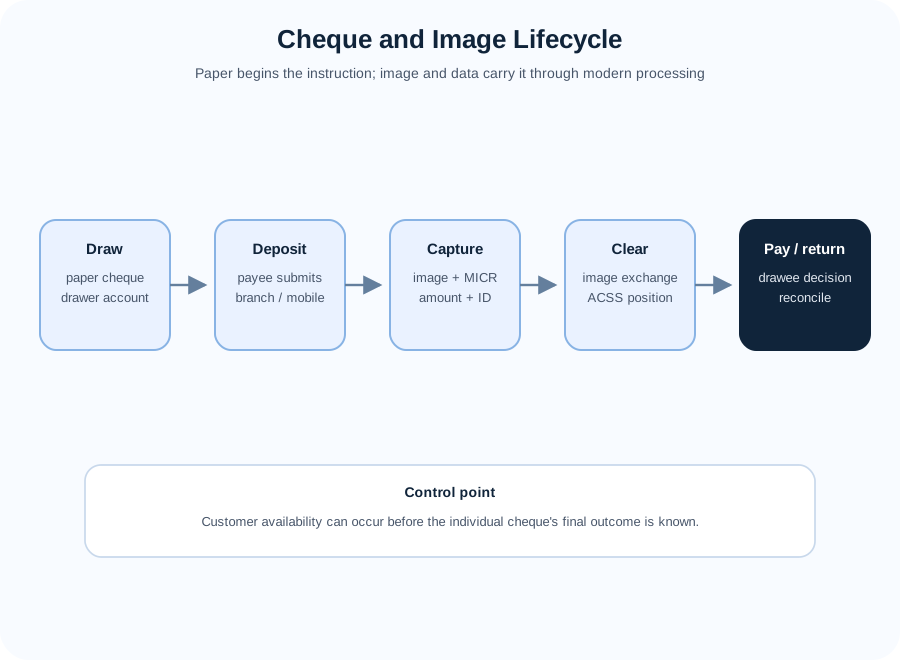
drawer issues paper → payee deposits → depositary FI captures and validates → image/data is archived and exchanged → drawee FI decides pay or return → ACSS position is calculated → Bank of Canada settlement occurs → customer and FI books are reconciled.
Payments Canada says the retail batch system consists of ACSS and the United States Bulk Exchange (USBE). ACSS is the Canadian-dollar retail system; it clears both paper-based and electronic payments. Its public operating page states that direct clearers enter items and values, ACSS calculates net balances, and previous-day net balances settle during the next business-day morning through Bank of Canada settlement accounts. 1
The flow is not a single “cleared” flag. At minimum, an item needs separate states for:
- accepted deposit instruction;
- image/data capture passed or sent to review;
- customer ledger credit and available amount;
- image/data released for exchange;
- presentment received by the drawee;
- paid, returned, adjusted or unresolved;
- ACSS clearing position and settlement evidence;
- final customer and general-ledger reconciliation.
Current volume context
Payments Canada’s January 20, 2026 ACSS statistics report 257,273,448 cheques and paper items delivered through ACSS in 2025, with a reported value of $2,446,227,356,000. This is a combined category, not a cheque-only count; it excludes on-us items that do not pass through inter-FI clearing. The statistic should not be presented as “all Canadian cheques.” 3
2. Participants and ownership boundaries
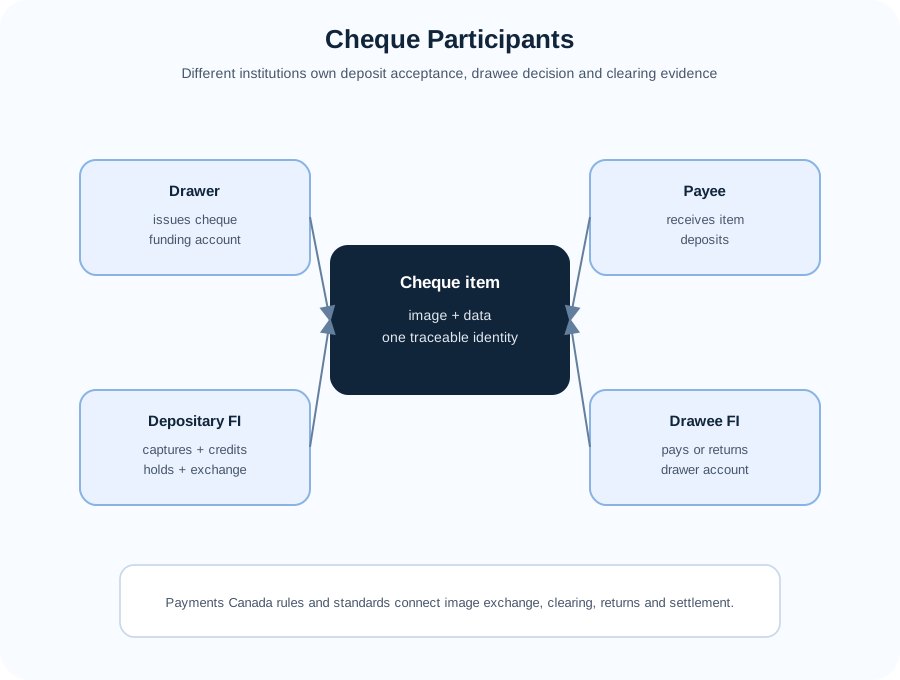
| Participant | What it owns in this journey | What it does not prove |
|---|
| Drawer | Issues the cheque and funds the account on which it is drawn. | Issuing a cheque does not prove that it was paid. |
| Payee / depositor | Receives the instrument and presents it for deposit. | Returning paper to the drawer does not prove that it was never deposited. |
| Depositary FI | Accepts the deposit, captures or receives images, applies customer/account controls, posts credit, applies holds and sends eligible items to exchange. | Its acceptance or provisional credit does not bind the drawee to pay. |
| Drawee FI | Receives presentment, checks the drawer account and payment conditions, and pays or returns under applicable rules. | A return reason alone does not establish fraud. |
| Direct clearer | Participates directly in ACSS, exchanges/records items and settles its own and sponsored positions. | Direct-clearer status is not the same as being the customer’s bank. |
| Indirect clearer / clearing agent | Uses a direct clearer for clearing and settlement under the applicable relationship. | Its use of an agent does not remove item-level evidence obligations. |
| Payments Canada | Owns and operates ACSS and publishes the rules, standards and procedures. | It is not the customer’s depositary or drawee FI. |
| Bank of Canada | Provides settlement accounts to ACSS direct clearers and settles obligations in central-bank money. | Settlement-account evidence is not a customer-facing pay decision. |
The Bank of Canada explains that direct participants instruct, clear and settle on their own behalf, while indirect participants rely on a direct participant. 4 Payments Canada’s retail-batch page identifies direct clearers and says they handle their own customers and the customers of indirect clearers. 1
3. Channels, authentication and bank processing
3.1 Capture channels
A deposit can arrive through:
- a teller or branch scanner;
- an FI-owned ABM;
- a mobile remote-deposit function;
- a business remote-deposit scanner or lockbox arrangement;
- centralized paper processing.
The channel and authentication layer is bank-specific. A mobile app may require sign-in, device controls or multi-factor authentication; a corporate channel may use entitlements, dual approval and file authentication. Neither Payments Canada Rule A10 nor the federal hold regulations prescribe a universal customer-login method. A training chapter should not turn one bank’s app behaviour into a national rule.
FCAC describes mobile deposit as photographing the front and back in the FI’s official app, confirming the details, and storing the original until it has cleared. It warns against depositing a photocopy, PDF or printout and identifies double presentment as a fraud risk. 5
3.2 Depositary-FI processing
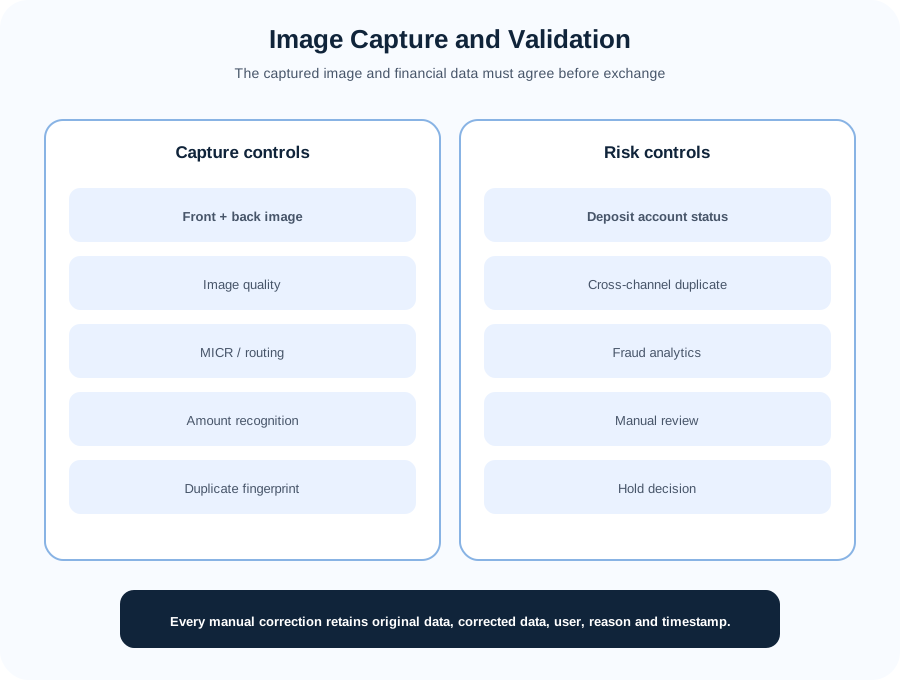
A realistic bank/payment-hub implementation separates these services:
- channel gateway — accepts the authenticated instruction and records channel, device/session and timestamp;
- capture service — stores front and back images and the entered or recognized amount;
- MICR/data service — reads routing and account fields and records confidence, repair and operator evidence;
- image-quality service — tests completeness, readability, edges, contrast, glare, skew and key zones;
- duplicate service — searches enterprise history across mobile, branch, ABM and corporate channels;
- risk service — applies account, velocity, counterfeit, alteration, mule and other institution-specific controls;
- posting/hold service — creates the customer credit and available/held amounts;
- archive and exchange gateway — binds the image and data to a durable item ID, creates the appropriate exchange record/file and manages acknowledgements and rejects;
- return/adjustment service — links a return or clearing error to the original item and applies an idempotent customer/accounting event;
- reconciliation service — compares channel, item, exchange, ACSS, settlement, subledger and GL evidence.
The system should preserve the machine-recognized value, any corrected value, reason, user and timestamp. OCR is an aid; it is not a legal or accounting decision by itself.
4. Instrument, image and data requirements
4.1 Legal and scheme layers
Federal law. Under the Bills of Exchange Act (BEA), an official image of an eligible bill can be used as though it were the eligible bill, and a bank may present an official image electronically in accordance with Canadian Payments Act by-laws, rules or standards. The Act also addresses presumptions and admissibility of an official image. 6
Payments Canada rules. Current Rule A10 covers image creation and storage, Image Printouts, Clearing Replacement Documents (CRDs), Return Replacement Documents (RRDs), electronic exchange and return of images, and related ICP files. Rule A10 says it must be read with A1, A3, A4, B1, B2, B10, K1 and Standards 006, 013, 014, 015 and 018. The current A10 PDF records amendments effective February 9, 2026, including the holistic return-reason review. 7
Standard 006. Standard 006 is the current Payments Canada specification for MICR-encoded payment items. Its Part A covers imageable items including cheques, and it defines the MICR fields and document requirements that support machine processing. Do not copy field lengths or transaction-code tables into application logic without version control. 8
Standard 015. Standard 015 is the companion document for electronic exchange of cheque and image data. The current rules library is the authoritative place to obtain the in-force document and any associated implementation material. 9
4.2 Data and identity
A bank should be able to retrieve, under one internal item ID:
- deposit ID and item ID;
- account and customer relationship;
- channel, business date and timestamp;
- front and back image versions;
- MICR institution/transit/account and cheque number where available;
- entered, recognized and corrected amount;
- endorsement and FI identifiers;
- image-quality and duplicate decisions;
- hold and customer-posting events;
- exchange/file/item references and acknowledgements;
- drawee outcome, return reason or adjustment reference;
- ACSS/settlement evidence and GL postings.
Rule A3 requires each Member party to an exchange to identify the item to facilitate tracing. It also describes the negotiating institution’s endorsement guarantee and the circumstances in which the payee’s endorsement is not a necessary endorsement. 10 The bank’s image archive must preserve the back image when it is needed to evidence endorsement and identification.
5. Exchange, messages/files and cutoffs
5.1 Image exchange
Rule A10 uses ICP Files for image-captured payment exchange. The implementation must distinguish:
- file creation and signing/authentication;
- transmission and transport acknowledgement;
- file validation and acceptance;
- item-level reject or acceptance;
- exchange release and downstream outcome.
A transport acknowledgement does not prove that every item was accepted for clearing. A replay-safe exchange gateway needs a file ID, item IDs, control totals, business date, sender/receiver, status, retry count and duplicate/replay decision. Any channel API used by a bank is an institution-specific interface, not a national cheque API established by Payments Canada.
Rule A10 includes participation requirements, disaster-recovery arrangements, ICP file creation and transmission, exchange times, late files, acknowledgements, settlement date, rejected ICP files, end-of-day notice and electronic presentment. The precise live times belong in the current rule and the participant’s operating calendar, not in a static training summary. 7
5.2 Paper exchange remains a controlled path
Image exchange is the ordinary path for eligible image-captured items, but current A1 also lists paper items, Image Printouts, CRDs and RRDs as eligible categories under their rules. A1 requires Canadian-dollar cheques to be drawn on a Member (or qualifying local), payable on demand, identified under A3 and compliant with the rules. A1 also says post-dated items are not exchangeable for clearing and settlement, and places a $25 million limit on Canadian-dollar paper items, subject to stated exceptions. 11
The statement “paper never moves” is therefore too broad. The correct statement is that routine image exchange avoids physical inter-FI movement, while controlled paper, replacement and return paths remain in the rule set.
5.3 Publicly documented timing
Payments Canada’s public ACSS page says that a branch cheque normally goes to the FI’s regional data centre the same evening; six regional exchanges are scheduled each evening; late-day or non-automated items often move to the next day; Saturday deposits are not cleared until the following Monday evening; and in most cases the pay/no-pay decision is due by the next business day. These are public operating explanations, not a substitute for the current member rule, calendar or a bank’s channel cutoff. 1
A channel should show its own cutoff and expected processing date. The central service should store one authoritative business date so that mobile, branch, ABM and corporate processing do not use incompatible local-clock logic.
6. ACSS clearing, settlement and liquidity
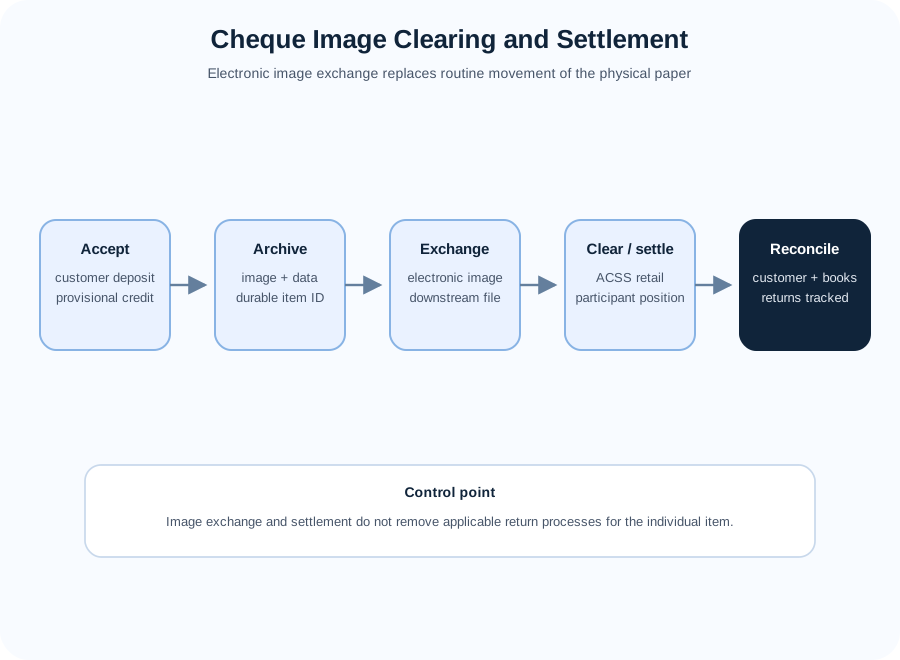
ACSS combines the direct clearers’ exchanged volumes and values to calculate net balances. The public Payments Canada page says previous-day net balances settle in the morning of each business day, with settlement-account balances extinguished through payments to and from the Bank of Canada. 1
The Bank of Canada states that it provides settlement accounts to ACSS direct clearers and that final settlement of payment obligations in ACSS occurs through accounts on its books. It describes the benefit as settlement finality in central bank money. 2
Operationally, the direct clearer must monitor:
- expected net debit/credit position by settlement date;
- settlement-account balance and intraday funding capacity;
- queued, late, rejected or replayed exchange records;
- sponsored indirect-clearer obligations;
- differences between item totals, ACSS reports, settlement-account evidence and the GL;
- contingency and recovery status.
This chapter does not invent a universal intraday-credit, collateral or queue rule. The direct clearer’s treasury, Payments Canada procedures and Bank of Canada settlement-account policy govern those details. The key control is that customer availability can create uncollected exposure before the item’s return risk has expired.
7. Holds and customer availability
7.1 Current federal rules
The Access to Funds Regulations are current to September 21, 2026 on the Justice Laws site. Sections 2–4 apply to qualifying paper-based cheques deposited in Canada that are MICR-encoded, readable, drawn on a Canadian institution’s branch and payable in Canadian dollars. For qualifying deposits, the maximum hold is:
| Qualifying cheque | In person with an employee | Other method, including ATM/mobile |
|---|
| $1,500 or less | 4 business days after deposit day | 5 business days after deposit day |
| More than $1,500 | 7 business days after deposit day | 8 business days after deposit day |
The first $100 must be available immediately when deposited in person with an employee, and on the following business day when deposited another way. The regulations include exceptions such as an account open less than 90 days, multiple endorsement, a cheque deposited at least six months after its date, and reasonable grounds to believe the deposit is for illegal or fraudulent purposes. Institutions relying on an exception must provide the required notice. 12
These are federal rules for covered institutions and qualifying deposits, not a promise that every cheque, credit union account or foreign item has those limits. FCAC explains that mobile deposits are paper-based for this purpose and that damaged, non-MICR, foreign and other excluded items may fall outside the legislated maximums. 13
7.2 2026 modernization status
The Department of Finance announced a proposed modernization to raise immediate availability from $100 to $250 and remove timing distinctions between deposit methods. However, the enacted Budget 2025 Implementation Act, No. 1 shows Division 15 (Bank Act—Funds Deposited by Cheque) as not in force and says it comes into force on a day fixed by order of the Governor in Council. As of this audit date, systems and training must therefore not present $250 or the proposed method-neutral timing as current law. 14 15
7.3 Implementation and communication
A bank can choose to release funds earlier as a credit decision, but FCAC explains that early release may be an extension of credit and that the institution can withdraw funds if the cheque does not go through. The customer view should separate deposited, held, available, returned and adjusted amounts. Do not label an available balance “final” unless the product’s legal terms support that wording. 13
8. Fraud, duplicate presentment, AML and sanctions boundaries
8.1 Fraud controls
Relevant risk patterns include counterfeit or altered items, forged or unauthorized signatures, stolen cheques, double presentment, account takeover, mule activity, kiting and fake drafts. These are risk typologies, not automatically Payments Canada return reasons.
Bank-specific controls may include image comparison, payee/amount review, velocity and device signals, customer history, positive pay, hold escalation, manual review, account restrictions and post-event analytics. A positive-pay file or API is a bank/business product; it is not mandated for every Canadian cheque.
Double presentment is especially important for mobile deposits because the customer retains the paper. FCAC tells customers to deposit an item only once, mark the front after deposit and contact the FI immediately if they mistakenly deposit it twice. 5
8.2 FINTRAC and recordkeeping
Cheque imaging and presentment are expressly excluded from the regulatory definition of an electronic funds transfer in the FINTRAC recordkeeping guidance. A bank must not automatically describe every image-clearing event as an EFT report. 16
Financial entities must keep cleared-cheque records and a copy of each cleared cheque deposited to an account, subject to the electronic-image exception where the image is readily reproducible and its location readily ascertainable. The cited FINTRAC guidance states a minimum five-year retention period for those records/images. 17
If facts give the reporting entity reasonable grounds to suspect money laundering, terrorist financing or sanctions evasion, the FI follows its FINTRAC Suspicious Transaction Report process. FINTRAC’s current guidance gives a cheque-deposit example and requires the report to explain the facts, context and indicators. A fraud alert alone is not an STR; a return reason alone is not an STR. 18
Sanctions screening, customer due diligence, account restrictions and escalation are institution-specific controls operated under applicable federal law and internal policy. This chapter does not invent a cheque-specific sanctions message or a universal screening API.
8.3 Interac and RTR are separate rails
Interac’s official consumer material describes Interac e-Transfer as an account-based service through participating banks and credit unions; it is not the cheque/image-clearing rail. RTR is likewise a separate modernization programme and is described by the Bank of Canada as planned. Do not route a cheque through Interac e-Transfer or claim that a cheque has RTR instant-finality characteristics. 19 2
9. Returns, adjustments, disputes and investigations
9.1 Return versus clearing error
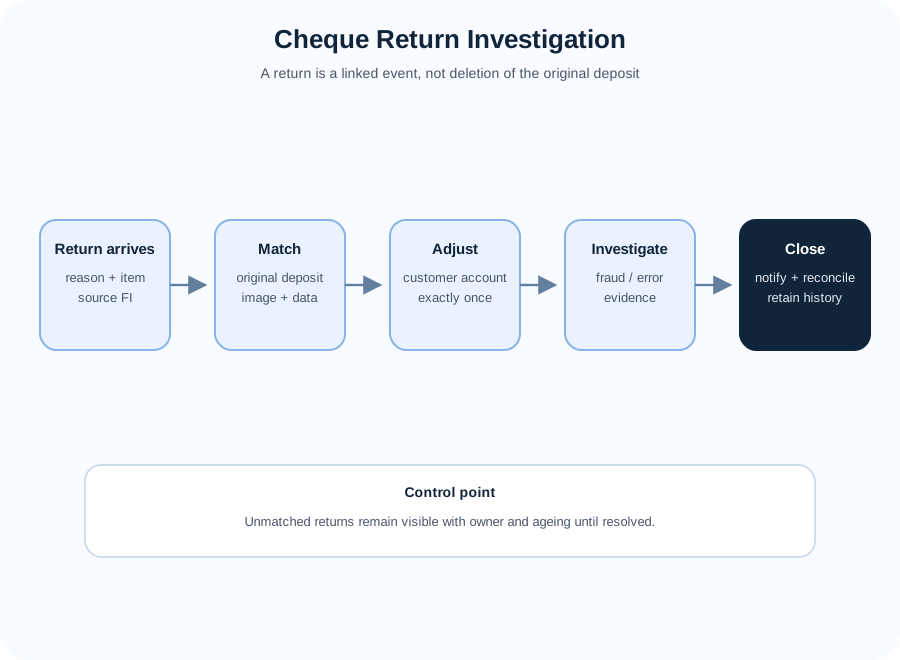
A drawee return is different from a post-settlement clearing error. Examples of returns or return-related outcomes include insufficient funds, account closed or not for us, stop payment, forged/unauthorized signature, forged endorsement, post-dated, duplicate payment item, material alteration, image missing/not usable, MICR mismatch and incorrect amount encoding. The exact reason code and eligibility must come from the current A4/A10 rule and the applicable item type.
Rule A4’s ordinary timing rule is that an item must be returned no later than the business day following receipt by the first drawee organizational unit able to decide to dishonour. The rule has material exceptions: for example, forged endorsement and intended payee not paid can be returned up to six years; duplicate payment, material alteration, wrong currency/incorrect amount encoding, CRD/ICP MICR mismatch and image missing/not usable are among reasons with 90-calendar-day windows; force majeure can extend the ordinary timeframe under the rule. 20
A returned item generally must not be exchanged a second time unless an A4 exception or written authorization applies. The bank must distinguish an allowed re-presentment, a customer redeposit and an uncontrolled duplicate. 20
9.2 B10 tracing and adjustments
Rule B10 covers post-settlement tracing and correction of clearing errors, adjustments and photocopies/Image Printouts. It defines an adjustment as a credit or debit to rectify a clearing error, including missing items, free items and capture/balancing errors. In the current rule, adjustments generally must be made within six months of exchange; an adjustment over $20 must be accepted when accompanied by full tracing information; and the rule specifies the settlement date, amount, listing/bundle and item-position evidence needed. 21
An unmatched return or adjustment is not a reason to journal an unexplained amount to generic suspense. It needs a case ID, owner, age, candidate original items, evidence, posting status and escalation date.
9.3 Investigation pack
For any disputed or returned item, retain and link:
- original front/back image and version used in processing;
- deposit channel, timestamp, customer/account and item ID;
- MICR and captured/corrected amount;
- endorsement and FI identifiers;
- image-quality, duplicate and fraud decisions;
- hold and customer-posting events;
- exchange file/item acknowledgement and ACSS/settlement references;
- return reason, return date and source FI;
- customer debit/credit adjustment and any fee event;
- customer notice, complaint, investigation and recovery outcome.
The customer debit must be idempotent. A retried return record or duplicate return message must not create a second debit. The original deposit history must remain visible; a return is a linked event, not deletion.
10. Posting, accounting and reconciliation
A simplified illustrative depositary-FI subledger flow is:
| Event | Illustrative subledger effect | Control evidence |
|---|
| Deposit accepted | Debit cheque-clearing/control or uncollected-funds asset; credit customer deposit account | Deposit and item IDs, amount and channel |
| Hold applied | Restrict availability or track held amount; no assumption of final payment | Hold reason, start, release and approval |
| Exchange released | Move item from capture queue to exchange/clearing control | ICP/file/item acknowledgement and control totals |
| ACSS settlement | Clear the inter-FI control against settlement-account evidence | ACSS position, settlement date and Bank evidence |
| Return | Debit customer account or create receivable under product terms; credit return/clearing control | Return reason, original link and one-time adjustment ID |
| Clearing adjustment | Post the rule-defined debit/credit to correct the error | B10 tracing and adjustment record |
Exact GL accounts and timing vary by FI. The non-negotiable control is visibility of customer credit, hold, uncollected exposure, exchange, settlement, return, fee and suspense states.
Reconcile at these layers:
- accepted item count/value to customer deposit posting;
- item to front/back archive and data;
- released item to exchange file and acknowledgements;
- exchange item to ACSS count/value and direct-clearer position;
- ACSS position to Bank of Canada settlement evidence;
- return/adjustment to the original item and customer posting;
- subledger to GL and aged suspense.
File-level totals can show that a batch balances while one item is wrong. Item-level references, control totals and replay-safe IDs are required to find the break.
11. Resilience, access and test design
11.1 Resilience
Durable queues must preserve item ID, business date, posting status and retry status when capture, archive, exchange or return services fail. Recovery must be idempotent. Archive DR must restore both image objects and indexes, metadata, front/back pairing, integrity checks and access logs. A backup is not proven until a historical item can be retrieved and matched to the exchange version.
For an exchange outage, do not silently move the item to a new business date; assess hold, customer communication, rule timing and settlement effects. For a return outage, preserve received records and prioritize any rule deadline. For a branch scanner outage, an approved paper-retention or alternate-capture process must prevent later duplicate capture.
11.2 Access and privacy
Least-privilege roles should distinguish teller, customer service, fraud investigator, corporate positive-pay user, finance reconciler and system administrator. Image access, manual data edits, hold overrides, positive-pay decisions and customer adjustments must be separately authorized and logged. Customer-facing image views should mask or omit unrelated data and internal annotations where appropriate.
11.3 Minimum release tests
Test at least:
- clean branch, ABM, mobile and business remote-deposit items;
- missing back, glare, crop, skew, low contrast, unreadable MICR and amount mismatch;
- manual amount correction with original/corrected values and audit trail;
- mobile-to-branch and branch-to-ABM duplicate attempts;
- post-dated, stale-dated, damaged, non-MICR, foreign and multi-endorsed items;
- new account, restricted account, high-risk and eligible-enterprise hold cases;
- paid, NSF, stop payment, closed account, forged endorsement, material alteration, duplicate and image-not-usable outcomes;
- ICP file acceptance, item reject, timeout, replay, late file and DR recovery;
- A4 ordinary return and an exception-window return;
- B10 missing bundle, wrong listing, free item, amount-encoding error and photocopy/Image Printout trace;
- duplicate return delivery and failed customer adjustment;
- ACSS-to-settlement mismatch, aged suspense and subledger-to-GL break;
- archive restore, permission denial, retention expiry and evidence export;
- Friday cutoff, Saturday deposit, statutory holiday, month-end and year-end business-date boundaries.
11.4 Operational metrics
Useful measures include item count/value by channel, image-quality reject rate, manual correction rate, duplicate-alert precision, fraud-alert ageing, hold value and release timing, ICP reject/replay rate, return rate by reason, unmatched returns, B10 adjustments, settlement differences, archive retrieval failures, aged suspense and customer complaints about availability/returns.
12. Practical Canadian examples (fictional)
Example A — Mobile duplicate (fictional)
A customer deposits a $1,250 cheque by mobile at 08:00 and presents the same paper at an ABM two days later. The enterprise duplicate service compares the item’s routing, account, cheque number, amount, image characteristics and customer/channel history. The second item is held for review and does not create an uncontrolled second credit. The message says the cheque appears already deposited; it does not accuse the customer of fraud automatically.
Example B — Hold and NSF return (fictional)
A business deposits a $9,000 qualifying Canadian-dollar MICR cheque. The FI posts the deposit, makes the amount available according to the applicable hold/product policy and later receives an NSF return. Operations links the return to the original item, applies one permitted customer adjustment, preserves the image and return evidence, and explains that earlier availability was not a guarantee of payment.
Example C — Image/data error (fictional)
A scanner reads $1,850 while the visible cheque says $1,350. Before exchange, the FI’s control detects the mismatch and routes it to authorized review. If an incorrect amount is exchanged, the FI uses the applicable A4/B10 correction or return path, preserves both recognized and corrected values and reconciles the customer and inter-FI records.
13. Key takeaways and authoritative references
- A cheque is an instrument; an image, clearing item, customer posting and settlement position are different records.
- ACSS is the current Canadian retail batch clearing system for cheque/image items; Bank of Canada settlement accounts support final settlement in central bank money.
- Customer availability can precede the drawee decision and can be reversed under the applicable product/rule process.
- A10 governs image creation, storage, ICP exchange and electronic presentment; A1/A3/A4/B10 govern eligibility, identification, returns and clearing-error tracing.
- The current federal covered-deposit rules remain $100 first-dollar availability and 4–8 business-day maximum holds; the enacted $250 modernization provision was not in force on 2026-10-05.
- Interac e-Transfer and planned RTR are separate rails, not cheque-clearing paths.
This application uses JavaScript for the full interactive experience. This text summary is served for accessibility and search indexing.