Cancellation, Disputes and Reimbursement. Connect cancellation rights, customer disputes, reimbursement, recourse and collector recovery.
Canada Payments & Collections · Block 5 · Chapter 25 of 75
Connect cancellation rights, customer disputes, reimbursement, recourse and collector recovery — from the payor's first "stop this" to the biller's last recovery step.
Every month, somewhere in Canada, the same two phone calls land within hours of each other. A payor rings their bank: "I cancelled that pre-authorised debit weeks ago — why did the money leave my account again?" A biller rings its bank: "You took money out of my account for a payment my customer is disputing — on what authority?" The payor exercised a forward-looking right — cancellation stops future collections — but a debit already taken needs a backward-looking remedy — reimbursement through recourse. The biller lost the collection through that same recourse, and now the recovery is its own job to do. This chapter connects those two calls into one controlled story: cancellation rights, customer disputes, reimbursement, recourse, and collector recovery, end to end.
The working rule for this chapter is a single sentence worth memorising: cancellation looks forward and stops what has not yet been collected; recourse looks backward and returns what should never have been taken. Cancellation ends the authority to collect. Recourse unwinds the debit that escaped that ending — or that never had authority in the first place. The first is a notice from payor to biller, with the payor's bank standing by as an assistance channel where debits continue. The second is a claim at the payor's bank that, once validated, reimburses the payor and pushes a linked recourse entry back through clearing to the biller's account. Confuse the two and you will give the wrong advice with total confidence: telling a payor that cancelling "gets the money back," or telling a biller that a recourse debit "can be refused like an invoice." Neither is true, and both errors cost real money and real trust.
A note on scope discipline before the journey starts. This chapter labels Rule H1/Payments Canada requirements, bank or processor implementation choices, and fictional examples separately. It gives the operative H1 windows and dates verified against the current rule text, but exact reason codes, layouts and participant procedures still belong to the live rules, standards and bank agreements. Card chargebacks appear only as a comparison case. RTR is not used as a live PAD path here. Nothing here is legal advice: procedures must be built with legal counsel and this chapter is operational education, not authority to promise outcomes.
What you should be able to do after this chapter
After working through this chapter, you should be able to:
- explain the difference between cancellation (forward-looking, ends future authority) and recourse (backward-looking, reimburses an improper debit) without hesitating;
- walk a payor through cancelling a PAD agreement: notice to the biller, what the agreement must say about cancellation, and when the bank's assistance channel applies;
- describe who owns what among the payor, the biller (payee), the payor's bank, the payee's bank, Payments Canada systems and the Bank of Canada across a dispute;
- validate a PAD collection before release the way a payee bank must — agreement, category, amount, timing, pre-notification — so fewer disputes are born;
- explain how a PAD moves through batch exchange, clearing and deferred-net settlement, and where a recourse entry fits into that flow;
- state what data and evidence a dispute needs — agreement copy, cancellation notice, confirmation and pre-notification records, linked references — and why each matters;
- read the Rule H1 neighbourhood functionally — cancellation, reimbursement claims, recourse, dishonours — and always confirm detail against the live rule text;
- place fraud, sanctions, AML and authority controls at the correct gates so exploitation does not ride the dispute process;
- run the dispute lifecycle end to end: intake, triage, evidence check, reimbursement, linked recourse, advices, and the routes for declined claims;
- post, account for and reconcile reimbursements and recourse debits truthfully while related entries are still in flight;
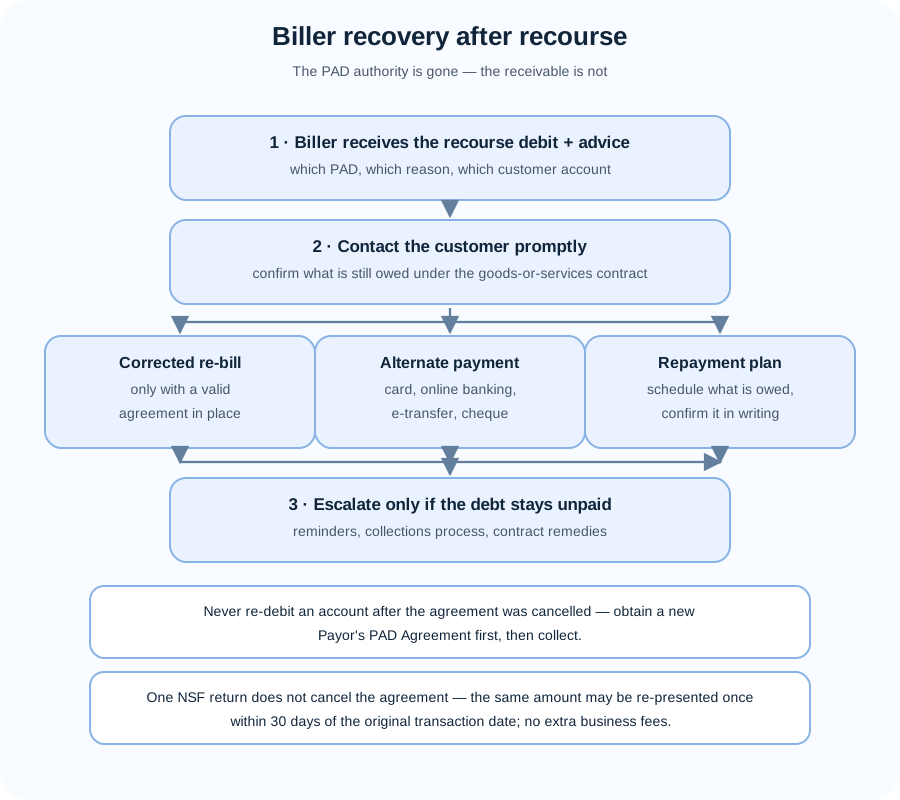
- describe the biller's recovery after recourse — corrected re-bill, alternate payment, repayment plan, escalation — and why a cancelled agreement needs a new agreement before any re-debit;
- build, test and staff the cancellation-and-dispute operation: queues, service levels, simulations, vendor boundaries and rule-amendment readiness;
- find the authoritative answer in the live Payments Canada rulebook, the PAD support guides and the Financial Consumer Agency of Canada material instead of memorising training slides.
For a roughly 60-minute core session, spend about 20 minutes on Section 1 and Section 8 up to the reimbursement diagram, 15 minutes on Section 9 with the biller-recovery diagram, 15 minutes on Section 11 working the three fictional stories, and 10 minutes on Section 12.
Chapter navigator
- Business context and customer need
- Participants, responsibilities and boundaries
- Initiation, validation and bank processing
- Clearing, exchange, settlement and finality
- Data, identifiers and messages
- Rules, cutoffs and service levels
- Fraud, compliance and controls
- Exceptions, investigations and recovery
- Posting, accounting, liquidity, reporting and reconciliation
- Implementation, testing and resilience
- Practical fictional Canadian examples
- Key takeaways and authoritative references
1. Business context and customer need
Start with the Tuesday morning that every Canadian contact centre knows. A payor in Winnipeg opens online banking and sees a $214 debit from a fitness club she left in January. She cancelled, she says — emailed the club, has the copy, even confirmed with an agent. Yet the debit arrived on schedule, and rent money is now short. She wants two things that sound like one: stop it happening again, and get this one back. The agent who answers must hold both apart while sounding like they belong together. Stopping it happening again is cancellation — forward-looking, a notice already given that must now be enforced. Getting this one back is recourse — backward-looking, a reimbursement claim for a debit taken after the agreement ended. Handle the first without the second and she calls back angrier next week. Handle the second without the first and the bank reimburses her every month while the club keeps collecting. The professional skill is running both tracks at once and saying plainly which track each action belongs to.
The mirror image sits on the biller's side of the same morning. A property-management company in Mississauga with 900 tenants on PAD opens its account and finds eleven recourse debits totalling just over $18,000 — rent it believed collected, now reversed with reason codes and customer names but no further explanation. The office manager's first instinct is to re-debit: the rent is genuinely owed, the leases are signed, the tenants are still in the building. That instinct is exactly what the rules forbid acting on directly. A recourse debit means the collection authority failed — no agreement, off-terms collection, or a cancelled agreement — and re-debiting the same accounts without fresh authority converts a recoverable receivable into a compliance incident. What the company actually needs is a recovery routine: contact each tenant, establish what is still owed under the lease, and collect by corrected re-bill under a valid agreement, by alternate payment, or by agreed plan. The bank's job is to deliver the advice that makes that routine possible — which PAD, which reason in plain language, what correction unblocks collection — and to hold the line when the biller asks to "just run them again."
Customers experience obligations, dates and consequences: the gym membership that should have ended, the rent that is still due, the insurance premium whose missed payment voids coverage. The bank experiences authorities, entries, windows, postings and returns. Cancellation and disputes are where those languages collide, because the customer wants a single outcome — "make this right" — while the bank must respect a process in which stopping the future and repairing the past are different instruments with different counterparties, different evidence and different clocks. The professional skill is holding both truths at once: empathise with the urgency, then walk the track the rules actually provide instead of the shortcut the caller imagines.
The economics explain why this chapter earns a full deep read rather than a two-page procedure card. A clean cancellation costs almost nothing: a notice, a confirmation, a diary entry, a stopped file. A disputed debit costs multiples across two institutions: intake time, evidence retrieval, reimbursement funding, a recourse entry through clearing, advices on both sides, the biller's recovery effort, and the reconciliation of every linked leg. Post-incident reviews consistently show the same pattern: most dispute cost originates upstream — in agreements never properly taken, cancellations never actioned, pre-notifications never sent — while most pain is felt downstream, in operations queues and biller relationships. Prevention is measured in cents per collection. Recovery is measured in phone calls, cases and lost billers.
Pull payments make all of this structurally sharper than push payments, and bankers who carry push habits across get into trouble. In a push payment the payer acts every time — every bill payment, every transfer is a fresh decision with fresh authentication. In a pre-authorised debit the payer acted once, sometimes years ago, and the biller has been pulling ever since. That convenience is the product, and it is also the risk: authority ages, circumstances change, and the pull continues on memory rather than mandate. Cancellation rights and recourse are the designed-in counterweight that lets millions of Canadians hand standing authority to billers with confidence. The controlled operation treats each dispute as a test of the authority chain and routes it accordingly.
Disputes also cluster seasonally — January membership cancellations, September tuition billing, variable-amount utility season — and mature operators roster capacity and brief biller clients for the load they know is coming.
2. Participants, responsibilities and boundaries
A cancellation only holds and a dispute only resolves when each participant does its bounded job and hands over clean evidence. Blurred responsibilities are how debits continue after cancellation and how valid claims get declined, so this section draws the boundaries crisply for the mechanics in Sections 6 and 8.
The payor is the customer whose account is debited. The payor's duties are agreement, attention and notice: to enter the PAD agreement knowingly, to check activity so improper debits surface inside the claim window, and to cancel through the channel the agreement describes — functionally, written notice to the biller, keeping a copy. The payor's rights mirror those duties: to cancel future collections on notice, to receive the required confirmation and pre-notification material, and to claim reimbursement for unauthorised or off-agreement debits. A payor who understands that cancelling the PAD agreement does not cancel the underlying contract disputes less and pays more reliably.
The biller (payee) is the business collecting by PAD — the utility, the insurer, the landlord, the franchisor. Its duties are authority, accuracy and responsiveness: every debit must sit under a valid Payor's PAD Agreement of the correct category, for the agreed amount at the agreed time, with required notices sent; and when a payor cancels, the biller must stop. When its bank debits it through recourse, the biller bears the recovery — contacting the customer, re-establishing authority where the relationship continues, and collecting by another method where it does not. The biller's bank holds it to these duties through the Payee Letter of Undertaking, the contract under which the bank agrees to issue PADs on the biller's behalf. Much dispute volume traces to biller-side weakness: agreements taken by sales channels that cannot produce them later, cancellations received by front desks that never reach the billing file, variable amounts changed without the required notice. Visiting and testing biller capability beats funding its recourse indefinitely.
The payor's bank (processing member) holds the payor's account and owns the payor-facing side of both tracks. On cancellation it provides the assistance channel where debits continue after the payor cancelled — functionally, helping enforce the stop rather than watching the customer re-argue with the biller every month. On disputes it owns intake, triage, the evidence check, the reimbursement decision, the recourse entry and the payor's advice. Critically, it owns the decision to decline: a claim outside the rules — a business PAD claimed late, a cash-management transfer the payor now regrets, a debit the payor authorised and simply dislikes — must be declined with written reasons, because reimbursing outside the framework spends the biller's money without authority.
The payee's bank (sponsoring member) owns the biller relationship and the consequences of sponsoring it: reviewing the biller's agreement forms and processes before they go live, confirming commercially reasonable verification methods are in place, binding the biller through the Letter of Undertaking, and — when recourse arrives — debiting the biller, advising it with repair-grade detail, and supporting its recovery without re-debiting on its behalf. When a biller's recourse rate climbs, the payee's bank owns the difficult conversation: fix the agreement and cancellation handling, or lose the sponsorship.
Payments Canada owns and operates the retail batch clearing system (ACSS) under the Canadian Payments Act. It sets the clearing rules, the exchange mechanics and the operating calendar through by-laws, rules, standards and procedures — including Rule H1 for PADs. It does not judge individual disputes, hold customer accounts, or decide who owes whom under a gym contract. When this chapter says "the live rule text," it means the current rules, standards and by-laws in the official rules and documentation library linked in Section 12. Keep this boundary in mind whenever someone suggests "asking Payments Canada to cancel a PAD." The operator provides the processes — cancellation mechanics, reimbursement claims, recourse entries, dishonours, and beyond them the items-in-dispute and arbitration families — through which participants act. It does not reach into participant books on request.
The Bank of Canada touches this chapter the way it touches all batch mechanics: as settlement agent, with ACSS net positions funded through settlement accounts at the Bank on the morning after the exchange day, and as overseer of payment systems. "The Bank of Canada will reverse our PAD" is a category error — reimbursement and recourse are participant-to-participant processes under Payments Canada rules, funded like any other clearing entries.
Service providers, payment processors and indirect participants complete the map. Billers commonly collect through processors, hubs and software platforms that generate files, hold agreement images and route notices; institutions that are not direct clearers reach clearing through a direct participant's arrangements. Outsourcing the work never outsources accountability: if a processor keeps emitting a cancelled PAD, it is the biller's debit and the sponsoring bank's problem. Contracts should mirror the dispute taxonomy — who holds the agreement image, who actions cancellations within what time, who produces evidence within what time, with what references.
Two principles recur throughout. First, the PAD agreement sits between payor and biller; the banks sit around it, not inside it. Neither bank rewrites the underlying contract, and clearing never owes any customer an explanation. Second, cancellation ends authority while recourse reverses value — never merge them into one gesture. Stopping the file without reimbursing the improper debit leaves the payor short; reimbursing without stopping the file manufactures next month's dispute. Every procedure runs both tracks and closes each explicitly.
3. Initiation, validation and bank processing
Most disputes are conceived at agreement-taking, born at validation and merely discovered months later on a statement. The cheapest recourse is the debit never raised against a dead agreement; the cheapest cancellation failure is the notice actioned the day it arrived.
Agreement-taking (initiation of authority) is where the entire downstream story is decided, and every field collected is a future dispute prevented or invited. A Payor's PAD Agreement must capture, at minimum, the date, the payor's authorisation to debit a specific account, the PAD category — personal, business, cash management or funds transfer, each carrying different recourse protection — the amount (fixed, or variable with the variability stated), the timing (set intervals, a one-time date, a triggering event, or sporadic with per-debit authorisation such as a password), how to cancel, contact information for the biller, and the mandatory recourse and reimbursement statement telling the payor that unauthorised or off-agreement debits can be reimbursed through their bank. The payee's bank must review the biller's forms and related processes before they go live, and must be satisfied the biller uses commercially reasonable verification for the circumstances — the method fitting the relationship and the channel, not a ritual checkbox. Weak banks wave through agreement templates to win the sponsorship; strong banks red-pen them, because every missing mandatory element is a claim the bank will later fund.
Initiation must also keep look-alike authorities apart, because each behaves differently when contested. A one-time PAD agreement terminates automatically once its single debit completes — any subsequent debit needs a brand-new agreement, and a biller that "keeps the details for next time" is collecting without authority. A sporadic PAD needs the payor's authorisation before each debit. For Personal and Business PADs at set intervals, H1 requires a first-PAD Confirmation at least 10 calendar days before the due date, unless the payor authorizes a waiver or reduction; if waived or reduced, the Confirmation must be provided within 5 calendar days after the first PAD. H1 also requires Pre-notification at least 10 calendar days before each variable PAD after the first and before a changed fixed amount or payment date, subject to the specified tax/payor-action exceptions and a prominent, authorized waiver or reduction. An assigned agreement after a business sale needs its assignment handling done properly, including the required notice and bank consent where applicable. Test every onboarding channel against one question: could a reasonable payor believe they agreed to something the biller cannot later prove? If a call-centre sale cannot produce a retrievable agreement image, the recourse arriving weeks later is already scheduled.
Validation before release is the layered gateset that earns the right to pull money from someone else's account, and pull validation must be stricter than push precisely because the account holder is not in the room. Format and completeness catch structural defects. Authority confirms the agreement exists, is of the right category, covers this amount at this time, has not been cancelled, and has its required pre-notification sent where applicable. Funds and limits screening runs at the payor's bank on receipt, not at the biller — the biller cannot know the balance — which is why NSF dishonours are a designed-in outcome, not a processing failure. Duplicate detection compares file hashes and item references against recent history so the re-released collection file dies at source. Reachability confirms the destination account details are still servable. Risk and compliance — fraud scoring, sanctions screening, AML review — run before release, because holding before release is always cheaper than recovering after settlement. Section 7 details placement; the lifecycle point is that each validation outcome must be explicit: accepted, rejected with repair-grade reasons, or held with a named owner and an expiry.
Cancellation handling inside processing deserves its own paragraph because it is where most "I cancelled but they kept debiting" stories are actually written. A cancellation notice arrives at the biller — by the channel the agreement describes — and must travel from the inbox to the billing file before the next release, with a confirmation back to the payor and a diary that proves the stop date. Mature billers run a cancellation register: notice received, agreement identified, final debit date stated, confirmation sent, file checked. Immature billers rely on memory, and memory does not stop batch files. The payor's bank has its own processing duty where debits continue: the assistance channel that helps enforce the cancellation rather than advising the payor to "take it up with the biller" for the fourth time. And operations must keep two instruments apart that payors constantly merge: cancellation, which ends the standing authority for all future debits, and a stop payment, which targets a single upcoming debit and leaves the agreement alive. A payor who needed cancellation but bought a stop payment will be debited again next month and will blame the bank. Name the instrument at intake, every time.
Bank processing and routing turns validated collections into releasable obligations. Enrichment adds what the network needs — routing, stream selection into the automated funds transfer debit stream, value dates, reference propagation — without erasing the original references the dispute process will later need. The routing decision applies the on-us test first: same legal entity means no clearing and therefore no clearing recourse, only internal posting controls. Interbank PADs inherit the full Rule H1 framework, which is why the routing decision must be recorded. Processing also owns scheduling discipline: warehouse future-dated collections against business days and cutoffs, and record the release authorisation that dispute evidence ties back to when a biller's authority is questioned. A bank-specific on-us path may bypass interbank ACSS exchange, but that is not a blanket exclusion from the PAD agreement, cancellation or reimbursement controls; map the equivalent internal controls explicitly.
4. Clearing, exchange, settlement and finality
Everyday language collapses five distinct events into "the debit went through." In cancellation and dispute work, confusing them causes real harm: a payor told "it cleared" hears "finished and unchallengeable," while operations should ask which stream, accepted or dishonoured, netted into which cycle, funded at which settlement, posted where, subject to what recourse rights.
Exchange is delivery of collection files between participants per the rail's rules: automated funds transfer debit items and totals into the batch streams on the operating calendar, with acceptance or rejection evidence per submission. A file can be exchanged yet partially rejected at item level — the first fork in handling. Rejected items go back for repair; accepted items enter clearing. A cancellation that arrives after exchange but before the value date may be too late for that cycle's items — the debit is already in flight — which is why confirmations must state the effective stop date honestly rather than promising an immediate halt to everything.
Clearing is the agreement and calculation layer: exchanged debit items aggregate into net participant positions due at a future settlement moment. A PAD can be cleared but not yet settled, and that gap is where cutoff promises, funding forecasts and customer communication live. Recourse operates here too — a recourse entry is itself an item through clearing, linked to the original PAD, recalculating positions — which is why recourse volumes show up in clearing evidence as expected reconciling items rather than surprises, provided the operation classifies them on receipt. Dishonours operate here as well: where the payor's bank cannot apply the debit — commonly non-sufficient funds, a closed account, or a stop — it dishonours the item inside the short window the rules provide, commonly by the next business day, and the biller is told to repair or absorb rather than to hope.
Settlement discharges clearing's obligations in central-bank money. The retail batch system settles deferred-net: positions from clearing are funded through settlement accounts at the Bank of Canada on the morning after the exchange day. Settlement evidence is the proof value moved between participants. A recourse wave — dozens of linked returns from one failed biller book — reshapes a participant's expected position after forecasts were set, which makes large dispute events liquidity facts as well as customer-service stories. Section 9 covers the funding discipline that keeps them manageable and the playbook for the rest. The structural point stands: reimbursement to the payor happens at the payor's bank on the claim decision, while the interbank value moves back through the applicable return/recourse process, clearing and settlement. The payor must never wait for the biller's bank to "send the money back" before being reimbursed on a valid claim; H1 section 24 says the Processing Member reimburses on a best-efforts, immediate basis.
RTR boundary (status checked 2026-10-05). RTR is not the production rail for this PAD story. The Bank of Canada describes RTR as a planned real-time payment system; do not treat its proposed instant messaging, settlement or dispute behaviour as current ACSS capability, and do not infer PAD recourse from RTR modernization material.
Posting applies outcomes to accounts — customer, suspense, general ledger — and belongs to each bank, not the network. The critical discipline is truthful reflection of uncertainty: a PAD credit posted to the biller while recourse rights may still operate is a different promise from one posted with finality, and biller statements, available-balance displays and advices must not blur it. Billers that spend recourse-exposed credits on day one and meet the debit on day thirty experience the rules as betrayal; billers told plainly that recent collections carry a tail of recourse risk manage their cash accordingly. Nothing matters more for biller trust than honest posting language during the window when value has moved but objections remain possible. Payor-side posting carries the mirror discipline: the reimbursement must post as a linked credit naming the original debit, never as an unexplained windfall the payor cannot match.
Finality is a legal and operational state, not a screen message. In the batch world, finality on the interbank leg is conditional in the specific sense that the framework provides defined processes for dishonouring, reimbursing and reversing after clearing. "Debited" describes a posting, not an irreversible outcome, while defined recourse rights remain open. Promising a biller "guaranteed collected funds" on a PAD file sells high-value certainty on a batch chassis, and the complaint will arrive dressed as an operations failure when it was a promise failure. Use these as diagnostic tools. "The money came back" is a dishonour or recourse entry with a reason in clearing evidence, not a malfunction. "The position does not fund" is a settlement event, not a repair queue. Locate the missing event before choosing the tool.
5. Data, identifiers and messages
Disputes are resolved with references, not adjectives. Every reimbursement must join to its PAD, every recourse entry must cite the original debit, every cancellation must identify the agreement it ends, every biller recovery must trace to the recourse that triggered it.
The foundation is end-to-end collection identity: references letting every system agree a debit is the same debit. At agreement-taking, the agreement identifier plus the payor's account designation and the biller's trading identity. At initiation, originator file and item references plus control totals and value dates. Through processing, enrichment without erasure — routing added, originals carried forward, never replaced by internal sequence numbers nobody downstream can see. At exchange, acceptance records preserving sender references so rejected and dishonoured items are precisely identifiable. At clearing, recourse and dishonour entries linked to the originals they reverse. At posting, customer narratives containing enough of the original reference for payors and biller reconciliation teams to match without calling. Test any data design with one question: if this PAD is disputed two months from now, can a junior operator join the claim to the agreement and the original without fuzzy matching? If the answer needs memory or amount-and-date guessing, the design is already generating its future investigation queue.
Batch formats deserve a frank paragraph. Batch exchange still leans on legacy record layouts — automatic funds transfer conventions for PADs — with short, rigid reference fields that are easy to truncate. Later blocks go deep; this chapter needs only the consequences. Never let conversion silently drop or reformat the reference the dispute process depends on: map fields explicitly, validate lengths, reject rather than truncate. Keep PAD category visible in exception data so the correct recourse protection is selected — personal PADs carry stronger, longer protection than business PADs, and an operation that cannot see category at triage will apply the wrong window. And preserve what the biller supplied: biller straight-through reconciliation dies when a bank replaces a meaningful client reference with an internal batch number that appears on the recourse advice instead.
Agreement and notice evidence is the second data pillar, and it is where dispute outcomes are actually decided. The agreement image or record with all mandatory elements. The confirmation sent after agreement-taking. Pre-notification records for variable amounts and for amount or date changes, with send dates that prove the notice period. Cancellation notices with receipt dates, the confirmation sent back, and the effective stop date. Assignment records where a business changed hands. Each must be retrievable by agreement reference and by item reference alike, because claims arrive citing debits while defences live in agreements. A biller whose processor stores agreement images under filenames nobody can search will lose claims it should have won. A payor's bank that cannot retrieve the cancellation notice the payor swears it sent will reimburse claims it should have declined. Archive by reference, index by reference, retrieve by reference — the Ch15 discipline applies here with interest, because PAD evidence must survive across the full horizon in which claims can still arrive.
Recourse and reimbursement linkage is the mechanical standard this chapter demands: every recovery entry carries the original PAD reference, the original file or cycle identifier, the reason in the form the process requires, and a distinct recovery reference of its own. Four fields, every time. A recourse debit that does not cite its original is operationally anonymous — no auto-match at the biller's bank, no intelligible advice, a suspense booking that ages while the biller's reconciliation team hunts. A reimbursement credit that does not name the original debit reads as a windfall and generates the next phone call. A corrected re-bill reusing the disputed reference reads as the same debit the payor just fought; one with no link reads as an unexplained new charge. Banks enforcing linkage in hub and gateway software resolve disputes in hours. Banks leaving it to operator discipline resolve them in weeks.
Finally, evidence retention and retrieval: H1 section 21 requires the payee's audit trail—including the Payor's PAD Agreement, evidence of authorization where applicable, and information needed to retrieve or trace the PAD—to be maintained for at least 12 months after the last PAD processed under that agreement. Other statutory, regulatory, contractual or litigation requirements can require longer retention; FINTRAC obligations apply where the entity is a reporting entity. Archive and index clearing records, validation logs, agreement images, cancellation and notice records, posting journals and customer communications by agreement and item reference. Retention is not merely storage: it is retrievability during the claim horizon.
6. Rules, cutoffs and service levels
Every cancellation enforced, reimbursement paid, recourse entry raised and dishonour returned draws authority from the Payments Canada rulebook — the by-laws, rules, standards and procedures participants accept as a condition of clearing. This section maps that rulebook functionally for PADs and instils the most important habit in dispute operations: read the live text, never memorise it.
The structure is straightforward at the level this chapter needs. Association By-law No. 3, the Payment Items and ACSS By-law, establishes what may travel through the system. Beneath it sit the lettered rules, with Rule H1 for pre-authorised debits as this chapter's home rule: it governs the procedures for exchanging PADs for clearing and settlement, the Payor's PAD Agreement and its mandatory elements, the Payee Letter of Undertaking, cancellation mechanics, reimbursement claims and recourse, dishonours, and the categories — personal, business, cash management and funds transfer — that decide the strength of protection. Around it sit the neighbourhoods every dispute operator must recognise: the F1/F4 rules for AFT and paper PAD processing and returns, with Rule H1 section 22 also pointing to the applicable A4/F1/F4 timing for dishonours; the A6 family, Items in Dispute, for eligible participant disputes over returned items; the A9 family, Arbitration, for member disputes submitted under that rule; and the B-family manual balancing processes for settlement-level corrections. A4 expressly excludes PAD items returned under H1's payor-dispute sections, and H1 section 27 sends a payee's challenge to a reimbursement claim outside the rules. Three deliberate omissions protect the reader. No reason definitions are quoted: correct reason selection is rule-text work, and a misclassified reason buys a rejected entry plus a second cycle of delay. The windows and dates stated here are limited to the current H1 provisions verified for this release; operating cutoffs, service levels and form or field layouts belong to standards, procedures and bank agreements.
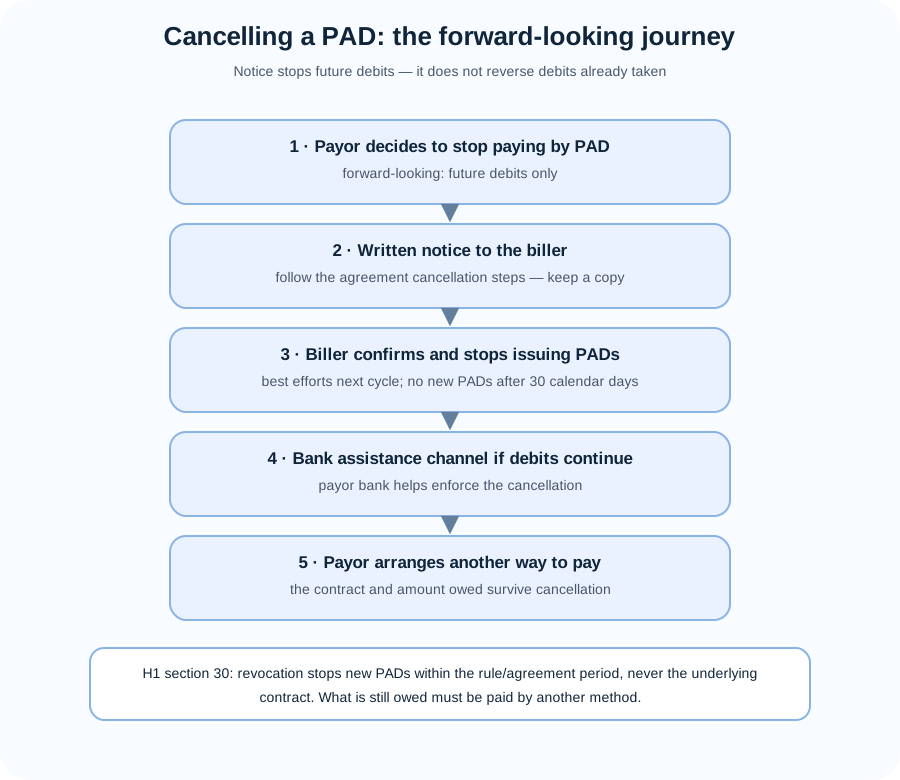
Cancellation in the rules is functionally simple and operationally exacting. The payor may cancel the PAD agreement by giving notice to the biller — functionally written notice following the agreement's cancellation steps — and the agreement itself must contain the cancellation instructions and contact information that make that notice possible. Where debits continue after cancellation, the assistance channel at the payor's bank exists functionally to help enforce the stop; procedures must define when front-line staff invoke it. Billers may also cancel agreements in accordance with their terms, with proper notice where the agreement does not otherwise address payee cancellation. One boundary holds everywhere: cancelling the PAD agreement never cancels the underlying contract for goods or services, nor any amount genuinely owed. State it on every cancellation confirmation, both sides.
Reimbursement and recourse in the rules is the backward-looking mirror. For a PAD or debit processed when no Payor's PAD Agreement (or, for cash management, no qualifying agreement) existed, H1 section 23 requires expeditious reimbursement and return when the claim is made within 90 calendar days of the posting date, across PAD types. For other declared conditions under section 24—such as a debit inconsistent with the agreement, a revoked agreement, or missing confirmation/pre-notification/notice—the window is 90 calendar days for Personal PADs and Funds Transfer PADs (including one miscoded as Business) and 10 Business Days for Business PADs. Funds Transfer PADs coded 650 or 83 and Cash Management PADs have additional no-recourse limits under sections 25 and 26; they are not safely described as simply “shorter business protection.” After the applicable window, the matter is outside the rules and the PAD must not be returned under section 24. The Processing Member obtains the duly completed reimbursement claim, and the Sponsoring Member or Member Payee must honour recourse for a returned PAD reimbursed under section 24.
Dishonours complete the rules map and must never be confused with recourse. A dishonour is the payor's bank refusing the debit on receipt—commonly NSF, a closed account or a stop payment—and H1 section 22 requires return no later than the Business Day following receipt by the first organizational unit able to decide, subject to the applicable A4/F1/F4 procedures. A recourse entry is the reversal of a debit already applied, on a validated reimbursement claim. Billers feel the difference in their cash position within days, which is why advices must label each path plainly. A single NSF dishonour does not cancel the agreement; the Payments Canada business guide says the same amount may be tried one more time within 30 days of the original transaction date, with no extra business fees. That is a permitted re-presentment, not a new authority.
Cutoffs translate the operating calendar into customer promises. A cancellation actioned Tuesday cannot stop Monday's file; a stop payment requested after the handling cutoff cannot catch tonight's run. Payors who see the effective date — stated at cancellation, restated on the confirmation — experience a final in-flight debit as their own scheduling fact. Payors promised "stopped immediately" experience the same event as a bank failure and enter the dispute path. When a cutoff is missed, the repair is scheduling honesty: next eligible cycle, stop date restated, nobody pretending the network can be hurried.
Service levels extend the same honesty to the dispute lifecycle: how fast claims are acknowledged, how fast validated reimbursements post, how fast recourse entries are matched and advised, how often suspense and unmatched recourse items are aged and at what age each class escalates. These are bank policy choices inside the rulebook's outer limits — written down, monitored, and reported in summary to biller clients who plan their receivables around them. Set targets from measured performance and improve them with the investments in Sections 7 and 10. And carry the rulebook habit into every artefact: playbooks cite Rule H1 functionally and link the library rather than quoting numbers; training decks carry a "verified against the live text on" date; every amendment triggers review of affected mappings, monitors, advice templates and test cases.
7. Fraud, compliance and controls
Disputes and fraud share territory: both concern debits that should not have produced their outcome. The difference is intent, and intent is often unknowable at intake. A cancelled gym debit is usually a biller's sloppy file — unless a call centre is systematically ignoring cancellations across hundreds of accounts. A "no agreement" claim is usually a missing mandate — unless a payor is spending first and disputing later as a routine source of funds. Place controls at the correct gates so prevention stays cheaper than recovery and the dispute process does not become the channel losses walk in through.
Pre-release screening is the highest-leverage control because every downstream process assumes the released collection was legitimate. Sanctions screening must clear before release: a batch debit cleared involving a sanctioned party is a regulatory event with reporting obligations, not a dispute to unwind — recourse reverses value but does not un-send a sanctions breach. Fraud scoring runs on the same side of the gate: biller behaviour, file-pattern anomalies, first-time collection spikes, round amounts at scale, velocity against history, collections against aged or purchased books, with clear hold-and-review outcomes and named owners. AML monitoring spans release and post-release: structuring across collection files, layering through mule accounts that then dispute the debits out, business profiles inconsistent with pull-collection patterns. Validate twice, release once is the cost curve made audible — and in pull payments the validation includes the authority chain, not just the money trail.
Authority controls for collections carry special weight because pull payments move money the payer did not push. Agreement evidence must exist before the first debit and be retrievable during the dispute, with doubt resolving to hold, not hope. Cancellation registers must reconcile to released files: every notice received, actioned before the next release, confirmed back. Pre-notification discipline for variable amounts must be provable by send record, not by assertion. A collection operation that cannot produce agreements during a dispute wave reimburses first and investigates later, funding reversals from margin. Sponsor banks should test these controls the way credit risk tests covenants: sample agreements, trace cancellations to files, demand pre-notification logs.
Friendly fraud and serial disputing need naming because pull recourse is exploitable: the payor is reimbursed first on a validated claim. Controls start with data: claim rates by payor, by biller, by channel; repeat claimants clustering around the same biller families; claims arriving just inside the window with identical wording. They continue with evidence standards that do not bend: the payor's declaration is signed, reason-specific and retained. And they end with biller-side alerting: a biller whose dispute rate trebles in a quarter is either broken or targeted, and both demand investigation. Strict process for the routine claim is what funds generous protection for the genuine victim.
Segregation, approval and access form the human perimeter. Agreement-template approval and biller onboarding must be separable from sales targets. Reimbursement decisions above thresholds need dual handling: one operator validates, another releases, with the declaration, evidence references and window calculation on record. Privileged access to collection hubs, cancellation registers and reconciliation tools must be logged. Ordinary discipline, honestly applied, is what lets a bank tell auditors the dispute operation is controlled rather than merely sympathetic.
Retention and regulatory honesty close the section. Validation logs, agreement images, cancellation and notice records, clearing evidence and customer communications must be retrievable by agreement and item reference across the full horizon in which claims can arrive. When controls fail, report as obligations require — suspected fraud, sanctions matters, control breakdowns, and consumer complaints through the bank's formal procedure. An operation that hides misses to protect metrics discovers, via auditor or regulator, that hidden misses compound while disclosed ones get fixed.
8. Exceptions, investigations and recovery
This is the core of the chapter. Read it with the three diagrams beside you. Every cancellation-and-dispute event resolves to one of four classifications, each with its own path, owner, evidence and customer story — and the most expensive mistake in the discipline is walking the wrong path with great efficiency.
A cancellation ends future authority: notice, confirmation, file stopped — "this will not be collected again." A reimbursement with recourse reverses an improper debit already taken: validated claim, payor restored, linked entry through the applicable return process — "this should never have been taken, and it has been returned." A dishonour refuses a debit on receipt inside the next-Business-Day rule window so value never rests with the biller: "this could not be applied, repair or absorb." A participant dispute is a member-to-member dispute about a returned item or clearing compliance. A payee's challenge to a payor reimbursement claim is handled outside H1's rules (section 27); A6/A9 are not an automatic appeal route. Hold that map: the first act on every case is classification.
Cancellation enforcement: making the stop real
Cancellation begins with the payor's written notice to the biller following the agreement's steps, and its quality is decided in the biller's register within days. The register records notice received, the agreement identified, the final debit date, the confirmation sent back, and the file check proving the stop. The confirmation matters more than billers believe: it states the effective stop date, reminds the payor that the underlying contract and any amount owed survive, and proposes the alternate payment method — the three sentences that prevent both the "stopped immediately" misunderstanding and the "owe nothing" misunderstanding. Where the biller's process is sound, the story ends here at the cost of postage and a diary entry.
Where debits continue, the case escalates along a rehearsed ladder. First, the payor re-contacts the biller with the cancellation copy and demands the stop plus confirmation. Second, the payor invokes the bank assistance channel, presenting the cancellation evidence. Third, each continued debit after cancellation becomes its own reimbursement claim — collected without authority, reimbursed on validation, recourse back to the biller. Fourth, persistent cases become conduct matters: complaint handling and biller-sponsor review of the cancellation handling the Letter of Undertaking promised. Design the ladder before the angry payor arrives.
Two restraints separate competence from chaos on this track. Never advise the payor that closing the bank account is the cancellation method: it manufactures fees, failed legitimate debits and the same dispute in new clothes. And never let a stop payment masquerade as cancellation in the case record: log which instrument was used and diary the agreement for next month's file where only a stop was bought. Under H1 section 30, a written or properly authorized oral revocation requires best efforts to stop the next business, billing or processing cycle and, subject to any clearly stated agreement period of no more than 30 calendar days, the payee must cease issuing new PADs within 30 calendar days; any later PAD needs a new agreement.
Dispute intake and triage: classify first, act second
Intake is where claims are won or lost, because the category chosen in the first ten minutes decides the evidence demanded, the window applied and the path walked. Learn the triage diagram cold.
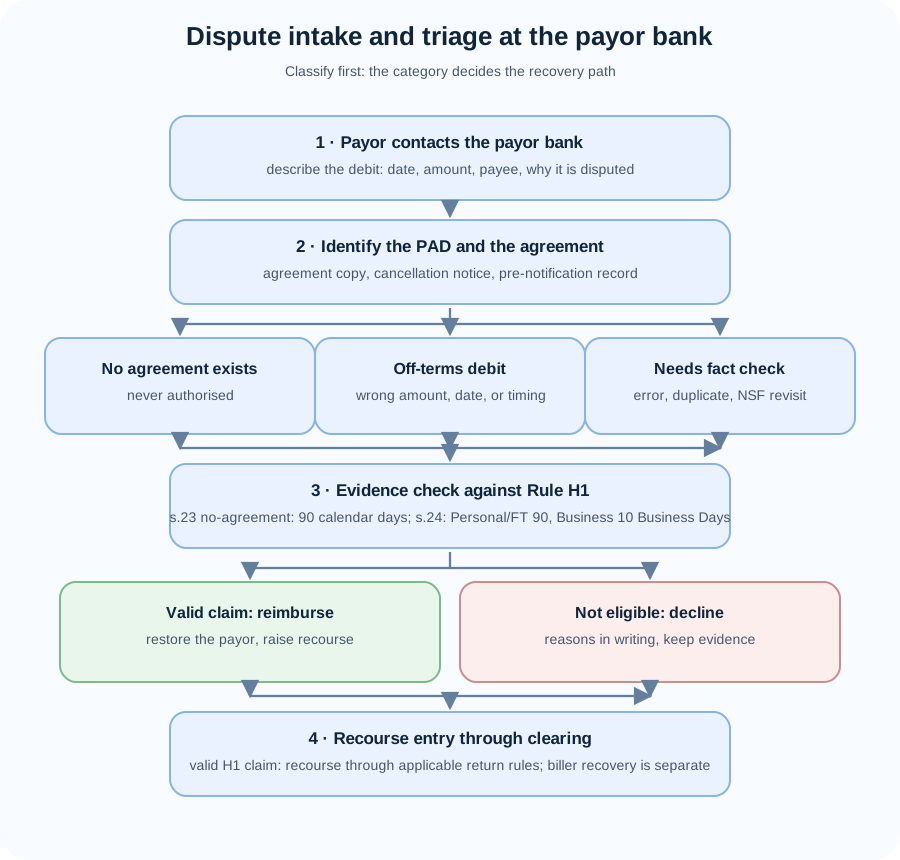
Walk the stages as an operator. 1, contact: the payor describes the debit and why it is disputed, in their own words first. Listen for the classification inside the complaint: "I never agreed" points to no-agreement; "wrong amount," "wrong date," "I cancelled" points to off-terms; "I don't recognise this name" points to fact check. 2, identification: join the complaint to the PAD and the agreement. A claim that cannot be joined to a specific debit is not yet a case; it is a hunt, and hunts need the payor's help before the bank's clock starts. 3, evidence check against Rule H1: which PAD category, which window, which proof.
Then the branch, and both branches must be worked with equal professionalism. Valid claim: reimburse the payor promptly, raise the linked recourse entry, advise with the original references and plain-language reasons. Not eligible: decline in writing with specific reasons — which category, which window calculation, which evidence was missing — plus the alternate routes: the payor-biller bilateral path outside the rules where the facts are genuinely contested, and the complaint procedure where the payor disagrees with the decision. A vague decline ("does not qualify") manufactures complaints at your expense; a reasoned decline with dates and references usually ends the matter, and where it does not, it becomes the evidence file the complaint handler needs.
Three disciplines separate competence from chaos on this track. First, take the signed, reason-specific declaration on every claim. Second, never reimburse on pressure before validation. Sympathy paid early is the biller's money spent without authority. Third, advise in the customer's language with the network's facts — "reimbursed: debit of March 14 for $214 taken after your January 28 cancellation; recourse raised to the biller" — instead of codes that generate callbacks.
Reimbursement and recourse: the backward-looking flow
Reimbursement restores the payor. Recourse recovers from the biller. The two are one motion with two legs, and both legs must complete for the case to close. Learn the flow diagram cold.
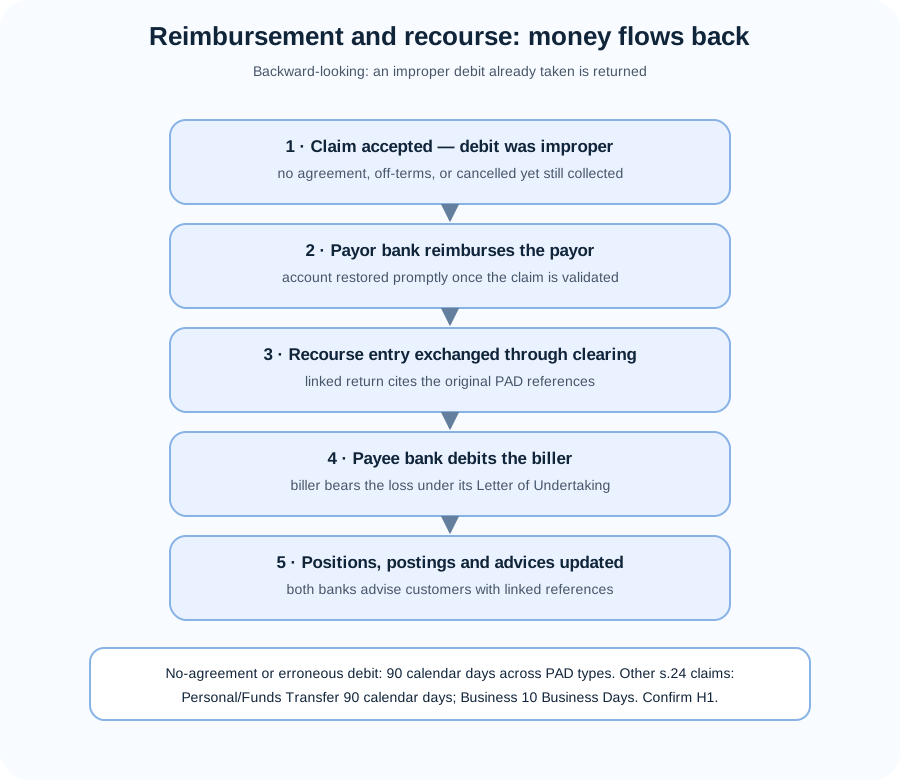
Walk the five stages as an operator. 1, claim accepted: the debit was improper — no agreement, off-terms, or collected after cancellation — inside the applicable window, with the declaration signed and the evidence on file. 2, payor reimbursed: the account restored promptly on the claim decision, posting as a linked credit naming the original debit, with fee treatment following stated policy. 3, recourse entry exchanged: the linked return travels through clearing citing the original PAD references, recalculating positions like any other entry. 4, payee bank debits the biller: under its Letter of Undertaking, with repair-grade advice — which PAD, which reason in plain language, what correction unblocks future collection. 5, positions, postings and advices updated: both banks reflect the reversal in clearing evidence, ledger, postings and reconciliation inputs, each leg joined to the original by reference.
The timing relationship between legs 2 and 3 is the point most often misunderstood, so state it explicitly in procedures and to customers: the payor is reimbursed on the claim decision and does not wait for the biller's bank to "send the money back." Interbank recovery follows through clearing on its own cycle. Mirror discipline applies biller-side: the biller is debited when the recourse entry arrives through clearing, not when the payor first complained. Section 9 covers what recovery looks like on the books.
What recourse is not: the chargeback comparison
Bankers who work both deposits and cards carry dangerous habits across the boundary, in both directions. A PAD dispute and a card chargeback both reverse value to a customer and both leave a merchant-side recovery problem — and there the resemblance ends. Learn the comparison cold, because misapplied habits are how PAD claims get declined for "missing representment."
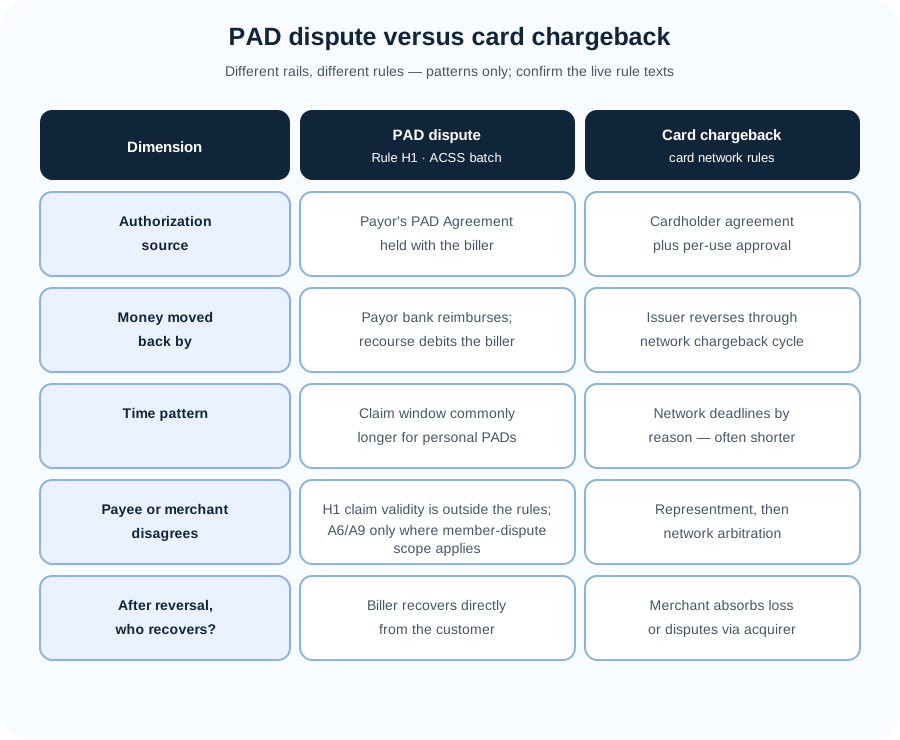
Five contrasts carry the lesson. Authorisation source: a standing Payor's PAD Agreement versus a cardholder agreement plus per-transaction approval. Money movement: payor-bank reimbursement with recourse through batch clearing versus issuer reversal through the network chargeback cycle. Time pattern: H1 section 23 gives 90 calendar days for no-agreement/erroneous-debit claims across PAD types; section 24 gives 90 calendar days for Personal/Funds Transfer PADs and 10 Business Days for Business PADs, subject to the 650/83 Funds Transfer and Cash Management exceptions, versus card-network deadlines by reason code. Disagreement: H1 section 27 sends a payee challenge to a reimbursement claim outside the rules; A6/A9 are only for an eligible member dispute within their own scope—there is no PAD representment cycle—while card merchants get representment and network arbitration. Recovery: the biller recovers directly from the customer while the card merchant absorbs or fights through its acquirer. Train triage staff on this table before cross-training them across rails.
Participant disagreements and the registers
Where the PAD process does not settle a matter, keep two cases separate. Under H1 section 27, a payee or Member Payee disputing the validity of a payor's reimbursement claim must address that matter with the payor/customer and payee outside the rules. Separately, where an eligible returned item is disputed between members, Rule A6 provides written notice within 60 calendar days, acknowledgement within 10 Business Days and possible escalation; Rule A9 arbitration is a member process that requires agreement to submit the dispute. Neither route reopens a valid customer claim by default. During a disagreement, give the customer the bank's complaint route and do not promise a network appeal.
Recovery ends in few states — name them to keep case management truthful. Cancelled and confirmed. Reimbursed and recourse-completed. Dishonoured and repaired-or-absorbed. Declined with reasons, with bilateral and complaint routes advised. Recovered by the biller. Written off under the authority matrix — governed, evidenced, never a quiet suspense burial. Open cases carry owners and next-action dates; closed cases carry ending states with linked evidence.
Two registers hold the operation together. The cancellation register records every notice from receipt to file-stop confirmation. The dispute and recourse register records every claim from intake to closure with category, window calculation, evidence references and both legs' linkage. Review both on a risk-set rhythm — daily for high-value and aged items — with escalation thresholds forcing attention before amounts or ages embarrass.
9. Posting, accounting, liquidity, reporting and reconciliation
Section 8 moved value and authority. This section keeps the books truthful while the pieces land — because a reimbursement posted opaquely, a recourse debit advised poorly, or a recourse wave unfunded turns a controlled process into a customer and treasury incident.
Posting: truthful balances while rights are still open
Payor-side posting carries the first discipline: the reimbursement must post as a linked credit naming the original debit — date, amount, biller identity — so the payor recognises it without calling. An unexplained credit for $214 generates the next phone call as surely as the unexplained debit did. Fee treatment follows stated policy and must be visible on the same advice: which fees stand, which reverse, including consequential charges the improper debit caused where policy provides. Nothing erodes dispute trust faster than a payor reimbursed for the debit but left paying the NSF fee the debit manufactured.
Biller-side posting carries the mirror discipline with higher stakes, because the biller's available balance is its working capital. The recourse debit must post with a narrative naming the original collection, the reason in plain language, and the customer identity the biller needs to start recovery. Accelerated availability granted on PAD credits as a commercial choice must be knowing, funded, priced and minuted in a risk committee, not drifted into through vague balance displays. Every "available immediately" promise on pull-sourced funds is a risk decision in marketing costume.
Posting mechanics must survive all four Section 8 paths without heroics. Recourse auto-matches to originals on linkage with defined manual tolerance. Corrected re-bills post as new collections with history linkage, never reusing disputed references in duplicate-reading ways. Suspense postings for unlinked recourse carry reason, age and owner from creation, because anonymous suspense is where biller receivables go to be forgotten. Test posting logic against Section 11's three stories before production does it for you.
Accounting: the bank's books under dispute load
Clearing-position general-ledger accounts must reflect reimbursements and recourse as linked entries so finance sees operations' story. Suspense accounts for unlinked items must be owned, aged and escalated. Fee and interest treatment follows stated policy consistently on both banks' sides, or the two advices will contradict each other. Write-offs travel the authority matrix with evidence attached. Period-end close includes explicit dispute cutoffs: which in-flight entries accrue, which provisions move, who signs that the registers reconcile to the ledger.
Liquidity: funding positions that recourse reshapes
Batch settles deferred-net with positions funded through Bank of Canada accounts on the morning after exchange, making recourse a liquidity event. A single reimbursement is noise; a recourse wave from one collapsed biller book reshapes a participant's expected position after forecasts were set. Three disciplines follow. Forecast with recourse modelled — claim-rate assumptions from history, seasonal uplifts, single-biller concentration limits. Monitor intraday against forecast with divergence alerts. Maintain a rehearsed position-break playbook jointly owned by treasury, settlement operations and payments operations.
Reporting: telling customers and management what happened
Payor advices must show the reimbursement as what it is: linked to the original debit, reasoned, with the cancellation position stated. Biller advices must show each recourse debit as what it is: linked to the original collection, reasoned in plain language, actionable toward recovery. Intraday and end-of-day corporate reporting should include recourse content by design — items received, reasons, customer identities, agreement references — because biller reconciliation teams plan their recovery working day around these inputs. Management reporting covers the Section 8 registers in summary: volumes by class, ageing buckets, reimbursement totals, recourse inventory, decline rates with reasons, biller concentration.
Reconciliation: proving the story end to end
The model is three-way, as in the companion exceptions chapter: collections released (files, counts, control totals, value dates, release records) against clearing evidence (acceptances, dishonours, recourse entries in flight, pending claims, flagged participant disputes, balancing entries) against settlement and books (funded positions, general-ledger entries, customer postings, suspense, fees, corrections). Match on reference, amount, date and status — all four — and treat in-flight reimbursements and recourse as expected reconciling items, provided each links to its original. A recourse entry that joins its PAD next run is timing. One that never joins is a value break, and value breaks escalate the day they are detected: un-netted amounts, items with no linked recovery, ownerless suspense growth never self-heal.
Breaks point to owners. Release-versus-clearing belongs to payments operations with the customer. Clearing-versus-settlement belongs to settlement and treasury. Release-versus-books belongs to posting and reconciliation teams. Route on detection, not after a general queue ages it. And close the day deliberately: define what "reconciled today" means, which in-flight entries are explicitly accepted as reconciling items with owners, who signs, what carries forward with a named next action.
10. Implementation, testing and resilience
Banks acquire a competent cancellation-and-dispute operation by building systems that enforce the two tracks, simulating feared failures, rehearsing dreaded incidents and staffing the desks — not by writing procedures. Retrofitting control onto a running collections business is surgery on a moving patient, so build it before dispute volumes grow.
Build the two tracks into systems, not manuals. Collection hubs should validate authority before release — agreement present, correct category, amount and timing covered, cancellation register checked, pre-notification sent where applicable — and block rather than warn where authority fails. Dispute queues should classify on intake from clearing evidence and payor statements, route each class to its queue with owner, deadline monitor and evidence template attached, and calculate the window from the live rule parameters rather than operator memory. Recourse entries should auto-match on four-field linkage with defined manual tolerance. Cancellation registers should reconcile nightly to released files and scream where a stopped agreement still emits. Biller portals should expose agreement images, cancellation actions, pre-notification logs and recourse advices in one place, because every capability withheld from the biller becomes a phone call to the bank. Size queues, staffing and auto-matching for the recourse storm — hundreds of linked claims from one failed biller book — not the average day. Storms convert manual workarounds into backlogs overnight.
Test dispute paths like origination. Harnesses should simulate the catalogue: cancellations arriving mid-cycle, continued debits after cancellation, no-agreement claims, off-amount and off-date claims, variable-amount collections without pre-notification evidence, NSF dishonours with re-presentment, duplicate collection files, counterparty evidence disputes, position divergences from recourse waves, suspense ageing. Regression suites cover every Rule H1 amendment — windows, categories, notice requirements, form elements, re-presentment terms — because an untested amendment is an incident scheduled for next cycle. End-to-end tests prove customer-visible outcomes: cancellation confirmations stating effective dates, reimbursement advices naming originals, recourse advices a biller clerk can act on, corporate-file references that join. And test the human path: staffing, contact lists, escalation matrices, reimbursement authorities, decline-approval thresholds, complaint handoffs.
Resilience means continuing to classify, reimburse, recurse and reconcile while degraded: redundant queue capture across hub failover so no cancellation or claim is lost; reference-keyed idempotency so replays cannot duplicate reimbursements; reconciliation runnable on backup feeds with explicitly degraded confidence; customer and counterparty communication templates for incidents; and a position-break drill cadence owned jointly by treasury, settlement and payments operations. Staffing resilience matters equally — dispute expertise concentrates in few senior operators. Cross-train, document judgement calls, roster so storms never meet skeleton crews holding undocumented knowledge.
Change and vendor management close the section because dispute operations change constantly. Biller migrations — new billing platforms, new processors, acquired books — arrive as dispute waves unless onboarding runs agreement-mapping sign-off, cancellation-register migration testing and parallel-run comparison. Vendor upgrades regression-test against the dispute catalogue with rollback criteria in dispute terms. Rule amendments trigger the Section 6 review cycle with a named owner and completion before effect.
11. Practical fictional Canadian examples
Theory classifies; stories teach judgement. All three examples below are fictional — invented companies and figures, realistic mechanics — each exercising a different track: a continued debit after cancellation needing both enforcement and recourse, a variable-amount dispute turning on pre-notification evidence, and a biller-side recourse wave needing recovery discipline. For each, ask the chapter's questions in order: cancellation or recourse or both, next-action owner, evidence linking recovery to original, what each customer hears.
Example (fictional): the cancelled membership that kept collecting
HarbourFit Studios Inc., a fictional Halifax fitness chain, signs Maya R., a fictional Dalhousie graduate student, to a monthly $79 personal PAD in March for a twelve-month plan with a standard cancellation clause. In late October Maya emails the club's cancellations address — the channel named in her agreement — cancelling effective the November debit, and keeps the sent copy. The front desk logs the email but nobody updates the billing file; the November through February debits of $79 each are collected. Maya notices in January, calls the club twice, is promised "it will be fixed," and sees the February debit arrive regardless. She then calls her bank.
Intake classifies correctly: cancellation (forward-looking, still unenforced) plus three — now four — off-terms debits (backward-looking, collected after cancellation). The operator takes the cancellation email copy, the agreement, and a signed reason-specific declaration, and checks the window against current Rule H1: personal PADs, well inside the commonly longer claim period, so all four debits are eligible. The bank invokes its assistance channel on the cancellation track — formally engaging the biller's side to enforce the stop — and simultaneously validates and pays the reimbursement claims: $316 restored to Maya as linked credits naming each original debit, with the small NSF fee manufacturing by the January debit reversed under policy. Four linked recourse entries travel through clearing to HarbourFit's bank, which debits the club with repair-grade advices naming each PAD, each date, and the reason in plain language.
The biller's recovery discipline is where the story earns its place. The agreement is cancelled, so any fresh PAD needs a brand-new Payor's PAD Agreement, which Maya will not sign. The club's manager, properly advised by its bank, works the contract point instead: nothing further is owed under a duly cancelled plan, so recovery here means process repair — a cancellation-register fix, a front-desk-to-billing-file workflow, and confirmation letters stating effective dates. The lessons are the chapter in miniature: reimbursement without enforcement would have manufactured March's dispute, and enforcement without reimbursement would have left Maya short. The declaration plus the email copy decided everything — documents beat recollection at every gate.
Example (fictional): the variable utility bill and the missing notice
PrairieLight Energy Co-op, a fictional Saskatoon electricity retailer with 40,000 customers on PAD, bills variable monthly amounts. Daniel K., a fictional customer, holds a variable-amount personal PAD agreement at set monthly intervals. His December bill triples on electric heating — $412 against a usual $130 — and the debit is collected on January 4. Daniel disputes: he says he never received the pre-notification of the amount the agreement promised. The co-op insists its platform "sends them automatically" but cannot produce a send log for Daniel's December notice.
Intake classifies: off-terms debit turning entirely on pre-notification evidence. The operator joins the claim to the January 4 debit, confirms the personal-PAD category and the window against current Rule H1, and asks the single decisive question through the payee's bank: produce the send record. What follows is the process working as designed. The co-op's bank requests the evidence its sponsored biller should hold; the co-op cannot produce it; the claim validates and Daniel is reimbursed $412 as a linked credit. The recourse entry travels through clearing, and the co-op is debited with an advice naming the PAD and the reason. Daniel's January electricity is still genuinely owed — the contract survives the recourse — so the co-op's recovery routine contacts him, agrees a corrected collection under the still-valid agreement (this time with the notice provably sent), plus a repayment spread for the balance he cannot meet at once. No new agreement is needed here because this agreement was never cancelled — a precise distinction the advice makes explicit.
Note the restraint on both sides, because restraint is the skill. The payor's bank did not reimburse on assertion alone — it tested the evidence through the proper channel. The co-op did not re-debit in frustration or add a late fee to the re-collection. The lasting fix is a control fix: the co-op's platform now writes immutable send logs per customer per cycle, and its bank samples them quarterly. Disputes are tuition. This one bought a logging control worth many times the $412.
Example (fictional): the property manager's January recourse wave
GatewayRent Property Management Ltd., a fictional Mississauga manager of 900 rental units, collects monthly rent by PAD through its sponsor bank. In mid-January its account is hit with eleven recourse debits totalling $18,340 — tenants who cancelled agreements when they moved out in the autumn, plus two "no agreement" claims from units whose leases turned over through a new superintendent who collected void cheques without completing agreement forms. The office manager's first call to the bank demands the debits be "rejected" and asks how to "run the rents again tonight." The bank declines both, correctly: recourse debit the rules provided, and re-debiting cancelled or never-existing agreements would manufacture the next wave plus a compliance incident.
Response follows the recovery playbook, not improvisation. The bank's biller team walks the manager through each advice and sorts the eleven into two piles. Nine are cancelled-agreement cases: the tenants moved, the receivables mostly died with the tenancies, and the action is ledger cleanup plus a process fix — agreement files tied to lease files, a cancellation register reconciled to the rent roll monthly. Two are live tenancies with missing agreements: the rent is genuinely owed, so the manager visits with new Payor's PAD Agreements, collects January by e-transfer on the spot, and resumes PAD in February under valid authority.
The lasting fixes are structural. The sponsor bank places the manager on enhanced monitoring for two quarters — agreement sampling, cancellation-register review, recourse-rate triggers. The manager's platform now blocks rent-file lines without a linked agreement image. Eleven disputes bought a control environment. That is tuition well spent.
12. Key takeaways and authoritative references
Twelve points carry the chapter. Pin them where your team can see them.
- Cancellation looks forward; recourse looks backward. Notice ends future authority; reimbursement with recourse returns the improper debit. Run both tracks on every case and close each explicitly.
- Cancel through the agreement's channel, in writing, keeping a copy. The agreement must contain usable cancellation instructions — an agreement without them is defective at birth.
- Where debits continue, escalate the ladder: re-contact with evidence, bank assistance channel, per-debit reimbursement claims, then conduct and sponsor review. Never improvise.
- Classify at intake: no-agreement, off-terms, or fact check. The category decides the window, the evidence and the path. Ten careful minutes save ten weeks.
- Reimburse validated claims promptly; decline the rest with written reasons. Pressure-payments spend the biller's money without authority; vague declines manufacture complaints.
- Recourse debits the biller through clearing with four-field linkage. Original reference, file or cycle identifier, reason, distinct recovery reference — every time, or the entry is anonymous.
- The biller bears recovery — by re-bill under valid authority, alternate payment, or plan. Never re-debit a cancelled or never-existing agreement; obtain fresh authority first.
- One NSF dishonour does not cancel the agreement. The same amount may be re-presented one more time within 30 days of the original transaction date, with no extra business fees; a new debit still needs valid authority.
- The window depends on the declared condition and PAD category. Under current H1, no-agreement/erroneous-debit claims are 90 calendar days across PAD types; other section 24 claims are 90 calendar days for Personal/Funds Transfer PADs and 10 Business Days for Business PADs, with 650/83 Funds Transfer and Cash Management exceptions. Confirm the live rule before promising any date.
- Post honestly while rights are open. Linked narratives both sides, visible fee treatment, suspense with reason, age and owner from birth.
- Fund the positions recourse reshapes. Forecast with claim assumptions, monitor intraday, rehearse the position-break playbook across treasury and operations.
- Read the live Rule H1; never memorise it. Reasons, windows, forms and timelines change. Playbooks cite functionally, link the library, carry verification dates. This chapter is operational education, not legal advice — build procedures with counsel.
Authoritative references
Official sources only — these links outrank anything quoted from memory, including from this chapter. URLs and operative text were checked on 2026-10-05; rule versions posted in the Payments Canada library are the ones in force, and a changed URL should be re-located from the official home page.
- Payments Canada — Retail batch payment system (ACSS live status, deferred-net clearing, next-morning settlement through Bank of Canada accounts, electronic streams including pre-authorised debits): https://www.payments.ca/systems-services/payment-systems/retail-batch-payment-system
- Payments Canada — Rules and documentation library (the live text: Rule H1 for PADs, the A4 Returned and Redirected Items, A6 Items in Dispute and A9 Arbitration families, B-family material, by-laws, standards and procedures; versions posted online are in force): https://www.payments.ca/systems-services/rules-documentation
- Payments Canada — Rule H1, Pre-Authorized Debits (the governing rule text: PAD categories, Payor's PAD Agreement elements, Payee Letter of Undertaking, cancellation, reimbursement claims, recourse, dishonours; confirm current version before advising customers): https://www.payments.ca/sites/default/files/h1eng.pdf
- Payments Canada — Pre-authorized debit business guide (payee duties, agreement elements, cancellation handling, error correction, NSF re-presentment practice, recourse and return timeframes described for billers): https://www.payments.ca/payment-resources/support-guides/business-guides/pre-authorized-debit
- Financial Consumer Agency of Canada — Pre-authorized debits (consumer guide: written cancellation, stop payments, 90-calendar-day consumer reimbursement guidance, NSF fees and complaint handling): https://www.canada.ca/en/financial-consumer-agency/services/banking/preauthorized-debit.html
- Bank of Canada — Payment systems the Bank oversees (ACSS role, exchange/clearing/settlement definitions, direct and indirect participants, and RTR described as a planned system): https://www.bankofcanada.ca/regulatory-oversight/financial-market-infrastructures/payment-systems-the-bank-of-canada-oversees/
- Bank of Canada — Settlement account policies for Payments Canada systems (ACSS direct clearers, settlement accounts and central-bank-money final settlement; RTR is planned): https://www.bankofcanada.ca/core-functions/financial-system/bank-canadas-settlement-account-policies-for-payments-canada-payment-systems/
- Visa Canada — Resolve disputes quickly (card issuer/acquirer/merchant dispute flow used only for the comparison column): https://www.visa.ca/en_CA/support/small-business/dispute-resolution.html
- FINTRAC — Record keeping requirements for financial entities (five-year examples, machine-readable records and production within 30 days where applicable): https://fintrac-canafe.canada.ca/guidance-directives/recordkeeping-document/record/fin-eng
Diagrams in this chapter: cancellation journey (forward-looking notice and stop); dispute intake and triage at the payor bank; reimbursement and recourse flow back to the payor; biller recovery after recourse (re-bill, alternate payment, collections); PAD dispute versus card chargeback comparison — all under /diagrams/payment-stories/canada/chapter-25/. Rule H1 and timeframes are described functionally; exact reasons, windows, forms and timelines are governed by the live rule text linked above. ACSS is live. Card network detail is comparison-level only; PAD and card rails each follow their own governing rules. Stories and companies are fictional. Nothing in this chapter is legal advice.
This application uses JavaScript for the full interactive experience. This text summary is served for accessibility and search indexing.