Canadian Payment Infrastructure Architecture. Map customer channels, bank processing, clearing systems, settlement, reporting and operational support across the Canadian ecosystem.
Canada Payments & Collections · Block 2: Canadian Accounts, Routing and Infrastructure · Chapter 10 of 75
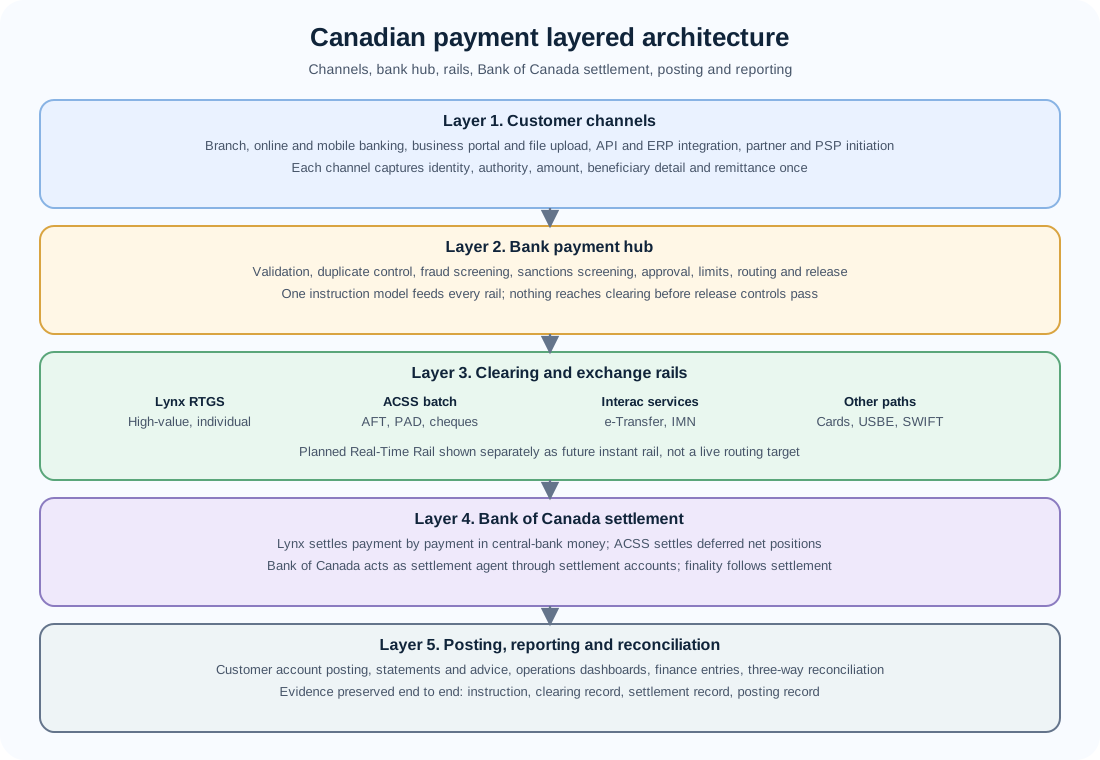
This chapter draws the one picture every Canadian banker, analyst, product owner and operations leader needs before touching any single rail in detail. It maps customer channels, bank processing, clearing systems, settlement, reporting and operational support across the Canadian ecosystem at architecture level. It answers the question a new joiner, an auditor, a vendor and a corporate customer all ask in different words: where does a Canadian payment actually travel inside the bank and between banks, who owns each step, and what evidence proves each step happened.
This chapter deliberately stays at architecture level. Rail detail lives in later blocks: batch, Automated Funds Transfer, pre-authorized debits and cheques in Blocks 3 to 5, Interac in Blocks 6 to 7, Lynx in Block 8, ISO 20022 in Block 9, bills, cards, cheques and government payments in their chapters, cross-border, United States Bulk Exchange and correspondent in Block 11, the Real-Time Rail in Block 12, fraud, anti-money laundering, sanctions and Retail Payment Activities Act supervision in Block 13, operations and reconciliation depth in Block 14, and full payment stories in Block 15. Here you learn the skeleton those blocks hang on and the hand-offs where most real failures happen.
A note on status dates. Baseline is 5 October 2026. Lynx has been live since 1 September 2021 as Canada's real-time gross settlement system for high-value and time-critical Canadian-dollar payments and is designated as systemic. Canada's retail batch payment system comprises the Automated Clearing Settlement System (ACSS) for Canadian-dollar items and the United States Bulk Exchange (USBE) application for eligible U.S.-dollar items; ACSS handles streams such as Automated Funds Transfer credits and debits, pre-authorized debits, cheques including imaged cheques, and other batch items. Interac Corp operates Interac e-Transfer and the Interac Inter-Member Network (IMN) on separate Interac infrastructure from Payments Canada systems; the Bank of Canada separately oversees Interac e-Transfer as a designated payment system. The Bank of Canada provides settlement accounts and the books on which final settlement for Payments Canada systems occurs; it is not the operator of those systems. The Real-Time Rail is not in production at 5 October 2026: Payments Canada's current launch plan targets Q4 2026, with sequenced onboarding and initial direct-to-Exchange participants, as a 24/7/365 instant, data-rich service operated by Payments Canada. The Future State of Retail Batch is a modernization initiative, not a live system. Every time this chapter says planned for the Real-Time Rail, that distinction is intentional. No exact cutoff times, fee schedules, throughput figures, vendor names, protocol specifics or line speeds are stated in this chapter, because those belong to rail-level chapters and to primary sources that change.
What you should be able to do after this chapter
After working through this chapter, you should be able to:
- sketch the five-layer Canadian payment architecture from memory: customer channels, bank payment hub, clearing and exchange rails, Bank of Canada settlement, and posting with reporting and reconciliation;
- name the participants in each layer and state precisely where one participant's responsibility ends and the next begins, including direct versus indirect participation and sponsorship;
- trace any common Canadian instruction from channel capture through hub validation, fraud and sanctions screening, approval, routing, release, gateway dispatch, clearing or exchange, settlement, posting and customer reporting without confusing those stages;
- explain what the bank payment hub owns versus what channels, core banking, gateways, reference-data services, fraud services and case tools own, and why that separation decides whether change is safe;
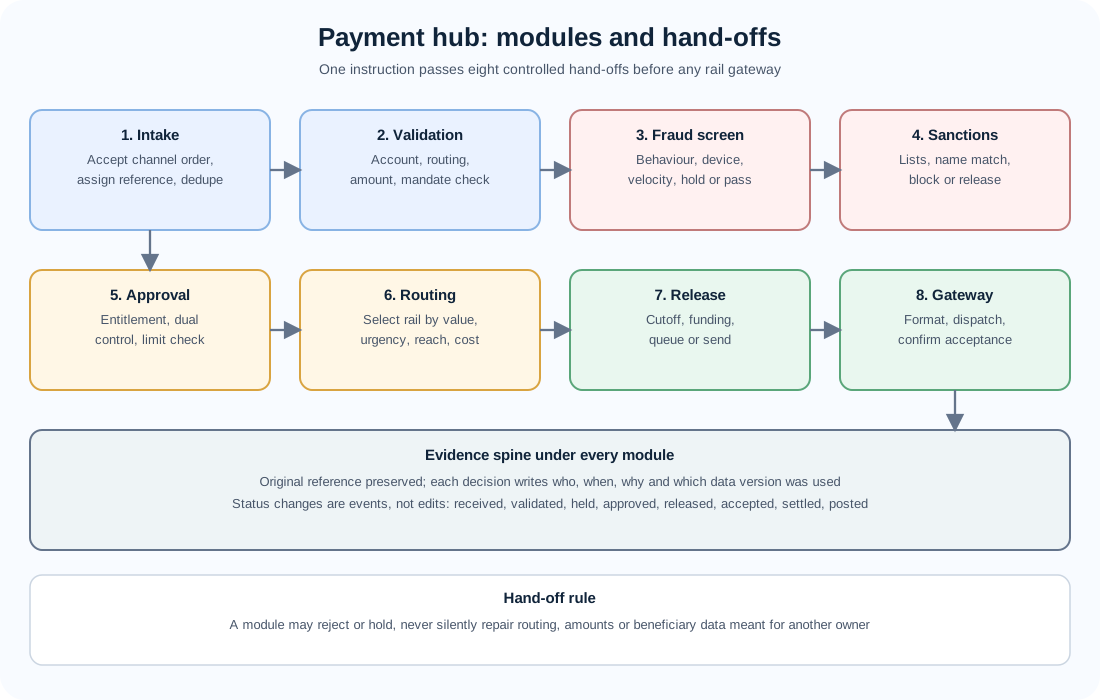
- describe the hub's internal module order and the hand-off rule each module enforces, including why a module may reject or hold but must never silently repair another owner's data;
- compare Lynx, ACSS batch, Interac services, card paths, USBE and correspondent with SWIFT messaging on clearing model, settlement model, finality, hours and information richness at architecture level, and route a business event to the correct family;
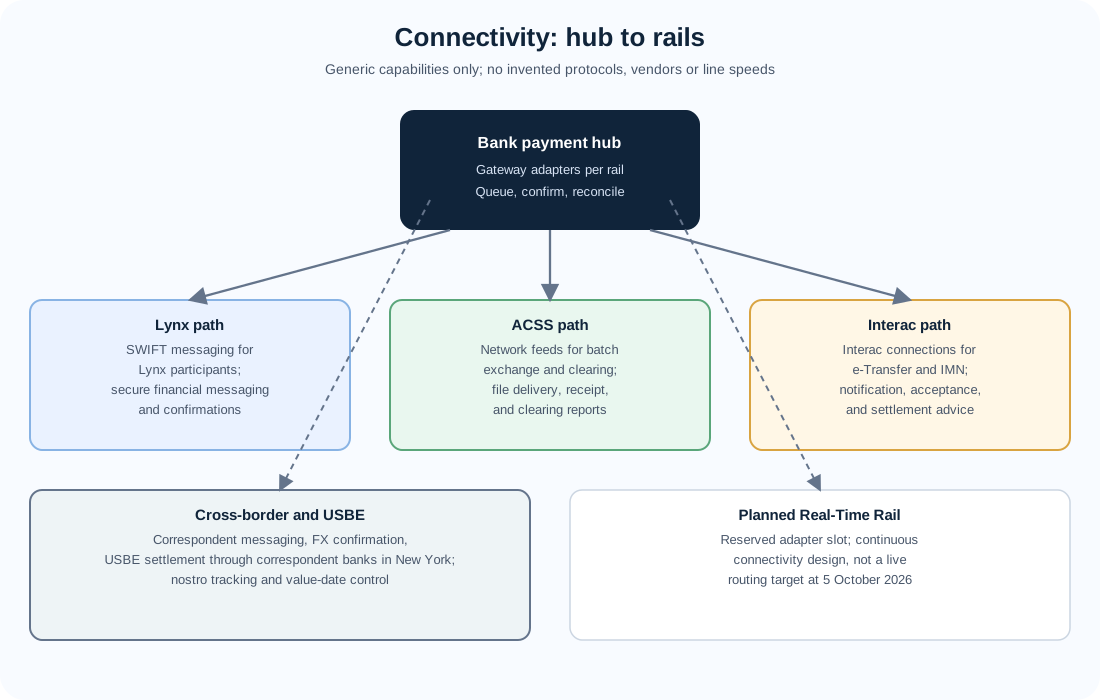
- describe connectivity generically and correctly: SWIFT messaging for Lynx participants, network feeds for ACSS exchange and clearing, Interac connections for e-Transfer services, correspondent messaging for cross-border legs, with the Real-Time Rail as a reserved adapter rather than a live target;
- explain the data spine every layer shares: institution, transit and account identification, Financial Institutions File reachability, mandate and authorization evidence, end-to-end references, and ISO 20022 coexistence with legacy formats;
- explain rules, business-day calendars, relative cutoff windows, service levels and customer impact without inventing exact times, and tell a customer in plain language when value is same-day final versus next-window batch;
- place fraud, FINTRAC, sanctions and RPAA expectations at the correct point in the flow and explain why screening placement relative to release decides whether a control prevents or merely records;
- classify rejects, returns, recalls and return requests, reversals, disputes and investigations, and describe recovery that preserves the original transaction identity and respects settlement truth;
- explain posting, accounting, liquidity, reporting and three-way reconciliation from the operations view, including settlement accounts at the Bank of Canada and nostro discipline for cross-border legs;
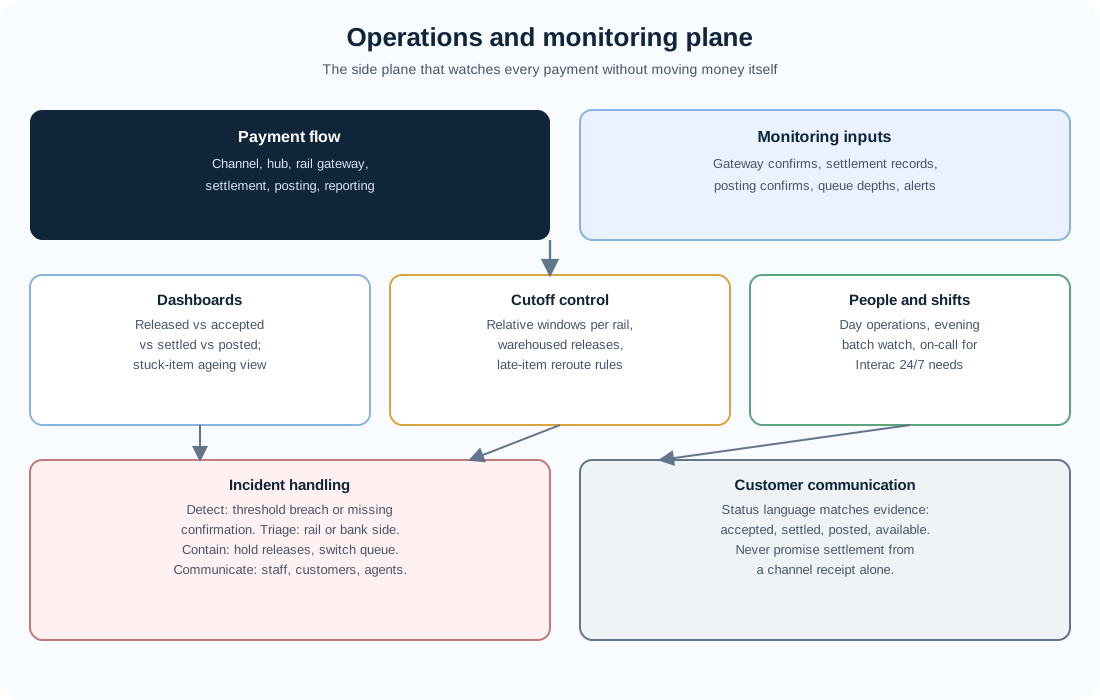
- describe the operations and monitoring plane, the resilience and failover posture, and the implementation and testing discipline that lets a bank change the hub safely and prepare for Real-Time Rail initial launch without pretending it is already production.
For a roughly 60-minute core session, spend about 10 minutes on this introduction and Sections 1 to 2 with the layered diagram, 15 minutes on Sections 3 to 4 with the hub and settlement diagrams, 10 minutes on Sections 5 to 6 on data and cutoffs, 10 minutes on Sections 7 to 9 on controls, exceptions and posting, 10 minutes on the fictional stories in Section 11, and 5 minutes on takeaways and the forward map in Section 12. Treat the worked detail inside each section as guided follow-up study; completing the whole chapter carefully takes longer, and that is intentional for an architecture chapter.
Chapter navigator
- Business context and customer need
- Participants, responsibilities and system boundaries
- Initiation, validation and bank processing
- Clearing or exchange, settlement and finality
- Data, identifiers, messages and references
- Rules, cutoffs, service levels and customer impact
- Fraud, compliance and operational controls
- Exceptions, investigations and recovery
- Posting, accounting, liquidity, reporting and reconciliation
- Bank implementation, testing and resilience
- Practical Canadian examples
- Key takeaways and authoritative references
1. Business context and customer need
Every Canadian business day starts with customers who do not think in systems. A payroll manager thinks in paydays: everyone credited on Friday morning, no partial runs, no unexplained reversals, a file acknowledgement that actually means something. A plant manager waiting on a replacement part thinks in certainty: the supplier releases the goods today because the wire is final, not because a screen says sent. A consumer who was double-charged thinks in tonight: the refund on the phone, the notification that makes sense, no second trip to the branch. A finance director paying a United States supplier thinks in value dates: dollars arriving on the agreed day with remittance the payables team can match without detective work. A treasurer thinks in funding: what settles today, what needs liquidity, what can wait until the next batch window without breaking a promise. None of them asks which clearing stream carries the item. All of them judge the bank on timing, certainty, cost, information quality and behaviour when something goes wrong.
The bank's architecture job is translation. Each business event must become a correctly chosen rail, a correctly controlled instruction, a correctly timed release, a correctly evidenced settlement and a correctly worded customer report. Get the translation right and the customer experiences banking as predictable. Get it wrong and the same customer experiences five different banks: one that promises same-day finality on a batch item, one that warehouses an urgent payment behind a file cutoff, one that screens sanctions after release, one that posts from a channel receipt instead of settlement evidence, one that answers an investigation with a new reference number that breaks every downstream match. Architecture is what keeps those five banks from emerging inside one institution.
Canada makes translation both easier and harder than in larger markets. Easier, because the system count is small and the purposes are well separated. Lynx settles high-value and time-critical Canadian-dollar payments individually in real time in central-bank money. The retail batch system comprises ACSS and USBE; ACSS clears Canadian-dollar retail batch items through exchange, clearing and deferred net settlement across streams that include Automated Funds Transfer credits and debits, pre-authorized debits, cheques and other items, while USBE handles eligible U.S.-dollar items. Interac services move consumer and increasingly business payments on a near-instant 24/7 experience through Interac Corp infrastructure that is separate from Payments Canada. Card systems authorize in seconds and clear and settle merchant funding later. USBE settlement is effected through correspondent banks in New York, not through the Canadian-dollar ACSS settlement cycle. Correspondent banking with SWIFT messaging and foreign exchange handles the rest of cross-border value. The Real-Time Rail, when it launches, adds a 24/7/365 instant, data-rich credit-transfer capability operated by Payments Canada. Harder, because each of those systems has different hours, different finality, different return rights, different data richness and different failure modes, and the bank must present them through one set of channels, one hub, one operations floor and one statement.
Consider the pressure on a single fictional relationship to make this concrete. A mid-sized Ontario food processor runs payroll every second Friday for several hundred staff, collects from food-service customers partly by pre-authorized debit, pays flour and packaging suppliers on mixed terms, replaces equipment on urgent timelines a few times a year, refunds overpayments to customers who increasingly expect Interac-speed returns, and buys packaging from a United States supplier in dollars. On any given Thursday the bank may hold that customer's payroll file for Friday value, a PAD collection for the same morning, an urgent Lynx payment for an oven part, an Interac refund instruction for tonight, and a cross-border dollar payment due next Tuesday. Five business events, five different rails, five different evidence trails, one relationship, one business day. If the bank treats each as an isolated product with its own intake, its own validation, its own cutoff language and its own investigation desk, the customer gets five answers and no plan. If the bank runs one architecture with one instruction model, one hub, rail adapters, one settlement view and one reporting language, the customer gets a coherent plan: which items are same-day final, which are next-window batch, which need mandate evidence today, which need foreign-exchange confirmation, and what happens if anything fails. That coherent plan is the commercial product this chapter describes. The rails are the machinery underneath it.
Scale explains why this discipline is not decoration. Payments Canada annual reporting for 2025 described ACSS clearing on the order of 10.6 billion items worth about 10 trillion dollars alongside Lynx settling on the order of 13.6 million payments worth about 93 trillion dollars. The structural lesson is that batch carries the item count and most of the customer-experience surface while Lynx carries value concentration, so the hub must hold both in one view rather than watching one and missing the other.
Regulation reinforces the same point. The Bank of Canada oversees designated systems including Lynx, acts as settlement agent, and supervises certain retail payment activities under the Retail Payment Activities Act alongside FINTRAC expectations. None of these stakeholders assesses rails in isolation. They assess whether each control sits where it can still change the outcome: sanctions screening after a Lynx payment has settled is a failed control, fraud review after an Interac acceptance is a design error, and mandate evidence sought only after a PAD dispute is a product defect.
Modernization is the third reason architecture comes before rail depth. Lynx is live and ISO 20022-enabled, Automated Funds Transfer lives in legacy and ISO 20022 coexistence, the Real-Time Rail is approved but not live, and the Future State of Retail Batch is an initiative rather than a routing target. Banks that hold one architecture absorb each change as a new adapter, mapping and settlement account. Banks that hard-wire each product to its rail rebuild every time. This chapter therefore ends where implementation begins: wiring the hub, testing safely, operating daily and preparing for the Real-Time Rail without pretending it is already production.
2. Participants, responsibilities and system boundaries
Architecture fails most often at boundaries, not inside boxes. Every Canadian payment crosses at least four ownership boundaries: from customer to bank, inside the bank from channel to hub to gateway, between banks through a clearing system or network, and from clearing into settlement and back into posting and reporting. Each boundary needs a named owner, a defined input, a defined output and a defined evidence record. Where ownership is vague, work falls between teams, references get reinvented, and investigations start by arguing about who should answer rather than by answering. This section names each participant once, states what each owns, and marks where responsibility passes.
Customers come first because they create the instruction and live with its consequences. Originators own the business intent: whom to pay, how much, in what currency, by when, with what remittance, under what authority. Beneficiaries own acceptance readiness. Neither party owns clearing or settlement, which is why front-line staff must distinguish instruction accepted, payment released, clearing accepted, settlement completed, beneficiary account posted and funds made available as six different facts owned by different parties.
Inside the originating bank, three domains share responsibility and must not be collapsed into one. Channels own capture and experience: branch, online and mobile banking, business portals, file upload, application programming interfaces and enterprise-resource-planning integration, and partner or payment-service-provider initiation. Their job is to collect complete, authenticated instructions once, with identity, authority, amount, beneficiary detail and remittance intact, and to set honest expectations about timing. The payment hub owns decisioning: validation, duplicate control, fraud screening, sanctions screening, entitlement and approval, limits, routing, warehousing, release and gateway dispatch, with an evidence spine that records every decision. Core banking and account systems own the account truth: balances, holds, posting, statements and the general ledger relationship. Gateways own rail formatting and exchange: building the correct outbound artefact for Lynx, ACSS streams, Interac services, card systems, USBE or correspondent paths, receiving confirmations and clearing reports, and returning them keyed to the original hub reference. Reference-data services, fraud services, sanctions services, foreign-exchange services, accounting engines, reporting engines and case-management tools support those owners without replacing them. When a vendor gateway starts making routing or release decisions that belong to the hub, or when a channel starts validating routing that belongs to reference data, the bank has created a shadow hub that will diverge on the worst possible day.
Payments Canada operates Lynx and the retail batch systems ACSS and USBE, is preparing the Real-Time Rail, sets and administers the associated rules and by-laws, and provides the clearing infrastructure participants connect to. It does not hold customer accounts, make credit decisions or settle in its own money. The Bank of Canada oversees designated systems and provides settlement accounts and central-bank-money settlement infrastructure for Payments Canada systems. Interac Corp operates Interac e-Transfer, the Interac Inter-Member Network (IMN) and related services as a separate corporate and infrastructure domain from Payments Canada; that separation matters operationally because hours, messaging, limits, dispute handling and support models differ, and routing logic must not treat Interac e-Transfer as a Payments Canada stream. Card networks, the correspondent banks through which USBE settles U.S.-dollar positions, correspondent and intermediary banks, billers, employers, governments and supervised payment service providers complete the ecosystem. Each owns a defined slice: networks own authorization, clearing, settlement and dispute rules for their brands; correspondent banks own the onward leg they accept, including their own screening and posting; billers and employers own the mandate, invoice and payroll-file quality their collections depend on.
Participation models decide who settles and who answers. Direct participants hold settlement accounts and discharge their own obligations; indirect participants and sponsored entities clear through a direct or group clearer and settle economically through that sponsor. Sponsorship is an allocation of validation, funding, monitoring, reporting and incident-answering duties that must be contractual, staffed and evidenced. Later Block 2 chapters expand the mechanics; here the rule is that every diagram should be readable twice, once from the direct participant's view and once from the sponsored institution's view.
System boundaries deserve explicit protection because Canadian flows tempt designers to blur them. Clearing is not settlement, settlement is not posting, messaging is not money, batch is not instant, and push is not pull. Each distinction is a boundary with an owner on each side, and the hub's routing decision is the moment the bank commits to one set of boundaries rather than another.
The practical test for this section is a blank-sheet exercise. Draw the five layers, place your bank's channels, hub, gateways, core banking, fraud and sanctions services, reference data, accounting, reporting, reconciliation and case tools on the drawing, then draw Payments Canada systems, the Bank of Canada settlement function, Interac Corp services, card networks, the correspondent banks used for USBE, and other correspondents outside your boundary with the correct connection type for each. Label every arrow with its owner, its artefact and its confirmation. If any arrow has no owner, no artefact or no confirmation, the architecture is incomplete at exactly the point where production will fail. Keep that drawing beside you for the rest of this chapter; every later section adds one overlay to it rather than replacing it.
3. Initiation, validation and bank processing
Initiation is where customer intent becomes a bank instruction, and bank processing is where that instruction earns the right to reach clearing. Both stages look simple on a slide and generate most of the operational cost in real life, because everything missing, ambiguous or duplicated here becomes an exception, a return, an investigation or a loss later. This section follows one instruction through capture, validation, screening, approval, routing, warehousing and release at architecture level, naming what each step owns and what evidence it leaves. Rail-specific field rules, message mappings and stream procedures belong to later blocks; the order of operations and the hand-off discipline belong here.
Capture starts in channels and must preserve intent without embellishment. Each channel must authenticate the instructing party, capture authority, collect beneficiary identification appropriate to the intended rail, and assign or accept an end-to-end reference that survives every later transformation. Channels must also set expectations honestly: a screen that displays accepted for next batch window with a relative cutoff explanation creates a manageable promise, while a screen that displays sent and lets the customer infer settled creates a future complaint.
Intake in the hub converts channel submissions into one canonical instruction model regardless of origin. File, interface, branch and partner inputs arrive in different shapes; the hub normalizes them into one internal representation with one identifier, one amount, one currency, one originator, one beneficiary description, one authority pointer and one remittance bundle. Normalization includes duplicate control at intake, because files get re-uploaded, interfaces retry, users double-click, and partners resend after timeouts. Duplicate-safe intake keys on a stable instruction identity rather than on arrival time, so a retried submission is recognized as the same business event rather than processed as new work. Intake also decides completeness: instructions missing mandatory routing, beneficiary or authority elements are rejected or pended back to the channel with a reason the customer can act on, never released downstream to see what happens. The intake evidence is the canonical instruction with its source, receipt time, deduplication outcome and completeness decision.
Validation checks that the instruction could execute on the intended path: account existence and authorization, beneficiary-path reachability against current reference data, authority of the instructing party including mandate evidence for pull instruments and file authorization for batches, and internal consistency of amount, currency, value date and remittance. Failures return to the channel with the defect named; validation must never auto-correct beneficiary data, because silent repair converts a detectable error into a misdirected payment.
Screening and approval decide whether the instruction should execute even though it could. Fraud screening evaluates behavioural, device, velocity and payee-risk signals appropriate to the channel and rail, with particular attention to push-payment pressure where the customer experience is near-instant and recovery is difficult. Sanctions and regulatory screening evaluates the instruction against applicable lists and expectations before release, because screening after release is recording rather than prevention for individually settled payments. Entitlement and approval workflows enforce who may approve what: dual authorization for wires and large batch releases, file-level versus item-level approval as policy requires, limit enforcement per customer, per instrument and per rail, and segregation between initiation, approval and release where risk demands it. Screening and approval outcomes are decisions with reasons, timestamps and data versions, not silent flags. A held instruction tells operations why it is held, what would release it, and how long the hold may lawfully and operationally persist before the customer must be told.
Routing selects the rail family on business facts: value and urgency, domestic versus cross-border currency, push versus pull authority, beneficiary reachability, data-richness needs, cost and return-right implications. An urgent equipment payment points to Lynx, a Friday payroll to batch credit, a monthly collection under agreement to pre-authorized debit, a tonight refund to Interac services. A payment whose beneficiary cannot receive the chosen rail must be repaired or rerouted with consent, never forced. Routing evidence records which rail was selected and which window was aimed at, so operations can explain a timing miss without reconstructing intent from logs.
Warehousing, release and gateway dispatch complete bank processing. Warehousing holds future-dated instructions safely, rechecking screening freshness, limits, funding and routing validity as release approaches. Release journals the bank's commitment before the instruction enters clearing. Gateway dispatch formats the rail-specific artefact without losing the original reference and awaits the rail's acceptance confirmation. A gateway timeout is an operational state that triggers confirmation-first recovery, never blind resend.
4. Clearing or exchange, settlement and finality
Clearing moves obligations between participants. Settlement discharges them. Finality marks the point after which discharge cannot be unwound through the system. Posting credits the beneficiary's account. Availability lets the beneficiary use the funds. Those five sentences carry the entire Canadian settlement architecture, and most customer disputes, audit findings and operations incidents in this country trace to confusing one of them with another. This section keeps each concept separate, maps it to each rail family at architecture level, and explains what the bank must do differently because the differences exist.
Lynx is Canada's real-time gross settlement system for high-value and time-critical Canadian-dollar payments, live since 1 September 2021 and designated as systemic. Each payment settles individually in central-bank money with queuing and liquidity management where immediate settlement is not possible. Finality follows settlement under the system's legal and rule framework, so any commercial correction needs a new payment or a defined investigation outcome. Every control that must prevent a Lynx payment therefore belongs before release, and every repair after settlement is a new business event with its own screening, approval and evidence.
ACSS is the opposite design answering the opposite problem: how to clear billions of retail items at manageable liquidity cost through exchange, clearing and deferred settlement. Participating institutions exchange batch items through clearing streams covering Automated Funds Transfer credits and debits including payroll and pre-authorized debits, cheques including imaged cheques, and other paper and electronic batch items, accumulate bilateral and multilateral positions through the day, and settle the resulting net obligations in Bank of Canada money. Direct clearers settle in their own settlement accounts, group clearers settle for their groups, and indirect participants settle economically through their sponsors. Finality arrives when the net settlement completes under the applicable by-laws and rules, not when items are exchanged. Between exchange and settlement, items are subject to stream procedures for returns, adjustments and claims: insufficient-funds debits return, unauthorized debits are contested, duplicate credits are adjusted, cheque images are returned, each through its own reason, timeline and evidence requirement. Every customer promise built on ACSS items is therefore a promise about a cycle with windows, return rights and settlement timing, not about instantaneous finality. The bank architecture consequence is that batch operations, return handling, adjustment teams, funding forecasts and customer status language must all be cycle-aware, and customer advice must distinguish exchanged from settled from posted.
Interac services sit on a third pattern. Interac Corp operates e-Transfer and the Interac Inter-Member Network (IMN) separately from Payments Canada, with a near-instant 24/7 customer experience for e-Transfer and its own network and settlement arrangements. Architecture must track both truths: customer-experienced completion and interbank settlement. Support, fraud monitoring, limits and notification handling must be always-on because the customer clock is always-on, even though batch and high-value operations historically organized around business-day windows.
Card paths, USBE and correspondent paths complete the map with the same vocabulary. Card systems authorize at the point of interaction in seconds, then clear and settle merchant funding later with fees, holds and chargeback rights that have no equivalent in Lynx or batch credit. USBE handles eligible United States-dollar batch items inside Canada through batch exchange with final dollar settlement through correspondent banks in New York, which means Canadian-dollar settlement thinking does not transfer: value dates, return handling and funding sit in a dollar world with its own windows and correspondents. Correspondent banking with SWIFT messaging moves cross-border value through chains of intermediaries where messaging, foreign exchange and settlement are distinct events: a SWIFT message instructs and confirms but does not itself settle, nostro accounts carry the economics, and each correspondent applies its own screening, posting and investigation discipline. The Real-Time Rail, when live, adds a 24/7/365 instant ISO 20022-native credit-transfer pattern operated by Payments Canada with its own settlement design to be taught in Block 12; at 5 October 2026 the architecture reserves space for it without routing to it. The hub routing table therefore has one row per rail family with columns for clearing model, settlement model, finality trigger, operating hours, return or dispute rights and information richness, and product owners must be able to explain any row to a customer without reaching for another team's manual.
Settlement accounts and liquidity tie the rails together inside the bank. Lynx demands intraday liquidity management payment by payment; ACSS demands forecast discipline across net positions including sponsored volumes; Interac, card, USBE and correspondent legs each demand their own funding or nostro discipline. Treasury, payments operations and finance therefore share one settlement view, and the monitoring plane watches released versus accepted versus settled versus posted per rail so gaps surface as operational facts rather than customer complaints.
Finality language is where architecture meets customer trust. A Lynx payment is same-day final when settled; an ACSS credit is next-window batch value with return exposure; an Interac transfer is near-instant available with its own advice behind it; a card authorization is a decision, not merchant funding; a correspondent payment is complete when the beneficiary's agent has paid with value-date confirmation. Teaching every customer-facing employee those five sentences is cheaper than staffing the investigations team that results from blurring them.
5. Data, identifiers, messages and references
Payments move on data before they move on money. An instruction with the wrong institution number, a stale transit, a missing mandate pointer, a truncated remittance field or a reinvented reference does not become a different payment; it becomes an exception, a return or a loss. This section maps the data spine every Canadian layer shares at architecture level: what identifies accounts and participants, what proves authority, what carries remittance, what references tie the lifecycle together, and how message standards coexist during modernization. Field-level formats, mapping tables and message-construction rules belong to Block 9 and the rail chapters; the spine they hang on belongs here.
Canadian domestic reachability starts with the account identifier triple: institution number, transit or branch number, and account number, governed by Canadian Payments Association routing conventions and validated against current Payments Canada reference data. The Financial Institutions File is a weekly-updated electronic directory of routing numbers; it records changes such as addresses, banking arrangements and additions or removals of institutions and branches. That data is not decoration on a batch record: it is the addressing without which Automated Funds Transfer, pre-authorized debit and cheque items cannot clear. Transit closures, amalgamations, branch renumbering and new participants all change reachability, and a hub that validates against last quarter's file manufactures returns. Beneficiary-agent identification for Lynx adds a further layer: complete receiving-agent detail alongside account identification, because a high-value payment cannot be repaired cheaply after settlement. Interac addressing uses a different key space anchored in notification and acceptance rather than account triple, which is why Interac validation logic must not reuse batch address checks. Card, USBE and cross-border legs each add their own identifier families, and the hub must hold them side by side without forcing one rail's address model onto another.
Authority and mandate data travels with the instruction rather than living in someone's memory. Pull instruments depend on it most visibly: a pre-authorized debit needs a valid agreement with its terms, amount or range, frequency, and cancellation handling, plus evidence the bank can produce when the payor disputes. But push instruments need authority data too: file authorization for payroll batches, dual-approval records for wires, entitlement proof for partner-initiated instructions, and client-agreement linkage for payment-service-provider volumes. The architecture rule is that authority evidence is captured at initiation, referenced by the hub instruction, rechecked where aging matters, and retrievable during disputes without reconstructing history from email. Later chapters on pre-authorized debits, returns and RPAA expectations expand retention, reimbursement and agreement-content depth; here the requirement is only that no instruction reaches release without its authority pointer populated and verifiable.
Remittance decides whether the beneficiary can apply the payment without manual work. The hub must treat remittance as a first-class bundle: captured once, mapped without loss where the target rail supports it, truncated only with explicit policy and customer disclosure where it does not, and reported back with the same keys the originator sent. Product owners who promise straight-through reconciliation must confirm the whole path supports it rather than selling the hub's capability as the rail's guarantee.
References are the thread that keeps a multi-day, multi-system lifecycle joinable. The end-to-end reference assigned or accepted at intake must survive channel to hub to gateway to clearing to settlement to posting to reporting to reconciliation to case handling, including across returns and investigations. Lynx adds a specific Payment Confirmation Reference Number (PCRN), generated only for a Lynx payment obligation settled through Lynx; cross-border legs may add the Unique End-to-End Transaction Reference that SWIFT-based tracking follows across intermediaries. The rule is preservation, not proliferation: each layer may add its own system or network reference, but it must never replace or orphan the original business reference, because the moment a return, adjustment or investigation carries only a system-generated number, straight-through matching breaks and humans re-key. French-language and accented-name handling belongs in this section as architecture rather than localization detail: beneficiary names, addresses and remittance travel through systems with different character support, and mapping that strips accents without a defined folding and matching policy creates screening misses, posting mismatches and failed sanctions comparisons that surface days later.
Message standards are where modernization is most visible. Lynx runs on ISO 20022, cross-border wires reaching Lynx connect through SWIFT messaging in its ISO 20022-based cross-border form, Automated Funds Transfer lives in legacy and ISO 20022 coexistence, and the Real-Time Rail is specified as ISO 20022-native. The hub therefore needs three permanent capabilities: native ISO 20022 handling where the rail demands it, loss-aware mapping where legacy and ISO 20022 meet, and validation that rejects or repairs at the hub rather than passing malformed data to the network. Block 9 teaches message construction; this chapter teaches why the hub owns mapping quality.
Data quality governance closes the section because architecture without ownership decays. Reference data has an owner, a refresh cadence, a version record and a fallback rule for when the current version is unavailable. Screening lists have a version and timestamp on every decision. Mandate repositories have lifecycle states rather than delete buttons. Remittance mappings have a loss register where truncation or transformation is known. Every screening, validation, routing and release decision records which data version it used, so a later dispute can distinguish a bad decision from a stale input. Banks that treat data as plumbing discover during their first major incident that plumbing was the product all along.
6. Rules, cutoffs, service levels and customer impact
Rules tell each participant what it must do. Cutoffs tell each customer when it must act. Service levels tell each customer what to expect after acting. All three vary by rail, and the bank's architecture must present them as one coherent promise rather than as five rulebooks stapled together. This section maps the rule layers, explains relative cutoff behaviour without inventing exact times, and translates service levels into customer language. Exact windows, calendars, fee tables and service-level numbers belong to rail chapters and primary sources; the structure that makes them intelligible belongs here.
Three rule layers govern any Canadian payment at once: network and system rules from Payments Canada, Interac Corp, card networks and agent or correspondent terms; legal and oversight expectations from statute, Bank of Canada oversight, FINTRAC obligations and RPAA supervision; and bilateral customer agreements with file deadlines earlier than network windows. The hub enforces all three together, and product, legal, compliance and operations maintain one rule inventory per rail family mapping each control to its source layer.
Business-day calendars and operating hours shape every promise. Lynx, ACSS batch cycles, Interac services, card authorization with later clearing, and USBE and correspondent legs with their United States and intermediary windows each run their own clock. The bank must never display one clock's time as another clock's promise. The hub holds a per-rail calendar with business-day definitions, holiday handling, warehouse-and-release logic and late-item behaviour, and channels read that calendar rather than maintaining their own copies.
Cutoffs are handled here in relative terms only, exactly as operations teams should explain them to customers. Each rail family has an intake window during which instructions can still make the next clearing, settlement or acceptance opportunity, a release point after which the instruction waits for the following opportunity, and a late-item policy that decides between warehouse, reroute or return-for-new-value-date. Batch cutoffs bite earliest in the day relative to customer experience because files need validation, approval, warehousing and gateway delivery before exchange; wires bite on liquidity and session discipline; Interac bites least on clock but most on limits, fraud holds and acceptance behaviour; cross-border bites on correspondent windows and foreign-exchange confirmation as well as domestic release. The bank adds its own internal cutoffs earlier than network windows to protect validation, screening, approval and funding time, and those internal cutoffs are the ones customers actually live with. Architecture must therefore expose two times per rail in plain language: the bank's last call for customer action and what happens to work that arrives after it. Exact times are deliberately absent from this chapter because they change and differ by participant; the discipline of naming last call and late-item fate is permanent.
Service levels translate all of that into promises the bank can keep and evidence it can show: availability per channel and rail, timing in relative terms (same-day final for settled Lynx, next-window batch for ACSS with return exposure, near-instant acceptance for Interac, later funding for cards, agent-window value for USBE, value-date arrival for correspondent chains), information promises on reporting and references, support promises per rail and hour, and exception promises on how quickly the customer is told and what to do next. Each promise needs a metric, a dashboard and an owner, otherwise service language is marketing rather than operations.
Customer impact is where this section earns its place in an architecture chapter rather than a rulebook summary. A missed batch window means a payroll that credits a day late with staff consequences no fee waiver repairs. A misunderstood return window means a biller that treats collected funds as final and releases goods before the debit can return. A misdescribed wire promise means a supplier that holds shipment because available differs from posted. A cross-border value-date miss means a treasury forecast that breaks and a foreign-exchange cost nobody budgeted. Each impact is preventable at architecture level by three habits: aim every instruction at a named window with funding and approvals secured before last call, describe late-item fate before the customer acts rather than after, and report status in settlement-aware language so the customer never mistakes released for settled or authorized for funded. Teams that practise those habits spend their time on growth; teams that do not spend it on investigations that Section 8 must then absorb.
7. Fraud, compliance and operational controls
Controls decide whether the architecture protects money, data and trust or merely documents their loss. Canadian payments concentrate control risk at one moment: release. Before release the bank can still prevent, hold, repair or decline. After release the bank can mostly record, chase, adjust or dispute, with cost and success varying sharply by rail. This section places each control family on the correct side of release, explains how the families interact inside the hub, and states what evidence each must leave. Thresholds, list-management mechanics, model detail and filing procedures belong to Block 13 and to primary compliance sources; control placement and interaction belong here.
Fraud controls start with the recognition that speed and reversibility differ by rail. Push payments with individual settlement or near-instant availability compress the decision window, so behavioural, device, velocity and payee-risk signals must evaluate before release. Batch collections face mandate abuse and compromised originator credentials; card paths face authorization fraud with chargeback mechanics behind them. The hub runs fraud as a layered service — channel authentication, hub-level cross-channel evaluation, rail-aware holds — with post-posting surveillance feeding back into prevention. Every decision records its inputs, reason, data version and reviewer, because a hold the bank cannot explain is a complaint and a release it cannot justify is a loss.
Sanctions, anti-money laundering and counter-terrorist financing controls sit beside fraud with different legal force and the same placement imperative. As a bank-control design, screening of originator, beneficiary and intermediary information against applicable sanctions lists is placed before release for individually settled payments, with name-matching, character-folding, transliteration and data-quality policies defined as architecture rather than left to a tool default; the exact legal obligation depends on the applicable sanctions regime and institution. FINTRAC requirements on client identification, record-keeping, transaction reporting and prescribed reports attach to defined payment events with real timestamps and parties, which makes the hub's evidence spine a compliance asset: who instructed, who approved, what was screened, against which list version, with what outcome, and where the record lives. Post-event monitoring, threshold analysis and suspicious-pattern detection continue after posting and feed investigations and filings, but they do not substitute for pre-release screening. Correspondent banking adds a contractual layer: correspondents expect complete payment data, truthful purpose and party information, and screening discipline as a condition of service, and truncated or embellished data passed to protect straight-through rates is a relationship risk, not an optimization. Block 13 expands list management, filing mechanics and RPAA supervision; here the rule is that screening placement relative to release is the control, and everything else is implementation.
Authorization, entitlement and limit controls translate policy into enforcement the hub cannot bypass. Dual control for wires and large releases, file-level versus item-level approval for batches, per-customer and per-instrument limits, rail-level exposure caps, and segregation between initiation, approval and release are not paper policies; they are hub workflow states with system enforcement, override handling and expiry. Overrides and limit breaches need a defined approver, a reason, a time bound and an audit record rather than a shared password or an after-hours verbal instruction. Payment-service-provider and sponsorship volumes add due-diligence and, where the RPAA applies, safeguarding verification: the bank must know whose money it moves, under what agreement, with what segregation, and with what monitoring, because sponsored volume inherits the sponsor's settlement and answering obligations. Operations teams must be able to see at release time which entitlement, limit and agreement governed the decision without opening three systems.
Operational controls protect the bank from itself. Reference-data freshness controls ensure routing, participant and calendar decisions use current versions. Mapping controls ensure ISO 20022 and legacy transformations preserve references and remittance within defined loss policy. Cutoff and warehousing controls ensure future-dated work is rechecked before release rather than released on stale approvals. Funding and liquidity checks ensure individually settled payments have cover and batch nets have forecasts. Confirmation-matching controls ensure gateway acceptances, clearing reports and settlement records are matched to hub instructions with breaks aged and owned. Change controls ensure hub, gateway and reference-data changes move through testing and approval rather than directly into production. Each control has a metric in the monitoring plane: hold queues by age and reason, screening latency, approval bottlenecks, unconfirmed releases, unmatched settlement records, stale reference-data versions. A control without a dashboard is a hope; an architecture chapter must say so plainly because product owners otherwise fund features while operations funds workarounds.
Control interaction is the final lesson in this section. Fraud holds, sanctions blocks, entitlement denials, limit stops, funding holds and cutoff holds can all stop the same instruction, and the hub must arbitrate them with a defined precedence: one coherent status to the channel, every underlying reason preserved internally, each reason routed to the team that can resolve it. A sanctions block must not be described as a technical delay, and a fraud hold must not be released by an operator who can see only the cutoff queue.
8. Exceptions, investigations and recovery
Every payment architecture is judged by its exceptions. Straight-through payments need no heroics; rejects, returns, recalls, reversals, disputes and investigations consume operations capacity, damage customer trust and create the losses that straight-through pricing never covered. Canadian architecture must handle exceptions from five rail families with different rights, timelines and evidence through one case discipline. This section classifies exception types, maps recovery order at architecture level, and states the identity and evidence rules that keep recovery from creating second-order breaks. Stream-specific return codes, adjustment procedures and network dispute mechanics belong to rail and operations chapters; the classification and recovery order belong here.
Rejects happen before clearing and are the cheapest failure when handled well. Validation rejects, duplicate stops, sanctions blocks, fraud declines, entitlement denials, limit stops, funding refusals and gateway format rejections each stop the instruction inside the bank or at the gateway before interbank obligations arise. The architecture requirement is precision and speed: tell the channel exactly what failed, why, who can fix it, and by when the fix must arrive to make the next window. A vague rejected message that forces the customer to call is not a control; it is a cost transfer. Rejects must also preserve the instruction identity so a corrected resubmission links to the original attempt rather than appearing as unrelated new work. Operations dashboards must show reject reasons by channel, rail and customer segment, because a spike in routing rejects after a reference-data change or a spike in mandate rejects after a new originator onboards is a product signal, not just an operations queue.
Returns, recalls, return requests and reversals happen after clearing or settlement and follow rail-specific rights. Batch debits return for insufficient funds, closed accounts, invalid accounts, unauthorized debits and administrative reasons within defined windows and reason structures. Cheque items return with their own image and representation discipline. Lynx payments do not return through a batch cycle; correction needs a new payment or a defined investigation outcome, which is why pre-release control matters disproportionately for wires. Interac items follow their own acceptance, expiry, cancellation and dispute handling rather than batch return logic. Card transactions carry chargeback and representment mechanics. Correspondent payments carry recall and return-request messaging where the receiving institution's cooperation and local law shape the outcome. The hub architecture must therefore hold a per-rail exception vocabulary with no cross-rail borrowing: staff must not promise a wire recall with batch-return timelines, must not describe an Interac expiry as a PAD return, must not treat a card chargeback as a reversibility precedent for Lynx. Each return or recall preserves the original reference, links the exception record to the original instruction, settlement and posting records, and carries its own reason, deadline and evidence requirement.
Disputes, claims and investigations add a human and interbank layer. Investigation tooling must assemble the answer from the evidence spine — original instruction, validation and screening record, approval, routing, release journal, gateway acceptance, clearing record, settlement record, posting and reporting — without asking the customer to repeat the story at each hand-off. Cross-bank investigations carry tracking keys intact. The architecture rule is confirmation-first recovery: when settlement status is unknown after a timeout or outage, confirm before replaying, because blind resend converts uncertainty into duplicates.
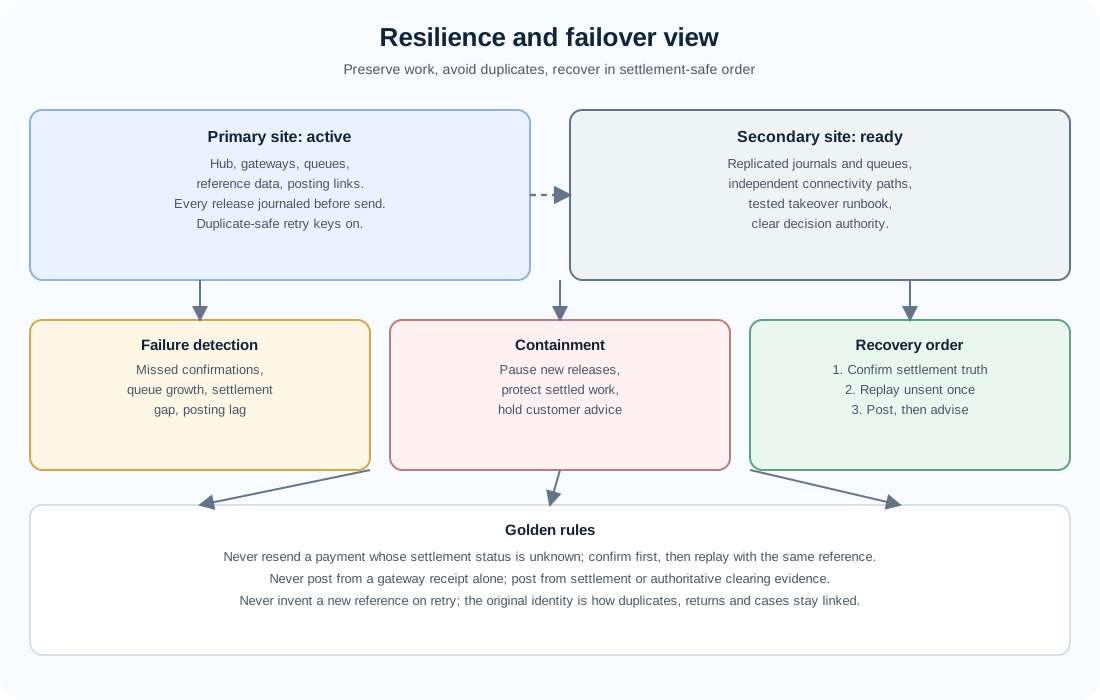
Recovery order protects the bank from fixing the visible symptom while compounding the underlying break. Confirm settlement truth first: did the original payment settle, was the batch net discharged, did the Interac acceptance complete, did the correspondent credit the beneficiary's agent. Contain second: pause related releases, protect settled work from reversal attempts that cannot succeed, hold customer advice that would promise what recovery has not yet achieved. Repair third: replay unsent work once with the same reference, issue correcting payments as new business events where the rail requires it, submit returns, recalls or claims through the correct rail procedure with correct reasons and deadlines. Post and advise fourth: complete posting from authoritative evidence, then tell the customer in settlement-aware language what happened and what happens next. Throughout, the original transaction identity is the join key across every record; new references annotate rather than replace. Operations runbooks encode that order per rail family so night-shift staff do not improvise it under pressure, and resilience testing rehearses it under simulated gateway, settlement-feed and posting-link failures.
Customer communication during exceptions is an architecture output with the same standing as settlement. Status language must match evidence — rejected with reason, held with reason and next step, released, accepted, settled, posted, available, returned, under investigation with a named owner — with one vocabulary maintained from the hub's status model rather than five local wordings.
9. Posting, accounting, liquidity, reporting and reconciliation
Posting turns interbank settlement into customer balances. Accounting turns postings into books the bank can defend. Liquidity makes settlement possible in the first place. Reporting tells customers, managers, auditors and overseers what happened. Reconciliation proves the story joins end to end. Those five functions are often organized as five departments with five tools and five definitions of done, which is why architecture must describe them as one evidence chain with five views rather than as five independent processes. This section follows settlement evidence into posting, accounting, liquidity, reporting and three-way reconciliation at architecture level. Posting rules, chart-of-accounts mapping, liquidity-instrument mechanics and report specifications belong to finance, treasury and rail chapters; the chain that binds them belongs here.
Posting discipline starts with a single rule: post from settlement or authoritative clearing evidence, never from channel status or customer pressure. Each posting links the customer account entry to the hub instruction, clearing record and settlement record through preserved references, with fees, foreign exchange and tax as separate lines rather than unexplained nets. Memo representations must stay visibly distinct from posted representations in every channel and statement, because displaying a memo as final is how availability disputes start.
Accounting extends posting into books that survive audit. Settlement-account entries, suspense and transit accounts for in-flight work, fee and foreign-exchange lines, adjustment and return lines, and nostro entries must each derive from the same instruction-keyed events. Each in-flight instruction needs a suspense home with an ageing policy, an owner and a clearing path: an architecture that cannot show every in-flight instruction in a balance-sheet home at day end has not finished its design.
Liquidity is the funding truth behind release and settlement. Lynx requires intraday management payment by payment with queue awareness, throughput coordination and treasury partnership; a queued high-value payment is a liquidity fact before it is a customer-service problem. ACSS requires forecast discipline across deferred net positions including sponsored volumes, with returns and adjustments moving the outcome after the forecast. Interac, card, USBE and correspondent activity each consume funding or nostro capacity with their own timing and value-date logic. The architecture therefore connects the hub release check, the treasury funding view and the settlement-account view into one loop: forecast before release, confirm at settlement, explain variances through reconciliation, feed learning back into limits and cutoffs. Later Block 8 and Block 14 chapters expand queue mechanics, collateral and funding operations; here the principle is that no release decision is funding-blind and no settlement surprise is treated as unforeseeable when the hub held the data that predicted it.
Reporting serves four audiences with one evidence base. Customers need advice and statements that distinguish released from accepted from settled from posted from available with matchable references. Operations need stuck-item ageing and cutoff countdowns. Finance and treasury need settlement, funding and suspense views tied to the ledger. Oversight and audit need screening, approval, mandate and investigation evidence assembled by instruction. Each audience reads a different projection of the same events; none receives a separately constructed truth.
Reconciliation proves the chain with three independent matches performed daily and aged openly: hub-to-gateway-to-posting internally, gateway-to-network-to-agent externally, and customer-to-bank on instructions versus reports. Breaks age by severity with named owners, and recurring patterns feed back into validation, mapping quality, reference-data freshness and customer guidance. Real-Time Rail preparation extends three-way matching to continuous operation rather than assuming batch windows will always provide a quiet catch-up period.
10. Bank implementation, testing and resilience
Implementation turns the architecture drawing into releases, runbooks and rosters that survive contact with production. Testing proves each change before customers fund that proof. Resilience decides what happens when proof meets outage. This section stays at the discipline level product, technology and operations leaders share: how to scope, build, test and operate the hub-and-rails picture without destabilizing today's Lynx, batch, Interac, card, USBE and correspondent services and without pretending the Real-Time Rail is already live. Build detail per rail belongs to later blocks; the discipline that makes those builds safe belongs here.
Scope honesty starts implementation. Each delivery names its rails, instruments, customer segments, participation model, messages and formats, cutoffs and calendars, controls and reports, because each choice pulls in a rulebook and a testing burden. Adding pre-authorized debit origination pulls in mandate lifecycle, agreement evidence, return handling and reimbursement workflows. Adding Lynx origination pulls in ISO 20022 message quality, liquidity management, session discipline and investigation readiness. Adding e-Transfer origination pulls in always-on support, notification and acceptance handling, fraud monitoring tuned to push-payment pressure, and limit management. Sponsoring indirect or payment-service-provider volumes pulls in due diligence, safeguarding verification, capacity planning and incident coordination. Reserving Real-Time Rail readiness pulls in continuous-processing design, address-management thinking and ISO 20022-native handling without committing to live routing. Scopes that pretend later blocks are out of scope while depending on their behaviour fail at integration; scopes that name the dependency and its owner pass.
Build order follows the evidence chain rather than the demonstration order. Reference data and calendar services come before routing, because routing without current reachability manufactures returns. The canonical instruction model and evidence spine come before new channels, because channels without a common hub create shadow hubs. Screening, entitlement and limit services come before new release paths, because volume without control is exposure. Gateway adapters come one rail at a time with confirmation matching built in, because a gateway that can send but cannot confirm creates unowned work. Posting, accounting, reporting and reconciliation links come with each adapter rather than as a later phase, because a rail without settlement-aware posting and three-way matching is operationally incomplete. Connectivity follows the generic pattern in this chapter's diagram: SWIFT messaging capability for Lynx participants, network-feed handling for ACSS exchange and clearing, Interac connections for Interac services, correspondent messaging and nostro handling for cross-border legs, with a reserved adapter slot for the Real-Time Rail. No vendor, protocol-version, throughput or line-speed specifics belong in architecture scope; capability, confirmation behaviour, failure modes and monitoring hooks do.
Testing proves the build at four levels without putting real customer funds at risk. Contract testing proves each module honours its hand-off. End-to-end testing follows representative instructions per rail family through capture, hub, gateway, simulated clearing and settlement, posting, reporting and reconciliation, including accented-name, duplicate-retry and late-window cases. Exception testing proves rejects, holds, returns, recalls and investigations with correct reasons and reference preservation. Resilience testing proves gateway timeouts, missing settlement feeds, posting-link loss, stale reference data and site failover against the recovery order in Section 8.
Cutover and release management protect the business day while change lands. Changes move with settlement and cutoff awareness — batch-cycle position, Lynx session state, Interac continuity, card authorization continuity and correspondent value-date impact checked before go-live. Parallel-run and dark-launch techniques compare new behaviour against current behaviour before customer-affecting cutover, feature flags isolate rail adapters, and back-out plans name the decision authority and customer wording in advance.
Resilience and staffing complete the section with the failover diagram as guide. Dual-site readiness with replicated journals and independent connectivity turns site loss into procedure. Queue preservation with duplicate-safe retry turns outages into confirmation-first recovery. Settlement-aware restoration order — confirm truth, contain, replay unsent once with original references, post from evidence, then advise — turns recovery from symptom repair into evidence-ordered restoration. Staffing follows the clocks the bank runs, with investigation capacity scaling with exception queues rather than straight-through volume.
Real-Time Rail preparation deserves a final paragraph because it tempts two opposite errors: ignoring it until initial launch forces panic integration, or building to it as if it were already live. The architecture-safe path is reserved-adapter readiness: isolate rail-specific logic from channel journeys and hub decisions so a new instant rail plugs in without rebuilding capture, screening or posting; design the canonical instruction and evidence spine for continuous operation with no quiet batch window assumed; extend monitoring, staffing, fraud, sanctions, liquidity and reconciliation thinking to 24/7/365 operation in design reviews and test plans; track Payments Canada readiness milestones through primary sources without encoding draft parameters as production truth. That posture lets initial launch arrive as an adapter activation with operations ready rather than as a rebuild under deadline, which is exactly what architecture exists to achieve.
11. Practical Canadian examples
Theory holds until payday. This section works three fictional illustrations that cross the rails this chapter connects. All companies, people, amounts and timings are invented for teaching operating logic and are labelled accordingly. None invents exact cutoff times, fee schedules, message field values or system parameters; all speak in relative windows. None treats the Real-Time Rail or the Future State of Retail Batch as live. Follow each story with the diagrams open, then extract the control lesson before moving to takeaways.
Example (fictional): a manufacturer Thursday that uses every layer. Northline Foods, an invented Ontario food processor, faces a Thursday with five business events. A payroll file for several hundred employees must credit Friday morning. A flour supplier collects its monthly invoice by pre-authorized debit the same morning. A replacement oven part must be paid today by wire or the weekend production run is lost. A food-service customer that overpaid last week wants a refund tonight and asks for Interac. A United States packaging supplier invoices in dollars due next Tuesday. The bank's hub handles the day as one plan. Intake normalizes the five submissions into canonical instructions with distinct references. Validation checks payroll funding and file authorization, PAD mandate evidence, beneficiary-agent completeness for the wire, Interac address and limits for the refund, and dollar-path readiness for the United States payment. Routing aims the wire at the Lynx session with funding secured before last call, the payroll at the batch window for Friday value, the PAD at the debit stream with return exposure disclosed, the refund at Interac services for tonight, and the dollar payment at the correspondent path with value-date confirmation. Settlement completes payment by payment for the wire, as a deferred net for batch, and through service-specific advice for Interac; posting follows settlement evidence per rail, and one report tells the manufacturer what is same-day final, what is next-window batch, and what confirmations are awaited.
Example (fictional): a payroll file that almost missed its window. Lakeside Clinics, an invented Alberta health-services group, uploads its bi-weekly payroll file late on a Thursday afternoon through its business portal after a human-resources correction. Intake accepts the file, deduplicates against an earlier partial upload, and rejects three records with stale transit numbers back to the portal with the defect named rather than holding the whole file. Approval confirms dual control; routing aims the file at the evening batch window for Friday value. One record breaches a per-item limit and is held alone with its reason, owner and next step while the remainder moves onward. The gateway dispatches through the batch feed, clearing reports are matched to hub instructions, settlement of the net completes, and posting follows settlement evidence. Overnight a single credit returns for a closed account; the return links to the original reference and the re-issue becomes a new instruction rather than an edit.
Example (fictional): an urgent supplier wire with a name that needs care. An invented British Columbia equipment distributor, Harbourline Marine, must pay a domestic supplier today so a vessel part ships before a long weekend. The branch captures the wire with full beneficiary-agent detail; the beneficiary legal name contains accented characters and a suffix the supplier's invoice renders differently. Validation holds rather than repairs: the hub flags the name variance, applies defined character-folding for screening without altering the legal beneficiary record, and returns a precise clarification request stating the settlement consequence. Approval applies dual control with treasury funding confirmation. The gateway dispatches through SWIFT messaging and settlement confirmation follows; posting follows settlement evidence with same-day finality stated. The next morning the supplier cannot match the payment because the remittance omitted the purchase-order number; the investigation assembles instruction, remittance as sent and as mapped, settlement and posting under one reference, and the correction travels as enriched remittance on a follow-up communication rather than a reversal the rail cannot support.
Stories, companies, people, amounts and timings in this section are fictional and for teaching only. Relative windows are used throughout; no exact cutoff times are stated. The Real-Time Rail is shown as planned and the Future State of Retail Batch as an initiative, neither as a live routing target.
12. Key takeaways and authoritative references
Twelve sentences carry this chapter into the rest of the programme. Channels capture intent once and set honest expectations. The hub decides through validation, screening, approval, routing and release with every decision recorded. Gateways dispatch per rail while preserving references and awaiting acceptance. Lynx settles individually in central-bank money with finality at settlement. ACSS exchanges batch and settles deferred nets with return rights. Interac Corp services run separately from Payments Canada on a near-instant 24/7 experience. Cards authorize first and fund later, USBE settles dollar batch through correspondent banks in New York, and correspondent chains separate messaging from money. Data, mandates, remittance and references form one spine. Rules, calendars and cutoffs become one promise only through the hub calendar. Controls prevent only before release, exceptions recover only in settlement-safe order, and posting, accounting, liquidity, reporting and reconciliation form one chain proven daily. Implementation scopes honestly, tests deep, cuts over with settlement awareness, and keeps a reserved adapter ready for Real-Time Rail initial launch.
Ten misunderstandings deserve correction before the next chapter, because each has caused a real incident somewhere in the industry. One, sent does not mean settled; channel status is not settlement evidence. Two, clearing does not mean finality; exchange and netting create obligations that settlement discharges. Three, SWIFT does not settle; it messages and confirms while accounts and systems settle. Four, Interac e-Transfer is not a Payments Canada stream; Interac Corp operates it on separate infrastructure. Five, batch cannot be hurried into finality by rewording customer advice; return rights and settlement timing are structural. Six, a Lynx payment cannot be recalled like a batch debit; correction needs a new payment or an investigation outcome. Seven, the Real-Time Rail is not in production at 5 October 2026; the current Q4 2026 launch plan and sequenced onboarding are readiness, not routing. Eight, the Future State of Retail Batch is a modernization initiative, not a system to address payments to. Nine, screening after release does not prevent; placement relative to release is the control. Ten, a new reference on retry does not fix a timeout; confirmation-first recovery with original identity is the only safe path. Carry those ten corrections into every later block and most rail chapters will read as elaborations rather than surprises.
The forward map keeps depth where it belongs. For account and routing depth, continue within Block 2. For batch, Automated Funds Transfer, pre-authorized debit, cheque and adjustment depth, study Blocks 3 to 5. For Interac depth, Blocks 6 to 7; for Lynx and high-value depth, Block 8; for ISO 20022 and message depth, Block 9. For cross-border, USBE and correspondent depth, Block 11; for Real-Time Rail depth, Block 12; for fraud, anti-money laundering, sanctions and RPAA supervision, Block 13; for operations and reconciliation depth, Block 14; for full payment stories, Block 15. Redraw this chapter's five diagrams from memory for any business event before opening the corresponding rail chapter.
Authoritative references below are official sources only. Consult the current pages for rule, operating and readiness detail, because parameters change and this chapter states none.
Diagrams in this chapter: layered architecture; payment-hub modules and hand-offs; connectivity view; operations and monitoring plane; resilience and failover view — all under /diagrams/payment-stories/canada/chapter-10/. No exact cutoff times, fees, vendor names, protocol specifics or line speeds are shown. The Real-Time Rail is shown as planned and not in production at 5 October 2026. The Future State of Retail Batch is referenced as an initiative, not a live rail. Stories, companies, people, amounts and timings are fictional.
This application uses JavaScript for the full interactive experience. This text summary is served for accessibility and search indexing.