Canadian Bill Payments. Follow bill-payment initiation, routing, remittance delivery, biller posting and reconciliation.
Block 10 · Chapter 46 of 75
Canadian bill payment is one of those services that looks almost trivial to a customer and becomes much more interesting the moment a bank has to operate it at scale. A customer selects a biller, enters an account or reference number, chooses an amount and presses Pay. The screen may show a confirmation within seconds. Behind that experience, however, the bank has to keep several different things aligned: customer authorization, account posting, biller identification, remittance data, exchange between financial institutions, retail clearing and settlement, biller reporting, cash application, correction of errors and reconciliation. If the money leg succeeds but the reference leg fails, the customer can still appear unpaid at the biller. If the reference is correct but the value never reaches the intended clearing path, the biller cannot apply anything. A good bill-payment service therefore treats value and remittance as one joined business outcome.
This chapter explains Canadian bill payments from the operating model outward. It is written for people who need to understand how the service behaves inside a bank: business analysts, architects, developers, testers, operations teams, product owners, fraud teams, finance teams and customer-service specialists. It deliberately does not reproduce proprietary file layouts or bank-specific interfaces. Instead, it explains the control points that remain true regardless of implementation: how billers are identified, what the customer reference means, how the payor financial institution validates and posts, where Payments Canada and ACSS fit, what the biller financial institution receives, why the biller’s cash-application process matters, how error correction works and how all the evidence is reconciled.
Scope and status (5 October 2026). The current production model described here is the in-force Payments Canada Rule H6 framework. It covers paper-based and electronic inter-FI remittances; current electronic CCIN items are exchanged as EDI Payment Items. The revised H6 text is published but not in force until 1 December 2026. On that date, electronic bill payments to non-CCIN billers enter the framework as AFT Credit Transactions, while paper-based remittances stop being exchanged between FIs. These are Payments Canada scheme-rule facts, not a bank’s customer-facing API contract; bank cutoffs, posting, risk decisions and biller reports remain implementation-specific.
The current framework matters. Payments Canada’s Rule H6 provides the rule framework for the inter-financial-institution exchange of bill-payment remittances used for clearing and settlement. Payments Canada’s bill-payment explainer also makes an important system distinction: when the payor and biller use the same financial institution, the shared FI can handle the payment internally; when they use different FIs, the retail batch framework and ACSS are used to track and reconcile the inter-FI positions. Payments Canada has also published amendments to the bill-payment framework that take effect on December 1, 2026, including expanded scope for electronic bill payments to non-CCIN billers, a more standardized biller-enrolment process, removal of paper-based remittances as acceptable exchange items and a guideline aimed at more consistent value-dating. Those are future-effective changes as of this chapter date, so the chapter separates today’s live model from the December 2026 target state.
What you should be able to do after this chapter
After working through this chapter, you should be able to:
- explain the Canadian bill-payment ecosystem without reducing it to “customer sends money to a biller”;
- distinguish a same-FI bill payment from an inter-FI bill payment and explain why the clearing evidence differs;
- describe the purpose of the Corporate Creditor Identification Number (CCIN) in the existing framework and how it supports biller routing;
- explain the roles of the payor, payor FI, biller, biller FI and Payments Canada;
- trace a bill payment from channel initiation through validation, posting, remittance exchange, clearing, settlement, biller reporting and cash application;
- separate the customer debit date, processing/business date, inter-FI settlement date and biller application date;
- explain why the biller account/reference number is operationally as important as the amount;
- describe the difference between a valid payment with wrong remittance data and a genuine value-movement failure;
- classify wrong-biller, wrong-reference, wrong-amount, duplicate and “biller cannot find it” cases;
- explain the functional purpose of Rule H3 error-correction processing without inventing a bank’s specific operational procedure;
- design fraud and operational controls around biller enrolment, payee selection, account takeover, duplicate payment and remittance integrity;
- reconcile instruction, customer posting, exchange, clearing/settlement and biller reporting;
- plan implementation and testing across channels, business-day cutoffs, duplicate handling, restart/replay and reconciliation;
- explain the December 1, 2026 bill-payment-framework changes accurately as future-effective changes rather than current production behaviour;
- navigate to the authoritative Payments Canada rules and public guidance when exact rule wording or implementation timing is required.
For a roughly 60-minute core session, spend 10 minutes on Sections 1 and 2 with the ecosystem and responsibility diagrams, 15 minutes on Sections 3 and 4 with the end-to-end flow, 10 minutes on Sections 5 and 6 with the remittance model, 10 minutes on Sections 7 to 9, 10 minutes on the practical cases in Section 11 and 5 minutes on the takeaways and authoritative sources.
Chapter navigator
- Business context and customer need
- Participants, responsibilities and system boundaries
- Biller enrolment, customer initiation and validation
- Exchange, clearing, settlement and biller receipt
- Data, CCINs, references and remittance integrity
- Cutoffs, service levels, value-dating and customer impact
- Fraud, security and operational controls
- Errors, corrections, investigations and recovery
- Posting, accounting, reporting and reconciliation
- Bank implementation, testing and resilience
- Practical Canadian examples
- Key takeaways and authoritative references
1. Business context and customer need
The easiest way to understand bill payment is to start with the customer’s problem rather than the bank’s system. A household receives a utility invoice for $186.42. The bill says the amount is due on the 25th and shows an account number that identifies the household in the utility’s receivables system. The customer opens mobile banking on the 22nd, selects the utility from a saved payee list, confirms the account number, enters $186.42 and presses Pay. The customer’s expectation is not merely that $186.42 leaves the bank account. The expectation is that the utility recognizes that this exact customer paid this exact obligation in time.
That is why a bill payment has two inseparable payloads:
- value — the financial amount to be transferred; and
- remittance identity — enough information for the biller to recognize and apply the payment.
This differs from a generic account-to-account transfer. In a bill-payment model, the receiving party is usually an enrolled biller with a governed relationship and defined reference structure. The bank does not ask the customer for arbitrary beneficiary bank details each time. Instead, it uses a biller directory, a biller identifier and a customer/biller account reference to route and report the payment.
Payments Canada’s public bill-payment material describes bill-payment remittances as the information associated with a bill payment that allows financial institutions and billers to identify and reconcile the transaction. In the existing Rule H6 framework, the Corporate Creditor Identification Number, or CCIN, uniquely identifies a biller for this purpose. A customer rarely thinks about a CCIN, because the channel normally presents a friendly payee name. Inside the bank, however, the biller master must resolve that friendly name to the governed biller identity and routing information.
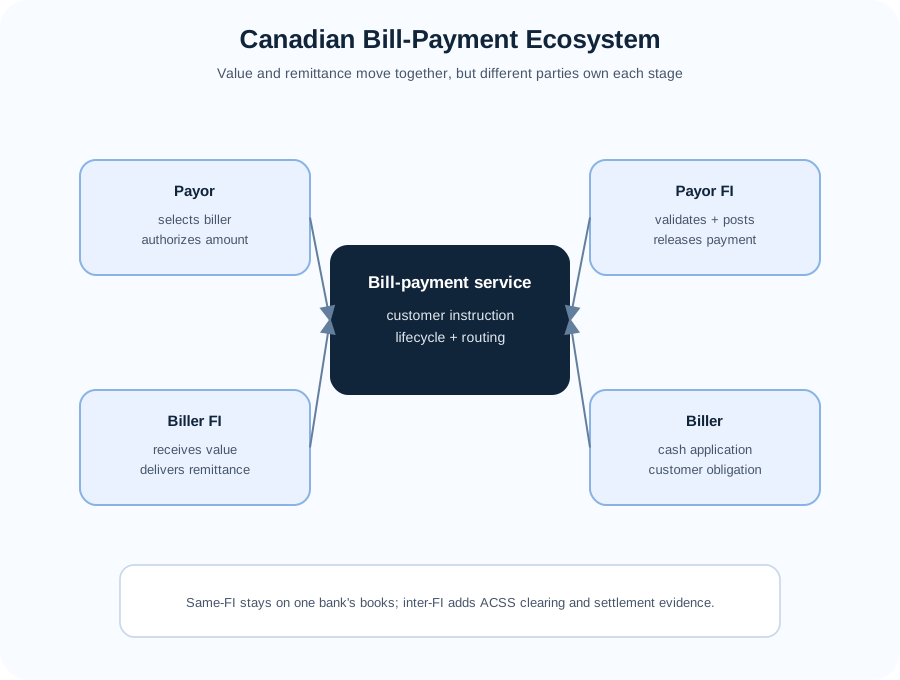
The four business outcomes
A bill-payment product should be measured against four outcomes.
The right customer was authorized. The bank can prove which customer, device/session and funding account initiated the instruction and what the customer saw at confirmation.
The right biller was selected. The biller identity used in processing matches the biller the customer intended to pay.
The right reference travelled. The biller account/reference information was preserved and delivered in the remittance flow.
The right value was settled and applied. The inter-FI financial position was processed correctly where required, and the biller could reconcile the value to its receivables.
A bank can pass three and fail the fourth. That is why “the debit is on your account” is not a sufficient investigation answer.
Same-FI versus inter-FI bill payment
Suppose the customer and the utility both bank with the same institution. The bank can debit the customer and credit the biller’s collection account on its own books. It still needs to produce the remittance information for the utility, but there is no need to create an inter-FI clearing position for that value.
Now suppose the utility’s collection account is at another FI. The payor FI has to send the applicable bill-payment/remittance information through the inter-FI framework, and the positions contribute to retail clearing and settlement. Payments Canada’s ACSS becomes relevant to tracking and reconciling those inter-FI obligations.
This is an important architecture rule: do not force the same evidence model onto same-FI and inter-FI transactions. Same-FI evidence is internal posting plus biller reporting. Inter-FI evidence adds exchange and clearing/settlement.
Why customers care about dates differently from banks
Customers think in terms of a due date. Banks operate with multiple dates:
- instruction date;
- requested payment date;
- bank processing date;
- business date;
- exchange date;
- clearing/settlement date;
- biller receipt/report date;
- biller application/value date.
A good channel hides this complexity until it matters, but a good operating model preserves every timestamp. When a late-payment dispute occurs, the bank needs to prove what the customer requested, when the bank accepted it, when it was processed and what remittance information was sent. The biller then needs to explain when it applied the value.
2. Participants, responsibilities and system boundaries
The bill payor is the customer or business making the payment. The payor chooses the biller, provides or confirms the reference, selects the amount and authorizes the instruction. The payor is responsible for checking the information displayed, but the bank should make that check easy by presenting the biller name and reference clearly before final confirmation.
The payor financial institution owns the customer-facing service. It authenticates the customer, validates the funding account, checks balance and limits, performs fraud controls, validates biller/reference data that it is capable of validating, records the authorization, posts or schedules the debit, constructs the downstream bill-payment/remittance representation and routes it to the appropriate path.
The biller is the creditor. It defines the customer reference or account structure used to identify obligations, participates in the relevant enrolment arrangements, receives payment/remittance information and applies the payment to its receivables.
The biller financial institution supports the biller’s receiving relationship. It receives the relevant inter-FI value and remittance/reporting information and provides the agreed reporting/settlement service to the biller.
Payments Canada provides the legal and operational rule framework for exchange and clearing. For this chapter, Rule H6 and Rule H3 are Payments Canada scheme rules, not universal bank product specifications. Rule H6 governs the inter-FI exchange of bill-payment remittances for clearing and settlement. Rule H3 governs correction debits used to correct certain electronic bill-payment errors, subject to the rule’s conditions and authorization requirements. ACSS is the retail batch system used by member FIs for positions arising from eligible retail payment items.
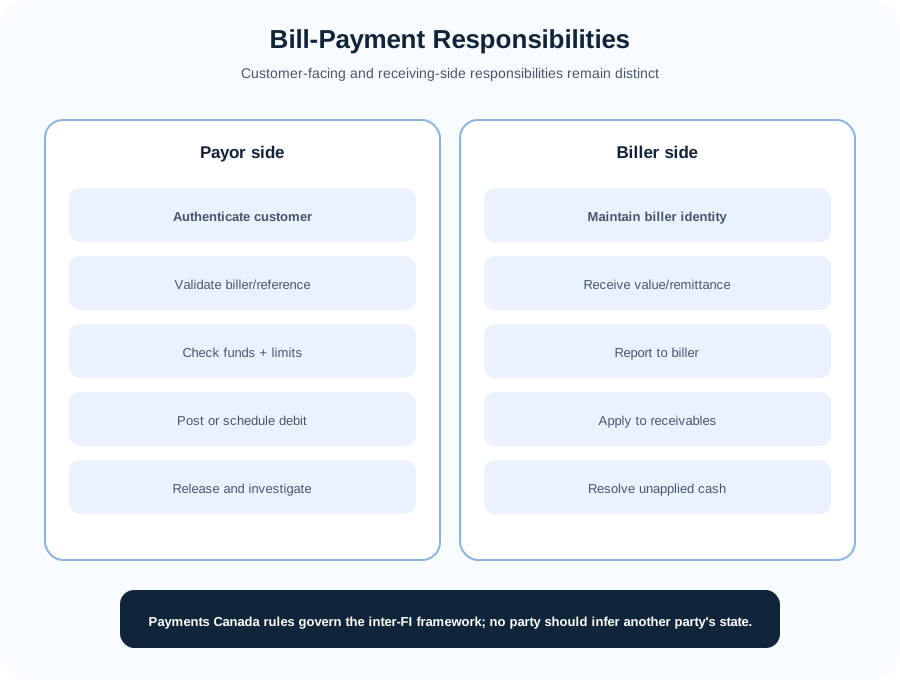
The bank boundary map
A practical system picture inside the payor FI looks like this:
Mobile / online / branch / file channel → biller directory → bill-payment service → fraud and limits → customer posting → payment hub / exchange adapter → clearing and settlement accounting → reconciliation → customer reporting
The biller side has a parallel chain:
incoming exchange → biller FI accounting → biller report / remittance file or API → biller receivables → cash application → unapplied-cash exceptions
The important architecture decision is where the system of record for the payment lifecycle lives. A bank should not let the channel be the only place that knows the customer reference, or let the clearing adapter be the only place that knows the exchange ID. The payment hub or bill-payment service should persist the end-to-end instruction, including:
- internal payment ID;
- biller master ID;
- CCIN where applicable;
- customer/biller account reference;
- amount;
- funding account;
- requested date;
- bank business date;
- lifecycle status;
- downstream exchange reference;
- correction/investigation link;
- biller report status.
That record becomes the anchor for reconciliation and investigations.
Biller enrolment as a control surface
Biller enrolment is often treated as back-office administration. It should be treated as a payment-control function because an incorrect or malicious biller master can redirect thousands of customer payments.
Controls should include:
- verified biller identity;
- approved banking relationship;
- governed biller identifier;
- reference-format definition;
- effective date;
- change authorization;
- dual control for sensitive changes;
- audit history;
- deactivation/closure handling;
- downstream FI/routing validation.
Payments Canada’s December 1, 2026 framework changes explicitly introduce a more standardized biller-enrolment process, including clearer responsibilities, communication requirements for FIs and a common biller-enrolment form. Banks should therefore design their target-state onboarding around controlled metadata rather than channel-specific payee tables.
3. Biller enrolment, customer initiation and validation
A high-quality bill-payment journey begins before the payment date.
When a customer adds a biller, the channel searches the bank’s governed biller catalogue. The customer selects the intended biller and enters the biller account/reference. The bank may apply biller-specific validation rules such as minimum/maximum length, allowed characters or check-digit logic where formally supplied by the biller. The bank should never present such validation as proof that the biller has confirmed ownership of that reference unless an actual online validation service exists.
The customer then sees a confirmation such as:
Biller: Example Energy
Account: 123456789012
Amount: $186.42
From: Chequing ****4321
Payment date: September 22
This is a control, not just UX. It gives the customer a final chance to detect a wrong biller or reference before authorization.
The validation stack
Once the customer confirms, the bank should run the instruction through controlled checks.
Customer and channel checks
- authenticated session;
- device risk;
- session integrity;
- step-up requirement;
- user entitlement;
- corporate maker/checker where applicable.
Funding-account checks
- account active;
- permitted debit account type;
- available balance;
- overdraft policy;
- debit restrictions;
- legal or operational blocks.
Payment checks
- biller active;
- biller route available;
- reference structurally valid;
- amount within limits;
- requested date permitted;
- duplicate indicators;
- cut-off/business-day treatment.
Risk checks
- first-time biller;
- unusual amount;
- abnormal payment velocity;
- compromised-device signal;
- account-takeover indicators;
- suspicious biller-master change;
- scam signals.
The result should be explicit: accepted, scheduled, rejected or held for review. The bank should not create a vague “processing” state before it knows whether the instruction is actually valid.
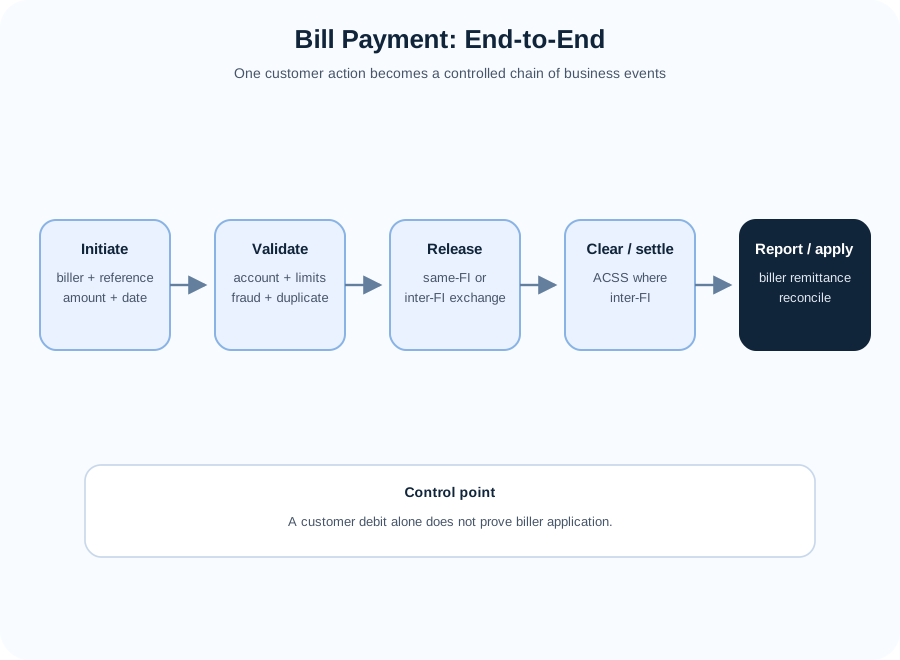
Duplicate detection
Bill payments are prone to accidental duplicates because customers often retry when the first confirmation is delayed. A robust duplicate service should compare more than a technical message ID. It should look at the economic instruction: customer, funding account, biller, biller reference, amount and requested date.
The best customer experience is usually a warning rather than a blind hard block:
You paid this biller $186.42 from this account earlier today. Do you still want to continue?
A customer may genuinely intend two payments, so the system should allow authorized continuation where product rules permit.
Posting strategy
Banks differ in whether they post the customer debit immediately, at release, or on the requested processing date. The exact accounting is product-specific, but the control requirement is consistent: the customer statement and payment lifecycle must agree.
If the bank shows the payment as debited but the downstream instruction has not been released because the requested date is tomorrow, operations must be able to explain that state. If the bank schedules without debiting, the channel must show that the payment is scheduled, not completed.
Recurring and future-dated bill payments
A recurring bill-payment instruction introduces another object: the standing schedule. The standing instruction and each resulting payment instance must have separate identity.
A bank needs controls for:
- schedule start/end date;
- frequency;
- amount rule;
- next execution date;
- biller still active;
- funding account still eligible;
- customer cancellation;
- holiday/weekend treatment;
- repeated failure handling.
When the scheduled instance is created, it should go through fresh balance, limit and fraud checks appropriate to the product. A standing instruction created six months ago is not sufficient evidence that every future payment remains executable.
4. Exchange, clearing, settlement and biller receipt
For an inter-FI bill payment, the payor FI converts the accepted instruction into the applicable bill-payment/remittance exchange representation. The exchange communicates enough information for the receiving side and biller to identify the biller, amount and customer obligation.
Under the current Rule H6 framework, the CCIN is central to biller identity. Payments Canada describes the CCIN as a unique number assigned to billers to help route client bill payments. That identifier travels with electronic remittances.
Message and file boundaries
In the current H6 model, an electronic CCIN bill payment is exchanged as an EDI Payment Item; a paper remittance is a separate current-state item type. In the revised H6 model effective 1 December 2026, CCIN electronic items remain EDI while electronic payments to non-CCIN billers are exchanged as AFT Credit Transactions. The revised rule also removes inter-FI exchange of paper-based Remittances. A bank must therefore version its exchange adapter and reconciliation rules by H6 effective date rather than treating “bill payment” as one universal file or API.
ACSS and the inter-FI value
ACSS is a deferred-net retail clearing system. Eligible retail items exchanged by participating institutions contribute to multilateral positions. Direct clearers participate directly and handle clearing and settlement for their own and indirect-clearer customers; direct clearers maintain settlement accounts at the Bank of Canada. Payments Canada says the previous day’s net balances settle during the morning of each business day, extinguishing settlement-account balances through payments to and from the Bank of Canada. This is system-level settlement evidence, not a promise that a customer debit or biller application is immediate. The system is not a real-time gross settlement engine for each bill payment. The customer can therefore see an immediate debit while the intermember financial obligation is part of later retail batch clearing and settlement.
This is why a production investigation should not say:
The bill settled because the customer was debited.
The debit proves the customer-account event. Settlement evidence comes from the bank’s clearing and settlement records.
The four-ledger model
A useful control model has four ledgers.
Ledger 1 — payor customer account
Did the customer debit occur once for the authorized amount and date?
Ledger 2 — payor FI clearing/accounting
Did the bank recognize the outgoing retail obligation correctly?
Ledger 3 — receiving/biller FI clearing/accounting
Did the receiving side receive the expected value and remittance population?
Ledger 4 — biller receivables
Did the biller apply the amount to the intended customer obligation?
The first three can reconcile while the fourth fails because of bad remittance data. That is exactly why bill-payment investigations must trace money and information separately.
Remittance delivery
The biller may receive a remittance report, file or other agreed representation through its FI/service arrangement. The biller’s cash-application system uses the biller reference to find the customer obligation.
Straight-through cash application should be measured. A biller with 99.9% auto-application has a very different operational profile from one with 95%. At large volume, even a small fall in reference quality creates thousands of manual exceptions.
Same-FI shortcut
For a same-FI payment, the bank can post between internal accounts and deliver remittance directly to the biller’s reporting flow. No external ACSS clearing position is needed for that amount.
Operations should still reconcile:
customer instruction → customer debit → biller internal credit → biller remittance report → biller application.
5. Data, CCINs, references and remittance integrity
Bill payment is a data-quality product as much as a money-movement product.
The critical fields typically include:
- internal payment ID;
- biller master ID;
- CCIN where applicable;
- biller name;
- customer/biller account reference;
- payor account;
- amount;
- currency;
- payment date;
- channel;
- exchange/business date;
- status;
- correction link;
- settlement/reconciliation status.
CCIN in the existing framework
Under the current Rule H6 model, billers participating in the framework use a CCIN to identify the corporate creditor. The CCIN is not the same as the customer’s account number with the biller.
The hierarchy is:
CCIN → which biller?
Customer reference → which obligation/customer at that biller?
Confusing those two identifiers produces serious design errors. The CCIN routes to the biller; the customer reference helps the biller apply the payment.
Customer-reference integrity
The reference should be preserved exactly as authorized, subject only to documented technical normalization.
Safe normalization examples can include:
- removing display spaces;
- normalizing hyphens where the biller specification explicitly says they are formatting only;
- uppercasing where case is defined as irrelevant.
Unsafe “repair” includes guessing a missing digit, replacing a number based on a similar customer profile or silently switching to another saved payee.
The payment record should preserve:
- what the customer entered;
- the normalized value used for processing;
- the transformation rule applied.
This creates auditability.
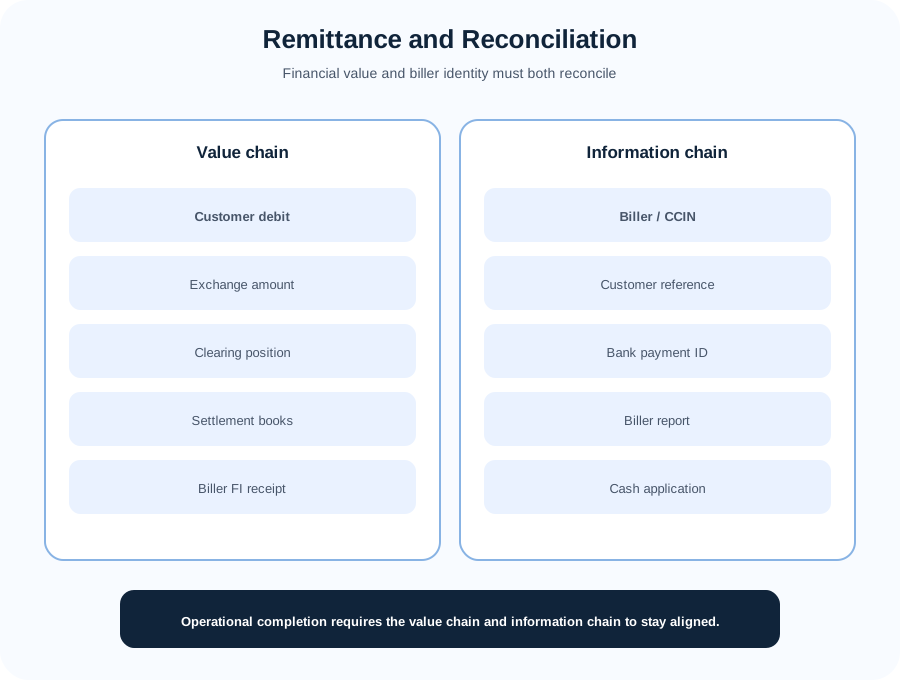
Why reference validation has limits
A bank can validate structure without knowing semantic truth. If a utility tells banks that its account number is 12 numeric digits, the bank can reject 11 digits or letters. It may still be unable to know whether 123456789012 actually belongs to that customer.
The channel language should therefore say “valid format” rather than “account verified” unless a real verification service exists.
Data ownership
A strong target architecture assigns clear ownership.
Biller master team owns biller identity, routing and reference rules.
Customer channel owns what the customer sees and authorizes.
Payment service owns instruction lifecycle.
Exchange adapter owns transformation into downstream representation.
Operations owns exceptions and investigations.
Finance/reconciliation owns proof that books and clearing agree.
Biller relationship team owns reporting and downstream receivables issues.
Without ownership, reference defects become everybody’s problem and nobody’s backlog.
6. Cutoffs, service levels, value-dating and customer impact
The hardest bill-payment conversations often happen around due dates.
A customer may initiate at 11:45 p.m. on a Friday. The channel can accept the instruction immediately, but the processing business date may be Monday or Tuesday depending on the holiday calendar and bank service design.
The bank should expose at least:
- accepted date/time;
- requested payment date;
- effective bank processing date where known;
- receipt/confirmation number.
The bank should avoid guaranteeing a universal biller posting time because the downstream biller controls its receivables application.
The in-force H6 definition of Payment Date is the day the payor makes the bill payment at the Payor’s FI. If extended hours or ABM processing is involved, it may be the following Business Day, provided the FI gives the payor notice of that additional day. This rule-level definition does not eliminate bank-specific mobile cutoffs, holiday calendars or customer disclosures.
Value-dating and the 2026 framework change
Payments Canada’s published December 1, 2026 changes address inconsistent value-dating by introducing a guideline encouraging FIs to include a provision in agreements with non-CCIN billers under which the biller agrees to deem its customer to have paid on the business day the customer makes the bill payment at the FI.
That is important customer protection direction, but as of the chapter date it is future-effective. Product teams should implement target-state contracts and customer language deliberately rather than assume the guideline is already live.
Service levels need state definitions
A statement such as “bill payments take 2–3 days” is operationally weak because it does not define which event.
Better definitions include:
- accepted by bank;
- released into exchange;
- included in clearing;
- settled between FIs;
- remittance delivered;
- applied by biller.
Different teams may own different stages.
Customer evidence
The customer receipt should contain:
- biller name;
- masked/full biller reference as appropriate;
- amount;
- funding account identifier;
- payment/requested date;
- bank confirmation number;
- status.
This evidence is invaluable in later disputes with the biller.
7. Fraud, security and operational controls
Bill payment has a different fraud profile from an open account-to-account transfer because the beneficiary population is usually a governed biller directory. That reduces some destination risk but does not remove fraud.
Account takeover
An attacker who controls online banking can pay a biller connected to an account the attacker benefits from, or can manipulate a customer into making a payment.
Controls include:
- device risk;
- anomalous-session signals;
- new-payee risk;
- step-up authentication;
- velocity monitoring;
- behavioural comparison.
Biller substitution and master-data risk
The higher-impact operational risk is compromise of the biller master. If a routing attribute is changed maliciously, thousands of legitimate customer instructions can be redirected.
Controls need:
- privileged-access management;
- maker/checker;
- authenticated change request;
- effective dating;
- independent confirmation;
- audit trail;
- post-change monitoring.
Scam risk
Fraudsters frequently impersonate utilities, tax authorities or telecom companies and pressure customers to pay urgently. Banks can add contextual warnings when a customer adds a new biller or makes an unusual payment. Warnings should be targeted and actionable, not generic banners customers ignore.
Duplicate risk
Technical retry after uncertain response is a major operational risk. The payment API should be idempotent using a customer/instruction key. Downstream replay should preserve that idempotency.
Sanctions and AML
Rule H6 does not replace Canadian financial-crime law or a bank’s AML/sanctions programme. The bank should apply the controls required by applicable law and its risk-based programme to the parties, biller relationship, account activity and available payment data; it should not blindly reuse a correspondent-wire screening flow for every domestic bill payment. FINTRAC recordkeeping guidance makes payment traceability material, including account information, reference numbers and transaction identifiers where the applicable record obligation is engaged. Treat any screening, hold, escalation or reporting decision as a bank/compliance control, not as a Rule H6 customer guarantee.
For a PSP that is subject to the Retail Payment Activities Act (RPAA), the Bank of Canada’s regime separately covers registration, operational-risk management, incident response, end-user-funds safeguarding and reporting. RPAA supervision does not replace H6 or a bank’s obligations. For a federally regulated institution, OSFI’s third-party-risk expectations also expressly include payment, clearing and settlement systems and call for continuity testing, contingency planning, monitoring and access to records where applicable.
Operational controls
Daily controls should monitor:
- rejected/held payment rate;
- duplicate warnings and overrides;
- biller-master changes;
- reference-validation failures;
- exchange rejects;
- reconciliation breaks;
- biller-report failures;
- aged unapplied-cash cases;
- correction requests;
- customer complaints.
8. Errors, corrections, investigations and recovery
Bill-payment errors are highly repetitive in pattern. A well-designed operations model classifies them early.
Wrong biller
The customer intended Biller A but selected Biller B.
If the instruction has not reached an irreversible downstream stage, the bank may be able to cancel according to product rules. If value has already been processed, recovery becomes an error-correction or biller-cooperation problem.
Correct biller, wrong account/reference
The money can reach the correct biller but be applied to the wrong customer account or fall into unapplied cash.
The investigation should compare:
- reference shown to customer;
- reference stored in payment record;
- reference sent downstream;
- reference received in biller report.
This isolates whether the error originated with the customer, a bank transformation or a downstream reporting issue.
Wrong amount
An authorized wrong amount is not automatically a bank processing error. If the bank sent exactly what the customer authorized, the bank may need to help the customer recover from the biller rather than reverse unilaterally.
Duplicate payment
Determine first whether two valid customer authorizations exist. If yes, it may be an accidental duplicate from the customer’s perspective but not a technical duplicate. If the bank or exchange duplicated one authorization, it is a processing defect.
Biller cannot find the payment
This case needs a two-track trace.
Track A — value
- was customer debited?
- was payment released?
- was inter-FI exchange successful?
- did clearing/settlement reconcile?
- did biller FI receive the expected amount?
Track B — remittance
- what biller/CCIN was used?
- what customer reference was sent?
- did biller report contain it?
- did biller reject or suspend it?
- is it sitting in unapplied cash?
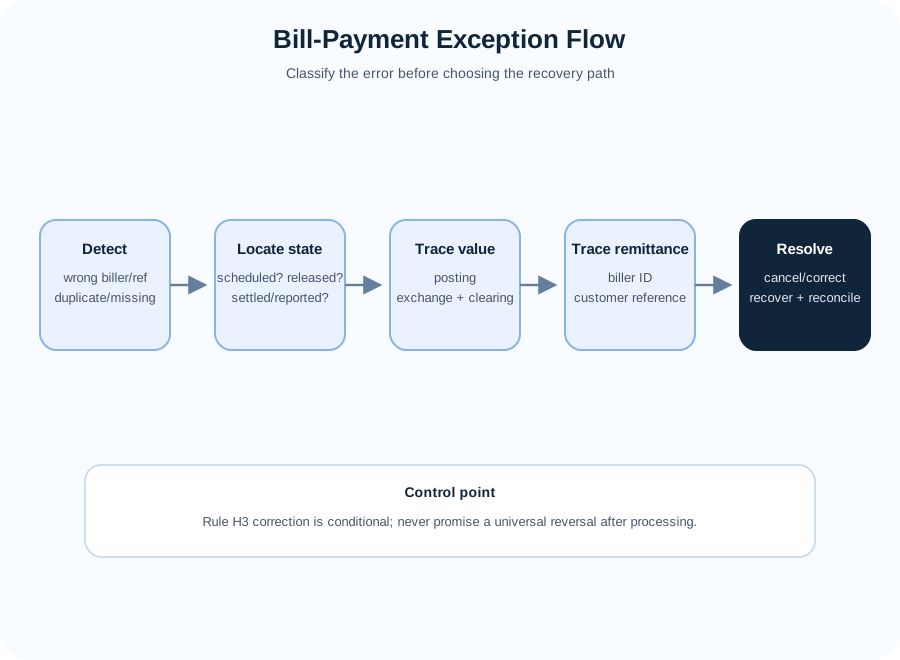
Rule H3 and correction debits
Payments Canada Rule H3 governs Bill Payment Error Correction Debits used to correct electronic bill-payment errors. The rule explicitly states that nothing in the rule obligates a bill payee to authorize a correction debit request; where authorization is not provided, recourse may need to be handled outside the rule framework between the parties.
That is an important practitioner lesson: a bank should not promise that every mistaken bill payment can simply be “reversed.” The correction process depends on rule conditions, timing, authorization and the actual state of the item.
The current H3 rule has concrete limits that belong in requirements and test cases. Where a Member offers the service, the Bill Payor FI is responsible for each correction debit. The FI must confirm the original bill-payor, correction amount, original amount, original date, payor reference and bill-payee name (from the customer or its own records where the FI caused the error). A correction debit must be at least CAD 20 and cannot exceed the original electronic bill payment. The Bill Payee’s explicit written or recorded authorization and an authorization indicator are required; a per-transaction authorization must specify the amount, while a standing authorization may add limits and timing. If authorization is requested but not provided within 10 Business Days, the FI may treat it as denied. AFT corrections use transaction code 453; the FI must keep the authorization, indicator and trace information for at least 12 months after processing. A dishonoured correction debit follows the applicable next-day return process, and a correction may be returned up to and including 90 calendar days for lack of authorization or processing inconsistent with the authorization. These are H3 scheme conditions, not a blanket consumer right to a unilateral reversal.
Operations tooling should therefore capture:
- original payment ID;
- biller;
- reference;
- amount;
- error type;
- date discovered;
- customer statement;
- payee authorization where required;
- correction instruction ID;
- outcome;
- customer communication.
Investigation service levels
A customer case should have state:
opened → evidence gathered → external enquiry sent → response received → correction/recovery initiated → accounting completed → customer informed → closed
Do not close a case merely because an external enquiry was sent.
9. Posting, accounting, reporting and reconciliation
Bill-payment accounting usually has customer, clearing and control-account layers.
A generic pattern may be:
Customer debit
Debit customer deposit account
Credit bill-payment clearing/control account
Inter-FI clearing/settlement
Move between clearing/control and settlement accounts according to the bank’s accounting design
Same-FI
Debit customer
Credit internal biller collection account
The exact chart of accounts differs by bank. The control principle is more important: principal value should be separately visible from fees, corrections and suspense.
Reconciliation layers
A mature bank performs at least five reconciliations.
1. Channel to payment hub
Every customer-confirmed instruction appears exactly once in the payment system.
2. Payment hub to customer posting
Every accepted debit has the correct account, amount and date.
3. Payment hub to exchange
Every released inter-FI payment is included exactly once in downstream exchange.
4. Exchange to clearing/settlement accounting
Item/control totals agree to the institution’s retail clearing position and settlement books.
5. Exchange to biller reporting
The value and reference population delivered to billers reconciles to what the bank processed.
Breaks must be typed.
Examples:
- accepted not posted;
- posted not exchanged;
- exchanged twice;
- exchange rejected;
- settlement/control total mismatch;
- biller-report missing;
- biller-reference mismatch;
- correction unmatched to original.
Why totals are not enough
Suppose a daily file contains 10,000 payments totaling $4.2 million. If the file total matches settlement, the bank knows the aggregate money is balanced. It does not know that Customer A’s $186.42 was attached to the correct biller reference.
Item-level reconciliation is therefore needed for customer investigations and biller service quality.
Reporting metrics
Useful metrics include:
- STP rate;
- reference-validation reject rate;
- duplicate-warning rate;
- same-FI/inter-FI mix;
- exchange reject rate;
- biller-report success rate;
- unapplied-cash rate;
- correction request volume;
- average investigation age;
- customer complaint rate;
- aged reconciliation breaks.
The objective is not merely “zero breaks.” It is fast, explainable detection and recovery.
10. Bank implementation, testing and resilience
A modern bill-payment platform should separate the customer channel from the payment business service.
Reference architecture
Biller master service
Stores biller identity, CCIN, routing, reference rules, effective dates and status.
Payment API/orchestrator
Owns instruction lifecycle, dates, idempotency and status.
Customer account service
Performs balance checks and posting.
Fraud/limits service
Provides real-time risk decisioning.
Exchange adapter
Transforms the bank instruction into the required bill-payment/remittance exchange representation.
Reconciliation service
Matches instructions, postings, exchange, settlement and biller reporting.
Operations workbench
Provides search, error classification, external enquiry, correction and customer communication.
API design
A customer-facing bill-payment API should support a stable idempotency key. If a mobile app retries after a timeout, the payment service should return the existing instruction rather than create a second one.
The API should return a bank lifecycle state, not a fabricated downstream status. For example:
- ACCEPTED;
- SCHEDULED;
- REJECTED;
- HELD;
- RELEASED.
Later asynchronous events can move the payment to reconciled/exception states internally.
Testing strategy
The test pack should include:
Biller selection
- active biller;
- inactive biller;
- duplicate display names;
- wrong biller selection;
- future biller change.
Reference validation
- valid;
- too short;
- too long;
- invalid character;
- check-digit failure;
- format-only normalization.
Funding
- sufficient funds;
- insufficient funds;
- overdraft;
- frozen account;
- debit restriction.
Date
- today before cutoff;
- today after cutoff;
- future date;
- weekend;
- statutory holiday;
- month-end.
Risk
- normal payment;
- new device;
- first-time biller;
- unusual amount;
- velocity breach.
Processing
- same-FI;
- inter-FI;
- exchange reject;
- exchange timeout;
- duplicate retry;
- recovery after service restart.
Exceptions
- wrong reference;
- wrong biller;
- wrong amount;
- duplicate;
- missing biller report;
- correction debit.
Reconciliation
- missing posting;
- missing exchange;
- duplicated exchange;
- settlement mismatch;
- biller-report mismatch.
Resilience and restart
Batch and exchange services fail. The design must answer:
- Which instructions were committed before failure?
- Which were transmitted?
- Which received acknowledgements?
- Which need replay?
- How do we prevent duplicates?
A restart should not depend on manual spreadsheet reconstruction. The payment lifecycle record should be durable and replay-safe. For a federally regulated financial institution, OSFI’s Third-Party Risk Management Guideline treats payment, clearing and settlement systems as third-party arrangements where applicable and expects continuity and disaster-recovery testing, contingency plans, monitoring, and access to records. Those expectations reinforce—but do not define—the bank’s bill-payment implementation.
Observability
Dashboards should show:
- accepted volume;
- released volume;
- exchange queue;
- rejected items;
- downstream acknowledgements;
- reconciliation status;
- biller-report generation;
- aged exceptions.
Alerts should be business-event aware. A file delivery failure affecting 50,000 payments deserves different escalation from one invalid customer reference.
December 2026 readiness
Banks should maintain a separate target-state workstream for the Rule H6 changes effective December 1, 2026.
Readiness areas include:
- non-CCIN electronic biller support;
- revised biller enrolment;
- common enrolment form;
- communication obligations;
- removal of paper remittance exchange;
- value-dating contractual/guideline changes;
- channel wording;
- reconciliation impact;
- testing with counterparties;
- operational procedures and training.
Do not deploy future rules early without a controlled migration plan.
Deep dive: business-analysis view of the complete lifecycle
A bank implementation becomes much easier to reason about when the bill-payment journey is decomposed into business events rather than screens or batch jobs. The customer sees one action; the platform should record a chain of events that can be replayed conceptually from first intent to final reconciliation.
A useful event model is:
BILLER_SELECTED — the channel resolved a customer-facing payee to a governed biller master record.
REFERENCE_VALIDATED — the reference passed the structural validation rules currently configured for that biller.
PAYMENT_AUTHORIZED — the customer or entitled corporate user approved the amount, funding account and requested date.
PAYMENT_ACCEPTED — the payment service accepted ownership of the instruction and assigned its durable payment ID.
CUSTOMER_POSTED — the funding-account event was booked or reserved according to the product design.
PAYMENT_RELEASED — the instruction crossed the bank boundary into the downstream bill-payment exchange process.
EXCHANGE_CONFIRMED — the downstream process accepted the instruction or batch for further clearing.
CLEARING_RECONCILED — the payment population and values agree to the institution’s retail-clearing evidence.
BILLER_REPORT_CREATED — the remittance population for the biller was generated and delivered through the agreed channel.
BILLER_APPLICATION_CONFIRMED, where such feedback exists — the biller’s downstream process recognized the remittance. Not every arrangement provides an item-level confirmation, so systems must not fabricate this state when it is unavailable.
This event model helps a BA write unambiguous requirements. “Payment successful” is not a useful acceptance criterion because different systems can satisfy it at different stages. “After PAYMENT_ACCEPTED, the customer must be able to retrieve the payment using the durable payment ID even if the mobile session terminates” is testable. “A payment must not enter PAYMENT_RELEASED when the biller master is inactive on the effective processing date” is testable. “Every PAYMENT_RELEASED inter-FI item must appear in the exchange-to-clearing reconciliation population” is testable.
Functional requirements a bank should make explicit
A bill-payment programme often inherits undocumented behaviour from a legacy platform. Migration is the right time to turn that behaviour into named requirements.
Biller-master requirements
The biller record must have a unique internal identifier independent of display name. Display names change; routing identity must not.
The record must support effective dating. A routing change approved today may be intended to take effect next Monday. Overwriting the current record immediately destroys the ability to reproduce historical decisions.
Reference-validation configuration must be versioned. If a biller changes from a 10-digit to a 12-digit account number, operations must know which rule was applied to a payment created before the change.
A biller closure must have a defined treatment for saved payees and scheduled payments. The channel should not merely hide the biller from new search while existing schedules continue to release into a dead route.
Payment-initiation requirements
The confirmation screen must reflect the exact biller and normalized reference that will be sent downstream. If the bank removes spaces or punctuation under a documented normalization rule, the customer should still be able to recognize the account.
The payment service must generate a durable payment identifier before returning success to the channel.
The API must be idempotent. Re-submission of the same request with the same idempotency key must return the original result rather than create another payment.
The customer must be warned, not silently blocked, when economic duplicate logic detects a recent payment with the same biller, reference and amount, unless a regulatory or product rule requires a hard stop.
Scheduling requirements
The scheduling engine must resolve weekends and holidays using the bill-payment service calendar, not the device calendar.
The engine must revalidate biller status and funding-account eligibility on execution date.
A failed scheduled instance must not corrupt the standing schedule. The instance should receive its own failure state and the next scheduled occurrence should be calculated according to product rules.
Posting requirements
The bank must define whether available balance changes at acceptance, release or execution date for each product variant.
If customer posting succeeds and downstream release later fails, the recovery process must either reverse/rebook according to the bank’s accounting model or place the item into an owned exception queue. A debit with no downstream owner is unacceptable.
Exchange requirements
A batch or file-level acknowledgement must not be interpreted as proof that every individual item is accepted if the downstream protocol supports item-level rejects.
The bank must preserve the relationship between its internal payment ID and every downstream reference used by the exchange service.
A replayed batch must be protected by duplicate controls at both batch and item level.
Non-functional requirements that are really business controls
Payments programmes sometimes push non-functional requirements to the end of the project. For bill payment, many of them directly determine whether customers are debited twice or whether an incident can be reconstructed.
Availability must be defined separately for initiation and processing. A 24/7 mobile channel can accept future-dated instructions while downstream retail exchange remains business-day based.
Recovery point objective must consider payment identity. Losing five minutes of accepted instructions from the payment database after the channel has already shown confirmation is more serious than losing five minutes of read-only analytics.
Recovery time objective must consider cutoffs. A one-hour outage at 03:00 and a one-hour outage just before a release window do not have the same customer impact.
Auditability requires immutable or strongly controlled evidence of customer authorization, biller/master version, reference transformation, release and correction actions.
Observability must support business counts and values, not only CPU and memory. A healthy server that has stopped producing biller reports is a business outage.
Capacity must consider peak dates. Property-tax deadlines, utility billing cycles and month-end can create concentration that average daily volume hides.
Reference transformations: a deceptively important design topic
Reference normalization needs its own design document. Consider a biller that prints account numbers as:
1234 5678 9012
The downstream specification may require:
123456789012
Removing spaces is safe if the biller formally defines them as presentation characters. Now consider a reference printed as:
12-3456-789012
The hyphens may be presentation only, or they may separate semantic components. The bank should not guess.
Every transformation rule should therefore state:
- source format;
- target format;
- semantic meaning;
- allowed characters;
- transformation;
- validation;
- examples;
- owner;
- effective date.
The platform should log the original and normalized values. This becomes crucial when a customer says, “That is not the account number I typed.” Operations can show exactly what happened.
Biller migration and change management
Biller changes are production events. A biller may move its banking relationship, change its account-reference convention, merge with another company or change legal name.
A safe migration plan includes:
- identify impacted biller records;
- confirm new receiving arrangement;
- validate effective date;
- configure new routing;
- test reference validation;
- test a controlled payment path;
- prepare rollback;
- communicate to FIs/channels as required;
- monitor old and new routes;
- close the old route only when reconciliation proves migration complete.
Saved payees deserve special attention. If a customer saved “City Water” five years ago, the saved object should reference the durable biller master ID, not a stale copy of routing data. The platform should resolve current effective routing at payment execution.
Reconciliation design at field level
For each reconciliation boundary, define the matching key and fallback process.
Channel to payment service
Primary key: durable payment ID.
Fallback: customer, biller, reference, amount, timestamp within controlled window.
Payment service to posting
Primary key: payment ID carried to the ledger reference.
Fallback: posting reference plus account and amount.
Payment service to exchange
Primary key: payment ID/downstream item ID mapping.
Fallback: biller identifier, reference, amount, batch/item sequence.
Exchange to settlement
Primary key: participant/batch/item accounting references appropriate to the clearing system.
Fallback: controlled totals plus item trace.
Exchange to biller report
Primary key: downstream item ID plus biller/reference.
Fallback: amount, reference, business date.
Fallback matching must generate an exception flag. It should not silently become the normal path.
Customer complaint handling as a data test
Complaint themes can expose design defects earlier than technical monitoring.
If customers repeatedly complain “the biller says it never arrived,” segment cases by:
- biller;
- payor FI processing date;
- biller FI;
- reference-validation rule;
- remittance-delivery channel;
- same-FI/inter-FI;
- day of week;
- recent biller-master change.
A spike concentrated in one biller after a master-data change points to routing or remittance configuration. A spike across many billers after a platform release points to exchange/reporting. A spike only in weekend payments may point to customer messaging around business dates.
Complaints should therefore feed product analytics rather than remain isolated service tickets.
Control ownership matrix
A practical RACI-style ownership view can be simplified as follows.
| Control | Primary owner | Evidence |
|---|
| Biller identity and routing | Biller master / product operations | Approved master record |
| Reference-rule configuration | Product + biller relationship | Versioned rule |
| Customer authentication | Digital/channel security | Authentication event |
| Funds and account status | Core/account service | Authorization/posting record |
| Fraud decision | Fraud platform | Risk score/decision |
| Duplicate prevention | Payment service | Idempotency/duplicate log |
| Exchange completeness | Payments operations | Release and acknowledgement |
| Settlement reconciliation | Finance/payments control | Clearing/settlement match |
| Biller report completeness | Biller service | Delivery/control totals |
| Correction approval | Operations under applicable rules | Case and authorization evidence |
The point is not the exact department name. The point is that every control has a named owner and evidence.
BA acceptance criteria examples
A few high-quality acceptance criteria illustrate the level of precision expected.
AC1 — idempotent retry
Given an accepted bill payment with payment ID P123, when the same client retries using the same idempotency key, then the payment service returns P123 and does not create a second payment or second customer posting.
AC2 — inactive biller
Given a saved payee whose biller master becomes inactive before execution date, when a scheduled payment instance reaches execution, then the payment is held/rejected according to product policy and no downstream release occurs.
AC3 — reference normalization
Given a biller whose approved rule removes spaces from a 12-digit reference, when the customer enters “1234 5678 9012,” then the payment stores both the entered representation and normalized “123456789012,” uses the normalized value downstream and records the transformation rule version.
AC4 — exchange break
Given a customer debit and a payment in RELEASED state, when the item is absent from the confirmed exchange population at reconciliation cutoff, then the payment enters a named exception queue with owner, age and customer-impact flag.
AC5 — duplicate economic payment
Given a customer has successfully paid a biller $200 within the configured duplicate window, when the same customer submits the same biller/reference/amount again with a new idempotency key, then the channel displays a duplicate warning and requires explicit reconfirmation before a second payment can be created.
Testing the December 2026 changes
The target-state Rule H6 change deserves its own test pack rather than being mixed casually into current-state regression.
Test dimensions should include:
- CCIN biller under existing process;
- non-CCIN electronic biller under expanded scope;
- common enrolment form validation;
- biller communications;
- agreement wording for value-dating guideline;
- removal of paper-remittance exchange;
- migration of existing billers;
- saved-payee behaviour;
- mixed current/target counterparties during cutover;
- audit evidence showing which rule version governed a payment.
The release plan should have a hard rule-version effective date. A payment processed before the effective date must not be reinterpreted under later rules merely because an investigation happens later.
Operational day-in-the-life
A useful way to validate the operating model is to walk through a normal processing day.
06:00 — prior-day reconciliation closes. Aged breaks are assigned before new volume begins.
08:00 — biller master changes scheduled for the day become effective after dual-control validation.
Morning — scheduled bill payments are instantiated. Funding, limits and biller status are rechecked.
Throughout the day — customer-initiated payments are accepted; same-FI items follow internal posting/reporting, inter-FI items accumulate for downstream release according to the bank’s service design.
Before release window — operations checks queue size, held items, biller-master exceptions and downstream connectivity.
Release — exchange population is transmitted. File/batch acknowledgements and item-level rejects are captured.
Post-release — customer and downstream counts/values are reconciled.
Biller reporting — remittance outputs are created, delivered and control-totalled.
End of day — clearing/settlement accounting is matched, unmatched items are classified, aged exceptions are escalated and metrics are produced.
Walking this timeline exposes gaps that a system diagram often misses, especially handoffs between digital, payments operations, finance and biller services.
Anti-patterns to avoid
Channel-owned business logic. If mobile, web and branch each carry their own biller rules, they will diverge.
Amount-only reconciliation. Matching by amount and date will fail at scale and can pair the wrong items.
Silent reference repair. Guessing a customer reference creates untraceable semantic changes.
File success equals item success. A batch accepted at transport level may still contain rejected items.
Reversal as a universal promise. Post-processing correction depends on state and rule conditions.
One “success” status. Customers and operations need state-specific language.
Ignoring biller reporting. A bank can reconcile financially and still fail the customer because the biller cannot apply the payment.
Future-state leakage. December 2026 rules should not be described as live before their effective date.
Practical checklist for design reviews
Before approving a bill-payment design, ask:
- Where is the authoritative biller master?
- How is biller identity mapped to customer-facing names?
- Is the CCIN/reference distinction understood?
- What reference validation is structural versus semantic?
- Where is the original customer-entered reference stored?
- Is the payment API idempotent?
- How are economic duplicates detected?
- What exact event triggers customer posting?
- How are same-FI payments distinguished?
- What downstream acknowledgement is stored?
- How does a file-level reject differ from item-level reject?
- What proves clearing/settlement?
- What proves biller report delivery?
- How is a correction linked to the original?
- Can operations trace value and remittance separately?
- Can every exception be assigned to a named owner?
- Are current and December 2026 rule behaviours versioned?
- Can the platform survive restart without duplicate release?
- Can a customer-service agent explain the state without consulting three back-office teams?
- Does end-of-day reconciliation prove both amount and item completeness?
If any answer is “we will figure that out in operations,” the design is not finished.
Final practitioner deep dive: proving a payment is complete
A bill-payment service should define completion in a way that both operations and audit can prove. “No error was raised” is not enough. A defensible completion model has evidence at each boundary.
For a same-FI bill payment, completion evidence can include:
- customer authorization;
- customer debit;
- biller internal credit;
- biller remittance/report creation;
- reconciliation between debit, credit and remittance.
For an inter-FI payment, completion evidence additionally includes:
- downstream exchange record;
- clearing/accounting evidence;
- settlement reconciliation;
- biller-FI/reporting handoff.
If the bank has no direct confirmation of biller application, it should stop the formal payment state at the last evidence it genuinely owns. A status such as reconciled to biller report is more honest than inventing biller posted.
Payment state and customer state can differ
Internally, a payment can be in a detailed state such as:
- accepted;
- released;
- exchange confirmed;
- reconciled.
The customer channel may show simpler language such as:
- scheduled;
- processed;
- needs attention.
The mapping between internal and customer state should be governed. Customer wording should never imply more certainty than the underlying state supports.
Audit replay exercise
A useful control test is to select a random historic payment and ask an independent reviewer to reconstruct it without contacting the original operations analyst.
The reviewer should be able to find:
- biller master version used;
- customer reference entered;
- normalization applied;
- customer authorization;
- payment ID;
- account posting;
- downstream exchange evidence;
- clearing/settlement evidence for inter-FI;
- biller remittance/report evidence;
- any correction or investigation.
If that reconstruction requires tribal knowledge, screenshots stored in email or manual spreadsheets, the service is not sufficiently controlled.
End-to-end data lineage table
| Business fact | Source system | Downstream use | Control |
|---|
| Biller identity | Biller master | Channel, routing, reporting | Version/effective date |
| Customer reference | Channel/payment service | Remittance, investigation | Preserve entered + normalized |
| Amount | Customer authorization | Posting, exchange, clearing | Immutable authorized amount |
| Requested date | Channel/payment service | Scheduler | Calendar/cutoff validation |
| Payment ID | Payment service | All internal systems | Durable/idempotent |
| Exchange ID | Adapter/network layer | Clearing trace | Mapped to payment ID |
| Settlement evidence | Finance/clearing | Reconciliation | Independent daily match |
| Biller report status | Reporting service | Receivables service | Count/value control |
This table is simple, but it exposes missing ownership quickly.
Risk and control self-assessment view
A bank can assess bill payment across five risk families.
Customer risk
Account takeover, scam, accidental wrong biller/reference.
Master-data risk
Incorrect or malicious biller configuration.
Processing risk
Duplicate, missing, wrong-date or failed release.
Settlement/reconciliation risk
Mismatch between exchanged value and financial books.
Remittance risk
Value arrives but cannot be applied by biller.
For each risk, document preventive control, detective control, owner and evidence. Example:
| Risk | Preventive | Detective | Evidence |
|---|
| Duplicate payment | Idempotency + warning | Duplicate monitoring | Payment IDs/retry log |
| Wrong reference | Biller format validation | Unapplied-cash analytics | Entered/normalized ref |
| Missing exchange | Release controls | Hub-to-exchange recon | Reconciliation break |
| Wrong biller master | Dual control | Post-change monitoring | Master audit trail |
| Missing biller report | Delivery control | Report-to-exchange recon | Delivery acknowledgement |
Operational resilience scenario: exchange outage near cutoff
Assume the downstream bill-payment exchange becomes unavailable shortly before the normal release window.
The bank should know:
- which payments are already customer-posted;
- which are only accepted/scheduled;
- whether the cutoff can be extended;
- whether a contingency route exists;
- how customer value dates will be affected;
- how to prevent duplicate release after recovery;
- which customers/billers need communication.
A poor recovery is to export the queue to a spreadsheet and manually resend later. A good recovery uses durable states and idempotent replay.
Operational resilience scenario: biller-reporting outage
Suppose inter-FI value clears normally but the service that creates biller remittance reports fails.
Finance sees no settlement break, yet billers cannot auto-apply customer payments.
This should be treated as a payment-service incident because customers can still receive overdue notices.
Monitoring should compare:
released/exchanged item population
versus
biller-report item population.
The difference should generate an alert before billers complain.
Operational resilience scenario: biller master corruption
A configuration release changes reference rules for several billers incorrectly.
The bank sees a sudden spike in reference-validation rejects.
Rollback should restore the prior biller-master version without requiring a code deployment. This is why configuration needs versioning and effective dating.
Product governance
A bill-payment product governance forum should review:
- biller onboarding/change;
- complaints;
- fraud trends;
- correction volume;
- reconciliation breaks;
- December 2026 readiness;
- control exceptions;
- SLA performance.
The forum should include product, operations, technology, fraud, finance/reconciliation and compliance as needed.
Final operational principle
The strongest bill-payment platforms have one habit: they never allow value, remittance and status to drift apart silently. Every divergence creates a named exception, a named owner and evidence. That discipline is what lets a simple consumer feature remain reliable at national-scale volume.
11. Practical Canadian examples
The examples below are fictional. The system behaviour and control lessons are realistic.
Example 1: utility payment with a wrong customer reference
Priya receives a $214 electricity bill from a fictional Ontario utility, Northlake Energy. Her biller reference is 771900458211. She accidentally enters 771900458212 when adding the biller in online banking.
The bank knows the reference must contain 12 digits. Both numbers satisfy that structural rule, so the bank cannot know the second number is semantically wrong. Priya confirms the biller, reference and amount.
The bank debits her account and processes the inter-FI bill payment. The clearing and settlement records balance correctly. Northlake receives the value and remittance, but its receivables system cannot match 771900458212 to Priya. The payment moves into unapplied cash.
A week later Priya receives an overdue notice and calls the bank.
A poor service response says:
We debited your account, so the biller has your money.
A strong response retrieves:
- Priya’s authorization;
- the exact reference she entered;
- downstream remittance;
- exchange/settlement evidence;
- biller relationship contact.
Northlake searches its unapplied-cash queue by amount and date and locates the payment. The utility moves the payment to Priya’s correct account.
The lesson is subtle: the payment system worked exactly as instructed, but the business outcome still failed because the reference was wrong. The bank’s value controls were sound; the reference validation had an unavoidable semantic limit. The winning controls were evidence preservation and downstream traceability.
Example 2: duplicate after mobile timeout
Daniel pays a telecom bill for $94.70 through mobile banking. He presses Pay, the request reaches the payment service and is committed, but the mobile app loses connectivity before receiving the confirmation.
Daniel presses Pay again.
If the bank has no idempotency control, two instructions can be created and both can be valid from downstream processing’s perspective.
In the better design, the app reuses the same idempotency key for the retry. The server recognizes that the first instruction exists and returns its confirmation. Only one economic payment is created.
If the retry arrives with a different key, duplicate-warning logic still sees the same customer, biller, reference, amount and date within seconds and prompts the customer.
The lesson is that duplicate prevention needs both technical idempotency and economic duplicate detection.
Example 3: same-FI municipal payment
A municipality and a resident both bank with the same FI. The resident pays property tax through bill payment.
The bank debits the resident’s account and credits the municipality’s internal collection account. It produces the remittance report containing the property roll reference.
Later the municipality says the payment is missing from its receivables file.
Operations checks the customer debit and internal biller credit: both are correct. There is no external clearing break because the transaction was same-FI. The problem is isolated to the reporting service, which failed after ledger posting.
The report is regenerated. No money is moved again.
The lesson: a missing bill payment can be a remittance/reporting failure even when value is perfectly balanced.
Example 4: wrong biller selected
A customer intends to pay a credit card but selects a similarly named telecom biller from saved payees and submits $1,500.
The bank processes exactly what the customer authorized. The customer notices after the debit.
Operations classifies:
- customer authorized wrong biller;
- payment already released;
- value processed inter-FI.
The bank cannot simply delete history or guarantee unilateral reversal. It follows the applicable correction/recovery process, obtains the required evidence and, where the Rule H3 process is applicable, follows the authorization and correction steps defined in the current procedure. If the biller does not authorize the correction debit, the parties may need to resolve recourse outside that specific rule mechanism.
The lesson: “wrong payment” does not automatically mean “reversible payment.”
Example 5: December 2026 target-state onboarding
A fintech utility provider wants to become available in multiple bank biller directories in December 2026. Under the revised framework, the target operating model includes the standardized enrolment approach and common form.
The implementation team builds:
- controlled biller master;
- onboarding workflow;
- dual approval;
- effective dating;
- reference-rule configuration;
- test biller;
- FI communications;
- cutover controls.
They do not simply add the payee name to the mobile channel.
The lesson: biller enrolment is payments infrastructure, not content management.
12. Key takeaways and authoritative references
Canadian bill payment is a coordinated value-and-remittance service. The customer’s debit, inter-FI clearing, biller-FI receipt and biller receivables application are separate events that need one connected lifecycle record.
The existing framework uses CCINs to identify billers participating under Rule H6. The customer’s biller account/reference is a different identifier used for cash application. Same-FI and inter-FI bill payments require different settlement evidence. ACSS matters for the inter-FI retail positions; it is not the customer channel and it is not the biller’s receivables ledger.
The key control rules are:
- govern biller master data;
- show the customer exactly what will be paid;
- validate what can genuinely be validated;
- preserve the reference exactly;
- make payment APIs idempotent;
- distinguish customer debit from settlement;
- reconcile value and remittance;
- classify errors before recovery;
- never promise an automatic reversal that the rules do not guarantee;
- keep December 1, 2026 framework changes clearly separated from current production behaviour until effective.
Authoritative references
This application uses JavaScript for the full interactive experience. This text summary is served for accessibility and search indexing.