Canada Real Time Rail Overview. Understand the RTR programme, operating objectives, legal framework and industry modernization context.
Block 12 · Chapter 56 of 75
Canada's Real-Time Rail, usually shortened to RTR, is the country's new national infrastructure for real-time exchange, clearing and settlement of Canadian-dollar payments. It is not simply a faster customer channel and it is not a replacement name for Interac e-Transfer. The RTR introduces a new Payments Canada system with its own by-law, rules, ISO 20022 messages, participant model, Bank of Canada settlement-account arrangements, fraud services, operational requirements and launch sequence.
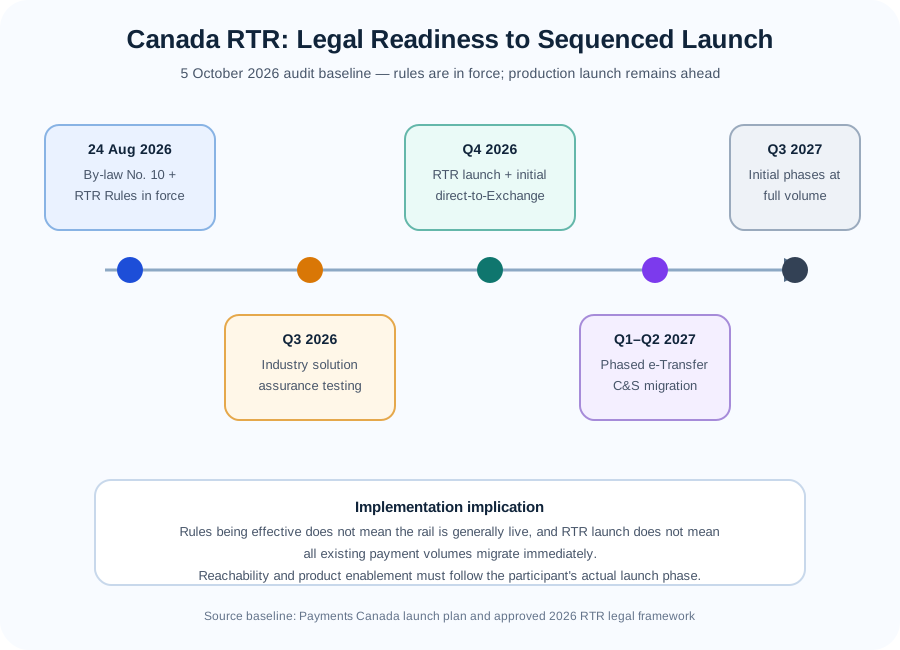
The most important starting point on the 5 October 2026 audit baseline is status. The legal framework is in force: Canadian Payments Association By-law No. 10 and the RTR Rules were implemented on 24 August 2026. Payments Canada’s current system and testing pages still describe production launch as targeted for Q4 2026, conditional on robust and successful testing; they do not establish that a general customer service is live on this audit date. The published launch plan is deliberately sequenced: initial direct-to-Exchange participants are targeted for Q4 2026; initial Interac e-Transfer clearing-and-settlement migration participants for Q1 2027; additional e-Transfer migration participants for Q2 2027; and participants in the initial launch phases are targeted to reach full transaction volumes in Q3 2027. A rule can therefore be legally effective before a payment rail is generally available to customers.
The RTR is designed for an always-on operating model. Payments Canada describes it as supporting instant, data-rich payments 24 hours a day, 7 days a week, 365 days a year. The current RTR Rules set an RTR Exchange Value Limit of CAD 100,000 per RTR Payment Message, while allowing a sending participant to impose a lower customer or product limit. The payment item exchanged through the RTR Exchange is an ISO 20022 pacs.008 FIToFICustomerCreditTransfer. The receiving participant responds with a pacs.002 acceptance or rejection status. Once settlement occurs, the RTR Exchange sends a Settlement Outcome Message, also a pacs.002, to both participants. Subject to the exceptions in Rule 7, the receiving participant must make the settled amount available to the payee promptly and no later than 60 seconds after receiving the settlement outcome.
Settlement is not performed in an account "at Payments Canada." A direct settlement participant's RTR Settlement Account is an account on the books of the Bank of Canada. Payments Canada operates the RTR system and makes the rule-governed entries that transfer an RTR payment obligation between settlement accounts. An indirect settlement participant uses a settlement agent's account. Direct settlement participants fund their RTR settlement accounts by sending funds to the Bank of Canada through Lynx, and defunding moves value back through Lynx under the Bank's settlement-account procedures. That relationship between RTR and Lynx is important: Lynx can be used to fund the RTR liquidity position, but a customer RTR payment is not a Lynx payment.
This chapter builds a current, practical operating model for the RTR. It separates confirmed rules from future product possibilities, distinguishes Exchange processing from settlement and customer posting, and shows how a bank must connect channels, authentication, fraud, ISO 20022, routing, settlement liquidity, accounting, reconciliation, customer communication and 24/7 operations.
What you should be able to do after this chapter
After working through this chapter, you should be able to:
- describe the RTR as a Payments Canada real-time exchange, clearing and settlement system rather than a customer app or overlay brand;
- explain the 5 October 2026 status: rules in force, testing still described as ongoing, and production launch targeted for Q4 2026;
- describe the sequenced launch and why Interac e-Transfer migration should not be treated as completed at RTR launch;
- distinguish the RTR Exchange from RTR Clearing and Settlement;
- explain the roles of a sending participant, receiving participant, direct settlement participant, indirect settlement participant and settlement agent;
- explain why direct RTR settlement accounts are on the Bank of Canada's books;
- describe how Lynx supports funding and defunding of RTR settlement accounts without becoming the RTR payment route;
- explain the CAD 100,000 RTR Exchange and clearing-and-settlement value limit and the possibility of lower participant limits;
- identify pacs.008 as the payment item exchanged through the RTR Exchange;
- explain the role of pacs.002 in acceptance/rejection and settlement-outcome communication;
- describe how UETR supports duplicate control and end-to-end transaction identity;
- explain the relationship between participant fraud controls and the mandatory Central Fraud Services;
- describe confirmation of payee, central fraud analytics and the Central Risk List at a functional level;
- trace a payment from customer authorization through Exchange validation, receiver decision, reservation, settlement, payee funds availability and reporting;
- explain why "submitted", "accepted", "settled" and "credited to payee" are different states;
- compare RTR with Lynx, ACSS/AFT and Interac e-Transfer without blending their operating models;
- identify 24/7 operational, liquidity, reconciliation and incident-management implications;
- design realistic implementation and test scenarios for launch readiness.
For a focused core session, spend about 10 minutes on Sections 1–2, 15 minutes on Sections 3–5 with the operating-model and lifecycle diagrams, 10 minutes on Sections 6–7, 10 minutes on Sections 8–9, 10 minutes on the implementation examples and 5 minutes on the practitioner rules and sources.
Chapter navigator
- Why Canada is introducing the RTR
- Current status, legal framework and launch sequence
- System boundaries and operating model
- Participants, access and settlement roles
- End-to-end RTR payment lifecycle
- ISO 20022, identifiers and data
- Settlement, liquidity, finality and funds availability
- Fraud, compliance and customer protection
- Exceptions, returns, investigations and reconciliation
- Bank architecture, operations and readiness
- Practical RTR scenarios
- Key takeaways and authoritative references
1. Why Canada is introducing the RTR
A payment system should be understood through the problems it solves. Traditional Canadian payment methods are strong in their own domains, but they were designed for different operating models.
ACSS and AFT are efficient for high-volume retail batch processing. Payroll, supplier files, direct deposits and pre-authorized debits can be handled at scale, but they depend on file and clearing cycles rather than a single always-on payment conversation. Lynx provides real-time settlement for high-value Canadian-dollar payments between participating financial institutions, but it is a high-value system with a different participant, product and operational model. Interac e-Transfer provides a widely used customer-facing near-real-time transfer experience, but it is a service with its own architecture and rules; Payments Canada's launch plan specifically describes future migration of its clearing and settlement to the RTR.
The RTR addresses a different requirement: real-time, data-rich, account-to-account Canadian-dollar payments using a national Payments Canada exchange and settlement infrastructure that can operate continuously.
That creates opportunities for use cases such as:
- person-to-person account transfers;
- merchant and bill payments;
- supplier payments;
- insurance or emergency disbursements;
- payroll corrections and on-demand wages;
- marketplace and gig-economy payouts;
- treasury movements within product limits;
- government disbursements and collections;
- request-to-pay or other competitive services built around the core rail;
- future domestic legs of international electronic funds transfers only under Rule 6’s timing and data conditions: before 30 September 2027 the domestic leg may not use the RTR Exchange; from that date the required
INTL indicator applies.
The infrastructure does not dictate the customer proposition. A bank can expose RTR through mobile banking, corporate APIs, online banking, ERP channels or embedded-finance services. The customer may never see the term "RTR." The bank still has to determine whether the requested product is eligible, the amount is within its limits, the receiving participant is reachable, fraud controls are satisfied and sufficient settlement capacity exists.
What "real time" changes inside a bank
Real-time payments change more than processing speed.
In a batch model, an operations team may have time to review files before a clearing window. In an RTR model, the control chain must execute while the customer is waiting. Authentication, confirmation of payee, fraud analytics, account validation, sanctions controls where applicable, transaction limits, routing, message construction, settlement capacity and response handling need to work as an orchestrated low-latency service.
An always-on rail also removes the comfort of the traditional banking day. Saturday night is not a maintenance window if customer payments are expected to continue. Banks need:
- active-active or highly resilient service design;
- 24/7 operational ownership;
- automated liquidity monitoring;
- real-time reconciliation and alerting;
- incident procedures that work outside office hours;
- controlled deployment and maintenance patterns;
- reliable downstream core-account availability;
- customer support for uncertain outcomes at any hour.
The bank must assign ownership for these controls across technology, treasury, fraud, finance and operations.
The RTR is infrastructure, not an overlay product
A common design mistake is to make the RTR screen the product. The rail should instead be a capability behind products.
A product request contains customer intent:
- who pays;
- who receives;
- amount;
- purpose;
- requested timing;
- remittance;
- customer channel;
- product terms.
The bank's routing layer then decides whether RTR is an eligible execution path. It may select another rail because of amount, recipient reachability, product agreement, risk controls or operational status.
This separation lets a bank evolve customer products without hard-coding the rail into every channel.
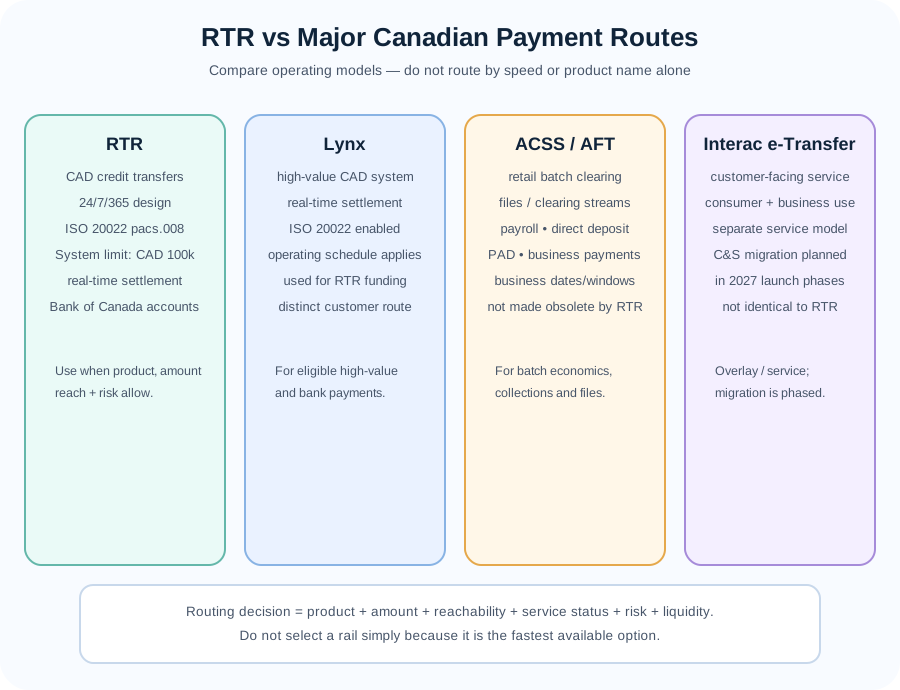
2. Current status, legal framework and launch sequence
The audit baseline for this chapter is 5 October 2026. Payments Canada’s current RTR system and testing pages still state that launch is targeted for Q4 2026, following robust and successful testing. This chapter therefore describes the approved legal/rule capability and planned production operating model; it does not assert that a particular bank, participant, customer product, API, reachability route or customer SLA is live. Implementation documentation must carry the source date and the participant’s actual onboarding status.
Evidence labels used below. By-law/Rule means a binding RTR legal or scheme requirement. Payments Canada/Bank of Canada/Interac means published system or scheme material. Bank implementation means a recommended architecture or control, not a universal Canadian rule. Example means a fictional implementation scenario, not evidence that a named participant or product is live.
Legal framework
The RTR legal framework contains several layers:
Canadian Payments Association Act and related legislative framework
establishes the wider Payments Canada mandate and membership environment.
Canadian Payments Association By-law No. 10 — Real-Time Rail
sets the core by-law framework for the system.
RTR Rules
define participant obligations for access, Exchange processing, settlement, funds availability, incidents, fraud, remittance and related operations.
ISO 20022 message specifications, API specifications, service-level descriptions, manuals and procedures
provide implementation detail.
By-law No. 10 and the RTR Rules came into force on 24 August 2026. A development team should therefore use the approved 2026 rule set, not draft consultation documents, as the legal baseline.
The rule set as an operating map
The Rules are usefully read as one end-to-end operating model:
| Rule | Functional focus |
|---|
| Rule 1 | Interpretation and defined terms |
| Rule 2 | General participant obligations |
| Rule 3 | Points of contact |
| Rule 4 | Participant access |
| Rule 5 | Connection service providers, third-party exchanges and competitive services |
| Rule 6 | RTR Exchange |
| Rule 7 | Funds availability exceptions and returns |
| Rule 8 | Clearing, settlement, funding and defunding |
| Rule 9 | Participant and system incidents |
| Rule 10 | Remittance information |
| Rule 11 | Cross-border arrangements |
| Rule 12 | Suspension, revocation, withdrawal and reinstatement |
| Rule 13 | Fraud management |
| Rule 14 | RTR Financial Institution Number Lookup Database |
| Rule 15 | Settlement-only direct settlement participant |
A business analyst should not read Rule 6 in isolation. The payment can be valid in the Exchange but still depend on Rule 8 settlement capacity, Rule 13 fraud controls and Rule 7 exception handling.
Sequenced production launch
Payments Canada's published target sequence is:
| Target period | Published launch milestone |
|---|
| Q4 2026 | RTR launch and initial direct-to-Exchange participants |
| Q1 2027 | Initial Interac e-Transfer clearing-and-settlement migration participants |
| Q2 2027 | Additional e-Transfer clearing-and-settlement migration participants |
| Q3 2027 | Participants in initial launch phases at full transaction volumes |
This sequence has practical consequences.
A bank cannot treat "RTR launched" as meaning every member, every product and every existing e-Transfer volume moved on the same weekend. Reachability, product availability and operational readiness can vary by participant and phase.
Industry assurance and testing
Payments Canada describes a testing programme including:
- system integration testing;
- user acceptance testing;
- industry solution assurance;
- operational readiness testing;
- performance testing;
- security and resilience testing.
The current testing page says testing continues until Payments Canada, regulators, participants and delivery partners have assurance that the system is ready; it lists system integration, user acceptance, industry solution assurance, operational readiness, performance, security and resilience testing. For a bank, testing must cover business processes and operational recovery, not only successful API messages.
3. System boundaries and operating model
The RTR should be separated into several functional layers.
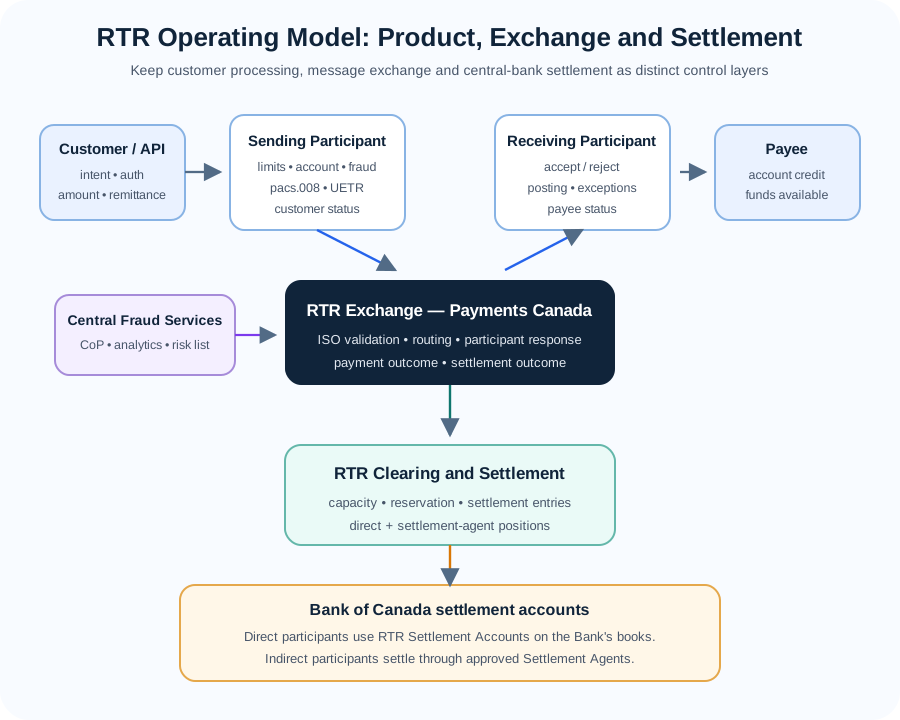
Customer and competitive-service layer
The payment begins in a customer or service context:
- mobile application;
- online banking;
- corporate portal;
- API;
- embedded PSP service;
- a competitive service that uses the RTR.
The RTR Rules recognize Competitive Services and Connection Service Providers. The core rail is therefore designed to support services above the payment infrastructure rather than define one universal front end.
Sending participant
The sending participant receives or originates the customer payment. Its responsibilities include:
- authenticating the payor;
- applying product and transaction limits;
- performing participant fraud controls;
- using Central Fraud Services as required;
- obtaining and acting on confirmation-of-payee information;
- checking account status and available funds;
- determining recipient routing;
- constructing the pacs.008;
- ensuring required identifiers and data are present;
- handling customer status.
Submission to the RTR Exchange is a significant boundary. Rule 6 states that once an RTR Payment Message has been submitted to the RTR Exchange, the sending participant cannot cancel, revoke or amend it. A user-interface "cancel" button therefore cannot remain active as though the instruction were still internal.
RTR Exchange
The RTR Exchange receives the pacs.008 and validates the message against the rule and technical requirements. It coordinates the receiving-participant response and the movement from accepted payment to settlement instruction.
Rule 6 distinguishes several events:
- pacs.008 enters the Exchange;
- receiving participant sends pacs.002 acceptance or rejection;
- funds are reserved under Rule 8;
- Exchange sends a positive Payment Outcome Report when the acceptance and reservation conditions are satisfied;
- Exchange directs RTR Clearing and Settlement to implement settlement;
- after settlement confirmation, Exchange sends Settlement Outcome Message to both participants.
This is more precise than a single "payment accepted" status.
RTR Clearing and Settlement
RTR Clearing and Settlement handles the payment obligation created by the payment message. It manages settlement instructions, payment capacity, reservations, settlement-agent positions and account entries.
The Bank of Canada does not run the customer message Exchange. The Bank provides the central-bank settlement-account foundation for direct settlement participants.
Receiving participant
The receiving participant is not a passive endpoint. It must decide whether to accept or reject the payment message within the service-level requirements and using the allowed reasons.
On settlement, it must make funds available to the payee promptly and no later than 60 seconds after receiving the settlement outcome, unless a Rule 7 exception applies.
This means "beneficiary bank accepted the message" and "beneficiary can use the funds" are not the same event.
Bank of Canada
The Bank of Canada maintains RTR settlement accounts for eligible direct settlement participants under its settlement-account access policy. The RTR Rules define a Settlement Account as an account on the books of the Bank.
The practical chain is:
customer obligation → participant payment message → RTR Exchange → settlement instructions → RTR Clearing and Settlement → entries to Bank of Canada settlement accounts → settlement outcome → customer posting/funds availability.
4. Participants, access and settlement roles
The RTR participant model is broader than "banks connect directly."
Payments Canada member and RTR participant
An organization first needs the relevant Payments Canada membership and must meet the RTR participation conditions. Legislative changes have opened membership pathways to eligible payment service providers that are supervised under the Retail Payment Activities Act framework.
Membership alone does not automatically make an organization production-ready on RTR. It still has to meet RTR access, technical, fraud, testing, settlement and operational conditions.
Direct Settlement Participant
A Direct Settlement Participant clears and settles RTR payment obligations through its own RTR settlement account.
Its responsibilities include maintaining sufficient payment capacity for:
- its own obligations;
- obligations of any Member Non-Participant for which it provides RTR Exchange payment services;
- obligations of indirect settlement participants for which it acts as settlement agent.
The Bank of Canada's current policy recognizes unrestricted and restricted RTR settlement-account access models. Product and treasury teams should use the current policy and participant agreements when determining what services a specific direct participant may provide.
Indirect Settlement Participant
An Indirect Settlement Participant exchanges RTR messages as a participant but uses an approved Settlement Agent for settlement.
This is not the same as "not participating." The indirect participant can own the customer relationship and Exchange processing while the financial settlement entry occurs through its agent's settlement account.
The settlement agent can set a Net Debit Cap for an indirect settlement participant. Rule 8 prevents settlement from causing that participant's ISP Net Position to fall below the cap.
Member Non-Participant
Rule 4 also supports arrangements where a Direct Settlement Participant provides RTR Exchange payment services on behalf of a Member Non-Participant, subject to rule requirements and agreements.
Architects should therefore model at least three separate questions:
- who owns the end-customer relationship?
- who sends/receives the RTR message?
- whose Bank of Canada settlement account bears the settlement entry?
Collapsing these into one "bank" field creates problems in routing, limits, reconciliation and investigations.
Connection Service Provider
A Connection Service Provider connects a participant to the RTR Exchange on behalf of that participant. It is a connectivity role, not a settlement agent role.
The pacs.008 includes the relevant Connection Service Provider Identifier according to the RTR specification and Rule 6.
Competitive Service
A Competitive Service can provide a product or overlay using the RTR. The payment message includes the Competitive Service Identifier.
This allows common national infrastructure to support different customer propositions while keeping core exchange and settlement governed.
5. End-to-end RTR payment lifecycle
The complete lifecycle should be modeled as a chain of durable business events.
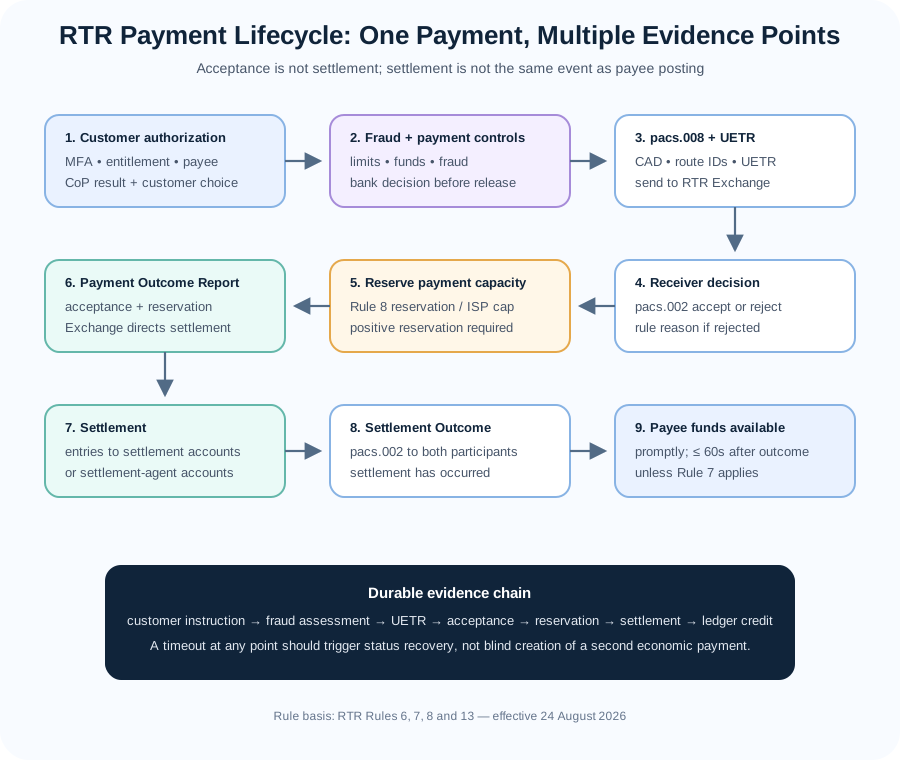
Step 1 — customer intent and authentication
The customer enters:
- payee;
- amount;
- account;
- remittance/purpose where supported;
- service choice.
The sending participant authenticates the payor. Rule 13 requires capability to use industry best practices for MFA or equivalent and requires authentication before initiating an RTR Payment Message.
The customer may see a confirmation-of-payee result before authorizing. Rule 13 requires a sending participant to implement confirmation of payee using either the central service or an approved registered third-party service.
Step 2 — account, product and risk checks
Typical bank checks include:
- account open/status;
- entitlement and signing authority;
- balance/available funds;
- participant/customer send limit;
- CAD currency;
- amount not above applicable RTR limit;
- beneficiary/reachability data;
- duplicate intent;
- sanctions/AML controls where applicable;
- transaction fraud controls;
- Central Fraud Analytics assessment.
The RTR system maximum does not replace the bank's own product limits. A bank can set lower limits by customer segment or risk profile.
Step 3 — pacs.008 creation
The sending participant creates the ISO 20022 pacs.008.
Rule 6 requires relevant fields including:
- RTR payment obligation amount;
- payee account number;
- sending-participant institution number;
- receiving-participant institution number;
- UETR;
- sending Connection Service Provider Identifier;
- Competitive Service Identifier.
The UETR is particularly important. Rule 6 rejects a message as a duplicate if its UETR was assigned to another RTR Payment Message sent to the Exchange within the previous 90 calendar days.
Step 4 — Exchange validation and routing
The RTR Exchange validates the message against the ISO 20022 specification, API requirements and related rules. Invalid messages are rejected rather than forwarded as successful business payments.
Technical validation should be logged separately from customer-account and fraud decisions.
Step 5 — receiving participant decision
The receiving participant sends a pacs.002 Payment Acceptance Status Message accepting or rejecting.
Rule 6 defines allowed rejection contexts such as:
- duplicate;
- value limit exceeded;
- invalid account number/status;
- wrong currency;
- incorrect format;
- malicious or harmful content;
- other permitted narrative reason.
A participant should map these rule outcomes to clear internal reason codes and customer wording.
Step 6 — reservation and payment outcome
For the normal RTR Exchange flow, settlement capacity is reserved under Rule 8. The Exchange sends a positive Payment Outcome Report only when the receiving participant has accepted and the required reservation notice is positive.
This is an important control point: receiving-bank acceptance by itself is not settlement.
Step 7 — settlement
RTR Clearing and Settlement transfers the RTR Payment Obligation by making entries to the relevant settlement accounts. If either participant is indirect, the entries are made to its Settlement Agent's account with the corresponding indirect-participant position treatment.
Step 8 — settlement outcome
After settlement, RTR Clearing and Settlement notifies the Exchange. The Exchange sends the Settlement Outcome Message, a pacs.002, to sending and receiving participants indicating settlement has occurred.
Step 9 — payee funds availability
Subject to Rule 7 exceptions, the receiving participant must make the amount available promptly and no later than 60 seconds from receipt of the settlement outcome.
The beneficiary customer experience should therefore be tied to the receiving bank's posting event, not merely to the sending bank's message submission.
Step 10 — reporting and reconciliation
Both banks need durable evidence for:
- customer instruction;
- authentication;
- confirmation-of-payee response and customer choice;
- fraud assessment;
- pacs.008;
- acceptance/rejection pacs.002;
- settlement/outcome evidence;
- customer ledger entries;
- fees if applicable;
- statements/notifications;
- reconciliation result.
6. ISO 20022, identifiers and data
The RTR uses ISO 20022 as the payment-data foundation.
Payments Canada's RTR ISO page currently publishes message specifications for:
- head.001 Business Application Header;
- pacs.008 FI-to-FI customer credit transfer;
- pacs.002 FI-to-FI payment status report;
- pacs.028 FI-to-FI payment status request;
- admi.002 message reject;
- admi.004 system event notification;
- admi.011 system event acknowledgement.
The most important implementation rule is not to import message semantics from another scheme. A pacs.004 is a return message in many ISO 20022 ecosystems, but the approved RTR material should determine what the RTR actually exchanges and how returns are executed. The published RTR message list does not make pacs.004 the settlement-confirmation message: the RTR settlement outcome is a pacs.002. The ISO page identifies its latest posted specification version as 30 May 2025, so a participant must use its controlled implementation package and confirm any later release before build or certification.
UETR as business identity
The UETR should be stored and indexed across:
- payment hub;
- fraud system;
- RTR gateway;
- operations console;
- customer service;
- reconciliation;
- investigations;
- audit.
It is both an ISO identifier and a rule-enforced duplicate-control key.
A retry after a timeout should never create a new economic payment without first determining the state of the original. The bank should query status using the supported process rather than interpreting "no response yet" as "not sent."
Remittance information
Rule 10 governs RTR remittance information. Each participant must receive Extended Remittance Information; a sender’s structured remittance component must not exceed 9,000 characters excluding tags. The receiving participant must provide or make the information available to the payee as soon as possible and no later than 60 seconds after making the payment available, subject to the rule’s terms. The system’s international-EFT treatment is separate: Rule 6 bars the domestic leg of an international EFT from the RTR Exchange before 30 September 2027 and requires the INTL code from that date under the specified conditions.
For corporate use cases, remittance can improve:
- invoice matching;
- accounts-receivable automation;
- cash application;
- reconciliation;
- dispute handling.
The value of ISO 20022 is lost if a bank receives structured data and flattens it into an internal 35-character field.
Directory and routing data
Rule 14 establishes the RTR Financial Institution Number Lookup Database. Participants provide the routing information needed for RTR processing and are responsible for its accuracy. The RTR Exchange does not replace the bank's own reachability and account validation.
A bank should version and audit the Database version and:
- institution number;
- reachability status;
- participant route;
- account-number format;
- effective date;
- direct/indirect settlement relationship where operationally relevant.
Rule 14 makes the participant responsible for the accuracy of submitted routing information. It also defines a weekly change process: updates are due before 12:00 ET Thursday, the report is distributed by 16:00 ET Friday, and the new database becomes effective Monday at 00:00 ET. Do not treat this scheme directory as a substitute for the bank’s account validation or entitlement checks.
7. Settlement, liquidity, finality and funds availability
Settlement is where a real-time payment becomes a treasury problem.
CAD-only settlement
Rule 6 requires the RTR Payment Obligation to be in Canadian dollars.
If the customer's source account is USD and the product offers a CAD RTR payment, the bank would need an FX/product process before creating the CAD payment. The RTR itself is not a multi-currency settlement rail.
Value limit
The current RTR Exchange Value Limit is CAD 100,000, and Rule 8 uses the same CAD 100,000 clearing-and-settlement limit for normal RTR payment obligations.
This does not mean every customer can send CAD 100,000. Participant limits can be lower.
A bank should distinguish:
- system limit;
- competitive-service limit;
- participant/product limit;
- customer limit;
- risk-adjusted transaction limit.
Settlement account
The direct participant's settlement account is on the Bank of Canada's books.
Rule 8 requires the direct participant to maintain sufficient payment capacity for its obligations and sponsored relationships. Treasury needs continuous visibility into:
- available payment capacity;
- reserved balance;
- forecast outgoing volume;
- incoming settlement;
- indirect-participant exposure;
- net debit caps;
- operational funding windows.
Funding and defunding through Lynx
Rule 8 states that a direct settlement participant funds its settlement account by sending a payment to the Bank through Lynx under its agreement with the Bank. Defunding results in the Bank sending value back through Lynx.
That creates an operational bridge between a 24/7 rail and a high-value funding mechanism with its own operating schedule and procedures. Treasury cannot assume it can always repair a liquidity shortage instantly by waiting until after capacity is exhausted.
Liquidity planning should therefore include:
- pre-funding strategy;
- intraday and overnight thresholds;
- weekend/holiday forecasts;
- contingency buffers;
- sponsor exposure;
- escalation before capacity becomes critical.
Finality and customer funds availability
The RTR framework separates:
system settlement
the payment obligation is settled through account entries.
settlement outcome notification
participants receive confirmation of settlement.
funds availability
receiving participant makes the amount available to the payee.
Rule 7 creates specific exceptions to immediate payee credit, including certain errors, account restrictions, law/court-order restrictions and events beyond control. Therefore the customer status model should not reduce all three to one Boolean "complete."
8. Fraud, compliance and customer protection
Instant settlement changes the economics of fraud because there is less time to stop a bad payment after release.
Participant fraud controls
Rule 13 requires participants to maintain Fraud Control Standards. Sending participants must support MFA or equivalent authentication and continuous transaction monitoring before introducing fraudulent messages into the Exchange.
A practical sending-bank flow is:
- authenticate customer;
- determine payee and account context;
- run confirmation of payee;
- obtain Central Fraud Analytics assessment;
- combine central result with bank/customer/device behaviour;
- approve, challenge or decline according to policy;
- create/send pacs.008 only after the decision.
Central Fraud Services
Payments Canada states that centralized fraud services will operate from day one and complement, rather than replace, participant controls.
The published service set includes:
- confirmation of payee;
- transaction risk assessment/analytics;
- central risk information;
- fraud reporting/intelligence capabilities.
Rule 13 makes use of Central Fraud Services mandatory for participants and requires Central Fraud Analytics for each RTR Payment Message.
Confirmation of payee is not an automatic payment decision
Rule 13 requires the sending participant to provide the payor a choice to proceed regardless of the confirmation-of-payee result, while ensuring the risks are outlined.
That means the bank must distinguish:
- name/account match result;
- customer warning;
- customer decision;
- bank fraud/risk decision.
A customer's choice to proceed does not remove the bank's own fraud, sanctions or legal controls. Regulatory/customer-protection distinction: FCAC says federally regulated financial institutions must investigate reported unauthorized transactions, while account agreements and the customer’s conduct affect liability. That investigation/consumer-protection process is not the same as an RTR Rule 7 return or a guarantee that a settled payment can be recovered.
AML and sanctions
RTR fraud services do not replace AML or sanctions obligations.
Real-time architecture should allow:
- customer due diligence to be maintained outside the transaction critical path;
- high-quality party data to be available to transaction monitoring;
- sanctions screening and legal holds to be applied where required;
- post-event AML monitoring and reporting;
- escalation to investigations without losing UETR and settlement evidence.
Rule 7 explicitly recognizes that a receiving participant may need to treat funds in accordance with AML, anti-terrorist financing, sanctions or other law.
9. Exceptions, returns, investigations and reconciliation
"Instant" does not mean "no exceptions."
Before payee credit
Rule 7 permits defined exceptions where the receiving participant may not make the amount immediately available to the payee. Examples include:
- duplicate detected by the receiving participant;
- error or omission preventing credit;
- foreign-currency account where the participant chooses not to convert;
- malicious/harmful content handling;
- event beyond control;
- participant-imposed account restriction;
- law or court-order restriction;
- payee-requested restriction.
Many of these cases require a return as soon as possible and, for specified scenarios, no later than the next participant business day after receipt of the settlement outcome.
After payee credit
Rule 7 also recognizes circumstances in which an amount already made available may be returned, including processing error, end-user error, unauthorized RTR payment and authorized RTR payment fraud, subject to the rule process.
A return is not the same as reversing settlement in place. Operations should preserve the original settled payment and create the return/recovery event with linkage to the original UETR and evidence.
Payment Return Request
A sending participant can initiate a Payment Return Request within 60 calendar days from the date the RTR Payment Message was exchanged and may not submit more than one request for the same original message.
The receiving participant must respond within 10 calendar days by accepting, rejecting or requesting an extension. The sending participant may grant an extension of no more than 30 calendar days from receipt; if no acceptance or rejection is provided within those 30 days, the request is deemed rejected.
These are operational case-management requirements, not just message fields.
Uncertain outcome
If a participant does not receive the expected Payment Outcome Report or Settlement Outcome Message within the service-level timing, Rule 6 requires the receiving participant to send a Payment Status Request Message under the defined procedure.
The safe principle is:
query before retry.
A timeout is an information problem, not proof that no settlement occurred.
Reconciliation
A strong RTR reconciliation model matches at least:
- customer instruction;
- payment-hub record;
- pacs.008/UETR;
- acceptance/rejection status;
- settlement outcome;
- settlement-account evidence/participant position;
- customer debit;
- customer credit or Rule 7 exception;
- any return/return-request case.
A payment can be technically successful but operationally broken if the customer ledger does not match the settled obligation.
10. Bank architecture, operations and readiness
RTR readiness is an enterprise change.
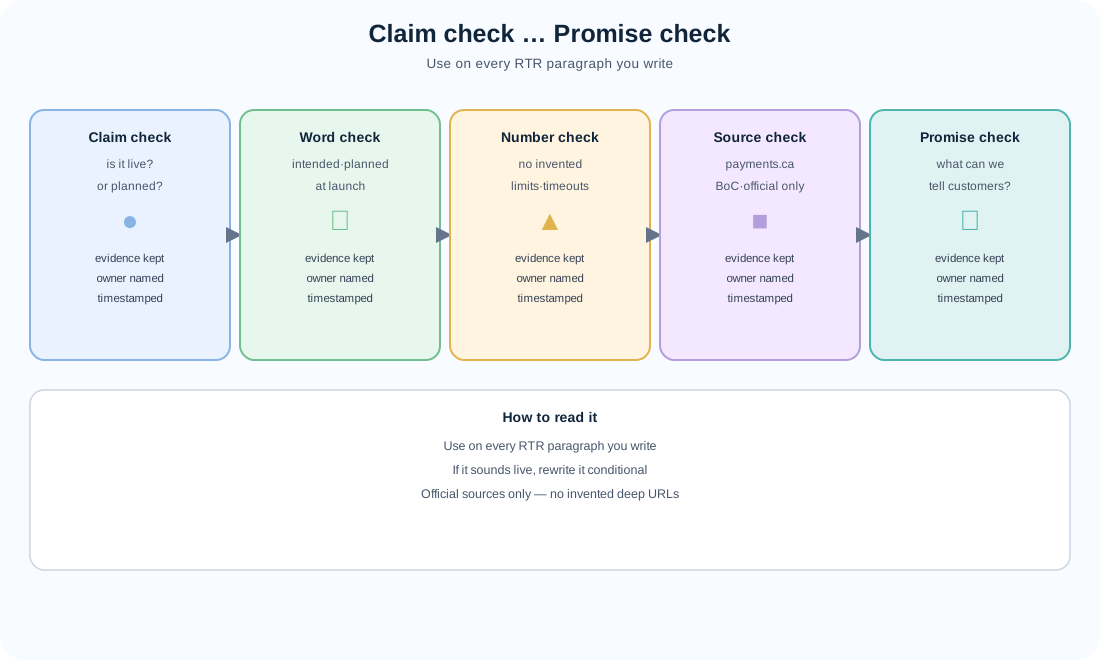
The claim-check diagram above is the discipline to apply before any RTR customer promise: every statement about what is live, planned or phased must name its evidence, owner and timestamp.
Reference architecture
A bank typically needs:
Channel and API layer
captures intent and presents status.
Identity and entitlement
authenticates payor and validates authority.
Confirmation-of-payee integration
retrieves and presents payee result.
Fraud orchestration
combines participant controls and Central Fraud Services.
Payment hub
normalizes, validates, controls, creates payment identity and chooses RTR route.
RTR adapter/gateway
creates/validates ISO 20022 and exchanges messages/APIs.
Account/core ledger
reserves or debits customer value according to product design and posts incoming credit.
Settlement/liquidity service
tracks payment capacity, reservations, settlement-agent positions and funding.
Operations and investigations
manages statuses, incidents, Rule 7 cases and customer inquiries.
Reconciliation and reporting
matches payment, settlement and ledger evidence.
State model
Recommended internal states should be explicit. For example:
- received from customer;
- authenticated;
- fraud cleared;
- ready to send;
- submitted to Exchange;
- Exchange accepted for processing;
- receiving participant accepted;
- funds reserved;
- payment outcome positive;
- settled;
- beneficiary posting pending;
- credited to payee;
- rejected;
- exception after settlement;
- return initiated;
- returned/recovered;
- investigation required.
Not every state needs to be customer-facing, but operations need the distinction.
24/7 operating model
A real-time rail requires defined ownership for:
- participant connection health;
- fraud services;
- account and ledger dependencies;
- liquidity;
- message queues;
- reconciliation breaks;
- service-level breaches;
- cyber/security incidents;
- customer support;
- Payments Canada contacts.
Support cannot wait for Monday if the payment service operates Sunday.
Testing
A bank-grade test pack should include:
happy path
- direct-to-direct participant;
- indirect participant;
- different competitive services;
- rich remittance.
limits
- amount below, equal to and above participant/system threshold;
- customer lower limit.
fraud
- confirmation-of-payee match/mismatch;
- customer proceeds after warning;
- central risk/analytics adverse result;
- participant fraud decline.
data
- malformed ISO message;
- wrong currency;
- invalid account format;
- duplicate UETR.
settlement
- sufficient capacity;
- insufficient capacity;
- indirect net debit cap;
- funding/defunding operational case.
exceptions
- receiving participant rejection;
- Rule 7 legal hold;
- customer-credit delay caused by event beyond control;
- return after credit;
- Payment Return Request.
uncertainty
- missing response;
- duplicate customer click;
- gateway reconnect;
- replay after timeout.
resilience
- regional outage;
- fraud-service dependency failure;
- account-core degradation;
- settlement/liquidity monitoring failure;
- failover with no duplicate payment.
Deep implementation considerations for the RTR operating model
The previous sections describe the core rule-driven lifecycle. A production bank still needs to turn that lifecycle into a service that remains understandable when volumes rise, dependencies fail or a customer asks a difficult question outside normal business hours.
Service-level architecture
The real-time promise should be decomposed into measurable internal service levels rather than one end-to-end target owned by nobody.
A useful decomposition is:
| Layer | Example internal measure |
|---|
| Channel | time to validate request and hand off |
| Authentication | time to complete step-up/MFA where required |
| Confirmation of payee | service response and customer-decision time |
| Fraud | time to obtain central assessment and internal decision |
| Payment hub | validation, idempotency and route-selection latency |
| RTR gateway | ISO construction, validation and submission time |
| RTR external | outcome and settlement timing under scheme service levels |
| Core ledger | debit/credit posting latency |
| Reconciliation | time from settlement outcome to matched financial evidence |
The purpose of these metrics is not to promise that every layer must always finish in a fixed number of milliseconds. It is to make degradation visible. If a customer payment takes 18 seconds and 15 seconds were spent waiting for an internal fraud service, the bank should know that immediately rather than blaming "the rail."
Each service should publish at least:
- success rate;
- latency distribution rather than only average;
- timeout count;
- retry/status-query count;
- dependency errors;
- current availability;
- queue depth where relevant;
- oldest unprocessed event.
For a 24/7 service, these metrics need thresholds for evenings, weekends and holidays as well as weekday peaks.
Availability is an end-to-end property
A bank can have a healthy RTR gateway and still be unable to deliver an RTR product.
Dependencies can include:
- customer identity service;
- account balance service;
- confirmation-of-payee service;
- participant fraud engine;
- Central Fraud Services;
- participant/routing reference data;
- core ledger;
- settlement-capacity service;
- Connection Service Provider;
- reconciliation platform.
The product-availability decision should therefore combine critical dependency health.
For example, if customer channels and the gateway are available but the bank cannot obtain an authoritative customer balance, allowing a payment to continue may create overdraft or loss risk. The bank may need to make the product temporarily unavailable rather than send with incomplete controls.
A different dependency may permit degraded operation. If a non-critical reporting warehouse is unavailable, the payment path can continue while events are durably queued for later reporting.
The architecture should classify dependencies as:
hard-stop critical
payment cannot safely continue without the service.
degrade-with-control
payment can continue under approved fallback limits or rules.
post-processing
failure does not stop payment but creates an operational backlog.
This classification should be agreed by business, risk, technology and operations before launch.
Maintenance in an always-on rail
Traditional overnight maintenance is incompatible with an always-on product unless the bank has another active processing path.
Release design should support patterns such as:
- rolling deployment;
- blue/green deployment;
- active-active regions;
- backward-compatible message changes;
- database migration that does not block payment processing;
- controlled drain of in-flight transactions before component restart.
A change should not be judged safe only because automated unit tests passed.
RTR production-change assessment should also ask:
- What happens to an in-flight pacs.008?
- Is UETR state durable across restart?
- Can a status response arrive while the old instance is shutting down?
- Can the new version read events written by the old version?
- Will settlement outcome still correlate to the original payment?
- Can reconciliation replay events without creating postings?
A payment platform that loses business state during a zero-downtime deployment is not truly highly available.
Business-date design
A 24/7 rail does not remove the need for business dates. It changes how they must be modeled.
A bank may have:
- RTR calendar date;
- customer statement date;
- accounting business date;
- treasury reporting date;
- fraud-reporting period;
- reconciliation cycle.
At 00:00 local time, customer channels can continue accepting payments. Internal systems cannot assume that changing accounting date means pausing the rail.
A practical design stores:
- event timestamp with timezone;
- scheme/system operating date where supplied;
- customer posting date;
- accounting business date;
- settlement date;
- reporting period.
This prevents reconciliation errors around midnight and daylight-saving changes.
Time synchronization
Accurate clocks are operationally important.
If the sending gateway clock, core ledger and fraud platform disagree by 30 seconds, operations may incorrectly sequence:
- authorization;
- fraud decision;
- network submission;
- settlement;
- customer debit.
Use synchronized infrastructure clocks and retain source timestamps from external messages. Do not overwrite an external event time with the time at which a downstream warehouse happened to ingest it.
Customer limits and scheme limits
The CAD 100,000 RTR limit is a system control, not a recommended universal customer limit.
A participant can set lower limits based on:
- retail vs business customer;
- channel;
- account type;
- new vs known beneficiary;
- transaction history;
- fraud risk;
- daily aggregate exposure;
- competitive-service terms.
A useful limit hierarchy is:
- scheme maximum;
- competitive-service maximum;
- bank product maximum;
- customer agreement maximum;
- user/entitlement maximum;
- risk-adjusted transaction limit.
The effective send limit is the lowest applicable limit.
Limit errors should tell the customer what can be acted upon without disclosing sensitive fraud logic. For example, "This amount is above your instant-payment limit" is better than exposing internal fraud thresholds.
Incoming-payment limits are different
A sending limit does not automatically imply the same receiving behavior.
The receiving bank needs policy for:
- account eligibility;
- legal restrictions;
- suspected fraud;
- closed or blocked accounts;
- non-CAD account handling under the Rules;
- internal posting capacity.
A product requirement that says "RTR limit = 100,000" without distinguishing send, receive and system rules is incomplete.
Settlement capacity as a product dependency
Customer deposit balance and RTR settlement capacity are not the same money.
A customer can have CAD 500,000 available while the bank's RTR Settlement Account has insufficient Payment Capacity for a CAD 40,000 outgoing transaction.
The payment architecture should therefore expose settlement-capacity state to the release decision.
For direct participants this can include:
- free payment capacity;
- reserved balance;
- minimum internal buffer;
- pending outgoing reservations;
- incoming expected settlement;
- current funding ability.
For a Settlement Agent it can additionally include:
- aggregate indirect exposure;
- each indirect participant's ISP Net Position;
- each indirect participant's Net Debit Cap;
- concentration thresholds.
Treasury should set operational thresholds above zero. Waiting until payment capacity reaches zero is too late.
A three-level model could be:
green
normal release.
amber
higher-frequency monitoring, restrict selected high-value/product traffic or prepare funding.
red
controlled product restriction and incident escalation.
The exact thresholds are a bank decision, not an RTR rule.
Liquidity forecasting for nights and weekends
Continuous payments create a forecasting problem that differs from a business-day wire system.
Inputs can include:
- historical hour-of-week patterns;
- payroll dates;
- government-payment dates;
- retail weekends;
- merchant campaigns;
- corporate file/API schedules;
- expected incoming flows;
- settlement-agent sponsored volumes;
- public holidays;
- exceptional events.
The forecast should not assume outgoing and incoming flows will offset perfectly. Fraud or incident controls may cause asymmetry, and one large corporate customer can change the profile quickly.
Scenario testing should include:
- long weekend;
- month-end;
- tax/payment deadline;
- major retailer event;
- one large indirect participant unexpectedly increasing volume;
- delayed incoming traffic;
- inability to add funding when expected.
Customer pricing and transparency
The RTR Rules define the infrastructure; a bank still defines customer pricing subject to applicable law and product terms.
Product design should make clear:
- transaction fee, if any;
- customer limit;
- whether the recipient must already be reachable;
- whether a confirmation-of-payee mismatch can be overridden;
- what "instant" means;
- what happens if the payment is rejected;
- what help is available after a scam or error;
- what remittance information the recipient receives.
Do not market "irrevocable" as "nothing can ever be done." That would ignore Rule 7 return processes and bank fraud/recovery procedures. A better explanation is that the sender cannot simply cancel a submitted instant payment and recovery is not guaranteed.
Customer-support timeline
Customer support should see a plain-language event timeline generated from scheme states.
For example:
10:15:02 — Customer authorized CAD 1,250 to Supplier A
10:15:03 — Bank risk controls passed
10:15:04 — Payment submitted to RTR
10:15:05 — Recipient institution accepted
10:15:05 — Settlement capacity reserved
10:15:06 — Payment settled
10:15:08 — Recipient account credited
If the payment is uncertain:
10:15:04 — Submitted
10:15:07 — Final outcome not yet received
10:15:08 — Status inquiry initiated
10:15:10 — Settlement confirmed
This is far more useful than exposing XML names or one generic "pending" status.
Scheme state versus customer wording
Maintain two layers.
Scheme/operations state should be precise:
- receiver accepted;
- reservation positive;
- payment outcome positive;
- settled;
- payee posting exception.
Customer wording should be understandable:
- Processing;
- Sent;
- Completed;
- Could not be sent;
- Under review;
- Return requested;
- Returned.
The mapping should be version-controlled and tested. Customer wording must never imply settlement before the bank has settlement evidence.
Incident management
An RTR incident should be classified by business effect.
Examples:
Channel incident
customers cannot initiate but in-flight external payments continue.
Fraud-service incident
bank cannot safely release new payments.
Exchange-connectivity incident
participant cannot exchange messages.
Settlement-capacity incident
messages may be technically healthy but outgoing settlement cannot progress normally.
Core-ledger incident
external settlement can occur while customer posting is impaired, creating a high-priority financial exception.
Reconciliation incident
payments can continue but the bank is losing financial control evidence.
Each incident type needs:
- owner;
- severity;
- decision rights;
- customer communication;
- scheme contact/escalation;
- recovery steps;
- reconciliation after recovery.
Recovery point and recovery time
Traditional disaster-recovery measures need payment-specific interpretation.
A payment platform may claim:
- RTO 30 minutes;
- RPO 5 minutes.
Losing five minutes of payment state is unacceptable if hundreds of payments can settle in that period.
Critical RTR transaction state should aim for no loss of committed business events. Replication and recovery design should prioritize:
- UETR;
- external message state;
- fraud decision;
- settlement outcome;
- posting instruction;
- idempotency key.
The bank can rebuild analytics later. It cannot safely guess whether money settled.
Cybersecurity and payment integrity
Security controls should protect:
- customer session;
- API credentials;
- certificates and keys;
- service identities;
- message integrity;
- privileged operations;
- participant reference data;
- settlement configuration.
High-risk administrative changes need strong control.
Examples:
- changing a Settlement Agent;
- changing participant routing;
- altering customer limits;
- disabling fraud checks;
- replaying a payment event;
- manually posting a customer account.
Use maker-checker, privileged access management and auditable change history.
Data retention and audit
A payment case can be investigated long after real-time processing completes.
Retain according to legal, regulatory and bank policies:
- customer authorization;
- payment instruction;
- UETR;
- CoP result;
- fraud assessment;
- internal decision;
- external messages/statuses;
- settlement evidence;
- ledger postings;
- customer notifications;
- exception/return communications;
- operator actions.
The objective is not to keep every transient log forever. It is to retain enough authoritative evidence to prove who instructed what, what the bank decided, what the RTR did and how the accounts were affected.
Production readiness checklist
Before enabling a customer cohort, validate at least:
Product
- eligibility and limits approved;
- terms/customer wording ready;
- support scripts ready.
Risk
- authentication;
- confirmation of payee;
- central fraud integration;
- participant fraud decisioning;
- AML/sanctions controls where required.
Payments
- ISO 20022 mapping;
- UETR/idempotency;
- routing;
- status handling;
- return/exception case model.
Settlement
- account/agent configured;
- capacity monitoring;
- funding procedure;
- thresholds and escalation.
Operations
- 24/7 contacts;
- runbooks;
- incident classification;
- scheme escalation.
Finance
- journals;
- reconciliation;
- break ownership;
- suspense/loss accounts.
Technology
- resilience;
- deployment strategy;
- monitoring;
- cybersecurity;
- disaster recovery.
A launch decision should require evidence across all these domains, not a single "technical connectivity passed" checkbox.
Launch governance, coexistence and production control
RTR launch is not a one-day replacement event. Payments Canada's sequenced strategy deliberately separates the Q4 2026 first direct-to-Exchange participants from the later Interac e-Transfer clearing-and-settlement migration phases. A bank therefore needs a coexistence model in which customer products, old settlement paths and new RTR paths can operate at the same time.
Product enablement must follow actual reachability
A product team should never infer that "RTR has launched" means every Canadian account can immediately receive every RTR-enabled product. Reachability must be determined from the current participant and service configuration.
A route decision should consider:
- sending product enabled for RTR;
- receiving institution currently reachable;
- competitive service supported;
- amount within scheme and participant limits;
- participant not under restriction;
- customer/account eligible;
- fraud and legal controls available;
- settlement capacity healthy.
The route engine should preserve the exact version of reference data used for the decision so operations can later explain why a payment was or was not routed through RTR.
Coexistence with Interac e-Transfer
Interac e-Transfer and RTR must not be presented as synonyms. The published launch sequence moves e-Transfer clearing and settlement onto RTR in later phases, while the customer-facing service remains an Interac proposition.
During migration, a bank can therefore have:
- existing e-Transfer customer journeys;
- new RTR-native products;
- participants on different migration phases;
- different settlement evidence behind otherwise familiar customer experiences.
Architecture should separate the overlay/service from the underlying clearing and settlement route.
Coexistence with AFT and Lynx
RTR also does not make AFT or Lynx obsolete.
AFT remains appropriate for:
- payroll;
- high-volume scheduled disbursement;
- PAD collections;
- large file-based corporate flows;
- cost-efficient batch processing.
Lynx remains appropriate for:
- high-value CAD payments;
- payments above the RTR limit;
- time-critical wholesale use cases;
- treasury and financial-institution movements.
The route decision should compare product need, amount, timing, remittance, reachability, risk, cost and finality rather than simply selecting the newest rail.
Launch controls
A prudent production rollout can use several gates:
Participant gate
Only approved and ready receiving participants are enabled.
Customer gate
Selected customer cohorts are activated first.
Amount gate
The bank can begin with lower internal limits than the scheme maximum.
Volume gate
Traffic ramps gradually while settlement, fraud and operational behavior are observed.
Use-case gate
Simple credit-transfer use cases can launch before more complex corporate or embedded propositions.
Operational gate
A new volume step proceeds only if incident, fraud, liquidity and reconciliation indicators remain within approved thresholds.
This turns launch into a controlled risk-management process rather than a marketing deadline.
Go-live command centre
Initial production should have a cross-functional command structure covering:
- payment operations;
- RTR gateway/network;
- fraud;
- customer channels;
- core ledger;
- treasury;
- reconciliation;
- customer support;
- cybersecurity;
- scheme/vendor contacts.
A shared dashboard should show:
- submitted volume;
- receiver accept/reject;
- settlement outcomes;
- settlement-to-credit latency;
- central fraud service health;
- payment capacity;
- unknown outcomes;
- pacs.028/status inquiries;
- reconciliation breaks;
- incidents.
The command centre should monitor financial correctness, not only infrastructure uptime.
Production rollback is not "reverse the payments"
A rollout may need to stop new RTR initiation. That is different from reversing completed payments.
A rollback plan should specify:
- how to disable new product routing;
- how in-flight payments continue to final outcome;
- how late settlement/status messages remain correlated;
- how alternative rails are offered for new customer instructions;
- how reconciliation stays open until every in-flight transaction closes.
Never change already-settled history to simulate a rollback.
Customer communication during launch
Customer messages should reflect actual capability.
Appropriate:
"Instant account-to-account payment is available for eligible recipients."
Risky:
"All Canadian bank payments are now instant."
The second statement overpromises both reachability and use-case scope.
Operational acceptance criteria
Before declaring an RTR product fully operational, require evidence that:
- every submitted payment has one durable UETR;
- every final state can be reconstructed after a restart;
- receiving-participant acceptance is not confused with settlement;
- settlement outcomes reconcile to settlement capacity and customer accounting;
- payee-credit timing is measurable;
- unknown outcomes are aged and queried;
- fraud controls cannot be silently bypassed during degradation;
- treasury can manage nights, weekends and holidays;
- participant/CSP incidents have tested runbooks;
- customer support can explain state in plain language.
Release management after launch
RTR will continue to evolve.
Every scheme or message change should trigger:
- impact assessment;
- message/specification comparison;
- regression testing;
- fraud/control assessment;
- operational procedure update;
- customer-impact review;
- deployment rollback plan.
A scheme or message change must not enter production without compatibility testing and an approved rollback path, because an incompatible rule can affect many payments before detection.
Value of the RTR for the bank
The business case should not be reduced to "faster payments."
Potential value includes:
- new account-to-account products;
- richer remittance;
- better cash application;
- API-driven corporate services;
- immediate payouts;
- stronger payee-verification and central fraud intelligence;
- more granular transaction-level settlement evidence.
Those benefits only materialize when the bank preserves the structured data and builds the operational model around it.
Final readiness question
Release approval should require evidence that the bank can operate, settle, support, investigate and reconcile a payment at 03:00 on a holiday while a dependency is degraded.
If the answer is yes, the bank is approaching real-time readiness.
Launch evidence pack
The final go-live decision should preserve evidence rather than rely on meeting minutes. A compact evidence pack can contain participant readiness, current RTR specification version, successful direct/indirect settlement tests, fraud-service tests, liquidity rehearsal, disaster-recovery results, customer wording approval, reconciliation evidence and named 24/7 contacts. This gives audit, operations and future release teams one controlled record of what was proven.
After go-live, the same pack should be refreshed when a material scheme release, participant-model change or settlement arrangement changes. Real-time readiness can decay when certificates expire, contacts change, volumes grow or new products are added.
Early-life support review
During the first weeks of a new RTR product, review daily:
- payment success and reject reasons;
- settlement-capacity peaks;
- payee-credit latency;
- fraud declines and false positives;
- unknown outcomes/status inquiries;
- customer contacts;
- reconciliation breaks.
A stable system is one where these measures are understood and owned, not merely low.
RTR operating metrics and product decision framework
Product, operations and treasury should use one controlled set of customer, scheme, settlement, fraud and accounting measures.
Core operating KPIs
Customer measures should cover initiation success, completion rate, customer-visible latency and support contacts. Scheme measures should cover Exchange rejects, receiver accept/reject outcomes, settlement-outcome completion and status-inquiry rates. Settlement measures should cover Payment Capacity, Reserved Balance, failed reservations and funding activity. Fraud measures should include confirmation-of-payee outcomes, Central Fraud Analytics latency, participant declines, confirmed fraud and recovery. Accounting measures should include settled-but-unposted items, settlement-to-ledger latency, unreconciled items and aged suspense.
A dashboard that shows only transaction throughput and technical uptime is insufficient for a financial rail.
Product route decision example
A corporate customer requests CAD 42,000 to a Canadian supplier.
The payment hub should ask:
- Is the product enabled for RTR?
- Is the receiving institution currently reachable?
- Is CAD 42,000 within the scheme and bank limits?
- Is the customer entitled through this channel?
- Did confirmation-of-payee and fraud controls complete?
- Is settlement capacity healthy?
- Does the customer need remittance data this product preserves?
- Is there an incident or participant restriction?
Only after those questions does "use RTR" become a controlled route decision.
If the amount were CAD 140,000, RTR would fail the current system-value test and the bank should select another eligible route rather than split one obligation merely to fit the rail.
24/7 ownership model
Define a primary on-call, backup, escalation manager, scheme contact, treasury contact, fraud contact and customer-communications owner. For each incident state who can restrict new payments, reduce internal limits, initiate liquidity action, invoke failover and communicate externally.
Decision rights should be rehearsed before launch.
Customer promise hierarchy
A retail instant transfer, corporate API payment and marketplace payout can all use RTR while having different limits, remittance, fraud and support models. Product documentation must therefore separate scheme capability, bank product capability and the customer agreement.
Controlled degradation
If a non-critical analytics service fails, the bank may continue while queuing reporting. If a required fraud service, authoritative account service or settlement control is unavailable, the bank may need to restrict new sends under its approved procedure. "Partly available" is not an operating policy; each dependency needs a predefined treatment.
Maturity test
An RTR implementation is mature when the bank can answer, in real time: what the customer asked, what controls ran, what entered the Exchange, what the receiver decided, whether settlement happened, whether the payee has funds, what accounting posted and whether reconciliation is clean. That joined story is the practical definition of a bank-grade real-time payment.
11. Practical RTR scenarios
Example 1 — CAD 850 supplier payment
A small business uses its bank API to pay a supplier CAD 850.
The bank:
- authenticates the corporate/API entitlement;
- runs confirmation of payee;
- checks balance and corporate limit;
- runs bank fraud controls and Central Fraud Analytics;
- creates pacs.008 with UETR and remittance;
- sends to RTR Exchange;
- receives positive participant acceptance;
- settlement capacity is reserved;
- RTR settlement occurs;
- both participants receive settlement outcome;
- receiving bank credits supplier within the rule requirement;
- ERP reconciliation uses remittance + UETR.
The value is not just speed. Structured remittance lets the supplier automatically close the invoice.
Example 2 — CAD 120,000 instruction
Customer enters CAD 120,000.
The bank should reject or reroute before creating an RTR message because the current RTR Exchange Value Limit is CAD 100,000.
Depending on product, the bank might offer Lynx/wire or another eligible route.
Do not split one CAD 120,000 customer obligation into two RTR payments automatically merely to bypass a system or product limit.
Example 3 — confirmation-of-payee mismatch
Customer enters new supplier details.
CoP returns a mismatch.
The bank:
- presents the mismatch and risk warning;
- captures customer decision if product/rules permit proceeding;
- still runs bank fraud controls and central analytics;
- may decline under risk policy despite customer choosing to continue.
The CoP result is a decision input, not a settlement guarantee.
Example 4 — receiving bank accepts but liquidity reservation fails
Receiving participant accepts.
The sending participant's settlement capacity is insufficient.
The payment must not be shown as settled just because the beneficiary bank accepted the message.
Treasury/operations investigate liquidity and the system follows the rule-defined payment outcome. Customer status should reflect the actual result rather than "recipient accepted."
Example 5 — settlement outcome received, account under legal restriction
Receiving participant gets settlement outcome but the payee account is subject to a legal restriction.
Rule 7 allows the participant to treat the amount according to law rather than blindly crediting usable funds.
Customer service must distinguish:
- system settlement occurred;
- funds availability is restricted under a rule/legal exception.
Example 6 — timeout after submission
Sending bank submits pacs.008 and its channel loses connection before showing final status.
The safe design:
- keep original UETR;
- query/recover status;
- do not create a second payment simply because the UI is uncertain.
Duplicate prevention belongs across channel, payment hub and RTR identifier handling.
Example 7 — weekend liquidity pressure
Saturday evening sees higher outbound volume than forecast.
Direct participant's payment capacity approaches its internal threshold.
Treasury alerting must act before the participant can no longer support payments. Funding mechanics depend on the Bank/Lynx arrangements and cannot be assumed to behave like an internal ledger transfer at any time.
This is why a 24/7 product needs a 24/7 liquidity operating model.
Example 8 — e-Transfer migration assumption
A developer assumes that because RTR launches in Q4 2026, every Interac e-Transfer will immediately settle on RTR.
That is inconsistent with Payments Canada's published sequence. Initial e-Transfer clearing-and-settlement migration is targeted for Q1 2027, with additional participants in Q2.
Architecture should support coexistence and phased migration.
12. Key takeaways and authoritative references
The RTR is a new Payments Canada real-time exchange, clearing and settlement system for Canadian-dollar payments. As of 5 October 2026, the by-law and Rules are in force, Payments Canada’s current pages still describe testing as continuing, and production launch is targeted for Q4 2026; this is not evidence of general customer availability.
The RTR payment journey uses ISO 20022 and has explicit state boundaries. pacs.008 is the payment item. pacs.002 is used for payment status and the settlement outcome. UETR is a required transaction identity and duplicate-control key. The current system value limit is CAD 100,000, with participants able to set lower send limits.
Direct settlement participants settle through RTR settlement accounts on the Bank of Canada's books. Indirect participants use settlement agents. Rule 8 governs payment capacity, reservations, settlement and funding/defunding; funding and defunding connect to Lynx under the Bank's arrangements. Settlement and beneficiary funds availability must not be treated as the same event.
Fraud prevention is integral to the scheme. Participant controls, MFA or equivalent, continuous monitoring, confirmation of payee, Central Fraud Analytics, the Central Risk List and fraud reporting form a combined model. The central services supply information and controls but do not replace each participant's decision-making responsibilities.
The practitioner rules are:
- treat 5 October 2026 as a conditional/pre-general-launch baseline, not as evidence of a fully live national rail;
- use the approved August 2026 by-law and rules, not old consultation material;
- separate customer product, RTR Exchange, settlement and customer posting;
- model direct, indirect and settlement-agent roles explicitly;
- keep settlement accounts correctly located on the Bank of Canada's books;
- respect the CAD 100,000 system limit and lower participant limits;
- use UETR as a persistent business identity and never retry blindly after uncertainty;
- distinguish acceptance, settlement outcome and payee funds availability;
- make fraud services part of the real-time critical path;
- design liquidity, reconciliation and operations for 24/7/365 from the start.
Authoritative references
This application uses JavaScript for the full interactive experience. This text summary is served for accessibility and search indexing.