Canada Payments Landscape. Map the major Canadian payment participants, instruments, rails and customer use cases.
Canada Payments & Collections · Block 1: Canada Payments Foundations · Chapter 1 of 75
Canada does not move money through a single pipe. On any ordinary business day a Canadian bank simultaneously releases a payroll file that will clear in batch overnight, collects thousands of utility bills under pre-authorized debit mandates, answers a customer asking why an Interac e-Transfer has not been accepted yet, queues a multi-million-dollar Lynx wire for a property closing, and fields a corporate treasurer asking whether the future Real-Time Rail (RTR) can already be used for urgent supplier payments. The honest answer to that last question, verified as of 5 October 2026, is no: the RTR is still pre-launch. Its By-law and Rules have received the necessary approvals and came into force on 24 August 2026, while Payments Canada continues to describe launch as planned for Q4 2026. It must never be described as a production rail.
This chapter builds the map you will use for the other seventy-four chapters. It introduces the major participants, the instruments customers recognise, the rails that actually move value, and the customer use cases that decide which rail is appropriate. Later blocks take each element apart: Block 2 covers accounts and routing, Block 3 covers the Automated Clearing Settlement System (ACSS) in depth, Blocks 4 and 5 cover Automated Funds Transfer (AFT) credits and Pre-Authorized Debits (PADs), Block 6 and 7 cover Interac, Block 8 covers Lynx and high-value payments, Block 9 covers ISO 20022 messages, Block 11 covers cross-border and US-dollar processing, Block 12 covers the RTR programme, Block 13 covers fraud, anti-money laundering (AML), sanctions and Retail Payment Activities Act (RPAA) supervision, and Block 14 brings operations, exceptions and reconciliation together. This chapter stays deliberately at landscape level: enough depth to make sound decisions and ask sharp questions, with pointers to where each topic goes deep.
A working rule worth memorising now applies to every Canadian payment you will ever touch: customer experience, payment instruction, clearing or exchange, settlement, account posting, funds availability and finality are related events, but they are not the same event. A customer can see money in online banking before interbank settlement completes. Interbank settlement can complete before the beneficiary's bank posts the credit. A payment can be available to spend while a return right still exists. Confusing any two of these timestamps is the root cause of a large share of customer complaints, reconciliation breaks and audit findings.
What you should be able to do after this chapter
After working through this chapter, you should be able to:
- name the major Canadian payment participants and explain what each one owns, operates or oversees, including Payments Canada, the Bank of Canada, financial institutions, Interac Corp, card networks, payment service providers (PSPs) and end customers;
- distinguish the live Canadian rails (Lynx, ACSS, the United States Bulk Exchange or USBE, Interac services, card networks, cheque imaging) from the planned RTR, and never present the RTR as operational;
- classify a payment as push, pull or request-led and explain why that classification changes the control model, the fraud risk and the exception rights;
- separate on-us book transfers from interbank clearing and explain why controls and evidence are still required when no external system is involved;
- describe at landscape level how a payment passes through initiation, validation, bank processing, clearing or exchange, settlement, posting and reconciliation;
- explain the difference between deferred net settlement, real-time gross settlement (RTGS) and good-funds-style consumer confirmation, and map each to the right Canadian rail;
- read a business requirement (payroll, supplier payment, PAD collection, person-to-person transfer, house purchase, cross-border payment) and propose a sensible first-choice rail with the right follow-up questions about cutoffs, reach, data and evidence;
- describe in introductory terms what routing identifiers (institution number, transit or branch number, account number) and message standards (including ISO 20022) do, without needing the Block 2 and Block 9 detail yet;
- summarise the introductory control landscape: fraud monitoring, sanctions screening, FINTRAC AML duties, RPAA PSP supervision and consumer-protection expectations;
- explain at landscape level how exceptions (rejects, returns, recalls, disputes), investigations, posting, liquidity, reporting and reconciliation fit around every rail;
- identify the common misunderstandings that cause the most damage, including treating SWIFT as a settlement system, treating Interac Corp as part of Payments Canada, and treating availability as finality;
- know which authoritative source to consult for each claim: Payments Canada for Lynx, ACSS and RTR programme facts, the Bank of Canada for oversight and settlement-account policy, the Canada Gazette for the RTR legal instruments, and FINTRAC for AML duties.
For a roughly 60-minute core session, spend about 35 minutes on Sections 1 to 4 (business context, participants, bank processing, clearing and settlement), 10 minutes on the five diagrams and the rail-comparison table, 10 minutes on the end-to-end example in Section 11, and 5 minutes on Section 12 takeaways. Treat the remaining sections as guided follow-up study; completing the whole chapter carefully takes longer, and that is intentional for a foundation chapter.
Chapter navigator
- Business context and customer need
- Participants, responsibilities and system boundaries
- Initiation, validation and bank processing
- Clearing or exchange, settlement and finality
- Data, identifiers, messages and references
- Rules, cutoffs, service levels and customer impact
- Fraud, compliance and operational controls
- Exceptions, investigations and recovery
- Posting, accounting, liquidity, reporting and reconciliation
- Bank implementation, testing and resilience
- Practical Canadian end-to-end example
- Key takeaways and authoritative references
1. Business context and customer need
Start with a business day, not a list of rails. On a Thursday morning in Toronto, a mid-sized manufacturer releases payroll for 4,000 employees and needs every credit in employee accounts on Friday morning with a readable statement description. At the same time its accounts receivable team starts collecting several thousand utility-style invoices through PADs authorised months ago, and needs to know which debits failed for insufficient funds, which mandates were cancelled, and which customers have disputed a charge. A project manager pays an electrician the same evening using Interac e-Transfer and needs the contractor to receive and accept the money before the weekend. A law firm holds a residential closing and needs several hundred thousand dollars to move between banks with same-day irrevocable settlement so keys can change hands. A retailer watches card sales authorise in seconds all afternoon while knowing the actual merchant funding arrives later net of fees and refunds. An importer pays a US supplier in dollars and needs to understand when the foreign-exchange rate was fixed, what charges were deducted, and how to prove the beneficiary was paid.
Every one of those events can be called a payment. Operationally they are very different, and Canada maintains several rails precisely because no single mechanism can simultaneously be the cheapest for bulk payroll, the most final for a property closing, the most convenient for a late-night person-to-person transfer, and the most data-rich for corporate reconciliation. The skill this course builds is the ability to answer one question consistently for any business event: for this obligation, which instrument, rail, settlement model, control set and reporting trail actually moves the money and proves that it moved correctly?
A payment and a collection are two views of the same economics. A payment is normally discussed from the sender side: payroll, supplier payment, tax payment, refund, claim payout, treasury transfer. A collection is normally discussed from the receiver side: invoice collection, subscription debit, card sale, rent collection, receivables receipt. The same AFT credit is a disbursement for the employer and a collection for the employee. The same Interac e-Transfer is a payment for the sender and a receipt for the contractor. Product design must serve both ends: the payer cares about authority, balance, timing and proof of payment, while the collector cares about invoice identification, remittance information, automated cash application and receivables status.
Scale helps explain why the landscape matters. In 2025 the ACSS processed about 10.6 billion retail batch transactions worth roughly 10 trillion dollars, and the combined Lynx and ACSS systems cleared about 103 trillion dollars for the year. Those figures, published by Payments Canada, describe two live systems with very different jobs: Lynx carries a smaller number of very large, time-critical, individually settled payments, while ACSS carries an enormous volume of smaller retail items settled on a deferred net basis. Interac e-Transfer adds a high-volume consumer and small-business layer operated by Interac Corp outside Payments Canada. Interac describes the service as fast, but its terms state that delivery timing depends on factors including the participating financial institution; do not turn a customer-facing speed promise into a settlement guarantee. Cards and cheques add their own networks and rulebooks. The planned RTR will eventually add an instant credit-transfer option, but until its planned Q4 2026 launch, every urgent use case must be served by the live rails, and every roadmap that assumes otherwise needs to be corrected.
The promise of this chapter is modest and practical. You will not learn file formats, message schemas, clearing-stream codes or mandate clauses here. You will learn the shape of the whole system, the vocabulary professionals use, the questions that prevent expensive mistakes, and the evidence each rail produces. Everything else in the course hangs on this frame.
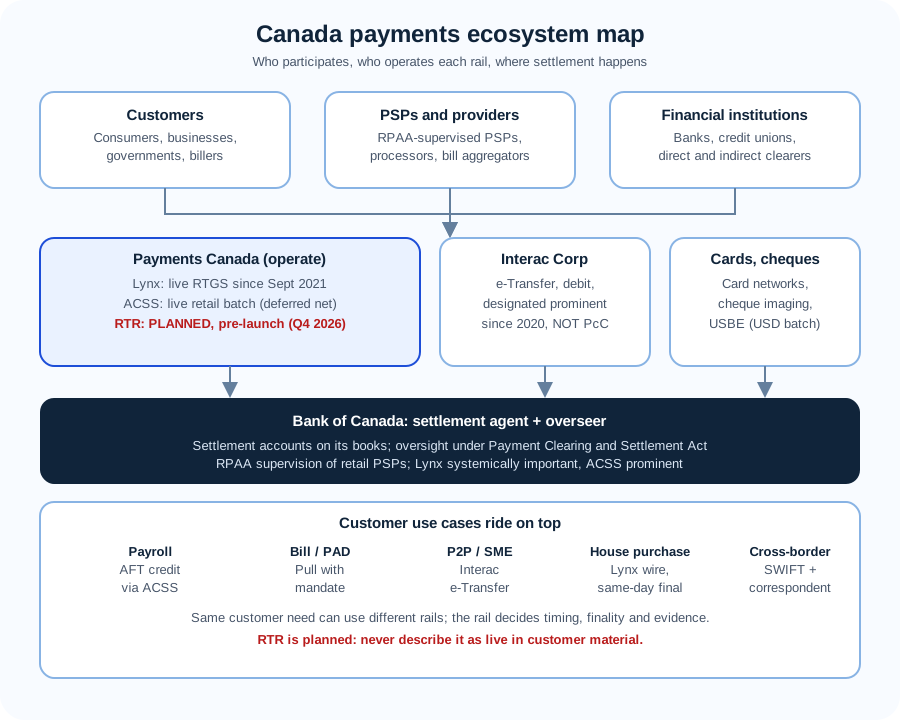
The ecosystem diagram above is worth studying before reading further. Notice three boundaries that beginners frequently blur. First, Payments Canada owns and operates Lynx and ACSS (and the future RTR), but it does not operate Interac e-Transfer; Interac Corp does, under its own designation as a prominent payment system since 2020. Second, the Bank of Canada both oversees designated systems under the Payment Clearing and Settlement Act and acts as settlement agent by providing the settlement accounts on its own books; oversight and settlement are two different functions performed by the same institution, and confusing them leads to confused accountability. Third, SWIFT messaging, correspondent accounts and Canadian settlement rails are complementary layers in a cross-border payment, not substitutes: SWIFT carries instructions and tracking, correspondent accounts carry the bilateral obligations, and a domestic rail such as Lynx may carry the final Canadian-dollar leg.
Customer need also determines how much data must travel with the money. A payroll credit needs an employee identifier, a pay-period reference and a statement description the employee recognises. A supplier payment needs an invoice number and ideally remittance detail the receiver's system can match automatically. A PAD collection needs mandate evidence linking the debit to a signed or confirmed agreement. A wire for a closing needs party details sufficient for sanctions screening and a reference the law firm's trust ledger can reconcile. A payment that arrives without usable references can be technically successful and operationally failed at the same time, because the receiver cannot apply it. That theme recurs throughout the course: reference quality is a product feature, not a technical nicety.
Finally, customer need determines the service promise a bank can honestly make. Same-day, next-day, near-instant and real-time sound similar in marketing copy and mean very different things in operations. A defensible promise always specifies the rail, the cutoff, the business-day calendar, the posting and availability convention, the finality point, and the exception path. Sections 6 and 10 return to this discipline; for now, treat any requirement that says only fast or instant as incomplete until those six elements are defined.
2. Participants, responsibilities and system boundaries
The Canadian payments ecosystem has six participant layers, and each layer has distinct responsibilities. Keeping them straight prevents the most common accountability failures: assuming someone else validated the account, screened the payment, funded settlement or owned the exception.
The first layer is end customers: consumers, businesses, billers, governments and not-for-profits. They originate instructions, authorise debits, accept or decline transfers, provide references, and reconcile their own books. Their responsibilities are frequently underestimated in system design. A PAD mandate is only as good as the customer's understanding of what was authorised. An e-Transfer only completes when the recipient acts on the notification. A corporate file is only as good as the originator's validation before submission. Good bank products make customer duties obvious at the point of action rather than burying them in terms and conditions.
The second layer is financial institutions: banks, credit unions, caisses populaires and other deposit-taking participants that hold customer accounts, authenticate customers, apply controls, submit items to clearing, fund settlement positions and post to customer accounts. Within this layer, participation models matter. Direct clearers settle directly on the books of the Bank of Canada and carry settlement responsibility for their own and sponsored volumes. Indirect clearers settle through a direct clearer acting as their settlement agent. The distinction affects cutoffs, funding obligations, reporting and who acts when something fails. Block 2 explains direct and indirect participation in detail; at landscape level, remember that not every institution that offers payments settles for itself.
The third layer is Payments Canada, the statutory operator under the Canadian Payments Act. Payments Canada owns and operates Lynx and ACSS and is building the RTR. It sets operational rules and by-laws for its systems, manages the exchange and clearing processes, calculates settlement positions for ACSS, and coordinates industry readiness for modernisation. It is not a bank, not a regulator of end customers, and not the operator of Interac. Its public statistics, system descriptions and rule publications are the authoritative source for what Lynx, ACSS and the RTR programme are and are not.
The fourth layer is the Bank of Canada, which plays three distinct roles that must not be collapsed into one. As settlement agent, it provides the settlement accounts on its books in which Lynx payments settle individually and ACSS positions settle on a deferred basis. As overseer under the Payment Clearing and Settlement Act, it designates and supervises systemically important systems (Lynx) and prominent payment systems (ACSS, and Interac e-Transfer as operated by Interac Corp), setting risk expectations. As supervisor under the RPAA, it supervises in-scope PSP registration and statutory requirements for operational-risk management, incident response, safeguarding of end-user funds and reporting. The RPAA is not a general substitute for bank consumer-protection or card-scheme rules. Settlement, oversight and supervision are separate mandates with separate policy documents, and a practitioner should be able to say which one is relevant to the question at hand.
The fifth layer is specialist operators and networks: Interac Corp for e-Transfer, Interac debit and related services; the card networks (notably Visa, Mastercard and the domestic debit arrangements) for card authorisation, clearing and settlement; cheque-imaging and exchange arrangements for paper and image items; and the USBE arrangement for US-dollar retail batch items processed in Canada alongside ACSS. Each has its own rulebook, economics, dispute model and evidence trail. The Bank of Canada’s current overseen-systems list also includes Interac’s Inter-Member Network, VisaNet, and Mastercard’s Global Clearing Management System and Single Message System; those network designations are distinct from Payments Canada ownership. Cards illustrate the point well: authorisation in seconds, clearing and settlement later, merchant funding net of interchange and fees, and a chargeback regime that has no equivalent in a Lynx wire. Treating all networks as interchangeable pipes guarantees design errors.
The sixth layer is PSPs, processors, bill aggregators, payroll providers, correspondent banks and infrastructure vendors. The RPAA brought many retail PSPs into a formal Bank of Canada supervision frame, which matters for partner due diligence: a fintech that initiates payments is not necessarily the institution that holds the funds or settles the obligation. Correspondent banks deserve special attention because cross-border payments depend on them: a Canadian bank without a direct presence in a foreign currency relies on a correspondent's accounts and services, and the division of duties for screening, fees, FX and investigations must be explicit. Block 11 maps these relationships; at landscape level, insist on knowing who holds the money at each step.
System boundaries follow from these roles. Customer channels and authorisation sit with the account-holding institution and its agents. Validation, sanctions screening, fraud decisioning and release authority sit with the sending institution before clearing. Exchange and clearing sit with the system operator and its rules. Settlement sits on the Bank of Canada's books for Lynx and ACSS. Posting, statements and customer reporting sit with each account-holding institution. Investigations span all of them, which is why references must survive every handoff. When a payment fails, the first diagnostic question is always a boundary question: which layer introduced the defect, and which layer owns the recovery.
3. Initiation, validation and bank processing
A bank-originated payment instruction generally passes through a logical sequence of initiation, authentication, validation, control decisioning, release and submission. Pull instruments, card transactions and cheques have additional instrument-specific presentment and acceptance steps, so this is an operating model, not a single Canadian legal or technical sequence. The rail changes the format, timing and finality, but it does not remove any of these steps. Weakness in this chain is the most common source of fraud losses, sanctions breaches, misdirected payments and customer harm.
Initiation is the capture of a complete instruction: who pays, who receives, how much, in what currency, on what date, for what purpose, with what references, and through which rail. Channels vary enormously: online and mobile banking, corporate host-to-host file delivery, branch counters, telephone instructions, application programming interfaces (APIs) offered directly or through PSPs, and lockbox or bill-aggregation feeds. Each channel must produce the same canonical instruction data before processing continues. A frequent implementation failure is allowing one channel to skip fields another channel requires, which pushes defects downstream where they are more expensive to fix.
Authentication establishes that the instructing party is entitled to act on the account. Consumers authenticate with credentials, device binding, one-time codes or biometrics depending on the bank's control framework. Corporate users authenticate individually and then act within an entitlement matrix: who can create, who can approve, who can release, and within what limits. High-risk actions such as adding a new beneficiary, changing standing instructions or releasing a large wire typically require step-up authentication or out-of-band confirmation. Authentication is necessary but not sufficient: an authenticated fraudster, a socially engineered customer or a compromised corporate workstation can all issue formally valid instructions, which is why validation and monitoring must follow.
Validation checks that the instruction is complete, well-formed and plausible. At landscape level the checks include: account existence and status, amount and currency reasonableness, value-date logic against business-day calendars, routing identifiers (institution, transit and account numbers are introduced in Section 5 and detailed in Block 2), beneficiary detail completeness, duplicate detection against recent submissions, mandate existence for PADs, and channel-specific rules such as e-Transfer limits or wire formatting requirements. Validation failures should reject the instruction inside the bank with a clear reason and a clear repair path. A reject is good news: it means the defect was caught before clearing, where recovery is cheapest.
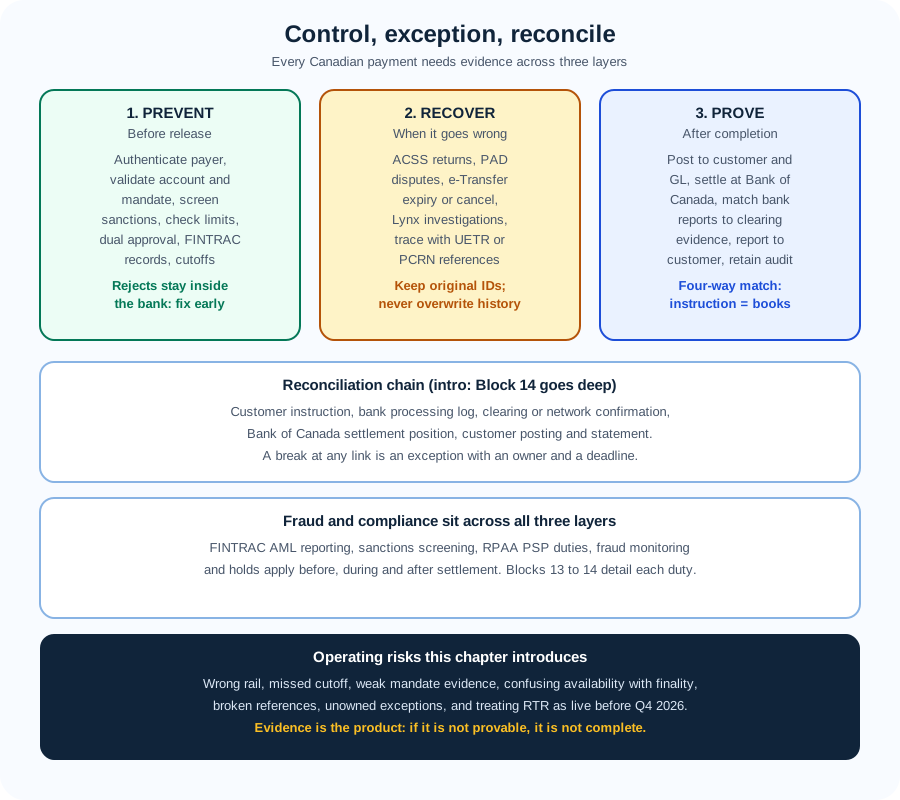
Control decisioning is where the bank decides whether the validated instruction may proceed. Sanctions and watch-list screening, fraud scoring and behavioural analytics, limit and velocity checks, dual-approval enforcement, and callback policies for changed beneficiary details are bank or participant controls. FINTRAC client-identification, recordkeeping and monitoring inputs must be captured across the lifecycle; they are not a generic rule that every payment is cleared only after a FINTRAC decision. Screening deserves emphasis because it is frequently misunderstood: a payment that matches a sanctions list is not simply delayed, it is stopped and escalated under a defined legal and operational protocol, and the bank must preserve evidence of the decision. Blocks 13 and 14 detail these controls; this chapter's point is positional: screening and fraud decisioning happen before release, and no cutoff pressure justifies skipping them.
Release and submission convert an approved instruction into clearing-system reality. For batch items, the bank aggregates validated items into files or streams, applies exchange cutoffs, and submits to ACSS or USBE processes. For Lynx wires, the bank constructs the ISO 20022 message (pacs.008 for customer credit transfers, pacs.009 for interbank legs), funds or queues against available liquidity, and releases to Lynx during operating hours. For Interac e-Transfers, the bank authenticates and, as a bank-specific implementation matter, may debit or hold funds before submitting through the Interac service and notifying the recipient. For cards, the bank authorises against balance, risk and network rules in real time and clears later. Each submission creates the first piece of external evidence: an exchange timestamp, a message identifier, a network reference. That evidence is what investigations and reconciliation depend on later.
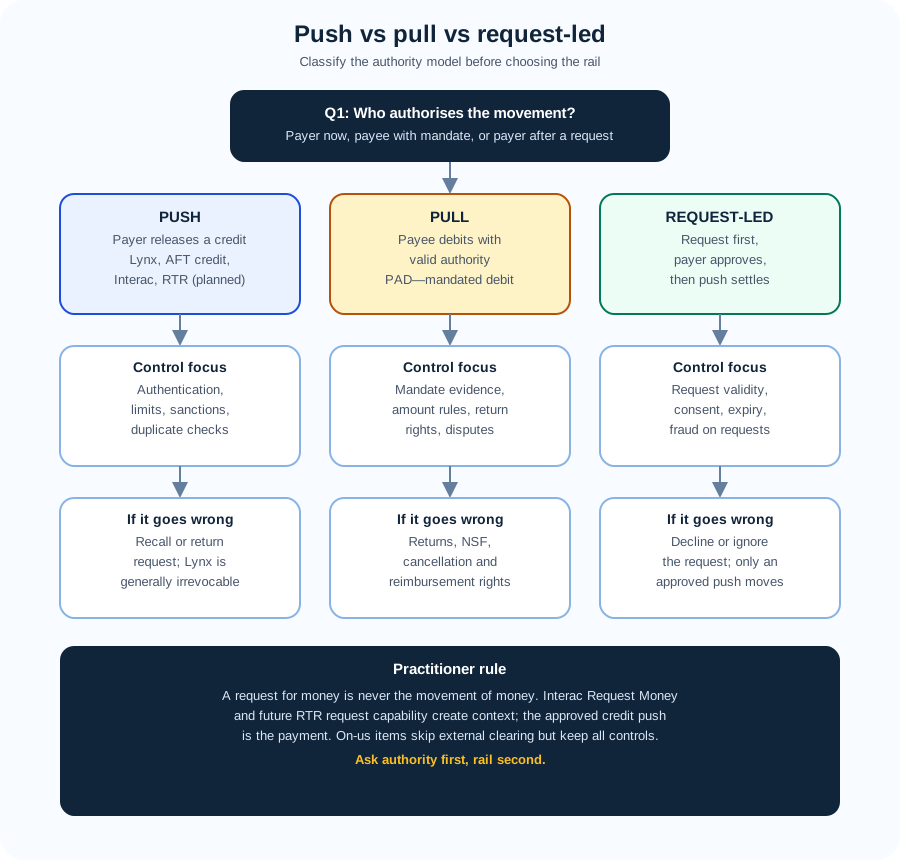
The decision-path diagram above organises the most important classification in bank processing: push, pull or request-led. A push (Lynx wire, AFT credit and Interac send, and in future an RTR credit transfer) is released by the payer; once the relevant rail has settled or the service has reached its final state, unilateral reversal is generally unavailable, so pre-release controls matter. A PAD is a payee-initiated account debit under prior authority and has rule-based return, dispute and reimbursement mechanics. Card purchases and cheques are different instrument and network models, not interchangeable PADs: card authorization/presentment and cheque draw/return rules must be applied from their own scheme or Payments Canada rulebooks. A request-led flow (Interac Request Money today, RTR request capability in future) sends structured context first and moves money only if the payer approves; the request itself is never the payment, and fraud can target the request as well as the resulting transfer. Misclassifying a flow, for example treating a PAD collection as if it had wire finality, produces exactly the credit decisions, customer promises and provisioning errors that examiners and auditors penalise.
On-us items deserve a short note because they confuse beginners. When both accounts sit at the same institution, the bank can post debits and credits on its own books without submitting anything to Lynx, ACSS or Interac. Customers may experience this as instant, and staff sometimes describe it as needing no controls. Both impressions are wrong operationally: authentication, validation, screening, approvals, posting integrity, statements and reconciliation are all still required, and the audit trail must be just as complete. On-us processing removes the external clearing leg; it removes nothing else.
4. Clearing or exchange, settlement and finality
Clearing, settlement, posting, availability and finality are five different milestones. Professionals who keep them separate give accurate customer answers, reconcile cleanly and survive audits. Those who merge them generate the complaints, breaks and findings that fill exception queues.
Clearing (sometimes called exchange in Canadian batch language) is the exchange and netting of payment information between participants under system rules. In ACSS, participating institutions exchange retail items, the system applies stream rules, and net positions are calculated for settlement. In Lynx, there is no batch netting: each payment is individually validated and settled in real time. In Interac e-Transfer, the service exchanges instructions and confirmations between participating institutions, but customer availability and delivery timing remain subject to the participating financial institution and transaction conditions. In card systems, acquirers and issuers exchange authorisation and clearing records under network rules. Clearing answers the question: what does each participant owe or is owed, and under which rulebook?
Settlement is the discharge of those obligations in settlement money. For Lynx and ACSS, final settlement of payment obligations occurs through settlement accounts on the books of the Bank of Canada; direct Lynx participants and ACSS direct clearers have the relevant access or settlement arrangements. Lynx settles each payment individually in real time (RTGS): the sending participant's settlement account is debited and the receiving participant's account is credited, payment by payment, during Lynx operating hours. ACSS settles on a deferred net basis: net positions calculated from the day's exchanged items are settled across Bank of Canada accounts after the exchange cycle, which is why ACSS is economical for high volumes but cannot offer intraday RTGS finality. Interac e-Transfer is not Lynx RTGS. Its service terms and public consumer material describe the holding, deposit and notification journey, but do not turn it into a Bank of Canada RTGS settlement event; institutions must document their own inter-FI settlement and posting arrangements separately. Card settlement follows network and acquirer arrangements with merchant funding later. USBE mirrors the ACSS-style deferred batch model for US-dollar retail items in Canada. Each model is a deliberate trade-off between liquidity cost, speed, operating hours and risk.
Posting is the debit and credit of customer accounts on each bank's books. Availability is the point from which the beneficiary can use the funds. Finality is the point at which the payment is irrevocable and unconditional under the applicable rules. These three customer-visible events do not necessarily coincide with settlement. A bank may post an ACSS credit and make funds available according to its availability policy while returns are still possible under the rules. A cheque deposit may be available subject to holds while return risk persists for days. A Lynx receipt, by contrast, carries RTGS finality that supports confident onward use such as closing a property transaction. Interac’s terms state that once its records show the recipient has deposited the transfer, the transaction is final; before deposit or Autodeposit, the sender may cancel, and an uncollected transfer expires after 30 days. That service finality is distinct from Lynx’s RTGS settlement finality and must not be presented as the same milestone.
System designations help calibrate expectations. Lynx is designated systemically important and overseen by the Bank of Canada against the highest risk standards; its RTGS design, operating controls and ISO 20022 transition (fully transitioned to MX by 2025) reflect that role. ACSS and Interac e-Transfer are designated prominent systems: essential to everyday commerce, with strong oversight, but operating on different settlement models. The RTR, once live, is intended to add an instant, always-on, irrevocable credit-transfer capability; until launch, that sentence must stay in the future tense. The live-versus-planned discipline is not pedantry: promising instant irrevocable settlement on infrastructure that has not launched is a conduct, contractual and reputational risk.
Factual baselines used in this chapter, verified against primary sources on 5 October 2026: Lynx has been live since 1 September 2021, replacing the Large Value Transfer System (LVTS); it is an RTGS system, systemically important, with settlement accounts at the Bank of Canada and ISO 20022 MX fully transitioned by 2025. ACSS is the live retail batch deferred-net settlement system and a prominent system; in 2025 it handled about 10.6 billion transactions worth about 10 trillion dollars. Combined, Lynx and ACSS cleared about 103 trillion dollars in 2025. The RTR legal instruments (By-law No. 10 and the RTR Rules) were approved 30 June 2026 and came into force 24 August 2026, with launch planned for Q4 2026; the RTR is therefore planned and pre-launch, never live, throughout this chapter. Interac e-Transfer is operated by Interac Corp (designated prominent since 2020), not by Payments Canada. Payments Canada owns and operates Lynx and ACSS (plus the future RTR) under the Canadian Payments Act. The Bank of Canada is settlement agent, overseer under the Payment Clearing and Settlement Act, and RPAA supervisor of PSPs. USBE is the US-dollar retail batch alongside ACSS.
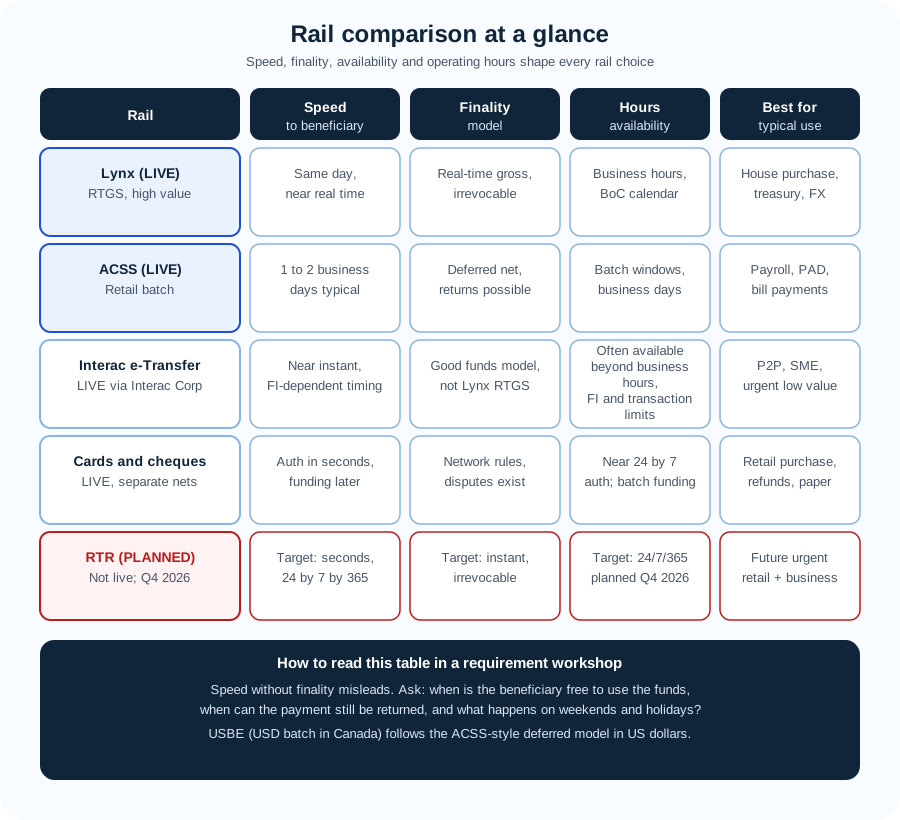
The rail-comparison diagram above compresses these trade-offs into four questions to ask every time: how fast does the beneficiary get usable funds, when is the payment final, which hours and business days apply, and what is the natural use case. Keep it visible during requirement discussions. When a stakeholder says a supplier payment is urgent, the diagram forces the clarifying question: urgent enough for a Lynx wire with same-day RTGS finality and wire pricing, or urgent enough for an Interac e-Transfer within limits, or simply due-date-sensitive enough for a well-timed AFT file? Each answer implies a different cutoff, cost, data payload and exception path, and the bank that documents the choice rarely has to defend it later.
5. Data, identifiers, messages and references
Money without data does not reconcile. This section introduces, at landscape level only, the identifiers and message conventions that let Canadian payments route correctly and reconcile automatically. Blocks 2 and 9 provide the full detail; the goal here is to understand what each data element is for and what breaks when it is wrong.
Canadian retail routing rests on three familiar identifiers: the institution number identifying the financial institution, the transit (branch) number identifying the branch or processing location, and the account number identifying the customer account. Together with the amount, currency, value date and beneficiary name, they answer the routing question: which institution, which branch logic, which account. The Financial Institutions File and related reference data let banks validate that an institution identifier is real and reachable on the intended rail. A surprising share of batch rejects traces to stale or mistyped routing data captured far upstream: a payroll administrator retyping transit numbers from a paper form, a biller onboarding a customer over the phone, a migration mapping that carried a legacy branch code forward. Validation at capture, confirmation of payee-style checks where offered, and pre-validation files are cheaper than returns.
Messages carry the instruction between banks and systems. Lynx moved to ISO 20022 MX messages, fully transitioned by 2025: pacs.008 for customer credit transfers, pacs.009 for interbank legs, pacs.004 for returns, camt messages for cash-management and account reporting, with the Unique End-to-End Transaction Reference (UETR) supporting end-to-end tracking and the Payments Canada Reference Number (PCRN) supporting Canadian processing needs. Retail batch files follow AFT conventions with their own record layouts, cross-referenced in Block 9 alongside ISO 20022 coexistence. Interac, card and cheque-image flows use their own network message standards. At landscape level the message lesson is simple: richer structured data improves screening, routing, matching, investigations and reporting, but only if originators populate it and every intermediary preserves it. Truncation, reformatting or re-keying at any handoff degrades everything downstream.
References are the thread that stitches the lifecycle together. An end-to-end reference created at initiation should survive bank processing, clearing, settlement, posting, statements and reconciliation, so that a customer inquiry, a return, an investigation or an audit can follow one identifier from start to finish. In practice, references can break: a corporate system generates a meaningful invoice reference that a channel truncates, a repair desk overwrites the original identifier with an internal ticket number, a return omits the original reference and becomes unmatchable. The discipline this course enforces is that original transaction identity is preserved alongside every repair, return and re-submission. Exception records supplement the original; they never replace it.
Remittance information deserves separate attention because it decides whether a received payment can be applied automatically. A supplier that receives a lump-sum credit with no invoice detail must investigate manually, call the payer, or park the cash in suspense. A supplier that receives structured remittance data can match to open invoices, clear receivables and release goods. Interac e-Transfer for business, AFT with EDI-style addenda, Lynx with structured ISO 20022 remittance, and future RTR uses all aim at this problem from different angles. When scoping a product, ask the receivables team what match rate they need and what reference the payer can realistically supply; the gap between those answers is the design problem.
Data quality is also a compliance input. Sanctions screening needs accurate party names and geographies. FINTRAC reporting needs prescribed client and transaction records. Cross-border processing needs purpose, charge and party detail sufficient for correspondent handling and beneficiary-bank compliance. Consumer-protection and contractual requirements need clear customer communications about status, timing and costs; those requirements should be attributed to the applicable regime, not generically to RPAA. None of these duties can be met from a bare amount and account number. Treat every data field as serving operations, compliance and customer experience simultaneously, and challenge any proposal to drop fields for convenience.
6. Rules, cutoffs, service levels and customer impact
Canadian payments run on clocks, calendars and rulebooks. The customer promise is only as precise as the bank's understanding of all three, and most service failures in this area come from vague language rather than system outages.
Rules define what each rail permits. Payments Canada by-laws and rules govern Lynx and ACSS participation, streams, returns, adjustments and settlement. Interac rules govern e-Transfer sending, receiving, autodeposit, request-money and cancellation behaviour. Card network rules govern authorisation, clearing, settlement, refunds and chargebacks. PAD Rule H1 and related instruments govern mandates, notifications, returns and reimbursement. RPAA instruments govern PSP conduct and safeguarding. A landscape-level practitioner does not need to recite these rulebooks, but must know which rulebook governs the payment in front of them and where to look when an edge case arises. Telling a PAD dispute team to follow wire-recall practice, or telling a card dispute team to follow ACSS return codes, wastes days and harms customers.
Cutoffs convert rulebook windows into daily deadlines. ACSS batch exchange has submission and stream windows; a file approved after the window misses the cycle and settles a business day later. Lynx has operating hours on the Bank of Canada calendar; a wire released after close waits for the next operating day, and no amount of customer urgency reopens the system. Interac e-Transfer and card authorization may be available outside ordinary business hours, but participating-institution policies, maintenance, transaction conditions and downstream processes such as limit resets, fraud review queues and back-office support may not be. Corporate cutoffs add a further layer: the bank's internal deadline for customer submission always sits ahead of the system deadline, leaving time for validation, approvals, screening and repair. Publishing only the system deadline without the customer deadline is a reliable way to manufacture missed payments.
Business days and holidays complete the picture. ACSS settlement follows business-day calendars; weekends and Canadian holidays shift value dates and availability. Lynx follows its operating calendar tied to Bank of Canada settlement availability. Cross-border legs add foreign calendars and time zones: a Canadian-dollar instruction sent late in the day may miss a correspondent's processing window abroad. Products that promise calendar-day behaviour on business-day infrastructure need explicit weekend and holiday logic, tested with date-sensitive scenarios, or they will fail on the first long weekend after launch.
Service levels should therefore be written as testable promises: rail, submission cutoff, business-day definition, expected posting and availability timing, finality point, reference and reporting content, fee and FX treatment, and the exception path with response times. Payroll promises a credit date with a defined re-run window for rejects. PAD collection promises a presentment date with defined return and dispute handling. E-Transfer promises notification and acceptance behaviour with expiry and cancellation rules. Wires promise same-day RTGS settlement within hours with investigation support. Cross-border promises a value date, charge option and tracking reference with defined inquiry handling. Each promise in Section 11's example is written this way, and every product team should hold itself to the same standard.
Customer impact is where vague promises surface. A missed payroll cutoff means employees unpaid on Friday, employer reputation damage and emergency re-runs. A mis-set PAD presentment date means unexpected debits, NSF fees and disputes. An unaccepted e-Transfer means a contractor unpaid and a strained business relationship. A late wire means a missed closing, penalty interest and legal escalation. Honest cutoffs, proactive status, and plain-language explanations of business days prevent most of these outcomes. The bank that tells a customer at 4 p.m. that a file missed the window and exactly what happens next keeps the relationship; the bank that stays silent until the customer calls loses it.
7. Fraud, compliance and operational controls
Controls are not an overlay applied after a payment product is designed. They are part of the product, and in Canada they draw on fraud practice, sanctions law, FINTRAC AML duties, RPAA supervision and consumer-protection expectations simultaneously. This section introduces each at landscape level; Block 13 takes them deep.
Fraud patterns follow the rail. Authorised-push-payment fraud and impersonation target credit pushes: a customer convinced to send an e-Transfer or approve a payment to a fraudster's account, a business-email compromise that substitutes supplier payment details, a fake invoice that diverts an AFT run. Account takeover targets authentication: credential theft, SIM-swap or session hijack followed by rapid transfers out. PAD fraud targets mandates: debits raised without valid authority or manipulated amounts. Cheque fraud targets instruments and images: counterfeit, alteration and remote-deposit duplication. Mule activity targets the receiving side: accounts used to receive and onward-send criminal proceeds. Faster customer experiences can compress the time available to detect and stop these patterns. Interac controls must account for its fast customer journey and institution-dependent timing; the future RTR is designed for instant, irrevocable payments and would require pre-release and near-real-time controls rather than next-day review.
The bank control stack before release combines authentication strength, transaction risk scoring, behavioural signals, limit and velocity management, beneficiary-risk checks, dual approval for corporate and high-value items, callbacks on changed payment details, and holds or step-up challenges on anomalous items. After release, monitoring continues: status tracking, beneficiary-account anomaly detection, mule-pattern analytics, customer-reported fraud intake, and rapid response playbooks including recipient-bank contact, recall or return requests where the rules permit, and law-enforcement liaison. For Lynx wires, which are final and irrevocable between Lynx participants once settled, prevention quality is everything; recovery depends on beneficiary cooperation and cannot be assumed. For PADs and cards, structured dispute and return rights exist, but they operate within deadlines and evidence requirements that operations must meet precisely.
Sanctions and payment screening apply across rails. Party and payment screening against applicable lists, with defined handling for matches, false positives, holds, escalation and record-keeping, sits in the pre-release path. Cross-border payments add correspondent and beneficiary-bank screening expectations plus richer party and purpose data requirements. Screening is a legal duty with operational consequences: a held payment needs a documented decision, a customer communication that says no more than the law permits, and an audit trail. Product timelines must include screening latency and queuing; treating screening as zero-cost overhead is a planning error.
FINTRAC AML duties form the next layer, introduced here and detailed in Block 13. At landscape level, banks and covered entities must know their clients, keep prescribed records, apply transaction-monitoring and reporting obligations (including large cash, electronic funds transfer and suspicious-transaction reporting as applicable), and support investigations with evidence. Payment operations contribute the raw material: complete originator and beneficiary information, preserved references, decision logs, and timely responses to FINTRAC and law-enforcement inquiries. FINTRAC’s travel-rule guidance is narrower than “every rail”: it applies to international EFTs and EFTs within Canada sent by SWIFT MT-103 or equivalent, and it requires specified originator and beneficiary information. The guidance excludes direct deposits, PADs and cheque imaging from its EFT definition. Do not use travel-rule language to describe every AFT, PAD, card or Interac item; apply the correct instrument and reporting rules.
RPAA supervision adds the PSP dimension. In-scope PSPs must register and meet statutory requirements for operational-risk management, incident response, safeguarding of end-user funds and reporting. Clear communications, fees, complaints and redress can also arise under the PSP’s contracts, other laws or bank/consumer-protection regimes; they should not be attributed wholesale to RPAA supervision. For banks, this matters twice: as directly supervised institutions in their own right where applicable, and as partners, sponsors or settlement providers to supervised PSPs whose outsourcing, safeguarding and incident coordination must be diligenced. Consumer-protection expectations from the Financial Consumer Agency of Canada (FCAC) complement this frame for bank-customer dealings. Landscape-level takeaway: when a fintech moves money for your customer, know who is supervised for what, who safeguards the funds, and who the customer calls when something goes wrong.
Operational controls bind these duties into daily practice: maker-checker discipline, entitlement reviews, cutoff enforcement, reconciliation ownership, exception ageing, evidence retention and independent testing. None is glamorous; together they are what examiners, auditors and customers actually rely on. A product that cannot describe its control stack in one page has not finished design.
8. Exceptions, investigations and recovery
No payment design is complete until its failure modes are designed. Canadian operations distinguish several exception types that staff, customers and systems must never conflate: rejects, returns, recalls and return requests, reversals, cancellations, disputes and claims. Each has different timing, different authority and different evidence.
Rejects happen before clearing: the sending bank refuses to submit the instruction because validation, screening, limits or approvals failed. Rejects are the cheapest failures and the best-handled ones stay inside the bank with a precise reason and a repair path. Returns happen after exchange under system rules: the receiving side or the system sends the item back (for example, an ACSS item with invalid account details, an NSF PAD, a cheque returned for cause). Returns carry rulebook codes and deadlines, and the originator must map each code to a customer communication and a next step: correct and re-present where permitted, collect differently, or absorb the loss. Cancellations stop an instruction the customer no longer wants, within the window the rail allows: an unaccepted e-Transfer can generally be cancelled by the sender, while a settled Lynx wire cannot be cancelled unilaterally. Recalls and return requests ask the receiving institution to return funds already delivered; they are requests, not entitlements, outside defined return rights, and for wires they depend on beneficiary consent. Reversals correct bank errors under defined conditions with full audit trails. Disputes and claims invoke rulebook rights: PAD reimbursement claims, card chargebacks, e-Transfer fraud reports, alleged-error investigations. Each follows its own clock and evidence standard.
Investigations follow the identifiers. A missing payroll credit, a disputed PAD, an unaccepted e-Transfer, a wire whose beneficiary says nothing arrived: each starts from the original reference (UETR where applicable and the PCRN generated for a settled Lynx wire, file and item references for batch, Interac reference numbers for e-Transfers, network references for cards) and traces initiation, bank processing logs, clearing confirmations, settlement positions and posting records. Status language must be honest about which milestone has been reached: instruction accepted, submitted to clearing, settled, posted, available. Telling a customer a payment settled when it was only submitted creates a second incident on top of the first. Banks need inquiry intake standards, trace templates per rail, correspondent inquiry protocols for cross-border legs, and ageing discipline so no case sits unowned.
Recovery prospects differ by rail and timing, and customer communication must reflect that honestly. Batch items caught before exchange windows can often be repaired and re-submitted the same cycle. Returned PADs can be re-presented only where the rules permit, with attention to amount, timing and customer impact. Expired or unaccepted e-Transfers can be reclaimed and re-issued. Misdirected wires settled in Lynx require beneficiary cooperation and prompt recipient-bank engagement; prevention through confirmation of details is worth far more than any post-settlement playbook. Cross-border recovery adds correspondent chains, time zones, FX movements and foreign-bank processes, all of which extend timelines. The operational principle is uniform: preserve original identity, document every action, set a customer callback commitment, and escalate on age rather than on noise.
Uncertain outcomes need explicit handling. Interac e-Transfers pending acceptance, batch files acknowledged but not yet settled, wires released near cutoff, cross-border payments in tracking states: each needs a defined status vocabulary, a customer-facing explanation, a re-check interval and an expiry or escalation rule. Products that display only sent and delivered force staff to improvise, and improvised status language is where misinformation starts. Design the status model before launch, test it with the scenarios staff actually see, and review the words with conduct and complaints teams.
Volume planning matters too. Exception rates multiply quickly: a 1 percent return rate on a 100,000-item payroll and biller run is 1,000 cases needing ownership, evidence and customer communication. Staffing, tooling, templates and service levels for exceptions should be sized from expected volumes, not treated as an afterthought. Block 14 builds the full operating model; this chapter's message is that exceptions are part of the product surface, budgeted and designed like any other feature.
9. Posting, accounting, liquidity, reporting and reconciliation
The back half of every payment is financial truth: customer accounts posted correctly, internal ledgers balanced, settlement positions funded, reports delivered, and every figure reconciled to independent evidence. Customers experience postings and statements; treasuries experience liquidity; finance experiences the general ledger; auditors experience the reconciliation pack. A landscape-level practitioner must understand all four views.
Posting translates payment events into account entries. Outgoing customer debits and incoming customer credits hit demand deposits, business operating accounts or trust ledgers according to product rules, value dates and hold policies. Fee, FX and charge entries post alongside principal movements with descriptions customers can understand. Internal suspense and clearing accounts hold items in transit between customer posting and interbank settlement, and must clear to zero on defined cycles; persistent suspense balances are a classic audit finding that signals broken exception ownership. Each posting needs a value date, a narrative, a reference linking back to the original instruction, and consistent treatment across channels so the same economic event looks the same wherever the customer views it.
Accounting extends posting into the general ledger and subledgers: nostro and settlement-account entries for interbank positions, fee-income recognition, FX revaluation where applicable, provision entries for expected returns or disputes, and write-offs where recovery fails. Cutoff discipline matters here as much as in clearing: transactions belong to the correct business date, accruals reflect items in flight, and period-end processes capture period-level completeness. Finance and operations must agree the business-day definition, or the same payment will appear in two periods in two reports.
Liquidity is the treasury dimension, most visible in Lynx and most easily underestimated elsewhere. Lynx RTGS settles payment by payment against available settlement-account balances (with intraday mechanisms under Bank of Canada policy); a participant that releases large wires without managing its position faces queuing, delays and funding costs. ACSS deferred net settlement concentrates funding into settlement-time obligations that treasury must meet from projected positions. Even Interac and card flows create funding and collateral considerations at the participant level. Landscape-level lesson: payment release order, queue management, large-item scheduling and daylight monitoring are treasury decisions with direct customer impact, and operations, treasury and large corporate clients need shared visibility of the day's payment profile.
Reporting closes the loop to the customer. Corporate clients expect machine-readable statements, transaction reports, return and adjustment advices, and increasingly ISO 20022 camt-based cash-management reporting alongside legacy formats. Consumers expect timely notifications, intelligible descriptions, fee disclosure and accessible dispute routes. Reporting content should carry the references the receiver needs to reconcile: end-to-end IDs, invoice and mandate references, return codes with plain-language explanations, and value-date clarity. Every report the bank sends is either a reconciliation input for the customer's system or a phone call to the contact centre; design determines which.
Reconciliation proves the story end to end, and at landscape level it is a four-way match: customer instruction against bank processing log, bank processing against clearing or network confirmation, clearing against Bank of Canada settlement position, and settlement against customer posting and statement. Breaks get owners, deadlines and ageing; adjustments reference originals; evidence is retained for audit, FINTRAC, tax and dispute needs. The control diagram in this chapter's fifth visual summarises the chain; Block 14 turns it into an operating model with roles, frequencies and tolerances. For now, remember the maxim: if it is not provable from independent evidence, it is not complete, no matter what the customer screen shows.
10. Bank implementation, testing and resilience
Building or changing a Canadian payment capability is a multi-discipline programme, not a software release. Implementation touches channels, payment hubs, core banking, network gateways, fraud and screening engines, liquidity and treasury feeds, finance ledgers, reporting services, operations tooling and customer communications simultaneously. Landscape-level awareness of that footprint prevents the classic failure of testing the happy path in one system while the end-to-end journey spans eight.
Implementation starts with scope honesty: which rails, which instruments, which customer segments, which participation model, which messages and formats, which cutoffs and calendars, which controls and which reports. Each choice pulls in a rulebook and a testing burden. Adding PAD origination pulls in mandate lifecycle, Rule H1 evidence, return handling and reimbursement workflows. Adding Lynx origination pulls in ISO 20022 message quality, liquidity management, operating-hour discipline and investigation readiness. Adding e-Transfer origination pulls in out-of-hours support planning, notification and acceptance handling, fraud monitoring tuned to push-payment scams, and limit management. Sponsoring PSP or indirect-clearer volumes pulls in due diligence, safeguarding verification, capacity planning and incident coordination. The RTR, while planned, already belongs in architecture thinking: systems designed now with rigid batch-only assumptions will be harder to extend to instant, always-on processing later, so integration layers should isolate rail-specific logic from customer-facing journeys.
Testing must cover the lifecycle, not just the message. Functional testing validates initiation, validation, approvals, screening, submission, posting, reporting and reconciliation per rail. Exception testing validates rejects, returns, recalls, disputes, re-presentment rules and status vocabulary under load. Calendar testing validates cutoffs, holidays, weekend behaviour, value-date logic and period-end handling with date-sensitive scenarios. Data testing validates routing identifiers, reference preservation across handoffs, remittance integrity, truncation behaviour and character-set handling. Non-functional testing validates throughput for payroll peaks, real-time responsiveness for customer channels, and the operational dashboards staff actually use during incidents. Migration testing validates number-mapping, mandate portability, beneficiary-detail transfer and statement continuity. Each of these has found production defects in Canadian programmes that unit-tested cleanly in isolation.
Resilience is an operating property, not a document. Clearing connectivity, Bank of Canada settlement access, Interac and network links, fraud and screening services, and core posting each need defined recovery objectives, tested failover, and degraded-mode procedures (for example, how corporate files are queued and communicated during an outage, how wires are prioritised on recovery, how customers are told what is delayed versus what is lost). Incident playbooks need payment-specific content: which rails are affected, which value dates move, which customers need proactive notice, which regulators and system operators need informing, and who authorises re-release. Post-incident reviews must trace to control and reconciliation improvements, not just infrastructure fixes. Operational-risk, conduct and audit stakeholders belong in these exercises from the start.
Change governance deserves a final note. Payment changes move customer money, which raises the bar for approval, communication and rollback planning. Dual control over configuration (cutoffs, limits, routing tables, screening lists), independent verification of reference-data changes such as institution and routing updates, and coordinated customer notice for cutoff or format changes are baseline expectations. The bank that treats a routing-table update with the gravity of a product launch will have fewer reconciliation breaks; the bank that treats it as routine maintenance will learn why the gravity was warranted.
11. Practical Canadian end-to-end example
Theory settles best in a concrete day. This section follows three realistic but entirely fictional Canadian scenarios through the landscape: a payroll run, an urgent contractor payment, and a property-closing wire. Names, amounts, institutions and identifiers are invented for training and carry no connection to real persons or firms. A fourth vignette sketches a cross-border supplier payment to position Block 11.
Example (fictional): Friday payroll for a Hamilton manufacturer. North Shore Fabricators Ltd., a fictional 4,000-employee manufacturer in Hamilton, Ontario, runs bi-weekly payroll through its bank's corporate file channel. On Wednesday afternoon its payroll officer uploads an AFT credit file dated for Friday, with each record carrying an employee account (institution, transit and account identifiers), amount, pay-period reference and a statement description such as PAYROLL JUN 12. The bank authenticates the officer, enforces dual approval (a second authorised signatory releases the file), validates routing data against current reference files, screens as applicable, checks the file against duplicates of the prior run, and confirms submission ahead of the customer cutoff for the Thursday exchange cycle. Items failing validation, say two records with transposed transit digits, reject inside the bank on Wednesday with precise repair guidance; the officer corrects and re-submits the same evening. Valid items exchange through ACSS batch processes, net positions settle across Bank of Canada accounts on the deferred cycle, and the bank posts employee credits for Friday availability with reporting back to the employer: a paid report, a reject-and-repair report, and later any returns (for example, a closed account discovered at the receiving institution) with codes and next steps. The employer's reconciliation matches the original payroll register to the bank's paid, rejected and returned reporting; suspense clears; FINTRAC and record-keeping duties are supported by retained file, approval and transmission evidence. Nothing about this story is instant, and that is the point: payroll succeeds through advance dating, cutoff discipline, repair windows and complete reporting, not speed.
Example (fictional): an urgent contractor payment in Calgary. A fictional Calgary homeowner, Priya, agrees on Thursday evening to pay her electrician, fictional contractor Marc Côté, 2,800 dollars on completion of emergency work. Her bank's mobile app offers Interac e-Transfer: she authenticates, selects Marc's email address, enters the amount with the reference PANEL UPGRADE JUN 11, reviews the fee and limit disclosure, and sends. The bank earmarks good funds, submits through Interac rails, and Marc receives a notification within minutes. Because Marc uses Autodeposit, the credit can be deposited without a security question. The sender and recipient may receive confirmations carrying the Interac reference, subject to their financial institutions’ functionality. Had Marc not used Autodeposit and failed to accept before expiry, Priya could have cancelled and re-issued or reclaimed the funds; had she mistyped the address, the bank's fraud and verification prompts plus Marc's non-acceptance would have bounded the damage, with defined intake for suspected fraud. Interac does not use Lynx RTGS for this customer journey. Deposit can be prompt, but Interac disclaims a guaranteed delivery time and the banks’ posting and statement references are institution-specific; Priya and Marc should reconcile using the Interac reference and their bank records. The lesson: convenient customer experience depends on authentication, limits, notification, acceptance, cancellation and reporting; it is not evidence of a guaranteed settlement time.
Example (fictional): a Toronto property closing by wire. A fictional Toronto law firm, Bayfront Law LLP, acting on a residential purchase, must move 685,000 dollars from the purchaser's bank to the vendor's bank with same-day Lynx settlement finality so the deal can close and keys can transfer, if the instruction is accepted and settled within Lynx hours. The purchaser's instruction arrives in-branch with identity verification, source-of-funds discussion, and full beneficiary detail including the vendor's bank, account and the trust-ledger reference CLOSING 88 KING ST W UNIT 1204. The sending bank validates, screens, applies dual control and large-value approval, constructs the ISO 20022 pacs.008 customer credit transfer with a UETR where applicable and a PCRN generated after Lynx settlement, confirms available liquidity and release order in its Lynx queue, and releases during Lynx operating hours. Lynx settles the payment individually across Bank of Canada settlement accounts in real time; the receiving Lynx participant gets the settled funds; the receiving institution then applies its own controls and posting process to the vendor's lawyer trust account. The PCRN proves a settled Lynx wire, while customer posting can still be a separate milestone. Had the instruction arrived after the Lynx close, the bank would have had to say so plainly and schedule next-operating-day release; had beneficiary details been uncertain, a pre-validation call under the bank's callback policy would have preceded release, because a settled Lynx wire is generally irrevocable and recovery depends on recipient cooperation. The contrast with payroll is instructive: the wire buys finality and timing certainty at wire pricing with tight hours, while payroll buys bulk economy with advance planning.
A cross-border sketch positions Block 11. Suppose North Shore Fabricators must also pay a US supplier 140,000 US dollars. The Canadian bank captures the instruction with beneficiary, account, correspondent-reachable routing, purpose, charge option and FX instruction; screens; executes or locks the FX rate with disclosed spread; routes via SWIFT messaging and correspondent accounts with UETR tracking; and reports the rate, charges, value date and tracking reference. The Canadian-dollar funding leg may itself settle domestically, but SWIFT is the messaging and tracking layer, not the settlement system, and the USBE batch is for US-dollar retail items in Canada, not a substitute for correspondent settlement of this supplier wire. Exceptions route through correspondent inquiries with longer timelines than domestic traces. Readers should carry that layered mental image into Block 11 rather than a detailed procedure.
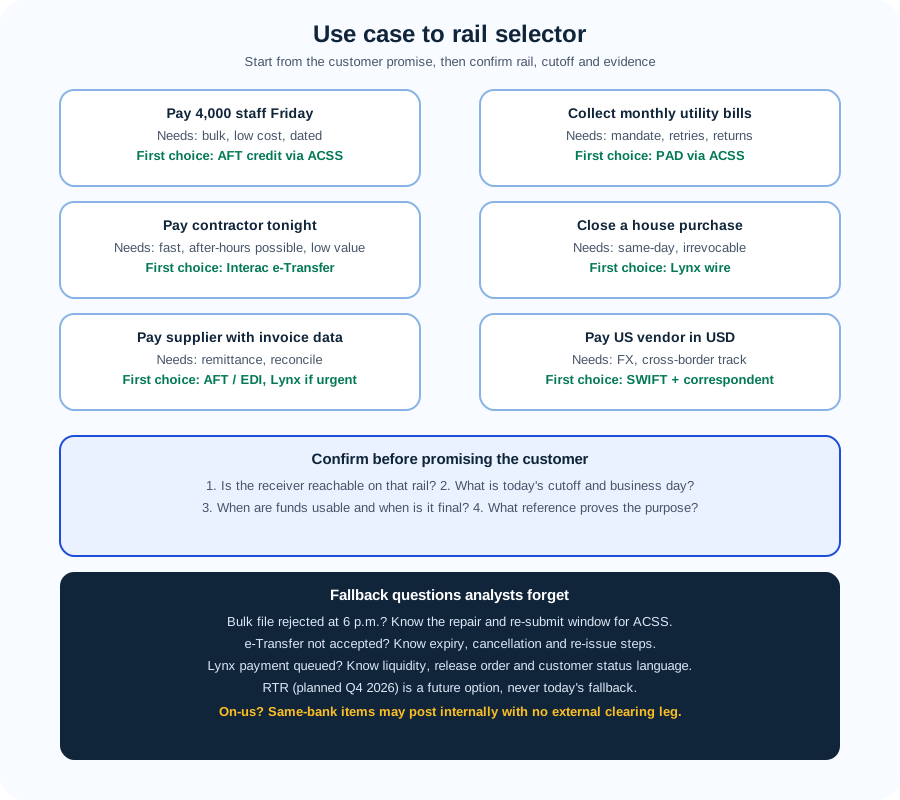
The use-case selector diagram above generalises these stories into a desk reference: payroll to AFT via ACSS, recurring collection to PAD via ACSS, tonight's contractor to Interac e-Transfer, the closing to Lynx, invoice-rich supplier flows to AFT or EDI-style remittance (Lynx if timing demands finality), and US-dollar supplier payments to SWIFT plus correspondent with FX. Below each first choice sit the four confirmation questions from Section 6: reachability, cutoff and business day, usability versus finality, and reference quality. Analysts who run every requirement through those four questions will rarely choose the wrong rail, and when constraints force a compromise (for example, a supplier paid by e-Transfer because the AFT cutoff was missed), the compromise and its evidence gap will at least be explicit and managed.
12. Key takeaways and authoritative references
Twelve points carry the chapter. First, Canada's landscape is a small set of live rails with distinct jobs: Lynx for high-value RTGS finality, ACSS for retail batch economy, USBE for US-dollar batch in Canada, Interac services for near-instant consumer and small-business transfers, card networks for authorised-now funded-later commerce, and cheque imaging for residual paper flows. Second, the RTR is planned and pre-launch (By-law No. 10 and Rules approved 30 June 2026, in force 24 August 2026, launch planned Q4 2026): roadmaps, customer material and staff talking points must keep it in the future tense. Third, Payments Canada operates Lynx and ACSS (and the future RTR); Interac Corp operates e-Transfer; the Bank of Canada settles, oversees and supervises in three separate capacities. Fourth, push, pull and request-led are control models, not marketing words: they determine what is checked before release and what rights exist after. Fifth, clearing, settlement, posting, availability and finality are five milestones with five timestamps; any status that merges them misleads. Sixth, deferred net settlement economises liquidity at the cost of timing and return exposure, while RTGS buys finality at the cost of liquidity and hours. Seventh, routing identifiers, message standards and end-to-end references are what make payments reconcilable; truncation and overwriting are operational defects. Eighth, cutoffs, business days and rulebooks define the honest customer promise; vague speed language does not. Ninth, fraud, sanctions, FINTRAC, RPAA and consumer-protection duties surround every rail and belong in design, not in an appendix. Tenth, exceptions are a designed product surface with vocabulary, clocks, owners and evidence; returns, recalls, reversals, cancellations and disputes are not synonyms. Eleventh, posting, liquidity, reporting and four-way reconciliation turn movement into provable truth. Twelfth, every business event maps to a first-choice rail plus four confirmation questions; analysts who apply that discipline prevent most failures this course exists to eliminate.
Common misunderstandings deserve explicit correction. The RTR is not live and cannot be offered to customers yet. Interac e-Transfer is not operated by Payments Canada. SWIFT does not settle payments; it messages, routes and tracks them while correspondent accounts and domestic rails settle value. Lynx did not go live recently: it has operated since 1 September 2021, replacing LVTS, with ISO 20022 fully transitioned by 2025. ACSS availability is not finality: batch credits can carry return exposure after the customer sees them. On-us processing does not remove controls or evidence. A request for money is not a payment. USBE is not a cross-border settlement substitute for large supplier wires. Cards do not settle merchants at authorisation. Keep these distinctions visible to designers, testers and front-line staff.
Authoritative references
- Payments Canada, Lynx high-value payment system: https://www.payments.ca/systems-services/payment-systems/high-value-payment-system-lynx
- Payments Canada, Real-Time Rail payment system (planned Q4 2026): https://www.payments.ca/systems-services/payment-systems/real-time-rail-payment-system
- Bank of Canada, payment systems overseen: https://www.bankofcanada.ca/regulatory-oversight/financial-market-infrastructures/payment-systems-the-bank-of-canada-oversees/
- Bank of Canada, settlement-account policies for Payments Canada systems: https://www.bankofcanada.ca/core-functions/financial-system/bank-canadas-settlement-account-policies-for-payments-canada-payment-systems/
- Government of Canada, Canada Gazette, RTR legal instruments (By-law No. 10, SOR/2026-133): https://gazette.gc.ca/rp-pr/p2/2026/2026-07-01/html/sor-dors133-eng.html
- Payments Canada, ACSS and USBE retail batch system: https://www.payments.ca/systems-services/payment-systems/retail-batch-payment-system
- Payments Canada, ACSS 2021–2025 statistics: https://www.payments.ca/automated-clearing-settlement-system-acss-statistics
- Payments Canada, Lynx 2025 statistics: https://www.payments.ca/high-value-payment-system-lynx-statistics
- Payments Canada, Lynx ISO 20022 message specifications: https://www.payments.ca/payment-resources/iso-20022/high-value-payment-system-lynx
- Payments Canada, rules and documentation (including ACSS changes effective 27 July 2026): https://www.payments.ca/systems-services/rules-documentation
- Payments Canada, Lynx PCRN explainer: https://www.payments.ca/explainer-lynx-wire-payments-and-payment-confirmation-reference-number
- Interac, e-Transfer help and acceptance/expiry: https://www.interac.ca/en/interac-e-transfer-help/
- Interac, e-Transfer Terms of Use: https://www.interac.ca/en/interac-e-transfer-terms-of-use/
- Interac, e-Transfer product and participating institutions: https://www.interac.ca/en/consumers/products/interac-e-transfer/
- Visa, Core Rules and Product and Service Rules (current public edition): https://usa.visa.com/dam/VCOM/download/about-visa/visa-rules-public.pdf
- Mastercard, Mastercard Rules (current public edition): https://www.mastercard.com/content/dam/mccom/shared/business/support/rules-pdfs/mastercard-rules.pdf
- Financial Transactions and Reports Analysis Centre of Canada (FINTRAC), EFT reporting: https://fintrac-canafe.canada.ca/guidance-directives/transaction-operation/eft-dt/eft-dt-eng
- FINTRAC, travel rule: https://fintrac-canafe.canada.ca/guidance-directives/transaction-operation/travel-acheminement/1-eng
- Bank of Canada, payment systems overseen: https://www.bankofcanada.ca/regulatory-oversight/financial-market-infrastructures/payment-systems-the-bank-of-canada-oversees/
- Bank of Canada, settlement-account policies: https://www.bankofcanada.ca/core-functions/financial-system/bank-canadas-settlement-account-policies-for-payments-canada-payment-systems/
- Bank of Canada, RPAA FAQ: https://www.bankofcanada.ca/2026/08/frequently-asked-questions-about-retail-payments-supervision/
- Government of Canada, Payment Clearing and Settlement Act: https://laws-lois.justice.gc.ca/eng/acts/P-4.4/
- Government of Canada, Canadian Payments Act: https://laws-lois.justice.gc.ca/eng/acts/C-21/
- Government of Canada, Retail Payment Activities Act: https://laws-lois.justice.gc.ca/eng/acts/R-7.36/FullText.html
- FCAC, bank complaint process: https://www.canada.ca/en/financial-consumer-agency/services/complaints/file-complaint-financial-institution.html
This application uses JavaScript for the full interactive experience. This text summary is served for accessibility and search indexing.