Canada End to End Payments Ecosystem. Connect domestic, high-value, batch, Interac, card, cheque, cross-border and emerging real-time services in one operating view.
Canada Payments & Collections · Block 1: Canada Payments Foundations · Chapter 5 of 75
This chapter connects everything you met in Chapters 1 to 4 into one operating view. Chapters 1 to 4 gave you the landscape, the money-movement lifecycle, the institutions, and the distinction between instruments, clearing and settlement. This chapter keeps you at the operating-table level: for any customer event — a payroll run, a supplier payment, an urgent equipment wire, a consumer refund, a US-dollar supplier payment — which channel takes the instruction, what the bank hub checks before release, which Canadian rail carries it, where final settlement happens, how the customer sees it, and what evidence proves it happened correctly.
This chapter does not replace Blocks 2 to 15. It deliberately stays at overview depth and points forward. Routing detail lives in Block 2. Batch detail lives in Blocks 3 to 5. Interac detail lives in Blocks 6 to 7. Lynx detail lives in Block 8. ISO 20022 detail lives in Block 9. Bills, cards, cheques and government payments live in Block 10. Cross-border and USBE live in Block 11. The Real-Time Rail lives in Block 12. Fraud, AML, sanctions and RPAA supervision live in Block 13. Operations, cutoffs, investigations, posting and reconciliation live in Block 14. Full payment stories live in Block 15. Here you learn to see the whole board so those later blocks land in the right place.
A note on status dates. Baseline is 5 October 2026. Lynx has been live since 1 September 2021 as Canada's high-value real-time gross settlement system. The Automated Clearing Settlement System (ACSS) remains the live retail-batch system. Payments Canada currently says the Real-Time Rail (RTR) is launching in Q4 2026; it is not a production rail on this audit date. By-law No. 10 — RTR came into force on 24 August 2026 and establishes participation and settlement-account requirements; production launch, reachability and participant readiness remain separate questions. The Future State of Retail Batch (FSRB) is a modernization initiative, not a live system. Every time this chapter says “planned” for RTR or FSRB, that distinction is intentional.
What you will be able to do after this chapter
After working through this chapter, you should be able to:
- explain why a bank needs one operating view across Lynx, ACSS and AFT, Interac, cards, cheques, USBE, correspondent and SWIFT paths, and the planned RTR — and where each rail's responsibility starts and stops;
- name the participants in a Canadian end-to-end payment — originator and beneficiary, originating and receiving banks, direct and indirect clearers, Payments Canada, the Bank of Canada, Interac Corp and card networks, correspondents and intermediaries, billers, employers, PSPs — and state what each owns;
- trace an instruction from channel to bank payment hub through validation, fraud and sanctions screening, approval, release, clearing or exchange, settlement, posting and reporting without confusing those stages;
- compare clearing, settlement, posting, availability and finality across rails in one table and explain the comparison to a customer or auditor in plain language;
- describe what routing and identification data each rail needs — institution, transit, account, Financial Institutions File reachability, Interac addressing, card tokens, SWIFT BICs, UETR and PCRN — and how ISO 20022 coexists with legacy AFT and Lynx formats during modernization;
- explain rules, business-day calendars, relative cutoff windows, service levels and customer impact without inventing exact cutoff times, and tell a customer when value is same-day final versus next-window batch;
- place fraud, FINTRAC, sanctions and RPAA controls at the correct point in the flow — before release, at clearing, and after posting — and explain why screening placement matters;
- classify rejects, returns, recalls and return requests, reversals, disputes and investigations, and describe recovery that preserves the original transaction identity;
- explain posting, accounting, liquidity, reporting and three-way reconciliation from the bank operations view, including settlement accounts at the Bank of Canada and nostro reconciliation for cross-border legs;
- describe operational risks, resilience expectations, and how a bank wires its payment hub, tests changes, and prepares for RTR initial launch and the FSRB initiative without treating either as live;
- work through two fictional multi-rail business days — a manufacturer payday and a retailer week — that cross AFT, PAD, Lynx, Interac and USBE or correspondent paths, and extract the control lesson from each;
- correct the ten most common misunderstandings about Canadian payments and navigate confidently to Blocks 2 to 15 for rail-level depth.
For a roughly 60-minute core session, spend about 10 minutes on the operating view and Sections 1–2, 15 minutes on Sections 3–4 with the settlement table, 10 minutes on Sections 5–6 with the routing tree and timeline, 10 minutes on Sections 7–9 with the control plane, 10 minutes on the fictional stories in Section 11, and 5 minutes on takeaways and the forward map in Section 12.
Chapter navigator
- Business context and customer need
- Participants, responsibilities and system boundaries
- Initiation, validation and bank processing
- Clearing or exchange, settlement and finality
- Data, identifiers, messages and references
- Rules, cutoffs, service levels and customer impact
- Fraud, compliance and operational controls
- Exceptions, investigations and recovery
- Posting, accounting, liquidity, reporting and reconciliation
- Bank implementation, testing and resilience
- Practical Canadian end-to-end example
- Key takeaways and authoritative references
1. Business context and customer need
Every Canadian business day, the same bank serves customers whose expectations were formed on different clocks. A payroll manager expects every employee credited on payday morning with no surprises. A plant manager waiting on a critical part expects the supplier paid today with certainty the funds cannot be unwound. A consumer who was double-charged expects the refund tonight on their phone. A finance director paying a US supplier expects the dollars to arrive on the agreed value date with full remittance so the invoice closes. A treasurer expects the bank to know, before noon, exactly what will settle today and what funding is needed. None of these customers cares which system moves the money. They care about timing, certainty, cost, information and what happens when something goes wrong. The bank's job is to translate each business event into the correct Canadian rail and to manage the consequences of that choice.
That translation matters because Canada does not have one payment system. It has a small number of well-defined systems with different purposes, plus network and correspondent paths that complete the picture. Lynx settles high-value and time-critical Canadian-dollar payments individually in real time in central-bank money. ACSS clears retail batch items — AFT credits and debits including payroll and pre-authorized debits (PADs), cheques including imaged cheques, and other paper and electronic batch items — through exchange, clearing and deferred settlement. Interac services move consumer and increasingly business payments on a 24/7 near-instant experience through Interac Corp infrastructure separate from Payments Canada. Card systems authorize at the till in seconds and clear and settle merchant funding later. The United States Bulk Exchange (USBE) handles eligible US-dollar batch items inside Canada with final dollar settlement through US agent arrangements. Correspondent banking with SWIFT messaging and foreign exchange handles the rest of cross-border value. The Real-Time Rail, when it launches, will add a 24/7/365 instant ISO 20022-native credit-transfer capability operated by Payments Canada. Each rail answers a different combination of urgency, value, data richness, pull-versus-push authority, and cost. Choosing wrong is not an academic error. It creates missed payrolls, late supplier releases, unexpected holds, failed collections, FX value-date breaks, and reconciliation breaks that consume operations teams for days.
Scale makes the operating view non-negotiable. For 2025, Payments Canada reported ACSS clearing about 10.6 billion items worth about $10 trillion, and Lynx settling about 13.6 million payments worth about $93.3 trillion. Combined, that is about $103 trillion over the year, or about $411 billion per business day. Those figures are cited here from Payments Canada annual reporting and Canadian Bankers Association summaries of that reporting; they are included to convey why resilience, liquidity management and reconciliation discipline matter, not to invite memorization. The practical implication is straightforward: the batch world carries the item count and the customer-experience surface — payrolls, bill collections, cheques — while Lynx carries the value concentration where a single delayed payment can create a funding or commercial problem. A bank operations leader must watch both at once. A commercial banker must explain both at once. A product manager must design for both at once.
Consider a single fictional Ontario manufacturer — call it Northline Foods — on a Thursday that will recur throughout this chapter. Payroll must credit 400 employees on Friday morning. A flour supplier collects its monthly invoice by PAD on the same day. A replacement oven must be paid today by wire or the weekend production run is lost. A food-service customer overpaid last week and wants an Interac refund tonight. A US packaging supplier invoices in dollars due next Tuesday. Five business events, five different rails, one bank relationship, one business day. If the bank treats each as an isolated product, the customer gets five different answers, five different cutoffs, five different evidence trails, and no one who can say what settles today. If the bank operates one hub with one view of instructions, clearing, settlement, posting and reconciliation, the customer gets a coherent plan: which items are same-day final, which are next-window batch, which need mandate evidence, which need FX confirmation, and what to do if anything fails. That coherent plan is what this chapter teaches you to build.
The operating view also protects the bank. Regulators, overseers and auditors do not assess rails in isolation. The Bank of Canada oversees designated systems including Lynx, acts as settlement agent, and supervises retail payment activities under the Retail Payment Activities Act (RPAA). FINTRAC expects transaction records, client identification and prescribed reports tied to real payment events. Card networks and Interac expect authorization, clearing, settlement and dispute discipline. Correspondents expect sanctions screening, complete payment data and nostro discipline. A control placed on the wrong side of release — sanctions checked after a Lynx payment has settled, fraud held until after an Interac refund is accepted, mandate evidence sought only after a PAD is disputed — is not a minor sequencing issue. It is the difference between prevention and expensive recovery. Seeing the whole flow lets control designers place each check where it can still change the outcome.
Finally, the operating view is how modernization stays safe. Canada is mid-transition. Lynx is live and ISO 20022-enabled. AFT is in ISO 20022 and legacy-format coexistence. RTR is approved and planned but not live. FSRB is an initiative to modernize retail batch, not a system you can route to today. Banks that hold one architecture — channels, hub, rails, settlement, posting, reporting — can absorb each change as a new rail adapter, a new message mapping and a new settlement account without rebuilding the customer experience or the control plane. Banks that hard-wire each product to its rail must rebuild every time. This chapter therefore ends where implementation begins: how to wire the hub, test safely, and prepare for RTR and FSRB without pretending either is already production.
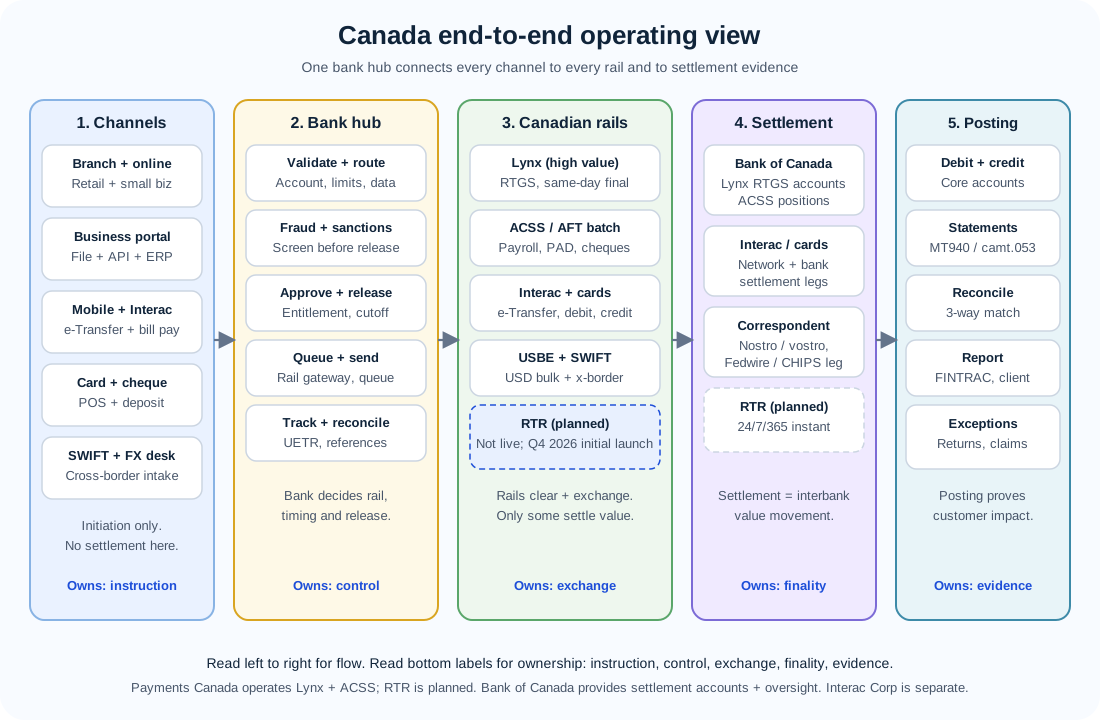
The diagram above is your anchor for the chapter. Read it left to right for flow and bottom to top for ownership. Channels own the instruction. The bank hub owns control. Rails own exchange. Settlement owns finality. Posting and reporting own evidence. Every later section is a deeper pass over one column of that picture, and every later block in the academy is a deeper pass over one box inside a column.
2. Participants, responsibilities and system boundaries
A Canadian payment always involves more parties than the two customers who think of it as "me paying you." The bank professional must keep six layers straight: the customers, the banks, the system operators, the settlement agent and overseer, the networks and correspondents, and the supervisors. Confusing any two creates the classic errors this academy corrects — treating SWIFT as a settlement system, treating Interac as part of Payments Canada, treating a direct clearer as the party that owes the customer money, or treating a PSP as a bank.
Start with customers. The originator instructs the payment; the beneficiary is entitled to receive it. In a credit push — payroll, supplier AFT, Lynx wire, Interac e-Transfer — the originator's bank acts on the originator's instruction and the beneficiary's bank credits the beneficiary. In a debit pull — a PAD collection, a USBE debit, a cheque presented for payment — the payee's bank initiates collection against the payer's account on the basis of an authorization or instrument, and the payer's bank decides to pay or return. In a card purchase, the cardholder, merchant, issuer and acquirer form a four-corner relationship with the network in the middle. In bill pay, the biller and the payer's bank share remittance responsibility. The boundary that matters operationally is this: the customer owns the economic obligation and the instruction, but the customer never settles interbank value. Only banks and their agents do.
Banks in Canada participate in different capacities, and the capacity determines liability. A direct clearer in Lynx or ACSS exchanges and settles directly, holds a settlement account at the Bank of Canada, and can sponsor indirect participants. An indirect participant — often called an indirect clearer — uses a direct clearer as clearing agent and settlement agent, which means the direct clearer stands between the indirect institution and the system for exchange and funding. A Lynx participant holds the intraday liquidity and queue responsibility for its own high-value payments. An ACSS direct clearer assumes the clearing and settlement responsibility for the items it introduces, including those of the institutions it sponsors. A receiving bank that is indirect does not "settle later because it is small"; it settles through its agent under a sponsorship agreement with defined cutoff, funding and return obligations. Block 2 covers participation models in full; here the operating lesson is that every payment has two banks with defined roles plus, where applicable, an agent bank whose cutoff and funding discipline constrains what the customer can be promised.
Payments Canada operates Lynx and ACSS today and is building the RTR for the future. Its role is often misunderstood. It does not hold customer accounts, does not decide whether an individual payroll credit posts, and does not guarantee a beneficiary payment. It provides the rulebooks, the exchange and clearing infrastructure, the settlement calculation for batch, and the network access for Lynx RTGS settlement in central-bank money. It publishes the business-day calendar including closures, maintains the Financial Institutions File and related routing references used with CACPA conventions, and advances modernization including ISO 20022 and the RTR programme. When this chapter says "the system," it means the Payments Canada-operated clearing and settlement infrastructure plus the rulebook that governs it — not the bank's internal systems.
The Bank of Canada plays three distinct roles that must never be blended. For direct participants and direct clearers, it provides the settlement accounts through which Lynx obligations settle individually and ACSS net positions settle; the Bank's policy also describes settlement accounts for planned RTR participants. As overseer of designated payment systems, it supervises systemic risk in systems including Lynx, ACSS, Interac e-Transfer, VisaNet and Mastercard systems. As supervisor under the RPAA, it registers and supervises in-scope payment service providers for operational risk, incident response, safeguarding of end-user funds and mandatory reporting. That is distinct from prudential bank supervision and from FINTRAC's financial-intelligence mandate. The practical boundary is narrower than “every Canadian-dollar payment settles at the Bank”: Lynx/ACSS direct-system settlement uses the Bank's books; customer posting, same-bank transfers and network/card funding are separate bank or scheme events. Later blocks separate these fully.
Interac Corp, card networks, and correspondent banks complete the map. Interac Corp is separate from Payments Canada, with its own addressing, notification, acceptance and bank-settlement legs. Card networks provide authorization, clearing, settlement and dispute frameworks for issuers, acquirers, merchants and cardholders. Correspondents provide the accounts and legs for foreign-currency value; SWIFT provides messaging, tracking (UETR, gpi) and CBPR+ standards — it does not settle value.
Billers, employers and PSPs matter because they originate scale. An employer with 400 payroll credits and a utility with 200,000 PADs are batch originators with file, mandate, return and reconciliation obligations the bank must enforce before exchange. PSPs supervised under RPAA may initiate or hold funds without being the settlement institution; the bank must define who authenticates, screens, holds funds, communicates status and evidences each stage.
Responsibility is a chain with no gaps. The originator authorizes and funds. The originating bank validates, screens, approves, releases and warrants. The clearing or network layer exchanges and calculates. The settlement agent moves value finally. The receiving bank posts and reports. Supervisors set rules and expect evidence. Every investigation walks that chain backwards, which is why this chapter teaches the walk once, generically.
3. Initiation, validation and bank processing
Every rail in this chapter starts in the same place: a customer instruction entering a bank channel and passing through a payment hub before any external system sees it. The hub is not a single product. It is a bank-specific reference architecture for instruction intake, validation, decisioning, release, gateway formatting, tracking and reconciliation—not a Payments Canada or regulatory prescription. Banks that operate one hub with rail adapters can reduce duplicated controls and fragmented evidence. Banks that let each channel talk directly to each rail create more reconciliation and change risk. The operating view in this chapter assumes a hub because it is a useful implementation pattern for absorbing Lynx, ACSS, Interac, cards, USBE, SWIFT and eventually RTR.
Initiation varies by channel but converges on the same data question: who pays whom, how much, in what currency, by when, with what references, and under what authority. Branch and online banking capture single wires, bill payments, Interac sends and cheque deposits with customer authentication and entered beneficiary details. Business portals, host-to-host files, APIs and ERP integrations submit bulk AFT payroll and supplier files, PAD collection files, and cross-border instructions with batch headers, item records, value dates and remittance. Mobile captures Interac addressing and card credentials. Point of sale captures card authorization requests. Cheque capture — branch, ATM, mobile, lockbox — captures image and MICR data. SWIFT and FX desks capture cross-border instructions with BICs, account numbers, charge options and purpose data. The hub's first job is to normalize these into one instruction model with a durable internal identifier that tracks the payment across every later stage, even when the external rail reference changes.
Validation is where most preventable failures are caught, and it must happen before release. Account validation confirms the debit account exists, is open, is authorized for this payment type, and holds or will hold sufficient funds or credit. Beneficiary validation confirms the institution, transit, account structure, and — for wires and cross-border — the BIC, account format and any intermediary requirement. Duplicate and anomaly checks compare the instruction against recent history, expected payroll patterns, and velocity limits. Data-completeness checks confirm the rail-mandatory fields are present: Lynx needs complete participant and beneficiary-agent data; AFT needs valid routing and amount fields that survive ACSS exchange; PAD needs mandate linkage; Interac needs a routable address; cards need token and cryptogram integrity; cross-border needs the applicable originator/beneficiary travel-rule information for international EFTs and Canadian SWIFT MT103-equivalent traffic, plus any corridor- or bank-required purpose data. Repair or reject happens here, not in clearing. A payment rejected in the hub costs a phone call. A payment rejected in clearing costs a business day. A payment released with bad data costs an investigation.
The control stack sits inside the hub between validation and release, and its order matters. Authentication and entitlement confirm the user may instruct and the approver may release — dual approval for business wires, file-release authority for payroll, mandate authority for PAD collections. Limits check amount, daily, per-payee and intraday-liquidity thresholds. Fraud monitoring scores the instruction against device, behavioural, mule, scam and account-takeover signals. Sanctions and watchlist screening checks parties, remittance text and routing against lists with a disposition of pass, false positive, or true-hit hold. FINTRAC-relevant capture supports client identification, record-keeping and prescribed reporting where applicable. Do not treat every domestic AFT, card or Interac item as an international EFT report: FINTRAC EFT reports generally attach to international EFT thresholds and the 24-hour aggregation rule, while other obligations depend on the reporting entity and event. Cutoff and calendar logic assigns the instruction to today's window or the next business day and sets the customer value-date expectation honestly. Only after all of these does the hub release. Sections 6 and 7 expand rules and controls; the point here is architectural: screening after release is recovery, not prevention, and on Lynx-settled payments recovery requires beneficiary cooperation.
Release is distinct from initiation and settlement. Release commits the instruction to the rail gateway: a Lynx pacs message queued for RTGS, an AFT file delivered for ACSS exchange, an Interac send issued, a card authorization forwarded, a USBE item submitted, a SWIFT message sent. For batch, release before the hub cutoff means today's exchange; after means tomorrow. For Lynx, release enters the RTGS queue where liquidity and priority govern timing. The hub records release time, rail, gateway acknowledgement and external reference (including UETR) at release — every inquiry starts there.
After release the hub stays active: tracking acceptances and rejections, matching clearing confirmations, watching settlement evidence, posting entries, generating statements and feeding reconciliation. It manages Lynx liquidity queues, batch repair queues, Interac pending states and correspondent pending credits with ownership and ageing. Amendments are narrow — pre-settlement cancellation where permitted, never silent editing of settled value — and the original identifier follows every return and re-origination.
Two design principles decide whether the view survives reality. First, route by policy, not silo: apply urgency, value, data, push-versus-pull and currency, subject to reasoned override. Second, fail visibly and early: a hub that rejects with reason, repair path and next-window promise creates one call; a hub that accepts everything and fails in clearing creates a week of investigations.
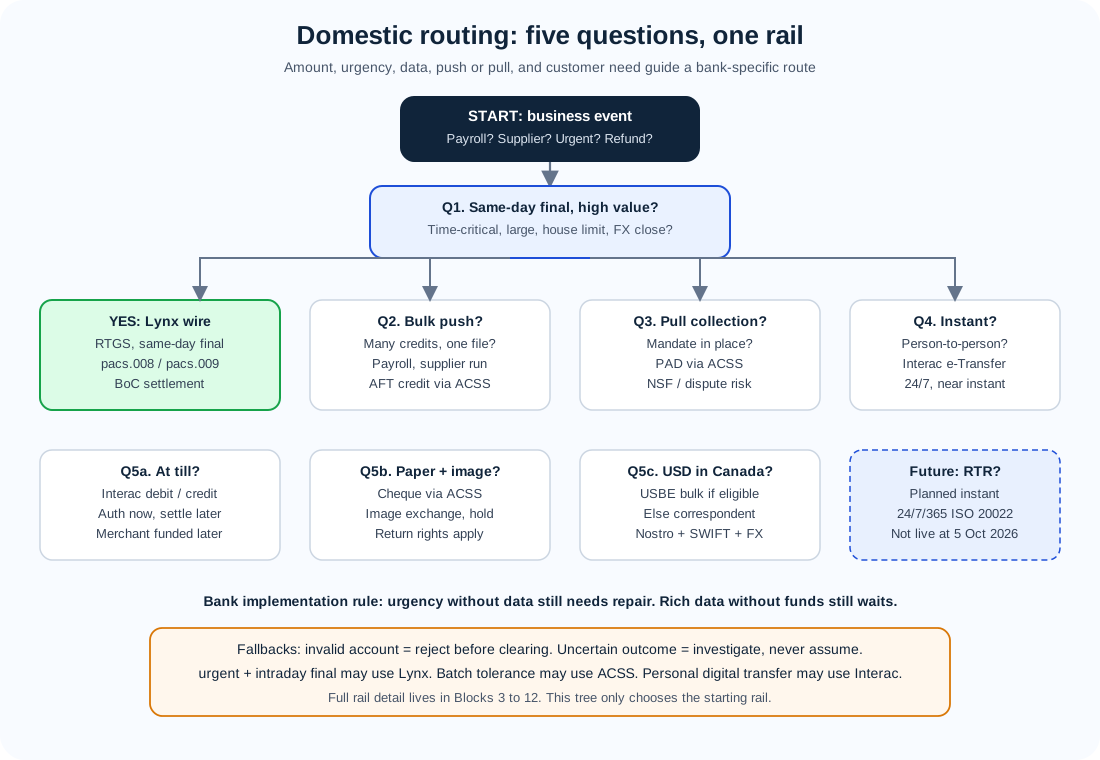
The routing tree above is intentionally shallow. It does not teach Block 2 routing detail, Block 3 stream detail, or Block 11 correspondent detail. It teaches the five questions a banker, a product designer and a hub routing engine must ask before any of that detail matters — and it makes the fallback explicit: reject before clearing when data or authority is missing, investigate uncertain outcomes rather than assuming success, and never promise same-day finality on a batch rail after its window.
4. Clearing or exchange, settlement and finality
If Section 3 is about the bank's decision, Section 4 is about the system's promise. Clearing and exchange, settlement, posting, availability and finality are five different events. Clearing compares, nets or positions instructions. Exchange delivers items and data between participants. Settlement moves value finally between settlement accounts. Posting debits and credits customer accounts. Availability tells the beneficiary the funds may be used. Finality tells the system the value movement cannot be unwound through the settlement mechanism. Every rail combines these differently, and the bank professional who blends them misleads customers, misstates liquidity and mishandles exceptions.
Lynx settles each payment individually in real time in central-bank money across settlement accounts at the Bank of Canada. There is no netting, no batch window, no deferred position. Once settled, a Lynx payment is final and irrevocable through the system; recovery of a misdirected payment requires a new payment with beneficiary agreement, not a system reversal. Queueing, priority and intraday liquidity determine when during the business day a released payment settles, but settlement itself is gross and immediate. That is why Lynx carries time-critical, large-value and settlement-critical payments — including the Canadian-dollar legs that support correspondent activity and financial-market settlement — and why its operating day is a business-day construct with published closures. Detail lives in Block 8; the overview lesson is that Lynx collapses clearing and settlement into one RTGS event with same-day finality during its business-day windows.
ACSS defers settlement by design. Participants exchange items — AFT credits and debits, imaged cheques and other paper, remittances and related batch items — through direct and indirect participation arrangements, build clearing positions by stream and window, and settle net positions through accounts at the Bank of Canada. The customer experience of "paid" therefore precedes interbank settlement, and return rights survive settlement for defined reasons and timeframes: insufficient funds, closed accounts, PAD disputes, cheque returns. A payroll credit may be made available or posted under the receiving bank's policy before the interbank position settles; a PAD debit may be posted to a biller while the payer retains rule-based dispute and return rights. That customer-posting behavior is bank-specific, not a statement that ACSS has settled the individual item. It is the batch bargain: efficiency and reach at the cost of deferred finality and return exposure. Detail lives in Blocks 3 to 5 and 10; the overview lesson is that ACSS finality is positional and rule-governed, not per-item RTGS finality, and customer availability must be explained with return rights attached.
Interac, cards, USBE and correspondent paths each add their own combination. Interac e-Transfer provides a fast customer journey—send, notify, accept or Autodeposit, confirm—through participating financial institutions, with a service/reference lifecycle distinct from interbank settlement. Availability, posting and settlement timing remain participant- and bank-dependent. Interac debit authorizes against the account in seconds with later clearing and settlement between banks and merchant funding. Credit cards authorize in seconds, clear in batches, settle between issuer and acquirer, fund the merchant net of interchange and fees, and support chargeback and dispute rights on network calendars. USBE exchanges eligible US-dollar items in Canada in batch with final dollar settlement through US agent and correspondent arrangements, not through Lynx. Correspondent cross-border payments settle across nostro and vostro accounts with possible onward Lynx, Fedwire or CHIPS legs, each with its own finality. SWIFT tracks but does not settle. The planned RTR, when live, will combine instant clearing with instant settlement and immediate confirmation on a 24/7/365 basis — which is precisely why its fraud, liquidity and operations design differs from batch.
The comparison table below is the chapter's central reference. Read it row by row for any customer question, and read it column by column to see why the bank hub, the control plane and the reconciliation process must be rail-aware. It stays at overview depth by design; each cell points to the block that teaches the full rule.
Reading labels: “live/planned” is system status as of 5 October 2026; system and scheme rows describe primary-source rules or capabilities; posting, availability, cutoffs, customer promises and control sequencing are bank-/participant-specific unless explicitly attributed.
| Dimension | Lynx (live, RTGS) | ACSS batch incl. AFT + PAD + cheque (live) | Interac e-Transfer + debit (live, separate) | Cards — credit + debit (live) | USBE USD batch (live) | Correspondent + SWIFT + FX (live) | RTR instant (planned, not live) |
|---|
| What it is best for | Same-day final CAD; large, urgent, settlement-critical | High-volume payroll, supplier runs, PAD collections, cheques | Person-to-person, consumer refund, 24/7 bill-adjacent needs | Till and online purchase, merchant collection | Eligible USD items inside Canada | Any-currency cross-border value + FX | Future instant account credit with data |
| Clearing model | None netted; per-payment RTGS queue | Exchange + multilateral positions by window | Network messaging + bank legs | Auth now; batch clear later | Batch exchange in Canada | Message chain + account debits-credits | Instant clear per payment (planned) |
| Settlement asset | Central-bank money, BoC accounts | Net positions via BoC accounts | Bank + network settlement legs | Interbank via network + merchant funding | USD via US agent/correspondent | Nostro/vostro; possible Fedwire/CHIPS leg | Planned instant settlement + confirm |
| Customer timing | Same business day if released in window | Next-window; returns possible | Near instant 24/7 for customer | Auth seconds; funding later | Batch; not instant | Value-date driven; multi-hop | Seconds, 24/7/365 (planned) |
| Finality | Final between Lynx participants on settlement; customer receipt may still be delayed | Net settlement plus rule-based return/adjustment rights | Customer confirmation/deposit is not the same as interbank settlement; participant terms apply | Scheme settlement plus dispute/chargeback rights | Per USBE/agent arrangement; returns possible | Per leg; no single global finality | Planned; apply RTR Rules and participant terms at launch |
| Data standard | ISO 20022 (pacs.008/009, camt) | Legacy AFT + ISO 20022 coexistence | Interac addressing + bank messages | Network + token data | Batch USD formats | CBPR+ pacs/camt + UETR/gpi | ISO 20022-native (planned) |
| Failure mode | Queue for liquidity; no unilateral unwind | Return, adjustment, re-present | Expire, decline, cancel pre-accept | Decline, chargeback, refund | Return via batch | Repair, recall request, cover/serial fix | Decline or uncertain-state handling (planned) |
| Deep dive | Block 8 | Blocks 3–5, 10, 14 | Blocks 6–7 | Block 10 | Block 11 | Block 11 | Block 12 |
Three implications follow. First, never equate availability with settlement: a Lynx credit and an ACSS payroll credit can look identical on a statement with opposite finality. Second, never treat messaging as settlement: SWIFT, Interac notification and AFT acceptance confirm data moved, not value settled. Third, staff and fund the clock you promise — Lynx needs intraday liquidity on business days, batch needs window discipline and return reserves, Interac and cards need 24/7 authorization and fraud coverage, correspondent needs nostro funding, and the planned RTR will need 24/7/365 liquidity and operations.
Scale reinforces the design. Lynx concentrates value, so one delayed wire can be a treasury event; ACSS concentrates items, so one bad file can be thousands of customer events. The hub manages Lynx per payment with liquidity awareness and ACSS per file with window and return awareness, presenting one customer status.
5. Data, identifiers, messages and references
If rails are the roads, data is the addressing that lets value arrive at the right house with the right letter attached. Canadian payments fail far more often from bad addressing and thin remittance than from system outages. The bank hub's data discipline — capture completely, validate early, preserve identity end to end — determines whether clearing, settlement, posting and reconciliation succeed or generate exceptions. This section maps what each rail needs, how ISO 20022 coexists with legacy formats, and which references must survive the whole journey.
Domestic routing uses institution, transit/branch and account data under Canadian routing conventions. Payments Canada's Financial Institutions File (FIF) is the official electronic directory of routing numbers, updated weekly; a bank should validate reachability against its current FIF and participant data. AFT, PAD and cheque items cannot clear without correct routing; Lynx needs complete beneficiary-agent identification in addition to account detail. Block 2 teaches the full routing architecture; the overview lesson is that reachability is a data question before it is a rail question. An unreachable or misrouted instruction must be rejected or repaired in the hub, never released "to see what happens," because each rail charges the error differently — a Lynx repair needs a new payment, a batch error needs a return cycle, a cross-border error needs a multi-bank investigation.
Each rail then adds its own addressing layer. Interac e-Transfer routes on email address, mobile number or Autodeposit registration rather than account numbers, with notification, acceptance and deposit confirmation as the addressing handshake. Cards route on PAN, token, expiry and cryptogram with issuer-acquirer-network identification behind the authorization. USBE routes eligible USD items with the additional eligibility and US-routing data the bulk exchange requires. Cross-border routes on SWIFT BICs, account numbers or IBAN-equivalents where applicable, intermediary identification, and purpose or regulatory data the corridor requires. Bill pay routes on biller identifier plus the customer account reference the biller can match. Payroll and supplier AFT route on the same domestic triple plus the remittance and employee or vendor identifiers the originator's ERP needs for reconciliation. The hub must capture the union of what the customer knows (who, how much, why) and what the rail needs (where, in what format, with what reference), and must refuse to release when the intersection is empty.
Messages carry that data, and Canada is mid-migration. Lynx supports ISO 20022 message specifications, including customer/FI payment, return, investigation and cash-management families as defined by the current Lynx portfolio. A bank must use the current Payments Canada and Swift specifications rather than hard-code a chapter list. UETR is a cross-border/Swift tracking identifier; a PCRN is the unique Lynx-generated alphanumeric identifier for a settled Lynx wire payment, not a generic Canadian return reference. AFT lives in coexistence: legacy formats that banks, employers and vendors have used for decades alongside ISO 20022-enabled processing with richer structured remittance, with mapping, truncation and repair risk wherever the two meet. Cross-border lives under CBPR+ with the same pacs and camt families plus gpi tracking. Interac and card networks use their own message families with bank-integration points rather than wholesale ISO 20022. The planned RTR is designed ISO 20022-native from inception. The coexistence lesson is practical: richer data sent into a constrained rail truncates; thin data sent into a rich rail under-describes the payment and starves reconciliation. The hub must validate against the destination rail's schema, map explicitly, log what was truncated or enriched, and carry the original reference forward so the customer statement still matches the ERP.
References are what let humans and systems agree on the same payment. Four classes of identity must be preserved where the rail supports them: the bank's internal instruction identifier; the rail or scheme reference (Lynx PCRN after settlement, ACSS trace, Interac reference, card authorization code, SWIFT UETR); a rail-native return/investigation linkage; and customer remittance (invoice, employee or bill reference). A PCRN identifies a settled Lynx payment; it is not a generic return number. Drop the relevant link and reconciliation breaks.
Two modernization notes shape hub investment. ISO 20022 coexistence is a multi-year condition, not a cutover: fund parallel validation, dual-format testing, explicit truncation rules and originator migration as permanent capabilities (Block 9). The planned RTR rewards structured remittance and end-to-end references already — cleaner masters and disciplined UETR and PCRN carriage improve Lynx, batch and cross-border reconciliation immediately.
6. Rules, cutoffs, service levels and customer impact
Customers experience rules as promises: "will it arrive today," "when can I use it," "what does it cost," "what reference will I see," "what happens if it fails." The bank experiences rules as windows, obligations and evidence. This section connects the two without inventing exact cutoff times. Exact times vary by bank, by direct clearer, by file type and by day, and they move with holidays and system calendars. This chapter therefore speaks only in relative windows — morning, afternoon and evening exchange and settlement windows on business days Monday to Friday excluding holidays, 24/7 authorization and acceptance for Interac and cards, and planned 24/7/365 operation for RTR — and directs you to your bank's published schedules and the payments.ca closure calendar for the times that bind your institution. Any study note, job aid or customer script that quotes a specific hour from this chapter is misusing it.
Business days anchor everything except the 24/7 services. Lynx, ACSS exchange and settlement, USBE exchange, and correspondent value dates operate on business days with published closures for weekends and holidays. A Thursday-evening AFT file does not "miss by minutes"; it misses the business-day window and belongs to the next one. A Friday-afternoon wire released after the bank's internal cutoff does not "just make it"; it queues or waits under the bank's published policy. A Monday holiday does not compress the week; it shifts value dates and return clocks. Block 14 teaches cutoff, calendar and business-day mechanics fully; the overview lesson is that the hub must assign every instruction to a business-day window at intake, communicate that window honestly, and never let a channel promise what the rail calendar cannot deliver.
Relative windows differ by rail in ways the timeline diagram makes visible. Lynx settles during business-day RTGS windows with intraday queueing — morning liquidity build, midday throughput, afternoon funding decisions. ACSS exchanges and clears in daytime batch windows with positions settling in defined settlement windows — files in, items exchanged, positions calculated, funding completed. USBE follows its own batch windows with US-leg timing overlaid. Interac and card services are commonly offered outside Payments Canada business days, but participating-FI, issuer and acquirer availability, risk controls and scheme calendars govern the actual customer outcome; bank settlement and merchant-funding legs remain separate events. The planned RTR will run 24/7/365 with instant settlement per payment, which is why its staffing, liquidity and fraud model differs categorically from batch. The customer-impact translation is direct: an evening Interac refund can be accepted tonight; an evening AFT payroll file cannot create Friday-morning value if it missed its window; a time-critical afternoon supplier payment that missed batch belongs on Lynx if the customer needs same-day finality and accepts the cost and data requirements.
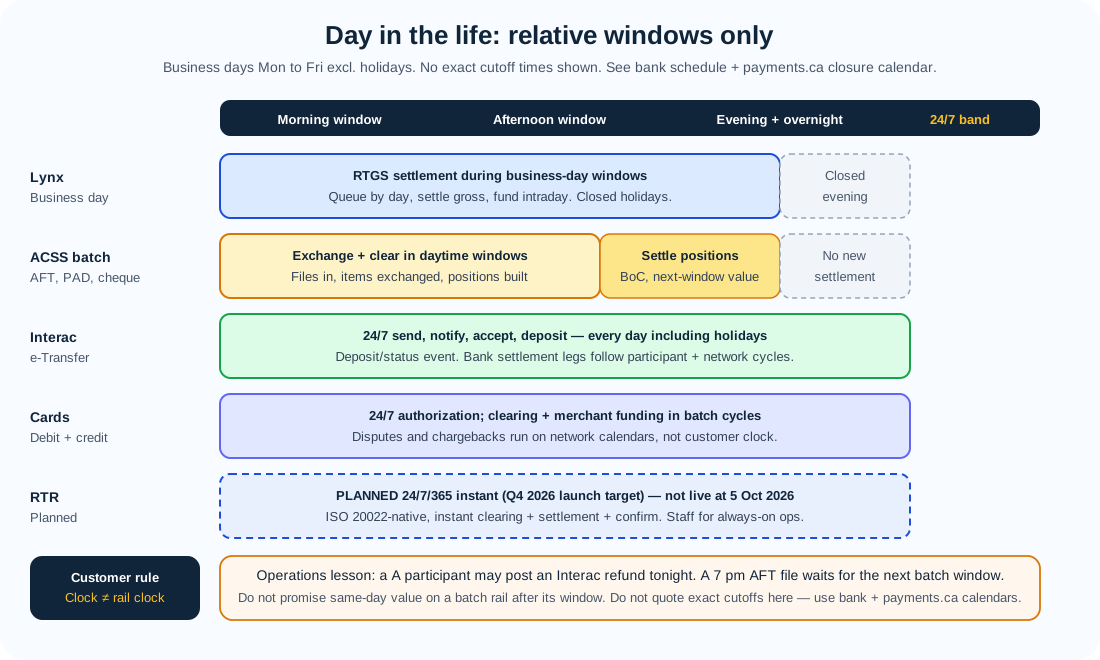
Service levels bundle timing with certainty, information and recourse. Lynx offers same-day finality with complete beneficiary-agent data, intraday status and irrevocability — at wholesale pricing and with no unilateral recall. ACSS batch offers low-cost scale with structured returns and adjustments — at the price of deferred settlement and return exposure. Interac offers 24/7 near-instant customer experience with Autodeposit, request-money and refund paths — with expiry, decline and cancellation rules before acceptance. Cards offer instant authorization with later funding and network dispute rights — with interchange, fees and chargeback economics. USBE offers economical USD batch inside Canada — with eligibility limits and US-timed finality. Correspondent offers global reach with FX, tracking and value-date control — with multi-hop timing, charges and investigation cost. RTR, when live, will offer instant value with rich data and immediate confirmation — with real-time fraud and always-on operations as the price. The bank's product and advisory job is to match the business event to that bundle, not to sell every payment on speed alone.
Customer communication must reflect finality honestly. "Sent" means released from the hub. "Accepted" means the gateway or network took it. "Settled" means interbank value moved finally. "Posted" means the beneficiary account was credited. "Available" means the beneficiary may use the funds, subject to holds or return rights where applicable. "Final" means the settlement cannot be unwound through the system. A Lynx "settled" can be stated as final with confidence during the business day. An ACSS "posted" must be stated with return-rights awareness. An Interac “deposited” status is a customer-facing milestone; do not equate it with an independently verified interbank settlement record. Participant terms and bank posting policy govern availability and recourse. A correspondent "tracked to beneficiary bank" must be stated as a messaging milestone, not as proof of posting, until the credit confirmation or camt statement arrives. Training every customer-facing colleague on those five words prevents more complaints than any system upgrade.
Pricing and cutoffs interact. Urgency costs — Lynx and correspondent investigation capacity cost more than batch — and customers accept that when the tradeoff is explicit. What they do not accept is paying for urgency and receiving batch timing, or paying for batch and discovering a hold or return no one mentioned. The hub's cutoff engine and the channel's promise engine must share one clock: the channel may only offer what the hub confirms for this instruction, this amount, this rail, this business day. That single-clock discipline is an implementation requirement from Section 10, not a slogan.
7. Fraud, compliance and operational controls
Controls fail when they are complete but misplaced. A sanctions check that runs after Lynx settlement, a fraud hold that triggers after Interac acceptance, a FINTRAC report built from truncated data, a PAD mandate review that starts only after dispute — each is a control that exists and still loses. This section places each control family at the point in the end-to-end flow where it can still change the outcome, and explains how the families interact without duplicating the rail-level control detail that lives in Block 13.
Fraud controls span initiation, transaction risk and post-event response. Takeover and social engineering attack initiation — authenticate, verify device and behaviour, challenge anomalous payees before release. Push-payment scams attack instruction truth — validate beneficiary changes and enforce dual approval and callbacks for wires. Mule activity attacks the receiving side — score incoming credits as well as outgoing payments. Cards need seconds-level issuer decisions; cheques need capture validation and holds; PADs need mandate evidence before presentment. The planned RTR compresses this into seconds with irrevocable settlement (Block 12). Fraud monitoring must run pre-release for every rail with a single case queue so a customer hit across two rails is seen once.
AML/ATF and FINTRAC obligations attach to reporting entities and specified events; they are not a blanket payment approval. For applicable EFTs, capture the required originator/beneficiary information, preserve instruction-to-settlement linkage, and report on the applicable threshold/timing rules. FINTRAC's current guidance says international EFT reports generally use the $10,000 threshold, the 24-hour aggregation rule and a five-business-day filing deadline; the travel rule also covers Canadian EFTs sent by SWIFT MT-103 or equivalent. Thresholds and filing mechanics belong in Block 13 and current FINTRAC guidance.
Sanctions compliance must prevent prohibited dealings and is a bank control, not a Payments Canada routing rule. Screen proposed transactions and relevant parties against the applicable Canadian/UN lists, investigate indirect dealings and escalate holds under the institution's sanctions program. Apply the FINTRAC travel-rule data requirement where it legally applies; missing data is handled under the applicable FINTRAC and scheme rules. Cross-border screening repeats per hop, so complete data matters — truncation creates multi-day false positives. Domestic screening matters equally: settled Lynx value cannot be unilaterally unwound. Log what was checked, when, against which list, and by whom.
RPAA supervision adds the PSP boundary. In-scope PSPs must register and are supervised by the Bank of Canada for operational risk, incident response, safeguarding of end-user funds and mandatory reporting. The RPAA excludes payment functions performed within a designated system such as Interac e-Transfer, but functions outside that system—such as account maintenance or instruction transmission—may remain in scope. A bank integrating a PSP should document who authenticates, screens, holds funds, communicates status and preserves evidence.
Operational controls complete the plane: entitlements and dual approval, limits and velocity, cutoff enforcement, queue management, amendment discipline, evidence preservation and segregation of duties. The control that ties them together is a documented release discipline: authentication, validation, limits, fraud, sanctions/data requirements, cutoff and approval are applied as required by the rail, law and bank policy, with each decision logged. The exact order and control owner are implementation-specific; scheme controls and issuer/acquirer decisions may occur in parallel or after gateway submission. Exceptions to that order — manual releases, verbal instructions, after-cutoff overrides — must themselves be controlled, dual-approved and time-bound, because every major loss in Canadian payment operations history involves an override that bypassed the order. Resilience controls — backup connectivity, contingency files, failover rails, communication trees — belong in the same plane and are covered in Section 10.
8. Exceptions, investigations and recovery
Every rail breaks differently, but every break is managed the same way: detect fast, classify correctly, contain within the rail's rights, recover as a new linked event, and reconcile with evidence. Banks that classify first recover cheaply. Banks that act first — re-sending, manually crediting, editing a settled payment — create duplicate payments, duplicate credits and audit breaks that dwarf the original error. This section teaches the classification and the recovery discipline at overview depth; Block 14 teaches each mechanism fully.
Start with the taxonomy. A reject happens before clearing: the hub, gateway or receiving participant refuses the instruction for invalid routing, closed account, limit breach, failed screening or incomplete data. Nothing settled; the originator repairs and re-originates. A return happens after entry: the receiving side sends the item back for NSF, closed account, PAD dispute, cheque return or USBE ineligibility, with reason codes and timeframes defined by the rulebook. A recall or return request is a post-submission or post-settlement request whose availability depends on the rail, scheme rules and status. A settled Lynx payment cannot be unilaterally reversed; recovery normally requires a new linked event and cooperation from the payee/receiving institution. Interac cancellation before acceptance and card refunds/chargebacks use their own scheme and participant processes. A reversal corrects a bank or system error through a defined mechanism, never by silent editing. A dispute or chargeback invokes network or rulebook rights — PAD reimbursement, card chargeback, Interac fraud claim — with evidence burdens and calendars. An investigation tracks an uncertain outcome — a timed-out authorization, a correspondent payment with no credit confirmation, a batch item with no return yet — through status inquiry, camt.056 and camt.029 flows, UETR and PCRN tracking, and beneficiary-bank confirmation. Each word means something different, and using them interchangeably in customer communication or incident tickets guarantees confusion.
Rail rights constrain recovery, so classify before acting. Lynx-settled value needs a new payment with beneficiary agreement — no system reversal. ACSS items use returns, adjustments or re-presentment within windows. Interac allows cancellation before acceptance with fraud paths after deposit. Cards use merchant refunds or network chargebacks. USBE follows batch returns; correspondent payments are investigated hop by hop with repair or re-issue. The hub must prevent impossible offers — no Lynx "reversal," no PAD "chargeback," no "cancellation of settled value."
Investigations walk one path: confirm release and reference, exchange acceptance, settlement evidence, posting or return, then communicate state. Lynx needs queue, settlement and beneficiary-posting status; batch needs file, trace, position, return and re-presentment status; Interac needs send, notification, acceptance or expiry and deposit confirmation; correspondent needs UETR and gpi tracking, intermediary confirmations, FX value-date verification and credit advice. Preserve the original identifier throughout.
Recovery follows four rules. Never edit settled value — originate a linked corrective payment. Never re-send on assumption — confirm original state first, or timeouts become duplicates. Choose the recovery rail by current urgency, not original rail. Communicate state plus next value date, not activity.
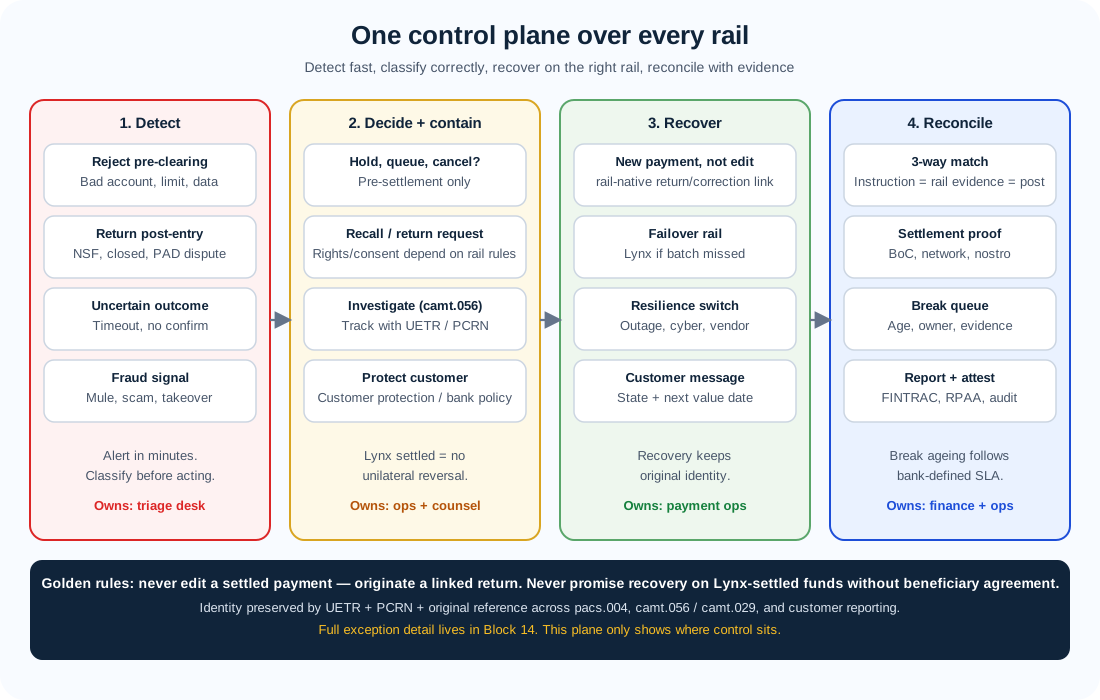
The control-plane diagram above compresses the section into an operating poster: detect in minutes, decide with rail rights in view, recover as a linked new event on the right rail, and reconcile to evidence with no idle breaks. Print it mentally on the operations wall. Blocks 13 to 15 then fill each box with rail-level procedure.
9. Posting, accounting, liquidity, reporting and reconciliation
If Sections 3 to 8 move money, Section 9 proves it moved correctly and funds the next movement. Posting, accounting, liquidity, reporting and reconciliation are not back-office afterthoughts. They are the bank operations view of the same payment, and they determine whether the bank closes the day funded, balanced and explainable. This section follows a payment from settlement evidence to customer statement to general ledger to liquidity position to regulatory report, and shows the three-way reconciliation that holds the chain together across every rail.
Posting translates settlement and clearing evidence into customer entries: Lynx credits post on settlement with same-day finality; AFT payroll posts hundreds of credits with one employer debit and return exposure behind it; PADs post biller credits with payer debits and dispute rights; Interac customer status/posting follows participating-bank implementation; interbank settlement is a separate leg; cards create an authorization/hold; issuer posting and merchant funding follow issuer/acquirer/network rules; cheques post with holds; cross-border customer posting, FX and nostro accounting follow the bank/correspondent arrangement and agreed value date. Each entry carries instruction, rail and remittance references the customer recognizes.
Accounting rolls postings into clearing and suspense accounts, BoC settlement accounts, network settlement accounts and nostro and vostro accounts. Fees post separately and visibly, never netted into principal. Returns and chargebacks post as linked distinct entries. A suspense balance growing without ownership is an investigation waiting for a complaint.
Liquidity funds release into settlement. Lynx consumes intraday liquidity payment by payment; ACSS consumes window funding for net positions plus a return buffer; correspondent consumes foreign-currency nostro funding across value dates; Interac and card legs need continuous smaller funding; the planned RTR will need 24/7/365 prefunding with treasury coverage. The treasurer's morning question is answered from the hub queue plus rail calendars.
Reporting serves customers (statements, advices, return reports, honest status), treasury and finance (confirmations, positions, nostro statements such as camt.052/053/054, fee and liquidity reports), and regulators (FINTRAC, RPAA, oversight and audit evidence) — all carrying one identity.
Reconciliation proves instruction, clearing evidence and posting agree, per rail, every business day, with breaks queued by age and owner. No break sits idle past one business day without owner, action and customer message where needed. Watch two pathologies: double-counting when an emergency Lynx credit duplicates an unlinked batch file, and nostro blindness when SWIFT acknowledgement is treated as proof before the nostro credit arrives short or late.
10. Bank implementation, testing and resilience
Seeing the operating view is one skill. Wiring a bank to deliver it is another. This section is for product, technology and operations leaders who must turn the architecture into releases, tests and runbooks — and who must prepare for RTR initial launch and the FSRB initiative without destabilizing today's Lynx, batch, Interac, card, USBE and correspondent services. It stays at implementation-overview depth; each rail's build detail lives in its block.
Wire the hub before adding rails: shared intake, validation, fraud, sanctions, entitlements, limits, cutoff and routing engines, gateway adapters, tracking, posting, reporting and reconciliation — fronted by channels, connected per rail. Each adapter translates the canonical instruction (Lynx pacs, AFT legacy and ISO 20022 files, Interac messages, card messages, USBE formats, SWIFT CBPR+ with FX) and normalizes rail statuses into one model — released, accepted, exchanged, settled, posted, returned, under investigation, recovered. RTR then arrives as one more adapter, not a new silo.
Testing must prove control as well as connectivity: schema and authentication per gateway; hub rejection of bad routing, duplicates, limit breaches and incomplete cross-border data; fraud, sanctions, entitlement and cutoff decisions including holds and evidenced false-positive releases; Lynx queue behaviour under liquidity stress; ACSS position funding; Interac acceptance and expiry; card authorization-to-clearing matching; USBE eligibility; correspondent repair and tracking; linked returns and investigations with correct customer messages; daily three-way matching with break ageing; regression and payday-scale volume. Sign-off needs operations, treasury, financial crimes, finance and support — not technology alone.
Resilience covers what customers cannot see: dual gateway connectivity, hub failover, backup batch submission, contingency Lynx and nostro funding, cyber-recovery preserving evidence, vendor runbooks, and communication trees. Drill rail-specific failover: delayed ACSS exchange, Lynx queue build, Interac notification degradation, stalled correspondent chains with value-date renegotiation.
For RTR on 5 October 2026, readiness means programme participation and testing, not production: access eligibility and any applicable RPAA assessment, 24/7/365 staffing, fraud and support models, an ISO 20022-native adapter with instant confirmation, and settlement-account funding/liquidity design with treasury. Channels must not offer RTR before reachability, testing and funding are actually available. For FSRB — an initiative exploring retail-batch evolution, not a live rail — track design direction and keep adapters modular for future format or window changes. For federally regulated banks, this also aligns with OSFI operational-resilience expectations for business continuity, disaster recovery, crisis management, change, technology/cyber, third-party and data risk. Every change needs calendar assessment, customer communication, control re-attestation, rollback respecting finality, and reconciliation prove-out over a full business-day cycle including returns.
11. Practical Canadian end-to-end example
Theory holds until payday. This section works two fictional multi-rail stories that cross the rails this chapter connects. Both are explicitly fictional — invented companies, people, amounts and timings used only to teach operating logic. Neither invents system cutoff times; both speak in relative windows. Neither treats RTR or FSRB as live. Follow each story with the diagrams open, then extract the control lesson before moving to takeaways.
Story A (fictional): Northline Foods — manufacturer payday across five rails
Northline Foods is a fictional 400-employee food manufacturer in Mississauga. It banks with a fictional Canadian direct clearer. Thursday is the day everything converges: Friday-morning payroll, a monthly flour-supplier PAD, an urgent oven wire, a customer refund request, and a US packaging invoice due next Tuesday. Treasurer Amara and operations lead Daniel run the day with the portal, file channel and FX desk.
Payroll first. Amara releases the AFT file before the morning batch window. The hub validates routing, funds, limits, totals and duplicates, confirms dual approval, and accepts for today's ACSS exchange. Two items reject pre-clearing — a closed account and a transposed transit — with repair guidance. The rest exchange, position and schedule for settlement; credits post for Friday-morning availability. Validation before exchange turns a 400-person incident into two repairs.
Mid-morning, the supplier's PAD presents against Northline's account under a business agreement. The bank checks mandate linkage, tolerance and standing, then pays while preserving dispute rights. Daniel confirms funding for payroll debit plus PAD with treasury. Pulls need authority evidence plus cash forecasting.
Early afternoon, the $185,000 oven balance needs same-day finality to hold the weekend slot — batch cannot promise it this late. The hub proposes Lynx; screening and dual approval pass; the pacs.008 settles gross in the afternoon window with finality, and the vendor's bank posts. Urgency plus value plus complete data equals Lynx, with liquidity consumed knowingly.
Late afternoon, the $4,200 refund goes by Interac e-Transfer to the customer's registered address — notified and, if Autodeposit is enabled, deposited under the participating bank's process; the customer-facing deposit event is distinct from bank settlement evidence. Clock matching: 24/7 experience without misusing wholesale rails.
The day closes with US$62,000 due next Tuesday. Because the supplier is outside Canada, this is not an eligible domestic USBE item; it goes through the bank's correspondent path: FX quoted and accepted, SWIFT pacs.008 with UETR, complete agents, travel-rule data and SHA charges, screened before release, tracked to beneficiary-bank credit on value date with nostro reconciled. Message tracks; nostro settles; FX dates value.
Friday proves the plan: 398 credits post, two repaired items re-originate linked to originals, PAD reconciles, wire stands final, refund confirmed deposited, dollars track to Tuesday value. Three-way reconciliation closes with two owned breaks and no idle suspense.
Story B (fictional): Lakeshore Outfitters — retailer week across Interac, cards, batch and wires
Lakeshore Outfitters is a fictional Toronto-area retailer with three stores, an online shop, weekly supplier runs and weekend staff payroll. Its week exercises the rails Story A touched lightly: cards, bill pay, Interac business flows and a contingency wire.
Monday: weekend card authorizations approved in seconds clear in batch with merchant funding net of interchange and fees — authorized does not equal funded, funded does not equal gross. A refund posts as a linked distinct event; a dispute enters chargeback with delivery and security evidence on network calendars.
Tuesday: the ERP supplier file validates and releases as AFT credits with matchable invoice remittance; one strict same-day supplier with complete wire data splits to Lynx with fee approval — routing by policy, not habit.
Wednesday: a wholesale PAD returns NSF; operations notifies per mandate terms, offers Interac as a consented immediate alternative, preserves return evidence — a returned pull is not revenue, and re-presentment without authority is a compliance event.
Thursday: a corrupted payroll export rejects correctly at validation; the vendor repairs, the file re-validates and releases in-window. The pre-tested backup — critical credits via instant or wire options with employee communication — stays unused. Resilience without improvisation.
Friday closes with three-way reconciliation plus merchant and remittance matching: volume and value need different rhythms under one hub and one evidence standard.
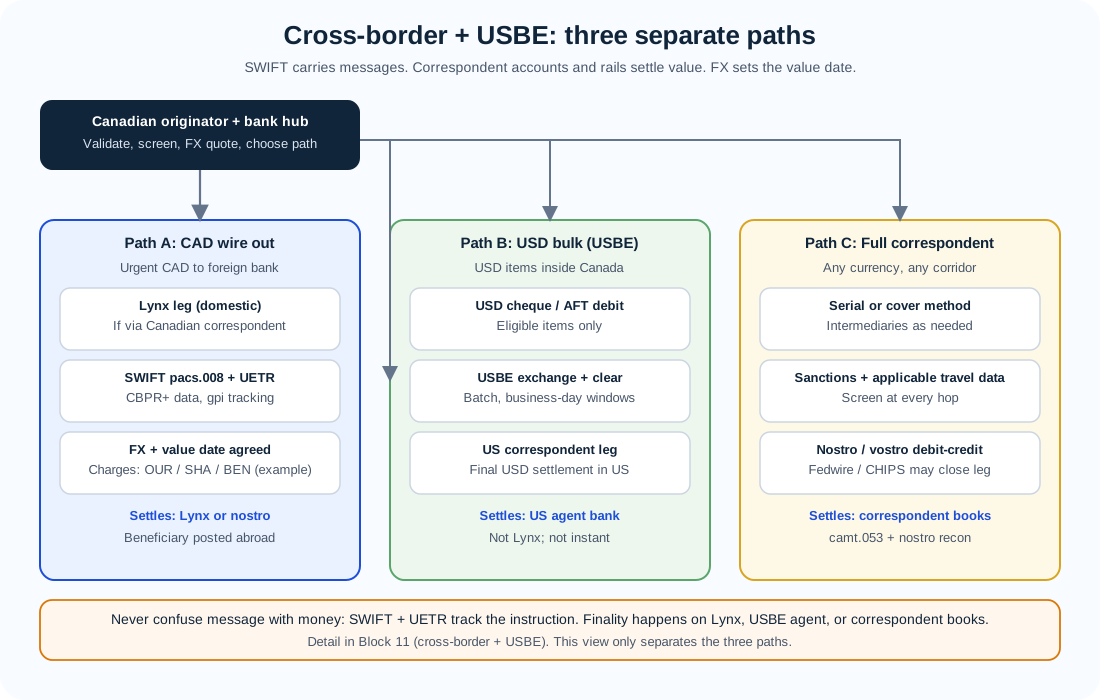
Keep the cross-border diagram beside both stories whenever dollars cross the border. Path A, B or C is a routing decision with funding, data and timing consequences — not a label. And keep the timeline beside every promise about "today": the customer's tonight and the rail's business-day window are different clocks, and the bank must translate between them honestly.
Misunderstandings this chapter corrects
Ten errors recur in classrooms, branches and operations floors. Each is stated, corrected and pointed forward.
- "ACSS settles each payment like Lynx." No. ACSS exchanges and positions batch items with deferred net settlement and return rights; Lynx settles each payment gross in real time with same-day finality. Detail in Block 3 versus Block 8.
- "Interac is part of Payments Canada." No. Interac Corp is separate, with its own addressing, notification, acceptance and bank-settlement legs. Detail in Blocks 6 to 7.
- "SWIFT settles the cross-border payment." No. SWIFT messages and tracks; correspondent accounts, and onward Lynx, Fedwire or CHIPS legs, settle value. Detail in Block 11.
- "USBE is just Lynx in dollars." No. USBE is a USD batch exchange inside Canada with US-agent dollar settlement, eligibility limits and batch timing. Detail in Block 11.
- “RTR is live because the by-law is in force.” No. As of the 5 October 2026 audit date, Payments Canada says RTR is launching in Q4 2026; By-law No. 10 came into force on 24 August 2026, but legal readiness is not production reachability. Detail in Block 12.
- "FSRB is a system I can route to." No. FSRB is a modernization initiative for retail batch, not a live rail. This chapter references the concept only for readiness planning.
- "ISO 20022 means one format everywhere now." No. Lynx is ISO 20022-enabled, AFT is in legacy and ISO 20022 coexistence with mapping risk, cross-border is under CBPR+, and Interac and cards use their own families. Detail in Block 9.
- "A settled Lynx payment can be reversed like a PAD." No. Lynx settlement is final and irrevocable through the system; recovery needs a new payment with beneficiary agreement. PADs, cheques and batch items carry defined return and dispute rights instead. Detail in Blocks 5, 8 and 14.
- "Sanctions and fraud checks can follow settlement." No. Screening must gate release; post-settlement review is recovery with beneficiary cooperation, not prevention. Detail in Block 13.
- "Reconciliation is finance's month-end job." No. Three-way reconciliation — instruction, rail evidence, posting — runs every business day per rail with owned, aged breaks. Detail in Block 14.
12. Key takeaways and authoritative references
Hold the operating view as five sentences. Channels take instructions; they never settle value. The bank hub validates, screens, approves, releases and tracks; its release discipline determines whether controls prevent or merely record. Rails exchange — Lynx RTGS for same-day final CAD, ACSS batch for scale with return rights, Interac and cards for 24/7 experience with later funding legs, USBE and correspondent with SWIFT and FX for dollar and cross-border value, and the planned RTR for future instant value — and each rail's finality, timing and data bargain differs. The Bank of Canada settles Canadian-dollar positions and oversees systemic risk while supervising retail payment activities; Payments Canada operates Lynx and ACSS today and the RTR programme for tomorrow; Interac Corp, card networks and correspondents complete the settlement picture. Posting, liquidity, reporting and daily three-way reconciliation prove the day closed funded, balanced and explainable — and recovery always preserves original identity through linked corrective events.
Carry five numbers with care. ACSS cleared about 10.6 billion items worth about $10 trillion in 2025. Lynx settled about 13.6 million payments worth about $93.3 trillion in 2025. Together about $103 trillion in the year, about $411 billion per business day. Lynx has been live since 1 September 2021. RTR is not live on the 5 October 2026 audit date; Payments Canada still describes launch as Q4 2026. Those figures and dates are the chapter's quantitative spine; everything else is operating logic built on them. Quote them only with their source and baseline, and re-check them against current Payments Canada reporting before customer or examination use after 5 October 2026.
Carry five behaviours into your next business day. Route by policy with reason — urgency, value, data, push-versus-pull, currency — and log the choice. Release only through the full control order with evidence. Promise only the window the rail calendar supports, in relative terms, with the exact time taken from your bank's schedule and the payments.ca closure calendar. Investigate uncertain outcomes before re-sending, and recover as a linked new event. Reconcile daily with no idle breaks. Those behaviours, repeated across billions of batch items and trillions of wire value, are what make Canadian payments boring in the best sense: predictable, provable and resilient.
Where to go next — forward links to Blocks 2 to 15
This chapter connected the rails; the following blocks take each apart. Use this map as your study sequence.
- Block 2 — Canadian Accounts, Routing and Infrastructure. For institution, transit and account detail, CACPA routing conventions, Financial Institutions File use, direct versus indirect participation and sponsorship, and the full infrastructure architecture behind the hub-and-rails picture, study Bank Account and Transit Numbers; Institution Numbers and CACPA Routing; Financial Institutions File and Payment Routing; Direct and Indirect Clearing Participants; Canadian Payment Infrastructure Architecture.
- Block 3 — ACSS and Retail Batch Payments. For exchange, clearing streams, windows, business days, settlement lifecycle, adjustments and reconciliation of batch, study ACSS Fundamentals; ACSS Clearing and Exchange Model; ACSS Settlement Lifecycle; Clearing Streams, Windows and Business Days; ACSS Exceptions, Adjustments and Reconciliation.
- Block 4 — AFT Credits and Direct Deposits. For payroll, supplier and disbursement files from initiation to returns, study Automated Funds Transfer in Canada; AFT Credit and Direct Deposit; Payroll Payments; Corporate and Supplier Payments; AFT Credit Returns and Reconciliation.
- Block 5 — Pre-Authorized Debits and Collections. For mandate-to-cash, Rule H1, personal versus business agreements, NSF, retries, cancellation, disputes and reimbursement, study Canadian PAD Fundamentals and Rule H1; Personal and Business PAD Agreements; PAD Authorization and Mandate Lifecycle; PAD Processing, NSF, Returns and Retries; Cancellation, Disputes and Reimbursement.
- Block 6 — Interac e-Transfer. For send-money, Autodeposit, request-money, cancellation, fraud and reconciliation of consumer Interac journeys, study Interac Ecosystem; Interac e-Transfer Send Money; Autodeposit; Request Money; Exceptions, Cancellation, Fraud and Reconciliation.
- Block 7 — Interac Business and Pay by Bank. For business payables, receivables, bulk flows, Interac Direct, pay-by-bank checkout and remittance matching, study Interac e-Transfer for Business; Bulk Payables; Bulk Receivables; Interac Direct and Pay by Bank; Business Remittance and Receivables Reconciliation.
- Block 8 — Lynx and High-Value Payments. For Lynx architecture, domestic wire lifecycle, RTGS settlement and finality, liquidity and queue management, returns and investigations, study Lynx High Value Payment System; Canadian Domestic Wire Lifecycle; Lynx RTGS, Settlement and Finality; Liquidity and Participant Processing; Wire Returns, Investigations and Reconciliation.
- Block 9 — ISO 20022 and Payment Messages. For pacs.008, pacs.009, pacs.004, camt families, PCRN, UETR and AFT legacy coexistence, study ISO 20022 in Canada; Lynx pacs.008 and Customer Credit Transfers; pacs.009 and Interbank Payments; pacs.004, camt Messages, PCRN and UETR; AFT ISO 20022 and Legacy Format Coexistence.
- Block 10 — Bills, Cards, Cheques and Other Payments. For bill-pay remittance, Interac debit, credit-card lifecycle, cheque image clearing with holds and returns, and government and cash payments, study Canadian Bill Payments; Interac Debit and Domestic Debit Cards; Credit Card Payment Lifecycle; Cheque and Image Clearing; Government Payments, Cash and Other Payment Methods.
- Block 11 — Cross-Border and USD Payments. For correspondent accounts, serial versus cover, SWIFT CBPR+, FX and value dates, and USBE processing with positions and exceptions, study Canada Cross-Border Payments Landscape; SWIFT and CBPR+; Correspondent Banking and Intermediaries; Foreign Exchange and Cross-Border Settlement; USBE and USD Payments in Canada.
- Block 12 — Real-Time Rail. For the RTR programme, access model, end-to-end instant lifecycle, ISO 20022 settlement and finality, fraud services and future use cases — remembering RTR is planned for Q4 2026 initial launch and not live on 5 October 2026 — study Canada Real Time Rail Overview; RTR Participants and Access Model; RTR End to End Payment Lifecycle; ISO 20022, Settlement and Finality; RTR Fraud Services and Future Use Cases.
- Block 13 — Fraud, AML, Sanctions and Regulation. For fraud landscape, rail-specific controls, FINTRAC reporting, sanctions and travel-rule screening, and RPAA supervision with consumer protection, study Canadian Payment Fraud Landscape; Fraud Controls Across EFT, PAD, Interac and Wires; FINTRAC, AML and Transaction Reporting; Sanctions, Travel Rule and Payment Screening; RPAA, PSP Supervision and Consumer Protection.
- Block 14 — Payment Operations and Exceptions. For cutoffs, calendars, rejects, returns, recalls, reversals, investigations, posting, accounting, statements, liquidity and resilience runbooks, study Cutoffs, Calendars and Business Days; Rejects, Returns, Recalls and Reversals; Payment Investigations and Exception Management; Posting, Accounting and Statements; Reconciliation, Liquidity and Operational Resilience.
- Block 15 — Canada End to End Payment Stories. For full worked stories that apply this chapter's operating view rail by rail, study Payroll Through AFT and ACSS; Utility Collection Through PAD; Interac Consumer and Business Payment; Domestic Lynx and Cross Border Wire; Real Time Payment and Exception Journey.
Authoritative references (official primary sources, audit date 5 October 2026)
This chapter uses official primary sources for system, legal and regulatory claims. Bank-specific processing, posting, cutoffs, participant contracts and scheme procedures are labelled as implementation or policy choices and must be verified against the institution's current procedures. Re-check any time-sensitive page before customer or examination use. No exact cutoff times are stated; for binding times use the bank's published schedule and the Payments Canada closure calendar.
- Payments Canada — Lynx system page. Operator description of Lynx as Canada's real-time gross settlement system for high-value and time-critical payments, live since 1 September 2021, settling in central-bank money. https://www.payments.ca/systems-services/payment-systems/high-value-payment-system-lynx
- Payments Canada — Real-Time Rail payment system. Current launch target is Q4 2026; the page describes instant, data-rich exchange, clearing and settlement. https://www.payments.ca/systems-services/payment-systems/real-time-rail-payment-system
- Payments Canada — Retail batch payment system. Official description of ACSS and USBE, direct/indirect clearers, Bank of Canada net settlement, 2025 ACSS statistics and eligible paper/electronic streams. https://www.payments.ca/systems-services/payment-systems/retail-batch-payment-system
- Payments Canada — System statistics. Source for 2025 ACSS (10.6 billion items, about $10 trillion) and Lynx (13.6 million items, about $93.3 trillion). https://www.payments.ca/high-value-payment-system-lynx-statistics and https://www.payments.ca/automated-clearing-settlement-system-acss-statistics
- Payments Canada — Lynx wire payments and PCRN explainer. Official definition of PCRN as the Lynx-generated identifier for a settled Lynx wire, plus participant, cut-off and intermediary caveats. https://www.payments.ca/explainer-lynx-wire-payments-and-payment-confirmation-reference-number
- Bank of Canada — Payment systems the Bank oversees. Official exchange/clearing/settlement definitions and list of overseen systems, including Lynx, ACSS, Interac e-Transfer, VisaNet and Mastercard systems. https://www.bankofcanada.ca/regulatory-oversight/financial-market-infrastructures/payment-systems-the-bank-of-canada-oversees/
- Bank of Canada — Settlement account policies for Payments Canada systems. Official direct-participant/direct-clearer settlement-account and central-bank-money policy for Lynx, ACSS and planned RTR. https://www.bankofcanada.ca/core-functions/financial-system/bank-canadas-settlement-account-policies-for-payments-canada-payment-systems/
- Canada Gazette — Payments Canada By-law No. 10 — RTR (SOR/2026-133). Legal source for participation, settlement-agent, testing and 24 August 2026 coming-into-force provisions. https://gazette.gc.ca/rp-pr/p2/2026/2026-07-01/html/sor-dors133-eng.html
- Payments Canada — Financial Institutions File. Official routing directory, weekly update cadence and subscription/sponsorship model. https://www.payments.ca/systems-services/payment-services/financial-institutions-file
- Payments Canada — ISO 20022 and AFT resources. Official scope, coexistence and AFT onboarding/testing/message portfolio. https://www.payments.ca/payment-resources/iso-20022 and https://www.payments.ca/payment-resources/iso-20022/automatic-funds-transfer
- Payments Canada — System closure schedule. Official Monday–Friday operating statement and 2026 statutory-holiday closures. https://www.payments.ca/system-closure-schedule
- Payments Canada — ACSS rule changes enhance payment system processes (27 July 2026). Current rule update, including paper-PAD phase-out effective 1 December 2028 and other operational amendments. https://www.payments.ca/acss-rule-changes-enhance-payment-system-processes
- Bank of Canada — Retail payments supervision. Official RPAA registration, operational-risk, incident, safeguarding and reporting responsibilities; consumer-dispute boundary. https://www.bankofcanada.ca/regulatory-oversight/retail-payments/
- Bank of Canada — FAQ on retail payments supervision (14 August 2026). Official scope caveat for designated systems such as Interac e-Transfer and functions performed outside them. https://www.bankofcanada.ca/2026/08/frequently-asked-questions-about-retail-payments-supervision/
- FINTRAC — Reporting electronic funds transfers and travel rule. Official $10,000 international-EFT threshold, 24-hour aggregation, five-business-day filing rule and travel-rule scope. https://fintrac-canafe.canada.ca/guidance-directives/transaction-operation/eft-dt/eft-dt-eng and https://fintrac-canafe.canada.ca/guidance-directives/transaction-operation/travel-acheminement/1-eng
- Global Affairs Canada — Canadian sanctions guidance: Financial sector. Official screening, indirect-dealing, prohibited-financial-service and sanctions-reporting guidance. https://www.international.gc.ca/world-monde/international_relations-relations_internationales/sanctions/financial-sector-secteur-financier.aspx?lang=eng
- OSFI — Guideline E-21, Operational Risk Management and Resilience. Official expectations for continuity, disaster recovery, crisis/change, technology/cyber, third-party and data risk. https://www.osfi-bsif.gc.ca/en/guidance/guidance-library/operational-risk-management-resilience-guideline
- FCAC — How to file a complaint with your bank. Official customer escalation process and 56-day written-response timeline; FCAC does not resolve individual complaints. https://www.canada.ca/en/financial-consumer-agency/services/complaints/file-complaint-financial-institution.html
- Interac — Interac e-Transfer help. Official send/notify/deposit, Autodeposit, 30-day expiry, cancellation/decline and reference-number information. https://www.interac.ca/en/interac-e-transfer-help/
- Visa Canada — Visa Rules and Policy. Official scheme-rule source and VisaNet prominent-payment-system oversight disclosure. https://www.visa.ca/en_CA/support/consumer/visa-rules.html
- Justice Laws Website — Proceeds of Crime (Money Laundering) and Terrorist Financing Act, current to 21 September 2026. Federal statutory source. https://laws-lois.justice.gc.ca/eng/acts/P-24.501/
- Payments Canada — Modernization. Official modernization programme source; retail-batch future-state material is a programme/target-state reference, not a live route. https://www.payments.ca/insights/modernization
Diagrams in this chapter: operating-view architecture; domestic routing decision tree; cross-border and USBE path; day-in-the-life relative timeline; resilience, exception and reconciliation control plane — all under /diagrams/payment-stories/canada/chapter-5/. No exact cutoff times are shown. RTR is shown as planned. FSRB is referenced as an initiative, not a live rail. Stories and companies are fictional.
This application uses JavaScript for the full interactive experience. This text summary is served for accessibility and search indexing.