Canada Cross Border Payments Landscape. Map originators, Canadian banks, correspondents, intermediaries, beneficiary institutions, FX and settlement relationships.
Block 11 · Chapter 51 of 75
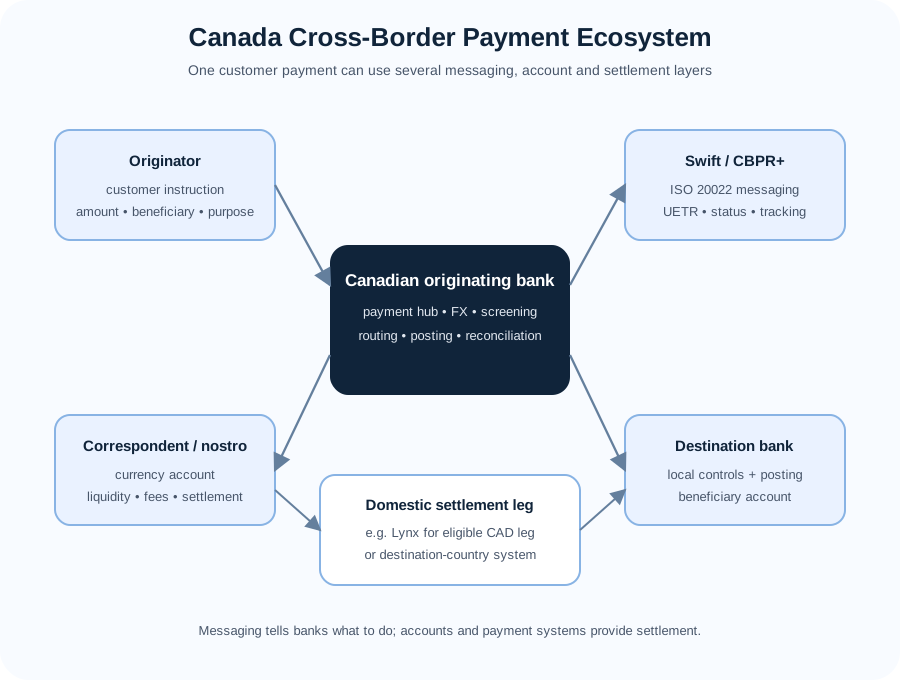
A cross-border payment is not a single rail. It is a coordinated journey in which a customer instruction, one or more bank-to-bank messages, one or more correspondent-account movements, possible foreign-exchange trades, domestic clearing or RTGS legs, sanctions and AML controls, fees, liquidity decisions, customer postings and reconciliation all have to describe the same economic payment. That is why a Canadian customer can initiate one apparently simple international transfer while the bank behind it may use Swift messaging, an overseas correspondent, a Canadian-dollar Lynx leg, a foreign domestic payment system and one or more nostro accounts before the beneficiary sees value.
This chapter builds the Canadian cross-border payments landscape from that operating reality. Payments Canada describes correspondent banking as the dominant model for Canadian cross-border payments and notes that most cross-border payments involving Canada use the Swift network for message exchange and payment instructions. Swift carries standardized payment information; it is not, by itself, the settlement account where the money finally moves. Settlement happens through correspondent accounts, domestic payment systems, central-bank money where applicable, or other agreed settlement arrangements. Understanding that separation between messaging, routing, foreign exchange and settlement is the foundation for everything that follows.
A second distinction is equally important in Canada. Lynx is a Canadian-dollar high-value payment system. A cross-border payment may use Lynx for its Canadian-dollar domestic leg, but Lynx does not become a general foreign-currency correspondent system simply because the customer is international. Likewise, the United States Bulk Exchange (USBE) is a Canadian retail-batch mechanism for eligible U.S.-dollar items involving accounts at financial institutions domiciled in Canada; it is not the same thing as a U.S.-dollar cross-border wire to a beneficiary bank in New York. This chapter keeps those boundaries explicit so that product, architecture and operations teams do not blend different settlement models together.
The audit baseline is 5 October 2026. Swift’s CBPR+ coexistence period for core cross-border payment instruction messages ended on 22 November 2025. ISO 20022 is now the standard language for those payment instructions across Swift’s cross-border community, although Swift’s wider roadmap for non-instruction messages, reporting and certain contingency processes continues beyond 2025. Swift’s current SR2026 notice also says the structured-address migration timeline and scope were changed on 27 August 2026; do not hard-code a retired-address date or usage rule—use the current CBPR+ MyStandards/Swift Knowledge Centre guidance at implementation time. Canadian banks therefore need to operate cross-border payments as ISO 20022-native journeys while still understanding legacy data, translation risk and the remaining transition timetable.
Evidence and status labels used in this chapter. A Canadian legal/regulatory rule is attributed to a statute, regulation, FINTRAC, FCAC, Bank of Canada, OSFI or other Canadian authority. A Payments Canada/Interac scheme or system rule is attributed to the operator’s current rulebook or system page. A bank-specific implementation is an operating pattern or control that varies by institution, correspondent agreement, product and corridor; it is not a universal legal requirement. Fictional examples are labelled and contain no real customer or bank data.
What you should be able to do after this chapter
After working through this chapter, you should be able to:
- explain why a cross-border payment is a chain of messaging, accounts and settlement systems rather than one universal rail;
- map the roles of the originator, originating bank, correspondent banks, intermediary banks, beneficiary bank and beneficiary;
- distinguish a direct correspondent route from a route that requires one or more intermediaries;
- explain nostro and vostro accounts in practical banking language;
- describe serial and cover approaches at a functional level without confusing messaging with settlement;
- explain how a Canadian-dollar leg can use Lynx while the wider cross-border chain still depends on correspondents;
- explain why USBE should not be described as a general cross-border wire system;
- connect customer currency, payment currency, settlement currency and FX booking;
- distinguish trade date, payment execution date and value date;
- explain how Swift CBPR+, ISO 20022, UETR and gpi/tracking support cross-border payment data and status;
- describe sanctions, AML, correspondent due diligence and payment-transparency controls without treating them as one generic “screening” step;
- explain charge, FX and intermediary-fee transparency from a customer and bank-operations perspective;
- trace exceptions such as invalid beneficiary data, sanctions holds, intermediary queries, returns and uncertain outcomes;
- reconcile customer instruction, bank postings, correspondent nostro entries, fees, FX and settlement evidence;
- design bank-grade implementation and testing scenarios for cross-border routing, cutoffs, holidays, data quality, timeouts and reconciliation;
- distinguish what the sending bank can prove from what only an intermediary or beneficiary bank can confirm.
For a roughly 60-minute core session, spend 10 minutes on Sections 1–2 with the ecosystem map, 15 minutes on Sections 3–4 with the correspondent and routing flows, 10 minutes on Sections 5–6 with the data and FX sections, 10 minutes on Sections 7–9, 10 minutes on the practical cases in Section 11 and 5 minutes on takeaways and authoritative sources.
Chapter navigator
- Business context and customer need
- Participants, accounts and system boundaries
- End-to-end correspondent payment lifecycle
- Routing models, serial, cover and domestic settlement legs
- Data, ISO 20022, UETR and tracking
- Foreign exchange, charges, value dates and liquidity
- AML, sanctions, correspondent controls and payment transparency
- Exceptions, investigations, returns and recovery
- Posting, accounting, nostro reconciliation and reporting
- Implementation, testing and operational resilience
- Practical Canadian cross-border examples
- Key takeaways and authoritative references
1. Business context and customer need
Cross-border payments start with ordinary customer needs: paying an overseas supplier, sending salary or pension money to another country, moving treasury funds between group companies, paying tuition, buying property, settling an international invoice, refunding a customer or sending a personal remittance. What changes across use cases is not only the amount. Urgency, currency, beneficiary access, fee tolerance, regulatory information, remittance detail and certainty of arrival can all change the appropriate route.
A Canadian corporate customer might say:
Pay USD 250,000 to our supplier in Chicago today and quote invoice INV-87421.
That instruction contains several business decisions before the bank sends any interbank message:
- which customer account funds the payment;
- whether the customer already holds USD or needs CAD converted to USD;
- what FX rate or treasury arrangement applies;
- which bank services the beneficiary;
- whether the originating bank has a direct USD correspondent relationship that can reach the beneficiary bank;
- whether an intermediary is required;
- what value date can be achieved;
- what fees and charges apply;
- what regulatory/payment-transparency data is mandatory;
- whether the payment passes sanctions, AML and fraud controls;
- how the bank will report status and final outcome.
The customer wants one answer: when will the supplier have usable funds and what will it cost? The bank can only answer reliably if product, routing, treasury, compliance and operations share the same model of the payment.
Cross-border payment is a chain, not a rail
Consider a Canadian bank with a USD nostro account at a U.S. correspondent. The Canadian bank can instruct that correspondent to debit the nostro and credit a beneficiary bank or route onward through the U.S. payment system. Swift may carry the instruction, but the commercial bank account relationship provides the settlement asset between the banks.
Now consider a CAD payment sent from an overseas bank to a beneficiary at a Canadian bank. The foreign bank may use a Canadian correspondent. Once the payment reaches the Canadian correspondent, a Lynx payment can move CAD between Lynx participants to the beneficiary’s bank. The cross-border chain therefore contains a domestic Canadian RTGS leg.
Payments Canada uses examples like these to illustrate the Canadian landscape. The important lesson is that the currency and account relationships determine the settlement path.
Customer product versus bank settlement route
A bank product may be called “international wire,” “global payment,” “cross-border transfer” or something similar. That product name should not be treated as the technical route.
A single product can support:
- CAD sent abroad;
- USD sent abroad;
- EUR sent abroad;
- foreign currency funded from CAD;
- foreign currency funded from an existing same-currency account;
- direct correspondent routing;
- intermediary routing;
- domestic final legs through local payment systems.
Architecture should therefore separate:
product request from route plan.
The product request expresses customer intent. The route plan expresses how the bank will execute that intent.
Why cross-border payments can take longer
Several factors can add time:
- time-zone differences;
- sending-bank cutoff;
- correspondent cutoff;
- beneficiary-bank cutoff;
- local clearing-system hours;
- non-aligned public holidays;
- manual compliance review;
- beneficiary-data repair;
- FX execution/value-date constraints;
- liquidity availability;
- intermediary enquiries;
- downstream posting rules.
A customer who sends at 16:30 Toronto time may be sending after the beneficiary country’s banking day has ended. A holiday in the settlement currency’s market can block value date even when Canada is open.
The right customer promise is therefore route-aware, not a generic “international payments take three days.”
2. Participants, accounts and system boundaries
Originator and originator bank
The originator is the customer instructing the payment. The originator bank, often called the ordering or debtor agent in ISO 20022 context, receives the instruction, authenticates the customer, validates data, checks funds and limits, performs compliance controls, books FX where required and chooses the interbank route.
The bank should preserve the distinction between:
- customer instruction;
- bank-created interbank payment;
- actual debit/settlement entries.
One customer instruction can create more than one bank event.
Beneficiary and beneficiary bank
The beneficiary is the final party intended to receive value. The beneficiary bank receives the payment, performs its own regulatory and account controls, posts the account and may provide confirmation/status.
The sending bank should not promise beneficiary credit merely because its own correspondent was debited. The beneficiary bank owns the final posting decision.
Correspondent bank
A correspondent bank provides banking services to another financial institution, commonly including account holding and payment execution in a currency or jurisdiction the respondent cannot access directly.
If Bank A holds a USD account with Bank B, Bank A calls that account its nostro: “our money with you.” From Bank B’s perspective, the same account is a vostro: “your money with us.”
The terms describe perspective, not different accounts.
Intermediary bank
An intermediary bank participates when the sending bank does not have a direct route to the beneficiary bank or when currency-clearing relationships require another institution.
A payment chain might be:
Customer → Canadian Bank A → U.S. Correspondent B → U.S. Intermediary C → Beneficiary Bank D → Beneficiary.
Every added intermediary can affect:
- fees;
- settlement timing;
- sanctions screening;
- data integrity;
- investigation complexity;
- liquidity.
Route design tries to minimize unnecessary hops while still using approved correspondent relationships.
Reimbursing/currency correspondent
In a cover structure, the bank carrying the customer-payment information and the bank transferring settlement cover can be different chains. The currency correspondent or reimbursing institution moves the financial institution settlement leg while customer-payment information travels directly toward the beneficiary bank.
This is why cover payment transparency is important: the settlement leg must carry sufficient underlying customer information for intermediary screening and compliance.
Domestic payment systems
A cross-border chain often enters a domestic payment system in the destination currency.
Examples conceptually include:
- Lynx for eligible Canadian-dollar high-value payments between Canadian participants;
- domestic U.S. payment systems for USD settlement;
- euro-area systems for EUR;
- other local RTGS/clearing systems depending on currency and route.
The cross-border product ends at the beneficiary; the settlement route may contain several domestic infrastructures.
System boundary map
Inside a Canadian bank, typical systems include:
Channel / corporate gateway
captures customer instruction.
Payment hub/orchestrator
normalizes, validates, enriches and routes.
Customer/accounting service
funds and posts customer accounts.
FX/treasury service
prices and books currency conversion.
Sanctions/AML/fraud services
perform risk controls.
Swift/financial messaging gateway
builds and exchanges CBPR+ messages.
Correspondent/nostro service
tracks account relationships, statements and liquidity.
Investigation/status service
tracks UETR/status, handles enquiries and returns.
Reconciliation
matches instruction, messaging, settlement, nostro and accounting.
A bank-grade design needs a durable payment ID connecting all of these.
Canadian production rails and modernization boundary
Production system — Lynx (scheme/system fact). Payments Canada describes Lynx as Canada’s high-value electronic wire system for participating financial institutions, in Canadian dollars, using real-time gross settlement with fast, irrevocable settlement finality. Direct participants maintain Bank of Canada settlement accounts; a non-participant can arrange a Lynx payment through a direct participant. Lynx operates Monday to Friday except statutory holidays. It is a Canadian-dollar domestic high-value system, not a multi-currency correspondent network. A cross-border payment may therefore contain a CAD Lynx leg without being “sent through Lynx” end to end.
Production system — ACSS/USBE (scheme/system fact). Payments Canada’s retail batch system comprises ACSS and the United States Bulk Exchange application (USBE), a dual-currency clearing and settlement system for paper and electronic items drawn on Canadian financial-institution accounts. USBE positions settle through correspondent banks in New York; the item’s instrument, participant and account eligibility—not the label “USD” alone—determine whether USBE applies.
Production system — Interac e-Transfer (scheme/system fact). Interac’s current consumer material describes e-Transfer as sending money to anyone in Canada through online banking; it says transfers are almost instant but can take up to 30 minutes depending on the financial institution. It is not the same route as a correspondent wire. Interac separately publishes an International Transfer by Mastercard and Interac product whose availability and destination countries vary by financial institution. Do not generalize either product into the other.
Planned/modernization system — RTR (not a production capability as of this audit). Payments Canada’s 15 April 2026 RTR update says user-acceptance testing was complete, non-functional performance/resilience/security testing was continuing, and the program was preparing for industry testing and operational readiness while moving toward a certified, production-ready state. The Bank of Canada describes RTR as a system being designed and says funds will be exchanged in real time when launched. Accordingly, this chapter does not present RTR as a live production rail, live settlement evidence, or an available cross-border route. Any future launch, access, message, settlement, fraud-service or operating-date claim must be rechecked against current Payments Canada and Bank of Canada publications.
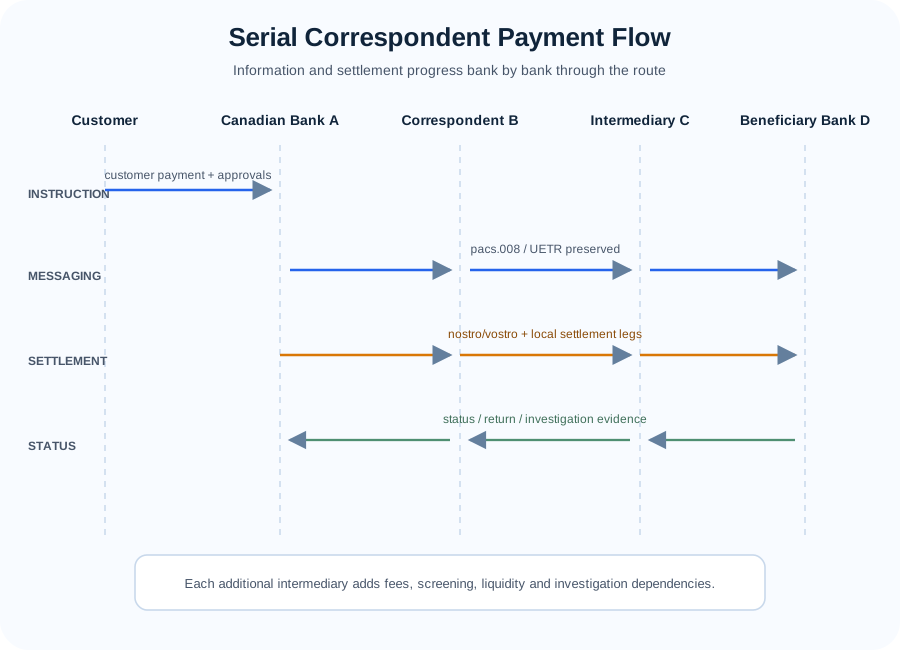
3. End-to-end correspondent payment lifecycle
The lifecycle below describes a typical customer credit transfer from Canada to a foreign beneficiary.
Step 1 — customer initiation
The customer provides:
- debit account;
- beneficiary name;
- beneficiary account/IBAN or local account format;
- beneficiary bank identifier;
- amount;
- currency;
- remittance/invoice information;
- requested execution/value date;
- charge preference where supported;
- regulatory/purpose information where required.
Corporate channels may provide richer structured data than retail channels.
Step 2 — authentication and entitlement
The bank confirms:
- user authentication;
- signing authority;
- corporate mandate;
- maker/checker approvals;
- transaction limit;
- account entitlement.
Corporate fraud risk often concentrates here. A technically valid bank-to-bank payment can still originate from a compromised corporate session.
Step 3 — data validation
Validation includes:
- account format;
- BIC/bank identifier where used;
- country/currency compatibility;
- required postal/party information;
- purpose/regulatory fields;
- structured remittance;
- duplicate detection;
- ISO 20022/CBPR+ data-quality rules.
Validation should happen before expensive downstream processing where possible.
Step 4 — fraud and compliance
Fraud controls ask whether the customer’s behaviour and instruction are credible.
Sanctions controls assess parties, agents and relevant payment data against applicable restrictions.
AML controls assess transaction risk, customer profile and suspicious activity.
These are related but not the same control. A bank should preserve the individual decision/evidence from each.
Step 5 — funding and FX
If the payment currency matches the debit account currency, no customer FX conversion may be needed.
If the customer funds a USD payment from CAD, the bank needs an FX transaction or product conversion.
The bank determines:
- exchange rate;
- rate source/product pricing;
- spread/markup;
- customer debit amount;
- payment amount;
- booking time;
- value date;
- FX deal reference.
The FX deal and payment should be linked but remain separate records because one economic payment can be re-routed without re-pricing, or an FX deal can exist before payment release.
Step 6 — route selection
The payment engine determines:
- direct correspondent available?
- same-currency nostro available?
- beneficiary bank reachable through correspondent?
- intermediary required?
- local clearing/RTGS option?
- product/SLA compatible?
- sanctions/relationship restrictions?
- cutoff still open?
- liquidity available?
Routing must be deterministic and auditable.
Step 7 — message creation and release
For Swift CBPR+ core customer payments, the interbank instruction is represented in ISO 20022, commonly using pacs.008 for the FI-to-FI customer credit transfer.
The bank:
- generates/preserves UETR;
- populates parties and agents;
- includes remittance;
- applies CBPR+ usage guidelines;
- validates;
- sends through FINplus/Swift infrastructure.
Step 8 — correspondent processing
The correspondent receives the instruction, applies its own controls and debits/credits the relevant correspondent account or routes onward.
Possible outcomes:
- accepted and processed;
- rejected;
- held for compliance;
- repaired/requested information;
- routed onward;
- fee deducted according to arrangement;
- returned later.
Step 9 — beneficiary bank receipt and posting
The beneficiary bank:
- receives payment;
- validates account;
- screens;
- posts or holds;
- reports status where applicable.
Only this stage can prove final beneficiary account credit.
Step 10 — settlement and reconciliation
The sending bank sees settlement through:
- nostro debit/credit;
- domestic-system settlement evidence;
- correspondent statement/notification;
- internal ledger.
The payment is not operationally complete until:
- customer accounting matches;
- FX accounting matches where applicable;
- fees match;
- correspondent entry matches;
- downstream status is understood;
- no unresolved break remains.
4. Routing models, serial, cover and domestic settlement legs
Direct correspondent route
The simplest correspondent route exists when the originating bank has the necessary currency account with a bank that can directly credit or reach the beneficiary bank.
Example:
Canadian Bank A holds USD nostro with U.S. Bank B.
Beneficiary also banks with B.
Flow:
Customer A → Bank A → Bank B → Beneficiary.
The route has fewer parties, but Bank A still needs sufficient USD liquidity at B and a valid correspondent relationship.
Intermediary route
If the beneficiary banks with Bank C and Bank B cannot directly credit it without using a domestic U.S. rail or another correspondent, the route can become:
Customer → Bank A → Bank B → Bank C → Beneficiary.
An additional bank adds data and operational dependencies.
Serial method
In a serial model, the customer credit transfer instruction moves through the chain of financial institutions, and each institution instructs the next while settlement follows the chain of correspondent accounts.
Functionally:
A → B → C → D.
Each bank sees the customer payment information required for its role and processes the onward transfer.
Cover method
In a cover model, the customer credit transfer information can travel directly from originator bank toward beneficiary bank, while a separate FI-to-FI cover payment provides the settlement funds through correspondent institutions.
Under CBPR+, Swift guidance explains that the cover settlement message is a pacs.009 COV, identified by the presence of the Underlying Customer Credit Transfer information. The underlying customer data supports transparency and screening.
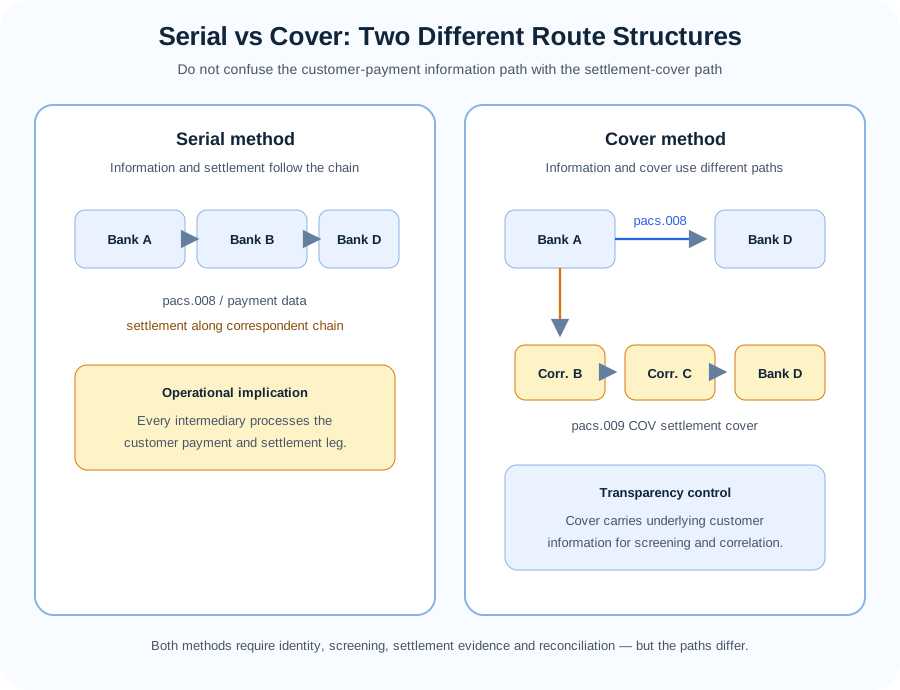
The critical operational rule is that a cover payment is not a substitute for the customer credit-transfer instruction. The customer-payment and cover-settlement legs need to remain correlated.
CAD domestic final leg through Lynx
Suppose an overseas bank needs to pay a beneficiary at Canadian Bank C but uses Canadian Bank B as its CAD correspondent.
The flow can be:
Foreign Bank A → Canadian Correspondent B → Lynx → Canadian Beneficiary Bank C.
The cross-border relationship exists between A and B. The domestic CAD settlement between B and C can use Lynx when the payment is eligible and participants are involved.
This makes Lynx an important component of some cross-border payment chains without making Lynx itself a multi-currency cross-border network.
USD retail batch in Canada is different
USBE handles eligible U.S.-dollar retail batch items associated with financial institutions domiciled in Canada. It is part of Payments Canada’s retail batch system.
A customer USD wire from Toronto to New York is not automatically a USBE item.
A USD cheque or USD AFT item between eligible Canadian FI accounts can be a USBE context.
Product and architecture teams should never route solely from currency. USD does not imply USBE; payment type and participating accounts matter.
Route-selection decision model
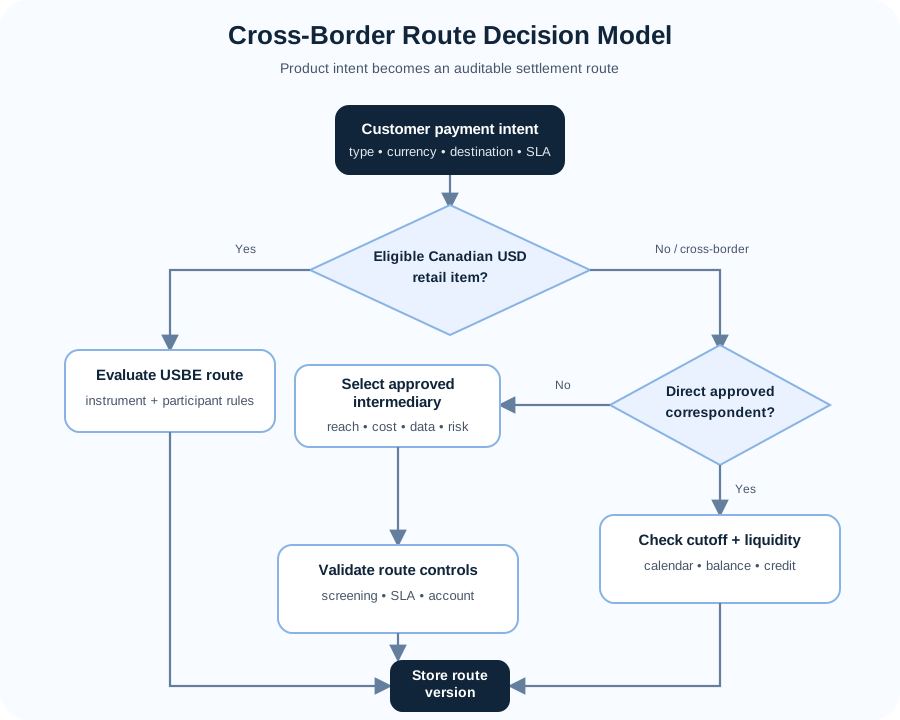
A route engine should consider:
- payment type;
- currency;
- destination country;
- beneficiary bank reachability;
- direct correspondent relationships;
- approved intermediaries;
- cutoff/time zone;
- SLA;
- cost;
- liquidity;
- sanctions/risk restrictions;
- operational availability.
Route changes should be versioned. If the bank changes from Correspondent X to Correspondent Y, investigations on historical payments must still show the original route.
5. Data, ISO 20022, UETR and tracking
Cross-border payments are now fundamentally data-rich workflows.
ISO 20022 under CBPR+
Swift’s coexistence period for core cross-border payment instructions ended on 22 November 2025. Payment instruction traffic under CBPR+ is now ISO 20022-based, while the broader roadmap continues for other message categories.
For core flows, practitioners should recognize:
pacs.008
FI-to-FI customer credit transfer.
pacs.009
Financial institution credit transfer, including core and cover use cases.
pacs.002
FI-to-FI payment status report.
pacs.004
Payment return.
camt.056
FI-to-FI payment cancellation request.
camt.029
Resolution/response to investigation or cancellation-related requests.
camt.052 / camt.053 / camt.054
Account reporting families for intraday report, statement and debit/credit notification use cases.
The exact CBPR+ usage guidelines, versions and mandatory data must be taken from Swift MyStandards/current documentation. A training chapter should not hard-code a schema version that becomes stale.
Business Application Header
The Business Application Header, commonly head.001 under ISO 20022 usage, carries business-message addressing/context separate from the document payload.
Architecture teams need to preserve the distinction between:
- network/application envelope;
- business application header;
- payment document.
Mapping all three into one flat legacy structure can lose context.
UETR
The Unique End-to-end Transaction Reference (UETR) is the chain-wide identifier used to track a payment. It is a UUID and should remain consistent through the payment journey according to the applicable rules.
The UETR supports:
- tracking;
- investigations;
- status correlation;
- reconciliation;
- customer service.
Internal bank IDs remain useful, but an internal ID should not replace the chain-wide identifier when speaking to another bank.
EndToEndId and bank references
ISO 20022 supports multiple identifiers. A strong data model preserves each identifier’s purpose.
Bank payment ID — internal lifecycle key.
UETR — cross-bank chain identity.
EndToEndId — customer/business end-to-end reference where used.
Instruction/transaction IDs — message-chain identifiers.
FX deal ID — currency trade linkage.
Nostro entry reference — settlement-account evidence.
Operations should be able to search by all of them.
Structured party data
The move to ISO 20022 improves the ability to carry structured:
- names;
- postal addresses;
- account identifiers;
- bank identifiers;
- remittance;
- purpose information;
- agent chains.
This improves compliance and straight-through processing only if the bank keeps the structure end to end.
A common anti-pattern is to receive structured data and flatten it into a 35-character internal field, destroying the very benefit CBPR+ introduced.
Tracking versus settlement
A tracking platform can report where a payment is in the chain. It does not itself become the settlement asset.
A status such as “credited to beneficiary bank” or a confirmation of credit is valuable, but treasury and reconciliation still need the corresponding account/settlement evidence.
Data, status and money must agree.
6. Foreign exchange, charges, value dates and liquidity
Payment currency and funding currency
A Canadian customer can fund:
- CAD payment from CAD;
- USD payment from USD;
- USD payment from CAD;
- EUR payment from CAD;
- other combinations depending on product.
When funding and payment currency differ, the bank needs an FX conversion.
Customer FX quote
The customer’s executable rate can include the bank’s pricing/spread and may differ from public indicative rates.
The Bank of Canada explicitly states that its published exchange rates are indicative rates, derived from aggregated quotes, and are not necessarily rates associated with actual currency trades. They are useful for reference and accounting contexts, not proof of the retail rate a bank must offer.
A customer confirmation should make clear:
- source currency;
- source amount if fixed;
- destination/payment currency;
- destination amount if fixed;
- agreed exchange rate;
- fees where known;
- quote validity/booking reference.
Fixed source versus fixed destination
Customers can express intent differently.
Fixed destination amount: “Beneficiary must receive USD 10,000 before downstream charges.”
The CAD funding amount depends on the rate and fee model.
Fixed source amount: “Debit CAD 10,000 and send the converted amount.”
The destination amount depends on the rate.
Systems need to know which side is authoritative to avoid rounding and repair defects.
Trade date and value date
The trade date is when the FX transaction is agreed.
The value date is when the currencies are due to settle.
The customer payment execution date can be related but is not identical by definition.
Currency-pair conventions and holiday calendars determine valid value dates. Banks should use treasury/market calendars rather than assume every “spot” trade settles on exactly the same number of calendar days.
Fees and charges
Cross-border cost can include:
- sending-bank fee;
- FX spread/markup;
- correspondent/intermediary charge;
- beneficiary-bank fee;
- local clearing fee.
The customer product should disclose what the sending bank can know and avoid promising that no downstream deduction can occur unless the route/fee arrangement guarantees it.
Nostro liquidity
A bank sending USD needs usable USD liquidity in the relevant nostro/correspondent arrangement.
Treasury monitors:
- opening balance;
- expected incoming;
- expected outgoing;
- cutoff times;
- intraday debit;
- credit lines/overdraft arrangements;
- funding transfers;
- currency concentration.
A payment can be fully valid and compliance-cleared yet still wait because the chosen route lacks available liquidity.
Prefunding versus intraday funding
Some routes rely on prefunded balances. Others use credit or intraday funding arrangements.
The product/SLA should be aligned with treasury reality. A “same-day” product sold without understanding correspondent funding deadlines will create manual escalations.
7. AML, sanctions, correspondent controls and payment transparency
Cross-border payments concentrate financial-crime controls because multiple jurisdictions and institutions are involved.
Customer due diligence and transaction monitoring
The originating bank already knows its customer under applicable KYC/CDD requirements. For a cross-border instruction, transaction monitoring considers whether the payment is consistent with the customer profile and whether the pattern indicates suspicious activity.
Signals may include:
- unusual country;
- sudden new beneficiary;
- abnormal amount;
- rapid movement of incoming funds outward;
- high-risk corridor;
- inconsistent trade description;
- structuring patterns;
- mule indicators.
Sanctions screening
Sanctions screening can cover:
- originator;
- beneficiary;
- banks/agents;
- addresses;
- free-text/remittance;
- other parties required by policy.
A potential match can create a hold while compliance reviews.
Banks should distinguish:
screening hit from confirmed match.
A false positive is an operational event, not evidence that the customer violated sanctions.
Correspondent banking due diligence
FATF Recommendation 13 addresses cross-border correspondent banking. The correspondent must understand the respondent institution, its business and reputation, assess AML/CFT controls, establish responsibilities and apply the required governance. The exact legal implementation depends on jurisdiction.
Industry practice commonly uses the Wolfsberg Correspondent Banking Due Diligence Questionnaire (CBDDQ) to standardize information collection.
Correspondent due diligence is relationship-level control; payment screening is transaction-level control. They complement each other.
Shell banks and nested relationships
Banks need controls around prohibited or unacceptable shell-bank exposure and need visibility into how respondent relationships can provide access to other institutions.
“Nested” correspondent access can be legitimate but changes risk because the direct correspondent may have less visibility into downstream users of the account. Risk-based due diligence, transaction monitoring and contractual controls matter.
Payment transparency and FATF Recommendation 16
FATF Recommendation 16 is an international standard for payment transparency, not by itself Canadian law. FATF’s June 2025 revisions and subsequent implementation work should be tracked separately from the currently applicable Canadian PCMLTFA/PCMLTFR travel-rule requirements described above.
The practical direction is clear: cross-border payments need sufficient originator and beneficiary information to be traceable and to support fraud/error prevention and financial-crime controls.
Banks should not present an international FATF implementation timetable as a Canadian effective date; they should comply with current Canadian law and current CBPR+/correspondent requirements while monitoring future amendments.
Data-quality control is a compliance control
A missing party address is not merely a formatting defect if it prevents effective screening.
Banks should monitor:
- missing structured fields;
- use of placeholder values;
- excessive free text;
- invalid country codes;
- truncation;
- transliteration issues;
- downstream repair frequency.
Good payment data reduces both false positives and missed risk.
8. Exceptions, investigations, returns and recovery
Cross-border operations spends much of its time on exceptions rather than happy-path payments.
Pre-release reject
Examples:
- invalid beneficiary account;
- invalid BIC;
- missing mandatory data;
- unsupported currency;
- cutoff missed;
- insufficient funds;
- sanctions hold;
- failed approval.
The payment has not left the bank. Customer communication should be direct and actionable.
Network/message reject
An ISO 20022 message can fail network or usage-guideline validation.
The bank should preserve:
- original message;
- validation error;
- corrected message;
- UETR/identity continuity according to the applicable correction process;
- operator action.
Correspondent repair request
The correspondent can ask for clarification:
- beneficiary address;
- purpose;
- intermediary details;
- account information;
- compliance information.
A repair workflow needs service-level ownership because every hour can push the payment past another time-zone cutoff.
Beneficiary-bank reject
The beneficiary bank may reject because:
- account closed;
- account invalid;
- currency not supported;
- regulatory restriction;
- beneficiary information mismatch;
- local-rule issue.
The economic outcome can become a return.
Return
A return should be linked to the original payment and preserve traceability.
Operations must distinguish:
- original payment reached beneficiary bank then was returned;
- payment was rejected before beneficiary-bank acceptance;
- correspondent returned value;
- bank initiated cancellation/recall but beneficiary response is pending.
Customer-facing language should match the state.
Cancellation/recall
A customer may ask to cancel after release.
The sending bank cannot assume it has unilateral control once settlement/payment processing has moved downstream. It sends the appropriate cancellation/recall request and waits for downstream response.
The bank should never promise “we reversed the international wire” before recovery is confirmed.
Uncertain outcome
The hardest incident is:
- bank sent payment;
- network acknowledgement exists;
- correspondent statement not yet updated;
- tracking status incomplete;
- customer asks whether to send again.
The correct action is not to duplicate the payment. Operations must resolve using UETR, network status, correspondent enquiry and settlement evidence.
Investigation evidence chain
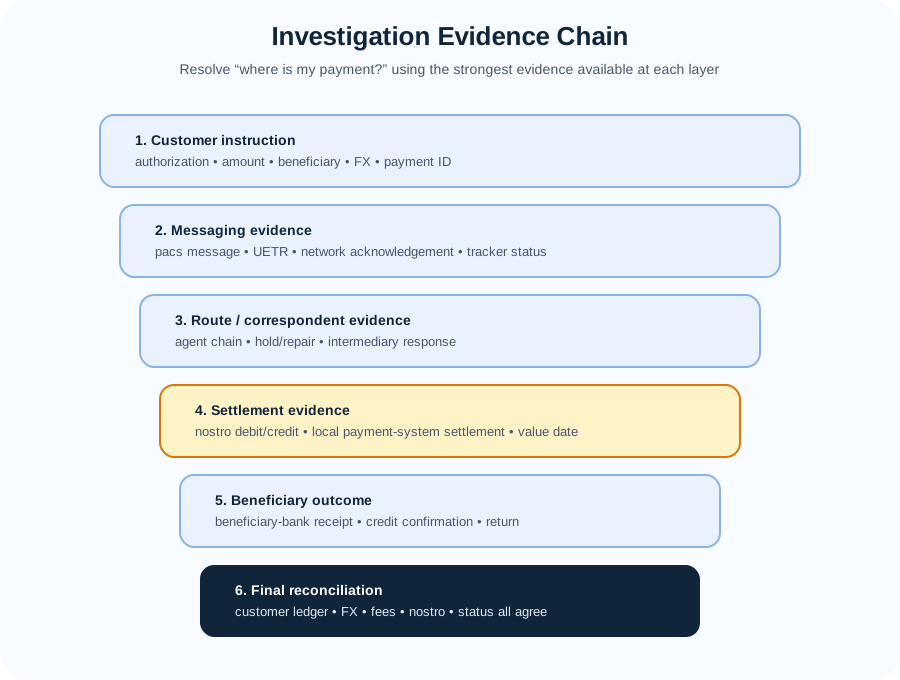
A complete evidence pack includes:
- customer authorization;
- bank payment ID;
- UETR;
- sent message;
- network acknowledgement;
- route/agent chain;
- sanctions/fraud decisions;
- FX deal;
- correspondent debit/credit;
- tracking status;
- beneficiary confirmation where available;
- return/cancellation messages;
- customer communications.
9. Posting, accounting, nostro reconciliation and reporting
Customer accounting
A cross-border payment can create:
- customer principal debit;
- sending fee;
- FX debit/credit;
- tax/other charges where applicable;
- suspense during processing.
The customer statement should keep principal and fees intelligible.
FX accounting
If the customer buys USD with CAD:
- customer CAD is debited;
- bank books FX according to treasury/accounting model;
- USD funding is made available to the payment;
- FX P&L/spread is accounted under product policy.
The payment record must link to the FX deal so finance can explain rate and value.
Nostro accounting
The correspondent nostro is the external settlement account.
Operations receives statement/reporting that can contain:
- debit entries;
- credit entries;
- fees;
- reversals;
- value dates;
- references.
The bank should match the payment to the nostro entry using UETR and other references where supported.
Nostro reconciliation
A strong daily process compares:
expected outgoing settlement
from payment hub
to
actual nostro debit
from correspondent account reporting.
Break categories:
- expected debit missing;
- unexpected debit;
- duplicate debit;
- amount mismatch;
- currency mismatch;
- fee separated;
- value-date mismatch;
- unmatched return.
Liquidity reconciliation
Treasury also needs forward-looking reconciliation:
expected flows → projected balance → funding decision → actual balance.
This differs from accounting reconciliation, which proves what already happened.
Customer status/reporting
Corporate customers may need:
- accepted/rejected;
- in process;
- sent;
- credited/confirmed where available;
- returned;
- fee/FX data;
- UETR.
The bank should expose status from real evidence rather than infer it from elapsed time.
Regulatory reporting
Cross-border transactions can feed regulatory/tax/AML reporting depending on jurisdiction and product.
Architecture should not hard-code one reporting use case into the payment message. A reporting layer should consume the normalized payment record and produce required outputs.
Canadian legal and consumer-control boundary
FINTRAC legal/regulatory rule. Under current FINTRAC guidance and the PCMLTFA/PCMLTFR, a financial entity or casino must submit an Electronic Funds Transfer Report when it initiates an international electronic funds transfer of $10,000 or more in a single transaction at a person’s or entity’s request, and when it finally receives an international EFT of that amount. The report is due within 5 business days after the day of initiation or final receipt; two or more transfers totaling $10,000 or more in a static 24-hour window can also trigger the 24-hour rule when the entity knows the relevant requester/third-party relationship. The reporting obligation is not a generic “cross-border payment may be reportable” flag. FINTRAC’s travel-rule guidance requires the name, address and account or other reference of the requester, and the beneficiary’s name/address and account or other reference where applicable, to travel with an EFT subject to the rule. A receiving intermediary must take reasonable measures to obtain missing information and maintain risk-based written policies for allowing, suspending or rejecting the transfer. FINTRAC’s EFT definition and exclusions matter: it covers international EFTs and Canadian EFTs sent by SWIFT MT-103 or equivalent, but excludes several domestic retail instruments such as direct deposits and pre-authorized debits.
Canadian sanctions legal/regulatory rule. Payment screening supports compliance with the PCMLTFA, the Criminal Code and applicable sanctions orders and regulations, including the Special Economic Measures Act. A screening hit is not itself a confirmed prohibition; the bank must apply the relevant instrument, ownership/control and permit analysis, record the decision and prevent release while the case is unresolved.
RPAA scope (regulatory rule). The Retail Payment Activities Act and Regulations apply to in-scope payment service providers, with Bank of Canada supervision covering registration, operational-risk management, incident response, safeguarding of end-user funds and required reporting. A bank or other federally supervised entity must assess the RPAA’s statutory exclusions rather than assume that its bank status answers every PSP question. RPAA supervision is not a substitute for FINTRAC AML/ATF duties, sanctions compliance, scheme rules or a bank’s own controls.
Consumer disclosure (FCAC rule/guidance). For banks and other federally regulated financial institutions, FCAC says the sending fee must be disclosed and does not include charges that may apply in the receiving country. The sender should receive a receipt and transaction number; arrival can range from minutes to days. The customer-facing product should therefore separate known sending fees and FX terms from downstream deductions and should not promise final beneficiary credit unless the route and evidence support that promise.
10. Implementation, testing and operational resilience
Canonical payment model
A cross-border payment hub should maintain a canonical model rich enough to preserve ISO 20022 structure.
At minimum:
- parties;
- accounts;
- agents;
- currencies;
- amounts;
- identifiers;
- remittance;
- purpose;
- charges;
- dates;
- route;
- statuses;
- compliance decisions;
- FX;
- settlement references.
Flattening into a legacy MT-shaped internal object creates long-term technical debt.
Route catalogue
Routing needs governed reference data:
- currency;
- country;
- correspondent;
- account;
- preferred route;
- backup route;
- cutoff;
- holiday calendar;
- cost;
- service;
- status;
- compliance restrictions.
Changes require dual control and effective dating.
BIC and bank-directory data
Institution identifiers change. Mergers, branch closures and BIC changes need managed reference-data updates.
The bank should not let each channel keep its own copy.
Holiday engine
Cross-border execution requires calendars for:
- Canada;
- correspondent country;
- settlement currency;
- destination payment system.
The calendar engine should determine achievable execution/value date before the bank promises it.
Testing matrix
Customer data
- individual;
- corporate;
- structured address;
- missing address;
- long legal name;
- special characters/transliteration.
Beneficiary data
- valid account;
- invalid IBAN/local format;
- closed account;
- unsupported currency account.
Route
- direct correspondent;
- one intermediary;
- multiple intermediary;
- CAD domestic Lynx leg;
- route unavailable.
FX
- no FX;
- CAD→USD;
- CAD→EUR;
- fixed source;
- fixed destination;
- quote expiry.
Compliance
- clean;
- false-positive sanctions hit;
- confirmed prohibited party simulation;
- AML review;
- missing transparency field.
Timing
- before cutoff;
- after cutoff;
- non-aligned holiday;
- month-end;
- correspondent outage.
Messaging
- valid pacs.008;
- usage-rule reject;
- duplicate send;
- network timeout;
- status report;
- return;
- cancellation.
Settlement
- expected nostro debit;
- missing debit;
- duplicate debit;
- fee entry;
- wrong value date.
ISO 20022 regression
Every release should test:
- structured parties remain structured;
- UETR preserved;
- BAH/document consistent;
- agent chain correct;
- remittance not truncated;
- charge fields handled;
- return/cancellation correlations;
- reporting messages reconcile.
Translation risk
Although core CBPR+ payment instructions are ISO 20022-native after the 2025 coexistence end, banks may still translate internally for legacy applications or temporary contingency.
Every translation should be treated as a potential data-loss boundary.
Monitor:
- truncated names;
- lost addresses;
- remittance loss;
- unmapped purpose;
- identifier loss.
Resilience
A Swift gateway/network outage, correspondent outage or internal hub failure should not create uncertain duplicate payments.
Recovery needs:
- durable outbound queue;
- network-message identity;
- send/acknowledgement log;
- idempotent reprocessing;
- operator controls;
- reconciliation after recovery.
Operational monitoring
Dashboards should show:
- payments accepted;
- payments released;
- network rejects;
- sanctions holds;
- correspondent holds;
- returns;
- average time by corridor;
- route volumes;
- nostro unreconciled;
- UETR status coverage;
- repair rate.
An incident can then be localized by corridor, correspondent or processing stage.
Change governance
Cross-border payments are externally dependent. A change can come from:
- Swift standards release;
- CBPR+ usage guideline;
- FATF/regulation;
- correspondent requirement;
- bank merger;
- domestic payment-system release;
- sanctions list process;
- FX calendar.
Change management needs a dependency calendar rather than isolated application releases.
Deep dive: cross-border route construction inside a payment hub
A payment hub should not treat routing as a single lookup from country to correspondent. Route construction is a controlled decision made from a combination of customer intent, payment currency, beneficiary-bank reachability, account relationships, cutoff status, product service level and liquidity.
A useful route object can contain:
- route ID and version;
- payment currency;
- destination country or market;
- destination-bank identifier;
- primary correspondent;
- optional intermediary chain;
- settlement account/nostro;
- local payment-system endpoint where relevant;
- service/cutoff;
- expected value-date rule;
- charge arrangement;
- permitted customer products;
- risk restrictions;
- effective date;
- backup route.
The payment should store the route version actually selected, not just a live pointer to the current routing table. If a correspondent changes next month, an investigation on a payment from today must still reconstruct today’s route.
Reachability is more than having a BIC
A valid beneficiary-bank BIC proves that an institution identifier exists. It does not prove that the sending bank has a funded, approved route to that institution for the requested currency and service.
Reachability depends on questions such as:
- Does the sending bank hold the required currency nostro?
- Can that correspondent reach the beneficiary institution?
- Does the beneficiary bank accept the payment type/currency?
- Is an intermediary required?
- Is the route open at the requested time?
- Does the bank permit the corridor under its risk policy?
- Is the correspondent relationship active and not restricted?
- Is the value date achievable?
A bank should therefore maintain a route catalogue rather than infer reachability from BIC validity alone.
Routing priority and cost
Banks can have several valid routes. Product teams often want the cheapest; operations may prefer the most reliable; treasury may prefer the best-funded; customers may pay for fastest.
A route-scoring model can consider:
| Factor | Example question |
|---|
| Service | Can it meet requested value date? |
| Cost | What are correspondent/network costs? |
| Liquidity | Is sufficient currency balance available? |
| Reliability | What is recent STP/repair performance? |
| Transparency | Is downstream tracking strong? |
| Risk | Is the corridor/correspondent approved? |
| Data | Can the route preserve required ISO 20022 data? |
| Resilience | Is this the primary or contingency path? |
The bank should make the policy explicit. Otherwise operators can manually route based on habit, creating inconsistent fees and settlement outcomes.
A route should not change silently after customer confirmation
If a route change changes:
- fee;
- FX;
- expected arrival;
- intermediary count;
- beneficiary amount;
the bank needs to know whether customer re-authorization is required under product terms.
A pure technical reroute that preserves customer economics can be handled internally. A reroute that materially changes the customer promise may require a different process.
Fee transparency and amount integrity
Cross-border payments can involve charges at several layers.
The bank should distinguish:
Customer price — what the sending bank charges the customer for the service.
FX price — the rate/spread used for currency conversion.
Correspondent charge — fee taken or billed by an intermediary/correspondent.
Beneficiary-bank charge — fee at final bank, where applicable.
Settlement/network cost — internal cost to the bank, not necessarily separately visible to customer.
Customer channels should avoid ambiguous wording such as “fee $25” if downstream deductions can still reduce the beneficiary amount.
The payment record should keep:
- instructed amount;
- currency;
- expected beneficiary amount where product promises it;
- sending fee;
- FX rate;
- downstream charge information received;
- final credited amount where confirmation makes it available.
This supports complaint handling.
Cross-border data validation in more detail
Data quality should be validated in layers.
Syntax validation
- mandatory field present;
- character set;
- maximum length;
- ISO code valid;
- account/BIC format.
Semantic validation
- country consistent with account format;
- payment currency supported;
- agent chain coherent;
- purpose compatible with product;
- date valid under calendar;
- amount within product range.
Relationship validation
- customer entitled;
- beneficiary permitted;
- correspondent active;
- route available.
Regulatory validation
- required originator/beneficiary information;
- required purpose/regulatory data;
- screening population complete.
A field can be syntactically valid but semantically wrong. A structurally valid IBAN can still belong to the wrong beneficiary. The bank should be precise about what it has actually validated.
Postal-address quality after CBPR+ migration
Structured party information is one of ISO 20022’s most valuable improvements. Banks should not throw it away internally.
A normalized party model should preserve:
- legal/name fields;
- address lines as received;
- structured street/building/post code/city/country where available;
- organization/private identification;
- account;
- source of data.
If a channel cannot capture a required structured element, the bank should fix the channel rather than permanently rely on free-text enrichment in operations.
Data quality also affects screening. Better-separated name and address components can improve matching and reduce false positives.
Cross-border payment identity model
A payment may have multiple identifiers. Documenting them prevents investigation confusion.
| Identifier | Practical role |
|---|
| Customer reference | customer’s business reference |
| Internal payment ID | bank lifecycle anchor |
| UETR | cross-bank tracking identity |
| EndToEndId | end-to-end business reference where used |
| Instruction/transaction IDs | ISO message-chain identity |
| Swift/network message reference | transport/network evidence |
| FX deal ID | currency trade |
| Nostro reference | settlement-account entry |
| Return/cancellation case ID | exception workflow |
The bank should not overwrite one identifier with another. Each is useful at a different boundary.
Status model for customer and operations
An internal state model might distinguish:
RECEIVED
Customer instruction captured.
VALIDATED
Data and entitlement checks complete.
HELD
Waiting on sanctions/fraud/manual review.
FUNDED
Customer funds/FX prepared.
RELEASED
Interbank instruction sent.
NETWORK_ACCEPTED
Messaging network accepted.
IN_PROCESS
Downstream bank/correspondent processing.
BENEFICIARY_BANK_RECEIVED
Evidence indicates final bank received instruction.
CREDIT_CONFIRMED
Confirmation of beneficiary credit received where supported.
RETURNED
Funds returned.
CANCEL_REQUESTED
Recall/cancellation request sent.
EXCEPTION
State requires operations action.
This model should not claim more certainty than evidence supports.
Tracking is not just a customer feature
UETR-based tracking can reduce internal operations work.
A servicing screen can combine:
- current tracker status;
- last bank in chain;
- timestamps;
- fees/status data where available;
- message history;
- investigation link.
This lets first-line operations answer many “where is my payment?” cases without sending a free-format enquiry.
The bank should measure how many investigations could have been resolved from tracker data but were still escalated. That is a training/process metric.
Sanctions hold lifecycle
A potential sanctions match should enter a controlled case.
- payment is held;
- matched party/field identified;
- analyst reviews;
- false positive or confirmed match decision;
- evidence recorded;
- release/block action;
- customer communication according to legal/policy constraints.
The payment service must prevent accidental release while the case is open.
A timeout from the screening engine must not be treated as “clear.”
Correspondent query lifecycle
Intermediaries can request information. A bank should structure the case rather than email informally.
Case data:
- payment ID/UETR;
- querying bank;
- question;
- required response date;
- source system for answer;
- customer contact needed?;
- compliance approval;
- response sent;
- payment resumed/returned.
Repeated queries for the same missing field should become a data-quality improvement backlog.
Cancellation lifecycle
A cancellation request needs state:
REQUESTED BY CUSTOMER
Bank checks whether still internally stoppable.
STOPPED INTERNALLY
If not released, cancel under product rules.
RECALL SENT
If released, request sent downstream.
AWAITING RESPONSE
No assumption of recovery.
ACCEPTED / FUNDS RETURNING
REJECTED / CANNOT RECOVER
RECONCILED / CUSTOMER CREDITED
This prevents customer service from saying “cancelled” when only a request exists.
Return versus recall
A return is downstream value coming back, usually because the payment cannot be completed or the receiving side initiates a return under applicable rules/process.
A recall/cancellation request is an attempt by the sending side to stop/recover a payment.
They can lead to similar customer outcomes but represent different events and controls.
Nostro statement processing
Nostro reconciliation deserves its own service design.
Incoming account reports can be normalized into:
- account;
- currency;
- value date;
- booking date;
- debit/credit;
- amount;
- correspondent reference;
- UETR where present;
- charge type;
- narrative.
The matching engine should use strong identifiers first.
Priority can be:
- UETR;
- correspondent/payment reference;
- internal mapped reference;
- amount/currency/value date as controlled fallback.
Amount-only automatic matching is dangerous.
Intraday versus end-of-day reconciliation
Intraday reconciliation supports liquidity and incident detection. It asks: have expected large debits/credits arrived?
End-of-day reconciliation supports accounting completeness. It asks: does the full day’s external account statement agree to internal books?
Both are necessary for major currencies.
A large unmatched outgoing payment should not wait until next morning simply because the formal daily reconciliation runs overnight.
Liquidity dashboard for cross-border payments
Treasury needs a view by currency and correspondent.
Example columns:
- opening available balance;
- expected customer outflows;
- expected incoming;
- confirmed nostro entries;
- pending high-value payments;
- buffer;
- available credit;
- projected closing balance.
Payment operations needs the same liquidity status at route-selection time so it does not route into a known funding constraint.
FX and payment exception separation
Suppose FX books successfully but the payment fails validation before release.
The bank now has an FX trade without an executed customer payment.
The operating model needs a policy:
- cancel/unwind FX;
- retain for re-submission;
- rebook;
- escalate if market moved.
Similarly, a payment can return days later after FX has settled. Re-crediting customer in the original funding currency may require a new conversion.
These outcomes should be covered in product terms and accounting design.
Customer-rate evidence
An FX-related complaint needs:
- quote time;
- quoted pair;
- source/destination amounts;
- agreed rate;
- spread/fee disclosure;
- acceptance;
- booking ID.
The Bank of Canada indicative rate from that date is not proof the bank’s executed retail rate was wrong. It is an indicative benchmark, not a transactional quote.
Corridor management
Banks should monitor cross-border performance by corridor, not only globally.
Useful corridor KPIs:
- volume/value;
- average completion time;
- percentile completion time;
- repair rate;
- sanctions-hold rate;
- return rate;
- average fee;
- correspondent hops;
- confirmation-of-credit rate;
- unreconciled nostro rate.
A route to one country may perform badly even while global averages look healthy.
Correspondent performance management
A correspondent relationship should have operational scorecards.
Monitor:
- availability;
- cutoff adherence;
- repair rate;
- response time to enquiries;
- statement timeliness;
- tracking quality;
- fee predictability;
- return timeliness;
- sanctions false-positive patterns.
These measures help treasury/product decide whether a route remains preferred.
Testing non-aligned holidays
Holiday testing is often weak.
Build cases where:
- Canada open, destination closed;
- Canada closed, destination open;
- correspondent country open, settlement currency market closed;
- Friday before long weekend;
- month-end/quarter-end;
- year-end.
The engine should calculate the same valid date as treasury and correspondent arrangements.
Performance and throughput testing
Cross-border traffic can spike around:
- payroll;
- month-end;
- quarter-end;
- tax dates;
- market events;
- sanctions/regulatory deadlines.
Performance tests should include:
- ISO 20022 message size;
- sanctions-screening latency;
- routing lookup;
- FX quote load;
- Swift gateway throughput;
- statement/reconciliation ingestion.
Large structured messages can expose limits in databases or logging systems designed for smaller MT payloads.
Data privacy and retention
Cross-border messages contain personal and commercial data.
Banks should define:
- who can view full party data;
- how data is masked in servicing screens;
- retention period;
- investigation retention;
- cross-border data processing considerations;
- secure logging;
- non-production data masking.
Developers should not copy production pacs.008 messages into test environments for convenience.
Business-analysis acceptance criteria
Route selection
Given a valid USD payment to Beneficiary Bank Z and two active correspondents, when Route A is past cutoff and Route B remains open and approved for the service, then the payment uses Route B if product economics/SLA allow it and stores the selected route version.
UETR preservation
Given a UETR generated for the outbound customer credit transfer, when the payment passes from hub to Swift gateway and downstream status is ingested, then the same UETR remains searchable and links all events.
Sanctions hold
Given screening returns a potential match, then the payment must enter HELD before interbank release and can only leave HELD through an authorized compliance decision.
FX expiry
Given a customer quote expires before authorization, then the system must not execute the payment at the expired rate without a defined re-quote/customer-acceptance process.
Nostro break
Given an outbound payment is expected to debit the USD nostro on value date but no matching debit is present by the defined intraday checkpoint, then a reconciliation exception is created with treasury/operations ownership.
Recall
Given a released payment and customer cancellation request, then the channel/servicing system must describe the action as recall/cancellation requested until downstream recovery is confirmed.
Architecture anti-patterns
BIC-only routing
A valid BIC does not equal a funded route.
MT-shaped canonical model
ISO structure gets truncated internally.
One status “sent”
Operations cannot distinguish network acceptance from beneficiary credit.
FX embedded in payment with no deal identity
Finance cannot reconcile or unwind.
Nostro reconciliation by amount
High duplicate-match risk.
Manual operator route overrides without audit
Inconsistent customer outcomes.
Customer promise based on average transit time
Ignores corridor, holiday and cutoff.
Resend on timeout
Creates duplicate payment risk.
Cross-border design-review checklist
Before production approval, ask:
- Is product intent separated from route?
- Is every route effective-dated and auditable?
- Is currency liquidity visible to routing?
- Are all customer and party fields preserved in ISO structure?
- Is UETR searchable in every operational system?
- Are screening holds fail-safe?
- Is correspondent due diligence current?
- Can the bank distinguish serial and cover flows?
- Can it distinguish cross-border wire from USBE?
- Can it identify the domestic Lynx leg separately?
- Is FX a linked transaction with rate evidence?
- Are holiday calendars multi-jurisdictional?
- Is cancellation represented as a request until confirmed?
- Are returns linked to originals?
- Does tracker status reconcile to actual settlement evidence?
- Can operations reconcile each major nostro intraday and end-of-day?
- Are fees and intermediary deductions explainable?
- Are contingency routes tested?
- Does recovery prevent duplicate release?
- Are customer statuses evidence-based?
If the answer to any core identity, routing, settlement or reconciliation question is “operations can look it up manually,” the design is not yet bank-grade.
Cross-border operating controls that often decide whether a payment is truly “complete”
A bank can build technically correct messaging and still deliver a poor service if operational ownership is unclear. Five control areas deserve explicit ownership.
Beneficiary-bank reachability control.
The route catalogue should prove that the intended final bank is reachable for the selected currency and product. A BIC directory lookup is not enough. Operations needs evidence that the chosen correspondent chain is commercially and operationally valid.
Cutoff control.
The routing engine should calculate the latest releasable time by route and currency. If the preferred route closes, the engine must know whether an alternate route can still meet the customer promise. A manual operator should not have to discover this from a PDF at 16:55.
Liquidity control.
Treasury should expose route/currency funding state to payment orchestration. If the USD nostro is below required buffer, the payment should be held or rerouted according to policy rather than repeatedly rejected by the correspondent.
Downstream-status control.
The bank should distinguish “message accepted,” “correspondent processed,” “beneficiary bank received” and “beneficiary credited.” Customer channels should display only states supported by evidence.
Reconciliation control.
Every released payment should either match an external settlement entry or remain in an owned exception queue. “Sent” is not a reconciliation outcome.
Corporate bulk cross-border payments
Corporate customers often send files containing many cross-border instructions. Bulk initiation creates additional controls:
- file-level authentication;
- file control totals;
- item-level validation;
- maker/checker;
- duplicate-file detection;
- duplicate-item detection;
- mixed currencies;
- mixed value dates;
- partial file acceptance;
- item-level status reporting.
A bank should not force a binary “whole file accepted or rejected” model unless the product explicitly requires it. If individual items can fail independently, the customer needs item-level status and the bank needs item-level accounting.
For ISO 20022 corporate initiation, pain.001 can be relevant at the customer-to-bank boundary depending on the service. The interbank CBPR+ leg then uses the appropriate pacs messages. This distinction between customer-to-bank and bank-to-bank messaging should remain clear in architecture.
High-value versus low-value cross-border products
Not every cross-border transfer needs the same route.
A bank may segment products by:
- amount;
- urgency;
- currency;
- customer type;
- beneficiary reach;
- remittance need;
- fee sensitivity.
A low-value consumer remittance may use a different partner/network model than a corporate high-value wire. This chapter focuses on bank correspondent/SWIFT flows, but product catalogues should avoid assuming one technical path serves every cross-border use case efficiently.
Payment confirmation and customer service
A sophisticated cross-border service should provide the customer with progressively stronger evidence.
At initiation:
- bank reference;
- UETR where exposed;
- amount/currency;
- FX rate;
- charges;
- requested date.
After release:
- sent/accepted status;
- route progress where supported.
After beneficiary credit:
- confirmation of credit where available.
If credit confirmation is unavailable, the bank should not invent it. The honest statement may be “payment reached beneficiary bank; final account posting confirmation not available.”
Root-cause categories for cross-border delays
Operations analytics should classify delay by root cause:
- customer data defect;
- bank validation;
- sanctions review;
- fraud review;
- FX/funding;
- internal queue;
- Swift/network;
- correspondent processing;
- intermediary processing;
- beneficiary bank;
- holiday/cutoff;
- local market infrastructure;
- investigation awaiting customer.
Without this classification, all delays become “international payments are slow,” which prevents improvement.
Training implication
Cross-border operations staff should be able to answer five questions for any payment:
- What message did we send?
- Through which banks did we route?
- Which account/system actually settled value?
- What is the latest evidence of downstream state?
- Do our books and nostro agree?
If a team can answer those five consistently, most investigations become controlled rather than mysterious.
11. Practical Canadian cross-border examples
The examples are fictional; the operational patterns are realistic.
Example 1 — Canadian manufacturer pays a U.S. supplier
A Calgary manufacturer needs to pay USD 425,000 to a supplier in Illinois.
The customer holds CAD only.
The bank:
- validates supplier/account data;
- screens parties;
- books CAD→USD FX;
- determines its U.S. correspondent can reach the beneficiary bank;
- creates the CBPR+ payment with UETR;
- sends through Swift;
- correspondent debits the Canadian bank’s USD nostro;
- correspondent routes to beneficiary bank;
- beneficiary bank credits supplier;
- sending bank reconciles customer debit, FX deal, USD nostro debit and status.
If the USD nostro balance is insufficient, treasury must fund it before route cutoff.
The customer sees one payment. The bank sees at least four linked records: customer instruction, FX trade, cross-border message and nostro settlement.
Example 2 — overseas customer sends CAD to Canada
A customer in Singapore sends CAD 1.2 million to a Canadian law firm at Bank C.
The sending foreign bank uses Canadian Bank B as CAD correspondent.
Bank B receives the cross-border instruction and settles the Canadian domestic leg to Bank C through Lynx.
The operational evidence chain is:
foreign instruction → B’s correspondent account relationship → Lynx settlement → C’s beneficiary posting.
If the law firm asks Bank C where the money is, Bank C needs the UETR and Lynx evidence for its leg; it may still need Bank B/foreign bank for upstream information.
Example 3 — payment held by an intermediary
A Toronto customer sends EUR 75,000 to a supplier. The route uses a European correspondent and an intermediary.
The intermediary’s sanctions filter produces a possible name match.
The payment is held.
The sending bank’s tracker shows progress only to the intermediary. The customer asks why the supplier has not been paid.
Operations should not say “the payment failed.” It is held pending compliance review.
Once the intermediary clears the false positive, the payment continues. The bank records the delay as correspondent/compliance hold, not internal processing time.
Example 4 — wrong beneficiary account
A Canadian business sends GBP to a U.K. supplier but uses an old account number.
The beneficiary bank rejects/returns the payment.
The return:
- links to original payment;
- travels back through the chain;
- credits the sending bank’s correspondent account;
- is matched to the original;
- triggers customer re-credit according to bank procedure;
- does not automatically cancel the original FX economics.
If the bank needs to convert returned GBP back to CAD, that can create a new FX transaction and a different rate. Customer terms determine how this is handled.
Example 5 — duplicate risk after network timeout
The bank sends a pacs.008. The application times out before receiving normal confirmation from the messaging layer.
An inexperienced operator clicks “send again.”
A bank-grade platform first checks message identity/network state. It does not create a new UETR/new payment merely because the UI timed out.
If the original was accepted, the duplicate must be prevented.
The incident teaches why messaging acknowledgement is a durable business event.
Example 6 — USD payment within Canada
A Canadian corporate customer pays USD to another Canadian company, both using USD accounts at Canadian FIs.
The product team assumes “USD = Swift cross-border.”
That is wrong as a universal rule. Depending on instrument, eligible USD retail batch transactions between Canadian FIs can use the USBE framework, while high-value/customer wire products can follow correspondent arrangements.
The architecture must route by product/instrument and participant relationship, not currency label alone.
12. Key takeaways and authoritative references
Cross-border payments should be understood as one customer instruction traversing multiple controlled layers.
Swift carries standardized financial messages; settlement occurs through accounts and payment systems. Correspondent banking provides cross-jurisdiction and cross-currency reach. Nostro and vostro describe the same account from opposite bank perspectives. Intermediaries extend reach but add cost, data, compliance and investigation dependencies. Serial and cover methods are different ways to combine payment information and settlement. A Canadian-dollar domestic leg can settle through Lynx without turning Lynx into a multi-currency system. USBE is a Canadian USD retail-batch mechanism, not a generic international wire rail.
ISO 20022 and CBPR+ now define the core cross-border payment-instruction language after the 22 November 2025 end of coexistence. UETR provides chain-wide identity. Rich structured data improves compliance and operations only when banks preserve it through internal systems. FX, correspondent charges, value dates and liquidity must be linked to the payment but modeled as distinct business components. Investigations need message, route, status and settlement evidence. Reconciliation must prove customer posting, FX, correspondent/nostro settlement and downstream outcome.
The practitioner rules are:
- separate messaging from settlement;
- separate product from route;
- preserve UETR and structured data;
- choose routes using governed correspondent and currency data;
- link FX without collapsing it into the payment record;
- never call a customer debit “settlement evidence”;
- screen and monitor at the correct relationship and transaction layers;
- treat downstream holds and returns as explicit states;
- reconcile the nostro, not just internal books;
- never duplicate a cross-border payment to resolve uncertainty.
Authoritative references
- Payments Canada — Cross-border payments: Canadian landscape and challenges: https://www.payments.ca/cross-border-payments-canadian-landscape-and-challenges
- Payments Canada — How cross-border payments are evolving: https://www.payments.ca/how-cross-border-payments-are-evolving
- Payments Canada — Cross-border payments: Canadian landscape and challenges: https://www.payments.ca/cross-border-payments-canadian-landscape-and-challenges
- Payments Canada — Payment systems: https://www.payments.ca/systems-services/payment-systems
- Payments Canada — Lynx (Canadian-dollar high-value system, RTGS, finality and participation): https://www.payments.ca/systems-services/payment-systems/high-value-payment-system-lynx
- Payments Canada — Retail batch payment system (ACSS and USBE, including New York correspondent settlement): https://www.payments.ca/systems-services/payment-systems/retail-batch-payment-system
- Payments Canada — RTR Q2 2026 update (UAT, non-functional testing and production-readiness status): https://www.payments.ca/canadas-real-time-rail-quarterly-update-jude-pinto-2026-q2
- Bank of Canada — Payment systems it oversees (Lynx, ACSS, Interac e-Transfer, RTR modernization status): https://www.bankofcanada.ca/regulatory-oversight/financial-market-infrastructures/payment-systems-the-bank-of-canada-oversees/
- Bank of Canada — Retail payments supervision (RPAA registration, operational risk, incidents, safeguarding and reporting): https://www.bankofcanada.ca/regulatory-oversight/retail-payments/
- Swift — ISO 20022 for financial institutions / CBPR+ roadmap and SR2026 update: https://www.swift.com/standards/iso-20022/iso-20022-financial-institutions-focus-payments-instructions
- Swift PMPG — Cover Payments Market Practice Guidelines v4.0 (pacs.009 COV, serial/cover and returns): https://www.swift.com/sites/default/files/files/pmpg-cover-payments-market-practice-guidance-v4-february-2024.pdf
- Interac — Interac e-Transfer FAQ (Canada scope, timing, investigations and International Transfer distinction): https://www.interac.ca/en/resources/personal-resources/personal-faq/interac-e-transfer/
- FINTRAC — Reporting electronic funds transfers (thresholds, directions and reporting): https://fintrac-canafe.canada.ca/guidance-directives/transaction-operation/eft-dt/eft-dt-eng
- FINTRAC — Travel rule for electronic funds transfers: https://fintrac-canafe.canada.ca/guidance-directives/transaction-operation/travel-acheminement/1-eng
- Justice Canada — Proceeds of Crime (Money Laundering) and Terrorist Financing Act (current to 21 September 2026): https://laws-lois.justice.gc.ca/eng/acts/p-24.501/
- Justice Canada — Special Economic Measures Act: https://laws-lois.justice.gc.ca/eng/acts/s-14.5/FullText.html
- FCAC — Sending money to someone in another country (fees, receipts, FX and timing): https://www.canada.ca/en/financial-consumer-agency/services/payment/international-money-transfers.html
- OSFI — Guide to Foreign Bank Branching (funding/liquidity, operational risk, AML/ATF, sanctions and correspondent banking context): https://www.osfi-bsif.gc.ca/en/data-forms/applications-approvals/guide-foreign-bank-branching
- Bank of Canada — Exchange rates (indicative-rate disclaimer): https://www.bankofcanada.ca/rates/exchange/
- FATF — The FATF Recommendations, including Recommendations 13 and 16 (international standards, not Canadian law): https://www.fatf-gafi.org/en/publications/Fatfrecommendations/Fatf-recommendations.html
This application uses JavaScript for the full interactive experience. This text summary is served for accessibility and search indexing.