Business Remittance and Receivables Reconciliation. Match payment references, remittance data and bank reporting to invoices, receivables and cash application.
Block 7 · Chapter 35 of 75
This chapter is about the moment money becomes meaning. A payment arrives in your business account — an AFT credit from a customer, a Lynx wire with a one-line reference, a cheque with a stub, an Interac transfer with a short message, a pre-authorized debit collection from hundreds of payers. The money is real. The question is whether you know what it is for. Until that payment is matched to the right invoices, applied to the right customer account, and confirmed against bank reporting, it is not cash you can trust. It is a deposit with a mystery attached, and mysteries age badly: customers get chased for invoices they already paid, discounts get missed, short-pays fester into disputes, and month-end becomes archaeology.
The discipline that resolves the mystery is receivables reconciliation, and its working half is cash application — pairing each payment and its remittance to open invoices so receivables close correctly. Automatic pairing is straight-through processing, and the share posting without human touch is the straight-through rate. Everything in this chapter serves that rate: references, advice, bank reporting, matching rules, the exception queue and the controls around them.
This chapter stays at the operating-table level of Chapter 5 and teaches one connected flow — invoice, payer payment and remittance, bank reporting, receivables ledger — so later detail lands in the right place. Read it as the companion to Chapter 33 on bulk receivables: Chapter 33 taught collecting at scale, and this chapter teaches proving, matching and closing at scale.
A note on status dates. The audit baseline is 5 October 2026. The Automated Clearing Settlement System (ACSS) remains the live retail batch system, and Lynx, live since 1 September 2021, is Canada's real-time gross settlement system for high-value and time-critical payments, operating with ISO 20022 messaging that supports richer remittance than legacy batch formats. The Real-Time Rail (RTR) is not live at this baseline: Payments Canada's By-law No. 10 and the RTR Rules were approved 30 June 2026 and came into force 24 August 2026, while Payments Canada still describes launch as Q4 2026 after testing. Initial launch is sequenced for direct-to-Exchange participants; later Interac e-Transfer clearing-and-settlement migration is planned for 2027. "Planned" for RTR is intentional throughout. No bank-specific cutoff times, customer limits or implementation specifications are stated in this chapter; binding detail sits with current rulebooks, bank schedules, the closure calendar and the end references.
How to read the labels. Regulatory rule means legislation or regulator guidance; Payments Canada/Interac scheme rule means an operator rule, standard or product capability; bank-specific implementation means a channel, posting, cutoff or control that varies by financial institution and contract; fictional example means teaching data, not a market statistic or promise.
What you will be able to do after this chapter
After working through this chapter, you should be able to:
- explain why reconciliation exists — turning received payments into trusted cash — and what breaks when matching lags behind money;
- name the participants in a remittance-to-cash flow — biller, payer, both banks, the rails, ERP and service providers, the reconciliation team — and state what each owns;
- trace a receipt from invoice and remittance through initiation, clearing, settlement, bank reporting, matching and application without confusing those stages;
- compare how AFT, Lynx, cheque, Interac and PAD receipts carry remittance data, and choose the collection method for the remittance you need;
- describe the reference and remittance data each situation needs — exact invoice numbers, structured lines, payer identification, adjustment codes — and how distinct EDI E3, AFT and ISO 20022 paths carry or accompany remittance;
- explain matching rules, tolerances and service levels in plain language — what auto-matches, what needs a human, how fast each path closes;
- place fraud, FINTRAC, sanctions and RPAA controls correctly and explain why screening and segregation still matter on inbound money;
- classify breaks — short-pays, unidentified payments, misapplied cash, duplicates, timing gaps — and work each through investigation to a linked resolution with no idle unapplied cash;
- explain posting, suspense handling, bank-statement reconciliation and the three-way match from the receivables view, including close discipline;
- describe how a business wires its matching engine, tests changes, measures its straight-through rate and prepares for richer ISO 20022 remittance on Lynx and the planned RTR;
- work through three fictional stories — a distributor clearing 400 invoices, a short-pay turned dispute, a donation batch with missing advice — and extract each control lesson;
- correct the ten most common misunderstandings about remittance and navigate to the authoritative references.
For a roughly 60-minute core session, spend 10 minutes on this introduction and Sections 1–2, 15 on Sections 3–5 with the pipeline and reference diagrams, 10 on Sections 6–7, 10 on Sections 8–9 with the break and reporting diagrams, 10 on the stories in Section 11, and 5 on takeaways and references.
Chapter navigator
- Business context and customer need
- Participants, responsibilities and system boundaries
- Initiation, validation and bank processing
- Clearing or exchange, settlement and finality
- Data, identifiers, messages and references
- Rules, cutoffs, service levels and customer impact
- Fraud, compliance and operational controls
- Exceptions, investigations and recovery
- Posting, accounting, liquidity, reporting and reconciliation
- Bank implementation, testing and resilience
- Practical Canadian remittance examples
- Key takeaways and authoritative references
1. Business context and customer need
Every Canadian finance team lives with the same quiet fear: the bank balance says the money arrived, but nobody can say with confidence what it paid for. A distributor receives a single $486,000 AFT credit that is supposed to clear 400 invoices and the reference field carries eleven characters. A manufacturer gets a Lynx wire for $96,400 against a $100,000 invoice with no explanation for the missing $3,600. A charity receives forty Interac transfers on a December evening with first names and heart emojis where the donor database needs full names and addresses for tax receipts. A utility collects 200,000 PADs in a morning and three weeks later still cannot explain a growing pile of unapplied credits. Each of these is the same failure wearing different clothes: the payment moved correctly through the banking system, but the information that gives the payment its business meaning — the remittance — was thin, late, separated or ignored.
Remittance is the payer's explanation of the payment: which invoices, which account, which deductions, which adjustments, and who is paying. References are the short keys inside that explanation — invoice numbers, customer numbers, claim numbers — that let a system pair payment to receivable without a human reading every line. Bank reporting is the bank's independent testimony about what arrived: statements of posted entries, advices confirming individual items, return reports showing what came back. Receivables reconciliation is the act of proving that three stories agree — what the business billed, what the payer says it paid, and what the bank says arrived — and cash application is the resulting posting that closes the invoices. When the three stories agree on first pass, the payment posts straight through. When they disagree, the payment waits in an exception queue as unapplied cash until a human resolves the disagreement. The straight-through rate — the share of receipts that post without human touch — is therefore not a technology vanity metric. It is the measurable distance between "money arrived" and "money understood," and it determines whether the receivables team spends its week collecting cash or keying data.
A low match rate costs more than labour, though the labour is real: every manual application costs attention, and attention does not scale on heavy receipt mornings. The larger costs sit downstream. A paid invoice that still shows as open triggers a dunning letter to a customer who already paid, and nothing erodes a commercial relationship faster than being chased for a settled debt. A short-pay that sits unworked for six weeks hardens into a dispute, and disputes get settled at a discount regardless of who was originally right. Unapplied cash distorts the aged trial balance, which distorts collection priorities, which distorts the cash forecast, which distorts borrowing decisions — a chain of small errors that starts with one unexplained deposit. At period end come reclassification journals, provisions against receivables that may already be paid, and audit queries the ledger alone cannot answer — only a reconciled, applied ledger proves the balance represents real amounts owed by real customers.
Consider a single fictional Ontario distributor — call it Lakeside Industrial Supply — that will recur throughout this chapter. Lakeside sells maintenance parts to about 1,200 business customers, issues roughly 3,000 invoices a month, and receives payment mostly by AFT credit and cheque, with a growing tail of Interac transfers and the occasional Lynx wire for large urgent orders. Its three-person cash-application team starts every morning with one question: of yesterday's fifty payments, which close by themselves and which need a detective? On a good day the answer is forty-five and five. On a bad day — after a big customer changes its payables system and its references change format without warning — the answer is twenty and thirty, and the month-end close slips by a week. Lakeside's story is ordinary, which is why it teaches the chapter: reconciliation is a daily rhythm set long before payment arrives, in the reference contracts agreed with each customer and the rules built into the system.
The bank's role in this rhythm is narrower than beginners expect and more important than cynics admit. The bank moves the money, preserves the reference the payer sent, reports what arrived with evidence, and returns what cannot be delivered — it does not decide which invoice a payment closes. That decision belongs to the biller's matching rules. But the bank determines the ceiling on what is possible: a reference truncated in transit cannot be matched downstream, a statement that arrives two days late delays the whole close, a return reported without its original reference creates a break that takes hours to unravel. Choosing collection rails with remittance in mind — structured AFT for big customers, wires for urgency, Interac for speed with short references, cheques where the stub carries the detail — is a receivables decision disguised as a payments decision. This chapter teaches you to make it deliberately.
The forward look sharpens the argument rather than changing it. Lynx is live with ISO 20022 messaging that can carry richer remittance than legacy batch formats, which means a wire today can already arrive with structured, per-invoice detail if the payer's bank sends it and the biller's systems can consume it. The planned Real-Time Rail is designed ISO 20022-native from inception, which promises an eventual world where instant payments arrive with rich data as standard. Richer formats raise the ceiling; they do not raise the floor. A business whose invoice masters are dirty, whose reference contracts are vague and whose matching rules are folklore will get richer confusion at higher speed. The distributor that masters exact references, same-day advice and owned breaks today inherits future richness as pure gain; the one waiting for the future to fix its discipline will simply mismatch faster.
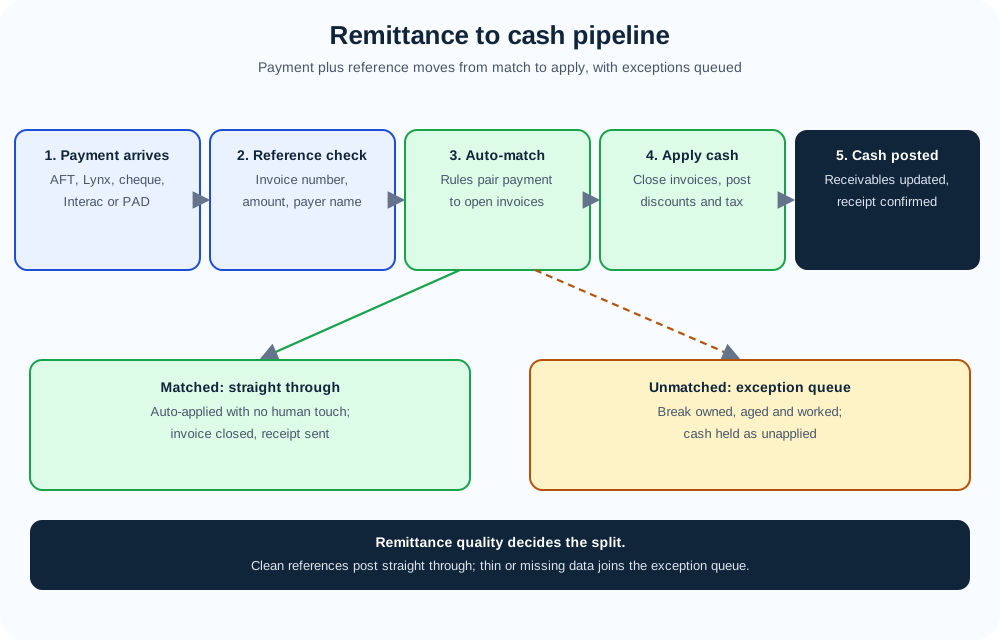
The diagram above is the chapter anchor: payment plus reference enters, matching decides its fate, application posts winners, the queue holds the rest under ownership. Every later section is a deeper pass over one box.
2. Participants, responsibilities and system boundaries
A remittance-to-cash flow always involves more parties than the two businesses who think of it as "you paid me." The reconciliation professional must keep five layers straight: the commercial parties, the banks, the system operators, the service providers in the middle, and the supervisors who set the rules. Confusing any two creates the classic errors this academy corrects — expecting the bank to know which invoice a payment closes, expecting the rail to preserve remittance it was never given, or expecting the ERP to reconcile against reporting nobody loaded.
Start with the commercial parties, because the obligation lives with them. The biller — sometimes called the creditor or payee — issues the invoice, defines the reference contract (which numbers the payer must quote), receives the payment and owns the receivables ledger where cash gets applied. The payer — the debtor or customer — owes the invoice, initiates the payment, creates or forwards the remittance, and owns the mirror image: its payables ledger and the deduction decisions (discounts taken, amounts disputed, fees netted) that explain why the paid amount differs from the billed amount. The boundary that matters operationally is this: the commercial truth about what a payment is for originates with these two parties, not with any bank or system. If the payer sends money without saying which invoices it covers, no downstream participant can reconstruct the intent. If the biller's numbers are ambiguous or reused, no engine can pair with confidence. Every reconciliation break that is not a bank error is, at root, a commercial communication failure between biller and payer — which is why this chapter spends as much time on reference contracts and payer habits as on systems.
The banks sit on either side of the value movement with distinct duties. The payer's bank validates, authenticates, screens and releases the instruction to the chosen rail with the reference supplied, subject to its channel and risk controls, and reports the debit. The biller's bank receives the incoming credit through clearing or settlement, posts it to the biller's account, preserves and reports the reference and remittance that arrived with it, and supplies the statements, advices and return reports on which reconciliation depends. Neither bank applies cash to invoices; that is the biller's job in its own systems. But each bank owns the fidelity of what passes through its hands: the payer's bank must not silently truncate a reference it accepted, and the biller's bank must report exactly what arrived — amount, date, reference, payer identification — without embellishment or loss. When a reference that left the payer correctly arrives damaged or missing, the investigation walks the bank chain first, because fidelity is the banks' warranty even though matching is not.
Payments Canada operates the rails the money travels on — ACSS for retail batch including AFT, and Lynx for high-value and time-critical payments — and publishes the rulebooks, exchange mechanics, business-day calendar and routing references the banks build on. Its batch windows and return timeframes decide when money and reporting arrive, its return and adjustment rules decide what comes back with what reasons, and AFT format coexistence decides how much remittance can travel with a batch payment. Interac Corp sits separately with its own addressing, notification, acceptance and settlement legs. The Bank of Canada acts as settlement agent, oversees designated systems, and supervises payment service providers under the Retail Payment Activities Act — three hats answering three questions, as Chapter 5 taught. None of these institutions sees your invoices.
The middle layer — ERP and accounting-system vendors, lockbox and bill-print providers, payment hubs, bank-connectivity channels — is where reconciliation usually succeeds or fails in practice, because this layer carries the data the banks move as bytes and the business reads as meaning. The ERP holds invoice masters, customer masters, matching rules and postings; its hygiene decides the auto-matching ceiling more directly than any bank feature. A lockbox provider captures cheque images, stubs and remittance lines into a file the ERP can match — functionally, an outsourced first pass of the pipeline. Host-to-host channels and portals move files both ways; a missed statement or mis-mapped field starves reconciliation silently until ledger and bank disagree. Vendors move and transform data, but the biller remains accountable for proving its receivables. A file the ERP could not ingest is not the vendor's reconciled item; it is your break, and it needs an owner.
Supervisors and rulebooks form the final layer. FINTRAC duties fall mainly on financial institutions but shape what payer data the business must keep. Sanctions and travel-rule screening gate outbound releases and colour inbound monitoring. Consumer and business PAD rules, card-network dispute frameworks and the payments.ca rule families set the return and recourse rights that determine whether an applied payment can come back. RPAA supervision of payment service providers matters wherever a fintech sits between payer and bank. Later blocks separate these fully; the operating lesson here is that compliance never sleeps just because money is arriving rather than leaving, and Section 7 places each control where it can still change the outcome.
Responsibility is a chain with no gaps. The biller defines contract and rules. The payer quotes references and sends remittance. The payer's bank carries faithfully. Rails exchange and settle under published rules. The biller's bank posts and reports with fidelity. Systems transform without loss. The team proves daily and closes every break linked. The most expensive sentence in receivables is "we assumed someone else checked."
3. Initiation, validation and bank processing
Every receipt in this chapter starts before any bank sees it: with an invoice that can be referenced and a payer that intends to pay. The initiation story therefore has two halves that must meet. On the biller's side, initiation means issuing invoices whose numbers are unique, stable and quotable, agreeing reference contracts with payers (quote this invoice number, on this line, in this format), and publishing where remittance advice should go and by when. On the payer's side, initiation means selecting which invoices to pay, deciding deductions and adjustments with reasons, entering the biller's reference exactly, choosing the payment method, and releasing the instruction through its bank channel. The meeting point is the reference: the small string of characters that lets the biller's system recognize its own invoice inside the payer's payment. When initiation is disciplined on both sides, matching is arithmetic. When either side improvises, matching is archaeology.
Validation is where the biller's defences catch what discipline missed, and it happens in two places. The first is at the payer's bank before release: account validation, beneficiary routing checks, duplicate and limit screening, sanctions and fraud gating, and cutoff assignment to a business-day window — the hub discipline from Chapter 5. A payment rejected here costs the payer a phone call and never becomes your problem. The second validation is yours, on receipt, before matching: is the amount plausible, is the reference shaped like your invoice numbers, is the payer identifiable, is this a duplicate, is the value date expected? This inbound validation deserves the same seriousness as outbound, because the failure modes are symmetric — a duplicate file applied twice overstates cash exactly as surely as a duplicate file paid twice understates it. Mirror the bank's one-hub posture with one intake: every receipt lands in one queue with reference, amount, date and payer identity normalized before any rule fires.
Bank processing between those two validations is the part the biller never sees but always depends on. The payer's instruction passes through validation, fraud and sanctions screening, approval and release, then enters the rail gateway: an AFT item delivered for ACSS exchange, a Lynx pacs message queued for gross settlement, an Interac send issued with its notification leg, a cheque captured as image and MICR data, a PAD collection presented under mandate authority. Each rail then does what its chapter teaches — batch exchange with deferred net settlement, per-payment RTGS with same-day finality, near-instant notification with separate bank-settlement legs — and the biller's bank posts the credit and reports it. Three details matter disproportionately. First, references travel only if supplied and preserved end to end; truncation anywhere is silent and permanent. Second, timing follows the rail's calendar, not the payer's intention: an instruction received after a bank's AFT submission window may be assigned to a later processing day, and the value date on your statement is the bank's report of account posting rather than the time the payer clicked send. Third, returns travel back with reason codes and timeframes, arriving as new events linked to the original — never silent edits — so intake must link each return to its payment.
After release the payer's hub stays active with tracking — acceptances, rejections, clearing confirmations, settlement evidence — and your receivables operation should mirror that posture on the inbound side: track expected versus arrived. The strongest receivables teams maintain an expected-receipts view built from issued invoices, promised payment dates, PAD schedules and notified wires, and they compare it daily against bank reporting. Expected but missing is a collection task. Arrived but unexpected is identification. Arrived with an unexpected reference is matching. Without expectations, every receipt looks equally surprising and the queue gets worked in arrival order instead of risk order. With it, the morning starts with the exceptions that matter: the big customer whose 400-invoice payment is short, the wire that arrived without advice, the duplicate that must not post twice.
Two design principles decide whether initiation survives reality, and they apply to billers as much as to banks. First, contract before code: agree the format, publish it, enforce it — then write rules that assume it. Rules written against unagreed references are complicated ways of failing. Second, fail visibly and early: reject an unprocessable receipt into the owned exception queue on day one with its reason attached, rather than letting it sit as unapplied cash while its context decays. A labelled break is a task; the same money unlabelled in suspense for six weeks is confusion earning interest. The pipeline rewards the team that names its unknowns fastest.
4. Clearing or exchange, settlement and finality
If Section 3 is about the decision to pay, Section 4 is about what the banking system promises once the decision is made — and why the promise differs by rail in ways the receivables team must feel in its bones. Clearing and exchange, settlement, posting, availability and finality are five different events, and the remittance travels with them under different guarantees. Clearing positions instructions, exchange delivers items between participants, settlement moves value finally, posting debits and credits accounts, availability releases funds for use, finality bars unwinding through the system. A payment can be available before it is finally settled, settled before its remittance is read, and posted before its reference is matched. The reconciliation team that blends these events chases ghosts: trying to match against money that has not arrived, trusting applied cash that can still return, or waiting for finality on funds that were usable days ago.
AFT credits — the workhorse of Canadian business receivables — clear through ACSS exchange with deferred net settlement by design. Participants exchange items and the ACSS calculates net balances; settlement of the previous business day's net balances occurs in the morning of each business day through direct clearers' Bank of Canada settlement accounts. Stream and file windows remain rule- and bank-specific. The customer experience of "paid" therefore precedes interbank settlement, with return rights surviving for rulebook reasons: invalid routing, closed accounts, PAD disputes, adjustments. An AFT credit posting Tuesday morning is usable cash with a small tail of return exposure, and its remittance may arrive in the file, in a companion advice, or not at all — the rail moved value efficiently, but explanation was always the payer's separate duty. Reconcile AFT receipts promptly, because the return clock is already running, and an applied-then-returned payment that nobody linked to its return becomes two breaks from one event.
Lynx wires sit at the opposite end of the bargain. Each payment settles individually in real time in central-bank money — no netting, no batch window. Once settled it is final and irrevocable; recovery needs a new payment with beneficiary agreement, not a system reversal. For receivables this finality is a gift with a wrapping problem. The money is certain — no return will unwind it — but the remittance is often the thinnest in the building: a single reference line the payer's clerk typed under time pressure, sometimes an invoice number, sometimes "payment on account," sometimes a fragment that truncates mid-thought. A $250,000 wire that settles with same-day finality and no usable reference is certain money with uncertain meaning, and it will sit in the exception queue earning nothing while the payer's payables team considers the matter closed. Treat every wire as two tracks from the first minute: confirm finality so treasury can use the funds, and chase advice in parallel so application does not lag settlement by days.
Cheques, Interac transfers and PAD collections each add their own combination of timing and data. A cheque carries remittance physically on the stub — sometimes with handwritten deductions — while funds travel image clearing with holds and return rights. The habit is match-early, confirm-late: capture stub detail at deposit, apply provisionally under the hold policy, confirm large applications against the return window. Interac e-Transfer for Business offers 24/7 service and says most payments land within seconds, with data-rich payment options; availability, fields, limits and posting still vary by participating financial institution and product. A basic transfer message is not a substitute for a contracted multi-invoice remittance feed. Interac receipts reconcile best when the business designs around the constraint: invoice-level references for single-invoice payments, and a strict habit of same-day advice by email or portal for anything covering multiple invoices. PAD collections invert the flow: the biller initiates the pull under mandate, so the "remittance" is the schedule itself — reconciliation is schedule-versus-arrival, with NSF, closed-account and dispute returns as exceptions. A PAD batch that reconciles against its own schedule the same morning is the cheapest reconciliation in Canadian payments; a PAD batch nobody compares to schedule until month-end is the most expensive surprise.
The planned Real-Time Rail is described by Payments Canada as an instant, data-rich exchange, clearing and settlement system intended for always-on use and ISO 20022 messaging. It is not a production capability at this audit baseline. Payments Canada's published launch plan is sequenced: Q4 2026 for initial direct-to-Exchange participants, Q1-Q2 2027 for initial and additional Interac e-Transfer clearing-and-settlement migration participants, and Q3 2027 for full volumes in the initial phases. The receivables implication is readiness, not a promise: confirmation and data may arrive with value, compressing today's batch matching windows. RTR readiness therefore means clean masters, agreed contracts, automatic rules, incident staffing and an owned queue designed for an always-on service. New rail; same discipline, compressed.
Three implications follow. First, never equate availability with understanding: a settled wire and a batch credit can look identical with opposite finality, and neither is reconciled until matched. Second, messaging is not settlement and settlement is not explanation: notification proves data moved, the credit proves value moved, only remittance explains what it settles. Third, staff the clock you promise: morning batch matching against return clocks, same-day wire advice chasing, 24/7 Interac acceptance with next-window matching, PAD schedule discipline before presentment. The treasurer's morning question — what arrived, what is usable, what is applied — can only be answered from bank reporting plus the matching state, never from either alone.
5. Data, identifiers, messages and references
If rails are the roads, data is the addressing that lets value arrive at the right house with the right letter attached — and Canadian receivables fail far more often from bad addressing and thin remittance than from system outages. Reference discipline, master hygiene and carriage fidelity jointly decide matching outcomes, and the evidence points one way: remittance data quality determines auto-match rates more than any algorithm. A clean, exact invoice number quoted verbatim will match under the simplest rule ever written. A missing or mangled reference will defeat the cleverest engine ever bought. This section maps each data element, the distinct EDI E3 payment-item framework, ISO 20022 AFT coexistence and the remittance paths that each actually supports, the ISO 20022 outlook on Lynx and the planned RTR, and the references that must survive the journey — functionally throughout, with no specifications stated.
Start with the commercial identifiers, because they are the only keys both commercial parties share. The invoice number is the primary key: unique, stable, printed, quoted, matched. Everything that corrupts it corrupts matching — reused numbers across years, prefixes dropped by a payer's ERP ("INV-004821" paid as "4821"), leading zeros trimmed, suffixes added ("4821-A" for a partial), two invoices netted into one reference line. The customer number is the secondary key: it cannot close an invoice, but it narrows 1,200 customers to one, turning a company-wide hunt into a single-account review. Adjustment and deduction codes — discount taken, shortage claimed, pricing disputed, freight netted — are the explanation layer: without them a short-pay is a mystery, with them it is a workflow item routed to the right owner. The rule is absolute: define identifiers, print them identically, never reuse them, validate at creation — every automation inherits their defects at scale.
The payment reference is the short key travelling with the money, and its capacity varies by rail. AFT references and remittance are constrained by the format and the bank channel; an AFT payment should not be assumed to carry a 400-line remittance. Payments Canada Rule E3 is a separate EDI payment-item framework, not a generic AFT remittance sidecar: it governs credit-driven Canadian-dollar EDI payment items for ACSS and permits related remittance information, with technical specifications in Standard 023. Use the current AFT standards or ISO AFT Usage Guidelines for AFT, and Rule E3/Standard 023 only when the parties actually use EDI. Lynx ISO 20022 messaging structurally supports richer remittance — per-invoice detail travelling with the wire — but capability is not usage: rich format carrying "payment on account" matches nothing, while a constrained batch reference with an exact invoice number matches instantly. Cheque stubs carry the richest free-form remittance of all and the weakest machine readability. Interac messages carry the shortest references and the fastest arrival. The design lesson repeats per rail: match the collection method to the remittance the situation needs, agree with the payer where the explanation will travel, and never assume a rail preserves what it was never given.
Remittance advice is the full explanation — document, file, email or portal submission listing each invoice, amount and deduction reason — and its coupling decides half of all matching outcomes. Advice that travels with the payment (in the same file, the same message, the same envelope as the cheque) matches on arrival. Advice that travels beside the payment (same-day email quoting the payment reference, portal upload keyed to the payment date and amount) matches within the day if the rejoin key — payment reference, amount, date — is exact. Late, vague or missing advice is the largest cause of exception queues: money sits unapplied, context decays, and by the time the spreadsheet arrives nobody remembers the payment. The enforceable disciplines: publish where advice goes, require it same-day, acknowledge receipt, measure advice timeliness per payer like payment timeliness — a payment without advice is half a payment.
Bank reporting is the independent testimony, arriving in three functional layers. Statements report posted entries and balances — what hit the account and when. Advices and credit notifications confirm individual items with references — the layer engines consume most greedily. Return, adjustment and fee reports show what came back — the layer preventing applied-then-returned breaks. Beneath sit modern message families, referenced here only generically: balance, transaction and notification concepts of the camt family, reporting intraday activity, positions and individual entries with structured references the ERP can ingest. Intake must consume all three layers daily, normalize keys to one identity, and never treat one layer as the whole truth. A statement without advices proves money but not meaning. Advices without the statement prove items but not completeness. Returns without linkage to originals prove motion but not position.
Two modernization notes shape investment without changing the chapter's disciplines. First, ISO 20022 coexistence is a multi-year condition, not a cutover: legacy and ISO 20022-enabled AFT run side by side with mapping and truncation risk, so intake must validate what actually arrived, log truncation, and carry the original reference forward. Second, the outlook improves: Lynx MX messaging is live with rich-remittance support, and the planned RTR is ISO 20022-native — but only ready masters, contracts and rules can consume the richness. Fund parallel validation and explicit truncation rules permanently, migrate willing payers to structured remittance first, and treat every rich-format failure as a master-data finding.
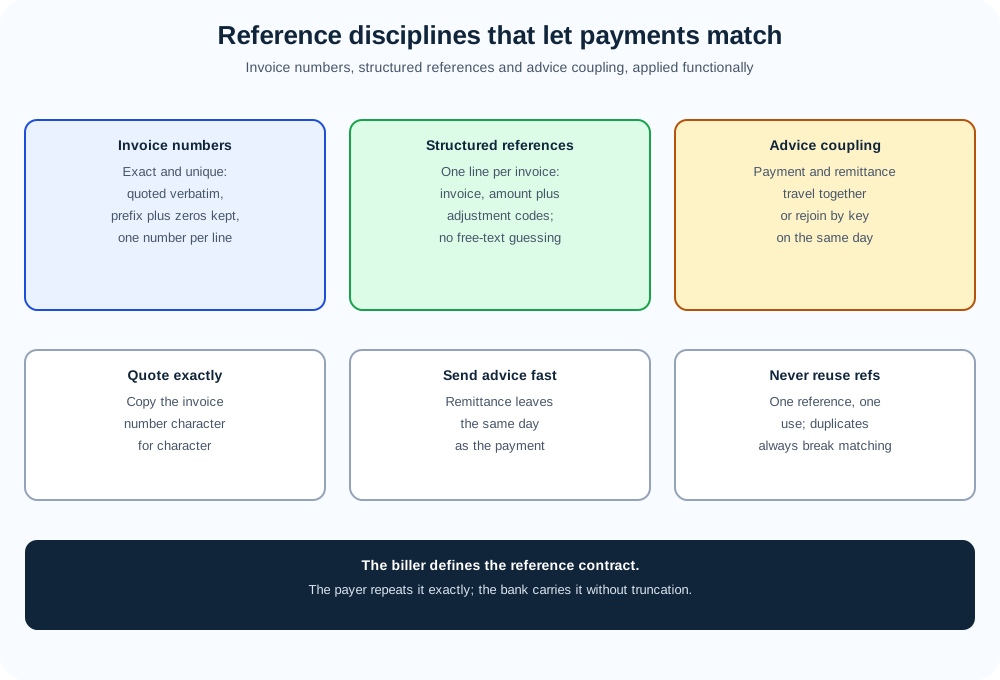
Three habits worth enforcing this quarter: exact invoice numbers quoted verbatim; structured per-invoice lines, not free text; advice leaving the same day and rejoining by exact key. None needs new technology; all raise the rate faster than any engine upgrade.
6. Rules, cutoffs, service levels and customer impact
Customers experience rules as promises: "did my payment arrive," "when will you apply it," "when will my account show clear," "what reference will appear on my receipt," "what happens if something is wrong." The receivables team experiences rules as windows, obligations and evidence. This section connects the two without inventing a single exact cutoff time, file specification or threshold. Exact times vary by bank, clearer, file type and day, and move with holidays. This chapter speaks only in relative windows — morning, afternoon and evening processing on business days, 24/7 acceptance for Interac receipts, planned 24/7/365 for RTR — and points to your bank's schedules and the payments.ca closure calendar for binding times. Any procedure manual or customer script that quotes a specific hour from this chapter is misusing it.
AFT credits arrive through batch windows; Lynx wires operate in Payments Canada's Monday-to-Friday system schedule (subject to closure days); cheques follow capture and return-window rhythms with holds; PADs follow presentment schedules; Interac e-Transfer for Business is offered 24/7, while the receiving financial institution's posting, reporting and reconciliation treatment remains product- and bank-specific. The daily rhythm: morning brings overnight batch credits and late wires with advices; midday brings cheque captures, Interac acceptances and PAD returns; afternoon brings urgent wires and the repair window; evening closes with the statement load and the expectation comparison setting tomorrow's priorities. Working this rhythm applies cash the same day; working in arrival order — or month-end batches — lets return clocks expire, advice go stale, and context evaporate.
Service levels bundle timing with certainty, information and recourse, and the biller should state them to payers explicitly rather than letting each payer assume its own. For AFT receipts the honest promise is low-friction scale with next-window availability and structured returns: "pay by AFT with exact references and same-day advice, and your account clears within our published application window." For wires the promise is same-day certainty with finality and a same-day advice obligation: "wire for urgency with exact references and send the breakdown before close of business, or your account shows unapplied." For cheques the promise is stub-driven matching under a hold policy: "mail the stub with the cheque and your account reflects the stub detail subject to clearing." For Interac the promise is instant acceptance with next-window application: "send anytime and we confirm receipt immediately; multi-invoice payments need same-day advice to clear the same day." For PAD the promise is schedule-driven: "your collection runs on the agreed date for the agreed amount; tell us before the notice window if anything changes." Each promise pairs a timing with a payer duty, because service levels without payer duties are just hope with a logo.
Matching rules are the service level the payer never sees but every payer feels, and they deserve plain-language governance. An exact match — reference identical, amount identical, payer known — posts automatically and confirms immediately. A tolerance match — amount within an agreed band for cash discounts, FX rounding or bank fees — posts automatically to a defined policy: discount allowed, fee absorbed, rounding written off under authority, never silently. A fuzzy or alias match — payer known by a trading name, reference off by a transposed digit, payment covering a known bundle — routes to a human with evidence pre-assembled, and the decision feeds back into rule or master so the break never recurs. A no-match — unknown payer, unparseable reference, amount matching nothing — enters the owned exception queue on day one with its age visible. The customer impact of this ladder is direct: exact payers get instant confirmation, tolerance payers get predictable treatment, alias payers get a same-day query instead of a month-end dunning letter, and no-match payers get contacted while the payment is fresh. Publish the ladder internally, review its bands quarterly, and never let tolerance become a habit for a payer whose contract says exact.
Pricing and promise interact on the receivables side as surely as on the payments side. Wires cost the payer more and arrive certain; asking a payer to wire a $400 invoice to improve your matching is commercial nonsense, while letting a $400,000 payment arrive by the cheapest path with no reference discipline is operational negligence. Segment explicitly: the largest payers get named contacts, agreed contracts, structured-remittance onboarding and quarterly match-rate reviews — they are half your receipts. Your long tail gets printed instructions on every invoice, portal advice upload, and automatic same-day queries — because they are half your breaks. What no payer gets is ambiguity: every invoice states the reference to quote, where to send advice, and what happens to payments that arrive without either. Customers accept disciplines they can follow; they do not accept being chased after paying correctly, or silence after paying vaguely.
7. Fraud, compliance and operational controls
Controls fail when complete but misplaced, and inbound money invites a complacency it does not deserve. A fraudulent inbound payment creates the same loss as a fraudulent outbound one once the business ships goods, releases services or refunds against it — and in several classic schemes the inbound payment is the weapon itself. This section places each control family at the point in the remittance-to-cash flow where it can still change the outcome, without duplicating the rail-level control detail that lives in Block 13.
Fraud against receivables takes four shapes the team must recognize on sight. First, the overpayment refund scam: a new "customer" overpays, invents urgency, and asks the excess back by a fast final method — then the original returns and the refund does not. The defence is procedural: never refund by a faster, more final method than the inbound payment, and hold overpayment refunds past the return window with dual approval. Second, remittance manipulation: genuine payment, altered advice — swapped numbers, edited amounts — hiding a misapplication or short-pay. The defence is to match against bank-reported amounts, not advice alone; advice disagreeing with payment is an investigation trigger, not an instruction. Third, payer impersonation: change-of-details or refund-redirection instructions from addresses that look almost right. The defence mirrors payables callbacks — verify change requests through a known, independent channel before updating masters or redirecting money. The fourth is internal: a clerk who can create credit memos, apply cash and issue refunds without a second pair of eyes can manufacture all three previous frauds alone. Segregation of duties — the person who applies cash does not approve adjustments, and neither issues refunds solo — is the control that makes every other control believable.
AML/FINTRAC boundary: FINTRAC reporting and travel-rule duties apply to reporting entities such as financial entities, money services businesses, foreign MSBs and casinos, not automatically to every biller. A business that is not a reporting entity should preserve commercial context and escalate unusual activity through its bank/provider process; a business that is itself a reporting entity must follow the PCMLTFA and current FINTRAC guidance. When a long-dormant customer suddenly wires large round amounts with vague references, or a payer overpays repeatedly and resists applying the excess, the receivables team may be the first to see a risk signal. Keep the matching decision and any suspicion decision on separate tracks, preserve evidence and do not promise a customer that a report was or was not filed.
Sanctions and travel-rule boundary: sanctions screening can require a hold, rejection or freeze; it is not correct to say inbound screening merely colours monitoring or that a bank's acceptance guarantees unrestricted use. Travel-rule information is a FINTRAC obligation for covered reporting entities on international EFTs and Canadian EFTs sent by SWIFT MT-103 or equivalent, with reasonable-measures and risk-based procedures when information is missing. The business should not overwrite originator data with aliases, should follow any bank/provider hold instruction, confirm large or unusual receipts before releasing goods or refunding, and answer investigations with the full remittance context. Domestic AFT/PAD/cheque processing may be outside the cited EFT travel-rule definition, but it still requires rail records and the institution's applicable AML/sanctions controls.
RPAA boundary: the RPAA applies to PSPs that perform covered retail payment activities in Canada. The Bank of Canada says PSPs must manage operational risk, respond to material incidents, safeguard end-user funds when they hold them, and meet reporting requirements; registered PSP frameworks were required by 8 September 2025. Not every payment link, lockbox or bank service is automatically an RPAA PSP. The biller should identify the regulated party and contractually define who authenticates, screens, holds funds, communicates status, reports incidents and evidences each stage — before volume arrives. The contract review is a reconciliation control in disguise: if the provider cannot deliver per-item references, same-day reporting and return linkage, its convenience fee is actually a matching-cost transfer, and the straight-through rate will pay it monthly.
Operational controls complete the plane and mostly concern the matching engine and the humans around it. Entitlements and dual approval govern who can change matching rules, widen tolerances, write off differences, move unapplied cash and issue refunds — the five actions where a small change compounds silently. Limits and velocity watch for the abnormal: a payment ten times a payer's history, a refund above authority, a burst of credit memos before period end. Amendment discipline requires that corrections post as linked new events — a reapplication references the original application, a reissue references the return — never as silent edits to settled postings. Evidence preservation keeps each receipt's four artefacts — bank report, advice, invoice snapshot, decision log — as one bundle, because auditor, dispute and fraud review all ask for the same bundle. Refunds, short-pay credits and overpayment returns pass authentication, validation, approval and screening in that order, logged — every major receivables loss involves a refund that bypassed the order under urgency.
8. Exceptions, investigations and recovery
Every break is managed the same way: detect fast, classify correctly, contain within the rail's rights, resolve as a linked event, reconcile with evidence. Classify first and resolve cheaply; act first — applying vaguely, refunding hastily, editing postings — and create breaks that dwarf the original. Block 14 teaches each banking mechanism; the focus here is the receivables side.
Start with the taxonomy, because each word implies different rights and different work. A short-pay is a payment for less than the invoiced amount with or without an explanation: discount taken, shortage claimed, fee netted, FX difference, or plain underpayment. The money is real and partially applied; the gap is a claim to be validated, not a balance to be ignored. An unidentified payment arrived without a usable payer or reference: the amount is known, the owner is not, and the work is identification before application — guessing misapplies twice, once to the wrong account and once to the right one when it is found. A misapplied payment was posted to the wrong invoice or customer: the work is linked reversal plus correct application, logged against the rule that caused it. A duplicate is the same economic payment presented twice — a file re-sent after a timeout, a cheque deposited by two channels: the work is confirming singularity before posting — applying both creates a false credit the customer will spend. A timing gap is not an error at all: the payment arrived before the invoice exists (prepayment, deposit) or the advice arrives after the money — the work is to hold explicitly labelled, not to force a match that does not exist yet. Each word routes to a different owner, a different clock and a different recovery; using them interchangeably in tickets and customer messages guarantees confusion.
Rail rights constrain recovery, so classify the rail before acting. An applied AFT credit later returned needs its application reversed as a linked event with the reason attached — the return code decides repair versus contact. A Lynx wire needs no finality worry — settled value does not come back — so a wire break is purely informational: chase advice, never question the money. A cheque break respects holds and return windows: link any return to its application before redepositing. An Interac receipt with a wrong amount must follow the product and financial institution's status, cancellation, refund or dispute process; do not assume a network adjustment. If a linked second transfer or refund is used, reference the original and preserve both events. A PAD NSF return follows mandate re-presentment practice — a returned pull is not revenue, and unauthorized re-presentment is a compliance event. The intake must prevent impossible offers: no "reversal" of settled wire value, no "chargeback" of a PAD, no silent editing of a posted application.
Investigations walk one path whatever the break: confirm what the bank says arrived, compare it with what the payer says was sent, compare both with what was billed, then communicate state. The evidence bundle is always the same four artefacts — the bank report (statement line, advice, return report), the payer's remittance advice, the invoice and account snapshot, and the decision log — laid side by side. Lynx breaks need settlement-to-posting confirmation plus the advice chase. Batch breaks need file, item, return and re-presentment status plus the remittance companion. Interac breaks need send-to-deposit confirmation. Correspondent breaks need tracking, intermediary confirmations and value-date verification. Every reapplication, claim, reissue and refund references the original receipt — one story with chapters, not scattered pages.
Recovery follows four rules that should be posted above every exception queue. Never edit posted value — reverse and reapply as linked events, so the ledger shows what happened instead of pretending it did not. Never post on assumption — confirm the original state first, or a timeout becomes a duplicate and a guess becomes a misapplication. Recover by current urgency and rights, not the original rail: a slow cheque can become AFT by agreement; a disputed short-pay moves faster as a documented claim. Communicate state plus next date, not activity: "we received $96,400 against invoice 4821, applied it, and raised claim 118 for the $3,600 shortage with a response date of Friday" closes a customer conversation, while "we are looking into it" extends it.
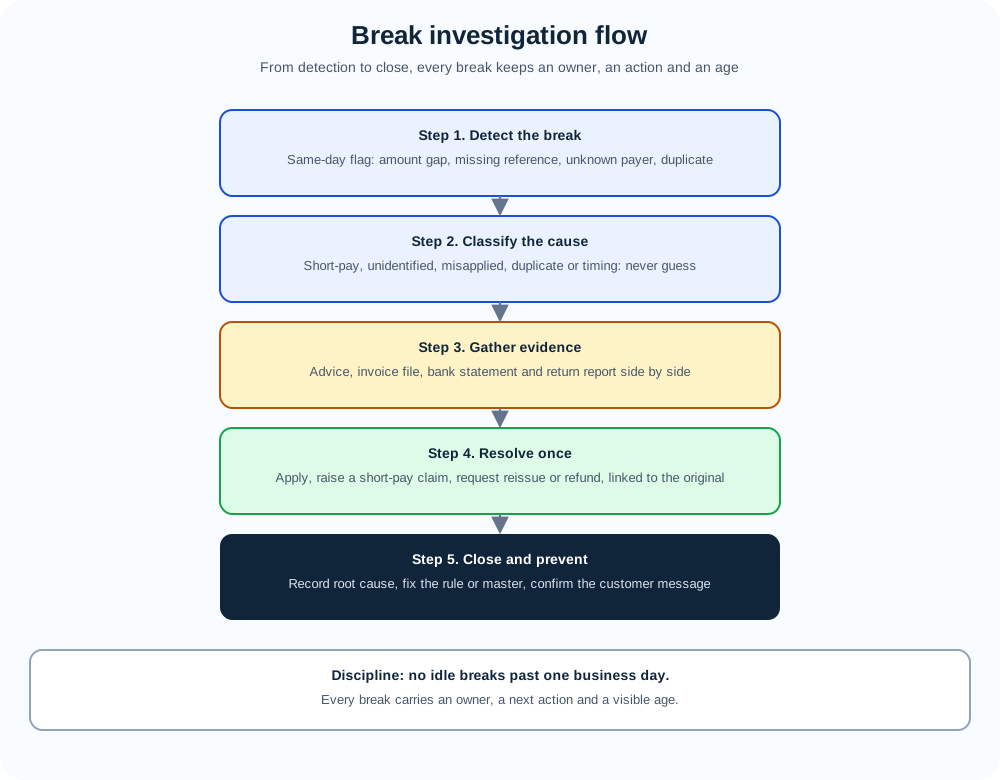
The diagram above is the operating poster: detect same-day, classify honestly, evidence before action, resolve once, convert every close into prevention. One discipline no tooling replaces: no break sits idle past one business day without owner, action and visible age.
9. Posting, accounting, liquidity, reporting and reconciliation
If Sections 3 to 8 move money and explain it, Section 9 proves it moved correctly and turns it into trusted cash the business can use. Posting, suspense, reporting and reconciliation are not month-end afterthoughts — they decide whether the business closes the day applied, balanced and explainable. This section follows a receipt from bank evidence to customer account to general ledger to cash position to the three-way proof that holds the chain together across every rail.
Posting translates matched evidence into ledger entries: an AFT batch closes hundreds of invoices with one debit to cash and hundreds of credits to receivables; a Lynx wire closes one large invoice with same-day finality and no return tail; a cheque posts its stub detail subject to the hold policy; an Interac receipt posts on acceptance with next-window matching for multi-invoice advice; a PAD collection posts the schedule with return exposure behind it. Each entry carries references the customer recognizes — invoice numbers, payment reference, date — because postings appear on customer statements, and an unrecognizable posting generates the query that undoes the efficiency. Discounts, bank fees, FX differences and tax adjustments post as separate, visible lines under their own authority, never netted silently into principal — the netting that hides a $3,600 shortage inside a $96,400 application is how disputes are manufactured. Returns and re-presentments post as linked entries with originals preserved — history as story, not palimpsest.
Subledgers carry detail, the general ledger carries control totals, suspense carries explicitly labelled unknowns — a suspense balance with ownership and ageing is a workstation, without it a write-off queue. Reconcile subledger to control daily, not monthly: the day's applied cash plus the day's unapplied balance plus the day's returns must equal the day's bank-reported receipts, per rail, every business day, with breaks queued by age and owner. Provisions reflect collection reality, never matching laziness — no provision shelters a paid-but-unapplied invoice, so the aged trial balance and the unapplied report are read together, same meeting, same owner. A suspense balance growing without ownership is an investigation waiting for a complaint; a suspense balance shrinking with documented reapplications is the visible pulse of a healthy operation.
Liquidity and cash positioning close the loop between reconciliation and treasury. The morning cash position answers three questions from last night's evidence: what settled and is usable today, what arrived but is held or unapplied, and what was expected but has not arrived. Wires and confirmed batch credits fund today's disbursements; held cheques fund nothing until windows pass; expected-but-missing receipts trigger collection calls before noon, not borrowing at dusk. The treasurer's forecast inherits the matching state directly: applied cash is certain, unapplied cash is probable with an age discount, expected-but-missing is at risk. Teams that report these three buckets separately give treasury a forecast it can fund against; teams that report "bank balance" as "cash" hand treasury a number that includes mysteries, holds and other people's money.
Reporting serves four audiences from the same evidence. Customers need recognizable receipts — applied invoices by number, balances stated plainly, short-pay claims as dated items. Collectors need the aged trial balance fused with the unapplied report, so nobody chases a paid invoice and nobody ignores a payer sitting on unapplied credit. Management needs the rate by payer, rail and reason, the queue by age and owner, unapplied-cash days, manual-application cost — five numbers saying improve or tread water. Regulators, auditors and lenders need the proof bundle: instruction, bank evidence, posting and linkage, preserved per receipt. All four cuts carry one identity per payment — a second identifier means a translation table, and translation tables are where breaks hide.
Reconciliation itself is the daily proof that three stories agree: what was billed, what the payer says it paid, and what the bank says arrived. Run it per rail, every business day, in two passes. First pass, completeness: every bank receipt has an intake record, every intake a decision, every decision a posting or owned break. The second pass is accuracy: sampled re-performance of auto-matches, review of every tolerance and alias decision, tie-out of subledger to control to bank. Watch two pathologies. Double-application — emergency wire duplicating unlinked batch value — overstates cash until the customer spends the false credit. Return-blindness — an applied payment returns unlinked — leaves invoices closed against gone money. Prevention is systemic: one identity per payment, returns linked to originals by rule, not habit.
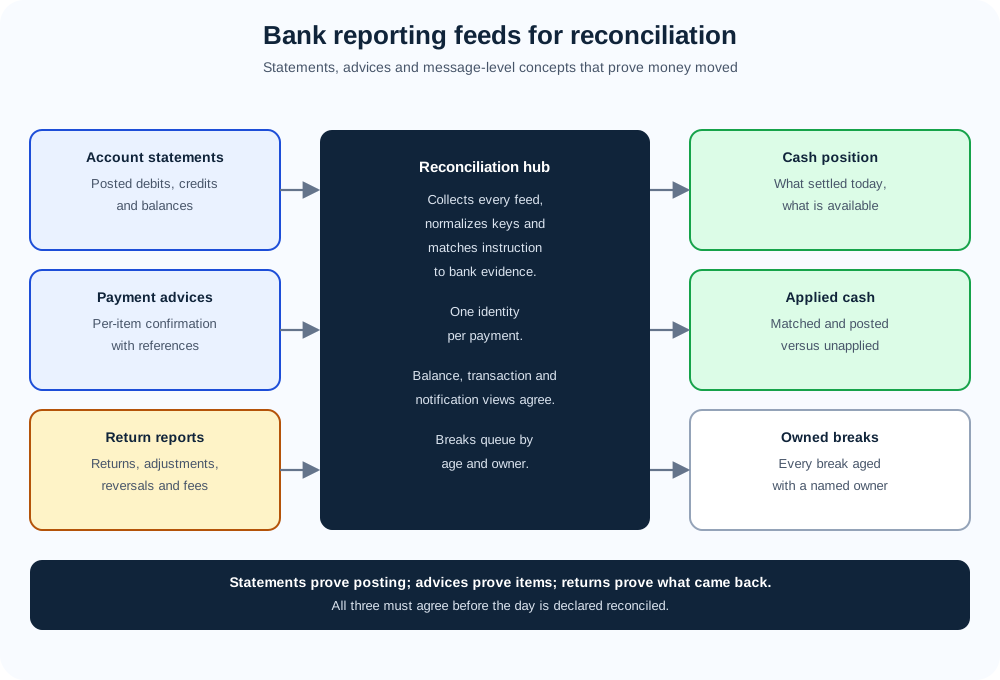
Three feeds in, one hub matching, three views out: statements prove posting, advices prove items, returns prove what came back — reconciled only when all three agree with the ledger. Print it beside the Section 1 pipeline; together they are the chapter on one wall.
10. Bank implementation, testing and resilience
Seeing the remittance-to-cash flow is one skill. Wiring a business to run it daily is another. This section is for the operations, technology and finance leaders who must turn the pipeline into configured systems, tested rules and staffed runbooks — and prepare for richer ISO 20022 remittance on Lynx and the planned RTR without destabilizing today's receipts.
Wire the intake before tuning the rules: one queue for every receipt with amount, date, reference, payer identity and rail normalized at entry; daily bank-reporting loaders that alert on missing files; a matching engine with the Section 6 ladder where every decision is logged with evidence; posting adapters that write applications and linked reversals with originals preserved; and the exception workbench showing each break's age, owner, evidence and next action. Each bank-reporting format arrives as one more loader, not a new silo — which is exactly how richer ISO 20022 remittance should arrive later: a new adapter feeding the same queue, the same ladder, the same workbench. Businesses that hard-wire each rail to its own spreadsheet must rebuild every time the bank changes a format; businesses with one intake absorb the change as configuration.
Data-master work precedes rule work, because rules inherit master defects at scale. Clean the customer master first: one payer, one identifier, trading names registered as aliases — every duplicate payer account is a future misapplication. Clean the invoice master: unique numbers, no reuse across years, credit memos in their own sequence. Register each significant customer's reference contract — format, advice path, tolerance, contact — where the workbench can see it. Write rules top-payer down: exact for the disciplined, alias-with-evidence for the messy-but-known, tight tolerances with explicit authority — and a default routing everything else to a human on day one. A rule that posts without evidence is not automation; it is a faster way of being wrong.
Testing must prove matching as well as connectivity: lossless loaders, duplicates caught before second posting, tolerance postings carrying authority, returns linked to originals, daily tie-out of subledger to control to bank, regression packs replaying last quarter's hardest breaks, volume tests at peak — the December rush, the post-holiday Monday, the morning the biggest customer pays 400 invoices at once. Sign-off needs operations, finance and audit — not technology alone — because an engine auditors cannot re-perform is a year-end finding.
Resilience covers what payers never see: backup statement retrieval, contingency matching with the same four-rung ladder on paper if necessary, vendor runbooks for lockbox and connectivity outages, communication trees for mornings when receipts arrive but reporting does not. Drill the failures: a missing statement file on month-end morning, a corrupted remittance companion, a duplicate delivery, a payer's format change without notice. For richer-remittance readiness at the October 2026 baseline, readiness means consumption capability: an ISO 20022-capable intake tested against Lynx-originated richness, explicit logged truncation rules, staff who read structured per-invoice detail — and channels never promising richness the intake cannot consume.
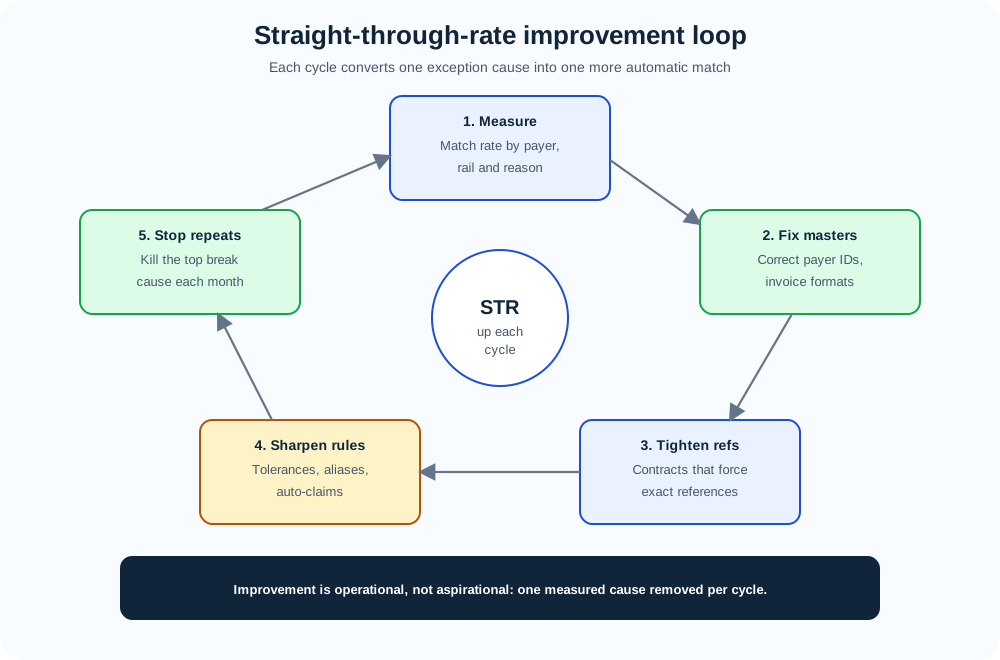
The loop above is the management habit: measure the rate by payer, rail and reason; fix the masters behind the top break cause; tighten the contract; sharpen the rule; remove one repeat cause per cycle. A point a month is twelve points a year — while engine upgrades without the loop merely fail faster. Put loop ownership with one person, review monthly with finance, and let queue ageing be the scoreboard.
11. Practical Canadian remittance examples
Theory holds until fifty payments arrive in one morning. Three fictional stories follow — all companies, people, amounts and timings invented for teaching only, in relative windows, with no invented specifications and RTR not treated as live. Read each with the diagrams open; extract the control lesson before moving on.
Example (fictional): Prairie Distributors clears 400 invoices in one payment
Prairie Distributors is a fictional Saskatoon wholesaler selling to about 900 contractors. Its largest customer, fictional builder Northgate Contracting, pays monthly: one AFT credit covering roughly 400 invoices, with a structured companion and same-day advice quoting reference, date and total. This fictional flow assumes a payer and biller have agreed an EDI/structured remittance feed in addition to the payment reference. Do not infer that every AFT credit includes EDI E3 data: Rule E3 is a separate ACSS EDI payment-item framework, while AFT uses its own legacy or ISO 20022 standards.
The receipt morning runs like a drill. Intake loads the statement and credit notification, normalizes the reference, and pulls the remittance companion by the agreed rejoin key — reference plus date plus total. Validation confirms the total to the cent and resolves the payer to the single Northgate master, its three trading names registered as aliases years ago. Exact matches fire: 387 of 400 post by mid-morning. The thirteen are classified before lunch. Nine are tolerance items — discounts inside the contracted band, posted automatically with visible adjustments. Three short-pays with shortage codes go to the sales owner with evidence. One transposed-digit reference goes to the named contact with the candidate match.
Close of business: one payment, 400 lines, 396 posted, three Friday-dated claims, one Wednesday answer, zero unapplied Thursday. The reference contract did more work than the engine; the old alias cleanup prevented a dozen misapplications. The three shortage claims, raised with evidence on day one, settled within the week at full recovery — a fresh claim is a clerical task; a month-end claim is a negotiation. Prairie's Northgate rate runs above ninety-five per cent, and the failing five per cent is the valuable five: real disagreements surfaced while still solvable.
Example (fictional): the $3,600 short-pay that became a dispute
Cascadia Marine Services is a fictional Victoria ship-repair yard billing fictional Harbourside Ferries $100,000 for a refit milestone — one invoice, one payer, the simplest receipt in this chapter. Harbourside sends a fictional domestic CAD Lynx wire for $96,400, settling with same-day finality; the reference reads "INV-2291 less 3600 fees." Finality is confirmed within the hour and the funds enter the day's position. Then the money sits — applied nowhere — for six weeks, until the $3,600 is a dispute neither side can prove.
Every link was avoidable. Finality was certain but explanation a fragment: which fees, under what clause, evidenced how? Nobody asked on day one. The engine correctly queued the mismatch, but the queue had no owner and no age alarm. The invoice showed $100,000 open, so collections dunned Harbourside for a balance it considered settled — the first dunning letter turned a clerical gap into a commercial insult. Weeks later the clerk had moved on, the paperwork was "with the previous person," and the yard could not confirm the fees were allowable. The split-the-difference settlement cost $1,800, six weeks of attention and a dented relationship — over one day-one phone call.
The counterfactual: day one, apply partially, hold $3,600 as an owned claim, query the named contact with a Friday date. Week one, the fee schedule arrives, records confirm half and contest half, the claim narrows to genuine disagreement handled commercially. Same economics, one-tenth the attention, relationship intact. The lesson in miniature: finality is not understanding, tolerance without authority is guessing, unowned queues manufacture disputes. Confirm money fast, chase meaning faster.
Example (fictional): December donations with missing advice
Harbourlight Foundation is a fictional Halifax charity: forty Interac transfers arrive one Sunday evening, $25 to $5,000, messages carrying first names and initials where the database needs legal names and addresses for tax receipts. Real money, instantly accepted, almost entirely unexplained — the unidentified-payment break at volume, on a 24/7 rail, against the receipting-season deadline.
Intake does three things right. First, accept and safeguard: every transfer accepted promptly, recorded with amount, timestamp and bank-reported identity — refusing donations is not a control. Second, identify before applying: distinctive amounts resolve against the pledge file; twenty-three unmatched enter an owned Monday queue with a Friday target. Third, communicate state: same-evening acknowledgements turn the chase into a welcomed conversation.
By Friday, thirty-four are receipted; six small unmatched gifts post to a labelled hold with documented follow-up, reviewed weekly — never written off or forced onto wrong donors. Design identification before the campaign; accept fast, apply only when identified; acknowledgement is a control, not a courtesy. Final report: forty gifts, thirty-four receipted, six in progress, zero forced matches.
Misunderstandings this chapter corrects
Ten recurring errors, each stated, corrected and pointed forward.
- "Reconciliation is the bank's job." No. The bank moves and reports value; matching to invoices is the biller's decision under its own rules. Detail in Sections 2 and 9.
- "The payment arrived, so the invoice is paid." No. Arrival is money, application is meaning; dunning against unapplied cash manufactures disputes. Detail in Sections 1 and 8.
- "A wire reference is enough for any receipt." No. Lynx finality is certain but its reference is often a single thin line — confirm money fast and chase advice in parallel. Detail in Section 4.
- "More matching software fixes a low match rate." No. Remittance data quality determines auto-match rates; exact references and same-day advice raise the rate faster than any engine. Detail in Section 5.
- "EDI and ISO 20022 mean one format everywhere now." No. AFT lives in legacy/ISO 20022 coexistence, Rule E3 is a separate ACSS EDI payment-item framework, not a universal AFT companion; Lynx MX richness is capability, not usage. Detail in Section 5.
- "Unapplied cash is harmless until month-end." No. Context decays daily; every break needs an owner, action and visible age within one business day. Detail in Section 8.
- "Tolerances mean the small stuff takes care of itself." No. Tolerance postings need explicit authority, visible adjustment lines and quarterly review, or discount creep hides inside rounding. Detail in Sections 6 and 9.
- "Inbound money needs no fraud controls." No. Overpayment refund scams, advice manipulation and refund authority abuse target receivables directly; segregation and refund discipline apply in full. Detail in Section 7.
- "RTR will fix our reconciliation." No. The rail is not live at the 5 October 2026 baseline; its published Q4 2026 launch is sequenced and contingent on testing, while instant rich payments will reward ready masters and punish messy ones faster. Detail in Sections 4 and 10.
- "The suspense balance is just an accounting line." No. Unapplied cash distorts ageing, collections, forecasting and provisions together — read it with the trial balance in the same meeting. Detail in Section 9.
12. Key takeaways and authoritative references
Hold the chapter as five sentences. Reconciliation turns received payments into trusted cash by proving billing, payer explanation and bank evidence agree — the straight-through rate measures how often proof completes untouched. Remittance data quality decides the rate: exact invoice numbers, structured per-invoice lines and same-day advice raise it, while vague references and late advice fill the exception queue regardless of technology. Banks move and report value but never close invoices; each receipt is matched with its rail's rights and clocks in view. Every break — short-pay, unidentified, misapplied, duplicate, timing — gets an owner, an action and a visible age within one business day, resolved as a linked event with its evidence preserved. Posting, suspense discipline, daily two-pass reconciliation and the monthly loop turn receipts into a ledger auditors, lenders and boards can trust — and ISO 20022 richness, live on Lynx and planned for RTR, rewards discipline while punishing mess faster.
Carry five behaviours forward. Contract first: every significant payer gets format, advice path and contact on the invoice and in the workbench. Validate on arrival: one normalized queue before any rule fires. Match by ladder: exact posts, tolerance under authority, alias with evidence, the rest owned on day one. Prove daily: tie subledger to control to bank per rail, no idle breaks, no silent edits. Improve monthly: one break cause removed per cycle. Repeated across thousands of invoices, these make receivables boring in the best sense: predictable, provable, collected.
Where to go next
Where to go next: Chapter 33 and Blocks 3 to 5 for collections; Block 8 for wires; Blocks 3 to 4 for batch; Blocks 6 to 7 for Interac; Block 9 for messages; Block 14 for rules and posting; Block 13 for fraud and supervision.
Authoritative references (official sources only, baseline 5 October 2026)
Official sources and functional descriptions only. No cutoff times, specifications or thresholds are stated; for binding detail use the publications below with your bank's schedules and the closure calendar. Re-check time-sensitive pages before customer or examination use.
- Payments Canada — Retail batch payment system page. Operator description of the retail batch system comprising ACSS and USBE, direct and indirect participation, entry of volumes and values into net balances, and settlement of balances through payments to and from the Bank of Canada. https://www.payments.ca/systems-services/payment-systems/retail-batch-payment-system
- Payments Canada — Rules and documentation page. Source for the current ACSS rules, standards, by-laws and procedures — including the return, adjustment and funds-transfer rule families referenced functionally in this chapter — with versions in force and update history. https://www.payments.ca/systems-services/rules-documentation
- Payments Canada — High-value payment system (Lynx) page. Operator description of Lynx as the real-time gross settlement system for high-value and time-critical payments, live since 1 September 2021, settling in central-bank money with ISO 20022 messaging. https://www.payments.ca/systems-services/payment-systems/high-value-payment-system-lynx
- Payments Canada — Real-Time Rail payment system and testing/launch pages. RTR is described as a planned instant, data-rich exchange, clearing and settlement system; Q4 2026 launch is sequenced after testing, with later 2027 migration phases. https://www.payments.ca/systems-services/payment-systems/real-time-rail-payment-system https://www.payments.ca/systems-services/payment-systems/real-time-rail-payment-system/testing-and-launch
- Bank of Canada — Payment systems overseen by the Bank. Central-bank description of oversight under the Payment Clearing and Settlement Act, including Lynx as systemically important and live since 2021, ACSS as an overseen retail system, and the Real-Time Rail as planned. https://www.bankofcanada.ca/regulatory-oversight/financial-market-infrastructures/payment-systems-the-bank-of-canada-oversees/
- Bank of Canada — Settlement account policies for Payments Canada systems. Central-bank description of settlement accounts for Lynx, ACSS and the planned RTR, settlement finality in central-bank money, and eligibility and application for settlement accounts. https://www.bankofcanada.ca/core-functions/financial-system/bank-canadas-settlement-account-policies-for-payments-canada-payment-systems/
- FINTRAC — Introduction to FINTRAC. Government source for FINTRAC's mandate, reporting-entity scope and links to current obligations and guidance. https://fintrac-canafe.canada.ca/intro-eng
- FINTRAC — Travel rule for electronic funds and virtual currency transfers. Defines covered entities, Canadian SWIFT MT-103/equivalent scope, required information and risk-based handling of missing data. https://fintrac-canafe.canada.ca/guidance-directives/transaction-operation/travel-acheminement/1-eng
- FINTRAC — Reporting electronic funds transfers. Defines reporting entities, EFT exclusions including direct deposits and PADs, and reporting responsibilities. https://fintrac-canafe.canada.ca/guidance-directives/transaction-operation/eft-dt/eft-dt-eng
- Interac Corp — Interac e-Transfer for Business. Operator source for 24/7 service, seconds-level typical delivery, data-rich remittance, Autodeposit, ERP integration, authentication and bank-specific availability/limits. https://www.interac.ca/en/payments/business/send-receive-money-with-interac-e-transfer-for-business/
- Payments Canada — Automatic funds transfer ISO 20022. Current AFT onboarding, message portfolio and corporate/bank reporting message resources; draft corporate guidelines are explicitly marked draft on the page. https://www.payments.ca/payment-resources/iso-20022/automatic-funds-transfer
- Payments Canada — Rule E3, Rules Applicable to Electronic Data Interchange (EDI) Transactions. Current rule text for EDI payment items and related remittance information; technical specifications are in Standard 023. https://www.payments.ca/sites/default/files/e3eng.pdf
- Bank of Canada — Retail payments supervision. RPAA scope, PSP registration, operational-risk, incident, safeguarding and reporting responsibilities. https://www.bankofcanada.ca/regulatory-oversight/retail-payments/
- Bank of Canada — Supervisory framework for retail payments. Detailed operational-risk, incident response, safeguarding and reporting expectations for PSPs. https://www.bankofcanada.ca/regulatory-oversight/retail-payments/supervisory-framework/
- OSFI — Guideline E-21, Operational Risk Management and Resilience. Applies to federally regulated financial institutions and sets risk-based resilience, governance, testing and critical-operation expectations. https://www.osfi-bsif.gc.ca/en/guidance/guidance-library/operational-risk-management-resilience-guideline
- Justice Laws — Canadian Payments Association By-law No. 3, Payment Items and ACSS. Current legal provisions for payment items, participation, exchange, clearing, settlement and returns; current to 21 September 2026. https://laws-lois.justice.gc.ca/eng/regulations/SOR-2003-346/index.html
- Justice Laws — Canadian Payments Association By-law No. 10 — RTR. Current legal framework for RTR participation, exchange, clearing, settlement, payee payments and coming into force; current to 21 September 2026. https://laws-lois.justice.gc.ca/eng/regulations/SOR-2026-133/index.html
- Payments Canada — System closure schedule. Binding closure calendar to use with bank and participant schedules. https://www.payments.ca/system-closure-schedule
Diagrams in this chapter: remittance-to-cash pipeline; reference disciplines; bank reporting feeds; break investigation flow; straight-through-rate improvement loop — all under /diagrams/payment-stories/canada/chapter-35/. No exact cutoff times, specifications or thresholds are shown. RTR is shown as planned. Stories, companies, people and amounts are fictional.
This application uses JavaScript for the full interactive experience. This text summary is served for accessibility and search indexing.