Bank Account and Transit Numbers. Understand customer account, branch and transit data used for Canadian payment initiation and routing.
Canada Payments & Collections · Block 2: Canadian Accounts, Routing and Infrastructure · Chapter 6 of 75
What you should be able to do after this chapter
After working through this chapter, you should be able to:
- explain what the Canadian 9-digit CACPA routing code means for applicable Canadian payment formats: leading zero, 3-digit institution number and 5-digit branch/transit number, and why the branch number identifies account domicile rather than where the customer walks in;
- read a MICR line on a cheque generically: which positions carry the cheque number, the routing with transit and institution, and the account number, and why a readable MICR line proves routing intent rather than funds;
- describe how institution, branch or transit record, customer account and payment instruction join together, where each element is mastered, and what breaks when any join fails;
- validate AFT/retail-batch account data at capture using format checks and the Financial Institutions File (FIF) maintained under Rule F7, while using the applicable bank or rail directory for other payment types;
- run a disciplined repair queue: preserve the original instruction, assign an owner and reason, confirm changed beneficiary details by callback, re-validate before release, and escalate on age;
- distinguish a reject inside the bank from a return after exchange, and map each outcome to the right customer message and next step;
- explain how routing data touches clearing, settlement and finality without confusing routing with settlement: correct routing gets the item to the right place, while ACSS deferred net settlement and Lynx real-time gross settlement decide when value moves finally;
- apply fraud, sanctions, privacy and mandate controls to account-data handling, including why beneficiary-name signals are rail- and provider-specific and never replace coded routing validation;
- size and staff the cost of misdirected data: returns, rework, suspense, reconciliation breaks, customer harm and trust loss, and what prevention is worth;
- design, test and operate account-data capture, storage and change processes that survive branch mergers, migrations, closures and channel differences.
For a roughly 60-minute core session, spend about 30 minutes on Sections 1 to 4 (business context, participants, bank processing, clearing and settlement context), 10 minutes on the five diagrams and the comparison tables, 15 minutes on one end-to-end example in Section 11, and 5 minutes on Section 12 takeaways. Treat the remaining depth as guided follow-up study; completing the whole chapter carefully takes longer, and that is intentional for a routing chapter that every later block depends on.
Chapter navigator
- Business context and customer need
- Participants, responsibilities and system boundaries
- Initiation, validation and bank processing
- Clearing, exchange, settlement and finality as they touch routing
- Data, identifiers, messages and references
- Rules, cutoffs, service levels and customer impact
- Fraud, compliance and operational controls
- Exceptions, investigations and recovery
- Posting, accounting, liquidity, reporting and reconciliation
- Bank implementation, testing and resilience
- Practical Canadian examples
- Key takeaways and authoritative references
1. Business context and customer need
Start with a Monday morning, not a data dictionary. A payroll officer in Mississauga uploads direct-deposit details for 800 employees and needs every dollar in the right account on Friday. A property-management firm in Burnaby onboards 300 new tenants for pre-authorized rent collection and needs each monthly debit drawn from the correct account without a wave of returns. A daughter in Ottawa sets up a recurring transfer to her elderly father's account at a different bank and needs confidence the money cannot land in a stranger's account because of one transposed digit. A supplier in Laval changes its remittance banking details by email and the buyer's accounts-payable clerk must decide whether to trust the new numbers. A branch teller in Halifax keys a wire instruction from a handwritten form while a queue builds behind the customer. Every one of these moments runs on the same three facts: which institution holds the money, which branch record is the domicile of the account, and which customer account at that domicile should be debited or credited. Get those three facts right and everything downstream has a chance. Get any one of them wrong and no amount of fast clearing, elegant messaging or sincere apology undoes the return, the delay and the doubt.
Canadian retail routing answers those three facts with a compact convention that every banker, analyst, product owner and operations lead must be able to read at sight. A Canadian 9-digit CACPA routing code has the shape 0IIITTTTT: a leading zero, a 3-digit institution number, and a 5-digit branch number commonly called the transit number. The account number itself is assigned by the institution and varies in length. Together, institution plus branch/transit plus account identify the intended destination, but the exact fields and directory depend on the rail. This code is used in AFT and other Canadian formats and is also the subject of Payments Canada's 2026 wire-format best practices; a Lynx participant message is not the same thing as putting a 9-digit code on every network hop. The convention appears on cheques in magnetic ink, on direct-deposit forms and in corporate AFT files. It is deliberately boring, and its boring reliability is what lets payroll, supplier payments, rent collection and bill payment scale to millions of items a day.
Why does the transit matter so much when customers rarely know theirs? Because the transit is the domicile pointer inside the holding institution. An account opened at a branch in Victoria twenty years ago may still be domiciled to that transit even though the customer now lives in Montreal, banks entirely by phone, and has never met the current staff at the domicile branch. Internal reorganisations, branch mergers, system migrations and processing centralisation move work around, but the domicile mapping must remain coherent or payments misroute. Staff sometimes describe the transit as the branch the customer uses, which is wrong in exactly the way that causes incidents: payments route to the domicile record, not to the friendly counter where the customer was last seen. Whenever a product, form or migration mapping treats those two ideas as interchangeable, returns follow within days.
The customer need underneath routing data is therefore profoundly practical rather than theoretical. Nobody wakes up wanting to understand transit numbers. They want pay to arrive, debits to come from the right place, statements to make sense, and mistakes to be caught before money moves rather than explained after it lands somewhere unexpected. Good routing design serves that need at the point of capture: forms that separate institution, transit and account into labelled fields instead of one free-text box; enrolment journeys that confirm details before the first live payment; corporate file validation that rejects a bad record on Monday with a precise message rather than returning it on Thursday with a code nobody remembers; branch procedures that read details back to the customer before release. Each of those controls costs a little friction at capture and saves an order of magnitude more friction in exceptions, and the business case for routing quality should always be framed that way for executives who only see the capture cost.
Scale makes the argument unavoidable: Payments Canada reports 10.6 billion ACSS items in 2025, and each item carries routing data captured somewhere far upstream: a payroll administrator retyping numbers from a void cheque, a tenant photographing a cheque with a phone, a call-centre agent transcribing numbers read aloud, or a migration script mapping legacy branch codes. Even a tiny defect rate becomes a large absolute queue of returns and rework. The best straight-through rates come from capture quality and reference-data freshness, not fancier clearing engines.
There is also a trust dimension that numbers alone miss. A misdirected payment is not merely an operational event for the affected customer. A tenant charged a non-sufficient-funds fee because a rent debit was drawn from a mistyped account, an employee who cannot pay rent because payroll landed late, a supplier who puts a customer on credit hold because a payment went to the wrong account: each of these episodes teaches the customer that the bank's plumbing cannot be trusted with the details that matter most. Rebuilding confidence costs more than any fee reversal, so every capture screen and validation message is a trust surface.
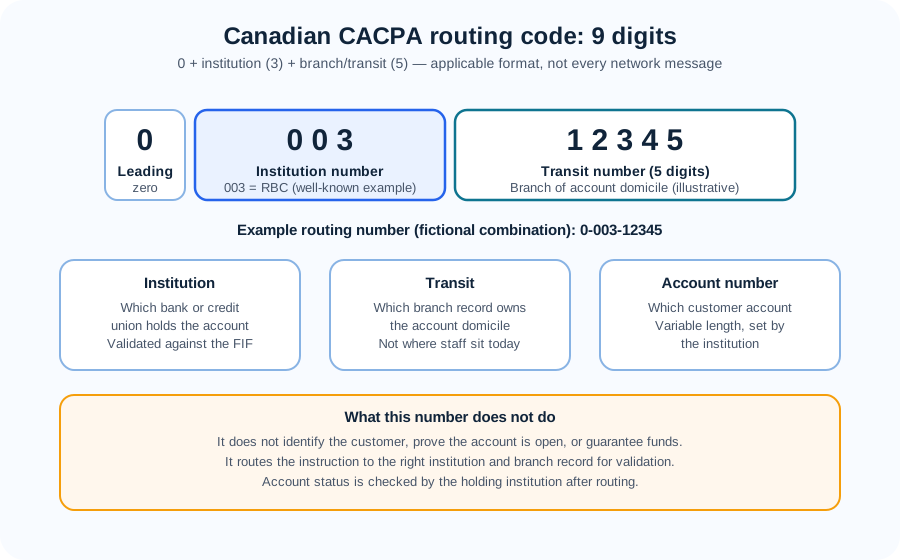
The routing-anatomy diagram above is the single visual to keep open while reading this chapter. It shows the 9-digit shape 0IIITTTTT broken into its three jobs: the leading zero that marks the Canadian routing convention, the institution segment that selects the holding bank or credit union, and the transit segment that selects the branch domicile record within that institution, with the variable-length account number selecting the customer account. Notice the warning box at the bottom: the routing number does not identify the customer, prove the account is open, or guarantee funds. It directs the instruction to the right door. Whether anyone answers, and with what balance, is decided after routing by the holding institution. Every later section returns to that boundary, because most routing incidents come from expecting the routing number to promise more than direction.
A final note on language: institution number and transit number are common Canadian terms; Payments Canada rules describe the 5-digit component as the branch number within the transit field. Account number means the institution-assigned customer identifier of variable length. The Financial Institutions File under Rule F7 is the authoritative AFT/retail-batch routing directory, while other rails use their applicable directory or message specification. MICR is the machine-readable cheque encoding. This chapter uses fictional or illustrative transit and account combinations throughout and names only the permitted well-known institution numbers (001, 002, 003, 004, 006 and 010).
2. Participants, responsibilities and system boundaries
Routing data passes through many hands, and every handoff is a place where a digit can be mistyped, a stale branch code can be reused, or an assumption can substitute for a check. Six participant layers share responsibility, and the chapter is explicit about who owns what, because the most expensive routing failures are ownership failures: everyone assumed someone else had validated the numbers.
The first layer is the end customer or originator: the employee handing over a void cheque, the tenant filling in a pre-authorized debit form, the supplier emailing new banking details, the corporate payroll administrator assembling a file, the family member setting up a recurring transfer. Customers originate the raw digits and carry the first duty of accuracy, but product design decides how easy accuracy is. A form that asks for one 17-character string labelled banking information invites transposition errors; a form that asks separately for institution number, transit number and account number, shows the expected lengths, and confirms the institution name back to the customer catches a large share of defects at the cheapest moment. Corporate originators carry a heavier duty: their files feed thousands of payments, so their assembly, validation and approval processes are effectively part of the bank's control perimeter whether or not the contract says so in those words. Banks that treat originator enablement as onboarding rather than paperwork, with test files, validation reports and repair coaching, see structurally lower return rates for years afterwards.
The second layer is the capturing channel and its staff or software: branch counters, contact centres, mobile and online enrolment, corporate host-to-host delivery, application programming interfaces offered directly or through payment service providers, bill-aggregation feeds and lockbox or image capture for cheques. Each channel converts human or file input into a canonical instruction with the same three routing facts plus amount, date, names and references. Responsibility here is conversion fidelity: read what was provided without adding error, enforce the field discipline the product promises, preserve the original image or file alongside the keyed interpretation, and surface validation outcomes in language the user can act on. A frequent implementation failure is channel divergence, where the mobile journey validates transit reachability but the contact-centre desktop lets agents free-type and submit, or where the corporate channel enforces strict record layouts while the branch channel accepts a sticky note. Routing quality is a property of the weakest capturing channel, and reviewers should always ask for the channel inventory before accepting any straight-through-processing claim.
The third layer is the account-holding institution on each side: the originator's bank that validates and releases the instruction, and the beneficiary's bank that validates the domicile join and posts or returns. The sending institution owns pre-release validation: format, FIF reachability, duplicate, limit, approval, screening and cutoff checks. The receiving institution owns domicile validation: does this transit belong to us and in what status, does this account exist and in what status, and what return reason applies when the answer is negative. Neither side may outsource its judgement to the other. The sender cannot assume the receiver will gracefully handle a guessed transit, and the receiver cannot assume the sender checked anything. On-us items, where both accounts sit at the same institution, keep both duties inside one bank; the absence of an external clearing leg removes no validation, and auditors rightly treat skipped on-us validation as a finding rather than an optimisation.
The fourth layer is Payments Canada as operator and rule-maker for ACSS batch, Lynx high-value settlement and the Rule F7 FIF regime. It owns the clearing framework and exchange discipline, not individual account digits; wrong routing is remedied in capture, validation and repair at the institutions, never by asking the operator to fix digits in flight.
The fifth layer is the Bank of Canada as settlement agent and designated-systems overseer. It is not the customer's routing-data repair desk or the supervisor of every retail provider. None of those capacities corrects a wrong transit; its relevance is that final settlement for Lynx and ACSS occurs through settlement accounts on the Bank's books and that designated-system oversight makes resilience and reconciliation material control concerns.
The sixth layer is vendors, processors, correspondents and infrastructure providers, each introducing mapping risk: renumbering conversions, weak MICR print batches, divergent padding, truncated references. These surface as routing failures with no customer mistyping, so vendor specifications and testing belong in the routing-quality programme.
| Participant layer | Owns for routing data | Does not own |
|---|
| End customer and originator | Accurate source digits, mandate evidence, timely correction | Reachability judgement, return-code interpretation |
| Capturing channel | Faithful conversion, field discipline, original preservation | Final account-status decision at the receiving bank |
| Sending institution | Pre-release validation, FIF check, approvals, screening, release | Receiving-side account status and posting decision |
| Receiving institution | Domicile and account validation, posting or coded return | Repair of sender-side capture defects |
| Payments Canada | Clearing framework, Rule F7 and FIF regime, exchange discipline | Individual account validation or digit correction |
| Bank of Canada | Settlement accounts and designated-system oversight | Any correction of customer routing data |
| Vendors and correspondents | Specification-grade conversion, print and mapping quality | Customer-facing promise about timing or finality |
Boundaries belong in procedures: channels and authorisation with the account-holding institution, validation and release with the sender before clearing, exchange with the operator, settlement on the Bank of Canada's books for Lynx and ACSS, posting with each holding institution, and investigations spanning all of them with references preserved. The first diagnostic question is always which layer introduced the defect and which owns recovery.
3. Initiation, validation and bank processing
Every routed payment, regardless of rail, passes through the same logical sequence inside the sending bank: initiation, authentication, validation, control decisioning, release and submission. The rail changes file layouts, message schemas, timing and finality, but it never removes a step. Weakness anywhere in this chain is the most common source of misdirected payments, and the validation stage is where routing data either earns its passage or is stopped while repair is still cheap.
Initiation is the capture of a complete instruction: who pays, who receives, how much, in what currency, on what date, for what purpose, with what references, and through which rail, anchored by the three routing facts of institution, transit and account. Channels differ enormously in how faithfully they capture those facts. A corporate AFT file delivers them in fixed record positions that either parse or fail loudly. A branch form delivers them in handwriting that two people can read differently. A phone call delivers them as spoken digits that sound alike. An online form delivers them as typed digits with no independent confirmation unless the product adds one. A cheque delivers them twice, once in human-readable print and once in MICR, and the two can disagree when printing or capture goes wrong. Mature banks normalise every channel into one canonical instruction model before validation. Banks that let each channel define completeness see channel-correlated return rates until the channel inventory is drawn.
Authentication establishes that the instructing party may act on the account, and it interacts with routing data in ways bankers sometimes overlook. Strong authentication of the wrong instruction is still the wrong payment: an authenticated fraudster who substitutes beneficiary routing, a socially engineered customer who reads out attacker-controlled digits, or a compromised corporate workstation that swaps a supplier's transit all produce formally authorised misdirection. High-risk routing actions therefore need their own authentication weight: adding a new beneficiary, changing standing routing instructions, releasing a first payment to new details, or keying a large wire from paper should attract step-up authentication, dual approval or out-of-band confirmation regardless of how trusted the session looks. Callback discipline for changed details belongs here rather than in fraud theory: any change to institution, transit or account on an existing payee should be confirmed through a previously known contact route before the first payment uses the new numbers.
Validation is the heart of this chapter and deserves a slow walk. Format checks come first and cost almost nothing: is the routing field 9 digits, does it begin with zero, are institution and transit segments numeric and in range, does the account field meet the holding institution's length and character rules, are required companion fields such as amount, currency, value date and beneficiary name present. These checks catch transposition, truncation, pasting and field-shift errors in milliseconds, and every channel should enforce them synchronously with messages the user can act on. A message that says invalid transit is a dead end; a message that says the transit must be 5 digits and you entered 4, with the entered value echoed back, is a repair path. Product owners should review every validation message the way they review marketing copy, because message quality determines whether customers fix defects or abandon and phone.
FIF lookup comes next and answers the reachability question authoritatively. The Financial Institutions File, maintained under Rule F7, is the industry reference that tells a sending bank whether an institution number is real, whether a transit belongs to that institution, what status each record carries, and how the destination is reachable across clearing. Practical use has three parts. First, keep the file current: subscribe to updates, apply them on schedule, and reconcile the applied version across every validation point so the branch, the contact centre, the mobile service and the corporate gateway never disagree about the same transit. Second, test the join rather than the parts: an institution that exists and a transit that exists do not jointly prove that the transit belongs to that institution, and only the join check catches the common error of pairing a valid institution with a valid transit from a different bank. Third, respect status: closed, merged, renumbered or non-reachable records are validation outcomes, not suggestions, and the repair path must distinguish a mistyped digit the customer can fix immediately from a stale record that needs reference-data or beneficiary follow-up.
Account-level checks inside the sending bank complete validation for outgoing items only partially, because the authoritative recipient-account status answer lives at the receiving institution. What the sender can still do is substantial: confirm the debit account exists and is in good standing with available balance or limit for the instruction, run duplicate detection against recent submissions to catch double-uploads and double-keying, check amount and date plausibility, verify mandate existence for pre-authorized debits, and enforce entitlement and limit discipline on who may release what. Bank-specific pre-validation or small-value test procedures, where offered and permitted, can add a further layer for high-risk first payments. None of these sender-side checks removes the need for receiving-side validation, and procedures must say so explicitly so staff never promise that a payment will post merely because it passed sender checks.
Control decisioning then decides whether the validated instruction may proceed: sanctions and watch-list screening, fraud scoring and behavioural analytics, velocity and beneficiary-risk checks, dual-approval enforcement, callback verification for changed details, and applicable client and record considerations. Cutoff pressure must never compress this stage. A file approaching the exchange window with unvalidated records should lose the records, not gain an exception to validation. Managers need to state that rule before payroll season rather than during it, because the moment of maximum temptation is exactly when the discipline matters most.
Release and submission convert the approved instruction into clearing reality: aggregation into AFT files or streams with exchange cutoffs for batch, ISO 20022 message construction and liquidity-aware release for Lynx wires, image and data submission for cheques, each creating the first piece of external evidence such as exchange timestamps, message identifiers and network references. Release logging should record what was released, when, by whom, under which approval, against which FIF version, and ahead of which cutoff, because that record is what investigations and reconciliation consume later. Anything released without that evidence is operationally invisible no matter what the customer screen displayed.
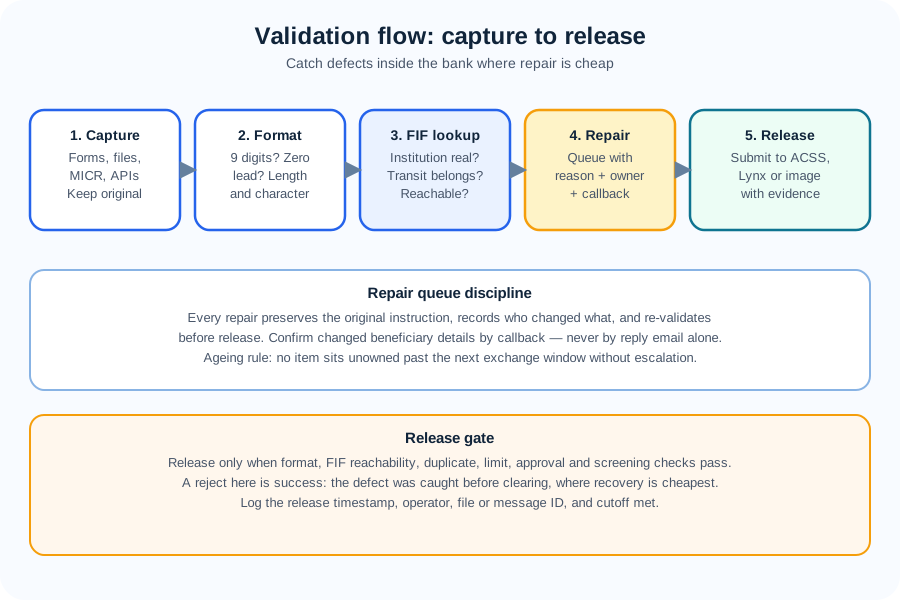
The validation-flow diagram above turns this section into a desk reference. Capture preserves the original. Format checks reject the obviously malformed. FIF lookup tests the institution-transit join and reachability. The repair queue assigns every defect a reason, an owner and a callback discipline, and nothing leaves the queue without re-validation. Release is a gate with a checklist, not a chute. The caption underneath states the economics plainly: a reject inside the bank costs minutes, while a return after exchange costs days and a relationship. New analysts should memorise that sentence before they memorise any return code.
Two special cases deserve explicit handling in every bank's procedures. First, branch mergers, closures and renumbering create long-lived stale-data risk: customers keep old cheques, employers keep old direct-deposit records, billers keep old debit mandates, and mappings that carried legacy transits forward keep working until the grace mapping expires. Communications, re-validation campaigns and mapping expiry monitoring belong in the operating calendar, not in a one-time project plan. Second, variable-length account numbers defeat naive field designs: any screen, file layout or database column that assumes a fixed account length will eventually truncate or pad a real account into a wrong one. Design for variable length from the start, preserve leading zeros exactly as issued, and test the shortest and longest live account shapes on every channel.
4. Clearing, exchange, settlement and finality as they touch routing
Routing data earns its keep in clearing and then hands off to settlement, and professionals who keep those two jobs separate give accurate customer answers while those who merge them manufacture complaints. Clearing and exchange move and net payment information between participants under system rules. Settlement discharges the resulting obligations in settlement money on the books of the Bank of Canada. Posting debits and credits customer accounts. Availability tells the beneficiary when funds may be used. Finality states when the payment is irrevocable and unconditional under the applicable rules. Correct routing is necessary for all five milestones and sufficient for none of them beyond delivery to the right institution and domicile.
In ACSS batch processing, routing data helps determine how each item is sorted, exchanged and directed to the receiving participant for domicile validation and posting. Institution and branch/transit select the destination; the account selects the customer record within it. The system then calculates net positions for settlement on a deferred basis. A correctly routed batch item therefore experiences the standard batch lifecycle: exchange, netting, deferred settlement through Bank of Canada settlement accounts, receiving-bank posting, and availability according to the receiving bank's policy with return rights still running. An incorrectly routed batch item may be rejected before exchange, returned after exchange, or—if valid data reaches an unintended account—require an investigation and recovery request. The resulting delay depends on the stream, cutoff, business calendar and applicable rule; it is not a universal extra-business-day outcome.
In Lynx high-value processing, live since 1 September 2021 as Canada's real-time gross settlement system, routing plays a narrower but higher-stakes role. The sending institution validates and screens the customer instruction, applies the applicable domestic wire/CACPA and creditor-data formatting, and releases during Lynx operating days against available liquidity. Lynx settles payment by payment with real-time finality. Payments Canada's public description notes that the partial Lynx copy used by the system does not include client information, account numbers or transit numbers; the receiving financial institution uses the customer/account information supplied by the sending institution to credit its customer. Incorrect detail can therefore be blocked before release or, if accepted and settled, require a recovery request rather than a batch return.
Cheque and image clearing uses routing data twice: the MICR line routes the image or paper to the domicile institution, and the same data keys the receiving bank's account lookup. A clean MICR line with valid transit and account data flows through image exchange to posting or coded return. A damaged, faint, reprinted or hand-corrected MICR line forces manual keying and image review, which introduces exactly the transcription risk the magnetic encoding was designed to remove. Remote-deposit capture adds a further variant: the customer's phone becomes the encoding device, with lighting, focus and cropping determining whether the transit is read as the printed digits or as their nearest neighbour. Operations planning for image volumes should treat MICR quality as a first-class input with its own handling track, rather than as an edge case the day shift absorbs.
| If routing data is… | ACSS batch outcome | Lynx wire outcome | Cheque or image outcome |
|---|
| Correct and reachable | Exchanged, netted, deferred settlement, posting | RTGS settled with finality, posting | Imaged, exchanged, posting or hold |
| Valid format, wrong destination | May be rejected, returned, or posted to an unintended valid account; investigate and re-submit only under applicable rules | May be blocked pre-release or settle finally to an unintended beneficiary; recovery is not guaranteed | Misrouted image, return, or re-presentment if permitted |
| Malformed or unreachable | Rejected pre-release if checked, else returned | Rejected pre-release; never submit hope | Manual keying, review queue, delayed return |
| Stale after merger or migration | Transitional mapping may route it, or the item may be rejected/returned after the applicable change | Bank-specific verification or rejection; do not assume a legacy transit is accepted | Old cheques may be rejected or require manual handling |
Availability and finality language must respect these mechanics. A batch credit that posts to online banking before applicable return rights or holds expire is available under the bank's policy but not necessarily final, and staff who describe it as cleared or guaranteed create the next complaint when a return arrives. Lynx settlement has real-time settlement finality, but beneficiary posting and any onward use remain subject to the receiving institution's processes. An image credit subject to holds and return rights sits between those poles. Routing accuracy moves an item along whichever of these paths applies; it never converts one path into another.
One forward-looking note, kept deliberately brief because this chapter is about live rails: Canada's Real-Time Rail programme is not described as production-live here. Payments Canada says its by-law and rules came into force on 24 August 2026, industry solution assurance testing is under way, and launch is planned for Q4 2026. Its only relevance here is architectural: addressing, account validation and instant irrevocability will raise the premium on capture-time routing accuracy once the rail exists, so systems designed now with rigid batch-only assumptions about repair windows should isolate rail-specific logic from customer journeys. Nothing in this chapter's procedures assumes the future rail is available.
5. Data, identifiers, messages and references
Money without data does not reconcile, and routing data without companion identity does not satisfy anyone for long. This section maps each data element to its job, its master, its failure mode and its fix, so that analysts, product owners and operations leads can ask precise questions instead of debating whether the numbers or the names matter more. In Canada the numbers route; the names inform screening, service and investigation; and neither substitutes for the other.
The institution number identifies the financial institution within the Canadian clearing framework. It is three digits; validity and AFT reachability are represented in the FIF under Rule F7, while a participant or rail directory may be the appropriate source for another rail. This course names only well-known institution numbers explicitly: 001 for Bank of Montreal, 002 for Scotiabank, 003 for Royal Bank of Canada, 004 for Toronto-Dominion Bank, 006 for National Bank of Canada and 010 for Canadian Imperial Bank of Commerce. Any other institution number appearing in training material must be labelled illustrative or fictional, and this chapter honours that rule throughout. Institution-level failures are almost always staleness or confusion: a credit union or trust company whose record changed, a foreign-bank name that resembles a domestic one, or a legacy schedule code carried forward from an acquired entity. The fix is to check the current applicable directory rather than memory, a bookmarked list or last year's spreadsheet.
The 5-digit branch number commonly called the transit number identifies the branch or processing domicile of the account within the holding institution. It travels with the institution segment as the 9-digit CACPA routing code 0IIITTTTT. Its master is the institution's branch registry joined to the FIF for AFT/retail-batch use, and its most consequential property is status over time: open, merged, renumbered, closed, relocated or logically centralised while physically unchanged. Transit failures dominate routing returns in many banks because transits change more often than institutions and are remembered less reliably by customers. Forms that print the transit from a stale cheque, files that repeat last quarter's transit, and migrations that map legacy codes through temporary cross-references all generate the same signature: valid institution, plausible-looking transit, failed join. Monitoring the join-failure rate by age of source data usually finds the stale population within days.
The account number identifies the customer account at that domicile. It is assigned by the holding institution, varies in length, and may carry institution-specific conventions that sender-side logic must never over-interpret. Its master is the core banking system of the holding institution, and its status, open, frozen, restricted, closed, is decided there after routing succeeds. Account-level failures split into two families with different remedies. Nonexistent or mistyped accounts need customer re-confirmation and re-entry, ideally with the original document re-examined rather than the same memory retyped. Closed, frozen or restricted accounts need a status conversation rather than a retyping loop: the digits may be perfectly correct for an account that can no longer receive the payment, and repeating the same instruction wastes cycles while the underlying status goes unaddressed.
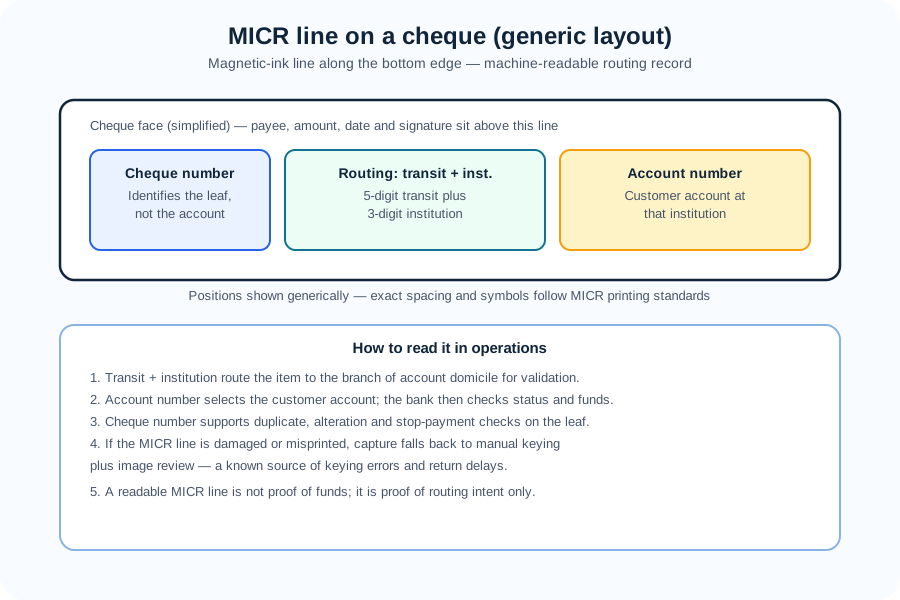
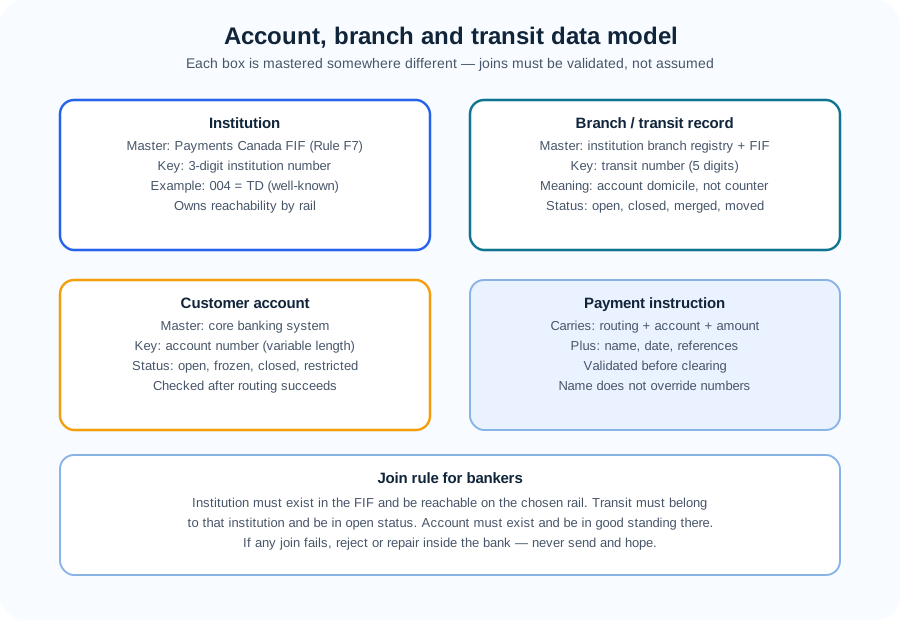
The two diagrams above belong together. The MICR visual shows where routing lives on paper: the machine-readable line along the bottom edge carrying the cheque-number, routing and account positions generically, with the reminder that exact spacing follows printing standards and that a readable line proves routing intent rather than funds. The data-model visual shows where routing lives in systems: four boxes for institution, branch or transit record, customer account and payment instruction, each mastered somewhere different, with the join rule stated underneath. For AFT/retail-batch use, the institution and branch join must be present in the current FIF; other rails require their applicable directory and message rules. The account must exist and be receivable there. If any join fails, the instruction is rejected or repaired inside the bank rather than sent in hope. Trainees who can redraw both diagrams from memory rarely misdiagnose a routing failure afterwards.
Beneficiary name handling deserves a firm scope statement because branches and contact centres face the question daily. In Canadian batch and image processing, coded routing and account data drive delivery and posting; the name supports screening, customer service and investigation, subject to the rail and institution's rules. A name comparison is not a universal Canadian payment guarantee or a substitute for validating the numbers. Interac's consumer flow, for example, can show a registered Autodeposit recipient's full legal name before confirmation. The operational answer is layered: use available name or payee signals as a warning that may trigger review, callback or additional confirmation for high-risk items, and document the provider-specific behaviour rather than promising universal name-based blocking.
Messages and references carry routing data between banks and preserve it for investigation. Lynx customer transfers use ISO 20022 messages with structured party, agent, account and reference elements plus end-to-end tracking references. AFT batch files use record layouts with fixed routing and account positions that either parse cleanly or fail loudly. Image exchange carries the MICR-derived routing alongside the image itself. Across all three, the same disciplines apply: populate structured fields rather than stuffing routing detail into free-text narratives, preserve original references alongside every repair, return or re-submission, and never truncate or reformat account detail at an intermediary handoff without verifying the receiving format preserves length and leading zeros. Investigations live or die on reference survival: an original end-to-end reference that persists from initiation through clearing, settlement, posting and statements lets a trace complete in minutes, while a reference overwritten by a repair ticket number turns the same trace into a multi-day reconstruction.
| Data element | Shape | Mastered in | Validated by | Typical failure |
|---|
| Routing leading zero | Single zero prefix | Convention and format rules | Format check at capture | Missing or shifted field positions |
| Institution number | 3 digits | FIF under Rule F7 | FIF join check before release | Stale or confused institution identity |
| Transit number | 5 digits | Branch registry plus FIF | FIF join and status check | Stale, merged or mistyped domicile |
| Account number | Variable length | Holding-institution core banking | Receiving-bank account lookup | Transposition, truncation, closed status |
| Beneficiary name | Free text | Instruction and customer record | Screening and review signal | Mismatch used as false guarantee |
| End-to-end reference | Instruction-generated | Originator and bank logs | Preserved across handoffs | Overwritten by repair or ticket ID |
Remittance detail decides whether a correctly delivered payment can be applied automatically: invoice references clear receivables, pay-period references explain payroll, lease references match rent, ledger references reconcile wires. Routing gets money to the door; remittance gets it to the right ledger line.
6. Rules, cutoffs, service levels and customer impact
Routing data lives inside clocks, calendars and rulebooks, and the customer promise is only as precise as the bank's understanding of all three. Most routing-related service failures come not from system outages but from vague language about when a correction still helps and when the window has closed.
Rules define what each rail permits for routed items. Payments Canada by-laws, rules and standards govern participation, exchange, returns, adjustments and settlement for ACSS batch; Lynx rules and operating procedures govern high-value message validation, release, queuing and finality; image-exchange and cheque rules govern paper and image handling, holds and returns; pre-authorized debit rules govern mandates, notifications, returns and reimbursement where routing errors intersect with authority disputes. Rule F7 and the FIF regime are authoritative for the AFT/retail-batch routing data they cover; other rails require their own applicable directory, message specification and rulebook. A landscape-level practitioner does not need to recite these instruments, but must know which one governs the item in front of them and where to look when an edge case arises. Telling a wire team to follow batch return-code practice, or telling a batch repair desk to expect wire-like finality, wastes days and harms customers.
Cutoffs convert rulebook windows into daily deadlines for routing repair. A batch file approved after its applicable exchange deadline may move to a later cycle, while a wire released after the Lynx operating day may wait for the next operating day. Corporate customer cutoffs sit ahead of system deadlines, and repair-queue staffing must follow the same clocks, with extended coverage and pre-agreed escalation in payroll weeks.
Business days, holidays and value dates complete the picture. ACSS settlement follows business-day calendars, so weekends and Canadian holidays shift value dates and availability for batch items including repaired re-submissions. Lynx follows its operating calendar tied to Bank of Canada settlement availability. Cross-border legs add foreign calendars and time zones on top. Products that promise calendar-day behaviour on business-day infrastructure need explicit weekend and holiday logic tested with date-sensitive scenarios, or they will fail on the first long weekend after launch with a queue of customers asking why a Friday correction did not help until Tuesday. Statement narratives should carry value dates that match the underlying settlement and posting reality rather than the date the repair was typed.
Service levels for routing quality should be testable promises naming rail, cutoffs, business-day definition, posting and availability timing, finality point and exception path: payroll promises a credit date with a re-run window, collection a presentment date with return handling, wires same-day settlement with investigation support. Anything vaguer is incomplete.
Customer impact is where vague promises surface as harm. A missed payroll cutoff means employees unpaid on Friday, employer reputation damage and emergency re-runs at premium cost. A mis-set rent-debit routing batch means unexpected returns, tenant fees and disputes that the property manager blames on the bank. An uncorrected recurring transfer means a month of payments to the wrong account before anyone looks. A late wire with wrong beneficiary detail means a missed closing, penalty interest and legal escalation. Honest cutoffs, proactive status and plain-language explanations of business days prevent most of these outcomes. The bank that tells a customer at mid-afternoon that a record missed the window, states exactly what happens next and when, and offers the verification step for the re-submission keeps the relationship; the bank that stays silent until the customer calls about missing money loses it. Routing accuracy is therefore a service-level input with complaint, attrition and remediation costs attached, and its budget should be defended in those terms.
7. Fraud, compliance and operational controls
Routing data is a fraud surface, a compliance input and an operational control point simultaneously. Controls are not an overlay applied after the payment product is designed; they are part of the capture, validation, release and change product, and in Canada they draw on fraud practice, sanctions law, anti-money-laundering duties, privacy obligations and consumer-protection expectations at once.
Fraud patterns target routing data directly. Business-email compromise substitutes a supplier's institution, transit and account with attacker-controlled numbers and relies on the victim's accounts-payable routine to release the next run without a callback. Authorised-push-payment scams convince a customer to send funds or approve payee changes to accounts the fraudster controls. Account takeover adds new payees or changes standing routing instructions after credential theft, then moves money quickly. Pre-authorized debit fraud raises debits against accounts without valid mandate evidence or manipulates amounts once routing is on file. Cheque fraud counterfeits, alters or duplicates instruments and images, exploiting the gap between a readable MICR line and the legitimacy of the underlying obligation. Mule activity recruits receiving accounts precisely because routing data looks ordinary even when the purpose is criminal. Faster and always-on channels compress the time available to detect each pattern, which is why confirmation, callbacks and behavioural monitoring must sit before release rather than in next-day review.
The control stack before release combines authentication, risk scoring, limits, beneficiary-risk checks, dual approval and callbacks on added or changed routing details. After release, monitoring continues through anomaly detection and rapid-response playbooks. For batch, recovery runs through defined return rights; for settled Lynx wires, prevention is everything and recovery needs beneficiary cooperation. Screening latency must be budgeted as a real cost, never skipped under cutoff pressure.
Sanctions and payment screening apply across rails to party and payment data associated with routed instructions. Screening sits in the pre-release path with defined handling for matches, false positives, holds, escalation and record-keeping, and cross-border payments add correspondent and beneficiary-bank screening expectations with richer party and purpose data requirements. Screening is a legal duty with operational consequences: a held payment needs a documented decision, a customer communication that says no more than the law permits, and an audit trail. Routing accuracy interacts with screening quality because truncated, reformatted or re-keyed party detail degrades matching on both sides; preserving structured data end to end is therefore a compliance control as well as a reconciliation nicety.
Anti-money-laundering duties form the next layer: know-your-client, prescribed records, transaction monitoring and reporting as applicable, supported by complete originator and beneficiary information, preserved references and decision logs. Stripped payments fail compliance as well as reconciliation.
Privacy, consent and consumer-protection duties surround routing data itself: need-to-know access, masked display, secure transmission and defined retention for account numbers and images, plus mandate-evidence duties where routing meets ongoing authority and plain-language disclosure of fees, timing and dispute routes at the point of action.
Operational controls bind these duties into daily practice: maker-checker discipline on file release and routing-table changes, entitlement reviews for who may key, approve or repair routing data, dual control over reference-data updates such as FIF application and branch-mapping changes, independent verification of migration mappings, cutoff enforcement without exceptions for unvalidated records, reconciliation ownership with ageing, evidence retention for audit and dispute needs, and independent testing of the whole chain. A product that cannot describe its routing control stack on one page has not finished design, and an operations area that cannot show its FIF version, repair ageing and release evidence for the current cycle is not ready for the next one.
8. Exceptions, investigations and recovery
No routing design is complete until its failure modes are designed. Canadian operations distinguish several exception types that staff, customers and systems must never conflate: rejects, returns, recalls and return requests, reversals, cancellations and disputes. Each has different timing, different authority and different evidence, and routing defects flow through them in predictable ways.
Rejects happen before clearing: the sending bank refuses to submit the instruction because format, FIF reachability, duplicate, limit, approval or screening checks failed. Rejects are the cheapest failures and the best-handled ones stay inside the bank with a precise reason and a repair path. A rejected payroll record on Monday afternoon with the message transit does not belong to the selected institution, with the entered and expected shapes shown, can be corrected and re-submitted the same evening. The same defect discovered as a return on Thursday costs a cycle, a customer call and a suspense entry. Operations management should therefore celebrate high pre-release reject rates for bad data the way safety engineers celebrate near-miss reports: each reject is a return prevented, and suppressing rejects to flatter straight-through metrics merely moves the cost downstream where it multiplies.
Returns happen after exchange under system rules: the receiving side or the system sends the item back with a reason code, for example for an invalid or closed account, a nonexistent domicile join, or an image that cannot be posted. Returns carry rulebook codes and deadlines, and the originator must map each code to a customer communication and a next step: correct and re-present where permitted, collect differently, absorb the loss, or investigate status rather than retyping blindly. Closed-account returns deserve special care because they tempt the worst response, which is asking the customer to confirm the same digits again. The digits may be exactly right for an account that no longer exists; the remedy is new digits or a different payment method, not repetition. Nonsufficient-funds interactions add a further wrinkle where routing meets debit authority: a rent debit drawn from the wrong account can create fees and disputes on an account the tenant never intended to use, and the recovery conversation must address both the routing correction and the fee consequences together.
Cancellations stop an instruction the customer no longer wants within the window the rail allows, and their interaction with routing is mostly about timing: a batch item caught before the exchange window can be removed or corrected cheaply, while an item already exchanged must follow the return path. Recalls and return requests ask the receiving institution to return funds already delivered; outside defined return rights they are requests rather than entitlements, and for settled Lynx wires they depend on beneficiary consent with no guaranteed outcome. Reversals correct bank errors under defined conditions with full audit trails that preserve the original instruction identity. Disputes and claims invoke rulebook rights such as pre-authorized debit reimbursement claims, image-instrument disputes and alleged-error investigations, each with its own clock and evidence standard. Procedures should place a one-page decision tree for routing failures at every repair desk: reject or return, which code, which owner, which customer words, which deadline, which re-presentment rule.
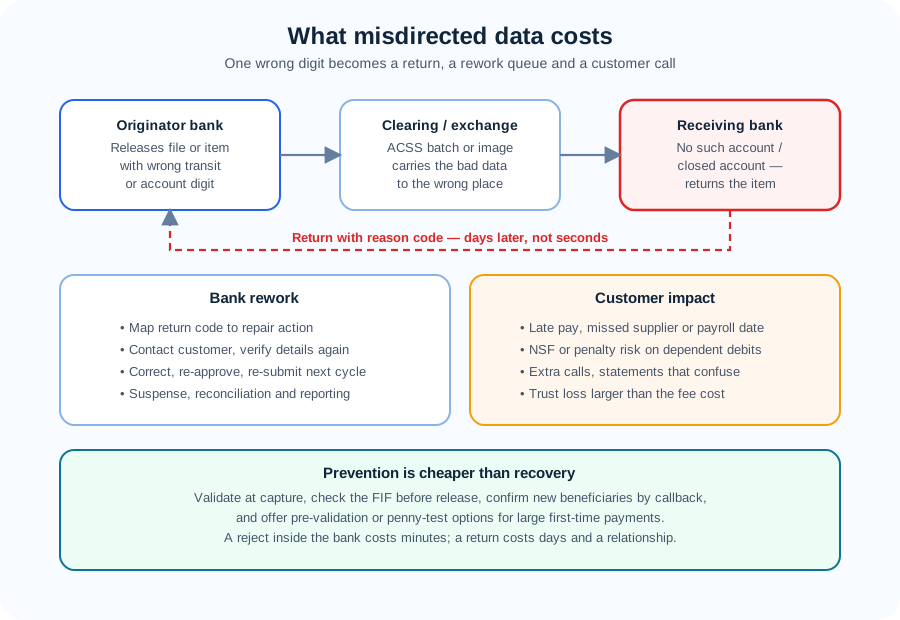
The cost diagram above generalises the return journey that Section 11 makes concrete twice over. An originator bank releases an item with a wrong digit. Clearing carries the bad data faithfully to the wrong place or to a validation failure at the right place. The receiving bank returns the item with a reason code days later rather than seconds. The originator bank then performs rework: mapping the code, contacting the customer, verifying details again, correcting, re-approving and re-submitting in a later cycle while carrying suspense and reporting. The customer absorbs delay, fee risk, extra calls and confusing statements, plus a trust loss larger than any fee. The prevention box at the bottom states the chapter's economics once more: validate at capture, check the FIF before release, confirm new beneficiaries by callback, and offer pre-validation for large first-time payments. Staff who can walk a customer through this diagram defuse the most corrosive complaint, which is the belief that the bank lost the money rather than routed it to a check that correctly refused it.
Investigations follow the identifiers from the original instruction through every handoff. A missing payroll credit, a disputed rent debit, a wire whose beneficiary says nothing arrived: each starts from the original reference, whether file and item references for batch, the MICR and image references for cheques, or message and end-to-end references for wires, and traces initiation logs, validation outcomes including FIF version, clearing confirmations, settlement positions and posting records. Status language must be honest about which milestone has been reached: instruction accepted, validated, submitted to clearing, settled, posted, available. Telling a customer a payment settled when it was only submitted creates a second incident on top of the first. Banks need inquiry intake standards, trace templates per rail, correspondent inquiry protocols for cross-border legs, and ageing discipline so no case sits unowned past the next exchange window without escalation.
Uncertain outcomes need a defined status vocabulary, customer explanation, re-check interval and escalation rule, designed before launch and reviewed with conduct teams so honesty about timing never sounds like evasion.
Volume planning matters because rates multiply: 1 percent on 100,000 items is 1,000 cases needing ownership within days. Size staffing, tooling and service levels from expected volumes with seasonal and migration peaks modelled, and rehearse the repair conversation before the first return arrives.
9. Posting, accounting, liquidity, reporting and reconciliation
The back half of every routed payment is financial truth: customer accounts posted correctly, internal ledgers balanced, settlement positions funded, reports delivered, and every figure reconciled to independent evidence. Routing data shapes each of these activities even after the money has moved, because the domicile and account joins determine where postings land and where breaks surface.
Posting translates payment events into account entries on each bank's books. Outgoing customer debits and incoming customer credits hit demand deposits, business operating accounts or trust ledgers according to product rules, value dates and hold policies, with fee, foreign-exchange and charge entries alongside principal movements carrying descriptions customers can understand. Correct routing delivers the item to the right domicile for a clean posting decision. Incorrect routing delivers it to a return decision instead, which still creates entries: suspense debits and credits while the return is processed, fee entries where applicable, and adjustment entries on re-submission. Internal suspense and clearing accounts hold items in transit between customer posting and interbank settlement and must clear to zero on defined cycles; persistent suspense balances are a classic audit finding that signals broken exception ownership rather than volume. Each posting needs a value date, a narrative the customer recognises, a reference linking back to the original instruction, and consistent treatment across channels so the same economic event looks the same wherever the customer views it.
Accounting extends posting into the general ledger and subledgers, with cutoff discipline so repaired items land in the correct business date; finance and operations must agree the business-day definition or the same payment appears in two periods in two reports.
Liquidity is the treasury dimension: Lynx settles payment by payment against available balances, so unmanaged large-wire release means queuing and funding costs, with misdirected wires wasting liquidity twice. ACSS concentrates funding into settlement-time obligations that return volumes shift after the fact. Every misdirected item prevented before release keeps liquidity available for genuine obligations.
Reporting closes the loop: corporates expect machine-readable statements and return reports with translated codes and next steps, consumers expect timely notifications with intelligible descriptions. A report that repeats raw codes without guidance generates calls; routing-data reports should be reviewed with the contact centre listening.
Reconciliation proves the story end to end as a four-way match: customer instruction against bank processing log, bank processing against clearing or network confirmation, clearing against Bank of Canada settlement position, and settlement against customer posting and statement. Routing breaks surface at each joint with a distinctive signature. Capture-to-processing breaks show as format and FIF rejections that never reach clearing. Processing-to-clearing breaks show as released items with no clearing confirmation, often a cutoff or transmission issue. Clearing-to-settlement breaks show as exchanged items missing from expected net positions. Settlement-to-posting breaks show as settled value without corresponding customer credits, the classic misdirected-wire or stale-domicile symptom. Breaks get owners, deadlines and ageing; adjustments reference originals; evidence including FIF version, approval records and transmission logs is retained for audit, tax and dispute needs. The maxim holds: if it is not provable from independent evidence, it is not complete, no matter what the customer screen shows.
10. Bank implementation, testing and resilience
Building or fixing routing-data capability spans channels, hubs, core banking, gateways, screening, reference-data distribution, ledgers, reporting and operations tooling. Projects scoped as screen redesigns under-deliver, because the defect lives in the joins between systems.
Implementation starts with scope honesty: which rails, which instruments, which customer segments, which participation model, which capture channels, which messages and file layouts, which FIF distribution path, which branch-mapping regime, which cutoffs and calendars, which controls and which reports. Each choice pulls in a rulebook and a testing burden. Adding corporate origination pulls in file validation, entitlement matrices, dual approval, repair coaching and return-report design. Adding wire origination pulls in structured message quality, beneficiary verification, liquidity awareness and investigation readiness. Adding image capture pulls in MICR quality thresholds, keying controls, image-review staffing and duplicate detection. Sponsoring indirect or provider volumes pulls in due diligence, safeguarding verification, capacity planning and incident coordination. Migrating cores, merging branches or centralising processing pulls in domicile-mapping governance, grace-period monitoring and customer re-validation campaigns. Systems designed now should isolate rail-specific logic from customer-facing journeys so future instant processing does not require rebuilding capture; that single architectural choice determines whether the next decade of change is configuration or surgery.
Reference-data implementation deserves its own paragraph because it fails quietly. The FIF must be subscribed, received, applied and version-stamped consistently across every validation point: branch teller platforms, contact-centre desktops, mobile and online services, corporate gateways, payment hubs and fraud engines. A bank that applies the update in the hub but not at the branch will reject at release what the branch accepted at capture, manufacturing exactly the customer argument nobody wins. Branch and transit mappings need the same governance with dual control: who may add, merge, close or renumber a domicile record, who verifies independently, how grace mappings expire, and how downstream holders of stale data such as employers and billers are notified. Treat every routing-table change with the gravity of a product launch and reconciliation breaks fall; treat it as routine maintenance and the Twitter-scale lesson arrives on its own schedule.
Testing must cover the lifecycle: functional testing of initiation through reconciliation per rail; exception testing of rejects, returns and status vocabulary under volume; calendar testing of cutoffs, holidays and value dates including Friday repairs; data testing of routing joins, leading-zero preservation and the shortest and longest live account shapes; throughput testing for payroll peaks; and migration testing with production-shaped stale data. The data family finds the most defects in routing work.
Resilience is an operating property: defined recovery objectives and tested failover for clearing, settlement access, screening, reference-data feeds and posting, with degraded-mode procedures for queuing files, prioritising wires on recovery and telling customers what is delayed versus lost. Playbooks name affected rails, moved value dates, proactive notice and re-release authority; reviews trace to capture and validation improvements.
Change governance closes the loop. Routing changes move customer money, which raises the bar for approval, communication and rollback planning. Dual control over configuration such as cutoffs, limits, routing tables and screening lists, independent verification of reference-data changes, coordinated customer notice for cutoff or format changes, and pre-agreed grace mappings with expiry monitoring are baseline expectations. The bank that announces a branch merger with new cheques, updated direct-deposit guidance, employer and biller outreach, extended repair coverage and a dashboard tracking stale-transit returns will be forgiven the inevitable stragglers; the bank that updates the mapping silently will spend months explaining returns one customer at a time.
11. Practical Canadian examples
Theory settles best in concrete days. This section follows three realistic but entirely fictional scenarios through the routing lifecycle: a payroll run poisoned by one stale transit, a rent-collection onboarding that catches bad data before the first debit, and a branch wire instruction read back before release. Names, amounts, institutions, transits and account numbers are invented for training and carry no connection to real persons, firms or branches. Institution numbers use only the well-known values this course permits; every transit and account combination is labelled illustrative or fictional.
Example (fictional): Friday payroll with one stale transit digit. Lakeside Packaging Ltd., a fictional 800-employee manufacturer in Mississauga, Ontario, runs bi-weekly payroll through its bank's corporate file channel for Friday credit. On Monday afternoon its payroll officer uploads an AFT credit file dated for Friday, each record carrying institution, transit and account identifiers plus amount, pay-period reference and a statement description such as PAYROLL JUN 12. The bank authenticates the officer, enforces dual approval with a second authorised signatory releasing the file, validates every record's format, checks each institution-transit join against the current FIF version, screens as applicable, runs duplicate detection against the prior run, and confirms submission ahead of the customer cutoff for the week's exchange cycle. Two records fail validation: both carry institution 003, a well-known institution number used here as the fictional employer's bank choice for illustration, paired with a 5-digit transit that belonged to a branch closed in a merger two years ago and carried forward in the employer's template ever since. The bank rejects those two records inside the bank on Monday with precise repair guidance naming the stale transit, showing the entered shape, and pointing to the current branch record to confirm with the affected employees; the remaining 798 records proceed. The officer corrects the two transits with the employees on Tuesday using void-cheque images rather than memory, re-submits the two records, and they validate and join the same week's cycle. Valid items exchange through ACSS batch processes, net positions settle across Bank of Canada accounts on the deferred cycle, and the bank posts employee credits for Friday availability with three reports back to the employer: a paid report, a reject-and-repair report, and later any returns with codes and next steps. One return still arrives for an account closed the prior week, which no sender check could have known; the employer's reconciliation matches register to paid, rejected and returned reporting while suspense clears. Nothing about this story is instant, and that is the point: payroll succeeds through advance dating, cutoff discipline, join validation, repair windows and complete reporting rather than speed. Without FIF validation, the two stale transits would have returned after exchange and missed the Friday credit date.
Example (fictional): rent collection that validates before the first debit. Harbourview Rentals, a fictional 300-unit property manager in Burnaby, British Columbia, onboards new tenants for monthly pre-authorized rent collection. Each tenant completes a mandate form capturing institution, transit and account identifiers with a void-cheque image, lease reference and a plain-language notice of amount, timing and cancellation rights. The manager's bank enrols the mandates through its corporate channel with per-record validation: format checks on every field, FIF join checks on every routing combination, and a review flag wherever the beneficiary name and account signals diverge enough to warrant a callback. Eleven records fail format or join checks on day one, most of them transposed transit digits from phone onboarding and two of them institution-transit mismatches where a valid institution number was paired with a valid transit from a different institution. Each failure returns to the leasing office the same day with a precise message and the entered values echoed, and the office corrects from the original cheque images rather than retyping from memory. For first debits above the manager's risk threshold, the bank offers a pre-validation confirmation before the live run, and the manager uses it for the eleven repaired records. The first live presentment then runs with a near-clean posting rate; the two debits that still return carry closed-account reasons that trigger status conversations with the tenants rather than retyping loops. Tenant statements show a recognisable rent narrative with the lease reference, the manager's receivables match automatically on that reference, and mandate evidence sits filed for any future dispute. The lesson generalises: collection success is decided at onboarding and validation, not at presentment, and every defect caught before the first live debit is a fee, a dispute and a strained tenancy prevented.
Example (fictional): a branch wire read back before release. A fictional retired teacher in Halifax instructs her branch to send 45,000 dollars to her daughter's account at another bank as a first-time transfer, handing over a handwritten slip with institution, transit and account digits. The teller authenticates the customer, keys the details into the validated wire journey rather than a free-text note, and the platform checks the applicable domestic wire/CACPA format and the bank's current destination data: institution 004, a well-known institution number used here illustratively, with an illustrative 5-digit branch/transit combination. Because the payee is new and the amount exceeds the bank's verification threshold, the bank's policy requires a read-back and a callback: the teller reads the institution name, branch/transit and account back digit by digit, confirms the daughter's contact through the previously known family number rather than any number written on the slip, and obtains a second approval before constructing the ISO 20022 customer credit transfer with full references. The payment releases during Lynx operating hours, settles individually through Bank of Canada settlement accounts with finality, and is then subject to the receiving institution's posting process. Had the transit been mistyped by one digit into another valid destination, the read-back and pre-release verification would have been the last cheap moment to catch it; after RTGS settlement, recovery would be a request with no guaranteed outcome. The branch's extra three minutes bought what no investigation playbook can guarantee.
Routing data is never a standalone topic in production; it is the addressing layer every other lifecycle assumes is correct.
12. Key takeaways and authoritative references
Twelve points carry the chapter. First, the Canadian CACPA routing code used in applicable formats is 9 digits in the shape 0IIITTTTT: leading zero, 3-digit institution number and 5-digit branch number commonly called transit, with a variable-length institution-assigned account number selecting the customer account. Second, the branch/transit identifies account domicile, not the counter the customer last visited. Third, a readable MICR line proves routing intent rather than funds: cheque number identifies the leaf, the routing field directs to the institution/branch, and the account selects the record for a status and balance decision made afterwards. Fourth, institution, branch/transit, account and instruction form a four-box data model with different masters, and the current FIF is the authoritative AFT/retail-batch directory; other rails require their own applicable directory and message rules. Fifth, version consistency across every validation point is an operating requirement rather than housekeeping. Sixth, capture quality decides exception volumes: labelled fields, synchronous format checks, original preservation, confirmation before first live payment and channel parity beat downstream repair. Seventh, rejects inside the bank are successes to be celebrated while returns after exchange are costs to be reduced, with repair queues run on reasons, owners, callbacks, re-validation and ageing. Eighth, routing delivers while settlement finalises: ACSS deferred net settlement economises batch at the cost of timing and return exposure, while Lynx RTGS since 1 September 2021 provides per-payment finality and makes pre-release verification essential. Ninth, beneficiary-name signals are provider- and rail-specific; they do not replace coded routing validation. Tenth, routing data is a fraud, sanctions, privacy and mandate control surface. Eleventh, posting, suspense, liquidity, reporting and four-way reconciliation turn routed movement into provable truth. Twelfth, reference-data governance, migration mapping, cutoff-aware repair staffing and degraded-mode playbooks decide whether routing quality survives mergers, conversions and outages.
Common misunderstandings deserve explicit correction. The transit is not the customer's preferred branch. Account length is not fixed. A valid institution plus another bank's valid transit is not a valid routing. A passed sender check does not promise posting. Availability is not finality for batch items. On-us items do not skip validation. New banking details sent by email are never verified by replying to the same email. A readable image is not proof of legitimacy. A return code needs translation and a next step.
Authoritative references
- Payments Canada, Rule F7 — Automated Funds Transfer System Financial Institutions File (FIF): https://www.payments.ca/sites/default/files/f7eng.pdf
- Payments Canada, Financial institutions file: https://www.payments.ca/systems-services/payment-services/financial-institutions-file
- Payments Canada, CPA Standard 014 — Clearing Replacement Document Design Standard: https://www.payments.ca/sites/default/files/standard014eng.pdf
- Payments Canada, Retail batch payment system: https://www.payments.ca/systems-services/payment-systems/retail-batch-payment-system
- Payments Canada, High-value payment system — Lynx: https://www.payments.ca/systems-services/payment-systems/high-value-payment-system-lynx
- Payments Canada, New best practices resource for Canadian wire transfers (CACPA codes): https://www.payments.ca/new-best-practices-resource-canadian-wire-transfers
- Bank of Canada, The Bank of Canada’s settlement account policies for Payments Canada payment systems: https://www.bankofcanada.ca/core-functions/financial-system/bank-canadas-settlement-account-policies-for-payments-canada-payment-systems/
- Payments Canada, Critical milestone achieved: By-law and rules approved for Canada’s Real-Time Rail: https://www.payments.ca/critical-milestone-achieved-law-and-rules-approved-canadas-real-time-rail
- Payments Canada, Real-Time Rail payment system: https://www.payments.ca/systems-services/payment-systems/real-time-rail-payment-system
- Payments Canada, ACSS rule changes enhance payment system processes (July 27, 2026): https://www.payments.ca/acss-rule-changes-enhance-payment-system-processes
- Interac, Send & receive money with Interac e-Transfer: https://www.interac.ca/en/payments/personal/send-receive-money-with-interac-e-transfer/
- FINTRAC, Record keeping requirements for financial entities: https://fintrac-canafe.canada.ca/guidance-directives/recordkeeping-document/record/fin-eng
- Department of Finance Canada, Retail Payment Activities Act: https://www.canada.ca/en/department-finance/corporate/transparency/access-information-privacy/reports/rpaa-laapd.html
- Justice Laws Website, Special Economic Measures Act: https://laws-lois.justice.gc.ca/eng/acts/s-14.5/index.html
This application uses JavaScript for the full interactive experience. This text summary is served for accessibility and search indexing.