AFT Credit Returns and Reconciliation. Handle invalid details, returned credits, posting exceptions, reporting and customer-to-bank reconciliation.
Canada Payments & Collections · Block 4 · Chapter 20 of 75
Handle invalid details, returned credits, posting exceptions, reporting and customer-to-bank reconciliation.
Every payroll run, supplier payment file and benefit disbursement sent as an AFT credit carries a quiet promise: the right amount, to the right account, on the right date, provable afterwards. Most of the time the promise holds. This chapter is about the rest of the time — the credit that comes back because the account number was wrong, the account was closed, or the receiving bank could not post it; the file that went out twice because somebody re-released it "to be safe"; the ledger that does not agree with the bank's report on Monday morning. AFT credit returns and reconciliation is where a bank's push-payment operation proves whether it is a controlled business or an optimistic one.
The working rule for this chapter is simple: a returned credit is a linked reversal with a reason, not a failure message — match it to its original, tell the originator what to fix, and keep both ledgers truthful until the repair lands. Rejects stop bad items before clearing and cost almost nothing. Returns unwind value after clearing through the AFT return process in Rule F1 and cost attention, funding and goodwill. Duplicates are corrected with linked adjustment entries, never with casual refunds that break the audit trail. Reconciliation is the discipline that proves all three stories agree: what the originator released, what clearing did, and what the books say. Confuse these paths and you will re-pay a credit whose return is already in flight, or refund a double-paid file with manual payments — manufacturing the second incident on top of the first.
Evidence labels used in this chapter: [Payments Canada rule/standard] means a scheme or operating requirement; [Regulatory] means a statute, by-law or supervisory requirement; [Bank implementation] means a bank, clearer, vendor or originator control that is not itself a Payments Canada rule; [Fictional example] marks invented facts and figures.
A note on scope discipline. This chapter covers Canadian-dollar AFT credits — push payments originated by the payer's side, mostly direct deposits — travelling through the live Automated Clearing Settlement System (ACSS), a retail batch system that calculates net balances and settles through direct-clearer settlement accounts at the Bank of Canada. Pre-authorised debits, cheques and high-value wires appear only as contrast or where a shared process touches them; their dedicated chapters go deeper. [Payments Canada rule] Rule F1 governs legacy Standard 005 AFT exchange, processing, returns, error corrections, tracing and settlement; Rule F4 governs ISO 20022 AFT transactions. Rule A4 is the general returned-and-redirected-items rule, but AFT items follow the AFT procedures in F1. Rule A6 covers disputes and Rule A9 covers arbitration; B9/B10 cover manual balancing, clearing errors and tracing. Exact current requirements are quoted in Section 6 and the references below, with the rules library treated as authoritative. Lynx appears only as contrast — Canada's live high-value system settles gross payments in real time and makes them irrevocable once processed — while the not-yet-production Real-Time Rail is discussed only to prevent confusing its Q4 2026 launch programme with current AFT production.
What you should be able to do after this chapter
After working through this chapter, you should be able to:
- explain why invalid account details, closed accounts and posting failures are the characteristic return drivers for AFT credits, and what each one demands from the originator;
- apply the timing test — before clearing means reject, after clearing means return — to any defective AFT credit and state the correct recovery path;
- describe who owns what among the originator, the sending bank, the receiving bank, Payments Canada systems, the Bank of Canada and service providers when a credit comes back;
- walk a returned credit through its full lifecycle — posting failure, reason selection, linked return entry, clearing of the return, unwind, originator advice, rework or absorption;
- run a posting-exception queue in a receiving bank so unpostable credits get a lane, an owner and a deadline instead of an ownerless shelf;
- detect, freeze, quantify and correct a duplicate file with linked adjustment entries rather than informal refunds;
- reconcile customer-to-bank activity — released files against clearing outcomes against reports and ledgers — and route each class of break to its owner;
- design originator reporting, advices and corporate files that name originals, carry reasons in plain language and let clients match without callbacks;
- place fraud, sanctions, AML and operational controls at the correct gates so prevention stays cheaper than recovery;
- interpret cutoffs and service levels as customer-impact promises and communicate misses, returns and breaks honestly;
- know what a bank must build, simulate and test — return storms, duplicate releases, posting outages — before and after going live;
- find the authoritative answer in the live Payments Canada rulebook and Bank of Canada oversight material instead of memorising training slides.
For a roughly 60-minute core session, spend about 20 minutes on Section 1 and Section 8 up to the return lifecycle diagram, 15 minutes on Section 9 with the customer-to-bank reconciliation diagram, 15 minutes on Section 11 working the three fictional stories, and 10 minutes on Section 12. The remaining sections are follow-up study that repays a second hour.
Chapter navigator
- Business context and customer need
- Participants, responsibilities and boundaries
- Initiation, validation and bank processing
- Clearing, exchange, settlement and finality
- Data, identifiers and messages
- Rules, cutoffs and service levels
- Fraud, compliance and controls
- Exceptions, investigations and recovery
- Posting, accounting, liquidity, reporting and reconciliation
- Implementation, testing and resilience
- Practical fictional Canadian examples
- Key takeaways and authoritative references
1. Business context and customer need
Start with the Monday every Canadian payroll manager knows. Friday's pay run looked clean: the file validated, the portal confirmed release, control totals agreed. Over the weekend most employees were paid exactly as expected and thought nothing of it. Monday morning brings three calls that sound identical — "some of our people didn't get paid" — but demand three different treatments. A dozen credits came back because account numbers in the HR system were stale. Four came back because employees closed accounts after moving and never told payroll. And one department's file went out twice, because a supervisor re-uploaded it on Friday afternoon "just to be safe," so forty people were paid double. The payroll manager wants one thing — "just fix it" — while the bank must do three different things: advise and rework the invalid details, advise and rework the closed accounts, and contain and correct the duplicate with linked entries. A team that classifies first resolves all three within days with balanced books. A team that "just re-sends everything" manufactures forty new duplicates on top of the forty it already has.
Customers experience obligations, dates and consequences: wages before rent is due, supplier terms met so goods release, benefits disbursed with proof the auditor will accept. The bank experiences instructions, clearing windows, net positions, postings, returns and breaks. Returns are where those languages collide, because the customer wants certainty while the bank must respect a process in which value already moved and can only be unwound through defined entries with defined evidence. The professional skill is holding both truths at once: empathise with the urgency, then follow the path that repairs the books instead of the path that merely calms the phone call. Nothing destroys a corporate client's trust faster than a bank that re-pays on pressure and then asks the client to help untangle the resulting double payments.
The economics explain why this chapter earns a full deep read. Prevention is cheaper than recovery: account validation at onboarding, a duplicate hash at release, and a confirmation screen that says "this file was already released" can prevent investigation, callbacks, correcting entries, suspense funding and goodwill damage. This is a [Bank implementation] business case, not a Payments Canada statistic. Measure whether the controls reduce downstream repair and reconciliation work.
Deferred-net settlement with return rights is what makes AFT credit exceptions structurally different from high-value ones, and bankers who carry habits across rails get into trouble. In Lynx, each payment settles individually in central-bank money with real-time finality and is irrevocable: there is no "return" of a Lynx payment through clearing, only separately negotiated recovery with the beneficiary's cooperation. In ACSS batch, the framework provides defined processes for reversing a credit that cannot be applied, correcting duplicated or misdirected value, and contesting liability where participants disagree. This is not a design flaw. It is how a system clearing billions of items at low unit cost handles imperfect account data, closed accounts and posting outages. Return rights are the pressure valve that lets the batch engine run fast and cheap — and the price is that every participant must operate a competent reverse gear, on the credit side as much as on the debit side.
"Customer-to-bank reconciliation" in the chapter scope means something specific: an operation, on both sides of the relationship, that can answer four questions about any credit, any day — what happened to it, where it sits, who owns the next action, and what evidence proves the story. Controlled operations argue about actions, because the facts are already on record; uncontrolled operations argue about facts, and the argument becomes the second cost of the original error.
Returns and duplicates also concentrate around predictable moments, and mature operators staff for them. Payroll cycles bring stale-account returns and the ever-present duplicate release. First payments against a newly onboarded supplier book bring invalid-detail returns in bulk. Month-ends and year-ends compress working days and stretch return handling across holidays. A corporate client's new HR platform or ERP brings format and reference breaks that surface as rejects and unmatched items. A bank that knows its calendar pre-positions explanations, capacity and funding for the exception load it knows is coming. Anticipate the return calendar the way treasury anticipates the funding calendar.
2. Participants, responsibilities and boundaries
A returned credit only resolves when each participant does its bounded job and hands over clean evidence. Blurred responsibilities are how incidents start, so this section draws the boundaries crisply for the return, rework and reconciliation mechanics in Sections 8 and 9.
The originator creates the economic need and the instruction — the employer for payroll, the buyer for supplier payments, the government or insurer for benefit disbursements. Its return-related duties are accuracy, currency and responsiveness: beneficiary account details must be right and kept current, files must be released once with proper approval, and when the bank reports a return or asks for a repair, the originator must respond with corrected data rather than a demand to "try again." Banks under-invest in originator capability and pay for it in repairs. A payroll administrator who understands release locks prevents the duplicate file that would consume a week of operations time. Treat originator capability as a control, not a courtesy.
The originator's bank (sending bank) owns validation, release and the consequences of release: format and completeness, authority and approval, duplicate detection, fraud and sanctions screening, routing and stream selection, cutoff compliance and the release record. When its own validation catches a defect, it rejects the item before clearing — cheap, fast, fully within its control. When the defect surfaces after clearing as an F1 return, it owns the customer conversation, the unwind of its posting, the repair-grade advice and the reconciliation of whatever comes back. Critically, it owns the decision to stop: to reject a suspicious file, hold a suspected duplicate release, refuse a repair that would create a second payment. A bank that cannot say no cleanly cannot operate push payments safely.
The receiving FI and its processing direct clearer or indirect clearer own receipt and posting validation — and the FI that cannot post an AFT credit initiates the return under F1. When an AFT credit is unpostable, dishonoured or refused, the return uses the applicable Standard 007 code; the sending side receives the returned transaction through the AFT process. When a credit can be applied, it posts subject to the rail's framework. The receiving bank also owns the posting-exception queue while items are undecided: unpostable credits must sit in classified lanes with owners and deadlines, never on an ownerless shelf. Much beneficiary confusion originates at this boundary, and the sending bank's advice must bridge the gap in the originator's language, with the network's facts attached.
Payments Canada owns and operates the ACSS (and Lynx) under the Canadian Payments Act. It sets clearing rules, exchange mechanics and the operating calendar through by-laws, rules, standards and procedures. It does not judge the underlying business deal, hold customer accounts, decide commercial disputes or reverse individual payments on request. When this chapter says "the live rule text," it means the current ACSS rules, standards and by-laws in the official rules and documentation library. Keep this boundary in mind whenever someone suggests "asking Payments Canada to pull a credit back." The operator provides the processes — AFT returns, adjustments, disputes and arbitration — through which participants reverse, correct and contest. It does not reach into participant books on request.
The Bank of Canada touches this chapter in two roles. First, as settlement agent: ACSS net obligations are settled through Bank of Canada accounts, and ACSS settlement-account holders meet those obligations by Lynx payments; returns therefore reshape positions after forecasts are set. Second, as overseer under the Payment Clearing and Settlement Act: Lynx is designated systemically important and ACSS prominent. Oversight concerns system safety and resilience, not individual returns. "The Bank of Canada will sort out our return" is a category error — a returned credit is a participant-to-participant process under Payments Canada rules, funded and settled through Bank of Canada infrastructure but not decided there.
Indirect participants, correspondents and service providers complete the map. Institutions that are not direct clearers reach ACSS through a direct participant's arrangements; that handoff is an interbank boundary with its own cutoff, evidence and return-handling obligations even when the originator sees one brand. Hubs, core vendors and transmission providers act as agents: outsourcing the work never outsources accountability. If a vendor's hub releases a duplicate file, it is the bank's duplicate.
Two principles recur throughout. First, returns and corrections are participant-to-participant processes; the customer relationship sits on top of them. Customers never touch clearing, and clearing never owes any customer an explanation. Second, every boundary needs a handoff record — each timestamped and reference-keyed. When a break cannot be diagnosed, the cause is usually a missing handoff record, not a mysterious network event.
3. Initiation, validation and bank processing
Most AFT credit returns are conceived at initiation, born at validation and merely discovered downstream. The cheapest returned credit is the one never raised; the cheapest duplicate correction is the duplicate file never released. This section follows a credit from the originator's intent to the bank's release decision, naming the gates where returns are prevented and the records on which later recovery depends.
Initiation must capture intent in a form the bank can act on without guessing, and every field it collects is a future return prevented or invited. File channels — portals, host-to-host, APIs — must enforce the minimum complete dataset: who pays, who is paid, how much, in what currency, on what value date, with what references, under what authority. They must bind authentication to the instruction and enforce release discipline: who prepared, who approved, whether dual approval applied, whether the file was already released. Duplicate release of a payroll or supplier file is the classic initiation failure no settlement engine can fix; it dies at source with file hashes, control totals, release locks and "already released" warnings that cannot be clicked through casually. Beneficiary detail capture deserves the same seriousness: account and transit information confirmed at onboarding, reverified before first payment, and reverified after any change notified through a channel the bank trusts. A supplier's emailed "please update our banking details" is simultaneously the commonest source of invalid-detail returns and a known fraud pattern, which is why Section 7 treats detail changes as a screened event rather than a clerical one.
Initiation must also keep look-alike intents apart, because confusion at the channel becomes exception volume at the back office. A future-dated instruction is not yet releasable and must sit visibly warehoused with its trigger date. A repaired item is not a new instruction and must carry linkage to the original return. Test every channel against one question: can a reasonable user express the wrong intent by accident, and would the bank notice before release? If an administrator can re-upload last month's payroll without the portal noticing the identical hash, next week's correction workload is already scheduled.
Validation is the layered gateset that earns the right to move money, and its outcomes must be explicit because each feeds a different path. Format and completeness catch structural defects: missing fields, malformed records, totals that do not foot. Authority confirms entitlement: the originator holds the account, approvals satisfy the mandate, release authority is current. Funds and limits confirm the account can bear the debits plus fees. Duplicates compare hashes, control totals and item references against recent history — the gate that stops the second release of the same payroll. Reachability confirms the destination is servable on the intended date, using current routing reference data rather than cached tables. Risk and compliance — fraud scoring, sanctions screening, AML review — run before release, because holding before release is always cheaper than recovering after settlement. Section 7 details placement; the lifecycle point is that validation is a gate with named outcomes, not a hopeful glance.
Those outcomes deserve precise handling, and the first diagram in this chapter exists to make the most important distinction unforgettable. Accepted means the item may proceed, and the acceptance record anchors reconciliation. Rejected means the bank stopped the item and must tell the originator why with repair-grade specificity. Held means it awaits approval, funding or screening disposition, with a named owner and an expiry — never an indefinite shelf. Study the decision diagram before reading further.
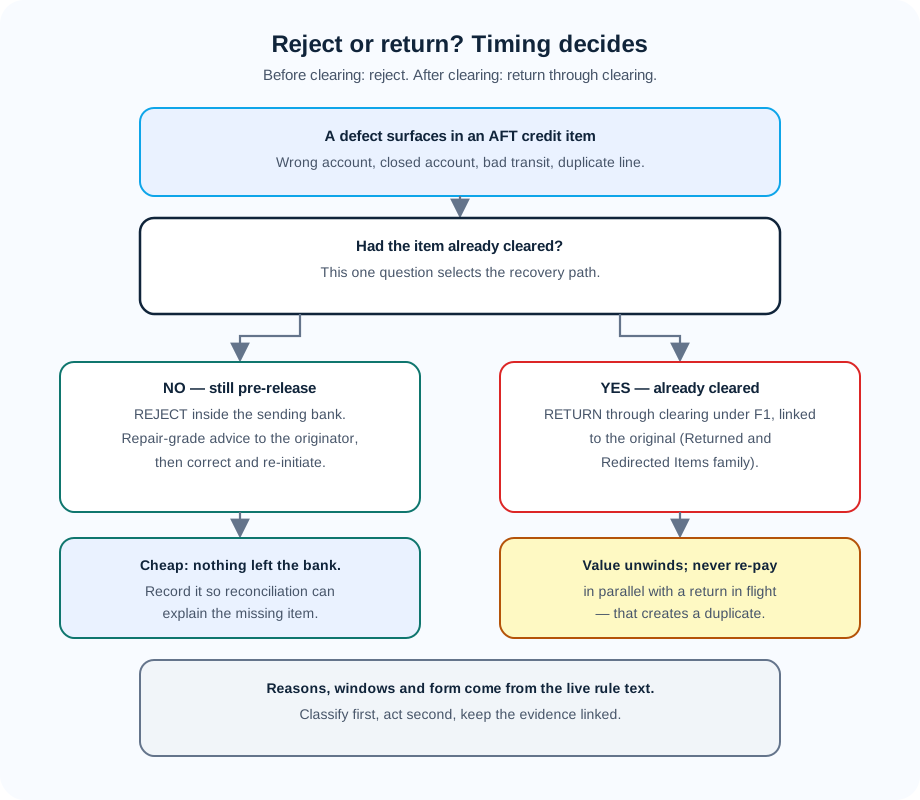
Weak banks validate silently and release hopefully, then meet their rejects downstream as returns. Strong banks reject early and keep every rejection in the instruction's history. Measure reject rates by originator and reason: a rising invalid-detail rate from one client is an education problem in operations costume.
Bank processing and routing turns validated instructions into releasable obligations. Enrichment adds what the network needs — routing, stream selection, value dates, reference propagation — without erasing the original references the originator supplied. The routing decision applies the on-us test first: same legal entity, same core, same account hosting means no clearing and therefore no clearing return. Interbank items inherit the rail's full return framework, which is why the routing decision must be recorded.
4. Clearing, exchange, settlement and finality
Everyday language collapses five distinct events into "paid" or "completed." In return handling, confusing them causes real harm: an originator told "it cleared" hears "finished and irreversible," while operations should ask which stream, accepted or rejected, netted into which cycle, funded at settlement, posted where, subject to what return rights. This section separates the events so each can be reasoned about, evidenced and explained.
Exchange is delivery of instructions between participants per the rail's rules: AFT credit items and totals into ACSS streams on the operating calendar, with acceptance or rejection evidence per submission. A file can be exchanged yet partially rejected at item level — the first fork in exception handling. Keep exchange evidence itemised so every rejected item is precisely identifiable for repair.
Clearing is the agreement and calculation layer: exchanged AFT credits aggregate into net participant positions due at a future settlement moment. An AFT return is a returned transaction handled under F1 and its return-reason codes; it changes the clearing evidence and the positions for its own exchange. Treat it as an expected reconciling item only when the bank's evidence links it to the original.
Settlement discharges clearing's obligations in central-bank money. ACSS is deferred-net: the previous day's net balances settle during the morning of the business day, through direct-clearer settlement accounts at the Bank of Canada. Under F1, the settlement date is generally the business day after the due date (or the business day after exchange when a transaction is delivered late). Returns and correcting entries reshape later positions; they do not make an accepted original disappear from the audit trail.
Posting applies outcomes to accounts — originator debits on the sending side, beneficiary credits on the receiving side — and belongs to each bank, not the network. The critical discipline is truthful reflection of uncertainty: statements, displays and advices must never present a batch credit as beyond recall while the story is still open.
Finality is a legal and operational state, not a screen message. In Lynx it is real-time: each payment settles gross across Bank of Canada settlement accounts, irrevocable — which is precisely why Lynx has no return lifecycle. ACSS is deferred-net, and F1 expressly provides post-exchange returns, customer refusals and error corrections within specified limits. Do not promise an AFT originator irrevocable same-day finality merely because the bank accepted a file; also do not imply that settled value can be casually debited outside the rule-based process.
Use these as diagnostic tools. "Debited here, not credited there" is a posting or clearing question until settlement evidence says otherwise. "The credit came back" is a return with a reason in clearing evidence. "We paid twice" is a duplicate containment event, not a return. Locate the missing event before choosing the tool.
5. Data, identifiers and messages
Returns are resolved with references, not adjectives. Every returned credit must join to its original, every correcting entry must cite the items it corrects, every break must trace across files, clearing evidence and books. When a payroll manager asks "which of our people didn't get paid," the only acceptable answer names items by reference. This section sets the data standard that makes such answers routine.
The foundation is end-to-end item identity: references letting every system agree a credit is the same credit. At initiation, originator file and item references plus control totals and value dates. Through processing, enrichment without erasure — routing added, originals carried forward, never replaced by internal sequence numbers nobody downstream can see. At exchange, acceptance records preserving sender references so rejected items are precisely identifiable. At clearing, return and correction entries linked to the originals they reverse or correct. At posting and reporting, customer narratives containing enough of the original reference for the originator and its reconciliation team to match. Test any data design with one question: if this credit returns in six weeks, can a junior operator join it to the original without fuzzy matching? If the answer needs memory or amount-and-date guessing, the design is already generating its future investigation queue.
Batch formats deserve a frank paragraph. [Payments Canada rule/standard] Legacy AFT uses Standard 005; ISO AFT uses Rule F4 and the ISO AFT Usage Guidelines. Payments Canada publishes ISO AFT message families for customer credit transfer, payment return, payment reversal and identification modification advice. Corporate-to-bank pain.001/pain.002 and bank-to-corporate camt examples on the AFT page are marked draft, so a bank must not present those draft examples as a universal production interface. [Bank implementation] Never let a format conversion silently drop the reference reconciliation depends on: map fields explicitly, validate lengths, reject rather than truncate, and retain the source reference alongside internal IDs.
Return reason information is the functional heart of this section. [Payments Canada standard] Standard 007 defines three-digit AFT return codes. For the credit cases in this chapter, 900 is an edit reject, 902 is account not found, 905 is account closed, 912 is invalid/incorrect account number, and 922 is a customer-initiated credit return; 901 (NSF) is debit-only and must not be taught as an AFT-credit return. The current code list and any future amendment remain authoritative. Reason precision is routing: each reason tells the originator a different repair.
Return and correction linkage is the [Bank implementation] control this chapter demands: retain the original item/file reference, due date, reason, and a distinct return or correction reference. A reworked credit is a new transaction with linked history, not an edited resend. A return that cannot be joined to its original becomes an investigation and suspense item. F1 defines returned transactions, error corrections and tracing; it does not make every bank's internal hash, reference or auto-match design a scheme requirement.
Finally, evidence retention and retrieval: clearing records, validation logs, release approvals, posting journals and advices must be retrievable by item reference long after the cycle closed. Archive by reference, index by reference, retrieve by reference. An archive organised by date alone is a warehouse; an archive organised by reference is an evidence system.
6. Rules, cutoffs and service levels
Every returned credit, every correction, every contested item draws authority from the Payments Canada rulebook — the by-laws, rules, standards and procedures participants accept as a condition of clearing. This section maps that rulebook functionally and instils the most important habit in batch operations: read the live text, never memorise it.
The structure is straightforward at the level this chapter needs. Association By-law No. 3, the Payment Items and ACSS By-law, establishes what may travel through the system. Beneath it sit the lettered rules: the A-series governing items and handling, the B-series governing settlement and balancing, with standards and procedures carrying operational detail. Five neighbourhoods matter here. For this chapter, Rule F1 and Standard 007 are the AFT-specific authorities for exchange, return reasons, error corrections and timing. Rule A4 supplies general returned-and-redirected-items concepts where applicable; F1 expressly controls AFT handling. The A6 family, Items in Dispute, lets disagreeing participants contest an item, beginning bilaterally and escalating to formal registration. The A9 family, Arbitration, provides a rule-based determination when an A6 dispute remains unresolved and the parties agree to arbitrate. The B-family manual balancing processes correct settlement-level imbalances, including compensation mechanics between participants. PAD, cheque and wire handling have their own neighbourhoods, detailed in their dedicated chapters; here they appear only so the right process is selected and AFT credit returns are never forced down a debit or paper path.
The operational limits below are quoted from the versions posted by Payments Canada on 2026-10-05; the rules library says the ACSS amendments took effect July 27, 2026 and that posted versions are in force. They are [Payments Canada rule/standard], not bank service-level promises. Confirm the live document before production change, especially after an amendment.
| Control point | Current F1 / Standard 005 requirement |
|---|
| AFT exchange periods | Deadlines are 09:30, 16:30 and 21:00 ET on business days. |
| Credit lead time | Serviceability code 0: earlier of the business day before due date (if available) or due date; code 1: one business day before; code 2: two business days before. |
| Funds availability | Code 0 destination branch: within 2 hours of the relevant exchange deadline; codes 1/2: by opening of business on the due date. A code-0 indirect clearer has the analogous 2-hour IC cut-off rule. |
| Transaction rejection | A transaction failing transaction edit is returned in a rejected AFT file no later than the business day after editing; resubmission is only as a new transaction. |
| AFT return | A debit or credit is returned no later than the business day after the first organizational unit able to decide to dishonour/refuse receives it. A payee may refuse a credit through clearing up to 90 calendar days after processing; after that, address it outside clearing. |
| Returned transaction and correction | An accepted returned transaction (I/J record) cannot itself be returned through clearing and is handled as an A6 dispute. F1 error corrections cover specified errors including duplicate payment, incorrect amount and incorrect account number; delivery is as soon as possible and no later than 3 business days after settlement. A customer may refuse an error correction within 90 calendar days after posting. |
| Tracing and settlement | Trace records/supporting documentation: at least 12 months; F1 response target is 2 business days for settlement dates up to 30 calendar days old and 5 business days when older. Settlement is generally the business day after due date; direct-clearer ACSS entries are due by 05:00 ET on settlement day, subject to the holiday exception in F1. |
These limits do not turn every bank promise into a rule. A bank may set earlier cutoffs, faster advices and shorter queue targets, but must not tell an originator that a discretionary target is a Payments Canada deadline.
Cutoffs translate the operating calendar into originator promises, and most "missed cutoff" pain is a communication design problem. Originators who see the cutoff — displayed at the channel, confirmed at release, restated on the confirmation — experience a miss as their own scheduling fact. When a miss happens, the repair is scheduling honesty: next eligible cycle, value date restated, nobody pretending the network can be hurried.
Service levels extend the same honesty to the return lifecycle: how fast rejects are advised, how fast returns are matched and advised, how long an unpostable item may sit before it escalates, how quickly duplicate blocks are confirmed. These are bank policy choices inside the rulebook's outer limits — written down, monitored, and shared in summary with corporate originators who plan reconciliation around them. A service level the bank cannot meet is worse than none: it converts a routine return into a broken promise. Set targets from measured performance, then improve them. Measure return-advise latency, rework cycle time and queue ages as first-class operational metrics.
The rulebook habit, once more: versions posted online are in force, and confirmation is an email away. Playbooks cite Rule F1/F4 and Standard 007 for AFT, link the library, carry verification dates, and trigger review of affected mappings, reason tables and test cases after every amendment.
7. Fraud, compliance and controls
Returns and fraud share territory: both concern credits that should not have produced their outcome. The difference is intent, and intent is often unknowable at detection. A duplicate supplier file is usually error — unless a compromised credential is testing what the bank releases. A sudden burst of invalid-account returns from one originator is usually stale data — unless somebody is probing which account numbers are live. A beneficiary-detail change is usually administration — unless it is invoice-manipulation fraud redirecting a supplier payment. Place controls at the correct gates so prevention stays cheaper than recovery and the return path does not become the channel losses walk in through.
[Bank implementation] Pre-release screening is a high-leverage control because every downstream process assumes the released instruction was legitimate. A bank may require sanctions and fraud dispositions before release; do not present that sequencing as an AFT rule. Applicable AML/ATF and sanctions duties arise from the institution's legal and regulatory perimeter, while F1 governs AFT exchange and exception processing. Fraud scoring can use originator behaviour, file-pattern anomalies, first-time beneficiaries and detail changes, with clear hold-and-review outcomes and named owners.
Duplicate and anomaly detection earns its own paragraph as the highest-volume preventable return-and-correction source. File hashes against recent history catch the re-released payroll; control totals catch the doubled file; behavioural baselines per originator catch the compromised session releasing at an unusual hour. The response ladder matters: block exact duplicates automatically, hold near-duplicates for confirmation, alert behavioural anomalies to fraud operations. Report the block rate alongside the return rate.
Authority and segregation controls form the human perimeter around push payments. Preparation and release must be separable with dual approval above thresholds. Release authority must be role-based and revoked promptly. Screening dispositions record the decision, reason and decider. Privileged access to hubs, gateways and reconciliation tools must be logged.
Retention and regulatory honesty close the section. Validation logs, screening dispositions, release approvals and detail-change audit trails must be retrievable by item reference across the full horizon in which returns and corrections can arrive. When controls fail, report as obligations require. An operation that hides misses to protect metrics discovers, via auditor or regulator, that hidden misses compound while disclosed ones get fixed. Candour is a control.
8. Exceptions, investigations and recovery
This is the core of the chapter. Read it with the two diagrams beside you. Every AFT credit exception resolves to one of a small set of classifications, each with its own path, owner, evidence and customer story — and the most expensive mistake in the discipline is walking the wrong path with great efficiency.
A reject is an AFT transaction-edit failure returned in the rejected-file process before the original transaction settles; repair and re-initiate as a new transaction. A return is an accepted AFT credit that later proves unpostable, dishonoured or refused and is returned under F1 with the applicable Standard 007 reason; value and evidence must be unwound through linked bank entries. A duplicate correction uses the F1 error-correction process where its permitted error category applies. A dispute holds an accepted returned transaction out of another clearing return and follows A6, with A9 arbitration only through its rule-based route. Hold that map. Everything below is navigation detail.
Rejects: the cheapest exception
Rejects are validation failures caught before release — the only exception class costing almost nothing, provided they are explicit. The duty is communication quality: exactly which credit failed, which check, what correction unblocks it. Record every rejection in the instruction's history so reconciliation can explain why an expected credit never reached clearing.
Returns: the lifecycle that defines batch credit operations
Returns are the signature exception of deferred-net batch. A return begins when a receiving bank cannot apply a cleared AFT credit as instructed and ends when the sending side has unwound its posting, advised its originator, and reworked or absorbed the outcome. Between lies the F1 AFT return process: a returned transaction linked to the original, exchanged through clearing, recalculating positions, evidenced to both sides. Learn the lifecycle diagram cold.
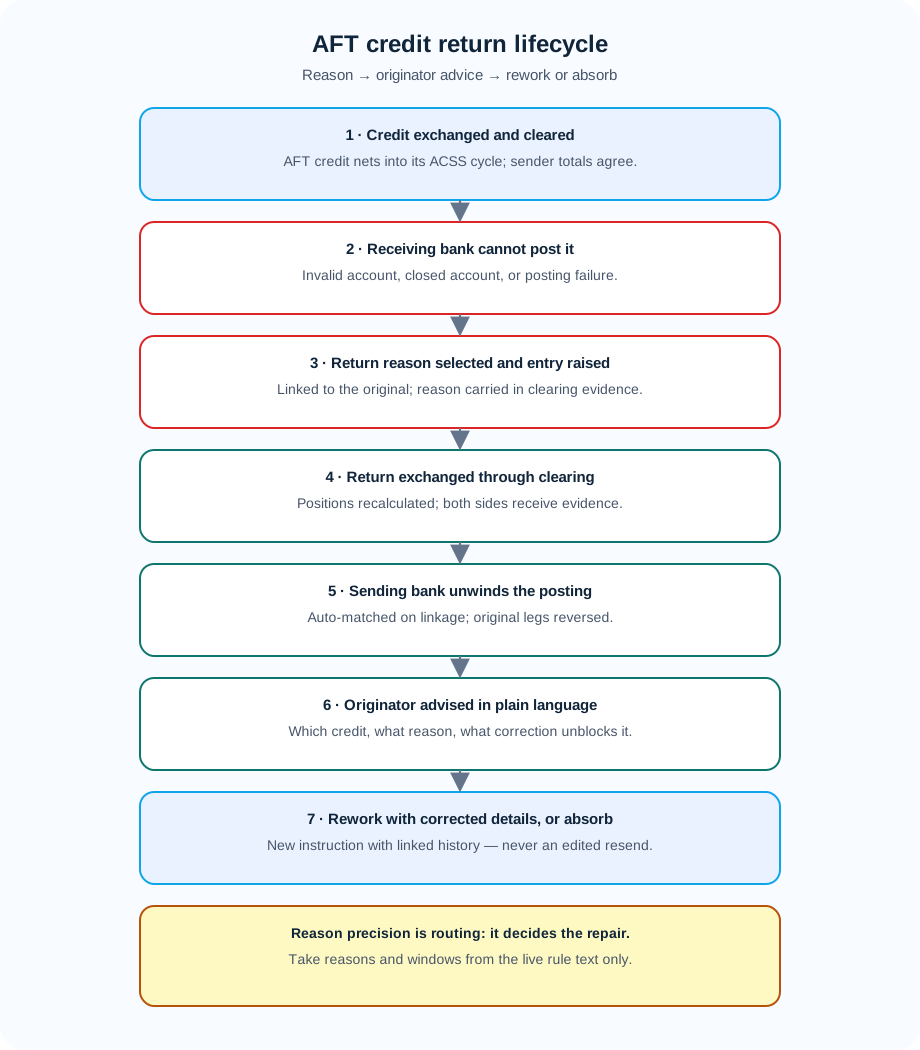
Walk the seven stages as an operator. 1, exchanged and cleared: the original credit netted into its cycle. 2, cannot post: receiving validation refuses the credit — invalid details, closed account, or posting failure. Reasons live in the live returned-items text and must be selected exactly. 3, return entry created: a new entry citing the original references with the reason in clearing evidence. 4, return exchanged: the return travels through clearing and positions recalculate — so the sending side learns of it after the return clears, not when the receiver decides. 5, unwind: reverse the original posting legs, matched on linkage. 6, advise: tell the originator which credit, which reason in plain language, and what correction unblocks re-initiation. 7, rework or absorb: correct the data and re-initiate as a new credit with linked history, or close with the unwind as final state.
Three disciplines separate competence from chaos. First, never re-pay on pressure. Parallel re-payment of a credit whose return is in flight is the standard recipe for a duplicate. Second, reroute only where permitted. Under F1, an FI undertaking rerouting bears liability directly resulting from it and sends a Notice of Change where it is advising corrected routing information. Third, advise in the originator's language with the network's facts.
The posting-exception queue: where receiving banks win or lose
Between "cannot post" and "return raised" sits the queue this chapter's third diagram governs. Unpostable credits must be classified on receipt into lanes — invalid details, closed accounts, posting failures — each with an owner and a deadline, because each lane has a different clock and a different decision.
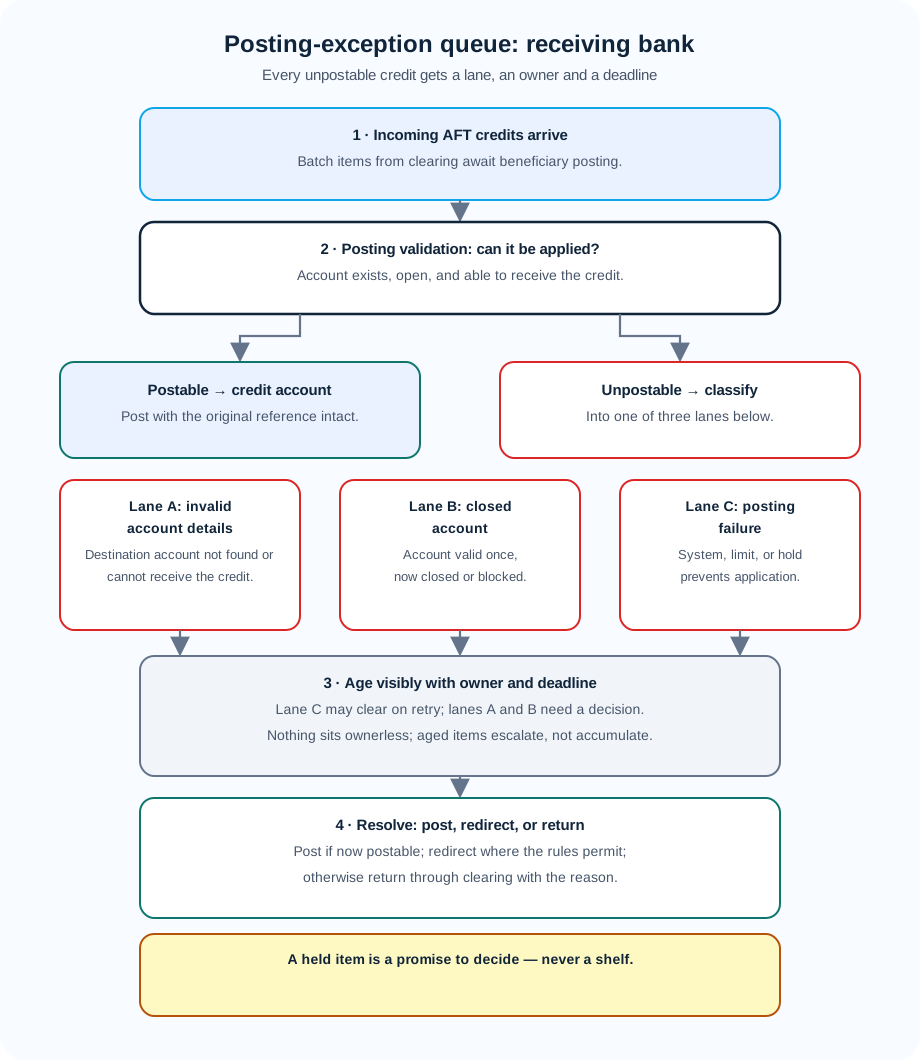
Lane discipline is specific. Invalid-detail items need a decision, not a shelf: no retry will change the details, so move to return promptly. Closed-account items need the same promptness with one extra check: is there a redirect arrangement the rules permit, or does the credit go back? Posting-failure items are the only lane where waiting can be correct — but a retry without a deadline is a shelf with better lighting. Every lane ages visibly and escalates at defined ages.
Duplicates: the operational risk with containment controls
Duplicate files are an operational risk, not a clearing defect — clearing processes what it receives — and containment is an operational discipline with controls at every gate. Prevention gates (hashes, control totals, release locks, confirmation screens, dual approval) stop most duplicates before release. Detection gates (hash-on-receipt, totals-against-history, per-item reference checks, behavioural baselines) catch what prevention missed. But once a duplicate has cleared, recovery is a correction exercise governed by one rule: freeze first, then quantify, then correct with linked entries. Study the containment diagram before reading further.
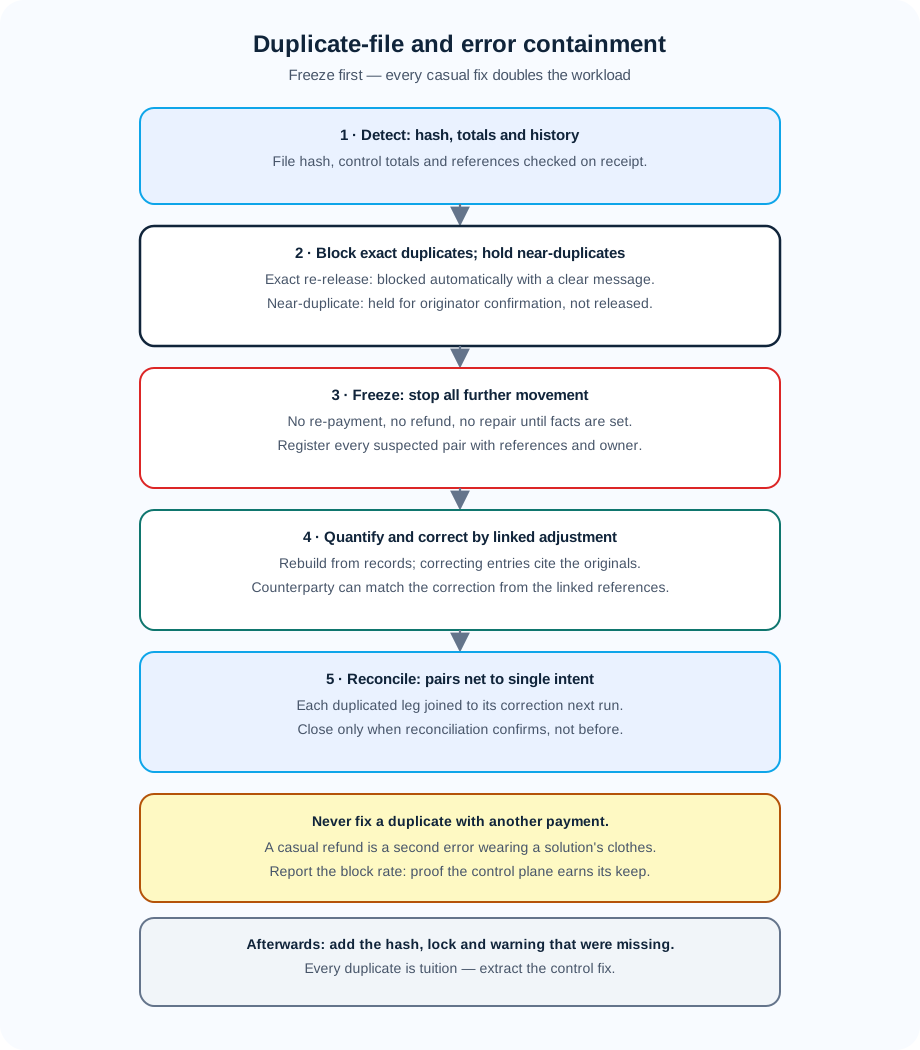
Walk the five gates as an operator. 1, detect: hash, totals and history checked on receipt; a suspected duplicate is registered with references and an owner. 2, block or hold: exact re-releases blocked automatically; near-duplicates held for confirmation, never released on assumption. 3, freeze: stop all further movement on the suspected pair — no re-payment, no informal refund. 4, quantify and correct: rebuild from records and move the correction as linked adjustment entries citing every original. 5, reconcile: each duplicated leg joined to its correction next run, closing only when reconciliation confirms pairs net to single intent.
Two prohibitions carry this subsection. Never fix a duplicate with another payment: a casual refund is a second error wearing a solution's clothes. Duplicates are tuition — extract the control fix, test it with the originator before the next cycle, and report the block rate as proof.
Investigations: finding facts while the originator waits
Between detection and resolution lies investigation: assembling facts across systems, participants and time for two masters — the recovery process, which needs evidence, and the originator, who needs honest updates. The method is mechanical. From the best available reference, pull every handoff record and establish the credit's state in lifecycle terms — rejected, cleared, settled, posted, returned, corrected, disputed — and the recovery path follows. Name the next-action owner. Then communicate outward: established, pending, who holds it, when the next update arrives.
Cross-participant investigation adds structured counterparty contact: references, facts and a specific question — not "where is our money" but "credit item X, reference Y, cycle Z, no return in our evidence; please confirm application or return status." Log every contact from the first call: disagreements ripening months later are won on contemporaneous notes, not recollection.
Disputes: contesting liability by process
When participants disagree on who bears a loss — whether a return was properly raised, whether a correction was properly claimed, or whether handling met the rules — disagreement moves from correspondence to process. [Payments Canada rule] A6 requires written dispute notice within 60 calendar days after receipt of the returned item, requires the item to be held in suspense, and requires written acknowledgement within 10 business days. A6 allows arbitration after 60 calendar days if the matter remains unresolved; A9 arbitration is by mutual agreement, not an automatic consumer appeal route.
Bilateral resolution first remains sensible operationally, but formal A6 notice is what preserves the scheme route. If arbitration proceeds under A9, the decision is final and binding subject to the rule's court/new-facts provisions; an order to pay is due within 5 business days after the report. Close every dispute with a [Bank implementation] lessons-learned control fix. Do not describe A9 as a generic neutral service available on customer request.
Recovery, ageing and the registers
Recovery ends in few states — name them to keep case management truthful. Repaired and re-initiated: defect corrected, new credit released with linked history. Unwound and absorbed: the return stands final. Corrected and reconciled: duplicate or error corrections netting to intent with reconciliation confirming. Decided and complied: dispute or arbitration outcome posted. Written off: unrecoverable amount recognised under the authority matrix — governed, evidenced, never a quiet suspense burial. Open cases sit in working states with owners and next-action dates; closed cases carry ending states with linked evidence. Cases without owners age; cases without ending states accumulate.
Two registers hold the operation together. The exception register records every classified exception from detection to closure. The suspense and unmatched register records every value outside its intended account with amount, age, owner and expected path. Review both on a risk-set rhythm — daily for high-value and aged items. Ageing analysis is the early-warning radar: timing breaks clear as linked entries land, but value breaks never self-heal, and an item older than its process's outer limits is an escalation, not a monitoring entry. Report upward in summary: volumes by class, ageing buckets, write-offs, dispute inventory.
9. Posting, accounting, liquidity, reporting and reconciliation
Section 8 handled exceptions credit by credit. This section covers the machinery keeping the push-payment business truthful while exceptions fly: posting puts value on accounts, accounting keeps the bank's books honest, liquidity funds positions, reporting tells the story, reconciliation proves it.
Posting: truthful balances while the story is still open
Posting's central tension is timing: expectations pull toward immediate certainty while return and correction mechanics push toward caution. The only standard is honesty — advices and statements must never present a batch credit as beyond recall while the story is still open. Product owners note: every "instant confirmed" promise on batch-sourced funds is a risk decision in marketing costume.
Posting mechanics must survive exception paths without heroics. Returns auto-match to originals on linkage and reverse the correct legs per stated fee policy. Corrections post as linked entries a corporate team can match. Suspense postings carry reason, age and owner from creation. Test posting logic against Section 11's three stories before production does it for you.
Accounting: the bank's books under exception load
Clearing-position general-ledger accounts must reflect returns and corrections as linked entries so finance sees operations' story. Suspense accounts must be owned, aged and escalated. Fee treatment on returned credits follows stated policy the originator has seen. Write-offs travel the authority matrix with evidence attached. Period-end close includes explicit exception cutoffs — and designed answers finish audits while improvised ones repeat them.
Liquidity: funding positions that returns reshape
ACSS settles deferred-net with positions funded through Bank of Canada accounts; ACSS settlement-account holders meet net obligations by Lynx payments. The Bank of Canada policy also expects operational capability, contingency operations and collateral arrangements, and notes direct-clearer exposure to a survivors-pay loss-allocation mechanism on default. [Bank implementation] Three disciplines follow. Forecast with returns modelled — assumptions from history, payroll Fridays, month-ends — not the happy path plus improvisation. Monitor intraday against forecast with divergence alerts. Maintain a rehearsed settlement-break playbook drilled jointly by treasury, settlement operations and payments operations.
Reporting: telling originators and management what happened
Originator reporting — release confirmations, statements, advices, corporate files — must show returns and corrections as what they are: linked to the original, reasoned in plain language, actionable. Intraday and end-of-day corporate reporting should include exception content by design, because originator reconciliation teams plan around these inputs — and the bank whose files the client's ERP can ingest without manual repair is the bank that keeps the mandate at renewal. Management reporting covers the Section 8 registers in summary. Regulatory and scheme reporting feeds from the same evidenced records, never from memory at deadline. And beneficiary-side reporting deserves its paragraph: the receiving bank's statements and displays must present returned-credit outcomes truthfully to beneficiaries who may otherwise call the originator in alarm. Both banks' language shapes the same incident.
Reconciliation: proving the story end to end, on both sides
The model is three-way on the bank side and mirrored on the customer side. Bank-side: files released (counts, control totals, value dates, release records) against clearing evidence (acceptances, rejections, returns in flight, pending corrections, flagged disputes, manual balancing entries) against settlement and books (Bank of Canada-funded positions, general-ledger entries, customer postings, suspense, fees, corrections). Match on reference, amount, date and status — all four — and treat in-flight returns and corrections as expected reconciling items, provided each links to its original. Customer-side, the mirror: released files and confirmations against bank reports and advices against the payroll or payables ledger. The joining key across all of it is the original reference, carried through every report line. Study the reconciliation diagram with both sides in mind.
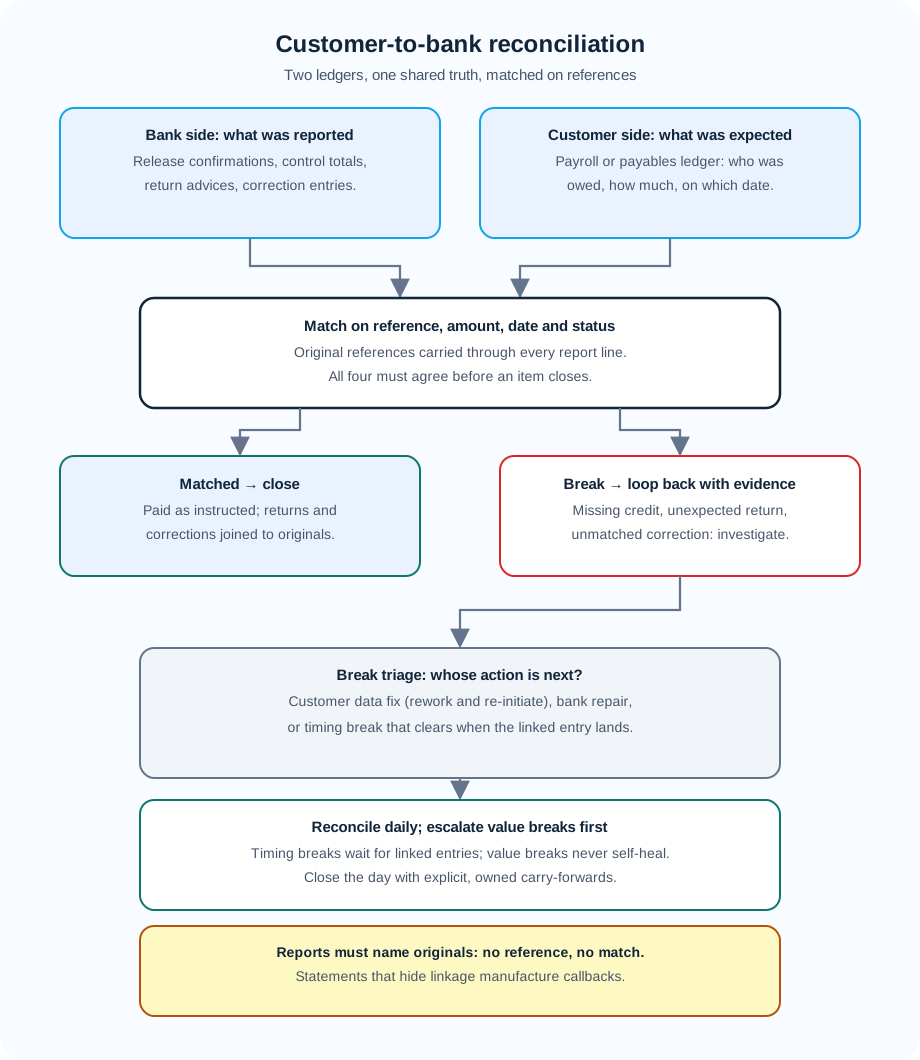
Breaks point to owners — memorise the pattern. Release-versus-clearing belongs to payments operations with the originator. Clearing-versus-settlement belongs to settlement and treasury. Settlement-versus-books belongs to posting and reconciliation teams. Report-versus-ledger belongs jointly to the bank's client service and the originator's finance team. Route on detection: misrouted breaks turn one-day timing differences into three-week investigations.
Two habits keep reconciliation controlled. Age everything daily and escalate value breaks first. Timing breaks clear as linked entries arrive; value breaks never self-heal. Close the day deliberately: define what "reconciled today" means, which in-flight items are explicitly accepted as reconciling items with owners, who signs. Explicit carry-forwards are controlled; ignoring the unmatched tail is a story told to the system, corrected at month-end with interest. And once a month, reconcile the relationship, not just the items: share return-rate trends with major originators and agree data-quality fixes.
10. Implementation, testing and resilience
Banks acquire competent return operations by building systems that enforce the taxonomy, simulating feared failures, rehearsing dreaded incidents and staffing the desks — not by writing procedures and hoping. Retrofitting control onto a running push-payment operation is surgery on a moving patient, so build it before volumes grow and before the first big originator migrates.
Build the return taxonomy into systems, not manuals. Hubs and gateways should classify returns on receipt and route each class to its queue with owner and deadline attached. Returns auto-match on linkage. Duplicate detection runs at every ingestion point with block-hold-alert ladders. Reconciliation runs the three-way match with class-based break routing. Size queues and staffing for the return storm — hundreds of linked returns from one failed corporate file — not the average day.
Test return paths like origination. Harnesses should simulate the catalogue: rejects, returns across all three driver lanes, exact and near duplicates, claim rejections, return-wave position divergences, suspense ageing, posting-outage backlogs. Regression suites cover every amendment touching the returned, dispute, arbitration and balancing neighbourhoods. End-to-end tests prove originator-visible outcomes: advices naming originals, linked corporate-file references the client's ERP can ingest. And test the human path: the 2 a.m. duplicate call tree, escalation matrices, write-off authorities. Systems passing technical tests but handing unworkable queues to untrained night staff fail their first real incident. [Bank implementation] F1 also requires incident notification when a direct clearer cannot process files, cannot make funds available, or has an incident likely to affect another clearer, including duplicate files; build those notification paths into the runbook.
Resilience means continuing to classify, work and reconcile while degraded: redundant return-queue capture across hub failover; reference-keyed idempotency so replays cannot manufacture duplicates; reconciliation runnable on backup feeds with explicitly degraded confidence; incident communication templates, because silence during outage converts a technical event into a trust event. Cross-train return expertise so storms never meet skeleton crews holding undocumented knowledge. The posting-exception queue in particular must be workable by the backup team: if only one person understands the lane discipline, the queue is a person, not a process. And keep a settlement-break drill cadence owned jointly by treasury, settlement and payments operations.
Change and vendor management close the section because return operations change constantly. Originator migrations arrive as return waves unless onboarding runs validation pilots, parallel runs and reference-mapping sign-off. Vendor upgrades regression-test against the return catalogue with rollback criteria in exception terms. Rule amendments trigger the Section 6 review cycle with a named owner and completion before effect. Operations treating change as routine stay controlled; those treating it as somebody else's problem meet it as incidents.
11. Practical fictional Canadian examples
Theory classifies; stories teach judgement. [Fictional example] All three examples below use invented companies and figures, with mechanics designed to illustrate the controls; they are not evidence of a bank's actual product or service level.
Example (fictional): the double-released payroll file
Northstar Trail Gear Ltd., a fictional Calgary outdoor retailer with about 900 staff, releases its biweekly payroll file on Wednesday afternoon: 900 AFT credits totalling CAD 1.4 million for Friday value. It validates cleanly and releases with confirmation. Thursday morning, the payroll supervisor — covering for a colleague, working from a desktop-saved copy of the file — uploads the same file again "to make sure it went." The portal, lacking a duplicate hash check, accepts it as new. Validation passes: well-formed, funded, authorised. Two identical files queue for Friday clearing, and Friday brings 900 double-paid employees, grateful callbacks and a quieter set of rapid withdrawals.
Detection comes from the employer's controller at 10 a.m. Friday, not from controls that were never built. Containment starts immediately: remaining unsettled legs of the second file are held where the cycle permits, and every credit from both files is registered as a suspected duplicate pair. The bank resists the plea to "just reverse the extras" — there is no unilateral debit authority over 900 employee accounts. Quantification follows from records — identical hashes confirming diagnosis. Recovery is a correction exercise: linked adjustment entries for duplicated legs, item by item, citing both file references. Collection of overpaid value runs through the employer's prompt, honest, legally advised communication to staff — not through debits the bank has no authority to raise. Reconciliation tracks pairs as explicit reconciling items until every one nets to the single intended payment.
The lessons are the chapter in miniature. A hash check, a release lock and an "already released" warning would have cost a fraction of the recovery. Classification mattered: nothing was misapplied, so there was nothing to return — only excess value to correct by adjustment. And the employer needed repair-grade honesty about what happened and which portal controls would prevent recurrence — built and tested before the next cycle.
Example (fictional): the wrong-account supplier credit
BlueHarbour Foods Inc., a fictional Halifax seafood distributor, pays a new supplier — fictional Fundy Packaging Co-op — CAD 84,000 by AFT credit on Tuesday, keyed from an emailed invoice carrying one transposed digit in the account number. Validation passes: valid structure, within limits, dual approval recorded. Clearing accepts. Wednesday the receiving bank cannot apply it — the details identify no servable account — and raises an F1 AFT return with the applicable Standard 007 reason in the clearing evidence. The return clears through its own cycle mechanics, and the sender's auto-matching joins it to the original that evening on linkage.
Thursday morning shows quality. The sending bank unwinds its posting, reverses the fee per stated policy, and sends repair-grade advice: which credit, which reason in plain language, exactly what correction unblocks re-initiation. The clerk asks the bank to "just fix the digit and resend," and to re-pay immediately so goods release. The bank declines both: it will not edit beneficiary details on a released payment, and it will not re-pay in parallel with the in-flight return. The distributor confirms details through a verified channel, corrects the digit, and re-initiates Thursday for the next eligible cycle as a new credit with linked history. Reconciliation shows original, linked return and rework as three joined entries. Goods release against the corrected arrival, and the distributor adopts first-payment verification for every new supplier.
Note the restraint, because restraint is the skill. No parallel re-payment alongside the in-flight return. No edited released instruction. No same-day-finality promise on a batch rework. The delay cost two days of supplier goodwill against the counterfactual the fraud section warns about: a same-day "fix" to unverified details sending CAD 84,000 wherever a manipulator nominated.
Example (fictional): the month-end funding surprise
Fictional mid-size direct clearer Meridian Trust closes a heavy month-end Monday — thousands of supplier credits plus payroll files from three major originators. Tuesday's settlement preparation shows funding materially below forecast. Three-way evidence: files match clearing, so origination is clean; clearing versus settlement diverges on one large supplier file whose return wave arrived late — hundreds of invalid-detail returns from a client's first run on a new ERP — plus correcting entries for a partial duplicate not yet landed.
Response follows the playbook, not improvisation. Treasury funds the position as required — settlement obligations are not negotiable during diagnostics. Settlement operations confirms the missing correcting entries through structured, referenced contact. By Wednesday the entries land, the position trues up, and the close records the cause. The lasting fixes are three: return-rate assumptions by client and cycle type plus first-file uplifts; first-live-file monitoring for every migrating originator; a divergence alert paging before the funding desk finds the gap. No originator heard anything untrue: the break lived and died in the settlement layer, exactly where design says such breaks belong.
12. Key takeaways and authoritative references
Twelve points carry the chapter. Pin them where your team can see them.
- A returned credit is a linked reversal with a reason, not a failure message. Match it to its original, tell the originator what to fix, keep both ledgers truthful until the repair lands.
- Timing selects the path: before clearing means reject, after clearing means return. Classify first, act second. Most disasters begin with the right energy on the wrong path.
- Invalid details, closed accounts and posting failures are the characteristic drivers. Each demands different originator action — verify, obtain current details, or wait for the retry decision — so reason precision is routing.
- Receiving banks own the posting-exception queue. Every unpostable credit gets a lane, an owner and a deadline. A held item is a promise to decide, never a shelf.
- Duplicates are contained, never casually fixed. Freeze, quantify, correct with linked adjustment entries, reconcile pairs to single intent. Never fix a duplicate with another payment.
- Never re-pay in parallel with a return in flight. Patience is a control. The calm, exact status update is the instrument that makes patience possible.
- Advise in the originator's language with the network's facts. Repair-grade advices fix data the same morning; reason codes manufacture callbacks that push rework past another cutoff.
- Reconcile three ways on the bank side and mirror it on the customer side. Files versus clearing evidence versus settlement and books; reports versus ledger. Match on reference, amount, date and status — all four.
- Route breaks to owners and escalate value first. Timing breaks wait for linked entries; value breaks never self-heal. Close every day with explicit, owned carry-forwards.
- Prevent upstream, where it is cheap. Hashes, locks, dual approval, beneficiary confirmation, detail-change screening, pre-release fraud and sanctions gates. Measure block and reject rates by originator.
- Read the live rule text; never memorise it. Reasons, windows, forms and timelines change. Playbooks cite families functionally, link the library, carry verification dates.
- Close deliberately. Every case ends in a named state with linked evidence; every dispute ends with a control fix; every duplicate ends with the missing control built and tested.
Authoritative references
Official sources only — these links outrank anything quoted from memory, including from this chapter. URLs and current versions were checked on 2026-10-05; if a document moves, start from the Payments Canada or Bank of Canada rules page and navigate to the named item.
- Payments Canada — Payment systems overview (ACSS retail batch and Lynx high-value systems, live status, modernisation including the planned Real-Time Rail): https://www.payments.ca/systems-services/payment-systems
- Payments Canada — Retail batch payment system (ACSS and USBE composition, deferred-net clearing, direct-clearer settlement through Bank of Canada accounts, electronic streams including AFT credits and debits): https://www.payments.ca/systems-services/payment-systems/retail-batch-payment-system
- Payments Canada — High-value payment system Lynx (RTGS model, irrevocability and real-time finality, participant and oversight roles — the contrast case for batch return rights): https://www.payments.ca/systems-services/payment-systems/high-value-payment-system-lynx
- Payments Canada — Rules and documentation library (the live text: ACSS rules including the A4 Returned and Redirected Items, A6 Items in Dispute and A9 Arbitration families, B-family settlement and balancing material, by-laws, standards and procedures; versions posted online are in force): https://www.payments.ca/systems-services/rules-documentation
- Payments Canada — Rule F1, Rules applicable to Automated Funds Transfer (AFT) Transactions (current effective version: July 27, 2026): https://www.payments.ca/sites/default/files/f1eng.pdf?v=1785157155
- Payments Canada — Rule F4, Rules applicable to AFT Transactions using ISO 20022 messages (current effective version: July 27, 2026): https://www.payments.ca/sites/default/files/f4eng.pdf?v=1785156747
- Payments Canada — Standard 007, Transaction Codes and Return Reason Codes in AFT Files: https://www.payments.ca/sites/default/files/standard007eng.pdf
- Payments Canada — AFT ISO 20022 onboarding, message families and draft corporate examples: https://www.payments.ca/payment-resources/iso-20022/automatic-funds-transfer
- Payments Canada — Rule A6, Items in Dispute: https://www.payments.ca/sites/default/files/a6eng.pdf
- Payments Canada — Rule A9, Arbitration: https://www.payments.ca/sites/default/files/a9eng.pdf
- Justice Canada — Canadian Payments Association By-law No. 3, Payment Items and ACSS (current to September 21, 2026): https://laws-lois.justice.gc.ca/eng/regulations/SOR-2003-346/index.html
- Payments Canada — Real-Time Rail payment system (launching in Q4 2026; current status is testing/onboarding, not AFT production): https://www.payments.ca/systems-services/payment-systems/real-time-rail-payment-system
- Bank of Canada — Payment systems oversight (Lynx as systemically important, ACSS as prominent, settlement-account and designation context for this chapter's funding and finality claims): https://www.bankofcanada.ca/regulatory-oversight/financial-market-infrastructures/payment-systems-the-bank-of-canada-oversees/
Diagrams in this chapter: pre-release reject versus post-clearing return decision; AFT credit return lifecycle (reason to originator advice to rework or absorb); posting-exception queue in the receiving bank; customer-to-bank reconciliation model; duplicate-file and error containment flow — all under /diagrams/payment-stories/canada/chapter-20/. Scheme labels refer to Payments Canada rules and standards; bank controls are labelled as implementation choices; examples are fictional. ACSS and Lynx are live; the Real-Time Rail is not current AFT production and is shown as a Q4 2026 launch programme. PAD, cheque and wire specifics stay at family level; dedicated chapters go deeper.
This application uses JavaScript for the full interactive experience. This text summary is served for accessibility and search indexing.