Enterprise AMH architecture, integration, routing, transformation, operations, controls, and implementation
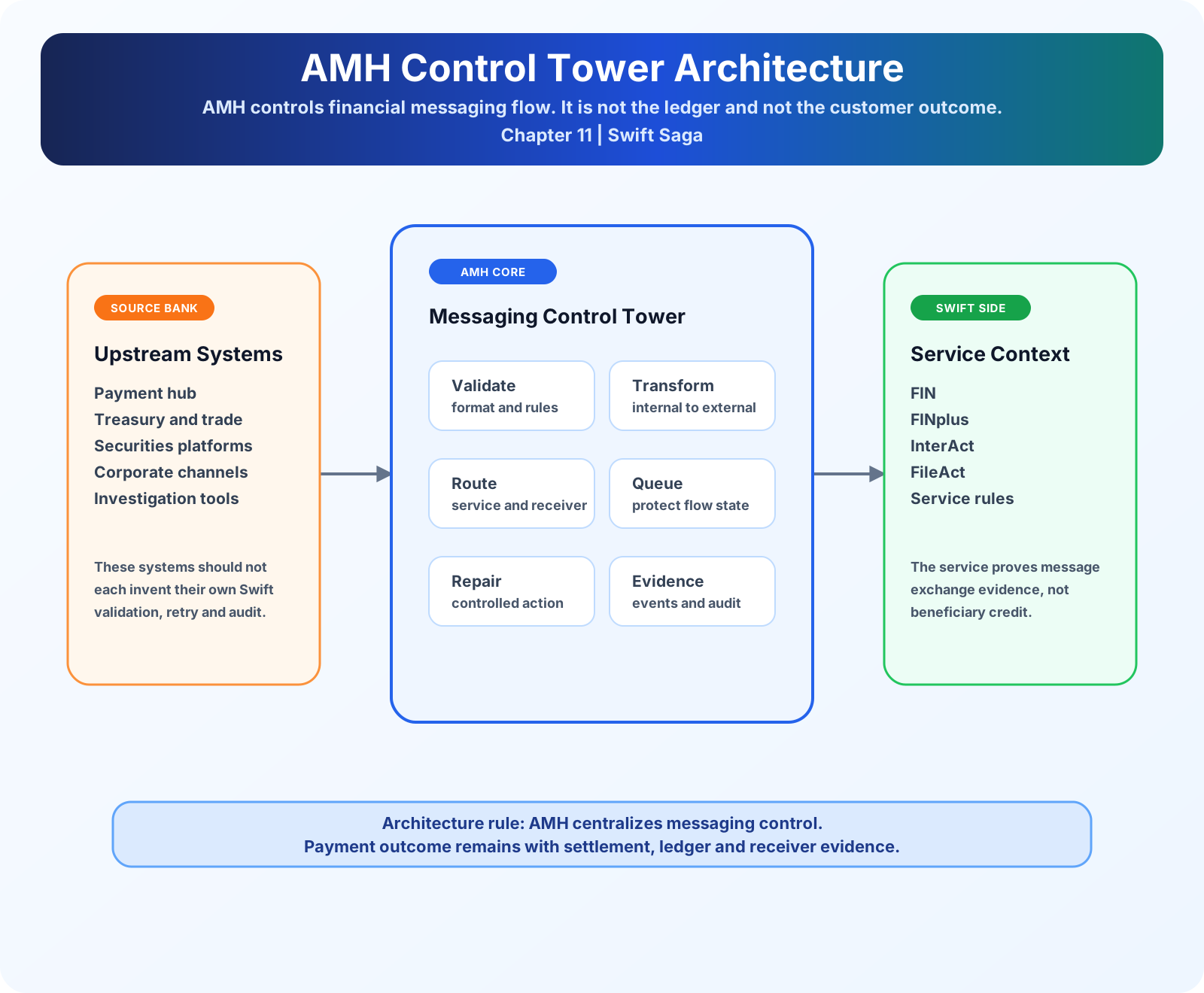
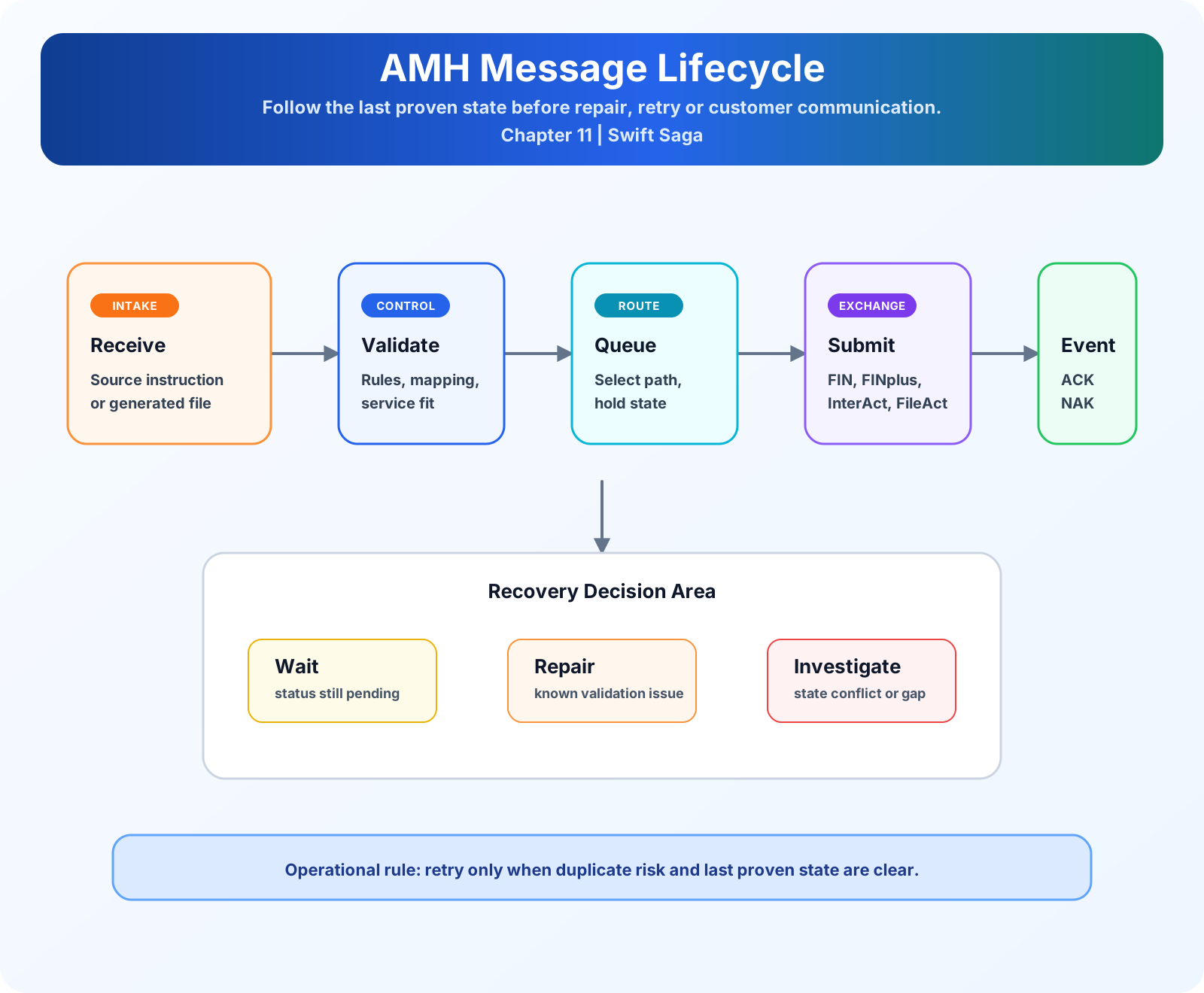
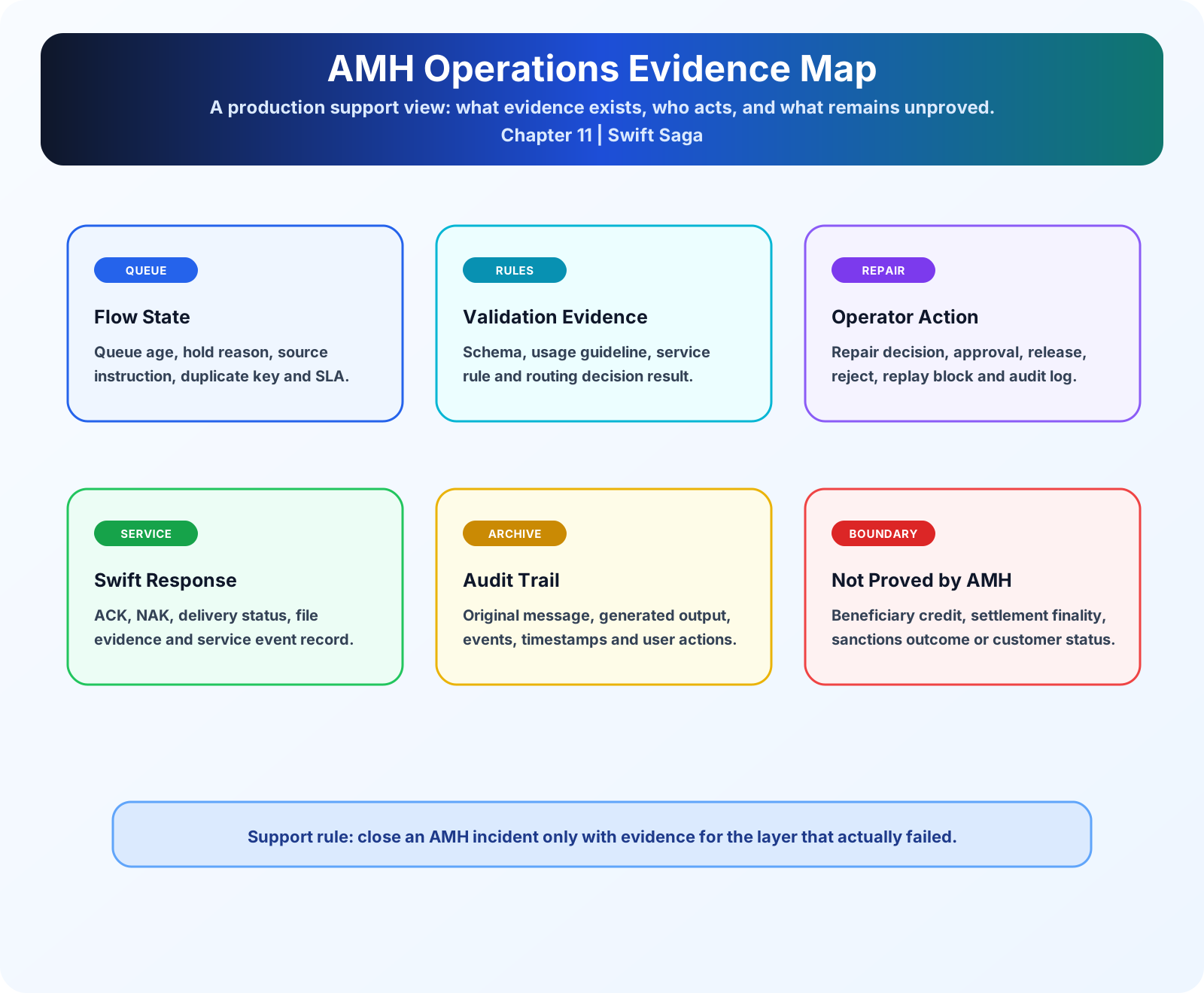
At 09:27, the payment enters the bank's control tower. The EUR 250,000 instruction is no longer just a payment object inside the bank. It is becoming a controlled external message flow that needs validation, transformation, routing, queueing, repair, monitoring, acknowledgements, evidence and safe recovery. Alliance Messaging Hub is where a serious bank stops treating Swift connectivity as a pipe and starts treating financial messaging as an operating discipline.
Accuracy position
Alliance Messaging Hub, commonly called AMH, is a modular financial messaging solution in Swift's Alliance portfolio. Swift public material describes AMH as designed for the Swift network, configurable, built for reliability and resiliency, able to handle messages and files across multiple formats, and suitable for high-volume message flows. Its public profile also identifies FIN, InterAct and FileAct support, off-the-shelf adaptors, and a Designer & Workflow engine for business flows, format definitions and transformation. These are documented capability descriptions; they do not establish every installed version's adapter, licence, topology or configured workflow. Swift AMH product profile
Throughout this chapter, suggested objects, events, states, controls and tables describe synthetic bank implementation patterns. They are not a published AMH API, mandatory database schema or official product status taxonomy. AMH, Alliance Access, Alliance Gateway and SwiftNet Link have different responsibilities; the selected supported deployment determines their integration paths. Do not infer a universal serial chain through every product from an illustrative architecture.
For this chapter, the durable teaching position is:
| Concept | Accurate teaching point |
|---|
| AMH | A bank-side financial messaging hub/control platform for orchestrating messages and files. |
| Swift service | FIN, FINplus, InterAct, FileAct or another service context that carries traffic. |
| Connectivity | Secure path to Swift services; not the same as hub orchestration. |
| Payment hub | Bank business orchestration layer; not the same as AMH messaging control. |
| Ledger/settlement | Value movement and accounting; not proved by AMH message submission alone. |
| Operations evidence | Queue, validation, routing, ACK/NAK, repair and audit evidence generated around the flow. |
AMH earns its value when traffic is high, flows are mixed, standards are changing, and exceptions need control.
09:27 - the message enters the bank's control tower
A payment hub releases the 09:17 payment for external messaging.
A weak architecture sends each upstream system directly toward Swift with its own mapping, retry logic, logs and repair process.
That architecture looks simple in a diagram. In production, it fragments control.
One system retries aggressively. Another loses ACK correlation. A third uses stale routing data. A fourth logs only the final status. Operations must search several tools to understand one payment.
AMH-style thinking solves a different problem:
"How do we bring financial messaging into a controlled, observable, recoverable platform?"
That question is bigger than transmission.
What AMH is not
AMH should not be taught as magic.
AMH is not:
- the customer channel;
- the payment product engine;
- the bank's legal settlement account;
- the correspondent banking arrangement;
- the sanctions decision by itself;
- the fraud model by itself;
- the beneficiary-credit proof;
- the full customer outcome;
- a reason to stop understanding FIN, FINplus, InterAct and FileAct.
A hub can control message flow. It cannot turn a bad payment design into a good one.
Why banks need a messaging hub
Banks accumulate systems.
Corporate channels, treasury systems, trade systems, securities platforms, liquidity tools, payment hubs, investigation systems and reporting processes may all need financial messaging. If each source builds direct messaging logic, the bank gets duplication and inconsistent controls.
A hub provides a place to centralize common messaging concerns:
| Concern | Why centralize it |
|---|
| Validation | Apply consistent message and usage rules before external submission. |
| Transformation | Convert internal objects or formats into required external structures. |
| Routing | Select service, receiver, queue and processing path under governed rules. |
| Queueing | Protect flow when downstream service or interface is slow or unavailable. |
| Repair | Give operations controlled workflows for correctable defects. |
| Monitoring | Show traffic health, queue age, rejects and stuck items. |
| Evidence | Store ACK/NAK, events, operator actions and audit history. |
| Replay control | Prevent duplicate financial submission when state is uncertain. |
| Release control | Manage standards changes and service configuration updates. |
Centralizing does not mean one team owns every business decision. It means common messaging behaviour is governed.
AMH as control tower
A control tower does not fly the aircraft. It coordinates safe movement.
AMH does not own the customer's commercial intent. It does not own the receiving bank's ledger. It coordinates financial message movement across configured flows.
A useful mental model:
Payment hub decides business instruction.
AMH controls message flow.
Swift service carries the message/file.
Receiver processes the business instruction.
Settlement/ledger proves value and accounting outcome.
When those layers stay separate, support gets easier.
Bank-side architecture layers
A practical AMH architecture can include these layers:
| Layer | Responsibility |
|---|
| Source systems | Create business instructions, files, responses or investigation messages. |
| Canonical/payment object layer | Holds bank-controlled payment or message objects. |
| Integration/adapters | Connect source systems to AMH using agreed protocols and formats. |
| Validation layer | Applies format, schema, usage guideline and bank rules. |
| Transformation layer | Maps internal or source formats into required external structures. |
| Routing/rule layer | Chooses service, destination, queue, path and handling. |
| Workflow/repair layer | Allows controlled correction, approval, rejection or resubmission. |
| Service interface layer | Connects to FIN, FINplus, InterAct, FileAct or other services. |
| Monitoring/logging layer | Captures traffic health, events, errors and operator actions. |
| Archive/evidence layer | Stores messages, status, audit trail and searchable proof. |
Different banks implement these with different products, extensions and integration styles. The principles remain.
Outbound message lifecycle
An outbound payment message through AMH-style architecture should move through controlled states.
| State | Meaning |
|---|
| Received from source | AMH or integration layer received an instruction/message/file from upstream. |
| Identified | Flow, source, business purpose, service and message type are recognized. |
| Normalized | Required internal structure or metadata is prepared. |
| Validated | Format, business, usage and service checks run according to configuration. |
| Enriched | Reference data, route, service or control metadata may be added where appropriate. |
| Routed | Destination service, receiver, queue and handling path are selected. |
| Queued | Message waits safely for submission or operator action. |
| Submitted | Message/file crosses the configured service boundary. |
| Acknowledged/rejected | ACK, NAK or service response arrives. |
| Delivered/statused | Delivery/status evidence arrives where service supports it. |
| Completed for layer | AMH closes its layer with evidence, not payment finality. |
| Repaired/rejected | Defects follow controlled repair or rejection path. |
| Outcome unknown | State cannot be confirmed; retry is blocked until reconciliation. |
A one-field status called sent cannot represent this lifecycle.
Inbound message lifecycle
Inbound traffic matters as much as outbound.
An inbound message or file may need:
- service receipt;
- sender validation;
- relationship/authorization check;
- format/usage validation;
- routing to correct internal application;
- duplicate detection;
- enrichment;
- workflow assignment;
- acknowledgement generation where applicable;
- archive;
- operator alert;
- downstream delivery confirmation;
- exception handling.
If inbound design is weak, the bank may receive messages correctly at the service level but fail to apply them internally.
Message and file coexistence
AMH is valuable because banks do not process one format forever.
A bank may need to handle:
- FIN MT messages;
- ISO 15022 securities messages;
- ISO 20022 MX messages;
- CBPR+ payment messages;
- FileAct files;
- corporate or proprietary files;
- investigation messages;
- status and reporting messages;
- market infrastructure flows;
- transition/coexistence traffic.
The hub must treat each flow according to its service and business meaning. A FileAct delivery event cannot be interpreted like a FIN ACK. A FINplus rejection cannot be treated like a receiver business reject. A legacy MT repair cannot automatically preserve all ISO 20022 data.
Validation inside AMH
Validation inside the hub should be layered.
| Validation | Example |
|---|
| Intake validation | Did the source send a recognizable object/file/message? |
| Source contract validation | Did the upstream system respect the agreed data contract? |
| Message construction validation | Can required target structure be built? |
| Schema/format validation | Does the MT/XML/file meet structural rules? |
| Usage guideline validation | Does it satisfy CBPR+, market practice or service rules? |
| Service validation preparation | Are service, receiver and environment consistent? |
| Bank business validation | Are bank policy and release controls satisfied at this layer? |
| Duplicate validation | Has this payment/message/file already crossed the boundary? |
The best error tells operations which layer failed.
Transformation and mapping
Transformation is dangerous when people treat it as field movement.
AMH-style transformation should preserve business meaning.
Examples:
| Transformation problem | What can go wrong |
|---|
| MT to MX | One MT field may become several ISO 20022 elements. |
| MX to MT coexistence | Rich structured data may be flattened or truncated. |
| Internal object to pacs.008 | Party and agent roles must be semantically correct. |
| File to message | Record-level references must survive. |
| Message to internal event | Original identifiers must remain correlated. |
| Investigation response | Original payment references must not be lost. |
A transformation should always produce evidence: source, target, rule version, mapping version and validation result.
Routing and rules
Routing is not just destination.
Routing can include:
- source system;
- payment product;
- country/currency;
- message type;
- service;
- receiver;
- business service;
- priority;
- cut-off;
- RMA/relationship context;
- file/message path;
- repair queue;
- fallback route;
- test/live environment.
A routing rule error can send a valid message to the wrong processing path. That is why routing changes need maker-checker approval, testing and audit.
Queueing discipline
Queues protect the bank, but only if designed carefully.
A queue should know:
- what object is queued;
- why it is queued;
- whether it has crossed an external boundary;
- whether retry is safe;
- how long it has aged;
- which SLA applies;
- what operator action is allowed;
- which downstream service it waits for;
- whether duplicates are blocked;
- how restart/recovery behaves.
A queue without state is a risk.
Repair workflow
Repair is one of the main reasons to control messaging centrally.
A repair workflow should distinguish:
| Repair type | Example |
|---|
| Source data repair | Missing beneficiary information needs source/customer correction. |
| Reference data repair | Stale BIC/SSI data requires reference-data owner. |
| Mapping repair | Wrong source-to-target logic requires change/fix. |
| Service configuration repair | Wrong service/receiver/routing setup requires platform owner. |
| Operational repair | Correctable format or release queue action needs maker-checker. |
| Non-repairable reject | Payment must return to source/customer. |
Repair should capture changed fields, reason, operator, approver, timestamp, validation rerun and new submission evidence.
ACK/NAK handling
AMH should consume acknowledgements as evidence.
It should not mark a payment complete because a service accepted a message.
A strong ACK/NAK model stores:
- raw service event;
- normalized status;
- original message reference;
- payment/business reference;
- timestamp;
- service;
- receiver;
- environment;
- failed rule/code where applicable;
- retry eligibility;
- next expected event;
- customer visibility rule.
This connects Chapter 9 directly to AMH implementation.
Unknown outcome and replay
The worst retry is the one that happens because the system does not know what happened.
AMH should treat uncertain state seriously.
Examples:
- submitted but ACK not consumed;
- interface restarted after submission;
- duplicate replay requested manually;
- service timeout after possible acceptance;
- file transfer state unclear;
- source system resubmits same payment with new reference.
Safe design includes:
- idempotency key;
- durable submission event;
- duplicate detection;
- operator warning;
- reconciliation job;
- unknown outcome state;
- blocked automatic retry;
- incident workflow.
A hub that can prevent one duplicate high-value payment has already earned attention.
Monitoring and observability
AMH monitoring should show more than system up/down.
Useful measures:
| Metric | Why it matters |
|---|
| inbound volume by source | Detects source/system disruption. |
| outbound volume by service | Shows FIN, FINplus, FileAct or InterAct behaviour separately. |
| queue age | Reveals backlog before customers complain. |
| validation failure rate | Signals mapping or data-quality issues. |
| NAK reason distribution | Points to root-cause patterns. |
| repair ageing | Shows operational pressure. |
| ACK latency | Detects service/interface slowdown. |
| unknown outcome count | Signals duplicate risk. |
| duplicate block count | Shows retry/replay pressure. |
| file-level vs record-level status | Prevents false success for files. |
| operator overrides | Highlights control risk. |
| standards-version failures | Reveals release defects. |
Dashboards should be built for decisions, not decoration.
Audit and evidence
AMH should help reconstruct the message story.
Audit evidence should include:
- source instruction;
- intake timestamp;
- transformation rule/version;
- generated message or file;
- validation results;
- routing decision;
- service submission;
- ACK/NAK/status;
- repair actions;
- operator approvals;
- replay decisions;
- archive record;
- final handoff to downstream systems;
- error and incident linkage.
An audit should not depend on someone remembering how a message was handled.
Security and access
AMH sits close to high-value financial messaging, so access matters.
Control topics include:
- privileged user management;
- maker-checker for critical configuration;
- segregation of duties;
- certificate/key-adjacent operating processes;
- secure zones;
- audit logs;
- change approvals;
- emergency access;
- monitoring for abnormal activity;
- environment segregation;
- release permissions.
A user who can change routing, repair messages and force statuses can create serious operational risk. Roles must be precise.
High availability and resilience
A messaging hub must be resilient because payments depend on it.
Resilience questions include:
| Question | Why it matters |
|---|
| Are queues durable? | Prevents message loss during restart. |
| Is failover tested? | Proves architecture, not just diagram. |
| Can replay happen safely? | Prevents duplicate external submission. |
| Are ACK events recoverable? | Protects state accuracy. |
| Is archive available during incident? | Supports investigation. |
| Can operations see last proven state? | Drives safe decision-making. |
| Are source systems back-pressure aware? | Prevents overload. |
| Are DR procedures current? | Makes recovery executable. |
Resilience is not only uptime. It is safe recovery with evidence.
Implementation roadmap
A bank implementing or upgrading AMH-style capability should proceed in phases.
Phase 1 - scope and inventory
Identify flows, sources, message types, services, files, volumes, SLAs, current interfaces, pain points and operational owners.
Phase 2 - target operating model
Define ownership, support model, repair roles, maker-checker, monitoring, incident process, change control and evidence requirements.
Phase 3 - architecture and integration
Design adapters, source contracts, validation, transformation, routing, queueing, security, archive and downstream handoff.
Phase 4 - migration design
Plan coexistence, cutover, parallel running, rollback, standards versioning, customer impact and data migration.
Phase 5 - test and certify
Test happy path, validation failures, NAK, lost ACK, duplicate replay, queue restart, failover, file partial reject, inbound routing and operator repair.
Phase 6 - production readiness
Confirm runbooks, dashboards, support coverage, access reviews, audit evidence, SLA, alerting and business sign-off.
Phase 7 - continuous improvement
Use incident trends, repair ageing, NAK patterns and data-quality defects to improve upstream processes.
BA view
For AMH requirements, a BA should document:
- source system;
- business flow;
- message/file type;
- Swift service;
- transformation rule;
- validation layers;
- routing rule;
- queue behaviour;
- repair eligibility;
- ACK/NAK meaning;
- duplicate control;
- timeout and unknown outcome;
- operator roles;
- audit evidence;
- customer impact;
- downstream handoff;
- SLA and monitoring;
- release/version dependency.
A requirement that says "AMH will route the message" is not enough.
Developer view
Developers need explicit contracts:
| Contract | Examples |
|---|
| Intake contract | payload shape, metadata, idempotency key, source reference |
| Message contract | target message type, version, namespace, header requirements |
| Routing contract | service, receiver, rule version, fallback path |
| Validation contract | schema, usage guideline, bank rules, error structure |
| Event contract | ACK/NAK, status, repair, retry, archive events |
| Error contract | retryable, repairable, rejectable, unknown outcome |
| Security contract | authentication, authorization, role, audit |
| Replay contract | when replay is safe and how duplicates are blocked |
Generic integration without these contracts leads to production ambiguity.
Tester view
The AMH test pack should include:
- inbound and outbound happy path;
- invalid source contract;
- missing mandatory data;
- schema failure;
- usage guideline failure;
- wrong route;
- wrong service;
- missing relationship authorization;
- queue backlog;
- interface restart;
- ACK lost locally;
- NAK with repair;
- unknown outcome;
- duplicate replay attempt;
- file transfer success with record-level reject;
- operator repair approval;
- access control rejection;
- failover and recovery;
- archive search;
- monitoring alert.
Testing only message format is not enough.
Operations view
Operations need a screen that answers:
- what arrived?
- from which source?
- which flow/service is it?
- where is it now?
- what is the last proven state?
- what failed?
- who owns repair?
- has it crossed the external boundary?
- is retry safe?
- what customer status is allowed?
- what evidence exists?
- what SLA is ageing?
If operations cannot answer these from AMH and related tools, incidents will spread across teams.
Architect view
The architect should ensure AMH does not become a black box.
Architecture must show:
- source systems;
- adapters;
- validation points;
- transformation components;
- routing rule ownership;
- queue boundaries;
- repair workflow;
- service connectors;
- monitoring and logs;
- archive;
- security zones;
- DR path;
- event publication;
- downstream consumers.
A black-box hub is only a bigger mystery.
Common anti-patterns
| Anti-pattern | Why it fails |
|---|
| Every source sends directly to Swift | Duplicates controls and fragments evidence. |
| Uncontrolled AMH pass-through | Wastes hub value and leaves repair weak. |
| One generic status | Hides ACK, delivery, business and settlement layers. |
| Manual replay without state proof | Creates duplicate payment risk. |
| Mapping owned only by developers | Loses business meaning. |
| Repair without maker-checker | Creates unauthorized business changes. |
| Queue monitoring only by count | Misses ageing, SLA and customer impact. |
| No raw event archive | Weakens audit and investigation. |
| No standards-version control | Breaks during releases. |
| No ownership matrix | Every incident becomes "messaging issue." |
Production case study: ACK lost in the hub
A message is submitted. Swift/service accepts it. The ACK reaches the interface, but AMH does not update the payment state because an internal consumer is down.
The scheduler retries the payment.
A duplicate risk appears.
The correct design would have:
- durable submission event;
- ACK reconciliation;
- idempotency;
- unknown outcome state;
- retry block;
- operator alert;
- recovery job.
This is a hub-state incident, not a customer-data incident.
Production case study: valid XML, wrong route
The message validates. AMH routing sends it to the wrong service context. Swift/service rejects it.
Root cause is routing/configuration, not XML.
Correct response:
- identify route rule;
- check service configuration;
- verify receiver/service reachability;
- repair rule;
- retest with correct service;
- preserve failed and corrected evidence.
Production case study: file delivered, records rejected
A FileAct file is delivered. AMH marks file transfer successful. Later, receiver business acknowledgement rejects 50 records.
Correct state:
FILE_TRANSFER_SUCCESS
RECORD_LEVEL_BUSINESS_REJECTS_PRESENT
Not:
COMPLETED
File and record outcomes must stay separate.
Current-source discipline
For real implementation, teams must check current Swift documentation, service descriptions, AMH release information, interface guides, bank configuration, security controls, RMA procedures, message standards and service rules.
This chapter teaches the operating model. Production design must use the exact version and environment facts available to the bank.
What a world-class Chapter 11 reader should remember
- AMH is a messaging control hub, not a payment ledger.
- AMH value appears in validation, routing, transformation, queueing, repair, monitoring and evidence.
- Upstream systems should not each invent their own Swift behaviour.
- Message and file flows need separate service semantics.
- ACK/NAK handling must preserve layer meaning.
- Unknown outcome must block blind retry.
- Repair must protect business meaning and audit.
- Queueing needs state, SLA and duplicate awareness.
- Inbound flows need as much control as outbound flows.
- AMH monitoring should show decisions, not just uptime.
- Transformation is semantic translation, not field movement.
- Routing rules need ownership, testing and maker-checker.
- Security and access around the hub are high-risk controls.
- Resilience means safe recovery with evidence.
- A hub without ownership and runbooks becomes a larger black box.
Enterprise flow inventory
Before a bank designs AMH, it must inventory flows. Do not begin with screens or servers. Begin with traffic.
A flow inventory should capture:
| Inventory item | Example |
|---|
| Source system | Payment hub, treasury, trade, securities, investigation platform, reporting system |
| Flow direction | Outbound, inbound, internal handoff, file exchange, response handling |
| Business purpose | Customer payment, FI transfer, statement, investigation, securities message, corporate file |
| Message/file type | MT, ISO 20022 MX, ISO 15022, FileAct file, proprietary file |
| Swift service | FIN, FINplus, InterAct, FileAct or service-specific context |
| Volume | Daily average, peak hour, end-of-month and stress volume |
| SLA | Submission, acknowledgement, receiver response, repair and completion target |
| Criticality | Customer-impacting, regulatory, liquidity, reporting, operational |
| Repairability | Can AMH/operations repair it, or must source correct it? |
| Duplicate risk | What happens if it is submitted twice? |
| Audit need | How long evidence must be retained and searched |
| Owner | Business, platform, operations and support owner |
This inventory becomes the backbone of the hub design.
If the bank does not know its flows, AMH becomes a powerful tool pointed at vague traffic.
Source-system contracts
Every upstream system that sends into AMH needs a contract.
The contract should define:
- payload shape;
- message/file type;
- metadata;
- idempotency key;
- source reference;
- business reference;
- expected service;
- priority;
- customer impact category;
- validation expectations;
- error return path;
- repair ownership;
- resubmission rules;
- timeout behaviour;
- audit retention.
Without source contracts, AMH must guess too much.
A payment hub can send a clean, bank-owned payment object. A treasury system may send a file. A trade system may send a documentary-credit message. An investigation tool may send status or case-related traffic. Each source has different semantics.
The hub should standardize how traffic is controlled, but it should not erase what the traffic means.
Intake design
Intake is where the hub first decides whether an object is understandable.
Good intake answers:
| Question | Why it matters |
|---|
| Who sent it? | Source ownership and security. |
| What flow is it? | Determines validation and routing path. |
| Is the object complete enough to process? | Prevents bad data from moving deeper. |
| Is this a duplicate? | Prevents repeated financial action. |
| Is the source allowed to send this flow? | Prevents unauthorized integration. |
| Which environment is it in? | Prevents test/live confusion. |
| What is the initial evidence? | Creates lineage from the first event. |
A weak intake design lets any payload enter a generic queue and waits for failure later. A strong intake design rejects or parks bad traffic before it contaminates downstream state.
Metadata is not optional
Messages and files need metadata.
Useful AMH metadata includes:
| Metadata | Purpose |
|---|
| sourceSystem | Tracks origin and ownership. |
| businessFlow | Identifies payment, treasury, trade, securities, investigation or report flow. |
| paymentReference | Connects to internal payment object. |
| messageReference | Connects to generated external message. |
| UETR where applicable | Supports tracking and investigation. |
| service | FIN, FINplus, InterAct, FileAct or applicable service. |
| businessService | CBPR+, market infrastructure, bilateral service or internal category. |
| priority | Drives queueing and SLA. |
| validationProfile | Selects schema/usage guideline/rule version. |
| routingRuleVersion | Proves which routing rule made the decision. |
| repairPolicy | Determines whether operations can edit, reject or return to source. |
| duplicateKey | Protects against replay. |
| auditClass | Determines retention and evidence needs. |
A message without metadata is just a payload. A hub needs more.
Routing rule governance
Routing rules deserve governance because they decide where financial messages go.
A routing rule can use:
- source system;
- payment product;
- message type;
- amount/currency;
- country;
- receiver;
- service;
- business service;
- priority;
- environment;
- cut-off;
- exception state;
- reference data;
- RMA/relationship eligibility;
- operational override.
A routing change should have:
| Control | Purpose |
|---|
| maker-checker | Prevents unreviewed route changes. |
| test evidence | Proves expected messages take expected path. |
| effective date | Avoids early or late activation. |
| rollback plan | Allows safe recovery. |
| audit record | Explains who changed what and why. |
| owner approval | Confirms business meaning. |
| monitoring | Detects unexpected route distribution. |
Routing is not a configuration footnote. It is payment control.
Transformation versioning
Transformation logic must be versioned.
A message generated yesterday and a message generated tomorrow may use different standards package, usage guideline, mapping rule, reference-data version or route.
Store:
- mapping version;
- schema version;
- usage guideline version;
- service configuration version;
- reference-data version;
- transformation timestamp;
- source object version;
- operator repair version where applicable.
This evidence matters during investigations.
If a receiver rejects a message, the bank must know which rules created it. Without versioning, teams can only inspect today's mapping and hope it matches yesterday's production behaviour.
Canonical object versus pass-through
Banks often debate whether AMH should process canonical objects or pass through source-native messages.
Both patterns exist.
| Pattern | Strength | Risk |
|---|
| Canonical object | Consistent validation, routing, enrichment and monitoring | Can become too generic if business meaning is flattened |
| Pass-through | Preserves source-native structure and reduces transformation | Source systems keep inconsistent controls |
| Hybrid | Uses controlled metadata and service-specific handling | Requires strong governance |
The right answer depends on flow, maturity, volume and risk. But the decision must be intentional.
Do not accidentally build pass-through while claiming control.
AMH and payment hub boundary
The payment hub and AMH should not fight for ownership.
A clean boundary:
| Payment hub owns | AMH owns |
|---|
| Customer/business instruction lifecycle | Message/file orchestration lifecycle |
| Product eligibility | Message/service validation path |
| Account, limit and customer controls | Queueing, routing and service submission |
| Payment status model | Messaging evidence and technical events |
| Settlement decision inputs | Swift service exchange evidence |
| Customer-facing payment state | Message-layer operational evidence |
The payment hub can derive customer/payment state from AMH events, but AMH should not become the business ledger.
AMH and sanctions/fraud boundary
AMH may integrate with controls, but the control decision has its own owner.
For sanctions:
- AMH may route message content to a screening system;
- screening system returns alert/pass/hold decision;
- compliance rules determine action;
- AMH may hold, release or route based on decision.
For fraud/payment controls:
- AMH may publish or consume events;
- fraud engine scores behaviour;
- payment operations decides release/hold policy;
- AMH enforces the configured outcome.
Do not call every hold an AMH issue. AMH may be the place where the hold is visible, not the policy source.
Inbound routing to bank applications
Inbound messages can be more complex than outbound.
Examples:
| Inbound traffic | Possible target |
|---|
| payment status | payment hub or investigation system |
| return | payment engine, ledger, customer notification, reconciliation |
| statement/report | cash management/reporting platform |
| investigation request | case management/investigation team |
| securities message | securities platform |
| trade message | trade finance platform |
| FileAct file | file processor, archive, reporting or corporate gateway |
AMH must know which internal application owns the message and what to do if that application is unavailable.
A received message that cannot reach its internal consumer is not a Swift delivery problem. It is an internal routing/availability problem.
File handling inside AMH-style architecture
Files need a different operating model.
For each file flow define:
- file naming rule;
- file identity;
- file source;
- file destination;
- service;
- file-level validation;
- record-level validation where applicable;
- duplicate file policy;
- partial acceptance policy;
- compression/encryption where applicable;
- business acknowledgement;
- reconciliation counts;
- archive;
- repair/resend logic.
A file transfer can succeed while record processing fails. AMH should show that distinction.
Repair queue design
A repair queue should not be one giant bucket.
Useful repair queues can separate:
| Queue | Example reason |
|---|
| source correction | customer/source data missing |
| mapping defect | transformation produced invalid structure |
| standards validation | usage guideline or schema failed |
| reference-data issue | BIC/SSI/route data missing or stale |
| service configuration | wrong business service or endpoint |
| relationship authorization | RMA/permission issue |
| operations approval | release requires manual maker-checker |
| unknown outcome | state reconciliation required |
| business response | receiver reject requires action |
Queues should have SLA, owner, allowed actions and escalation.
Operator experience
Operators need screens that show meaning.
An AMH operations screen should show:
- source system;
- business flow;
- service;
- message type/version;
- current AMH state;
- last successful checkpoint;
- failed validation layer;
- failed rule;
- repair owner;
- message preview where authorized;
- references and UETR;
- ACK/NAK/status events;
- queue age;
- retry eligibility;
- duplicate warning;
- customer impact;
- audit trail.
The operator should never have to infer business risk from a raw XML error alone.
Event publication from AMH
Modern banks often publish AMH events to Kafka or another event bus.
Events may include:
- message received;
- validation passed;
- validation failed;
- routed;
- queued;
- submitted;
- ACK received;
- NAK received;
- delivery evidence received;
- repair opened;
- repair completed;
- retry blocked;
- outcome unknown;
- archived.
Event design must include idempotency, ordering, schema evolution and correlation keys. A late ACK event should not corrupt payment state. A replayed event should not trigger duplicate submission.
State reconciliation
AMH should reconcile its state with related systems.
Reconciliation questions:
- Does every submitted message have a response or known pending state?
- Does every ACK link to a submitted message?
- Does every NAK have repair/reject action?
- Does every source payment have one expected outbound path?
- Are any messages stuck in queue beyond SLA?
- Are any file transfers missing business acknowledgement?
- Are any duplicate keys reused unexpectedly?
- Are any externally submitted messages missing payment-hub update?
Reconciliation turns hidden risk into visible work.
AMH implementation roles
A real implementation needs clear roles.
| Role | Responsibility |
|---|
| Payments BA | business flow, status meaning, repair policy, customer impact |
| Messaging architect | AMH architecture, service selection, routing design |
| Standards expert | MT/MX/usage guideline rules and release impact |
| Integration developer | adapters, APIs, events, source contracts |
| Operations lead | queues, repair workflow, monitoring, runbooks |
| Security lead | access, zones, credentials, audit and CSP alignment |
| Reference-data owner | BIC, SSI, route and effective-date data |
| Test lead | service, failover, negative and recovery scenarios |
| Product owner | prioritization, scope, customer impact |
| Incident manager | production escalation and post-incident learning |
If AMH has no business owner, it becomes a platform nobody fully controls.
Migration from legacy interfaces
When moving from scattered interfaces to AMH, migration must be careful.
Migration steps:
- inventory legacy flows;
- identify duplicate transformations;
- map current statuses to target states;
- identify repair processes;
- compare archive requirements;
- design coexistence;
- run parallel validation;
- migrate low-risk flows first;
- prove ACK/NAK correlation;
- migrate high-value flows only after recovery tests;
- decommission old routes with evidence.
The risk is not only message failure. It is losing operational knowledge embedded in old tools and teams.
Coexistence with Alliance Access or other interfaces
Banks may run AMH alongside Alliance Access, Alliance Entry, service-bureau interfaces or other integration components.
Coexistence design should define:
- which flows use which interface;
- how routing avoids duplicate submission;
- where RMA/admin tasks sit;
- where message repair happens;
- where ACK/NAK is consumed;
- which archive is official;
- how operators search across tools;
- how migration cutover is controlled.
A bank can survive coexistence if ownership is explicit.
Performance and capacity
AMH design must consider volume.
Capacity planning should include:
| Factor | Why it matters |
|---|
| peak message volume | End-of-day and market events can spike traffic. |
| file size and count | FileAct/bulk flows stress storage and processing. |
| validation cost | Complex ISO 20022 validation can consume resources. |
| transformation complexity | Mapping and enrichment can become bottlenecks. |
| queue growth | Backlog affects SLA and customer impact. |
| ACK latency | Slow feedback affects state and retry. |
| operator repair capacity | Manual queues can become bottlenecks. |
| archive/search load | Investigations require fast retrieval. |
Performance is not only transactions per second. It is end-to-end operational throughput.
Housekeeping and archive
A hub creates data. Without housekeeping, data becomes a production problem.
Housekeeping should cover:
- queue cleanup;
- old temporary files;
- archived message retention;
- log rotation;
- search index health;
- audit retention;
- repair-case closure;
- orphan event detection;
- test data cleanup;
- evidence export for audit.
Archive design should balance retention, searchability, security and cost.
Security logging
Security logs should answer:
- who changed routing rules?
- who repaired a message?
- who approved release?
- who replayed traffic?
- who changed service configuration?
- who accessed message content?
- who exported evidence?
- who used emergency access?
- who changed user roles?
AMH security logging is not optional because message control can affect money movement.
Incident taxonomy
Classify AMH incidents by type.
| Incident type | Example |
|---|
| source contract | upstream sent invalid object |
| mapping | transformation produced wrong message |
| validation | rule/profile rejected traffic |
| routing | wrong queue/service/receiver selected |
| queue | backlog or stuck processing |
| service response | ACK/NAK/delivery issue |
| event propagation | AMH event not consumed by payment hub |
| repair | manual queue ageing or wrong action |
| duplicate | replay/idempotency failure |
| security | unauthorized access or configuration change |
| resilience | failover/restart issue |
| archive | evidence not searchable |
This taxonomy makes post-incident review useful.
Acceptance criteria
A Chapter 11 implementation is strong when:
- every source flow has a contract;
- every message/file has lineage;
- routing rules are governed and testable;
- validation layers are visible;
- repair queues have owners and SLA;
- ACK/NAK handling preserves layer meaning;
- duplicate and unknown-outcome controls exist;
- inbound and outbound flows are both designed;
- file-level and record-level outcomes remain separate;
- operator screens show last proven state;
- events are idempotent and correlated;
- archive supports audit and investigation;
- security roles are reviewed;
- failover and replay are tested;
- runbooks exist for NAK, lost ACK, queue backlog, file reject and unknown outcome.
Additional production scenarios
Scenario: source sends wrong metadata
A source sends a valid message body but wrong service metadata. AMH routes it incorrectly.
Root cause: source contract and routing metadata control.
Scenario: mapping fix creates new reject
A mapping change fixes one field but breaks another conditional CBPR+ rule.
Root cause: insufficient regression test pack.
Scenario: operator repairs without approval
An operator changes creditor agent to clear a reject. The route changes.
Root cause: repair governance failure.
Scenario: archive missing raw NAK
Operations sees normalized status but not raw service response.
Root cause: evidence retention gap.
Scenario: inbound return not routed
Return message arrives but internal payment engine is unavailable.
Root cause: inbound routing and back-pressure handling.
AMH and customer experience
Customers do not see AMH, but AMH affects customer experience.
AMH delays can appear as:
- payment stuck processing;
- unclear status;
- delayed repair;
- duplicate payment concern;
- missing confirmation;
- late statement/reporting;
- investigation delay.
A good AMH design improves customer experience by making status accurate and recovery safe.
Final operating principle
The hub should make production calmer.
Not because nothing fails.
Because when something fails, the bank knows:
- what failed;
- where it failed;
- who owns it;
- whether external submission occurred;
- whether retry is safe;
- what evidence exists;
- what the customer can be told.
That is the real value of AMH-style architecture.
AMH data model
A hub needs a data model that can explain every message.
Suggested core objects:
| Object | Purpose |
|---|
| FlowDefinition | Defines source, business flow, service, validation, routing and owner. |
| MessageInstance | Represents one message or file moving through the hub. |
| SourceInstructionLink | Links AMH traffic back to payment, treasury, trade or investigation source. |
| TransformationRecord | Stores mapping version, source object, target message and validation result. |
| RoutingDecision | Stores rule, destination, service, receiver and effective date. |
| QueueEntry | Stores queue state, priority, SLA and retry eligibility. |
| ServiceEvent | Stores ACK, NAK, delivery/status or submission evidence. |
| RepairCase | Stores defect, owner, changed fields, approval and outcome. |
| AuditEvent | Stores operator/system action. |
| ArchiveRecord | Stores searchable message/file evidence. |
This model keeps the hub explainable. Without it, AMH becomes a place where messages pass through but the bank cannot reconstruct why.
Event model
A modern AMH implementation should publish events carefully.
Useful event types include:
| Event | Meaning |
|---|
| AMH_MESSAGE_RECEIVED | Hub accepted a source object. |
| AMH_FLOW_IDENTIFIED | Hub classified the flow/service. |
| AMH_VALIDATION_PASSED | Configured validation passed. |
| AMH_VALIDATION_FAILED | Validation failed with rule/layer. |
| AMH_TRANSFORMATION_COMPLETED | Target structure generated. |
| AMH_ROUTE_SELECTED | Routing rule selected a service/path. |
| AMH_MESSAGE_QUEUED | Message waiting in controlled queue. |
| AMH_SUBMITTED_TO_SERVICE | External submission attempted. |
| AMH_ACK_RECEIVED | Service/interface acceptance evidence received. |
| AMH_NAK_RECEIVED | Technical/service rejection received. |
| AMH_REPAIR_REQUIRED | Operator/source repair needed. |
| AMH_REPAIR_COMPLETED | Repair action finished and audited. |
| AMH_OUTCOME_UNKNOWN | State cannot be safely confirmed. |
| AMH_DUPLICATE_BLOCKED | Replay/retry blocked by duplicate logic. |
| AMH_ARCHIVED | Evidence stored for search/audit. |
Each event should carry correlation IDs and should be idempotent.
Derived state model
Raw events are not the same as derived state.
A possible derived state model:
| Derived state | Meaning |
|---|
| INTAKE_RECEIVED | Object arrived and awaits classification. |
| VALIDATION_FAILED | It cannot progress until data/config/rule is fixed. |
| READY_FOR_SUBMISSION | Message is valid and routed. |
| QUEUED_FOR_SERVICE | Waiting for service availability or schedule. |
| SUBMITTED_UNCONFIRMED | Submission attempted but acknowledgement not yet known. |
| SERVICE_ACCEPTED | Service/interface accepted the message at defined layer. |
| SERVICE_REJECTED | Service/interface rejected the message. |
| DELIVERY_PENDING | Accepted but next delivery/status event pending. |
| REPAIR_REQUIRED | Defect requires authorized action. |
| OUTCOME_UNKNOWN | External boundary may have been crossed; retry blocked. |
| HUB_LAYER_COMPLETE | Hub completed its layer and handed off evidence. |
| REJECTED_TO_SOURCE | Cannot be repaired in hub; source must correct or cancel. |
The derived state should never hide raw events. If a later reject arrives, the earlier ACK still remains true for its layer.
AMH runbook: local validation failure
- Identify source, flow and message type.
- Read failed validation layer and rule.
- Confirm whether external submission occurred.
- Assign owner: source data, mapping, standards, reference data or configuration.
- Decide repair path.
- Rerun validation after correction.
- Store original failure and correction evidence.
- Monitor recurrence.
- Feed recurring issue back to upstream owner.
- Update customer only if delay or rejection policy requires it.
This runbook prevents every validation error from becoming a developer ticket.
AMH runbook: queue backlog
- Identify affected queue and service.
- Check oldest item age and SLA breach risk.
- Check source volume spike or downstream slowdown.
- Check whether high-priority payments are blocked behind low-priority traffic.
- Confirm no duplicate submissions are occurring.
- Decide throttle, reroute, scale, hold or escalate.
- Communicate customer impact by business flow.
- Preserve timeline evidence.
- Review capacity after incident.
A queue backlog is not just a technical delay. It can become customer, liquidity and regulatory impact.
AMH runbook: lost ACK
- Confirm submission event.
- Check service/interface evidence.
- Check local consumer/event processing.
- Match message reference and timestamp.
- If external boundary may have been crossed, mark outcome unknown.
- Block automatic retry.
- Reconcile with service logs or agreed investigation route.
- Update payment hub after evidence is confirmed.
- Audit any manual correction.
- Review why ACK consumption failed.
This is one of the most important AMH runbooks because it protects against duplicate payments.
AMH runbook: duplicate replay attempt
- Capture replay request source: operator, scheduler, source system or recovery job.
- Compare duplicate key, message reference, UETR and payment reference.
- Check last external state.
- If original outcome is unknown, block replay.
- If original failed before external submission, allow controlled retry after correction.
- If original was service accepted, require investigation or business approval.
- Store replay decision and approver.
- Alert if repeated duplicate attempts occur.
Replay safety is a financial control.
AMH runbook: standards release defect
- Identify affected message type and validation profile.
- Compare old and new rule versions.
- Check whether production, test and readiness profiles align.
- Identify source/channel fields affected.
- Update mapping or data capture rules.
- Add regression scenarios.
- Review repair queue impact.
- Communicate affected flows.
- Deploy with rollback and monitoring.
- Archive rule-version evidence.
Standards releases are not only documentation updates.
AMH KPIs
A production AMH should measure:
| KPI | Why it matters |
|---|
| flow volume by source/service | Shows business traffic pattern. |
| validation failure rate | Reveals data or mapping quality. |
| NAK rate by service | Shows service/configuration issues. |
| repair ageing | Shows operational pressure. |
| queue age by priority | Shows customer/SLA risk. |
| unknown outcome count | Shows duplicate risk. |
| duplicate blocked count | Shows replay pressure. |
| ACK latency | Shows service/interface health. |
| transformation failure rate | Shows mapping defects. |
| route override count | Shows configuration or operational exception frequency. |
| failover success rate | Shows resilience maturity. |
| archive search success | Shows evidence readiness. |
| operator override count | Shows control-risk pressure. |
Metrics should drive action. If no one acts on a metric, remove or redesign it.
AMH and release assurance
Release assurance should cover:
- AMH version changes;
- standards package updates;
- mapping changes;
- routing rule changes;
- source-system contract changes;
- Swift service configuration changes;
- certificate/security changes;
- event schema changes;
- archive/search changes;
- monitoring alert changes;
- DR/failover procedure changes.
A release test should prove:
- happy path works;
- validation failures classify correctly;
- ACK/NAK is correlated;
- repair works with audit;
- replay is safe;
- duplicate is blocked;
- inbound messages route correctly;
- files preserve file and record outcomes;
- events reach payment hub;
- dashboard shows real state.
AMH security risk scenarios
Unauthorized routing change
A user changes route configuration so traffic goes through an unintended service path.
Control: maker-checker, role segregation, audit alert and route-diff review.
Unauthorized repair
A user changes beneficiary or agent data without approval.
Control: field-level permissions, repair policy, dual approval and full audit.
Excessive privileged access
Too many users can modify service configuration.
Control: periodic access review and emergency-access procedure.
Weak archive access
Sensitive payment messages can be searched or exported without justification.
Control: search permissions, export logging and data-masking policy.
AMH security must be treated as payment security.
AMH business continuity scenarios
Primary hub unavailable
Can source systems queue safely? Can DR hub take over? Are duplicate keys preserved? Is last state visible?
Swift connectivity unavailable
Can AMH hold outbound traffic safely? Can it prioritize when service returns? Can it prevent bulk replay spike?
Archive unavailable
Can production continue? Can operations investigate without archive? What is degraded?
Repair team unavailable
Are high-value payments blocked? Is there escalation? Can source systems correct instead?
Event bus unavailable
Does AMH continue processing? How are payment-hub statuses recovered later? Are events replayable?
Continuity is not only infrastructure. It is business operation under degraded conditions.
Migration playbook: moving flows into AMH
Moving a flow into AMH is not only a technical cutover. It changes evidence, operations, support and sometimes customer status.
A migration playbook should include:
- baseline current flow;
- capture current message samples;
- capture current ACK/NAK/status behaviour;
- identify current repair process;
- identify current archive/search process;
- define target AMH state model;
- map old statuses to new statuses;
- prove same or better validation;
- test routing with production-like reference data;
- run parallel comparison where risk justifies it;
- freeze duplicate legacy route before cutover;
- prove rollback without duplicate submission;
- train operations;
- monitor first-day and first-week traffic;
- review rejects, queue age and customer impact.
The danger in migration is not only that the new flow fails. The danger is that both old and new routes submit the same financial instruction.
Parallel run and reconciliation
For high-value flows, parallel run can help, but only if designed safely.
Parallel run may compare generated messages, validation results, routing decisions and archive evidence without sending duplicate external traffic.
A safe comparison asks:
| Comparison area | Question |
|---|
| message structure | Does AMH produce the expected MT/MX/file content? |
| header/service data | Does service context match target design? |
| routing | Does the same business scenario choose the same intended route? |
| validation | Do old and new validations differ? Why? |
| references | Are MsgId, EndToEndId, UETR and internal IDs preserved correctly? |
| repair | Does the new repair queue classify defects better? |
| status | Does ACK/NAK/status mapping align to business meaning? |
| archive | Can operations retrieve evidence faster? |
Parallel run should never become parallel external submission unless explicitly designed and controlled.
Final mental model
SOURCE SYSTEMS
What business object, message or file arrived?

AMH CONTROL
How is it validated, transformed, routed, queued, repaired and evidenced?

SWIFT SERVICE
Which service carries it and what does that service prove?

OPERATIONS
What is the last proven state and next safe action?

OUTCOME
What downstream evidence proves receiver processing, settlement, posting or customer completion?
The practitioner rule is:
Do not use AMH as a fancy pipe. Use it as a controlled messaging operating model where every message has lineage, evidence and safe recovery.
Continue into the expanded AMH course
This chapter is Episode 11 of Swift Saga. The expanded Alliance Messaging Hub course develops the hub topic separately; its completion is independent of this 30-episode journey. The object and event names in this chapter are illustrative bank designs, not mandatory AMH product APIs or database tables. Select installed-version functionality and supported deployment patterns from the bank's licensed product documentation.
This application uses JavaScript for the full interactive experience. This text summary is served for accessibility and search indexing.