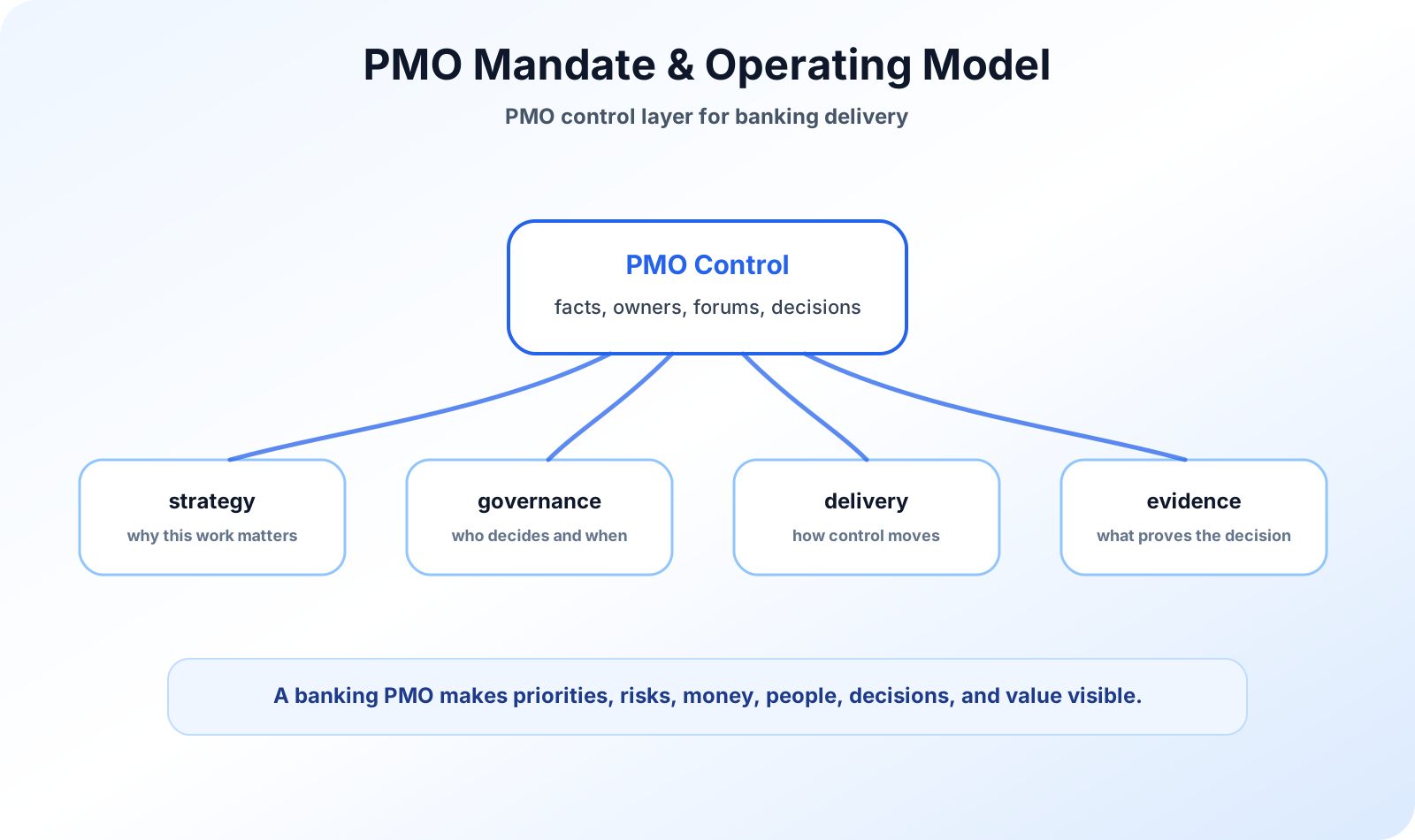
This diagram shows how the PMO mandate connects executive intent, control ownership, and delivery evidence.
What the topic means
A PMO mandate is the bank's formal answer to a simple question: what is the PMO allowed to control, challenge, report, and escalate? Without that answer, the PMO becomes a calendar team, a slide factory, or a polite messenger between stronger departments. In a bank, that is not enough. A banking PMO exists to help senior leaders see whether change work is aligned to strategy, funded responsibly, governed properly, delivered within risk appetite, and evidenced clearly enough for management, risk, compliance, audit, and regulators.
The operating model is the practical design behind the mandate. It explains how the PMO works day to day. It defines the services the PMO provides, the forums it supports, the controls it owns, the information it collects, the decisions it prepares, and the escalation routes it uses when delivery is not healthy. A mandate says what authority exists. An operating model says how that authority works in real life.
A junior colleague should not think of this as organisation chart theory. Think of Northstar Bank approving a core banking upgrade. Technology wants speed, operations wants stability, finance wants cost discipline, risk wants control evidence, and business wants customer outcomes. The PMO mandate decides whether the PMO is allowed to challenge a weak plan, stop an unready gate, request missing evidence, or escalate a funding and risk conflict to the right committee. If that authority is unclear, the project moves forward on confidence rather than control.
The fictional examples use Northstar Bank, BlueRiver Bank, and Cedar Payments Bank. The fictional people are Asha, Ravi, Meera, Daniel, Jonas, and Farah. They are used only to make the lesson practical. They are not real banks and not real people.
Banking control principle
In a bank, PMO Mandate & Operating Model is not an administrative topic. It is part of how the institution controls change before change affects customers, money, data, systems, regulatory commitments, or operational resilience. The PMO should keep the language simple, but the control thinking must be serious.
Basel corporate governance guidance supports the idea that banks need clear responsibilities, effective oversight, reliable information, and sound risk management. For a PMO, this becomes practical behaviour: define ownership, prepare evidence, show risk clearly, escalate early, and keep a decision trail. Basel operational resilience principles add another important lesson. Change governance should help the bank keep critical operations working, especially when technology, process, people, vendors, or data are under stress.
EBA internal governance guidance is also relevant at principle level because it discusses management body responsibilities, governance framework, risk culture, internal control, and business continuity. The PMO does not give legal advice, but it should understand that banking governance is not optional decoration. It is part of how the bank proves controlled management. ISO project guidance is useful because it reinforces good project management practices, but banking PMO work must add the banking control lens.
Purpose of the mandate
The PMO mandate should explain why the PMO exists in the bank. A useful mandate does not say only that the PMO supports delivery. It says the PMO provides control visibility over the change portfolio, supports decision forums, maintains governance evidence, challenges poor quality status, tracks portfolio risks and dependencies, and escalates matters that exceed tolerance.
In banking, this purpose matters because change is never only about delivery speed. A project can be fast and still be unsafe. A project can be cheap and still create regulatory risk. A project can be popular and still break an operational process. The mandate keeps the PMO anchored in the wider bank outcome.
The mandate should also protect the project team. If the PMO authority is clear, project managers know what evidence is expected before a gate. Sponsors know what decisions they own. Risk and compliance know where their input is required. Senior forums know what the PMO view means.
Authority and independence
Authority does not mean the PMO becomes the boss of everyone. It means the PMO has recognised permission to ask for evidence, challenge weak reporting, call out missing ownership, and escalate unresolved issues. Independence means the PMO can present an honest view even when the message is uncomfortable.
A PMO that depends only on personal relationships becomes weak when pressure rises. A clear mandate allows the PMO analyst to say, "This gate is not ready because operations readiness evidence is missing", without making it personal. The analyst is applying the bank's agreed control model.
The PMO should not approve credit policy, sign off architecture, accept operational risk, approve legal wording, or own regulatory interpretation unless the bank has explicitly assigned such authority. The PMO coordinates and evidences those approvals. That boundary is important.
Operating model design
The operating model describes how the mandate becomes daily practice. It should include PMO services, team structure, governance calendar, forum support, reporting rhythm, templates, data sources, escalation path, role definitions, service level expectations, and document storage rules.
A small bank may have a lean central PMO. A large banking group may have enterprise PMO, divisional PMOs, programme PMOs, and project support teams. The model can vary. The control logic should not vary: decision information must be reliable, ownership must be clear, and material risks must be visible.
The operating model should also define what is centralised and what remains local. Centralising everything can slow delivery. Leaving everything local can create inconsistent control. The right answer depends on bank size, complexity, regulatory exposure, delivery method, and risk appetite.
Service catalogue
A service catalogue is a practical list of what the PMO does. It turns the mandate into visible services. Typical services include intake coordination, business case tracking, portfolio reporting, governance calendar management, stage gate control, RAID quality review, dependency tracking, financial tracking coordination, resource demand tracking, benefits tracking, decision logging, action tracking, and closure review.
The catalogue should be honest. Do not list services the PMO cannot actually perform. If the PMO does not have access to finance actuals, do not pretend it owns financial control. If the PMO cannot see resource capacity, do not pretend it owns capacity management. Name the dependency and improve it.
A good service catalogue tells project teams what help they can expect and tells executives what control view they can rely on. It also prevents the PMO from becoming an unlimited helper team for every urgent request.
Three lines and control functions
Many banks use a three lines model or a similar internal control model. The PMO must understand where it sits in that model. Usually the PMO is close to first-line delivery control, although its reporting may go to transformation leadership, operations, technology, or enterprise governance depending on the bank.
The PMO should work with risk and compliance without pretending to replace them. Risk teams define risk frameworks, risk appetite, and challenge expectations. Compliance and legal teams interpret regulatory obligations. Internal audit provides independent assurance. The PMO makes sure their required inputs are included in delivery governance.
This distinction is not academic. If a PMO says a project is compliant without compliance confirmation, it creates false comfort. If a PMO records that compliance review is pending and escalates the launch risk, it is doing the right control work.
Fictional teaching example
At Cedar Payments Bank, Daniel leads a settlement platform upgrade. He reports green because build progress is strong. Asha in the PMO reviews the gate pack and sees missing operational readiness, incomplete run cost approval, and no signed resilience test evidence. Daniel feels the PMO is slowing him down.
The senior PMO lead explains it simply: "We are not questioning your effort. We are checking whether the bank is ready to own the outcome." That sentence changes the conversation. The issue is not Daniel's competence. The issue is whether the bank has enough evidence to make a launch decision.
The steering committee defers the launch gate for one week. Operations confirms staffing, finance approves run cost, technology provides resilience evidence, and compliance confirms customer notification wording. The project moves forward with stronger control and less future argument.
How this topic touches the bank
PMO Mandate & Operating Model does not sit in one department. A PMO mandate touches every department because it defines how change evidence reaches decision makers.
For Business sponsor, the practical concern is that it owns the business outcome and explains why the work matters now.
For Finance, the practical concern is that it confirms funding, forecast discipline, run cost impact, and benefit assumptions.
For Risk, the practical concern is that it tests whether the risk position is inside approved appetite and whether risk acceptance is valid.
For Compliance and legal, the practical concern is that it check whether regulatory, customer, conduct, data, or contractual obligations are affected.
For Technology, the practical concern is that it confirms solution feasibility, architecture route, cyber considerations, release impact, and service stability.
For Operations, the practical concern is that it confirms process readiness, training needs, support model, manual workarounds, and service impact.
For Data, the practical concern is that it confirms data ownership, lineage, quality, reporting impact, and retention requirements.
For Procurement and third party, the practical concern is that it confirms vendor route, contract impact, service dependency, and outsourcing assessment where needed.
For Internal audit, the practical concern is that it does not run the project, but may later test whether the governance evidence is complete.
For PMO, the practical concern is that it connects all views into one decision-ready control story.
When these views are disconnected, projects look better than they are. When the PMO connects them, leaders see the full picture before they approve funding, launch, delay, or risk acceptance.
Stage gate discipline
A stage gate is not a ceremony. It is a point where the bank decides whether work is ready to move forward. In PMO Mandate & Operating Model, stage gates protect the bank from moving on confidence alone. The purpose of the mandate gate should ask what has changed, what evidence is complete, what risk remains, what decision is required, and what happens if the decision is delayed.
A junior colleague may think the gate pack is mainly a document. It is better to think of it as a control conversation. The document only matters because it carries the evidence for that conversation. If the document says "green" but the dependencies are unconfirmed, the gate is weak. If the document says "ready" but operations has not agreed the support model, the gate is weak. If the document says "approved" but the decision owner is unclear, the gate is weak.
The PMO should make gate outcomes precise. Use clear outcomes such as approved, approved with conditions, deferred for evidence, rejected, or escalated. Avoid vague outcomes such as "noted", "broadly agreed", or "team to progress". In a banking environment, vague governance creates future arguments.
Evidence pack
A PMO working on PMO Mandate & Operating Model should be able to open the evidence pack and explain the position without hunting through old emails. Evidence is not paperwork for its own sake. Evidence is how a bank proves that decisions were made with care.
| Evidence item | What it proves |
|---|---|
| Approved PMO mandate | Shows the PMO's purpose, authority, and scope |
| Operating model document | Shows how PMO services, forums, reporting, and escalation work |
| Service catalogue | Shows what PMO provides and what it does not provide |
| RACI or role map | Shows ownership across sponsor, PMO, project manager, risk, compliance, finance, technology, and operations |
| Forum terms of reference | Shows what each governance forum can decide |
| Escalation route | Shows where unresolved issues go |
| Decision log | Shows what was approved, rejected, deferred, or escalated |
The evidence pack should be simple enough for a project manager to maintain and strong enough for a steering committee, audit review, risk review, or management meeting. If the pack is beautiful but cannot answer the control question, it is not useful. If the pack is ugly but complete, the PMO can improve the format later. Substance comes first.
Questions a junior PMO analyst should ask
When you support PMO Mandate & Operating Model, do not begin with the slide deck. Begin with the control questions. Good questions save the bank from late surprises.
- What authority does the PMO actually have?
- Which decisions can the PMO challenge or escalate?
- Which services are mandatory and which are advisory?
- Who owns risk, compliance, finance, technology, operations, and business outcomes?
- Where is the evidence stored?
- What happens when a project bypasses the PMO route?
- Can audit reconstruct the decision later?
These questions are not meant to embarrass the project team. They are meant to protect the team before the forum asks harder questions. A strong PMO culture makes challenge normal, respectful, and evidence-led.
Practical working model
A practical working model for PMO Mandate & Operating Model has four layers. The first layer is ownership. The bank must know who owns the outcome, who owns the decision, who owns the risk, who owns the money, and who owns the evidence. The second layer is evidence. The decision should be based on enough information to show the true position, not only confidence or pressure. The third layer is escalation. If the matter is outside tolerance or outside authority, it must move to the correct forum. The fourth layer is follow-up. A decision without tracked actions is not finished.
This model is intentionally simple because junior colleagues need something they can use in real meetings. When a senior sponsor speaks quickly, when a project manager is under pressure, and when multiple control teams have different views, the PMO analyst can return to the four layers: ownership, evidence, escalation, and follow-up.
The PMO should also keep the language human. Instead of saying "governance artefact maturity is insufficient", say "the decision cannot be approved yet because the risk owner has not confirmed acceptance". Instead of saying "dependency governance is suboptimal", say "the payment testing team is needed by three projects in the same week and leadership must choose the order". Clear language is stronger than heavy language.
Common mistakes
The first mistake is treating PMO Mandate & Operating Model as a document rather than a working control. A document can be approved and still ignored. The PMO should test whether people actually follow it during funding, planning, change control, escalation, and launch decisions.
The second mistake is hiding uncertainty. Banking leaders can manage uncertainty if it is shown clearly. They cannot manage uncertainty if every report is made to look neat. If evidence is missing, say it is missing. If a deadline is at risk, say why. If the bank is accepting risk, name who is accepting it and under what authority.
The third mistake is confusing speed with control failure. Good governance does not always slow work. Often it speeds work because decisions are clearer, evidence is prepared earlier, and escalation routes are known before pressure arrives. Bad governance creates delays because nobody knows who can decide.
Senior banker summary
If you remember only one lesson from this chapter, remember this: PMO Mandate & Operating Model should make banking change easier to control, not harder to understand. The PMO is useful when it helps the bank see the truth early, choose deliberately, and keep evidence for later review.
A junior colleague should not be afraid of governance. Governance is simply how the bank makes important choices responsibly. When the PMO keeps the topic practical, respectful, and evidence-led, project teams stop seeing control as punishment and start seeing it as protection.
Sources and local policy checks
This chapter is aligned at principle level to these public sources. The links are included so a learner can see where the control thinking comes from:
- Basel Committee, Corporate governance principles for banks
- Basel Committee, Principles for operational resilience
- European Banking Authority, Guidelines on internal governance under CRD
- ISO 21502:2020, Guidance on project management
- ISO 21500:2021, Project, programme and portfolio management
These sources are used carefully. They support the principles of clear responsibility, effective oversight, risk management, operational resilience, internal control, reliable information, and disciplined project management. They do not replace the bank's own policy, board-approved governance framework, jurisdictional rules, local regulator expectations, or legal interpretation. Any exact rule, threshold, reporting date, committee authority, risk appetite tolerance, regulatory commitment, or rulebook version must be checked inside the live bank against current bank policy and applicable local rules.