Why Financial Crime Matters in Banking
Financial crime matters because banks sit at a point where real-world conduct becomes financial evidence. A bank rarely sees the original offence from beginning to end. It sees fragments: a customer application, an ownership chain, a cash deposit, a payment instruction, a device change, a merchant settlement, a trade document, a sanctions-screening candidate, a pattern of counterparties, or activity that no longer resembles the purpose for which an account was opened. Most individual fragments are ordinary. The challenge is deciding when a combination of facts is meaningful enough to justify more questions, a control action, an investigation or a report.
That makes financial-crime risk a whole-bank problem rather than the responsibility of one compliance queue. Relationship teams create customer information that later investigators depend on. Product teams decide which parties and payment details are captured. Payment systems preserve or lose data that screening and monitoring need. Fraud teams may identify victims and mule accounts before AML investigators see a wider network. Sanctions controls may need a decision before value leaves the bank, while behavioural monitoring may become meaningful only after several transactions. Case systems must preserve evidence. Legal and compliance teams must interpret jurisdiction-specific obligations. Operations must act quickly without making unsupported accusations or disclosing protected information. Architects, developers and testers must make sure the implemented control receives the data that policy assumes it receives.
The practical objective is not to treat every unusual event as criminal. It is to build a disciplined process that turns imperfect signals into proportionate, explainable decisions. A well-run bank should be able to show what it knew, what it did not know, which risk it was assessing, which legal framework applied, what evidence supported the outcome, who approved it, what happened to the customer or transaction, and what the institution learned from the case.
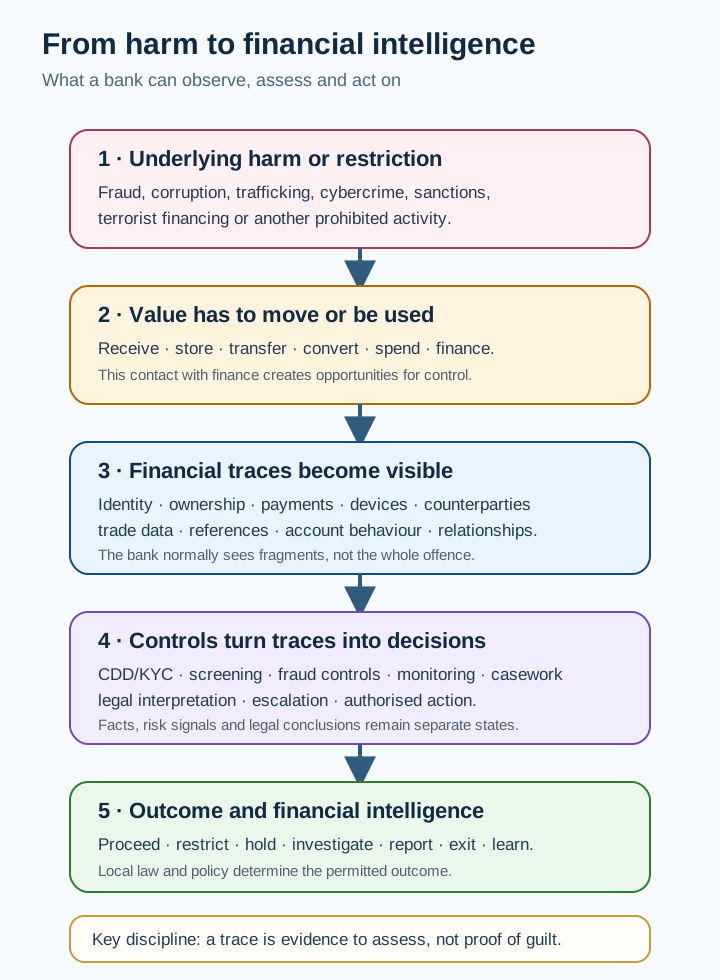
A simple mental model: harm, value, traces and decisions
A useful way to understand financial crime is to separate four layers that are often mixed together in operational discussions.
The first layer is the underlying harm, prohibited purpose or legal restriction. The starting point may be fraud, corruption, bribery, trafficking, tax crime, cybercrime, theft, environmental crime, sanctions evasion, terrorist financing, proliferation financing or another offence or prohibited activity. The bank may know nothing about that original event when money first appears in an account.
The second layer is value. Criminal proceeds have to be received, stored, moved, converted, hidden or spent. Terrorist financing can involve lawful or unlawful funds that are collected or transferred for a prohibited purpose. A sanctioned person or entity may try to obtain access to funds, goods, services or assets through intermediaries. Fraudsters need receiving accounts and cash-out routes. Commercial bribery may be disguised as consulting fees, commissions or invoices. Value movement creates contact with the financial system and therefore creates opportunities for control.
The third layer is the financial trace. Identity data, account ownership, transaction amounts, counterparties, addresses, devices, merchant information, IP data, remittance text, payment references, securities activity, trade documents and relationships between entities can all become evidence. The bank usually has only part of the picture, but its part can still be useful when it is accurate, connected to context and preserved over time.
The fourth layer is the controlled decision. The bank may onboard or decline a relationship, request more information, permit or stop a transaction where law and policy allow, investigate unusual behaviour, refresh customer due diligence, change a risk classification, restrict a product, escalate to a specialist, file a report with a competent authority where required, preserve assets under an applicable sanctions rule, or exit a relationship when risk cannot be managed.
The discipline is in keeping these layers separate. A financial trace is not proof of an offence. A large payment is not criminal because it is large. A higher-risk country connection is not automatically suspicious. A name similarity is not a sanctions match. A fraud score is not a finding of guilt. Good financial-crime control is the process of moving from facts to risk analysis to legal interpretation to operational action without pretending that one layer proves the next.
This distinction matters for system design. A data platform may hold facts such as customer identity, transaction amount and counterparty. A detection model may derive a signal. A case-management system may record an analyst's assessment. A legal or policy rule may determine an authorised action. If those states are collapsed into one universal risk=true flag, the institution loses the meaning needed for correct decisions, auditability and customer treatment.
Financial crime is broader than AML
Banks often use “AML” as shorthand for a wider family of risks and controls. The shorthand is convenient, but it becomes dangerous when teams assume that money laundering, terrorist financing, proliferation financing, sanctions and fraud have the same legal test, the same data requirements or the same operational outcome.
Money laundering generally concerns criminal proceeds and attempts to conceal, convert, move, disguise or integrate those proceeds. The classic placement, layering and integration model is still useful for teaching, but modern laundering does not always move through three neat stages. Fraud proceeds can pass through mule accounts within minutes. Corporate structures can obscure control before the first payment is made. Laundering can use cash, cards, transfers, securities, trade, virtual assets, businesses and professional intermediaries.
Terrorist financing is different because funds may be lawful or unlawful in origin. Risk may arise from the recipient, network, destination or intended use rather than from criminal proceeds. A legitimate salary or charitable donation can still be misused if it is directed to a prohibited purpose. A clean source of funds therefore does not automatically remove terrorist-financing risk.
Proliferation financing concerns financing associated with proliferation-sensitive programmes, procurement networks, goods, technology or related sanctions-evasion activity. It can intersect with targeted financial sanctions, trade finance, correspondent banking, shipping, export-control awareness and complex ownership structures. Banks should not treat an industrial-goods description as proof of proliferation activity, but they do need a way to identify combinations of customer, goods, destination, ownership and transaction facts that merit specialist review.
Sanctions compliance is fundamentally about legal restrictions. Depending on the regime, restrictions may concern named persons and entities, ownership or control, countries or territories, sectors, securities, services, vessels, aircraft, goods, technology or specified activities. Possible outcomes can include freezing, blocking, rejecting, prohibiting, restricting, reporting, obtaining a licence or proceeding under an exemption. Those terms are not universal synonyms. The correct action depends on the applicable legal framework and the bank's role in the activity.
Fraud generally involves deception, theft, manipulation or unauthorised activity. Fraud controls often aim to prevent immediate loss, protect a customer, stop an account takeover or recover funds. Fraud can also create proceeds that later become relevant to AML. Mule accounts are a clear example: a fraud team may first see victim-linked incoming payments, while AML later sees an account or network receiving and dispersing criminal proceeds.
Bribery, corruption, tax crime, human trafficking, environmental crime, market abuse, cybercrime and organised crime can also create or use financial value. The exact legal definitions and predicate offences vary by jurisdiction. A global bank therefore benefits from a connected financial-crime framework while preserving distinct legal and operational logic for each risk.
Why banks are a critical control point
Banks are attractive to legitimate customers because they can store, transfer, convert and document value. The same capabilities can be misused. Accounts receive funds. Payment rails move them across borders. Foreign exchange changes their form. Cards and wallets make them spendable. Trade finance connects money to goods and documents. Correspondent banking extends reach across institutions and jurisdictions. Lending, securities and investment products can give funds a different economic form.
The same infrastructure creates evidence. Customer onboarding establishes identity and relationship information. Corporate due diligence can capture beneficial owners, controllers and authorised persons. Payment systems record parties, amounts, currencies, agents, references and routes. Digital channels create authentication and device traces. Screening systems preserve candidate matches and dispositions. Monitoring systems identify patterns over time. Investigators record reasoning. Case systems create an audit trail.
The Basel Committee's consolidated AML/CFT guidance, published in its current consolidated form in January 2026, places money-laundering and terrorist-financing risk within banks' overall risk-management framework. It links sound management of these risks to the safety and soundness of banks and the banking system. That framing matters because weak controls do not create only regulatory exposure. They can produce operational disruption, customer harm, correspondent-banking concerns, expensive remediation, reputational damage, litigation, frozen assets, management distraction and concentration risk.
A bank is not a police force. Its investigators do not have the powers of law enforcement and should not present internal suspicion as a finding of guilt. The bank's role is narrower but important: understand the customers and activity it can observe, implement applicable law and policy, detect meaningful concerns, investigate proportionately, take authorised action, preserve records and provide information to competent authorities where required.
The bank also has an information advantage and an information limit at the same time. It may see a customer's account in extraordinary detail but know little about a counterparty at another bank. It may see the payment but not the conversation that caused it. It may see an invoice but not the physical goods. Good control design uses the evidence the bank can reasonably obtain without pretending that it sees the whole world.
Global standards provide architecture, not one global rulebook
The Financial Action Task Force sets international standards for combating money laundering, terrorist financing and proliferation financing. The FATF Recommendations provide a common architecture for national frameworks, but they do not create one identical operating procedure for every bank in every country. Countries and regional bodies implement standards through laws, regulations, supervisory expectations and enforcement arrangements.
This distinction is fundamental for global banking. A requirement should identify whether it comes from an international standard, local law, a regulator or supervisor, a sanctions authority, an FIU requirement, group policy, or internal risk appetite. Those sources interact, but they are not interchangeable.
Suspicious reporting illustrates the point. FATF Recommendation 20 establishes an international standard around suspicious transaction reporting. FATF Recommendation 29 describes the role of financial intelligence units as national centres for receiving and analysing relevant reports and disseminating financial intelligence. The trigger, terminology, filing mechanism, timing, form, confidentiality rules and retention requirements are then defined through local implementation. A deadline that applies in one country should not be copied into a global case-management requirement as if it applied everywhere.
Sanctions make the distinction even clearer. OFAC is central to US sanctions compliance where a relevant US nexus exists, but OFAC is not the sanctions authority for the whole world. The United Nations, European Union, United Kingdom and many national authorities operate different legal frameworks. A global bank may consume several sanctions lists and rulesets, but an operational decision cannot be reduced to a single global sanctioned=true field.
The standards themselves evolve. FATF updated Recommendation 1 and related text in February 2025 to strengthen the emphasis on proportionality and financial inclusion. It revised Recommendation 16 on payment transparency in June 2025, with countries expected to be ready to implement the strengthened requirements by the end of 2030, and consulted on implementation guidance in June 2026. In June 2026 FATF also updated Recommendation 6 to align targeted-financial-sanctions requirements related to terrorism and terrorist financing with relevant UN humanitarian exemptions. These changes show why policy and technology need controlled horizon scanning rather than static configuration.
A sound design therefore separates three questions. What is the international policy objective? What is legally binding for the relevant bank entity, customer and transaction? What operational control implements that obligation or risk decision? Keeping those layers explicit prevents a policy label from being mistaken for a legal conclusion.
The risk-based approach: proportionate does not mean optional
The risk-based approach is often misunderstood in opposite directions. One weak interpretation says that commercially valuable customers can simply be accepted because the bank is willing to take more risk. Another overly rigid interpretation says that every higher-risk customer should be refused. Neither reflects a proportionate approach.
A risk-based framework means the institution identifies and understands relevant exposure, applies measures proportionate to that exposure, and retains evidence that the decision was reasoned. Higher risk normally requires deeper understanding, stronger controls, enhanced monitoring or higher approval. Lower risk may permit simplified measures where the applicable framework allows. Some activity remains prohibited regardless of risk appetite. A bank cannot neutralise a binding sanctions prohibition by assigning a low customer-risk score.
The 2025 FATF amendments to Recommendation 1 sharpened this idea by replacing some “commensurate” language with “proportionate” and by strengthening expectations around simplified measures in lower-risk situations. The change is useful operationally because it reminds institutions that risk-based control should differentiate. Applying the maximum possible friction to every customer is not a sign of maturity; it can create overcompliance, financial exclusion and operational noise that distracts from material risk.
In practice, institutions consider several dimensions. Customer risk concerns who the customer is, what they do, ownership and control, occupation or sector, political exposure and other relevant characteristics. Product risk concerns how value can enter, leave, convert, withdraw or move, and the product's speed, reach, anonymity or third-party access. Channel risk considers branch, remote onboarding, API, agent, correspondent or embedded-finance access. Geographic risk can include residence, incorporation, operating footprint, counterparties, payment corridors, sanctions exposure, conflict, corruption and control weaknesses. Behavioural risk asks what actually happens in the relationship over time.
No single factor is a verdict. A higher-risk country connection can be legitimate. A low-risk domestic account can become a mule. An established company can change business model. The strength of the risk-based approach lies in combining context, applying proportionate controls and keeping the reasoning visible.
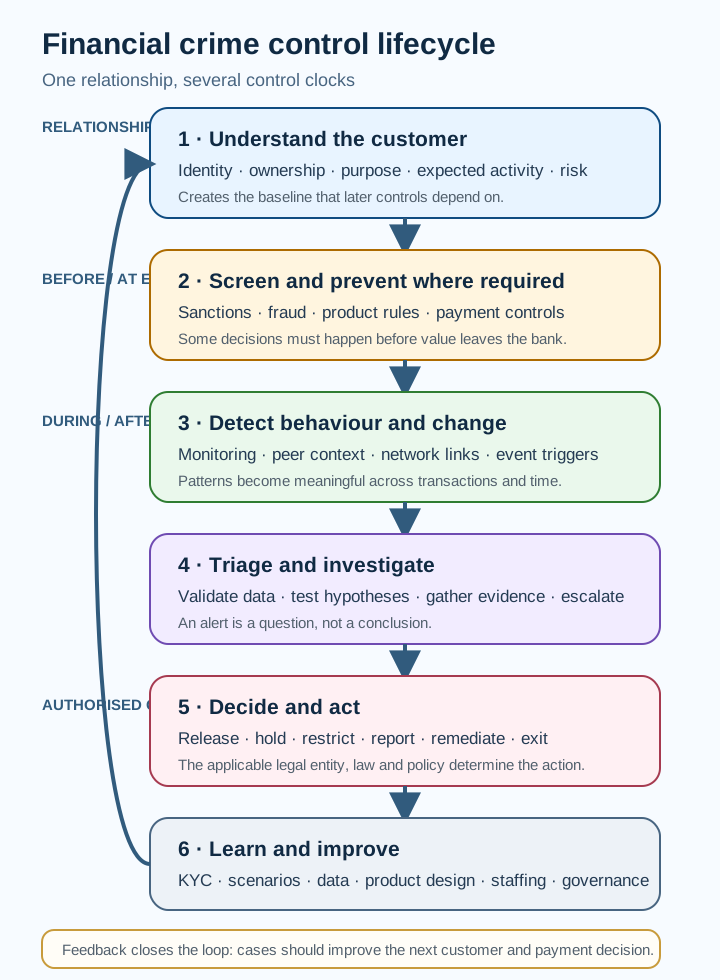
Customer understanding is the first control surface
Financial-crime risk does not begin when transaction monitoring creates an alert. It begins when the bank decides whether and how to establish a relationship.
For an individual, due diligence may include identity, date of birth, address, residency, occupation, purpose of the relationship and expected account use, depending on product, risk and jurisdiction. For a company, the bank may need to understand legal existence, business activity, ownership and control, beneficial owners, directors, authorised persons, expected products, expected countries and transaction patterns.
The design mistake is to equate KYC with document collection. More documents do not automatically create more understanding. A certificate of incorporation can prove legal existence without explaining commercial purpose. An ownership diagram stored only as a PDF may be readable by a reviewer but unusable by screening. A free-text field saying “international trading” may technically be populated while giving monitoring almost no useful baseline.
Good due diligence creates reusable facts with provenance. The bank should know where information came from, when it was verified, which evidence supports it, which legal entity or relationship it belongs to, when it must be refreshed and which downstream controls depend on it.
Expected activity is best treated as a hypothesis, not a promise. A customer profile gives the bank an informed expectation about products, counterparties, countries, amounts and transaction behaviour. Monitoring tests that expectation over time. If the customer's legitimate business changes, the profile must also change. Otherwise stale KYC can create false positives and hide the meaning of real anomalies.
Event-driven review therefore matters. Ownership can change. Directors can change. Products can change. A company can enter a new market. An adverse event can alter risk. A sanctions-list update can affect a connected party. A mature framework asks both whether behaviour still fits the profile and whether the profile still describes the customer.
The customer lifecycle continues after onboarding. Product additions, address changes, changes in employment, new jurisdictions, unusual complaints, fraud events, sanctions-list changes and investigative findings can all become triggers for review. Periodic review is useful, but event-driven review often captures the moment when risk actually changes.
Payment risk is about parties, purpose, route, timing and data
Payments expose the practical difference between controls because value is moving and the time available to act can vary dramatically.
Fraud decisioning may need to work in milliseconds or seconds. Sanctions screening may need to reach a decision before a payment is released. Operations may have limited time before a scheme or market cut-off. Broader transaction monitoring may examine behaviour after posting across days, weeks or months. These are different control clocks using related data.
A cross-border payment can contain debtor and creditor information, accounts, agents, intermediaries, addresses, remittance text, purpose information and transaction identifiers. ISO 20022 can provide richer structured data than older formats, but structured standards do not guarantee usable financial-crime data. Data can still be omitted, defaulted, truncated, poorly mapped or transformed into an unstructured string before it reaches screening or investigation.
A control therefore needs traceability. An investigator should be able to move from a case to the triggering transaction, from the transaction to the original instruction, from the instruction to the relevant account and customer, and from the customer to related parties and earlier cases. If identifiers break between systems, analysts fall back on manual name searches and human memory.
Payment controls can occur at different places in a chain: customer channel, payment hub, correspondent, clearing participant, beneficiary institution or post-event monitoring environment. A domestic instant payment does not have the same data or decision window as documentary trade finance. Requirements should reflect the actual rail and role rather than assume one generic payment flow.
Return and reject flows also matter. A payment that leaves one institution and later returns is not simply the same event in reverse. The return can contain new reason data, new agents, new timing and new customer impact. Controls need to distinguish an original payment, a cancellation, a rejection, a return and a recall rather than treating every debit or credit as independent activity.
Product and channel design can create or remove risk visibility
Financial-crime control is shaped before a transaction ever reaches a monitoring engine. Product and channel design determine which actors can use the service, what data is captured, how value moves, how quickly it settles and which interventions are technically possible.
A retail current account may offer branch cash, cards, instant payments and international transfers. A corporate account may support bulk files, APIs, host-to-host instructions and treasury sweeps. A merchant-acquiring product sees card settlements and merchant descriptors. A digital wallet may have different funding and withdrawal mechanisms. A correspondent account can expose the bank to underlying respondent-bank customers whom it does not directly onboard.
The same control cannot simply be copied across those products. Cash monitoring depends on branch and deposit data. Card-fraud detection uses device, merchant and authorisation signals. Cross-border sanctions screening depends on party and routing information. Trade-finance controls may need invoices, bills of lading, goods descriptions, ports and shipping parties. Correspondent monitoring needs to understand respondent relationships and nested activity.
Channels create their own identity and evidence questions. In a branch, staff may physically inspect identity documents and observe customer behaviour. In remote onboarding, the bank may rely on digital identity, device intelligence, biometrics and electronic evidence. API-based corporate channels can produce strong authentication and structured data, but they can also move very high volumes with little human intervention. Embedded-finance models can put several intermediaries between the bank and the end user.
A good product review therefore asks not only “what AML control applies?” but “what evidence will this product create, what evidence can it lose, where can value move, where can a decision be made, and how will the bank reconstruct the event later?”
Geography matters, but geography alone is not guilt
Country and territorial exposure matters because legal restrictions, corruption risk, conflict, organised crime, regulatory effectiveness and financial-system transparency differ. But geographic risk is one input, not a criminal conclusion.
A customer's nationality is not the same as transaction geography. A company may be incorporated in one country, owned from another, operate in a third, use suppliers in a fourth and settle in a fifth currency through a correspondent in a sixth location. Each fact can have a different risk and legal meaning.
National risk assessments, FATF public statements, sanctions regimes, supervisory publications and reliable external intelligence can help institutions understand geographic exposure. The use of those sources should be controlled and time-stamped because classifications change. A country that was subject to one type of measure last year may have a different status now.
Blanket country blocking can create serious errors. It can refuse legitimate customers without a lawful basis, overlook targeted restrictions that apply outside a named country, and teach operational staff to use geography as a substitute for legal analysis. The stronger approach is to identify the applicable risk or restriction, determine the relevant nexus, and then design a proportionate control.
Risk often lives in relationships
Financial crime can become clearer through relationships than through isolated records. One individual may own one company, control another through an intermediary, share an address with a third party, use a device linked to a fraud case and send funds to a beneficiary used by apparently unrelated customers. Each relationship can have an innocent explanation. The network may still be important.
This creates two opposite data risks. Under-linking occurs when duplicate customer records, trapped ownership information or broken identifiers cause related activity to be analysed separately. Over-linking occurs when a system assumes two people are the same because they share a common name, address, corporate-services provider or device.
Entity resolution therefore needs explainability. Investigators should be able to see why two records were connected, which attributes matched, how reliable those attributes are and whether the relationship is verified or inferred. Historical relationships also matter. An investigator reviewing an old transaction may need to know who owned or controlled an entity at the time, not only who owns it today.
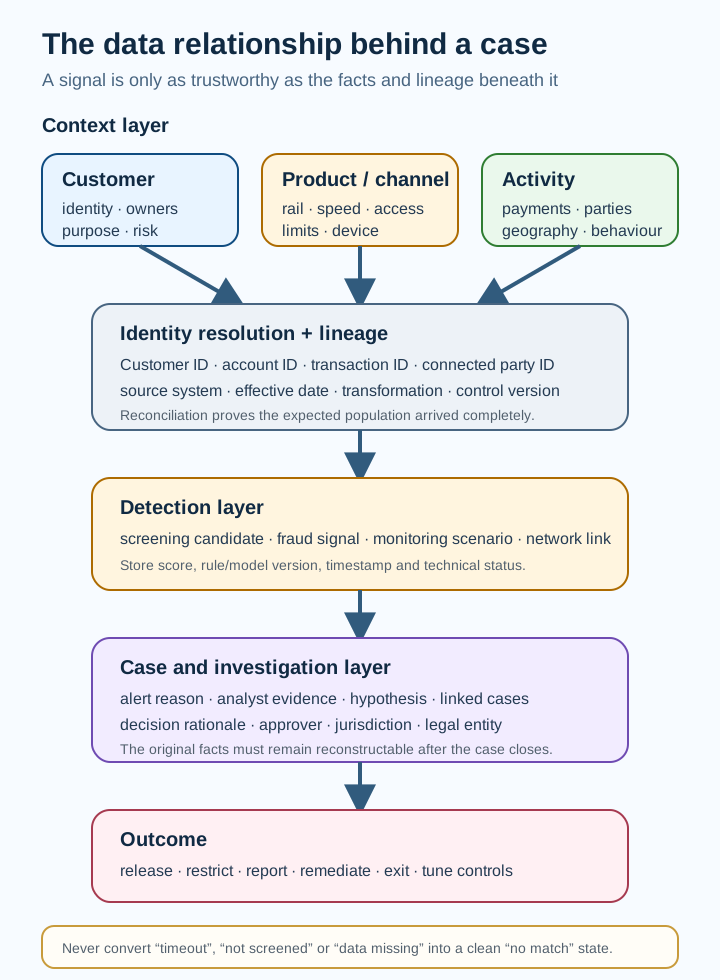
For architects and BAs, relationships should therefore be modelled as business facts. Ownership percentage, control type, role, source, effective date, end date and verification status can matter. A graph is only as useful as the meaning and quality of its edges.
Screening and monitoring answer different questions
Screening and monitoring are often grouped together under financial crime, but they answer different questions and can lead to different actions.
Screening usually asks whether a customer, connected party or transaction element corresponds to a person, entity, vessel or other subject represented in a relevant list or risk dataset. The hard problems are identity, spelling variation, aliases, transliteration, incomplete identifiers, ownership or control, list versions and legal applicability.
Transaction or activity monitoring asks whether behaviour is unusual or suspicious in context. The hard problems are pattern, sequence, amount, velocity, geography, cash usage, counterparties, circularity and deviation from expected activity.
Customer risk rating asks a third question: what level of financial-crime exposure does the relationship present, and what due-diligence or oversight intensity is appropriate?
Fraud decisioning may ask whether a particular instruction is likely to be unauthorised, manipulated or linked to a scam and whether intervention can prevent immediate loss.
These controls can share data without becoming interchangeable. A payment can pass sanctions screening and later form part of a suspicious behavioural pattern. A sanctions candidate can be a false positive while the customer's activity remains unusual. A fraud alert can identify a mule account that becomes relevant to AML after funds arrive.
The system should preserve that meaning. No match, candidate cleared, monitoring alert closed, fraud approved and customer low risk should never collapse into a universal safe flag.
Detection quality depends on the population before it depends on the rule
Financial-crime teams often focus on scenario thresholds, matching algorithms and model performance. Those things matter, but a perfect rule applied to an incomplete population is still an ineffective control.
A transaction-monitoring control should know which accounts, products and transactions are eligible, what source events prove completeness, how late data is handled and what reconciliation detects missing populations. A sanctions-screening control should know which parties and fields are in scope, when list updates are loaded, which customers or transactions are re-screened and how technical failures are surfaced.
This is why data lineage and coverage testing are control requirements rather than technical documentation. If a new payment channel is launched and its events are not included in monitoring, the risk is not solved by tuning existing scenarios. If beneficial owners are captured in KYC but never sent to screening where policy requires them, the source data exists but the control does not.
Coverage must also be temporal. A daily batch that receives all transactions but arrives two days late may be complete in volume and weak in timeliness. A real-time screen that processes every instruction but uses a stale list can be operationally fast and legally inadequate. Quality has dimensions: completeness, accuracy, timeliness, lineage, uniqueness and fitness for the decision being made.
From signal to alert to case
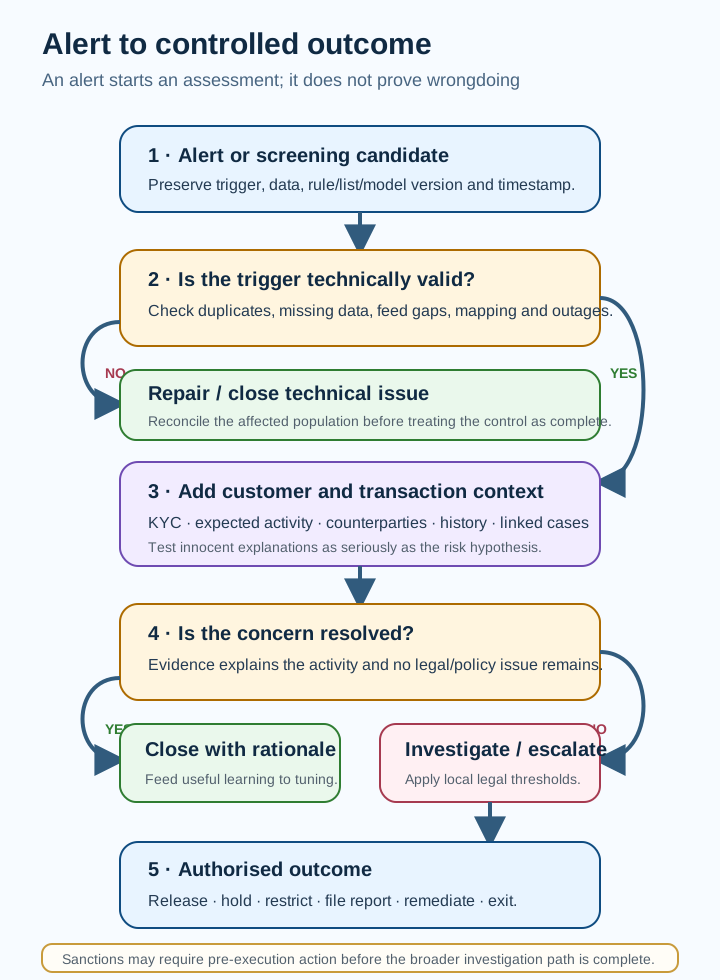
An alert is a request for attention, not an accusation. A rule may identify a threshold or pattern. A model may identify unusual behaviour. A screening engine may find a candidate name match. An employee may make an internal referral. A fraud platform may detect a device-beneficiary pattern associated with scam activity. External intelligence may trigger a review.
Triage should first determine what the signal means and whether reliable existing information can resolve it. Some alerts are genuinely false positives. Others require a fuller investigation. Strong triage is not simply fast triage. If analysts are rewarded mainly for closure volume, an institution can create efficient-looking queues while weakening decisions.
A case is the controlled container for deeper review. It should preserve the reason for investigation, triggering events, relevant customer and transaction data, searches performed, evidence obtained, analyst reasoning, approvals, links to related cases and the final outcome. Where relevant, it should retain the rule, model, threshold or list version that applied when the alert was created.
An investigation should form and test a hypothesis rather than collect red flags mechanically. The analyst may ask whether rapid pass-through activity is consistent with the customer's business, whether several counterparties are actually related, whether a change in ownership explains the activity, whether a payment purpose is supported by commercial evidence, or whether a screening candidate can be resolved through reliable identifiers. The analyst should record both evidence that supports concern and evidence that weakens it.
Possible outcomes are broader than “report” or “do nothing.” The bank may close the concern as reasonably explained, refresh KYC, enhance monitoring, refer to fraud or sanctions specialists, place an authorised restriction, review related relationships, decline a product, exit the relationship, make a suspicious transaction or activity report where the legal threshold is met, or take another action required or permitted by the applicable framework.
Suspicious reporting creates financial intelligence
FATF Recommendation 20 establishes the international standard around suspicious transaction reporting, while Recommendation 29 describes the role of financial intelligence units. The Egmont Group describes FIUs as national centres that receive and analyse suspicious transaction reports and other relevant information and disseminate the results of their analysis. Countries implement those principles differently.
A strong report explains the concern rather than merely listing transactions. It should help the competent authority understand who is involved, the banking relationship, what happened, why the activity is unusual or suspicious, relevant counterparties, chronology and the action taken by the institution. The internal investigation should preserve supporting evidence even when the regulatory filing has format or length constraints.
The legal trigger, terminology, deadline, reporting channel, retention rule and confidentiality obligations are jurisdiction-specific. For example, US Bank Secrecy Act requirements and FinCEN guidance apply in a US context and should not be copied into a global design as universal rules. A global case platform should support configurable jurisdiction, legal entity, authority, report type, due-date logic, submission reference and access controls.
Confidentiality also affects customer communication. Rules in many jurisdictions restrict disclosure of suspicious reports or protected investigative information. That does not mean banks can never communicate with customers about payment delays, fraud concerns or account closures. In the US, FinCEN and federal banking agencies clarified on 2 September 2026 that SAR confidentiality requirements do not themselves prevent banks from communicating with customers about potentially fraudulent transactions, suspicious activity or account closures, while the statement did not change existing Bank Secrecy Act requirements or create new supervisory expectations. The wider lesson is not to import that US statement into other jurisdictions, but to use legally reviewed, fact-based communication rather than revealing protected filings or hiding behind vague language where clearer communication is permitted.
FIUs are also part of a wider intelligence network. The Egmont Group facilitates secure information exchange and cooperation among member FIUs; it does not itself conduct the bank's investigation or replace domestic authorities. For bank teams, this reinforces the value of high-quality reports: the narrative and structured information may contribute to analysis far beyond the institution's own view.
Sanctions need separate legal decision logic
Sanctions are related to financial crime but require their own decision discipline. A candidate name match does not establish that a customer is a designated person. Analysts may need to compare aliases, dates of birth, addresses, nationality, registration details and other identifiers. For entities, ownership or control rules may matter, and those rules differ by regime.
Even a confirmed identity match does not answer every legal question. The bank must determine which sanctions authority and programme apply, what jurisdictional nexus exists, whether ownership or control extends the restriction, what activity is involved, and whether an exemption, general licence, specific licence or other authorisation is relevant.
Country, sector, service, securities, trade, shipping and activity-based restrictions may also apply without a simple list hit. Conversely, association with a sanctioned country does not automatically mean every person from that country is prohibited.
OFAC's Framework for Compliance Commitments is useful in a US sanctions context because it emphasises five broad compliance components: management commitment, risk assessment, internal controls, testing and auditing, and training. Those components are not a universal legal test, but they demonstrate a principle that translates well to control design: sanctions compliance is an operating framework, not merely a screening engine.
The system therefore needs to separate identity matching from legal applicability and operational action. One component can say “this appears to be the listed entity”; another decision determines “this rule applies to this bank and transaction”; a final operational instruction says hold, release, reject, freeze, block, report or another authorised state. Combining those stages into one Boolean creates both false positives and legal error.
Fraud-to-AML handoffs show why silos fail
Consider a retail account that has behaved normally for a year. It suddenly receives several credits from unrelated people. Some are linked to scam complaints at other banks. Funds are transferred onward quickly to new beneficiaries and partly withdrawn as cash.
The fraud team may see the first risk: victim-linked incoming payments, unusual device activity, a newly added beneficiary or an account takeover. Its immediate goal may be to prevent further loss, restrict access or support recovery.
AML may see a broader risk: an account receiving and dispersing criminal proceeds, possibly as part of a mule network. If fraud and AML systems exchange only a label such as fraud referral, AML may have to rediscover information that is already known. If AML shares an entire protected case indiscriminately, the institution can create privacy and confidentiality problems.
A useful handoff preserves the facts that the receiving team is allowed and needs to know: relevant transactions, complaint references where permissible, devices, beneficiaries, related accounts, restrictions and prior investigative conclusions. AML still applies its own suspicion and reporting framework. Fraud does not decide an AML reporting outcome, and AML does not need to repeat every fraud step.
The same principle applies across sanctions, trade finance, KYC, correspondent banking and investigations. Financial-crime risks overlap, but decision accountability should remain explicit.
Control architecture: prevent, detect, investigate, decide and learn
A mature financial-crime framework is not one platform. It is a connected architecture of preventive, detective, investigative, decision and assurance controls.
Preventive controls include customer due diligence, product eligibility, ownership understanding, country or business restrictions, onboarding approvals and contractual conditions. Their purpose is to reduce unmanaged exposure before activity begins.
Detection controls include screening, transaction monitoring, behavioural analytics, fraud signals, adverse information, network analysis and internal referrals. Their purpose is to surface meaningful risk rather than prove guilt.
Investigation controls combine customer, account, transaction, counterparty, screening, fraud and external information into a case. Their purpose is to turn signals into evidence-based conclusions.
Decision controls translate analysis into operational states. Depending on the risk and legal framework, the result may be continue, release, request information, restrict, reject, freeze, report, escalate, exit or another authorised outcome.
Feedback and assurance make the framework sustainable. Investigation outcomes should improve customer data, rules, models, product controls and training. Quality assurance should test case reasoning. Model validation should challenge detection approaches. Internal audit should provide independent assurance. Management should see material risks, control failures and remediation rather than only activity volumes.
The architecture succeeds when handoffs preserve meaning. A screening refer must not become a payment approved because an interface mapped an unknown status incorrectly. A monitoring data gap should be detected through reconciliation. A KYC ownership update should reach screening and analytics. A case decision should return to the operational system using a controlled reason code and decision authority.
Data lineage is part of the control
Financial-crime programmes depend heavily on data. Policy can be excellent while control effectiveness is weak because critical information is missing, stale, transformed incorrectly or delivered too late.
Suppose onboarding holds a customer's full legal name but an interface truncates it before sanctions screening. The system can truthfully log “screening completed,” yet the intended identity check was weakened. Suppose transaction monitoring receives a payment amount but not the original currency. Cross-currency behaviour can be misread. Suppose operations repair a beneficiary name but the corrected value never reaches downstream monitoring. Later investigators may see a different party from the one actually processed.
For important attributes, teams should understand the authoritative source, format, validation, transformations, identifiers, propagation timing, missing-data handling, reconciliation and historical retention. A control owner should be able to answer what data the control actually used at a particular time, not just what a source system displays today.
Historical reconstruction matters because the world changes. Customer ownership changes. Lists change. Rules and models change. Risk ratings change. If an analyst cleared a sanctions candidate in January, an auditor in September may need to know which list version, customer data, matching configuration and evidence existed in January.
A case should therefore preserve decision context: triggering alert, underlying data, relevant rule or model version, information available to the analyst, additional evidence obtained, reasoning, approval, operational action and related cases. This is how the institution demonstrates that a decision was authorised, repeatable and based on evidence rather than improvised.
Operational resilience is financial-crime resilience
A financial-crime control can fail while the banking application itself remains online. An overnight monitoring feed may omit one payment channel after a release. The monitoring platform is available, analysts can log in, and the batch job reports success. Only a reconciliation between the source ledger and monitoring intake reveals that eligible transactions are missing.
Service recovery alone is not control recovery. The bank must identify the affected population, replay missing activity where appropriate, consider whether late data changes aggregate behaviour, reassess related alerts if necessary, and document residual uncertainty.
Different controls need different outage strategies. A sanctions-screening failure may require a pre-execution contingency because the legal decision may need to occur before release. A post-transaction monitoring delay may allow settlement but require complete later recovery. A reporting-platform outage may create a regulatory-deadline risk. These should not be represented by one generic AML system unavailable procedure.
For architects, failure behaviour must be a designed state. Can an instruction queue? Can it route to contingency processing? Can a control fail open or fail closed, and who approved that behaviour? Are retries idempotent? How does reconciliation prove that no required event disappeared? Business-continuity exercises should ask not only whether the system is back but whether any customer, payment, list update, alert, case or report fell through the gap.
AI and advanced analytics do not remove accountability
Machine learning, graph analytics, natural-language processing and generative AI can improve financial-crime work. They can identify networks, prioritise alerts, summarise cases, surface patterns that fixed rules miss and reduce repetitive effort.
They can also introduce new failure modes. Historical labels may reflect inconsistent analyst decisions. Models can drift as customer behaviour changes. Graphs can over-link common addresses. A language model can produce a persuasive summary containing a fact that was never in the evidence. Sensitive case data can leak into inappropriate tools or logs. A complex risk score can become difficult for an analyst to challenge.
The Wolfsberg Group's 2025 statement on effective monitoring for suspicious activity is a useful industry benchmark rather than binding law. It emphasises responsible transition and validation, balancing model risk with financial-crime risk, and explainability. Those principles align with a practical bank need: innovation should improve risk outcomes without making the control impossible to understand or challenge.
An AI use case should therefore define source data, permitted purpose, human decision points, confidence or uncertainty, access controls, retention, monitoring, fallback behaviour and change governance. If a tool drafts an investigation summary, the investigator should be able to trace each material statement back to evidence. If a model ranks alerts, the institution should know which risk it is designed to prioritise and what population is in or out of scope.
“AI decided” is not a sufficient control rationale. A responsible design uses automation to improve the quality and speed of human-controlled outcomes, while keeping material legal and customer decisions explainable and governed.
Governance: ownership, challenge and independent assurance
Financial-crime governance exists because ownership and independence both matter. The first line typically owns customers, products, transactions and many operating controls. The second-line financial-crime or compliance function sets or interprets policy, provides specialist expertise, challenges implementation and oversees frameworks. Internal audit provides independent assurance over design and operating effectiveness.
The exact organisational split varies. Some institutions place large investigation teams in the first line with second-line oversight; others centralise more activity in compliance. The important point is that decision rights are clear. Who can approve a high-risk relationship? Who can release a held payment? Who interprets a sanctions licence? Who decides whether an investigation meets the local reporting threshold? Who owns a monitoring scenario? Who can change a matching threshold? Who accepts a temporary control gap?
Senior management and board-level governance need meaningful information. Material backlogs, control failures, unresolved sanctions exposures, data gaps, regulatory findings, overdue remediation and risk-appetite breaches should not remain hidden inside operational queues.
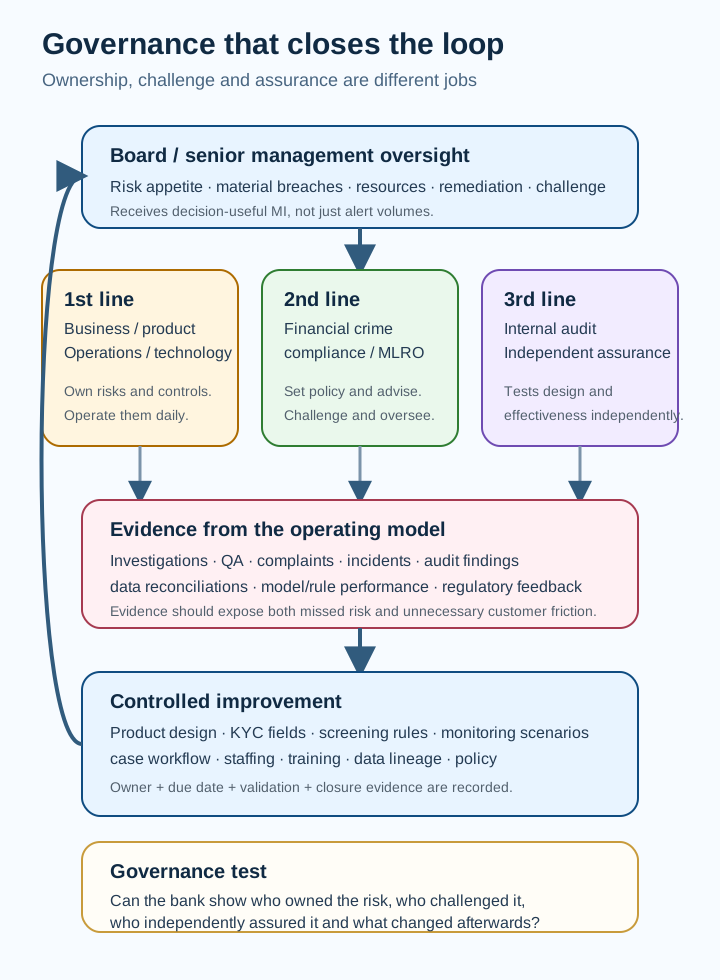
A useful governance forum sees risk, quality, timeliness, customer impact, technology health and uncertainty rather than only volumes.
Effectiveness matters more than activity volume
Financial-crime programmes generate impressive numbers: customers screened, alerts created, cases closed, reports filed, names reviewed and quality checks completed. Those numbers describe workload. They do not automatically prove that the control is effective.
A transaction-monitoring scenario can produce enormous alert volumes while identifying little useful risk. A KYC process can collect many documents while still failing to understand ownership. A screening engine can be tuned so aggressively that ordinary names repeatedly stop payments, burdening analysts and customers while making meaningful cases harder to prioritise.
Effectiveness starts with the risk objective. What threat or vulnerability is the control designed to address? What population is in scope? Which evidence shows the control can detect or prevent the intended risk? What could it miss? How much unnecessary customer friction does it create? What do investigation outcomes tell the bank to change?
Useful measures may include coverage of priority risks, quality of investigative conclusions, usefulness of reporting, time to resolve genuine risk, false-positive drivers, data completeness, aged alerts and cases, unresolved technical failures, customer impact and remediation closure. The right measures depend on the control. A sanctions screen and a post-event behavioural model should not be judged by one common hit-rate target.
The goal is not the lowest number of alerts and not the highest number. The goal is a defensible relationship between risk, detection, investigation capacity, customer impact and useful outcomes.
Customer protection and financial inclusion are part of good design
Financial-crime controls protect legitimate customers as well as the institution. Weak mule controls allow victims' money to disappear through receiving accounts. Poor identity controls enable account takeover. Weak monitoring can allow exploitation of vulnerable people. Poor sanctions data can expose the bank to legal breaches.
Badly designed controls can also harm legitimate customers. Crude name matching can delay family payments. Repetitive KYC requests can ask for information the bank already holds. Blanket de-risking can exclude whole customer categories without individual assessment. Temporary restrictions can become effectively permanent because no team owns the review.
FATF's 2025 standards changes strengthened the emphasis on proportionality and financial inclusion in the risk-based approach. In the EU context, EBA guidance has addressed unwarranted de-risking and access to financial services. The legal context varies, but the practical principle is useful across markets: higher risk should trigger better understanding and proportionate mitigation, not an automatic assumption that every customer in a category must be refused.
Customer impact should therefore be measurable. How long do legitimate payments remain in screening review? How often is the same information requested? Are false-positive causes fed back into screening and KYC quality? Can customers obtain support while a restriction is being reviewed? Are vulnerable customers handled appropriately? Good compliance and good customer experience are not opposites; both depend on accurate controls.
The business analyst view: translate policy into events, data, states and evidence
A business analyst should challenge requirements that contain a regulatory noun but no operational behaviour. “The system shall perform AML checks” is not testable. Neither is “the transaction must be sanctions compliant” unless the project defines the relevant event, scope, data, outcome and evidence.
A stronger onboarding requirement identifies the trigger and parties. For example: when a legal-entity application reaches pre-activation review, the customer service sends the identity attributes for the customer and connected parties required by the applicable policy to the configured screening service. A refer outcome creates a controlled review state. Activation follows the approved decision rule. The case retains source data, list version and decision evidence.
A stronger payment requirement states when screening occurs relative to external release, which party and transaction fields are evaluated, how refer or technical-error outcomes change the payment state, what operations can see, who can release or reject the instruction, and how the final decision returns to the payment hub.
A stronger monitoring requirement defines the eligible transaction population, required customer and transaction attributes, delivery timing, reconciliation, scenario dependencies, missing-data handling and alert creation. If one transaction source fails, the requirement makes the control gap visible instead of allowing silent omission.
A stronger reporting requirement identifies legal entity, jurisdiction, report type, due-date source, mandatory fields, secure transmission, acknowledgement, amendment handling and confidentiality controls.
The BA should be able to trace every requirement backward to a risk or obligation and forward to a testable business outcome. Traceability also makes regulatory change manageable: when a rule changes, the bank can identify which requirements, interfaces, controls, procedures and tests depend on it.
The architect and developer view: preserve semantics across systems
Financial-crime architecture is usually distributed. Identity may sit in one platform, corporate ownership in another, accounts in core banking, payments in several hubs or rail engines, sanctions screening in a specialist service, fraud decisioning in a real-time engine, transaction monitoring in a data platform, investigations in a case-management product and regulatory reporting in local systems.
The architecture challenge is therefore orchestration plus evidence. Which controls are synchronous? Which are asynchronous? What happens if a control is unavailable? How are retries made idempotent? How are stable customer, account, transaction, screening and case identifiers preserved? Where are list and model versions recorded? How are data-residency and access restrictions applied? How does a decision propagate back to customer channels and payment processing?
Developers need domain semantics, not only schemas. A Boolean such as screeningPassed is often too weak. Did the engine find no candidate? Did it create a candidate that an analyst cleared? Was the subject not screened because a dependency failed? Was the transaction permitted under a relevant authorisation? Is review still open?
Those states are materially different. Interfaces should carry explicit outcome and technical-status fields. A technical timeout should never masquerade as no match. Timestamps should have defined meaning and time zones. Character handling and transliteration need testing. Free text should not be normalised in a way that destroys information required for matching.
Logging also requires restraint. Identity documents, customer-risk notes, sanctions-review evidence and suspicious-report information can be highly sensitive. Copying them into a broadly accessible observability platform can create a new confidentiality problem. Teams should know which fields may be logged, which must be masked or excluded, and how a production incident can be investigated safely.
The tester view: prove the control, not just the interface
Testing financial-crime controls requires realistic positive, negative and failure scenarios.
For KYC, test incomplete ownership, ownership changes, duplicate identities, expired evidence, non-Latin names, event-driven review and customer-risk changes. Confirm that downstream systems receive the update rather than stopping at the source screen.
For screening, test exact and close matches, aliases, reordered names, transliteration, weak identifiers, list updates, connected parties, false positives, true matches, service outages and authorised manual decisions. Confirm that the case records the right list and programme context.
For monitoring, test behaviour across time rather than one transaction. Include reversals, returns, duplicate events, cross-currency activity, late-arriving data and related accounts. Reconcile the eligible source population against the monitoring intake.
For case management, test evidence immutability, reassignment, segregation of duties, escalation, deadlines, linked cases, attachments, restricted access and quality review. For reporting, test legal entity, jurisdiction, mandatory data, transaction population, acknowledgements, corrections and confidentiality.
Negative testing is as important as detection. A scenario that catches a seeded suspicious pattern but wrongly blocks normal behaviour at an unacceptable rate is not automatically effective. Testing should prove both risk coverage and controlled customer impact.
Regression testing matters whenever rules, models, list providers, payment formats or mappings change. A harmless-looking field-length change can alter screening quality. A new payment message version can move a party from one field to another. A scenario threshold change can interact with currency conversion. Test data should therefore represent real production diversity without exposing real customer information unnecessarily.
A realistic end-to-end case study
Consider a fictional company, Meridian Components Ltd, applying for a business account at North River Bank. Meridian says it imports electronic and industrial components for domestic manufacturers. It was incorporated two years ago. Two directors are listed, and a holding company owns most of the shares. The bank traces that holding company to a natural-person beneficial owner and records the ownership relationship as structured data while retaining supporting evidence.
The expected activity is modest: domestic customer receipts and several monthly supplier payments to established manufacturers in two overseas markets. The customer-risk assessment identifies no factor that prevents onboarding, and the relationship is opened with controls appropriate to its risk profile.
For several months the account behaves broadly as expected. Customer receipts arrive from known commercial buyers. Supplier payments resemble the profile recorded at onboarding. There are no material fraud, sanctions or monitoring concerns.
Then the pattern changes. Meridian begins receiving larger payments from companies described as consulting partners. It sends much of the value within hours to newly established overseas counterparties. Payment purposes are vague. Some beneficiary addresses change between transactions. One counterparty shares a director with a company that the bank previously exited after an unrelated financial-crime investigation.
None of those facts proves money laundering. A company can expand, change suppliers or use consultants. Shared directors can be legitimate. Rapid movement can reflect working-capital arrangements. The purpose of monitoring is not to label the behaviour criminal but to identify that the current activity is materially different from what the bank understands.
A monitoring scenario identifies rapid pass-through behaviour and activity outside the expected profile. Network analytics identify the shared director. Triage confirms that the data is complete and that the alert is not caused by a duplicated transaction feed. The case is escalated because the combination of profile deviation and relational information requires investigation.
The investigator starts with customer context. KYC shows no ownership change. The relationship manager says Meridian has mentioned growth but has not disclosed a new business model. The investigator reviews transaction chronology, counterparties, prior alerts, payment references and available corporate information. The shared director is verified through reliable records rather than assumed from a name match.
The bank requests updated commercial information through an approved process. Meridian provides contracts showing a new distribution arrangement. Several documents are plausible, but some descriptions are generic and dates do not align with the earliest payments. One overseas counterparty appears to have been incorporated only shortly before receiving substantial funds.
The investigator forms a narrow hypothesis: the account may be operating as a pass-through vehicle for activity that is not sufficiently explained by the customer's stated business. The hypothesis does not say “Meridian is laundering money.” It states what the observed evidence means and what remains uncertain.
The investigator tests alternative explanations. Could the payments be legitimate distributor settlements? Do invoice values correspond to goods or services? Are receiving entities in a relevant industry? Is rapid onward movement consistent with contracted payment terms? Are there related accounts at the bank? Has fraud identified any victim-linked payments? Does sanctions screening identify a relevant party, or only unrelated name similarities?
The fraud team confirms no known victim-linked incoming transactions. Sanctions screening shows no confirmed restricted party. That information weakens some theories but does not resolve the unexplained pass-through activity. The investigation finds that several incoming companies share a corporate-services address, but the analyst does not treat the address itself as suspicious because many legitimate firms use the same provider.
After further review, the bank concludes that the customer's explanation remains incomplete and that the local legal threshold for suspicious reporting is met for the legal entity handling the account. The authorised team files the required report with the relevant FIU under local law. The filing is kept confidential according to the applicable rules. Separately, the bank considers whether the relationship can continue within risk appetite. That decision is not automatically determined by the act of reporting.
The most valuable part of the case is the feedback. Investigators discover that the customer's expected-activity profile was stored mainly in free text. Analytics could identify payment velocity but could not compare counterparties to a structured expected population. They also discover that director relationships from corporate KYC were available to one analytics environment but not to another.
The case therefore creates control improvements. The KYC model is changed so selected expected-activity attributes can be consumed downstream. The data team repairs director-relationship propagation. Scenario owners review whether the pass-through pattern is covered effectively without creating excessive noise. Quality assurance checks the case narrative and evidence. Management information records both the customer outcome and the identified control weaknesses.
This case shows why a good financial-crime programme is more than alert production. Customer understanding created the baseline. Monitoring identified deviation. Network information added context. Fraud and sanctions data helped test alternative hypotheses. Investigation turned fragments into a defensible conclusion. Local law determined the reporting outcome. Governance converted the case into better controls.
Common failure modes
Several recurring failures weaken financial-crime programmes even when individual applications appear healthy.
Stale customer data. Ownership, business activity or risk rating changes in KYC but downstream screening and monitoring receive the update late.
Truncated identity information. The source system holds a full name or address while screening receives an abbreviated or transformed value.
Unscreened connected parties. Policy requires relevant owners or controllers to be screened, but the integration sends only the named customer.
Silent monitoring-feed gaps. A transaction source stops delivering data and no reconciliation control identifies the missing population.
Duplicate customer identities. Activity is split across records, weakening behavioural analysis and network understanding.
Case without source evidence. The alert summary survives but the underlying transactions, list version or model context does not.
Metric gaming. Analysts optimise closure speed because SLA performance dominates quality measures.
Jurisdiction confusion. A filing rule, sanctions interpretation or record-retention period from one country is embedded in a global process.
Over-de-risking. A category is treated as automatically unacceptable rather than assessed through applicable law, risk and proportionate mitigation.
Alert silos. Fraud, sanctions, KYC and AML teams each hold part of the evidence but no process combines permitted information.
Change without impact testing. A rule is tuned to reduce false positives and unintentionally removes important coverage.
Poor customer communication. A channel reveals protected investigative information or makes an unsupported accusation.
Unowned exceptions. A temporary manual workaround remains in place after an outage because no team owns its retirement or reconciliation.
Technical success mistaken for control success. A batch reports green even though the eligible population was incomplete, or an API returns HTTP 200 while required party fields are blank.
The recurring theme is the handoff. Data, meaning, timing, ownership and evidence can be lost between teams or systems even when each component works as designed.
A practical review method for any banking product
A financial-crime review becomes more useful when it follows the lifecycle of the product rather than asking for a generic compliance sign-off.
Start with the customer. Who can use the product? Who can act for whom? What identity, ownership and authority information exists?
Then follow the value. What can enter, leave, convert, settle, withdraw or be transferred? How fast? In which currencies or assets?
Then examine reach. Which countries, counterparties, merchants, platforms, correspondents or service providers can the product access?
Then identify control points. Which KYC, screening, fraud, monitoring, limits or specialist reviews apply, and at which lifecycle stage?
Then test the data. Which attributes do those controls need, where do they originate, what transformations occur and what reconciliation proves completeness?
Then design the exception. What happens when data is missing, the control service is unavailable or a decision remains unresolved?
Then define the customer state. What can the customer see and do while review is open? Which messages are legally and operationally appropriate?
Then preserve evidence. Can an investigator reconstruct the customer, transaction, control version and decision later?
Finally, close the feedback loop. Which metrics, incidents, quality reviews and investigations tell the product owner that the control is effective or needs to change?
That sequence turns “obtain AML sign-off” into an actual control design.
What good looks like
A mature institution can tell a coherent story from risk to evidence. It knows which customers, products, channels, geographies and threats create material exposure. It collects customer information that downstream controls can actually use. It screens the parties and activity required by applicable law and policy with clear jurisdiction logic. It monitors behaviour using reliable customer and transaction context. It reconciles data so silent gaps are visible. It turns alerts into controlled investigations rather than email chains. It preserves versions, reasoning and approvals. It routes regulated reporting to the correct legal entity and authority. It protects sensitive information. It measures customer impact as well as workload. It feeds investigation findings back into KYC, detection, product design and governance.
No single vendor system provides all of this. Financial-crime risk management is an operating model made real through people, processes, data, technology and decision rights.
For compliance professionals, the lesson is to distinguish facts, risk, legal obligation and operational action. For investigators, it is to form and test hypotheses rather than count red flags. For operations, it is to preserve controlled states and evidence. For business analysts, it is to convert policy into events, data, states, decisions and acceptance criteria. For architects and developers, it is to preserve identity, lineage and semantics across systems. For testers, it is to prove the control under positive, negative and failure conditions. For product owners, it is to recognise that customer experience and financial-crime control are shaped by the same process and data decisions.
Final takeaway
Financial crime matters because banks occupy a unique position between real-world harm and financial evidence. They usually see fragments rather than the whole offence, but those fragments can become valuable when connected carefully.
The bank's responsibility is not to guess and not to treat every unusual event as criminal. It is to understand customers and activity proportionately, implement applicable legal requirements, preserve reliable data, detect meaningful concerns, investigate with evidence, make authorised decisions, protect legitimate customers, report where required and learn from what it discovers.
The most important idea is that financial-crime control is not one queue at the end of a payment. It is a connected set of decisions running through the entire banking relationship. When those decisions are designed well, compliance, operations, technology and customer service reinforce one another. When they are fragmented, an institution can have many systems and many alerts while still missing the risk.
References and further reading
- Financial Action Task Force, The FATF Recommendations — current consolidated standards, last updated June 2026: https://www.fatf-gafi.org/en/publications/Fatfrecommendations/Fatf-recommendations.html
- Financial Action Task Force, FATF updates Standards and consults on guidance to better promote financial inclusion, 25 February 2025: https://www.fatf-gafi.org/en/publications/Fatfrecommendations/update-standards-promote-financial-conclusion-feb-2025.html
- Financial Action Task Force, The FATF strengthens its standards to help ensure access to financial services for humanitarian assistance, 23 June 2026: https://www.fatf-gafi.org/en/publications/Fatfrecommendations/update-recommendation-6-june-2026.html
- Financial Action Task Force, Public consultation on guidance to increase payment transparency, 24 June 2026: https://www.fatf-gafi.org/en/publications/Fatfrecommendations/R16-Public-Consultation-June-2026.html
- Basel Committee on Banking Supervision, Anti-money laundering and counter-terrorist financing — Basel Consolidated Guidelines, published 1 January 2026: https://www.bis.org/committees/bcbs/basel-consolidated-guidelines/module/afs/10
- Basel Committee on Banking Supervision, Sound management of risks related to money laundering and financing of terrorism: revisions to supervisory cooperation, 2 July 2020: https://www.bis.org/publications/202007-guidelines-sound-management-risks-related-money-laundering-and-financing-terrorism-revisions-supervisory-cooperation
- Egmont Group, Financial Intelligence Units: https://egmontgroup.org/about/financial-intelligence-units/
- Wolfsberg Group, Statement on Effective Monitoring for Suspicious Activity, Part II: Transitioning to Innovation, 2025: https://wolfsberg-group.org/resources/195/202
- European Banking Authority, Guidelines to challenge unwarranted de-risking and safeguard access to financial services, 31 March 2023: https://www.eba.europa.eu/publications-and-media/press-releases/eba-issues-guidelines-challenge-unwarranted-de-risking-and
- Financial Crimes Enforcement Network, Joint Statement on Suspicious Activity Report Confidentiality Considerations Regarding Communications with Customers, 2 September 2026 — US-specific context: https://www.fincen.gov/news/news-releases/fincen-agencies-issue-joint-statement-suspicious-activity-report-confidentiality
- US Department of the Treasury, Office of Foreign Assets Control, A Framework for OFAC Compliance Commitments, 2 May 2019 — US sanctions compliance context: https://ofac.treasury.gov/recent-actions/20190502_33
Further worked cases and independent practice
These worked cases extend the core explanation through evidence reconstruction, control design and decision practice. Read the chapter and explanations first; allow additional time for the exercises and diagram interpretation. Exercise time is additional to the chapter's reading estimate.
From criminal harm to a bank decision
The most important professional skill in financial crime is learning to separate what happened outside the bank from what the bank can actually know. A bank may know that a customer received funds, that those funds moved rapidly, that the counterparties appear unrelated and that several linked accounts share devices or addresses. It may not know the underlying criminal event. That limitation is not a weakness; it is the reason financial-crime processes are built around risk, indicators, investigation, suspicion and reporting rather than around proving a criminal offence.
A strong analyst therefore starts with observable facts. Which customer or legal entity is involved? Which account or product was used? What value moved? Through which channel? Which parties, agents, countries and currencies were involved? What was the customer expected to do? What changed? Which information came from the customer, which came from the bank's own systems and which came from an external source? Only after those facts are established should the analyst form a hypothesis about fraud, money laundering, terrorist financing, sanctions evasion or another risk.
The same discipline should guide system design. A monitoring engine should not store only a risk score. It should preserve the features and source data that explain why the score changed. A case platform should not show only the latest customer profile. It should allow an investigator to understand what the bank knew at the time of the transaction. A payment archive should preserve original data and repaired or enriched values so that later reviewers can reconstruct the decision.
Worked case: one customer, four different financial-crime questions
A long-standing small-business customer receives EUR 85,000 from a new overseas counterparty. Within two hours, EUR 70,000 is sent to a virtual-asset service provider and EUR 12,000 is transferred to a personal account belonging to one of the company's directors. The payment description says "consulting services." The company was originally onboarded as a domestic equipment-maintenance business with limited international activity.
The fraud question is whether the customer or another party was deceived, manipulated or using compromised credentials. Authentication, device, beneficiary-creation and customer-contact evidence may matter. The AML question is whether the activity is consistent with the customer's legitimate economic purpose and whether the movement could represent criminal proceeds or laundering. The sanctions question is different again: are any relevant parties, owners, controllers, jurisdictions or services restricted under an applicable regime? A CFT or proliferation-financing concern would require still another analysis based on parties, purpose, networks, goods or destinations.
The same payment can therefore create several control pathways without one discipline automatically answering another. A clean sanctions result does not make the payment economically credible. An AML alert does not prove fraud. Successful authentication does not prove that the customer understood the transaction. A high-risk country does not by itself establish suspicion.
The correct bank outcome depends on the evidence, legal entity, jurisdiction, product and timing. The immediate payment may be held for fraud or sanctions review while a broader AML investigation continues after the payment decision. If the bank identifies suspicion under the applicable reporting framework, reporting can occur even when the payment itself was technically valid. The case should record each decision independently.
Worked case: apparently normal payments, important network context
Five retail customers each send relatively small transfers to the same beneficiary over several weeks. Individually, the transfers fit each customer's normal value range. The beneficiary account is held by a newly established company that receives payments from more than 200 unrelated individuals and sends almost all value onward to three overseas companies within the same day. Several victim complaints later identify the company as a recipient in investment scams.
This example shows why financial-crime risk often lives in relationships rather than isolated transactions. A customer-level threshold may never fire. A network or beneficiary-level view may be much stronger. The receiving bank may see the concentration of payers and rapid onward movement. The sending banks may see customer complaints and scam indicators. Lawful information sharing, fraud-to-AML handoffs and FIU reporting can connect fragments that no single institution sees completely.
The analyst should still avoid overclaiming. The company may be involved in fraud, may be functioning as a mule entity or may have been compromised. The bank should describe the facts, test the business explanation, review ownership and linked accounts, and distinguish confirmed victim information from inferred network relationships.
Practice exercise — work through this before reading on.
Control-design exercise: follow one fact through the bank
Take the fact "customer expected monthly international turnover is EUR 50,000." Ask where that fact is created, where it is stored, how it is verified, how long it remains valid, which systems consume it and whether transaction monitoring can actually use it. Then assume the customer legitimately expands and the expectation becomes EUR 500,000. What event updates the profile? Which models are rescored? Which alerts are suppressed or reopened? Can an investigator see both the old and new values with effective dates?
Repeat the exercise for beneficial ownership, customer occupation or industry, device identity, sanctions-list match status and payment purpose. The lesson is that financial-crime control depends on data lineage as much as policy language. A policy can be correct while the control fails because information is missing, stale, truncated or unavailable to the decision point.
Evidence hierarchy and judgement
A mature investigation distinguishes evidence types. Core-banking records and original payment messages establish transactions. KYC records establish what was collected and verified at onboarding or review. Customer statements explain what the customer says happened. Documents such as invoices, contracts and sale agreements support an explanation but do not automatically prove the underlying economic event. External databases, adverse media, law-enforcement information and vendor scores contribute context with different levels of reliability.
The analyst's job is to connect those sources into a defensible conclusion. A case note saying "customer explained, close alert" is weak. A stronger note explains what the customer said, what evidence supports it, what independent facts were checked, what inconsistencies remain and why the remaining uncertainty is or is not material.
Practice exercise — work through this before reading on.
Governance exercise: when a control looks successful but is not
Imagine a transaction-monitoring scenario creates 40,000 alerts per month and 99.5% are closed as normal activity. Management may still describe the scenario as successful because every alert is reviewed on time. That is operational compliance, not necessarily control effectiveness. The bank should ask whether the scenario detects meaningful risk, whether false positives are concentrated in identifiable customer segments, whether known incidents would have been detected, whether analysts receive the necessary context and whether better segmentation could reduce noise without losing relevant coverage.
The same principle applies to sanctions screening, customer-risk scoring and KYC refresh. Completion counts are not enough. Effective control means the design is appropriate, the data is sufficient, the process operates as intended and the outcomes support the risk objective.
Final 10-minute judgement test
Practice exercise — work through this before reading on. For each statement below, decide what it represents: a fact, a risk factor, a red flag, an alert, a hypothesis, a legal restriction or a conclusion. Then state what additional evidence would be needed before taking an adverse customer decision.
- The customer sends funds to a higher-risk jurisdiction.
- A sanctions-screening engine produces a 92% name similarity score.
- Three unrelated customers use the same device fingerprint.
- A company receives funds described as a shareholder loan from a non-shareholder.
- A victim confirms that a transfer was induced by an investment scam.
- A listed person owns or controls a customer under the applicable sanctions regime.
- A customer cannot provide one requested historic document but gives another credible source of evidence.
- A payment contains a repaired beneficiary name.
- A transaction-monitoring scenario fires because value moved rapidly.
- The investigator concludes that the activity creates reportable suspicion under the applicable local framework.
Suggested reasoning for the judgement test
Several statements can occupy more than one category. Classification is a way to organise reasoning; it does not turn an uncertain description into a verified fact.
| Statement | Interpretation | What the bank still needs to establish |
|---|---|---|
| Higher-risk destination | A transaction fact, if verified, and a geographic risk factor. | The relevant risk source, business purpose, parties and applicable restrictions. Geography alone does not establish criminality. |
| Name similarity of 92% | A screening output that may create an alert. | What the score measures and whether identifying details support the same-person conclusion. It is not a 92% probability that the customer is sanctioned. |
| Shared device | A relationship indicator, if the underlying observations are reliable. | Whether the device is genuinely shared and whether household, employer, agency or technical explanations are plausible. “Unrelated” may itself be an untested assumption. |
| Shareholder loan from a non-shareholder | An inconsistency that may be a red flag. | Whether ownership records are current, who actually supplied the funds and what the agreement means. An inaccurate payment description is possible. |
| Victim confirms an investment scam | An allegation and potentially strong fraud evidence once the contact and circumstances are verified. | The affected transactions, urgency, available protective measures and corroborating records. This does not by itself establish every recipient's knowledge or involvement. |
| Listed person owns or controls the customer | A potentially decisive legal fact if correctly established under the applicable regime. | Identity, the actual ownership or control test, the relevant legal nexus and any applicable authorisation or exception. The required action follows the specific regime. |
| Missing historic document | An evidence limitation with a possible alternative source. | Whether the alternative is reliable and sufficient for the actual requirement. Inability to produce one preferred document does not automatically mean suspicion or refusal. |
| Repaired beneficiary name | A processing fact with possible control consequences. | Original and amended values, the reason, authorisation and whether the changed data received the required checks. Repair can be legitimate. |
| Rapid-movement scenario fires | An alert about a behavioural pattern. | Expected activity, counterparties, timing, economic purpose and linked evidence. The alert does not identify a predicate offence. |
| Investigator reaches reportable suspicion | A documented professional conclusion under the relevant framework. | The supporting rationale, authorised decision, applicable filing process and confidentiality requirements. Reporting is not a criminal conviction. |
For the final item, distinguish the investigator's conclusion from successful delivery of a report. A case can contain a sound reporting decision while a submission fails or is rejected for correction. The reporting process needs to track the required next action and evidence of the relevant submission outcome. The authority's receipt does not confirm that the suspected offence occurred.
The correct professional habit is to avoid collapsing these stages. A risk factor is not guilt. An alert is not suspicion. A system score is not legal fact. A legal prohibition is not the same thing as an AML judgement. The quality of financial-crime work comes from preserving those distinctions while connecting the information quickly enough to protect customers, the bank and the financial system.
References and further reading
-
Financial Action Task Force, The FATF Recommendations, as amended June 2026: https://www.fatf-gafi.org/en/publications/Fatfrecommendations/Fatf-recommendations.html
-
Financial Action Task Force, FATF updates Standards and consults on guidance to better promote financial inclusion (25 February 2025): https://www.fatf-gafi.org/en/publications/Fatfrecommendations/update-standards-promote-financial-conclusion-feb-2025.html
-
Financial Action Task Force, Risk-Based Approach for the Banking Sector (October 2014): https://www.fatf-gafi.org/en/publications/Fatfrecommendations/Risk-based-approach-banking-sector.html
-
Financial Action Task Force, FATF launches public consultation on guidance to increase payment transparency (24 June 2026), confirming the June 2025 Recommendation 16 revisions and end-2030 implementation-readiness expectation: https://www.fatf-gafi.org/en/publications/Fatfrecommendations/R16-Public-Consultation-June-2026.html
-
Financial Action Task Force, The FATF strengthens its standards to help ensure access to financial services for humanitarian assistance (23 June 2026), covering the Recommendation 6 update: https://www.fatf-gafi.org/en/publications/Fatfrecommendations/update-recommendation-6-june-2026.html
-
Financial Action Task Force, Report on the State of Effectiveness and Compliance with the FATF Standards: https://www.fatf-gafi.org/content/dam/fatf/documents/recommendations/Report-on-the-State-of-Effectiveness-Compliance-with-FATF-Standards.pdf
-
Basel Committee on Banking Supervision, Anti-money laundering and counter-terrorist financing, Basel Consolidated Guidelines module AFS10, publication date 1 January 2026: https://www.bis.org/committees/bcbs/basel-consolidated-guidelines/module/afs/10
-
Basel Committee on Banking Supervision, Sound management of risks related to money laundering and financing of terrorism: revisions to supervisory cooperation (2 July 2020): https://www.bis.org/publications/202007-guidelines-sound-management-risks-related-money-laundering-and-financing-terrorism-revisions-supervisory-cooperation
-
Egmont Group, Financial Intelligence Units: https://egmontgroup.org/about/financial-intelligence-units/
-
Wolfsberg Group, Guidance on the Risk-Based Approach (23 June 2026): https://wolfsberg-group.org/news/guidance-on-the-risk-based-approach
-
Wolfsberg Group, Statement on Effective Monitoring for Suspicious Activity (1 July 2024): https://wolfsberg-group.org/news/the-wolfsberg-group-statement-on-effective-monitoring-for-suspicious-activity/
-
Wolfsberg Group, Statement on Effective Monitoring for Suspicious Activity, Part II: Transitioning to Innovation (27 August 2025): https://wolfsberg-group.org/resources/195/202
-
Wolfsberg Group, Principles for Auditing for Effectiveness (26 March 2024): https://wolfsberg-group.org/news/wolfsberg-group-principles-for-auditing-for-effectiveness
-
Wolfsberg Group, Financial Crime Principles for Correspondent Banking 2022: https://wolfsberg-group.org/resources/200/91
-
European Banking Authority, Final revised Guidelines on ML/TF risk factors (1 March 2021): https://www.eba.europa.eu/publications-and-media/press-releases/eba-publishes-final-revised-guidelines-money-laundering-and
-
European Banking Authority, Guidelines to challenge unwarranted de-risking and safeguard access to financial services to vulnerable customers (31 March 2023): https://www.eba.europa.eu/publications-and-media/press-releases/eba-issues-guidelines-challenge-unwarranted-de-risking-and
-
Financial Crimes Enforcement Network, The Bank Secrecy Act: https://www.fincen.gov/resources/statutes-and-regulations/bank-secrecy-act
-
Basel Committee on Banking Supervision, Principles for operational resilience (2021): https://www.bis.org/publications/202103-guidelines-principles-operational-resilience
Source review completed on 14 September 2026 against the current FATF Recommendations and the current first-party pages above. The FATF banking-sector guidance dates from 2014 and should be read with the current Recommendations and later guidance. FATF standards, Basel guidance, Wolfsberg industry guidance, EU supervisory guidance and US BSA material have different legal status and jurisdictional reach; applicable local law determines binding duties. The worked incidents, organisations and amounts in this chapter are fictional educational examples.