Transaction Monitoring Operating Model
Transaction monitoring watches customer behaviour over time for patterns warranting investigation, converting the fragments banks observe — accounts, payments, cards, cash, devices, counterparties — into suspicion decisions that reporting regimes depend upon. The operating model connects seven stages into a disciplined pipeline: customer-profile inputs defining expected behaviour, detection engines comparing observed against expected, alert pipelines routing exceptions with priority, analyst review testing alerts against evidence, case decisions disposing with authority, reporting where thresholds are met, and quality feedback improving every upstream stage from downstream outcomes. Weakness at any stage degrades the whole chain, since brilliant scenarios fed by stale profiles generate noise while superb analysts starved of context clear risk they never saw.
The companion chapters divide adjacent territory. Screening versus transaction monitoring separates list-matching decisions from behaviour-analysis decisions that different data, timing and legal consequences govern. Rules, scenarios and threshold logic details the detection layer this chapter positions within the wider pipeline. Behaviour and peer-group review covers the analytical techniques profile comparison depends upon. Where those chapters specialise, this chapter owns the end-to-end system: how the stages connect, where accountability sits, and how the model proves it works rather than merely operates.
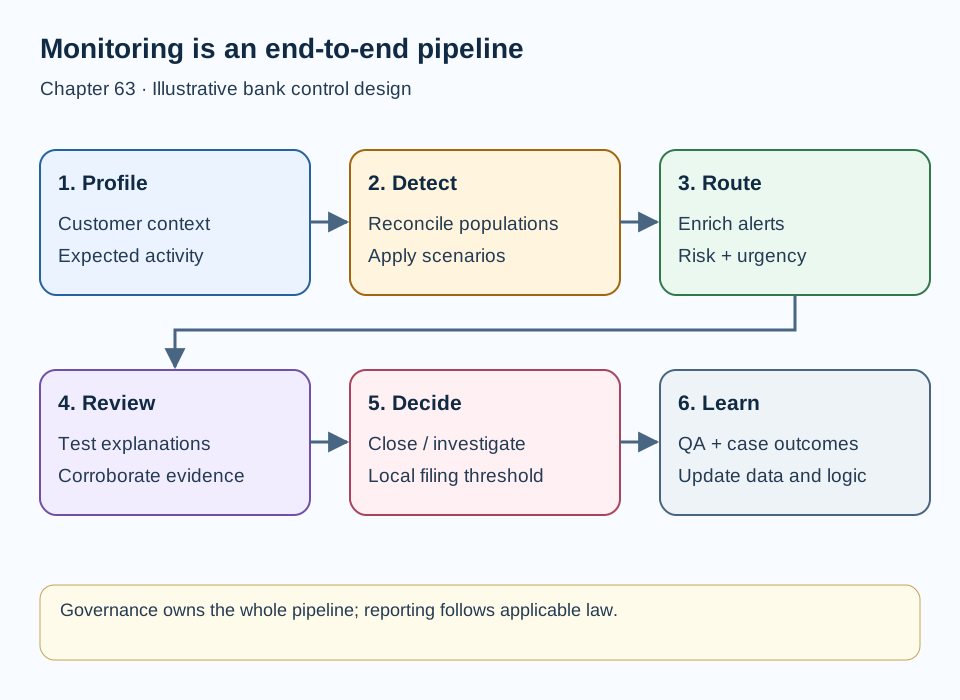
The pipeline above traces the seven stages with feedback returning from quality to every upstream point. Its message is that monitoring is a system whose stages must be designed jointly: profile quality determines scenario precision, scenario precision determines alert value, alert value determines analyst effectiveness, and analyst outcomes determine profile updates. Optimising any stage in isolation while neighbours decay produces local metrics that flatter while system outcomes stagnate, the characteristic failure of monitoring programmes managed as disconnected functions.
Profile inputs: expectations monitoring tests against
Detection quality begins before any scenario executes, in the customer profiles and expected-activity parameters that define normal against which monitoring measures deviation. Profile completeness determines scenario precision directly: transaction monitoring comparing behaviour against empty expectations generates either silence or noise depending on default-rule design, neither of which constitutes detection. Profile attributes feeding monitoring include product holdings with facility parameters, transaction volumes with seasonal patterns, counterparty universes with concentration norms, geographic corridors with jurisdiction specificity, channel usage with device associations, and risk-tier overlays weighting sensitivity where elevated exposure warrants tighter tolerance. Each attribute needs currency maintenance with change detection, since profiles decaying after onboarding mislead every scenario consuming them.
Expected-activity methodology translates profile knowledge into testable parameters with tolerance bands that alert logic evaluates systematically rather than comparing transactions against static thresholds ignorant of customer context. Parameter design covers turnover volumes with growth-aware baselines distinguishing structural expansion from anomalous spikes, transaction counts and value distributions by channel separating retail patterns from corporate flows, counterparty novelty scoring flagging first-time relationships without treating every new counterparty as suspicious, and temporal patterns capturing salary cycles, business rhythms and seasonal variation that naive monitoring flags wastefully. Tolerance-band calibration balances detection sensitivity against false-positive burden through historical-volatility analysis, peer-group benchmarking for thin-history customers, and business-cycle awareness adjusting bands without manual intervention each cycle.
Parameter governance prevents tolerance-band drift where incremental analyst adjustments accumulate into systematic leniency that no single change would justify alone. Band-change requests need documented rationale with before-after detection-impact estimates, approval authority scaled to the affected population size, and expiry review where temporary widening for verified business changes reverts automatically rather than persisting as permanent tolerance the original justification never supported. Change-history analytics track band movements by direction, approver and segment identifying systematic widening patterns that indicate calibration evasion rather than legitimate evolution, with investigation distinguishing genuine business transformation from threshold-gaming that relationship pressure drives quietly through successive minor adjustments.
Profile-quality metrics translate expectation adequacy into governable numbers with completeness scoring by attribute criticality, currency measurement through review-cycle adherence and trigger responsiveness, and consistency reconciliation across source systems with break investigation. Quality shortfalls map directly to scenario performance with false-positive attribution identifying profile-driven noise versus logic-driven noise, directing remediation investment toward data quality where stale profiles generate the alerts analysts clear without correcting source inaccuracy. Profile-quality reporting reaches governance with trend analysis distinguishing genuine improvement from metric management, since completeness percentages improve cosmetically through low-criticality attribute filling while decision-critical expectations remain empty behind reassuring aggregates.
Cross-channel profile unification determines whether monitoring sees customers whole or fragments them into channel-specific shadows that behaviour analysis cannot reconcile. Customers transact across branches, digital platforms, cards, call centres and correspondent-mediated flows with identifiers varying by channel — account numbers, card PANs, device fingerprints, phone numbers — that entity-resolution logic must bind into unified profiles with documented match confidence and manual-review queues for ambiguous linkages. Unification failures split single customers into multiple monitored entities where structuring across channels evades thresholds applied per fragment while consolidated activity would alert immediately, the exact blind spot that channel-silo monitoring creates systematically. Resolution-quality measurement tracks match rates with false-merge and missed-merge analysis, since over-aggressive merging attributes strangers' activity to innocent customers while under-merging shelters structuring behind fragmentation that adversaries exploit deliberately through multi-channel transaction spreading.
Temporal profile depth separates monitoring that understands trajectories from monitoring that snapshots moments, since behaviour meaning depends on history length and change velocity that point-in-time profiles cannot convey. Profile histories preserve expectation evolution with effective dating showing what the bank believed about each customer at every past date, enabling retrospective analysis of whether historical alerts were judged against accurate contemporaneous expectations or outdated profiles that misled reviewers systematically. Lookback capability reconstructs profile states for investigation and examination queries spanning years, with archive integrity ensuring historical profiles reflect genuine past knowledge rather than current states backfilled anachronistically. History-length standards define minimum behavioural baselines for new versus established customers with graduated monitoring sensitivity that thin-history uncertainty warrants, preventing new-customer monitoring from either paralysing legitimate onboarding with suspicion or waving through risks that absent history cannot contextualise.
Detection engines: scenarios executing at scale
Scenario engines evaluate transaction populations against detection logic continuously, and engine architecture determines whether scenarios execute completely, timely and accountably. Coverage architecture maps scenarios to the transaction universe with completeness reconciliation proving every in-scope transaction entered evaluation — no silent exclusions from feed gaps, transformation errors or population misconfigurations that incident reviews later expose as unmonitored periods. Scheduling design balances intraday detection for time-critical typologies against batch efficiency for pattern analysis requiring accumulated data, with latency budgets per scenario tier and breach escalation where processing delays push detection beyond useful windows.
Engine-change governance treats scenario modifications as control changes with testing, approval and rollback disciplines matching production-system standards rather than analyst-configuration tweaks deployed casually. Threshold changes need back-tested impact analysis showing expected alert-volume and risk-coverage effects before production deployment, since threshold relaxation without coverage analysis converts alert reduction into control degradation that metrics celebrate while protection decays. Scenario-version control preserves historical logic with effective dating enabling retrospective analysis of what past transactions would have triggered under current versus historical rules, supporting lookback exercises and examination queries about detection capability at material dates.
Scenario retirement discipline removes obsolete detection logic that generates volume without protection, since scenarios accumulate indefinitely while typologies evolve around fixed rules that adversaries study systematically. Retirement candidates emerge from precision analytics identifying scenarios with sustained low conversion, coverage-redundancy analysis where overlapping scenarios duplicate detection wastefully, and typology-obsolescence review where criminal methods abandoned the patterns specific scenarios target. Retirement decisions need the same governance as deployment with coverage-impact analysis proving remaining scenarios absorb the retired logic's genuine detections, preventing alert-reduction exercises from degrading protection while celebrating efficiency that incident reviews later expose as blindness.
Typology-to-scenario traceability connects each scenario to the specific criminal methods it targets with documented rationale, ensuring detection inventories reflect threat landscapes rather than historical accident. Traceability matrices map typology intelligence — internal case findings, industry alerts, law-enforcement advisories, supervisory guidance — to covering scenarios with gap flags where intelligence lacks detection response, driving scenario-development pipelines that threat evolution feeds continuously. Coverage reviews test traceability bidirectionally: every scenario must justify its typology target while every known typology must show covering detection, with orphan scenarios retired and orphan typologies developed through governed backlogs that threat intelligence prioritises rather than developer availability sequencing arbitrarily.
Scenario-segmentation design applies detection logic differentially across customer populations where uniform rules generate noise for legitimate segments while missing risk in others, requiring segmentation methodology with documented risk rationale rather than arbitrary partitioning that complicates governance without improving precision. Segmentation dimensions span customer type with behavioural baselines varying fundamentally between retail, corporate and institutional populations, product usage with facility-specific patterns that generic scenarios misread systematically, geographic corridors with typology concentrations warranting dedicated logic, and risk tiers with sensitivity scaling that elevated exposure justifies through tighter tolerance. Each segment carries performance measurement distinguishing genuine precision improvement from volume redistribution that segmentation theatre produces when rules merely shift alerts between queues without changing detection outcomes.
Adversarial adaptation expects criminal methods to evolve around published detection logic with scenario-effectiveness decay that static rules suffer predictably as adversaries probe thresholds through sacrificial transactions mapping trigger boundaries. Effectiveness monitoring tracks scenario yield trends with decay investigation distinguishing typology evolution from rule staleness, red-team exercises probing production scenarios with controlled evasion attempts measuring bypass feasibility, and threshold-confidentiality disciplines preventing exact trigger values from reaching customer-facing documentation or staff populations with spreading incentives. Scenario-refresh cycles update logic proactively from threat intelligence rather than reactively from missed cases, since adversary adaptation outpaces incident-driven development systematically while proactive refresh informed by industry typology sharing stays ahead of criminal innovation that targets precisely the scenarios banks stopped updating.
Alert pipelines: routing with priority and context
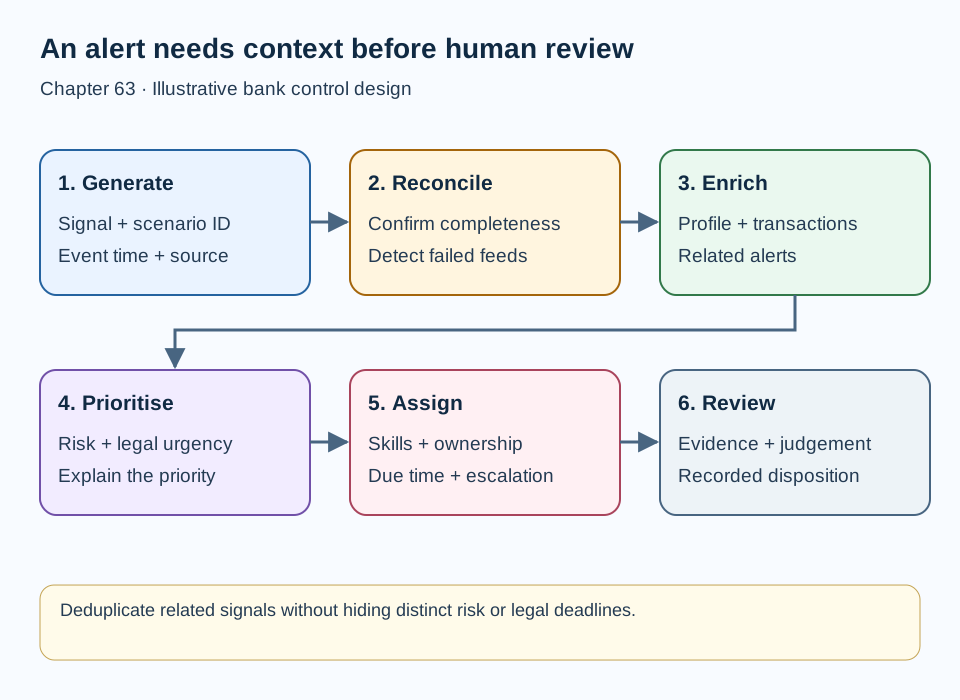
Alert generation converts scenario matches into reviewable work items, and pipeline design determines whether analysts receive prioritised, contextualised cases or chronological noise queues that bury risk under volume. Prioritisation logic combines scenario severity with customer risk, alert novelty, corroborating signals from parallel scenarios, and external intelligence overlays where law-enforcement or typology information elevates specific patterns. Priority must reflect legal urgency alongside risk strength — time-critical scenarios with cutoff implications outrank stronger-signal routine work — with queue-ordering logic governed explicitly rather than emerging from first-in-first-out convenience that treats all alerts as equal while risk insists otherwise.
Alert enrichment assembles the evidence package analysts need before first human touch: customer profile with expectation parameters and change history, transaction details with counterparty and corridor context, related alerts across scenarios and timeframes revealing pattern fragments, network linkages to other customers and known-risk entities, and external-data hits from screening, adverse media and watchlists. Enrichment quality determines review depth directly, since analysts working from bare transaction lines either clear superficially or request information that automated assembly should have provided, both outcomes wasting the specialist judgement that alert pipelines exist to deploy efficiently. Suppression and deduplication logic prevents alert multiplication where single behaviours trigger multiple scenarios, consolidating related matches into unified cases with scenario-attribution preserved rather than flooding queues with redundant work items analysts clear mechanically.
Pipeline service levels convert priority design into experienced reality with defined review timeframes per priority tier, ageing-escalation mechanics advancing stale alerts automatically, and breach analytics distinguishing capacity shortfalls from logic failures. Service-level differentiation must reflect consequence urgency genuinely rather than nominally, since congested queues equalise all priorities in practice while reporting maintains the fiction of tiered service that breach-free dashboards assert without reviewer-experience validation. Capacity planning aligns reviewer staffing with priority-volume forecasts, treating high-priority SLA compliance as the binding constraint that hiring and surge procedures protect before standard-tier timeliness receives residual attention.
Alert-ageing governance prevents stale alerts from drifting without decision through maximum-age limits with escalation on approach, ensuring time pressure drives triage completion rather than accumulating silent inventory that customers experience as unmonitored exposure. Ageing analysis by priority tier reveals whether escalation mechanics operate or merely exist in procedure documents, with stale-alert root-cause investigation distinguishing capacity gaps requiring resourcing from priority-logic failures needing redesign and reviewer-avoidance patterns indicating difficult-case deferral that coaching must address. Ageing metrics belong in governance packs alongside closure volumes, since queues growing older while closures grow numerous describe operations clearing easy work first while risk waits patiently in the ageing tail that incident attribution eventually exposes.
Queue-transparency mechanics expose pipeline health to reviewers, managers and governance with graduated detail serving each consumer's decisions rather than uniform dashboards that inform nobody specifically. Reviewer-facing transparency shows queue position context with priority rationale and expected wait times that manage workload psychology honestly, preventing the learned helplessness that opaque ever-growing queues produce in analysts who stop prioritising because prioritisation appears futile. Management-facing transparency presents bottleneck analysis identifying which pipeline stage constrains throughput with capacity-versus-demand quantification guiding resourcing decisions toward measured constraints rather than assumed ones. Governance-facing transparency quantifies unreviewed exposure with risk-weighted ageing that translates queue statistics into risk language boards understand, since alert counts without risk weighting leave directors unable to distinguish routine backlog from material undetected exposure.
Fairness monitoring across queue outcomes detects systematic disadvantage where prioritisation logic or reviewer behaviour disadvantages specific customer segments disproportionately to measured risk. Disparity analysis compares review timeliness, escalation rates and disposition severity across demographic and business segments with statistical controls for genuine risk differences, triggering criteria revision where facially neutral queue mechanics produce systematically adverse outcomes for protected populations. Reviewer-behaviour fairness sampling examines individual disposition patterns for segment-correlated strictness variations that training or bias may explain, with coaching interventions addressing disparities through evidence-based discussion rather than accusation that defensive responses render counterproductive. Fairness metrics belong in the same governance packs as effectiveness metrics, since monitoring that detects risk accurately while treating segments inequitably fails the institutional legitimacy that sustainable control requires.
Prioritise by severity, risk, novelty and legal urgency — then enrich every alert into a reviewable case before first human touch.
Analyst review: testing alerts against evidence
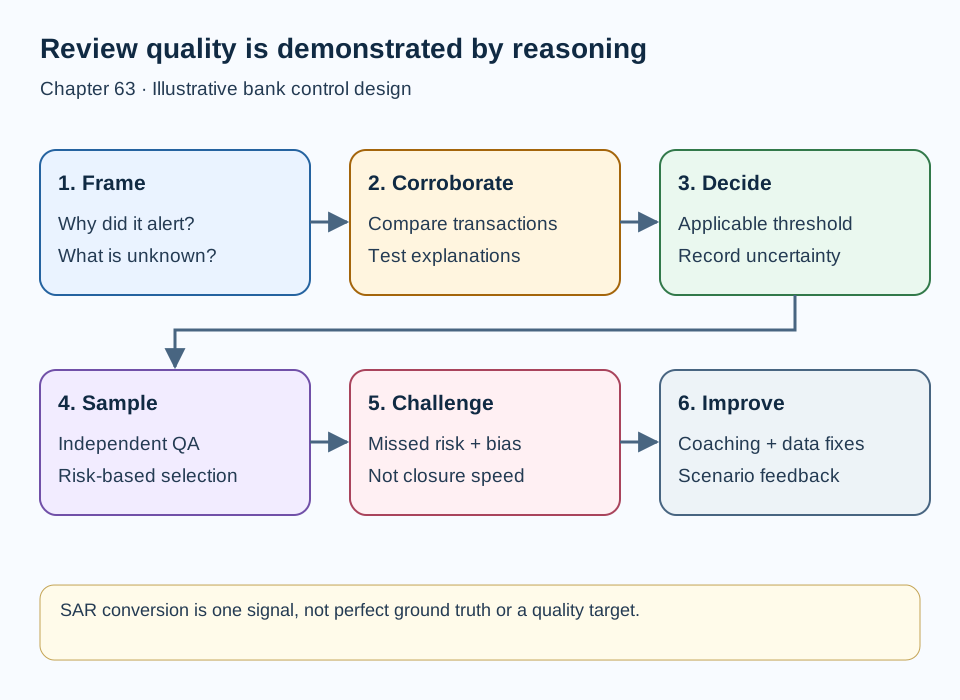
Analyst review converts machine-generated exceptions into human judgements through evidence testing that automation cannot replicate: contextual interpretation of behaviour against customer knowledge, hypothesis formation with alternative explanations actively sought, corroboration through independent sources beyond the alerting data, and disposition reasoning documented to standards supporting downstream review. Review quality depends on case presentation design delivering complete evidence packages rather than isolated scores, decision frameworks specifying approval, escalation, information-request and closure paths with evidence standards per path, and workload management ensuring analysts have time for genuine investigation rather than clearance quotas that throughput incentives corrupt into superficial processing.
Reviewer capability needs typology literacy with continuous training on emerging patterns, data literacy enabling independent verification beyond alert-provided information, and writing discipline producing case narratives that downstream investigators, reporters and examiners can reconstruct without re-performing the analysis. Performance measurement tracks decision quality through outcome sampling — cleared alerts' subsequent incident rates, escalated cases' investigation yields, narrative-quality scoring — rather than throughput alone that speed incentives degrade into clearance mills. Reviewer feedback loops connect downstream case outcomes to individual reviewers with coaching addressing systematic weaknesses, converting quality assurance from judgment into development that improves analyst capability structurally over time.
Reviewer independence protects judgement quality where commercial and relationship pressures tempt clearance over investigation, requiring structural safeguards beyond integrity expectations that pressure reliably overcomes. Case-assignment mechanics prevent reviewer selection by interested parties with automated routing and conflict-of-interest exclusion where reviewer-customer connections exist. Performance metrics exclude business-volume considerations that would reward permissive reviewing systematically, while rotation requirements prevent relationship capture through repeated exposure to persuasive front-office advocacy. Dissent-preservation protocols record control-function objections with escalation rights where commercial majorities overrule risk concerns without adequate justification that retrospective review would condemn specifically.
Escalation culture determines whether reviewers raise uncomfortable findings or suppress them to meet throughput expectations, and culture measurement tracks escalation rates by reviewer cohort with abnormally low escalation triggering coaching investigation rather than performance praise. Psychological safety needs explicit management sponsorship with demonstrated protection for reviewers whose escalations prove inconvenient, since single instances of escalation punishment teach entire teams that silence advances careers while diligence endangers them. Quality-assurance sampling should oversample non-escalated closures for missed-risk testing, creating detection pressure that balances throughput incentives toward genuine investigation rather than clearance speed that incident reviews later attribute to cultural failure rather than individual error.
Analyst-specialisation design balances depth against flexibility where complex typologies demand dedicated expertise while narrow specialisation creates bottlenecks and single points of failure. Specialisation tracks for sanctions-adjacent monitoring, trade-based typologies, virtual-asset patterns and correspondent-network analysis develop deep expertise through concentrated exposure with certification requirements verifying competence before independent case responsibility. Generalist rotation maintains surge capacity and prevents specialisation blindness where narrow exposure normalises category-specific anomalies into accepted baselines that cross-trained reviewers would question immediately. Workforce planning models blend specialist depth with generalist breadth against typology-mix forecasts, adjusting hiring profiles as threat landscapes shift rather than staffing yesterday's specialisations against tomorrow's criminal innovation.
Knowledge-management systems preserve analytical expertise beyond individual tenure through typology playbooks with worked examples, decision-rationale libraries showing how similar cases were judged with outcomes where available, and lessons-learned repositories capturing incident insights in searchable form that new analysts can actually find during live reviews. Playbook governance keeps guidance current with typology-evolution updates, retirement of superseded approaches that continued circulation would perpetuate as outdated practice, and effectiveness measurement tracking whether playbook-guided decisions outperform unguided ones. Without institutional knowledge capture, analyst turnover resets capability cyclically while training investments evaporate with departing staff, converting workforce attrition from manageable rotation into recurring capability crises that queue performance reflects within quarters of key departures.
Test evidence with hypotheses and corroboration, decide through specified paths, measure on downstream yields, develop through coaching.
Case decisions: disposition with authority
Case disposition converts reviewed alerts into institutional decisions with consequences for customers, reporting and risk posture, requiring authority frameworks matching decision impact. Disposition options span no-further-action with documented rationale where evidence refutes suspicion, enhanced monitoring designations intensifying surveillance without customer impact, information requests seeking clarification through lawful channels, account restrictions constraining activity pending resolution, relationship-exit recommendations where findings support termination, and suspicious-report filings where legal thresholds are met. Each option carries authority requirements with seniority scaled to consequence, preventing junior reviewers from making relationship-ending decisions while ensuring routine closures proceed without committee bottlenecks.
Decision documentation preserves the reasoning chain supporting each disposition with evidence citations, alternative hypotheses considered with exclusion rationale, approval records with authority verification, and review triggers where conditional dispositions need follow-up. Documentation standards serve examination defence, quality review and future investigators encountering related activity, since case files become institutional memory that outlasts analyst tenure and system migrations. Disposition consistency monitoring compares similar fact patterns across analysts and teams identifying divergent outcomes that uniform policy should have prevented, with calibration sessions addressing systematic strictness or leniency variations that fairness and effectiveness both require eliminating.
Conditional dispositions need follow-up mechanics preventing probationary decisions from decaying into permanent ambiguity where monitoring designations persist without review and information requests go unanswered without consequence. Each conditional outcome carries defined review triggers with timeframes, responsible owners and escalation paths where conditions resolve ambiguously, ensuring cases progress toward terminal dispositions rather than accumulating in indefinite holding states that queue metrics count as managed while risk remains undecided. Expiry rules revert conditional states to defined defaults where follow-up fails, forcing explicit re-decision rather than silent perpetuation that incident reviews cite as tolerance of known undecided risk.
Decision-expiry governance addresses the time dimension of all dispositions, since case conclusions valid at decision dates decay as customer behaviour evolves and external intelligence develops. Material dispositions carry review triggers tied to behaviour-change indicators, external-data developments and elapsed-time thresholds that reactivate assessment rather than assuming permanent correctness that evolving risk invalidates systematically. Re-decision mechanics preserve original reasoning while incorporating new evidence with change documentation showing what shifted the conclusion, preventing repeated full reinvestigation where targeted updates suffice while ensuring stale dispositions never govern current risk through administrative inertia that calendar-only maintenance permits silently.
Cross-case linkage consumption ensures dispositions benefit from portfolio context where related cases inform individual conclusions with network and pattern evidence that isolated review misses structurally. Linkage workflows surface connected cases automatically at disposition time with relationship strength indicators distinguishing strong evidentiary links from coincidental overlaps, enabling decision-makers to weigh coordinated-activity hypotheses that single-case evidence cannot support alone. Disposition consistency across linked cases prevents contradictory outcomes where related customers receive divergent decisions from different analysts unaware of the connection, with linkage-aware quality sampling specifically testing whether connected cases were decided coherently. Where linkage reveals organised activity, individual dispositions escalate to network-case handling with consolidated evidence and coordinated decision-making that fragmented case management would process as independent closures while the network continues operating through undetected siblings.
Appeal and complaint integration treats customer challenges to monitoring-driven actions — restrictions, exits, enhanced-information demands — as disposition-quality feedback rather than operational nuisance to be minimised through procedural friction. Challenge-outcome tracking connects upheld complaints to original dispositions with root-cause analysis distinguishing evidence insufficiency from communication failure, feeding both reviewer coaching and scenario calibration with ground-truth error signals that internal quality sampling cannot replicate authentically. Restriction-regime coordination ensures monitoring dispositions triggering customer consequences follow the restriction-governance standards of proportionality, documentation and appeal rights rather than operating as shadow restriction powers outside the governance that customer-facing consequences require for institutional legitimacy.
Reporting: from case conclusion to authority filing
Suspicious-reporting decisions translate case conclusions into authority filings where legal thresholds are met, with decision frameworks separating the suspicion judgement from filing mechanics that different specialists may own. Threshold application tests case evidence against jurisdiction-specific reporting standards with legal input for boundary cases, documenting the threshold analysis supporting filing or non-filing decisions with equal rigour since non-filing where thresholds were met creates liability while over-filing where thresholds were not met degrades report quality that FIUs depend upon. Narrative quality determines filing value with who-what-when-how-much-why structures, predicate-offence hypotheses where reasonably identifiable, and fact-inference separation that authorities need for intelligence fusion.
Filing operations manage submission mechanics with deadline compliance tracked per case, quality review before submission catching narrative and data defects, acknowledgement monitoring confirming authority receipt, and amendment procedures correcting filed reports where subsequent information changes material facts. Feedback integration consumes FIU responses, law-enforcement requests and correspondent inquiries as control intelligence improving upstream stages: report-quality assessments informing analyst coaching, typology feedback informing scenario design, and volume-pattern analysis informing capacity planning. Reporting metrics balance quality against timeliness with narrative-adequacy scoring alongside deadline compliance, since rushed filings meeting deadlines with poor narratives waste the investigative effort cases invested while delayed quality filings breach obligations that timeliness rules enforce strictly.
Defensive filing — submitting reports where thresholds are not met to avoid decision responsibility — degrades national financial intelligence while creating liability the filer intended to avoid, since systematic over-filing indicates threshold-application failure that supervisory review treats as control weakness rather than prudence. Filing-discipline measurement tracks report-to-investigation yield with FIU feedback integration distinguishing useful filings from noise, and analysts with anomalous filing patterns receive coaching on threshold application rather than praise for volume that quality assessment contradicts. Non-filing decisions need documentation rivalling filing rigour with threshold analysis preserved for retrospective challenge, since unfiled cases later linked to criminal proceedings face scrutiny that absent reasoning cannot survive regardless of the original judgement's substantive correctness.
Report-quality sampling programmes review filed narratives for intelligence value with structured scoring covering completeness, predicate-hypothesis quality, fact-inference separation and usability for FIU analysis. Sampling stratifies toward high-consequence filings, boundary-threshold decisions and new-analyst output where quality risk concentrates, with findings feeding targeted coaching and scenario-design improvements that address recurring narrative weaknesses structurally. FIU feedback mechanisms — where jurisdictions provide report-quality assessments, information requests signalling intelligence value, or consent decisions indicating investigative utility — integrate into quality measurement with trend analysis distinguishing genuine improvement from metric management that narrative-length optimisation mimics while intelligence value stagnates undetected by superficial scoring.
Consent-regime operations in jurisdictions requiring authority consent before proceeding with suspicious transactions add time-critical decision layers where monitoring, investigation and reporting compress into coordinated action under statutory deadlines. Consent-request preparation assembles case evidence to authority standards with narrative completeness determining consent-decision speed, since inadequate submissions trigger information requests that consume the consent window while transactions wait in controlled holds customers experience as unexplained freezing. Consent-outcome tracking measures grant, refusal and conditional-consent rates with pattern analysis identifying submission-quality drivers that coaching addresses specifically, while refusal-response procedures define asset-treatment, customer-communication and investigation-continuation steps that refusal triggers immediately rather than improvising under enforcement pressure.
Multi-jurisdiction reporting coordination handles cases spanning entities whose filing obligations, thresholds, formats and deadlines differ, requiring per-jurisdiction assessment with filing decisions independent across regimes rather than assuming one filing satisfies all obligations. Coordination mechanics prevent both gaps where each entity assumes another filed and duplication where uncoordinated filings confuse authorities with inconsistent narratives about shared underlying activity. Narrative consistency across jurisdictions needs central coordination with local-legal review ensuring each filing satisfies domestic requirements while the collective set presents coherent facts that cross-border FIU cooperation will compare directly through intelligence-sharing channels designed exactly for such cases.
Quality feedback: the loop that improves everything
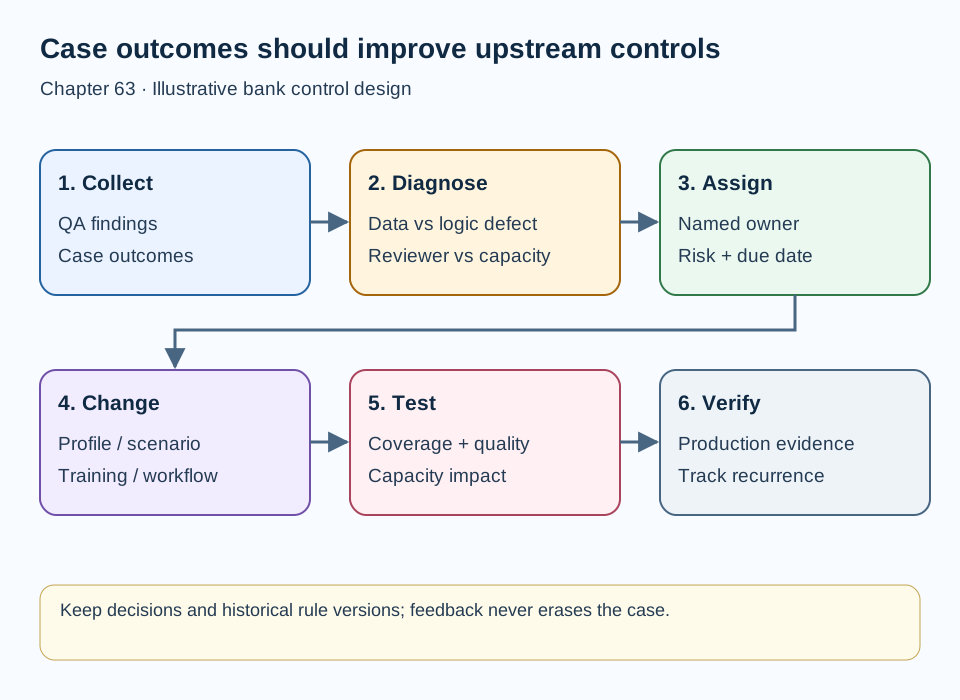
Quality assurance closes the monitoring loop by converting downstream outcomes into upstream improvements across every pipeline stage. Alert-quality analysis measures scenario precision through conversion rates — alerts escalated, cases reported, reports acknowledged as useful — with low-precision scenarios triggering tuning, segmentation or retirement rather than continued volume generation that reviewer capacity absorbs wastefully. Profile-quality feedback routes recurring false positives from stale expectations to relationship owners with update deadlines, closing the cycle where outdated profiles generate noise analysts clear without correcting source inaccuracy perpetuating future alerts indefinitely.
Reviewer-quality feedback connects case outcomes to individual analysts through sampled re-review with agreement scoring, downstream-yield tracking by reviewer cohort, and coaching programmes addressing systematic weaknesses with development plans rather than punitive responses that incentivise defensive reviewing. Scenario-governance feedback aggregates quality findings into detection strategy with scenario-inventory reviews retiring obsolete logic, coverage-gap analysis identifying typologies without scenarios, and investment prioritisation directing analytical capacity toward highest-yield detection improvements. Governance reporting presents quality metrics alongside activity volumes with trend analysis distinguishing genuine improvement from metric management, since programmes reporting growing alert closures with flat conversion rates are scaling noise rather than protection regardless of operational narratives claiming otherwise.
Feedback service levels ensure quality loops operate within timeframes that make improvements timely rather than archival, with scenario-tuning backlogs triaged by risk impact, profile-update deadlines enforced with escalation for non-compliance, and reviewer-coaching scheduled within weeks of identified weakness rather than deferred to annual review cycles. Unactioned feedback measurement tracks quality findings without corresponding improvements, distinguishing resource-constrained deferral requiring governance decisions from neglected feedback indicating cultural indifference that leadership must address directly. Quality-committee governance reviews feedback effectiveness with authority to direct cross-functional remediation where stage owners dispute responsibility, preventing the mutual blame that decentralised quality ownership produces when every stage attributes failures to neighbours while system outcomes decay globally.
Alert precision, profile currency, reviewer development and scenario strategy all improve from measured downstream outcomes.
Governance: owning the pipeline end to end
Monitoring governance assigns accountability across pipeline stages with end-to-end ownership preventing the diffusion where each function optimises locally while system outcomes decay globally. A designated monitoring owner — typically within financial-crime operations with compliance oversight — carries responsibility for pipeline performance with authority spanning profile quality, scenario effectiveness, alert management, review standards and feedback operation. Stage owners manage their components with service-level obligations to downstream consumers: data teams delivering profile currency, detection teams delivering scenario precision, operations delivering review quality, each measured on outcomes the next stage experiences rather than activity each stage generates internally.
Committee governance reviews pipeline performance with balanced packs combining activity volumes, quality conversion rates, backlog health by risk priority, scenario-change pipelines with coverage-impact analysis, and incident attribution identifying which stage failures caused. Escalation paths carry stage disputes — operations challenging scenario precision, detection challenging profile currency, compliance challenging review standards — to resolution with authority rather than perpetual negotiation that deteriorates into mutual blame. Independent assurance covers the pipeline through outcome-based testing sampling cleared alerts for missed risk, reported cases for narrative quality and scenario changes for coverage impact, providing the governing body with assurance about system effectiveness rather than component activity that operational reporting already supplies abundantly.
Three-lines mapping clarifies monitoring accountability where first-line operations own pipeline execution, second-line compliance owns policy, challenge and effectiveness assessment, and internal audit owns independent assurance with each line's scope documented to prevent the diffusion where monitoring failures belong to everybody in principle and nobody in practice. First-line ownership includes profile quality, scenario operation, alert management and review standards with performance metrics tied to pipeline outcomes rather than functional activity. Second-line challenge covers scenario-approval authority with rejection powers for inadequately tested changes, thematic reviews producing findings that surprise management, and escalation rights where business pressure threatens control integrity. Audit independence requires separation from monitoring operations and compliance with direct board reporting that adverse findings reach without management filtering.
Board deep-dive scheduling brings monitoring themes to governing bodies cyclically with case studies illustrating pipeline operation concretely: anonymised alert-to-report journeys walked through from scenario trigger to authority filing, backlog incidents analysed for root causes with remediation accountability, and scenario-change proposals with coverage-impact evidence supporting approval decisions. Directors need monitoring literacy sufficient to challenge management assertions with informed scepticism, distinguishing genuine effectiveness evidence from metric comfort through questions about conversion rates, missed-risk sampling and unreviewed exposure that operational packs should answer before being asked. Board minutes should record monitoring deliberation explicitly, since examination review increasingly tests whether governing bodies oversaw detection effectiveness actively or merely received volumes they never questioned while incidents accumulated behind green dashboards.
References and further reading
The sources below are the primary public references used for this chapter. FATF provides the global standard-setting baseline. Basel Committee and Wolfsberg material provides bank-practical risk-management guidance. EBA, FCA, FFIEC and AUSTRAC material is jurisdiction-specific and should not be treated as globally binding law.
- Financial Action Task Force (FATF), The FATF Recommendations, as amended June 2026: https://www.fatf-gafi.org/en/publications/Fatfrecommendations/Fatf-recommendations.html
- Basel Committee on Banking Supervision, Sound management of risks related to money laundering and financing of terrorism: https://www.bis.org/bcbs/publ/d505.htm
- Wolfsberg Group, Statement on Effective Monitoring for Suspicious Activity, Part I: Moving Beyond Automated Transaction Monitoring (2024): https://wolfsberg-group.org/resources/general/168
- Wolfsberg Group, Statement on Effective Monitoring for Suspicious Activity, Part II: Transitioning to Innovation (2025): https://wolfsberg-group.org/resources/195/202
- European Banking Authority, Guidelines on customer due diligence and ML/TF risk factors: https://www.eba.europa.eu/publications-and-media/press-releases/eba-publishes-final-revised-guidelines-money-laundering-and
- European Banking Authority, Final Report on revised ML/TF Risk Factors Guidelines: https://www.eba.europa.eu/sites/default/files/document_library/Publications/Guidelines/2021/963637/Final%20Report%20on%20Guidelines%20on%20revised%20ML%20TF%20Risk%20Factors.pdf
- UK Financial Conduct Authority, Financial Crime Guide: https://handbook.fca.org.uk/handbook/fcg
- US Federal Financial Institutions Examination Council, BSA/AML Examination Manual: https://bsaaml.ffiec.gov/manual
- US Federal Financial Institutions Examination Council, Customer Risk Versus Due Diligence and Suspicious Activity Monitoring: https://bsaaml.ffiec.gov/manual/Appendices/12
- AUSTRAC, Suspicious matter reports, updated 9 September 2026: https://www.austrac.gov.au/industry-and-business/obligations-and-guidance/your-amlctf-program/reporting-us/suspicious-matter-reports
- AUSTRAC, Changes to AML/CTF obligations: What you need to do, 1 July 2026: https://www.austrac.gov.au/news-and-media/article/changes-amlctf-obligations-what-you-need-do
Operational deep dive: coverage, change control and latency engineering
The base chapter established the monitoring pipeline. This deep dive covers the engineering disciplines that determine whether detection operates completely and accountably: coverage architecture proving every transaction is evaluated, change governance preventing silent control degradation, and latency engineering keeping detection timely under production load.
Coverage architecture proving complete evaluation
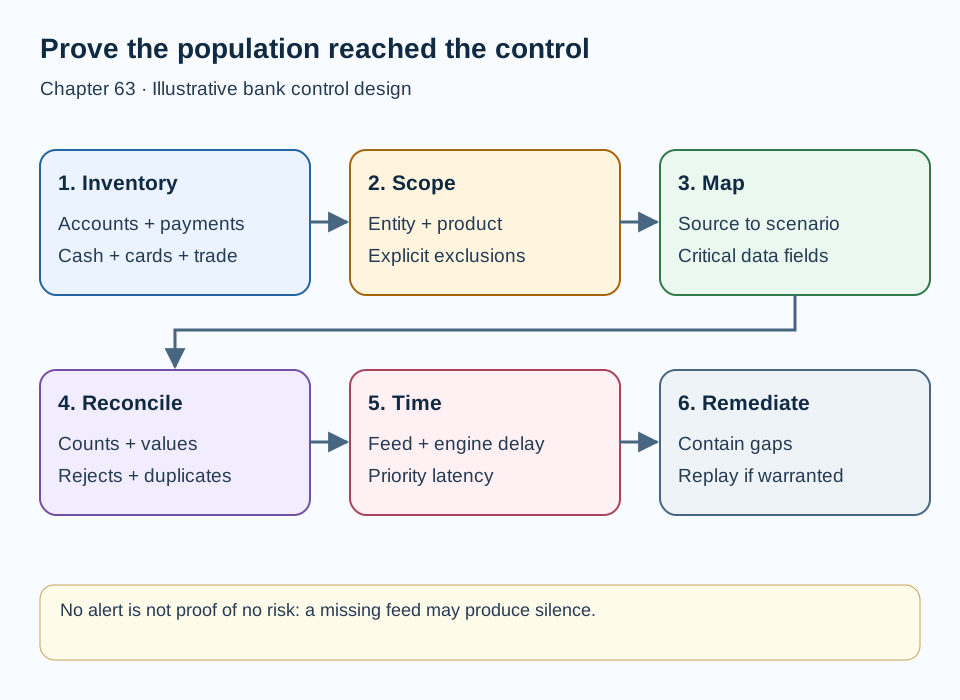
Coverage mapping connects transaction populations to evaluating scenarios with reconciliation proving completeness rather than asserting it through architecture diagrams that examinations test against data. Population inventories enumerate every in-scope transaction source — payment rails with message types, card systems with authorisation and settlement feeds, cash channels with teller and device capture, securities and custody movements, wallet and virtual-asset flows — with volume baselines per source enabling evaluated-count reconciliation that breaks visibly when feeds fail rather than degrading silently into unmonitored gaps. Scenario-to-population matrices record which scenarios evaluate which populations with explicit gap registers where typologies lack coverage, converting unknown unknowns into known gaps with remediation plans that governance tracks rather than discovers through incidents.
Exclusion governance controls the populations scenarios deliberately skip with documented rationale, approval authority and review triggers: low-value thresholds with evasion analysis proving structuring cannot exploit the floor systematically, closed-product populations with dormancy verification, and intra-group flows with transfer-pricing transparency. Each exclusion carries sunset review where typology evolution may invalidate original rationale, since exclusions designed for historical patterns persist indefinitely while criminal methods adapt around precisely the populations monitoring ignores. Transformation-loss analysis examines data mappings between source systems and scenario engines for attribute truncation — counterparty details dropped in normalisation, free-text fields excluded from evaluation, timestamp precision lost in aggregation — that silently narrow effective coverage behind nominally complete population routing.
Engine-change governance preventing silent degradation
Scenario modifications arrive continuously from tuning exercises, typology updates, regulatory findings and false-positive initiatives, each carrying degradation risk that change governance must contain through production-system disciplines rather than analyst-configuration informality. Change classification separates threshold adjustments with quantified impact analysis from logic modifications requiring full regression testing, with emergency-change procedures for supervisory findings demanding immediate implementation balanced against testing thoroughness through defined minimum-evidence standards that urgent changes must still satisfy. Each change records its rationale, expected alert-volume and coverage effects, approval authority with independence from the requesting team, and rollback criteria with decision triggers where production behaviour diverges from tested expectations.
Back-testing protocols measure proposed changes against historical transaction populations with outcome-labelled data proving coverage effects before production deployment: true-positive retention analysis confirming known suspicious patterns still alert under modified logic, false-positive reduction measurement quantifying noise improvement honestly rather than accepting projected figures, and coverage-delta documentation recording which typologies gain or lose detection with compensating measures for any coverage surrendered. Champion-challenger deployment runs modified scenarios alongside production versions on live traffic with comparison analysis before cutover, catching production-data divergences that historical back-testing misses where current transaction mixes differ from test windows. Post-implementation review verifies production behaviour matches tested expectations within defined tolerance periods, with automatic rollback where divergence exceeds thresholds that change governance defines in advance rather than negotiating after degradation manifests in missed cases.
Model-risk governance for detection models
Machine-learning detection models — anomaly detectors, network-risk scorers, behavioural classifiers, alert-priority engines — carry model-risk obligations matching their decision influence, requiring validation rigour that vendor-managed black boxes resist but supervisory expectations demand regardless of origin. Inventory discipline catalogues every model influencing detection outcomes with owner attribution, version tracking and change histories that examinations expect for material models, treating vendor models as bank models for governance purposes since outsourced analytics produce the bank's regulatory outcomes. Tiering assigns validation intensity by consequence with anomaly detectors affecting case selection facing full independent validation while ancillary productivity models receive lighter-touch oversight proportionate to their indirect influence on risk decisions.
Validation methodology tests detection models against labelled historical populations with segment-level performance reporting, challenger-model benchmarking where feasible, and stability monitoring detecting performance decay from population drift or adversary adaptation that static validations miss within operational quarters. Bias testing across demographic and business segments with disparity investigation prevents models learning historical enforcement patterns that reproduce exclusionary outcomes behind mathematical objectivity claims. Documentation preserves validation evidence with methodology, populations, results and limitations recorded to examination standard, since detection-model failures surface as missed criminal networks and systematic false-positive burdens that retrospective governance cannot reconstruct from vendor accuracy claims divorced from deployment context.
Data-timing dependencies and staleness management
Scenario inputs arrive asynchronously across feeds with different latencies — real-time payment messages, batch ledger postings, delayed external data, periodic profile updates — and detection operating on incomplete inputs needs staleness awareness preventing confident decisions on partial evidence. Input-timing inventories document expected arrival patterns per source with delay tolerances distinguishing normal variance from feed failures, enabling monitoring systems to recognise missing data explicitly rather than evaluating incomplete populations silently. Staleness indicators attach to alerts generated where material inputs were absent or outdated, directing reviewers toward verification of the missing elements rather than allowing silent reliance on partial evidence that subsequent data would contradict.
Re-evaluation triggers activate where delayed data materially changes case assessment: late-arriving transactions completing structuring patterns that partial views understated, external-data updates reversing screening conclusions that monitoring consumed, and profile corrections invalidating expectation baselines that detection applied. Each trigger needs defined scope with proportionate re-review depth preventing full reinvestigation where targeted updates suffice, while ensuring material changes receive assessment that cursory acknowledgement cannot provide under queue pressure. Backfill procedures handle extended outages with catch-up evaluation sequencing prioritised by risk tier, documenting the delayed-detection window honestly rather than presenting catch-up reviews as timely monitoring that incident timelines would contradict specifically.
Latency engineering for timely detection
Detection latency determines whether monitoring prevents harm or merely documents it, with different typologies carrying different timing requirements that engineering must satisfy differentially rather than through uniform batch schedules. Latency-budget design allocates time across data availability, ingestion processing, scenario execution, alert generation, enrichment assembly and queue delivery with per-stage targets and breach escalation, since end-to-end latency claims without stage measurement conceal the bottlenecks determining real-world detection speed. Time-critical scenarios — structuring in progress, mule-network activation, sanctions-evasion payments approaching cutoffs — warrant intraday or real-time execution with dedicated processing capacity, while pattern-analysis scenarios aggregating weeks of behaviour legitimately operate on longer cycles that rushing would degrade through incomplete data.
Backlog and catch-up mechanics handle the volume surges that break latency budgets during system outages, designation waves and seasonal peaks: surge-capacity provisioning with pre-tested scaling procedures, prioritisation frameworks directing constrained processing to highest-risk populations first, and catch-up sequencing with latency-impact documentation where delayed detection affects case outcomes. Data-timing dependencies require explicit management where scenario inputs arrive asynchronously — late transaction feeds, delayed external data, batch-profile updates — with staleness indicators attached to alerts generated on incomplete inputs and re-evaluation triggers where delayed data materially changes case assessment. Performance testing under peak-volume conditions with latency measurement validates engineering before production stress discovers shortfalls during the incidents timely detection would have mitigated.
Advanced practice: prioritisation science, enrichment and consolidation
The base chapter and deep dive established pipeline architecture and engineering. This supplement addresses the analytical disciplines determining alert value: prioritisation models routing risk first, enrichment systems assembling reviewable cases, and consolidation logic preventing alert multiplication from drowning reviewers.
Prioritisation science beyond severity labels
Static severity labels attached to scenarios route crudely where risk concentrates dynamically across customers, timeframes and intelligence contexts that fixed labels cannot reflect. Composite prioritisation models combine scenario severity with customer-risk multipliers, alert-novelty scoring distinguishing first occurrences from repeat patterns, corroboration bonuses where parallel scenarios or external intelligence reinforce the same concern, and legal-urgency overrides where cutoff implications or reporting deadlines demand immediate attention regardless of risk ranking. Each factor needs weight calibration with outcome feedback measuring whether highly prioritised alerts actually convert to cases and reports at rates justifying their queue position, since priority models optimised on analyst preference rather than outcome data route comfortably rather than correctly.
Dynamic reprioritisation responds to intraday developments that static queue ordering misses: designation events elevating affected customers' pending alerts, law-enforcement inquiries prioritising related cases, and emerging typology intelligence boosting specific scenario outputs across the queue simultaneously. Reprioritisation mechanics need audit trails explaining queue-position changes with reason codes that reviewers understand, preventing opaque reordering that analysts distrust and game through cherry-picking. Service-level differentiation by priority tier with ageing escalation ensures high-priority alerts receive genuinely faster review rather than nominal precedence that congested queues equalise in practice, with SLA-breach analytics distinguishing capacity shortfalls from prioritisation-logic failures requiring different remediations.
Enrichment architecture assembling reviewable cases
Enrichment determines review depth by assembling evidence before first human touch, and architecture quality separates programmes where analysts investigate from those where analysts assemble. Data-source inventory for enrichment spans customer profiles with expectation parameters and change history, transaction context with counterparty and corridor intelligence, historical alert and case linkages revealing pattern fragments across timeframes, network analysis connecting customers through shared devices, counterparties and behavioural templates, and external-data overlays from screening hits, adverse media and watchlist intelligence. Each source needs freshness management with staleness indicators where enrichment data lags, since reviewers acting on outdated profiles or superseded screening results make decisions the current facts would reverse.
Assembly performance governs enrichment value as directly as content coverage: case packages assembling in seconds enable immediate review while minute-scale assembly delays push analysts toward premature clearance of unenriched alerts that queue pressure prioritises by age. Pre-computation strategies assemble enrichment at alert-generation time rather than review time, trading storage cost for review speed with invalidation triggers where underlying data changes between assembly and review. Enrichment-quality measurement samples assembled packages for completeness scoring with gap analysis identifying systematically missing elements — network context absent for nested-customer alerts, expectation parameters missing for thin-profile segments — driving source-integration investment toward the gaps reviewers feel most acutely rather than the integrations vendors market most aggressively.
Cross-institution intelligence for detection tuning
Detection scenarios improve dramatically when informed by cross-institution typology intelligence that single-bank data cannot generate, since criminal networks distribute activity across institutions precisely to stay below each bank's detection thresholds. Intelligence-sharing participation provides manufacturing signatures, emerging typology indicators and evasion-technique disclosures that scenario designers convert into detection logic with implementation timelines measured in weeks rather than the quarters that isolated development requires. Contribution obligations return value through the bank's own confirmed-typology sharing with standardised formats and timeliness commitments, sustaining sharing quality through reciprocity that free-riding members degrade for all participants.
Legal foundations for detection-intelligence sharing vary across privacy regimes with legitimate-interest assessments and sectoral provisions enabling different sharing depths in different jurisdictions. Banks map permitted sharing per footprint with legal approval rather than assuming global arrangements transfer across privacy boundaries that data-localisation rules enforce strictly. Effectiveness measurement tracks shared-intelligence detection yield on the bank's own populations with precision analysis distinguishing high-value manufacturing intelligence from noise that broad sharing without quality governance generates. Feedback to sharing forums reports implementation outcomes improving collective intelligence quality, converting operational experience into sourcing improvements that static vendor relationships cannot provide without institutional learning mechanisms spanning organisational boundaries.
Reviewer-assist technology without reviewer replacement
Machine assistance for reviewers promises productivity gains that automation framing often converts into headcount reduction justifying itself, degrading the human judgement monitoring exists to deploy. Assistive design principles keep reviewers deciding with machine support rather than machines deciding with reviewer rubber-stamping: evidence summarisation presenting case facts efficiently while preserving source access for independent verification, similar-case retrieval surfacing historical dispositions as reference rather than precedent binding current judgement, and narrative-drafting assistance generating structured starting points reviewers must actively confirm rather than passively approve. Each assistive feature needs usage measurement distinguishing genuine productivity from clearance acceleration, since tools that halve review time while halving detection quality destroy more value than their efficiency saves.
Automation-bias countermeasures address reviewers' tendency to defer to machine outputs, particularly where scores present false precision that human judgement hesitates to contradict. Interface design displays uncertainty alongside scores with confidence intervals and dissenting indicators where parallel models disagree, training reviewers to treat machine outputs as fallible inputs rather than authoritative conclusions. Mandatory independent-verification steps for high-consequence dispositions force evidence examination regardless of score confidence, with compliance monitoring detecting reviewers whose approval patterns correlate suspiciously with score ordering rather than evidence strength. Reviewer-override analytics track disagreement rates with investigation distinguishing healthy scepticism from systematic disregard, calibrating the human-machine partnership toward complementary strengths rather than mutual abdication where each side assumes the other verified what neither examined.
Consolidation preventing alert multiplication
Single behaviours triggering multiple scenarios generate redundant alerts that reviewers clear mechanically, training dangerous habits of superficial disposition that genuine risk then exploits through multi-scenario patterns cleared as duplicates. Consolidation logic groups related matches into unified cases using entity resolution across customers and accounts, temporal clustering connecting alerts within behaviour windows, and scenario-relationship mapping recognising which scenario combinations indicate single underlying behaviours versus genuinely independent concerns. Each consolidation decision preserves scenario attribution within the unified case, ensuring downstream investigators and reporters understand the full detection footprint rather than receiving flattened cases stripped of the multi-angle evidence that justified escalation.
Consolidation-threshold calibration balances noise reduction against pattern visibility with measurement distinguishing healthy consolidation from dangerous over-merging: merged-case investigation yields should meet or exceed single-alert yields, since consolidation that buries distinct risks inside mega-cases degrades outcomes while improving queue metrics cosmetically. Exception handling preserves high-severity alerts from consolidation where immediate individual attention outweighs case-assembly efficiency, with severity definitions reviewed periodically as typology evolution shifts which patterns demand instant response. Reviewer override capabilities allow manual case-splitting where automated consolidation merged genuinely distinct concerns, with override-pattern analysis informing consolidation-logic refinement that static rules cannot achieve without operational feedback.
Practice close: checklists and acceptance criteria
This supplement converts the chapter into delivery artefacts: pipeline-design checklists, effectiveness acceptance criteria and testing guidance proving monitoring operates as a system rather than a collection of tools.
BA checklist before accepting a monitoring design
Profile requirements should specify attribute inventories feeding detection with currency-maintenance mechanics and change-detection coverage, expectation-parameter methodology with tolerance-band calibration approaches, and data-quality thresholds with break-investigation procedures. Each requirement needs measurable completeness and timeliness standards rather than qualitative coverage aspirations that implementation interprets variably and testing cannot verify objectively against production populations.
Detection requirements should define scenario inventories mapped to typology coverage with explicit gap registers, completeness-reconciliation mechanics proving evaluated populations match inputs, scheduling tiers with latency budgets per tier, and change-governance procedures with back-testing and rollback disciplines. Alert-pipeline requirements need prioritisation logic with factor weights and reprioritisation mechanics, enrichment-source inventories with freshness management, and consolidation rules with attribution preservation. Review requirements specify evidence-package contents, decision frameworks per disposition path, workload standards protecting investigation depth, and outcome-based performance measurement.
What good acceptance criteria look like
Adequate criteria assert measured system outcomes: evaluated populations reconcile to inputs with break investigation for any gap; high-priority alerts receive review within defined service levels with ageing-escalation evidence; sampled cleared alerts show missed-risk rates below defined thresholds on independent re-review; reported cases carry narrative-quality scores above defined bars with FIU feedback tracked. Each criterion names measurement populations, methods and thresholds enabling objective sign-off rather than stakeholder opinion about monitoring readiness.
Inadequate criteria assert component activities without system outcomes: scenarios deployed, alerts generated, analysts hired, training delivered. Activity assertions prove expenditure rather than protection and should be rejected wherever they appear. Similarly inadequate are criteria without adverse measurement — closure volumes without conversion rates, review timeliness without missed-risk sampling, scenario counts without precision analysis. Acceptance requires evidence that the pipeline converts behaviour into correct decisions at measured quality, the single outcome monitoring exists to produce.
Calibrating with seeded test cases
Ongoing reviewer calibration needs ground-truth measurement that live production cannot provide, since production outcomes arrive months late and many clearances never receive definitive resolution. Seeded test cases — synthetic alerts with known correct dispositions interleaved into live queues without reviewer knowledge — measure judgement quality directly with immediate scoring and targeted feedback. Seed design covers typology breadth with difficulty grading distinguishing routine pattern recognition from genuinely ambiguous boundary cases, demographic fairness ensuring seeded populations do not train reviewers toward biased dispositions, and scenario coverage spanning all active detection logic so calibration reflects the full decision landscape rather than frequently encountered subsets.
Programme governance protects seeding integrity with strict confidentiality limiting knowledge to calibration administrators, preventing reviewer gaming where known-test identification would corrupt measurement into performance theatre. Scoring distinguishes error types with different coaching responses: missed-risk errors triggering evidence-examination coaching, over-escalation errors indicating threshold miscalibration rather than diligence excess, and procedural errors revealing training gaps in disposition mechanics rather than judgement failures. Results aggregate into reviewer development plans with progress tracking, team-level calibration sessions addressing shared weaknesses, and hiring-profile refinement where persistent capability gaps indicate recruitment criteria mismatched to operational judgement demands that interviews never tested authentically.
Handoff testing between pipeline stages
Stage handoffs lose information where upstream outputs fail to meet downstream needs, and handoff testing verifies transfer quality with the same rigour payment-message testing applies to value movement. Profile-to-detection handoff testing samples expectation parameters for completeness and currency at scenario-consumption time, catching staleness that profile reports conceal behind aggregate quality scores. Detection-to-pipeline handoff testing verifies alert generation completeness with reconciliation between scenario matches and queue arrivals, exposing drops that silent failures create systematically during engine upgrades and configuration changes. Pipeline-to-review handoff testing examines enrichment-package completeness with gap analysis identifying systematically missing elements that reviewers work around through information requests the pipeline should have eliminated.
Review-to-decision and decision-to-reporting handoffs need equivalent verification with case-file completeness scoring before disposition authority engages, and filing-package quality gates preventing narrative-deficient cases from reaching authorities. Feedback-handoff testing closes the loop by verifying that quality findings reach stage owners with action tracking rather than dissipating in governance packs that all stages receive while none owns. Each handoff test needs defined frequency with continuous monitoring for high-volume transfers and periodic sampling for judgement-intensive ones, ensuring the pipeline operates as connected system rather than adjacent functions whose boundary failures incident reviews attribute to everybody and therefore nobody.
Reviewer-override analytics track disagreement rates with investigation distinguishing healthy scepticism from systematic disregard, calibrating the human-machine partnership toward complementary strengths rather than mutual abdication where each side assumes the other verified what neither examined. Override-pattern analysis by scenario and reviewer cohort reveals automation-trust calibration issues where blanket acceptance indicates complacency while blanket rejection indicates tool irrelevance, both failure modes that partnership design must address through interface, training and threshold adjustments rather than policy exhortations that behaviour ignores.
Testing monitoring end to end
Positive testing proves genuine suspicious patterns alert with measured detection rates using labelled historical cases spanning typologies, customer segments and evasion sophistication, establishing the detection baseline against which tuning changes are honestly weighed. Test populations must include edge-case typologies — low-value terrorist financing, nested-correspondent layering, professional-enabler structuring — since monitoring validated only on classic money-laundering patterns fails precisely the threats evolution produces most dangerously.
Negative testing proves legitimate behaviour clears without alert burden through high-volume legitimate-pattern simulation measuring false-positive rates by segment, with fairness analysis across demographic and business segments preventing systematically exclusionary precision gaps. Evasion testing probes known blind spots — threshold-proximate structuring, corridor-shifting after scenario deployment, entity-mutation defeating resolution logic — with findings driving coverage remediation rather than being filed as accepted limitations. Failure-mode testing proves degraded operation where feeds fail, engines lag and reviewer capacity collapses under surge, with fallback procedures verified under production-like stress rather than documented hopefully.
Masterclass: when a healthy-looking queue hides a network
This is a composite educational case built from recurring transaction-monitoring failure patterns described across supervisory guidance, industry practice and public enforcement themes. It does not describe a specific bank, customer population, loss amount, regulatory outcome or historical incident. The purpose is to show how a monitoring operating model can fail even when individual components appear to be functioning.
The misleading comfort of operational metrics
A bank's monitoring operation is handling rising transaction volumes. Alert volumes also rise, but management reporting remains reassuring because the dashboard concentrates on alerts closed, average handling time and the proportion of work completed inside internally defined service targets. Investigators are working hard and closing large quantities of routine alerts. Nothing on the dashboard obviously says that the control is failing.
The weakness sits in what the metrics do not show. The queue is reported as one population even though some alerts carry much more financial-crime risk than others. Ageing is averaged, so a large number of recently created routine alerts can make the overall queue look healthy while a smaller set of complex alerts remains unresolved. Closure volume is not paired with a measure of what was actually found. The operation can therefore become faster at clearing work without becoming better at identifying suspicious activity.
At the same time, the alert-routing model gives too much weight to arrival time and too little to network context. Several customers generate individually modest alerts that do not look exceptional when viewed one by one. The accounts share counterparties, infrastructure and behavioural characteristics, but those relationships are not assembled automatically for the reviewer. Each alert reaches a different analyst with a narrow evidence package. Every analyst sees a fragment; nobody is shown the picture.
This is an operating-model failure rather than a single scenario failure. The scenarios are producing signals. The queue is moving. Analysts are making defensible decisions on the evidence presented to them. Yet the system is not turning distributed signals into useful intelligence because prioritisation, enrichment, entity resolution and cross-case linkage do not work together.
The trigger that exposes the blind spot
The problem becomes visible when an external or internal trigger prompts a wider review. That trigger might be a law-enforcement request, a fraud investigation, a customer complaint, a new typology alert, a sanctions connection, an internal audit sample or a quality-assurance finding. The important point is not which trigger occurs. It is that the bank is forced to look across customers and cases instead of treating each alert as an isolated unit of work.
Once investigators assemble the wider history, relationships appear that the original queue design concealed. Customers may share devices, beneficiaries, introducers, contact details, payment rhythms or other infrastructure. Individually, each signal may have an innocent explanation. Together, the pattern can justify a different investigative hypothesis. Historical alerts that looked weak in isolation become useful when linked across the network and time.
The bank then has to answer an uncomfortable question: why did the monitoring programme possess many of the relevant pieces without connecting them? The answer usually spans several stages. Entity-resolution logic may not have linked related identifiers. Alert enrichment may not have shown previous cases. Queue prioritisation may have favoured easy work over risk-rich work. Analyst procedures may not have provided a route from a local suspicion to portfolio-level analysis. Quality assurance may have tested whether analysts followed the procedure rather than whether the procedure itself could detect the threat.
That distinction matters. A bank should not respond by blaming the last analyst who touched an alert. A useful root-cause analysis asks where the operating model prevented competent people from reaching the right conclusion.
What the reviewers could and could not see
Suppose one analyst notices that several counterparties recur across otherwise unrelated customers. The analyst records the observation but the case-management tool does not search automatically for the same counterparties elsewhere. Another analyst later sees a similar feature but has no access to the first analyst's reasoning. A quality reviewer samples one of the closures and confirms that the analyst followed the documented procedure. Each action can be locally correct while the control remains globally weak.
The lesson is that documentation is not enough. Information must be consumable. A case note that never reaches related investigations has little preventive value. A network-analysis capability that exists only in a specialist team does not help unless ordinary reviewers can route a concern to that team. A quality-assurance function that checks procedural compliance but never challenges the adequacy of the procedure can certify systematic weakness as acceptable quality.
A mature operating model therefore provides explicit escalation paths for pattern concerns that do not fit the current alert. It allows reviewers to request portfolio analysis, preserves cross-case links and feeds confirmed relationships back into detection logic. The system should make it easier for a good reviewer to expand the question rather than forcing the reviewer to remain inside the boundaries of the original alert.
Triage after a network concern emerges
Once a possible network is identified, the bank should avoid another common failure: treating every connected customer as equally culpable. A network can contain organisers, knowing facilitators, recruited money mules, deceived victims, coerced participants and legitimate counterparties whose only connection is transactional.
Investigation should therefore separate linkage from culpability. Shared infrastructure is evidence of a relationship or common operating pattern; it is not automatically proof that every connected person understood the criminal purpose. The bank may need transaction analysis, customer contact where appropriate, account history, device or channel evidence, source-of-funds information, fraud intelligence and other lawful evidence to understand each participant's role.
This distinction changes customer treatment. A customer who appears to be a scam victim may need safeguarding and account protection. A customer knowingly moving criminal proceeds may require escalation under the bank's AML framework and potentially relationship action. A legitimate business caught in a network graph because it received an ordinary payment should not be treated as suspicious merely because an algorithm drew an edge.
The exact actions, reporting thresholds, restrictions, disclosure rules and safeguarding obligations depend on the applicable jurisdiction and the facts. The operating model should provide the evidence and decision routes needed to apply those rules, not substitute an automated network score for legal or investigative judgement.
Repairing the operating model
The first repair is usually better measurement. Governance should see the whole queue, not only work inside selected service windows. Ageing should be segmented by risk and priority. Management information should distinguish alerts generated, alerts reviewed, cases opened, cases escalated and reports filed rather than compressing them into one productivity story. Where lawful and methodologically sound, outcome measures can help assess whether prioritisation and scenarios are producing useful investigative leads.
The second repair is risk-aware routing. Arrival time remains operationally relevant, but it should not be the only organising principle. Queue logic can combine scenario significance, customer risk, corroborating signals, novelty, ageing and any genuinely time-sensitive legal or operational factors. The weighting should be governed and tested rather than chosen informally, and the bank should be able to explain why an alert was prioritised.
The third repair is enrichment. Reviewers need the customer's profile, expected activity, relevant transaction history, related alerts and cases, material network links and appropriate external intelligence at the point of decision. The aim is not to overwhelm the analyst with every data field. It is to provide the evidence needed to test the alert hypothesis without spending most of the review assembling information manually.
The fourth repair is cross-case learning. Confirmed typologies and investigation outcomes should feed back into scenario design, entity resolution, analyst guidance and quality sampling. If a network was found through a shared device, for example, the bank should consider whether that relationship belongs in future enrichment or detection, subject to data quality, privacy, proportionality and validation requirements.
The fifth repair is capacity governance. A queue that is persistently growing faster than it can be reviewed is a control problem, not merely an operations inconvenience. Capacity planning should consider alert inflow, complexity, skill mix, priority distribution, system downtime, investigative quality and surge scenarios. Reducing alerts by weakening thresholds merely to restore a service metric is not a sustainable capacity strategy unless testing shows that risk coverage remains appropriate.
What assurance should test
Independent testing should examine more than whether scenarios run and analysts follow procedures. It should test whether transaction populations are actually covered, whether data feeds reconcile, whether alert-to-case handoffs preserve relevant information, whether cleared alerts contain missed risk, whether prioritisation behaves as designed and whether feedback results in controlled change.
Testing should also challenge the metrics themselves. A dashboard can be technically accurate and still materially misleading if it excludes the part of the population carrying the greatest risk. Assurance should therefore ask what is omitted, how definitions affect the result, whether averages conceal tails and whether management can reconstruct the exposure sitting in unresolved work.
For architects and business analysts, the case translates into concrete requirements: effective-dated entity relationships, explainable priority factors, full queue ageing, case-link APIs, traceable scenario versions, evidence provenance, reviewer escalation routes, audit trails for reprioritisation and measurable handoff completeness. For testers, it creates end-to-end scenarios in which related alerts arrive through different products or channels and must still converge into a coherent investigative picture.
The main lesson
A transaction-monitoring operating model is effective only when its stages work together. Scenario generation alone is not success. High closure volume is not success. A green service dashboard is not success. The bank needs evidence that relevant activity enters monitoring, meaningful signals reach the right reviewers, reviewers receive enough context to investigate, decisions are governed, jurisdiction-specific reporting obligations are applied correctly, and downstream outcomes improve the upstream control.
The most important question for governance is therefore not simply, "How many alerts did we close?" It is, "What risk remains unseen or unresolved, and what evidence shows that this operating model is finding the activity it was designed to find?"
Knowledge check and glossary
Test understanding of the monitoring operating model before applying it. Each answer follows its question with the reasoning that makes the answer stick.
Why must profiles precede scenarios in design priority? Because detection compares behaviour against expectations, and empty or stale profiles generate silence or noise rather than detection regardless of scenario sophistication. Profile currency determines scenario precision directly, making profile investment the highest-yield monitoring expenditure that scenario-tuning budgets often starve.
What separates prioritisation from severity labelling? Static labels route crudely while composite prioritisation combines severity with customer risk, novelty, corroboration and legal urgency, calibrated on outcome conversion rather than analyst preference. Queues ordered by arrival date treat all alerts equally while risk insists otherwise, burying time-critical patterns under volume that chronological fairness misallocates structurally.
How does enrichment determine review quality? By assembling profiles, history, networks and external hits before first human touch, enabling investigation rather than information-gathering. Analysts working from bare transaction lines clear superficially or request data automation should have provided, wasting specialist judgement that pipelines exist to deploy efficiently on evidence rather than assembly.
When does consolidation become dangerous? When merged cases bury distinct risks inside mega-cases that investigation yields would expose through comparison with single-alert outcomes. Healthy consolidation preserves scenario attribution and permits manual splitting, with threshold calibration measured on yield rather than queue metrics that cosmetic merging flatters while protection decays.
What proves reviewer effectiveness? Downstream outcome sampling — cleared alerts' subsequent incident rates, escalated cases' investigation yields, narrative-quality scoring — rather than throughput that speed incentives corrupt into clearance mills. Coaching from outcome patterns develops capability structurally, while punishment for errors incentivises defensive reviewing that hides weakness instead of correcting it.
How should scenario changes be governed? Through classification separating threshold adjustments from logic modifications, back-tested impact analysis on labelled historical data, champion-challenger live comparison before cutover, and post-implementation verification with automatic rollback where production diverges beyond pre-defined tolerance. Casual deployment converts tuning into degradation that metrics celebrate while coverage decays.
What makes backlog reporting honest? Full-population ageing with risk weighting instead of scoped subsets excluding overdue work, unreviewed-exposure quantification alongside queue counts, and capacity modelling on quality-adjusted output. Scoped metrics conceal accumulation until incidents reveal exposure that honest measurement would have surfaced affordably months earlier.
Why measure conversion rates alongside closure volumes? Because growing closures with flat conversion scale noise rather than protection, and only outcome ratios reveal whether operational growth represents control improvement or queue-clearing theatre. Boards overseeing volumes alone optimise for busyness while boards overseeing conversion govern effectiveness that volumes never evidence.
What distinguishes monitoring from screening fundamentally? Monitoring evaluates behaviour over time against expectations with investigation-paced review, while screening matches parties and data against lists with time-critical disposition. Different data, timing, evidence and legal consequences govern each, and conflating them produces controls with the wrong speed, wrong evidence and wrong outcomes for both.
How does quality feedback reach every stage? Through alert-precision analysis tuning scenarios, profile-currency feedback with update deadlines for stale expectations, reviewer development from re-review agreement, and scenario-strategy reviews retiring obsolete logic while funding highest-yield detection. Governance packs present quality trends beside activity volumes so improvement shows as conversion growth rather than closure growth.
What makes coverage reconciliation different from coverage assertion? Reconciliation proves evaluated populations match inputs with break investigation for any gap, while assertion claims completeness from architecture diagrams examinations test against data. Silent exclusions from feed failures, transformation losses and misconfigurations hide behind assertions but surface immediately under reconciliation that incident reviews later demand retrospectively.
When should scenarios retire rather than tune? Where sustained low conversion persists across segments despite calibration attempts, where overlapping scenarios duplicate detection wastefully, and where criminal methods abandoned the targeted patterns leaving logic that generates volume without protection. Retirement needs coverage-impact proof that remaining scenarios absorb genuine detections, preventing efficiency exercises from degrading protection while celebrating blindness.
How do seeded test cases improve reviewers? By measuring judgement against known-correct dispositions immediately rather than awaiting production outcomes that arrive late or never resolve. Difficulty-graded seeds across typologies with confidential administration prevent gaming, while error-type analysis directs coaching precisely — evidence examination for misses, threshold calibration for over-escalation, mechanics training for procedural errors.
Why separate legal urgency from risk strength in queues? Because time-critical scenarios with cutoff implications demand immediate review regardless of signal strength, while strong-signal routine work tolerates scheduled attention. Queues ordered on risk alone miss deadlines that legal consequences enforce strictly, and queues ordered on arrival miss both dimensions behind chronological fairness that risk realities reject.
What distinguishes assistive technology from replacement automation? Assistive tools present evidence efficiently while reviewers decide independently with machine outputs treated as fallible inputs; replacement automation decides while reviewers rubber-stamp authoritative-seeming scores. Interface uncertainty display, mandatory verification steps and override analytics preserve the human judgement monitoring exists to deploy rather than ceremonially retain.
What makes handoff testing different from stage testing? Stage testing verifies component operation while handoff testing verifies transfer quality between stages — profile currency at scenario-consumption time, alert completeness between engine and queue, enrichment adequacy at review start, and feedback delivery to stage owners. Boundary failures hide from component tests by definition, which is why incident reviews attribute them to everybody and therefore nobody without dedicated handoff verification.
When should prioritisation override chronological fairness? Always where risk or legal urgency differentiates alerts, since arrival order carries no risk information while severity, customer risk, novelty and cutoff implications do. Chronological queues treat all alerts equally while risk insists otherwise, burying time-critical patterns under volume that fairness-to-arrival misallocates structurally against the customers and obligations urgency exists to protect.
How do seeded cases avoid gaming? Through strict confidentiality limiting knowledge to calibration administrators, difficulty grading spanning routine to boundary cases, demographic fairness in seeded populations, and error-type analysis directing coaching precisely. Known-test identification would corrupt measurement into performance theatre, which is why seed compromise triggers population replacement rather than continued measurement against gamed baselines.
Why track manufacturing pressure separately? Because per-application metrics report individual outcomes while factory-scale attack hides in portfolio patterns of element reuse, infrastructure sharing and synchronized behaviour. Cohort emergence rates, linkage volumes and batch-discovery counts reported to governance alongside approval quality ensure industrial threats receive industrial responses rather than case-by-case handling campaigns outpace structurally.
Glossary for delivery teams
Operating model: the end-to-end monitoring system from profiles through detection, routing, review, decisions, reporting and feedback with stage owners and service obligations.
Coverage: the mapping of transaction populations to evaluating scenarios with reconciliation proving complete evaluation and explicit gap registers.
Prioritisation: queue ordering by severity, customer risk, novelty, corroboration and legal urgency calibrated on outcome conversion.
Enrichment: pre-review evidence assembly with profiles, history, networks and external overlays determining achievable review depth.
Consolidation: grouping related scenario matches into unified cases with attribution preserved and manual splitting available.
Disposition: the institutional case decision with authority matched to consequence and documentation supporting examination and review.
Conversion rate: the proportion of alerts escalating to cases and reports, measuring precision that closure volumes never evidence. Rising closures with flat conversion scale noise rather than protection, the central diagnostic separating genuine improvement from queue-clearing theatre.
Backlog honesty: full-population risk-weighted queue reporting exposing unreviewed exposure that scoped metrics conceal. Honest backlogs drive surge resourcing sequenced by exposure with prevention redesign addressing capacity honestly, while scoped reporting accumulates silently until incidents reconcile comfort against exposure catastrophically.
Champion-challenger: parallel deployment of modified scenarios against production versions with comparison analysis before cutover.
Scenario precision: the true-risk proportion within generated alerts, tuned through segmentation rather than threshold relaxation that degrades coverage.
Queue risk: the undetected exposure sitting in unreviewed alerts, measured through risk-weighted ageing rather than queue counts, governed through priority routing with ageing escalation and honest full-population reporting that scoped metrics conceal until incidents reveal exposure accumulated silently behind reassuring dashboards.
References and further reading
The sources below are the primary public references used for the chapter. FATF provides the global standard-setting baseline; the Basel Committee and Wolfsberg Group provide bank-practical risk-management guidance; EBA, FCA, FFIEC and AUSTRAC material is jurisdiction-specific and should not be treated as globally binding law.
Global standards and bank-practical guidance
- Financial Action Task Force (FATF), The FATF Recommendations, as amended June 2026: https://www.fatf-gafi.org/en/publications/Fatfrecommendations/Fatf-recommendations.html
- Basel Committee on Banking Supervision, Sound management of risks related to money laundering and financing of terrorism: https://www.bis.org/bcbs/publ/d505.htm
- Wolfsberg Group, Statement on Effective Monitoring for Suspicious Activity, Part I: Moving Beyond Automated Transaction Monitoring (2024): https://wolfsberg-group.org/resources/general/168
- Wolfsberg Group, Statement on Effective Monitoring for Suspicious Activity, Part II: Transitioning to Innovation (2025): https://wolfsberg-group.org/resources/195/202
European and UK supervisory material
- European Banking Authority, Guidelines on customer due diligence and ML/TF risk factors (revised Guidelines, including monitoring expectations): https://www.eba.europa.eu/publications-and-media/press-releases/eba-publishes-final-revised-guidelines-money-laundering-and
- European Banking Authority, Final Report on revised ML/TF Risk Factors Guidelines: https://www.eba.europa.eu/sites/default/files/document_library/Publications/Guidelines/2021/963637/Final%20Report%20on%20Guidelines%20on%20revised%20ML%20TF%20Risk%20Factors.pdf
- UK Financial Conduct Authority, Financial Crime Guide: https://handbook.fca.org.uk/handbook/fcg
United States and Australia examples
- US Federal Financial Institutions Examination Council, BSA/AML Examination Manual: https://bsaaml.ffiec.gov/manual
- US Federal Financial Institutions Examination Council, Customer Risk Versus Due Diligence and Suspicious Activity Monitoring: https://bsaaml.ffiec.gov/manual/Appendices/12
- AUSTRAC, Suspicious matter reports (current guidance, updated 9 September 2026): https://www.austrac.gov.au/industry-and-business/obligations-and-guidance/your-amlctf-program/reporting-us/suspicious-matter-reports
- AUSTRAC, Changes to AML/CTF obligations: What you need to do (1 July 2026): https://www.austrac.gov.au/news-and-media/article/changes-amlctf-obligations-what-you-need-do