The FATF Travel Rule for Crypto Asset Transfers
A crypto transfer can move value on a public blockchain while the information needed to understand the people behind that transfer sits somewhere else entirely. That separation is the heart of the Travel Rule problem. A transaction hash may show that value moved from one address to another, but it normally does not tell a bank, supervisor or investigator the verified name of the customer who sent it, the person intended to receive it, which regulated provider served each side, or why the transfer was permitted.
The FATF Travel Rule is designed to close that transparency gap. In virtual-asset transfers, FATF expects the originating virtual asset service provider, or another obliged financial institution where relevant, to obtain and hold required originator information and required beneficiary information, transmit the required information securely to the beneficiary institution, and make it available to competent authorities when required. The beneficiary side must obtain and hold the required information and apply the related controls. FATF is explicit that the information does not have to be written onto the blockchain itself. In practice, most Travel Rule data travels through a separate secure messaging or data-exchange channel that must be correlated reliably with the on-chain transfer.
That sounds simple until a bank tries to operate it. The sending customer may use a hosted exchange, a self-hosted address, a broker, a wallet service, or a provider in a jurisdiction whose implementation differs from the bank's own. The beneficiary provider may use another Travel Rule network. Names may not match exactly. The message may arrive before or after the asset transfer. A counterparty may be regulated but technically unreachable. A transfer may be legally permissible but missing mandatory data. Sanctions screening may produce a hit while the blockchain transfer is still pending. A customer may insist that the destination address belongs to them personally. Each case needs a controlled answer that combines law, policy, customer knowledge, counterparty information, message status and transaction evidence.
The mental model: three things move, not one
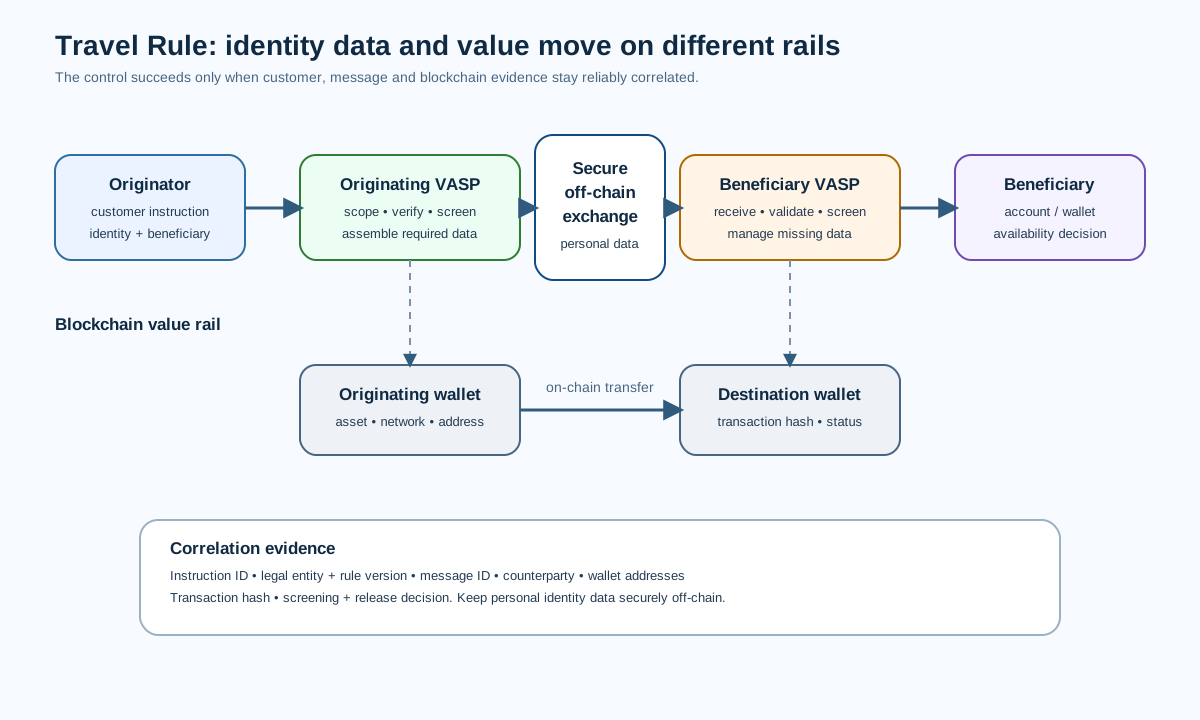
A useful way to understand the Travel Rule is to stop thinking of a crypto transfer as a single event. A bank or VASP is actually managing three related movements.
The first is the customer instruction. The customer asks the institution to move a particular virtual asset, amount and network destination. The instruction belongs to an identified relationship, channel session and product. It may contain a beneficiary name, wallet address, transfer purpose and other information gathered by the institution.
The second is the Travel Rule information exchange. Required originator and beneficiary data is assembled, checked and sent to the receiving institution or another relevant counterparty through a secure mechanism. That mechanism may be supplied internally, through a vendor, through an industry protocol, or through a combination of services. The exchange is not the asset transfer itself. It is compliance information that must be tied to the transfer and protected as personal data.
The third is the on-chain transfer. The virtual asset is broadcast and confirmed on the relevant network. That transfer has blockchain-specific identifiers such as sending and receiving addresses and a transaction hash. Depending on the asset and network, settlement may be fast and difficult to reverse. The control therefore has to decide what must be known before broadcast, what can be resolved while pending, and what can only be investigated after settlement.
The strongest architecture gives all three movements a common correlation key. An investigator should be able to start from a case, customer, blockchain hash, Travel Rule message or wallet address and reconstruct the same event. If the compliance message and blockchain transfer cannot be matched reliably, the institution has transparency data without operational traceability.
What FATF requires and what FATF does not do
FATF sets global AML/CFT standards; it does not directly legislate for a bank. Recommendation 15 brings virtual assets and VASPs into the FATF framework, and the interpretive material applies Recommendation 16 payment-transparency requirements to virtual-asset transfers. FATF's current materials require originating VASPs to obtain and hold required and accurate originator information and required beneficiary information, submit the information immediately and securely to the beneficiary VASP or financial institution where there is one, and make it available to appropriate authorities. Beneficiary institutions must obtain and hold the required originator information and required and accurate beneficiary information. Related Recommendation 16 duties, including monitoring information availability and applying sanctions-related freezing or prohibitions where applicable, also carry across.
The word accurate matters. An originating institution should not simply repeat an unverified customer-entered name as though it were known fact. The institution's KYC framework, the applicable standard and local legal requirements determine how the originator information is established and verified. The beneficiary side receives originator information from the sender but still needs controls to detect missing, incomplete, obviously inconsistent or suspicious information.
FATF also makes clear that Travel Rule information need not be attached directly to the virtual-asset transfer. This is operationally important. Putting sensitive customer names, addresses or identification data onto a public ledger would create serious privacy and security problems. The usual design is therefore an off-chain exchange protected in transit and at rest, linked to the on-chain transaction by controlled identifiers.
The FATF framework is global, but the binding details are local. A jurisdiction decides how the standard becomes law, which entities are in scope, which transfers are covered, what thresholds or exemptions apply, which information elements are mandatory, how self-hosted wallet transfers are handled, what verification is required, how missing data is treated and what records must be retained. A bank with entities in several countries cannot safely implement one hard-coded global rule and assume that it satisfies every legal perimeter.
There is another date issue that architects and policy teams need to understand. FATF agreed revisions to Recommendation 16 in June 2025 and was consulting during 2026 on guidance for the strengthened payment-transparency standard. FATF has said countries are expected to be ready to implement the strengthened changes by the end of 2030. Those future-facing changes should be tracked through regulatory change; they should not be misrepresented as if every element is already domestic law today.
Current implementation is still uneven
The Travel Rule is no longer a niche future requirement. FATF's July 2026 targeted update reported that 83% of surveyed jurisdictions had passed legislation implementing the Travel Rule, up from 73% in 2025. That is meaningful progress, but it also means global transfers still cross jurisdictions with different implementation status, technical maturity and supervisory expectations.
This unevenness creates what practitioners often call the sunrise problem: one institution is ready to send and receive the required data while its counterparty, or the counterparty's jurisdiction, may not yet operate the same requirement. The answer is not to ignore the obligation. The sending institution needs a documented decision model for counterparties that cannot technically receive the data, and the receiving institution needs a model for incoming transfers with missing or incomplete information. The exact legal answer differs by jurisdiction.
The United Kingdom provides a useful example of jurisdiction-specific implementation. UK cryptoasset businesses have been required since 1 September 2023 to collect, verify and share required information under the UK Money Laundering Regulations. The FCA states that firms remain responsible for compliance even when they use third-party suppliers. For transfers to a jurisdiction that has not implemented the Travel Rule, the UK firm should take reasonable steps to determine whether the receiving firm can receive the required information; if it cannot, the UK firm must still collect, verify and store the information before making the transfer. Incoming missing information must feed a risk-based decision rather than an assumption that the transfer is automatically acceptable or automatically prohibited.
The European Union follows its own binding framework. Regulation (EU) 2023/1113 applies from 30 December 2024 and extends transfer-information requirements to certain crypto-asset transfers where an EU crypto-asset service provider is involved. EBA Travel Rule Guidelines specify how firms should detect missing or incomplete information and manage affected transfers, including requirements connected with transfers to or from self-hosted addresses. Those are EU obligations and should not be described as global FATF rules.
Australia changed again in 2026. AUSTRAC states that obligations for new virtual-asset services, including Travel Rule requirements, were deferred until 1 July 2026 under the AML/CTF reforms. That date belongs to the Australian legal implementation, not to FATF as a whole. A group policy should therefore carry an obligation matrix by legal entity and jurisdiction rather than one date stamped across every VASP business.
The information model
A Travel Rule implementation needs a canonical information model even when different jurisdictions, vendors or counterparties use different field sets. At minimum, the model must distinguish the originator from the beneficiary, the originator institution from the beneficiary institution, the customer identity from the wallet address, and the Travel Rule message identifier from the blockchain transaction identifier.
Originator data usually comes from the institution's KYC record and transfer instruction. Beneficiary information may be supplied by the originator customer, resolved through counterparty discovery, confirmed by a beneficiary institution or, in a self-hosted-wallet case, evidenced through a different process. The architecture should record the source of each element rather than flatten all values into one profile. A name typed by a customer, a name returned by a counterparty and a name verified by an institution do not carry the same evidential weight.
Names require particular care. Transliteration, ordering of family and given names, punctuation, corporate suffixes and character sets can all produce superficial differences. The objective is not to force every party into identical spelling; it is to understand whether the data is complete enough, whether the parties can be resolved, and whether screening and monitoring can work effectively.
Wallet addresses are also not identities. An address can be controlled by a customer, an exchange, a smart contract, a merchant, a custodian or an unknown party. Address attribution from a blockchain-analytics provider can help, but attribution is probabilistic and changes over time. A Travel Rule message saying the beneficiary is Jane Doe does not prove that every future transfer to the same address belongs to Jane, and an analytics label does not replace required customer or counterparty information.
Counterparty discovery and VASP due diligence
Before a provider can send Travel Rule information, it often needs to know whether the destination address belongs to another regulated VASP and, if so, which legal entity. This is a counterparty-discovery problem as much as a messaging problem.
The institution may use customer declarations, address attribution, counterparty directories, public registers, prior transfer history or vendor intelligence. Each source has limitations. A brand name may represent several licensed entities. A VASP may change its wallet infrastructure. An address may be omnibus. A directory entry may be stale. The safe design resolves the counterparty legal entity and preserves evidence of how that resolution was made at the time of the transfer.
A successful technical handshake should not be mistaken for due diligence. A provider that can receive a protocol message is not necessarily authorised for the relevant activity, low risk, or within the bank's appetite. Relationship-level VASP risk assessment and transfer-level Travel Rule exchange are related but different controls. The bank may allow messages to a counterparty technically while restricting transfers because of sanctions, licensing, fraud, jurisdiction or risk-appetite concerns.
Self-hosted and unhosted wallets
A self-hosted wallet changes the control path because there may be no beneficiary VASP to receive Travel Rule information. That does not make the transfer automatically illicit, and it does not eliminate the institution's obligation to understand the transaction under applicable law and policy.
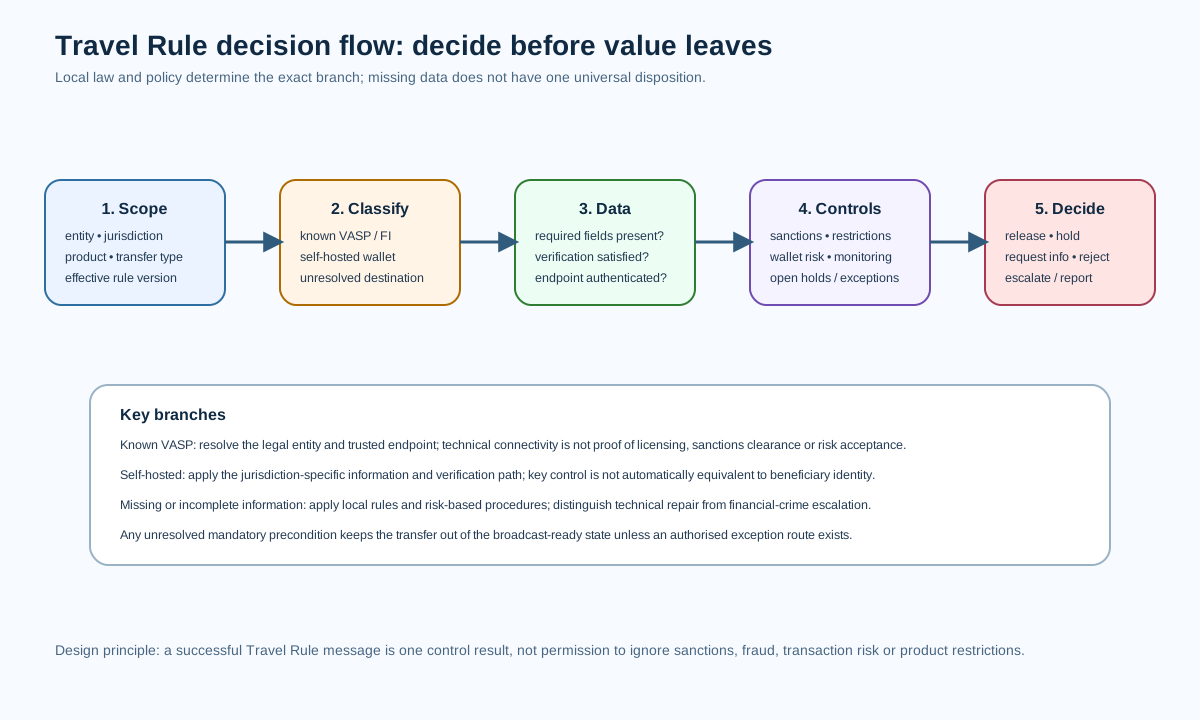
The first question is classification: is the destination actually self-hosted, or is it an address controlled by a provider that has not been identified? The second is relationship: does the customer claim to control the address, or is the address controlled by another person? The third is evidence: what does the applicable jurisdiction require the institution to collect or verify, and what additional risk controls are justified by the circumstances?
EU rules contain specific provisions and EBA guidance for transfers involving self-hosted addresses. Other jurisdictions take different approaches. A global platform therefore needs a configurable decision service rather than a single universal ownership-proof step. Some cases may require additional information or evidence; others may be handled through risk-based controls. Whatever the local rule, the system should preserve the classification, evidence, jurisdictional basis and decision.
Self-hosted-wallet controls also need to avoid false confidence. A cryptographic signature can demonstrate control of a private key in some implementations, but control of a key is not the same as knowing the economic beneficiary or proving the source of funds. Conversely, inability to perform a particular wallet-signing technique should not automatically be treated as evidence of criminality. The control objective is proportionate transparency, not technological theatre.
Sanctions, screening and transaction monitoring
The Travel Rule is a transparency control, not a replacement for sanctions screening, transaction monitoring or blockchain analytics. The extra party information can improve those controls because it gives the institution names and institutional context that a raw address may not contain.
The originating side should screen parties and counterparties in line with applicable sanctions obligations before value is released where the legal and technical model requires pre-execution interdiction. The beneficiary side may need to screen incoming information before making assets available. The exact disposition of a sanctions match depends on the legal regime: block, freeze, reject, hold, report or another outcome cannot be universalised.
Transaction monitoring should use Travel Rule data as context. Repeated transfers to changing VASPs, inconsistent beneficiary names, unexplained use of high-risk counterparties, rapid movement through several providers, recurring missing information or a mismatch between declared purpose and actual flows may all matter. None is automatically suspicious in isolation. The value comes from joining the message data with customer profile, fiat flows, wallet activity, device and channel signals, sanctions results and case history.
Blockchain analytics contributes a different evidence layer. It can identify exposure patterns, address clusters or service attribution, but it does not prove the civil identity of a person by itself. Strong investigations keep the identity evidence, Travel Rule exchange and blockchain evidence distinct so that uncertainty is visible rather than hidden behind one risk score.
Privacy and information security are part of the control
Travel Rule data can include sensitive personal information. A poor implementation can solve one financial-crime problem by creating a data-protection and security problem. The institution therefore needs data minimisation, access controls, encryption, secure transport, retention rules, incident handling and vendor oversight appropriate to the applicable privacy regime.
Only data required by law or justified by policy should be sent. The message should go to the correct counterparty, not merely to a technically reachable endpoint. Endpoint authentication matters because sending verified customer data to the wrong institution is a serious failure even if the blockchain transfer itself goes to the intended address.
Logs must also be designed carefully. A troubleshooting log that stores full identity payloads may become an uncontrolled secondary customer database. Good systems log message identifiers, status codes and controlled diagnostic information while protecting or tokenising personal data. Production support teams need enough evidence to diagnose failures without receiving unrestricted access to every customer's Travel Rule record.
The bank control architecture
The architecture normally sits across several systems rather than inside one Travel Rule engine. Customer and KYC systems provide identity. The crypto product or custody platform creates the transfer instruction. A counterparty-discovery service identifies the beneficiary provider where possible. A policy service determines which legal rule set applies. A Travel Rule gateway assembles and exchanges information. Screening services assess parties and institutions. Blockchain analytics enriches wallet risk. A transaction-control service decides whether to release, hold or escalate. Case management records exceptions and investigations. Evidence stores preserve the point-in-time decision.
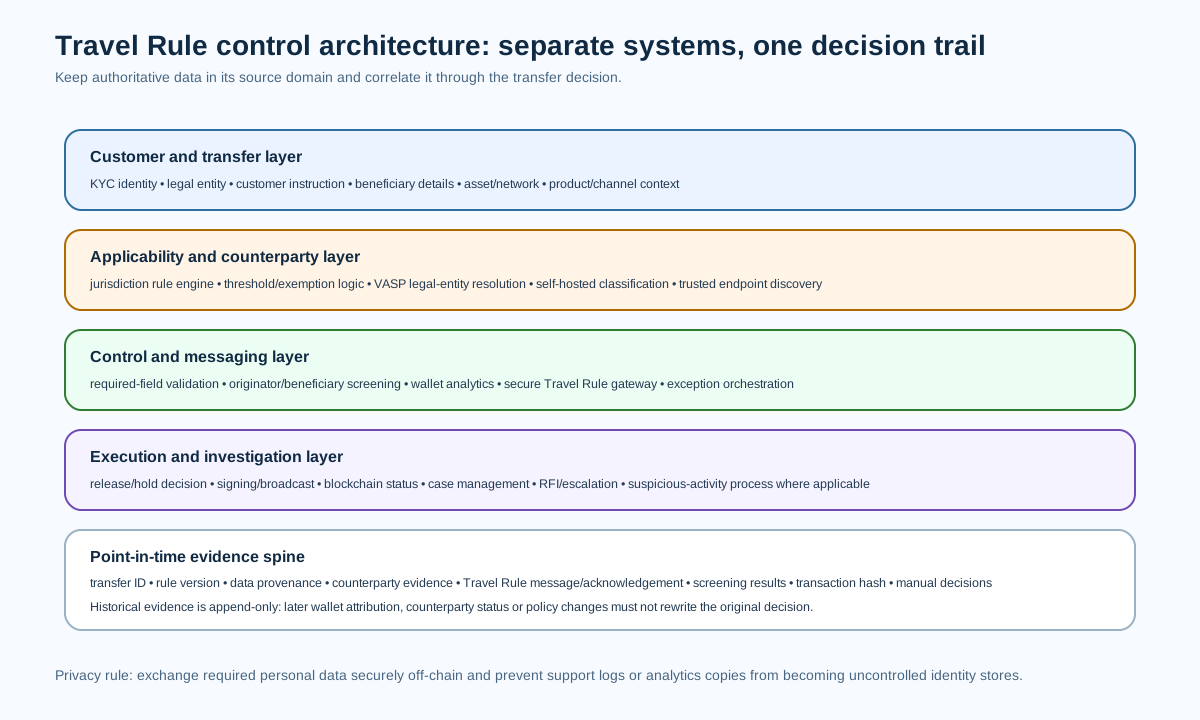
A key design principle is separation with correlation. Identity data should not be copied unnecessarily into blockchain systems. Blockchain data should not overwrite KYC. Vendor messages should not become the system of record for customer identity. Each domain should retain its authoritative data while a correlation layer connects the evidence needed for a decision.
Another principle is versioned jurisdiction logic. The decision made on 21 September 2026 should be reconstructable using the rules that were applicable on that date, not today's updated configuration. The evidence record should therefore preserve legal-entity context, jurisdiction determination, policy/rule version, counterparty status, relevant data, screening results, message status and final disposition.
Operational exceptions
Travel Rule operations are dominated by exceptions. A message can fail because a required field is missing, a counterparty cannot be found, a protocol is unavailable, the counterparty rejects the message, a name format fails validation, an endpoint certificate is invalid, the blockchain transfer is already broadcast, or the receiving institution requests more information.
The queue design should separate technical repair from financial-crime investigation. A malformed date or unavailable vendor endpoint may be an operational issue. A beneficiary name that conflicts materially with customer information, a counterparty with uncertain regulatory status or repeated missing data may need compliance review. Mixing every failure into one queue creates poor prioritisation and encourages staff to treat compliance questions as message repairs.
The institution also needs a clear rule for sequencing. If local law requires the information to be transmitted before or contemporaneously with the transfer, the system should not routinely broadcast first and attempt the message later. Where the receiving institution's system is temporarily unavailable, policy should define whether the transfer is held, retried, manually assessed or rejected. That decision must reflect local law and risk; there is no safe global default.
Governance and accountability
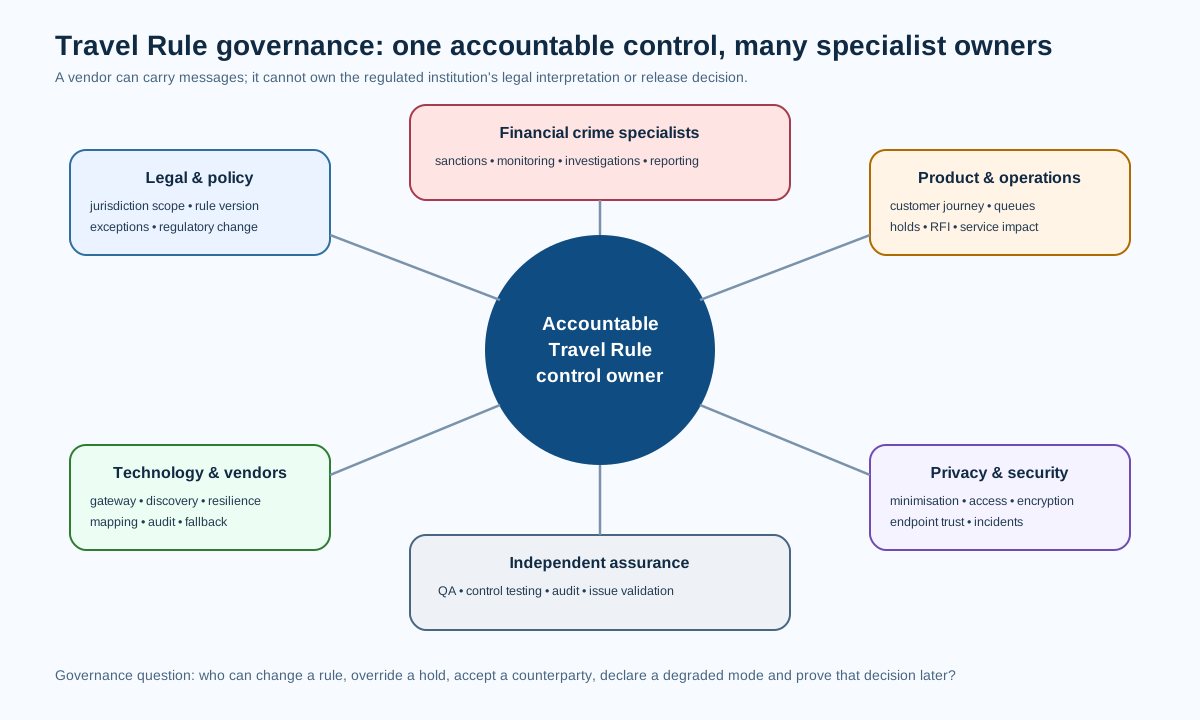
Travel Rule compliance crosses product, financial crime, legal, privacy, cyber security, data, engineering and operations. That makes ambiguous ownership dangerous. Product cannot treat it as merely a compliance message. Compliance cannot define requirements without understanding settlement timing and technical failure modes. Engineering cannot choose a vendor protocol and assume the policy problem is solved.
A workable governance model assigns one accountable control owner, supported by defined decision rights. Legal or policy teams interpret jurisdictional requirements. Financial-crime specialists define control outcomes and escalation. Product owns customer journey and service behaviour. Engineering owns reliable implementation. Operations owns exception handling. Privacy and security teams govern personal-data handling. Vendor management oversees external service dependencies. Independent assurance tests whether the combined control works.
Third-party technology does not transfer accountability. The FCA says this explicitly for UK firms: they remain responsible for Travel Rule compliance when using third-party suppliers. The same principle is sensible more broadly even where the legal wording differs. A bank should understand what its vendor does, what it does not do, how counterparties are authenticated, how outages are handled, where data is stored, how changes are governed and how the bank exits or replaces the service.
What a business analyst should be able to specify
A BA working on a Travel Rule implementation should be able to trace a requirement from obligation to data to decision to evidence. “Send Travel Rule information” is not a usable requirement. A buildable requirement says which entity and product are in scope, what triggers the exchange, which information elements are required for that scenario, where they come from, how they are validated, when they must be sent, how the counterparty is resolved, what happens when transmission fails, which screening controls run, what blocks release, what can be manually overridden, who can approve an exception and what evidence must be retained.
Acceptance criteria should cover the happy path and the ugly path. Test a fully compliant VASP-to-VASP transfer, a counterparty in a non-implemented jurisdiction, an incoming message with missing data, a self-hosted destination, a sanctions potential match, a duplicate message, a delayed blockchain transaction, a Travel Rule message that arrives without a matching transfer, vendor outage, retry after timeout, protocol mismatch, stale counterparty data and a case where the customer cancels before broadcast.
Non-functional requirements matter just as much. The system needs latency targets that fit the transfer journey, secure handling of personal data, resilience, idempotency, observability, replay controls, message authentication, audit logging and controlled retention. A crypto rail can settle quickly; a compliance service that fails slowly can become the operational bottleneck or, worse, encourage unsafe bypasses.
The practical standard
A mature Travel Rule capability does not claim success because messages are being sent. It can answer harder questions. Can the institution prove which rule applied to a specific transfer? Can it show the verified originator, the stated beneficiary, the resolved counterparty and the blockchain transaction as one event? Can it distinguish a self-hosted wallet from an unidentified provider? Can it explain what happened when information was missing? Can it demonstrate that sanctions screening occurred at the right point? Can it reconstruct the decision after a vendor has updated its data? Can it protect the personal information it exchanges?
If the answer to those questions is yes, the Travel Rule becomes more than a regulatory message. It becomes a usable transparency layer connecting identity and value movement across virtual-asset networks. If the answer is no, a green technical delivery status can hide a serious control weakness.
Operational deep dive: making the Travel Rule work under real transfer pressure
The difficult part of the Travel Rule is not knowing that originator and beneficiary information has to travel. The difficult part is deciding when the institution has enough information to release value, how to treat counterparties that are technically or legally different, and how to preserve a defensible record when the compliance message and the blockchain transaction move through different systems.
Outbound transfer orchestration
An outbound transfer should begin with scope determination, not message creation. The institution first needs to know which legal entity is serving the customer, which product is being used, where the customer and relevant service are located, the destination type, the asset and network, and which local rule set applies. A global platform can calculate this through policy logic, but it should preserve the inputs and rule version used for the decision.
The destination then needs to be classified. If a known VASP or financial institution controls the destination, the platform resolves the counterparty legal entity and obtains a trusted messaging endpoint. If the address appears self-hosted, the flow moves to the jurisdiction-specific self-hosted-wallet path. If classification is uncertain, the transfer should not be silently forced into whichever branch is easiest technically. Uncertainty is itself an operational state that needs defined evidence and escalation.
Once the counterparty is resolved, the Travel Rule payload is assembled from authoritative sources. Originator information should come from current customer records and relevant transaction data, not from free-text re-entry where avoidable. Beneficiary information may come from the customer's instruction and, in some designs, counterparty confirmation. The payload should carry enough identifiers to be linked later to the customer instruction and blockchain transfer without exposing unnecessary personal data on-chain.
Before release, the institution runs the controls required by law and policy. These can include completeness validation, identity-data checks, sanctions screening, counterparty restrictions, wallet-risk analysis, transaction monitoring and product limits. The sequencing matters. A transfer that is already irrevocably broadcast cannot be meaningfully “held” by a downstream Travel Rule workflow.
The message is then transmitted through the selected Travel Rule mechanism. Successful transmission means more than an HTTP success code. The bank should know that the endpoint belonged to the intended counterparty, the message was authenticated, required fields were accepted and a durable delivery status was recorded. A vendor saying “sent” is not sufficient evidence if the institution cannot later determine what was sent, to whom and under which rule.
Finally, the asset transfer is broadcast when the control state permits it. The resulting transaction hash is written back to the same evidence record. If a transaction is replaced, cancelled, fails on-chain or produces multiple hashes because of network mechanics, the correlation model must preserve that history rather than simply overwrite the first value.
Inbound transfer orchestration
Inbound processing starts differently because the institution may receive value, Travel Rule data or both in an unexpected order. The control needs to match the incoming message to the expected beneficiary and on-chain transfer while protecting against false associations.
When a message arrives first, the institution can validate the sender, inspect required fields, screen parties and prepare the beneficiary record before blockchain receipt. When the asset arrives first, the institution may need to identify the sending VASP through wallet attribution, transaction context or a later message. The business rule for making the assets available to the beneficiary must reflect local law and policy, especially when information is incomplete or the sending jurisdiction has not implemented the Travel Rule.
The FCA's UK guidance illustrates a risk-based approach to incoming gaps: when a transfer arrives from a jurisdiction without Travel Rule implementation and information is missing or incomplete, the UK cryptoasset business should consider the jurisdictions involved and implementation status when deciding whether to make the assets available. That is a UK expectation, not a universal rule for every market.
The EU has a separate framework. Regulation (EU) 2023/1113 and EBA Guidelines require CASPs to have procedures to detect missing or incomplete information and to manage affected transfers. The EU framework also addresses self-hosted addresses. An institution operating in both the UK and EU should therefore map the same operational event to different legal rules where necessary instead of burying regional distinctions inside one generic exception code.
Missing and incomplete information
A robust design distinguishes at least four conditions: information was never received; information was received but a required field is empty; information is syntactically present but clearly invalid; and information is present but materially inconsistent with other evidence. These conditions may lead to different actions.
A missing beneficiary name is not the same problem as a name that differs only because of transliteration. An invalid date is not the same as a sanctions hit. A provider that repeatedly sends incomplete messages is different from a one-off outage. The case taxonomy should preserve those differences because they drive remediation, counterparty management and supervisory evidence.
The response should also be proportionate. Depending on applicable law and risk, a firm may request missing information, hold or delay availability, reject or return the transfer where technically and legally possible, apply enhanced monitoring, escalate the counterparty, or restrict future activity. The chapter deliberately avoids a universal “missing data equals reject” rule because authoritative frameworks do not support one global disposition.
Repeated deficiencies need relationship-level treatment. If the same counterparty regularly sends incomplete information, operations should not solve each transfer in isolation. The institution should aggregate exception rates, determine whether the counterparty's controls are weak, assess whether restrictions are needed, and document the decision. Otherwise a systemic control weakness is disguised as hundreds of successfully closed tickets.
Protocol interoperability and vendor risk
There is no single FATF-mandated technical protocol. Industry solutions differ in counterparty discovery, identity certificates, addressing, payload formats and network coverage. That creates interoperability risk. A bank may subscribe to one network while a beneficiary VASP participates in another, or both may use vendors that cannot exchange data directly.
Architecture should therefore separate the regulatory data model from the transport adapter. The core system determines which data is required and what the business decision is. Protocol adapters translate and transport that data. This prevents a vendor schema from becoming the bank's de facto legal interpretation and makes it easier to add or replace networks later.
Vendor due diligence should cover data location, encryption, identity and endpoint authentication, subcontractors, message retention, incident notification, resilience, service-level objectives, change management and exit. It should also cover coverage truth: how does the vendor decide that a wallet belongs to a particular VASP, how current is that directory, and how are conflicts resolved?
If a vendor is unavailable, the fallback must be pre-designed. A bank should not discover during a production outage that its only options are to stop every crypto transfer or bypass the Travel Rule. Depending on legal constraints, a fallback may queue transfers, use an alternate route, invoke controlled manual handling or block release until service is restored. The fallback itself needs testing and evidence.
Correlating off-chain and on-chain evidence
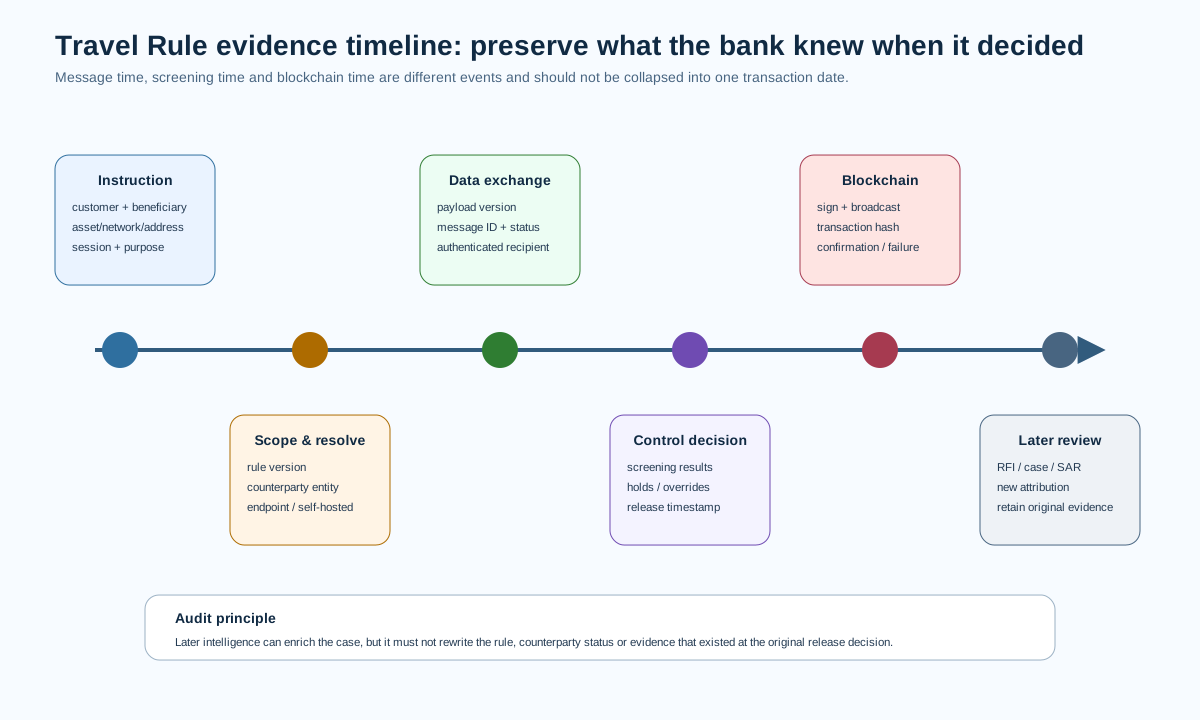
A Travel Rule control is only as strong as its correlation model. A useful evidence object contains the customer instruction ID, legal entity, rule version, counterparty identity, Travel Rule message ID, wallet addresses, asset/network, transaction hash or hashes, screening results, decision timestamps and exception/case references.
Timing should be recorded in a way that distinguishes business time from blockchain time. The Travel Rule message may be accepted at 10:00:02, the transfer signed at 10:00:05, broadcast at 10:00:06 and confirmed at 10:00:20. If a sanctions list update arrived at 10:00:04, the sequence can matter. A single “transaction date” field loses the evidence needed to explain which control ran when.
Evidence should be point-in-time. A counterparty directory entry updated next week must not overwrite the fact that the institution treated the destination as an unknown provider today. A wallet attribution that changes after an investigation should be preserved as a later intelligence event, not rewritten into the original transfer record. This protects auditability and prevents hindsight from distorting the decision history.
Requests for information, investigations and reporting outcomes
A Travel Rule exception is not automatically a suspicious-activity case. Many exceptions are caused by technical outages, data-format problems, counterparty implementation gaps or innocent customer mistakes. The operating model should therefore define a controlled handoff from repair to financial-crime investigation rather than sending every failed message directly to investigators.
A request for information should have a specific purpose. The institution may need the sending VASP to clarify an originator address, provide a missing identifier, confirm which legal entity served the customer, explain an apparent beneficiary mismatch or supply information required under the applicable local rule. The request should identify the transfer and the missing fact without disclosing internal screening logic or unnecessary intelligence. A response deadline, ownership and escalation path should be recorded so that held transfers do not become forgotten inventory.
An investigation begins when the available evidence creates a financial-crime concern rather than merely an incomplete message. The investigator should see the customer profile, Travel Rule data and versions, counterparty identity, blockchain trace, wallet attribution, sanctions results, related fiat or crypto activity, prior exceptions and any communications with the counterparty. The evidence should remain separated by source. A customer declaration that a wallet belongs to a supplier is different from the receiving VASP confirming an account holder, and both are different from a blockchain analytics label.
The investigation should ask whether the explanation is coherent across those sources. A corporate customer may have a legitimate reason to pay a new overseas supplier. Concern rises if the customer cannot explain the relationship, the named beneficiary repeatedly changes while the wallet destination remains connected, funds move rapidly through several providers, the counterparty VASP provides inconsistent data, or the blockchain path conflicts with the stated purpose. None of these facts proves laundering by itself; the strength lies in the combined pattern and jurisdiction-specific reporting test.
If the facts meet the applicable threshold for suspicious activity reporting, the Travel Rule data becomes part of the evidential narrative rather than the reason for filing by itself. Reporting terminology and thresholds differ by jurisdiction: SAR, STR and other regimes are not interchangeable labels. The case system should route the matter to the correct legal entity and reporting process, preserve confidentiality controls, and prevent customer communications from revealing that a report was filed where tipping-off or disclosure restrictions apply.
Where the concern relates instead to sanctions, the decision path may be different. A confirmed designated person or prohibited activity can trigger blocking, freezing, rejection or reporting duties depending on the sanctions regime and the institution's legal nexus. The Travel Rule can provide the party information needed to identify that exposure, but it does not determine the legal consequence. Sanctions disposition should therefore remain a specialised decision linked to, but not hidden inside, the Travel Rule workflow.
Closure also matters. If an alert is resolved because missing information is received and the transfer is legitimate, the analyst should document why the explanation was sufficient. If the case remains suspicious but the transfer can lawfully proceed, the monitoring strategy may need enhancement. If the counterparty itself is the problem, counterparty management may restrict future activity. A single “closed” status cannot capture these different outcomes.
Customer and operational impact
Travel Rule controls sit directly in the customer payment journey, so weak operating design can create unnecessary friction. A legitimate customer may face a delayed supplier payment because the beneficiary VASP cannot be resolved, a name contains unsupported characters or a messaging provider is unavailable. The bank should treat those failures seriously even when the financial-crime control is functioning as designed.
Customer communication should explain what action is needed without exposing sensitive screening logic. For example, the institution can ask the customer to confirm beneficiary information or explain that a transfer is under compliance review. It should not reveal that a particular person produced a sanctions potential match or disclose the existence of a suspicious-activity report. Scripts, channel messages and service-team permissions therefore form part of the control design.
Operations needs ageing and prioritisation rules. A high-value corporate transfer, an incoming retail transfer and a low-value self-hosted-wallet payment may have different service expectations, but legal requirements cannot be waived merely because a customer is important. Queue design should surface transfers approaching contractual or customer-service deadlines while preserving mandatory holds. Escalation should accelerate decision-making, not bypass it.
Management should also understand the economics of control quality. Poor counterparty data creates manual work, long customer waits and repeated RFIs. Better directory quality, cleaner customer data and protocol interoperability can reduce both risk and cost. The right objective is not “zero exceptions”; it is a controlled system in which genuine exceptions are identified quickly, low-risk technical failures are repaired efficiently, serious concerns reach investigators, and every release or restriction can be explained later.
Monitoring the Travel Rule control itself
Control monitoring should look beyond transfer volumes. Useful measures include the percentage of in-scope transfers with complete required data, unmatched message-to-chain events, failed counterparty resolution, messages rejected by counterparties, incoming missing-data rates by counterparty, manual override rates, self-hosted-wallet volumes, ageing of held transfers, vendor outages and the proportion of exceptions that became investigations.
Those measures need interpretation. A sudden fall in exceptions could mean improved counterparties or a broken validation rule. A high success rate could hide messages routed to the wrong legal entity. A low manual-review rate could mean good automation or unsafe auto-release. Quality assurance should sample the underlying evidence and not rely solely on dashboard percentages.
The best operating model uses the exception data to improve the control. Operations identify recurring failure patterns, engineering fixes technical causes, compliance changes policy where needed, counterparty management addresses poor senders, and testing adds regression scenarios so the same weakness does not return.
Advanced practice: requirements, architecture and testing that survive production
The Travel Rule becomes a real engineering problem when the bank has to support several legal entities, crypto networks, customer types and counterparty providers without turning every regional difference into custom code. Advanced practice is therefore about building a control that is configurable, explainable and testable.
Build an obligation-to-rule model
A mature implementation starts with an obligation catalogue. Each obligation should identify the jurisdiction, legal entity, effective date, product scope, transfer type, threshold or exemption where applicable, required information, verification rule, sequencing expectation, treatment of self-hosted addresses, exception handling and retention requirement. Legal text and policy interpretation belong in governed records, not developer comments.
The decision service then consumes those records. Given the legal entity, customer, product, asset, network, destination and counterparty, it determines which rules apply. The output should be explicit: Travel Rule in scope or out of scope, required fields, required checks, permitted dispositions and the policy version used. If the service returns only a Boolean flag, investigators and auditors will struggle to explain why two apparently similar transfers received different treatment.
Rules need effective dating. A rule that changes on 1 January must not alter the evidence for a transfer made on 31 December. Test data should include the boundary second around regulatory changes because timezone handling can create subtle production errors.
Design a canonical Travel Rule object
The bank should own a canonical data object independent of any one messaging vendor. A practical object normally contains the transfer context, originator identity, beneficiary identity, originating institution, beneficiary institution, wallet or account identifiers, jurisdiction metadata, consent or notice information where relevant, message status and correlation identifiers.
Every field should have provenance. The system should know whether a beneficiary name came from the sender, a counterparty response, an internal customer record or manual investigation. Verification status should be separate from the value. Otherwise downstream systems may treat an asserted value as verified simply because it occupies the same field.
Mapping to external protocols should occur at the boundary. One adapter may call a vendor API; another may support an industry messaging standard. The mapping layer should report loss of information rather than silently truncate or transform fields. If one protocol cannot carry a field required by local law, that is a business exception, not a harmless technical warning.
Counterparty identity needs its own service
Counterparty resolution is too important to be hidden inside a Travel Rule vendor call. A dedicated service can combine verified directories, regulatory registers, historical interactions and wallet attribution. It should identify the legal entity, not just the brand, and record confidence and evidence source.
The service also needs lifecycle events. Counterparties merge, change licences, switch vendors, rotate addresses and lose permissions. A cached decision may become wrong. High-risk changes should trigger review and, where appropriate, block or restrict new transfers until the institution understands the new position.
A Travel Rule endpoint should be authenticated separately from the VASP's general web identity. Attackers who can redirect compliance messages can obtain high-value personal data even if they cannot divert the asset itself. Certificate rotation, DNS changes, vendor directory updates and endpoint ownership therefore deserve security monitoring.
Pre-execution and post-execution controls
Controls should be divided by the point at which they can still change the outcome. Required information checks, sanctions interdiction, counterparty restrictions and certain self-hosted-wallet requirements may need to run before broadcast. Post-execution monitoring can investigate patterns and support suspicious activity reporting, but it cannot pretend to have prevented an irrevocable transfer.
This distinction should appear in requirements and test cases. A pre-execution control needs a hard latency budget, deterministic timeout handling and an explicit fail-safe or fail-operational policy. A post-execution control can tolerate more analytical latency but needs reliable event capture and linkage.
Do not let a slow compliance dependency create informal bypass behaviour. If staff repeatedly override a hold because the vendor is slow, the real control becomes “release when customers complain.” Management information should therefore show overrides by reason, owner, counterparty, channel and duration.
Idempotency, retries and duplicate protection
Travel Rule systems operate across unreliable networks. Retries are normal, but duplicates can create confusing or contradictory evidence. Each business transfer should have a stable idempotency key. Re-sending a message after a timeout should not create a second unrelated compliance event.
The receiving side should also handle duplicate messages safely. If an identical message arrives twice, the system should recognise it. If a second message changes material identity data, it should be treated as an amendment or exception, not silently replace the first record. The audit trail should show both versions and who or what initiated the change.
The same principle applies to blockchain events. Fee replacement, network reorganisation or failed transactions can alter the final transaction hash. Systems need a lifecycle model rather than a single hash field that assumes the first broadcast is final.
Testing strategy
Functional testing should begin with a scenario matrix covering legal entity, customer type, destination classification, jurisdiction, threshold state, VASP capability, message completeness, sanctions result and blockchain outcome. Pairwise testing can reduce the combinatorial volume, but high-risk combinations should be tested explicitly.
Negative tests are essential. Send a message with a missing beneficiary, malformed identifier, unsupported character set, stale counterparty certificate, wrong legal entity, duplicate ID, impossible wallet/network combination and mismatched transaction amount. Verify that the system fails in the intended place and that the customer journey does not reveal restricted investigation information.
Resilience testing should simulate vendor timeout, complete vendor outage, delayed counterparty acknowledgement, partial network partition and database recovery. Test what happens to queued transfers after recovery. A system that restarts safely but releases every previously held transfer without re-running sanctions or policy checks has not recovered safely.
Security testing should include endpoint impersonation, replay, payload tampering, unauthorised support access and sensitive-data leakage through logs. Privacy testing should confirm that only required fields are sent and that retention/deletion rules work in all copies, including vendor storage and backups where contractually applicable.
Regression testing should be tied to rule change. When a jurisdiction changes requirements, the release should include positive and negative cases proving both the new behaviour and the preservation of unaffected markets. This is especially important in a global platform where one country's legal change can accidentally alter another country's transfer flow.
Acceptance criteria that mean something
A good acceptance criterion describes evidence, not just UI behaviour. For example: when an in-scope outbound VASP-to-VASP transfer is initiated, the platform must determine the applicable rule version, populate required originator data from the authoritative customer source, capture required beneficiary data, authenticate the counterparty endpoint, transmit the required payload securely, complete configured pre-release screening, record message and decision status, and prevent asset broadcast until all mandatory preconditions are satisfied or an authorised exception route is completed.
That criterion can be tested. “System supports the Travel Rule” cannot.
The final engineering principle is simple: regulatory messaging is not plumbing. It is part of the financial-crime decision. Architecture is strong when a reviewer can move from the legal obligation to the exact data, system event, control result and final transfer outcome without reconstructing the story from disconnected logs.
Practice close: controls, acceptance criteria and review questions
A team should be able to use this chapter to challenge a real implementation. The following practice material is deliberately framed around evidence rather than a generic checklist.
Control walkthrough
Start with one outbound transfer and ask the team to show the full chain. Which legal entity serves the customer? Which rule version made the transfer in scope? Where did the originator data come from? How was the beneficiary information obtained? How was the beneficiary VASP or self-hosted address classification reached? Which endpoint received the Travel Rule message? What screening ran before release? Which event authorised blockchain broadcast? Can the transaction hash be linked back to the message and customer instruction without relying on a manual spreadsheet?
Repeat the exercise for an inbound transfer. Ask what happens if value arrives before the message, if the message arrives before value, if required information is missing, and if the sending VASP cannot be identified. The answer should be system and policy behaviour, not “an analyst will investigate.” An analyst needs a queue, evidence, decision options and authority boundaries.
Then choose one self-hosted-wallet transfer. Ask which jurisdiction-specific rule applies, what evidence was required, how the address classification was made, whether ownership or control was asserted or demonstrated, and what the system records. The team should be able to explain why its control is proportionate without pretending that one wallet-verification method proves the economic beneficiary in every case.
Example acceptance criteria
For an outbound in-scope VASP-to-VASP transfer, the transfer must not reach the broadcast-ready state until required Travel Rule fields pass validation, the beneficiary institution is resolved to an approved counterparty or authorised exception path, required pre-execution screening is complete, message delivery reaches the policy-defined state, and any open financial-crime hold is resolved. Every state transition must carry a timestamp, system actor and reason.
For an incoming transfer with missing required information, the platform must identify the deficiency, preserve the received payload, determine the applicable local treatment, prevent automatic availability where policy requires review, route the item to the correct queue, record any information request to the sending institution and capture the final disposition. Repeated deficiencies from the same counterparty must be measurable at relationship level.
For a self-hosted destination, the platform must distinguish “customer-controlled”, “third-party self-hosted”, “provider-controlled” and “unresolved” where the bank's policy uses those states. Evidence supporting the classification must be retained. A change in classification must create history rather than overwrite the original transfer decision.
For a vendor outage, the platform must enter a defined degraded state. Transfers must follow the configured fallback for the affected legal entity and jurisdiction. No support user should be able to convert a mandatory compliance failure into a successful state by editing a database field or replaying an unapproved message.
Testing pack
A minimum useful pack includes clean outbound and inbound transfers, threshold boundary cases where a local threshold exists, duplicate messages, duplicate blockchain events, unsupported character sets, missing names, invalid identifiers, mismatched wallet/network combinations, counterparty name ambiguity, counterparty licence change, self-hosted destinations, sanctions potential matches, true sanctions matches, vendor timeout, retry after timeout, delayed acknowledgement, late-arriving Travel Rule data, blockchain failure after approval and customer cancellation before broadcast.
Add privacy and security cases. Verify that a Travel Rule payload cannot be sent to an unauthenticated endpoint, that support logs do not expose unnecessary identity data, that role-based access works, that encrypted transport is enforced, and that retention or deletion processes cover secondary copies where required.
Add point-in-time audit cases. Take an old transfer and update the counterparty directory, wallet attribution and policy configuration. The old case should still show what the bank knew and which rule it used when it made the original decision.
Reviewer questions
A senior reviewer should challenge the control with a few simple questions. Can we explain the legal basis by entity and jurisdiction? Can we demonstrate that our vendor is a transport component rather than our policy engine? Can we measure missing data by counterparty? Can we stop value before broadcast when a mandatory check fails? Can we identify messages that never matched a blockchain transfer and transfers that never matched a message? Can we prove what was screened and when? Can we recover safely from a prolonged vendor outage?
If those questions produce screenshots from unrelated systems, personal spreadsheets or verbal explanations, the implementation is not yet mature. The evidence should already be joined by design.
Learner knowledge check
Why is the Travel Rule message usually separate from the blockchain transfer? Because the required identity information is sensitive and FATF does not require it to be embedded directly in the virtual-asset transaction. A secure off-chain exchange can carry the data while preserving a controlled link to the on-chain event.
Does a successful message acknowledgement mean the transfer is safe to release? No. Travel Rule completion is one control state. Sanctions, transaction risk, counterparty restrictions, product limits or other holds can still prevent release.
Does a self-hosted wallet fall outside all Travel Rule-related controls? No. There may be no beneficiary VASP to receive a message, but applicable local law and risk policy can still require information, verification or enhanced controls. EU requirements, for example, explicitly address self-hosted addresses.
Can a bank rely completely on a Travel Rule vendor? No. A vendor can provide discovery and transport capabilities, but the regulated institution remains responsible for its compliance decisions. The FCA states this explicitly for UK firms.
Why preserve old counterparty and rule data? Because an investigator or auditor needs the evidence available at the time of the transfer. Replacing historical data with today's cleaner information destroys the decision trail.
What is the strongest sign of a mature implementation? Not a high message-success percentage. It is the ability to reconstruct a transfer from customer instruction through legal rule, identity data, counterparty resolution, message exchange, screening, release decision and blockchain outcome with clear ownership and point-in-time evidence.
Final takeaway
The Travel Rule is best implemented as a joined control, not a standalone messaging feature. Identity, policy, counterparty resolution, screening, secure data exchange, blockchain execution, exception handling and investigation all have to agree on the same transfer. When those pieces are correlated and governed properly, the institution gains both regulatory transparency and better investigative evidence. When they are disconnected, the bank can send technically perfect messages while still failing to understand the movement of value.
Masterclass case: the transfer that was technically ready but not control-ready
Consider a fictional global VASP, Northstar Digital, serving a corporate customer through its UK entity. The customer instructs a transfer of stablecoins to a wallet it says belongs to a supplier. The amount is commercially plausible and the customer has made similar payments before. Blockchain analytics shows no direct high-risk exposure. At first glance the transfer looks routine.
The destination address is attributed by a vendor to an exchange brand called MeridianX. Counterparty discovery finds two MeridianX legal entities: one registered in a jurisdiction that has implemented the Travel Rule and another offshore entity serving some international customers. The vendor directory returns the brand but not a conclusive legal entity. The customer's supplier invoice names “MeridianX Custody” as the payment destination without an entity number.
A weak implementation would send the Travel Rule payload to whichever MeridianX endpoint is available, receive a technical acknowledgement and release the asset. A stronger implementation recognises that endpoint reachability has not answered the legal-entity question. The transfer is moved into counterparty-resolution exception handling before value leaves.
Operations contacts the customer for additional beneficiary information while the counterparty service checks prior transfers and regulatory data. The customer responds that the supplier uses an account at MeridianX but does not know which entity. A previous transfer six months earlier used a different MeridianX address and was routed to the regulated entity. That history is useful but not proof because large VASPs can change wallet infrastructure and entity routing.
The counterparty team sends a structured request through the Travel Rule network. MeridianX responds with the beneficiary's account identifier and confirms that the beneficiary relationship sits with its regulated entity. The response also provides the legal-entity identifier used within the messaging network. The bank now has a defensible counterparty mapping rather than a brand assumption.
During the delay, however, the sanctions service refreshes its list data. A director of the supplier appears as a potential match to a newly designated individual. The customer itself is not listed, and the destination VASP is not listed. The sanctions control therefore creates a separate hold requiring identity resolution. Travel Rule completion does not override that hold.
An analyst reviews date of birth, nationality and corporate records and determines that the director is not the designated person. The false positive is closed with evidence. The Travel Rule payload is assembled using verified originator data from Northstar's KYC system and the beneficiary information supplied and confirmed through the receiving VASP. The payload is transmitted securely, MeridianX acknowledges it, and the control service records the applicable UK rule version and screening outcomes.
Only then is the stablecoin transfer broadcast. The blockchain hash is written back to the same transfer object. Northstar preserves the customer instruction, the counterparty-resolution evidence, the Travel Rule message and acknowledgement, the sanctions alert and closure, the final approval, and the blockchain event. Months later an auditor can understand not just that the transfer succeeded, but why it was safe to release.
What the case teaches
The case exposes several boundaries that matter in production. A wallet attribution is not the same as legal-entity resolution. A Travel Rule acknowledgement is not a sanctions clearance. Historical routing is evidence, not proof of today's counterparty. A technical delay can change the risk picture because sanctions, customer or counterparty data can change while a transfer is held.
It also shows why the evidence timeline matters. If the transaction had been broadcast before the counterparty and sanctions questions were resolved, later documentation would have described a decision that no longer existed in practice. Pre-execution controls have value only when they actually sit before release.
The customer impact is real. A legitimate supplier payment was delayed. Good operations therefore needs customer communication that explains a compliance review without disclosing sensitive screening logic or tipping off a suspicious-activity process. Service teams should know expected review windows and escalation contacts, but they should not be able to bypass a financial-crime hold because the payment is commercially urgent.
For a BA, the case becomes a set of requirements: ambiguous counterparty brands must route to resolution; the transfer must remain unreleased while mandatory checks are open; sanctions refreshes must apply to held transfers where policy requires; message acknowledgement and blockchain broadcast must share a correlation ID; and all manual decisions must capture owner, reason, evidence and timestamp.
For testers, it becomes a regression pack. Change the counterparty to an unimplemented jurisdiction. Make the endpoint unavailable. Make the beneficiary data incomplete. Turn the sanctions false positive into a true match. Let the customer cancel while the transfer is held. Have the blockchain broadcast fail after all compliance checks pass. Each variation tests a different control boundary.
The most important lesson is that the Travel Rule is not a message-delivery contest. The objective is controlled transparency around a transfer. Technical success is only one part of the evidence needed to prove that the institution knew who was involved, understood the counterparty, applied the correct rule and released value for a defensible reason.
References and further reading
The chapter uses the following public, authoritative sources. Jurisdiction-specific material is identified as such in the chapter and should not be treated as a universal rule.
FATF global standards and current implementation
FATF, The FATF Recommendations, current page last updated June 2026. This is the source of the global Recommendations and interpretive notes, including the current Recommendation 15 and Recommendation 16 framework. https://www.fatf-gafi.org/en/publications/Fatfrecommendations/Fatf-recommendations.html
FATF, Public Statement – Mitigating Risks from Virtual Assets. The interpretive material explains the application of Recommendation 16 to virtual-asset transfers, including the requirement for originating VASPs to obtain and hold required originator and beneficiary information and submit it securely to the beneficiary institution. It also states that the information does not need to be attached directly to the virtual-asset transfer. https://www.fatf-gafi.org/en/publications/Fatfrecommendations/Regulation-virtual-assets-interpretive-note.html
FATF, Best Practices in Travel Rule Supervision, 2025. Practical supervisory material on implementation of the Travel Rule for virtual assets and VASPs. https://www.fatf-gafi.org/content/dam/fatf-gafi/recommendations/Best-Practices-Travel-Rule-Supervision.pdf
FATF, Seventh Targeted Update on Implementation of the FATF Standards on Virtual Assets/VASPs, 16 July 2026. Current implementation assessment, including Travel Rule adoption and remaining operational gaps. https://www.fatf-gafi.org/en/publications/Fatfrecommendations/targeted-updated-virtualassets-vasps-2026.html
FATF, FATF calls for closing of regulatory gaps as virtual asset illicit finance risks become more complex, 16 July 2026. FATF reports that 83% of surveyed jurisdictions had passed Travel Rule legislation, while implementation and supervision gaps remain. https://www.fatf-gafi.org/en/news/targeted-updated-va-vasps-2026.html
FATF, Public consultation on guidance to increase payment transparency, 24 June 2026. Explains that revisions to Recommendation 16 agreed in June 2025 are intended to be implemented globally by the end of 2030; these future-facing changes should not be confused with already-effective domestic law. https://www.fatf-gafi.org/en/publications/Fatfrecommendations/R16-Public-Consultation-June-2026.html
European Union
EUR-Lex, Regulation (EU) 2023/1113 on information accompanying transfers of funds and certain crypto-assets. The Regulation applies from 30 December 2024 and sets the EU legal framework for relevant transfers involving crypto-asset service providers. https://eur-lex.europa.eu/eli/reg/2023/1113
European Banking Authority, Guidelines on information requirements in relation to transfers of funds and certain crypto-assets transfers under Regulation (EU) 2023/1113. Final Travel Rule Guidelines covering missing or incomplete information and transfers involving self-hosted addresses. https://www.eba.europa.eu/activities/single-rulebook/regulatory-activities/anti-money-laundering-and-countering-financing-terrorism/guidelines-information-requirements-relation-transfers-funds-and-certain-crypto-assets-transfers
European Banking Authority, The EBA issues ‘travel rule’ guidance to tackle money laundering and terrorist financing in transfers of funds and crypto assets, 4 July 2024. https://www.eba.europa.eu/publications-and-media/press-releases/eba-issues-travel-rule-guidance-tackle-money-laundering-and-terrorist-financing-transfers-funds-and
United Kingdom
Financial Conduct Authority, FCA sets out expectations for UK cryptoasset businesses complying with the Travel Rule, first published 17 August 2023 and updated 6 February 2026. Covers the UK implementation from 1 September 2023, third-party supplier accountability and risk-based treatment where counterparties are in jurisdictions without implementation. https://www.fca.org.uk/news/statements/fca-sets-out-expectations-uk-cryptoasset-businesses-complying-travel-rule
Australia
AUSTRAC, What to expect from the changes to the AML/CTF Rules, 2026. Includes the transitional treatment of new virtual-asset services and the deferral of relevant Travel Rule obligations until 1 July 2026. https://www.austrac.gov.au/news-and-media/article/what-expect-changes-amlctf-rules
AUSTRAC, Changes to AML/CTF obligations: What you need to do, 1 July 2026. Current implementation guidance following the 2026 AML/CTF reforms. https://www.austrac.gov.au/news-and-media/article/changes-amlctf-obligations-what-you-need-do
Reading note
FATF standards establish the international baseline, but local legislation and supervisory guidance determine the binding rule for each legal entity and transfer. Teams should always apply the bank's current approved legal and compliance interpretation for thresholds, data fields, verification, self-hosted-wallet treatment, timing, retention and disposition of incomplete transfers.