Rules, Scenarios and Threshold Logic
Detection logic converts typology knowledge into executable tests that evaluate large volumes of customer and transaction activity, and its quality determines whether monitoring protects effectively or merely creates workload. Rules test defined conditions with deterministic outcomes — amounts above limits, velocities exceeding counts, particular combinations of geography, product or counterparty characteristics — while scenarios combine multiple conditions into behavioural patterns that individual rules cannot express. Thresholds draw the operating lines that determine when activity is surfaced for review. Those numbers can materially affect alert volumes, customer friction and missed-risk exposure, so they should be calibrated and governed rather than inherited indefinitely from historical settings nobody can explain.
The companion chapters divide adjacent territory. The transaction monitoring operating model positions detection within the end-to-end pipeline whose stages consume logic outputs as prioritised alerts. Screening versus transaction monitoring separates list-matching controls from behaviour-analysis controls while recognising that timing and technology labels differ across institutions. Behaviour and peer-group review covers the analytical techniques that advanced scenarios employ beyond static thresholds. Where those chapters frame and consume detection, this chapter builds the logic itself: rule types, scenario patterns, threshold calibration, segmentation, testing, tuning and governance.
FATF sets the global expectation that financial institutions apply a risk-based approach, conduct ongoing due diligence and scrutinise transactions so they are consistent with the institution's knowledge of the customer, business and risk profile. It does not prescribe one universal library of scenarios, one alert threshold or one vendor architecture. National and regional frameworks then translate those principles into more specific obligations and supervisory expectations. The examples in this chapter are therefore bank-practical design patterns, not a claim that every jurisdiction mandates identical rule types, committee structures, testing methods or alert dispositions.
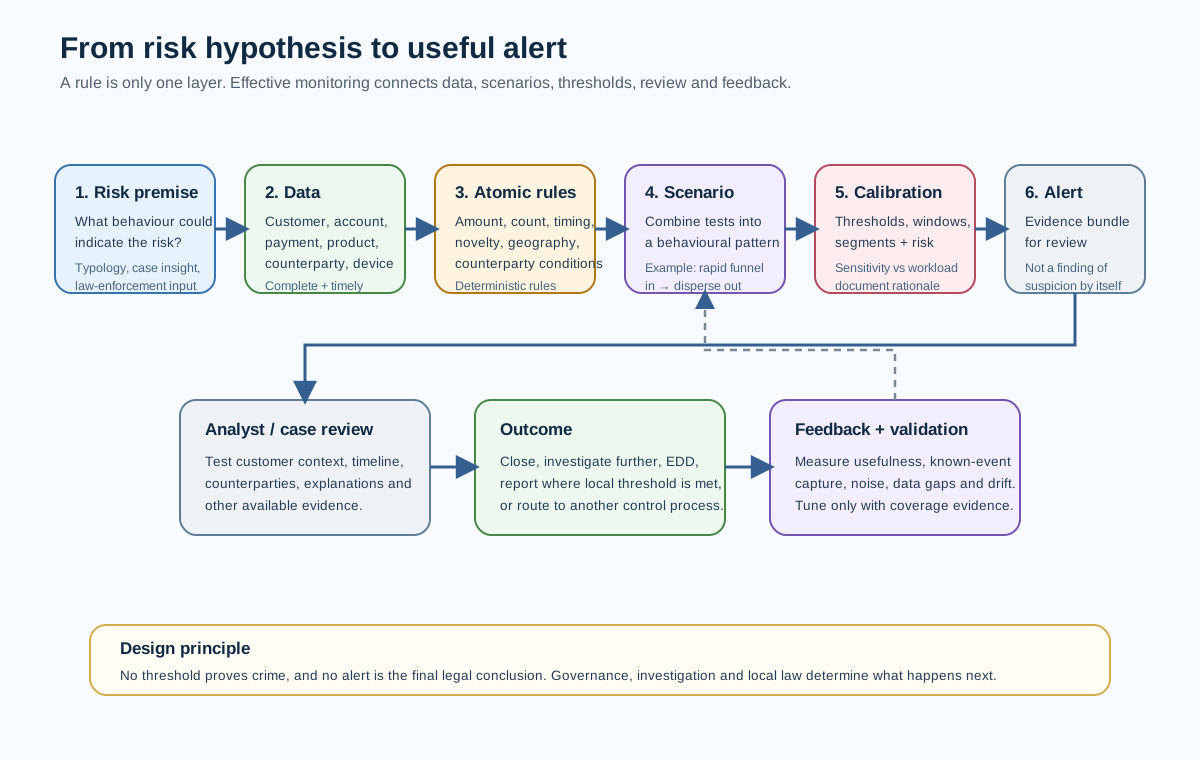
The stack above layers atomic rules into behavioural scenarios, thresholds into sensitivity controls, and segmentation into precision targeting, all governed by tuning discipline connecting threat intelligence to logic changes. Its message is that detection logic is a designed system rather than an accumulated configuration: material rules should have a clear risk or typology rationale, thresholds should have a calibration rationale, and scenario performance should be measured against the outcomes the control is intended to support.
Rule types: the atomic detection vocabulary
Atomic rules test single conditions with deterministic outcomes forming the vocabulary from which scenarios compose behavioural tests. Amount rules flag transactions exceeding value limits with structuring-aware variants detecting threshold-proximate clustering that single-transaction limits miss systematically. Velocity rules count transactions, counterparties or channels within time windows with window design reflecting typology tempo — intraday burst detection for mule-network activation, monthly aggregation for recurring patterns, or longer horizons for slow-moving activity that daily monitoring would never reveal. Geography rules can test corridor or jurisdiction conditions where those factors are relevant, but geography should be used as risk context rather than treated as proof of suspicious activity by itself.
Counterparty rules examine relationship novelty, concentration and network position with first-time-counterparty detection flagging novel relationships without treating every new counterparty as suspicious in dynamic commercial environments. Product and channel rules test facility misuse — instant-payment velocity on newly opened accounts, trade-finance structures inconsistent with customer profiles, or virtual-asset on-ramp patterns indicating rapid movement — with product mechanics informing rule design that generic transaction rules would miss. Temporal rules test timing anomalies such as dormant-account reactivation or activity inconsistent with an expected operating pattern, but the baseline must reflect the customer's actual geography, business model and channel behaviour rather than a simplistic assumption that after-hours activity is suspicious.
Rule-design discipline should give each material rule a documented risk rationale, expected behaviour, ownership and review trigger. In mature programmes, that rationale may be tied to a typology, a legal or supervisory expectation, a known control gap, a law-enforcement priority or an internally observed risk pattern. Rules without clear ownership can accumulate as folklore configuration that nobody wants to remove, while rules without performance measurement can generate volume that reviewer capacity absorbs wastefully. Periodic rationalisation should test whether logic remains useful rather than assuming age equals effectiveness.
Scenario patterns: composing behaviour tests
Scenarios combine atomic rules into behavioural patterns expressing typologies that single conditions cannot capture. Structuring scenarios assemble threshold-proximate transactions across accounts, channels and timeframes. Layering scenarios trace rapid movement through multiple accounts with velocity and network dimensions, while still distinguishing legitimate payment-processing models that can exhibit similar speed. Funnel-account scenarios detect collection-to-dispersion patterns where multiple incoming credits consolidate before onward transfer, a pattern that can occur in mule activity, fraud proceeds and informal value transfer but also in legitimate business models that therefore require careful segmentation.
Trade-anomaly scenarios compare goods descriptions, values, quantities, counterparties and routes against what the bank reasonably knows, while recognising that a bank may not possess enough technical or customs data to determine whether a trade is legitimate from payment data alone. New-account scenarios may apply heightened sensitivity during early-relationship windows where behavioural history is thin, with later tuning informed by actual activity and refreshed customer-risk information rather than permanent treatment of the customer as "new". Network scenarios evaluate entity relationships — shared devices, common counterparties, coordinated timing or linked beneficiaries — detecting organised operations invisible in single-account review.
Scenario-design methodology should translate a defined risk hypothesis into logic with documented rationale, then test that logic against representative historical or synthetic populations before production deployment where feasible. Back-testing can measure known-event capture and false-positive burden, but historical labels are imperfect because suspicious reporting is not the same as confirmed criminality and many undetected cases never become labelled data. Scenario documentation should therefore explain the risk hypothesis, data inputs, segmentation, thresholds, known limitations, testing approach, change history and decision rights. Supervisory expectations vary, but a bank should be able to explain why material detection logic is reasonable for its own risk profile and how it knows that logic continues to work.
Threshold mathematics: drawing lines honestly
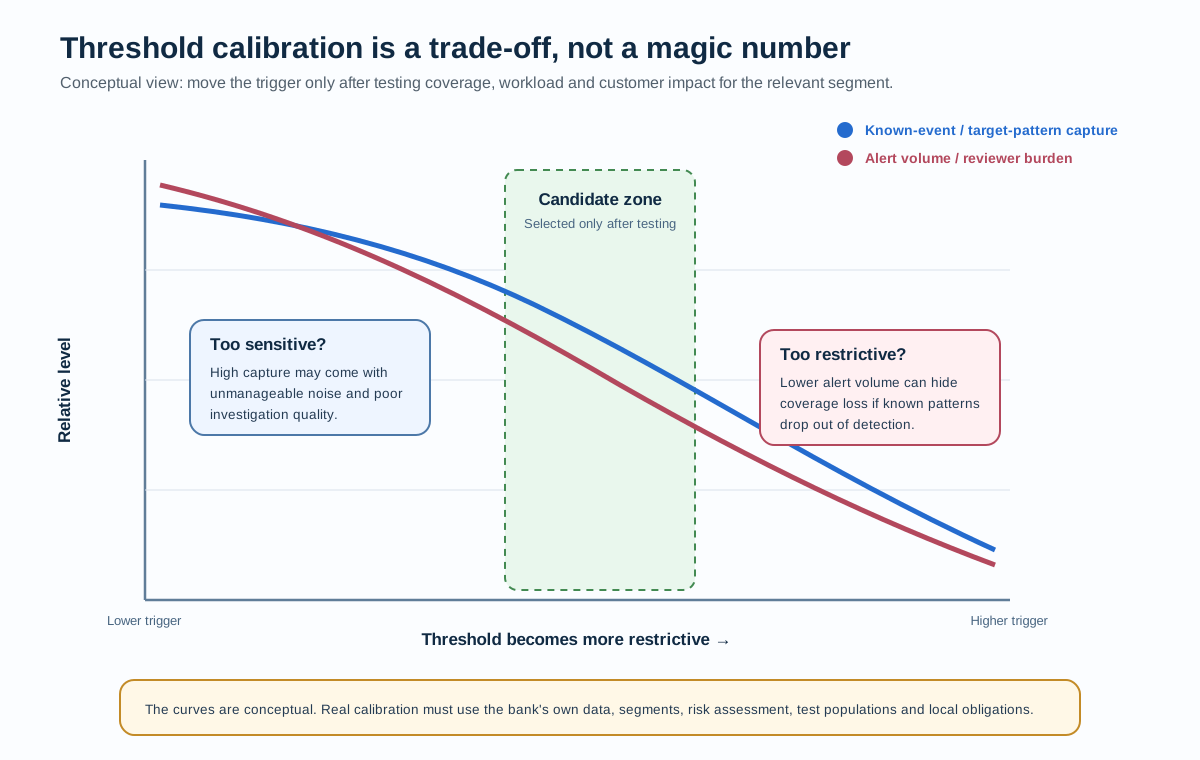
Thresholds convert continuous activity into an operational trigger. Distribution analysis examines the underlying transaction populations with percentile mapping showing what proportion each candidate threshold captures, helping the bank understand the volume implications of a change. Structuring-aware threshold design recognises that criminals may infer control boundaries through probing or repeated experience, so a monitoring programme should avoid relying on a single obvious amount threshold where the typology is specifically about evading that threshold.
Precision-coverage curves can map candidate thresholds to alert volumes and known-event capture using available labelled data, enabling operating-point selection that reflects risk appetite and operational capacity without pretending those measures are perfect estimates of true criminal detection. Segment-specific thresholds may improve precision where customer types, products or corridors behave materially differently. Exact trigger values should be treated as sensitive control information where disclosure would make evasion easier, while access inside the bank should follow legitimate operational and governance need rather than secrecy for its own sake.
Distribute, test, segment where justified, document the trade-off and protect sensitive trigger values — calibration should be explainable rather than based on round-number convenience.
Segmentation: precision through population honesty
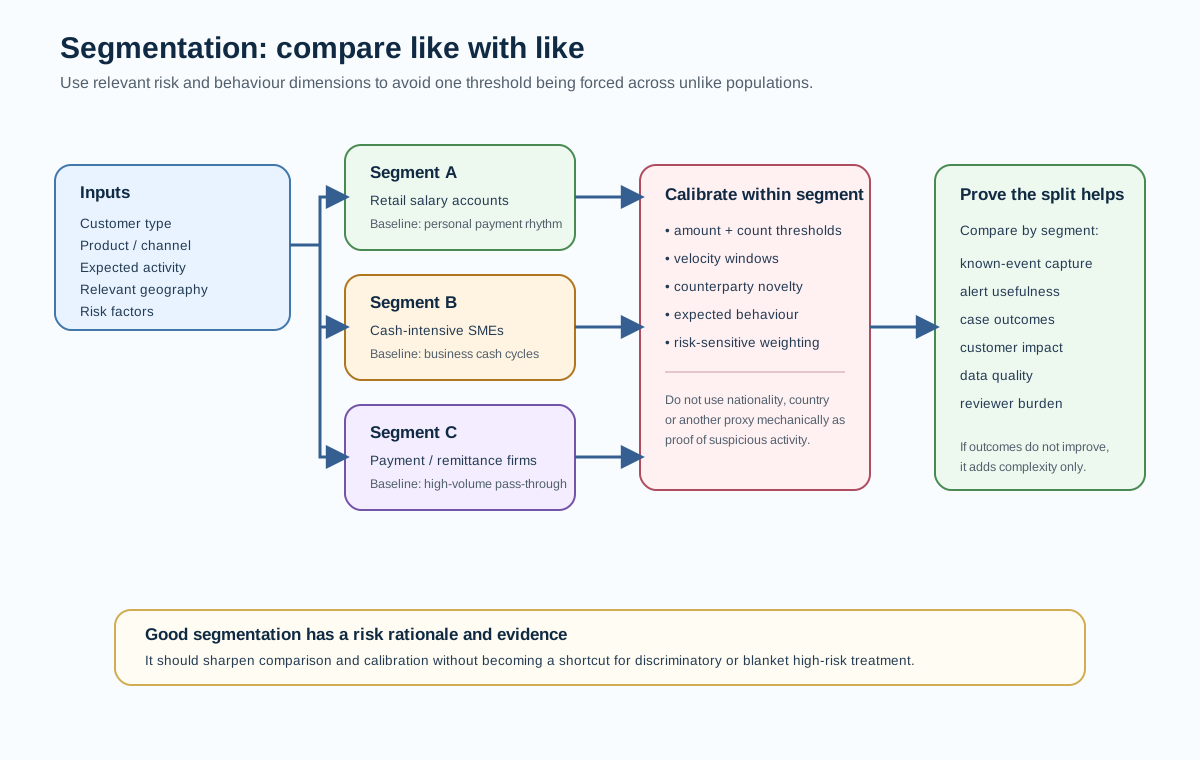
Segmentation applies detection logic differentially across populations where uniform rules mistreat heterogeneous behaviour. Customer-type segmentation separates retail, corporate, institutional and respondent-bank populations whose behavioural baselines differ fundamentally. Product segmentation distinguishes payment, lending, trade-finance and investment flows where facility mechanics matter. Geographic segmentation may be useful where corridor risk is supported by reliable risk information, but country or nationality alone should not become an automatic proxy for suspicion.
Risk-tier segmentation can adjust sensitivity where the institution's risk-based approach supports stronger monitoring for higher-risk relationships. The design should remain traceable to risk factors that are relevant to ML/TF or related financial-crime exposure and should be reviewed for unintended or unjustified bias. Each segmentation dimension needs performance measurement distinguishing genuine precision improvement from volume redistribution that merely moves alerts between queues without improving the control outcome.
Split by customer, product, geography or risk tier only where the split has a defensible risk rationale — and prove the segmentation improves detection or investigation quality rather than rearranging workload.
Velocity logic: counting what matters across time
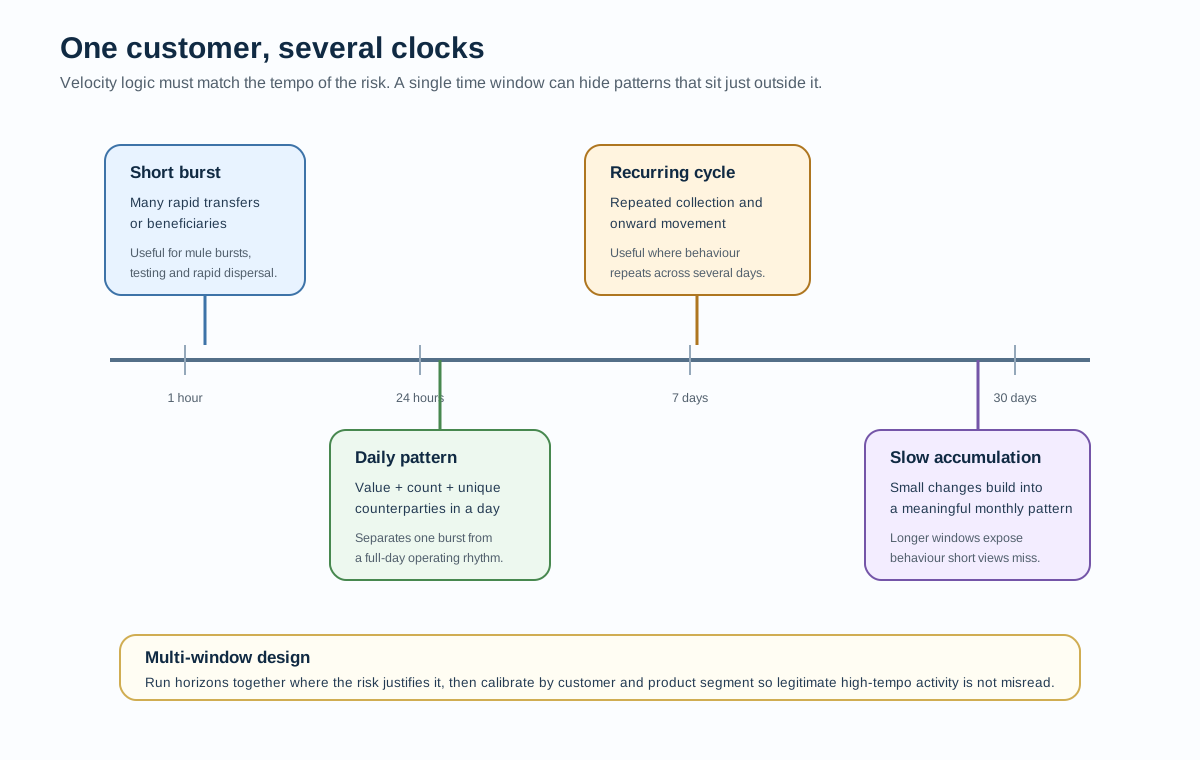
Velocity detection counts activity within time windows with window design determining what patterns emerge and what legitimate behaviour suffers false-positive burden. Window selection should reflect typology tempo: intraday windows can catch rapid mule-network bursts or repeated transfers, weekly windows can reveal recurring cycles, and monthly or longer windows can surface slower accumulation or dispersion that short windows cannot detect. Multi-window architectures can evaluate critical behaviours across several horizons simultaneously where the threat genuinely operates at different speeds.
Counterparty-velocity dimensions count distinct counterparties rather than only transaction count, detecting collection and dispersion patterns where many senders or recipients matter more than the number of payments. Channel-velocity analysis can track usage intensity across branches, devices and platforms where the bank lawfully collects and governs those data. Amount-velocity hybrids combine value and count dimensions, with calibration preventing legitimate high-volume businesses from triggering rules designed around retail behaviour.
Intraday bursts, recurring cycles and slow accumulation each need the horizon that fits the risk — a single window cannot reveal every pattern.
Geography and counterparty dimensions in logic
Geographic logic tests location attributes where they are relevant to the bank's risk assessment. Corridor analysis can evaluate origin-destination pairs against sanctions exposure, predicate-crime risk, known typologies, customer purpose and other contextual factors, but FATF grey-list status or another country-risk indicator should not be converted mechanically into a conclusion that all transactions involving that jurisdiction are suspicious. FATF's risk-based approach is explicitly about proportionate measures rather than wholesale treatment of entire customer or country categories without individual context.
Counterparty logic evaluates relationship novelty, concentration and network position. First-time-counterparty detection can flag a new relationship for proportionate review rather than suspicion by default. Concentration analysis identifies cases where one counterparty dominates flows and may justify a commercial-rationale check. Network-position analysis examines counterparty-of-counterparty patterns where data and legal permissions allow it, particularly for trade, remittance, fintech and correspondent relationships whose indirect exposure can matter. The bank should distinguish what it knows from what it infers and avoid presenting network proximity as proof of wrongdoing.
Scenario lifecycle governance from birth to retirement
Scenarios need lifecycle governance spanning ideation through retirement, but the exact governance form should be proportionate to the bank's size, complexity, jurisdiction and model risk framework. Ideation captures risk intelligence from case findings, industry alerts, law-enforcement advisories, supervisory guidance, customer-risk changes and emerging product or channel threats. Design translates the risk into logic with peer or second-line challenge appropriate to materiality. Development uses test environments and representative data to assess expected behaviour before production exposure where practicable.
Deployment may use phased rollout, parallel testing or champion-challenger techniques for material changes where those methods are feasible and proportionate. Those are useful engineering and validation patterns, not global regulatory mandates. Production operation monitors alert volumes, known-event capture, segment performance, investigation outcomes, customer impact and data quality as relevant to the scenario. Review triggers should be defined in advance where practical so performance drift prompts action instead of becoming normalised.
Retirement closes lifecycles where the risk has changed, coverage is duplicated, data no longer support the logic or sustained low value resists improvement. Retirement decisions should test whether meaningful coverage is lost and whether another control absorbs the risk. Historical versions and decision records should be retained in line with the institution's recordkeeping and change-management obligations so later assurance work can reconstruct what the control did at a point in time.
Lifecycle metrics can include scenario age, alert volume, investigation conversion, known-event capture, data-quality exceptions, backlog effect and change frequency. No single metric proves effectiveness. A scenario with a low conversion rate may still detect a rare high-impact risk, while a high conversion rate may reflect excessively narrow logic that misses most relevant activity. Governance should therefore interpret metrics together rather than optimise one number in isolation.
Threshold governance and decision rights
Threshold changes carry coverage consequences that should not rest with an uncontrolled individual decision. Some banks use formal tuning committees; others use product governance, model governance, financial-crime change forums or delegated approval matrices. The name of the forum matters less than clear authority, documented challenge and proportionate independence for material changes.
A change proposal should explain why the threshold is changing, which populations are affected, expected alert-volume movement, known-event or back-test results where available, customer-impact considerations, data assumptions, limitations and rollback criteria. Where a bank uses precision or coverage metrics, the proposal should define them clearly so approvers know what is and is not being measured. Decision records should preserve material challenge and the reason for approval, rejection or deferral rather than implying that unanimous minutes are the only sign of good governance.
Post-decision monitoring should verify that production behaviour is reasonably consistent with the change analysis. A variance may indicate implementation defect, poor test data, population drift, unexpected customer behaviour or a flawed analytical assumption. The response depends on the cause. Periodic assurance can sample threshold changes for process compliance and effectiveness without assuming every institution requires a separate threshold committee.
Risk scores inside detection: inputs, not verdicts
Customer risk scores can inform detection sensitivity without determining investigation outcomes. Score-weighted logic may adjust scenario thresholds or prioritisation by customer tier where policy supports that design, but an alert still requires evidence-based review. A high customer-risk rating should not be treated as proof that a transaction is suspicious, and a low rating should not immunise activity from review where behaviour contradicts expectations.
Dynamic risk information can change over time, but clean transactional history should not automatically erase static or externally supported risk factors. Any re-rating, decay or sensitivity adjustment should follow the bank's customer-risk methodology, applicable regulatory expectations and documented governance. For example, a relationship can show stable legitimate behaviour while still requiring enhanced measures because of PEP status, product exposure or another risk factor that does not simply disappear with time.
Score-transparency requirements should let reviewers understand which factors affected sensitivity or prioritisation at a level appropriate to the control. Model or rule validation should test whether score-driven logic behaves as intended across relevant customer and business segments. Where personal or demographic data are involved, privacy, data-protection and discrimination obligations vary by jurisdiction and must be assessed separately rather than assumed from AML/CFT requirements alone.
Alert-burden economics and reviewer capacity
Tuning changes alter reviewer workload, sometimes nonlinearly, because a modest threshold move can cause a large change in alert volume for a densely populated distribution. Workload-impact forecasting should therefore use historical scenario behaviour where available rather than a simple linear assumption. Segment-level analysis helps identify where a proposed tuning change reduces noise genuinely and where it merely shifts the burden elsewhere.
Capacity planning should consider sustained versus temporary demand, staff skill, quality review, escalation depth, queue ageing and surge options. Cross-trained reviewer pools, automation that pre-assembles evidence and vendor support can help, but each arrangement needs quality controls and clear accountability. Excessive backlog and sustained overload can degrade investigation quality even where nominal staffing ratios appear adequate.
Reviewer-experience metrics, quality sampling and attrition trends can provide early evidence that a monitoring design is operationally unhealthy. They should not be used to justify lowering thresholds simply to make queues look better. The control question remains whether the bank can investigate relevant alerts in a timely and defensible way while preserving adequate detection coverage.
Detection inventory rationalisation programmes
Detection inventories can accrete logic while criminal methods, products and customer behaviour evolve. Periodic rationalisation programmes help identify obsolete, duplicative or low-value scenarios without turning alert reduction into the primary objective. An inventory should record ownership, risk rationale, data dependencies, performance indicators, recent changes and known limitations for each material scenario.
Candidate retirement should test removal safety by examining whether the risk remains relevant and whether other controls cover the same behaviour. Phased deactivation or shadow monitoring can be useful for material scenarios where uncertainty remains. A scenario should not be removed merely because it produces many alerts, nor retained merely because it has existed for years.
Rationalisation is most effective as continuous portfolio management rather than an occasional purge. New scenarios should prompt a review of overlap with existing logic, and persistent poor performance should trigger analysis rather than silent acceptance. Success is measured by a more understandable and effective control portfolio, not simply by fewer rules.
Scenario performance benchmarking across institutions
External benchmarking can be useful where comparable, lawfully shareable data exist, but institutions should be cautious about treating another bank's alert rate or threshold as a target. Customer populations, products, geographies, data quality, legal obligations and investigation practices differ materially. A benchmark that ignores those differences compares operating models rather than detection quality.
Where industry consortiums or information-sharing arrangements permit aggregated performance comparison, metric definitions must be standardised enough to make the comparison meaningful. Peer information can identify questions worth investigating, but it does not replace institution-specific calibration. A bank should be able to explain why its own logic is appropriate for its risk profile rather than defend a threshold only because peers use something similar.
Machine-learning detection models and validation
Machine-learning models can identify pattern combinations that static rules may not capture, but they also introduce data, explainability, validation and governance challenges. Supervised models depend on labelled historical outcomes that can contain bias and incomplete ground truth. Unsupervised models can surface novel behaviour but often require substantial investigation to distinguish meaningful anomalies from normal variation. Hybrid designs can combine machine learning with rule-based controls where each technique addresses a different part of the risk.
Validation methodology should test representative suspicious and legitimate populations, segment performance, data lineage, stability and known limitations. Challenger-model benchmarking can be useful where feasible. Explainability should be sufficient for the people accountable for decisions to understand why activity was surfaced and what evidence should be reviewed, even if the underlying model is mathematically complex.
Deployment governance for machine-learning models should be proportionate to materiality and the bank's broader model-risk framework. Parallel testing, phased cutover and rollback capability are useful techniques where practical. Performance monitoring should look for drift in input populations and outcome quality, with controlled retraining and versioning. Wolfsberg's 2024 and 2025 monitoring statements are useful industry guidance here: they encourage institutions to move beyond narrow traditional transaction monitoring while emphasising effectiveness, responsible transition, explainability and a balance between model risk and financial-crime risk.
References and further reading
- Financial Action Task Force (FATF), The FATF Recommendations: https://www.fatf-gafi.org/en/publications/Fatfrecommendations/Fatf-recommendations.html
- Financial Action Task Force (FATF), Risk-Based Approach for the Banking Sector: https://www.fatf-gafi.org/en/publications/Fatfrecommendations/Risk-based-approach-banking-sector.html
- Basel Committee on Banking Supervision, Anti-money laundering and counter-terrorist financing (Basel consolidated guidelines, 2026): https://www.bis.org/committees/bcbs/basel-consolidated-guidelines/module/afs/10
- Wolfsberg Group, Statement on Effective Monitoring for Suspicious Activity, Part I: Moving Beyond Automated Transaction Monitoring (2024): https://wolfsberg-group.org/resources/general/168
- Wolfsberg Group, Statement on Effective Monitoring for Suspicious Activity, Part II: Transitioning to Innovation (2025): https://wolfsberg-group.org/resources/195/202
- European Banking Authority, Guidelines on ML/TF risk factors (EU; consolidated): https://www.eba.europa.eu/sites/default/files/document_library/Publications/Guidelines/2023/EBA-GL-2023-03/1061654/Guidelines%20ML%20TF%20Risk%20Factors_conslidated.pdf.pdf
- US Federal Financial Institutions Examination Council, BSA/AML Examination Manual: Suspicious Activity Reporting (United States): https://bsaaml.ffiec.gov/manual/AssessingComplianceWithBSARegulatoryRequirements/04
- UK Financial Conduct Authority, Financial Crime Guide (United Kingdom): https://handbook.fca.org.uk/handbook/fcg
Operational deep dive: back-testing, controlled deployment and coverage proof
The base chapter established detection-logic design. This deep dive focuses on the validation disciplines that help a bank decide whether a rule, scenario or threshold change is ready for production: representative historical testing, careful use of outcome labels, controlled comparison where feasible, structuring-aware validation and explicit analysis of what coverage changes when logic is tuned.
Back-testing on labelled history
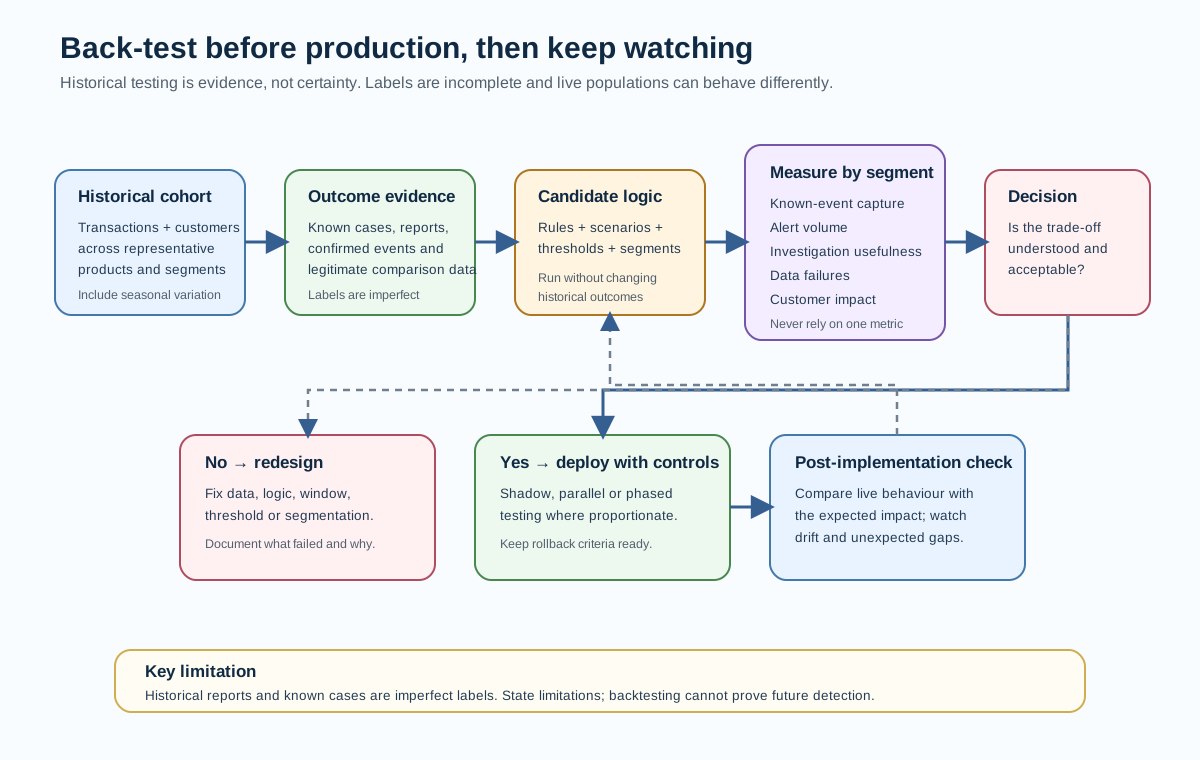
Back-testing runs proposed logic against historical customer and transaction data to estimate how it would have behaved. The value is practical: teams can compare alert volume, segment effects and capture of selected known events before exposing current customers to the change. The limitation is equally important. Financial-crime labels are incomplete. A suspicious activity report represents a reporting decision, not a court finding; a closed alert may have been resolved because available evidence was insufficient, not because the activity was objectively benign; and undetected criminal activity has no label at all.
A useful test population therefore combines several forms of evidence. Previously escalated or reported cases can provide known-event examples. Law-enforcement-confirmed matters may offer stronger ground truth where the bank is permitted to use them. Quality-assured false-positive examples help test legitimate look-alikes. Representative ordinary activity is needed across customer, product and geography segments so a scenario is not validated only against the population in which it was easiest to detect suspicious behaviour.
Test-window selection should cover enough time to include meaningful seasonal and business variation. Payroll dates, holidays, tax periods, campaign activity, product migrations or major customer-behaviour changes can distort results if the test period is too narrow. Conversely, very old data may reflect products, customers or source systems that no longer resemble production. The correct window is therefore a design decision to explain rather than a fixed universal number.
Known-event retention asks whether the proposed change still surfaces the selected previously identified patterns. Noise analysis asks what new legitimate activity is pulled into the alert population. Both should be segmented where material, because a change can improve aggregate results while degrading a smaller population badly. Neither metric should be advertised as a complete true-positive or false-negative rate unless the institution genuinely has the ground truth needed to calculate those measures.
Validation data and peer information
Thin customer populations can make calibration difficult. A bank may have too few comparable customers to establish a stable behavioural baseline for a specialised product, corridor or business model. External typology information, industry publications, law-enforcement advisories and lawful information-sharing arrangements can help the bank understand plausible risk patterns, but they do not remove the need to validate logic against the institution's own data and operating model.
Where an institution participates in a consortium or privacy-preserving information-sharing arrangement, governance should define what data can be contributed, how it is protected, what purposes are permitted and how quality is assessed. The legal basis for sharing varies significantly by jurisdiction and data type. A design that is lawful for one group entity or country should not be assumed to transfer automatically across the bank's footprint.
Peer information is most useful as a question generator rather than a calibration shortcut. If comparable institutions report a particular typology or control weakness, that should prompt analysis of whether the bank has similar exposure. It does not mean the bank should import a peer's threshold, model score or alert rate without testing whether the customer population, products and data are comparable.
Scenario documentation for assurance and supervision
A material scenario should be explainable without relying on the memory of the developer who built it. Documentation should normally identify the risk hypothesis, source data, key fields, segmentation, thresholds or weights, scenario version, known limitations, testing evidence, change history, ownership and the downstream alert or case process. The level of detail should be proportionate to materiality and to the institution's local governance framework.
Supervisors and auditors can legitimately ask how the institution knows its monitoring is appropriate for its risk profile. In the United States, for example, the FFIEC BSA/AML Examination Manual explicitly discusses reasonable filtering criteria, documentation, periodic review and testing. EU guidance expects transaction monitoring to be effective and risk-sensitive. Those sources do not create one global scenario-documentation template, but they support the broader principle that a bank should be able to explain and evidence material monitoring logic.
Documentation should change when the control changes. A threshold update that leaves the design document untouched creates a historical record that no longer describes production. Versioned documentation and configuration provenance allow investigators, testers, auditors and regulators to reconstruct which logic generated an alert at a particular time.
Champion-challenger and controlled production comparison
Historical testing cannot reproduce every live condition. Current customer mix, new products, source-data timing and operational behaviour may differ from the back-test population. For material changes, some banks therefore run candidate logic in shadow or parallel mode beside existing production logic. The candidate can generate comparison data without immediately changing customer or investigator outcomes.
The value of this approach is discrepancy analysis. Which alerts appear only under the candidate? Which disappear? Are the differences concentrated in a customer segment, product, corridor or source-system version? Do investigators consider the candidate alerts more useful, or has the change simply moved noise? This live evidence can reveal assumptions that historical testing missed.
Champion-challenger is not mandatory for every bank or every threshold change. Small institutions, simple rule changes or technology constraints may make another testing method more proportionate. Where parallel comparison is used, cutover criteria and rollback expectations should be agreed before the test so teams do not reinterpret success after seeing the results.
Structuring detection beyond a single threshold
Structuring is a useful example of why monitoring cannot rely on one transaction limit. If the risk hypothesis is deliberate fragmentation to avoid a reporting, control or detection boundary, then a rule that looks only for transactions above that boundary can be evaded by amount adjustment. Effective analysis may need aggregation across transactions, time windows, accounts, branches, channels or linked parties, depending on the product and the data available.
Threshold-proximate analysis can look for unusual concentration immediately below a relevant amount, but clustering is not proof of structuring. Legitimate businesses can generate round-number or just-below-limit distributions for commercial reasons. Calibration should therefore compare the observed pattern with the customer's business model, peers, historical activity and other evidence. Segment-specific testing is essential because a cash-intensive merchant and a salary-account customer can have very different legitimate distributions.
Network analysis can extend the view across linked accounts or common beneficiaries where the bank has a lawful and reliable basis for those links. Shared address, device, phone number or counterparty information can be informative, but weak connections should not be converted into guilt by association. Entity-resolution confidence and data provenance belong in the investigation evidence.
Evasion testing can probe obvious boundary weaknesses defensively. Testers can split a synthetic pattern across adjacent time windows, vary amounts around a threshold, rotate counterparties or distribute activity across linked accounts to see whether the design fails in predictable ways. The purpose is validation of the bank's control, not publication of production trigger values.
Coverage-delta analysis for material changes
A tuning change can reduce alert volume while also removing detection. Coverage-delta analysis makes that trade visible by comparing which known patterns, scenarios, segments or behaviours are surfaced before and after the change. The exact method depends on the control and available labels. For a threshold adjustment it may compare known-event retention and alert populations; for scenario retirement it may test whether other controls surface the same representative cases; for a data-field change it may examine which logic can no longer evaluate its original conditions.
Coverage delta should not be presented as perfect measurement of unknown crime. It is a structured way to ask, “what do we know we are gaining or losing?” If a change deliberately accepts lower sensitivity in one area because another control is stronger, that decision should be visible and supported by evidence rather than hidden inside a net alert-reduction figure.
Maintaining a change history helps reveal accumulated drift. Five small threshold adjustments may each appear harmless while collectively moving a scenario far from its original operating point. Periodic review should therefore consider the cumulative effect of changes, not only the last ticket in isolation.
Post-implementation validation
Deployment is not the end of validation. After release, the bank should compare actual alert volume, segment distribution, data-quality exceptions, case usefulness and other agreed measures with the expectations used to approve the change. A material variance needs explanation. The cause may be a coding defect, a test-population weakness, a changed customer mix, a missing source feed or an incorrect analytical assumption.
Rollback is one possible response where the change creates unacceptable risk, but not every variance requires immediate reversal. Some may be corrected through data repair, segmentation changes or further tuning. What matters is that the bank notices the difference and has a governed way to respond rather than allowing production drift to become the new undocumented baseline.
The validation discipline across the whole lifecycle is therefore iterative: define the risk hypothesis, test representative data, state label limitations, compare outcomes, deploy proportionately, observe production and feed evidence back into the next version. That is a stronger foundation for monitoring effectiveness than either blind faith in legacy rules or uncritical enthusiasm for a new model.
Advanced practice: tuning operations, burden management and governance
The base chapter and deep dive established logic design and validation. This supplement addresses the operational disciplines that keep detection useful in production: tuning workflows responding to measured performance, alert-burden management that does not quietly abandon coverage, false-positive root-cause analysis, vendor-scenario ownership and proportionate governance for material logic changes.
Tuning operations responding to measured performance
Tuning workflows convert performance evidence into controlled changes through request intake, impact analysis, testing, approval, deployment and post-implementation review. Requests can come from deteriorating scenario performance, investigator feedback, data-quality findings, new typology intelligence, product changes, internal audit, independent validation, law-enforcement information or supervisory findings. Prioritisation should reflect risk and materiality rather than whoever has the loudest operational complaint. A known coverage gap may reasonably outrank a noise-reduction request, while a large false-positive source that consumes scarce investigation capacity may itself become a material control problem.
Impact analysis should be proportionate to the change. A minor wording or enrichment change may not require the same evidence as a material threshold increase affecting millions of transactions. For significant changes, the bank should understand expected alert-volume movement, known-event or historical-case capture where usable labels exist, segment effects, data assumptions, customer impact and any meaningful coverage trade-off. Back-testing can help, but its limitations must be explicit because historic labels are incomplete and suspicious reporting is not equivalent to confirmed criminality.
Deployment scheduling should account for operational capacity. Several tuning changes released together can alter queue composition in ways that individual analyses do not predict. Staggered deployment, shadow testing, parallel evaluation or phased cutover can be useful for higher-risk changes where the institution's technology and governance allow them. These are good control-engineering techniques rather than globally mandated steps, and the bank should choose a method proportionate to the risk of the change.
Alert-burden management without coverage surrender
Reviewer alert burden determines whether technically sound detection becomes usable investigation. Burden measurement should go beyond raw alert count because ten simple name-disambiguation cases are not equivalent to ten multi-account network investigations. Useful capacity views consider complexity, ageing, escalation rates, quality results and the time needed to assemble evidence. Forecasting should also distinguish temporary surges from structural growth that needs sustained staffing, automation or scenario redesign.
Burden reduction is legitimate when the control becomes more precise without creating an unexamined blind spot. Better customer profiles, improved data, sensible segmentation, duplicate suppression, stronger network resolution and scenario redesign can all reduce noise. Raising a threshold merely because the queue is large is a different decision: it changes the control's sensitivity and should be evaluated as such. The correct question is not “did alerts fall?” but “what happened to detection usefulness, known-event capture, customer impact and investigative quality after the change?”
Reviewer-experience signals also matter. Sustained overload can encourage shallow closures, reduce curiosity and increase inconsistency even where formal service levels appear green. Quality sampling, ageing analysis, rework, escalation patterns and attrition can reveal that the operating model is under strain. Those indicators should trigger capacity or control-design review, not automatically lower sensitivity to make the dashboard look healthier.
False-positive root-cause programmes
False positives consume investigation capacity that genuine risk needs, so root-cause analysis should address why they occur rather than repeatedly clearing the same symptom. A practical taxonomy can separate stale or incomplete customer-profile data, threshold miscalibration, inappropriate segmentation, source-data defects, duplicate signals, scenario-logic flaws and workflow problems. Each cause belongs to a different owner: a data-quality problem is not solved by teaching analysts to close faster, and a weak scenario is not fixed by asking relationship managers for more documentation on every alert.
Measurement should track noise by scenario and segment while avoiding a simplistic target of zero false positives. A financial-crime detection control that never alerts on legitimate activity may simply be too narrow. The goal is proportionate precision: reduce avoidable noise while preserving meaningful coverage. When remediation changes the logic, the same testing and change-governance discipline should apply as for any other material tuning decision.
Vendor-scenario management and customisation
Vendor-supplied scenarios can accelerate implementation, but they do not transfer responsibility for control effectiveness to the vendor. Generic content must be assessed against the bank's products, customers, geographies, data fields and risk assessment. A scenario calibrated on one institution's population can perform poorly on another, even when the typology name is identical.
Customisation may include threshold recalibration, segment definitions, field mapping, local typology extensions and removal of logic that the bank cannot support with reliable data. Version control should distinguish vendor baseline from bank modification so upgrades do not silently overwrite local calibration. Regression testing should confirm that material customisations still operate as intended after product releases, data migrations or vendor model updates.
Performance conversations with vendors should use the bank's own evidence rather than accept marketing benchmarks as proof. Where supplied logic performs poorly, the institution can tune, supplement, replace or retire it according to its governance and contractual options. The decision remains the bank's because the regulatory and customer consequences of weak detection sit with the institution using the control.
Reviewer-capacity economics for tuning decisions
Threshold changes can alter workload nonlinearly because transaction populations are often dense around particular ranges. A small numerical change may therefore cause a large alert-volume swing. Historical elasticity analysis can help estimate that effect by scenario and segment, although product or customer changes may make past behaviour an imperfect predictor.
Temporary surge capacity, cross-trained investigators, automation that pre-assembles evidence and external support can each help absorb demand, but quality and accountability must remain clear. External staff cannot compensate for unclear decision standards or poor source data. Automation can reduce search time but should not turn an unexplained model score into an investigation conclusion.
The business case for a tuning change should therefore look at more than reviewer hours saved. It should consider coverage, downstream case quality, customer friction, remediation cost if the change fails, and the ability to reverse the change safely. A low-cost change that creates a long-lived blind spot is not efficient merely because the operating budget improves.
Governance for material tuning decisions
Many banks use a tuning committee, model governance forum, financial-crime change board or similar body for significant detection changes. Others use delegated approval matrices with second-line or independent challenge. There is no single globally required committee structure. What matters is that authority, materiality thresholds, challenge, evidence requirements and accountability are clear enough that a consequential change cannot be made informally because one team wants fewer alerts.
For a material change, decision makers should receive enough evidence to understand the risk hypothesis, affected populations, testing results, expected volume change, known limitations, coverage implications and rollback criteria. Independent challenge should be meaningful rather than ceremonial. If reviewers disagree materially, the record should show the concern and how it was resolved rather than erasing dissent to make minutes appear unanimous.
Post-implementation review closes the loop. Production behaviour should be compared with the assumptions used to approve the change. Unexpected alert collapse, concentration in a previously quiet segment, deterioration in case quality or a new data gap should trigger investigation. Governance is effective when it can change course in response to evidence, not when every proposal receives a formally complete approval pack.
Practice close: checklists and acceptance criteria
This supplement converts the chapter into practical delivery artefacts for business analysts, control owners, architects, developers, testers and operations teams. The aim is to make a monitoring change testable without pretending that one bank's governance model or numerical threshold is universal.
BA checklist before accepting detection logic
A rule or scenario requirement should explain the risk hypothesis it is intended to address, the population in scope, the data fields required, the time window, the trigger logic, the expected alert output and the owner of the control. Where the logic is derived from a typology, supervisory expectation, internal case finding or product risk, that parent rationale should be traceable. Requirements should also identify important exclusions and limitations so later reviewers know what the control was never designed to detect.
Threshold requirements should explain the calibration method rather than only the final number. Useful evidence can include transaction distributions, known-event testing, representative legitimate activity, segment-level alert forecasts and the reason a particular operating point was selected. Exact thresholds may be sensitive control information; access and documentation should therefore follow the bank's security and governance standards rather than appear in customer-facing material.
Segmentation requirements should define why populations are separated and how each split relates to relevant risk or behaviour. A segment should not exist merely because a data field is available. Geography, nationality, occupation or customer type can have legitimate risk relevance in some contexts, but none should be treated mechanically as proof of suspicious activity. Testing should confirm that segmentation improves monitoring or investigation quality rather than simply moving alert volume between queues.
Tuning requirements should identify change materiality, required testing, approvers, implementation controls, rollback expectations and post-implementation review. Coverage-impact analysis should be proportionate to the change. Where a threshold increase or scenario retirement could remove meaningful detection, the proposal should show how that risk was assessed and whether another control covers the same behaviour.
What good acceptance criteria look like
Good acceptance criteria describe observable outcomes. For example: the scenario receives the required source feeds with reconciled completeness checks; the time window is calculated consistently across time zones; a seeded structuring pattern generates an alert with the expected evidence fields; a representative legitimate high-volume business does not trigger merely because it exceeds a retail baseline; a threshold configuration change is versioned and traceable; and the alert can be linked to the customer, transactions and scenario version used at the time of detection.
Where historic labels are used, criteria should say what those labels actually represent. A suspicious activity report is not proof of criminality, and a closed alert is not necessarily proof that the underlying activity was harmless. Known-event retention can be valuable testing evidence, but it should be described honestly as one signal of control performance rather than an absolute measure of true-positive detection.
Weak criteria describe only deployment activity: “scenario configured”, “threshold updated”, “testing completed” or “alert volume reduced”. Those statements prove that work happened, not that the control behaves as intended. A useful sign-off tells a tester what to observe and gives the approver evidence that the change has not silently altered a different population or broken the investigation workflow.
Tuning-proposal review checklist
A material tuning proposal should answer four groups of questions. First, what risk problem is being solved? Is the change intended to close a coverage gap, reduce avoidable noise, respond to a data change, adapt to a typology or address an operational failure? Second, what evidence supports the proposed change? This may include historical testing, investigator examples, transaction distributions, scenario performance and data-quality analysis.
Third, what could be lost? Reviewers should understand which customer and product segments are affected, whether known patterns drop out of detection, whether alert volumes shift to another queue, and whether a lower workload is being achieved by abandoning relevant coverage. Fourth, how will the bank know whether the change worked? Post-implementation measures and rollback conditions should be agreed before release where practical, not invented only after performance deteriorates.
For higher-risk changes, independent or second-line challenge can test whether the evidence supports the conclusion. Some institutions will use a formal committee; others will use delegated approval under change or model governance. The control objective is documented, proportionate challenge, not a particular meeting format.
Scenario-inventory review workshops
Periodic inventory reviews bring control owners, investigators, data specialists, product experts and governance teams together to ask whether existing detection still matches the bank's risk profile. Preparation material can include alert volume and ageing, investigation outcomes, known-event capture, data-quality exceptions, new typology intelligence, customer/product changes and scenarios with persistent low usefulness.
The review should make retirement as legitimate a decision as adding new logic. A scenario can become redundant because another control absorbs the risk, because the product has changed, because the required data no longer exist or because the underlying typology is addressed more effectively elsewhere. Retirement should still be evidence based; removing noisy logic without understanding the coverage consequence is not portfolio hygiene.
Actions from the review should have owners and dates, with enough context that the next review can tell whether the decision was implemented and whether the expected outcome occurred. The purpose is a smaller, clearer and more effective portfolio where appropriate, not an ever-growing catalogue that nobody can explain end to end.
Coverage-drift monitoring between reviews
Periodic workshops are not enough if material performance can change between them. Drift indicators can include sudden changes in alert volume, falling known-event capture, increasing data-feed exceptions, new concentrations by segment, changes in case conversion, or unexpected movement in threshold-proximate activity. The right indicators depend on the scenario and the data available; there is no universal dashboard metric that proves coverage.
Trend views should distinguish normal variation from sustained change so governance teams are not flooded with meaningless signals. A drift alert should lead to root-cause analysis: did the customer population change, did a source field disappear, did an upstream mapping alter, did criminals adapt, did a product launch create a new legitimate pattern, or did the tuning itself behave differently in production than testing predicted? Each cause needs a different response.
Testing detection logic end to end
Positive testing should prove that the intended risk pattern can reach the expected alert or decision point using controlled test data, synthetic cases or suitably governed historical examples. Test sets should include boundary conditions such as activity just inside and outside time windows, transactions around thresholds, repeated counterparties, missing optional fields and different customer segments. For complex scenarios, tests should show how several weak signals combine into a stronger pattern rather than only testing each condition separately.
Negative testing should prove that representative legitimate activity can pass without unnecessary alerts. A high-volume merchant, remittance provider or corporate treasury flow can look unusual against a retail baseline; testing should therefore use the population for which the rule is actually intended. This is where segmentation errors often become visible before production.
Evasion and mutation testing can explore predictable weaknesses such as splitting amounts across channels, moving just outside a time window, alternating counterparties or distributing activity across linked accounts. The purpose is defensive validation of monitoring coverage, not a claim that every possible evasion can be simulated. Findings should feed scenario design and known limitation records.
Failure-mode testing should cover the data and technology dependencies that can make correct logic ineffective: missing transactions, duplicate events, delayed feeds, incorrect customer linkage, stale risk attributes, time-zone errors, rule-engine outages and configuration rollback. A control that works only when every upstream dependency is perfect is not operationally robust. Recovery behaviour, reconciliation and alert provenance should therefore be part of acceptance testing alongside the rule mathematics themselves.
Delivery hand-off
Before a monitoring change is closed, the delivery team should be able to hand operations and assurance teams a coherent evidence package: approved requirement and risk rationale, data lineage, rule or scenario version, calibration evidence, test results, known limitations, release record, rollback approach where relevant and post-implementation measures. That package lets a later investigator, auditor or regulator reconstruct what the control was intended to do without relying on the memory of the people who built it.
The strongest final question for a BA or product owner is simple: can another competent person explain why this logic exists, what it looks at, when it alerts, what it intentionally does not detect and how the bank knows it is still useful? If the answer depends on tribal knowledge, the implementation is not finished even if the code is live.
Masterclass: the threshold relaxation that hid structuring
This masterclass traces a composite tuning failure where threshold relaxation without coverage proof created an eighteen-month detection gap for systematic structuring, assembled from recurrent industry patterns. Figures are illustrative. The mechanics — burden-driven relaxation, celebrated alert reduction, criminal migration into blind zones and later control challenge — recur wherever tuning governance lacks coverage discipline, and the remediation generalises across detection operations of any maturity.
Burden pressure and the relaxation decision
The operation's structuring scenarios generated sustained high volumes concentrated in retail cash-intensive segments where legitimate activity shared characteristics with target typologies, producing precision rates that reviewer-capacity planning flagged as unsustainable. Tuning analysis proposed threshold increases projecting forty-percent alert reduction with coverage-impact assessment limited to aggregate back-testing that showed modest detection decline within tolerance bands the analysis itself had defined without independent challenge. The tuning committee approved unanimously after brief discussion with no dissenting review of coverage methodology, since burden relief appealed to operations, engineering and compliance members alike while coverage scepticism lacked an institutional advocate in the approval process.
Implementation proceeded without champion-challenger comparison or phased cutover, deploying relaxed thresholds across all retail populations simultaneously on the strength of historical back-testing alone. Production alert volumes fell as projected with reviewer morale improving and backlog metrics greening within weeks, and quarterly governance packs celebrated efficiency gains that coverage-delta documentation — never produced because procedures did not require it — would have qualified severely. The operation had traded unmeasured protection for measured comfort with governance approval secured through impact analysis that measured only the comfort side of the exchange while coverage effects went unexamined by design omission rather than deliberate concealment.
Migration into the blind zone and discovery
Criminal networks adapted within months as probing transactions mapped the relaxed thresholds with precision that bank tuning governance never applied to its own changes. Structuring migrated into sub-threshold bands systematically with per-transaction amounts clustering just below new trigger levels in patterns that threshold-proximate detection — removed in the same tuning package as redundant — would have caught had it survived the efficiency exercise. Network operations expanded confidently through the blind zone with volumes growing behind monitoring that reported declining alerts as improving precision, the exact inversion of reality that coverage-free tuning can produce while celebrating its own blindness with improving metrics.
Discovery arrived through a hypothetical law-enforcement inquiry about accounts whose structuring the bank's monitoring had never flagged, forcing retrospective analysis that reconstructed eighteen months of undetected activity behind relaxed thresholds. Coverage reconstruction quantified missed cases with typology attribution showing how the tuning change created the gap rather than merely coinciding with criminal innovation that independent evolution might alternatively explain. In a real institution, the legal, supervisory and reporting consequences would depend on jurisdiction, facts and the bank's regulatory framework; the important learning point is the control-governance failure, not an assumed universal enforcement outcome.
Customer impact of the blind eighteen months
Coverage gaps affect legitimate customers alongside missed criminals, since undetected structuring networks can operate accounts whose eventual law-enforcement exposure disrupts innocent counterparties, employers and service providers connected through normal commerce. Customer-impact assessment in this composite scenario considers frozen or restricted-account consequences for legitimate businesses transacting with network entities unknowingly, reputational damage from association with criminal proceedings, and relationship decisions the bank imposes retrospectively on customers whose activity monitoring should have questioned earlier with more proportionate intervention. Each impact category requires jurisdiction-aware communication and remediation rather than a generic response.
Vulnerable-customer dimensions can concentrate harm where network operations recruit financially distressed individuals as mules with coercion markers that monitoring tuned for efficiency never examined, since burden-driven thresholds eliminate some of the low-value alerts through which victim identification may begin. Post-discovery victim triage should distinguish witting participants from exploited recruits where evidence permits, with safeguarding responses aligned to local law, bank policy and available support mechanisms. The case demonstrates that coverage gaps can distribute harm unevenly while organised beneficiaries extract value systematically, making detection coverage a customer-outcome consideration alongside its security function.
Control challenge and the coverage reckoning
A serious missed-detection case should trigger retrospective analysis that reconstructs undetected activity with typology attribution and tests whether the tuning change materially contributed to the gap. Coverage reconstruction can reveal organised operations behind individually sub-threshold transactions that relaxed thresholds cleared systematically while threshold-proximate detection would have caught the clustering patterns had it remained in place. Independent validation or second-line challenge strengthens the credibility of that reconstruction, especially where the original tuning analysis lacked segment-level testing.
Supervisory expectations vary by jurisdiction, but a bank should be able to explain how material monitoring changes were governed, tested and challenged, how their risk impact was assessed, and how effectiveness was monitored after implementation. Remediation may include stronger coverage-delta documentation, independent challenge, staged deployment, rollback criteria and validation. The point is not that every supervisor mandates a particular committee or champion-challenger design; it is that material detection changes need proportionate evidence that the control remains effective for the institution's risk profile.
Board reporting during the reckoning
Crisis-period board reporting determines whether governance grasps control failures accurately enough to direct remediation effectively or receives sanitised narratives that delay decisive action. Report design for the reckoning phase should present coverage reconstruction with typology attribution showing which patterns proceeded undetected and for how long, reviewer-burden analysis explaining how efficiency metrics concealed protection decay, and dissent history documenting warnings the governance previously received without acting. Each element needs plain-language interpretation guidance since directors without detection expertise cannot infer implications from technical coverage statistics that specialists understand intuitively while boards require translated consequence statements.
Meeting dynamics during a serious control remediation test board independence with management incentives favouring minimisation that non-executives must challenge through informed scepticism grounded in independent assurance rather than management presentations alone. External perspectives — supervisory correspondence, independent validation findings or law-enforcement information where available — can calibrate internal accounts. Decision records from these meetings should show what information was considered, what challenge occurred and what actions were directed, without assuming a single governance template across jurisdictions.
Dissenters vindicated too late
Post-incident review in this composite scenario documents dissent that contemporaneous governance had buried: two analysts' written objections questioning aggregate back-testing methodology, a reviewer's informal escalation about declining structuring alerts dismissed as resistance to efficiency, and quality-forum findings on coverage methodology shelved without committee consideration. Each dissent channel existed procedurally while failing functionally, since cultures rewarding consensus can punish the scepticism that control effectiveness requires structurally. The lesson is not that dissent must always prevail, but that material challenge should be recorded, answered with evidence and visible to the authority approving the change.
Structural remediation can establish protected challenge channels, decision-packet dissent documentation and clearer accountability where warnings are dismissed without evidence. Cultural measurement should not treat unanimous minutes as proof of strong governance where decisions involve real risk trade-offs. A healthy control function can support a final decision while preserving the reasoning of those who disagreed, giving later reviewers a truthful record of what was known and how the choice was made.
Whistleblower signals the committee missed
Retrospective review finds that two tuning-team analysts had raised coverage concerns through internal channels months before the problem surfaced, with documented objections questioning the aggregate back-testing methodology and requesting segment-level analysis that committee leadership deferred to future review cycles never scheduled. Their concerns proved accurate in this scenario, yet organisational response at the time treated scepticism as resistance to efficiency rather than valid challenge deserving investigation. Reviewers also noticed declining structuring alerts without understanding threshold mechanics behind the change, and their informal concerns dissipated through management layers that filtered bad news upward as operational grumbling rather than control intelligence.
Cultural remediation should provide channels that can bypass the decision owner where the challenge concerns that owner's own proposal, with safeguards appropriate to the institution's speak-up framework and local employment law. Dissent-documentation requirements can record objections with committee responses in decision packets, creating accountability for how warnings were handled. Leadership signals matter most when supported by personnel decisions that reward evidence-based challenge rather than simple agreement.
Remediation with coverage discipline restored
Remediation restores thresholds with coverage-first calibration using typology-labelled test populations and precision-coverage analysis that the original tuning skipped, accepting higher alert volumes where that is the honest consequence of preserving detection. Threshold-proximate detection can be redeployed with structuring-specific logic that looks for deliberate under-threshold clustering rather than relying on a single amount line. Tuning governance can require coverage-delta documentation, independent challenge for material burden-driven proposals, and controlled deployment with rollback criteria proportionate to change risk.
Ongoing monitoring should track indicators that can reveal post-tuning drift or evasion, including threshold-proximate transaction densities where relevant, alert volumes by segment, case conversion, known-event capture and other institution-specific effectiveness measures. Coverage registries can preserve change histories with typology-impact trails so future reviews distinguish deliberate strategy from accumulated drift. The enduring discipline is simple: alert reduction is not evidence of improved detection unless the bank can also show what happened to coverage, customer impact and investigative usefulness.
Knowledge check and glossary
Use these questions to test whether the logic in this chapter can be applied without turning monitoring heuristics into legal conclusions or universal rules.
What distinguishes a rule from a scenario? A rule usually tests one defined condition or a small deterministic set of conditions. A scenario combines several signals into a behavioural hypothesis. The terminology is not standard across every vendor, so the important design question is what data and logic the control actually uses, not what the product screen calls it.
How should a threshold be chosen? By analysing the population to which the threshold applies, testing plausible operating points, understanding expected alert volume and known-event capture where reliable labels exist, and documenting the trade-off. A round number or a workload target is not a sufficient calibration rationale by itself.
Does a threshold crossing mean activity is suspicious? No. It means the activity met the detection condition. Suspicion, reporting and customer action require the evidence and decision process applicable to the bank, product and jurisdiction.
Why can segmentation improve precision? Because retail customers, large corporates, payment firms and other populations can have very different legitimate behaviour. Applying the same rule to all of them can produce noise in one segment and weak sensitivity in another. Segmentation is useful only if the split has a defensible risk or behavioural rationale and its performance is measured.
Can country or nationality be used as an automatic suspicion rule? They can be relevant risk factors in appropriate contexts, but they should not be treated mechanically as proof of suspicious activity. Country-risk information should be combined with customer, product, transaction and other relevant facts under the institution's risk-based framework.
Why do velocity windows matter? A one-hour window can reveal a rapid burst that a monthly total hides, while a thirty-day view can reveal slow accumulation that an intraday rule cannot see. The window should match the tempo of the risk and can be combined with other horizons where justified.
When can customer risk scores help detection? They can influence sensitivity or prioritisation where the bank's methodology supports it. A high-risk rating is not proof that a transaction is suspicious, and a low-risk rating should not override contradictory behavioural evidence.
Should a clean transaction history automatically reduce a high customer-risk rating? No. Some risk factors may change with experience, but others are static or externally driven. Re-rating should follow the institution's customer-risk methodology, local requirements and documented governance rather than an automatic score-decay rule.
What does back-testing prove? It shows how candidate logic would have behaved on the test population. It does not prove future effectiveness because historical labels are incomplete, customer behaviour changes and unknown criminal activity is absent from the labelled set.
What is known-event capture? It measures whether previously identified events or cases would have been surfaced by the proposed logic. It is useful evidence but not a complete true-positive rate because known events are only a subset of actual financial crime.
When is champion-challenger or parallel testing useful? For material changes where the bank can run candidate logic beside existing logic and compare behaviour before full cutover. It is a strong engineering practice, not a universal regulatory requirement for every threshold change.
What should a tuning proposal explain? The risk problem, affected populations, data dependencies, test evidence, expected alert-volume movement, known limitations, possible coverage loss, approval path and how production behaviour will be checked after implementation.
Why is alert reduction not automatically a success? Fewer alerts can mean better precision, but they can also mean lower sensitivity or a broken data feed. The bank needs evidence showing what changed in detection and investigation outcomes rather than treating volume alone as an effectiveness measure.
How should reviewer burden be managed? Through a combination of better data, more precise logic, sensible segmentation, duplicate suppression, adequate staffing, workflow improvement and automation where appropriate. Raising thresholds purely to make queues smaller can create unmeasured coverage loss.
What is coverage-delta analysis? It is a comparison of what behaviour is surfaced before and after a material change. The exact method can vary, but the purpose is to understand which patterns or populations gain or lose detection rather than looking only at the net alert count.
When should a scenario be retired? When its risk rationale is no longer relevant, its data are no longer reliable, another control demonstrably covers the risk, or sustained poor usefulness cannot be improved. Retirement should include a proportionate assessment of what detection is being removed.
Does every bank need a tuning committee? No. A bank may use a tuning committee, model governance forum, change board or delegated approval structure. The requirement is clear decision rights, evidence, challenge and accountability proportionate to materiality and applicable local expectations.
Why preserve dissent or challenge in decision records? Because it shows what risks were considered and how they were resolved. Good governance does not require unanimous thinking; it requires a reasoned decision based on evidence with material concerns visible to the approver.
How do data-quality failures affect threshold logic? A perfect rule can fail if transactions are missing, customers are linked incorrectly, currencies are mis-converted, timestamps are inconsistent or risk attributes are stale. Detection assurance therefore has to test data lineage and completeness as well as rule mathematics.
What is threshold-proximate analysis? It looks for concentrations of activity near a trigger where the typology makes that behaviour relevant, such as deliberate structuring around a known reporting or monitoring boundary. A concentration is an investigative signal, not proof of evasion, and legitimate clustering must be considered.
What makes structuring detection different from a simple limit check? A limit check sees one transaction. Structuring analysis considers repeated behaviour across time, channels, accounts or related parties to identify possible deliberate fragmentation. It therefore depends heavily on aggregation, entity resolution and suitable time windows.
Can a monitoring system automatically file a suspicious report because a risk score is high? Reporting thresholds and decision rights are jurisdiction specific. Automation may support prioritisation and evidence assembly, but the institution must follow the legal and governance framework that applies to suspicious reporting in the relevant jurisdiction.
How should machine-learning detection be governed? Proportionately to its influence and risk. Validation should examine representative data, segment performance, drift, explainability, data lineage and known limitations. Retraining and model changes should be version-controlled so investigators and assurance teams can reconstruct which model generated a particular alert.
What is the most important BA question when reviewing a scenario? Can a competent person explain why the logic exists, what data it uses, which population it applies to, how its thresholds were selected, what evidence appears in the alert, what it intentionally does not detect and how changes are governed?
Glossary for delivery teams
Atomic rule: a deterministic test of one condition or a small set of conditions, such as amount, count, timing, counterparty novelty or a defined combination of fields.
Scenario: a monitoring construct that combines rules, features or analytical signals to represent a risk hypothesis or behavioural pattern.
Threshold: a configured operating point that determines when a value, score, count or other measure triggers further processing or review.
Segmentation: applying different baselines, rules or calibration to populations that have meaningfully different behaviour or risk characteristics.
Velocity window: the time horizon over which activity is counted or aggregated, such as one hour, one day, seven days or thirty days.
Calibration: selecting and documenting thresholds, windows, weights or other settings using evidence from the relevant population and control objective.
Back-testing: running candidate logic against historical data to estimate how it would have behaved, subject to the limitations of the available labels and population.
Known-event capture: the proportion or count of selected previously identified events that candidate logic would surface. It is not equivalent to the unknown true rate of criminal activity.
Champion-challenger: parallel comparison of existing and candidate logic, often used for significant changes or analytical models where controlled live comparison is feasible.
Coverage delta: the change in detectable patterns or populations created by a tuning or design change, considered alongside alert-volume movement.
Precision: in this educational context, the share of alerts associated with a defined useful outcome or labelled positive set. The exact numerator and denominator must be stated because banks use different outcome definitions.
False positive: an alert that is ultimately resolved without the concern the detection logic was intended to identify. A closed alert does not necessarily prove the activity was objectively harmless; it means the available review did not support the relevant concern under the bank's process.
Structuring-aware logic: monitoring designed to detect possible deliberate fragmentation around thresholds through aggregation across transactions, time, channels, accounts or linked parties.
Threshold-proximate density: a concentration of observations close to a threshold that may justify analysis where the typology makes such clustering relevant.
Drift: a change in data, customer behaviour, product mix or model performance that causes logic to behave differently from the conditions under which it was calibrated or validated.
Rollback criterion: a pre-defined condition that can trigger reversal or containment of a change when production behaviour is materially different from what was approved.
Detection inventory: the controlled catalogue of active rules, scenarios, models and related ownership, rationale, data dependencies, versions and performance information.
References and further reading
The sources below support the chapter's global-standard, supervisory and bank-control discussion. Jurisdiction-specific material is labelled accordingly; no single national approach should be treated as a universal rule for transaction-monitoring thresholds, scenario governance or suspicious reporting.
Global standards and bank risk management
- Financial Action Task Force (FATF), The FATF Recommendations: https://www.fatf-gafi.org/en/publications/Fatfrecommendations/Fatf-recommendations.html
- Financial Action Task Force (FATF), Risk-Based Approach for the Banking Sector: https://www.fatf-gafi.org/en/publications/Fatfrecommendations/Risk-based-approach-banking-sector.html
- Financial Action Task Force (FATF), Financial Inclusion and Anti-Money Laundering and Terrorist Financing Measures (2025, useful for the strengthened proportionality principle in the risk-based approach): https://www.fatf-gafi.org/en/publications/Financialinclusionandnpoissues/financial-inclusion-aml-cft-guidance.html
- Basel Committee on Banking Supervision, Anti-money laundering and counter-terrorist financing (Basel consolidated guidelines, 2026): https://www.bis.org/committees/bcbs/basel-consolidated-guidelines/module/afs/10
Monitoring effectiveness, tuning and innovation
- Wolfsberg Group, Statement on Effective Monitoring for Suspicious Activity, Part I: Moving Beyond Automated Transaction Monitoring (2024): https://wolfsberg-group.org/resources/general/168
- Wolfsberg Group, Statement on Effective Monitoring for Suspicious Activity, Part II: Transitioning to Innovation (2025): https://wolfsberg-group.org/resources/195/202
- Wolfsberg Group, Statement on Demonstrating Effectiveness: https://wolfsberg-group.org/resources/effectiveness/36
Jurisdiction-specific supervisory guidance
- European Banking Authority, Guidelines on ML/TF risk factors (EU; consolidated guidelines, including transaction-monitoring expectations in section 4): https://www.eba.europa.eu/sites/default/files/document_library/Publications/Guidelines/2023/EBA-GL-2023-03/1061654/Guidelines%20ML%20TF%20Risk%20Factors_conslidated.pdf.pdf
- European Banking Authority, Q&A 2023_6723: extent of real-time transaction monitoring when executing and processing payments (EU): https://www.eba.europa.eu/single-rule-book-qa/qna/view/publicId/2023_6723
- US Federal Financial Institutions Examination Council, BSA/AML Examination Manual: Suspicious Activity Reporting (United States): https://bsaaml.ffiec.gov/manual/AssessingComplianceWithBSARegulatoryRequirements/04
- UK Financial Conduct Authority, Financial Crime Guide (United Kingdom): https://handbook.fca.org.uk/handbook/fcg