Real Estate, Luxury Goods and Professional Gatekeepers
Real estate, high-value goods and professional intermediaries can all be used for legitimate investment, consumption, wealth management and legal transactions. They can also help convert, preserve or transfer illicit value because assets can be expensive, transferable and capable of producing a respectable economic explanation for wealth.
The bank’s task is not to treat expensive purchases, lawyers, accountants, estate agents, art dealers or offshore structures as inherently suspicious. It is to understand who owns the value, where the funds came from, who is acting for whom, why the transaction is structured as it is and whether the economic story is credible.
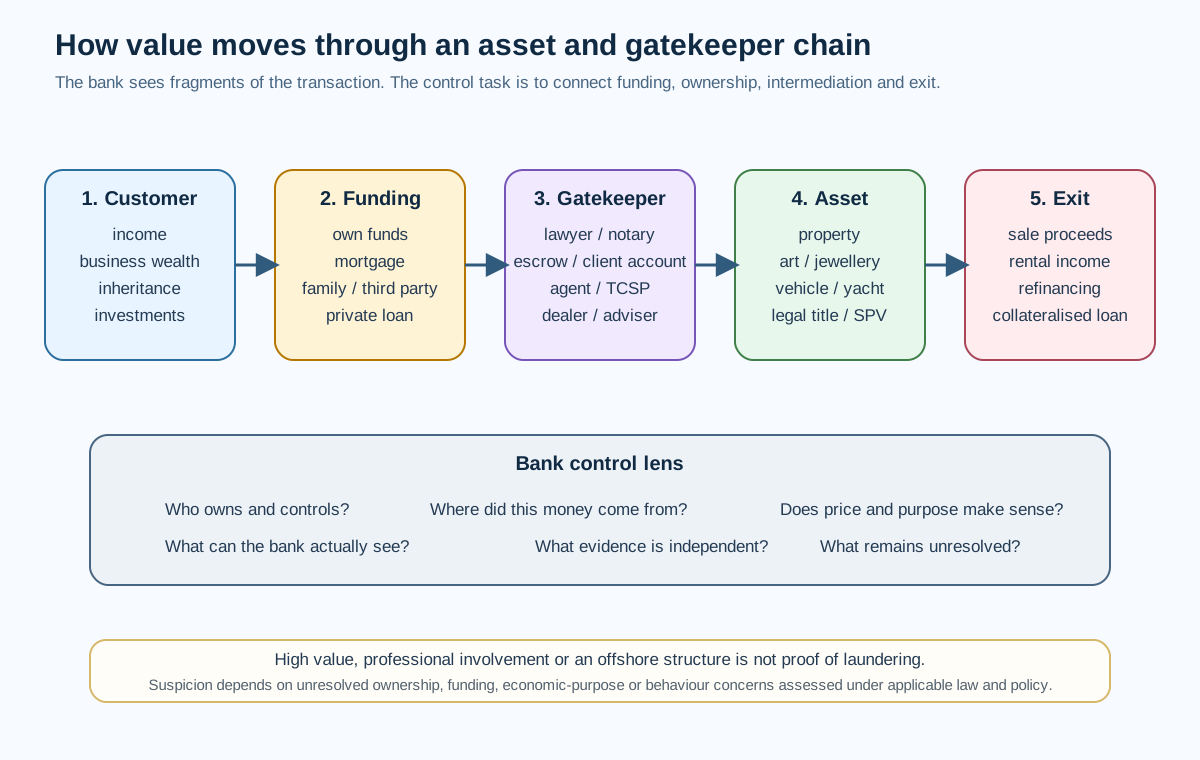
Why property can be attractive for laundering
Property can absorb large amounts of value, appreciate, generate rent, support borrowing and be held directly or through companies and trusts. Once property is purchased, later rental income, mortgage borrowing or sale proceeds can appear to provide an ordinary source of wealth.
That does not mean property investment is suspicious. The concern arises when ownership, funding or valuation lacks a credible explanation.
What a bank sees in a property transaction
A retail bank may see deposit funding and mortgage payments. A private bank may also hold source-of-wealth evidence. A correspondent bank may see only a transfer to a law firm or escrow account. A bank financing a property developer may have still different visibility.
Control design should reflect the institution’s actual role.
Source of funds for property
Source of funds asks where the specific purchase money comes from. It may be savings, a mortgage, inheritance, investment proceeds, business sale or family loan.
A bank should distinguish the immediate source account from the economic origin. A transfer from the customer’s investment account identifies the immediate source, but higher-risk review may need to understand how that investment account was funded.
Source of wealth
Source of wealth explains how the customer accumulated overall economic capacity. Property transactions can be useful moments to test whether the customer’s known wealth is consistent with the transaction.
The objective is proportionate understanding, not endless documentary collection.
Third-party funding
Property purchases can involve parents, spouses, companies, trusts, lenders or other third parties. Such funding can be legitimate.
Risk increases when the third party has no clear relationship, lacks financial capacity, has opaque ownership or appears to be funded indirectly by the buyer.
Company-owned property
Companies can legitimately own property for investment, operations or development. Corporate ownership can also create distance between the asset and the natural person who controls it.
Banks should map beneficial ownership and control rather than assume that legal title identifies the ultimate economic owner.
Trusts and legal arrangements
Trusts can hold property for family, succession, charity or investment. They can also complicate ownership analysis.
Where relevant, the bank should understand settlor, trustee, protector, beneficiaries and persons exercising ultimate control according to applicable law.
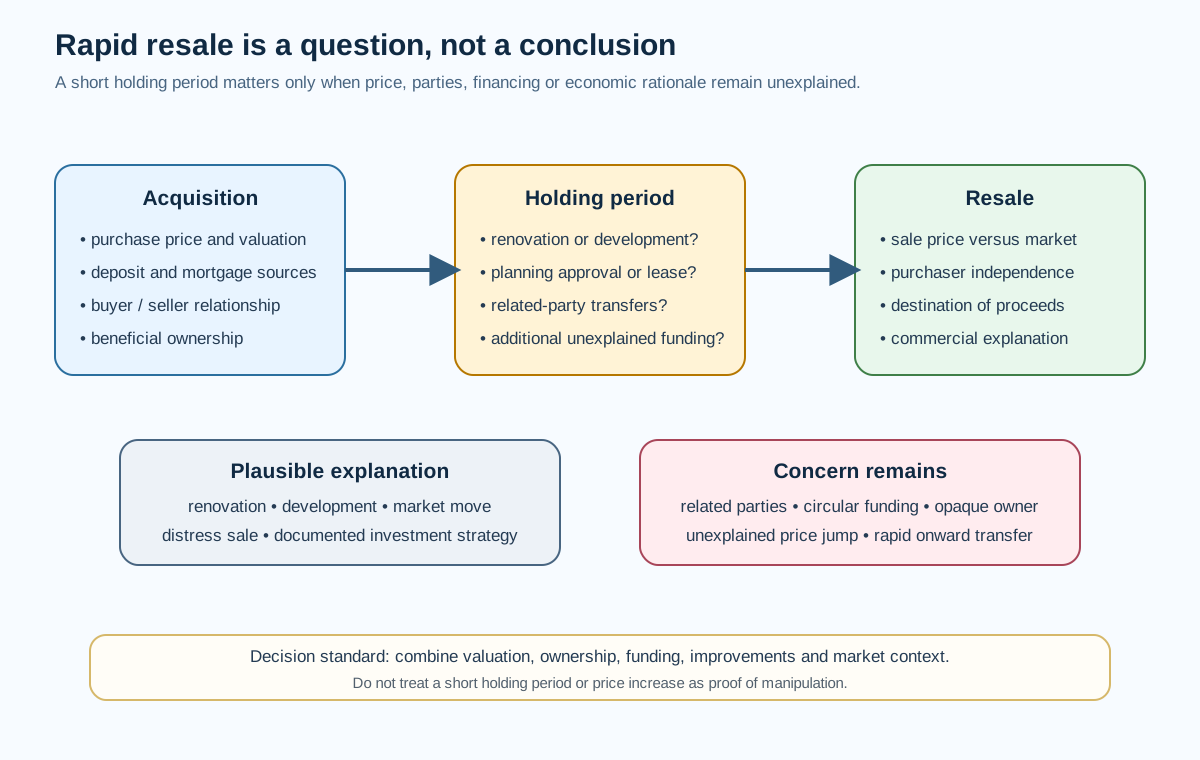
Rapid resale
Rapid purchase and resale can be legitimate in property development or investment. It can also create apparently legitimate sale proceeds and disguise earlier funding.
The bank should consider customer profile, valuation, related parties, financing and commercial rationale.
Five checks separate development from disguise: profile, valuation, parties, funding and rationale.
Price anomalies
Property prices vary significantly by location, condition, timing and transaction terms. An unusual price can be a signal but is not proof of manipulation.
Where the bank has reliable valuation data, material discrepancies can justify additional review.
Mortgage misuse
Mortgages can be repaid using criminal funds, creating equity in the property. Overpayments, early repayment or third-party repayment can be relevant depending on context.
A legitimate high-income customer may also repay early. Behaviour should be compared with profile and source.
Asset-backed lending
A customer can pledge property or another asset as collateral and receive bank lending. If the underlying asset was acquired with illicit proceeds, the loan may create apparently clean liquidity.
This is why collateral ownership and source can matter in higher-risk relationships.
Luxury goods
Art, jewellery, watches, vehicles, collectables and other high-value assets can store and transfer value. Markets may be international, privately negotiated and subject to price variation.
Banks generally see payments rather than the physical asset. A transfer to a luxury dealer is not suspicious merely because the value is high.
Art and collectables
Art can have subjective valuation and can move through galleries, auction houses, advisers and private sales. The bank may need to understand counterparties and source of funds when risk is elevated.
It should not claim to verify authenticity or fair market value unless it actually has relevant evidence.
Jewellery and precious metals
Jewellery and precious metals can be portable and high value. They may be part of legitimate retail or investment activity.
Repeated large purchases and resales that do not fit a customer’s profile may justify review.
Vehicles and other movable assets
High-value cars, boats and aircraft can also hold value and be owned through companies. Ownership and payment relationships can be complex.
Professional gatekeepers
Lawyers, accountants, notaries, estate agents, trust and company service providers and other professionals can facilitate legitimate transactions and ensure legal compliance. Their involvement is not evidence of wrongdoing.
They may also sit between the bank and the ultimate economic parties, creating a need to understand underlying purpose where risk requires it.
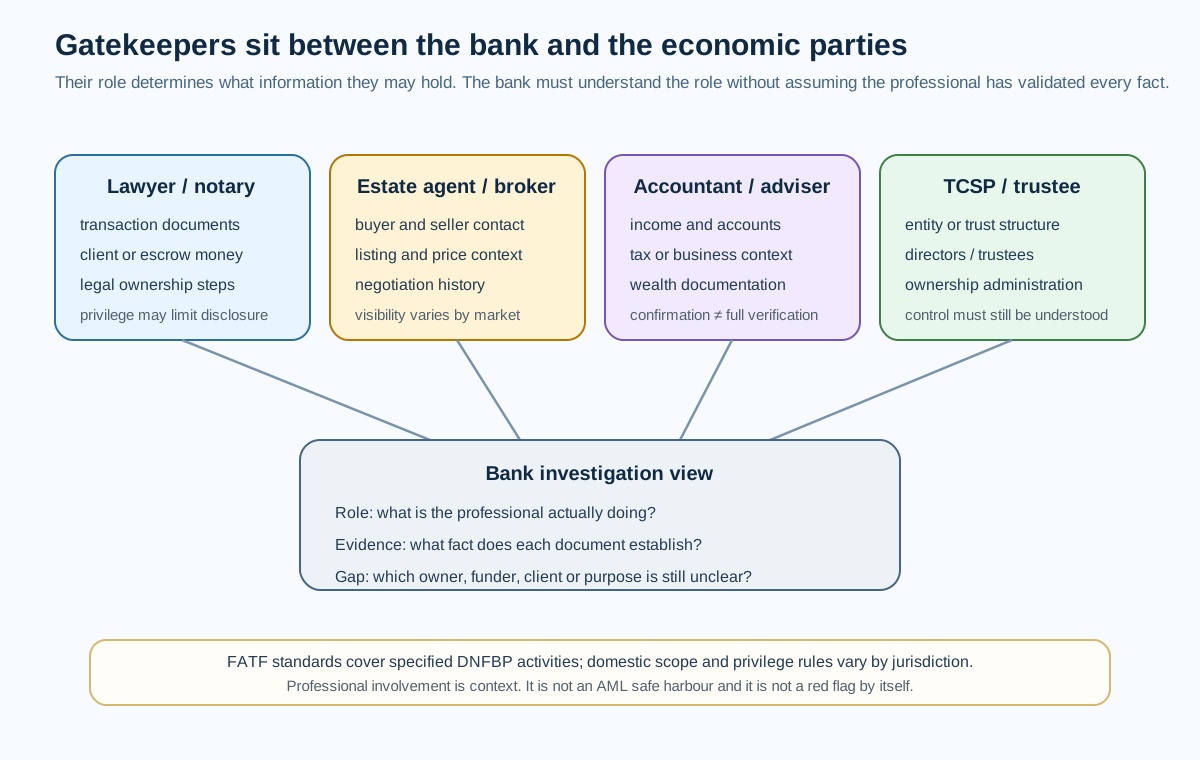
Client accounts
Law firms and other professionals may operate client accounts that hold money on behalf of customers. The bank account holder may therefore not be the ultimate payer or beneficiary.
The bank should understand the nature of the customer’s client-account business, regulatory status, expected flows and control environment.
A transfer through a lawyer’s client account should not automatically be treated as legitimate or suspicious.
Legal privilege and confidentiality
Professional relationships can involve privilege or confidentiality rules. Banks should respect applicable law and avoid demanding information they are not entitled to receive.
Escalation to legal or compliance specialists may be necessary where financial-crime obligations and privilege intersect.
Trust and company service providers
TCSPs can form and administer entities, provide registered offices and support trusts. These are legitimate services. Risk can increase when structures become opaque, ownership is unclear or the provider is linked to concerning activity.
Estate agents and brokers
Estate agents can hold information about buyers, sellers and property value that banks may not have. Public-private partnerships can sometimes improve typology understanding, subject to law.
Accountants and tax advisers
Accountants can support normal business and tax compliance. Criminal misuse can involve false accounts, sham invoices or concealment, but banks should not infer that merely because an accountant appears in the transaction.
Professional fees
Payments labelled legal, consulting or advisory fees can be legitimate. The label should not end the analysis where risk is elevated.
The bank can consider whether the professional relationship and payment size make sense without claiming to verify the underlying service unless it has evidence.
Escrow
Escrow arrangements can reduce transaction risk by holding funds until conditions are met. They can also obscure the ultimate parties if the bank sees only the escrow account.
Understanding the escrow provider and underlying transaction can be relevant.
Property developers
Developers can receive deposits from many buyers, borrow large amounts and pay contractors. Their flows can look complex by design.
Monitoring should understand project cycles, expected counterparties and financing structure.
Real estate investment structures
Funds, SPVs and joint ventures can hold property legitimately. The bank should understand ownership, investors and financing where appropriate.
Cross-border property investment
Foreign property investment is common. Risk can increase where funds pass through several jurisdictions, companies or intermediaries without clear rationale.
Country risk should inform, not replace, transaction analysis.
PEP and corruption risk
Real estate and luxury assets can be relevant to corruption because illicit wealth can be converted into assets. PEP status is a risk factor, not evidence of corruption.
Where appropriate, source-of-wealth review, ownership mapping and public information can help assess the relationship.
Sanctions exposure
Property, securities and luxury assets can be owned or controlled by sanctioned persons. AML and sanctions analysis should remain distinct.
A legitimate source of wealth does not override a sanctions prohibition.
Scenario: family-funded property
A customer receives a substantial transfer from a parent abroad to fund a home purchase. The relationship and lender’s financial capacity are documented.
The transaction may be entirely legitimate. Risk-based review should not turn normal family support into suspicion solely because the value is high.
Scenario: opaque property SPV
A newly incorporated company purchases high-value property using funds from several offshore entities. Beneficial ownership is unclear and the company has no obvious operating purpose.
The bank should establish ownership, source of funds and commercial rationale before reaching conclusions.
Scenario: law-firm client account
A payment arrives from a regulated law firm’s client account. The customer says it represents property-sale proceeds.
The law-firm account explains the immediate payer, but the bank may still need evidence linking the funds to the sale if risk requires it.
Scenario: luxury purchase
A long-standing private-banking customer buys a high-value artwork. The transaction fits known wealth and prior collecting activity.
The value alone should not trigger a suspicion conclusion.
Scenario: unexplained asset sale
A customer receives large “vehicle sale” proceeds from a company under common ownership. No evidence supports the asset, and similar payments occur repeatedly.
The bank should investigate economic substance and related-party relationships.
Monitoring design
Useful indicators can include high-value asset purchases inconsistent with profile, unexplained third-party funding, repeated transactions through professional-client accounts, rapid property resale, unusual loan repayment, related-party transfers and sudden changes in wealth.
These indicators should be combined with customer context.
Event-driven KYC
A major property purchase, inheritance, business sale or acquisition of a company can change the customer’s source-of-wealth profile. Event-driven review can update the bank’s understanding rather than waiting for the next periodic cycle.
Evidence quality
Documents may include sale agreements, mortgage statements, probate records, valuation reports, invoices and company records. Evidence should resolve a defined question.
A document’s existence does not prove every underlying fact.
Business analyst view
Systems should represent asset type, ownership, related parties, source of funds, source of wealth, evidence, verification status and dates as structured information where useful.
Free text alone makes reuse and monitoring difficult.
Data lineage
If source-of-wealth data originates in a relationship-manager system and is later used by risk engines, lineage should show when it was collected, who verified it and whether it remains current.
Case-management view
One investigation may involve a customer, company, lawyer, property, loan and several payments. Case systems should support linked objects rather than flattening everything into narrative text.
Customer fairness
High-value customers should not be treated as suspicious by default, and customers without conventional documentation should not automatically be excluded. Requests should be proportionate and specific.
Common mistakes
Common errors include treating property ownership as proof of wealth, assuming payments through lawyers are automatically legitimate, treating offshore ownership as criminal, or collecting excessive documents without explaining the risk question.
Another mistake is failing to distinguish immediate source of funds from broader source of wealth.
Learning checkpoint
A reader should be able to explain why real estate and high-value assets can be attractive for value storage, distinguish source of funds from source of wealth, understand the role and limits of professional gatekeepers, and design evidence-based investigations that do not equate wealth or professional involvement with criminality.
Reference links
- FATF — Risk-Based Approach Guidance for Real Estate: https://www.fatf-gafi.org/en/publications/Fatfrecommendations/Guidance-rba-real-estate-sector.html
- FATF — Guidance for a Risk-Based Approach for Legal Professionals: https://www.fatf-gafi.org/en/publications/Fatfrecommendations/Rba-legal-professionals.html
- FATF — Guidance for a Risk-Based Approach for the Accounting Profession: https://www.fatf-gafi.org/en/publications/Fatfrecommendations/Rba-accounting-profession.html
- FATF — Beneficial Ownership: https://www.fatf-gafi.org/en/topics/beneficial-ownership.html
Educational note: property reporting, professional privilege, beneficial ownership and high-value-dealer obligations vary by jurisdiction. Apply local law and product-specific requirements.
Deep dive: tracing ownership, wealth and professional intermediation
High-value asset cases become difficult when investigators focus only on the payment in front of them. The transaction may be perfectly real: a property was sold, an artwork was purchased, a mortgage was advanced or a law firm transferred client funds. The deeper question is whether the ownership, funding and wealth history are credible for the customer and whether the bank has enough evidence to support that conclusion.
Map the property lifecycle
A property relationship can include reservation or deposit, mortgage approval, completion, ownership transfer, renovation, rental income, refinancing, early repayment and eventual sale. Each stage can generate different financial-crime questions.
A one-time source-of-funds review at purchase does not automatically explain future changes in ownership, refinancing or large capital movements.
Purchase funding
Purchase funding can combine savings, investments, mortgages, family support, company distributions and loans. Systems should allow more than one source rather than force a single free-text answer.
For higher-risk transactions, the bank can document how much came from each source and what evidence supports it.
Mortgage deposits
A deposit may come from another bank, investment platform or third party. The nearest sending account is the immediate source, not necessarily the origin of the wealth.
The depth of review should be proportionate to risk and applicable requirements.
Mortgage repayment
Regular repayments from expected income are usually straightforward. Large early repayments, unexplained third-party repayments or repayment materially inconsistent with customer income can justify review.
Early repayment is not suspicious by itself. Bonuses, inheritance, asset sales or refinancing can explain it.
Property development
Developers can have large, irregular inflows from buyers and lenders and outflows to contractors, tax authorities and suppliers. Monitoring should understand project cycles and escrow arrangements rather than compare a developer with an ordinary operating company.
Special-purpose vehicles
An SPV with no employees can be completely normal when its purpose is to hold one property. Due diligence should assess whether ownership, financing and purpose are transparent and consistent.
Real-estate funds
Funds and collective investment structures can hold many properties through subsidiaries. The bank may serve the manager, fund, SPV or investor. Control responsibilities depend on the relationship and product.
Cross-border ownership
Foreign ownership can involve companies, trusts, family offices or investment vehicles. Cross-border structure alone is not suspicious. Investigators should understand why the structure exists, who controls it and how acquisition funds were generated.
Effective-dated ownership
Current ownership can differ from ownership when the property was acquired. Systems should preserve historical beneficial owners and controllers with effective dates so investigators can reconstruct past transactions.
Trust-held property
Where property is held in trust, the bank may need to understand settlor, trustee, protector, beneficiaries and persons exercising control according to applicable law and risk.
The trust is a legal arrangement, not a red flag by itself.
Source-of-wealth history
Source-of-wealth review can include employment, business ownership, inheritance, investment, property or other legitimate sources. The bank should identify a reasonable evidential starting point rather than demand impossible proof of every historical euro.
Older wealth may require alternative corroboration where records no longer exist.
Evidence hierarchy
Evidence can include bank statements, audited accounts, sale agreements, tax records, probate documents, company filings, investment statements and property records. Each source answers different questions.
A bank statement proves money moved through an account. It does not necessarily establish how the money was originally earned.
Plausibility assessment
Plausibility asks whether the customer's explanation is broadly compatible with known career, business, asset history and transaction values. It is not a mathematical proof of legitimacy.
Analysts should explain why evidence is sufficient rather than write generic phrases such as 'wealth verified'.
Valuation uncertainty
Real-estate and luxury-asset values are not always precise. Property condition, location, timing and private transaction terms can affect price. Art and collectables may have even wider valuation ranges.
A price difference can prioritise review but should not be presented as manipulation without appropriate evidence.
Rapid resale
Rapid resale can reflect legitimate development, market opportunity or distress. Risk increases where related parties, unexplained price changes, unusual financing or circular flows are present.
Property flipping and related parties
Where property passes among connected parties, investigators should understand ownership, valuation, financing and economic purpose. Related-party transaction does not equal laundering, but it changes the independence of the price signal.
Loan-back structures
A customer can transfer value to an entity and later receive funds back as a loan. The bank should assess lender ownership, capacity, terms and source. A signed loan agreement does not automatically establish independent funding.
Family loans
Family lending can be entirely legitimate. Review should be proportionate and focus on relationship, financial capacity and source where relevant.
Asset-backed borrowing
Borrowing against an asset can turn stored wealth into liquid bank funds. If the collateral's origin is relevant to risk, the bank may need to understand how the asset was acquired.
Rental income
Rental income can become an apparently ordinary source of funds. In higher-risk cases, the bank may need to understand the origin of the property that generates the income, especially where the property portfolio was built from unclear capital.
Luxury goods as value stores
Art, jewellery, watches, cars, boats and other assets can preserve or transfer value. Banks generally observe the payment, not the physical asset.
The institution should be careful not to claim authenticity, valuation or ownership facts it has not independently established.
Art-market intermediaries
Transactions may involve galleries, auction houses, advisers, storage providers and agents. The economic buyer or seller may not be obvious from the payment account name.
Where risk warrants it, investigators can establish the role of each party and the underlying client.
Precious metals and stones
High-value commodities can be portable and internationally traded. A customer's legitimate business model is central to interpreting related payments.
Vehicles, yachts and aircraft
These assets can be held by companies, financed and moved across jurisdictions. Legal owner, user and ultimate controller can be different.
Client accounts
Professional-client accounts can hold money for multiple underlying clients. Banks should understand the professional customer's business, regulatory status, expected flow and client-money controls.
The bank may not be entitled to all underlying client information in every circumstance. Requirements should respect local law and privilege.
Escrow accounts
Escrow can provide a controlled mechanism for property and business transactions. The presence of escrow does not itself validate the underlying source of funds.
Legal privilege
Legal professional privilege and confidentiality vary by jurisdiction. Financial-crime teams should have escalation to legal specialists where information requests could conflict with protected communications.
Accountants and advisers
Accountants and advisers can provide documents and explanations, but the bank should distinguish professional confirmation from independent verification of every underlying fact.
Trust and company service providers
TCSPs can create and administer companies and trusts. Shared addresses and professional directors may be normal. Risk depends on ownership transparency, purpose and activity.
Estate agents
Estate agents can have information about transaction parties and valuation, but the bank's access varies. Public-private typology sharing can improve understanding without replacing customer due diligence.
Private banking
Private-banking relationships can include complex wealth, trusts, holding companies and cross-border investments. Relationship-manager knowledge is valuable but should not replace evidence where stronger verification is required.
PEP overlay
PEP status increases corruption exposure but is not evidence of wrongdoing. Enhanced measures should remain proportionate and evidence-based.
Corruption typologies
Corruption proceeds can be converted into property or luxury assets, sometimes through associates or companies. Ownership links, government-contract exposure, source of wealth and transaction timing can provide context.
Sanctions overlay
A property or asset can be indirectly owned or controlled by a designated person. Applicable sanctions regimes may use specific ownership or control tests. These should not be replaced by a generic beneficial-owner threshold.
Tax-crime overlay
Offshore property ownership and tax planning can be legal. AML concerns arise where facts indicate criminal tax evasion or false documentation under applicable law, not merely because the structure reduces tax.
Scenario: founder property purchase
A founder sells a technology company and buys property. Sale agreement, buyer payment, ownership history and company records are coherent. The transaction is high value but economically understandable.
This is a useful negative case against threshold-only monitoring.
Scenario: unexplained portfolio growth
A customer with modest known income acquires several properties over two years through companies funded by offshore loans. The lenders are controlled by associates and their source of funds is unclear.
The bank should reconstruct funding, ownership, lender capacity and source of wealth before deciding whether concern remains.
Scenario: client account proceeds
A customer receives funds from a lawyer after a property sale. The bank links the amount to a genuine sale and historical ownership. The professional-account payment can then be understood in context rather than treated as either automatically safe or suspicious.
Scenario: related-party artwork sale
A customer sells artwork to a company controlled by a family member at a value far above prior purchase price. The bank should investigate valuation evidence, ownership and commercial rationale while avoiding unsupported claims about market value.
Event-driven review
Material events such as inheritance, business sale, major asset acquisition, ownership change or PEP status can justify customer-profile refresh. Event-driven KYC is often more meaningful than waiting for a fixed periodic date.
Data architecture
Structured fields can include source category, source amount, evidence type, verification status, asset type, ownership role, controller, professional intermediary, financing and effective date.
Sensitive documents can remain access-controlled while selected structured facts are made reusable for risk decisions.
Relationship mapping
A case can involve customer, spouse, parent, company, trust, lawyer, property, mortgage, lender and payment. Graph or relationship views can help, but links should indicate source and confidence.
Payment lineage
Investigators should be able to connect deposit, mortgage disbursement, completion payment, sale proceeds and repayment events where the bank holds those records.
Data retention
Historical source-of-wealth and property evidence can be important years later. Retention must comply with applicable legal rules and privacy principles.
Customer communication
Requests should be specific: explain the source of the deposit, provide evidence of the property sale, identify the third-party lender. Generic repeated requests for 'proof of wealth' can create unnecessary burden.
Customer fairness
Not every customer has audited accounts or decades of digital records. Banks should consider credible alternative evidence and document limitations rather than assume missing documents prove illicit origin.
Monitoring design
Potential signals include property-related payments inconsistent with profile, repeated third-party funding, unexplained loan flows, rapid resale, unusual early mortgage repayment, luxury purchases inconsistent with known wealth and related-party asset transactions.
Signals create questions; investigation creates conclusions.
Quality assurance
QA should test whether analysts distinguish source of funds from source of wealth, whether professional intermediaries are treated appropriately, whether evidence status is clear, and whether conclusions overstate property valuation or ownership facts.
BA failure scenarios
Test ownership change during a case, multiple funding sources, family loan, trust-held property, missing historical document, partial mortgage repayment, transaction through client account, duplicate asset record and conflicting registry information.
Regulatory examination readiness
The bank should be able to explain how high-value asset risk is assessed, which customers require enhanced source review, how evidence is stored, how ownership is mapped, how sanctions dependencies operate and how customer fairness is considered.
Final deep-dive exercise
Take a property purchase funded by savings, family loan and investment sale through an SPV. Map every payer, owner, controller, source and evidence item. Then identify which facts are verified, customer-provided and inferred. The exercise demonstrates why clear relationship and evidence modelling is more useful than collecting a large unstructured document pack.
Advanced practice: property funding, professional accounts and high-value assets
Real-estate and luxury-asset investigations become difficult when the bank focuses only on the final payment. Property transactions often combine deposits, mortgages, private loans, lawyers or notaries, developers, companies, trusts and sale proceeds. The investigator needs to reconstruct the funding chain and separate what the bank knows directly from what it infers from documents or external records.
Case 1: third-party deposit for a property purchase
A customer intends to buy a property and receives a large transfer from a parent. The customer has modest savings but the family relationship is documented, and the parent has a long-standing business relationship with the bank.
Third-party property funding is common and can be legitimate. The bank should assess the relationship, reason for the gift or loan and, where policy and risk require, the parent's source of funds. It should not escalate solely because the buyer did not earn the entire purchase price personally.
Now change the facts: the funding comes from three unrelated overseas companies, none of which appears on the sale contract. The customer says they are "family friends" but cannot explain the corporate relationships. Beneficial-ownership review shows one company is controlled by the seller's associate. That is a materially different risk picture.
The concern is the unresolved funding and ownership chain, not the fact that property is being purchased.
Case 2: solicitor or escrow account
A customer sends money to a lawyer's client account for a property acquisition. Client accounts legitimately receive and disburse funds for multiple matters. The payment should not be considered suspicious simply because the final seller is not the immediate beneficiary.
If the bank services the professional firm, monitoring should recognise the pooled-account model and the bank's actual visibility. Depending on jurisdiction and product, the bank may not know every underlying client. It can still monitor for activity inconsistent with the firm's practice, unexplained pass-through, unusual jurisdictions or transactions without an apparent legal purpose.
The account type should be represented explicitly so generic retail or corporate rules do not create constant false positives.
Case 3: accelerated mortgage repayment
A customer takes a mortgage and begins repaying principal far faster than expected. Accelerated repayment can be legitimate after bonuses, inheritance, asset sales or refinancing. The relevant question is where the money comes from.
If repayments are funded by the customer's verified business sale, the pattern may be readily explained. If they are funded by repeated third-party transfers from companies with opaque ownership, the bank should understand those relationships.
Mortgage repayment can convert incoming funds into property equity, but the AML concern still depends on source and context.
Case 4: refinance after unexplained equity build-up
A property was originally acquired using private loans from companies related to the purchaser. Two years later, a regulated lender refinances the property based on its market value. The customer receives ordinary mortgage proceeds.
Refinancing is a common regulated lending activity, but a particular transaction still needs to be assessed on its facts. It can convert earlier equity into apparently straightforward bank-loan funds without resolving the legitimacy of the original funding. A historical review may therefore need to understand how the original equity was created.
This does not mean every refinance requires forensic review. Risk, customer profile and specific concerns should determine the depth.
Case 5: luxury vehicle dealer
A dealer in high-value vehicles receives payments from individuals and companies and pays manufacturers, auction houses and logistics providers. High turnover and international payments are normal.
A monitoring rule identifies repeated purchases by one customer through different companies, followed by quick resale and payments to unrelated third parties. The investigator maps ownership of the purchasing companies, resale counterparties and funding.
Rapid resale can be legitimate in a trading market. Concern increases if the companies are under common hidden control, funding originates from unrelated parties and sale proceeds move to the same ultimate individual.
Case 6: art or collectibles with limited bank visibility
A customer pays a gallery or auction house. The bank may not know the exact artwork, provenance or ultimate seller. It should not claim to validate the underlying asset from the payment alone.
Where values are material and risk is elevated, source of funds, customer wealth, counterparty and payment structure may be relevant. External art-market or registry information can support a case where available, but absence of public information is not automatically suspicious because private markets often have limited transparency.
Gatekeepers and professional intermediaries
Lawyers, accountants, property agents, notaries and company-service providers can be essential to legitimate transactions. Criminals can also misuse professional structures to obscure ownership or make transactions appear routine.
The bank should identify the role of the intermediary. Are they holding client money, providing escrow, forming a company, certifying documents, arranging financing or advising on tax? The answer affects what the bank should expect to see.
Professional involvement is not an AML guarantee. A signed agreement or professional letter can establish context but may not answer the original source-of-wealth question.
Beneficial ownership of property vehicles
Properties can be held through companies, partnerships, trusts or funds. Such structures can be legitimate for investment, succession, joint ownership, financing or tax reasons. The bank should identify beneficial owners and controllers according to applicable rules and understand whether the structure aligns with customer purpose.
If ownership changes, historical data matters. A company that buys property under one owner and sells it later under another should not be analysed using only today's ownership record.
Source of funds versus source of wealth in property cases
A property-sale credit provides a clear immediate source of funds. It does not necessarily explain how the customer acquired the property. Similarly, a regulated mortgage explains part of the purchase funding but not necessarily the deposit.
The bank should ask the question appropriate to risk. For a routine low-risk customer, immediate source may be sufficient. For a high-risk customer with a major wealth discrepancy, the review may need to trace earlier accumulation.
Professional money-laundering networks
Professional launderers can connect property companies, private lenders, lawyers, company-service providers and underground settlement. Cross-customer analysis can reveal that several unrelated customers use the same small group of lenders or corporate vehicles.
Shared professionals require context. A major law firm or bank will naturally appear across many clients. A small private lender repeatedly funding unrelated high-risk purchases may deserve closer analysis.
Customer explanation and documentary evidence
Documents should answer the actual risk question. A purchase contract confirms transaction terms. A bank statement can show where deposit funds came from. Company accounts can show whether a lender has capacity. Registry data can identify legal ownership. None should be treated as universally sufficient.
The investigator should document both the evidence obtained and any remaining gap.
Monitoring and alert design
Useful property or high-value-asset hypotheses include:
- purchase funding materially inconsistent with known wealth;
- repeated third-party contributions without clear relationship;
- private lenders with opaque or related ownership;
- rapid purchase and resale with unexplained counterparties;
- substantial mortgage repayment from unrelated parties;
- sale proceeds rapidly sent to unrelated high-risk parties;
- repeated use of companies or professional accounts inconsistent with customer purpose.
These are contextual indicators. Property investors, developers, family offices and dealers need different peer groups from ordinary retail customers.
Data model exercise
A property case can require customer, purchasing entity, beneficial owner, property or asset identifier where known, seller, lender, private lender, professional intermediary, payment, source-of-funds evidence and source-of-wealth evidence.
The platform should record which facts come from bank transactions, customer documents, external registries or analyst inference. This prevents a case diagram from appearing more certain than the evidence.
Final practitioner standard
A strong real-estate or luxury-asset investigation can explain the full funding story in ordinary language. It identifies who paid, who owns or controls the asset-holding structure, what financing was used, which professionals were involved, how the customer's wealth supports the transaction and which part of the chain remains unexplained. The asset may be high value, but the unresolved economic inconsistency is what should drive suspicion.
Practitioner close: real estate, luxury assets and professional gatekeepers
High-value assets can preserve or transform wealth, but ownership of property, art, jewellery or luxury vehicles is not itself suspicious. The bank’s strongest questions concern who funded the asset, who economically owns it, why value is moving now, and whether the transaction fits the customer’s known source of wealth and commercial story.
Case lab: third-party property funding
A customer purchases property using funds from their own account plus several large transfers from unrelated companies. The immediate transaction is visible, but the economic relationship between the buyer and funders is unclear.
The investigation should identify whether the payments are gifts, loans, business distributions, nominee funding or another legitimate arrangement. Useful evidence can include contracts, ownership links, loan terms, source of funds and the customer’s explanation. A third-party contribution is a risk indicator, not proof of laundering.
Client and escrow accounts
Law firms, notaries, estate professionals and other gatekeepers can legitimately receive and distribute client money. A payment from a professional client account should therefore not be automatically treated as “clean.” The bank can still consider the professional’s role, transaction purpose, source information available to it and whether the account is being used consistently with its expected function.
Equally, the mere involvement of a lawyer or accountant is not suspicious. The concern arises when professional structures appear to obscure the economic parties or movement without a credible purpose.
Mortgage repayment and refinancing
Early repayment of a mortgage or rapid refinancing can be legitimate, especially after a property sale, inheritance or business event. It can also be used to convert unexplained funds into equity or create apparently legitimate loan proceeds.
The analyst should examine the funding source, timing, customer wealth profile and relationship among parties rather than use early repayment as a standalone typology.
Luxury assets and resale
Vehicles, art, precious stones and other high-value assets can be bought and later sold, creating legitimate-looking proceeds. The immediate sale receipt explains where the current money came from but not necessarily how the asset was originally acquired.
Where risk justifies review, investigators should distinguish source of funds from source of wealth and consider ownership, valuation, third-party payments and whether the transaction is consistent with the customer’s financial history.
Gatekeeper evidence and limitations
Documents prepared by professionals can be strong evidence, but they are not infallible. The bank should preserve provenance and avoid treating a contract, valuation or legal letter as automatic proof of legitimacy. At the same time, analysts should not dismiss professional evidence merely because a typology mentions gatekeepers.
The correct approach is proportional corroboration.
Final practitioner checkpoint
A strong learner should be able to investigate high-value assets without treating wealth itself as suspicious, distinguish immediate source of funds from historical source of wealth, understand legitimate client-account activity, assess third-party funding and preserve a precise evidence trail around ownership, valuation and economic purpose.
Practitioner masterclass: following wealth through assets and intermediaries
The most useful way to investigate high-value assets is to separate the present transaction from the history of the value behind it. A property sale can be genuine. A lawyer's client account can be legitimate. A luxury asset can be real. None of those facts automatically explains how the customer obtained the underlying wealth.
Work backwards from the asset
If a customer receives property-sale proceeds, establish when and how the property was acquired, who owned it, how the original purchase was funded and whether any companies or trusts sit in the ownership chain. Stop when the risk-based evidence is sufficient; do not turn every review into an unlimited historical investigation.
Source-of-funds versus source-of-wealth exercise
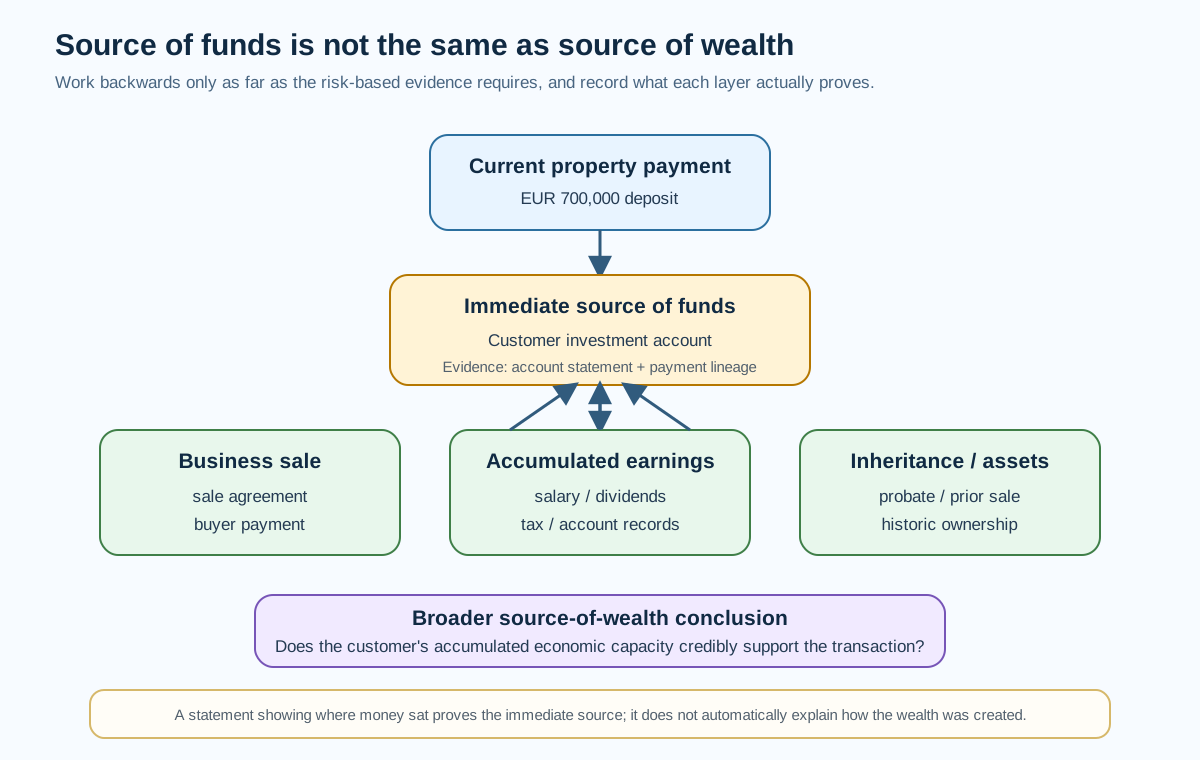
A customer pays EUR 700,000 toward a property from an investment account. The source of funds is the investment account. If the account was funded by a company sale, the source-of-wealth question may concern how the customer built or acquired that company.
This distinction should be explicit in both case notes and data models.
Third-party funding exercise
A buyer's parent provides EUR 250,000 for a deposit. Family funding can be completely legitimate. The bank may need to understand relationship, capacity and origin of the funds depending on risk.
The presence of a third party should create a question, not an accusation.
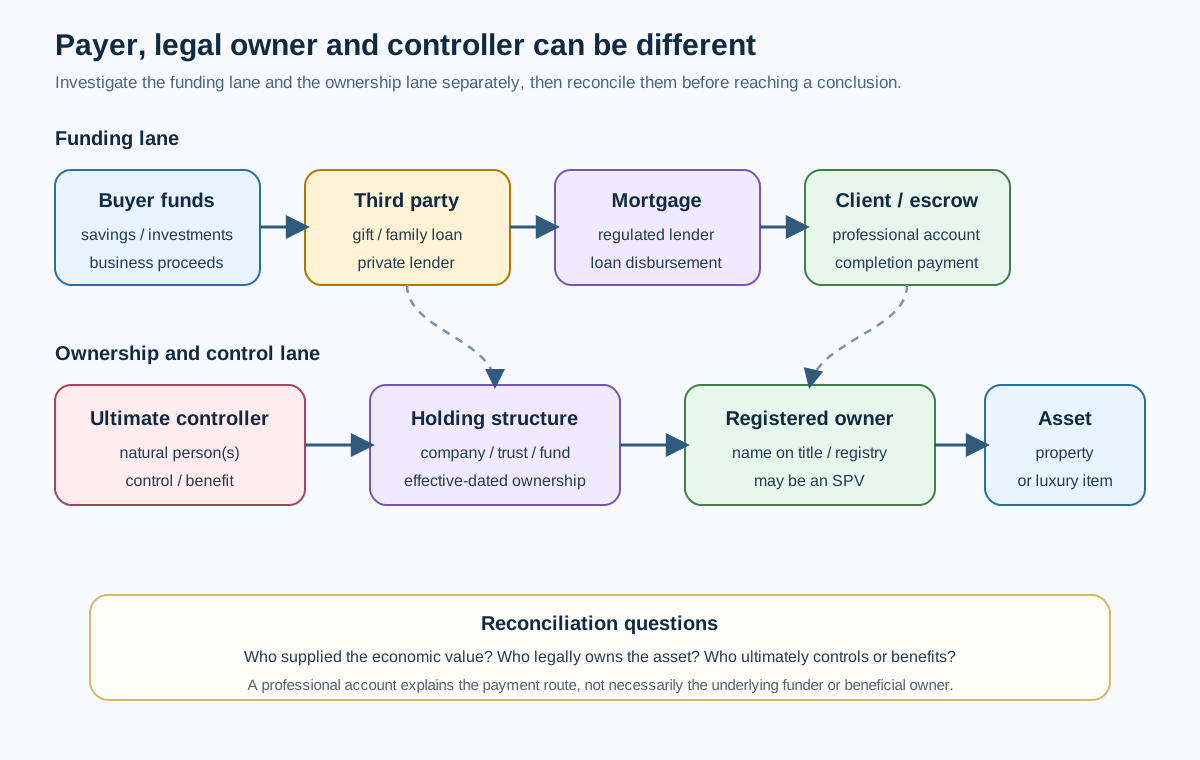
Client-account exercise
A customer receives EUR 1.8 million from a law firm's client account and says it is property-sale proceeds. The bank should link the funds to the underlying transaction where appropriate rather than treating the professional account as automatic proof of legitimacy.
At the same time, the bank should respect privilege and confidentiality rules and avoid asking for information it is not entitled to receive.
Rapid resale exercise
A company buys a property and sells it six months later at a significant gain. That can be normal development activity. Investigate valuation, improvements, market conditions, related parties and financing before treating the gain as suspicious.
Asset-backed loan exercise
A customer pledges an asset and receives a bank loan. The loan proceeds are bank-created funds, but the collateral may embody older value. Where risk warrants it, the origin and ownership of the collateral matter.
Luxury-asset exercise
A long-standing customer purchases art through a reputable dealer. The transaction fits known wealth and prior behaviour. The correct response is not to generate suspicion merely because the asset is expensive.
Now change the facts: the customer begins buying and reselling multiple high-value pieces through related companies with unexplained funding. The risk picture changes because behaviour and ownership no longer align with the established profile.
Gatekeeper-role clarity
A lawyer, accountant, estate agent, trustee or company-service provider can act for a client without being the economic beneficiary. Systems should distinguish account holder, payer, client, beneficial owner and ultimate beneficiary where the bank has that information.
Property company exercise
An SPV owns one building and has no employees. That is normal for many property structures. Economic substance should be assessed against the entity's purpose rather than a generic expectation that every company has staff and premises.
PEP and corruption overlay
A PEP purchasing property is not evidence of corruption. The bank may apply enhanced measures depending on law and risk, including source-of-wealth understanding and senior approval. The case should remain factual.
Sanctions overlay
A property can be owned through companies or trusts connected to a designated person. Sanctions ownership/control rules may produce a legal restriction even where source of wealth is legitimate.
Keep sanctions decisioning separate from AML suspicion.
BA data-model exercise
Create objects for customer, asset, legal owner, beneficial owner, controller, professional intermediary, source of funds, source of wealth, financing, payment and evidence. Add effective dates so ownership at the time of purchase can be reconstructed years later.
Quality assurance test
Review cases closed because “lawyer confirmed” or “sale proceeds verified.” Ask what was actually verified. Did the evidence prove the sale, ownership and funding, or only that money came from a professional account?
Final practitioner test
A strong learner should be able to trace high-value assets back to a credible economic origin, distinguish immediate funding from accumulated wealth, understand the role and limits of professional gatekeepers and avoid treating wealth, offshore structures or professional intermediaries as evidence of crime.
60-minute mastery extension: real estate, luxury goods and professional gatekeepers
This extension makes the chapter a minimum 60-minute guided learning experience. Spend around 25 minutes on the core lesson and diagrams, 15 minutes on the property and gatekeeper cases, 10 minutes on source-of-wealth reconstruction and 10 minutes on the final evidence test.
High-value assets can make illicit value look ordinary
Property, art, jewellery, vehicles, watches and other high-value assets can store value, appreciate, be financed and later be sold. Those characteristics make them useful to legitimate customers and potentially useful to criminals. The bank should not treat the asset category as proof of risk. The relevant questions are who owns the asset, how it was acquired, how the current transaction is funded, whether the price and parties are credible and whether the activity fits the customer's known economic profile.
Worked case: property purchase through a company
A customer-controlled company purchases a EUR 3 million property. The deposit comes from a lawyer's client account, with the remainder financed by a mortgage. The lawyer confirms the transfer relates to the purchase. That supports the immediate source of funds, but the bank may still need to understand who ultimately owns the purchasing company and how the deposit capital was accumulated if risk justifies it.
The company has no employees and exists only to hold the property. That can be entirely legitimate for a property SPV. Economic substance should be assessed against the entity's purpose rather than a generic expectation that every company employs staff.
Rapid resale
A property bought for EUR 1.5 million is sold eight months later for EUR 2.1 million. Rapid resale and price increase can be red flags, but legitimate explanations include renovation, development, planning approval or market movement. The bank should examine valuation, improvements, related parties, financing and transaction history before concluding the price change is artificial.
Source of funds versus source of wealth
If a customer pays a deposit from an investment account, the source of funds may be clear. The source of wealth can still require deeper analysis: how was the investment portfolio built? Was it funded by salary, business sale, inheritance, earlier property proceeds or another source? The objective is not infinite tracing; it is proportionate confidence in the economic origin.
A strong case note states where the evidence chain reasonably begins and why that point is sufficient for the risk level.
Luxury assets
A high-value art purchase can be normal for a wealthy customer. Risk increases when purchases and sales occur rapidly, ownership moves through opaque companies, valuations are inconsistent or funding does not fit known wealth. Banks usually see payments rather than the physical asset, so conclusions should remain within the institution's visibility.
If the bank only sees a payment to an art dealer, it should not write as though it has authenticated the artwork or verified market value unless it actually obtained reliable evidence.
Gatekeepers and professional intermediaries
Lawyers, accountants, trustees, estate agents and company-service providers can hold or move client money legitimately. Their involvement does not make a transaction safe or suspicious by itself. A payment from a client account may obscure the ultimate payer or beneficiary, so the bank can need additional context where risk justifies it.
Privilege and confidentiality rules also matter. The bank should request information it is legally entitled to obtain and document any limitations. A case should not penalise a customer merely because a professional cannot disclose protected information.
Under the FATF standards, specified DNFBPs are brought within AML/CFT requirements only for defined activities, and countries implement those standards through their own legal frameworks. For legal professionals in particular, FATF Recommendations 22 and 23 do not mean that every legal service is subject to the same AML/CFT duties. FATF also recognises that information obtained in circumstances covered by legal professional privilege or professional secrecy may be outside suspicious-transaction reporting requirements, with each jurisdiction determining the scope of those concepts. Bank procedures should therefore map the professional's role, the relevant activity and the applicable local law rather than assuming a universal obligation.
PEP and corruption overlay
A politically exposed person buying property is not evidence of corruption. Depending on law and risk, the bank may apply enhanced due diligence, senior approval and source-of-wealth analysis. The case should focus on ownership, funding, public-office exposure, counterparties and credible evidence rather than status alone.
Sanctions overlay
A property or asset can be lawfully acquired wealth yet subject to sanctions restrictions because of ownership or control by a designated person. This demonstrates again why sanctions legal analysis is separate from AML suspicion. Systems should allow shared ownership data while preserving different outcomes.
Asset-lineage exercise
Choose a property or luxury asset and reconstruct five layers: current transaction, immediate funding, asset ownership, original acquisition funding and broader source of wealth. Mark each step as verified fact, customer explanation, independent corroboration or unresolved. Then decide what additional evidence is proportionate and where the investigation can reasonably stop.
BA data model
Represent customer, asset, legal owner, beneficial owner, controller, professional intermediary, funding source, financing, payment, valuation evidence and ownership effective dates as separate objects. This supports investigations years after acquisition and avoids losing important history during system migration.
Final evidence test
Explain why each phrase is incomplete: "lawyer confirmed," "property sale proceeds," "customer is wealthy," "offshore company," "luxury purchase," and "PEP property buyer." Rewrite each into a factual statement and identify the unanswered risk question.
A strong learner should finish able to follow value through assets and intermediaries without treating wealth, professional involvement or offshore structures as proof of crime.
Worked case: the development that funded itself
A corporate banking team reviews a property-development customer mid-project: a residential scheme of eighty units financed by a senior loan from the bank, mezzanine funding from two offshore entities, and presale deposits from buyers. Drawdown requests have proceeded normally for fourteen months. A routine covenant review then surfaces anomalies: construction-cost certifications from the quantity surveyor lag actual drawdowns by widening margins, three subcontractors receiving the largest payments share directors with the developer's own shareholders, and presale buyer lists show multiple purchases by entities connected to the mezzanine funders at prices above the marketed range.
The investigation reframes the development from a financed project into a possible integration mechanism. Property development is attractive for laundering because it naturally combines large values, complex payment chains, subjective valuations, related-party contracting and extended timelines, each of which provides cover for value injection at a different stage. Inflated construction costs move value to related contractors; circular presales manufacture apparent market validation and deposit funding; mezzanine layers introduce opaque offshore value with contractual legitimacy; and the completed units can appear to be ordinary investment assets despite the illicit value used to fund them. That appearance does not remove the criminal origin of the value or any applicable proceeds-of-crime consequences.
Evidence is built stage by stage. Cost verification compares certified costs against independent benchmarks for the specification and region, examines the related-party subcontractors' substance and pricing against arm's-length comparators, and traces where subcontractor receipts go next. Presale analysis tests buyer independence, price consistency with genuine arm's-length sales in the scheme, deposit funding sources, and completion rates, since circular presales often fail to complete once their validation purpose is served. Funding analysis traces the mezzanine entities to ultimate origin, testing whether the offshore layers represent genuine third-party investment or recycled value from the developer's own network. Timeline analysis checks whether anomalies cluster around drawdown dates, suggesting reactive fabrication, or run throughout, suggesting structural design.
In this fictional case the findings support a mixed conclusion requiring tiered response. Genuine construction is under way with real contractors and genuine buyers forming the majority, so the project is not a sham; but an identifiable subset of costs, presales and funding traces to related-party circularity inconsistent with arm's-length development economics. The bank's response protects its position while addressing the crime risk: enhanced monitoring and verification conditions on further drawdowns, independent cost certification requirements, investigation of the implicated subset with reporting where thresholds are met, and relationship-level review of the developer's wider portfolio for the same pattern. The lesson is that development finance controls must verify economics continuously, not only at origination: approval-stage appraisals decay as projects evolve, and stage-certification discipline is a financial-crime control as much as a credit control.
Rental income: integration through yield
Completed property generates rental income that can integrate illicit value through several mechanisms: inflated rents paid by related tenants, phantom tenancies with documented leases but no occupants, short-term rental platforms obscuring occupancy reality, and property-management intermediaries pooling and redistributing receipts. Rental-yield analysis therefore belongs in property monitoring: yields materially above market for the location and asset class, occupancy claims inconsistent with observable activity or platform data, and tenant entities with no independent substance all warrant inquiry.
Verification draws on sources beyond the customer's statements: tenancy-deposit registrations where schemes exist, property-management records with tenant-identification trails, utility-consumption patterns inconsistent with claimed occupancy, and platform-listing histories for short-term lets. Related-party tenancies require the same arm's-length testing as related-party sales: lease terms benchmarked to market, payment discipline examined, and the tenant's own funding sources verified where the rent materially supports the customer's wealth proposition. A property whose yield depends entirely on related tenants paying above-market rents is not demonstrating investment performance but manufacturing it.
Portfolio landlords multiply both the opportunity and the analytical leverage. Common tenants, managers and funders across properties reveal networks; yield anomalies concentrated in specific properties or managers localise the concern; and management-company pooling accounts provide single points where commingling becomes visible. Monitoring should therefore aggregate to landlord and manager level rather than assessing each property in isolation.
Auctions, art markets and the opacity premium
Art, antiques and collectibles combine extreme price subjectivity with market practices built around discretion: private sales without public price records, intermediaries shielding buyer and seller identities, storage in freeports where ownership can transfer without movement, and valuations dependent on expert opinion that interested parties can influence. These features create an opacity premium that laundering exploits through overvaluation, sham transactions and collateral arrangements.
Banking controls where the bank finances, takes collateral in, or processes payments for art-market activity should reflect this reality. Provenance examination goes beyond authenticity to ownership history: gaps, recent emergence without exhibition or publication history, and jurisdictions of concern in the ownership chain each raise questions. Price testing uses comparable sales while acknowledging the limits of comparability for unique objects; prices wildly inconsistent with artist or genre benchmarks, rapid resale at multiples of acquisition price without intervening recognition events, and valuations commissioned from appraisers with interests in the transaction all indicate manufactured value. Intermediary analysis identifies who stands between buyer and seller, what function they perform, and what margin they extract, since functionless intermediaries in art transactions serve the same layering purpose as in any other trade.
Freeport and storage-facility activity deserves specific attention where visible: goods entering long-term storage without commercial logic, ownership transfers within storage, and collateralisation of stored goods at valuations inconsistent with market evidence. The bank should understand what visibility it genuinely has into stored-asset activity and avoid both over-claiming control and ignoring the signals available in its own payments and lending data.
Leaseback and sale-and-repurchase arrangements
Sale-and-leaseback transactions, where an owner sells an asset and immediately leases it back, have legitimate commercial uses in releasing capital while retaining use. The same structure can be misused to integrate criminal value when the sale price is inflated, the buyer is related or opaque, or the lease terms transfer no genuine risk. The analytical question is whether the transaction transfers real economic ownership at a market price or merely re-papers existing control while injecting value.
Testing examines price against independent valuation, buyer independence and funding, lease economics against market rents with realistic residual assumptions, and the seller-lessee's subsequent behaviour. Genuine leasebacks show market pricing, independent buyers with verifiable funding, commercial lease terms, and sellers whose operations genuinely benefit from released capital. Suspect arrangements show price anomalies, buyer opacity, circular funding where the purchase money traces back to the seller's own network, and lease terms structured to return the asset regardless of commercial logic. Cross-border leasebacks add jurisdiction arbitrage to the assessment, particularly where asset registries or tax treatments differ in ways the structure exploits without commercial purpose.
Worked case: the law firm's client account
A bank holds pooled client accounts for a mid-sized law firm specialising in conveyancing and company formation. Quarterly review shows monthly throughput tripling over six months to an illustrative 18 million, with credits from dozens of individuals and entities across four jurisdictions and debits to property sellers, other law firms and offshore entities. The firm's explanation cites a booming property practice and several large commercial transactions. The firm's own compliance officer, when asked, provides a generic assurance letter without underlying client data, citing legal professional privilege.
Pooled client accounts concentrate the bank's visibility problem: the bank sees the firm's aggregated flows without seeing the underlying clients, purposes or legitimacy, while privilege and confidentiality constrain inquiry. The control framework should reflect both the firm's applicable AML/CFT perimeter and the bank's own contractual, regulatory and risk-management rights. Under FATF Recommendations 22 and 23, legal professionals are covered for specified activities; domestic implementation, supervision, reporting routes and privilege rules differ materially by jurisdiction. The bank therefore needs to establish which obligations actually apply to this firm and activity before testing how effectively they are met.
The assessment examines the firm's client-acceptance standards, matter-level risk assessment, source-of-funds procedures for property transactions, and suspicious-reporting governance to the extent the bank is legally entitled to obtain such assurance. Generic assurances can be tested through specific, proportionate inquiry: how the firm approaches source of funds for higher-risk matters, what its procedures require for third-party funding, how it handles politically exposed clients, and how its control framework is independently reviewed. Reporting statistics may be relevant only where disclosure is lawful and meaningful; a low or zero count is not, by itself, proof of a failed control environment. Independent corroboration can include property or corporate records where accessible, adverse media on counterparties and the plausibility of the firm's stated practice scale against its staffing and business profile.
In this fictional case the assessment reveals a firm operating as a formation-and-conveyancing mill: minimal matter-level diligence, template source-of-funds attestations without verification, several clients with adverse corruption and fraud histories, and throughput fees structured to reward volume over diligence. The bank's response addresses both the account and the relationship: enhanced conditions where legally and contractually available, independent review of the firm's compliance programme, investigation of suspicious activity, and consideration of relationship restriction or exit if assurance remains inadequate. Privilege should not be treated as a blanket concept that either defeats every bank inquiry or permits unrestricted disclosure; the protected boundary must be determined under the applicable legal framework, with legal or compliance escalation where necessary.
The general lesson is that pooled professional accounts require a control model matched to the bank's visibility and the professional's regulated perimeter. Monitoring can track throughput, jurisdictional spread and matter-type evolution against the firm's stated practice, with material deviations triggering proportionate assurance review. If the bank cannot obtain assurance it reasonably requires, the relationship decision should follow applicable law, contract, bank policy, risk appetite and customer-protection considerations rather than a universal rule.
Mortgage fraud as integration infrastructure
Mortgage fraud creates integration pathways by manufacturing property equity from false pretences: inflated valuations supporting larger loans, fictitious employment and income supporting affordability, straw buyers fronting for hidden controllers, and simultaneous multiple applications concealing total exposure. The fraudulently obtained funds or the fraudulently acquired property then enter the financial system with institutional legitimacy, a bank's own lending decision certifying the value.
Origination controls remain the primary defence and deserve continuous investment: independent valuation with valuer rotation and quality review, income verification through primary sources rather than customer-provided documents, employer verification independent of applicant-supplied contacts, deposit-source analysis applying full source-of-funds discipline, and application-fraud analytics detecting linked applications through shared data points. Each control addresses a specific fabrication vector, and collectively they raise the cost and difficulty of fraud beyond opportunistic levels.
Post-origination monitoring catches what origination misses. Early-payment-default analysis identifies loans deteriorating immediately, suggesting the borrower never intended genuine performance. Occupancy verification tests owner-occupation claims through utility, electoral and behavioural data where such data is lawfully available. Valuation-backtesting compares origination valuations against subsequent sales and market movements, identifying valuers and introducers associated with systematic inflation. Payment-source analysis examines who actually services the loan: third-party servicing, especially from unrelated parties or abroad, can indicate hidden beneficial interest requiring investigation.
The financial-crime dimension extends beyond the fraud loss. Mortgage fraud proceeds, whether cash released through remortgage fraud or equity manufactured through valuation fraud, can fund further criminality and integrate through the property market's respectability. Organised mortgage-fraud networks involving complicit valuers, brokers and solicitors can constitute professional money-laundering infrastructure warranting network treatment and intelligence sharing. The bank's own repossession and sale of fraud-tainted property can also require legal handling to avoid dealing with suspected proceeds without proper authority. Fraud prevention, credit risk and AML functions should therefore treat mortgage fraud as shared territory with joint analytics, shared intelligence and coordinated response rather than parallel processes that each see half the pattern.
Property funds, REITs and pooled vehicles
Pooled property investment vehicles, from listed REITs to private funds and syndicates, combine legitimate investment access with laundering affordances that differ from direct property ownership. Subscription-redemption mechanics allow value to enter as investment and exit as returns with institutional respectability; fund-level opacity can obscure ultimate investors where subscription chains pass through nominees and feeders; and property-valuation subjectivity within fund net-asset-value calculations creates performance-manipulation possibilities. The bank's exposure arises through fund banking relationships, lending against fund units, processing subscriptions and redemptions, and serving fund investors whose wealth derives from fund participation.
Fund-level due diligence examines manager reputation and regulation, fund structure and domicile rationale, investor-base transparency including look-through where nominees and feeders feature, valuation methodology and auditor independence, and redemption terms that may facilitate rapid entry and exit inconsistent with property-investment horizons. Subscription analysis tests investor funds against investor profiles with full source-of-funds and source-of-wealth discipline: a fund subscription is a large unilateral inflow like any other, and fund respectability does not transfer to the subscriber. Redemption analysis watches for patterns inconsistent with investment logic: rapid subscription-redemption cycling, redemptions routed to third parties or different jurisdictions from subscription sources, and returns inconsistent with fund performance suggesting the fund mechanics disguise value transfer.
Private syndicates and fractional-ownership schemes warrant particular attention where they operate with limited regulation, opaque valuation and related-party management. Genuine syndications show independent investors, arm's-length management terms, transparent valuations and coherent property strategies; suspect arrangements show circular investor-manager relationships, fees extracting disproportionate value, valuations supporting subscriptions rather than reflecting markets, and investor onboarding without meaningful diligence. The bank should apply the same substance testing to property-investment intermediaries as to any other gatekeeper: function, independence, transparency and economics must each withstand examination.
Yachts, aircraft and mobile luxury assets
High-value mobile assets, yachts, private aircraft and collectible vehicles combine integration utility with jurisdictional mobility: registration can be arranged in favourable jurisdictions, physical location shifts across borders routinely, valuation is subjective, and ownership through layered structures is industry-normal rather than exceptional. The bank's exposure arises through marine and aviation finance, refit and maintenance payments, berthing and handling fees, insurance, and crew payroll, each providing visibility fragments that only assembled analysis converts into understanding.
Ownership-structure analysis must penetrate layering that the industry treats as standard: single-asset companies, flag and registration choices, management-company intermediation and beneficial concealment behind maritime and aviation professionals. The standard is the same as for any high-value asset: identify ultimate ownership and control to the extent required by applicable law, policy and risk, and preserve evidence. Use-pattern analysis tests the asset's economics: charter revenue supporting financing costs may indicate genuine commercial operation verifiable through charter records, while idle assets with opaque funding can require a stronger wealth explanation. Cross-border movement patterns, where lawfully visible through port, handling and fuel data, can test declared usage against observed reality.
Finance-structure review addresses the lending dimension: advance rates against independent valuations, income verification for repayment capacity separate from the asset's own purported earnings, and charter-assignment structures where relied upon for serviceability. Refit and maintenance payment monitoring catches the ongoing cost dimension that purchase-price analysis misses. Funding sources for material operating costs may require the same wealth explanation as acquisition funding when risk is elevated. Fractional-ownership and jet-card programmes require the same analysis at smaller scale: the usage economics should match the customer's profile, and structures layering multiple intermediaries between user and operator warrant the standard opacity inquiry rather than deference to aviation-industry norms. Crew-employment and management-company arrangements can provide further corroboration where the bank has legitimate access to that information.
Investment migration and golden-visa abuse
Residence- and citizenship-by-investment programmes can link property investment to immigration benefits, creating incentives beyond the asset itself: applicants may seek mobility, banking access and jurisdictional optionality alongside an investment return. The property transaction may be genuine in market terms while still requiring enhanced review where programme, corruption, sanctions or source-of-wealth risk is elevated. Controls should not assume that programme approval itself proves the legitimacy of the wealth.
For programme-linked buyers, the bank should apply the risk-based due-diligence measures required by the relevant legal and policy framework. Source-of-wealth analysis, identity consistency, ownership and intermediary roles can be important. Where lawfully available, material discrepancies between information supplied to the bank and information used in another regulated process can become relevant evidence. Intermediary analysis can examine migration agents, developers and legal advisers without treating participation in the sector as suspicious by itself.
Post-approval monitoring should remain tied to the bank's visibility and legal basis. Rapid resale after a minimum holding period, a customer profile inconsistent with declared residence or unexplained changes in counterparties may create questions, but they are not standalone proof of abuse. The correct response is to test the economic and customer story against evidence and applicable requirements rather than infer criminal purpose from participation in an investment-migration programme.
Authoritative anchors
FATF Recommendations, as amended June 2026: https://www.fatf-gafi.org/en/publications/Fatfrecommendations/Fatf-recommendations.html
FATF risk-based guidance for the real-estate sector, 26 July 2022: https://www.fatf-gafi.org/en/publications/Fatfrecommendations/Guidance-rba-real-estate-sector.html
FATF guidance for a risk-based approach for legal professionals, 2019: https://www.fatf-gafi.org/content/dam/fatf-gafi/guidance/Risk-Based-Approach-Legal-Professionals.pdf
FATF beneficial-ownership resources: https://www.fatf-gafi.org/en/topics/beneficial-ownership.html
Boundary case: valuation differences are not proof
Property, art and other high-value assets can have legitimate valuation ranges. A purchase above or below an external estimate should trigger proportionate review when relevant, but it does not prove laundering. Investigators should consider valuation date, asset condition, market liquidity, related-party relationships, financing and credible professional evidence before reaching a conclusion.
2026 practitioner enhancement: real estate, luxury assets and professional gatekeepers
Real estate and high-value assets are attractive laundering vehicles because they can store value, appreciate, support borrowing and generate sale proceeds that later appear commercially ordinary. The financial-crime challenge is not the asset class itself; it is the funding, ownership, control, intermediaries and economic rationale surrounding the transaction.
Property transactions should be analysed as a funding chain
A property purchase can involve purchaser, beneficial owner, lender, seller, lawyer or notary, escrow account, agent, developer and third-party funders. The bank may see only some of those parties. The investigator should therefore map the chain it can observe and identify where information is missing.
A transfer to a lawyer's client account is common and not suspicious by itself. Concern increases where the customer's wealth does not support the purchase, funding arrives from unrelated third parties, the buyer is hidden behind opaque entities, private lending lacks commercial substance, or funds move through several jurisdictions without clear purpose.
Mortgage repayment and refinancing can transform the appearance of value
Illicit value can be introduced through a deposit, accelerated mortgage repayment or third-party funding. Later refinancing can convert property equity into apparently normal loan proceeds. This does not make refinancing suspicious; it means the bank should understand source of funds and source of wealth when risk warrants it.
The investigation should distinguish the immediate source of a transaction from the historical accumulation of wealth. Sale proceeds from a property are a clear source of funds, but they do not necessarily answer how the property was originally acquired.
Private lending and loan-back structures
Private loans are common in families, private investment and corporate groups. They can also be used to disguise the return of value to the same economic controller. Relevant questions include who owns or controls the lender, the lender's capacity, loan terms, security, interest, repayment and source of the lender's money.
A related-party loan is not automatically suspicious. The issue is whether the arrangement has economic substance and whether ownership has been fully understood.
Luxury goods and portable stores of value
Art, jewellery, watches, vehicles, precious metals and other high-value goods can transfer or store value outside a bank account. Banks often see payment or financing but may not know the ultimate asset, buyer or resale history.
Useful risk factors can include unexplained third-party funding, repeated rapid purchase and resale, payments inconsistent with customer wealth, opaque corporate purchasers, unusual cross-border flows and professional intermediaries that make the chain difficult to understand. High value alone is not enough.
Gatekeepers are legitimate professionals, not risk labels
Lawyers, accountants, trust and company service providers, real-estate professionals and wealth advisers are essential to legitimate transactions. Criminals can misuse professional services to create companies, trusts, contracts, escrow arrangements or funding structures that add credibility or distance from the beneficial owner.
The correct approach is not to treat professional involvement as validation or as suspicion. The bank should understand the professional's role and test whether the transaction and funding chain make sense.
FATF Recommendations 22 and 23 apply to specified activities of designated non-financial businesses and professions rather than making every activity of every professional subject to the same AML/CFT duties. FATF's 2019 legal-profession guidance also stresses that countries implement the standards through their own laws and that differences exist between jurisdictions. Legal professional privilege or professional secrecy can limit suspicious-transaction reporting for information obtained in protected circumstances; each country determines the scope under its own legal framework.
Client accounts and pooled money
Professional client or escrow accounts can contain funds for multiple underlying clients. Depending on product, law and jurisdiction, the bank may not have direct KYC information on every underlying party. Monitoring should therefore reflect the account's legitimate pooled purpose and the bank's actual visibility.
Unusual use can include funds moving through a client account without a plausible underlying legal or property transaction, rapid third-party pass-through or patterns inconsistent with the professional firm's business. These signals need specialist context because legitimate client accounts can be high-volume and complex.
Beneficial ownership across property companies and trusts
Property can be held through companies, partnerships or trusts for legitimate tax, succession, privacy, financing or investment reasons. The bank should identify beneficial owners and controllers under applicable rules and represent trust roles accurately where relevant.
FATF's 2023 legal-person guidance and 2024 legal-arrangement guidance make effective ownership transparency a continuing priority. For investigations, historical ownership matters: the person controlling a property company today may not have controlled it when the acquisition occurred.
Foreign ownership and geography
Cross-border property investment is normal. A foreign buyer, offshore company or high-risk geography is not enough to establish laundering. The analyst should consider customer wealth, economic purpose, ownership, funding source, counterparties, sanctions exposure and whether the transaction fits known activity.
Risk-based controls should avoid blanket exclusion that is unsupported by law or the institution's risk assessment.
Professional money-laundering networks
FATF's 2018 Professional Money Laundering report documents how professional launderers can combine companies, asset purchases, intermediaries and settlement mechanisms to provide laundering services to criminal clients. It supports looking for recurring facilitators and shared infrastructure across apparently unrelated customers, while avoiding the assumption that a professional appearing in multiple legitimate transactions is complicit.
A lawyer, company-formation agent, property company or lender recurring across multiple suspicious structures may deserve network review. Network association is still evidence to assess, not proof of complicity.
Current U.S. example: why legal status must be date-scoped
FinCEN's current Residential Real Estate Rule page illustrates why jurisdiction-specific requirements must be checked at the time of use. FinCEN states that on 19 March 2026 the U.S. District Court for the Eastern District of Texas vacated the Residential Real Estate Rule and that FinCEN and the Department of Justice appealed. While that court order remains in force, reporting persons are not required to file Real Estate Reports and are not liable for failing to do so. This U.S.-specific litigation status should not be generalised to other jurisdictions, and older descriptions of the rule as an active filing obligation are no longer current while the vacatur remains effective.
Read historical guidance with the current Standards
FATF's current real-estate guidance page explicitly notes that its July 2022 guidance predates later changes to the Standards, including the 2025 Recommendation 1 revisions. Use it for sector understanding alongside the current June 2026 Recommendations and more recent risk-assessment and financial-inclusion guidance; do not treat a historical guidance document as the complete current rule set. National implementation still determines the obligations of the bank and professional intermediary.
Operational and BA view
Case tooling should allow an investigator to connect customer, legal entity, beneficial owner, property or asset where known, lender, intermediary, payment, source-of-funds evidence and prior alerts. Source documents should be retained with provenance and effective date.
Requirements should not assume the bank can see land-registry, title, tax or transaction details in every country. Where external data is used, source reliability and matching confidence should be visible.
Final evidence test
Before escalating, the investigator should be able to explain which part of the funding or ownership chain is inconsistent, what the customer said, what evidence supports or contradicts that explanation, whether the professional intermediary's role is understood, and why the activity remains suspicious after plausible legitimate explanations are considered.
References and further reading
- FATF — Risk-Based Approach Guidance for the Real Estate Sector, 26 July 2022: https://www.fatf-gafi.org/en/publications/Fatfrecommendations/Guidance-rba-real-estate-sector.html
- FATF — The FATF Recommendations, as amended June 2026: https://www.fatf-gafi.org/en/publications/Fatfrecommendations/Fatf-recommendations.html
- FATF — Guidance for a Risk-Based Approach for Legal Professionals, 2019: https://www.fatf-gafi.org/content/dam/fatf-gafi/guidance/Risk-Based-Approach-Legal-Professionals.pdf
- FATF — Guidance on Beneficial Ownership of Legal Persons, 10 March 2023: https://www.fatf-gafi.org/en/publications/Fatfrecommendations/Guidance-Beneficial-Ownership-Legal-Persons.html
- FATF — Guidance on Beneficial Ownership and Transparency of Legal Arrangements, 11 March 2024: https://www.fatf-gafi.org/en/publications/Fatfrecommendations/Guidance-Beneficial-Ownership-Transparency-Legal-Arrangements.html
- FATF — Professional Money Laundering, 2018: https://www.fatf-gafi.org/en/publications/Methodsandtrends/Professional-money-laundering.html
- FinCEN — Residential Real Estate Rule, current status and litigation notice: https://www.fincen.gov/rre
- FinCEN — Residential Real Estate Frequently Asked Questions: https://www.fincen.gov/rre-faqs
- Wolfsberg Group — Financial crime risk management resources: https://wolfsberg-group.org/resources